The Dark Side Of The Brain Harry Oldfield
download
https://ebookbell.com/product/the-dark-side-of-the-brain-harry-
oldfield-56904014
Explore and download more ebooks at ebookbell.com
Here are some recommended products that we believe you will be
interested in. You can click the link to download.
Psychopath Inside A Neuroscientists Personal Journey Into The Dark
Side Of The Brain Fallon
https://ebookbell.com/product/psychopath-inside-a-neuroscientists-
personal-journey-into-the-dark-side-of-the-brain-fallon-61855900
Casting Light On The Dark Side Of Brain Imaging Amir Razrobert T
Thibault Robert T Thibault
https://ebookbell.com/product/casting-light-on-the-dark-side-of-brain-
imaging-amir-razrobert-t-thibault-robert-t-thibault-59329756
Corporate Cancel Culture And Brand Boycotts The Dark Side Of Social
Media For Brands Angeline Close Scheinbaum
https://ebookbell.com/product/corporate-cancel-culture-and-brand-
boycotts-the-dark-side-of-social-media-for-brands-angeline-close-
scheinbaum-59434204
The Dark Side Of Lyndon Baines Johnson Joachim Joesten
https://ebookbell.com/product/the-dark-side-of-lyndon-baines-johnson-
joachim-joesten-22568318
The Dark Side Of The Workplace Managing Incivility 1st Edition Annette
B Roter
https://ebookbell.com/product/the-dark-side-of-the-workplace-managing-
incivility-1st-edition-annette-b-roter-23613134
The Dark Side Of The City Cambridge English Readers Level 2 Alan
Battersby
https://ebookbell.com/product/the-dark-side-of-the-city-cambridge-
english-readers-level-2-alan-battersby-33122312
The Dark Side Of The Moon The Making Of The Pink Floyd Masterpiece
First Printing John Harris
https://ebookbell.com/product/the-dark-side-of-the-moon-the-making-of-
the-pink-floyd-masterpiece-first-printing-john-harris-4947472
The Dark Side Of The Hive The Evolution Of The Imperfect Honey Bee
Robin Moritz
https://ebookbell.com/product/the-dark-side-of-the-hive-the-evolution-
of-the-imperfect-honey-bee-robin-moritz-7355120
The Dark Side Of The Internet Protecting Yourself And Your Family From
Online Criminals Paul Bocij
https://ebookbell.com/product/the-dark-side-of-the-internet-
protecting-yourself-and-your-family-from-online-criminals-paul-
bocij-1392118
The
Dark Side
Of The
Brain
Major Discoveries in use of Kirlian Photography and
Electrocrystal Therapy
Roger Coghill
And
Harry Oldfield
Table of Contents
PAGES
ACKNOWLEDGEMENTS 3
PREFACE 5
1. THE DARK SIDE OF THE BRAIN 7
2. EXPERIMENTS WITH AN EARTHWORM 16
3. LIFE ENERGIES: THE PIONEERS 36
4. THE WORK OF HARRY OLDFIELD 70
5. LIFE'S SECRET MECHANISMS 86
6. ELECTROCRYSTAL THERAPY:
DIAGNOSIS AND TREATMENT 122
7. NUTRITION: PICTURES OF HEALTH 154
8. THE BIRTH OF ELECTRONIC MEDICINE 176
CONCLUSIONS: "A THINGE WORTHE YE TRYALLE” 217
APPENDIX: HOW TO MAKE KIRLIAN PICTURES 221
BIBLIOGRAPHY 240
ACKNOWLEDGEMENTS AND PERMISSIONS
It is impossible to identify in a few paragraphs all the people who have
had a formative influence on us in producing this book.
Were we to do so they would fall naturally into three categories: the
first would include great scientific thinkers of the past like Goethe, the
father of morphology, Pythagoras , Heraclitus, and Plato from a more
contemplative age, Sir Isaac Newton and Johannes Kepler the pragmatic
enquirers, and Hippocrates and Paracelsus the fathers of orthodox and
alternative medicines . The second category would embrace the pioneers of
life fields such as Lakhovsky and Kirlian himself and their counterparts the
practical and theoretical developers of electricity and magnetism like Clerk
Maxwell and Tesla. And finally would would acknowledge the many
modern influences from all walks of physics chemistry and biology; names
as diverse as Gary Zukav, John Gribbin, Francis Crick, Dr. Julian Kenyon,
Rupert Sheldrake, Peter Tompkins and Christopher Bird, Max Perutz,
Albert Einstein, Jacques Monod, Bernard Watson, Steven Weinberg,
Robert Gallo, Leslie and Susannah Kenton, and Guy Murchie.
In addition to these however are the small but vital band of people to
whom we have turned for guidance and practical help: Ra Bonewitz,
Rosemary Steel, Ian McGibbon, Colonel McCausland, Jamie Pridmore,
and Fred Bentham, Paul Devereux, Glen Rein, John Steel, John Merron
and Caroline Wise, and to Harry's patient wife Eileen.
None of this would have reached the printed page were it not for
Sheila Lawler's perseverence in typing our drafts and adding her own touch
of Northern common sense; the illustrative skills of Carol Ross; finally and
above all without the encouragement and patient enthusiasm of Michael
Mann our publisher, not only would the quality of the work have been
lacking, but its clarity would also have suffered. Our debt to him and the
many hours spent in discussing the concepts and detail of the book cannot
easily be conveyed in a few words
We are also grateful to the many other publishers and authors who
gave us permission to quote from their work, in particular to Dr. Julian
Kenyon, John Gribbin, Charles Berlitz, Horace Freeland Judson, Lyall
Watson, and Rupert Sheldrake. They often expressed concepts far more
elegantly than we ourselves could have ever done.
Though we accept the intellectual donation they have bestowed with
enormous gratitude, we must emphasise that the views and opinions
contained in this book, and any factual errors which may have crept in or
been wrongly left out , must always remain our sole responsibility.
Roger Coghill and Harry Oldfield.
Chateau de Laveau,
St. Georges du Bois.
PREFACE
Natural science is the study of "that which is or can be known".
A good definition of the aims of natural science, is based on the
overview by Gary Zukav in his book on the new physics, "The Dancing
Wu Li Masters":
"...to discover principles in Nature which unify large tracts of
experience by reference only to sound experimental evidence, and to
formalise these mathematically".
This is what we are attempting with this book.
If one thing stands out in the history of scientific progress it is that
careful observation of small discrepancies has often uncovered
fundamentally better scientific principles than those existing beforehand.
The solving of the Mars equations by Kepler, who had refused to accept a
discrepancy of only minutes of arc, led in turn to the replacement of a
circular planetary orbit theory by the elliptical Laws of planetary motion.
So the first aim of this preface is to ask the reader to cultivate an
attitude which does not reject or condemn evidence, however small, simply
because it does not accord with received opinion. Very few of us, in any
case, have actually carried out those experiments which have changed
man's view of his environment: we take them on trust and on the perceived
results which they produce: atom bombs, recovering from influenza, space
shuttles, or whatever.
Newton, who formulated "the laws by which the great machine of
Nature runs" is often quoted for saying "hypotheses non fingo" (I don't
make hypotheses), and he demanded reproducible experiments to support
any hypothesis offered. Yet both Newton and Kepler studied astrology
assiduously, a science difficult to replicate.. Replication indeed is the cry
of the normal scientist in defence of any breach through which fringe or
frontier science threatens to invade. But the mechanics of scientific
acceptance may be more difficult than such a simple and innocuous
demand as replication implies.
First, to gain credence, the original experimental results must appear
in a reputable journal, and such articles are usually only accepted if
emanating from a recognised academic body or university research
department. Once submitted, the findings are quickly evaluated by other
research establishments, and sometimes the tests are published at the same
time as the initial work, since there is a delay between submission and
publication. This is patently a problem for a frontier scientist not attached
to any particular establishment. Nevertheless some of our greatest advances
have come precisely from those who were not involved in full time
academic research. Einstein was working in a patent office when he
proposed the theory of relativity.
Another problem for researchers in frontier areas is not only that
projects of less than central interest are unlikely to get funded, but that it is
almost impossible to get the establishment to take them seriously. The
absence of any "rival" institution who can check such work by itself may
lead to oblivion, simply through lack of interest, or inability to respond.
Should the frontier scientist seek to get his message across via a specialist
publisher, then the commercial demand for profitable sales becomes the
bridegroom of the innocent exposition of truth; and the child of the
marriage is often sensationalism.
We, the authors, have chosen the medium of a popularist book rather
than a more academic means of publication not because we are in the
slightest biassed against the establishment: we are simply not a part of it;
and our contribution can be tested as sandcastle or rock, untrammelled by
any need on our part to safeguard career or reputation.
In recognising, on the one hand, the Scylla of an over-zealous and
underfunded scientific corpus, without the resources to examine small
discrepancies or flaws in the received body of scientific knowledge, and
aware, on the other hand, of the Charybdis of sensationalising the evidence
which we wish to present, we aim to sail through the straits to safer waters
with our experimental and theoretical contributions still afloat. We only
hope that we have succeeded.
CHAPTER ONE: THE DARK SIDE OF THE BRAIN.
Today you will listen to a radio set, more probably watch TV.
You may use a phone, switch on an electric light, boil an electric
kettle, or microwave a hamburger. All these things could be affecting your
brain and your body.
This is because the brain and body of every living creature relies on a
wireless telecommunications system which controls, repairs, organises and
renews its body's cells and tissues.
We will demonstrate how this brain-to-cell mechanism works; and
that if it goes wrong or is disturbed by outside influences the animal,
whether worm or human being, wasp, or whale, will, die, or at least
become very ill. Other life forms like plants which do not have brains are
dependent on a similar mechanism, except that local cell-to-cell
communication replaces the brain.
More than that: we propose that the body's diseases can not only be
brought about by external electromagnetic waves, but can also be cured by
them. We will try to show you that your brain, like the moon, has an
unseen dark side, whose workings are not revealed easily, but without
which your life as an organism would cease immediately.
We start by proposing the hypothesis that the brain's transmission to,
and reception from its individual cells can be intelligibly received
externally by electronic instruments, or even by other people. We use the
word "intelligibly" because of course EEG records through the skull are
already being monitored as part of routine medical investigation. But their
intelligibility is very limited, and the records are as if the transmission of a
radio programme had been converted into a graphic printout of the digitally
encoded broadcast information, and the listener expected to understand the
squiggles on the page.
There are some grounds for believing that the brain's transmissions can
be detected externally, and the possibility has been explored seriously both
in the West and more importantly in Russia. It has however been often
overlooked in attempting to explain certain well replicated but puzzling
phenomena of every day life.
Take the common cold, and its big brother influenza.
The very word 'influenza' (which comes from the Italian word for
influence) should have given us all a clue: originally it was thought that the
disease, common since the time of Hippocrates and clearly described by
him, was transmitted through the air. Even today the concise Oxford
dictionary refers to influenza as, inter alia, "a mental epidemic".
In their speculative book "Space Travellers, The Bringers of Life",
Fred Hoyle and Chandra Wickramasinghe give an account of influenza
epidemics known in this century, and explain the puzzling fact that the
epidemics spread much faster than can be explained by case-to-case (that is
person to person) transmission, or even by the wind, by suggesting that the
influenza virus falls onto a cluster of people from outer space. It is a
suggestion which certainly merits consideration. But they are wrong to
ignore the possibility that influenza, -and possibly even the common cold-,
is transmitted by the brains of affected persons. The chilling prospect of
this possibility would revolutionise medical procedure overnight if it were
found to be correct. It would also lead to the cure of the common cold: and
the waveform necessary for such a cure might be remarkably similar to that
of ascorbic acid, or Vitamin C as it is more usually called!
The actual epidemics of influenza described by the two authors
support this incredible possibility:
"As well as having variations in their fine genetic detail", they
say,"influenza viruses have larger differences which are classified into
types A,B, and C, and into sub-types of these main classes. Sub-types of A
are particularly common, and it was a new subtype of A that first appeared
in Sardinia in 1948. Commenting on this first appearance, Professor F.
Margrassi wrote:
" We were able to verify... the appearance of influenza in shepherds
who were living for a long time alone, in solitary open country far from
any inhabited centre; this occurred absolutely contemporaneously with the
appearance of influenza in the nearest inhabited centres."
"This observation shows" continue the two authors, “that influenza can
be contracted without connection being necessary to another human".
"In 1918 there were only some 45,000 people living in Alaska, which
is two and a quarter times larger than the state of Texas", they say
elsewhere. “In November and December of 1918 a lethal epidemic of
influenza passed over the whole of that vast thinly populated territory,
when human travel from the coast to the interior was essentially impossible
because of snow and ice. Here again then we have an example of the
spread of influenza by some means other than person-to-person contact,
and as before there are the same three possibilities (wind, animals or birds,
and that the virus came from space) for explaining how the spread
occurred." It is also possible that the disease was spread
electromagnetically, as we shall see, and this possibility the authors have
unfortunately ignored.
Louis Wienstein, writing about the same epidemic, says:
"The lethal second wave, which started at Fort Devens in Ayer,
Massachusetts, on September 12 1918, involved almost the entire world
over a very short time... Its epidemiological behaviour was most unusual.
Although person-to-person spread occurred in local areas, the disease
appeared on the same day in widely separated parts of the world on one
hand, but, on the other, took days to weeks to spread relatively short
distances. It was detected in Boston and Bombay on the same day, but took
three weeks before it reached New York City, despite the fact that there
was considerable travel between the two cities."
Commenting on this the authors say:
"Here we have a third case where influenza was not spread by person
to person contact, for nobody in 1918 could travel from Massachusetts to
Bombay in the day or two which elapsed between the appearance of the
new wave at Fort Devens and its appearance in Bombay. Nor could the
fastest flying birds, the shearwater swift, or even the albatross, make the
journey in that time, even if Boston and Bombay were on the customary
flight paths of these birds which they are not. Nor are there winds that
blow over such a route , with such a speed, and over such a distance."
If this disease is being transmitted electromagnetically, like radio, the
implications are frightening. But remorselessly the facts pile up: in their
book "Influenza" Stuart Harris and Schild in 1975 pointed to the same
feature, saying:
"Studies in schools have shown that epidemic occurs explosively in
such a manner that it is difficult to explain the rapid build-up on a case-to-
case transmission basis."
"Doctors are familiar with sudden outbreaks of influenza in families,
institutions, and other circumstances in which people are closely associated
together, and from such observations they convince themselves that
influenza is being transmitted from one person to another", say Hoyle and
Wickramasinghe. "But since the incubation time of influenza is three days,
person to person transmission would be drawn out by the need for this to
occur at each link of the chain. The authors' (Hoyle et al.) own survey of an
influenza epidemic in British boarding schools in 1977/1978 with 100,000
victims despite conditions for case-to-case transmission being ideal, the
real incidence was random and there was no case-to-case transmission. "
Though the idea of viral infection from space cannot be ruled out, nor
can the possibility that influenza is an electromagnetically transmitted
disease. And if this applies to influenza, what of herpes, the common cold,
and other cerebrally induced dysfunctions, some of which have not even
been properly identified, in our opinion, by medical science?
We are not the first to notice the special characteristics of influenza. In
his book The Modern Practice of Physic, published in 1813, Robert
Thomas commented:
"By some physicians influenza was supposed to be contagious; by
others not so; indeed its wide and rapid spread made many suspect some
more generally prevailing cause in the atmosphere."
In their detailed analysis of Headington School's flu epidemic Hoyle
and Wickramasinghe unwittingly provide evidence for a radiative
explanation:
we asked the school to tell us the physical distances apart of each of its
house dorms. and correlated these with the onset and incidence of
influenza. The results show the same attenuation as that of an
electromagnetic field, suggesting that influenza is radiating out from
specific epicentres. Only further research with other locations will test our
prediction that all local epidemics of influenza can be measured in this
way.
Another quite different effect of this "influence" could be its ability to
create so-called 'telepathic communication' as a result of transmissions
intended for internal consumption by an organism being picked up
sympathetically by another. We approach this subject with considerable
caution, since most of the data concerning telepathy are anecdotal, and in
any case, the quality of information transfer is extremely high, involving
highly defined images, complex human emotions and identified concepts:
to say, "I was just thinking of you when the phone rang and it was you"
invokes cerebral mechanisms of a very high order of complexity. The
receiver of such telepathic information will have to have held a mental
picture of the telephoner, and this picture will have to have been translated
into an electromagnetic waveform spreading probably over time. The
waveform will have to have been recognised,- but by what?-in the brain of
the recipient. Our model has no construct for the conscious mind. So we
are in the invidious position of investigating a non-phenomenon without
any hypothesis to help us, save the possibility that a 'radio' transmission
system is somehow involved.
The idea that a three dimensional form can be translated into a specific
complex waveform has already been demonstrated by Hans Jenny. Once
this is accepted as a building block then the concept of image transmission
is possible. The central problem is however one of transmission power: if
the transmitter is emanating any kind of electromagnetic wave then these
waves will attenuate (weaken) with distance ( and there are specific
formulae which calculate the fall-off rate , unless the signals are re-
amplified somewhere along the line. Normally this is done by means of a
repeater station. Perhaps in the case of telepathic energies the mechanism
could account for poltergeistic phenomena, or the role of the spiritualist or
sensitive invoked and adapted to fill such a function. Or it might occur
spontaneously as a result of a phenomenon known in atomic physics as
Brownian Movement where all atoms are constantly jiggling in any organic
or inorganic form, just as people have sometimes been startled by the
phenomenon of hearing a radio programme coming out of a kettle if they
live near a radio transmitting station.
The number of incidents of telepathy are legion . But the ability to
replicate them at will is almost zero; otherwise the common shares of
British Telecom, ATT, ITT, and other telecommunications utilities might
take a nosedive. Much Russian research into telepathy has centred round
investigation of specific individuals claiming telepathic power, such as Yuri
Kamensky, and Mikhail Lomonosov. Empirical evidence is also available:
a change in the brain waves in one identical twin can cause a similar shift
in another in experiments documented in Philadelphia in 1965 by doctors
Duane and Behrendt.
Another explicable feature of reports of telepathy is the incredibly long
distances over which information can apparently be transmitted: Bernard
Kajinski, an early Russian pioneer in telepathy, noted the tranference of
bodily symptoms from a daughter to a mother when the daughter was
undergoing abdominal surgery 1400 miles away. Another feature, long
observed by Western researchers, is that spontaneous telepathy flashes
most often between members of a family, people in love, and childhood
friends. The power of prayer can have beneficial effects on the distant
recipients of its benison, and at football matches the encouragement of
spectators seems to have an influence on players' performance. Paralleling
these observations are the more sinister implications of magic spells,
incantations, and the whole paraphernalia of psychic attack. All these are
forms of telepathic communication, and all imply that the cerebral
mechanism designed to control form and emotional reaction to harm has
extracranial transmissive by-products.
"Each outcry of the hunted hare
A fibre from the brain does tear"
to quote William Blake. Within the context of an apparatus designed to
preserve the morphology of an organism none of these seem unduly out of
place as alarm signals which have been too powerfully transmitted. The
same mechanism could be responsible for people "falling in love", where it
is said that such afflicted couples gaze directly into each other's eyes,
surely the most direct way of intercommunicating cerebral waveforms,
given that the eye is directly connected to the cortex!
More specifically, and what if taken to its logical conclusion must be a
cause of grave concern for any physician, is the result of an experiment in
1959 where doctors Serov and Troskin demonstrated that the number of a
patient's white blood cells can be altered by his or her own suggestion.
This fundamental discovery of a cerebrally controlled and non neural
immunosensitive system at work deserves more attention than to be buried
in a work on psychic discovery.
Finally, do not, believe for one moment that only harmless old writers
about spiritualism are interested in such subjects. In 1963 Dr. Konneci of
NASA told delegates at the 14th. International Astronautic Federation
meeting in Paris:
"The nature and essence of certain phenomena of electromagnetic
communication between living organisms is reportedly being pursued with
top priority under the Soviet manned space program".
The Americans themselves were not slow to investigate the effects of
electromagnetic impulses at a distance from humasn and animal subjects.
Indeed as we shall relate, they had been aware of the possibilities for
decades, but had chosen to squash any research in that area. Some of the
more recent researchers like Robert Becker, and the similarly named
Robert Beck have reported horrific results from the use of electromagnetic
weapons in crowd control. The pernicious effects of high tension cables,
which by their nature emanate electromagnetic fields at right angles to their
current flow, on creatures human or otherwise, living near to them are only
just being recognised. The truth is we live in a world which during the last
fifty years , through the arrival of radio, television, electric power
generation and transmission,computers, cathode ray tubes, microwave
cooking, communication and telecommunications, and an amazing variety
of domestic electrical appliances, industrial electrical machines, and other
hardwired and wireless systems, has created a sea of electromagnetic traffic
around our heads never before experienced in the known history of the
world. If our bodies are subject to the sort of mechanisms propounded in
this book, sooner or later such traffic will start to disrupt the work of these
delicate biological systems, if it is not already doing so. The first sufferers
may well be those with the least epidermal protective tissues.
The evidence is already there: the famous case of Sam Yannon
illustrates the dangers. In 1954 he started running the television programme
for local stations from the 87th. floor of the Empire State building. In 1961
he began complaining to doctors that his sight and hearing were
deteriorating, and that he held the radio waves responsible. He died thirteen
years later, in 1974, some twenty years after the start of his electromagnetic
irradiation, at the age of sixty two, weighing just five stone, having
suffered cataracts of the eyes, loss of balance, premature senility and
remembering no one, all signs of cerebral destruction. A doctor testified
that Yannon's symptoms were identical to those found in many patients
exposed to long term microwave doses.
Today an increasing percentage of British households use microwave
cooking devices to heat food, blissfully unaware of the potential dangers
caused by leaks and indeed the possibility that microwaves may have more
than a thermal effect on the food subsequently ingested. We discuss this
further in Chapter Seven.
Dr, Jean Munro works at the Lister Hospital, in London treating
allergies with specific electromagnetic frequencies. Together with her
colleague Dr. Cyril Smith of Salford Hospital, she believes that many
allergies are caused by electromagnetic pollution, in other words that they
are electronic diseases, quoting 26 cases where the evidence is clear cut.
Just as intriguing was her report on another five patients who were
themselves able to affect electrical equipment: causing light bulbs to blow
when in an extremely hypersensitive state, producing background noise on
tape recorders and television sets up to ten yards away, and so on. Actually
this is not particularly amazing to any physicist. Anyone with a cordless
telephone knows that it will pick up the click of a refrigerator as the
thermostat comes into action, or if you turn the light on. Electromagnetic
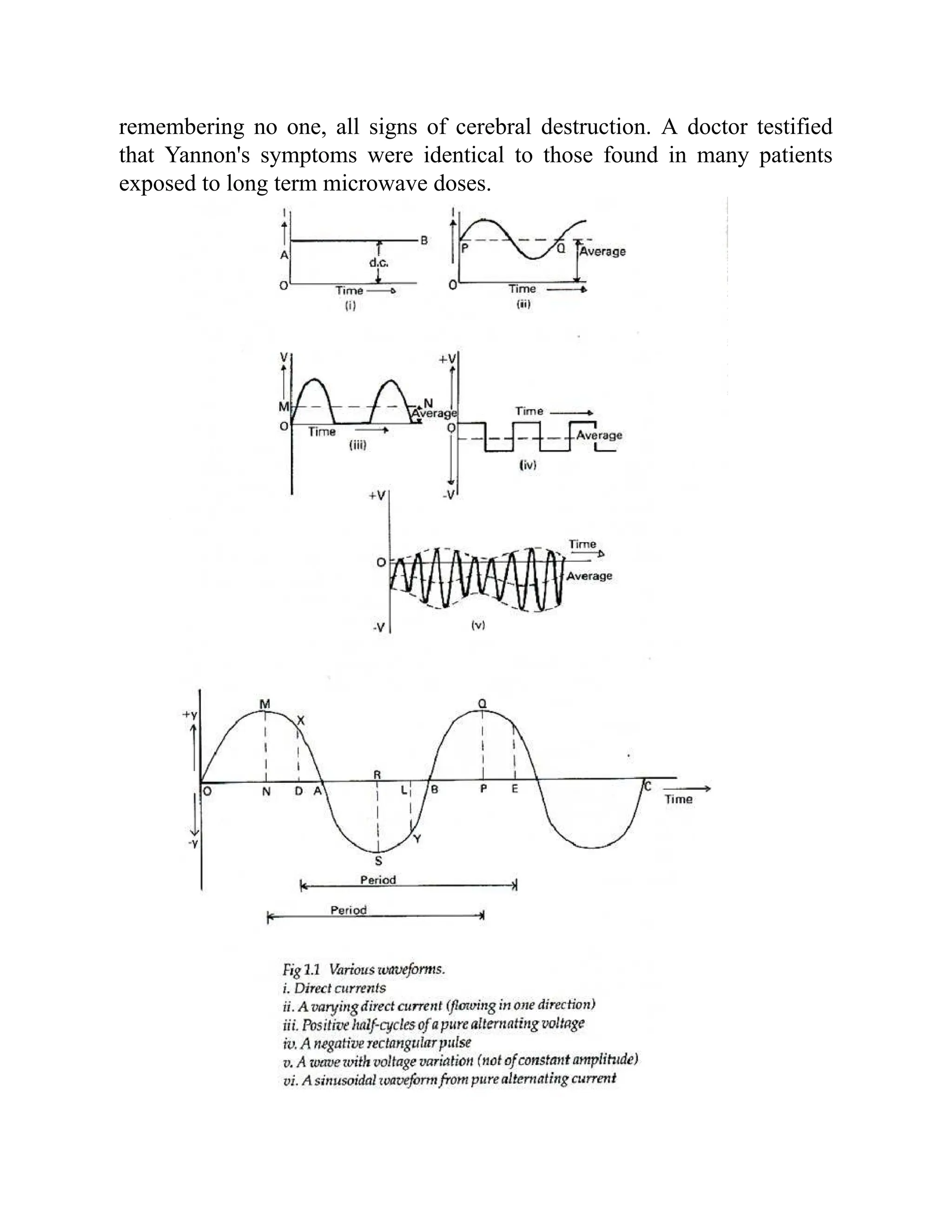
waves are flowing everywhere around us, affecting everything.(Fig 1.1).
"Everything flows" is the most modern statement of observations in this
electromagnetic age, just as it was thousands of years ago when
pronounced by an ancient Greek philosopher.
The deliberate use of non-ionising low level electromagnetic
irradiation, stated the Observer in March 1987, is known as zapping in the
United States, and a book "The Zapping of America" by Paul Brodeur, was
published as long ago as 1977.
To conclude this introduction we quote from the British journal
"Public Health" whose editorial in 1982 proclaimed:
"Comparable alternating magnetic fields do not occur in nature. They
only appear as a by-product of man's industrial activity, and comprise an
influence to which there has been no opportunity for evolutionary
adaptation".
This book explores the effects of a hidden mechanism of the brain
which works on none other than electromagnetic principles, and the
understanding of which is becoming vital to our continued existence on
this planet.
CHAPTER TWO: EXPERIMENTS WITH AN EARTHWORM
There are moments in one's life which suddenly seem ludicrous.
Why, at the age of forty six, am I, Roger Coghill, passionately
interested in what is happening to an earthworm, which I have dug up from
the back garden, cut in two pieces, and christened the rear half "Ollie"?
My wife has long since established in her mind that I am in need of
urgent psychiatric attention. My youngest child is only slightly more
interested in my mad experiment: cutting worms in half, after all, is part of
the everyday apparatus of many young lads with even a modicum of
curiosity, paralleled only by pulling the wings off hapless flies.
But my purpose has a more serious objective than sheer curiosity. I am
trying to solve an important problem of natural science. By the time that
you have read this, you may accept that without such researches we are
unlikely to solve problems as huge as the pandemic of AIDS which
currently threatens mankind.
Let me explain why. It is a story which will take us back into pre-
Christian history, make us struggle through the intricacies of our own
bodies' cells, cause us to speculate about the dematerialisation of human
beings, and whether gout is caused by a failure of communication between
foot and brain.
* * * *
Arguably the most important scientific challenge facing physicists and
biologists today is the largely untackled question of morphogenetic
biological fields. These fields are the fields by which our bodies' shape
stays the same,even when, as they inevitably do, some of its cells are dying
every day of our lives.
When we cut our finger, what makes the fingerprint cells grow and
heal exactly where they were before? How is it that, even though every
cell in the human body has changed in six months, we can instantly
recognise the face of a friend whom we bump into after a year's absence?
What causes cells to run amok and refuse to toe the morphogenetic line,
dragging malignant cancers in their train? How can we eliminate the
AIDS virus which is insidiously damaging the immune system of
mankind?
The problem is not simply a biological one: it brings sub-atomic
physical knowledge into the fray. It cannot be solved by a closer look
down an electron microscope. Restated, the central question asks just how
an unknown non-physical influence organises and controls at a distance the
growth and maintenance of organic tissues, perhaps even inorganic ones
too. The answer is bound to embrace the theoretical frontiers of the
physical sciences, because we are dealing with sub-cellular components;
with hydrogen bonds within DNA macromolecules; with the electronic
transmission of information; with wave mechanics; and with the origins
and properties of light and other electro-magnetic and electrostatic
energies.
Even psychology, demography and social economics have parts to play
in this giant quest for the key to morphogenetics. Tackling such an
undertaking requires the kind of scientist more common in the eighteenth
than the twentieth century. A breed which has largely disappeared in the
two centuries of specialisation which followed that enlightened age.
Today we stand in need of generalists with open minds: Newton, tough
empiricist though he was, still studied astrology passionately. So did
Johannes Kepler, if only to eke out a frugal living when times were hard .
In Christopher Wren's day a dinner party might be equally at home in
discussing Robert Boyle's new Law as they would the philosophy of
Aristotle. Aristotle himself was a great biologist, carrying out pioneer
work on the egg embryo . And Wren too attained eminence as an
astronomer before embarking on a career as an architect at the ripe old age
of thirty. Did you know that Wren also acted as an illustrator to a book
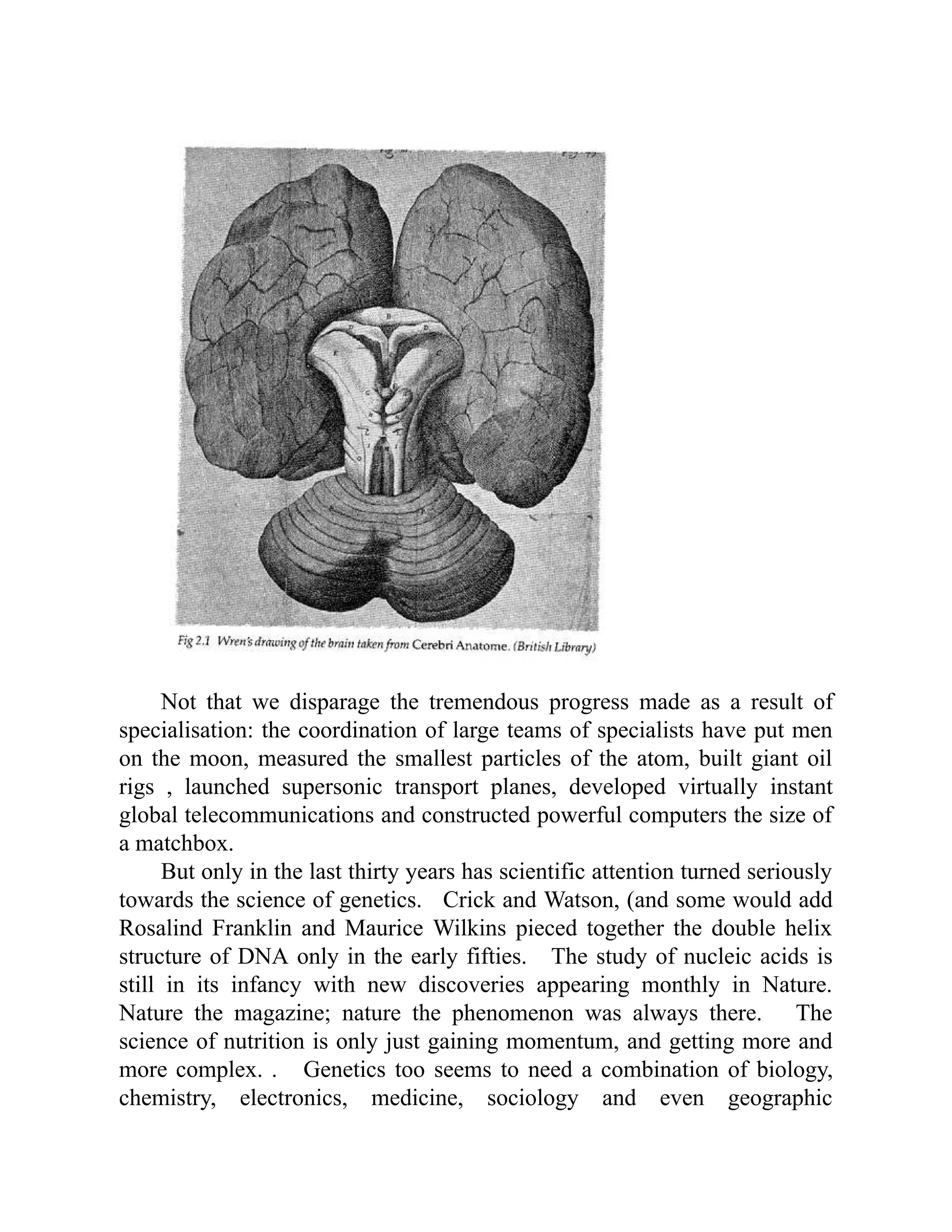
about the brain? Figure 2.1 shows his illustration of the cerebrum and its
features, revealing its di-pole nature. Joseph Priestley discovered Oxygen,
but this was only a hobby, a Sunday afternoon pastime. In those days,
science meant knowledge of all kinds, not just maths, physics and
chemistry.
Not that we disparage the tremendous progress made as a result of
specialisation: the coordination of large teams of specialists have put men
on the moon, measured the smallest particles of the atom, built giant oil
rigs , launched supersonic transport planes, developed virtually instant
global telecommunications and constructed powerful computers the size of
a matchbox.
But only in the last thirty years has scientific attention turned seriously
towards the science of genetics. Crick and Watson, (and some would add
Rosalind Franklin and Maurice Wilkins pieced together the double helix
structure of DNA only in the early fifties. The study of nucleic acids is
still in its infancy with new discoveries appearing monthly in Nature.
Nature the magazine; nature the phenomenon was always there. The
science of nutrition is only just gaining momentum, and getting more and
more complex. . Genetics too seems to need a combination of biology,
chemistry, electronics, medicine, sociology and even geographic
economics for its advancement. Archaeology and Anthropology have been
relegated to the third division.
Perhaps the age of the generalist is returning.
Like all these problems of natural enquiry, to study biological
morphogenetic fields we must construct the tools for the job and bring the
data into one place. Only after this may hypotheses emerge to explain the
collected phenomena. In such a field of study there might also be 'non-
phenomena' to contend with; gravity for example is something which you
know is there but cannot actually see,, and, to avoid being led down the
blind alleys of dogma, it is well to anticipate this.
But first back to my earthworm. The common earthworm, Oligochaeta
Lumbricus Terrestris to its biologist friends, and "Ollie" to me, happens to
be one of the most populous animals on our planet. Charles Darwin, who
sensibly devoted the last years of his life to the study of earthworms,
estimated that there were between six and thirteen million of them in every
square kilometre; and more recent estimates suggest that there are actually
between one hundred and twenty and six hundred million in every square
kilometre of grassland and fertile farmland.
Before you say "Ugh", you should know that these quiet battalions do
us such a signal service that we would probably all starve to death if it were
not for their quiet devotion to duty. They oxygenate and aerate the topsoil
of the world, balance its acidity or alkalinity, help decompose rotting leaves
and other detritus, supply natural guanin and urea thereby improving the
soil's fertility, and cost absolutely nothing.
Ollie the earthworm has other endearing features: most important to
me right now is his incredible power of regeneration. Biology textbooks
are not certain on the subject, but whilst most agree that the front (anterior)
part of a severed earthworm can regenerate itself, there is some doubt as to
whether the back (posterior) part can grow a new brain, mouth and
pharynx, not to mention the five hearts with which every decent lumbricus
is blessed.
Why should I care?
If it can be shown that an animal has the capability of regenerating all
those organs, then it is saying something about the mechanics of life and
the way in which cut fingers get repaired. It could help to prove in fact that
the cells of an animal not only carry a blueprint of the whole animal-this
much we know from studies of DNA- but that those cells can broadcast, as
it were, that blueprint to new cells so that they develop in precisely the
right places to reform the animal in its entirety. This is why the process is
called morphogenesis, and the broadcast network can therefore be labelled
a morphogenetic field.
And here's the point: if we can succeed in understanding the
mechanics of morphogenetic fields, we have a window onto the
mechanisms occurring when morphogenesis goes wrong, as it might be
with diseases like AIDS, multiple sclerosis, arthritis, and cancer.
More of that anon. Let me now tell you a little more about Ollie.
The other thing that interests me about him/her is that Ollie is
incredibly sensitive to vibrations; not just to the tread of the farmer's
Wellington boots, but also to the electromagnetic vibrations of visible light,
which are enough to paralyse the poor creature, and as for ultraviolet light,
well it is just lethal to lumbrici. When you see a dead worm in a puddle of
rainwater, its death is not by drowning but from ultraviolet radiation. That
is why worms stay well underground, coming up only at night. They can
live for months under water, and for upto fifteen years in a harmonious
atmosphere.
So as a testbed for experiments with ultraviolet and visible light, and
any other electromagnetic non-phenomena, Ollie is perfect. And as we
shall see, electromagnetics and ultraviolet light seem to play an important
part in morphogenetic field studies.
I do not want to go into Ollie's private sex life. Except to say that he
can be a she whenever he wants, simply by lying head to tail with a friend,
and if nothing else, is therefore more procreative than most animals would
dare to hope in their wildest dreams.
For now let us concentrate on finding out whether Ollie can grow a
new brain, using only his lower half.
If we are right that it is by means of a broadcast signal, then we further
suspect that human ingenuity and technology will be capable of developing
electronic equipment which can mimic this process by artificial means
using equipment which can generate the complex waveforms of
morphogenetic fields. And this would be the start of electronic medicine.
What has led us to this suspicion? It is because of what we call the
'phantom leaf effect', a strange phenomenon we have observed by means of
an even stranger process known as Kirlian photography, which we shall
soon describe in detail.
The phantom leaf effect has by accident allowed us to chance upon a
mechanism in Nature which could provide an important clue to
morphogenetic fields. More than that, it offers an opportunity to explain in
a few principles large tracts of experience which are currently an almost
complete mystery. As an example let us apply the resulting hypothesis to a
new way of looking at the AIDS retrovirus, and a few other horrific
diseases currently plaguing the attempts of researchers to find a cure.
Cancer, multiple sclerosis, arthritis, and psoriasis, to name but a few.
Let us suppose for one moment that our brain acts like a di-pole radio
aerial. After all, it looks a bit like one: there are two fat, but highly
separate hemispheres with a plate wrapped round each one ( called the
cerebrum and cortex respectively). Connecting the two halves, which are
neatly insulated from each other by a membrane and ventricles, is a thick
connecting band called the corpus callosum. Underneath this appear to be
some signal detectors and also some signal generators, called the limbic
system , thalamus, and other specialist components. The cerebrum is set in
its entirely like a jelly in an upturned bowl (the skull) so as to be sensitive
to the slightest mechanical vibration, let alone electromagnetic ones.
Let us next suppose that this relatively vast and complicated
transmitting and receiving station services a immense number of small
radio sets, each one being one individual cell of our body: and that the
receiving aerial of each radio set is the nucleus, packed with DNA in
helical windings. A helical winding is ideal for picking up a radio signal,
and all modern radios have a similar device inside. The difference in this
case is that instead of having a separate tuning device the station has been
programmed to a fixed frequency and cannot therefore easily change its
station. The way it has been programmed is that along the helix are a
number of different bumps: they are tied to the helix by hydrogen bonds
and bases (chemical molecules) each three of which represents a specific
bit of information. Thus only a specific waveform can be received by the
helix, and more than this the distance between one complete winding of
the helix is also fixed by hydrogen bonds which ensure that it doesn't
stretch or contract, which might also have the effect of making the aerial go
off tune.
Apart from acting as a radio receiver, however, let us further suppose
that the other part of a double stranded helix acts as a local transmitter of
exactly the same signal as that which it receives. This kind of structure,
we speculate, is like a two-way radio: other types of single stranded
structures of DNA (and all RNA) may only be receivers.
The strength with which the cell can broadcast its signal will depend
on how much energy is pumped into the cell by a sort of biological battery
called the mitochondria.
And the strength with which the brain can send and receive signals to
all its cells will also depend on the amount of energy available to it. This
energy is protected by an insulator called myelin which insulates the
whole central nervous system from the rest of the body. If this sheath is
destroyed then energy can seep away, the brain's radio signal strength falls
off, and the body starts to malfunction, as in the case of multiple sclerosis.
If the brain's specific signals are weakened by its having to use up a lot
of energy in a stress loop then the cells start mishearing , or worse not
hearing the signals at all. So they either start doing their own thing and go
wild, or start doing the wrong thing and rebroadcast incorrect instructions,
allowing for example a build up of uric acid in the feet which we call gout;
or letting in foriegn bacterial infections; or wrapping themselves in a
mucous coat so that they go completely deaf to the signals coming to them
from the brain. When one considers that the real problem in understanding
morphogenesis is that there are millions of cells dying and being born in
one human being every day and that it is necessary to replace each one
correctly, then it must be immediately obvious that this sort of traffic could
never be handled by a chemical -electrical system whose speed of
transmission down neural axons is forty metres a second if you are lucky.
Nervous transmission is simply too slow by a high factor: the number of
transmissions to and fro down the spinal cord necessary to keep the brain
and its cells in touch with each other would exceed the capacity of the
spinal cord to carry the information. Even the spinal cord needs a rest to
recover from electro-chemical transmissions! The cord would have to cope
with some 15,000 million brain cells alone.
Sometimes the effect is pellicular, that is to say it affects the skin, as in
a sarcoma (a tumorous skin disease) or psoriasis. Here's where we can
actually test to see how the mechanism works, because we can overtly see
the effect of any treatment. With multiple sclerosis it isn't so easy: every
thing is inside and hidden from view.
In our postulated radio network a number of things can go wrong: a
virus for example could get into the nucleus and alter the signal by
inserting its own signal into the DNA chain. In consequence the structure
starts sending out the wrong fixed signal to other cells, which start to
ignore the brain's normal signal- unless the cells are brought back to
normality by an even more powerful transmission from the brain in
retaliation. The effort of engaging in this electronic warfare causes the
headache which might for example accompany a stomach upset or the
onset of influenza. Usually the brain can overcome these local invasions,
except when it is already weakened by stress loops or lack of energy
resources.
Another way the system can go wrong is if the cells are miscoded in
the first place by reason of hereditary translation of the sequence of bumps
along the DNA. Phenylketonuria is an example of this 'point mutation'.
And a miscoding can also be caused to an already grown animal by
ionising radiation, leading to cancers: even excessive sunlight causes
mutations of the skin pigment and accompanying skin cancers, as a recent
study by the Royal College of Physicians entitled 'Links between
Ultraviolet Radiation and Skin Cancer' pointed out in April 1987.
Chemicals can also cause mutations by altering the structure of the DNA
and its hydrogen bonds. Finally there can be direct mechanical damage to
cells by burning or cutting. In such cases the brain has to send out specific
instructions to the repair squad, and this hurts when the pain mechanism is
brought into play. Pain is simply the after effect of the radio distress calls
from the cells to the brain.
The more one starts thinking of the brain and the cells in this way the
more it explains a lot of different things.
But in one case there is a really serious problem. Some particular
viruses which are very small, including the AIDS virus, can penetrate the
blood brain barrier or the myelin sheath and establish themselves in the
brain from where they can start altering the brain's signal ever so slightly
and slowly. This virus then operates specifically to alter the signal to the
special class of cells designed to seek and destroy foriegn bodies. In more
dramatic terms it has infiltrated behind the lines, captured the enemy's
machine guns and is turning them on their owners. Down in the trenches
the cells then start doing precisely the reverse of what they were
programmed to do: they attack when they should defend .
The other cells cannot stop it: as the signal strength builds up they are
progressively weakened , even though it takes a long time. Antibiotics
cannot stop it: they act by having a fixed radio signal of their own which
cancels the cells' signals, but with this signal it is uniquely different for
each body, and unless the signal is exactly right it will not be obeyed. DNA
is different for every one in the world, just like a fingerprint.
So what on earth is the solution?
It very much depends on the way these signals work. And that is why I
am so interested in Ollie the earthworm .
Right. We've put an idea forward. Now we are going to stop just there
and ask you to read the following account of a dreadful plague:
"The season was universally admitted to have been remarkably free
from other sicknesses; and if anybody was already ill of any other disease,
it finally turned into this. The other victims who were in perfect health, all
in a moment and without any exciting cause, were seized first with violent
heats in the head and with redness and burning of the eyes. Internally, the
throat and tongue at once became blood red, and the breath abnormal and
fetid. Sneezing and hoarseness followed; in a short time the disorder,
accompanied by a violent cough, reached the chest. And wherever it settled
in the heart, it upset it; and there were all the vomits of bile to which
physicians have ever given names, and they were accompanied by great
distress. An ineffectual retching, producing violent convulsions, attacked
most of the sufferers; some as soon as the previous symptoms had abated,
others not until long afterwards. The body externally was not so very hot to
the touch, not yellowish but flushed and livid and breaking out in blisters
and ulcers. But the internal fever was intense; the sufferers could not bear
to have on them even the lightest linen garment; they insisted on being
naked, and there was nothing which they longed for more than to throw
themselves into cold water ; many of those who had no one to look after
them actually plunged into the cisterns. They were tormented by unceasing
thirst, which was not in the least assuaged whether they drank much or
little. They could find no way of resting, and sleeplessness attacked them
throughout. hile the disease was at its height, the body, instead of wasting
away, held out amid these sufferings unexpectedly. Thus most died on the
seventh or ninth day of internal fever, though their strength was not
exhausted; or if they survived, then the disease descended into the bowels
and there produced violent lesions, at the same time diarrhoea set in which
was uniformly fluid, and at a later stage carried them off with a few
exceptions. For the disorder which had originally settled inthe head passed
gradually through the whole body and if a person got over the worst, would
often seize the extremities and leave its mark, attacking the privy parts
fingers and toes; and many escaped with the loss of these, some with the
loss of their eyes. Some again had no sooner recovered than they were
seized with a total loss of memory and knew neither themselves nor their
friends."
No, not Bhopal. Not AIDS. It was a description by Thucydides of the
great plague of Athens in 430 B.C.. But it illustrates what we mean by
what can happen when the brain starts to mistransmit its signals as a result
of a cerebro-viral infection: progressively the signal works its way down
the body from the eyes to the feet. Thank goodness we haven't had many
plagues like that.
It seems that the wavelength the brain is using is not a low one as one
might have supposed by listening to EEG recordings; we are used to being
told that our alpha waves are about eight to twelve Hertz which is only
eight to twelve cycles per second. But a glance at the wavetrains and their
irregularities will convince any electronic engineer that the frequencies are
much higher, more probably in the low ultraviolet wavelength range. At
this wavelength certainly we can see many effects on DNA and on skin
sarcomata too: psoriasis for example yields to special ultraviolet light
wavelengths. Yet the psoriasis returns in a few weeks when the UV light
stops. Ollie's regenerative powers are completely smashed by ultraviolet
light. With other organisms however mutation or growth can result. We just
do not know enough yet about which frequencies and wavelengths work
most effectively. -ll we can say is that there is considerable evidence that
when ultraviolet radiation comes into contact with organic tissues it starts
to affect DNA. And that this is a clearly radio (or radiative) effect.
The essential task in all healing is to normalise the brain so that its
signal gives the proper instructions once more to the particular cells which
are not doing their job. With AIDS it is the T4 helper cells, which are part
of the platoon of fighters programmed to destroy enemy viruses and other
foreigners. Unless we can reprogram these T4 helper cells, the patient is
increasingly prone to opportunistic diseases any one of which can take over
the cells and swamp their signals until death is the only result.
Under this hypothesis AIDS is not an ordinary viral disease, it is a
cerebroviral cellular dysfunction. It eventually kills by destroying brain
tissue, and its immunosuppressive qualities are merely a secondary
symptom. Pharmaceuticals cannot penetrate the blood-brain barrier and get
to the virus without damaging the brain itself. And even if they did they
would not be able to reproduce the individual signal necessary to bring the
T4 helper cells back to normal, since each patient is different.
The only answer is to send an artificial signal into the patient's body
which mimics its unique healthy brain signal. Or to send a signal which
precisely cancels out the incorrect version put there by the retrovirus.
Fortunately the retrovirus cannot itself broadcast. It is made of RNA not
DNA and does not have a transceiving capacity. Even DNA cannot
broadcast all the signals it would like to: it lacks a codon called Uracil, so
cannot ever manufacture the so-called "essential" amino-acids, which have
to be ingested from outside the body.
Remarkably an instrument which can mimic the brain's signals has
already been developed. In fact prototypes and early versions have been
around for over fifty years. But that is the subject of the next chapter.
Before that let us now take a fresh look at cancer, or rather cancers:
even the common wart is a cancer of sorts. If you look at a wart under a
microscope (Fig. 2.3) the most amazing thing you will surely notice is that
it has little crystals in it. Little square crystals. Actually these are probably
viral infections too called papovaviruses from their longer name papilloma
polyoma vacuolating virus (Fig 2.2). Let's not be frightened of long
medical words: papopilloma simply means a wart or similar skin growth,
polyoma is a type of animal tumour, and vacuolating refers to the ability of
many of these viruses to produce spaces or vacuoles (vacuums)-within the
infected cells. Indeed , most medical terms are simply latinised descriptions
of the symptoms or appearance of the structure or disease. The interesting
thing about crystals is that they can act as very good receivers: ever heard
of a crystal radio set? And the interesting thing about warts is that they can
appear and disappear very quickly, sometimes overnight.
If the cells of a wart are retrained by the brain to become normal again then
the virus is evicted or destroyed -phased away-, according to our
hypothesis. The question is, how does the brain do it? We suspect it is by
first finding out what is the viral wavelength and then broadcasting a
resonant waveform which cancels it out; and that this is sometimes a
difficult calculation for the brain to make, so that warts will persist then
suddenly disappear.
Other Cancers are not so easily dealt with.
In such cases the cells continue to run amok, and are not contained.
The signal is growing steadily, or is being misunderstood; or not being
heard at all. There is a clear connection with the brain in that cancer very
often strikes after a mental trauma within the last two years. There appears
to be a fatty coating round some cancerous cells. Using Kirlian
photographs it is possible to identify a chaotic effusion of uncontrolled
energy at the tumour source. Clearly the cell's radio tuner has gone out of
tune. Eating fresh fruit seems to give the cells normalising energy, and
surgery seems literally to cut out the aberrant signals. Other suggested
causes and helpful treatments for cancer can all be traced back to an
explanation in terms of our proposed radio network as a later chapter will
show. One of the most powerful of these is willpower: the power of the
brain to override the wayward signals and reimpose normality.
An example of this is the work of Carl Simonton who has used
techniques of visualisation to help cancer patients combat their problem. In
one case he suggested to a Naval officer that he should imagine the white
cells as frogmen putting limpet mines on the side of cancerous cells and
blowing them up. It worked: the officer was cured of cancer.
Of course, it is easy to be dogmatic about the cause of any
phenomenon, and we talked just now about the "blind alleys of dogma".
As an example of this danger take that great blind alley in physics
whose entrance was first unwittingly opened by Thomas Young in l8O3 -
the particle/wave duality of light. Young discovered that light passing
through two slits in a board produces an interference pattern when it falls
subsequently on a screen. This pattern, of alternate bands of light and
dark, is a wave mechanics phenomenon, suggesting that light travels in
waves. About a century later it was found that 'photons' of violet light act
like particles to knock electrons loose from a metal plate (the photo-electric
effect). So is light composed of waves or is it composed of particles?
The ensuing debate has occupied theoretical physicists ever since as they
struggle to rationalise these seemingly inconsistent sets of phenomena.
Suppose for a moment we deny the existence of a photon as a particle,
but regard it simply as a harmonic resonant frequency of the existing
waveform. (The Schrodinger equation in fact revealed quanta essentially
as waves of resonance). This harmonic could also dislodge an electron
from a metal surface. If the light were of a violet colour it would do so
more easily, in fact, than a red one, being of a shorter and more powerful
wavelength.
No one has ever seen a Hydrogen atom: millions would sit on a pin's
head. But we think that the spaces between hydrogen atoms in a covalent
resonant Hydrogen bond can be changed by temperature and by other
attachments to the Hydrogen atom, which serve to pull the atoms apart
slightly. Exciting a Hydrogen atom's electron with a specific
electromagnetic frequency causes it to move from one harmonic to the
next. This is what produces the photon of light perceived by us to emanate
from the Hydrogen atom. So it isn't a particle after all: we just perceive it
to be one, because we perceive only certain electromagnetic frequencies.
If the source of the electromagnetic waves is subject to interference - that is
if the crest of one wave is cancelled out by the simultaneous trough of
another, then we will perceive no light at all. In this way the photo-electric
effect may be explained without recourse to the invention of a new
concept, the photon; being entirely a wave-mechanical phenomenon, the
'shells' round an atom are simply the harmonics of any particular electro-
magnetic frequency. They even follow a molecular equivalent of Bode's
Law of planetary distances.
While such sorts of hypothesis would allow the wave-particle duality
to be synthesised, they are unlikely to be a correct guess. We use the
duality problem as an example of the need not to ignore those realities
which may not be perceivable. And also as an example of how one wave
can cancel out another by means of resonance.
Magnetic fields, gravity, radio waves and the vacuum are other
examples of non-phenomena, perceivable only by their effects on other
phenomena, and yet we are quite used to accepting such fields now that
they have been identified and defined mathematically.
By and large science is suspicious of non-phenomena, and it is not
adept at understanding them even when they are known to exist.
"Modern scientists", say Tompkins and Bird, "still have no idea of the
composition of electro-magnetic waves. They simply use them for radio,
radar, television, - and toasters". Remember the concept, long rejected, of
the ether? It was rejected because nobody could measure its effects. Such
suspicions, moreover, are usually redoubled at the frontiers of science..."
Not always, fortunately.
Great scientists occasionally acknowledge the unknown. This
quotation from James Clerk Maxwell is suitably tinged with humility:
"Mr. Airey has found that a large proportion of the disturbances at
Greenwich correspond with the electric currents collected by electrodes
placed in the earth in the neighbourhood, and are such as would be directly
produced in the magnet if the earth current were conducted through a wire
placed underneath the magnet. It has been found that there is an epoch of
maximum disturbance every eleven years, and that this appears to coincide
with the epoch of maximum number of spots on the sun. The field of
investigation into which we are introduced by the study of terrestrial
magnetism is as profound as it is extensive... When we consider that the
intensity of the magnetisation of the great globe of the earth is quite
comparable with that which we produce with much difficulty in our steel
magnets, these immense changes in so large a body force us to conclude
that we are dealing with one of the most powerful agents in nature, the
scene of whose activity lies in those inner depths of the earth, to the
knowledge of which we have so few means of access".
(It subsequently transpired that such magnetic disturbances had their
origin outside of rather than inside the earth).
But back to Ollie the earthworm. After four days Ollie's severed rear
half is still alive . We have kept him moist, and remembering his
sensitivity to light we have put a china cup over him. He moved in both
directions during the first few days, as if uncertain which way was
forwards or backwards. But now all the residual earth in his little gut has
moved right down to the end of his body without passing out of it, and his
front end has as a result got cleaner and redder. Could this be a hopeful
sign? The front end of complete earthworms is where the their light
sensitive pigments are concentrated and the same could be happening to
Ollie. But he hasn't eaten a thing. He no longer moves backwards when
provoked but tends to move more normally forwards. Concerned that he
has not for obvious reasons been able to eat anything , we are surprised that
he has not expelled any earth either. Perhaps he is making the most of the
food already in his gut. Or ingesting the air like a plant; or taking in
nutrients through his skin? Meanwhile Ollie's front half is as lively as if
the divorce had never occurred . Are the two halves still in radio
communication. According to our hypothesis they should be, since their
DNA is identical. This is not incidentally such a daft question: if an
earthworm is severed and then retied together with cotton , movement will
continue normally.
A brief glimmer of support for our hypothesis.
Moreover, if only the nervecord is left unsevered the wave of
contractions will continue down the segments posterior to the cut. What we
are really trying to see however is whether Ollie can generate a new brain.
Now an earthworm's brain is hardly a mighty affair: it would look to us no
more complicated than the eye of a needle, the interesting thing for our
hypothesis being that it has two flanks with a hole in the middle, a
prototype di-pole transmitter (Fig. 2.3)?!
So we are not asking a lot of Ollie if we ask him/her to generate a new
brain. What is more complex is for Ollie to generate a new mouth,
pharynx, oesophagus, and five hearts. If he can get these all back together
then we have a clone with identical DNA to his better half. And with these
two identical clones we might be able to carry out some interesting
experiments on the effect of electromagnetic radiations on organic cellular
tissues.
Overall our book gives an account of developments within the leading
edge of research into morphogenetic fields, one of science's few remaining
great unknowns. It attempts to survey, between one set of covers, most of
the previous research and hypotheses in this field, much of which has been
vehemently ridiculed or denied by orthodoxy and commercial interests. It
describes the specific work carried out by Harry Oldfield with Kirlian
apparatus and related equipment. It proposes our general hypothesis of
morphogenetic fields based on and within the framework of accepted
subatomic and atomic physics.
And finally it applies our central hypothesis to certain tracts of
experience such as nutrition, disease and the alternative medicines, and
reaches towards some areas of the so-called paranormal sciences.
This is going to be an exciting journey. But the prize is the better
understanding of how nature works, the explanation of important unsolved
questions, and just possibly a curative solution for some of the most
mysterious and uncheckable of human diseases.
Whilst Ollie is wriggling down his yellow brick road in search of a
brain, let us take a brief look at other examples of regeneration in animals
in the hope that they may give us clues to the mechanism of morphogenetic
fields.
The most commonly known example must be the tails of lizards.
"Gotcha", we cry, only to see the creature dart off, while we are left
clutching a small piece of its tail. Reptiles are in fact the highest vertebrates
which possess any substantial powers of regeneration. At the other end of
the scale, amoebae seem to do nothing except feed and divide. And in
between these the sponges are probably the most spectacular of creatures,
in that they were never really one organism at the outset.
The common feature of all regenerates is that their replacement limbs
are never quite as good as the original, like a video rerecorded from a
video. Furthermore,studies both in animals and man reveal that if the
wound is closed by a suture, regeneration will fail to occur. Regeneration
can only begin after a scab has been formed from clotted blood and dead
tissue, which can take a week or two. When a new skin (or epidermis to be
precise) has been formed underneath it, this scab falls off. Occasionally
regeneration goes wrong, and double or even triple new tails are produced.
The regenerated scales are often abnormal in colour or arrangement, and
tend to be smaller than normal scales, again as if the template from which
they were made was at one stage removed. Digits of lizards do not
regenerate, but a limited amount of cellular tissue or cartilege overgrows
the wound. A turtle can replace about one third of an injured shell within a
year, and shells which have been completely restored have also been
reported.
No one knows how the regenerative mechanism works, except that in
the higher life forms is it somehow dependent on the essential nearby
presence of nervous tissue, an essential for regeneration. Planaria, for
example, a common species of a tiny flat worm found in nearly every
pond, stream or canal, and just as careful to avoid light as the earthworm,
have the amazing capacity to regenerate the whole of their body after it has
been starved to almost nothing, leaving only the epidermis and the nervous
system. A small piece of planarian cut from its centre will regenerate a
head at the correct anterior end. (Hear that, Ollie?). But as in other higher
organisms, even the humble algae can only regenerate if medullary cells
are present; and, though the hydra is able to regenerate a complete animal
even after being cut into fifty pieces, the pieces must have the two
components of nerve and cell.
The champion regenerators, however, are the sponges.
If a sponge is sieved through a cloth into a dish of water the cells will
soon regenerate into small clumps, and each clump will slowly develop
into the mature form. Apart from this sponges have no other form of co-
ordinating mechanism: they have no nervous system or special receptor
cells. In consequence, every single cell of a sponge must carry with it any
communicative mechanism with which it is equipped, and the
intercommunication between cells must rely on a mechanism other than via
neural pathways. In our investigations this feature of primitive organisms
may prove to be an important clue.
If we now trace the development of how animals control their shape
starting with the sponges, our account might appear like this:
The cells of sponges have a non-neural intercommunicative system,
something like citizen band radio. When the cells have been divided they
subsequently reform as before, even when mixed up with another different
variety of sponge. Lyall Watson recounts the experiment where a red and
white sponge are sieved together into a pink mixture. After a day the two
sponges have reunited into separate red and white shapes. This tells us
something about the mechanism at work. The two sponges must have their
own unique and separate callsign, so do not confuse each other's signals.
Higher up the ladder of life a nervous system starts to develop which
exercises overriding control: without its presence the individualised and
therefore now much more specialised cells cannot seem to operate
completely independently as before, but get lost without the central
controlling mechanism. They can still intercommunicate with each other or
amplify and relay signals emanating from the nervous system. Since the
nervous system is not in physical contact with all of its cells some non-
neural mechanism must be in operation. It is not so effective as direct
transmission however, and regenerated tails or claws are not likely to be as
large as or diferentiated as the originals which they replace. If the
epidermis is interfered with or sutured this has an inhibitive effect on
regeneration. Indeed one purpose of the epidermis seems to be to shield
internal tissues from external radiative influences, and this function may
actually be working against the organism's own radiations when a suture
has been made.
The epidermis is special in animals: its cells are highly impervious to
ultraviolet radiation by comparison with internal tissues. They cover the
entire outer structure of plants, protecting them everywhere except in the
growing root-tip area. (Later we describe an experiment where the root tips
seem to emanate radiations). The epidermic cells sometimes produce oil,
resin, crystalline salts, or silica for protective purposes, exactly like a car
wax: they are impregnated with a waxy substance called cutin.
Normally in invertebrates the epidermis is only one cell thick, but
frogs by contrast have an epidermis several cells thick, constantly renewed
by division. Normally blood vessels do not penetrate into the epidermis,
which tends to become scaly and hardened with age. Multiple sclerosis is
so-called because of the scaly cells which are a feature of the disease. In
plants the epidermal cells do not generally contain chlorophyll. In short the
epidermal cells of plants and animals serve as their armour, and are an
unfeeling protection against the hostile outside world. They may also serve
as a barrier against the incursions of electromagnetic waves which would
otherwise interrupt interior intracellular communication.
Ollie the posterior earthworm has now been alive for a month. He /she
has crawled out from the small saucer and is decidely more lively if
touched. He looks a little fatter and redder at the front. And what is quite
pleasing is that he has voided the earth from his rear end. He/she rests with
his new nose touching the earth, as if somehow ingesting the moister
liquids of the soil, or about to start burrowing. He/she avoids magnetic
fields, and definitely crawls in the original direction of his /her previous
self. Do we detect signs of something forming under the front end of
Ollie's skin? Let us leave Ollie there while we look back over the history of
research into the fields of life, and see how those early versions of
waveform broadcasting machines came to be developed, and the
remarkable results which were obtained from their use.
CHAPTER THREE: LIFE ENERGIES: THE PIONEERS
Doktor Franz Anton Mesmer, struck off.
Ruth Drown, suicide.
Wilhelm Reich, died in prison.
Upton, Knuth and Armstrong, forced into bankruptcy.
Dr. Albert Abrams, slated by the Establishment, died of shame.
C.M. Allen, sent insane.
Dr. M.K. Jessup, suicide/murdered.
Bill Moore, researcher and author; fled into retreat.
Such has been the fate of early researchers into bio-electric life fields.
Why?
The answer may lie buried for ever in one sentence of a letter from
Albert Einstein to a fellow scientist, Otto Stern, in the dark days of World
War Two:
"I can report no more on this matter than we are not the first who have
faced similar things,...and that it would in no way help, at the present
moment, to bring it to public notice."
Cryptic words indeed from one of the most lucid of scientists.
Subsequent commentators believed that Einstein was referring to the secret
atomic development known as the Manhattan Project. But as we shall
show, he may have had quite a different experiment very much on his
mind.......
* * * * * * * * * *
About a hundred and sixty years ago a farm boy was returning to the
hayfield with his empty cart. He was worried: the clouds, which had been
white and fluffy all morning, were changing to the less differentiated and
more diffused blankets which he knew brought rain. His spaniel dog,
Charlie, trotted beside the cart. Normally the boy would go over the
bridge some distance away but, in his haste to get the cart loaded, he
decided to cross at the ford. Gingerly his two horses edged the cart into
the deeper water; the other bank seemed so far away. Seeing his concern
and the horses' reluctance, the owner of the cornmill by the ford came
wading in to hold their heads and the party crossed safely, but wet. Poor
Charlie, whom they had forgotten to put on the cart, stayed whining on the
bank to await his master's return and to enjoy, by way of compensation, the
crumbs from a loaf offered him by the solitary artist who happened to be
painting the scene....
Today the Hay Wain, painted by John Constable in l82l, hangs in the
National Gallery, serving as a reminder of how different life must have
been a mere century and a half ago. In less than two hundred years
mankind has advanced from haycarts to space shuttles as a means of
transport.
The fundamentals of physics are unchanging. It is only the way we
use them which has changed.
As if like an echo from some previous technological age, Joshua
fought the well-celebrated battle of Jericho, using the principles of
resonance to bring the walls tumbling down. Tesla, the inventor of
wireless telegraphy, would have been proud of him. Archimedes, the
inventor of so many things, would have been grateful that Joshua hadn't
passed the idea on to the Romans beseiging him at Syracuse. (Not that
Archimedes noticed even when they did break in).
But Joshua was the first we know of to bring resonance into the human
battlefield.
Here's how he did it:
"And Joshua had commanded the people saying "Ye shall not shout,
nor make any noise with your voice, neither shall any word proceed out of
your mouth, until the day I bid thee shout; then shall ye shout.
And Joshua rose up early in the morning and the priests took up the
Ark of the Lord. And seven priests, bearing seven trumpets of rams' horns
before the Ark of the Lord went on continuously and blew with the
trumpets; and the armed men went before them, but the rereward came
after the Ark of the Lord, the priests going on and blowing with the
trumpets.
And the second day they compassed the city once, and returned into
the camp.
So they did six days.
And it came to pass on the seventh day when the priests blew with the
trumpets, Joshua said unto the people, "Shout; for the Lord has given you
the city...
So the people shouted when the priests blew with the trumpets: and it
came to pass, when the people heard the sound of the trumpet, and the
people shouted with a great shout, that the wall fell down flat...".
These verses from Joshua describe perfectly the critical features of his
divinely inspired experiment with resonance. By first establishing a
specific frequency with the trumpets, and then overlaying it with the
frequency of his mens' shout, he could have set up a powerful resonance
effect no less devastating than that by which Tesla once nearly brought
down a New York building with his oscillator. (We describe this in more
detail later).
Offshore sailors will understand the principle immediately: every few
waves or so 'the big green one' comes rolling up from behind, threatening
to poop them, and fill the boat with water.
The idea that every organic particle has its own particular resonant
frequency or "call-sign" which can be transmitted and received at a
distance, is one of the few which never occurred to the ancient Greeks.
except, perhaps, to Pythagoras of Samos. However, the 'evil' uses to
which wizards and witches of the Middle Ages put a lock of hair to damage
a distant victim are well documented; and it is said that the ancient
Egyptians were afraid to portray a person's full face in case enemies could
weaken him from afar.
Historical evidence for the existence of a human energy field dates
right back to ancient Chinese and Indian cultures. But probably the first
well documented account comes from Paracelsus in the Middle Ages,
around 1530.Though Athanasius Kircher, one hundred years later, was
interested in magnetism, and wrote several papers on it, he never seemed to
connect magnetism with health as later writers did, nor with any vital force.
Paracelsus was a rebel from medical orthodoxy. In 1527 he burned the
famous textbook of medieval medicine, the 'Canon of Avicenna', which
became a symbol of rebellion against pedantry and unthinking acceptance
of ancient doctrines. According to his new ' doctrine of sympathetic
resemblances ', all growing things reveal their usefulness through their
shape and physical characteristics: everything that lives radiates light, and
plants with high vibrations are able to raise the low vibrations of man. He
advised all physicians to sense the natural energies of plants, advice which
was developed later by Edward Bach, a London doctor, into the well-
known Bach Flower Remedies. Paracelsus probably inspired Bach with his
habit of gathering the dew under various configurations of the celestial
bodies, believing the water to contain the energies of planetary aspects.
Bach too believed that the dew contained a power of some sort .
Perhaps one of the earliest scientific approaches to bio-electrical
radiation was that by Maimbray in l746. He put two myrtle shrubs next to
an electrical conductor in Edinburgh and was amazed to see the shrub grow
three inch branches and buds at a time when most other buds were
dormant. (In a later chapter we discuss the impact of electricity on
nutritional processes). A few years later Jean Antoine Nollet, physics tutor
to the Dauphin of France, discovered that plants in metallic pots increased
their rate of transpiration and that seeds grown in electrified containers
grew more rapidly. By l783 AbbÑ Bertholon had published a complete
work, "De l'ElectricitÑ des Vegetaux", and had collected atmospheric
electricity with what he termed an electrovegetometer, which was then
passed through plants growing in a field. His suggestion that "one day the
best fertiliser for plants will come in electrical form, free from the sky",
should strike terror into the hearts of fertiliser manufacturers, and comfort
the minds of conservationists. Happily for Bertholon there had been no
massive demand for nitrites, the stuff of First World War explosives, and
the consequent nitrate fertiliser industry had not become the lobby it is
today, otherwise his name might have been added to the list of ill-fated
pioneers which heads this chapter.
Round about 1780, the time that Luigi Galvani discovered that not
only plants but also frogs' nerves could be excited by "the electrical fluid",
an Hungarian Jesuit, with the colourful but unfortunate name of
Maximilian Hell, and his Viennese physician friend, Franz Anton Mesmer,
came to the conclusion that "living matter has a property susceptible to
being acted on by earthly and celestial magnetic forces". They called it
'animal magnetism', were subsequently expelled from the medical
profession, and Mesmer retired to the cold of Switzerland to write an
infamous treatise in l8l4, which protested the truth of his assertion.
Unlike Galileo Galilei, his muttered rebellion in the cause of his belief
hasn't yet been given much of an accolade.
The bio-electrical baton was then taken up by a more prestigious
personage, the mighty Baron Karl von Reichenbach of Tubingen, who in
l845 invented the wood-tar product since known as creosote. Reichenbach
perceived that 'sensitives' could actually see a strange energy emanating
from human beings, - he called this the Odyle or Od - but even the Baron's
attempts to prove the existence of the 'Odyle energy' were discredited. He
did at least succeed in having his message translated into English through
the good offices of one William Gregory, Professor of Chemistry at
Edinburgh, under the somewhat Teutonic title of 'Researches into the forces
of magnetism, electricity, heat, and light in relation to the force of life'.
Meanwhile the list of fellow researchers into the beneficial effects of
electricity on plants was growing:
In l844 William Ross reported on "Galvanic Experiments on
Vegetation", and Edward Solly, an agronomist, recorded "The Influence of
Electricity on Vegetation" a year later.
But more attractive subjects were beckoning the scientific minds of the
second half of the nineteenth century: scientists were quite rightly
concerning themselves with atomics, rather than holistics, which were to be
left for the next century, and a wide gap developed between physicists and
students of the life sciences, a gap which was necessary at the time if the
massive quantity of new knowledge was to be assimilated, but which is
now fortunately closing again.
In the first three decades of this century interest in bio-electrical
studies became intense, counterbalanced only by the efforts of the
establishment to prevent the spread of innovation from this source. A
similar ludditism had delayed the introduction of alternating electrical
current in America during the late eighteen hundreds, thanks to the
machinations of Thomas Edison who favoured the unworkable direct
current method of transmitting electrical power. The fear which gripped
the establishment was, and perhaps still is, that established markets for
fertiliser and pesticide products will be lost to them should
electrical/electronic methods be allowed to gain a foothold. There were
also more insidious factors to consider which threatened the very fabric of
life itself, as we shall see.
As early as l9O4 the battle commenced with the publication by
Lemstrôm of his "Electricity in Agriculture and Horticulture", and even
this early work had been anticipated two years previously by Sylvanus
Thompson's "Magnetism in Growth". Just one year after Lemstrôm's
book, Raoul H. FrancÑ came out with "Das Sinnesleben der Pflanzen"
published in English as "The Love Life of Plants" and also "Germs of
Mind in Plants" . Thus the battle lines were arrayed for one of the most
unfortunate confrontations in the history of scientific endeavour.
Lemstrôm, a Finn, had made several expeditions to Spitzbergen and
Lapland, and was an expert on earth magnetism and polar light. He firmly
believed, as a result, that the luxuriant vegetation of that region owed more
to the radiations of the Aurora Borealis than to the long summer days.
"The sharp points of plants", he proposed, "act like lightning
conductors, to collect atmospheric electricity, and facilitate the exchange of
charges of the air and the ground".
An ion effect, to be precise.
It was Lemstrôm who first correlated high sunspot activity with tree
growth by reference to firtree rings, adding to the observations of Clerk
Maxwell a quarter of a century before. He also carried out confirmatory
experiments in which 'electrified' plants grew 5O percent taller than
normal. He reported these results in 'ElectroKultur', published in Berlin.
Back in England this book inspired that great scientific frontiersman,
Sir Oliver Lodge, and John Newman among others, to replicate the results
successfully.
Why, the reader may then ask, does no-one use these techniques
today?
Actually, they do: The Electroculture Corporation was formed only in
l97O by Dr. Len Cox of Denver, Colorado, - a region so beloved of
Nikola Tesla for its hugh thunderstorms and atmosphere heavy with
electricity, that he built a laboratory there - to market a magnetised fertiliser
powder with exceptional properties to encourage plant growth.
However, probably the most tragic story (amongst many) concerning
the early pioneers is that of Dr. Albert Abrams, and the subsequent
invention of the homeotron.
Abrams was a very rich San Franciscan who studied advanced
medicine at Heidelberg, in the last decades of the nineteenth century,
gaining top honours and the Gold Medal from that eminent university.
Abrams had already witnessed, while in Naples, the great Caruso perform
the trick of shattering a glass with his voice by singing the same tone as
that given out when the glass was tapped with a finger.
One day a Professor mentioned to Abrams that onions uprooted and
left adjacent to others still planted, seemed to have adversely affected the
onions still in the ground, whereas onions further away were unchanged;
and Abrams wondered whether this too might be a resonant radiation
effect: were the dying onions damaging their growing neighbours? He
came across the same effect again much later when, having returned to
America, he began teaching pathology at Stanford University. As a matter
of course he would tap a patient's abdomen to test for reflex reaction, and
noticed that he obtained a resonant sound from a healthy patient. When
the patient was diseased in some way, however, the sound became dull.
Experiments with this technique brought Abrams to the conclusion that
unknown waves from diseased specimens of tissue could be received by
another person and reflected in the muscular tonality of his tissues,
particularly the muscular and nerve fibres in the stomach region. When,
for example, X-rays were pulsing from nearby equipment, the tone
produced was that of an unhealthy body: when the apparatus was switched
off the tonality improved immediately!
It is significant to recall that the ancient Greeks considered the
stomach to be the seat of the emotions.
Abrams, after some further months' research, produced the hypothesis
that the cellular origin of disease should be abandoned: it was only because
the molecular constituents of cells are altered by radiated changes in the
composition of their electrons that disease occurs. He found that radiation
from a pathological specimen could be transmitted, like electricity, over a
six foot wire; and he then set about developing a diagnostic instrument to
replace his finger tapping technique, which he called a "reflexophone".
This instrument, claimed Abrams, could differentiate between the
wavelength of different diseased tissues.
If this account is beginning to sound far-fetched, the reader should
note that the most modern method of pest detection uses radar to identify
the specific waveform radiated from different types of insect flying up to a
thousand feet above the apparatus, thus exposing its feeding and flying
habits. Insecticides can then be sprayed at only those times when the
offending aphids are known to be on the wing. The same detection
apparatus is used to provide a map of migrations by insects, each of which
has a quite distinguishable waveform.
Abrams went further than this in l924 however, with a claim that was
to bring him into direct conflict with medical opinion, and eventual
disrepute. He said he could diagnose disease and to what extent it had
taken hold of a patient simply from a drop of that patient's blood.
Shades of witchcraft again!
Today we are beginning to use DNA 'fingerprints' from a single blood
sample to identify individual human beings. DNA stands for
deoxyribonucleic acid, the genetic encoder of life. To a conservative
America in the twenties, however, Abrams' claim must have smacked of
black magic, and it did not take long for the establishment to brand him as
a charlatan.
To one audience Abrams proposed, by way of example, that the
curative effect of quinine on malaria is the result of radiations from the
quinine molecules, which cancel out exactly the emissions from the
malarial cells, -- a resonance effect, to be exact -- due to an unsuspected
electromagnetic effect, rather than as a result of any chemo-pharmaceutical
action. With the aid of a certain competent radio engineer, Sam Hoffman,
he then built a radio wave emitter which could emit specific waves to
cancel out the malignant radio waves emitted by diseased specimens. In
l922 Abrams reported his results. If he expected honest enthusiasm, he
was disappointed: he was promptly condemned as a quack and charlatan
both by the American Medical Association and the British Medical
Journal.
Despite the championship of a number of eminent medical men,
Abrams died two years later, killed by ignominy, with the journal
Scientific American still vilifying his work in eighteen consecutive issues.
Meanwhile other researchers into life fields were beginning to suffer
similar ignominy. Perhaps the most 'infamous' of these was Dr. Wilhelm
Reich. He had the unfortunate habit of inventing strange words, such as
'oraccu', and talking quite openly about sex at a time when it wasn't really
done. This, together with some rather nasty experiments, according to one
rumour, eventually put him into prison where he spent the last few months
of his life. His concept of an all pervasive 'orgone energy' was of a field
which lay outside of the electromagnetic spectrum, "a cosmic energy that
obeys functional rather than mechanical laws". It had, he claimed, a blue
colour. In order to collect this orgone energy, whose unit was for Reich the
'bion', he developed an instrument which accumulated it called an oraccu.
Plants grow rapidly in this box, according to observers. It is six-sided,
with all sides made of alternating layers of organic and non-organic
materials. The inner wall is lined with a thin sheet of iron. In his book 'The
Cancer Biopathy', Reich suggested that in advanced cancer cases the
orgone content of the blood had been totally consumed in the orgone's
struggle against the systemic disease and the local tumour. "This T-reaction
is usually present before any symptoms of anaemia and often reveals the
cancer process long before a perceptible tumour has formed." Reich
discovered that his orgone energy was readily absorbed by organic
materials like wood, cotton, wool, and so on, whereas it was attracted then
quickly repelled by metals. The layering of the orgone accumulator's walls
thus established a flow of energy to the inside from the outside of the
oraccu. The whole box is slightly reminiscent of the Ark of the covenant
whose manufacture is detailed in Exodus, the same Ark which Joshua
carried for some reason round the city of Jericho. Reich believed that the
red blood corpuscles carried orgone energy into the organic body in
addition to oxygen. Certainly there is an iron atom right at the centre of
each haemoglobin molecule, but no further explanation seems available to
understand the transport mechanism.
"The orgonotic charge is also revealed in the shape of the structure of
the red corpuscles. Cells with a weak charge are more or less shrunken and
have a narrow blue margin which glimmers feebly. Once the organism is
charged the red blood cells swell, while the blue margin intensifies and
widens sometimes including the entire cell. No pathogenic microorganism
can survive in the vicinity of these orgonotically highly charged red blood
cells".
Whatever the sinister rumours surrounding the emprisoned and
maligned Reich, and however fanciful his ideas of orgone energy may have
been, conceptually he is pointing to what may, in more mundane terms, be
electromagnetism. As Bill Schul and Ed Pettit say in their intriguing (and
certainly more understandable) book 'The Secret Power of Pyramids',
"references to the blue light or auras would seem to point to the presence of
electromagnetic qualities in the energy field being generated. Observations
of blue light around pyramids or reported by persons sitting or meditating
within pyramids provide some evidence that the pyramid shares in the
phenomena of producing identical or similar electromagnetic forces These
observations, along with the similarities between descriptions of treatment
of disease and afflictions by blue light, orgone energy, and various forms of
electromagnetic therapy and those reportedly produced by the pyramids
would seem to point to some common denominators."
If we might digress for a moment, the origin of the word pyramis, if
Greek, could mean 'the power of light or fire' as opposed to the word
dynamis which was the word for the physical power of the body. A second
meaning could be the bread or cake from which the sustenance is gained:
only much later did the word pyramid take on the meaning of a sepulchral
tomb. To anyone struggling to express the meaning of electromagnetism
pyramis was a pretty good attempt. But the derivation is almost lost now
in the mists of time: Plato had no difficulty in connecting the pyramid with
a basic elemental fire-power: in the Timaeus , which as we mention is the
only reference to Atlantis in classical literature, and from which all other
descriptions ultimately derive, he suggested that the pyramid is one of the
four basic building blocks of creation. Having ascribed the cube to earth,
the octahedron to air, and the eikosahedron to water, he ascribes the
pyramid to fire, saying:
"Logic and likelihood thus both require us to regard the pyramid as the
solid figure that is the basic unit or seed of fire... We must think of the
individual units as being far too small to be visible, and only becoming
visible when massed together in large numbers". Sounds a bit like a
crystalline structure with electrical properties to us! Certainly Plato was
familiar with the difference between radiation and combustion: "Next we
must notice that there are several kinds of fire: the flame , the radiation
from flame, which does not burn but provides the eyes with light, and the
glow left in embers after flame has been quenched." That these thoughts
should be running through Plato's head after describing a legend brought
out of Egypt (that of Atlantis) is intriguing. Was he repeating some of the
Egyptian thinking which Solon, who first reported the Atlantis legend
from Egypt to Kritias and so to Plato, had brought back with him after his
visit to the priests of Sais in Egypt? Even more mystifying is that though
Plato nowhere in the Kritias or the Timaeus mentions pyramids in relation
to Atlantis, many subsequent writers on the subject have somehow
introduced the idea of special energies and pyramids into the legend,
particularly those like Cayce whose inspiration is from hypnotic trancelike
states, and not presumably from a close reading of Platonic dialogues.
The purpose of this digression was to allow us to point out how
material structures are considered by certain researchers to collect energy,
to which extent the concept of pyramid energy and the orgone-
accumulated energy are similar. Both Reich and others like Reichenbach
searched for some new energy as a result; but was that really necessary?
Ions will naturally move towards any point in an organic structure, and the
phenomenon is demonstrated in virtually every school physics laboratory
in the form of a Van der Graaf accumulator which readily produces nice
blue sparks across the gap as a result of accumulated positve ions, which
create differences in electrical potential. All these 'new' energies may be
nothing more than boring old electricity.
To return to Reich: in his book 'Cosmic Superimposition' he describes
his 'Oranur Experiment', suggesting that organic bioplasma responds
violently with radioactive materials, providing a by-product that is
dangerous to life for a short period of time. Radioactivity was, however,
reduced by its action on the bioplasma, he thought. Reich's experiments,
vocabulary, and ideas are somewhat offputting to the rational observer and
difficult to understand. Those who want to gain a deeper insight into the
man could do no better than read Brian Inglis' useful and commentative
biography. Whilst respecting Reich's contribution to life field research, we
now leave this avenue for others who believe that some new force is
involved, to tread.
Certainly, nothing is wasted: Reich's influence continues to be felt
today, and from Abrams' work, for example, sprang an Association whose
work continues today bringing together hundreds of practitioners of the
new frontier science of Radionics as the technique became known. Its
basic tenet is that diagnosis of illness is possible at a distance using the
higher faculties of the human mind in conjunction with electronic
instruments designed for the purpose of measuring disease patterns. The
box itself was called by Abrams a Biodynamometer, but soon got dubbed
the "Black Box", a phrase used colloquially for any mysterious electronic
gadget ever since. This instrument has never been claimed as anything
more than a variable resistance meter. The Radionics hypothesis is that any
disease gives off radiations, and that different diseases have different
resistances which can be measured by reference to a healthy body.
Once a pathological condition has been identified (the instrument was
known as the reflexophone) another machine called an Oscilloclast is used
to correct the aberrant radiation using pulsed weak electromagnetic energy,
modified by the appropriate treatment rates. Tests of validity were carried
out and supported the Radionic pioneers' claims. More and more
practitioners took up the instruments: in England such pioneers as Dr.
Guyon Richards, whose meticulous research work is recorded in "The
Chain of Life". He also founded the Medical Society for the Study of
Radiesthesia, of which the current Radionics Association is a branch.
Another radionics pioneer was George de la Warr, whose investigations
into radionics from the electronic engineering viewpoint began in the
forties. De la Warr made many improvements to the equipment and his
laboratory became established as the seat of Radionics in Britain. The
Association is still very active with new developments being produced, and
new books on the subject being written.
In 1951 on the other side of the Atlantic in America, Phoenixlike from
his ashes, Abrams' ideas had been taken up by three other young and bright
hopeful engineers from Princeton named Upton, Knuth, and Armstrong.
They modified Abrams equipment to tackle the task of pest control, - an
area of industry which cost farmers dear, and for a remedy to which they
Random documents with unrelated
content Scribd suggests to you:
have been suitable to his profession. The doctor smiled grimly under his
muffler; he would have laughed if it had not been for Jim by his side, who
sat thinking of nothing, looking out for the Sliplin lights and that turning
about which Lady Jane had warned his master. If it had not been for Jim,
indeed, Dr. Burnet, though so good a driver, would have run the mare into
the bank of stones and roadmakers’ materials which had been accumulated
there for the repair of the road. “Exit praying”?—no, the Rector, to judge
from his present aspect of irritated and wounded pride, could not have done
that. “Exit cursing,” would have been more like it. The doctor did burst into
a little laugh as he successfully steered round the Eversfield corner, thanks
to the observation of his groom, and Jim thought this was the reason of the
laugh. At all events, neither the praying nor the cursing had come yet for Dr.
Burnet, and he was not in any hurry. He said to himself that he would go
and pay old Tredgold a visit next morning, and tell him of the dinner party
at Steephill and see how the land lay.
I cannot tell whether Mr. Tredgold had any suspicion of the motives
which made his medical man so very attentive to him, but he was always
glad to see the doctor, who amused him, and whose vigorous life and
occupation it did the old gentleman good to see.
“Ah, doctor, you remind me of what I was when I was a young man—
always at it night and day. I didn’t care not a ha’penny for pleasure; work
was pleasure for me—and makin’ money,” said the old man with a chuckle
and a slap on the pocket where, metaphorically, it was all stored.
“You had the advantage over me, then,” the doctor said.
“Why, you fellows must be coining money,” cried the patient; “a golden
guinea for five minutes’ talk; rich as Creosote you doctors ought to grow—
once you get to the top of the tree. Must be at the top o’ the tree first, I’ll
allow—known on ‘Change, you know, and that sort of thing. You should go
in for royalties, doctor; that’s the way to get known.”
“I should have no objection, Mr. Tredgold, you may be sure, if the
royalties would go in for me; but there are two to be taken into account in
such a bargain.”
“Oh, that’s easily done,” said the old man. “Stand by when there’s some
accident, doctor—there’s always accidents; and be on the spot at the proper
time.”
“Unless I were to hire someone to get up the accident—— Would you go
so far as to recommend that?”
Old Tredgold laughed and resumed the former subject. “So you took my
Katie in to dinner? Well, I’m glad of that. I don’t approve of young
prodigals dangling about my girls; they may save themselves the trouble.
I’ve let ’em know my principles, I hope, strong enough. If I would not give
in to my little Stella, it stands to reason I won’t for Kate. So my Lady Jane
had best keep her fine gentlemen to herself.”
“You may make your mind quite easy, sir,” said the doctor; “there were
nothing but county people, and very heavy county people into the bargain.”
“County or town, I don’t think much of ’em,” said old Tredgold; “not
unless they can table their money alongside of me; that’s my principle, Dr.
Burnet—pound for pound, or you don’t get a daughter of mine. It’s the only
safe principle. Girls are chiefly fools about money; though Stella wasn’t,
mind you—that girl was always a chip o’ the old block. Led astray, she was,
by not believing I meant what I said—thought she could turn me round her
little finger. That’s what they all think,” he said with a chuckle, “till they try
—till they try.”
“You see it is difficult to know until they do try,” said Dr. Burnet; “and if
you will excuse me saying it, Mr. Tredgold, Miss Stella had every reason to
think she could turn you round her little finger. She had only to express a
wish——”
“I don’t deny it,” said the old man with another chuckle—“I don’t deny
it. Everything they like—until they come to separatin’ me from my money.
I’ll spend on them as much as any man; but when it comes to settlin’, pound
by pound—you’ve heard it before.”
“Oh yes, I’ve heard it before,” the doctor said with a half groan, “and I
suppose there are very few men under the circumstances——”
“Plenty of men! Why there’s young Fred Turny—fine young fellow—as
flashy as you like with his rings and his pins, good cricketer and all that,
though I think it’s nonsense, and keeps a young fellow off his business.
Why, twice the man that Somers fellow was! Had him down for Stella to
look at, and she as good as turned him out of the house. Oh, she was an
impudent one! Came down again the other day, on spec, looking after
Katie; and bless you, she’s just as bad, hankering after them military swells,
too, without a copper. I’m glad to know my Lady Jane understands what’s
what and kept her out of their way.”
“There were only county people—young Fortescue, who has a pretty
estate, and myself.”
“Oh, you don’t count,” said old Mr. Tredgold; “we needn’t reckon you.
Young Fortescue, eh? All land, no money. Land’s a very bad investment in
these days. I think I’ll have nothing to do with young Fortescue. Far safer
money on the table; then you run no risks.”
“Young Fortescue is not a candidate, I believe,” said Dr. Burnet with a
smile much against the grain.
“A candidate for what?—the county? I don’t take any interest in politics
except when they affect the market. Candidate, bless you, they’re all
candidates for a rich girl! There’s not one of ’em, young or old, but thinks
‘That girl will have a lot of money.’ Why, they tell me old Stanley—old
enough to be her father—has been after Katie, old fool!” the old man said.
Dr. Burnet felt himself a little out of countenance. He said, “I do not
believe, sir, for a moment, that the Rector, if there is any truth in the
rumour, was thinking of Miss Katherine’s money.”
“Oh, tell that to the—moon, doctor! I know a little better than that. Her
money? why it’s her money everybody is thinking of. D’ye think my Lady
Jane would pay her such attention if it wasn’t for her money? I thought it
was all broken off along of Stella, but she thinks better luck next time, I
suppose. By George!” cried the old man, smiting the table with his fist, “if
she brings another young rake to me, and thinks she’ll get over me—— By
George, doctor! I’ve left Stella to taste how she likes it, but I’d turn the
other one—that little white proud Katie—out of my house.” There was a
moment during which the doctor held himself ready for every emergency,
for old Tredgold’s countenance was crimson and his eyes staring. He
calmed down, however, quickly, having learned the lesson that agitation
was dangerous for his health, and with a softened voice said, “You, now,
doctor, why don’t you get married? Always better for a doctor to be
married. The ladies like it, and you’d get on twice as well with a nice wife.”
“Probably I should,” said Dr. Burnet, “but perhaps, if the lady happened
to have any money——”
“Don’t take one without,” the old man interrupted.
“I should be considered a fortune-hunter, and I shouldn’t like that.”
“Oh, you!” said Mr. Tredgold, “you don’t count—that’s another pair of
shoes altogether. As for your young Fortescue, I should just like to see him
fork out, down upon the table, thousand for thousand. If he can do that, he’s
the man for me.”
“ ‘You don’t count!’ What did the old beggar mean by that?” Dr. Burnet
asked himself as he took the reins out of Jim’s hand and drove away. Was it
contempt, meaning that the doctor was totally out of the question? or was it
by any possibility an encouragement with the signification that he as a
privileged person might be permitted to come in on different grounds? In
another man’s case Dr. Burnet would have rejected the latter hypothesis
with scorn, but in his own he was not so sure. What was the meaning of that
sudden softening of tone, the suggestion, “You, now, doctor, why don’t you
get married?” almost in the same breath with his denunciation of any
imaginary pretender? Why was he (Burnet) so distinctly put in a different
category? He rejected the idea that this could mean anything favourable to
himself, and then he took it back again and caressed it, and began to think it
possible. You don’t count. Why shouldn’t he count? He was not a
spendthrift like Charlie Somers; he was not all but bankrupt; on the
contrary, he was well-to-do and had expectations. He was in a better
position than the young military swells whom Mr. Tredgold denounced; he
was far better off than the Rector. Why shouldn’t he count? unless it was
meant that the rule about those pounds on the table, &c., did not count
where he was concerned, that he was to be reckoned with from a different
point of view. The reader may think this was great folly on Dr. Burnet’s
part, but when you turn over anything a hundred times in your mind it is
sure to take new aspects not seen at first. And then Mr. Tredgold’s words
appeared to the doctor’s intelligence quite capable of a special
interpretation. He was, as a matter of fact, a much more important person to
Mr. Tredgold than any fashionable young swell who might demand
Katherine in marriage. He, the doctor, held in his hands, in a measure, the
thread of life and death. Old Tredgold’s life had not a very enjoyable aspect
to the rest of the world, but he liked it, and did not want it to be shortened
by a day. And the doctor had great power over that. The old man believed in
him thoroughly—almost believed that so long as he was there there was no
reason why he should die. Was not that an excellent reason for almost
believing, certainly for allowing, that he might want to make so important a
person a member of his family on terms very different from those which
applied to other people, who could have no effect upon his life and comfort
at all? “You don’t count!” Dr. Burnet had quite convinced himself that this
really meant all that he could wish it to mean before he returned from his
morning round. He took up the question à plusieurs reprises; after every
visit working out again and again the same line of argument: You don’t
count; I look to you to keep me in health, to prolong my life, to relieve me
when I am in any pain, and build me up when I get low, as you have done
for all these years; you don’t count as the strangers do, you have something
to put down on the table opposite my gold—your skill, your science, your
art of prolonging life. To a man like you things are dealt out by another
measure. Was it very foolish, very ridiculous, almost childish of Dr. Burnet?
Perhaps it was, but he did not see it in that light.
He passed the Rector as he returned home, very late for his hurried
luncheon as doctors usually are, and he smiled with a mixed sense of
ridicule and compassion at the handsome clergyman, who had not yet
recovered his complacency or got over that rending asunder of his amour
propre. Poor old fellow! But it was very absurd of him to think that
Katherine would have anything to say to him with his grown-up children.
And a little while after, as he drove through the High Street, he saw young
Fortescue driving into the stables at the Thatched House Hotel, evidently
with the intention of putting up there.
“Ah!” he said to himself, “young Fortescue, another candidate!” The
doctor was no wiser than other people, and did not consider that young
Fortescue had been introduced for the first time to Katherine on the
previous night, and could not possibly by any rule of likelihood be on his
way to make proposals to her father the next morning. This dawned upon
him after a while, and he laughed again aloud to the great disturbance of the
mind of Jim, who could not understand why his master should laugh right
out about nothing at all twice on successive days. Was it possible that much
learning had made the doctor mad, or at least made him a little wrong in the
head? And, indeed, excessive thinking on one subject has, we all know, a
tendency that way.
CHAPTER XXX.
Lady Jane gave Katherine a great deal of good advice before she allowed
her to return home. They talked much of Stella, as was natural, and of the
dreadful discovery it was to her to find that after all she had no power over
her father, and that she must remain in India with her husband for the sake
of the mere living instead of returning home in triumph as she had hoped,
and going to court and having the advantage at once of her little title and of
her great fortune.
“The worst is that she seems to have given up hope,” Lady Jane said. “I
tell her that we all agreed we must give your father a year; but she has quite
made up her mind that he never will relent at all.”
“I am afraid I am of her opinion,” said Katherine; “not while he lives. I
hope indeed—that if he were ill—if he were afraid of—of anything
happening——”
“And you, of course, would be there to keep him up in his good
intentions, Katherine? Oh, don’t lose an opportunity! And what a good
thing for you to have a sensible understanding man like Dr. Burnet to stand
by you. I am quite sure he will do everything he can to bring your father to
a proper frame of mind.”
“If he had anything to do with it!” said Katherine a little surprised.
“A doctor, my dear, has always a great deal to do with it. He takes the
place that the priest used to take. The priest you need not send for unless
you like, but the doctor you must have there. And I have known cases in
which it made all the difference—with a good doctor who made a point of
standing up for justice. Dr. Burnet is a man of excellent character, not to
speak of his feeling for you, which I hope is apparent enough.”
“Lady Jane! I don’t know what you mean.”
“Well,” said Lady Jane with composure, “there is no accounting for the
opaqueness of girls in some circumstances. You probably did not remark
either, Katherine, the infatuation of that unfortunate Rector, which you
should have done, my dear, and stopped him before he came the length of a
proposal, which is always humiliating to a man. But I was speaking of the
doctor. He takes a great interest in poor Stella; he would always stand up for
her in any circumstances, and you may find him of great use with your
father at any—any crisis—which let us hope, however, will not occur for
many a long year.”
Lady Jane’s prayer was not, perhaps, very sincere. That old Tredgold
should continue to cumber the ground for many years, and keep poor Stella
out of her money, was the very reverse of her desire; but the old man was a
very tough old man, and she was afraid it was very likely that it would be
so.
“I think,” said Katherine with a little heat, “that it would be well that
neither Dr. Burnet nor any other stranger should interfere.”
“I did not say interfere,” said Lady Jane; “everything of that kind should
be done with delicacy. I only say that it will be a great thing for you to have
a good kind man within reach in case of any emergency. Your father is, we
all know, an old man, and one can never tell what may happen—though I
think, for my part, that he is good for many years. Probably you will
yourself be married long before that, which I will rejoice to see for my part.
You have no relations to stand by you, no uncle, or anything of that sort? I
thought not; then, my dear, I can only hope that you will find a good man
——”
“Thank you for the good wish,” said Katherine with a laugh. “I find it is
a good man to look after Stella’s interests rather than anything that will
please me that my friends wish.”
“My dear,” said Lady Jane with a little severity, “I should not have
expected such a speech from you. I have always thought a good quiet man
of high principles would be far more suitable for you than anything like
Charlie Somers, for example. Charlie Somers is my own relation, but I’m
bound to say that if I proposed to him to secure to his sister-in-law half of
his wife’s fortune I shouldn’t expect a very gracious answer. These sort of
men are always so hungry for money—they have such quantities of things
to do with it. A plain man with fewer needs and more consideration for
others—— Katherine, don’t think me interested for Stella only. You know I
like her, as well as feeling partly responsible; but you also know, my dear,
that of the two I always preferred you.”
“You are very kind,” said Katherine; but she was not grateful—there was
no effusion in her manner. Many girls would have thrown themselves upon
Lady Jane’s neck with an enthusiasm of response. But this did not occur to
Katherine, nor did she feel the gratitude which she did not express.
“And I should like, I confess, to see you happily married, my dear,” said
Lady Jane impressively. “I don’t think I know any girl whom I should be
more glad to see settled; but don’t turn away from an honest, plain man.
That is the sort of man that suits a girl like you best. You are not a butterfly,
and your husband shouldn’t be of the butterfly kind. A butterfly man is a
dreadful creature, Katherine, when he outgrows his season and gets old.
There’s Algy Scott, for example, my own cousin, who admired you very
much—you would tire of him in a week, my dear, or any of his kind; they
would bore you to death in ten days.”
“I have no desire, Lady Jane, to try how long it would take to be bored to
death by——”
“And you are very wise,” Lady Jane said. “Come and let’s look at the
aloe and see how much it has unfolded since that night. And is it quite
certain, Katherine, that you must go to-morrow? Well, you have had a very
dull visit, and I have done nothing but bore you with my dull advice. But
Sir John will be broken-hearted to lose you, and you will always find the
warmest welcome at Steephill. Friends are friends, my dear, however dull
they may be.”
Katherine went home with her whole being in a state of animation,
which is always a good thing for the mind even when it is produced by
disagreeable events. The spirit of men, and naturally of women also, is apt
to get stagnant in an undisturbed routine, and this had been happening to
her day by day in the home life which so many things had concurred to
make motionless. The loss of Stella, the double break with society, in the
first place on that account, in the second because of the Rector, her partial
separation from Steephill on one side and from the village on the other, had
been, as it were, so many breakages of existence to Katherine, who had not
sufficient initiative or sufficient position to make any centre for herself.
Now the ice that had been gathered over her was broken in a multitude of
pieces, if not very agreeably, yet with advantage to her mind. Katherine
reflected with no small sense of contrariety and injustice of the continued
comparison with Stella which apparently was to weigh down all her life.
Lady Jane had invited her, not for her own attractiveness—though she did
not doubt that Lady Jane’s real sentiment at bottom was, as she said, one of
partiality for Katherine—but to be put into the way she should go in respect
to Stella and kept up to her duty. That Stella should not suffer, that she
should eventually be secured in her fortune, that was the object of all her
friends. It was because he would be favourable to Stella that Lady Jane had
thrust Dr. Burnet upon her, indicating him almost by name, forcing her, as it
were, into his arms. Did Dr. Burnet in the same way consider that he was
acting in Stella’s interests when he made himself agreeable to her sister?
Katherine’s heart—a little wounded, sore, mortified in pride and generosity
(as if she required to be pushed on, to be excited and pricked up into action
for Stella!)—seemed for a moment half disposed to throw itself on the other
side, to call back the Rector, who would probably think it right that Stella
should be punished for her disobedience, or to set up an immovable front as
an unmarried woman, adopting that rôle which has become so common
now-a-days. She would, she felt, have nobody recommended to her for her
husband whose chief characteristic was that he would take care of Stella. It
was an insult to herself. She would marry nobody at second-hand on
Stella’s account. Better, far better, marry nobody at all, which was certainly
her present inclination, and so be free to do for Stella, when the time came,
what she had always intended, of her own accord and without intervention.
I think all the same that Lady Jane was quite right, and that the butterfly
kind of man—the gallant, gay Algy or any of his fellows—would have been
quite out of Katherine’s way; also that a man like Dr. Burnet would have
been much in her way. But to Katherine these calculations seemed all, more
or less, insulting. Why an elderly clergyman with a grown-up family should
suppose himself to be on an equality with her, a girl of twenty-three, and
entitled to make her an offer, so very much at second-hand, of his heart and
home, which was too full already; and why, in default of him, a country
practitioner with no particular gifts or distinction should be considered the
right thing for Katherine, gave her an angry sense of antagonism to the
world. This, then, was all she was supposed to be good for—the humdrum
country life, the humdrum, useful wife of such a man. And that everything
that was pleasant and amusing and extravagant and brilliant should go to
Stella: that was the award of the world. Katherine felt very angry as she
drove home. She had no inclination towards any “military swell.” She did
not admire her brother-in-law nor his kind; she (on the whole) liked Dr.
Burnet, and had a great respect for his profession and his much-occupied,
laborious, honourable life. But to have herself set down beforehand as a fit
mate only for the doctor or the clergyman, this was what annoyed the
visionary young person, whose dreams had never been reduced to anything
material, except perhaps that vague figure of James Stanford, who was
nobody, and whom she scarcely knew!
Yet all this shaking up did Katherine good. If she had been more
pleasantly moved she would perhaps scarcely have been so effectually
startled out of the deadening routine of her life. The process was not
pleasant at all, but it made her blood course more quickly through her veins,
and quickened her pulses and cleared her head. She was received by her
father without much emotion—with the usual chuckle and “Here you are!”
which was his most affectionate greeting.
“Well, so you’ve got home,” he said. “Find home more comfortable on
the whole, eh, Katie? Better fires, better cooking, more light, eh? I thought
you would. These grand folks, they have to save on something; here you’re
stinted in nothing. Makes a difference, I can tell you, in life.”
“I don’t think there is much stinting in anything, papa, at Steephill.”
“Not for the dinner party, perhaps. I never hold with dinner parties. They
don’t suit me; sitting down to a large meal when you ought to be thinking of
your bed. But Sir John puts his best foot forward, eh, for that? Saves up the
grapes, I shouldn’t wonder, till they go bad, for one blow-out, instead of
eating ’em when he wants ’em, like we do, every day.”
This speech restored the equilibrium of Katherine’s mind by turning the
balance of wit to the other side.
“You are not at all just to Sir John, papa. You never are when you don’t
know people. He is very honest and kind, and takes very little trouble about
his dinner parties. They were both very kind to me.”
“Asked young Fortescue to meet you, I hear. A young fellow with a lot
of poor land and no money. Meaning to try me on another tack this time, I
suppose. Not if he had a hundred miles of downs, Katie; you remember
that. Land’s a confounded bad investment. None of your encumbered
estates for me.”
“You need not distress yourself, papa. I never spoke to Mr. Fortescue,”
said Katherine.
There was a little offence in her tone. She had not forgiven Lady Jane for
the fact that Mr. Fortescue, the only young man of the party, had not been
allotted to her for dinner, as she felt would have been the right thing.
Katherine thought him very red in the face, weatherbeaten, and dull—so far
as appearances went; but she was piqued and offended at having been
deprived of her rights. Did Lady Jane not think her good enough, par
exemple, for young Fortescue? And her tone betrayed her, if Mr. Tredgold
had taken any trouble to observe her tone.
“He need not come here to throw dust in my eyes—that’s all,” said the
old man. “I want none of your landed fellows—beggars! with more to give
out than they have coming in. No; the man that can put down his money on
the table——”
“Don’t you think I have heard enough of your money down on the
table?” said Katherine, very red and uncomfortable. “No one is likely to
trouble you about me, papa, so we may leave the money alone, on the table
or off it.”
“I’m not so sure about that. There’s young Fred Turny would like
nothing better. And a capital fellow that. Plenty of his own, and going into
all the best society, and titled ladies flinging themselves at his head. Mind
you, I don’t know if you keep shilly-shallying, whether he’ll stand it long—
a young fellow like that.”
“He knows very well there is no shilly-shallying about me,” said
Katherine.
And she left her father’s room thinking within herself that though Lady
Jane’s way of recommending a plain man was not pleasant, yet the other
way was worse. Fred Turny, it was certain, would not hear of dividing his
wife’s fortune with her sister, should her father’s will give it all to herself;
neither would Charlie Somers, Lady Jane assured her. Would Dr. Burnet do
this? Katherine, possessed for the moment of a prejudice against the doctor,
doubted, though that was the ground on which he was recommended.
Would any man do so? There was one man she thought (of whom she knew
nothing) who would; who cared nothing about the money; whose heart had
chosen herself while Stella was there in all her superior attractions.
Katherine felt that this man, of whom she had seen so little, who had been
out of the country for nearly four years, from whom she had never received
a letter, and scarcely even could call to mind anything he had ever said to
her, was the one man whom she could trust in all the world.
Dr. Burnet came that afternoon, as it was his usual day for visiting Mr.
Tredgold. He was very particular in keeping to his days. It was a beautiful
spring-like afternoon, and the borders round the house were full of
crocuses, yellow and blue and white. The window was open in Katherine’s
corner, and all the landscape outside bright with the westering light.
“What a difference,” he said, “from that snowstorm—do you remember
the snowstorm? It is in this way an era for me—as, indeed, it was in the
whole island. We all begin to date by it: before the snowstorm, or at the
time of the snowstorm.”
“I wonder,” said Katherine, scarcely conscious of what she was saying,
“why it was an era to you?”
“Ah, that I cannot tell you now. I will, perhaps, if you will let me,
sometime. Come out and look at the crocuses. This is just the moment,
before the sun goes down.”
“Yes, they shut when the sun goes down,” Katherine said, stepping out
from the window.
The air had all the balm of spring, and the crocuses were all the colours
of hope. It is delightful to come out of winter into the first gleam of the
reviving year.
“We are nothing if not botanical,” said the doctor. “You remember the
aloe. It is a fine thing but it is melancholy, for its blossoming is its death. It
is like the old fable of the phœnix. When the new comes the old dies. And a
very good thing too if we did not put our ridiculous human sentiment into
everything.”
“Do you think human sentiment is ridiculous?” said Katherine, half
disposed to back him up, half to argue it out.
“Of course I don’t!” said the doctor with vehemence; and then he
laughed and said, “We are talking like a book. But I am glad you went to
Steephill; there is not any such sentiment there.”
“Do you think, then, I am liable to be attacked by fits of sentiment? I
don’t think so,” she said, and then she invited the doctor to leave the
crocuses and to come in to tea.
I think it was that day that Dr. Burnet informed Katherine that her father
had symptoms of illness more or less serious. He hoped that he might be
able to stave off their development, and Mr. Tredgold might yet have many
years of tolerable health before him. “But if I am right,” he said, “I fear he
will not have the calm life he has had. He will be likely to have sudden
attacks, and suffer a good deal, from time to time. I will always be at hand,
of course, and ready night and day. And, as I tell you, great alleviations are
possible. I quite hope there will be many intervals of comfort. But, on the
other hand, a catastrophe is equally possible. If he has any affairs to attend
to, it would perhaps be—a good thing—if he could be persuaded to—look
after them, as a matter of prudence, without giving him any alarm.”
Such an intimation makes the heart beat of those to whom the angel of
death is thus suddenly revealed hovering over their home; even when there
is no special love or loss involved. The bond between Mr. Tredgold and his
children was not very tender or delicate, and yet he was her father.
Katherine’s heart for a moment seemed to stand still. The colour went out of
her face, and the eyes which she turned with an appealing gaze to the doctor
filled with tears.
“Oh, Dr. Burnet!” she said.
“Don’t be alarmed; there is nothing to call for any immediate
apprehension. It is only if you want to procure any modification—any
change in a will, or detail of that kind.”
“You mean about Stella,” she said. “I don’t know what he has done
about Stella; he never tells me anything. Is it necessary to trouble him,
doctor? If he has not changed his will it will be all right; if he has destroyed
it without making another it will still be all right, for some one told me that
in that case we should share alike—is that the law? Then no harm can come
to Stella. Oh, that we should be discussing in this calm way what might
happen—after!” Two big tears fell from Katherine’s eyes. “If the worst
were to happen even,” she said; “if Stella were left out—it would still be all
right, doctor, so long as I was there to see justice done.”
“Dear Katherine!” he said, just touching her hand for a moment. She
scarcely perceived in her agitation that he had left out the prefix, and the
look which he gave her made no impression on her preoccupied mind. “You
will remember,” he said, “that I am to be called instantly if anything
unusual happens, and that I shall always be ready—to do the best I can for
him, and to stand by you—to the end.”
CHAPTER XXXI.
This made again a delay in Dr. Burnet’s plans. You cannot begin to make
love to a girl when you have just told her of the serious illness, not likely to
end in anything but death, which is hovering over her father. It is true that
old Tredgold was not, could not, be the object of any passionate devotion on
the part of his daughter. But even when the tie is so slight that, once broken,
it has but a small effect on life, yet the prospect of that breaking is always
appalling, more or less worse than the event itself. All that a man can say in
such circumstances, Dr. Burnet said—that he would be at her service night
or day, that everything he could do or think of he would do, and stand by
her to the last. That was far more appropriate than professions of love, and
it was a little trying to him to find that she had not even noticed how he
looked at her, or that he said, “Dear Katherine!” which, to be sure, he had
no right to say. She was not even aware of it! which is discouraging to a
man.
Dr. Burnet was a good doctor, he knew what he was about; and it was
not long before his prophecy came true. Mr. Tredgold was seized with an
alarming attack in the spring, which brought him to the very verge of the
grave, and from which at one time it was not expected he would ever rally.
The old man was very ill, but very strong in spirit, and fought with his
disease like a lion; one would have said a good old man to see him lying
there with no apparent trouble on his mind, nothing to pre-occupy time or
draw him away from the immediate necessity of battling for his life, which
he did with a courage worthy of a better cause. His coolness, his self-
possession, his readiness to second every remedy, and give himself every
chance, was the admiration of the watchers, doctors, and nurses alike, who
were all on the alert to help him, and conquer the enemy. Could there be a
better cause than fighting for your life? Not one at least of more intimate
interest for the combatant; though whether it is worth so much trouble when
a man is over seventy, and can look forward to nothing better than the
existence of an invalid, is a question which might well be debated. Mr.
Tredgold, however, had no doubt on the subject. He knew that he possessed
in this life a great many things he liked—what he would have in another he
had very little idea. Probably, according to all that he had ever heard, there
would be no money there, and if any difference between the beggar and the
rich man, a difference in favour of the former. He did not at all desire to
enter into that state of affairs. And the curious thing was that it could never
be discovered that he had anything on his mind. He did not ask for Stella, as
the large circle of watchers outside who read the bulletins at the lodge, and
discussed the whole matter with the greatest interest, feeling it to be as good
as a play, fondly hoped. He never said a word that could be construed into a
wish for her, never, indeed, mentioned her name. He did not even desire to
have Katherine by him, it was said; he preferred the nurses, saying in his
characteristic way that they were paid for it, that it was their business, and
that he never in anything cared for amateurs; he said amateurs, as was
natural, and it was exactly the sentiment which everybody had expected
from Mr. Tredgold. But never to ask for Stella, never to call upon her at his
worst moment, never to be troubled by any thought of injustice done to her,
that was the extraordinary thing which the community could not
understand. Most people had expected a tragic scene of remorse, telegrams
flying over land and sea, at the cost of a sovereign a word—but what was
that to Mr. Tredgold?—calling Stella home. The good people were
confounded to hear, day by day, that no telegram had been sent. It would
have been a distinction for the little post-office in Sliplin to have a telegram
of such a character to transmit to India. The postmistress awaited, feeling as
if she were an inferior, but still very important, personage in the play,
attending her call to go on. But the call never came. When the patient was at
his worst various ladies in the place, and I need not say Mrs. Shanks and
Miss Mildmay, had many whispered conferences with the people at the
post. “No telegram yet? Is it possible?”
“No, indeed, ma’am, not a word.”
“I wonder at you for expecting it now,” cried Miss Mildmay, angry at the
failure of all those hopes which she had entertained as warmly as anyone.
“What use would it be. She couldn’t come now; he’ll be gone, poor man,
weeks and weeks before Stella could be here.”
But Mr. Tredgold did not go, and then it began to be understood that he
never meant nor expected to go, and that this was the reason why he did not
disturb himself about Stella. The spectators were half satisfied, yet half
aggrieved, by this conclusion, and felt, as he got slowly better, that they had
been cheated out of their play; however, he was an old man, and the doctor
shook his head over all the triumphant accounts of his recovery which were
made in the local papers; and there was yet hope of a tragedy preceded by a
reconciliation, and the restoration of Stella to all her rights. Dr. Burnet was,
throughout the whole illness, beyond praise. He was at the Cliff at every
available moment, watching every symptom. Not a day elapsed that he did
not see Katherine two or three times to console her about her father, or to
explain anything new that had occurred. They were together so much that
some people said they looked as if they had been not only lovers but
married for years, so complete seemed their confidence in each other and
the way they understood each other. A glance at Dr. Burnet’s face was
enough for Katherine. She knew what it meant without another word; while
he divined her anxiety, her apprehensions, her depression, as the long days
went on without any need of explanation. “As soon as the old man is well
enough there will, of course, be a marriage,” it was generally said. “And, of
course, the doctor will go and live there,” said Mrs. Shanks, “such a
comfort to have the doctor always on the spot—and what a happy thing for
poor Mr. Tredgold that it should be his son-in-law—a member of his
family.”
“Mr. Tredgold will never have a son-in-law in his house,” said Miss
Mildmay, “if Katherine is expecting that she is reckoning without her father.
I don’t believe that will ever be a marriage whatever you may say. What!
send off Sir Charles Somers, a man with something at least to show for
himself, and take in Dr. Burnet? I think, Jane Shanks, that you must be off
your head!”
“Sir Charles Somers could never have been of any use to poor, dear Mr.
Tredgold,” said Mrs. Shanks, a little abashed, “and Dr. Burnet is. What a
difference that makes!”
“It may make a difference—but it will not make that difference; and I
shouldn’t like myself to be attended by my son-in-law,” said the other lady.
“He might give you a little pinch of something at a critical moment; or he
might change your medicine; or he might take away a pillow—you can’t
tell the things that a doctor might do—which could never be taken hold of,
and yet——”
“Ruth Mildmay!” cried Mrs. Shanks, “for shame of yourself, do you
think Dr. Burnet would murder the man?”
“No; I don’t think he would murder the man,” said Miss Mildmay
decidedly, but there was an inscrutable look in her face, “there are many
ways of doing a thing,” she said, nodding her head to herself.
It appeared, however, that this time at least Dr. Burnet was not going to
have the chance, whether he would have availed himself of it or not. Mr.
Tredgold got better. He came round gradually, to the surprise of everybody
but himself. When he was first able to go out in his bath chair he explained
the matter to the kind friends who hastened to congratulate him, in the most
easy way. “You all thought I was going to give in this time,” he said, “but I
never meant to give in. Nothing like making up your mind to it. Ask the
doctor. I said from the beginning, ‘I ain’t going to die this bout, don’t you
think it.’ He thought different; ignorant pack, doctors, not one of ’em knows
a thing. Ask him. He’ll tell you it wasn’t him a bit, nor his drugs neither, but
me as made up my mind.”
The doctor had met the little procession and was walking along by Mr.
Tredgold’s chair. He laughed and nodded his head in reply, “Oh yes, he is
quite right. Pluck and determination are more than half of the battle,” he
said. He looked across the old man’s chair to Katherine on the other side,
who said hastily: “I don’t know what we should have done without Dr.
Burnet, papa.”
“Oh, that’s all very well,” said old Tredgold. “Pay each other
compliments, that’s all right. He’ll say, perhaps, I’d have been dead without
your nursing, Katie. Not a bit of it! Always prefer a woman that is paid for
what she does and knows her duty. Yes, here I am, Rector, getting all right,
in spite of physic and doctors—as I always meant to do.”
“By the blessing of God,” said the Rector, with great solemnity. He had
met the group unawares round a corner, and to see Burnet and Katherine
together, triumphant, in sight of all the world, was bitter to the injured man.
That this common country doctor should be preferred to himself added an
additional insult, and he would have gone a mile round rather than meet the
procession. Being thus, however, unable to help himself, the Rector grew
imposing beyond anything that had ever been seen of him. He looked a
Bishop, at least, as he stood putting forth no benediction, but a severe
assertion that belied the words. “By the blessing of God,” he said.
“Oh!” said old Mr. Tredgold, taken aback. “Oh yes, that’s what you say.
I don’t mean to set myself against that. Never know, though, do you, how
it’s coming—queer thing to reckon on. But anyhow, here I am, and ten
pounds for the poor, Rector, if you like, to show as I don’t go against that
view.”
“I hope the improvement will continue,” the Rector said, with his nose in
the air. “Good morning, Miss Katherine, I congratulate you with all my
heart.”
On what did he congratulate her? The doctor, though his complexion
was not delicate, coloured high, and so did Katherine, without knowing
exactly what was the reason; and Sliplin, drawing its own conclusions,
looked on. The only indifferent person was Mr. Tredgold, always sure of his
own intentions and little concerned by those of others, to whom blushes
were of as little importance as any other insignificant trifles which did not
affect himself.
It was perhaps this little incident which settled the question in the mind
of the community. The Rector had congratulated the pair in open day; then,
of course, the conclusion was clear that all the preliminaries were over—
that they were engaged, and that Mr. Tredgold, who had rejected Sir Charles
Somers, was really going to accept the doctor. The Rector, who, without
meaning it, thus confirmed and established everything that had been mere
imagination up to this time, believed it himself with all the virulence of an
injured man. And Katherine, when Dr. Burnet had departed on his rounds
and she was left to accompany her father home, almost believed herself that
it must be true. He had said nothing to her which could be called a definite
proposal, and she had certainly given no acceptance, no consent to anything
of the kind, yet it was not impossible that without any intention, without
any words, she had tacitly permitted that this should be. Looking back, it
seemed to her, that indeed they had been always together during these
recent days, and a great many things had passed between them in their
meetings by her father’s bedside, outside his door, or in the hall, at all times
of the night and day. And perhaps a significance might be given to words
which she had not attached to them. She was a little alarmed—confused—
not knowing what had happened. She had met his eyes full of an
intelligence which she did not feel that she shared, and she had seen him
redden and herself had felt a hot colour flushing to her face. She did not
know why she blushed. It was not for Dr. Burnet; it was from the Rector’s
look—angry, half malignant, full of scornful meaning. “I congratulate you!”
Was that what it meant, and that this thing had really happened which had
been floating in the air so long?
When she returned to the Cliff, Katherine did not go in, but went along
the edge of the path, as she had done so often when she had anything in her
mind. All her thinkings had taken place there in the days when she had
often felt lonely and “out of it,” when Stella was in the ascendant and
everything had rolled on in accordance with her lively views. She had gone
there with so many people to show them “the view,” who cared nothing for
the view, and had lingered afterwards while they returned to more noisy
joys, to think with a little sigh that there was someone in the world, though
she knew not where, who might have preferred to linger with her, but had
been sent away from her, never to be seen more. And then there had been
the night of Stella’s escapade in the little yacht, and then of Stella’s second
flight with her husband, and of many a day beside when Katherine’s heart
had been too full to remain quietly indoors, and when the space, the sky, the
sea, had been her consolers. She went there now, and with a languor which
was half of the mind and half of the body walked up and down the familiar
way. The tamarisks were beginning to show a little pink flush against the
sea. It was not warm enough yet to develop the blossom wholly, but yet it
showed with a tinge of colour against the blue, and all the flowering shrubs
were coming into blossom and flowers were in every crevice of the rocks. It
was the very end of April when it is verging into May, and the air was soft
and full of the sweetness of the spring.
But Katherine’s mind was occupied with other things. She thought of Dr.
Burnet and whether it was true that she was betrothed to him and would
marry him and have him for her companion always from this time forth.
Was it true? She asked herself the question as if it had been someone else,
some other girl of whom she had heard this, but almost with less interest
than if it had been another girl. She would, indeed, scarcely have been
moved had she heard that the doctor had been engaged to Charlotte Stanley
or to anyone else in the neighbourhood. Was it true that it was she,
Katherine Tredgold, who was engaged to him? The Rector’s fierce look had
made her blush, but she did not blush now when she thought over this
question alone. Was she going to marry Dr. Burnet? Katherine felt
indifferent about it, as if she did not care. He would be useful to papa; he
would be a friend to Stella—he would not oppose her in anything she might
do for her sister. Why not he as well as another? It did not seem to matter so
very much, though she had once thought, as girls do, that it mattered a great
deal. There was Charlie Somers, for whom (though without intending it)
Stella had sacrificed everything. Was he better worth than Dr. Burnet?
Certainly, no. Why not, then, Dr. Burnet as well as another? Katherine said
to herself. It was curious how little emotion she felt—her heart did not beat
quicker, her breath came with a kind of languid calm. There were no
particular objections that she knew of. He was a good man; there was
nothing against him. Few country doctors were so well bred, and scarcely
anyone so kind. His appearance was not against him either. These were all
negatives, but they seemed to give her a certain satisfaction in the weariness
of soul. Nothing against him, not even in her own mind. On the contrary,
she approved of Dr. Burnet. He was kind, not only to her, but to all. He
spared no trouble for his patients, and would face the storm, hurrying out in
the middle of the night for any suffering person who sent for him without
hesitation or delay. Who else could say the same thing? Perhaps the Rector
would do it too if he were called upon. But Katherine was not disposed to
discuss with herself the Rector’s excellencies, whereas it seemed necessary
to put before herself, though languidly, all that she had heard to the
advantage of the doctor. And how many good things she had heard!
Everybody spoke well of him, from the poorest people up to Lady Jane,
who had as good as pointed him out in so many words as the man whom
Katherine should marry. Was she about to marry him? Had it somehow been
all settled?—though she could not recollect how or when.
She was tired by the long strain of her father’s illness, not so much by
absolute nursing, though she had taken her share of that (but Mr. Tredgold,
as has been said, preferred a nurse who was paid for her work on the
ordinary business principle), as by the lengthened tension of mind and body,
the waiting and watching and suspense. This no doubt was one great reason
for her languid, almost passive, condition. Had Dr. Burnet spoken then she
would have acquiesced quite calmly, and indeed she was not at all sure
whether it might not have so happened already.
So she pursued her musing with her face towards the lawn and the
shrubberies. But when Katherine turned to go back along the edge of the
cliff towards the house, her eyes, as she raised them, were suddenly struck
almost as by a blow, by the great breadth of the sea and the sky, the moving
line of the coast, the faint undulation of the waves, the clouds upon the
horizon white in flakes of snowy vapour against the unruffled blue. It was
almost as if someone had suddenly stretched a visionary hand out of the
distance, and struck her lightly, quickly, to bring her back to herself. She
stood still for a moment with a shiver, confused, astonished, awakened—
and then shook herself as if to shake something, some band, some chain,
some veil that had been wound round her, away.
CHAPTER XXXII.
But whether the result of this awaking would have told for anything in
Katherine’s life had it not been for another incident which happened shortly
after, it would be impossible to say. She forgot the impression of that
sudden stroke of nature, and when she went back to her father, who was a
little excited by his first outing, there revived again so strong an impression
of the need there was of the doctor and his care, and the importance of his
position in the house as a sort of deus ex machinâ, always ready to be
appealed to and to perform miracles at pleasure, that the former state of
acquiescence in whatever he might demand as the price of his services,
came back strongly to her mind, and the possibility was that there would
have been no hesitation on her part, though no enthusiasm, had he seized
the opportunity during one of the days of that week, and put his fate to the
touch. But a number of small incidents supervened; and there is a kind of
luxury in delay in these circumstances which gains upon a man, the
pleasure of the unacknowledged, the delightful sense of feeling that he is
sure of a favourable response, without all the responsibilities which a
favourable response immediately brings into being. The moment that he
asked and Katherine consented, there would be the father to face, and all the
practical difficulties of the position to be met. He would have to take “the
bull by the horns.” This is a very different thing from those preliminaries,
exciting but delightful, which form the first step. To declare your sentiments
to the girl you love, to receive that assent and answering confession of
which you are almost sure—only so much uncertainty in it as makes the
moment thrilling with an alarm and timidity which is more sweet than
confidence. That is one thing; but what follows is quite another; the doctor a
little “funked,” as he himself said, that next important step. There was no
telling what might come out of that old demon of a father. Sometimes Dr.
Burnet thought that he was being encouraged, that he had become so
necessary to Mr. Tredgold that the idea of securing his attendance would be
jumped at by the old man; and sometimes he thought otherwise. He was, in
fact, though a brave man, frightened of the inevitable second step. And
therefore he let the matter linger, finding much delight in the happy
unconsciousness that he was risking nothing, that she understood him and
all his motives, and that his reward was certain, when he did make up his
mind to ask for it at last.
Things were in this condition when one day, encouraged by her father’s
improvement, Katherine went to town, as everybody in the country is bound
to do, to go through that process which is popularly known as “shopping.”
In previous years Stella’s enterprise and activity had provided clothes for
every season as much in advance as fashion permitted, so that there never
was any sudden necessity. But Katherine had never been energetic in these
ways, and the result was that the moment arrived, taking her a little
unawares, in which even Katherine was forced to see that she had nothing
to wear. She went to town, accordingly, one morning in the beginning of
June, attended by the maid who was no more than an elderly promoted
upper housemaid, who had succeeded Stevens. Katherine had not felt
herself equal to a second Stevens entirely for herself, indeed, she had been
so well trained by Stella, who always had need of the services of everybody
about her, that she was very well able to dispense with a personal attendant
altogether. But it was an admirable and honourable retirement for Hannah
to give up the more active work of the household and to become Miss
Katherine’s maid, and her conscientious efforts to fulfil the duties of her
new position were entertaining at least. A more perfect guardian, if any
guardian had been necessary, of all the decorums could not have been than
was this highly respectable person who accompanied her young mistress to
London with a sense of having a great responsibility upon her shoulders. As
a matter of fact, no guardian being in the least necessary, it was Katherine
who took care of her, which came to exactly the same thing and answered
all purposes.
The train was on this occasion rather full, and the young lady and her
maid were put into a compartment in which were already two passengers, a
lady and gentleman, at the other extremity of the carriage, to all appearance
together. But it soon turned out that they were not together. The lady got out
at one of the little stations at which they stopped, and then, with a little
hesitation, the gentleman rose and came over to the side on which Katherine
was. “It is long since we have met,” he said in a voice which had a thrill in
it, noticeable even to Hannah, who instinctively retired a little, leaving the
place opposite Katherine at his disposition (a thing, I need not remark,
which was quite improper, and ought not to have been done. Hannah could
not for a long time forgive herself, when she thought it over, but for the
moment she was dominated by the voice). “I have not seen you,” he
repeated, with a little faltering, “for years. Is it permitted to say a word to
you, Miss Tredgold?”
The expression of his eyes was not a thing to be described. It startled
Katherine all the more that she had of late been exposed to glances having a
similar meaning, yet not of that kind. She looked at him almost with a gasp.
“Mr. Stanford! I thought you were in India?”
“So I was,” he said, “and so I am going to be in a few months more.
What a curious unexpected happi—I mean occurrence—that I should have
met you—quite by accident.”
“Oh yes, quite by accident,” she said.
“I have been in the island,” he said, “and near Sliplin for a day or two,
where it would have been natural to see you, and then when I was coming
away in desp—without doing so, what a chance that of all places in the
world you should have been put into this carriage.”
He seemed so astonished at this that it was very difficult to get over it.
Katherine took it with much more composure, and yet her heart had begun
to beat at the first sound of his voice.
He asked her a great many questions about her father, about Stella; even,
timidly, about herself, though it soon became apparent that this was not
from any need of information. He had heard about Stella’s marriage, “down
there,” with a vague indication of the point at which their journey began;
and that Mr. Tredgold had been ill, and that—— But he did not end that
sentence. It was easily to be perceived that he had acquired the knowledge
somewhere that Katherine was still—Katherine—and took a great
satisfaction in the fact. And then he began to tell her about himself. He had
done very well, better than could have been expected. He had now a very
good appointment, and his chief was very kind to him. “There are no
fortunes to be made now in India—or, at least, not such as we used to hear
were once made. The life is different altogether. It is not a long martyrdom
and lakhs of rupees, but a very passable existence and frequent holidays
home. Better that, I think.”
“Surely much better,” said Katherine.
“I think so. And then there are the hills—Simla, and so forth, which
never were thought of in my father’s time. They had to make up their minds
and put up with everything. We have many alleviations—the ladies have
especially,” he added, with a look that said a great deal more. Why should
he add by his looks so much importance to that fact? And how was it that
Katherine, knowing nothing of the life in India, took up his meaning in the
twinkling of an eye?
“But the ladies,” she said, “don’t desert the plains where their—their
husbands are, I hope, to find safety for themselves on the hills?”
“I did not mean that,” he said, with a flush of colour all over his brown
face (Katherine compared it, in spite of herself, to Dr. Burnet’s recent blush,
with conclusions not favourable to the latter). “I mean that it is such a
comfort to men to think that—what is most precious to them in the world—
may be placed in safety at any critical moment.”
“I wonder if that is Charlie Somers’ feeling,” Katharine said with an
involuntary laugh. It was not that she meant to laugh at Charlie Somers; it
was rather the irrestrainable expression of a lightening and rising of her
own heart.
“No doubt every man must,” James Stanford said.
And they went on talking, he telling her many things which she did not
fully understand or even receive into her mind at all, her chief
consciousness being that this man—her first love—was the only one who
had felt what a true lover should, the only one to whom her heart made any
response. She did not even feel this during the course of that too rapid
journey. She felt only an exhilaration, a softening and expansion of her
whole being. She could not meet his eyes as she met Dr. Burnet’s; they
dazzled her; she could not tell why. Her heart beat, running on with a
tremulous accompaniment to those words of his, half of which her
intelligence did not master at the time, but which came to her after by
degrees. He told her that he was soon going back to India, and that he
would like to go and see Stella, to let her know by an independent
testimony how her sister was. Might he write and give her his report? Might
he come—this was said hurriedly as the train dashed into the precincts of
London, and the end of the interview approached—to Sliplin again one day
before he left on the chance of perhaps seeing her—to inquire for Mr.
Tredgold—to take anything she might wish to send to Lady Somers?
Katherine felt the flush on her own face to be overwhelming. Ah, how
different from that half-angry confused colour which she had been
conscious of when the Rector offered his congratulations!
“Oh no,” she said with a little shake of her head, and a sound of pathos
in her voice of which she was quite conscious; “my father is ill; he is better
now, but his condition is serious. I am very—sorry—I am distressed—to
say so—but he must not be disturbed, he must not. I have escaped for a
little to-day. I—had to come. But at home I am altogether taken up by papa.
I cannot let you—lose your time—take the trouble—of coming for nothing.
Oh, excuse me—I cannot——” Katherine said.
And he made no reply, he looked at her, saying a thousand things with
his eyes. And then there came the jar of the arrival. He handed her out, he
found a cab for her, performing all the little services that were necessary,
and then he held her hand a moment while he said goodbye.
“May I come and see you off? May I be here when you come back?”
“Oh, no, no!” Katherine said, she did not know why. “I don’t know when
we go back; it perhaps might not be till to-morrow—it might not be till—
that is, no, you must not come, Mr. Stanford—I—cannot help it,” she said.
Still he held her hand a moment. “It must still be hope then, nothing but
hope,” he said.
She drove away through London, leaving him, seeing his face wherever
she looked. Ah, that was what the others had wanted to look like but had not
been able—that was—all that one wanted in this world; not the Tredgold
money, nor the fortune of the great City young man, nor the Rector’s
dignity, nor Dr. Burnet’s kindness—nothing but that, it did not matter by
what accompanied. What a small matter to be poor, to go away to the end of
the earth, to be burned by the sun and wasted by the heat, to endure
anything, so long as you had that. She trembled and was incoherent when
she tried to speak. She forgot where to tell the cabman to go, and said
strange things to Hannah, not knowing what she said. Her heart beat and
beat, as if it was the only organ she possessed, as if she were nothing but
one pulse, thumping, thumping with a delicious idiocy, caring for nothing,
and thinking of nothing. Thinking of nothing, though rays and films of
thought flew along in the air and made themselves visible to her for a
moment. Perhaps she should never see him again; she had nothing to do
with him, there was no link between them; and yet, so to speak, there was
nothing else but him in the world. She saw the tall tower of the Parliament
in a mist that somehow encircled James Stanford’s face, and broad
Whitehall was full of that vapour in which any distinctions of other feature,
of everything round about her, was lost.
How curious an effect to be produced upon anyone so reasonable, so
sensible as Katherine! After a long time, she did not know how long, she
was recalled to common day by her arrival at the dressmaker’s where she
had to get out and move and speak, all of which she seemed to do in a
dream. And then the day turned round and she had to think of her journey
back again. Why did she tell him not to come? It would have harmed
nobody if he had come. Her father had not forbidden her to see him, and
even had he forbidden her, a girl who was of age, who was nearly twenty-
four, who had after all a life of her own to think of, should she have
refrained from seeing him on that account? All her foundations were
shaken, not so much by feeling of her own as by the sight and certainty of
his feeling. She would not desert her father, never, never run away from him
like Stella. But at least she might have permitted herself to see James
Stanford again. She said to herself, “I may never marry him; but now I shall
marry nobody else.” And why had she not let him come, why might they
not at least have understood each other? The influence of this thought was
that Katherine did not linger for the afternoon train, to which Stanford after
all did go, on the chance of seeing her, of perhaps travelling with her again,
but hurried off by the very first, sadly disappointing poor Hannah, who had
looked forward to the glory of lunching with her young mistress in some
fine pastrycook’s as Stevens had often described. Far from this, Hannah was
compelled to snatch a bun at the station, in the hurry Miss Katherine was in;
and why should she have hurried? There was no reason in the world. To be
in London, and yet not in London, to see nothing, not even the interior of
Verey’s, went to Hannah’s heart. Nor was Katherine’s much more calm
when she began to perceive that her very impetuosity had probably been the
reason why she did not see him again; for who could suppose that she who
had spoken of perhaps not going till to-morrow, should have fled back again
in an hour, by a slow train in which nobody who could help it ever went?
By that strange luck which so often seems to regulate human affairs, Dr.
Burnet chose this evening of all others for the explanation of his sentiments.
He paid Mr. Tredgold an evening visit, and found him very well; and then
he went out to join Katherine, whom he saw walking on the path that edged
the cliff. It was a beautiful June evening, serene and sweet, still light with
the lingering light of day, though the moon was already high in the sky.
There was no reason any longer why Dr. Burnet should restrain his feelings.
His patient was well; there was no longer any indecorum, anything
inappropriate, in speaking to Katherine of what she must well know was
nearest to his heart. He, too, had been conscious of the movement in the air
—the magnetic communication from him to her on the day of Mr.
Tredgold’s first outing, when they had met the Rector, and he had
congratulated them. To Katherine it had seemed almost as if in some way
unknown to herself everything had been settled between them, but Dr.
Burnet knew different. He knew that nothing had been settled, that no
words nor pledge had passed between them; but he had little doubt what the
issue would be. He felt that he had the matter in his own hands, that he had
only to speak and she to reply. It was a foregone conclusion, nothing
wanting but the hand and seal.
Katherine had scarcely got beyond the condition of dreaming in which
she had spent the afternoon. She was a little impatient when she saw him
approaching. She did not want her thoughts to be disturbed. Her thoughts
were more delightful to her than anything else at this moment, and she half
resented the appearance of the doctor, whom her mind had forsaken as if he
had never been. The dreaming state in which she was, the preoccupation
with one individual interest is a cruel condition of mind. At another moment
she would have read Dr. Burnet’s meaning in his eyes, and would have been
prepared at least for what was coming—she who knew so well what was
coming, who had but a few days ago acquiesced in what seemed to be fate.
But now, when he began to speak, Katherine was thunderstruck. A sort of
rage sprang up in her heart. She endeavoured to stop him, to interrupt the
words on his lips, which was not only cruel but disrespectful to a man who
was offering her his best, who was laying himself, with a warmth which he
had scarcely known to be in him, at her feet. He was surprised at his own
ardour, at the fire with which he made his declaration, and so absorbed in
that that he did not for the first moment see how with broken exclamations
and lifted hands she was keeping him off.
“Oh, don’t, doctor! Oh, don’t say so, don’t say so!” were the strange
words that caught his ear at last; and then he shook himself up, so to speak,
and saw her standing beside him in the gathering dimness of the twilight,
her face not shining with any sweetness of assent, but half convulsed with
pain and shame, her hands held up in entreaty, her lips giving forth these
words, “Oh, don’t say so!”
It was his turn to be struck dumb. He drew up before her with a sudden
pause of consternation.
“What?” he cried—“what?” not believing his ears.
And thus they stood for a moment speechless, both of them. She had
stopped him in the middle of his love tale, which he had told better and with
more passion than he was himself sensible of. She had stopped him, and
now she did not seem to have another word to say.
“It is my anxiety which is getting too much for me,” he said. “You didn’t
say that, Katherine—not that? You did not mean to interrupt me—to stop
me? No. It is only that I am too much in earnest—that I am frightening
myself——”
“Oh, Dr. Burnet!” she cried, instinctively putting her hands together. “It
is I who am to blame. Oh, do not be angry with me. Let us part friends.
Don’t—don’t say that any more!”
“Say what?—that I love you, that I want you to be my wife? Katherine, I
have a right to say it! You have known for a long time that I was going to
say it. I have been silent because of—for delicacy, for love’s sake; but you
have known. I know that you have known!” he cried almost violently,
though in a low voice.
She had appealed to him like a frightened girl; now she had to collect her
forces as a woman, with her dignity to maintain. “I will not contradict you,”
she said. “I cannot; it is true. I can only ask you to forgive me. How could I
stop you while you had not spoken? Oh no, I will not take that excuse. If it
had been last night it might have been otherwise, but to-day I know better. I
cannot—it is impossible! Don’t—oh don’t let us say any more.”
“There is a great deal more to be said!” he cried. “Impossible! How is it
impossible? Last night it would have been possible, but to-day—— You are
playing with me, Katherine! Why should it be impossible to-day?”
“Not from anything in you, Dr. Burnet,” she said; “from something in
myself.”
“From what in yourself? Katherine, I tell you you are playing with me! I
deserve better at your hands.”
“You deserve—everything!” she cried, “and I—I deserve nothing but
that you should scorn me. But it is not my fault. I have found out. I have
had a long time to think; I have seen things in a new light. Oh, accept what I
say! It is impossible—impossible!”
“Yet it was possible yesterday, and it may be possible to-morrow?”
“No, never again!” she said.
“Do you know,” said the doctor stonily, “that you have led me on, that
you have given me encouragement, that you have given me almost a
certainty?—and now to cast me off, without sense, without reason——”
The man’s lip quivered under the sting of this disappointment and
mortification. He began not to know what he was saying.
“Let us not say any more—oh, let us not say any more! That was unkind
that you said. I could give you no certainty, for I had none; and to-day—I
know that it is impossible! Dr. Burnet, I cannot say any more.”
“But, Miss Tredgold,” he cried in his rage, “there is a great deal more to
be said! I have a right to an explanation! I have a right to—— Good
heavens, do you mean that nothing is to come of it after all?” he cried.
CHAPTER XXXIII.
It turned out that there was indeed a great deal more to be said. Dr. Burnet
came back after the extraordinary revelation of that evening. He left
Katherine on the cliff in the silvery light of the lingering day, with all the
tender mists of her dream dispersed, to recognise the dreadful fact that she
had behaved very badly to a man who had done nothing but good to her. It
was for this he had been so constant night and day. No man in the island
had been so taken care of, so surrounded with vigilant attention, as old Mr.
Tredgold—not for the fees he gave certainly, which were no more than
those of any other man, not for love of him, but for Katherine. And now
Katherine refused to pay the price—nay, more, stood up against any such
plea—as if he had no right to ask her or to be considered more than another
man. Dr. Burnet would not accept his dismissal, he would not listen to her
prayer to say no more of it. He would not believe that it was true, or that by
reasoning and explanation it might not yet be made right.
There were two or three very painful interviews in that corner of the
drawing-room where Katherine had established herself, and which had so
many happy associations to him. He reminded her of how he had come
there day after day during the dreary winter, of that day of the snowstorm,
of other days, during which things had been said and allusions made in
which now there was no meaning. Sometimes he accused her vehemently of
having played hot and cold with him, of having led him on, of having
permitted him up to the very last to believe that she cared for him. And to
some of these accusations Katherine did not know how to reply. She had
not led him on, but she had permitted a great deal to be implied if not said,
and she had acquiesced. She could not deny that she had acquiesced even in
her own mind. If she had confessed to him how little of her heart was in it
at any time, or that it was little more than a mental consent as to something
inevitable, that would have been even less flattering to him than her refusal;
this was an explanation she could not make. And her whole being shrank
from a disclosure of that chance meeting on the railway and the self-
revelation it brought with it. As a matter of fact the meeting on the railway
had no issue any more than the other. Nothing came of it. There was
nothing to tell that could be received as a reason for her conduct. She could
only stand silent and pale, and listen to his sometimes vehement reproaches,
inalterable only in the fact that it could not be.
There had been a very stormy interview between them one of those
evenings after he had left her father. He was convinced at last that it was all
over, that nothing could be done, and the man’s mortification and indignant
sense of injury had subsided into a more profound feeling, into the deeper
pang of real affection rejected and the prospects of home and happiness
lost.
“You have spoiled my life,” he had said to her. “I have nothing to look
forward to, nothing to hope for. Here I am and here I shall be, the same for
ever—a lonely man. Home will never mean anything to me but dreary
rooms to work in and rest in; and you have done it all, not for any reason,
not with any motive, in pure wantonness.” It was almost more than he could
bear.
“Forgive me,” Katherine said. She did not feel guilty to that extent, but
she would not say so. She was content to put up with the imputation if it
gave him any comfort to call her names.
And then he had relented. After all had been said that could be said, he
had gone back again to the table by which she was sitting, leaning her head
on her arm and half covering it with her hand. He put his own hand on the
same table and stooped a little towards her.
“All this,” he said with difficulty, “will of course make no difference.
You will send for me when I am wanted for your father all the same.”
“Oh, Dr. Burnet!” was all she said.
“Of course,” he said almost roughly, “you will send for me night or day
all the same. It makes no difference. You may forsake me, but I will not
forsake you.” And with that, without a word of leavetaking or any courtesy,
he went away.
Was that how she was to be represented to herself and the world now and
for ever? Katherine sat with her head on her hand and her thoughts were
bitter. It seemed hard, it seemed unjust, yet what could she say? She had not
encouraged this man to love her or build his hopes upon her, but yet she had
made no stand against it; she had permitted a great deal which, if she had
not been so much alone, could not have been. Was it her fault that she was
alone? Could she have been so much more than honest, so presumptuous
and confident in her power, as to bid him pause, to reject him before he
asked her? These self-excusing thoughts are self-accusing, as everybody
knows. All her faults culminated in the fact that whereas she was dully
acquiescent before, after that going to London the thing had become
impossible. From that she could not save herself—it was the only truth. One
day the engagement between them was a thing almost consented to and
settled; next day it was a thing that could not be, and that through no fault in
the man. He had done nothing to bring about such a catastrophe. It was no
wonder that he was angry, that he complained loudly of being deceived and
forsaken. It was altogether her fault, a fault fantastic, without any reason,
which nothing she could say would justify. And indeed how could she say
anything? It was nothing—a chance encounter, a conversation with her
maid sitting by, and nothing said that all the world might not hear.
There was the further sting in all this that, as has been said, nothing had
come, nothing probably would ever come, of that talk. Time went on and
there was no sign—not so much as a note to say—— What was there to
say? Nothing! And yet Katherine had not been able to help a faint
expectation that something would come of it. As a matter of fact Stanford
came twice to Sliplin with the hope of seeing Katherine again, but he did
not venture to go to the house where his visits had been forbidden, and
either Katherine did not go out that day or an evil fate directed her footsteps
in a different direction. The second time Mr. Tredgold was ill again and
nothing could possibly be seen of her. He went to Mrs. Shanks’, whom he
knew, but that lady was not encouraging. She told him that Katherine was
all but engaged to Dr. Burnet, that he had her father’s life in his hands, and
that nothing could exceed his devotion, which Katherine was beginning to
return. Mrs. Shanks did not like lovers to be unhappy; if she could have
married Katherine to both of them she would have done so; but that being
impossible, it was better that the man should be unhappy who was going
away, not he who remained. And this was how it was that Katherine saw
and heard no more of the man whose sudden appearance had produced so
great an effect upon her, and altered at a touch what might have been the
current of her life.
It was not only Dr. Burnet who avenged his wrongs upon her. Lady Jane
came down in full panoply of war to ask what Katherine meant by it.
“Yes, you did encourage him,” she said. “I have seen it with my own
eyes—if it were no more than that evening at my own house. He asked you
to go into the conservatory with him on the most specious pretext, with his
intentions as plainly written in his face as ever man’s were. And you went
like a lamb, though you must have known——”
“But, Lady Jane,” said Katherine, “he said nothing to me, whatever his
intentions may have been.”
“No,” said Lady Jane with a little snort of displeasure; “I suppose you
snubbed him when you got him there, and he was frightened to speak. That
is exactly what I object to. You have blown hot and blown cold, made him
feel quite sure of you, and then knocked him down again like a ninepin. All
that may be forgiven if you take a man at the end. But to refuse him when it
comes to the point at last, after having played him off and on so long—it is
unpardonable, Katherine, unpardonable.”
“I am very sorry,” Katherine said, though indeed Lady Jane’s reproaches
did not touch her at all. “It is a fact that I might have consented a few days
ago; no, not happily, but with a kind of dull acquiescence because
everybody expected it.”
“Then you allow that everybody had a right to expect it?”
“I said nothing about any right. You did all settle for me it appears
without any will of mine; but I saw on thinking that it was impossible. One
has after all to judge for oneself. I don’t suppose that Dr. Burnet would wish
a woman to—to marry him—because her friends wished it, Lady Jane.”
“He would take you on any terms, Katherine, after all that has come and
gone.”
“No one shall have me on any terms,” cried Katherine. “It shall be
because I wish it myself or not at all.”
“You have a great opinion of yourself,” said Lady Jane. “Under such a
quiet exterior I never saw a young woman more self-willed. You ought to
think of others a little. Dr. Burnet is far the best man you can marry in so
many different points of view. Everybody says he has saved your father’s
life. He is necessary, quite necessary, to Mr. Tredgold; and how are you to
call him in as a doctor after disappointing him so? And then there is Stella.
He would have done justice to Stella.”
“It will be strange,” cried Katherine, getting up from her seat in her
agitation, “if I cannot do justice to Stella without the intervention of Dr.
Burnet—or any man!”
Welcome to our website – the perfect destination for book lovers and
knowledge seekers. We believe that every book holds a new world,
offering opportunities for learning, discovery, and personal growth.
That’s why we are dedicated to bringing you a diverse collection of
books, ranging from classic literature and specialized publications to
self-development guides and children's books.
More than just a book-buying platform, we strive to be a bridge
connecting you with timeless cultural and intellectual values. With an
elegant, user-friendly interface and a smart search system, you can
quickly find the books that best suit your interests. Additionally,
our special promotions and home delivery services help you save time
and fully enjoy the joy of reading.
Join us on a journey of knowledge exploration, passion nurturing, and
personal growth every day!
ebookbell.com


The Dark Side Of The Brain Harry Oldfield

  • 1.
    The Dark SideOf The Brain Harry Oldfield download https://ebookbell.com/product/the-dark-side-of-the-brain-harry- oldfield-56904014 Explore and download more ebooks at ebookbell.com
  • 2.
    Here are somerecommended products that we believe you will be interested in. You can click the link to download. Psychopath Inside A Neuroscientists Personal Journey Into The Dark Side Of The Brain Fallon https://ebookbell.com/product/psychopath-inside-a-neuroscientists- personal-journey-into-the-dark-side-of-the-brain-fallon-61855900 Casting Light On The Dark Side Of Brain Imaging Amir Razrobert T Thibault Robert T Thibault https://ebookbell.com/product/casting-light-on-the-dark-side-of-brain- imaging-amir-razrobert-t-thibault-robert-t-thibault-59329756 Corporate Cancel Culture And Brand Boycotts The Dark Side Of Social Media For Brands Angeline Close Scheinbaum https://ebookbell.com/product/corporate-cancel-culture-and-brand- boycotts-the-dark-side-of-social-media-for-brands-angeline-close- scheinbaum-59434204 The Dark Side Of Lyndon Baines Johnson Joachim Joesten https://ebookbell.com/product/the-dark-side-of-lyndon-baines-johnson- joachim-joesten-22568318
  • 3.
    The Dark SideOf The Workplace Managing Incivility 1st Edition Annette B Roter https://ebookbell.com/product/the-dark-side-of-the-workplace-managing- incivility-1st-edition-annette-b-roter-23613134 The Dark Side Of The City Cambridge English Readers Level 2 Alan Battersby https://ebookbell.com/product/the-dark-side-of-the-city-cambridge- english-readers-level-2-alan-battersby-33122312 The Dark Side Of The Moon The Making Of The Pink Floyd Masterpiece First Printing John Harris https://ebookbell.com/product/the-dark-side-of-the-moon-the-making-of- the-pink-floyd-masterpiece-first-printing-john-harris-4947472 The Dark Side Of The Hive The Evolution Of The Imperfect Honey Bee Robin Moritz https://ebookbell.com/product/the-dark-side-of-the-hive-the-evolution- of-the-imperfect-honey-bee-robin-moritz-7355120 The Dark Side Of The Internet Protecting Yourself And Your Family From Online Criminals Paul Bocij https://ebookbell.com/product/the-dark-side-of-the-internet- protecting-yourself-and-your-family-from-online-criminals-paul- bocij-1392118
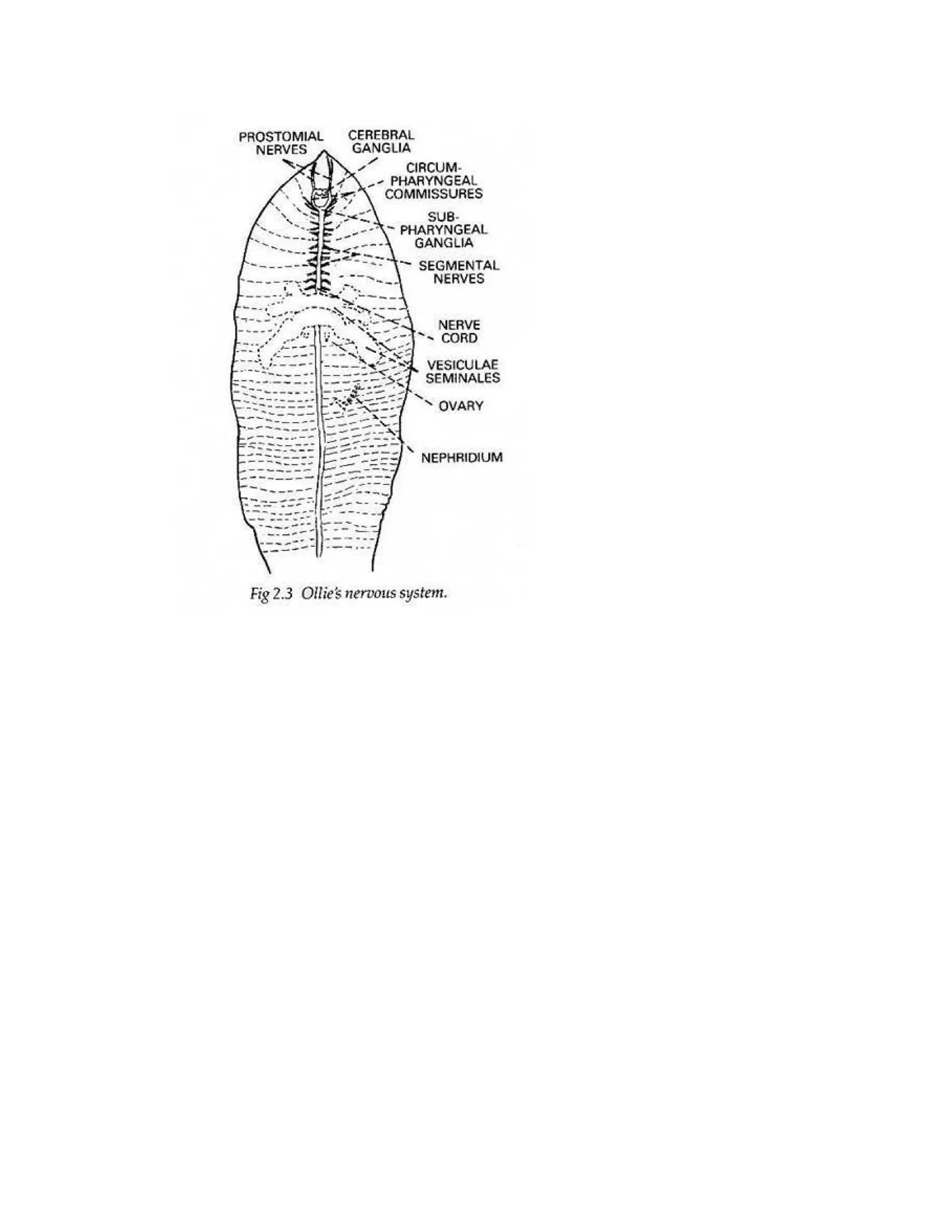
  • 6.
    The Dark Side Of The Brain MajorDiscoveries in use of Kirlian Photography and Electrocrystal Therapy Roger Coghill And Harry Oldfield
  • 7.
    Table of Contents PAGES ACKNOWLEDGEMENTS3 PREFACE 5 1. THE DARK SIDE OF THE BRAIN 7 2. EXPERIMENTS WITH AN EARTHWORM 16 3. LIFE ENERGIES: THE PIONEERS 36 4. THE WORK OF HARRY OLDFIELD 70 5. LIFE'S SECRET MECHANISMS 86 6. ELECTROCRYSTAL THERAPY: DIAGNOSIS AND TREATMENT 122 7. NUTRITION: PICTURES OF HEALTH 154 8. THE BIRTH OF ELECTRONIC MEDICINE 176 CONCLUSIONS: "A THINGE WORTHE YE TRYALLE” 217 APPENDIX: HOW TO MAKE KIRLIAN PICTURES 221 BIBLIOGRAPHY 240
  • 8.
    ACKNOWLEDGEMENTS AND PERMISSIONS Itis impossible to identify in a few paragraphs all the people who have had a formative influence on us in producing this book. Were we to do so they would fall naturally into three categories: the first would include great scientific thinkers of the past like Goethe, the father of morphology, Pythagoras , Heraclitus, and Plato from a more contemplative age, Sir Isaac Newton and Johannes Kepler the pragmatic enquirers, and Hippocrates and Paracelsus the fathers of orthodox and alternative medicines . The second category would embrace the pioneers of life fields such as Lakhovsky and Kirlian himself and their counterparts the practical and theoretical developers of electricity and magnetism like Clerk Maxwell and Tesla. And finally would would acknowledge the many modern influences from all walks of physics chemistry and biology; names as diverse as Gary Zukav, John Gribbin, Francis Crick, Dr. Julian Kenyon, Rupert Sheldrake, Peter Tompkins and Christopher Bird, Max Perutz, Albert Einstein, Jacques Monod, Bernard Watson, Steven Weinberg, Robert Gallo, Leslie and Susannah Kenton, and Guy Murchie. In addition to these however are the small but vital band of people to whom we have turned for guidance and practical help: Ra Bonewitz, Rosemary Steel, Ian McGibbon, Colonel McCausland, Jamie Pridmore, and Fred Bentham, Paul Devereux, Glen Rein, John Steel, John Merron and Caroline Wise, and to Harry's patient wife Eileen. None of this would have reached the printed page were it not for Sheila Lawler's perseverence in typing our drafts and adding her own touch of Northern common sense; the illustrative skills of Carol Ross; finally and above all without the encouragement and patient enthusiasm of Michael Mann our publisher, not only would the quality of the work have been lacking, but its clarity would also have suffered. Our debt to him and the many hours spent in discussing the concepts and detail of the book cannot easily be conveyed in a few words We are also grateful to the many other publishers and authors who gave us permission to quote from their work, in particular to Dr. Julian
  • 9.
    Kenyon, John Gribbin,Charles Berlitz, Horace Freeland Judson, Lyall Watson, and Rupert Sheldrake. They often expressed concepts far more elegantly than we ourselves could have ever done. Though we accept the intellectual donation they have bestowed with enormous gratitude, we must emphasise that the views and opinions contained in this book, and any factual errors which may have crept in or been wrongly left out , must always remain our sole responsibility. Roger Coghill and Harry Oldfield. Chateau de Laveau, St. Georges du Bois.
  • 10.
    PREFACE Natural science isthe study of "that which is or can be known". A good definition of the aims of natural science, is based on the overview by Gary Zukav in his book on the new physics, "The Dancing Wu Li Masters": "...to discover principles in Nature which unify large tracts of experience by reference only to sound experimental evidence, and to formalise these mathematically". This is what we are attempting with this book. If one thing stands out in the history of scientific progress it is that careful observation of small discrepancies has often uncovered fundamentally better scientific principles than those existing beforehand. The solving of the Mars equations by Kepler, who had refused to accept a discrepancy of only minutes of arc, led in turn to the replacement of a circular planetary orbit theory by the elliptical Laws of planetary motion. So the first aim of this preface is to ask the reader to cultivate an attitude which does not reject or condemn evidence, however small, simply because it does not accord with received opinion. Very few of us, in any case, have actually carried out those experiments which have changed man's view of his environment: we take them on trust and on the perceived results which they produce: atom bombs, recovering from influenza, space shuttles, or whatever. Newton, who formulated "the laws by which the great machine of Nature runs" is often quoted for saying "hypotheses non fingo" (I don't make hypotheses), and he demanded reproducible experiments to support any hypothesis offered. Yet both Newton and Kepler studied astrology assiduously, a science difficult to replicate.. Replication indeed is the cry of the normal scientist in defence of any breach through which fringe or frontier science threatens to invade. But the mechanics of scientific acceptance may be more difficult than such a simple and innocuous demand as replication implies. First, to gain credence, the original experimental results must appear in a reputable journal, and such articles are usually only accepted if
  • 11.
    emanating from arecognised academic body or university research department. Once submitted, the findings are quickly evaluated by other research establishments, and sometimes the tests are published at the same time as the initial work, since there is a delay between submission and publication. This is patently a problem for a frontier scientist not attached to any particular establishment. Nevertheless some of our greatest advances have come precisely from those who were not involved in full time academic research. Einstein was working in a patent office when he proposed the theory of relativity. Another problem for researchers in frontier areas is not only that projects of less than central interest are unlikely to get funded, but that it is almost impossible to get the establishment to take them seriously. The absence of any "rival" institution who can check such work by itself may lead to oblivion, simply through lack of interest, or inability to respond. Should the frontier scientist seek to get his message across via a specialist publisher, then the commercial demand for profitable sales becomes the bridegroom of the innocent exposition of truth; and the child of the marriage is often sensationalism. We, the authors, have chosen the medium of a popularist book rather than a more academic means of publication not because we are in the slightest biassed against the establishment: we are simply not a part of it; and our contribution can be tested as sandcastle or rock, untrammelled by any need on our part to safeguard career or reputation. In recognising, on the one hand, the Scylla of an over-zealous and underfunded scientific corpus, without the resources to examine small discrepancies or flaws in the received body of scientific knowledge, and aware, on the other hand, of the Charybdis of sensationalising the evidence which we wish to present, we aim to sail through the straits to safer waters with our experimental and theoretical contributions still afloat. We only hope that we have succeeded.
  • 12.
    CHAPTER ONE: THEDARK SIDE OF THE BRAIN. Today you will listen to a radio set, more probably watch TV. You may use a phone, switch on an electric light, boil an electric kettle, or microwave a hamburger. All these things could be affecting your brain and your body. This is because the brain and body of every living creature relies on a wireless telecommunications system which controls, repairs, organises and renews its body's cells and tissues. We will demonstrate how this brain-to-cell mechanism works; and that if it goes wrong or is disturbed by outside influences the animal, whether worm or human being, wasp, or whale, will, die, or at least become very ill. Other life forms like plants which do not have brains are dependent on a similar mechanism, except that local cell-to-cell communication replaces the brain. More than that: we propose that the body's diseases can not only be brought about by external electromagnetic waves, but can also be cured by them. We will try to show you that your brain, like the moon, has an unseen dark side, whose workings are not revealed easily, but without which your life as an organism would cease immediately. We start by proposing the hypothesis that the brain's transmission to, and reception from its individual cells can be intelligibly received externally by electronic instruments, or even by other people. We use the word "intelligibly" because of course EEG records through the skull are already being monitored as part of routine medical investigation. But their intelligibility is very limited, and the records are as if the transmission of a radio programme had been converted into a graphic printout of the digitally encoded broadcast information, and the listener expected to understand the squiggles on the page. There are some grounds for believing that the brain's transmissions can be detected externally, and the possibility has been explored seriously both in the West and more importantly in Russia. It has however been often overlooked in attempting to explain certain well replicated but puzzling phenomena of every day life. Take the common cold, and its big brother influenza.
  • 13.
    The very word'influenza' (which comes from the Italian word for influence) should have given us all a clue: originally it was thought that the disease, common since the time of Hippocrates and clearly described by him, was transmitted through the air. Even today the concise Oxford dictionary refers to influenza as, inter alia, "a mental epidemic". In their speculative book "Space Travellers, The Bringers of Life", Fred Hoyle and Chandra Wickramasinghe give an account of influenza epidemics known in this century, and explain the puzzling fact that the epidemics spread much faster than can be explained by case-to-case (that is person to person) transmission, or even by the wind, by suggesting that the influenza virus falls onto a cluster of people from outer space. It is a suggestion which certainly merits consideration. But they are wrong to ignore the possibility that influenza, -and possibly even the common cold-, is transmitted by the brains of affected persons. The chilling prospect of this possibility would revolutionise medical procedure overnight if it were found to be correct. It would also lead to the cure of the common cold: and the waveform necessary for such a cure might be remarkably similar to that of ascorbic acid, or Vitamin C as it is more usually called! The actual epidemics of influenza described by the two authors support this incredible possibility: "As well as having variations in their fine genetic detail", they say,"influenza viruses have larger differences which are classified into types A,B, and C, and into sub-types of these main classes. Sub-types of A are particularly common, and it was a new subtype of A that first appeared in Sardinia in 1948. Commenting on this first appearance, Professor F. Margrassi wrote: " We were able to verify... the appearance of influenza in shepherds who were living for a long time alone, in solitary open country far from any inhabited centre; this occurred absolutely contemporaneously with the appearance of influenza in the nearest inhabited centres." "This observation shows" continue the two authors, “that influenza can be contracted without connection being necessary to another human". "In 1918 there were only some 45,000 people living in Alaska, which is two and a quarter times larger than the state of Texas", they say elsewhere. “In November and December of 1918 a lethal epidemic of
  • 14.
    influenza passed overthe whole of that vast thinly populated territory, when human travel from the coast to the interior was essentially impossible because of snow and ice. Here again then we have an example of the spread of influenza by some means other than person-to-person contact, and as before there are the same three possibilities (wind, animals or birds, and that the virus came from space) for explaining how the spread occurred." It is also possible that the disease was spread electromagnetically, as we shall see, and this possibility the authors have unfortunately ignored. Louis Wienstein, writing about the same epidemic, says: "The lethal second wave, which started at Fort Devens in Ayer, Massachusetts, on September 12 1918, involved almost the entire world over a very short time... Its epidemiological behaviour was most unusual. Although person-to-person spread occurred in local areas, the disease appeared on the same day in widely separated parts of the world on one hand, but, on the other, took days to weeks to spread relatively short distances. It was detected in Boston and Bombay on the same day, but took three weeks before it reached New York City, despite the fact that there was considerable travel between the two cities." Commenting on this the authors say: "Here we have a third case where influenza was not spread by person to person contact, for nobody in 1918 could travel from Massachusetts to Bombay in the day or two which elapsed between the appearance of the new wave at Fort Devens and its appearance in Bombay. Nor could the fastest flying birds, the shearwater swift, or even the albatross, make the journey in that time, even if Boston and Bombay were on the customary flight paths of these birds which they are not. Nor are there winds that blow over such a route , with such a speed, and over such a distance." If this disease is being transmitted electromagnetically, like radio, the implications are frightening. But remorselessly the facts pile up: in their book "Influenza" Stuart Harris and Schild in 1975 pointed to the same feature, saying: "Studies in schools have shown that epidemic occurs explosively in such a manner that it is difficult to explain the rapid build-up on a case-to- case transmission basis."
  • 15.
    "Doctors are familiarwith sudden outbreaks of influenza in families, institutions, and other circumstances in which people are closely associated together, and from such observations they convince themselves that influenza is being transmitted from one person to another", say Hoyle and Wickramasinghe. "But since the incubation time of influenza is three days, person to person transmission would be drawn out by the need for this to occur at each link of the chain. The authors' (Hoyle et al.) own survey of an influenza epidemic in British boarding schools in 1977/1978 with 100,000 victims despite conditions for case-to-case transmission being ideal, the real incidence was random and there was no case-to-case transmission. " Though the idea of viral infection from space cannot be ruled out, nor can the possibility that influenza is an electromagnetically transmitted disease. And if this applies to influenza, what of herpes, the common cold, and other cerebrally induced dysfunctions, some of which have not even been properly identified, in our opinion, by medical science? We are not the first to notice the special characteristics of influenza. In his book The Modern Practice of Physic, published in 1813, Robert Thomas commented: "By some physicians influenza was supposed to be contagious; by others not so; indeed its wide and rapid spread made many suspect some more generally prevailing cause in the atmosphere." In their detailed analysis of Headington School's flu epidemic Hoyle and Wickramasinghe unwittingly provide evidence for a radiative explanation: we asked the school to tell us the physical distances apart of each of its house dorms. and correlated these with the onset and incidence of influenza. The results show the same attenuation as that of an electromagnetic field, suggesting that influenza is radiating out from specific epicentres. Only further research with other locations will test our prediction that all local epidemics of influenza can be measured in this way. Another quite different effect of this "influence" could be its ability to create so-called 'telepathic communication' as a result of transmissions intended for internal consumption by an organism being picked up sympathetically by another. We approach this subject with considerable
  • 16.
    caution, since mostof the data concerning telepathy are anecdotal, and in any case, the quality of information transfer is extremely high, involving highly defined images, complex human emotions and identified concepts: to say, "I was just thinking of you when the phone rang and it was you" invokes cerebral mechanisms of a very high order of complexity. The receiver of such telepathic information will have to have held a mental picture of the telephoner, and this picture will have to have been translated into an electromagnetic waveform spreading probably over time. The waveform will have to have been recognised,- but by what?-in the brain of the recipient. Our model has no construct for the conscious mind. So we are in the invidious position of investigating a non-phenomenon without any hypothesis to help us, save the possibility that a 'radio' transmission system is somehow involved. The idea that a three dimensional form can be translated into a specific complex waveform has already been demonstrated by Hans Jenny. Once this is accepted as a building block then the concept of image transmission is possible. The central problem is however one of transmission power: if the transmitter is emanating any kind of electromagnetic wave then these waves will attenuate (weaken) with distance ( and there are specific formulae which calculate the fall-off rate , unless the signals are re- amplified somewhere along the line. Normally this is done by means of a repeater station. Perhaps in the case of telepathic energies the mechanism could account for poltergeistic phenomena, or the role of the spiritualist or sensitive invoked and adapted to fill such a function. Or it might occur spontaneously as a result of a phenomenon known in atomic physics as Brownian Movement where all atoms are constantly jiggling in any organic or inorganic form, just as people have sometimes been startled by the phenomenon of hearing a radio programme coming out of a kettle if they live near a radio transmitting station. The number of incidents of telepathy are legion . But the ability to replicate them at will is almost zero; otherwise the common shares of British Telecom, ATT, ITT, and other telecommunications utilities might take a nosedive. Much Russian research into telepathy has centred round investigation of specific individuals claiming telepathic power, such as Yuri Kamensky, and Mikhail Lomonosov. Empirical evidence is also available:
  • 17.
    a change inthe brain waves in one identical twin can cause a similar shift in another in experiments documented in Philadelphia in 1965 by doctors Duane and Behrendt. Another explicable feature of reports of telepathy is the incredibly long distances over which information can apparently be transmitted: Bernard Kajinski, an early Russian pioneer in telepathy, noted the tranference of bodily symptoms from a daughter to a mother when the daughter was undergoing abdominal surgery 1400 miles away. Another feature, long observed by Western researchers, is that spontaneous telepathy flashes most often between members of a family, people in love, and childhood friends. The power of prayer can have beneficial effects on the distant recipients of its benison, and at football matches the encouragement of spectators seems to have an influence on players' performance. Paralleling these observations are the more sinister implications of magic spells, incantations, and the whole paraphernalia of psychic attack. All these are forms of telepathic communication, and all imply that the cerebral mechanism designed to control form and emotional reaction to harm has extracranial transmissive by-products. "Each outcry of the hunted hare A fibre from the brain does tear" to quote William Blake. Within the context of an apparatus designed to preserve the morphology of an organism none of these seem unduly out of place as alarm signals which have been too powerfully transmitted. The same mechanism could be responsible for people "falling in love", where it is said that such afflicted couples gaze directly into each other's eyes, surely the most direct way of intercommunicating cerebral waveforms, given that the eye is directly connected to the cortex! More specifically, and what if taken to its logical conclusion must be a cause of grave concern for any physician, is the result of an experiment in 1959 where doctors Serov and Troskin demonstrated that the number of a patient's white blood cells can be altered by his or her own suggestion. This fundamental discovery of a cerebrally controlled and non neural immunosensitive system at work deserves more attention than to be buried in a work on psychic discovery.
  • 18.
    Finally, do not,believe for one moment that only harmless old writers about spiritualism are interested in such subjects. In 1963 Dr. Konneci of NASA told delegates at the 14th. International Astronautic Federation meeting in Paris: "The nature and essence of certain phenomena of electromagnetic communication between living organisms is reportedly being pursued with top priority under the Soviet manned space program". The Americans themselves were not slow to investigate the effects of electromagnetic impulses at a distance from humasn and animal subjects. Indeed as we shall relate, they had been aware of the possibilities for decades, but had chosen to squash any research in that area. Some of the more recent researchers like Robert Becker, and the similarly named Robert Beck have reported horrific results from the use of electromagnetic weapons in crowd control. The pernicious effects of high tension cables, which by their nature emanate electromagnetic fields at right angles to their current flow, on creatures human or otherwise, living near to them are only just being recognised. The truth is we live in a world which during the last fifty years , through the arrival of radio, television, electric power generation and transmission,computers, cathode ray tubes, microwave cooking, communication and telecommunications, and an amazing variety of domestic electrical appliances, industrial electrical machines, and other hardwired and wireless systems, has created a sea of electromagnetic traffic around our heads never before experienced in the known history of the world. If our bodies are subject to the sort of mechanisms propounded in this book, sooner or later such traffic will start to disrupt the work of these delicate biological systems, if it is not already doing so. The first sufferers may well be those with the least epidermal protective tissues. The evidence is already there: the famous case of Sam Yannon illustrates the dangers. In 1954 he started running the television programme for local stations from the 87th. floor of the Empire State building. In 1961 he began complaining to doctors that his sight and hearing were deteriorating, and that he held the radio waves responsible. He died thirteen years later, in 1974, some twenty years after the start of his electromagnetic irradiation, at the age of sixty two, weighing just five stone, having suffered cataracts of the eyes, loss of balance, premature senility and
  • 19.
    remembering no one,all signs of cerebral destruction. A doctor testified that Yannon's symptoms were identical to those found in many patients exposed to long term microwave doses.
  • 20.
    Today an increasingpercentage of British households use microwave cooking devices to heat food, blissfully unaware of the potential dangers caused by leaks and indeed the possibility that microwaves may have more than a thermal effect on the food subsequently ingested. We discuss this further in Chapter Seven. Dr, Jean Munro works at the Lister Hospital, in London treating allergies with specific electromagnetic frequencies. Together with her colleague Dr. Cyril Smith of Salford Hospital, she believes that many allergies are caused by electromagnetic pollution, in other words that they are electronic diseases, quoting 26 cases where the evidence is clear cut. Just as intriguing was her report on another five patients who were themselves able to affect electrical equipment: causing light bulbs to blow when in an extremely hypersensitive state, producing background noise on tape recorders and television sets up to ten yards away, and so on. Actually this is not particularly amazing to any physicist. Anyone with a cordless telephone knows that it will pick up the click of a refrigerator as the thermostat comes into action, or if you turn the light on. Electromagnetic waves are flowing everywhere around us, affecting everything.(Fig 1.1). "Everything flows" is the most modern statement of observations in this electromagnetic age, just as it was thousands of years ago when pronounced by an ancient Greek philosopher. The deliberate use of non-ionising low level electromagnetic irradiation, stated the Observer in March 1987, is known as zapping in the United States, and a book "The Zapping of America" by Paul Brodeur, was published as long ago as 1977. To conclude this introduction we quote from the British journal "Public Health" whose editorial in 1982 proclaimed: "Comparable alternating magnetic fields do not occur in nature. They only appear as a by-product of man's industrial activity, and comprise an influence to which there has been no opportunity for evolutionary adaptation". This book explores the effects of a hidden mechanism of the brain which works on none other than electromagnetic principles, and the understanding of which is becoming vital to our continued existence on this planet.
  • 21.
    CHAPTER TWO: EXPERIMENTSWITH AN EARTHWORM There are moments in one's life which suddenly seem ludicrous. Why, at the age of forty six, am I, Roger Coghill, passionately interested in what is happening to an earthworm, which I have dug up from the back garden, cut in two pieces, and christened the rear half "Ollie"? My wife has long since established in her mind that I am in need of urgent psychiatric attention. My youngest child is only slightly more interested in my mad experiment: cutting worms in half, after all, is part of the everyday apparatus of many young lads with even a modicum of curiosity, paralleled only by pulling the wings off hapless flies. But my purpose has a more serious objective than sheer curiosity. I am trying to solve an important problem of natural science. By the time that you have read this, you may accept that without such researches we are unlikely to solve problems as huge as the pandemic of AIDS which currently threatens mankind. Let me explain why. It is a story which will take us back into pre- Christian history, make us struggle through the intricacies of our own bodies' cells, cause us to speculate about the dematerialisation of human beings, and whether gout is caused by a failure of communication between foot and brain. * * * * Arguably the most important scientific challenge facing physicists and biologists today is the largely untackled question of morphogenetic biological fields. These fields are the fields by which our bodies' shape stays the same,even when, as they inevitably do, some of its cells are dying every day of our lives. When we cut our finger, what makes the fingerprint cells grow and heal exactly where they were before? How is it that, even though every cell in the human body has changed in six months, we can instantly recognise the face of a friend whom we bump into after a year's absence? What causes cells to run amok and refuse to toe the morphogenetic line, dragging malignant cancers in their train? How can we eliminate the
  • 22.
    AIDS virus whichis insidiously damaging the immune system of mankind? The problem is not simply a biological one: it brings sub-atomic physical knowledge into the fray. It cannot be solved by a closer look down an electron microscope. Restated, the central question asks just how an unknown non-physical influence organises and controls at a distance the growth and maintenance of organic tissues, perhaps even inorganic ones too. The answer is bound to embrace the theoretical frontiers of the physical sciences, because we are dealing with sub-cellular components; with hydrogen bonds within DNA macromolecules; with the electronic transmission of information; with wave mechanics; and with the origins and properties of light and other electro-magnetic and electrostatic energies. Even psychology, demography and social economics have parts to play in this giant quest for the key to morphogenetics. Tackling such an undertaking requires the kind of scientist more common in the eighteenth than the twentieth century. A breed which has largely disappeared in the two centuries of specialisation which followed that enlightened age. Today we stand in need of generalists with open minds: Newton, tough empiricist though he was, still studied astrology passionately. So did Johannes Kepler, if only to eke out a frugal living when times were hard . In Christopher Wren's day a dinner party might be equally at home in discussing Robert Boyle's new Law as they would the philosophy of Aristotle. Aristotle himself was a great biologist, carrying out pioneer work on the egg embryo . And Wren too attained eminence as an astronomer before embarking on a career as an architect at the ripe old age of thirty. Did you know that Wren also acted as an illustrator to a book about the brain? Figure 2.1 shows his illustration of the cerebrum and its features, revealing its di-pole nature. Joseph Priestley discovered Oxygen, but this was only a hobby, a Sunday afternoon pastime. In those days, science meant knowledge of all kinds, not just maths, physics and chemistry.
  • 23.
    Not that wedisparage the tremendous progress made as a result of specialisation: the coordination of large teams of specialists have put men on the moon, measured the smallest particles of the atom, built giant oil rigs , launched supersonic transport planes, developed virtually instant global telecommunications and constructed powerful computers the size of a matchbox. But only in the last thirty years has scientific attention turned seriously towards the science of genetics. Crick and Watson, (and some would add Rosalind Franklin and Maurice Wilkins pieced together the double helix structure of DNA only in the early fifties. The study of nucleic acids is still in its infancy with new discoveries appearing monthly in Nature. Nature the magazine; nature the phenomenon was always there. The science of nutrition is only just gaining momentum, and getting more and more complex. . Genetics too seems to need a combination of biology, chemistry, electronics, medicine, sociology and even geographic
  • 24.
    economics for itsadvancement. Archaeology and Anthropology have been relegated to the third division. Perhaps the age of the generalist is returning. Like all these problems of natural enquiry, to study biological morphogenetic fields we must construct the tools for the job and bring the data into one place. Only after this may hypotheses emerge to explain the collected phenomena. In such a field of study there might also be 'non- phenomena' to contend with; gravity for example is something which you know is there but cannot actually see,, and, to avoid being led down the blind alleys of dogma, it is well to anticipate this. But first back to my earthworm. The common earthworm, Oligochaeta Lumbricus Terrestris to its biologist friends, and "Ollie" to me, happens to be one of the most populous animals on our planet. Charles Darwin, who sensibly devoted the last years of his life to the study of earthworms, estimated that there were between six and thirteen million of them in every square kilometre; and more recent estimates suggest that there are actually between one hundred and twenty and six hundred million in every square kilometre of grassland and fertile farmland. Before you say "Ugh", you should know that these quiet battalions do us such a signal service that we would probably all starve to death if it were not for their quiet devotion to duty. They oxygenate and aerate the topsoil of the world, balance its acidity or alkalinity, help decompose rotting leaves and other detritus, supply natural guanin and urea thereby improving the soil's fertility, and cost absolutely nothing. Ollie the earthworm has other endearing features: most important to me right now is his incredible power of regeneration. Biology textbooks are not certain on the subject, but whilst most agree that the front (anterior) part of a severed earthworm can regenerate itself, there is some doubt as to whether the back (posterior) part can grow a new brain, mouth and pharynx, not to mention the five hearts with which every decent lumbricus is blessed. Why should I care? If it can be shown that an animal has the capability of regenerating all those organs, then it is saying something about the mechanics of life and the way in which cut fingers get repaired. It could help to prove in fact that
  • 25.
    the cells ofan animal not only carry a blueprint of the whole animal-this much we know from studies of DNA- but that those cells can broadcast, as it were, that blueprint to new cells so that they develop in precisely the right places to reform the animal in its entirety. This is why the process is called morphogenesis, and the broadcast network can therefore be labelled a morphogenetic field. And here's the point: if we can succeed in understanding the mechanics of morphogenetic fields, we have a window onto the mechanisms occurring when morphogenesis goes wrong, as it might be with diseases like AIDS, multiple sclerosis, arthritis, and cancer. More of that anon. Let me now tell you a little more about Ollie. The other thing that interests me about him/her is that Ollie is incredibly sensitive to vibrations; not just to the tread of the farmer's Wellington boots, but also to the electromagnetic vibrations of visible light, which are enough to paralyse the poor creature, and as for ultraviolet light, well it is just lethal to lumbrici. When you see a dead worm in a puddle of rainwater, its death is not by drowning but from ultraviolet radiation. That is why worms stay well underground, coming up only at night. They can live for months under water, and for upto fifteen years in a harmonious atmosphere. So as a testbed for experiments with ultraviolet and visible light, and any other electromagnetic non-phenomena, Ollie is perfect. And as we shall see, electromagnetics and ultraviolet light seem to play an important part in morphogenetic field studies. I do not want to go into Ollie's private sex life. Except to say that he can be a she whenever he wants, simply by lying head to tail with a friend, and if nothing else, is therefore more procreative than most animals would dare to hope in their wildest dreams. For now let us concentrate on finding out whether Ollie can grow a new brain, using only his lower half. If we are right that it is by means of a broadcast signal, then we further suspect that human ingenuity and technology will be capable of developing electronic equipment which can mimic this process by artificial means using equipment which can generate the complex waveforms of morphogenetic fields. And this would be the start of electronic medicine.
  • 26.
    What has ledus to this suspicion? It is because of what we call the 'phantom leaf effect', a strange phenomenon we have observed by means of an even stranger process known as Kirlian photography, which we shall soon describe in detail. The phantom leaf effect has by accident allowed us to chance upon a mechanism in Nature which could provide an important clue to morphogenetic fields. More than that, it offers an opportunity to explain in a few principles large tracts of experience which are currently an almost complete mystery. As an example let us apply the resulting hypothesis to a new way of looking at the AIDS retrovirus, and a few other horrific diseases currently plaguing the attempts of researchers to find a cure. Cancer, multiple sclerosis, arthritis, and psoriasis, to name but a few. Let us suppose for one moment that our brain acts like a di-pole radio aerial. After all, it looks a bit like one: there are two fat, but highly separate hemispheres with a plate wrapped round each one ( called the cerebrum and cortex respectively). Connecting the two halves, which are neatly insulated from each other by a membrane and ventricles, is a thick connecting band called the corpus callosum. Underneath this appear to be some signal detectors and also some signal generators, called the limbic system , thalamus, and other specialist components. The cerebrum is set in its entirely like a jelly in an upturned bowl (the skull) so as to be sensitive to the slightest mechanical vibration, let alone electromagnetic ones. Let us next suppose that this relatively vast and complicated transmitting and receiving station services a immense number of small radio sets, each one being one individual cell of our body: and that the receiving aerial of each radio set is the nucleus, packed with DNA in helical windings. A helical winding is ideal for picking up a radio signal, and all modern radios have a similar device inside. The difference in this case is that instead of having a separate tuning device the station has been programmed to a fixed frequency and cannot therefore easily change its station. The way it has been programmed is that along the helix are a number of different bumps: they are tied to the helix by hydrogen bonds and bases (chemical molecules) each three of which represents a specific bit of information. Thus only a specific waveform can be received by the helix, and more than this the distance between one complete winding of
  • 27.
    the helix isalso fixed by hydrogen bonds which ensure that it doesn't stretch or contract, which might also have the effect of making the aerial go off tune. Apart from acting as a radio receiver, however, let us further suppose that the other part of a double stranded helix acts as a local transmitter of exactly the same signal as that which it receives. This kind of structure, we speculate, is like a two-way radio: other types of single stranded structures of DNA (and all RNA) may only be receivers. The strength with which the cell can broadcast its signal will depend on how much energy is pumped into the cell by a sort of biological battery called the mitochondria. And the strength with which the brain can send and receive signals to all its cells will also depend on the amount of energy available to it. This energy is protected by an insulator called myelin which insulates the whole central nervous system from the rest of the body. If this sheath is destroyed then energy can seep away, the brain's radio signal strength falls off, and the body starts to malfunction, as in the case of multiple sclerosis. If the brain's specific signals are weakened by its having to use up a lot of energy in a stress loop then the cells start mishearing , or worse not hearing the signals at all. So they either start doing their own thing and go wild, or start doing the wrong thing and rebroadcast incorrect instructions, allowing for example a build up of uric acid in the feet which we call gout; or letting in foriegn bacterial infections; or wrapping themselves in a mucous coat so that they go completely deaf to the signals coming to them from the brain. When one considers that the real problem in understanding morphogenesis is that there are millions of cells dying and being born in one human being every day and that it is necessary to replace each one correctly, then it must be immediately obvious that this sort of traffic could never be handled by a chemical -electrical system whose speed of transmission down neural axons is forty metres a second if you are lucky. Nervous transmission is simply too slow by a high factor: the number of transmissions to and fro down the spinal cord necessary to keep the brain and its cells in touch with each other would exceed the capacity of the spinal cord to carry the information. Even the spinal cord needs a rest to
  • 28.
    recover from electro-chemicaltransmissions! The cord would have to cope with some 15,000 million brain cells alone. Sometimes the effect is pellicular, that is to say it affects the skin, as in a sarcoma (a tumorous skin disease) or psoriasis. Here's where we can actually test to see how the mechanism works, because we can overtly see the effect of any treatment. With multiple sclerosis it isn't so easy: every thing is inside and hidden from view. In our postulated radio network a number of things can go wrong: a virus for example could get into the nucleus and alter the signal by inserting its own signal into the DNA chain. In consequence the structure starts sending out the wrong fixed signal to other cells, which start to ignore the brain's normal signal- unless the cells are brought back to normality by an even more powerful transmission from the brain in retaliation. The effort of engaging in this electronic warfare causes the headache which might for example accompany a stomach upset or the onset of influenza. Usually the brain can overcome these local invasions, except when it is already weakened by stress loops or lack of energy resources. Another way the system can go wrong is if the cells are miscoded in the first place by reason of hereditary translation of the sequence of bumps along the DNA. Phenylketonuria is an example of this 'point mutation'. And a miscoding can also be caused to an already grown animal by ionising radiation, leading to cancers: even excessive sunlight causes mutations of the skin pigment and accompanying skin cancers, as a recent study by the Royal College of Physicians entitled 'Links between Ultraviolet Radiation and Skin Cancer' pointed out in April 1987. Chemicals can also cause mutations by altering the structure of the DNA and its hydrogen bonds. Finally there can be direct mechanical damage to cells by burning or cutting. In such cases the brain has to send out specific instructions to the repair squad, and this hurts when the pain mechanism is brought into play. Pain is simply the after effect of the radio distress calls from the cells to the brain. The more one starts thinking of the brain and the cells in this way the more it explains a lot of different things.
  • 29.
    But in onecase there is a really serious problem. Some particular viruses which are very small, including the AIDS virus, can penetrate the blood brain barrier or the myelin sheath and establish themselves in the brain from where they can start altering the brain's signal ever so slightly and slowly. This virus then operates specifically to alter the signal to the special class of cells designed to seek and destroy foriegn bodies. In more dramatic terms it has infiltrated behind the lines, captured the enemy's machine guns and is turning them on their owners. Down in the trenches the cells then start doing precisely the reverse of what they were programmed to do: they attack when they should defend . The other cells cannot stop it: as the signal strength builds up they are progressively weakened , even though it takes a long time. Antibiotics cannot stop it: they act by having a fixed radio signal of their own which cancels the cells' signals, but with this signal it is uniquely different for each body, and unless the signal is exactly right it will not be obeyed. DNA is different for every one in the world, just like a fingerprint. So what on earth is the solution? It very much depends on the way these signals work. And that is why I am so interested in Ollie the earthworm . Right. We've put an idea forward. Now we are going to stop just there and ask you to read the following account of a dreadful plague: "The season was universally admitted to have been remarkably free from other sicknesses; and if anybody was already ill of any other disease, it finally turned into this. The other victims who were in perfect health, all in a moment and without any exciting cause, were seized first with violent heats in the head and with redness and burning of the eyes. Internally, the throat and tongue at once became blood red, and the breath abnormal and fetid. Sneezing and hoarseness followed; in a short time the disorder, accompanied by a violent cough, reached the chest. And wherever it settled in the heart, it upset it; and there were all the vomits of bile to which physicians have ever given names, and they were accompanied by great distress. An ineffectual retching, producing violent convulsions, attacked most of the sufferers; some as soon as the previous symptoms had abated, others not until long afterwards. The body externally was not so very hot to the touch, not yellowish but flushed and livid and breaking out in blisters
  • 30.
    and ulcers. Butthe internal fever was intense; the sufferers could not bear to have on them even the lightest linen garment; they insisted on being naked, and there was nothing which they longed for more than to throw themselves into cold water ; many of those who had no one to look after them actually plunged into the cisterns. They were tormented by unceasing thirst, which was not in the least assuaged whether they drank much or little. They could find no way of resting, and sleeplessness attacked them throughout. hile the disease was at its height, the body, instead of wasting away, held out amid these sufferings unexpectedly. Thus most died on the seventh or ninth day of internal fever, though their strength was not exhausted; or if they survived, then the disease descended into the bowels and there produced violent lesions, at the same time diarrhoea set in which was uniformly fluid, and at a later stage carried them off with a few exceptions. For the disorder which had originally settled inthe head passed gradually through the whole body and if a person got over the worst, would often seize the extremities and leave its mark, attacking the privy parts fingers and toes; and many escaped with the loss of these, some with the loss of their eyes. Some again had no sooner recovered than they were seized with a total loss of memory and knew neither themselves nor their friends." No, not Bhopal. Not AIDS. It was a description by Thucydides of the great plague of Athens in 430 B.C.. But it illustrates what we mean by what can happen when the brain starts to mistransmit its signals as a result of a cerebro-viral infection: progressively the signal works its way down the body from the eyes to the feet. Thank goodness we haven't had many plagues like that. It seems that the wavelength the brain is using is not a low one as one might have supposed by listening to EEG recordings; we are used to being told that our alpha waves are about eight to twelve Hertz which is only eight to twelve cycles per second. But a glance at the wavetrains and their irregularities will convince any electronic engineer that the frequencies are much higher, more probably in the low ultraviolet wavelength range. At this wavelength certainly we can see many effects on DNA and on skin sarcomata too: psoriasis for example yields to special ultraviolet light wavelengths. Yet the psoriasis returns in a few weeks when the UV light
  • 31.
    stops. Ollie's regenerativepowers are completely smashed by ultraviolet light. With other organisms however mutation or growth can result. We just do not know enough yet about which frequencies and wavelengths work most effectively. -ll we can say is that there is considerable evidence that when ultraviolet radiation comes into contact with organic tissues it starts to affect DNA. And that this is a clearly radio (or radiative) effect. The essential task in all healing is to normalise the brain so that its signal gives the proper instructions once more to the particular cells which are not doing their job. With AIDS it is the T4 helper cells, which are part of the platoon of fighters programmed to destroy enemy viruses and other foreigners. Unless we can reprogram these T4 helper cells, the patient is increasingly prone to opportunistic diseases any one of which can take over the cells and swamp their signals until death is the only result. Under this hypothesis AIDS is not an ordinary viral disease, it is a cerebroviral cellular dysfunction. It eventually kills by destroying brain tissue, and its immunosuppressive qualities are merely a secondary symptom. Pharmaceuticals cannot penetrate the blood-brain barrier and get to the virus without damaging the brain itself. And even if they did they would not be able to reproduce the individual signal necessary to bring the T4 helper cells back to normal, since each patient is different. The only answer is to send an artificial signal into the patient's body which mimics its unique healthy brain signal. Or to send a signal which precisely cancels out the incorrect version put there by the retrovirus. Fortunately the retrovirus cannot itself broadcast. It is made of RNA not DNA and does not have a transceiving capacity. Even DNA cannot broadcast all the signals it would like to: it lacks a codon called Uracil, so cannot ever manufacture the so-called "essential" amino-acids, which have to be ingested from outside the body. Remarkably an instrument which can mimic the brain's signals has already been developed. In fact prototypes and early versions have been around for over fifty years. But that is the subject of the next chapter. Before that let us now take a fresh look at cancer, or rather cancers: even the common wart is a cancer of sorts. If you look at a wart under a microscope (Fig. 2.3) the most amazing thing you will surely notice is that it has little crystals in it. Little square crystals. Actually these are probably
  • 32.
    viral infections toocalled papovaviruses from their longer name papilloma polyoma vacuolating virus (Fig 2.2). Let's not be frightened of long medical words: papopilloma simply means a wart or similar skin growth, polyoma is a type of animal tumour, and vacuolating refers to the ability of many of these viruses to produce spaces or vacuoles (vacuums)-within the infected cells. Indeed , most medical terms are simply latinised descriptions of the symptoms or appearance of the structure or disease. The interesting thing about crystals is that they can act as very good receivers: ever heard of a crystal radio set? And the interesting thing about warts is that they can appear and disappear very quickly, sometimes overnight.
  • 34.
    If the cellsof a wart are retrained by the brain to become normal again then the virus is evicted or destroyed -phased away-, according to our hypothesis. The question is, how does the brain do it? We suspect it is by first finding out what is the viral wavelength and then broadcasting a resonant waveform which cancels it out; and that this is sometimes a difficult calculation for the brain to make, so that warts will persist then suddenly disappear. Other Cancers are not so easily dealt with. In such cases the cells continue to run amok, and are not contained. The signal is growing steadily, or is being misunderstood; or not being heard at all. There is a clear connection with the brain in that cancer very often strikes after a mental trauma within the last two years. There appears to be a fatty coating round some cancerous cells. Using Kirlian photographs it is possible to identify a chaotic effusion of uncontrolled energy at the tumour source. Clearly the cell's radio tuner has gone out of tune. Eating fresh fruit seems to give the cells normalising energy, and surgery seems literally to cut out the aberrant signals. Other suggested causes and helpful treatments for cancer can all be traced back to an explanation in terms of our proposed radio network as a later chapter will show. One of the most powerful of these is willpower: the power of the brain to override the wayward signals and reimpose normality. An example of this is the work of Carl Simonton who has used techniques of visualisation to help cancer patients combat their problem. In one case he suggested to a Naval officer that he should imagine the white cells as frogmen putting limpet mines on the side of cancerous cells and blowing them up. It worked: the officer was cured of cancer. Of course, it is easy to be dogmatic about the cause of any phenomenon, and we talked just now about the "blind alleys of dogma". As an example of this danger take that great blind alley in physics whose entrance was first unwittingly opened by Thomas Young in l8O3 - the particle/wave duality of light. Young discovered that light passing through two slits in a board produces an interference pattern when it falls subsequently on a screen. This pattern, of alternate bands of light and
  • 35.
    dark, is awave mechanics phenomenon, suggesting that light travels in waves. About a century later it was found that 'photons' of violet light act like particles to knock electrons loose from a metal plate (the photo-electric effect). So is light composed of waves or is it composed of particles? The ensuing debate has occupied theoretical physicists ever since as they struggle to rationalise these seemingly inconsistent sets of phenomena. Suppose for a moment we deny the existence of a photon as a particle, but regard it simply as a harmonic resonant frequency of the existing waveform. (The Schrodinger equation in fact revealed quanta essentially as waves of resonance). This harmonic could also dislodge an electron from a metal surface. If the light were of a violet colour it would do so more easily, in fact, than a red one, being of a shorter and more powerful wavelength. No one has ever seen a Hydrogen atom: millions would sit on a pin's head. But we think that the spaces between hydrogen atoms in a covalent resonant Hydrogen bond can be changed by temperature and by other attachments to the Hydrogen atom, which serve to pull the atoms apart slightly. Exciting a Hydrogen atom's electron with a specific electromagnetic frequency causes it to move from one harmonic to the next. This is what produces the photon of light perceived by us to emanate from the Hydrogen atom. So it isn't a particle after all: we just perceive it to be one, because we perceive only certain electromagnetic frequencies. If the source of the electromagnetic waves is subject to interference - that is if the crest of one wave is cancelled out by the simultaneous trough of another, then we will perceive no light at all. In this way the photo-electric effect may be explained without recourse to the invention of a new concept, the photon; being entirely a wave-mechanical phenomenon, the 'shells' round an atom are simply the harmonics of any particular electro- magnetic frequency. They even follow a molecular equivalent of Bode's Law of planetary distances. While such sorts of hypothesis would allow the wave-particle duality to be synthesised, they are unlikely to be a correct guess. We use the duality problem as an example of the need not to ignore those realities which may not be perceivable. And also as an example of how one wave can cancel out another by means of resonance.
  • 36.
    Magnetic fields, gravity,radio waves and the vacuum are other examples of non-phenomena, perceivable only by their effects on other phenomena, and yet we are quite used to accepting such fields now that they have been identified and defined mathematically. By and large science is suspicious of non-phenomena, and it is not adept at understanding them even when they are known to exist. "Modern scientists", say Tompkins and Bird, "still have no idea of the composition of electro-magnetic waves. They simply use them for radio, radar, television, - and toasters". Remember the concept, long rejected, of the ether? It was rejected because nobody could measure its effects. Such suspicions, moreover, are usually redoubled at the frontiers of science..." Not always, fortunately. Great scientists occasionally acknowledge the unknown. This quotation from James Clerk Maxwell is suitably tinged with humility: "Mr. Airey has found that a large proportion of the disturbances at Greenwich correspond with the electric currents collected by electrodes placed in the earth in the neighbourhood, and are such as would be directly produced in the magnet if the earth current were conducted through a wire placed underneath the magnet. It has been found that there is an epoch of maximum disturbance every eleven years, and that this appears to coincide with the epoch of maximum number of spots on the sun. The field of investigation into which we are introduced by the study of terrestrial magnetism is as profound as it is extensive... When we consider that the intensity of the magnetisation of the great globe of the earth is quite comparable with that which we produce with much difficulty in our steel magnets, these immense changes in so large a body force us to conclude that we are dealing with one of the most powerful agents in nature, the scene of whose activity lies in those inner depths of the earth, to the knowledge of which we have so few means of access". (It subsequently transpired that such magnetic disturbances had their origin outside of rather than inside the earth). But back to Ollie the earthworm. After four days Ollie's severed rear half is still alive . We have kept him moist, and remembering his sensitivity to light we have put a china cup over him. He moved in both directions during the first few days, as if uncertain which way was
  • 37.
    forwards or backwards.But now all the residual earth in his little gut has moved right down to the end of his body without passing out of it, and his front end has as a result got cleaner and redder. Could this be a hopeful sign? The front end of complete earthworms is where the their light sensitive pigments are concentrated and the same could be happening to Ollie. But he hasn't eaten a thing. He no longer moves backwards when provoked but tends to move more normally forwards. Concerned that he has not for obvious reasons been able to eat anything , we are surprised that he has not expelled any earth either. Perhaps he is making the most of the food already in his gut. Or ingesting the air like a plant; or taking in nutrients through his skin? Meanwhile Ollie's front half is as lively as if the divorce had never occurred . Are the two halves still in radio communication. According to our hypothesis they should be, since their DNA is identical. This is not incidentally such a daft question: if an earthworm is severed and then retied together with cotton , movement will continue normally. A brief glimmer of support for our hypothesis. Moreover, if only the nervecord is left unsevered the wave of contractions will continue down the segments posterior to the cut. What we are really trying to see however is whether Ollie can generate a new brain. Now an earthworm's brain is hardly a mighty affair: it would look to us no more complicated than the eye of a needle, the interesting thing for our hypothesis being that it has two flanks with a hole in the middle, a prototype di-pole transmitter (Fig. 2.3)?!
  • 39.
    So we arenot asking a lot of Ollie if we ask him/her to generate a new brain. What is more complex is for Ollie to generate a new mouth, pharynx, oesophagus, and five hearts. If he can get these all back together then we have a clone with identical DNA to his better half. And with these two identical clones we might be able to carry out some interesting experiments on the effect of electromagnetic radiations on organic cellular tissues. Overall our book gives an account of developments within the leading edge of research into morphogenetic fields, one of science's few remaining great unknowns. It attempts to survey, between one set of covers, most of the previous research and hypotheses in this field, much of which has been vehemently ridiculed or denied by orthodoxy and commercial interests. It describes the specific work carried out by Harry Oldfield with Kirlian apparatus and related equipment. It proposes our general hypothesis of morphogenetic fields based on and within the framework of accepted subatomic and atomic physics. And finally it applies our central hypothesis to certain tracts of experience such as nutrition, disease and the alternative medicines, and reaches towards some areas of the so-called paranormal sciences. This is going to be an exciting journey. But the prize is the better understanding of how nature works, the explanation of important unsolved questions, and just possibly a curative solution for some of the most mysterious and uncheckable of human diseases. Whilst Ollie is wriggling down his yellow brick road in search of a brain, let us take a brief look at other examples of regeneration in animals in the hope that they may give us clues to the mechanism of morphogenetic fields. The most commonly known example must be the tails of lizards. "Gotcha", we cry, only to see the creature dart off, while we are left clutching a small piece of its tail. Reptiles are in fact the highest vertebrates which possess any substantial powers of regeneration. At the other end of the scale, amoebae seem to do nothing except feed and divide. And in between these the sponges are probably the most spectacular of creatures, in that they were never really one organism at the outset.
  • 40.
    The common featureof all regenerates is that their replacement limbs are never quite as good as the original, like a video rerecorded from a video. Furthermore,studies both in animals and man reveal that if the wound is closed by a suture, regeneration will fail to occur. Regeneration can only begin after a scab has been formed from clotted blood and dead tissue, which can take a week or two. When a new skin (or epidermis to be precise) has been formed underneath it, this scab falls off. Occasionally regeneration goes wrong, and double or even triple new tails are produced. The regenerated scales are often abnormal in colour or arrangement, and tend to be smaller than normal scales, again as if the template from which they were made was at one stage removed. Digits of lizards do not regenerate, but a limited amount of cellular tissue or cartilege overgrows the wound. A turtle can replace about one third of an injured shell within a year, and shells which have been completely restored have also been reported. No one knows how the regenerative mechanism works, except that in the higher life forms is it somehow dependent on the essential nearby presence of nervous tissue, an essential for regeneration. Planaria, for example, a common species of a tiny flat worm found in nearly every pond, stream or canal, and just as careful to avoid light as the earthworm, have the amazing capacity to regenerate the whole of their body after it has been starved to almost nothing, leaving only the epidermis and the nervous system. A small piece of planarian cut from its centre will regenerate a head at the correct anterior end. (Hear that, Ollie?). But as in other higher organisms, even the humble algae can only regenerate if medullary cells are present; and, though the hydra is able to regenerate a complete animal even after being cut into fifty pieces, the pieces must have the two components of nerve and cell. The champion regenerators, however, are the sponges. If a sponge is sieved through a cloth into a dish of water the cells will soon regenerate into small clumps, and each clump will slowly develop into the mature form. Apart from this sponges have no other form of co- ordinating mechanism: they have no nervous system or special receptor cells. In consequence, every single cell of a sponge must carry with it any communicative mechanism with which it is equipped, and the
  • 41.
    intercommunication between cellsmust rely on a mechanism other than via neural pathways. In our investigations this feature of primitive organisms may prove to be an important clue. If we now trace the development of how animals control their shape starting with the sponges, our account might appear like this: The cells of sponges have a non-neural intercommunicative system, something like citizen band radio. When the cells have been divided they subsequently reform as before, even when mixed up with another different variety of sponge. Lyall Watson recounts the experiment where a red and white sponge are sieved together into a pink mixture. After a day the two sponges have reunited into separate red and white shapes. This tells us something about the mechanism at work. The two sponges must have their own unique and separate callsign, so do not confuse each other's signals. Higher up the ladder of life a nervous system starts to develop which exercises overriding control: without its presence the individualised and therefore now much more specialised cells cannot seem to operate completely independently as before, but get lost without the central controlling mechanism. They can still intercommunicate with each other or amplify and relay signals emanating from the nervous system. Since the nervous system is not in physical contact with all of its cells some non- neural mechanism must be in operation. It is not so effective as direct transmission however, and regenerated tails or claws are not likely to be as large as or diferentiated as the originals which they replace. If the epidermis is interfered with or sutured this has an inhibitive effect on regeneration. Indeed one purpose of the epidermis seems to be to shield internal tissues from external radiative influences, and this function may actually be working against the organism's own radiations when a suture has been made. The epidermis is special in animals: its cells are highly impervious to ultraviolet radiation by comparison with internal tissues. They cover the entire outer structure of plants, protecting them everywhere except in the growing root-tip area. (Later we describe an experiment where the root tips seem to emanate radiations). The epidermic cells sometimes produce oil, resin, crystalline salts, or silica for protective purposes, exactly like a car wax: they are impregnated with a waxy substance called cutin.
  • 42.
    Normally in invertebratesthe epidermis is only one cell thick, but frogs by contrast have an epidermis several cells thick, constantly renewed by division. Normally blood vessels do not penetrate into the epidermis, which tends to become scaly and hardened with age. Multiple sclerosis is so-called because of the scaly cells which are a feature of the disease. In plants the epidermal cells do not generally contain chlorophyll. In short the epidermal cells of plants and animals serve as their armour, and are an unfeeling protection against the hostile outside world. They may also serve as a barrier against the incursions of electromagnetic waves which would otherwise interrupt interior intracellular communication. Ollie the posterior earthworm has now been alive for a month. He /she has crawled out from the small saucer and is decidely more lively if touched. He looks a little fatter and redder at the front. And what is quite pleasing is that he has voided the earth from his rear end. He/she rests with his new nose touching the earth, as if somehow ingesting the moister liquids of the soil, or about to start burrowing. He/she avoids magnetic fields, and definitely crawls in the original direction of his /her previous self. Do we detect signs of something forming under the front end of Ollie's skin? Let us leave Ollie there while we look back over the history of research into the fields of life, and see how those early versions of waveform broadcasting machines came to be developed, and the remarkable results which were obtained from their use.
  • 43.
    CHAPTER THREE: LIFEENERGIES: THE PIONEERS Doktor Franz Anton Mesmer, struck off. Ruth Drown, suicide. Wilhelm Reich, died in prison. Upton, Knuth and Armstrong, forced into bankruptcy. Dr. Albert Abrams, slated by the Establishment, died of shame. C.M. Allen, sent insane. Dr. M.K. Jessup, suicide/murdered. Bill Moore, researcher and author; fled into retreat. Such has been the fate of early researchers into bio-electric life fields. Why? The answer may lie buried for ever in one sentence of a letter from Albert Einstein to a fellow scientist, Otto Stern, in the dark days of World War Two: "I can report no more on this matter than we are not the first who have faced similar things,...and that it would in no way help, at the present moment, to bring it to public notice." Cryptic words indeed from one of the most lucid of scientists. Subsequent commentators believed that Einstein was referring to the secret atomic development known as the Manhattan Project. But as we shall show, he may have had quite a different experiment very much on his mind....... * * * * * * * * * * About a hundred and sixty years ago a farm boy was returning to the hayfield with his empty cart. He was worried: the clouds, which had been white and fluffy all morning, were changing to the less differentiated and more diffused blankets which he knew brought rain. His spaniel dog, Charlie, trotted beside the cart. Normally the boy would go over the bridge some distance away but, in his haste to get the cart loaded, he decided to cross at the ford. Gingerly his two horses edged the cart into the deeper water; the other bank seemed so far away. Seeing his concern and the horses' reluctance, the owner of the cornmill by the ford came wading in to hold their heads and the party crossed safely, but wet. Poor
  • 44.
    Charlie, whom theyhad forgotten to put on the cart, stayed whining on the bank to await his master's return and to enjoy, by way of compensation, the crumbs from a loaf offered him by the solitary artist who happened to be painting the scene.... Today the Hay Wain, painted by John Constable in l82l, hangs in the National Gallery, serving as a reminder of how different life must have been a mere century and a half ago. In less than two hundred years mankind has advanced from haycarts to space shuttles as a means of transport. The fundamentals of physics are unchanging. It is only the way we use them which has changed. As if like an echo from some previous technological age, Joshua fought the well-celebrated battle of Jericho, using the principles of resonance to bring the walls tumbling down. Tesla, the inventor of wireless telegraphy, would have been proud of him. Archimedes, the inventor of so many things, would have been grateful that Joshua hadn't passed the idea on to the Romans beseiging him at Syracuse. (Not that Archimedes noticed even when they did break in). But Joshua was the first we know of to bring resonance into the human battlefield. Here's how he did it: "And Joshua had commanded the people saying "Ye shall not shout, nor make any noise with your voice, neither shall any word proceed out of your mouth, until the day I bid thee shout; then shall ye shout. And Joshua rose up early in the morning and the priests took up the Ark of the Lord. And seven priests, bearing seven trumpets of rams' horns before the Ark of the Lord went on continuously and blew with the trumpets; and the armed men went before them, but the rereward came after the Ark of the Lord, the priests going on and blowing with the trumpets. And the second day they compassed the city once, and returned into the camp. So they did six days. And it came to pass on the seventh day when the priests blew with the trumpets, Joshua said unto the people, "Shout; for the Lord has given you
  • 45.
    the city... So thepeople shouted when the priests blew with the trumpets: and it came to pass, when the people heard the sound of the trumpet, and the people shouted with a great shout, that the wall fell down flat...". These verses from Joshua describe perfectly the critical features of his divinely inspired experiment with resonance. By first establishing a specific frequency with the trumpets, and then overlaying it with the frequency of his mens' shout, he could have set up a powerful resonance effect no less devastating than that by which Tesla once nearly brought down a New York building with his oscillator. (We describe this in more detail later). Offshore sailors will understand the principle immediately: every few waves or so 'the big green one' comes rolling up from behind, threatening to poop them, and fill the boat with water. The idea that every organic particle has its own particular resonant frequency or "call-sign" which can be transmitted and received at a distance, is one of the few which never occurred to the ancient Greeks. except, perhaps, to Pythagoras of Samos. However, the 'evil' uses to which wizards and witches of the Middle Ages put a lock of hair to damage a distant victim are well documented; and it is said that the ancient Egyptians were afraid to portray a person's full face in case enemies could weaken him from afar. Historical evidence for the existence of a human energy field dates right back to ancient Chinese and Indian cultures. But probably the first well documented account comes from Paracelsus in the Middle Ages, around 1530.Though Athanasius Kircher, one hundred years later, was interested in magnetism, and wrote several papers on it, he never seemed to connect magnetism with health as later writers did, nor with any vital force. Paracelsus was a rebel from medical orthodoxy. In 1527 he burned the famous textbook of medieval medicine, the 'Canon of Avicenna', which became a symbol of rebellion against pedantry and unthinking acceptance of ancient doctrines. According to his new ' doctrine of sympathetic resemblances ', all growing things reveal their usefulness through their shape and physical characteristics: everything that lives radiates light, and plants with high vibrations are able to raise the low vibrations of man. He
  • 46.
    advised all physiciansto sense the natural energies of plants, advice which was developed later by Edward Bach, a London doctor, into the well- known Bach Flower Remedies. Paracelsus probably inspired Bach with his habit of gathering the dew under various configurations of the celestial bodies, believing the water to contain the energies of planetary aspects. Bach too believed that the dew contained a power of some sort . Perhaps one of the earliest scientific approaches to bio-electrical radiation was that by Maimbray in l746. He put two myrtle shrubs next to an electrical conductor in Edinburgh and was amazed to see the shrub grow three inch branches and buds at a time when most other buds were dormant. (In a later chapter we discuss the impact of electricity on nutritional processes). A few years later Jean Antoine Nollet, physics tutor to the Dauphin of France, discovered that plants in metallic pots increased their rate of transpiration and that seeds grown in electrified containers grew more rapidly. By l783 AbbÑ Bertholon had published a complete work, "De l'ElectricitÑ des Vegetaux", and had collected atmospheric electricity with what he termed an electrovegetometer, which was then passed through plants growing in a field. His suggestion that "one day the best fertiliser for plants will come in electrical form, free from the sky", should strike terror into the hearts of fertiliser manufacturers, and comfort the minds of conservationists. Happily for Bertholon there had been no massive demand for nitrites, the stuff of First World War explosives, and the consequent nitrate fertiliser industry had not become the lobby it is today, otherwise his name might have been added to the list of ill-fated pioneers which heads this chapter. Round about 1780, the time that Luigi Galvani discovered that not only plants but also frogs' nerves could be excited by "the electrical fluid", an Hungarian Jesuit, with the colourful but unfortunate name of Maximilian Hell, and his Viennese physician friend, Franz Anton Mesmer, came to the conclusion that "living matter has a property susceptible to being acted on by earthly and celestial magnetic forces". They called it 'animal magnetism', were subsequently expelled from the medical profession, and Mesmer retired to the cold of Switzerland to write an infamous treatise in l8l4, which protested the truth of his assertion.
  • 47.
    Unlike Galileo Galilei,his muttered rebellion in the cause of his belief hasn't yet been given much of an accolade. The bio-electrical baton was then taken up by a more prestigious personage, the mighty Baron Karl von Reichenbach of Tubingen, who in l845 invented the wood-tar product since known as creosote. Reichenbach perceived that 'sensitives' could actually see a strange energy emanating from human beings, - he called this the Odyle or Od - but even the Baron's attempts to prove the existence of the 'Odyle energy' were discredited. He did at least succeed in having his message translated into English through the good offices of one William Gregory, Professor of Chemistry at Edinburgh, under the somewhat Teutonic title of 'Researches into the forces of magnetism, electricity, heat, and light in relation to the force of life'. Meanwhile the list of fellow researchers into the beneficial effects of electricity on plants was growing: In l844 William Ross reported on "Galvanic Experiments on Vegetation", and Edward Solly, an agronomist, recorded "The Influence of Electricity on Vegetation" a year later. But more attractive subjects were beckoning the scientific minds of the second half of the nineteenth century: scientists were quite rightly concerning themselves with atomics, rather than holistics, which were to be left for the next century, and a wide gap developed between physicists and students of the life sciences, a gap which was necessary at the time if the massive quantity of new knowledge was to be assimilated, but which is now fortunately closing again. In the first three decades of this century interest in bio-electrical studies became intense, counterbalanced only by the efforts of the establishment to prevent the spread of innovation from this source. A similar ludditism had delayed the introduction of alternating electrical current in America during the late eighteen hundreds, thanks to the machinations of Thomas Edison who favoured the unworkable direct current method of transmitting electrical power. The fear which gripped the establishment was, and perhaps still is, that established markets for fertiliser and pesticide products will be lost to them should electrical/electronic methods be allowed to gain a foothold. There were
  • 48.
    also more insidiousfactors to consider which threatened the very fabric of life itself, as we shall see. As early as l9O4 the battle commenced with the publication by Lemstrôm of his "Electricity in Agriculture and Horticulture", and even this early work had been anticipated two years previously by Sylvanus Thompson's "Magnetism in Growth". Just one year after Lemstrôm's book, Raoul H. FrancÑ came out with "Das Sinnesleben der Pflanzen" published in English as "The Love Life of Plants" and also "Germs of Mind in Plants" . Thus the battle lines were arrayed for one of the most unfortunate confrontations in the history of scientific endeavour. Lemstrôm, a Finn, had made several expeditions to Spitzbergen and Lapland, and was an expert on earth magnetism and polar light. He firmly believed, as a result, that the luxuriant vegetation of that region owed more to the radiations of the Aurora Borealis than to the long summer days. "The sharp points of plants", he proposed, "act like lightning conductors, to collect atmospheric electricity, and facilitate the exchange of charges of the air and the ground". An ion effect, to be precise. It was Lemstrôm who first correlated high sunspot activity with tree growth by reference to firtree rings, adding to the observations of Clerk Maxwell a quarter of a century before. He also carried out confirmatory experiments in which 'electrified' plants grew 5O percent taller than normal. He reported these results in 'ElectroKultur', published in Berlin. Back in England this book inspired that great scientific frontiersman, Sir Oliver Lodge, and John Newman among others, to replicate the results successfully. Why, the reader may then ask, does no-one use these techniques today? Actually, they do: The Electroculture Corporation was formed only in l97O by Dr. Len Cox of Denver, Colorado, - a region so beloved of Nikola Tesla for its hugh thunderstorms and atmosphere heavy with electricity, that he built a laboratory there - to market a magnetised fertiliser powder with exceptional properties to encourage plant growth. However, probably the most tragic story (amongst many) concerning the early pioneers is that of Dr. Albert Abrams, and the subsequent
  • 49.
    invention of thehomeotron. Abrams was a very rich San Franciscan who studied advanced medicine at Heidelberg, in the last decades of the nineteenth century, gaining top honours and the Gold Medal from that eminent university. Abrams had already witnessed, while in Naples, the great Caruso perform the trick of shattering a glass with his voice by singing the same tone as that given out when the glass was tapped with a finger. One day a Professor mentioned to Abrams that onions uprooted and left adjacent to others still planted, seemed to have adversely affected the onions still in the ground, whereas onions further away were unchanged; and Abrams wondered whether this too might be a resonant radiation effect: were the dying onions damaging their growing neighbours? He came across the same effect again much later when, having returned to America, he began teaching pathology at Stanford University. As a matter of course he would tap a patient's abdomen to test for reflex reaction, and noticed that he obtained a resonant sound from a healthy patient. When the patient was diseased in some way, however, the sound became dull. Experiments with this technique brought Abrams to the conclusion that unknown waves from diseased specimens of tissue could be received by another person and reflected in the muscular tonality of his tissues, particularly the muscular and nerve fibres in the stomach region. When, for example, X-rays were pulsing from nearby equipment, the tone produced was that of an unhealthy body: when the apparatus was switched off the tonality improved immediately! It is significant to recall that the ancient Greeks considered the stomach to be the seat of the emotions. Abrams, after some further months' research, produced the hypothesis that the cellular origin of disease should be abandoned: it was only because the molecular constituents of cells are altered by radiated changes in the composition of their electrons that disease occurs. He found that radiation from a pathological specimen could be transmitted, like electricity, over a six foot wire; and he then set about developing a diagnostic instrument to replace his finger tapping technique, which he called a "reflexophone". This instrument, claimed Abrams, could differentiate between the wavelength of different diseased tissues.
  • 50.
    If this accountis beginning to sound far-fetched, the reader should note that the most modern method of pest detection uses radar to identify the specific waveform radiated from different types of insect flying up to a thousand feet above the apparatus, thus exposing its feeding and flying habits. Insecticides can then be sprayed at only those times when the offending aphids are known to be on the wing. The same detection apparatus is used to provide a map of migrations by insects, each of which has a quite distinguishable waveform. Abrams went further than this in l924 however, with a claim that was to bring him into direct conflict with medical opinion, and eventual disrepute. He said he could diagnose disease and to what extent it had taken hold of a patient simply from a drop of that patient's blood. Shades of witchcraft again! Today we are beginning to use DNA 'fingerprints' from a single blood sample to identify individual human beings. DNA stands for deoxyribonucleic acid, the genetic encoder of life. To a conservative America in the twenties, however, Abrams' claim must have smacked of black magic, and it did not take long for the establishment to brand him as a charlatan. To one audience Abrams proposed, by way of example, that the curative effect of quinine on malaria is the result of radiations from the quinine molecules, which cancel out exactly the emissions from the malarial cells, -- a resonance effect, to be exact -- due to an unsuspected electromagnetic effect, rather than as a result of any chemo-pharmaceutical action. With the aid of a certain competent radio engineer, Sam Hoffman, he then built a radio wave emitter which could emit specific waves to cancel out the malignant radio waves emitted by diseased specimens. In l922 Abrams reported his results. If he expected honest enthusiasm, he was disappointed: he was promptly condemned as a quack and charlatan both by the American Medical Association and the British Medical Journal. Despite the championship of a number of eminent medical men, Abrams died two years later, killed by ignominy, with the journal Scientific American still vilifying his work in eighteen consecutive issues.
  • 51.
    Meanwhile other researchersinto life fields were beginning to suffer similar ignominy. Perhaps the most 'infamous' of these was Dr. Wilhelm Reich. He had the unfortunate habit of inventing strange words, such as 'oraccu', and talking quite openly about sex at a time when it wasn't really done. This, together with some rather nasty experiments, according to one rumour, eventually put him into prison where he spent the last few months of his life. His concept of an all pervasive 'orgone energy' was of a field which lay outside of the electromagnetic spectrum, "a cosmic energy that obeys functional rather than mechanical laws". It had, he claimed, a blue colour. In order to collect this orgone energy, whose unit was for Reich the 'bion', he developed an instrument which accumulated it called an oraccu. Plants grow rapidly in this box, according to observers. It is six-sided, with all sides made of alternating layers of organic and non-organic materials. The inner wall is lined with a thin sheet of iron. In his book 'The Cancer Biopathy', Reich suggested that in advanced cancer cases the orgone content of the blood had been totally consumed in the orgone's struggle against the systemic disease and the local tumour. "This T-reaction is usually present before any symptoms of anaemia and often reveals the cancer process long before a perceptible tumour has formed." Reich discovered that his orgone energy was readily absorbed by organic materials like wood, cotton, wool, and so on, whereas it was attracted then quickly repelled by metals. The layering of the orgone accumulator's walls thus established a flow of energy to the inside from the outside of the oraccu. The whole box is slightly reminiscent of the Ark of the covenant whose manufacture is detailed in Exodus, the same Ark which Joshua carried for some reason round the city of Jericho. Reich believed that the red blood corpuscles carried orgone energy into the organic body in addition to oxygen. Certainly there is an iron atom right at the centre of each haemoglobin molecule, but no further explanation seems available to understand the transport mechanism. "The orgonotic charge is also revealed in the shape of the structure of the red corpuscles. Cells with a weak charge are more or less shrunken and have a narrow blue margin which glimmers feebly. Once the organism is charged the red blood cells swell, while the blue margin intensifies and widens sometimes including the entire cell. No pathogenic microorganism
  • 52.
    can survive inthe vicinity of these orgonotically highly charged red blood cells". Whatever the sinister rumours surrounding the emprisoned and maligned Reich, and however fanciful his ideas of orgone energy may have been, conceptually he is pointing to what may, in more mundane terms, be electromagnetism. As Bill Schul and Ed Pettit say in their intriguing (and certainly more understandable) book 'The Secret Power of Pyramids', "references to the blue light or auras would seem to point to the presence of electromagnetic qualities in the energy field being generated. Observations of blue light around pyramids or reported by persons sitting or meditating within pyramids provide some evidence that the pyramid shares in the phenomena of producing identical or similar electromagnetic forces These observations, along with the similarities between descriptions of treatment of disease and afflictions by blue light, orgone energy, and various forms of electromagnetic therapy and those reportedly produced by the pyramids would seem to point to some common denominators." If we might digress for a moment, the origin of the word pyramis, if Greek, could mean 'the power of light or fire' as opposed to the word dynamis which was the word for the physical power of the body. A second meaning could be the bread or cake from which the sustenance is gained: only much later did the word pyramid take on the meaning of a sepulchral tomb. To anyone struggling to express the meaning of electromagnetism pyramis was a pretty good attempt. But the derivation is almost lost now in the mists of time: Plato had no difficulty in connecting the pyramid with a basic elemental fire-power: in the Timaeus , which as we mention is the only reference to Atlantis in classical literature, and from which all other descriptions ultimately derive, he suggested that the pyramid is one of the four basic building blocks of creation. Having ascribed the cube to earth, the octahedron to air, and the eikosahedron to water, he ascribes the pyramid to fire, saying: "Logic and likelihood thus both require us to regard the pyramid as the solid figure that is the basic unit or seed of fire... We must think of the individual units as being far too small to be visible, and only becoming visible when massed together in large numbers". Sounds a bit like a crystalline structure with electrical properties to us! Certainly Plato was
  • 53.
    familiar with thedifference between radiation and combustion: "Next we must notice that there are several kinds of fire: the flame , the radiation from flame, which does not burn but provides the eyes with light, and the glow left in embers after flame has been quenched." That these thoughts should be running through Plato's head after describing a legend brought out of Egypt (that of Atlantis) is intriguing. Was he repeating some of the Egyptian thinking which Solon, who first reported the Atlantis legend from Egypt to Kritias and so to Plato, had brought back with him after his visit to the priests of Sais in Egypt? Even more mystifying is that though Plato nowhere in the Kritias or the Timaeus mentions pyramids in relation to Atlantis, many subsequent writers on the subject have somehow introduced the idea of special energies and pyramids into the legend, particularly those like Cayce whose inspiration is from hypnotic trancelike states, and not presumably from a close reading of Platonic dialogues. The purpose of this digression was to allow us to point out how material structures are considered by certain researchers to collect energy, to which extent the concept of pyramid energy and the orgone- accumulated energy are similar. Both Reich and others like Reichenbach searched for some new energy as a result; but was that really necessary? Ions will naturally move towards any point in an organic structure, and the phenomenon is demonstrated in virtually every school physics laboratory in the form of a Van der Graaf accumulator which readily produces nice blue sparks across the gap as a result of accumulated positve ions, which create differences in electrical potential. All these 'new' energies may be nothing more than boring old electricity. To return to Reich: in his book 'Cosmic Superimposition' he describes his 'Oranur Experiment', suggesting that organic bioplasma responds violently with radioactive materials, providing a by-product that is dangerous to life for a short period of time. Radioactivity was, however, reduced by its action on the bioplasma, he thought. Reich's experiments, vocabulary, and ideas are somewhat offputting to the rational observer and difficult to understand. Those who want to gain a deeper insight into the man could do no better than read Brian Inglis' useful and commentative biography. Whilst respecting Reich's contribution to life field research, we
  • 54.
    now leave thisavenue for others who believe that some new force is involved, to tread. Certainly, nothing is wasted: Reich's influence continues to be felt today, and from Abrams' work, for example, sprang an Association whose work continues today bringing together hundreds of practitioners of the new frontier science of Radionics as the technique became known. Its basic tenet is that diagnosis of illness is possible at a distance using the higher faculties of the human mind in conjunction with electronic instruments designed for the purpose of measuring disease patterns. The box itself was called by Abrams a Biodynamometer, but soon got dubbed the "Black Box", a phrase used colloquially for any mysterious electronic gadget ever since. This instrument has never been claimed as anything more than a variable resistance meter. The Radionics hypothesis is that any disease gives off radiations, and that different diseases have different resistances which can be measured by reference to a healthy body. Once a pathological condition has been identified (the instrument was known as the reflexophone) another machine called an Oscilloclast is used to correct the aberrant radiation using pulsed weak electromagnetic energy, modified by the appropriate treatment rates. Tests of validity were carried out and supported the Radionic pioneers' claims. More and more practitioners took up the instruments: in England such pioneers as Dr. Guyon Richards, whose meticulous research work is recorded in "The Chain of Life". He also founded the Medical Society for the Study of Radiesthesia, of which the current Radionics Association is a branch. Another radionics pioneer was George de la Warr, whose investigations into radionics from the electronic engineering viewpoint began in the forties. De la Warr made many improvements to the equipment and his laboratory became established as the seat of Radionics in Britain. The Association is still very active with new developments being produced, and new books on the subject being written. In 1951 on the other side of the Atlantic in America, Phoenixlike from his ashes, Abrams' ideas had been taken up by three other young and bright hopeful engineers from Princeton named Upton, Knuth, and Armstrong. They modified Abrams equipment to tackle the task of pest control, - an area of industry which cost farmers dear, and for a remedy to which they
  • 55.
    Random documents withunrelated content Scribd suggests to you:
  • 56.
    have been suitableto his profession. The doctor smiled grimly under his muffler; he would have laughed if it had not been for Jim by his side, who sat thinking of nothing, looking out for the Sliplin lights and that turning about which Lady Jane had warned his master. If it had not been for Jim, indeed, Dr. Burnet, though so good a driver, would have run the mare into the bank of stones and roadmakers’ materials which had been accumulated there for the repair of the road. “Exit praying”?—no, the Rector, to judge from his present aspect of irritated and wounded pride, could not have done that. “Exit cursing,” would have been more like it. The doctor did burst into a little laugh as he successfully steered round the Eversfield corner, thanks to the observation of his groom, and Jim thought this was the reason of the laugh. At all events, neither the praying nor the cursing had come yet for Dr. Burnet, and he was not in any hurry. He said to himself that he would go and pay old Tredgold a visit next morning, and tell him of the dinner party at Steephill and see how the land lay. I cannot tell whether Mr. Tredgold had any suspicion of the motives which made his medical man so very attentive to him, but he was always glad to see the doctor, who amused him, and whose vigorous life and occupation it did the old gentleman good to see. “Ah, doctor, you remind me of what I was when I was a young man— always at it night and day. I didn’t care not a ha’penny for pleasure; work was pleasure for me—and makin’ money,” said the old man with a chuckle and a slap on the pocket where, metaphorically, it was all stored. “You had the advantage over me, then,” the doctor said. “Why, you fellows must be coining money,” cried the patient; “a golden guinea for five minutes’ talk; rich as Creosote you doctors ought to grow— once you get to the top of the tree. Must be at the top o’ the tree first, I’ll allow—known on ‘Change, you know, and that sort of thing. You should go in for royalties, doctor; that’s the way to get known.” “I should have no objection, Mr. Tredgold, you may be sure, if the royalties would go in for me; but there are two to be taken into account in such a bargain.” “Oh, that’s easily done,” said the old man. “Stand by when there’s some accident, doctor—there’s always accidents; and be on the spot at the proper time.”
  • 57.
    “Unless I wereto hire someone to get up the accident—— Would you go so far as to recommend that?” Old Tredgold laughed and resumed the former subject. “So you took my Katie in to dinner? Well, I’m glad of that. I don’t approve of young prodigals dangling about my girls; they may save themselves the trouble. I’ve let ’em know my principles, I hope, strong enough. If I would not give in to my little Stella, it stands to reason I won’t for Kate. So my Lady Jane had best keep her fine gentlemen to herself.” “You may make your mind quite easy, sir,” said the doctor; “there were nothing but county people, and very heavy county people into the bargain.” “County or town, I don’t think much of ’em,” said old Tredgold; “not unless they can table their money alongside of me; that’s my principle, Dr. Burnet—pound for pound, or you don’t get a daughter of mine. It’s the only safe principle. Girls are chiefly fools about money; though Stella wasn’t, mind you—that girl was always a chip o’ the old block. Led astray, she was, by not believing I meant what I said—thought she could turn me round her little finger. That’s what they all think,” he said with a chuckle, “till they try —till they try.” “You see it is difficult to know until they do try,” said Dr. Burnet; “and if you will excuse me saying it, Mr. Tredgold, Miss Stella had every reason to think she could turn you round her little finger. She had only to express a wish——” “I don’t deny it,” said the old man with another chuckle—“I don’t deny it. Everything they like—until they come to separatin’ me from my money. I’ll spend on them as much as any man; but when it comes to settlin’, pound by pound—you’ve heard it before.” “Oh yes, I’ve heard it before,” the doctor said with a half groan, “and I suppose there are very few men under the circumstances——” “Plenty of men! Why there’s young Fred Turny—fine young fellow—as flashy as you like with his rings and his pins, good cricketer and all that, though I think it’s nonsense, and keeps a young fellow off his business. Why, twice the man that Somers fellow was! Had him down for Stella to look at, and she as good as turned him out of the house. Oh, she was an impudent one! Came down again the other day, on spec, looking after Katie; and bless you, she’s just as bad, hankering after them military swells,
  • 58.
    too, without acopper. I’m glad to know my Lady Jane understands what’s what and kept her out of their way.” “There were only county people—young Fortescue, who has a pretty estate, and myself.” “Oh, you don’t count,” said old Mr. Tredgold; “we needn’t reckon you. Young Fortescue, eh? All land, no money. Land’s a very bad investment in these days. I think I’ll have nothing to do with young Fortescue. Far safer money on the table; then you run no risks.” “Young Fortescue is not a candidate, I believe,” said Dr. Burnet with a smile much against the grain. “A candidate for what?—the county? I don’t take any interest in politics except when they affect the market. Candidate, bless you, they’re all candidates for a rich girl! There’s not one of ’em, young or old, but thinks ‘That girl will have a lot of money.’ Why, they tell me old Stanley—old enough to be her father—has been after Katie, old fool!” the old man said. Dr. Burnet felt himself a little out of countenance. He said, “I do not believe, sir, for a moment, that the Rector, if there is any truth in the rumour, was thinking of Miss Katherine’s money.” “Oh, tell that to the—moon, doctor! I know a little better than that. Her money? why it’s her money everybody is thinking of. D’ye think my Lady Jane would pay her such attention if it wasn’t for her money? I thought it was all broken off along of Stella, but she thinks better luck next time, I suppose. By George!” cried the old man, smiting the table with his fist, “if she brings another young rake to me, and thinks she’ll get over me—— By George, doctor! I’ve left Stella to taste how she likes it, but I’d turn the other one—that little white proud Katie—out of my house.” There was a moment during which the doctor held himself ready for every emergency, for old Tredgold’s countenance was crimson and his eyes staring. He calmed down, however, quickly, having learned the lesson that agitation was dangerous for his health, and with a softened voice said, “You, now, doctor, why don’t you get married? Always better for a doctor to be married. The ladies like it, and you’d get on twice as well with a nice wife.” “Probably I should,” said Dr. Burnet, “but perhaps, if the lady happened to have any money——” “Don’t take one without,” the old man interrupted. “I should be considered a fortune-hunter, and I shouldn’t like that.”
  • 59.
    “Oh, you!” saidMr. Tredgold, “you don’t count—that’s another pair of shoes altogether. As for your young Fortescue, I should just like to see him fork out, down upon the table, thousand for thousand. If he can do that, he’s the man for me.” “ ‘You don’t count!’ What did the old beggar mean by that?” Dr. Burnet asked himself as he took the reins out of Jim’s hand and drove away. Was it contempt, meaning that the doctor was totally out of the question? or was it by any possibility an encouragement with the signification that he as a privileged person might be permitted to come in on different grounds? In another man’s case Dr. Burnet would have rejected the latter hypothesis with scorn, but in his own he was not so sure. What was the meaning of that sudden softening of tone, the suggestion, “You, now, doctor, why don’t you get married?” almost in the same breath with his denunciation of any imaginary pretender? Why was he (Burnet) so distinctly put in a different category? He rejected the idea that this could mean anything favourable to himself, and then he took it back again and caressed it, and began to think it possible. You don’t count. Why shouldn’t he count? He was not a spendthrift like Charlie Somers; he was not all but bankrupt; on the contrary, he was well-to-do and had expectations. He was in a better position than the young military swells whom Mr. Tredgold denounced; he was far better off than the Rector. Why shouldn’t he count? unless it was meant that the rule about those pounds on the table, &c., did not count where he was concerned, that he was to be reckoned with from a different point of view. The reader may think this was great folly on Dr. Burnet’s part, but when you turn over anything a hundred times in your mind it is sure to take new aspects not seen at first. And then Mr. Tredgold’s words appeared to the doctor’s intelligence quite capable of a special interpretation. He was, as a matter of fact, a much more important person to Mr. Tredgold than any fashionable young swell who might demand Katherine in marriage. He, the doctor, held in his hands, in a measure, the thread of life and death. Old Tredgold’s life had not a very enjoyable aspect to the rest of the world, but he liked it, and did not want it to be shortened by a day. And the doctor had great power over that. The old man believed in him thoroughly—almost believed that so long as he was there there was no reason why he should die. Was not that an excellent reason for almost believing, certainly for allowing, that he might want to make so important a person a member of his family on terms very different from those which
  • 60.
    applied to otherpeople, who could have no effect upon his life and comfort at all? “You don’t count!” Dr. Burnet had quite convinced himself that this really meant all that he could wish it to mean before he returned from his morning round. He took up the question à plusieurs reprises; after every visit working out again and again the same line of argument: You don’t count; I look to you to keep me in health, to prolong my life, to relieve me when I am in any pain, and build me up when I get low, as you have done for all these years; you don’t count as the strangers do, you have something to put down on the table opposite my gold—your skill, your science, your art of prolonging life. To a man like you things are dealt out by another measure. Was it very foolish, very ridiculous, almost childish of Dr. Burnet? Perhaps it was, but he did not see it in that light. He passed the Rector as he returned home, very late for his hurried luncheon as doctors usually are, and he smiled with a mixed sense of ridicule and compassion at the handsome clergyman, who had not yet recovered his complacency or got over that rending asunder of his amour propre. Poor old fellow! But it was very absurd of him to think that Katherine would have anything to say to him with his grown-up children. And a little while after, as he drove through the High Street, he saw young Fortescue driving into the stables at the Thatched House Hotel, evidently with the intention of putting up there. “Ah!” he said to himself, “young Fortescue, another candidate!” The doctor was no wiser than other people, and did not consider that young Fortescue had been introduced for the first time to Katherine on the previous night, and could not possibly by any rule of likelihood be on his way to make proposals to her father the next morning. This dawned upon him after a while, and he laughed again aloud to the great disturbance of the mind of Jim, who could not understand why his master should laugh right out about nothing at all twice on successive days. Was it possible that much learning had made the doctor mad, or at least made him a little wrong in the head? And, indeed, excessive thinking on one subject has, we all know, a tendency that way.
  • 61.
    CHAPTER XXX. Lady Janegave Katherine a great deal of good advice before she allowed her to return home. They talked much of Stella, as was natural, and of the dreadful discovery it was to her to find that after all she had no power over her father, and that she must remain in India with her husband for the sake of the mere living instead of returning home in triumph as she had hoped, and going to court and having the advantage at once of her little title and of her great fortune. “The worst is that she seems to have given up hope,” Lady Jane said. “I tell her that we all agreed we must give your father a year; but she has quite made up her mind that he never will relent at all.” “I am afraid I am of her opinion,” said Katherine; “not while he lives. I hope indeed—that if he were ill—if he were afraid of—of anything happening——” “And you, of course, would be there to keep him up in his good intentions, Katherine? Oh, don’t lose an opportunity! And what a good thing for you to have a sensible understanding man like Dr. Burnet to stand by you. I am quite sure he will do everything he can to bring your father to a proper frame of mind.” “If he had anything to do with it!” said Katherine a little surprised. “A doctor, my dear, has always a great deal to do with it. He takes the place that the priest used to take. The priest you need not send for unless you like, but the doctor you must have there. And I have known cases in which it made all the difference—with a good doctor who made a point of standing up for justice. Dr. Burnet is a man of excellent character, not to speak of his feeling for you, which I hope is apparent enough.” “Lady Jane! I don’t know what you mean.” “Well,” said Lady Jane with composure, “there is no accounting for the opaqueness of girls in some circumstances. You probably did not remark either, Katherine, the infatuation of that unfortunate Rector, which you should have done, my dear, and stopped him before he came the length of a proposal, which is always humiliating to a man. But I was speaking of the doctor. He takes a great interest in poor Stella; he would always stand up for
  • 62.
    her in anycircumstances, and you may find him of great use with your father at any—any crisis—which let us hope, however, will not occur for many a long year.” Lady Jane’s prayer was not, perhaps, very sincere. That old Tredgold should continue to cumber the ground for many years, and keep poor Stella out of her money, was the very reverse of her desire; but the old man was a very tough old man, and she was afraid it was very likely that it would be so. “I think,” said Katherine with a little heat, “that it would be well that neither Dr. Burnet nor any other stranger should interfere.” “I did not say interfere,” said Lady Jane; “everything of that kind should be done with delicacy. I only say that it will be a great thing for you to have a good kind man within reach in case of any emergency. Your father is, we all know, an old man, and one can never tell what may happen—though I think, for my part, that he is good for many years. Probably you will yourself be married long before that, which I will rejoice to see for my part. You have no relations to stand by you, no uncle, or anything of that sort? I thought not; then, my dear, I can only hope that you will find a good man ——” “Thank you for the good wish,” said Katherine with a laugh. “I find it is a good man to look after Stella’s interests rather than anything that will please me that my friends wish.” “My dear,” said Lady Jane with a little severity, “I should not have expected such a speech from you. I have always thought a good quiet man of high principles would be far more suitable for you than anything like Charlie Somers, for example. Charlie Somers is my own relation, but I’m bound to say that if I proposed to him to secure to his sister-in-law half of his wife’s fortune I shouldn’t expect a very gracious answer. These sort of men are always so hungry for money—they have such quantities of things to do with it. A plain man with fewer needs and more consideration for others—— Katherine, don’t think me interested for Stella only. You know I like her, as well as feeling partly responsible; but you also know, my dear, that of the two I always preferred you.” “You are very kind,” said Katherine; but she was not grateful—there was no effusion in her manner. Many girls would have thrown themselves upon
  • 63.
    Lady Jane’s neckwith an enthusiasm of response. But this did not occur to Katherine, nor did she feel the gratitude which she did not express. “And I should like, I confess, to see you happily married, my dear,” said Lady Jane impressively. “I don’t think I know any girl whom I should be more glad to see settled; but don’t turn away from an honest, plain man. That is the sort of man that suits a girl like you best. You are not a butterfly, and your husband shouldn’t be of the butterfly kind. A butterfly man is a dreadful creature, Katherine, when he outgrows his season and gets old. There’s Algy Scott, for example, my own cousin, who admired you very much—you would tire of him in a week, my dear, or any of his kind; they would bore you to death in ten days.” “I have no desire, Lady Jane, to try how long it would take to be bored to death by——” “And you are very wise,” Lady Jane said. “Come and let’s look at the aloe and see how much it has unfolded since that night. And is it quite certain, Katherine, that you must go to-morrow? Well, you have had a very dull visit, and I have done nothing but bore you with my dull advice. But Sir John will be broken-hearted to lose you, and you will always find the warmest welcome at Steephill. Friends are friends, my dear, however dull they may be.” Katherine went home with her whole being in a state of animation, which is always a good thing for the mind even when it is produced by disagreeable events. The spirit of men, and naturally of women also, is apt to get stagnant in an undisturbed routine, and this had been happening to her day by day in the home life which so many things had concurred to make motionless. The loss of Stella, the double break with society, in the first place on that account, in the second because of the Rector, her partial separation from Steephill on one side and from the village on the other, had been, as it were, so many breakages of existence to Katherine, who had not sufficient initiative or sufficient position to make any centre for herself. Now the ice that had been gathered over her was broken in a multitude of pieces, if not very agreeably, yet with advantage to her mind. Katherine reflected with no small sense of contrariety and injustice of the continued comparison with Stella which apparently was to weigh down all her life. Lady Jane had invited her, not for her own attractiveness—though she did not doubt that Lady Jane’s real sentiment at bottom was, as she said, one of
  • 64.
    partiality for Katherine—butto be put into the way she should go in respect to Stella and kept up to her duty. That Stella should not suffer, that she should eventually be secured in her fortune, that was the object of all her friends. It was because he would be favourable to Stella that Lady Jane had thrust Dr. Burnet upon her, indicating him almost by name, forcing her, as it were, into his arms. Did Dr. Burnet in the same way consider that he was acting in Stella’s interests when he made himself agreeable to her sister? Katherine’s heart—a little wounded, sore, mortified in pride and generosity (as if she required to be pushed on, to be excited and pricked up into action for Stella!)—seemed for a moment half disposed to throw itself on the other side, to call back the Rector, who would probably think it right that Stella should be punished for her disobedience, or to set up an immovable front as an unmarried woman, adopting that rôle which has become so common now-a-days. She would, she felt, have nobody recommended to her for her husband whose chief characteristic was that he would take care of Stella. It was an insult to herself. She would marry nobody at second-hand on Stella’s account. Better, far better, marry nobody at all, which was certainly her present inclination, and so be free to do for Stella, when the time came, what she had always intended, of her own accord and without intervention. I think all the same that Lady Jane was quite right, and that the butterfly kind of man—the gallant, gay Algy or any of his fellows—would have been quite out of Katherine’s way; also that a man like Dr. Burnet would have been much in her way. But to Katherine these calculations seemed all, more or less, insulting. Why an elderly clergyman with a grown-up family should suppose himself to be on an equality with her, a girl of twenty-three, and entitled to make her an offer, so very much at second-hand, of his heart and home, which was too full already; and why, in default of him, a country practitioner with no particular gifts or distinction should be considered the right thing for Katherine, gave her an angry sense of antagonism to the world. This, then, was all she was supposed to be good for—the humdrum country life, the humdrum, useful wife of such a man. And that everything that was pleasant and amusing and extravagant and brilliant should go to Stella: that was the award of the world. Katherine felt very angry as she drove home. She had no inclination towards any “military swell.” She did not admire her brother-in-law nor his kind; she (on the whole) liked Dr. Burnet, and had a great respect for his profession and his much-occupied, laborious, honourable life. But to have herself set down beforehand as a fit
  • 65.
    mate only forthe doctor or the clergyman, this was what annoyed the visionary young person, whose dreams had never been reduced to anything material, except perhaps that vague figure of James Stanford, who was nobody, and whom she scarcely knew! Yet all this shaking up did Katherine good. If she had been more pleasantly moved she would perhaps scarcely have been so effectually startled out of the deadening routine of her life. The process was not pleasant at all, but it made her blood course more quickly through her veins, and quickened her pulses and cleared her head. She was received by her father without much emotion—with the usual chuckle and “Here you are!” which was his most affectionate greeting. “Well, so you’ve got home,” he said. “Find home more comfortable on the whole, eh, Katie? Better fires, better cooking, more light, eh? I thought you would. These grand folks, they have to save on something; here you’re stinted in nothing. Makes a difference, I can tell you, in life.” “I don’t think there is much stinting in anything, papa, at Steephill.” “Not for the dinner party, perhaps. I never hold with dinner parties. They don’t suit me; sitting down to a large meal when you ought to be thinking of your bed. But Sir John puts his best foot forward, eh, for that? Saves up the grapes, I shouldn’t wonder, till they go bad, for one blow-out, instead of eating ’em when he wants ’em, like we do, every day.” This speech restored the equilibrium of Katherine’s mind by turning the balance of wit to the other side. “You are not at all just to Sir John, papa. You never are when you don’t know people. He is very honest and kind, and takes very little trouble about his dinner parties. They were both very kind to me.” “Asked young Fortescue to meet you, I hear. A young fellow with a lot of poor land and no money. Meaning to try me on another tack this time, I suppose. Not if he had a hundred miles of downs, Katie; you remember that. Land’s a confounded bad investment. None of your encumbered estates for me.” “You need not distress yourself, papa. I never spoke to Mr. Fortescue,” said Katherine. There was a little offence in her tone. She had not forgiven Lady Jane for the fact that Mr. Fortescue, the only young man of the party, had not been allotted to her for dinner, as she felt would have been the right thing.
  • 66.
    Katherine thought himvery red in the face, weatherbeaten, and dull—so far as appearances went; but she was piqued and offended at having been deprived of her rights. Did Lady Jane not think her good enough, par exemple, for young Fortescue? And her tone betrayed her, if Mr. Tredgold had taken any trouble to observe her tone. “He need not come here to throw dust in my eyes—that’s all,” said the old man. “I want none of your landed fellows—beggars! with more to give out than they have coming in. No; the man that can put down his money on the table——” “Don’t you think I have heard enough of your money down on the table?” said Katherine, very red and uncomfortable. “No one is likely to trouble you about me, papa, so we may leave the money alone, on the table or off it.” “I’m not so sure about that. There’s young Fred Turny would like nothing better. And a capital fellow that. Plenty of his own, and going into all the best society, and titled ladies flinging themselves at his head. Mind you, I don’t know if you keep shilly-shallying, whether he’ll stand it long— a young fellow like that.” “He knows very well there is no shilly-shallying about me,” said Katherine. And she left her father’s room thinking within herself that though Lady Jane’s way of recommending a plain man was not pleasant, yet the other way was worse. Fred Turny, it was certain, would not hear of dividing his wife’s fortune with her sister, should her father’s will give it all to herself; neither would Charlie Somers, Lady Jane assured her. Would Dr. Burnet do this? Katherine, possessed for the moment of a prejudice against the doctor, doubted, though that was the ground on which he was recommended. Would any man do so? There was one man she thought (of whom she knew nothing) who would; who cared nothing about the money; whose heart had chosen herself while Stella was there in all her superior attractions. Katherine felt that this man, of whom she had seen so little, who had been out of the country for nearly four years, from whom she had never received a letter, and scarcely even could call to mind anything he had ever said to her, was the one man whom she could trust in all the world. Dr. Burnet came that afternoon, as it was his usual day for visiting Mr. Tredgold. He was very particular in keeping to his days. It was a beautiful
  • 67.
    spring-like afternoon, andthe borders round the house were full of crocuses, yellow and blue and white. The window was open in Katherine’s corner, and all the landscape outside bright with the westering light. “What a difference,” he said, “from that snowstorm—do you remember the snowstorm? It is in this way an era for me—as, indeed, it was in the whole island. We all begin to date by it: before the snowstorm, or at the time of the snowstorm.” “I wonder,” said Katherine, scarcely conscious of what she was saying, “why it was an era to you?” “Ah, that I cannot tell you now. I will, perhaps, if you will let me, sometime. Come out and look at the crocuses. This is just the moment, before the sun goes down.” “Yes, they shut when the sun goes down,” Katherine said, stepping out from the window. The air had all the balm of spring, and the crocuses were all the colours of hope. It is delightful to come out of winter into the first gleam of the reviving year. “We are nothing if not botanical,” said the doctor. “You remember the aloe. It is a fine thing but it is melancholy, for its blossoming is its death. It is like the old fable of the phœnix. When the new comes the old dies. And a very good thing too if we did not put our ridiculous human sentiment into everything.” “Do you think human sentiment is ridiculous?” said Katherine, half disposed to back him up, half to argue it out. “Of course I don’t!” said the doctor with vehemence; and then he laughed and said, “We are talking like a book. But I am glad you went to Steephill; there is not any such sentiment there.” “Do you think, then, I am liable to be attacked by fits of sentiment? I don’t think so,” she said, and then she invited the doctor to leave the crocuses and to come in to tea. I think it was that day that Dr. Burnet informed Katherine that her father had symptoms of illness more or less serious. He hoped that he might be able to stave off their development, and Mr. Tredgold might yet have many years of tolerable health before him. “But if I am right,” he said, “I fear he will not have the calm life he has had. He will be likely to have sudden
  • 68.
    attacks, and suffera good deal, from time to time. I will always be at hand, of course, and ready night and day. And, as I tell you, great alleviations are possible. I quite hope there will be many intervals of comfort. But, on the other hand, a catastrophe is equally possible. If he has any affairs to attend to, it would perhaps be—a good thing—if he could be persuaded to—look after them, as a matter of prudence, without giving him any alarm.” Such an intimation makes the heart beat of those to whom the angel of death is thus suddenly revealed hovering over their home; even when there is no special love or loss involved. The bond between Mr. Tredgold and his children was not very tender or delicate, and yet he was her father. Katherine’s heart for a moment seemed to stand still. The colour went out of her face, and the eyes which she turned with an appealing gaze to the doctor filled with tears. “Oh, Dr. Burnet!” she said. “Don’t be alarmed; there is nothing to call for any immediate apprehension. It is only if you want to procure any modification—any change in a will, or detail of that kind.” “You mean about Stella,” she said. “I don’t know what he has done about Stella; he never tells me anything. Is it necessary to trouble him, doctor? If he has not changed his will it will be all right; if he has destroyed it without making another it will still be all right, for some one told me that in that case we should share alike—is that the law? Then no harm can come to Stella. Oh, that we should be discussing in this calm way what might happen—after!” Two big tears fell from Katherine’s eyes. “If the worst were to happen even,” she said; “if Stella were left out—it would still be all right, doctor, so long as I was there to see justice done.” “Dear Katherine!” he said, just touching her hand for a moment. She scarcely perceived in her agitation that he had left out the prefix, and the look which he gave her made no impression on her preoccupied mind. “You will remember,” he said, “that I am to be called instantly if anything unusual happens, and that I shall always be ready—to do the best I can for him, and to stand by you—to the end.”
  • 69.
    CHAPTER XXXI. This madeagain a delay in Dr. Burnet’s plans. You cannot begin to make love to a girl when you have just told her of the serious illness, not likely to end in anything but death, which is hovering over her father. It is true that old Tredgold was not, could not, be the object of any passionate devotion on the part of his daughter. But even when the tie is so slight that, once broken, it has but a small effect on life, yet the prospect of that breaking is always appalling, more or less worse than the event itself. All that a man can say in such circumstances, Dr. Burnet said—that he would be at her service night or day, that everything he could do or think of he would do, and stand by her to the last. That was far more appropriate than professions of love, and it was a little trying to him to find that she had not even noticed how he looked at her, or that he said, “Dear Katherine!” which, to be sure, he had no right to say. She was not even aware of it! which is discouraging to a man. Dr. Burnet was a good doctor, he knew what he was about; and it was not long before his prophecy came true. Mr. Tredgold was seized with an alarming attack in the spring, which brought him to the very verge of the grave, and from which at one time it was not expected he would ever rally. The old man was very ill, but very strong in spirit, and fought with his disease like a lion; one would have said a good old man to see him lying there with no apparent trouble on his mind, nothing to pre-occupy time or draw him away from the immediate necessity of battling for his life, which he did with a courage worthy of a better cause. His coolness, his self- possession, his readiness to second every remedy, and give himself every chance, was the admiration of the watchers, doctors, and nurses alike, who were all on the alert to help him, and conquer the enemy. Could there be a better cause than fighting for your life? Not one at least of more intimate interest for the combatant; though whether it is worth so much trouble when a man is over seventy, and can look forward to nothing better than the existence of an invalid, is a question which might well be debated. Mr. Tredgold, however, had no doubt on the subject. He knew that he possessed in this life a great many things he liked—what he would have in another he had very little idea. Probably, according to all that he had ever heard, there
  • 70.
    would be nomoney there, and if any difference between the beggar and the rich man, a difference in favour of the former. He did not at all desire to enter into that state of affairs. And the curious thing was that it could never be discovered that he had anything on his mind. He did not ask for Stella, as the large circle of watchers outside who read the bulletins at the lodge, and discussed the whole matter with the greatest interest, feeling it to be as good as a play, fondly hoped. He never said a word that could be construed into a wish for her, never, indeed, mentioned her name. He did not even desire to have Katherine by him, it was said; he preferred the nurses, saying in his characteristic way that they were paid for it, that it was their business, and that he never in anything cared for amateurs; he said amateurs, as was natural, and it was exactly the sentiment which everybody had expected from Mr. Tredgold. But never to ask for Stella, never to call upon her at his worst moment, never to be troubled by any thought of injustice done to her, that was the extraordinary thing which the community could not understand. Most people had expected a tragic scene of remorse, telegrams flying over land and sea, at the cost of a sovereign a word—but what was that to Mr. Tredgold?—calling Stella home. The good people were confounded to hear, day by day, that no telegram had been sent. It would have been a distinction for the little post-office in Sliplin to have a telegram of such a character to transmit to India. The postmistress awaited, feeling as if she were an inferior, but still very important, personage in the play, attending her call to go on. But the call never came. When the patient was at his worst various ladies in the place, and I need not say Mrs. Shanks and Miss Mildmay, had many whispered conferences with the people at the post. “No telegram yet? Is it possible?” “No, indeed, ma’am, not a word.” “I wonder at you for expecting it now,” cried Miss Mildmay, angry at the failure of all those hopes which she had entertained as warmly as anyone. “What use would it be. She couldn’t come now; he’ll be gone, poor man, weeks and weeks before Stella could be here.” But Mr. Tredgold did not go, and then it began to be understood that he never meant nor expected to go, and that this was the reason why he did not disturb himself about Stella. The spectators were half satisfied, yet half aggrieved, by this conclusion, and felt, as he got slowly better, that they had been cheated out of their play; however, he was an old man, and the doctor shook his head over all the triumphant accounts of his recovery which were
  • 71.
    made in thelocal papers; and there was yet hope of a tragedy preceded by a reconciliation, and the restoration of Stella to all her rights. Dr. Burnet was, throughout the whole illness, beyond praise. He was at the Cliff at every available moment, watching every symptom. Not a day elapsed that he did not see Katherine two or three times to console her about her father, or to explain anything new that had occurred. They were together so much that some people said they looked as if they had been not only lovers but married for years, so complete seemed their confidence in each other and the way they understood each other. A glance at Dr. Burnet’s face was enough for Katherine. She knew what it meant without another word; while he divined her anxiety, her apprehensions, her depression, as the long days went on without any need of explanation. “As soon as the old man is well enough there will, of course, be a marriage,” it was generally said. “And, of course, the doctor will go and live there,” said Mrs. Shanks, “such a comfort to have the doctor always on the spot—and what a happy thing for poor Mr. Tredgold that it should be his son-in-law—a member of his family.” “Mr. Tredgold will never have a son-in-law in his house,” said Miss Mildmay, “if Katherine is expecting that she is reckoning without her father. I don’t believe that will ever be a marriage whatever you may say. What! send off Sir Charles Somers, a man with something at least to show for himself, and take in Dr. Burnet? I think, Jane Shanks, that you must be off your head!” “Sir Charles Somers could never have been of any use to poor, dear Mr. Tredgold,” said Mrs. Shanks, a little abashed, “and Dr. Burnet is. What a difference that makes!” “It may make a difference—but it will not make that difference; and I shouldn’t like myself to be attended by my son-in-law,” said the other lady. “He might give you a little pinch of something at a critical moment; or he might change your medicine; or he might take away a pillow—you can’t tell the things that a doctor might do—which could never be taken hold of, and yet——” “Ruth Mildmay!” cried Mrs. Shanks, “for shame of yourself, do you think Dr. Burnet would murder the man?” “No; I don’t think he would murder the man,” said Miss Mildmay decidedly, but there was an inscrutable look in her face, “there are many
  • 72.
    ways of doinga thing,” she said, nodding her head to herself. It appeared, however, that this time at least Dr. Burnet was not going to have the chance, whether he would have availed himself of it or not. Mr. Tredgold got better. He came round gradually, to the surprise of everybody but himself. When he was first able to go out in his bath chair he explained the matter to the kind friends who hastened to congratulate him, in the most easy way. “You all thought I was going to give in this time,” he said, “but I never meant to give in. Nothing like making up your mind to it. Ask the doctor. I said from the beginning, ‘I ain’t going to die this bout, don’t you think it.’ He thought different; ignorant pack, doctors, not one of ’em knows a thing. Ask him. He’ll tell you it wasn’t him a bit, nor his drugs neither, but me as made up my mind.” The doctor had met the little procession and was walking along by Mr. Tredgold’s chair. He laughed and nodded his head in reply, “Oh yes, he is quite right. Pluck and determination are more than half of the battle,” he said. He looked across the old man’s chair to Katherine on the other side, who said hastily: “I don’t know what we should have done without Dr. Burnet, papa.” “Oh, that’s all very well,” said old Tredgold. “Pay each other compliments, that’s all right. He’ll say, perhaps, I’d have been dead without your nursing, Katie. Not a bit of it! Always prefer a woman that is paid for what she does and knows her duty. Yes, here I am, Rector, getting all right, in spite of physic and doctors—as I always meant to do.” “By the blessing of God,” said the Rector, with great solemnity. He had met the group unawares round a corner, and to see Burnet and Katherine together, triumphant, in sight of all the world, was bitter to the injured man. That this common country doctor should be preferred to himself added an additional insult, and he would have gone a mile round rather than meet the procession. Being thus, however, unable to help himself, the Rector grew imposing beyond anything that had ever been seen of him. He looked a Bishop, at least, as he stood putting forth no benediction, but a severe assertion that belied the words. “By the blessing of God,” he said. “Oh!” said old Mr. Tredgold, taken aback. “Oh yes, that’s what you say. I don’t mean to set myself against that. Never know, though, do you, how it’s coming—queer thing to reckon on. But anyhow, here I am, and ten
  • 73.
    pounds for thepoor, Rector, if you like, to show as I don’t go against that view.” “I hope the improvement will continue,” the Rector said, with his nose in the air. “Good morning, Miss Katherine, I congratulate you with all my heart.” On what did he congratulate her? The doctor, though his complexion was not delicate, coloured high, and so did Katherine, without knowing exactly what was the reason; and Sliplin, drawing its own conclusions, looked on. The only indifferent person was Mr. Tredgold, always sure of his own intentions and little concerned by those of others, to whom blushes were of as little importance as any other insignificant trifles which did not affect himself. It was perhaps this little incident which settled the question in the mind of the community. The Rector had congratulated the pair in open day; then, of course, the conclusion was clear that all the preliminaries were over— that they were engaged, and that Mr. Tredgold, who had rejected Sir Charles Somers, was really going to accept the doctor. The Rector, who, without meaning it, thus confirmed and established everything that had been mere imagination up to this time, believed it himself with all the virulence of an injured man. And Katherine, when Dr. Burnet had departed on his rounds and she was left to accompany her father home, almost believed herself that it must be true. He had said nothing to her which could be called a definite proposal, and she had certainly given no acceptance, no consent to anything of the kind, yet it was not impossible that without any intention, without any words, she had tacitly permitted that this should be. Looking back, it seemed to her, that indeed they had been always together during these recent days, and a great many things had passed between them in their meetings by her father’s bedside, outside his door, or in the hall, at all times of the night and day. And perhaps a significance might be given to words which she had not attached to them. She was a little alarmed—confused— not knowing what had happened. She had met his eyes full of an intelligence which she did not feel that she shared, and she had seen him redden and herself had felt a hot colour flushing to her face. She did not know why she blushed. It was not for Dr. Burnet; it was from the Rector’s look—angry, half malignant, full of scornful meaning. “I congratulate you!” Was that what it meant, and that this thing had really happened which had been floating in the air so long?
  • 74.
    When she returnedto the Cliff, Katherine did not go in, but went along the edge of the path, as she had done so often when she had anything in her mind. All her thinkings had taken place there in the days when she had often felt lonely and “out of it,” when Stella was in the ascendant and everything had rolled on in accordance with her lively views. She had gone there with so many people to show them “the view,” who cared nothing for the view, and had lingered afterwards while they returned to more noisy joys, to think with a little sigh that there was someone in the world, though she knew not where, who might have preferred to linger with her, but had been sent away from her, never to be seen more. And then there had been the night of Stella’s escapade in the little yacht, and then of Stella’s second flight with her husband, and of many a day beside when Katherine’s heart had been too full to remain quietly indoors, and when the space, the sky, the sea, had been her consolers. She went there now, and with a languor which was half of the mind and half of the body walked up and down the familiar way. The tamarisks were beginning to show a little pink flush against the sea. It was not warm enough yet to develop the blossom wholly, but yet it showed with a tinge of colour against the blue, and all the flowering shrubs were coming into blossom and flowers were in every crevice of the rocks. It was the very end of April when it is verging into May, and the air was soft and full of the sweetness of the spring. But Katherine’s mind was occupied with other things. She thought of Dr. Burnet and whether it was true that she was betrothed to him and would marry him and have him for her companion always from this time forth. Was it true? She asked herself the question as if it had been someone else, some other girl of whom she had heard this, but almost with less interest than if it had been another girl. She would, indeed, scarcely have been moved had she heard that the doctor had been engaged to Charlotte Stanley or to anyone else in the neighbourhood. Was it true that it was she, Katherine Tredgold, who was engaged to him? The Rector’s fierce look had made her blush, but she did not blush now when she thought over this question alone. Was she going to marry Dr. Burnet? Katherine felt indifferent about it, as if she did not care. He would be useful to papa; he would be a friend to Stella—he would not oppose her in anything she might do for her sister. Why not he as well as another? It did not seem to matter so very much, though she had once thought, as girls do, that it mattered a great deal. There was Charlie Somers, for whom (though without intending it)
  • 75.
    Stella had sacrificedeverything. Was he better worth than Dr. Burnet? Certainly, no. Why not, then, Dr. Burnet as well as another? Katherine said to herself. It was curious how little emotion she felt—her heart did not beat quicker, her breath came with a kind of languid calm. There were no particular objections that she knew of. He was a good man; there was nothing against him. Few country doctors were so well bred, and scarcely anyone so kind. His appearance was not against him either. These were all negatives, but they seemed to give her a certain satisfaction in the weariness of soul. Nothing against him, not even in her own mind. On the contrary, she approved of Dr. Burnet. He was kind, not only to her, but to all. He spared no trouble for his patients, and would face the storm, hurrying out in the middle of the night for any suffering person who sent for him without hesitation or delay. Who else could say the same thing? Perhaps the Rector would do it too if he were called upon. But Katherine was not disposed to discuss with herself the Rector’s excellencies, whereas it seemed necessary to put before herself, though languidly, all that she had heard to the advantage of the doctor. And how many good things she had heard! Everybody spoke well of him, from the poorest people up to Lady Jane, who had as good as pointed him out in so many words as the man whom Katherine should marry. Was she about to marry him? Had it somehow been all settled?—though she could not recollect how or when. She was tired by the long strain of her father’s illness, not so much by absolute nursing, though she had taken her share of that (but Mr. Tredgold, as has been said, preferred a nurse who was paid for her work on the ordinary business principle), as by the lengthened tension of mind and body, the waiting and watching and suspense. This no doubt was one great reason for her languid, almost passive, condition. Had Dr. Burnet spoken then she would have acquiesced quite calmly, and indeed she was not at all sure whether it might not have so happened already. So she pursued her musing with her face towards the lawn and the shrubberies. But when Katherine turned to go back along the edge of the cliff towards the house, her eyes, as she raised them, were suddenly struck almost as by a blow, by the great breadth of the sea and the sky, the moving line of the coast, the faint undulation of the waves, the clouds upon the horizon white in flakes of snowy vapour against the unruffled blue. It was almost as if someone had suddenly stretched a visionary hand out of the distance, and struck her lightly, quickly, to bring her back to herself. She
  • 76.
    stood still fora moment with a shiver, confused, astonished, awakened— and then shook herself as if to shake something, some band, some chain, some veil that had been wound round her, away.
  • 77.
    CHAPTER XXXII. But whetherthe result of this awaking would have told for anything in Katherine’s life had it not been for another incident which happened shortly after, it would be impossible to say. She forgot the impression of that sudden stroke of nature, and when she went back to her father, who was a little excited by his first outing, there revived again so strong an impression of the need there was of the doctor and his care, and the importance of his position in the house as a sort of deus ex machinâ, always ready to be appealed to and to perform miracles at pleasure, that the former state of acquiescence in whatever he might demand as the price of his services, came back strongly to her mind, and the possibility was that there would have been no hesitation on her part, though no enthusiasm, had he seized the opportunity during one of the days of that week, and put his fate to the touch. But a number of small incidents supervened; and there is a kind of luxury in delay in these circumstances which gains upon a man, the pleasure of the unacknowledged, the delightful sense of feeling that he is sure of a favourable response, without all the responsibilities which a favourable response immediately brings into being. The moment that he asked and Katherine consented, there would be the father to face, and all the practical difficulties of the position to be met. He would have to take “the bull by the horns.” This is a very different thing from those preliminaries, exciting but delightful, which form the first step. To declare your sentiments to the girl you love, to receive that assent and answering confession of which you are almost sure—only so much uncertainty in it as makes the moment thrilling with an alarm and timidity which is more sweet than confidence. That is one thing; but what follows is quite another; the doctor a little “funked,” as he himself said, that next important step. There was no telling what might come out of that old demon of a father. Sometimes Dr. Burnet thought that he was being encouraged, that he had become so necessary to Mr. Tredgold that the idea of securing his attendance would be jumped at by the old man; and sometimes he thought otherwise. He was, in fact, though a brave man, frightened of the inevitable second step. And therefore he let the matter linger, finding much delight in the happy unconsciousness that he was risking nothing, that she understood him and
  • 78.
    all his motives,and that his reward was certain, when he did make up his mind to ask for it at last. Things were in this condition when one day, encouraged by her father’s improvement, Katherine went to town, as everybody in the country is bound to do, to go through that process which is popularly known as “shopping.” In previous years Stella’s enterprise and activity had provided clothes for every season as much in advance as fashion permitted, so that there never was any sudden necessity. But Katherine had never been energetic in these ways, and the result was that the moment arrived, taking her a little unawares, in which even Katherine was forced to see that she had nothing to wear. She went to town, accordingly, one morning in the beginning of June, attended by the maid who was no more than an elderly promoted upper housemaid, who had succeeded Stevens. Katherine had not felt herself equal to a second Stevens entirely for herself, indeed, she had been so well trained by Stella, who always had need of the services of everybody about her, that she was very well able to dispense with a personal attendant altogether. But it was an admirable and honourable retirement for Hannah to give up the more active work of the household and to become Miss Katherine’s maid, and her conscientious efforts to fulfil the duties of her new position were entertaining at least. A more perfect guardian, if any guardian had been necessary, of all the decorums could not have been than was this highly respectable person who accompanied her young mistress to London with a sense of having a great responsibility upon her shoulders. As a matter of fact, no guardian being in the least necessary, it was Katherine who took care of her, which came to exactly the same thing and answered all purposes. The train was on this occasion rather full, and the young lady and her maid were put into a compartment in which were already two passengers, a lady and gentleman, at the other extremity of the carriage, to all appearance together. But it soon turned out that they were not together. The lady got out at one of the little stations at which they stopped, and then, with a little hesitation, the gentleman rose and came over to the side on which Katherine was. “It is long since we have met,” he said in a voice which had a thrill in it, noticeable even to Hannah, who instinctively retired a little, leaving the place opposite Katherine at his disposition (a thing, I need not remark, which was quite improper, and ought not to have been done. Hannah could not for a long time forgive herself, when she thought it over, but for the
  • 79.
    moment she wasdominated by the voice). “I have not seen you,” he repeated, with a little faltering, “for years. Is it permitted to say a word to you, Miss Tredgold?” The expression of his eyes was not a thing to be described. It startled Katherine all the more that she had of late been exposed to glances having a similar meaning, yet not of that kind. She looked at him almost with a gasp. “Mr. Stanford! I thought you were in India?” “So I was,” he said, “and so I am going to be in a few months more. What a curious unexpected happi—I mean occurrence—that I should have met you—quite by accident.” “Oh yes, quite by accident,” she said. “I have been in the island,” he said, “and near Sliplin for a day or two, where it would have been natural to see you, and then when I was coming away in desp—without doing so, what a chance that of all places in the world you should have been put into this carriage.” He seemed so astonished at this that it was very difficult to get over it. Katherine took it with much more composure, and yet her heart had begun to beat at the first sound of his voice. He asked her a great many questions about her father, about Stella; even, timidly, about herself, though it soon became apparent that this was not from any need of information. He had heard about Stella’s marriage, “down there,” with a vague indication of the point at which their journey began; and that Mr. Tredgold had been ill, and that—— But he did not end that sentence. It was easily to be perceived that he had acquired the knowledge somewhere that Katherine was still—Katherine—and took a great satisfaction in the fact. And then he began to tell her about himself. He had done very well, better than could have been expected. He had now a very good appointment, and his chief was very kind to him. “There are no fortunes to be made now in India—or, at least, not such as we used to hear were once made. The life is different altogether. It is not a long martyrdom and lakhs of rupees, but a very passable existence and frequent holidays home. Better that, I think.” “Surely much better,” said Katherine. “I think so. And then there are the hills—Simla, and so forth, which never were thought of in my father’s time. They had to make up their minds and put up with everything. We have many alleviations—the ladies have
  • 80.
    especially,” he added,with a look that said a great deal more. Why should he add by his looks so much importance to that fact? And how was it that Katherine, knowing nothing of the life in India, took up his meaning in the twinkling of an eye? “But the ladies,” she said, “don’t desert the plains where their—their husbands are, I hope, to find safety for themselves on the hills?” “I did not mean that,” he said, with a flush of colour all over his brown face (Katherine compared it, in spite of herself, to Dr. Burnet’s recent blush, with conclusions not favourable to the latter). “I mean that it is such a comfort to men to think that—what is most precious to them in the world— may be placed in safety at any critical moment.” “I wonder if that is Charlie Somers’ feeling,” Katharine said with an involuntary laugh. It was not that she meant to laugh at Charlie Somers; it was rather the irrestrainable expression of a lightening and rising of her own heart. “No doubt every man must,” James Stanford said. And they went on talking, he telling her many things which she did not fully understand or even receive into her mind at all, her chief consciousness being that this man—her first love—was the only one who had felt what a true lover should, the only one to whom her heart made any response. She did not even feel this during the course of that too rapid journey. She felt only an exhilaration, a softening and expansion of her whole being. She could not meet his eyes as she met Dr. Burnet’s; they dazzled her; she could not tell why. Her heart beat, running on with a tremulous accompaniment to those words of his, half of which her intelligence did not master at the time, but which came to her after by degrees. He told her that he was soon going back to India, and that he would like to go and see Stella, to let her know by an independent testimony how her sister was. Might he write and give her his report? Might he come—this was said hurriedly as the train dashed into the precincts of London, and the end of the interview approached—to Sliplin again one day before he left on the chance of perhaps seeing her—to inquire for Mr. Tredgold—to take anything she might wish to send to Lady Somers? Katherine felt the flush on her own face to be overwhelming. Ah, how different from that half-angry confused colour which she had been conscious of when the Rector offered his congratulations!
  • 81.
    “Oh no,” shesaid with a little shake of her head, and a sound of pathos in her voice of which she was quite conscious; “my father is ill; he is better now, but his condition is serious. I am very—sorry—I am distressed—to say so—but he must not be disturbed, he must not. I have escaped for a little to-day. I—had to come. But at home I am altogether taken up by papa. I cannot let you—lose your time—take the trouble—of coming for nothing. Oh, excuse me—I cannot——” Katherine said. And he made no reply, he looked at her, saying a thousand things with his eyes. And then there came the jar of the arrival. He handed her out, he found a cab for her, performing all the little services that were necessary, and then he held her hand a moment while he said goodbye. “May I come and see you off? May I be here when you come back?” “Oh, no, no!” Katherine said, she did not know why. “I don’t know when we go back; it perhaps might not be till to-morrow—it might not be till— that is, no, you must not come, Mr. Stanford—I—cannot help it,” she said. Still he held her hand a moment. “It must still be hope then, nothing but hope,” he said. She drove away through London, leaving him, seeing his face wherever she looked. Ah, that was what the others had wanted to look like but had not been able—that was—all that one wanted in this world; not the Tredgold money, nor the fortune of the great City young man, nor the Rector’s dignity, nor Dr. Burnet’s kindness—nothing but that, it did not matter by what accompanied. What a small matter to be poor, to go away to the end of the earth, to be burned by the sun and wasted by the heat, to endure anything, so long as you had that. She trembled and was incoherent when she tried to speak. She forgot where to tell the cabman to go, and said strange things to Hannah, not knowing what she said. Her heart beat and beat, as if it was the only organ she possessed, as if she were nothing but one pulse, thumping, thumping with a delicious idiocy, caring for nothing, and thinking of nothing. Thinking of nothing, though rays and films of thought flew along in the air and made themselves visible to her for a moment. Perhaps she should never see him again; she had nothing to do with him, there was no link between them; and yet, so to speak, there was nothing else but him in the world. She saw the tall tower of the Parliament in a mist that somehow encircled James Stanford’s face, and broad
  • 82.
    Whitehall was fullof that vapour in which any distinctions of other feature, of everything round about her, was lost. How curious an effect to be produced upon anyone so reasonable, so sensible as Katherine! After a long time, she did not know how long, she was recalled to common day by her arrival at the dressmaker’s where she had to get out and move and speak, all of which she seemed to do in a dream. And then the day turned round and she had to think of her journey back again. Why did she tell him not to come? It would have harmed nobody if he had come. Her father had not forbidden her to see him, and even had he forbidden her, a girl who was of age, who was nearly twenty- four, who had after all a life of her own to think of, should she have refrained from seeing him on that account? All her foundations were shaken, not so much by feeling of her own as by the sight and certainty of his feeling. She would not desert her father, never, never run away from him like Stella. But at least she might have permitted herself to see James Stanford again. She said to herself, “I may never marry him; but now I shall marry nobody else.” And why had she not let him come, why might they not at least have understood each other? The influence of this thought was that Katherine did not linger for the afternoon train, to which Stanford after all did go, on the chance of seeing her, of perhaps travelling with her again, but hurried off by the very first, sadly disappointing poor Hannah, who had looked forward to the glory of lunching with her young mistress in some fine pastrycook’s as Stevens had often described. Far from this, Hannah was compelled to snatch a bun at the station, in the hurry Miss Katherine was in; and why should she have hurried? There was no reason in the world. To be in London, and yet not in London, to see nothing, not even the interior of Verey’s, went to Hannah’s heart. Nor was Katherine’s much more calm when she began to perceive that her very impetuosity had probably been the reason why she did not see him again; for who could suppose that she who had spoken of perhaps not going till to-morrow, should have fled back again in an hour, by a slow train in which nobody who could help it ever went? By that strange luck which so often seems to regulate human affairs, Dr. Burnet chose this evening of all others for the explanation of his sentiments. He paid Mr. Tredgold an evening visit, and found him very well; and then he went out to join Katherine, whom he saw walking on the path that edged the cliff. It was a beautiful June evening, serene and sweet, still light with the lingering light of day, though the moon was already high in the sky.
  • 83.
    There was noreason any longer why Dr. Burnet should restrain his feelings. His patient was well; there was no longer any indecorum, anything inappropriate, in speaking to Katherine of what she must well know was nearest to his heart. He, too, had been conscious of the movement in the air —the magnetic communication from him to her on the day of Mr. Tredgold’s first outing, when they had met the Rector, and he had congratulated them. To Katherine it had seemed almost as if in some way unknown to herself everything had been settled between them, but Dr. Burnet knew different. He knew that nothing had been settled, that no words nor pledge had passed between them; but he had little doubt what the issue would be. He felt that he had the matter in his own hands, that he had only to speak and she to reply. It was a foregone conclusion, nothing wanting but the hand and seal. Katherine had scarcely got beyond the condition of dreaming in which she had spent the afternoon. She was a little impatient when she saw him approaching. She did not want her thoughts to be disturbed. Her thoughts were more delightful to her than anything else at this moment, and she half resented the appearance of the doctor, whom her mind had forsaken as if he had never been. The dreaming state in which she was, the preoccupation with one individual interest is a cruel condition of mind. At another moment she would have read Dr. Burnet’s meaning in his eyes, and would have been prepared at least for what was coming—she who knew so well what was coming, who had but a few days ago acquiesced in what seemed to be fate. But now, when he began to speak, Katherine was thunderstruck. A sort of rage sprang up in her heart. She endeavoured to stop him, to interrupt the words on his lips, which was not only cruel but disrespectful to a man who was offering her his best, who was laying himself, with a warmth which he had scarcely known to be in him, at her feet. He was surprised at his own ardour, at the fire with which he made his declaration, and so absorbed in that that he did not for the first moment see how with broken exclamations and lifted hands she was keeping him off. “Oh, don’t, doctor! Oh, don’t say so, don’t say so!” were the strange words that caught his ear at last; and then he shook himself up, so to speak, and saw her standing beside him in the gathering dimness of the twilight, her face not shining with any sweetness of assent, but half convulsed with pain and shame, her hands held up in entreaty, her lips giving forth these words, “Oh, don’t say so!”
  • 84.
    It was histurn to be struck dumb. He drew up before her with a sudden pause of consternation. “What?” he cried—“what?” not believing his ears. And thus they stood for a moment speechless, both of them. She had stopped him in the middle of his love tale, which he had told better and with more passion than he was himself sensible of. She had stopped him, and now she did not seem to have another word to say. “It is my anxiety which is getting too much for me,” he said. “You didn’t say that, Katherine—not that? You did not mean to interrupt me—to stop me? No. It is only that I am too much in earnest—that I am frightening myself——” “Oh, Dr. Burnet!” she cried, instinctively putting her hands together. “It is I who am to blame. Oh, do not be angry with me. Let us part friends. Don’t—don’t say that any more!” “Say what?—that I love you, that I want you to be my wife? Katherine, I have a right to say it! You have known for a long time that I was going to say it. I have been silent because of—for delicacy, for love’s sake; but you have known. I know that you have known!” he cried almost violently, though in a low voice. She had appealed to him like a frightened girl; now she had to collect her forces as a woman, with her dignity to maintain. “I will not contradict you,” she said. “I cannot; it is true. I can only ask you to forgive me. How could I stop you while you had not spoken? Oh no, I will not take that excuse. If it had been last night it might have been otherwise, but to-day I know better. I cannot—it is impossible! Don’t—oh don’t let us say any more.” “There is a great deal more to be said!” he cried. “Impossible! How is it impossible? Last night it would have been possible, but to-day—— You are playing with me, Katherine! Why should it be impossible to-day?” “Not from anything in you, Dr. Burnet,” she said; “from something in myself.” “From what in yourself? Katherine, I tell you you are playing with me! I deserve better at your hands.” “You deserve—everything!” she cried, “and I—I deserve nothing but that you should scorn me. But it is not my fault. I have found out. I have
  • 85.
    had a longtime to think; I have seen things in a new light. Oh, accept what I say! It is impossible—impossible!” “Yet it was possible yesterday, and it may be possible to-morrow?” “No, never again!” she said. “Do you know,” said the doctor stonily, “that you have led me on, that you have given me encouragement, that you have given me almost a certainty?—and now to cast me off, without sense, without reason——” The man’s lip quivered under the sting of this disappointment and mortification. He began not to know what he was saying. “Let us not say any more—oh, let us not say any more! That was unkind that you said. I could give you no certainty, for I had none; and to-day—I know that it is impossible! Dr. Burnet, I cannot say any more.” “But, Miss Tredgold,” he cried in his rage, “there is a great deal more to be said! I have a right to an explanation! I have a right to—— Good heavens, do you mean that nothing is to come of it after all?” he cried.
  • 86.
    CHAPTER XXXIII. It turnedout that there was indeed a great deal more to be said. Dr. Burnet came back after the extraordinary revelation of that evening. He left Katherine on the cliff in the silvery light of the lingering day, with all the tender mists of her dream dispersed, to recognise the dreadful fact that she had behaved very badly to a man who had done nothing but good to her. It was for this he had been so constant night and day. No man in the island had been so taken care of, so surrounded with vigilant attention, as old Mr. Tredgold—not for the fees he gave certainly, which were no more than those of any other man, not for love of him, but for Katherine. And now Katherine refused to pay the price—nay, more, stood up against any such plea—as if he had no right to ask her or to be considered more than another man. Dr. Burnet would not accept his dismissal, he would not listen to her prayer to say no more of it. He would not believe that it was true, or that by reasoning and explanation it might not yet be made right. There were two or three very painful interviews in that corner of the drawing-room where Katherine had established herself, and which had so many happy associations to him. He reminded her of how he had come there day after day during the dreary winter, of that day of the snowstorm, of other days, during which things had been said and allusions made in which now there was no meaning. Sometimes he accused her vehemently of having played hot and cold with him, of having led him on, of having permitted him up to the very last to believe that she cared for him. And to some of these accusations Katherine did not know how to reply. She had not led him on, but she had permitted a great deal to be implied if not said, and she had acquiesced. She could not deny that she had acquiesced even in her own mind. If she had confessed to him how little of her heart was in it at any time, or that it was little more than a mental consent as to something inevitable, that would have been even less flattering to him than her refusal; this was an explanation she could not make. And her whole being shrank from a disclosure of that chance meeting on the railway and the self- revelation it brought with it. As a matter of fact the meeting on the railway had no issue any more than the other. Nothing came of it. There was nothing to tell that could be received as a reason for her conduct. She could
  • 87.
    only stand silentand pale, and listen to his sometimes vehement reproaches, inalterable only in the fact that it could not be. There had been a very stormy interview between them one of those evenings after he had left her father. He was convinced at last that it was all over, that nothing could be done, and the man’s mortification and indignant sense of injury had subsided into a more profound feeling, into the deeper pang of real affection rejected and the prospects of home and happiness lost. “You have spoiled my life,” he had said to her. “I have nothing to look forward to, nothing to hope for. Here I am and here I shall be, the same for ever—a lonely man. Home will never mean anything to me but dreary rooms to work in and rest in; and you have done it all, not for any reason, not with any motive, in pure wantonness.” It was almost more than he could bear. “Forgive me,” Katherine said. She did not feel guilty to that extent, but she would not say so. She was content to put up with the imputation if it gave him any comfort to call her names. And then he had relented. After all had been said that could be said, he had gone back again to the table by which she was sitting, leaning her head on her arm and half covering it with her hand. He put his own hand on the same table and stooped a little towards her. “All this,” he said with difficulty, “will of course make no difference. You will send for me when I am wanted for your father all the same.” “Oh, Dr. Burnet!” was all she said. “Of course,” he said almost roughly, “you will send for me night or day all the same. It makes no difference. You may forsake me, but I will not forsake you.” And with that, without a word of leavetaking or any courtesy, he went away. Was that how she was to be represented to herself and the world now and for ever? Katherine sat with her head on her hand and her thoughts were bitter. It seemed hard, it seemed unjust, yet what could she say? She had not encouraged this man to love her or build his hopes upon her, but yet she had made no stand against it; she had permitted a great deal which, if she had not been so much alone, could not have been. Was it her fault that she was alone? Could she have been so much more than honest, so presumptuous and confident in her power, as to bid him pause, to reject him before he
  • 88.
    asked her? Theseself-excusing thoughts are self-accusing, as everybody knows. All her faults culminated in the fact that whereas she was dully acquiescent before, after that going to London the thing had become impossible. From that she could not save herself—it was the only truth. One day the engagement between them was a thing almost consented to and settled; next day it was a thing that could not be, and that through no fault in the man. He had done nothing to bring about such a catastrophe. It was no wonder that he was angry, that he complained loudly of being deceived and forsaken. It was altogether her fault, a fault fantastic, without any reason, which nothing she could say would justify. And indeed how could she say anything? It was nothing—a chance encounter, a conversation with her maid sitting by, and nothing said that all the world might not hear. There was the further sting in all this that, as has been said, nothing had come, nothing probably would ever come, of that talk. Time went on and there was no sign—not so much as a note to say—— What was there to say? Nothing! And yet Katherine had not been able to help a faint expectation that something would come of it. As a matter of fact Stanford came twice to Sliplin with the hope of seeing Katherine again, but he did not venture to go to the house where his visits had been forbidden, and either Katherine did not go out that day or an evil fate directed her footsteps in a different direction. The second time Mr. Tredgold was ill again and nothing could possibly be seen of her. He went to Mrs. Shanks’, whom he knew, but that lady was not encouraging. She told him that Katherine was all but engaged to Dr. Burnet, that he had her father’s life in his hands, and that nothing could exceed his devotion, which Katherine was beginning to return. Mrs. Shanks did not like lovers to be unhappy; if she could have married Katherine to both of them she would have done so; but that being impossible, it was better that the man should be unhappy who was going away, not he who remained. And this was how it was that Katherine saw and heard no more of the man whose sudden appearance had produced so great an effect upon her, and altered at a touch what might have been the current of her life. It was not only Dr. Burnet who avenged his wrongs upon her. Lady Jane came down in full panoply of war to ask what Katherine meant by it. “Yes, you did encourage him,” she said. “I have seen it with my own eyes—if it were no more than that evening at my own house. He asked you to go into the conservatory with him on the most specious pretext, with his
  • 89.
    intentions as plainlywritten in his face as ever man’s were. And you went like a lamb, though you must have known——” “But, Lady Jane,” said Katherine, “he said nothing to me, whatever his intentions may have been.” “No,” said Lady Jane with a little snort of displeasure; “I suppose you snubbed him when you got him there, and he was frightened to speak. That is exactly what I object to. You have blown hot and blown cold, made him feel quite sure of you, and then knocked him down again like a ninepin. All that may be forgiven if you take a man at the end. But to refuse him when it comes to the point at last, after having played him off and on so long—it is unpardonable, Katherine, unpardonable.” “I am very sorry,” Katherine said, though indeed Lady Jane’s reproaches did not touch her at all. “It is a fact that I might have consented a few days ago; no, not happily, but with a kind of dull acquiescence because everybody expected it.” “Then you allow that everybody had a right to expect it?” “I said nothing about any right. You did all settle for me it appears without any will of mine; but I saw on thinking that it was impossible. One has after all to judge for oneself. I don’t suppose that Dr. Burnet would wish a woman to—to marry him—because her friends wished it, Lady Jane.” “He would take you on any terms, Katherine, after all that has come and gone.” “No one shall have me on any terms,” cried Katherine. “It shall be because I wish it myself or not at all.” “You have a great opinion of yourself,” said Lady Jane. “Under such a quiet exterior I never saw a young woman more self-willed. You ought to think of others a little. Dr. Burnet is far the best man you can marry in so many different points of view. Everybody says he has saved your father’s life. He is necessary, quite necessary, to Mr. Tredgold; and how are you to call him in as a doctor after disappointing him so? And then there is Stella. He would have done justice to Stella.” “It will be strange,” cried Katherine, getting up from her seat in her agitation, “if I cannot do justice to Stella without the intervention of Dr. Burnet—or any man!”
  • 90.
    Welcome to ourwebsite – the perfect destination for book lovers and knowledge seekers. We believe that every book holds a new world, offering opportunities for learning, discovery, and personal growth. That’s why we are dedicated to bringing you a diverse collection of books, ranging from classic literature and specialized publications to self-development guides and children's books. More than just a book-buying platform, we strive to be a bridge connecting you with timeless cultural and intellectual values. With an elegant, user-friendly interface and a smart search system, you can quickly find the books that best suit your interests. Additionally, our special promotions and home delivery services help you save time and fully enjoy the joy of reading. Join us on a journey of knowledge exploration, passion nurturing, and personal growth every day! ebookbell.com