Thinking About Science Good Science Bad Science
And How To Make It Better Ferric C Fang download
https://ebookbell.com/product/thinking-about-science-good-
science-bad-science-and-how-to-make-it-better-ferric-c-
fang-52900360
Explore and download more ebooks at ebookbell.com
Here are some recommended products that we believe you will be
interested in. You can click the link to download.
Thinking About Science Good Science Bad Science And How To Make It
Better Ferric C Fang Arturo Casadevall
https://ebookbell.com/product/thinking-about-science-good-science-bad-
science-and-how-to-make-it-better-ferric-c-fang-arturo-
casadevall-53728100
The Science Of The Good Samaritan Thinking Bigger About Loving Our
Neighbors Dr Emily Smith
https://ebookbell.com/product/the-science-of-the-good-samaritan-
thinking-bigger-about-loving-our-neighbors-dr-emily-smith-53249518
Thinking About Science Reflecting On Art Bringing Aesthetics And
Philosophy Of Science Together 1st Edition Otvio Bueno Editor
https://ebookbell.com/product/thinking-about-science-reflecting-on-
art-bringing-aesthetics-and-philosophy-of-science-together-1st-
edition-otvio-bueno-editor-35170468
Thinking About Religion Extending The Cognitive Science Of Religion A
Smith
https://ebookbell.com/product/thinking-about-religion-extending-the-
cognitive-science-of-religion-a-smith-5377096
Thinking About Thinking Cognition Science And Psychotherapy Philip E
Mcdowell
https://ebookbell.com/product/thinking-about-thinking-cognition-
science-and-psychotherapy-philip-e-mcdowell-4982076
New Thinking About Evolution 21st Century Science John P Rafferty
https://ebookbell.com/product/new-thinking-about-evolution-21st-
century-science-john-p-rafferty-1940898
Thinking Differently About Hivaids Contributions From Critical Social
Science Mykhalovskiy
https://ebookbell.com/product/thinking-differently-about-hivaids-
contributions-from-critical-social-science-mykhalovskiy-10425080
Clones Cats And Chemicals Thinking Scientifically About Controversial
Issues Illustrated Edition Irwin L Slesnick
https://ebookbell.com/product/clones-cats-and-chemicals-thinking-
scientifically-about-controversial-issues-illustrated-edition-irwin-l-
slesnick-4543418
Thinking About Equations A Practical Guide For Developing Mathematical
Intuition In The Physical Sciences And Engineering 1st Edition Matt A
Bernstein
https://ebookbell.com/product/thinking-about-equations-a-practical-
guide-for-developing-mathematical-intuition-in-the-physical-sciences-
and-engineering-1st-edition-matt-a-bernstein-2004146
Thinking about
Science
Thinking
about Science
Good Science, Bad
Science, and How
to Make It Better
FERRIC C. FANG
University of Washington School of Medicine
Seattle,Washington
ARTURO CASADEVALL
The Johns Hopkins University Bloomberg School
of Public Health and School of Medicine
Baltimore, Maryland
  
Copyright © 2024 American Society for Microbiology. All rights reserved.
Copublication by the American Society for Microbiology and John Wiley & Sons, Inc.
No part of this publication may be reproduced, stored in a retrieval system, or transmitted in any form or by
any means electronic, mechanical, photocopying, recording, scanning, or otherwise, except as permitted by
law. Advice on how to reuse material from this title is available at http://wiley.com/go/permissions.
The right of Ferric C. Fang and Arturo Casadevall to be identified as the author(s) of this work/the editorial
material in this work has been asserted in accordance with law.
Limit of Liability/Disclaimer of Warranty
While the publisher and author have used their best efforts in preparing this book, they make no
representations or warranties with respect to the accuracy of completeness of the contents of this book and
specifically disclaim any implied warranties or merchantability of fitness for a particular purpose. No warranty
may be created or extended by sales representatives or written sales materials. The publisher is not providing
legal, medical, or other professional services. Any reference herein to any specific commercial products,
procedures, or services by trade name, trademark, manufacturer, or otherwise does not constitute or imply
endorsement, recommendation, or favored status by the American Society for Microbiology (ASM). The
views and opinions of the author(s) expressed in this publication do not necessarily state or reflect those of
ASM, and they shall not be used to advertise or endorse any product.
Editorial Correspondence:
ASM Press, 1752 N Street, NW, Washington, DC 20036-­2904, USA
Registered Offices:
John Wiley & Sons, Inc., 111 River Street, Hoboken, NJ 07030, USA
For details of our global editorial offices, customer services, and more information about Wiley products, visit
us at www.wiley.com.
Wiley also publishes its books in a variety of electronic formats and by print-­on-­demand.
Some content that appears in standard print versions of this book may not be available in other formats.
Library of Congress Cataloging-­in-­Publication Data Applied for
Paperback ISBN: 9781683674344
Cover: © Naeblys/Shutterstock; KTSDesign/SCIENCEPHOTOLIBRARY/Getty Images
Cover design: Wiley
Set in 10.5/13pt ArnoPro by Straive, Pondicherry, India
v
Contents
List of Boxes, Figures, and Tables   ix
Preface  xiii
Acknowledgments  xvii
About the Authors   xix
SECTION I DEFINITIONS OF SCIENCE  1
CHAPTER 1 What Is Science?   3
We discuss the epistemological origins of science; features of the scientific method;
and characteristics to distinguish science from intuition, belief, or pseudoscience.
CHAPTER 2 
Descriptive Science  15
We argue that although “descriptive” is an adjective often used pejoratively,
description plays a vital role in science and is essential for the generation and
testing of hypotheses.
CHAPTER 3 
Mechanistic Science  23
We explain that the adjective “mechanistic” is often applied to explanatory science,
but its meaning is relative.
CHAPTER 4 
Reductionistic and Holistic Science   33
We show that reductionism and holism are two ends of a scientific spectrum that
are often viewed in opposition but are actually complementary and essential.
SECTION II GOOD SCIENCE  41
CHAPTER 5 
Elegant Science  43
We consider what scientists mean when they refer to an “elegant” idea or
experiment and how the quest for elegance can mislead.
vi • Contents
CHAPTER 6  
Rigorous Science  51
We provide a how-to guide for performing rigorous research that produces
reliable results.
CHAPTER 7  
Reproducible Science  61
We explore why reproducibility is prized in science and why it is so elusive.
CHAPTER 8  
Important Science  73
We propose criteria to assess whether a scientific finding or line of inquiry is
important.
CHAPTER 9  
Historical Science  85
We discuss why the history of a scientific discovery is important even though it
may be neglected or distorted by scientists.
CHAPTER 10 
Specialized Science  95
We examine the value and risk of specialization in science, reasons for the
emergence of scientific fields, and the growing importance of interdisciplinary
teams in contemporary research.
CHAPTER 11 
Revolutionary Science  115
We ask what constitutes a revolution in science and consider whether revolutions
truly replace older ideas or rather build upon them.
CHAPTER 12 
Translational Science  131
We probe the interface between basic and applied research that translates into
useful applications and question whether society can or should favor one type of
science over the other.
CHAPTER 13 
Moonshot Science  141
We review past and present major targeted investments in science akin to the
moonshot program and the determinants of their success.
CHAPTER 14 
Serendipitous Science  149
We consider the importance of undirected exploration and the many scientific
discoveries that were wholly unanticipated.
SECTION III BAD SCIENCE  155
CHAPTER 15 
Unequal Science  157
We reflect on how science is rife with inequality and inequity, but a diverse
scientific workforce will be critically important for science’s future.
CHAPTER 16 
Pseudoscience  171
We explain that the power of science to persuade has led some to mimic scientific
methods and language in the service of false or misguided beliefs.
CHAPTER 17 
Duplicated Science  177
We demonstrate that inappropriate image duplication resulting from sloppiness
or misconduct is surprisingly common in the scientific literature.
CHAPTER 18 
Fraudulent Science  195
We show that in addition to fabrication, falsification, and plagiarism, a variety
of poor research practices collectively undermine the reliability of the research
Contents • vii
enterprise and are symptomatic of a dysfunctional research culture in which
incentives are misaligned with goals.
CHAPTER 19 Dismal Science  203
We argue that the economics of science comprises a complex web of incentives
and disincentives, as scientists compete not only for funding and jobs, but also for
prestige.
CHAPTER 20 Competitive Science  217
We consider that competition is conventionally viewed as a motivator for
scientists but can have a negative impact on resource sharing, integrity, and
creativity.
CHAPTER 21 
Prized Science  229
We observe that prizes are highly sought in science but epitomize the winner-
take-all economics of science that unfairly allocates credit and distorts scientific
history.
CHAPTER 22 
Rejected Science  251
We examine the essential role of peer review in science, which means that
rejection of ideas, papers, and grant applications is commonplace.
CHAPTER 23 
Unfunded Science  263
We conclude that a persistent imbalance between the research workforce and
available resources has created a preoccupation with funding, a capricious peer
review system, and researcher frustration, but there may be a solution.
CHAPTER 24 
Retracted Science  285
We show how a study of retracted scientific publications can provide a window
into the scientific enterprise and the underlying causes of fraud and error.
CHAPTER 25 
Erroneous Science  303
We explain how the analysis of errors can play a vital role in identifying
weaknesses in how science is done and how it can be improved.
CHAPTER 26 
Impacted Science  319
We suggest that competition among scientists for funding and jobs has driven a
preoccupation with prestigious publications and the highly flawed use of journal
impact factor as a surrogate measure of publication quality.
CHAPTER 27 
Risky Science  341
We consider the responsibility of scientists to safeguard society from potential
hazards of research and whether some types of research should be off-limits,
including a balanced examination of “gain-of-function” experiments in which
microbes are enhanced to study a scientific question.
CHAPTER 28 
Authoritarian Science  353
We review several examples that illustrate the danger of deference to authority in
science.
CHAPTER 29 
Deplorable Science  361
We review classic examples in which science was used in an immoral manner
to identify their common features and highlight important concerns when
considering human experimentation.
viii • Contents
SECTION IV FUTURE SCIENCE  371
CHAPTER 30 
Plague Science  373
We reflect on the triumphs and failures of science during the COVID-19 pandemic
and why countries with the strongest research programs did not always fare the
best.
CHAPTER 31 
Reforming Science  389
We discuss the methodological, cultural, and structural reforms that the scientific
enterprise should consider as it faces the future and attempts to make scientific
results and the scientific literature more reliable.
SECTION V AFTERWORD  415
CHAPTER 32 
Diseased Science  417
We close by taking a lighthearted look at the foibles and afflictions of scientists.
References  421
Index  513
ix
Boxes, Figures, and Tables
Boxes
Box 1.1 Science and technology   4
Box 1.2 Mathematics and science   6
Box 1.3 Was science inevitable?   7
Box 1.4 Science and uncertainty   10
Box 1.5 Where do formulas in science come from?   12
Box 2.1 Careful description leads to cosmic understanding   16
Box 2.2 “Descriptive”is a fraught word in the scientific lexicon   19
Box 2.3 Careful description can lead to revolutionary new insights   20
Box 3.1 The illusion of scientific processes as clockwork   25
Box 3.2 Mechanism leads to rational drug design   30
Box 5.1 Elegance in the crust   44
Box 5.2 Elegance in medicine   45
Box 6.1 Rigor, deception, and intellectual honesty   55
Box 6.2 Rigor and reproducibility   57
Box 7.1 Efforts to improve the reproducibility of biomedical sciences   66
Box 8.1 Importance in real time   74
Box 8.2 Important science in the 1890s: Anna Williams and diphtheria antitoxin   82
Box 9.1 Forgetting history cost lives in the COVID-­
19 pandemic   89
Box 10.1 Do scientific generalists pay a penalty today?   96
Box 11.1 Revolutionary science as an antidote for depression   128
Box 12.1 How basic research allowed scientists to meet the HIV challenge   132
Box 12.2 Reverse translation: drug toxicity triggers bedside-­
to-­
bench research   136
Box 13.1 Science and the moonshot   143
Box 14.1 The cultivation of Mycobacterium ulcerans  153
Box 15.1	
Using science teaching to highlight inequality and recognize
diversity in science   168
x • Boxes, Figures, and Tables
Box 17.1 A study of problematic images in published papers   180
Box 17.2 The Molecular and Cellular Biology study  188
Box 17.3 Post-­
publication review   193
Box 18.1 A problematic paper triggers a congressional hearing   197
Box 19.1	
The Higgs boson as a case study in the capriciousness of credit
allocation in science   207
Box 20.1 Polio vaccine wars: Albert Sabin versus Jonas Salk   222
Box 20.2 Conflict resolution in science   223
Box 21.1 The Nobel Prize distorts the history of DNA   235
Box 21.2 More fun than a Nobel Prize   243
Box 21.3 An alternative Nobel Prize scheme   248
Box 22.1 Preprints and rejected science   258
Box 22.2 The fate of rejected papers   259
Box 22.3 The importance of failure in science   261
Box 23.1 Transformative research that almost wasn’t   269
Box 23.2 Randomization as a mechanism for bias reduction   281
Box 24.1 Fake peer review   299
Box 25.1 Types of error   308
Box 25.2 The worst error in science?   317
Box 26.1 How to choose a journal? Then and now   320
Box 26.2 The cult of numerology in science   321
Box 26.3	
Other numbers used for the measurement (and mismeasurement)
of science  324
Box 27.1 Biosafety versus biosecurity   342
Box 27.2 Daniel Carrión, medical martyr   343
Box 29.1	
Should a chapter on deplorable science include a quote from
Wernher von Braun?   362
Box 29.2 Is it ethical to use findings from unethical research?   366
Box 30.1 Ten lessons from COVID-19 for science   387
Box 31.1 Training scientists as generalists   405
Figures
Fig. 1.1 Inductive versus deductive reasoning   5
Box 1.4 Fig.	
Ancient Roman mosaic from 3rd century CE depicting Anaximander
holding a sundial   11
Box 2.1 Fig. Henrietta Swan Leavitt (1868–­
1921)   17
Box 2.3 Fig. Alfred Wegener (1880–­
1930)   20
Fig. 2.1 John Snow’s cholera map   21
Box 3.1 Fig. 
A pendulum clock designed by Galileo, as drawn by Vincenzo Viviani
in 1659  26
Box 3.2 Fig. Gertrude Elion (1918–­
1999)   31
Fig. 4.1 Modern extension of the central dogma of molecular biology   40
Box 5.2 Fig.	
Rates of cervical cancer in Swedish women stratified by vaccination
status  45
Fig. 5.1	
Journal articles in PubMed containing the keyword“elegant”as a function of
publication year  46
Fig. 5.2 The concept of elegance in science   49
Fig. 6.1 A Pentateuch for improving rigor in the biomedical sciences   53
Box 7.1 Fig. Factors that might improve reproducibility   66
Boxes, Figures, and Tables • xi
Fig. 8.1 Scientific importance is all about the SPIN   75
Box 8.2 Fig. Anna Wessels Williams (1863–­
1954)   83
Fig. 9.1 Elie Metchnikoff (1845–­
1916)   87
Box 10.1 Fig. Carl Sagan (1934–­
1996)   96
Fig. 11.1 Thomas Kuhn (1922–­
1996)   116
Fig. 12.1	
U.S. research and development spending as a percentage of the gross
domestic product, 1953 to 2016   138
Fig. 12.2 Trends in U.S. investment in research and development   139
Fig. 13.1	
Illustration from Jules Verne’s From the Earth to the Moon, and
Round It  142
Fig. 14.1 Three Princes of Serendip   150
Box 15.1 Fig. June Dalziel Almeida (1930–­
2007)   168
Fig. 15.1 Important contributors to the germ theory of disease   169
Fig. 17.1 Dr. Elisabeth Bik   178
Fig. 17.2 Examples of simple duplication   181
Fig. 17.3 Examples of duplication with repositioning   182
Fig. 17.4 Examples of duplication with alteration   183
Fig. 17.5	
Percentage of papers containing inappropriate image duplications
by year of publication   184
Fig. 18.1 Example of data fabrication   198
Fig. 19.1 The economics of science   205
Box 19.1 Fig. Peter Higgs, 2013 Nobel laureate in Physics   208
Box 20.1 Fig. Albert Sabin and Jonas Salk   222
Box 21.2 Fig. Jocelyn Bell Burnell in 1967 and 2009   243
Box 22.3 Fig. Oswald Avery in 1937, thriving on disappointment   262
Box 23.1 Fig. Katalin Karikó   269
Fig. 23.1 Proposed scheme for a modified funding lottery   278
Fig. 24.1 Correlation between impact factor and retraction index   291
Fig. 24.2 Citation network of a retracted paper   295
Fig. 24.3 Trends in retractions as a function of time   297
Fig. 25.1 Major causes of error   305
Box 25.1 Fig. Type I versus type II error   308
Fig. 25.2 Errata and error-­
related retractions over time   312
Fig. 26.1	
Distribution of the number of citations for neuroscience articles in six major
journals, 2000–­
2007  327
Box 27.2 Fig. Daniel Alcides Carrión García (1857–1885)   344
Fig. 28.1 Max Planck (1858–1947), c. 1930   358
Box 29.1 Fig. Saturn V rocket   363
Fig. 30.1 First COVID-­
19 vaccine recipient in the United States   375
Fig. 30.2 Reduction of airborne virus transmission by face mask use   385
Fig. 31.1	
Overall R01 grant success rates at the National Institutes of Health,
1965 to 2021   391
Box 31.1 Fig. The three R’s   406
Fig. 31.2 The chain of research integrity   411
Tables
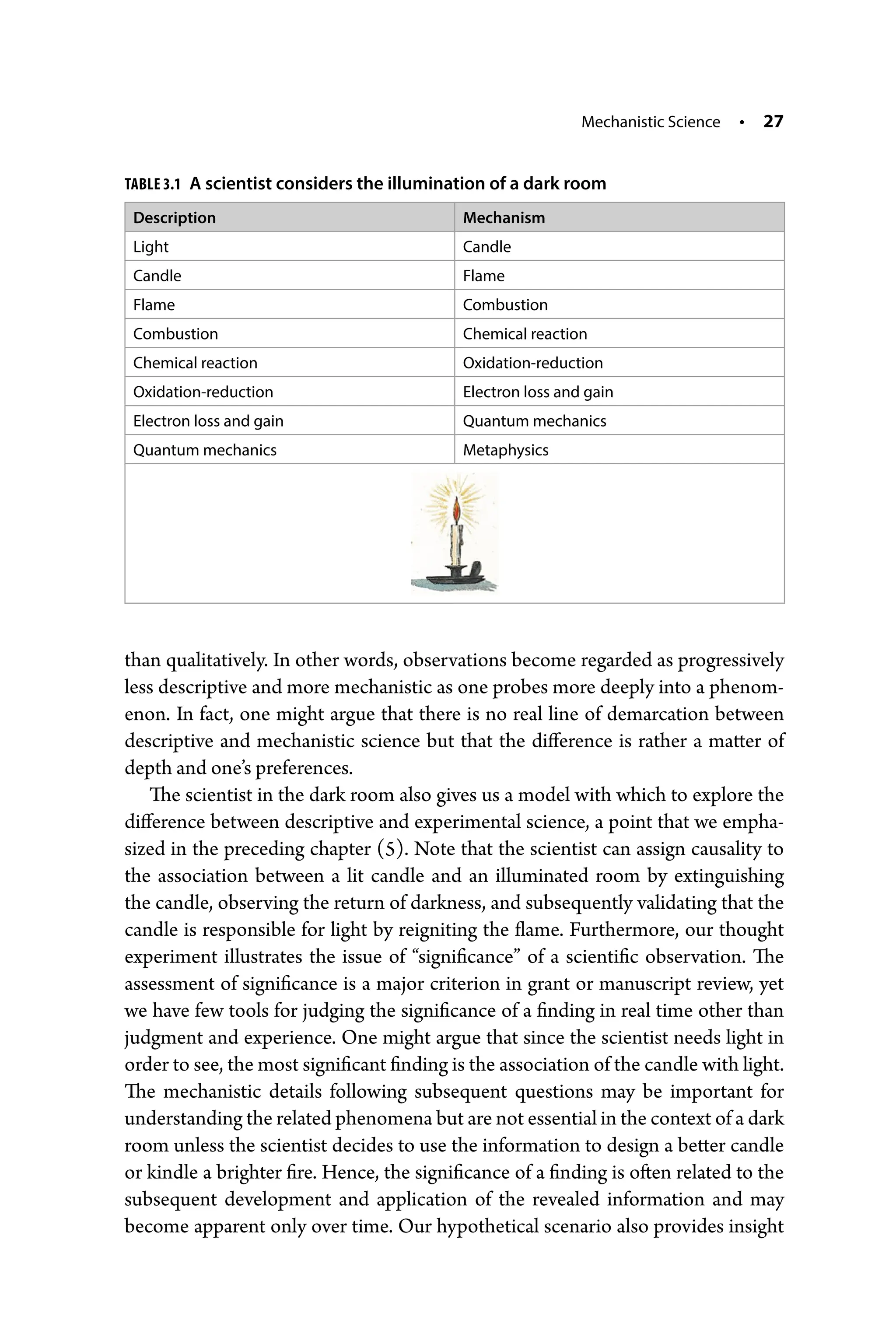
Table 3.1 A scientist considers the illumination of a dark room   27
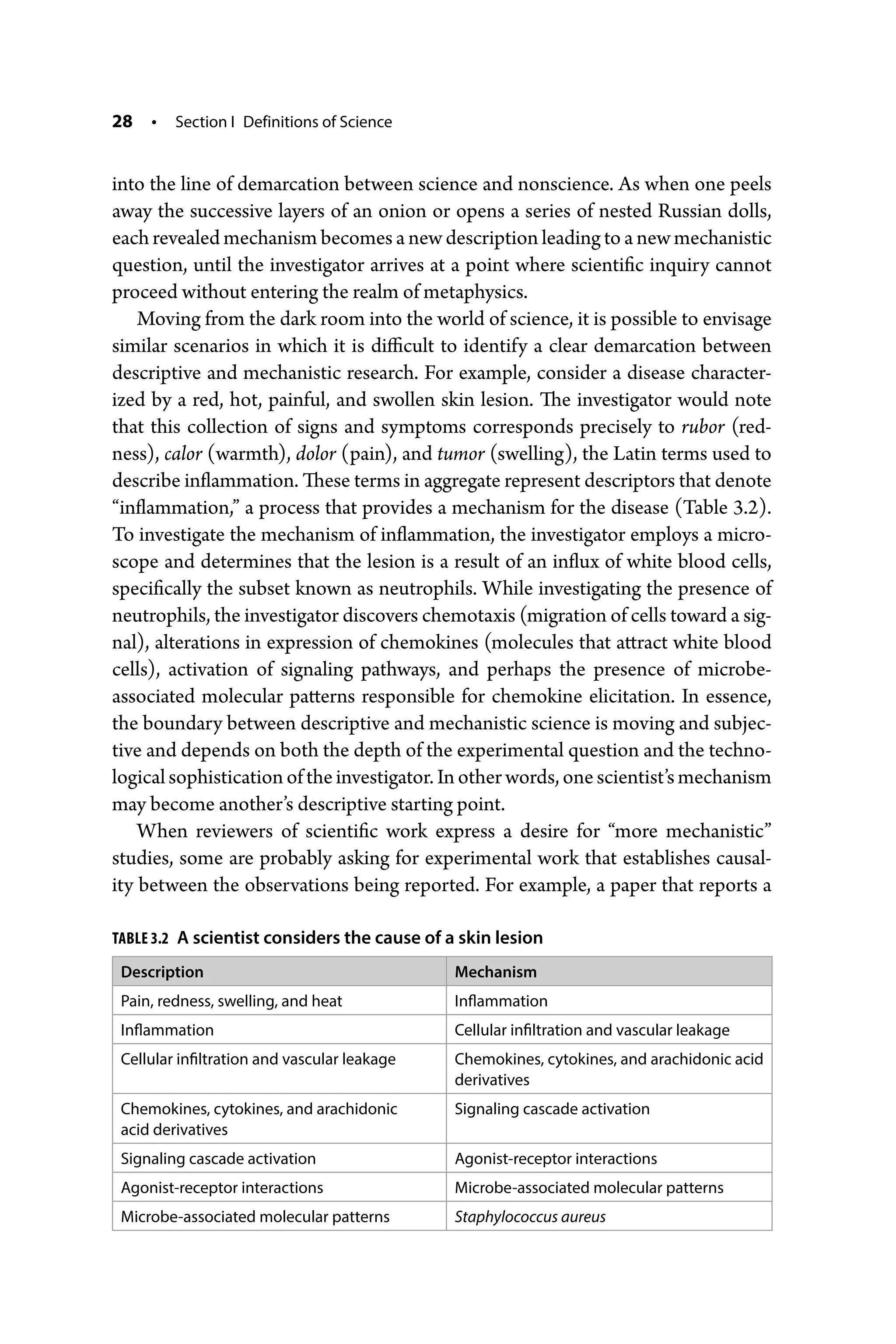
Table 3.2 A scientist considers the cause of a skin lesion   28
Table 6.1 Some elements of scientific redundancy   54
xii • Boxes, Figures, and Tables
Table 6.2 ASA principles for the use of P values  59
Table 7.1 Some causes of irreproducibility and error in biomedical sciences   65
Table 11.1 Characteristics and impact of scientific revolutions   119
Table 11.2 Some practical societal benefits from scientific revolutions   127
Table 16.1 Warning signs of pseudoscience   173
Table 19.1 Competition for money versus credit   210
Table 21.1 Some controversial Nobel Prizes in the sciences   237
Table 23.1 Potential sources of bias in grant application peer review   270
Table 24.1 Retraction problems and suggested solutions   301
Table 25.1 Categories of errors before and after 2000   305
Table 25.2 Examples of unretracted articles containing significant errors   310
Table 25.3 Examples of common errors and suggested remedies   314
Table 27.1	
A few of the scientists believed to have been injured or killed from
research-related exposures  343
Table 28.1 Some Nobel laureates who have strayed from their areas of expertise   357
Table 30.1 A comparison of pandemic responses   374
Table 31.1	
Sample checklist for an observation in which a stimulus elicits
an effect  407
xiii
Preface
We live in an age of science and technology. Science has allowed us to understand
our place in the universe and our relationship to all life on Earth. Technology has
provided a sophisticated computer on which to compose this book and allowed us
toreshapeourworldtomakelifesafer,moreproductive,andmorecomfortable.This
has never been clearer than during this time of plague, as the COVID-­
19 pandemic
enters its fourth year and finally shows signs of receding. The advanced technology
of COVID-­
19 vaccines has greatly reduced the mortality of severe acute respiratory
syndrome coronavirus 2 (SARS-­
CoV-­
2) infection and provided a vivid demonstra-
tion of the tangible benefits of science for society. As harrowing as the last few years
have been, just think of what they would have been like if we didn’t have science.
Andyet,therearesignsthatnotalliswellwiththescientificenterprise.Thepace
of transformative biomedical innovation appears to be slowing (1, 2). Fraud, slop-
piness, and error have required the retraction of publications from the literature.
Record numbers of research trainees are opting out of academic career pathways.
Surveys report declining public confidence in scientists. With looming challenges
from future pandemics, climate change, and shortages of food, water, and energy,
it is vital for the world’s scientific enterprise to be firing on all cylinders, to use an
automotive metaphor (which will happily become anachronistic as electric vehi-
cles displace those with internal combustion engines). This volume is a collection
of essays exploring the nature of science and the way that it is performed today.
In thinking about science, both good and bad, we will cast a light on contempo-
rary scientific culture and practice, provide guideposts for young scientists, and
­propose a blueprint for reforming the way that science is done.
xiv • Preface
This book is written for scientists and science students, but also for technolo-
gists, engineers, mathematicians, teachers, journalists, administrators, policymak-
ers, and anyone with an interest in science and how scientists think. The project
began 15 years ago when we were editors at the journal Infection and Immunity.
Our initial collaborative essay, called “Descriptive Science,” was prompted by
the tendency of many reviewers to dismiss work with the adjective “descriptive,”
despite the fact that description is the foundation of much of science (3). Encour-
aged by the positive responses from our colleagues, we subsequently collaborated
on more than 40 articles, editorials, or commentaries. Many of the essays in this
collection had their genesis in conversations or email exchanges, which eventually
developed into editorials or commentaries. Each has been recently updated and
supplemented with additional material for publication in this book. Nine of the
chapters are completely new and have not been published elsewhere.
Our goal has been to create a volume that can be read either sequentially or
as individual chapters, each constituting a freestanding essay that can be read
and understood independently, although we have connected the themes through
cross-­
referencing. Anyone reading the book from cover to cover will note some
repetition, as certain issues arise again and again in various contexts. This is inten-
tional and was necessary for the chapters to be able to stand on their own. We hope
that this will help to reinforce these points.
Overtheyears,wehaveoftencommentedtoeachotherhowwritingtheseessays
has improved our understanding of science and made us better scientists. We hope
the same will be true for our readers. You will find that much of the material is
slanted toward issues in the biomedical sciences, with a particular preference for the
subdisciplines of microbiology and immunology. This reflects the fact that we are
both active scientists with research programs focused on microbial pathogenesis.
We make no apologies for writing about what we know best and note that other
­
science essayists, such as Thomas Kuhn (4) and Eugene Wigner (5) writing about
scientific revolutions and the unreasonable effectiveness of mathematics, have
focused largely on examples from the physical sciences. In fact, we think that our
biomedical emphasis makes sense since the 21st century is heralded to be the bio-
logical century. We subscribe to the view that science is a continuous discipline and
observations made in one domain can apply to other domains as well. Nevertheless,
wehaveattemptedwheneverpossibletobringthephysicalsciencesintothecontext
ofouressays,andreaderswillfindnumerousreferencestoNewtonianphysics,plate
tectonics, and particle physics. We purposefully refer to some of the same scientific
discoveriesinmultiplechaptersinordertoillustratethecontinuityofthemesacross
different aspects of science using familiar examples. Hence, some scientists, such
as Alfred Wegener, Oswald Avery, and Rosalind Franklin, appear in more than one
chapter, and we hope you will enjoy becoming more acquainted with them.
Preface • xv
In many ways, Thinking about Science is a commentary on the current state
of science in the early 21st century, with a particular emphasis on biomedical
research. Although both of us are unabashed admirers of science and the scientific
process, the reader may note a critical tone in many of these chapters. This, too,
is intentional and reflects the fact that many chapters are written to highlight a
problem in science in the hope of correcting it. The “Historical Science” chapter
laments how often science ignores and neglects its history. In fact, we hope that
the book provides an accurate snapshot, from the perspective of scientists working
in the present day, for future historians of science. Similarly, we hope that chapters
such as “Descriptive Science,” “Mechanistic Science,” “Reductionistic and Holistic
Science,” and “Important Science” have captured the tension of our time regard-
ing preferred scientific approaches. “Impacted Science” describes a contemporary
sociological malady that we hope will become obsolete in future years as science
reforms its value system. “Dismal Science” delves into the economics of science,
and we hope that more economists will take an interest in this important topic
that remains largely unexplored. “Plague Science” feels unfinished, as every week
brings a new development in the COVID-­
19 pandemic, and yet we hope that the
words therein capture a sense of this moment in early 2023 by documenting suc-
cesses and failures in confronting a novel viral scourge. In updating the early chap-
ters of our collaboration, we have been both pleasantly surprised at the progress in
certain areas, such as prepublication review, efforts to improve reproducibility, and
efforts to improve equality and diversity in science, and dismayed by how little has
been done in others, such as persistent problems with peer review and funding.
Forus,thisbookhasprovidedanopportunitytoreflectandtogatherandupdate
our thoughts after 15 years of friendship and collaboration. This is, of course, a
work in progress, and we will continue our work as practitioners, observers, and
commentators of contemporary science who want to improve the scientific enter-
prise. We encourage readers to write to us with their comments, criticisms, and
suggestions so that we can continue to think about science together.
January 2023
1. Park M, Leahey E, Funk RJ. 2023. Papers and patents are becoming less disruptive over
time. Nature 613:138–144. http://dx.doi.org/10.1038/s41586-­022-­05543-­x.
2. Casadevall A. 2018. Is the pace of biomedical innovation slowing? Perspect Biol Med
61:584–593. http://dx.doi.org/10.1353/pbm.2018.0067.
3. Casadevall A, Fang FC. 2008. Descriptive science. Infect Immun 76:3835–3836. http://
dx.doi.org/10.1128/IAI.00743-­08.
4. Kuhn TS. 1970. The Structure of Scientific Revolutions, 2nd ed. The University of Chicago
Press, Chicago, IL.
5. Wigner EP. 1960. The unreasonable effectiveness of mathematics in the natural
sciences. CommunPureApplMath 13:1–14. http://dx.doi.org/10.1002/cpa.3160130102.
xvii
Acknowledgments
The opinions expressed in this book are our own, and we take full responsibility
for any errors (see chapter 25). We gratefully acknowledge the contributions of
coauthors who have collaborated with us on previous publications, including
Joan Bennett, Elisabeth Bik, Anthony Bowen, Erika Davies, Roger Davis, Daniele
Fanelli, Michael Imperiale, Amy Kullas, Margaret McFall-­
Ngai, R. Grant Steen,
and Andrew Stern. We also thank our many colleagues who have provided impor-
tant insights and feedback on the topics covered in this book, including Gundula
Bosch, Nichole ­
Broderick, Lee Ellis, Sunil Kumar, Adam Marcus, Ivan Oransky,
Liise-­
anne Pirofski, and Jessica Scoffield. We are grateful to the American Society for
Microbiology for their longstanding support and for giving us a venue to publish
our papers and ideas, in ­
particular Stefano Bertuzzi, Christine Charlip, Shannon
Vassell, Shaundra Branova, and our editor, Megan Angelini. We thank our mentors
and students, who have taught us so much and renewed our passion for science.
Finally, but certainly not least, we thank our families for their love, encouragement,
and indulgence during the many late nights and weekends that we have spent
thinking about science instead of other things. This book is dedicated to them.
xix
About the Authors
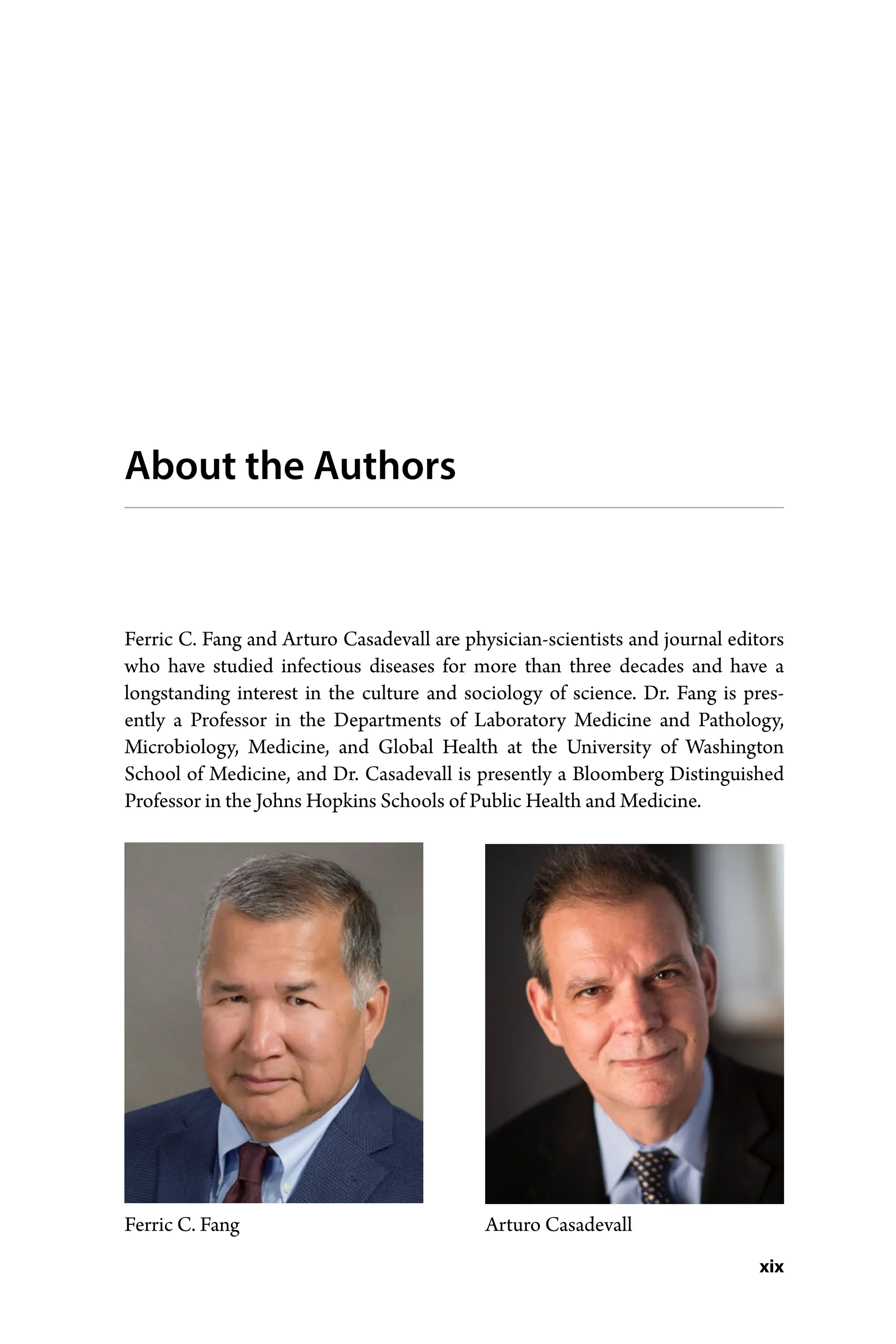
Ferric C. Fang and Arturo Casadevall are physician-­
scientists and journal ­
editors
who have studied infectious diseases for more than three decades and have a
longstanding interest in the culture and sociology of science. Dr. Fang is pres-
ently a ­
Professor in the Departments of Laboratory Medicine and Pathology,
­
Microbiology, Medicine, and Global Health at the University of Washington
School of ­
Medicine, and Dr. Casadevall is presently a Bloomberg Distinguished
Professor in the Johns Hopkins Schools of Public Health and Medicine.
Ferric C. Fang Arturo Casadevall
I DEFINITIONS OF SCIENCE
3
Thinking about Science: Good Science, Bad Science, and How to Make It Better, First Edition.
Ferric C. Fang and Arturo Casadevall.
© 2024 American Society for Microbiology.
Science is not inevitable; this question is very fruitful indeed.
Edgar Zilsel (1)
Science is humanity’s greatest invention. When difficult decisions are to be made,
everyone says that they want to “follow the science.” But what is science? The
Merriam-­
Webster online dictionary defines science as “knowledge about the
­
natural world based on facts learned through experiments and observation” (2).
The word itself is derived from the Latin word scientia, which means “knowledge.”
However, as Carl Sagan observed, “Science is more than a body of knowledge. It is
a way of thinking” (3). Thus, Great Britain’s Science Council has defined science as
“the pursuit and application of knowledge and understanding of the natural and
social world following a systematic methodology based on evidence” (4). This is
animprovement,butperhapsgoestoofarinemphasizingtheprocessover­scientific
knowledge itself.
Thomas Huxley suggested that science is merely “common sense clarified” (5),
although common sense tells us many things that science has shown to be untrue,
such as that the Sun travels around the Earth (6). Science rises beyond mere
­
observation, intuition, and association. Science is a way of acquiring knowledge
that is progressive, cumulative, testable, and predictive. Fields that call themselves
sciences share certain elements in common, including facts, theories, methods,
practices, and predictions. The most persuasive characteristic of science is that it
1What Is Science?
4 • Section I Definitions of Science
works. Science underlies all technology, from the light-­emitting diode illuminating
this room to the laptop on which this chapter is being composed, or the cellphone
giving a reminder about an imminent meeting. Yet science is much more than
technology, and its relationship to technology is complex (Box 1.1). Science allows
the recognition of principles that make the natural world comprehensible. That
doesn’t mean that science is always right, not by a long shot. Scientific knowledge
is always tentative and subject to change. But evidence of the power of the scien-
tific method is all around us, and even when science leads to errors, the method
itself embodies the means to correct its mistakes.
The scientific method was not invented all at once, but rather evolved over time
with refinement from a range of sources. The scientific method has not arisen in
every civilization. In fact, most scientific knowledge has been acquired only during
the past 400 years, less than one-­
quarter of 1% of the time that our species has
Box 1.1 Science and technology
Science and technology are often mistakenly viewed as synonymous.
Whereas a definition of science is elusive, the definition of technology is
easier. Technology is “the application of scientific knowledge for practical
purposes” (24). Hence, while science and technology are intimately associ-
ated, the two can exist independently. For example, the ancient world had
the technology to construct majestic buildings and structures such as pyra-
mids and the Great Wall of China without a formal understanding of the
laws of physics. The Industrial Revolution was catalyzed by the invention of
the steam engine, which was created by tinkering without any knowledge of
thermodynamics. In fact, the field of thermodynamics emerged afterwards
to explain phenomena observed in steam engines and in efforts to optimize
their efficiency. On the other hand, major advancements in science often
find no immediate technological applications. Einstein’s theory of general
relativity, formulated in 1916, did not find a clear technological application
until the development of a geopositioning system in the 1970s required
­
synchronization of clocks on Earth and in orbit, which run differently
depending on the gravitational field that they experience. In 2016, gravita-
tional waves were first detected using remarkable technology in the form of
paired interferometers, constructed by highly exacting tolerances prescribed
by physical laws, but these have yet to find a technological application.
Today, much scientific research is dependent on technology made possible
by our scientific knowledge.
What Is Science? • 5
inhabited the earth. In their books The Unnatural Nature of Science and Uncommon
Sense, the embryologist Lewis Wolpert and the physicist Alan Cromer, despite
theirdifferentperspectives,bothtracetheoriginsofsciencetoancientGreece(6,7).
Plato regarded reason as the most powerful capacity of human beings, Thales of
Miletus attempted to describe the nature of the world, and Aristotle defined
humans as rational animals. Aristotle distinguished induction, the inference of
­universal principles from particular observations, from deduction, in which general
principlesareusedtomakepredictionsinspecificsituations.Mostofwhat­Aristotle
had deduced turned out to be incorrect, but his mode of thinking laid a foundation
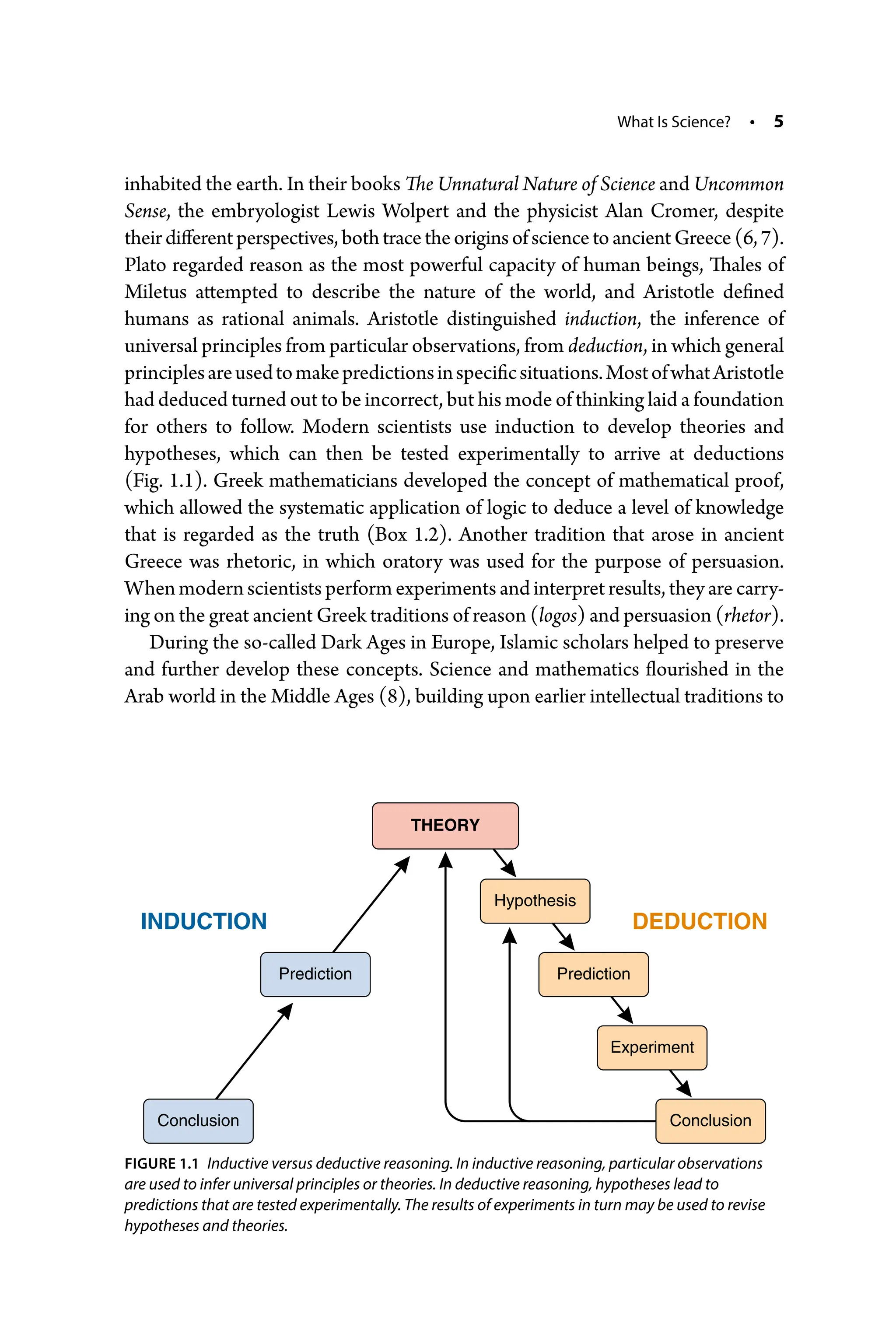
for others to follow. Modern scientists use induction to develop theories and
hypotheses, which can then be tested experimentally to arrive at deductions
(Fig. 1.1). Greek mathematicians developed the concept of mathematical proof,
which allowed the systematic application of logic to deduce a level of knowledge
that is regarded as the truth (Box 1.2). Another tradition that arose in ancient
Greece was rhetoric, in which oratory was used for the purpose of persuasion.
When modern scientists perform experiments and interpret results, they are carry-
ing on the great ancient Greek traditions of reason (logos) and persuasion (rhetor).
During the so-­
called Dark Ages in Europe, Islamic scholars helped to preserve
and further develop these concepts. Science and mathematics flourished in the
Arab world in the Middle Ages (8), building upon earlier intellectual traditions to
THEORY
INDUCTION DEDUCTION
Hypothesis
Prediction
Experiment
Conclusion
Conclusion
Prediction
FIGURE 1.1 Inductive versus deductive reasoning. In inductive reasoning, particular ­observations
are used to infer universal principles or theories. In deductive reasoning, hypotheses lead to
predictions that are tested experimentally. The results of experiments in turn may be used to revise
hypotheses and theories.
6 • Section I Definitions of Science
create a body of knowledge that was communicated to Europeans through trade
and contacts in the Iberian Peninsula. This eventually blossomed into what is rec-
ognizable as modern science during the Scientific Revolution in Western Europe.
Two influential publications were Francis Bacon’s Novum Organum, published in
1620 (9), and Rene Descartes’ Discourse on the Method, published in 1637 (10).
Novum Organum proposed an inductive method for understanding natural phe-
nomena in which relevant facts were systematically assembled and categorized
according to their association with a phenomenon of interest to generate axioms
based on empirical data. Discourse on the Method proposed that problems be
divided into smaller parts so that the simpler parts might be solved first and urged
scientists to begin any inquiry from a skeptical perspective. Scholars continue to
debate why the Scientific Revolution occurred in Western Europe rather than
­
elsewhere. Contributing factors include the continuum with classical Greek
Box 1.2 Mathematics and science
In 1960, the physicist Eugene Wigner penned an influential essay titled
“The Unreasonable Effectiveness of Mathematics in the Natural Sciences”
(25), in which he noted how mathematical relationships pervade the natural
sciences and, once identified, are predictive of new relationships and
­
findings in nature. The relationship between science and mathematics may
be viewed as essential, dependent, intricate, synergistic, and even symbiotic.
Science depends on mathematics, and advances in science and technology
furtherthedevelopmentofmathematics,asevidencedbytheever-­increasing
reliance of mathematics on computers to probe its secrets, such as finding
ever-­
larger prime numbers. At the heart of the matter is the fundamental
question of whether the essence of the natural world is mathematical. The
ancient cult of Pythagoras viewed the world as mathematical and promoted
its understanding through mathematics, a world view with echoes in Plato’s
allegory of the cave, in which a perfect world lies just beyond the senses. The
ability to express a scientific finding in the precise notation of mathematics
is considered an apotheosis in modern science. The increasing recognition
that we live in a probabilistic universe has reinforced the notion that both
discovered and as yet undiscovered mathematical relationships underlie
everything in the natural world, something that Pythagoreans would have
embraced and appreciated. Although a detailed treatment of the relation-
ship between mathematics and science is beyond the scope of this book, we
encourage budding scientists to learn as much mathematics as they can.
What Is Science? • 7
­
philosophy, the increasing prominence of academic institutions, the development
of printing and the increasing availability of books, a growing crisis between
­
religious and humanistic world views, and the rise of capitalism, which lessened
deference to authority and brought scholars and craftsmen together. The result was
the emergence of a critical mass of practitioners of the scientific method who gave
the revolution an unstoppable momentum (Box 1.3).
Box 1.3 Was science inevitable?
This chapter has emphasized the Western roots of modern science. That the
Scientific Revolution occurred in 17th-­
century Europe in unquestioned,
but contributions from many civilizations and cultures made this revolution
possible (26). We have already mentioned the critically important contribu-
tions of Islamic scholarship. In addition, Chinese civilization developed
science-­
enabling technologies such as the magnetic compass, the printing
press, and papermaking, which allowed global exploration and efficient
communication. As Bacon recognized, “Printing, gunpowder, and the com-
pass … changed the appearance and state of the world” (9). Chinese astron-
omy was also highly developed and precisely recorded a supernova in the
year 1054, which created the Crab Nebula. It is noteworthy that there is no
record of this event in Western records despite what must have been the
spectacular event in the night sky, with the appearance of a new, very bright
star that was visible during daytime. This curious and mystifying omission
from European records may reflect that it conflicted with philosophical-­
religious consensus at the time, which held that the heavens were eternal and
constant. Indian contributions to mathematics, such as the concept of zero,
the decimal system, and advanced notation systems, were essential for later
advances in theoretical physics (27). In the Americas, the Mayan civiliza-
tion developed highly advanced astronomy and mathematics, along with the
sophisticated engineering expertise to build magnificent cities. Ancient
Africans developed advanced astronomy and metallurgy (28). In Oceania,
ancient Polynesians mastered navigational skills that allowed them to travel
to remote, isolated islands. Hence, the impulse to develop mathematics and
science may be seen everywhere that humans settled and built civilizations
and reflects the indomitable human curiosity. The will to do science, like the
will to make music, can be viewed as a universal human trait. However, in
contrast to the development of scientific concepts and mathematics in other
(Continued)
8 • Section I Definitions of Science
In the 1920s, a school of philosophy known as logical positivism, with centers in
the European capitals of Vienna and Berlin, asserted that truth must be demon-
strated by direct observation or logical proof. Thus, scientific knowledge was
favored over other forms of knowledge. In the classic formulation of the scientific
method, science consists of careful observation and description, formulation of a
hypothesis, and experimental testing of predictions. An implicit assumption is that
experimental results can be replicated by others (chapter 7). Although this so-­
called “hypothetico-­deductive” approach is not the only way of doing science, it is
what many people think of when referring to the scientific method.
Logical positivism ultimately fell out of favor among philosophers of science,
although its influence on 20th-­
century philosophy of science is undeniable. One
reason for the decline of logical positivism is an inability to provide a clear demar-
cation between science and nonscience. Any definition of science must be able to
distinguish it from pseudoscience, such as astrology, alchemy, creationism, and
homeopathy. In fact, separating pseudoscience from science can be difficult since
those disciplines have many of the trappings of science, including theory, method,
and practice (see chapter 16). For the Austrian philosopher Karl Popper, the issue
societies, the Scientific Revolution gave rise to unique new insights,
­
formalisms, and ways to investigate the world—­
the creation of the modern
scientific method and scientific disciplines and institutions. The Scientific
Revolution allowed humanity to overcome the limits of intuitive thinking,
which serves us well in many situations but can lead us astray when trying to
understand natural phenomena.
To return to Edgar Zilsel’s question at the beginning of this chapter, we
must consider the uniqueness of the Scientific Revolution. While there is
abundant evidence of curiosity, ingenuity, creativity, and mathematics in
many human civilizations, what we call modern science has arisen only
once. This alone suggests that science was not an inevitable consequence of
the evolution of human thought. Accordingly, science should not be taken
for granted. Why it arose in 17th-­century Europe, rather than in other scien-
tifically and mathematically sophisticated societies, remains a fascinating
and open question. It is probably not a coincidence that Europe during this
periodalsowitnessednewtechnologiesliketheprintingpressandtelescope,
brutal wars of religion, and the upheaval of medieval theology by the
­
Protestant Reformation. Modern science may owe its existence to an
­unusual confluence of technological, historical, and sociological events.
Box 1.3 (Continued)
What Is Science? • 9
of demarcating science from nonscience was a central issue. He was concerned
that a statement can never be definitively verified, only falsified (11). In his classic
example, no amount of evidence can ever prove the assertion that all swans are
white, but the assertion may be disproved by the sighting of a single black swan.
Reliance on verification cannot distinguish science from pseudoscience, as pseu-
doscience may use inductive reasoning to generate false theories and selectively
collect observations that appear to verify them. Instead, Popper proposed that sci-
entificassertionsshouldbefalsifiableifshowntoconflictwithobservableevidence
(or even theoretically observable evidence). This concept has proven popular with
scientists. However, falsifiability has its limitations and fails to describe much of
what scientists actually do. Furthermore, the quest for falsification itself can be an
impossible journey. For example, the statement that all iron has ferromagnetism
cannot be falsified unless all iron in the universe is examined, which is an
­impossible task.
The physicist and philosopher Thomas Kuhn argued that much of “normal
­science” consists of puzzle-­solving rather than testing for falsifiability, and that it is
the feature of puzzle-­
solving that best provides a basis for the demarcation of
­science (12). Kuhn also proposed that scientists are guided by paradigms, broadly
explanatory models or theories that can periodically undergo a radical change
when they no longer conform to objective reality (see further discussion in
­
chapter 11). Kuhn’s views have also been challenged. The concept of paradigms
implies an element of subjectivity in science and has been used by postmodernists
to question whether science is superior to other forms of knowledge. In fact, Paul
Feyerabend declared that a definition of science is impossible, and that the only
principle is “anything goes” (13). Rather than specifying criteria to define science,
the physicist John Ziman opted for a social definition consisting of a consensus
among competent researchers (14).
While each of these efforts ultimately falls short of providing a universally satis-
fying definition of science, one can take a pragmatic approach to identifying core
principles that distinguish science from nonscience (15). Conserved characteris-
tics of science, such as an absence of supernatural explanations, measures to reduce
the risk of bias, receptivity to new evidence, and support from independent forms
of evidence, can help to distinguish science from pseudoscience. Although the
world may indeed be “awash in bullshit,” as some authors claim (16), science pro-
vides the tools to distinguish truth from bullshit. Nevertheless, as we will discuss
in detail in later chapters, it can be challenging to distinguish good science from
bad or fraudulent science, and the problem is even more daunting for nonscien-
tists. Most nonscientists lack a sufficient understanding of the scientific method
and the mathematics of uncertainty to critically evaluate scientific information,
and people who trust science are not necessarily immune to misinformation (17).
10 • Section I Definitions of Science
Science as it is presently understood possesses several essential characteristics:
(i) an assumption that nature can be understood without having to invoke super-
natural forces; (ii) a requirement for supporting evidence; (iii) arguments that
conform to logical chains of reasoning; (iv) accumulation of knowledge that can
change and undergo refinement over time as a result of new ideas or observations
and improvements in methodology; and (v) predictive power. Expertise is valued
in science, but authority is not (chapter 28). A characteristic of science that sets it
apart from other human endeavors is that it embraces the notion that all knowl-
edge is provisional and that answering one scientific question inevitably leads to
another (Box 1.4). Bias refers to any process that can improperly influence scien-
tific inquiry and lead to erroneous conclusions. Accordingly, bias is to be avoided
as much as possible, and potential sources of bias must be identified. For example,
simple measures such as the inclusion of control groups, randomization, and
blinding can help to control for selection bias, but there are many other potential
forms of bias (18). As science has advanced, the development of probability,
Bayesian analysis, and other statistical tools has allowed increasing rigor and the
estimation of scientific certainty (Box 1.5).
Box 1.4 Science and uncertainty
The acknowledgment of uncertainty and that one might be wrong is as
important for science as the quest for knowledge. Many ancient cul-
tures were certain that the Earth was flat, with the heavens above and
the ground below—­
until the 6th century BCE, when the pre-­
Socratic
Greek philosopher Anaximander suggested that the Earth is suspended
in space, with celestial bodies situated all around. Although he did not
realize that the Earth is spherical or that it orbits around the Sun, his
insight was nevertheless a revolutionary idea that enabled subsequent
advances in Greek astronomy. His contemporary Pythagoras subse-
quently taught that the Earth is spherical, and this idea spread so that
Pliny the Elder could state in the 1st century CE that this fact was
­
universally accepted. In contrast, although Aristarchus of Samos pro-
posed a heliocentric model of the ­universe in the 3rd century BCE, his
notion was rejected in favor of the geocentric models of Aristotle and
Ptolemy, and Aristarchus would not be vindicated until Copernicus
published De Revolutionibus Orbium ­
Coelestium 1,800 years later. Why
did ­geocentrism persist for so long when it conflicted with the ­measured
What Is Science? • 11
movement of the planets, in particular the periodic retrograde motion
of Mars? Ptolemy was so certain of geocentrism that he created an
extraordinarily complex explanation in which planets traveled in small
epicycles that traveled around the Earth. When this also proved inade-
quate to account for planetary motion, additional epicycles were added,
so that epicycles were traveling in epicycles around other epicycles. In
retrospect, this model violates the principle of parsimony and is ludi-
crously wrong. However, it also illustrates the danger of certainty. As
the theoretical physicist Carlo Rovelli has observed: “Science is not
about certainty. Science is about finding the most reliable way of think-
ing at the present level of knowledge. ... In fact, it’s the lack of ­certainty
that grounds it” (29).
While science allows us to conclude some things with reasonable
­certainty, such as that the Earth orbits the Sun, even that knowledge is tem-
poral and provisional, as the solar system is evolving. In a few billion years,
the Sun will exhaust its fuel and is expected to expand into a red giant and
swallow the Earth. An essential feature of science is the humility to remain
open to new evidence and ideas.
Ancient Roman mosaic from 3rd century CE depicting Anaximander holding a sundial.
Courtesy of GDKE-­Rheinisches Landesmuseum Trier, Thomas Zühmer.
12 • Section I Definitions of Science
Box 1.5 Where do formulas in science come from?
Laws in science are often stated as formulas that relate a fact to a set of
­
variables. Examples are Newton’s and Einstein’s famous formulas for force
(F = ma, or force = mass × acceleration) and energy (E = mc2
, or energy =
mass × square of speed of light), respectively. So, a reasonable question to
ask when thinking about science is: Where do these relationships come
from? Certainly, they are not written down in nature until they come from
the minds of scientists. Richard Feynman addressed this question in one of
his famous Messenger Lectures, “The Character of Physical Law,” given at
Cornell University on November 9, 1964 (30). According to Feynman, the
first step is to “guess,” and then to compare the results of the equation to
experimental data and see what happens. If the formula’s predictions match
the experimental results, the formula may be right. If the results are discrep-
ant, then the formula is wrong and must be discarded. This reveals the
insight that mathematical relationships can explain laws of nature. Scientists
tinker with variables to see what works and validate formulas by careful
observation and measurement. However, Feynman may have overstated
things a bit when he said, “First, we guess it.” An equation represents a highly
educated guess, not just intuition. For instance, Newton’s second law of
motion can be inferred by the observation that a change in the momentum
of an object varies directly in proportion to the force exerted on the object
but inversely in proportion to its mass. All that’s left is to collect observa-
tions and determine whether a coefficient is required. Ohm’s law, in which
current or flow varies in proportion to voltage but inversely in proportion to
resistance, is analogous. Feynman was simply restating inductive inference
from observation, which leads to hypothetical formulas or laws that can be
tested experimentally (Fig. 1.1).
Hence,theremaybedifferentroutestofindinganequationthatdescribes
nature. We could imagine that the sequence to finding a law of nature and
representing it mathematically follows the sequence of observation, insight,
tinkering with equations, and validating with experimental data. In this
sequence, the first step, observation, can involve the collection of data that
provide the basis for writing down formulas until one fits the data and mak-
ing predictions that can be validated by subsequent experiments. The uni-
verse functions by unwritten laws that the human mind can discern, write
down, and use to explain natural phenomena.
What Is Science? • 13
It is also important to remember that science aims to accurately describe
­physical reality but does not provide answers to questions of morality. In the 18th
century, the Scottish philosopher David Hume discussed this as the “is-­
ought
problem” (19); in other words, one cannot conclude what ought to be on the basis
of what is. For questions of right and wrong, science and ethics may be viewed as
separate magisteria (20), although science can certainly be informed by an applica-
tion of ethical principles, and neuroscience may one day provide a biological
explanation for human ethical behavior. In addition to adhering to principles of
research integrity (see chapters 18 and 29), scientists have a responsibility to
understand the ethical and social dimensions of their work and to ensure that
­scientific knowledge is used wisely and in the public interest (21).
The coexistence of science with religion has often been fraught, and that ­tension
has led to conflict, as evidenced in the struggles between Galileo and the Inquisi-
tion and more recently between evolution and creationism. Stephen Jay Gould
introduced the concept of “NOMA,” or nonoverlapping magisteria (20), to argue
that science and religion occupy different spheres of human action and thought.
However, just as defining science is difficult, drawing a bright line of separation
between science and religion is not always straightforward, and each may intrude
on the other. Religion relies on received wisdom that is permanent and dependent
on the supernatural, whereas science produces knowledge based on observable
evidence, which is always provisional and subject to change as new information
becomes available. The NOMA concept requires adherents of science and religion
to agree to accept their limitations, e.g., Galileo’s assertion that “the intention of
the Holy Spirit is to teach us how one goes to heaven, not how the heavens go”
(22).However,NOMAoftenfailsinpracticebecausescienceandreligionencoun-
ter irreconcilable conflicts with regard to fundamental questions such as the origin
of life, and science and faith are fundamentally incompatible at an epistemological
level. Nevertheless, science and religion can find many areas of common ground
(23), and frequently manage to coexist peacefully, even within the same individ-
ual. This is fortunate, as both science and religion have much to offer humanity.
In summary, science is a body of knowledge, a way of thinking, and a method for
studying and understanding the natural world. Just as scientific knowledge has
evolved over time, undergoing constant testing, reinforcement, and refinement
from the contributions of innumerable scientists, so have the scientific method and
the definition of science evolved over time. Although scientific revolutions occur
only rarely (more on this topic in chapter 11), scientific knowledge and methodol-
ogy continue to grow and advance with every passing year. With all that in mind, we
shall now explore in detail how science can be done well or poorly and used for
good or ill, and what that may mean for both science itself and society as a whole.
15
Thinking about Science: Good Science, Bad Science, and How to Make It Better, First Edition.
Ferric C. Fang and Arturo Casadevall.
© 2024 American Society for Microbiology.
Certainly no developed science is merely descriptive in the
­narrower sense of the word—­it seeks to explain.
Ernest Albee (1)
The word “descriptive” is defined as “referring to, constituting or grounded in
­
matters of observation or experience” (2). Since practically all laboratory-­
based
­
science is based on recording evidence from experimentation, it might be argued
that all science is in some sense “descriptive.” However, scientists distinguish
between descriptive research, in which information is collected without a par-
ticular question in mind, and hypothesis-­
driven research, which is designed
to test a specific explanation for a phenomenon. In this dichotomy, “descrip-
tive” has numerous synonyms, including “observational,” “inductive,” or “fishing
expedition,” while “hypothesis-­
driven” may also be referred to as “hypothetico-­
deductive” or “mechanistic” (see chapter 3). When scientists favor hypothesis-­
driven science over descriptive science, they are really saying that they prefer
work that is explanatory or provides insights into causation.
Journals commonly state that they will not consider papers that are “purely
descriptive” (3), although what this means is usually not defined. When applied to
science, the word “descriptive” has acquired dismissive or pejorative connotations
and is frequently provided as justification for rejection of a manuscript or grant
application. Given the widespread use of this adjective and its profound implica-
tions, it is worthwhile to reflect on what is right or wrong with descriptive science.
2Descriptive Science
16 • Section I Definitions of Science
In considering this issue, it is noteworthy that many esteemed scientific dis-
ciplines, such as astronomy, archaeology, and paleontology, are almost entirely
descriptive sciences (4). Newton’s laws of motion can be considered descriptive,
and there is nothing mechanistic about the gravitational constant. Nevertheless,
we hold these laws in great esteem because they are able to predict the behavior of
the natural world. One cannot perform an experiment in which a stellar variable
(Box 2.1) or a geological epoch is altered. Moreover, the descriptive sciences of
taxonomy, anatomy, botany, and paleontology have been central to the develop-
ment of evolutionary theory, which remains the linchpin of all biological sciences.
Hence, there is nothing fundamentally wrong with descriptive research, with
the caveat that a scientific field may demand more from an investigator once it
becomes an experimental science.
Box 2.1 Careful description leads to cosmic understanding
As telescopes improved, astronomers discovered an astounding number of
stars and cloudy patches known as nebulae. In the early 20th century, the
nature of nebulae was unknown and there were no methods available to
measure cosmic distances. The marrying of telescopes with photographic
cameras allowed astronomers to take long-­
exposure photographs and see
objects that were too dim for the naked eye. Soon, however, it was evi-
dent that analyzing celestial photographs to map stars was a very laborious
process. Edward Pickering at Harvard College Observatory hired women
known as “computers” to assist in the identification and cataloguing of stars
accordingtotheirbrightnessandspectralcharacteristics.TheHarvardCom-
puters analyzed thousands of photographic plates. Among these women was
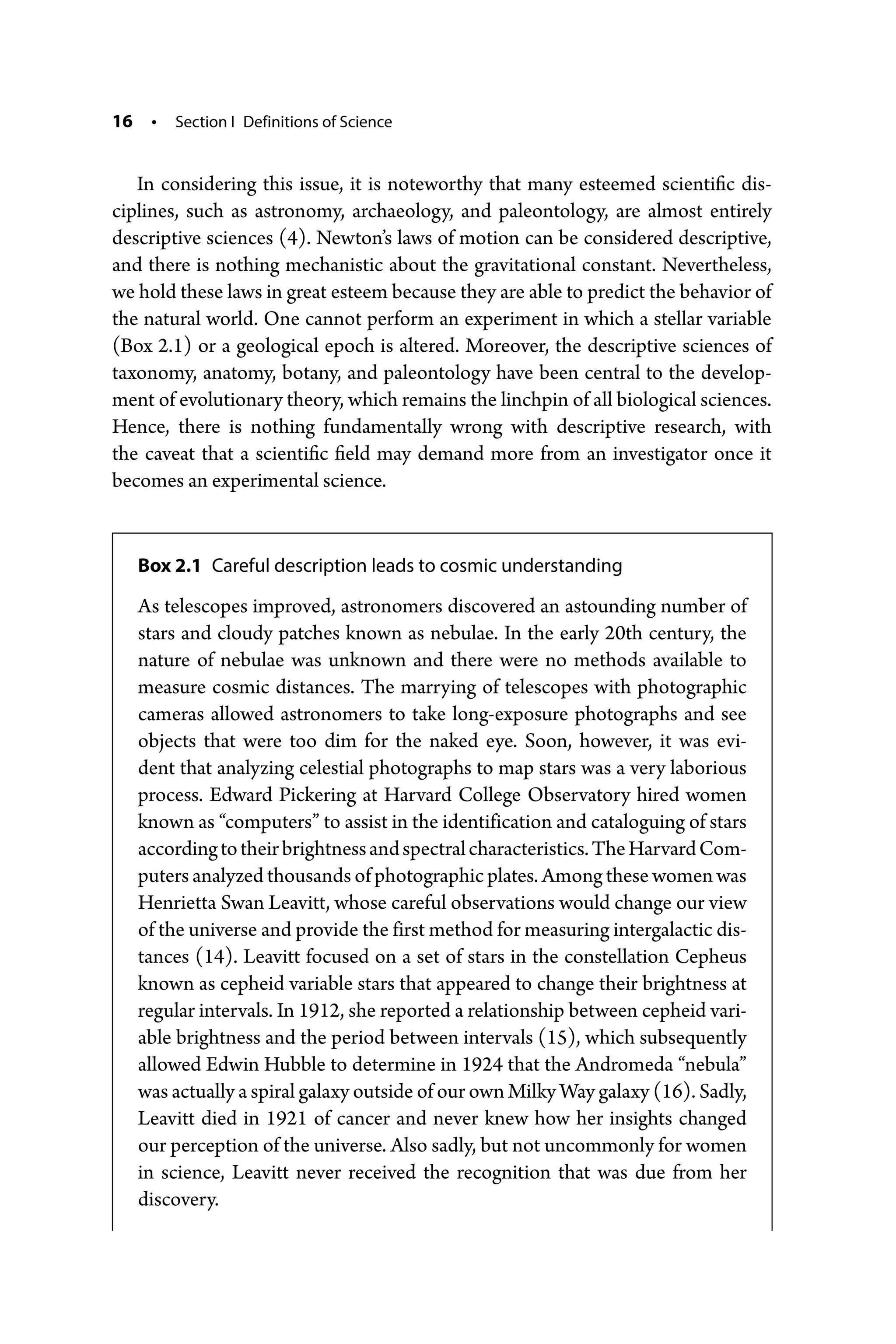
Henrietta Swan Leavitt, whose careful observations would change our view
of the universe and provide the first method for measuring intergalactic dis-
tances (14). Leavitt focused on a set of stars in the constellation Cepheus
known as cepheid variable stars that appeared to change their brightness at
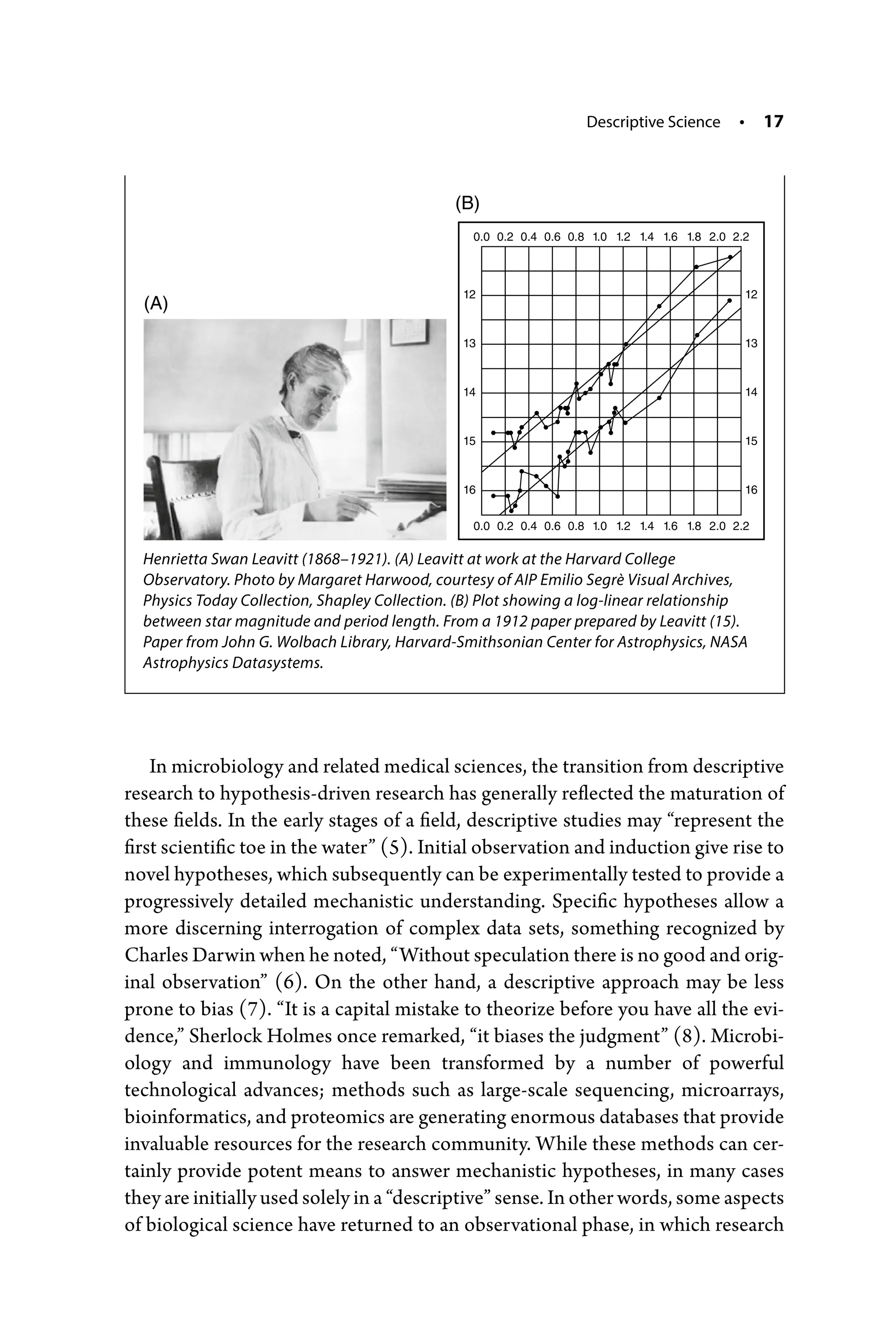
regular intervals. In 1912, she reported a relationship between cepheid vari-
able brightness and the period between intervals (15), which subsequently
allowed Edwin Hubble to determine in 1924 that the Andromeda “nebula”
was actually a spiral galaxy outside of our own Milky Way galaxy (16). Sadly,
Leavitt died in 1921 of cancer and never knew how her insights changed
our perception of the universe. Also sadly, but not uncommonly for women
in science, Leavitt never received the recognition that was due from her
discovery.
Descriptive Science • 17
In microbiology and related medical sciences, the transition from descriptive
research to hypothesis-­
driven research has generally reflected the maturation of
these fields. In the early stages of a field, descriptive studies may “represent the
first scientific toe in the water” (5). Initial observation and induction give rise to
novel hypotheses, which subsequently can be experimentally tested to provide a
progressively detailed mechanistic understanding. Specific hypotheses allow a
more discerning interrogation of complex data sets, something recognized by
Charles Darwin when he noted, “Without speculation there is no good and orig-
inal observation” (6). On the other hand, a descriptive approach may be less
prone to bias (7). “It is a capital mistake to theorize before you have all the evi-
dence,” Sherlock Holmes once remarked, “it biases the judgment” (8). Microbi-
ology and immunology have been transformed by a number of powerful
technological advances; methods such as large-­
scale sequencing, microarrays,
bioinformatics, and proteomics are generating enormous databases that provide
invaluable resources for the research community. While these methods can cer-
tainly provide potent means to answer mechanistic hypotheses, in many cases
they are initially used solely in a “descriptive” sense. In other words, some aspects
of biological science have returned to an observational phase, in which research
(A)
(B)
0.0
12
13
14
15
16
12
13
14
15
16
0.2 0.4 0.6 0.8 1.0 1.2 1.4 1.6 1.8 2.0 2.2
0.0 0.2 0.4 0.6 0.8 1.0 1.2 1.4 1.6 1.8 2.0 2.2
Henrietta Swan Leavitt (1868–­1921). (A) Leavitt at work at the Harvard College
Observatory. Photo by Margaret Harwood, courtesy of AIP Emilio Segrè Visual Archives,
Physics Today Collection, Shapley Collection. (B) Plot showing a log-­linear relationship
between star magnitude and period length. From a 1912 paper prepared by Leavitt (15).
Paper from John G. Wolbach Library, Harvard-­Smithsonian Center for Astrophysics, NASA
Astrophysics Datasystems.
18 • Section I Definitions of Science
is primarily discovery-­driven rather than hypothesis-­driven (9). Such research is
clearly important when it leads to the recognition of novel phenomena or the
generation of novel hypotheses. However, microbiology and immunology are
now experimental sciences, and ­
consequently investigators can go beyond sim-
ply describing observations to formulate hypotheses and then perform experi-
ments to validate or refute them.
Why, then, the proscription against descriptive science? Editors and reviewers
distinguish between descriptive science that significantly advances the field and
mere descriptive science that does not further understanding. The former might be
appropriate for publication in a selective journal, but the latter will almost always
be returned to the authors as too preliminary. An example of a rejected descriptive
manuscript would be a survey of changes in gene expression or cytokine produc-
tion under a given condition. These manuscripts usually fare poorly in the review
process and are assigned low priority on the grounds that they are merely descrip-
tive; some journals categorically reject such manuscripts (10). Although survey
studiesmayhavesomevalue,theirvalueisgreatlyenhancedwhenthedataleadtoa
hypothesis-­driven experiment. For example, consider a cytokine expression study
in which an increase in a specific inflammatory mediator is inferred to be impor-
tant because its expression changes during infection. Such an inference cannot be
made on correlation alone, since correlation does not necessarily imply a causal
relationship. The study might be labeled “descriptive” and assigned low ­
priority.
On the other hand, imagine the same study in which the investigators use the ini-
tial data to perform a specific experiment to establish that blocking the cytokine
has a certain effect while increasing expression of the cytokine has the opposite
effect. By manipulating the system, the investigators transform their study from
merely descriptive to hypothesis-­
driven. Hence, the problem is not that the study
is descriptive per se but rather that there is a preference for studies that provide
novel mechanistic insights.
When a manuscript is rejected by a journal for being “merely descrip-
tive,” the reviewer is essentially saying that the work has not revealed novel
­
phenomena, has failed to generate interesting novel hypotheses, or has failed
to adequately follow up such hypotheses with further experimentation. The
most common reason for a paper to be assessed as “merely descriptive” is that
more in-­
depth investigation is required. A reviewer who recommends that a
paper be rejected because it is “merely descriptive” can provide a great service
to the authors by clearly and unambiguously explaining the additional studies
required for the paper to become more significant and therefore more interest-
ing (Box 2.2).
Descriptive Science • 19
Descriptive observations play a vital role in scientific progress, particularly
­
during the initial explorations made possible by technological breakthroughs.
­
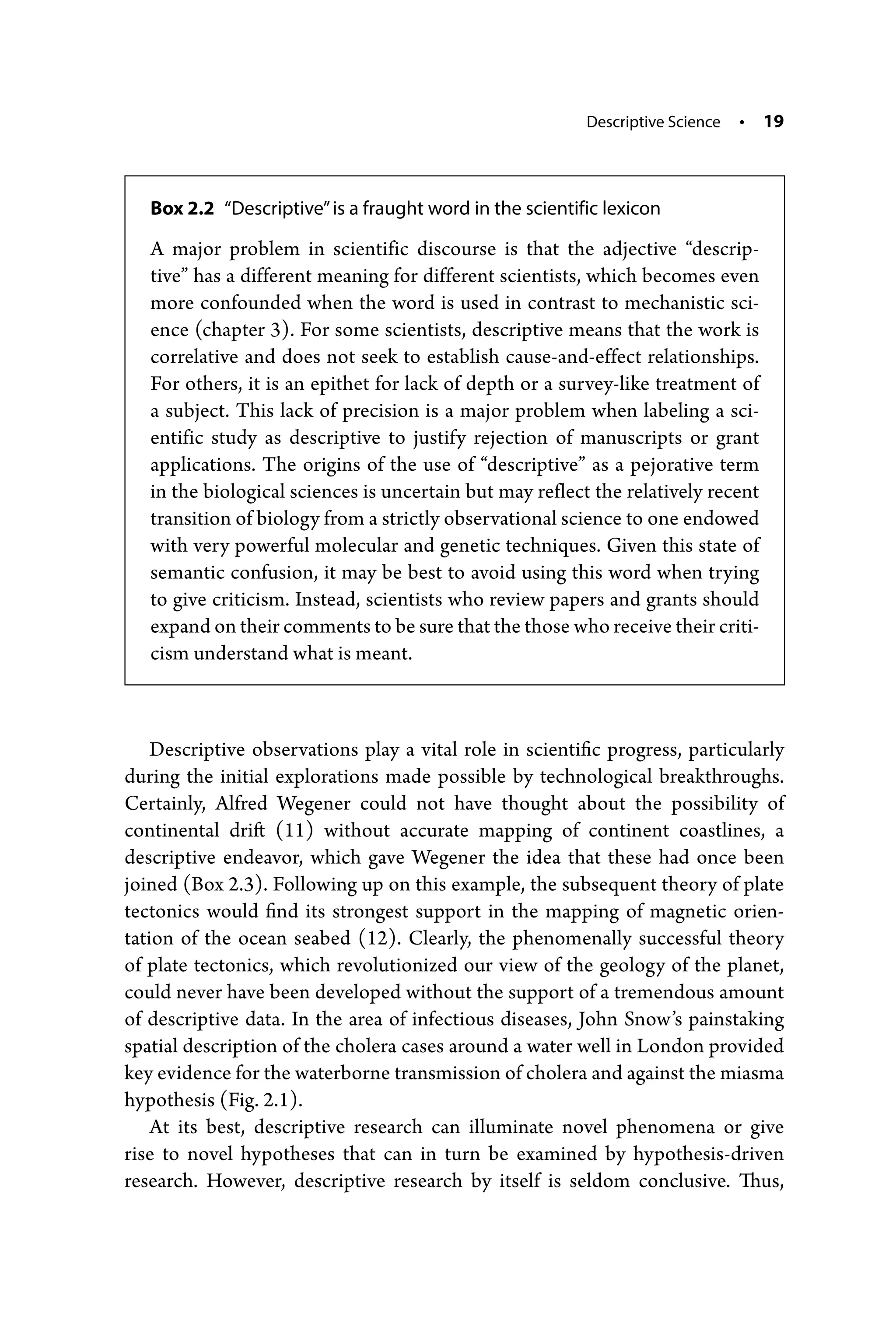
Certainly, Alfred Wegener could not have thought about the possibility of
­
continental drift (11) without accurate mapping of continent coastlines, a
descriptive endeavor, which gave Wegener the idea that these had once been
joined (Box 2.3). Following up on this example, the subsequent theory of plate
tectonics would find its strongest support in the mapping of magnetic orien-
tation of the ocean seabed (12). Clearly, the phenomenally successful theory
of plate tectonics, which revolutionized our view of the geology of the planet,
could never have been developed without the support of a tremendous amount
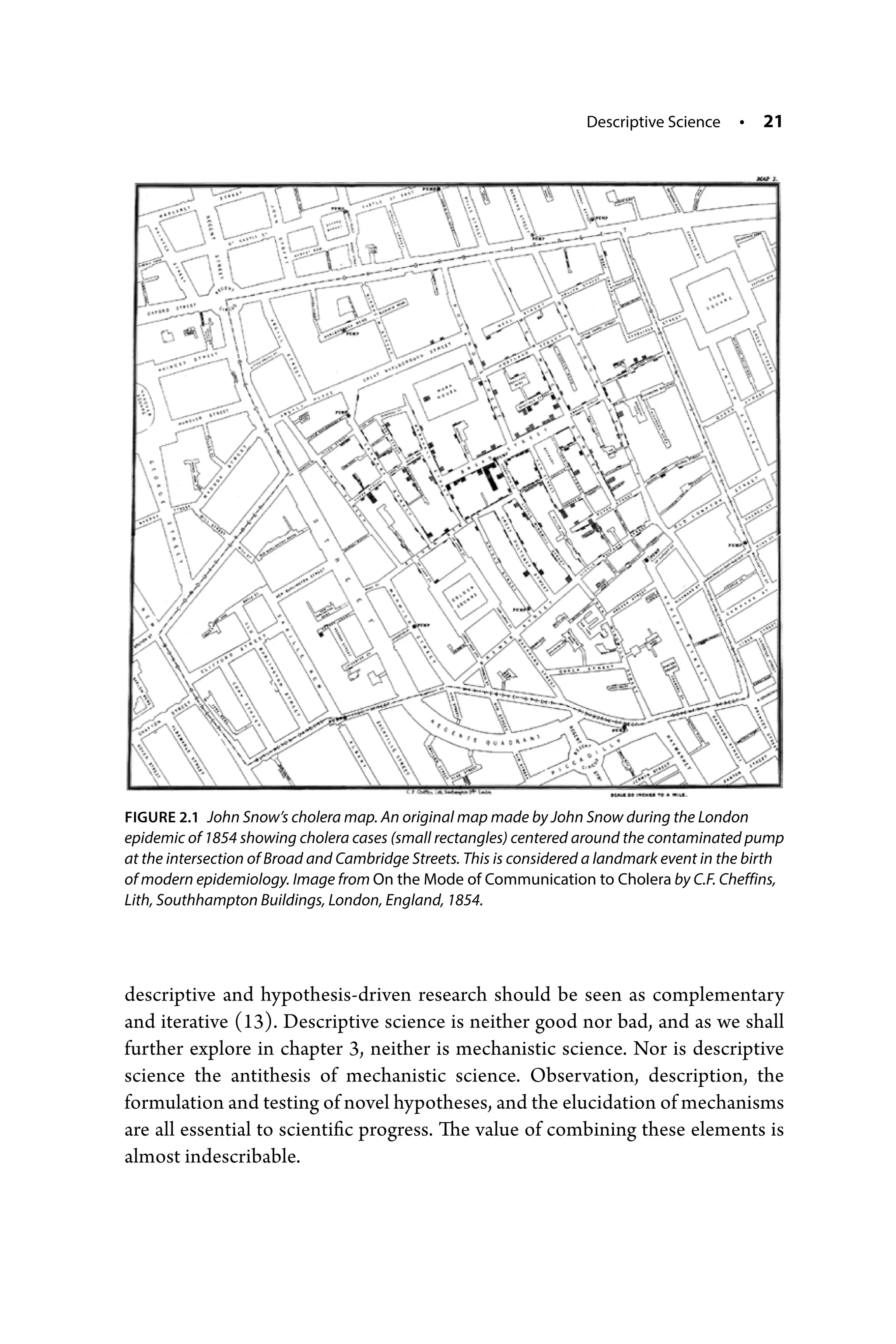
of descriptive data. In the area of infectious diseases, John Snow’s painstaking
spatial description of the cholera cases around a water well in London provided
key evidence for the waterborne transmission of cholera and against the miasma
hypothesis (Fig. 2.1).
At its best, descriptive research can illuminate novel phenomena or give
rise to novel hypotheses that can in turn be examined by hypothesis-­
driven
research. However, descriptive research by itself is seldom conclusive. Thus,
Box 2.2 “Descriptive”is a fraught word in the scientific lexicon
A major problem in scientific discourse is that the adjective “descrip-
tive” has a different meaning for different scientists, which becomes even
more confounded when the word is used in contrast to mechanistic sci-
ence (chapter 3). For some scientists, descriptive means that the work is
correlative and does not seek to establish cause-­
and-­
effect relationships.
For others, it is an epithet for lack of depth or a survey-­
like treatment of
a subject. This lack of precision is a major problem when labeling a sci-
entific study as descriptive to justify rejection of manuscripts or grant
applications. The origins of the use of “descriptive” as a pejorative term
in the biological sciences is uncertain but may reflect the relatively recent
transition of biology from a strictly observational science to one endowed
with very powerful molecular and genetic techniques. Given this state of
semantic confusion, it may be best to avoid using this word when trying
to give criticism. Instead, scientists who review papers and grants should
expand on their comments to be sure that the those who receive their criti-
cism understand what is meant.
20 • Section I Definitions of Science
Box 2.3 Careful description can lead to revolutionary new insights
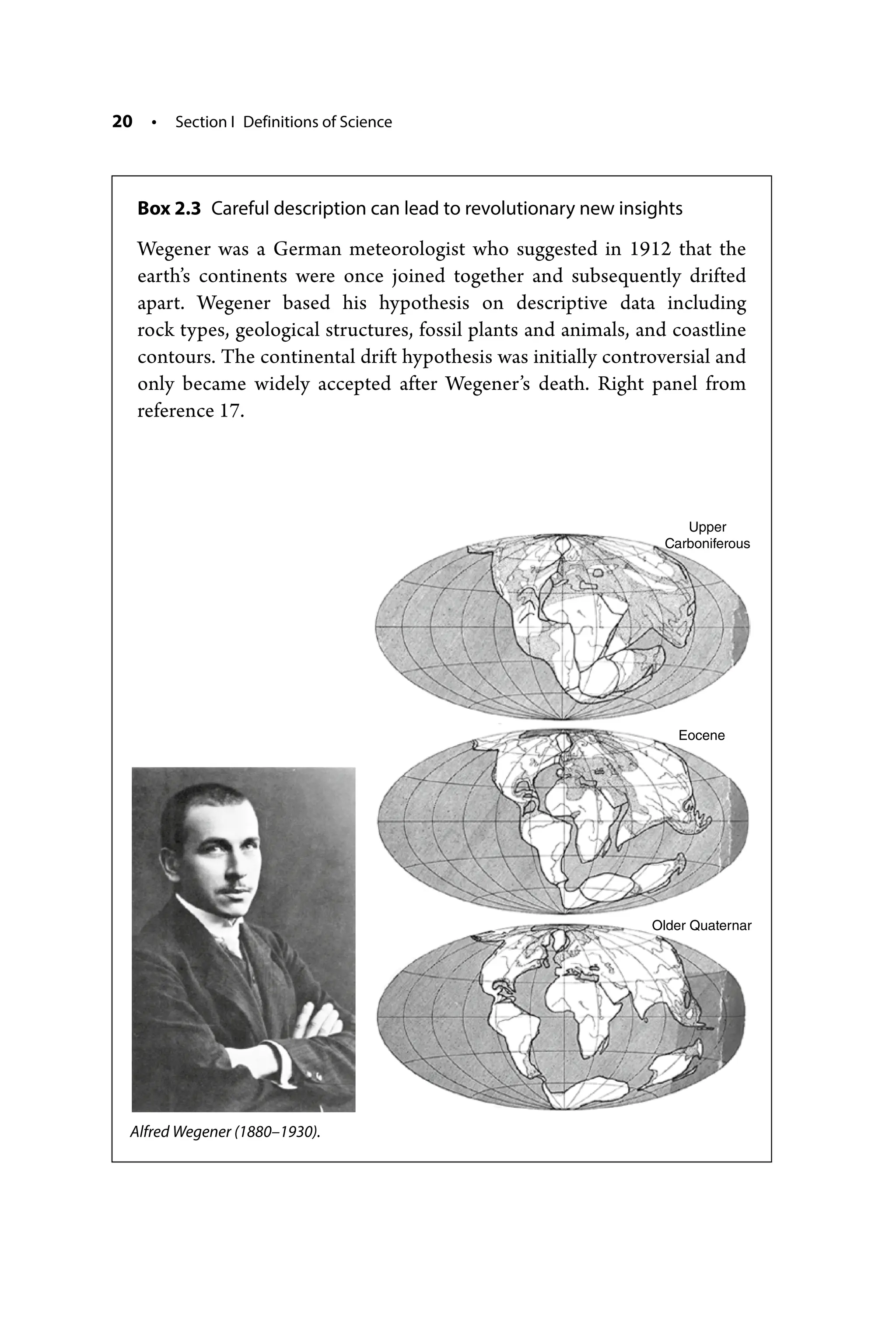
Wegener was a German meteorologist who suggested in 1912 that the
earth’s continents were once joined together and subsequently drifted
apart. Wegener based his hypothesis on descriptive data including
rock types, geological structures, fossil plants and animals, and coastline
contours. The continental drift hypothesis was initially controversial and
only became widely accepted after Wegener’s death. Right panel from
reference 17.
Upper
Carboniferous
Eocene
Older Quaternar
Alfred Wegener (1880–­1930).
Descriptive Science • 21
descriptive and hypothesis-­
driven research should be seen as complementary
and iterative (13). Descriptive science is neither good nor bad, and as we shall
further explore in chapter 3, neither is mechanistic science. Nor is descriptive
science the antithesis of mechanistic science. Observation, description, the
­formulation and testing of novel hypotheses, and the elucidation of mechanisms
are all essential to scientific progress. The value of combining these elements is
almost indescribable.
FIGURE 2.1 John Snow’s cholera map. An original map made by John Snow during the London
epidemic of 1854 showing cholera cases (small rectangles) centered around the contaminated pump
at the intersection of Broad and Cambridge Streets. This is considered a landmark event in the birth
of modern epidemiology. Image from On the Mode of Communication to Cholera by C.F. Cheffins,
Lith, Southhampton Buildings, London, England, 1854.
23
Thinking about Science: Good Science, Bad Science, and How to Make It Better, First Edition.
Ferric C. Fang and Arturo Casadevall.
© 2024 American Society for Microbiology.
Science is the knowledge of consequences, and dependence
of one fact upon another.
Thomas Hobbes (1)
In contrast to the pejorative use of the adjective “descriptive” discussed in the
preceding chapter, the term “mechanistic” is usually used to praise the quality
of science. This is apparent in discussions when the phrases “mechanistic under-
standing” and “mechanistic approach” are used to convey a sense of high-­
quality
research. Science educators attempt to instill “molecular mechanistic reasoning”
into the curriculum through the use of graphics and models (2). In reviews of sci-
entific manuscripts and grants, the words “mechanistic” and “descriptive” are often
misused as synonyms for “good” and “bad,” respectively (3, 4).
However, the extraordinary power of the words “descriptive” and “­mechanistic”
requires us to wield them carefully when critiquing science. In chapter 2, we con-
sidered the epithet “descriptive” and argued for an important role of descriptive
studies in many scientific fields, while also acknowledging a general preference
for studies that go further by including experimental work (5). Here we con-
sider the more favored adjective “mechanistic” and explore its usage, meanings,
implications, and limitations. Recognizing the centrality of mechanistic research
to the ­
history of science (6), we will explore what scientists mean when they use
this term.
3Mechanistic Science
24 • Section I Definitions of Science
DEFINITIONS
Atfirstglance,oneisstruckbythefactthattheterms“descriptive”and“­mechanistic”
are often used antagonistically as descriptors of scientific quality, yet they are not
antonyms. “Descriptive” is defined as “referring to, constituting, or grounded in
matters of observation or experience,” while “mechanism” is defined as “the funda-
mental processes involved in or responsible for an action, reaction or other natural
phenomenon” (7). From these definitions, “descriptive” can be seen as analogous
to the interrogatives who, what, where, and when, whereas “mechanistic” in turn
asks how and why. Hence, these terms collectively encompass the spectrum of
inquiry. But if “descriptive” and “mechanistic” are not antonyms, what accounts
for the general preference for mechanistic over descriptive work?
As “descriptive” and “mechanistic” are generally considered to denote differ-
ent qualities in science, we must probe further to ascertain what these terms mean
in the scientific vernacular. In chapter 2, we suggested that “descriptive” means
different things to different people. Since practically all laboratory-­
based science
is based on recording evidence from experimentation, it could be argued that
all ­
science is in some sense descriptive. However, this is unsatisfactory because
every scientist intuitively knows that there are qualitative differences among
­
scientific studies. Hence, the first problem we encounter is in the precision of
language, as we try to understand and convey meaning in words. Similarly, the
word “mechanistic” is used to refer to both complex natural phenomena and man-­
made mechanical devices (Box 3.1). The machine as an analogy for the natural
world owes much to the writings of Hobbes and Descartes (even though the latter
could not bring himself to ascribe the human soul to a mechanical process). Like
Hobbes, the modern scientist makes the implicit assumptions that phenomena
have rational explanations and that events may be connected as cause and effect.
Scientists seeking mechanisms to explain the workings of the natural world are
only the latest practitioners in a philosophical continuum extending back to the
17th century (6, 7).
The explanation for many biological phenomena requires a basic understand-
ing of causal mechanisms. However, “mechanism” can mean different things in
­different fields. For example, in the late 1950s the problem of protein synthesis was
central to biology, and “mechanism” to biochemists meant the formation of cova-
lent bonds in polypeptides, whereas to molecular biologists, “mechanism” was the
means by which the genetic code is translated into proteins (8). Although these
approaches were eventually reconciled during the great synthesis of the mid-­1960s
(8), it is noteworthy for our discussion that the word “mechanism” can hold differ-
entmeaningsevenincloselyrelatedfieldslikebiochemistryandmolecular­biology.
Furthermore, the meaning of the term “mechanism” with respect to science has
Mechanistic Science • 25
Box 3.1 The illusion of scientific processes as clockwork
The development of mechanical clocks such as pendulum clocks in the 17th
century coincided with the Scientific Revolution and provided much more
accurate measures of time than prior technologies, such as water and sand
clocks. Mechanical clocks rely on gear mechanisms that operate at discrete
time intervals to measure the passage of time. Such clocks were essential for
measurements that unearthed basic physical laws and enabled much pro-
gress during the Scientific Revolution. Clocks are deterministic in the sense
that the gears interact to produce a known outcome, which is reliable and
produces an accurate measurement of time. Clockwork mechanisms have
a powerful allure for the human mind, for the intricate gearwork and their
interactions provide a perfect explanation for their function and output.
The metaphor of clockwork as a representation of the universe has fueled
philosophical debates about free will versus determinism, which led Pierre-­
Simon Laplace to hypothesize in 1814 that knowledge of all forces and mat-
ter at a certain moment would allow the prediction of all future events, a
concept known as “Laplace’s demon” (13). Hence, it is no surprise that sci-
entists look for the mechanism of a process hoping that elucidation of its
components will provide enlightenment as to both function and purpose.
However desirable, clockwork mechanisms in nature are rare and illusory.
In contrast to the deterministic mechanism of a clock, natural processes are
often unpredictable. Quantum theory posits that the microscopic world
is probabilistic and indeterminate, while at the other end of the size scale,
gravitational interactions between bodies in the solar system are chaotic and
unpredictable (14). Emergent properties reduce the predictability of com-
plex biological systems (15). Thus, for atoms and planets and many things
in between, the human desire for predictability and understanding collides
with fundamental dynamic processes that limit what we can know for cer-
tain about the present and future. The scientific penchant for “mechanis-
tic science” may reflect an anthropomorphic bias for clockwork processes
that obscures a deeper understanding of the natural world. In other words,
the quest for mechanisms can be thwarted by epistemological limitations,
and there are limits to how precisely scientists can predict the future. We
suggest that focusing on what can be known while remaining critical about
what we know and how we know it is a more productive approach to science
than attempting to judge science on the basis of such imprecise epithets as
“descriptive” and “mechanistic.”
(Continued)
26 • Section I Definitions of Science
changed over time, from a version of philosophical materialism in ­
opposition to
vitalism to a stepwise explanation of how system components interact to produce
an outcome (6).
WHERE IS THE LINE OF DEMARCATION BETWEEN“DESCRIPTIVE”
AND“MECHANISTIC?”
Starting with the assumption that there is a difference between descriptive and
mechanistic science and seeking a clear line of demarcation that can be expressed
in words, one immediately runs into the problem that the description of a process
can be considered the mechanism for another process. To further illustrate this
point, let us consider a hypothetical situation. A scientist walks into a dark room
and encounters impenetrable darkness. A candle is lit, and the scientist now per-
ceivestheoutlineoftheroom.Thescientistdecidestoinvestigatethephenomenon
of light. The mechanism responsible for the light is the candle. However, the scien-
tist notes that only part of the candle emits light and determines that the mecha-
nism for light is the flame. In describing the flame, the investigator establishes that
the mechanism for the flame is combustion. Describing combustion, the scientist
determines that the mechanism is a series of oxidation-­
reduction reactions that
in turn are explained by electron transfer and, ultimately, quantum mechanics.
At each step, the description of a process provides only a partial explanation in
search of a deeper mechanism that must in turn be described (Table 3.1). What
is striking in this hypothetical situation is that the difference between description
and mechanism is one of proximate causation. Hence, the epithets “descriptive”
and “mechanistic” are epistemologically related and differ quantitatively rather
A pendulum clock designed by Galileo, as drawn by Vincenzo Viviani in 1659. Courtesy of
­
University of Toronto Photographic services.
Box 3.1 (Continued)
Mechanistic Science • 27
than qualitatively. In other words, observations become regarded as progressively
less descriptive and more mechanistic as one probes more deeply into a phenom-
enon. In fact, one might argue that there is no real line of demarcation between
­
descriptive and mechanistic science but that the difference is rather a matter of
depth and one’s preferences.
The scientist in the dark room also gives us a model with which to explore the
difference between descriptive and experimental science, a point that we empha-
sized in the preceding chapter (5). Note that the scientist can assign causality to
the association between a lit candle and an illuminated room by extinguishing
the candle, observing the return of darkness, and subsequently validating that the
candle is responsible for light by reigniting the flame. Furthermore, our thought
experiment illustrates the issue of “significance” of a scientific observation. The
assessment of significance is a major criterion in grant or manuscript review, yet
we have few tools for judging the significance of a finding in real time other than
judgment and experience. One might argue that since the scientist needs light in
order to see, the most significant finding is the association of the candle with light.
The mechanistic details following subsequent questions may be important for
understanding the related phenomena but are not essential in the context of a dark
room unless the scientist decides to use the information to design a better ­
candle
or kindle a brighter fire. Hence, the significance of a finding is often related to the
subsequent development and application of the revealed information and may
become apparent only over time. Our hypothetical scenario also provides insight
TABLE 3.1 A scientist considers the illumination of a dark room
Description Mechanism
Light Candle
Candle Flame
Flame Combustion
Combustion Chemical reaction
Chemical reaction Oxidation-­reduction
Oxidation-­reduction Electron loss and gain
Electron loss and gain Quantum mechanics
Quantum mechanics Metaphysics
28 • Section I Definitions of Science
into the line of demarcation between science and nonscience. As when one peels
away the successive layers of an onion or opens a series of nested Russian dolls,
each revealed mechanism becomes a new description leading to a new mechanistic
question, until the investigator arrives at a point where scientific inquiry cannot
proceed without entering the realm of metaphysics.
Moving from the dark room into the world of science, it is possible to envisage
similar scenarios in which it is difficult to identify a clear demarcation between
descriptive and mechanistic research. For example, consider a disease character-
ized by a red, hot, painful, and swollen skin lesion. The investigator would note
that this collection of signs and symptoms corresponds precisely to rubor (red-
ness), calor (warmth), dolor (pain), and tumor (swelling), the Latin terms used to
describe inflammation. These terms in aggregate represent descriptors that denote
“inflammation,” a process that provides a mechanism for the disease (Table 3.2).
To investigate the mechanism of inflammation, the investigator employs a micro-
scope and determines that the lesion is a result of an influx of white blood cells,
specifically the subset known as neutrophils. While investigating the presence of
neutrophils, the investigator discovers chemotaxis (migration of cells toward a sig-
nal), alterations in expression of chemokines (molecules that attract white blood
cells), activation of signaling pathways, and perhaps the presence of microbe-­
associated molecular patterns responsible for chemokine elicitation. In essence,
the boundary between descriptive and mechanistic science is moving and subjec-
tive and depends on both the depth of the experimental question and the techno-
logical sophistication of the investigator. In other words, one scientist’s mechanism
may become another’s descriptive starting point.
When reviewers of scientific work express a desire for “more mechanistic”
studies, some are probably asking for experimental work that establishes causal-
ity between the observations being reported. For example, a paper that reports a
TABLE 3.2 A scientist considers the cause of a skin lesion
Description Mechanism
Pain, redness, swelling, and heat Inflammation
Inflammation Cellular infiltration and vascular leakage
Cellular infiltration and vascular leakage Chemokines, cytokines, and arachidonic acid
derivatives
Chemokines, cytokines, and arachidonic
acid derivatives
Signaling cascade activation
Signaling cascade activation Agonist-­receptor interactions
Agonist-­receptor interactions Microbe-­
associated molecular patterns
Microbe-­
associated molecular patterns Staphylococcus aureus
Random documents with unrelated
content Scribd suggests to you:
Mr. Knudsen. C. Calvert Knudsen. And may the record show that I am,
Mr. Chairman, if you please, the treasurer of the Seattle Bar
Association, and, at the request of that association and at the
request of this gentleman, I am undertaking to represent him at this
hearing inasmuch as he is financially unable to obtain other counsel.
Mr. Moulder. The record will so reflect the statement made by
counsel.
Mr. Velde. May I make this remark?
In connection with our hearings last June it was mentioned several
times that the mere fact that an attorney represents a witness who
might be a fifth amendment witness should be no reflection
whatsoever on the attorney. And I am sure that is true of all the
attorneys who have appeared here today.
Mr. Moulder. It is your duty to be here in the capacity in which you
appear here today, in the honor of your own profession.
Mr. Knudsen. Thank you, Mr. Chairman.
Mr. Wheeler. Will you spell your name, please?
Mr. Kroener. K-r-o-e-n-e-r.
Mr. Wheeler. Do you presently reside in Seattle?
Mr. Kroener. Yes.
Mr. Wheeler. What is your occupation, Mr. Kroener?
Mr. Kroener. Work as a machinist.
Mr. Wheeler. Are you presently employed?
Mr. Kroener. No; I am not.
Mr. Wheeler. Being a machinist, are you a member of any union?
(The witness confers with his counsel.)
Mr. Kroener. I wish to invoke, on answering that, the fifth
amendment, on the grounds that it may incriminate me.
Mr. Wheeler. Are you a member of the International Association of
Machinists, A. F. of L.?
Mr. Kroener. Again I wish to invoke the fifth amendment.
Mr. Wheeler. Have they instituted charges against you to remove you
from membership in the union?
Mr. Kroener. Again I wish to invoke the fifth amendment.
Mr. Wheeler. What has been your educational background, Mr.
Kroener?
Mr. Kroener. First half year of the eighth grade of grammar school.
Mr. Wheeler. In Seattle?
Mr. Kroener. Yes.
Mr. Wheeler. How have you been employed?
Mr. Kroener. When I was younger I worked in logging camps and did
odd jobs in the steel mills, and as a welder. And, oh, since about
1941 and 1942 I have worked in the machine trade.
Mr. Wheeler. In the machine trade?
Mr. Kroener. Yes.
Mr. Wheeler. For what companies have you worked as a machinist?
Mr. Kroener. I don’t remember all of them exactly, and I couldn’t say
the times I have worked for a number of the uptown shops and
marine yards in Seattle. Some of them have gone out of business.
Gibson’s has gone out of business. And I worked at Washington Iron
Works and marine yards around Seattle.
Mr. Wheeler. Do you know who just preceded you on the witness
stand?
(The witness confers with his counsel.)
Mr. Kroener. I wish to again invoke the fifth amendment on the
grounds of self-incrimination.
Mr. Wheeler. Were you present in the hearing room when Mr. Eugene
Robel testified?
Mr. Kroener. I was present.
Mr. Wheeler. Are you acquainted with him?
Mr. Kroener. Again I wish to invoke the fifth amendment.
Mr. Wheeler. Were you present in the hearing room when Mr. Harold
Johnston testified?
Mr. Kroener. I was present.
Mr. Wheeler. Are you acquainted with Mr. Harold Johnston?
Mr. Kroener. Again I wish to invoke the fifth amendment.
Mr. Wheeler. Is it a fact that the three individuals I just mentioned,
along with you and other people, were members of a cell within the
machinists union?
Mr. Kroener. Again I wish to invoke the fifth amendment on the
grounds of self-incrimination.
Mr. Moulder. Do you have any knowledge as to the action taken by a
machinists union referred to by Mr. Wheeler in expelling members
from that union where there is evidence of their Communist
affiliations?
Mr. Kroener. I believe there may be some such program going on,
but I am not too well acquainted with it. So I couldn’t answer it too
clearly.
Mr. Moulder. Is the reason why you refuse to answer because of the
fear you might be expelled from the union?
(The witness confers with his counsel.)
Mr. Kroener. Again I wish to invoke the fifth amendment on the
ground that the answer may tend to incriminate me.
Mr. Moulder. Do you have knowledge and information that the union
referred to is exercising its efforts to rid its ranks of persons who are
Communists?
Mr. Kroener. Again I wish to invoke the fifth amendment.
Mr. Moulder. I hope the witness has contributed to the union’s effort.
Mr. Wheeler. When and where you were born, Mr. Kroener?
Mr. Kroener. Seattle, Wash., April 8, 1920.
Mr. Wheeler. Are you acquainted with Mrs. Barbara Hartle?
Mr. Kroener. Again I invoke the fifth amendment.
Mr. Wheeler. Did you know that Mrs. Hartle, in her testimony as a
witness before this committee in June 1954, identified you as a
member of the Communist Party?
Mr. Kroener. Again I invoke the fifth amendment on the grounds of
self-incrimination.
Mr. Wheeler. Have no comment other than that concerning her
testimony?
Mr. Kroener. No.
Mr. Velde. Mr. Wheeler, do you have the testimony of Mrs. Hartle
there?
Mr. Wheeler. I do, sir.
Mr. Velde. Will you read it for the record, please?
Mr. Wheeler. Mrs. Hartle, during a portion of the testimony discussing
the industrial branch of the Communist Party, was questioned by Mr.
Tavenner:
Will you tell the committee, please, whether or not there was
any important function that Elmer Thrasher performed in the
industrial section of the party?
Mrs. Hartle. He was chairman of a branch in the industrial
section, in the building trades. He was a member of one of the
building-trades unions—the carpenters union.
Another one whom I recall is Ed Kroener. He lived in the
Duwamish Bend area, in the Duwamish Bend housing project,
with his wife, Donna Kroener, who was a member of the south
King region and the Duwamish Bend Club, but he was a
member of the industrial section inasmuch as he was a member
of the Machinists Union, Local No. 79.
Do you wish to comment on that testimony, Mr. Kroener?
Mr. Kroener. No.
Mr. Velde. To what period of time was Mrs. Hartle referring?
Mr. Wheeler. To what period of time, Mr. Kroener, was she referring?
Mr. Kroener. Again I wish to invoke the fifth amendment on the
grounds of self-incrimination.
Mr. Wheeler. Mr. Kroener, did you at any time participate as an
individual within the Progressive Party in 1948 in the State of
Washington?
Mr. Kroener. Again I wish to invoke the fifth amendment on the
grounds of self-incrimination.
Mr. Wheeler. Are you a member of the Communist Party today?
Mr. Kroener. Again I wish to invoke the fifth amendment on the
grounds of self-incrimination.
Mr. Wheeler. I have no further questions, Mr. Chairman.
Mr. Moulder. Mr. Velde?
Mr. Velde. I have just one brief question. How could your
acquaintanceship with Mrs. Hartle or Mr. Johnston or the other
witnesses whom you were asked about tend to incriminate you?
(The witness confers with his counsel.)
Mr. Kroener. The answer to that question may open up a whole field
of other questions, and, therefore, I wish to invoke the fifth
amendment on the grounds of self-incrimination.
Mr. Moulder. Do you have anything else you wish to say in
explanation of your presence or your appearance here?
Are you married?
Mr. Kroener. Yes.
Mr. Moulder. Do you have a family?
Mr. Kroener. Yes.
Mr. Moulder. Did you serve in the Armed Forces of the United States?
Mr. Kroener. Yes.
Mr. Moulder. In what capacity and what branch?
Mr. Kroener. I was in the Marine Corps, 1944, 1945, and 1946, South
Pacific and China.
Mr. Moulder. Is there anything further you wish to say?
Mr. Kroener. That is all.
Mr. Moulder. The witness is excused.
(Whereupon the witness was excused.)
The committee will stand recessed until tomorrow morning at 9
o’clock.
(Whereupon, at 4:57 p. m., the committee was recessed, to be
reconvened at 9 a. m., Friday, March 18, 1955.)
INVESTIGATION OF COMMUNIST
ACTIVITIES IN THE SEATTLE,
WASH., AREA
FRIDAY, MARCH 18, 1955
United States House of Representatives,
Subcommittee of the
Committee on Un-American Activities,
Seattle, Wash.
PUBLIC HEARING
A subcommittee of the Committee on Un-American Activities met,
pursuant to recess, at 9 a. m., in Room 402, County-City Building,
Seattle, Wash., Hon. Morgan M. Moulder (chairman) presiding.
Committee members present: Representatives Morgan M. Moulder
(chairman) and Harold H. Velde (appearance as noted).
Staff members present: Frank S. Tavenner, Jr., counsel; William A.
Wheeler, staff investigator.
Mr. Moulder. The subcommittee will be in order.
Mr. Counsel, call the witness you wish to examine.
Mr. Tavenner. Mr. Chairman, I would like to recall Mr. Dennett at this
time.
TESTIMONY OF EUGENE VICTOR DENNETT,
ACCOMPANIED BY HIS COUNSEL, KENNETH A.
MacDONALD—Resumed
Mr. Tavenner. It is noted, Mr. Dennett, that your counsel is not with
you. Do you prefer to wait until he arrives before proceeding?
Mr. Dennett. It doesn’t make any particular difference. I am sure my
counsel intends to be here as soon as he can get here, but there is
no need to delay.
Mr. Tavenner. I understand he is in the corridor, so we will wait until
he arrives.
(At this point Kenneth A. MacDonald, counsel to the witness, entered
the hearing room.)
Mr. Tavenner. When you left the stand yesterday, Mr. Dennett, we
were speaking of your experience in the Communist Party at
Bellingham. Will you please describe to the committee what
additional activities of the Communist Party you engaged in while at
Bellingham.
Mr. Dennett. I believe, sir, that I recounted that the Communist Party
was active in the unemployed movement, and our membership grew
from 7 to approximately 160 in the course of a year’s time, and that
we had proceeded to reorient that membership in the party from
exclusive work in the unemployment councils to working in an
organization known as the People’s Councils, which was organized by
non-party people.
The two leaders of that organization at that time were Mr. M. M.
London and Mr. George Bradley.
The Communist Party was quite disturbed that there was such an
effective organization in existence which was not directly under our
leadership.
Mr. Tavenner. What was the name of that organization?
Mr. Dennett. The People’s Councils. Consequently, one of our major
objectives was to win that leadership to support the party position
one way or another. We had had previous experience with Mr.
London and we considered that it was not possible to win Mr.
London back to—or to support the party. Therefore, we concentrated
our attention on Mr. Bradley, and ultimately won him to support the
party and the party position in opposition to Mr. London.
Mr. Tavenner. When you say you won Mr. Bradley to the support of
the Communist Party position, do you mean to indicate that he
became a member of the Communist Party?
Mr. Dennett. Yes; he did. He became a member of the Communist
Party after my constant agitation with him had convinced him that
the Communist Party program was a sounder program and a better
program than the one that they were pursuing in the People’s
Councils.
And Mr. Bradley was unable to convince Mr. London, and they
became at some conflict in point of view on that.
Mr. Tavenner. The organization there known as the Unemployed
Councils, if I understood your testimony correctly, was a Communist-
organized group?
Mr. Dennett. That is true. The Unemployed Council was organized by
the Communist Party, and it was our policy throughout that entire
period to insist that all unemployed organizations, if they were to
truly represent the unemployed, had to affiliate with the
Unemployed Councils.
Now in the case of the People’s Councils, we tried to get them to
affiliate with the National Unemployed Councils. They never did.
Even after we won Bradley to our support the rest of the
membership still would not agree to direct affiliation with the
National Unemployed Council. Instead, they felt that they had a
greater kinship and association with the Unemployed Citizens
Leagues, which had been organized in the city of Seattle and in
various parts of the State of Washington under the leadership of
anti-Communists who had originally come from the labor movement
in the city of Seattle.
There were three particular leaders of the Unemployed Citizens
League who organized it at the outset.
And I am not sure that I related yesterday how serious the
unemployment problem was in the city of Seattle, but I am sure that
if anyone would take the trouble to look up the records they would
find that at one time there were over 90,000 families in the city of
Seattle who were dependent upon public assistance to maintain
themselves and their families.
There was no private employment in the city. The only persons who
were receiving paychecks were those who were working for either
the State, Federal, or city governments. And under those
circumstances the problem was very, very acute. The tax rolls were
overtaxed. I mean by that that the tax burden was greater than the
city was able to bear. The city treasury was soon exhausted trying to
maintain the citizens who were unemployed through no fault of their
own.
Soon the county budget was exhausted, and they were perplexed.
The problem was far more serious and far more acute than the
average person today can possibly comprehend unless he looks at
the statistics, which are available, I am sure, in some of the research
libraries.
I speak of that about the city of Seattle because I have some
knowledge of it from personal experience. The same situation
existed in nearly every small city in the State of Washington at that
time. I cannot testify as to what the condition was in other parts of
the country.
But it was that condition which opened the door for widespread
organization on the part of workers and unaffiliated and disaffiliated
people, and it was when they came into these organizations that it
became possible for the Communists to begin to hammer away with
the class-struggle line of tactics and the insistence that a relentless
fight must be waged against the capitalist system and blame the
capitalist system for this condition of unemployment.
It created a problem, too, for those who held public office because
they did not know what to do about it. And, frankly, it wasn’t
possible for any local people to solve the problem. It had to be dealt
with on a national scale, on a national basis.
It was not until after the new administration took office in 1933 that
steps were taken which made it possible to start the wheels of
industry in motion again. And as those wheels of industry got started
in motion it was possible for these workers to find jobs. And when
they started finding jobs they left the unemployed organizations.
When they left the unemployed organizations they got out from
under the immediate influence of the Communists who had entered
those organizations, and, in many instances, obtained control.
I am speaking specifically of the Unemployed Citizens League, the
People’s Councils, and I think that there were some other
organizations around here that I have forgotten the names of.
I think that there was one called the United Producers of
Washington that was created over in Pierce County which was
affiliated with the Unemployed Citizens League.
There were many different names of these organizations, and they
assumed different forms. But essentially they all performed the same
function. They provided a center around which people could begin to
develop their own ideas and listen to other people’s ideas.
I would certainly like to make certain that everyone understands that
that kind of problem has to be dealt with also with ideas.
Mr. Tavenner. You made reference to unemployment citizens’ leagues.
Were there such organizations in Bellingham?
Mr. Dennett. No, there were not. The People’s Councils performed all
the functions which the Unemployed Citizens Leagues would do, plus
the fact that the People’s Councils also developed some political
aspirations. I mean they did embark upon an independent political
campaign, and they did run candidates for public office. That was
largely due to the influence of the Communist Party there.
Remember 1932? We were insistent that they not support either the
Democratic or Republican Parties because we branded them as
capitalist parties, and we insisted that the only way it was possible
for the workers to obtain what they wanted was through their own
party.
We succeeded in prevailing upon the People’s Councils to run their
independent candidates, and some of them came very close to
election to office. They didn’t quite make it.
Mr. Tavenner. Mr. Dennett, I think it would be of value to the
committee to understand as fully as possible the methods used by
the Communist Party in that period in causing the Unemployed
Councils to take various courses of action in Bellingham and Seattle,
and to understand to what extent the Communist Party was
successful in using other organizations which it did not control.
Mr. Dennett. I can think of two very graphic illustrations of that.
One occurred in the city of Seattle at the time the unemployed
occupied this building for 3 solid days. The Unemployed Citizens
Leagues in the city of Seattle were anti-Communist; their leadership
was anti-Communist. But they were confronted with the budget
running low, the city funds exhausted, and the county
commissioners were confronted with the dilemma of what to do with
their funds diminishing.
The county commissioners at that time ordered a cut in the amount
of relief which would be allowed. When they did that it placed the
anti-Communist leadership in the Unemployed Citizens Leagues in a
most embarrassing position because we in the Communist Party and
in the Unemployed Councils had been very critical of everything
which the Unemployed Citizens Leagues had been doing and which
their leaders had been doing.
When this cut occurred we blamed the leaders of the Unemployed
Citizens Leagues for permitting it. We didn’t know that these leaders
had been opposing the cut. We didn’t know what their actual
attitude was. But we very soon found out because these leaders
were so desperate that they decided to make a march on the
County-City Building where the commissioners were to meet in a
room similar to this one. And it was their intention to demand at that
time that the cuts not be put into effect.
However, the demonstration proved to be much larger and had much
more support than the leaders of the Unemployed Citizens Leagues
anticipated, and the Communists—I remember it very well because I
was on the district bureau at that time—and we found ourselves not
in the leadership of a militant action, and we were embarrassed and
fearful that if we didn’t get into the act that we would be blamed by
the national leadership.
And we didn’t have any contacts in the Unemployed Citizens League
leadership, and we didn’t know what to do. So we debated the
question for about 30 hours in 1 continuous bureau meeting.
Following that meeting we decided that it was best for us to join the
demonstration regardless, whether we had contact or not, and we
issued leaflets and called upon our members to join in the
demonstration.
(At this point Representative Harold H. Velde entered the hearing
room).
Mr. Dennett. In the process of doing so we received a bigger
response than we expected. In other words, the need was more
acute than even the most closest observers realized. Consequently,
there were about 6,000 people down here in this building. They
couldn’t all get into the chambers. They crowded the hallways, they
crowded several floors of the building. And some of the
commissioners got so scared of the demonstration that they tried to
run out. They tried to avoid meeting the leaders.
As a result, the demonstrators decided they would stay until they did
meet the leaders, until they met the commissioners. And it took over
3 days before the commissioners finally agreed to meet with the
committee of this group.
I happened to be the secretary of that committee at that time, and I
am sorry that those records that I kept of that demonstration are
records which I do not have today. They would be quite valuable to
understand all the things that happened, the chronology of why one
thing followed another.
But I am quite convinced and I am quite certain that the account I
have just given you can be verified by checking the newspaper files
of that period.
Mr. Tavenner. Now is it correct to say that the general objectives of
the Unemployed Councils, which was organized by the Communist
Party, and the general objectives of the Unemployed Citizens
Leagues, which were anti-Communist in character, were the same in
that their purpose was to alleviate suffering from unemployment? Is
that true?
Mr. Dennett. I think that is generally true with this possible exception,
that the Communist Party was never satisfied to resolve the
alleviation of immediate suffering. That was a tactic to win wider
support and to pursue their further objective of political control.
But, on the other hand, the Unemployed Citizens Leagues were
concerned only with the question of getting some relief for the
immediate situation and not fundamentally altering the economic
system.
The Unemployed Councils did strive to change the economic system.
Mr. Tavenner. That is the point I wanted made clear. This appears to
be an excellent example of the Communist Party using a situation in
which all people were interested from the humanity standpoint and
endeavoring to turn it to its own advantage in developing its general
objectives.
Mr. Dennett. I think that is true.
And while we speak of that point I think that all political parties do
the same thing. They try to turn things to their own advantage. That
is the way the Communists try to do it.
Mr. Tavenner. Was there any other development at that period of time
which would demonstrate how the Communist Party by its
organizational efforts turned unfortunate situations of this character
to its own advantage?
Mr. Dennett. There was another example which seems rather devious
when you look at it from this perspective, but at that time we
thought it was quite skillful.
In the city of Seattle after this embarrassing financial crisis arose it
became quite clear to everyone that to finance the relief load was a
problem greater than cities or counties could bear. It required State
and Federal assistance. But the State was not helping at that time.
The State was not doing anything. And the Communists conceived
the idea of hunger marches. I remember there were national hunger
marches. There were also State hunger marches. There were county
hunger marches. There were hunger marches within cities.
Wherever the need was acute there were hunger marches.
And we had more than our share of them here.
In one, in particular, on one occasion, the Communists raised a
demand for a march on Olympia to demand that the State finance
the relief load for localities. Our request was for a big bond issue.
The unemployed councils in the city of Seattle did not have a very
large following, and it was a hopeless task unless some means could
be found to prevail upon the unemployed citizens’ leagues to take
part in such a march. But the Unemployed Citizens’ League
leadership was hostile to the Communist leadership in the
unemployed councils. But through the people’s councils we were
able to exert some influence because we had a considerable
Communist leadership developing in the ranks of the people’s
councils in Whatcom County. Strangely enough, that organization
was in a position where its top leadership was friendly with and
collaborated with the unemployed citizens’ leagues in Seattle while
those of us in the Communist Party, in the ranks of the organization,
naturally were following the leadership of the national unemployed
councils and were friendly with and working with the unemployed
councils in the city of Seattle.
Consequently, when the unemployed councils in the city of Seattle
issued a call for a march on Olympia, that call was transmitted to
Bellingham where we entered into the people’s councils and won a
majority vote in support of such a march, and with the further
request that they call upon the unemployed citizens’ leagues in
Seattle to join the march, which they did. They prevailed upon the
unemployed citizens’ leagues to join in the march.
Consequently, we had two somewhat hostile groups participating in
the same event, marching on Olympia.
But when they got to Olympia there was a split. There were two
demonstrations. And there is a gentleman in this room who suffered
as a casualty of one of those demonstrations because at that
particular time he was a leader in the unemployed citizens leagues.
The unemployed councils people wanted to chase the leadership of
the unemployed citizens leagues and the people’s councils away
from the head of that demonstration. And Mr. Jess Fletcher was a
casualty on that occasion. He was pulled down off of one of the—I
forget what you would call it—one of those approaches to the steps.
And he had a badly crushed ankle as a result of that occasion.
I was called upon by the district leadership of the party at that time
to make a speech. I was instructed to expose Mr. London and to
otherwise denounce the Social-Fascist leaders of those
organizations. And, of course, being a thoroughly disciplined
Communist, I did precisely what I was instructed.
It had some repercussions because when we returned to Bellingham
I had some other unfortunate experiences about it.
I should say that in this demonstration in Olympia the Unemployed
Citizens League people did wait out the Governor and did get a
committee in to see the Governor, whereas the unemployed councils
people left Olympia without seeing the Governor and without
accomplishing their objective.
Mr. Tavenner. If I correctly understand these two illustrations which
you have described, in one instance the Communist Party occupied
this very building, joined in the activity of the unemployed citizens
leagues, and attempted to obtain for its own credit whatever credit
could be obtained, whereas in the other instance, by devious means,
they got the other organizations to cooperate with the unemployed
councils in the march on Olympia.
Mr. Dennett. That is true.
Mr. Tavenner. The Communist Party reversed its tactics.
Mr. Dennett. That is true. We were very flexible people. We could do
almost anything with our tactics.
Mr. Tavenner. Therefore, the Communist Party’s objectives were
accomplished in both instances.
Mr. Dennett. That is right. And what was even more important to the
party was to be able to carry a great big newspaper story in the
Daily Worker to the effect that the revolution was starting because
the workers had seized the County-City Building in King County,
State of Washington, and held it for 3 days.
Mr. Tavenner. Was that used as Communist propaganda over the
entire United States?
Mr. Dennett. It was.
Mr. Tavenner. Up until the time you made that speech at the direction
of the Communist Party it appears to me that this was a cooperative
effort between the unemployed councils and the unemployed
citizens leagues in the march on Olympia. Am I correct in that?
Mr. Dennett. It was; through the people’s councils.
Mr. Tavenner. But manipulated through the people’s councils where
you had influence?
Mr. Dennett. Correct.
Mr. Tavenner. Then after arriving on the scene, you, at the direction
of the Communist Party, made this attack on the leadership of the
unemployed citizens leagues.
Mr. Dennett. And the people’s councils.
Mr. Tavenner. Was the purpose of this attack to utterly destroy any
effectiveness of those organizations in the accomplishment of the
general purpose of the march?
Mr. Dennett. Looking back on it from this distance, it certainly
appears to me that that was its objective.
Mr. Tavenner. When you returned to Bellingham what reception did
you receive from these organizations which had in good faith
supported this march on Olympia?
Mr. Dennett. There was a great deal of tension; open threats were
made that if I showed my head around anywhere I would have my
head knocked off.
However, I was not so easily scared as that. So I showed my head.
The people’s councils had a practice of, which I considered to be
most democratic, reporting to their membership.
Following the hunger march they called a mass meeting for the
purpose of reporting what had been happening, what their success
was. And these very leaders of the people’s councils whom I had
denounced in Olympia presented themselves and reported to their
membership. In the process of reporting naturally they reported my
part in the affair, and their report aroused a great deal of bitterness
among the members of the organization.
When I appeared in attendance at the meeting those who were
present near me moved about 6 or 8 feet away, leaving me a
conspicuous figure out in the open spaces. And some of the remarks
were directed toward me in that meeting.
I felt at the time that something was wrong with the situation, of
what I had done. But I wasn’t sure what. I knew, however, that if I
didn’t face it all would be lost. So I chose to face it and take
whatever consequences might happen.
The consequences came very soon. When the meeting adjourned, as
I attempted to leave the building four members of the organization
surrounded me and marched me around behind the building where
they proceeded to give me a physical beating.
I never have been much of a fighter as such. Physically I am not
equipped to do so. So I merely rolled up into a ball and let them do
as best they could.
In the meantime some of my friends came to my assistance, and the
police intervened to stop anything from proceeding too far.
However, I did surprise everyone by appearing and I did unnerve
them because they didn’t believe that I had the nerve to show up
after what I had done in Olympia. And as a total consequence of it
all, I finally recruited most of the people who beat me up into the
Communist Party.
I felt they were good, militant people, and they were the kind of
people we wanted.
Mr. Tavenner. How long was that before you left Bellingham?
Mr. Dennett. Right now I can’t fix a real date on that. I would have to
look at the newspaper files to be certain of the date. It wasn’t too
long, however, because our influence had grown, and it wasn’t very
long after that.
Mr. Tavenner. Was there any other activity of the Communist Party
while you were at Bellingham which would be of value to this
committee as far as you know in making the committee aware of the
tactics and methods used by the Communist Party to advance its
objectives?
Mr. Dennett. Offhand, right now I think of nothing further with
respect to Bellingham.
Mr. Tavenner. I see before me several pamphlets which apparently
relate to the various hunger marches which are among the
documents which you made available to the staff. Will you examine
these, please, and state whether or not they were used in any
connection with the matters you have been describing?
(Documents handed to the witness.)
Mr. Dennett. Yes. These were what we called popular pamphlets, to
popularize the hunger marches. They were brief penny pamphlets
which we tried to sell in mass lots. In other words, if we could find
someone who would contribute a dollar we would make a hundred
of these things available and try to hand them out in large numbers.
They were given to nearly all persons who participated in hunger
marches, and they were an elementary introduction to the
orientation which the Communist Party had to the whole economic
situation.
Mr. Tavenner. The purpose is not clear of the use of those documents
by the Communist Party.
Here were those members who had agreed to take part in the
hunger marches. Why was it necessary for them to have such
material?
Mr. Dennett. Because in many instances people would participate in
these events because they were in need of relief themselves, but
they had no conception of what the economic problems were, and
they had no conception of the political objectives that we had.
And we were quite anxious to take that occasion, when they were
rubbing elbows with us, to make certain that they took some
elementary steps of understanding in our direction.
Dennett Exhibit No. 5
THE MARCH
AGAINST
HUNGER
By I. AMTER
Mr. Tavenner. Mr. Chairman, I would like to introduce in evidence three
pamphlets entitled “The March Against Hunger,” by I. Amter, “The
Highway of Hunger,” by Dave Doran, and “Our Children Cry for Bread,”
by Sadie Van Veen, and ask that they be marked “Dennett Exhibits 5,
6, and 7” respectively, with the understanding that only the front
cover and the back cover of each be incorporated in the transcript of
the record.
Read! Subscribe!
Daily Worker
Central Office Communist Party U.S.A.
50 East Thirteenth Street
New York, N. Y.
“The Only English Daily Working
Class Newspaper in America”
Brings you the truth about all vital and dramatic
developments in the class struggle in America and
throughout the world.
SPECIAL CORRESPONDENCE FROM THE
SOVIET UNION. The only authoritative news
accounts and features of the life and accomplishments
in the First Workers Republic.
Address All Subscriptions and Communications to:
DAILY WORKER
50 East 13th Street New York, N. Y.
SUBSCRIPTION RATES:
In Boros of Manhattan
and Bronx, N.Y.C.:
In the Rest of the
United States:
One year $9.00 One year $6.00
Six months 5.00 Six months 3.50
Three months 3.00 Three months 2.00
One month 1.00 One month .75
Mr. Moulder. They will be so marked and admitted.
Mr. Tavenner. In other words, you were going beyond the real
immediate purposes of the hunger march, and were trying to sell the
participants a bill of goods through these pamphlets.
Mr. Dennett. That is true.
Mr. Tavenner. Will you hurriedly look through these documents, please,
and call the committee’s attention to a few items which would
substantiate your testimony on that point?
Mr. Dennett. Well, here is this one on the March Against Hunger, by
Israel Amter, in which some of the subheadings tell the story.
There is one, “Struggles Force Relief.” The implication is very plain
that the only way they can get the relief is to engage in mass
struggles. And in too many instances that was true from their own
experience.
Dennett Exhibit No. 6
Welcome to our website – the perfect destination for book lovers and
knowledge seekers. We believe that every book holds a new world,
offering opportunities for learning, discovery, and personal growth.
That’s why we are dedicated to bringing you a diverse collection of
books, ranging from classic literature and specialized publications to
self-development guides and children's books.
More than just a book-buying platform, we strive to be a bridge
connecting you with timeless cultural and intellectual values. With an
elegant, user-friendly interface and a smart search system, you can
quickly find the books that best suit your interests. Additionally,
our special promotions and home delivery services help you save time
and fully enjoy the joy of reading.
Join us on a journey of knowledge exploration, passion nurturing, and
personal growth every day!
ebookbell.com

Thinking About Science Good Science Bad Science And How To Make It Better Ferric C Fang
  • 1.
    Thinking About ScienceGood Science Bad Science And How To Make It Better Ferric C Fang download https://ebookbell.com/product/thinking-about-science-good- science-bad-science-and-how-to-make-it-better-ferric-c- fang-52900360 Explore and download more ebooks at ebookbell.com

  • 2.
    Here are somerecommended products that we believe you will be interested in. You can click the link to download. Thinking About Science Good Science Bad Science And How To Make It Better Ferric C Fang Arturo Casadevall https://ebookbell.com/product/thinking-about-science-good-science-bad- science-and-how-to-make-it-better-ferric-c-fang-arturo- casadevall-53728100 The Science Of The Good Samaritan Thinking Bigger About Loving Our Neighbors Dr Emily Smith https://ebookbell.com/product/the-science-of-the-good-samaritan- thinking-bigger-about-loving-our-neighbors-dr-emily-smith-53249518 Thinking About Science Reflecting On Art Bringing Aesthetics And Philosophy Of Science Together 1st Edition Otvio Bueno Editor https://ebookbell.com/product/thinking-about-science-reflecting-on- art-bringing-aesthetics-and-philosophy-of-science-together-1st- edition-otvio-bueno-editor-35170468 Thinking About Religion Extending The Cognitive Science Of Religion A Smith https://ebookbell.com/product/thinking-about-religion-extending-the- cognitive-science-of-religion-a-smith-5377096
  • 3.
    Thinking About ThinkingCognition Science And Psychotherapy Philip E Mcdowell https://ebookbell.com/product/thinking-about-thinking-cognition- science-and-psychotherapy-philip-e-mcdowell-4982076 New Thinking About Evolution 21st Century Science John P Rafferty https://ebookbell.com/product/new-thinking-about-evolution-21st- century-science-john-p-rafferty-1940898 Thinking Differently About Hivaids Contributions From Critical Social Science Mykhalovskiy https://ebookbell.com/product/thinking-differently-about-hivaids- contributions-from-critical-social-science-mykhalovskiy-10425080 Clones Cats And Chemicals Thinking Scientifically About Controversial Issues Illustrated Edition Irwin L Slesnick https://ebookbell.com/product/clones-cats-and-chemicals-thinking- scientifically-about-controversial-issues-illustrated-edition-irwin-l- slesnick-4543418 Thinking About Equations A Practical Guide For Developing Mathematical Intuition In The Physical Sciences And Engineering 1st Edition Matt A Bernstein https://ebookbell.com/product/thinking-about-equations-a-practical- guide-for-developing-mathematical-intuition-in-the-physical-sciences- and-engineering-1st-edition-matt-a-bernstein-2004146
  • 7.
  • 9.
    Thinking about Science Good Science,Bad Science, and How to Make It Better FERRIC C. FANG University of Washington School of Medicine Seattle,Washington ARTURO CASADEVALL The Johns Hopkins University Bloomberg School of Public Health and School of Medicine Baltimore, Maryland   
  • 10.
    Copyright © 2024American Society for Microbiology. All rights reserved. Copublication by the American Society for Microbiology and John Wiley & Sons, Inc. No part of this publication may be reproduced, stored in a retrieval system, or transmitted in any form or by any means electronic, mechanical, photocopying, recording, scanning, or otherwise, except as permitted by law. Advice on how to reuse material from this title is available at http://wiley.com/go/permissions. The right of Ferric C. Fang and Arturo Casadevall to be identified as the author(s) of this work/the editorial material in this work has been asserted in accordance with law. Limit of Liability/Disclaimer of Warranty While the publisher and author have used their best efforts in preparing this book, they make no representations or warranties with respect to the accuracy of completeness of the contents of this book and specifically disclaim any implied warranties or merchantability of fitness for a particular purpose. No warranty may be created or extended by sales representatives or written sales materials. The publisher is not providing legal, medical, or other professional services. Any reference herein to any specific commercial products, procedures, or services by trade name, trademark, manufacturer, or otherwise does not constitute or imply endorsement, recommendation, or favored status by the American Society for Microbiology (ASM). The views and opinions of the author(s) expressed in this publication do not necessarily state or reflect those of ASM, and they shall not be used to advertise or endorse any product. Editorial Correspondence: ASM Press, 1752 N Street, NW, Washington, DC 20036-­2904, USA Registered Offices: John Wiley & Sons, Inc., 111 River Street, Hoboken, NJ 07030, USA For details of our global editorial offices, customer services, and more information about Wiley products, visit us at www.wiley.com. Wiley also publishes its books in a variety of electronic formats and by print-­on-­demand. Some content that appears in standard print versions of this book may not be available in other formats. Library of Congress Cataloging-­in-­Publication Data Applied for Paperback ISBN: 9781683674344 Cover: © Naeblys/Shutterstock; KTSDesign/SCIENCEPHOTOLIBRARY/Getty Images Cover design: Wiley Set in 10.5/13pt ArnoPro by Straive, Pondicherry, India
  • 11.
    v Contents List of Boxes,Figures, and Tables   ix Preface  xiii Acknowledgments  xvii About the Authors   xix SECTION I DEFINITIONS OF SCIENCE  1 CHAPTER 1 What Is Science?   3 We discuss the epistemological origins of science; features of the scientific method; and characteristics to distinguish science from intuition, belief, or pseudoscience. CHAPTER 2  Descriptive Science  15 We argue that although “descriptive” is an adjective often used pejoratively, description plays a vital role in science and is essential for the generation and testing of hypotheses. CHAPTER 3  Mechanistic Science  23 We explain that the adjective “mechanistic” is often applied to explanatory science, but its meaning is relative. CHAPTER 4  Reductionistic and Holistic Science   33 We show that reductionism and holism are two ends of a scientific spectrum that are often viewed in opposition but are actually complementary and essential. SECTION II GOOD SCIENCE  41 CHAPTER 5  Elegant Science  43 We consider what scientists mean when they refer to an “elegant” idea or experiment and how the quest for elegance can mislead.
  • 12.
    vi • Contents CHAPTER6   Rigorous Science  51 We provide a how-to guide for performing rigorous research that produces reliable results. CHAPTER 7   Reproducible Science  61 We explore why reproducibility is prized in science and why it is so elusive. CHAPTER 8   Important Science  73 We propose criteria to assess whether a scientific finding or line of inquiry is important. CHAPTER 9   Historical Science  85 We discuss why the history of a scientific discovery is important even though it may be neglected or distorted by scientists. CHAPTER 10  Specialized Science  95 We examine the value and risk of specialization in science, reasons for the emergence of scientific fields, and the growing importance of interdisciplinary teams in contemporary research. CHAPTER 11  Revolutionary Science  115 We ask what constitutes a revolution in science and consider whether revolutions truly replace older ideas or rather build upon them. CHAPTER 12  Translational Science  131 We probe the interface between basic and applied research that translates into useful applications and question whether society can or should favor one type of science over the other. CHAPTER 13  Moonshot Science  141 We review past and present major targeted investments in science akin to the moonshot program and the determinants of their success. CHAPTER 14  Serendipitous Science  149 We consider the importance of undirected exploration and the many scientific discoveries that were wholly unanticipated. SECTION III BAD SCIENCE  155 CHAPTER 15  Unequal Science  157 We reflect on how science is rife with inequality and inequity, but a diverse scientific workforce will be critically important for science’s future. CHAPTER 16  Pseudoscience  171 We explain that the power of science to persuade has led some to mimic scientific methods and language in the service of false or misguided beliefs. CHAPTER 17  Duplicated Science  177 We demonstrate that inappropriate image duplication resulting from sloppiness or misconduct is surprisingly common in the scientific literature. CHAPTER 18  Fraudulent Science  195 We show that in addition to fabrication, falsification, and plagiarism, a variety of poor research practices collectively undermine the reliability of the research
  • 13.
    Contents • vii enterpriseand are symptomatic of a dysfunctional research culture in which incentives are misaligned with goals. CHAPTER 19 Dismal Science  203 We argue that the economics of science comprises a complex web of incentives and disincentives, as scientists compete not only for funding and jobs, but also for prestige. CHAPTER 20 Competitive Science  217 We consider that competition is conventionally viewed as a motivator for scientists but can have a negative impact on resource sharing, integrity, and creativity. CHAPTER 21  Prized Science  229 We observe that prizes are highly sought in science but epitomize the winner- take-all economics of science that unfairly allocates credit and distorts scientific history. CHAPTER 22  Rejected Science  251 We examine the essential role of peer review in science, which means that rejection of ideas, papers, and grant applications is commonplace. CHAPTER 23  Unfunded Science  263 We conclude that a persistent imbalance between the research workforce and available resources has created a preoccupation with funding, a capricious peer review system, and researcher frustration, but there may be a solution. CHAPTER 24  Retracted Science  285 We show how a study of retracted scientific publications can provide a window into the scientific enterprise and the underlying causes of fraud and error. CHAPTER 25  Erroneous Science  303 We explain how the analysis of errors can play a vital role in identifying weaknesses in how science is done and how it can be improved. CHAPTER 26  Impacted Science  319 We suggest that competition among scientists for funding and jobs has driven a preoccupation with prestigious publications and the highly flawed use of journal impact factor as a surrogate measure of publication quality. CHAPTER 27  Risky Science  341 We consider the responsibility of scientists to safeguard society from potential hazards of research and whether some types of research should be off-limits, including a balanced examination of “gain-of-function” experiments in which microbes are enhanced to study a scientific question. CHAPTER 28  Authoritarian Science  353 We review several examples that illustrate the danger of deference to authority in science. CHAPTER 29  Deplorable Science  361 We review classic examples in which science was used in an immoral manner to identify their common features and highlight important concerns when considering human experimentation.
  • 14.
    viii • Contents SECTIONIV FUTURE SCIENCE  371 CHAPTER 30  Plague Science  373 We reflect on the triumphs and failures of science during the COVID-19 pandemic and why countries with the strongest research programs did not always fare the best. CHAPTER 31  Reforming Science  389 We discuss the methodological, cultural, and structural reforms that the scientific enterprise should consider as it faces the future and attempts to make scientific results and the scientific literature more reliable. SECTION V AFTERWORD  415 CHAPTER 32  Diseased Science  417 We close by taking a lighthearted look at the foibles and afflictions of scientists. References  421 Index  513
  • 15.
    ix Boxes, Figures, andTables Boxes Box 1.1 Science and technology   4 Box 1.2 Mathematics and science   6 Box 1.3 Was science inevitable?   7 Box 1.4 Science and uncertainty   10 Box 1.5 Where do formulas in science come from?   12 Box 2.1 Careful description leads to cosmic understanding   16 Box 2.2 “Descriptive”is a fraught word in the scientific lexicon   19 Box 2.3 Careful description can lead to revolutionary new insights   20 Box 3.1 The illusion of scientific processes as clockwork   25 Box 3.2 Mechanism leads to rational drug design   30 Box 5.1 Elegance in the crust   44 Box 5.2 Elegance in medicine   45 Box 6.1 Rigor, deception, and intellectual honesty   55 Box 6.2 Rigor and reproducibility   57 Box 7.1 Efforts to improve the reproducibility of biomedical sciences   66 Box 8.1 Importance in real time   74 Box 8.2 Important science in the 1890s: Anna Williams and diphtheria antitoxin   82 Box 9.1 Forgetting history cost lives in the COVID-­ 19 pandemic   89 Box 10.1 Do scientific generalists pay a penalty today?   96 Box 11.1 Revolutionary science as an antidote for depression   128 Box 12.1 How basic research allowed scientists to meet the HIV challenge   132 Box 12.2 Reverse translation: drug toxicity triggers bedside-­ to-­ bench research   136 Box 13.1 Science and the moonshot   143 Box 14.1 The cultivation of Mycobacterium ulcerans  153 Box 15.1 Using science teaching to highlight inequality and recognize diversity in science   168
  • 16.
    x • Boxes,Figures, and Tables Box 17.1 A study of problematic images in published papers   180 Box 17.2 The Molecular and Cellular Biology study  188 Box 17.3 Post-­ publication review   193 Box 18.1 A problematic paper triggers a congressional hearing   197 Box 19.1 The Higgs boson as a case study in the capriciousness of credit allocation in science   207 Box 20.1 Polio vaccine wars: Albert Sabin versus Jonas Salk   222 Box 20.2 Conflict resolution in science   223 Box 21.1 The Nobel Prize distorts the history of DNA   235 Box 21.2 More fun than a Nobel Prize   243 Box 21.3 An alternative Nobel Prize scheme   248 Box 22.1 Preprints and rejected science   258 Box 22.2 The fate of rejected papers   259 Box 22.3 The importance of failure in science   261 Box 23.1 Transformative research that almost wasn’t   269 Box 23.2 Randomization as a mechanism for bias reduction   281 Box 24.1 Fake peer review   299 Box 25.1 Types of error   308 Box 25.2 The worst error in science?   317 Box 26.1 How to choose a journal? Then and now   320 Box 26.2 The cult of numerology in science   321 Box 26.3 Other numbers used for the measurement (and mismeasurement) of science  324 Box 27.1 Biosafety versus biosecurity   342 Box 27.2 Daniel Carrión, medical martyr   343 Box 29.1 Should a chapter on deplorable science include a quote from Wernher von Braun?   362 Box 29.2 Is it ethical to use findings from unethical research?   366 Box 30.1 Ten lessons from COVID-19 for science   387 Box 31.1 Training scientists as generalists   405 Figures Fig. 1.1 Inductive versus deductive reasoning   5 Box 1.4 Fig. Ancient Roman mosaic from 3rd century CE depicting Anaximander holding a sundial   11 Box 2.1 Fig. Henrietta Swan Leavitt (1868–­ 1921)   17 Box 2.3 Fig. Alfred Wegener (1880–­ 1930)   20 Fig. 2.1 John Snow’s cholera map   21 Box 3.1 Fig.  A pendulum clock designed by Galileo, as drawn by Vincenzo Viviani in 1659  26 Box 3.2 Fig. Gertrude Elion (1918–­ 1999)   31 Fig. 4.1 Modern extension of the central dogma of molecular biology   40 Box 5.2 Fig. Rates of cervical cancer in Swedish women stratified by vaccination status  45 Fig. 5.1 Journal articles in PubMed containing the keyword“elegant”as a function of publication year  46 Fig. 5.2 The concept of elegance in science   49 Fig. 6.1 A Pentateuch for improving rigor in the biomedical sciences   53 Box 7.1 Fig. Factors that might improve reproducibility   66
  • 17.
    Boxes, Figures, andTables • xi Fig. 8.1 Scientific importance is all about the SPIN   75 Box 8.2 Fig. Anna Wessels Williams (1863–­ 1954)   83 Fig. 9.1 Elie Metchnikoff (1845–­ 1916)   87 Box 10.1 Fig. Carl Sagan (1934–­ 1996)   96 Fig. 11.1 Thomas Kuhn (1922–­ 1996)   116 Fig. 12.1 U.S. research and development spending as a percentage of the gross domestic product, 1953 to 2016   138 Fig. 12.2 Trends in U.S. investment in research and development   139 Fig. 13.1 Illustration from Jules Verne’s From the Earth to the Moon, and Round It  142 Fig. 14.1 Three Princes of Serendip   150 Box 15.1 Fig. June Dalziel Almeida (1930–­ 2007)   168 Fig. 15.1 Important contributors to the germ theory of disease   169 Fig. 17.1 Dr. Elisabeth Bik   178 Fig. 17.2 Examples of simple duplication   181 Fig. 17.3 Examples of duplication with repositioning   182 Fig. 17.4 Examples of duplication with alteration   183 Fig. 17.5 Percentage of papers containing inappropriate image duplications by year of publication   184 Fig. 18.1 Example of data fabrication   198 Fig. 19.1 The economics of science   205 Box 19.1 Fig. Peter Higgs, 2013 Nobel laureate in Physics   208 Box 20.1 Fig. Albert Sabin and Jonas Salk   222 Box 21.2 Fig. Jocelyn Bell Burnell in 1967 and 2009   243 Box 22.3 Fig. Oswald Avery in 1937, thriving on disappointment   262 Box 23.1 Fig. Katalin Karikó   269 Fig. 23.1 Proposed scheme for a modified funding lottery   278 Fig. 24.1 Correlation between impact factor and retraction index   291 Fig. 24.2 Citation network of a retracted paper   295 Fig. 24.3 Trends in retractions as a function of time   297 Fig. 25.1 Major causes of error   305 Box 25.1 Fig. Type I versus type II error   308 Fig. 25.2 Errata and error-­ related retractions over time   312 Fig. 26.1 Distribution of the number of citations for neuroscience articles in six major journals, 2000–­ 2007  327 Box 27.2 Fig. Daniel Alcides Carrión García (1857–1885)   344 Fig. 28.1 Max Planck (1858–1947), c. 1930   358 Box 29.1 Fig. Saturn V rocket   363 Fig. 30.1 First COVID-­ 19 vaccine recipient in the United States   375 Fig. 30.2 Reduction of airborne virus transmission by face mask use   385 Fig. 31.1 Overall R01 grant success rates at the National Institutes of Health, 1965 to 2021   391 Box 31.1 Fig. The three R’s   406 Fig. 31.2 The chain of research integrity   411 Tables Table 3.1 A scientist considers the illumination of a dark room   27 Table 3.2 A scientist considers the cause of a skin lesion   28 Table 6.1 Some elements of scientific redundancy   54
  • 18.
    xii • Boxes,Figures, and Tables Table 6.2 ASA principles for the use of P values  59 Table 7.1 Some causes of irreproducibility and error in biomedical sciences   65 Table 11.1 Characteristics and impact of scientific revolutions   119 Table 11.2 Some practical societal benefits from scientific revolutions   127 Table 16.1 Warning signs of pseudoscience   173 Table 19.1 Competition for money versus credit   210 Table 21.1 Some controversial Nobel Prizes in the sciences   237 Table 23.1 Potential sources of bias in grant application peer review   270 Table 24.1 Retraction problems and suggested solutions   301 Table 25.1 Categories of errors before and after 2000   305 Table 25.2 Examples of unretracted articles containing significant errors   310 Table 25.3 Examples of common errors and suggested remedies   314 Table 27.1 A few of the scientists believed to have been injured or killed from research-related exposures  343 Table 28.1 Some Nobel laureates who have strayed from their areas of expertise   357 Table 30.1 A comparison of pandemic responses   374 Table 31.1 Sample checklist for an observation in which a stimulus elicits an effect  407
  • 19.
    xiii Preface We live inan age of science and technology. Science has allowed us to understand our place in the universe and our relationship to all life on Earth. Technology has provided a sophisticated computer on which to compose this book and allowed us toreshapeourworldtomakelifesafer,moreproductive,andmorecomfortable.This has never been clearer than during this time of plague, as the COVID-­ 19 pandemic enters its fourth year and finally shows signs of receding. The advanced technology of COVID-­ 19 vaccines has greatly reduced the mortality of severe acute respiratory syndrome coronavirus 2 (SARS-­ CoV-­ 2) infection and provided a vivid demonstra- tion of the tangible benefits of science for society. As harrowing as the last few years have been, just think of what they would have been like if we didn’t have science. Andyet,therearesignsthatnotalliswellwiththescientificenterprise.Thepace of transformative biomedical innovation appears to be slowing (1, 2). Fraud, slop- piness, and error have required the retraction of publications from the literature. Record numbers of research trainees are opting out of academic career pathways. Surveys report declining public confidence in scientists. With looming challenges from future pandemics, climate change, and shortages of food, water, and energy, it is vital for the world’s scientific enterprise to be firing on all cylinders, to use an automotive metaphor (which will happily become anachronistic as electric vehi- cles displace those with internal combustion engines). This volume is a collection of essays exploring the nature of science and the way that it is performed today. In thinking about science, both good and bad, we will cast a light on contempo- rary scientific culture and practice, provide guideposts for young scientists, and ­propose a blueprint for reforming the way that science is done.
  • 20.
    xiv • Preface Thisbook is written for scientists and science students, but also for technolo- gists, engineers, mathematicians, teachers, journalists, administrators, policymak- ers, and anyone with an interest in science and how scientists think. The project began 15 years ago when we were editors at the journal Infection and Immunity. Our initial collaborative essay, called “Descriptive Science,” was prompted by the tendency of many reviewers to dismiss work with the adjective “descriptive,” despite the fact that description is the foundation of much of science (3). Encour- aged by the positive responses from our colleagues, we subsequently collaborated on more than 40 articles, editorials, or commentaries. Many of the essays in this collection had their genesis in conversations or email exchanges, which eventually developed into editorials or commentaries. Each has been recently updated and supplemented with additional material for publication in this book. Nine of the chapters are completely new and have not been published elsewhere. Our goal has been to create a volume that can be read either sequentially or as individual chapters, each constituting a freestanding essay that can be read and understood independently, although we have connected the themes through cross-­ referencing. Anyone reading the book from cover to cover will note some repetition, as certain issues arise again and again in various contexts. This is inten- tional and was necessary for the chapters to be able to stand on their own. We hope that this will help to reinforce these points. Overtheyears,wehaveoftencommentedtoeachotherhowwritingtheseessays has improved our understanding of science and made us better scientists. We hope the same will be true for our readers. You will find that much of the material is slanted toward issues in the biomedical sciences, with a particular preference for the subdisciplines of microbiology and immunology. This reflects the fact that we are both active scientists with research programs focused on microbial pathogenesis. We make no apologies for writing about what we know best and note that other ­ science essayists, such as Thomas Kuhn (4) and Eugene Wigner (5) writing about scientific revolutions and the unreasonable effectiveness of mathematics, have focused largely on examples from the physical sciences. In fact, we think that our biomedical emphasis makes sense since the 21st century is heralded to be the bio- logical century. We subscribe to the view that science is a continuous discipline and observations made in one domain can apply to other domains as well. Nevertheless, wehaveattemptedwheneverpossibletobringthephysicalsciencesintothecontext ofouressays,andreaderswillfindnumerousreferencestoNewtonianphysics,plate tectonics, and particle physics. We purposefully refer to some of the same scientific discoveriesinmultiplechaptersinordertoillustratethecontinuityofthemesacross different aspects of science using familiar examples. Hence, some scientists, such as Alfred Wegener, Oswald Avery, and Rosalind Franklin, appear in more than one chapter, and we hope you will enjoy becoming more acquainted with them.
  • 21.
    Preface • xv Inmany ways, Thinking about Science is a commentary on the current state of science in the early 21st century, with a particular emphasis on biomedical research. Although both of us are unabashed admirers of science and the scientific process, the reader may note a critical tone in many of these chapters. This, too, is intentional and reflects the fact that many chapters are written to highlight a problem in science in the hope of correcting it. The “Historical Science” chapter laments how often science ignores and neglects its history. In fact, we hope that the book provides an accurate snapshot, from the perspective of scientists working in the present day, for future historians of science. Similarly, we hope that chapters such as “Descriptive Science,” “Mechanistic Science,” “Reductionistic and Holistic Science,” and “Important Science” have captured the tension of our time regard- ing preferred scientific approaches. “Impacted Science” describes a contemporary sociological malady that we hope will become obsolete in future years as science reforms its value system. “Dismal Science” delves into the economics of science, and we hope that more economists will take an interest in this important topic that remains largely unexplored. “Plague Science” feels unfinished, as every week brings a new development in the COVID-­ 19 pandemic, and yet we hope that the words therein capture a sense of this moment in early 2023 by documenting suc- cesses and failures in confronting a novel viral scourge. In updating the early chap- ters of our collaboration, we have been both pleasantly surprised at the progress in certain areas, such as prepublication review, efforts to improve reproducibility, and efforts to improve equality and diversity in science, and dismayed by how little has been done in others, such as persistent problems with peer review and funding. Forus,thisbookhasprovidedanopportunitytoreflectandtogatherandupdate our thoughts after 15 years of friendship and collaboration. This is, of course, a work in progress, and we will continue our work as practitioners, observers, and commentators of contemporary science who want to improve the scientific enter- prise. We encourage readers to write to us with their comments, criticisms, and suggestions so that we can continue to think about science together. January 2023 1. Park M, Leahey E, Funk RJ. 2023. Papers and patents are becoming less disruptive over time. Nature 613:138–144. http://dx.doi.org/10.1038/s41586-­022-­05543-­x. 2. Casadevall A. 2018. Is the pace of biomedical innovation slowing? Perspect Biol Med 61:584–593. http://dx.doi.org/10.1353/pbm.2018.0067. 3. Casadevall A, Fang FC. 2008. Descriptive science. Infect Immun 76:3835–3836. http:// dx.doi.org/10.1128/IAI.00743-­08. 4. Kuhn TS. 1970. The Structure of Scientific Revolutions, 2nd ed. The University of Chicago Press, Chicago, IL. 5. Wigner EP. 1960. The unreasonable effectiveness of mathematics in the natural sciences. CommunPureApplMath 13:1–14. http://dx.doi.org/10.1002/cpa.3160130102.
  • 23.
    xvii Acknowledgments The opinions expressedin this book are our own, and we take full responsibility for any errors (see chapter 25). We gratefully acknowledge the contributions of coauthors who have collaborated with us on previous publications, including Joan Bennett, Elisabeth Bik, Anthony Bowen, Erika Davies, Roger Davis, Daniele Fanelli, Michael Imperiale, Amy Kullas, Margaret McFall-­ Ngai, R. Grant Steen, and Andrew Stern. We also thank our many colleagues who have provided impor- tant insights and feedback on the topics covered in this book, including Gundula Bosch, Nichole ­ Broderick, Lee Ellis, Sunil Kumar, Adam Marcus, Ivan Oransky, Liise-­ anne Pirofski, and Jessica Scoffield. We are grateful to the American Society for Microbiology for their longstanding support and for giving us a venue to publish our papers and ideas, in ­ particular Stefano Bertuzzi, Christine Charlip, Shannon Vassell, Shaundra Branova, and our editor, Megan Angelini. We thank our mentors and students, who have taught us so much and renewed our passion for science. Finally, but certainly not least, we thank our families for their love, encouragement, and indulgence during the many late nights and weekends that we have spent thinking about science instead of other things. This book is dedicated to them.
  • 25.
    xix About the Authors FerricC. Fang and Arturo Casadevall are physician-­ scientists and journal ­ editors who have studied infectious diseases for more than three decades and have a longstanding interest in the culture and sociology of science. Dr. Fang is pres- ently a ­ Professor in the Departments of Laboratory Medicine and Pathology, ­ Microbiology, Medicine, and Global Health at the University of Washington School of ­ Medicine, and Dr. Casadevall is presently a Bloomberg Distinguished Professor in the Johns Hopkins Schools of Public Health and Medicine. Ferric C. Fang Arturo Casadevall
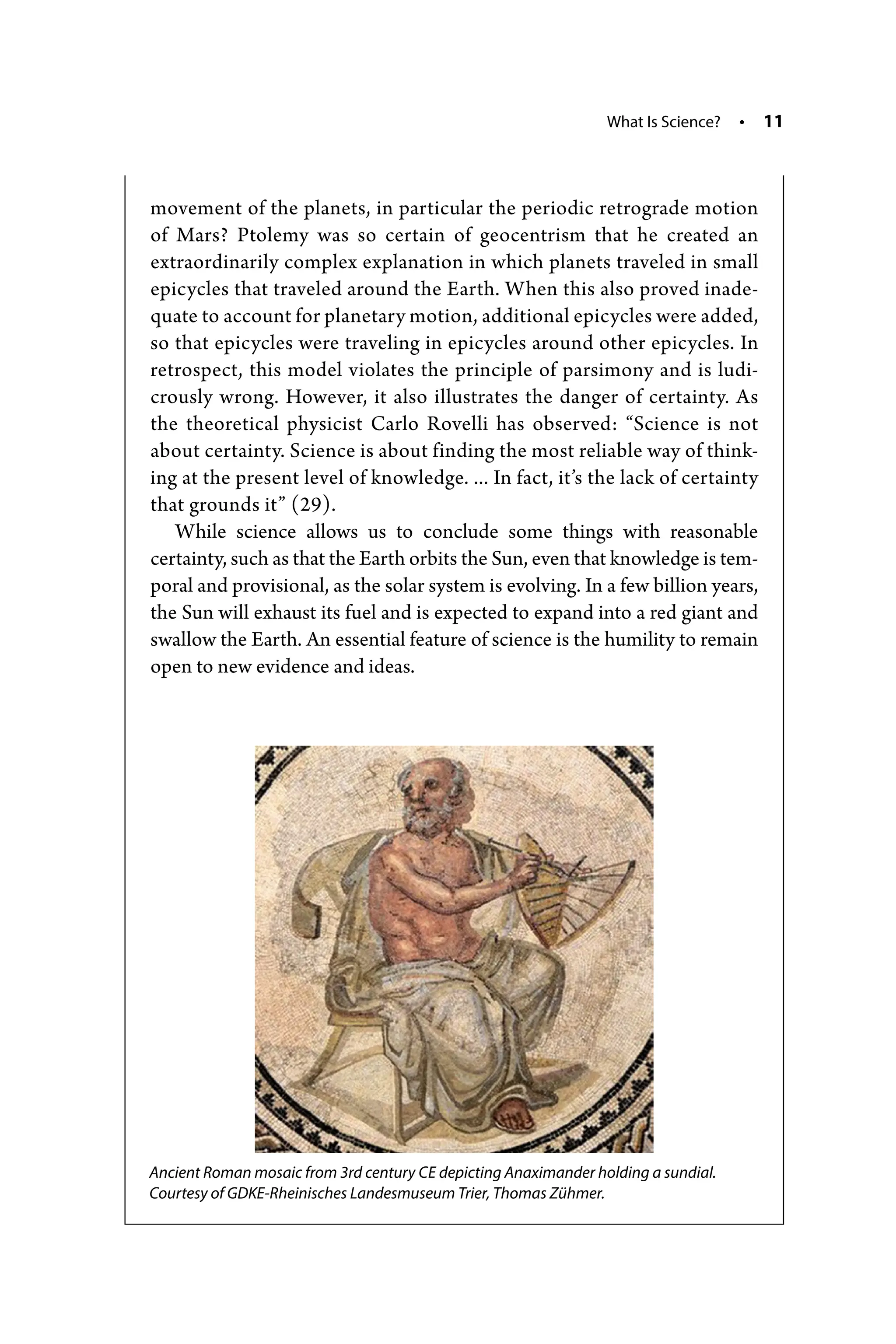
  • 27.
  • 29.
    3 Thinking about Science:Good Science, Bad Science, and How to Make It Better, First Edition. Ferric C. Fang and Arturo Casadevall. © 2024 American Society for Microbiology. Science is not inevitable; this question is very fruitful indeed. Edgar Zilsel (1) Science is humanity’s greatest invention. When difficult decisions are to be made, everyone says that they want to “follow the science.” But what is science? The Merriam-­ Webster online dictionary defines science as “knowledge about the ­ natural world based on facts learned through experiments and observation” (2). The word itself is derived from the Latin word scientia, which means “knowledge.” However, as Carl Sagan observed, “Science is more than a body of knowledge. It is a way of thinking” (3). Thus, Great Britain’s Science Council has defined science as “the pursuit and application of knowledge and understanding of the natural and social world following a systematic methodology based on evidence” (4). This is animprovement,butperhapsgoestoofarinemphasizingtheprocessover­scientific knowledge itself. Thomas Huxley suggested that science is merely “common sense clarified” (5), although common sense tells us many things that science has shown to be untrue, such as that the Sun travels around the Earth (6). Science rises beyond mere ­ observation, intuition, and association. Science is a way of acquiring knowledge that is progressive, cumulative, testable, and predictive. Fields that call themselves sciences share certain elements in common, including facts, theories, methods, practices, and predictions. The most persuasive characteristic of science is that it 1What Is Science?
  • 30.
    4 • SectionI Definitions of Science works. Science underlies all technology, from the light-­emitting diode illuminating this room to the laptop on which this chapter is being composed, or the cellphone giving a reminder about an imminent meeting. Yet science is much more than technology, and its relationship to technology is complex (Box 1.1). Science allows the recognition of principles that make the natural world comprehensible. That doesn’t mean that science is always right, not by a long shot. Scientific knowledge is always tentative and subject to change. But evidence of the power of the scien- tific method is all around us, and even when science leads to errors, the method itself embodies the means to correct its mistakes. The scientific method was not invented all at once, but rather evolved over time with refinement from a range of sources. The scientific method has not arisen in every civilization. In fact, most scientific knowledge has been acquired only during the past 400 years, less than one-­ quarter of 1% of the time that our species has Box 1.1 Science and technology Science and technology are often mistakenly viewed as synonymous. Whereas a definition of science is elusive, the definition of technology is easier. Technology is “the application of scientific knowledge for practical purposes” (24). Hence, while science and technology are intimately associ- ated, the two can exist independently. For example, the ancient world had the technology to construct majestic buildings and structures such as pyra- mids and the Great Wall of China without a formal understanding of the laws of physics. The Industrial Revolution was catalyzed by the invention of the steam engine, which was created by tinkering without any knowledge of thermodynamics. In fact, the field of thermodynamics emerged afterwards to explain phenomena observed in steam engines and in efforts to optimize their efficiency. On the other hand, major advancements in science often find no immediate technological applications. Einstein’s theory of general relativity, formulated in 1916, did not find a clear technological application until the development of a geopositioning system in the 1970s required ­ synchronization of clocks on Earth and in orbit, which run differently depending on the gravitational field that they experience. In 2016, gravita- tional waves were first detected using remarkable technology in the form of paired interferometers, constructed by highly exacting tolerances prescribed by physical laws, but these have yet to find a technological application. Today, much scientific research is dependent on technology made possible by our scientific knowledge.
  • 31.
    What Is Science?• 5 inhabited the earth. In their books The Unnatural Nature of Science and Uncommon Sense, the embryologist Lewis Wolpert and the physicist Alan Cromer, despite theirdifferentperspectives,bothtracetheoriginsofsciencetoancientGreece(6,7). Plato regarded reason as the most powerful capacity of human beings, Thales of Miletus attempted to describe the nature of the world, and Aristotle defined humans as rational animals. Aristotle distinguished induction, the inference of ­universal principles from particular observations, from deduction, in which general principlesareusedtomakepredictionsinspecificsituations.Mostofwhat­Aristotle had deduced turned out to be incorrect, but his mode of thinking laid a foundation for others to follow. Modern scientists use induction to develop theories and hypotheses, which can then be tested experimentally to arrive at deductions (Fig. 1.1). Greek mathematicians developed the concept of mathematical proof, which allowed the systematic application of logic to deduce a level of knowledge that is regarded as the truth (Box 1.2). Another tradition that arose in ancient Greece was rhetoric, in which oratory was used for the purpose of persuasion. When modern scientists perform experiments and interpret results, they are carry- ing on the great ancient Greek traditions of reason (logos) and persuasion (rhetor). During the so-­ called Dark Ages in Europe, Islamic scholars helped to preserve and further develop these concepts. Science and mathematics flourished in the Arab world in the Middle Ages (8), building upon earlier intellectual traditions to THEORY INDUCTION DEDUCTION Hypothesis Prediction Experiment Conclusion Conclusion Prediction FIGURE 1.1 Inductive versus deductive reasoning. In inductive reasoning, particular ­observations are used to infer universal principles or theories. In deductive reasoning, hypotheses lead to predictions that are tested experimentally. The results of experiments in turn may be used to revise hypotheses and theories.
  • 32.
    6 • SectionI Definitions of Science create a body of knowledge that was communicated to Europeans through trade and contacts in the Iberian Peninsula. This eventually blossomed into what is rec- ognizable as modern science during the Scientific Revolution in Western Europe. Two influential publications were Francis Bacon’s Novum Organum, published in 1620 (9), and Rene Descartes’ Discourse on the Method, published in 1637 (10). Novum Organum proposed an inductive method for understanding natural phe- nomena in which relevant facts were systematically assembled and categorized according to their association with a phenomenon of interest to generate axioms based on empirical data. Discourse on the Method proposed that problems be divided into smaller parts so that the simpler parts might be solved first and urged scientists to begin any inquiry from a skeptical perspective. Scholars continue to debate why the Scientific Revolution occurred in Western Europe rather than ­ elsewhere. Contributing factors include the continuum with classical Greek Box 1.2 Mathematics and science In 1960, the physicist Eugene Wigner penned an influential essay titled “The Unreasonable Effectiveness of Mathematics in the Natural Sciences” (25), in which he noted how mathematical relationships pervade the natural sciences and, once identified, are predictive of new relationships and ­ findings in nature. The relationship between science and mathematics may be viewed as essential, dependent, intricate, synergistic, and even symbiotic. Science depends on mathematics, and advances in science and technology furtherthedevelopmentofmathematics,asevidencedbytheever-­increasing reliance of mathematics on computers to probe its secrets, such as finding ever-­ larger prime numbers. At the heart of the matter is the fundamental question of whether the essence of the natural world is mathematical. The ancient cult of Pythagoras viewed the world as mathematical and promoted its understanding through mathematics, a world view with echoes in Plato’s allegory of the cave, in which a perfect world lies just beyond the senses. The ability to express a scientific finding in the precise notation of mathematics is considered an apotheosis in modern science. The increasing recognition that we live in a probabilistic universe has reinforced the notion that both discovered and as yet undiscovered mathematical relationships underlie everything in the natural world, something that Pythagoreans would have embraced and appreciated. Although a detailed treatment of the relation- ship between mathematics and science is beyond the scope of this book, we encourage budding scientists to learn as much mathematics as they can.
  • 33.
    What Is Science?• 7 ­ philosophy, the increasing prominence of academic institutions, the development of printing and the increasing availability of books, a growing crisis between ­ religious and humanistic world views, and the rise of capitalism, which lessened deference to authority and brought scholars and craftsmen together. The result was the emergence of a critical mass of practitioners of the scientific method who gave the revolution an unstoppable momentum (Box 1.3). Box 1.3 Was science inevitable? This chapter has emphasized the Western roots of modern science. That the Scientific Revolution occurred in 17th-­ century Europe in unquestioned, but contributions from many civilizations and cultures made this revolution possible (26). We have already mentioned the critically important contribu- tions of Islamic scholarship. In addition, Chinese civilization developed science-­ enabling technologies such as the magnetic compass, the printing press, and papermaking, which allowed global exploration and efficient communication. As Bacon recognized, “Printing, gunpowder, and the com- pass … changed the appearance and state of the world” (9). Chinese astron- omy was also highly developed and precisely recorded a supernova in the year 1054, which created the Crab Nebula. It is noteworthy that there is no record of this event in Western records despite what must have been the spectacular event in the night sky, with the appearance of a new, very bright star that was visible during daytime. This curious and mystifying omission from European records may reflect that it conflicted with philosophical-­ religious consensus at the time, which held that the heavens were eternal and constant. Indian contributions to mathematics, such as the concept of zero, the decimal system, and advanced notation systems, were essential for later advances in theoretical physics (27). In the Americas, the Mayan civiliza- tion developed highly advanced astronomy and mathematics, along with the sophisticated engineering expertise to build magnificent cities. Ancient Africans developed advanced astronomy and metallurgy (28). In Oceania, ancient Polynesians mastered navigational skills that allowed them to travel to remote, isolated islands. Hence, the impulse to develop mathematics and science may be seen everywhere that humans settled and built civilizations and reflects the indomitable human curiosity. The will to do science, like the will to make music, can be viewed as a universal human trait. However, in contrast to the development of scientific concepts and mathematics in other (Continued)
  • 34.
    8 • SectionI Definitions of Science In the 1920s, a school of philosophy known as logical positivism, with centers in the European capitals of Vienna and Berlin, asserted that truth must be demon- strated by direct observation or logical proof. Thus, scientific knowledge was favored over other forms of knowledge. In the classic formulation of the scientific method, science consists of careful observation and description, formulation of a hypothesis, and experimental testing of predictions. An implicit assumption is that experimental results can be replicated by others (chapter 7). Although this so-­ called “hypothetico-­deductive” approach is not the only way of doing science, it is what many people think of when referring to the scientific method. Logical positivism ultimately fell out of favor among philosophers of science, although its influence on 20th-­ century philosophy of science is undeniable. One reason for the decline of logical positivism is an inability to provide a clear demar- cation between science and nonscience. Any definition of science must be able to distinguish it from pseudoscience, such as astrology, alchemy, creationism, and homeopathy. In fact, separating pseudoscience from science can be difficult since those disciplines have many of the trappings of science, including theory, method, and practice (see chapter 16). For the Austrian philosopher Karl Popper, the issue societies, the Scientific Revolution gave rise to unique new insights, ­ formalisms, and ways to investigate the world—­ the creation of the modern scientific method and scientific disciplines and institutions. The Scientific Revolution allowed humanity to overcome the limits of intuitive thinking, which serves us well in many situations but can lead us astray when trying to understand natural phenomena. To return to Edgar Zilsel’s question at the beginning of this chapter, we must consider the uniqueness of the Scientific Revolution. While there is abundant evidence of curiosity, ingenuity, creativity, and mathematics in many human civilizations, what we call modern science has arisen only once. This alone suggests that science was not an inevitable consequence of the evolution of human thought. Accordingly, science should not be taken for granted. Why it arose in 17th-­century Europe, rather than in other scien- tifically and mathematically sophisticated societies, remains a fascinating and open question. It is probably not a coincidence that Europe during this periodalsowitnessednewtechnologiesliketheprintingpressandtelescope, brutal wars of religion, and the upheaval of medieval theology by the ­ Protestant Reformation. Modern science may owe its existence to an ­unusual confluence of technological, historical, and sociological events. Box 1.3 (Continued)
  • 35.
    What Is Science?• 9 of demarcating science from nonscience was a central issue. He was concerned that a statement can never be definitively verified, only falsified (11). In his classic example, no amount of evidence can ever prove the assertion that all swans are white, but the assertion may be disproved by the sighting of a single black swan. Reliance on verification cannot distinguish science from pseudoscience, as pseu- doscience may use inductive reasoning to generate false theories and selectively collect observations that appear to verify them. Instead, Popper proposed that sci- entificassertionsshouldbefalsifiableifshowntoconflictwithobservableevidence (or even theoretically observable evidence). This concept has proven popular with scientists. However, falsifiability has its limitations and fails to describe much of what scientists actually do. Furthermore, the quest for falsification itself can be an impossible journey. For example, the statement that all iron has ferromagnetism cannot be falsified unless all iron in the universe is examined, which is an ­impossible task. The physicist and philosopher Thomas Kuhn argued that much of “normal ­science” consists of puzzle-­solving rather than testing for falsifiability, and that it is the feature of puzzle-­ solving that best provides a basis for the demarcation of ­science (12). Kuhn also proposed that scientists are guided by paradigms, broadly explanatory models or theories that can periodically undergo a radical change when they no longer conform to objective reality (see further discussion in ­ chapter 11). Kuhn’s views have also been challenged. The concept of paradigms implies an element of subjectivity in science and has been used by postmodernists to question whether science is superior to other forms of knowledge. In fact, Paul Feyerabend declared that a definition of science is impossible, and that the only principle is “anything goes” (13). Rather than specifying criteria to define science, the physicist John Ziman opted for a social definition consisting of a consensus among competent researchers (14). While each of these efforts ultimately falls short of providing a universally satis- fying definition of science, one can take a pragmatic approach to identifying core principles that distinguish science from nonscience (15). Conserved characteris- tics of science, such as an absence of supernatural explanations, measures to reduce the risk of bias, receptivity to new evidence, and support from independent forms of evidence, can help to distinguish science from pseudoscience. Although the world may indeed be “awash in bullshit,” as some authors claim (16), science pro- vides the tools to distinguish truth from bullshit. Nevertheless, as we will discuss in detail in later chapters, it can be challenging to distinguish good science from bad or fraudulent science, and the problem is even more daunting for nonscien- tists. Most nonscientists lack a sufficient understanding of the scientific method and the mathematics of uncertainty to critically evaluate scientific information, and people who trust science are not necessarily immune to misinformation (17).
  • 36.
    10 • SectionI Definitions of Science Science as it is presently understood possesses several essential characteristics: (i) an assumption that nature can be understood without having to invoke super- natural forces; (ii) a requirement for supporting evidence; (iii) arguments that conform to logical chains of reasoning; (iv) accumulation of knowledge that can change and undergo refinement over time as a result of new ideas or observations and improvements in methodology; and (v) predictive power. Expertise is valued in science, but authority is not (chapter 28). A characteristic of science that sets it apart from other human endeavors is that it embraces the notion that all knowl- edge is provisional and that answering one scientific question inevitably leads to another (Box 1.4). Bias refers to any process that can improperly influence scien- tific inquiry and lead to erroneous conclusions. Accordingly, bias is to be avoided as much as possible, and potential sources of bias must be identified. For example, simple measures such as the inclusion of control groups, randomization, and blinding can help to control for selection bias, but there are many other potential forms of bias (18). As science has advanced, the development of probability, Bayesian analysis, and other statistical tools has allowed increasing rigor and the estimation of scientific certainty (Box 1.5). Box 1.4 Science and uncertainty The acknowledgment of uncertainty and that one might be wrong is as important for science as the quest for knowledge. Many ancient cul- tures were certain that the Earth was flat, with the heavens above and the ground below—­ until the 6th century BCE, when the pre-­ Socratic Greek philosopher Anaximander suggested that the Earth is suspended in space, with celestial bodies situated all around. Although he did not realize that the Earth is spherical or that it orbits around the Sun, his insight was nevertheless a revolutionary idea that enabled subsequent advances in Greek astronomy. His contemporary Pythagoras subse- quently taught that the Earth is spherical, and this idea spread so that Pliny the Elder could state in the 1st century CE that this fact was ­ universally accepted. In contrast, although Aristarchus of Samos pro- posed a heliocentric model of the ­universe in the 3rd century BCE, his notion was rejected in favor of the geocentric models of Aristotle and Ptolemy, and Aristarchus would not be vindicated until Copernicus published De Revolutionibus Orbium ­ Coelestium 1,800 years later. Why did ­geocentrism persist for so long when it conflicted with the ­measured
  • 37.
    What Is Science?• 11 movement of the planets, in particular the periodic retrograde motion of Mars? Ptolemy was so certain of geocentrism that he created an extraordinarily complex explanation in which planets traveled in small epicycles that traveled around the Earth. When this also proved inade- quate to account for planetary motion, additional epicycles were added, so that epicycles were traveling in epicycles around other epicycles. In retrospect, this model violates the principle of parsimony and is ludi- crously wrong. However, it also illustrates the danger of certainty. As the theoretical physicist Carlo Rovelli has observed: “Science is not about certainty. Science is about finding the most reliable way of think- ing at the present level of knowledge. ... In fact, it’s the lack of ­certainty that grounds it” (29). While science allows us to conclude some things with reasonable ­certainty, such as that the Earth orbits the Sun, even that knowledge is tem- poral and provisional, as the solar system is evolving. In a few billion years, the Sun will exhaust its fuel and is expected to expand into a red giant and swallow the Earth. An essential feature of science is the humility to remain open to new evidence and ideas. Ancient Roman mosaic from 3rd century CE depicting Anaximander holding a sundial. Courtesy of GDKE-­Rheinisches Landesmuseum Trier, Thomas Zühmer.
  • 38.
    12 • SectionI Definitions of Science Box 1.5 Where do formulas in science come from? Laws in science are often stated as formulas that relate a fact to a set of ­ variables. Examples are Newton’s and Einstein’s famous formulas for force (F = ma, or force = mass × acceleration) and energy (E = mc2 , or energy = mass × square of speed of light), respectively. So, a reasonable question to ask when thinking about science is: Where do these relationships come from? Certainly, they are not written down in nature until they come from the minds of scientists. Richard Feynman addressed this question in one of his famous Messenger Lectures, “The Character of Physical Law,” given at Cornell University on November 9, 1964 (30). According to Feynman, the first step is to “guess,” and then to compare the results of the equation to experimental data and see what happens. If the formula’s predictions match the experimental results, the formula may be right. If the results are discrep- ant, then the formula is wrong and must be discarded. This reveals the insight that mathematical relationships can explain laws of nature. Scientists tinker with variables to see what works and validate formulas by careful observation and measurement. However, Feynman may have overstated things a bit when he said, “First, we guess it.” An equation represents a highly educated guess, not just intuition. For instance, Newton’s second law of motion can be inferred by the observation that a change in the momentum of an object varies directly in proportion to the force exerted on the object but inversely in proportion to its mass. All that’s left is to collect observa- tions and determine whether a coefficient is required. Ohm’s law, in which current or flow varies in proportion to voltage but inversely in proportion to resistance, is analogous. Feynman was simply restating inductive inference from observation, which leads to hypothetical formulas or laws that can be tested experimentally (Fig. 1.1). Hence,theremaybedifferentroutestofindinganequationthatdescribes nature. We could imagine that the sequence to finding a law of nature and representing it mathematically follows the sequence of observation, insight, tinkering with equations, and validating with experimental data. In this sequence, the first step, observation, can involve the collection of data that provide the basis for writing down formulas until one fits the data and mak- ing predictions that can be validated by subsequent experiments. The uni- verse functions by unwritten laws that the human mind can discern, write down, and use to explain natural phenomena.
  • 39.
    What Is Science?• 13 It is also important to remember that science aims to accurately describe ­physical reality but does not provide answers to questions of morality. In the 18th century, the Scottish philosopher David Hume discussed this as the “is-­ ought problem” (19); in other words, one cannot conclude what ought to be on the basis of what is. For questions of right and wrong, science and ethics may be viewed as separate magisteria (20), although science can certainly be informed by an applica- tion of ethical principles, and neuroscience may one day provide a biological explanation for human ethical behavior. In addition to adhering to principles of research integrity (see chapters 18 and 29), scientists have a responsibility to understand the ethical and social dimensions of their work and to ensure that ­scientific knowledge is used wisely and in the public interest (21). The coexistence of science with religion has often been fraught, and that ­tension has led to conflict, as evidenced in the struggles between Galileo and the Inquisi- tion and more recently between evolution and creationism. Stephen Jay Gould introduced the concept of “NOMA,” or nonoverlapping magisteria (20), to argue that science and religion occupy different spheres of human action and thought. However, just as defining science is difficult, drawing a bright line of separation between science and religion is not always straightforward, and each may intrude on the other. Religion relies on received wisdom that is permanent and dependent on the supernatural, whereas science produces knowledge based on observable evidence, which is always provisional and subject to change as new information becomes available. The NOMA concept requires adherents of science and religion to agree to accept their limitations, e.g., Galileo’s assertion that “the intention of the Holy Spirit is to teach us how one goes to heaven, not how the heavens go” (22).However,NOMAoftenfailsinpracticebecausescienceandreligionencoun- ter irreconcilable conflicts with regard to fundamental questions such as the origin of life, and science and faith are fundamentally incompatible at an epistemological level. Nevertheless, science and religion can find many areas of common ground (23), and frequently manage to coexist peacefully, even within the same individ- ual. This is fortunate, as both science and religion have much to offer humanity. In summary, science is a body of knowledge, a way of thinking, and a method for studying and understanding the natural world. Just as scientific knowledge has evolved over time, undergoing constant testing, reinforcement, and refinement from the contributions of innumerable scientists, so have the scientific method and the definition of science evolved over time. Although scientific revolutions occur only rarely (more on this topic in chapter 11), scientific knowledge and methodol- ogy continue to grow and advance with every passing year. With all that in mind, we shall now explore in detail how science can be done well or poorly and used for good or ill, and what that may mean for both science itself and society as a whole.
  • 41.
    15 Thinking about Science:Good Science, Bad Science, and How to Make It Better, First Edition. Ferric C. Fang and Arturo Casadevall. © 2024 American Society for Microbiology. Certainly no developed science is merely descriptive in the ­narrower sense of the word—­it seeks to explain. Ernest Albee (1) The word “descriptive” is defined as “referring to, constituting or grounded in ­ matters of observation or experience” (2). Since practically all laboratory-­ based ­ science is based on recording evidence from experimentation, it might be argued that all science is in some sense “descriptive.” However, scientists distinguish between descriptive research, in which information is collected without a par- ticular question in mind, and hypothesis-­ driven research, which is designed to test a specific explanation for a phenomenon. In this dichotomy, “descrip- tive” has numerous synonyms, including “observational,” “inductive,” or “fishing expedition,” while “hypothesis-­ driven” may also be referred to as “hypothetico-­ deductive” or “mechanistic” (see chapter 3). When scientists favor hypothesis-­ driven science over descriptive science, they are really saying that they prefer work that is explanatory or provides insights into causation. Journals commonly state that they will not consider papers that are “purely descriptive” (3), although what this means is usually not defined. When applied to science, the word “descriptive” has acquired dismissive or pejorative connotations and is frequently provided as justification for rejection of a manuscript or grant application. Given the widespread use of this adjective and its profound implica- tions, it is worthwhile to reflect on what is right or wrong with descriptive science. 2Descriptive Science
  • 42.
    16 • SectionI Definitions of Science In considering this issue, it is noteworthy that many esteemed scientific dis- ciplines, such as astronomy, archaeology, and paleontology, are almost entirely descriptive sciences (4). Newton’s laws of motion can be considered descriptive, and there is nothing mechanistic about the gravitational constant. Nevertheless, we hold these laws in great esteem because they are able to predict the behavior of the natural world. One cannot perform an experiment in which a stellar variable (Box 2.1) or a geological epoch is altered. Moreover, the descriptive sciences of taxonomy, anatomy, botany, and paleontology have been central to the develop- ment of evolutionary theory, which remains the linchpin of all biological sciences. Hence, there is nothing fundamentally wrong with descriptive research, with the caveat that a scientific field may demand more from an investigator once it becomes an experimental science. Box 2.1 Careful description leads to cosmic understanding As telescopes improved, astronomers discovered an astounding number of stars and cloudy patches known as nebulae. In the early 20th century, the nature of nebulae was unknown and there were no methods available to measure cosmic distances. The marrying of telescopes with photographic cameras allowed astronomers to take long-­ exposure photographs and see objects that were too dim for the naked eye. Soon, however, it was evi- dent that analyzing celestial photographs to map stars was a very laborious process. Edward Pickering at Harvard College Observatory hired women known as “computers” to assist in the identification and cataloguing of stars accordingtotheirbrightnessandspectralcharacteristics.TheHarvardCom- puters analyzed thousands of photographic plates. Among these women was Henrietta Swan Leavitt, whose careful observations would change our view of the universe and provide the first method for measuring intergalactic dis- tances (14). Leavitt focused on a set of stars in the constellation Cepheus known as cepheid variable stars that appeared to change their brightness at regular intervals. In 1912, she reported a relationship between cepheid vari- able brightness and the period between intervals (15), which subsequently allowed Edwin Hubble to determine in 1924 that the Andromeda “nebula” was actually a spiral galaxy outside of our own Milky Way galaxy (16). Sadly, Leavitt died in 1921 of cancer and never knew how her insights changed our perception of the universe. Also sadly, but not uncommonly for women in science, Leavitt never received the recognition that was due from her discovery.
  • 43.
    Descriptive Science •17 In microbiology and related medical sciences, the transition from descriptive research to hypothesis-­ driven research has generally reflected the maturation of these fields. In the early stages of a field, descriptive studies may “represent the first scientific toe in the water” (5). Initial observation and induction give rise to novel hypotheses, which subsequently can be experimentally tested to provide a progressively detailed mechanistic understanding. Specific hypotheses allow a more discerning interrogation of complex data sets, something recognized by Charles Darwin when he noted, “Without speculation there is no good and orig- inal observation” (6). On the other hand, a descriptive approach may be less prone to bias (7). “It is a capital mistake to theorize before you have all the evi- dence,” Sherlock Holmes once remarked, “it biases the judgment” (8). Microbi- ology and immunology have been transformed by a number of powerful technological advances; methods such as large-­ scale sequencing, microarrays, bioinformatics, and proteomics are generating enormous databases that provide invaluable resources for the research community. While these methods can cer- tainly provide potent means to answer mechanistic hypotheses, in many cases they are initially used solely in a “descriptive” sense. In other words, some aspects of biological science have returned to an observational phase, in which research (A) (B) 0.0 12 13 14 15 16 12 13 14 15 16 0.2 0.4 0.6 0.8 1.0 1.2 1.4 1.6 1.8 2.0 2.2 0.0 0.2 0.4 0.6 0.8 1.0 1.2 1.4 1.6 1.8 2.0 2.2 Henrietta Swan Leavitt (1868–­1921). (A) Leavitt at work at the Harvard College Observatory. Photo by Margaret Harwood, courtesy of AIP Emilio Segrè Visual Archives, Physics Today Collection, Shapley Collection. (B) Plot showing a log-­linear relationship between star magnitude and period length. From a 1912 paper prepared by Leavitt (15). Paper from John G. Wolbach Library, Harvard-­Smithsonian Center for Astrophysics, NASA Astrophysics Datasystems.
  • 44.
    18 • SectionI Definitions of Science is primarily discovery-­driven rather than hypothesis-­driven (9). Such research is clearly important when it leads to the recognition of novel phenomena or the generation of novel hypotheses. However, microbiology and immunology are now experimental sciences, and ­ consequently investigators can go beyond sim- ply describing observations to formulate hypotheses and then perform experi- ments to validate or refute them. Why, then, the proscription against descriptive science? Editors and reviewers distinguish between descriptive science that significantly advances the field and mere descriptive science that does not further understanding. The former might be appropriate for publication in a selective journal, but the latter will almost always be returned to the authors as too preliminary. An example of a rejected descriptive manuscript would be a survey of changes in gene expression or cytokine produc- tion under a given condition. These manuscripts usually fare poorly in the review process and are assigned low priority on the grounds that they are merely descrip- tive; some journals categorically reject such manuscripts (10). Although survey studiesmayhavesomevalue,theirvalueisgreatlyenhancedwhenthedataleadtoa hypothesis-­driven experiment. For example, consider a cytokine expression study in which an increase in a specific inflammatory mediator is inferred to be impor- tant because its expression changes during infection. Such an inference cannot be made on correlation alone, since correlation does not necessarily imply a causal relationship. The study might be labeled “descriptive” and assigned low ­ priority. On the other hand, imagine the same study in which the investigators use the ini- tial data to perform a specific experiment to establish that blocking the cytokine has a certain effect while increasing expression of the cytokine has the opposite effect. By manipulating the system, the investigators transform their study from merely descriptive to hypothesis-­ driven. Hence, the problem is not that the study is descriptive per se but rather that there is a preference for studies that provide novel mechanistic insights. When a manuscript is rejected by a journal for being “merely descrip- tive,” the reviewer is essentially saying that the work has not revealed novel ­ phenomena, has failed to generate interesting novel hypotheses, or has failed to adequately follow up such hypotheses with further experimentation. The most common reason for a paper to be assessed as “merely descriptive” is that more in-­ depth investigation is required. A reviewer who recommends that a paper be rejected because it is “merely descriptive” can provide a great service to the authors by clearly and unambiguously explaining the additional studies required for the paper to become more significant and therefore more interest- ing (Box 2.2).
  • 45.
    Descriptive Science •19 Descriptive observations play a vital role in scientific progress, particularly ­ during the initial explorations made possible by technological breakthroughs. ­ Certainly, Alfred Wegener could not have thought about the possibility of ­ continental drift (11) without accurate mapping of continent coastlines, a descriptive endeavor, which gave Wegener the idea that these had once been joined (Box 2.3). Following up on this example, the subsequent theory of plate tectonics would find its strongest support in the mapping of magnetic orien- tation of the ocean seabed (12). Clearly, the phenomenally successful theory of plate tectonics, which revolutionized our view of the geology of the planet, could never have been developed without the support of a tremendous amount of descriptive data. In the area of infectious diseases, John Snow’s painstaking spatial description of the cholera cases around a water well in London provided key evidence for the waterborne transmission of cholera and against the miasma hypothesis (Fig. 2.1). At its best, descriptive research can illuminate novel phenomena or give rise to novel hypotheses that can in turn be examined by hypothesis-­ driven research. However, descriptive research by itself is seldom conclusive. Thus, Box 2.2 “Descriptive”is a fraught word in the scientific lexicon A major problem in scientific discourse is that the adjective “descrip- tive” has a different meaning for different scientists, which becomes even more confounded when the word is used in contrast to mechanistic sci- ence (chapter 3). For some scientists, descriptive means that the work is correlative and does not seek to establish cause-­ and-­ effect relationships. For others, it is an epithet for lack of depth or a survey-­ like treatment of a subject. This lack of precision is a major problem when labeling a sci- entific study as descriptive to justify rejection of manuscripts or grant applications. The origins of the use of “descriptive” as a pejorative term in the biological sciences is uncertain but may reflect the relatively recent transition of biology from a strictly observational science to one endowed with very powerful molecular and genetic techniques. Given this state of semantic confusion, it may be best to avoid using this word when trying to give criticism. Instead, scientists who review papers and grants should expand on their comments to be sure that the those who receive their criti- cism understand what is meant.
  • 46.
    20 • SectionI Definitions of Science Box 2.3 Careful description can lead to revolutionary new insights Wegener was a German meteorologist who suggested in 1912 that the earth’s continents were once joined together and subsequently drifted apart. Wegener based his hypothesis on descriptive data including rock types, geological structures, fossil plants and animals, and coastline contours. The continental drift hypothesis was initially controversial and only became widely accepted after Wegener’s death. Right panel from reference 17. Upper Carboniferous Eocene Older Quaternar Alfred Wegener (1880–­1930).
  • 47.
    Descriptive Science •21 descriptive and hypothesis-­ driven research should be seen as complementary and iterative (13). Descriptive science is neither good nor bad, and as we shall further explore in chapter 3, neither is mechanistic science. Nor is descriptive science the antithesis of mechanistic science. Observation, description, the ­formulation and testing of novel hypotheses, and the elucidation of mechanisms are all essential to scientific progress. The value of combining these elements is almost indescribable. FIGURE 2.1 John Snow’s cholera map. An original map made by John Snow during the London epidemic of 1854 showing cholera cases (small rectangles) centered around the contaminated pump at the intersection of Broad and Cambridge Streets. This is considered a landmark event in the birth of modern epidemiology. Image from On the Mode of Communication to Cholera by C.F. Cheffins, Lith, Southhampton Buildings, London, England, 1854.
  • 49.
    23 Thinking about Science:Good Science, Bad Science, and How to Make It Better, First Edition. Ferric C. Fang and Arturo Casadevall. © 2024 American Society for Microbiology. Science is the knowledge of consequences, and dependence of one fact upon another. Thomas Hobbes (1) In contrast to the pejorative use of the adjective “descriptive” discussed in the preceding chapter, the term “mechanistic” is usually used to praise the quality of science. This is apparent in discussions when the phrases “mechanistic under- standing” and “mechanistic approach” are used to convey a sense of high-­ quality research. Science educators attempt to instill “molecular mechanistic reasoning” into the curriculum through the use of graphics and models (2). In reviews of sci- entific manuscripts and grants, the words “mechanistic” and “descriptive” are often misused as synonyms for “good” and “bad,” respectively (3, 4). However, the extraordinary power of the words “descriptive” and “­mechanistic” requires us to wield them carefully when critiquing science. In chapter 2, we con- sidered the epithet “descriptive” and argued for an important role of descriptive studies in many scientific fields, while also acknowledging a general preference for studies that go further by including experimental work (5). Here we con- sider the more favored adjective “mechanistic” and explore its usage, meanings, implications, and limitations. Recognizing the centrality of mechanistic research to the ­ history of science (6), we will explore what scientists mean when they use this term. 3Mechanistic Science
  • 50.
    24 • SectionI Definitions of Science DEFINITIONS Atfirstglance,oneisstruckbythefactthattheterms“descriptive”and“­mechanistic” are often used antagonistically as descriptors of scientific quality, yet they are not antonyms. “Descriptive” is defined as “referring to, constituting, or grounded in matters of observation or experience,” while “mechanism” is defined as “the funda- mental processes involved in or responsible for an action, reaction or other natural phenomenon” (7). From these definitions, “descriptive” can be seen as analogous to the interrogatives who, what, where, and when, whereas “mechanistic” in turn asks how and why. Hence, these terms collectively encompass the spectrum of inquiry. But if “descriptive” and “mechanistic” are not antonyms, what accounts for the general preference for mechanistic over descriptive work? As “descriptive” and “mechanistic” are generally considered to denote differ- ent qualities in science, we must probe further to ascertain what these terms mean in the scientific vernacular. In chapter 2, we suggested that “descriptive” means different things to different people. Since practically all laboratory-­ based science is based on recording evidence from experimentation, it could be argued that all ­ science is in some sense descriptive. However, this is unsatisfactory because every scientist intuitively knows that there are qualitative differences among ­ scientific studies. Hence, the first problem we encounter is in the precision of language, as we try to understand and convey meaning in words. Similarly, the word “mechanistic” is used to refer to both complex natural phenomena and man-­ made mechanical devices (Box 3.1). The machine as an analogy for the natural world owes much to the writings of Hobbes and Descartes (even though the latter could not bring himself to ascribe the human soul to a mechanical process). Like Hobbes, the modern scientist makes the implicit assumptions that phenomena have rational explanations and that events may be connected as cause and effect. Scientists seeking mechanisms to explain the workings of the natural world are only the latest practitioners in a philosophical continuum extending back to the 17th century (6, 7). The explanation for many biological phenomena requires a basic understand- ing of causal mechanisms. However, “mechanism” can mean different things in ­different fields. For example, in the late 1950s the problem of protein synthesis was central to biology, and “mechanism” to biochemists meant the formation of cova- lent bonds in polypeptides, whereas to molecular biologists, “mechanism” was the means by which the genetic code is translated into proteins (8). Although these approaches were eventually reconciled during the great synthesis of the mid-­1960s (8), it is noteworthy for our discussion that the word “mechanism” can hold differ- entmeaningsevenincloselyrelatedfieldslikebiochemistryandmolecular­biology. Furthermore, the meaning of the term “mechanism” with respect to science has
  • 51.
    Mechanistic Science •25 Box 3.1 The illusion of scientific processes as clockwork The development of mechanical clocks such as pendulum clocks in the 17th century coincided with the Scientific Revolution and provided much more accurate measures of time than prior technologies, such as water and sand clocks. Mechanical clocks rely on gear mechanisms that operate at discrete time intervals to measure the passage of time. Such clocks were essential for measurements that unearthed basic physical laws and enabled much pro- gress during the Scientific Revolution. Clocks are deterministic in the sense that the gears interact to produce a known outcome, which is reliable and produces an accurate measurement of time. Clockwork mechanisms have a powerful allure for the human mind, for the intricate gearwork and their interactions provide a perfect explanation for their function and output. The metaphor of clockwork as a representation of the universe has fueled philosophical debates about free will versus determinism, which led Pierre-­ Simon Laplace to hypothesize in 1814 that knowledge of all forces and mat- ter at a certain moment would allow the prediction of all future events, a concept known as “Laplace’s demon” (13). Hence, it is no surprise that sci- entists look for the mechanism of a process hoping that elucidation of its components will provide enlightenment as to both function and purpose. However desirable, clockwork mechanisms in nature are rare and illusory. In contrast to the deterministic mechanism of a clock, natural processes are often unpredictable. Quantum theory posits that the microscopic world is probabilistic and indeterminate, while at the other end of the size scale, gravitational interactions between bodies in the solar system are chaotic and unpredictable (14). Emergent properties reduce the predictability of com- plex biological systems (15). Thus, for atoms and planets and many things in between, the human desire for predictability and understanding collides with fundamental dynamic processes that limit what we can know for cer- tain about the present and future. The scientific penchant for “mechanis- tic science” may reflect an anthropomorphic bias for clockwork processes that obscures a deeper understanding of the natural world. In other words, the quest for mechanisms can be thwarted by epistemological limitations, and there are limits to how precisely scientists can predict the future. We suggest that focusing on what can be known while remaining critical about what we know and how we know it is a more productive approach to science than attempting to judge science on the basis of such imprecise epithets as “descriptive” and “mechanistic.” (Continued)
  • 52.
    26 • SectionI Definitions of Science changed over time, from a version of philosophical materialism in ­ opposition to vitalism to a stepwise explanation of how system components interact to produce an outcome (6). WHERE IS THE LINE OF DEMARCATION BETWEEN“DESCRIPTIVE” AND“MECHANISTIC?” Starting with the assumption that there is a difference between descriptive and mechanistic science and seeking a clear line of demarcation that can be expressed in words, one immediately runs into the problem that the description of a process can be considered the mechanism for another process. To further illustrate this point, let us consider a hypothetical situation. A scientist walks into a dark room and encounters impenetrable darkness. A candle is lit, and the scientist now per- ceivestheoutlineoftheroom.Thescientistdecidestoinvestigatethephenomenon of light. The mechanism responsible for the light is the candle. However, the scien- tist notes that only part of the candle emits light and determines that the mecha- nism for light is the flame. In describing the flame, the investigator establishes that the mechanism for the flame is combustion. Describing combustion, the scientist determines that the mechanism is a series of oxidation-­ reduction reactions that in turn are explained by electron transfer and, ultimately, quantum mechanics. At each step, the description of a process provides only a partial explanation in search of a deeper mechanism that must in turn be described (Table 3.1). What is striking in this hypothetical situation is that the difference between description and mechanism is one of proximate causation. Hence, the epithets “descriptive” and “mechanistic” are epistemologically related and differ quantitatively rather A pendulum clock designed by Galileo, as drawn by Vincenzo Viviani in 1659. Courtesy of ­ University of Toronto Photographic services. Box 3.1 (Continued)
  • 53.
    Mechanistic Science •27 than qualitatively. In other words, observations become regarded as progressively less descriptive and more mechanistic as one probes more deeply into a phenom- enon. In fact, one might argue that there is no real line of demarcation between ­ descriptive and mechanistic science but that the difference is rather a matter of depth and one’s preferences. The scientist in the dark room also gives us a model with which to explore the difference between descriptive and experimental science, a point that we empha- sized in the preceding chapter (5). Note that the scientist can assign causality to the association between a lit candle and an illuminated room by extinguishing the candle, observing the return of darkness, and subsequently validating that the candle is responsible for light by reigniting the flame. Furthermore, our thought experiment illustrates the issue of “significance” of a scientific observation. The assessment of significance is a major criterion in grant or manuscript review, yet we have few tools for judging the significance of a finding in real time other than judgment and experience. One might argue that since the scientist needs light in order to see, the most significant finding is the association of the candle with light. The mechanistic details following subsequent questions may be important for understanding the related phenomena but are not essential in the context of a dark room unless the scientist decides to use the information to design a better ­ candle or kindle a brighter fire. Hence, the significance of a finding is often related to the subsequent development and application of the revealed information and may become apparent only over time. Our hypothetical scenario also provides insight TABLE 3.1 A scientist considers the illumination of a dark room Description Mechanism Light Candle Candle Flame Flame Combustion Combustion Chemical reaction Chemical reaction Oxidation-­reduction Oxidation-­reduction Electron loss and gain Electron loss and gain Quantum mechanics Quantum mechanics Metaphysics
  • 54.
    28 • SectionI Definitions of Science into the line of demarcation between science and nonscience. As when one peels away the successive layers of an onion or opens a series of nested Russian dolls, each revealed mechanism becomes a new description leading to a new mechanistic question, until the investigator arrives at a point where scientific inquiry cannot proceed without entering the realm of metaphysics. Moving from the dark room into the world of science, it is possible to envisage similar scenarios in which it is difficult to identify a clear demarcation between descriptive and mechanistic research. For example, consider a disease character- ized by a red, hot, painful, and swollen skin lesion. The investigator would note that this collection of signs and symptoms corresponds precisely to rubor (red- ness), calor (warmth), dolor (pain), and tumor (swelling), the Latin terms used to describe inflammation. These terms in aggregate represent descriptors that denote “inflammation,” a process that provides a mechanism for the disease (Table 3.2). To investigate the mechanism of inflammation, the investigator employs a micro- scope and determines that the lesion is a result of an influx of white blood cells, specifically the subset known as neutrophils. While investigating the presence of neutrophils, the investigator discovers chemotaxis (migration of cells toward a sig- nal), alterations in expression of chemokines (molecules that attract white blood cells), activation of signaling pathways, and perhaps the presence of microbe-­ associated molecular patterns responsible for chemokine elicitation. In essence, the boundary between descriptive and mechanistic science is moving and subjec- tive and depends on both the depth of the experimental question and the techno- logical sophistication of the investigator. In other words, one scientist’s mechanism may become another’s descriptive starting point. When reviewers of scientific work express a desire for “more mechanistic” studies, some are probably asking for experimental work that establishes causal- ity between the observations being reported. For example, a paper that reports a TABLE 3.2 A scientist considers the cause of a skin lesion Description Mechanism Pain, redness, swelling, and heat Inflammation Inflammation Cellular infiltration and vascular leakage Cellular infiltration and vascular leakage Chemokines, cytokines, and arachidonic acid derivatives Chemokines, cytokines, and arachidonic acid derivatives Signaling cascade activation Signaling cascade activation Agonist-­receptor interactions Agonist-­receptor interactions Microbe-­ associated molecular patterns Microbe-­ associated molecular patterns Staphylococcus aureus
  • 55.
    Random documents withunrelated content Scribd suggests to you:
  • 56.
    Mr. Knudsen. C.Calvert Knudsen. And may the record show that I am, Mr. Chairman, if you please, the treasurer of the Seattle Bar Association, and, at the request of that association and at the request of this gentleman, I am undertaking to represent him at this hearing inasmuch as he is financially unable to obtain other counsel. Mr. Moulder. The record will so reflect the statement made by counsel. Mr. Velde. May I make this remark? In connection with our hearings last June it was mentioned several times that the mere fact that an attorney represents a witness who might be a fifth amendment witness should be no reflection whatsoever on the attorney. And I am sure that is true of all the attorneys who have appeared here today. Mr. Moulder. It is your duty to be here in the capacity in which you appear here today, in the honor of your own profession. Mr. Knudsen. Thank you, Mr. Chairman. Mr. Wheeler. Will you spell your name, please? Mr. Kroener. K-r-o-e-n-e-r. Mr. Wheeler. Do you presently reside in Seattle? Mr. Kroener. Yes. Mr. Wheeler. What is your occupation, Mr. Kroener? Mr. Kroener. Work as a machinist. Mr. Wheeler. Are you presently employed? Mr. Kroener. No; I am not.
  • 57.
    Mr. Wheeler. Beinga machinist, are you a member of any union? (The witness confers with his counsel.) Mr. Kroener. I wish to invoke, on answering that, the fifth amendment, on the grounds that it may incriminate me. Mr. Wheeler. Are you a member of the International Association of Machinists, A. F. of L.? Mr. Kroener. Again I wish to invoke the fifth amendment. Mr. Wheeler. Have they instituted charges against you to remove you from membership in the union? Mr. Kroener. Again I wish to invoke the fifth amendment. Mr. Wheeler. What has been your educational background, Mr. Kroener? Mr. Kroener. First half year of the eighth grade of grammar school. Mr. Wheeler. In Seattle? Mr. Kroener. Yes. Mr. Wheeler. How have you been employed? Mr. Kroener. When I was younger I worked in logging camps and did odd jobs in the steel mills, and as a welder. And, oh, since about 1941 and 1942 I have worked in the machine trade. Mr. Wheeler. In the machine trade? Mr. Kroener. Yes. Mr. Wheeler. For what companies have you worked as a machinist?
  • 58.
    Mr. Kroener. Idon’t remember all of them exactly, and I couldn’t say the times I have worked for a number of the uptown shops and marine yards in Seattle. Some of them have gone out of business. Gibson’s has gone out of business. And I worked at Washington Iron Works and marine yards around Seattle. Mr. Wheeler. Do you know who just preceded you on the witness stand? (The witness confers with his counsel.) Mr. Kroener. I wish to again invoke the fifth amendment on the grounds of self-incrimination. Mr. Wheeler. Were you present in the hearing room when Mr. Eugene Robel testified? Mr. Kroener. I was present. Mr. Wheeler. Are you acquainted with him? Mr. Kroener. Again I wish to invoke the fifth amendment. Mr. Wheeler. Were you present in the hearing room when Mr. Harold Johnston testified? Mr. Kroener. I was present. Mr. Wheeler. Are you acquainted with Mr. Harold Johnston? Mr. Kroener. Again I wish to invoke the fifth amendment. Mr. Wheeler. Is it a fact that the three individuals I just mentioned, along with you and other people, were members of a cell within the machinists union? Mr. Kroener. Again I wish to invoke the fifth amendment on the grounds of self-incrimination.
  • 59.
    Mr. Moulder. Doyou have any knowledge as to the action taken by a machinists union referred to by Mr. Wheeler in expelling members from that union where there is evidence of their Communist affiliations? Mr. Kroener. I believe there may be some such program going on, but I am not too well acquainted with it. So I couldn’t answer it too clearly. Mr. Moulder. Is the reason why you refuse to answer because of the fear you might be expelled from the union? (The witness confers with his counsel.) Mr. Kroener. Again I wish to invoke the fifth amendment on the ground that the answer may tend to incriminate me. Mr. Moulder. Do you have knowledge and information that the union referred to is exercising its efforts to rid its ranks of persons who are Communists? Mr. Kroener. Again I wish to invoke the fifth amendment. Mr. Moulder. I hope the witness has contributed to the union’s effort. Mr. Wheeler. When and where you were born, Mr. Kroener? Mr. Kroener. Seattle, Wash., April 8, 1920. Mr. Wheeler. Are you acquainted with Mrs. Barbara Hartle? Mr. Kroener. Again I invoke the fifth amendment. Mr. Wheeler. Did you know that Mrs. Hartle, in her testimony as a witness before this committee in June 1954, identified you as a member of the Communist Party?
  • 60.
    Mr. Kroener. AgainI invoke the fifth amendment on the grounds of self-incrimination. Mr. Wheeler. Have no comment other than that concerning her testimony? Mr. Kroener. No. Mr. Velde. Mr. Wheeler, do you have the testimony of Mrs. Hartle there? Mr. Wheeler. I do, sir. Mr. Velde. Will you read it for the record, please? Mr. Wheeler. Mrs. Hartle, during a portion of the testimony discussing the industrial branch of the Communist Party, was questioned by Mr. Tavenner: Will you tell the committee, please, whether or not there was any important function that Elmer Thrasher performed in the industrial section of the party? Mrs. Hartle. He was chairman of a branch in the industrial section, in the building trades. He was a member of one of the building-trades unions—the carpenters union. Another one whom I recall is Ed Kroener. He lived in the Duwamish Bend area, in the Duwamish Bend housing project, with his wife, Donna Kroener, who was a member of the south King region and the Duwamish Bend Club, but he was a member of the industrial section inasmuch as he was a member of the Machinists Union, Local No. 79. Do you wish to comment on that testimony, Mr. Kroener? Mr. Kroener. No.
  • 61.
    Mr. Velde. Towhat period of time was Mrs. Hartle referring? Mr. Wheeler. To what period of time, Mr. Kroener, was she referring? Mr. Kroener. Again I wish to invoke the fifth amendment on the grounds of self-incrimination. Mr. Wheeler. Mr. Kroener, did you at any time participate as an individual within the Progressive Party in 1948 in the State of Washington? Mr. Kroener. Again I wish to invoke the fifth amendment on the grounds of self-incrimination. Mr. Wheeler. Are you a member of the Communist Party today? Mr. Kroener. Again I wish to invoke the fifth amendment on the grounds of self-incrimination. Mr. Wheeler. I have no further questions, Mr. Chairman. Mr. Moulder. Mr. Velde? Mr. Velde. I have just one brief question. How could your acquaintanceship with Mrs. Hartle or Mr. Johnston or the other witnesses whom you were asked about tend to incriminate you? (The witness confers with his counsel.) Mr. Kroener. The answer to that question may open up a whole field of other questions, and, therefore, I wish to invoke the fifth amendment on the grounds of self-incrimination. Mr. Moulder. Do you have anything else you wish to say in explanation of your presence or your appearance here? Are you married?
  • 62.
    Mr. Kroener. Yes. Mr.Moulder. Do you have a family? Mr. Kroener. Yes. Mr. Moulder. Did you serve in the Armed Forces of the United States? Mr. Kroener. Yes. Mr. Moulder. In what capacity and what branch? Mr. Kroener. I was in the Marine Corps, 1944, 1945, and 1946, South Pacific and China. Mr. Moulder. Is there anything further you wish to say? Mr. Kroener. That is all. Mr. Moulder. The witness is excused. (Whereupon the witness was excused.) The committee will stand recessed until tomorrow morning at 9 o’clock. (Whereupon, at 4:57 p. m., the committee was recessed, to be reconvened at 9 a. m., Friday, March 18, 1955.)
  • 63.
    INVESTIGATION OF COMMUNIST ACTIVITIESIN THE SEATTLE, WASH., AREA
  • 64.
    FRIDAY, MARCH 18,1955 United States House of Representatives, Subcommittee of the Committee on Un-American Activities, Seattle, Wash. PUBLIC HEARING A subcommittee of the Committee on Un-American Activities met, pursuant to recess, at 9 a. m., in Room 402, County-City Building, Seattle, Wash., Hon. Morgan M. Moulder (chairman) presiding. Committee members present: Representatives Morgan M. Moulder (chairman) and Harold H. Velde (appearance as noted). Staff members present: Frank S. Tavenner, Jr., counsel; William A. Wheeler, staff investigator. Mr. Moulder. The subcommittee will be in order. Mr. Counsel, call the witness you wish to examine. Mr. Tavenner. Mr. Chairman, I would like to recall Mr. Dennett at this time.
  • 65.
    TESTIMONY OF EUGENEVICTOR DENNETT, ACCOMPANIED BY HIS COUNSEL, KENNETH A. MacDONALD—Resumed Mr. Tavenner. It is noted, Mr. Dennett, that your counsel is not with you. Do you prefer to wait until he arrives before proceeding? Mr. Dennett. It doesn’t make any particular difference. I am sure my counsel intends to be here as soon as he can get here, but there is no need to delay. Mr. Tavenner. I understand he is in the corridor, so we will wait until he arrives. (At this point Kenneth A. MacDonald, counsel to the witness, entered the hearing room.) Mr. Tavenner. When you left the stand yesterday, Mr. Dennett, we were speaking of your experience in the Communist Party at Bellingham. Will you please describe to the committee what additional activities of the Communist Party you engaged in while at Bellingham. Mr. Dennett. I believe, sir, that I recounted that the Communist Party was active in the unemployed movement, and our membership grew from 7 to approximately 160 in the course of a year’s time, and that we had proceeded to reorient that membership in the party from exclusive work in the unemployment councils to working in an organization known as the People’s Councils, which was organized by non-party people. The two leaders of that organization at that time were Mr. M. M. London and Mr. George Bradley. The Communist Party was quite disturbed that there was such an effective organization in existence which was not directly under our
  • 66.
    leadership. Mr. Tavenner. Whatwas the name of that organization? Mr. Dennett. The People’s Councils. Consequently, one of our major objectives was to win that leadership to support the party position one way or another. We had had previous experience with Mr. London and we considered that it was not possible to win Mr. London back to—or to support the party. Therefore, we concentrated our attention on Mr. Bradley, and ultimately won him to support the party and the party position in opposition to Mr. London. Mr. Tavenner. When you say you won Mr. Bradley to the support of the Communist Party position, do you mean to indicate that he became a member of the Communist Party? Mr. Dennett. Yes; he did. He became a member of the Communist Party after my constant agitation with him had convinced him that the Communist Party program was a sounder program and a better program than the one that they were pursuing in the People’s Councils. And Mr. Bradley was unable to convince Mr. London, and they became at some conflict in point of view on that. Mr. Tavenner. The organization there known as the Unemployed Councils, if I understood your testimony correctly, was a Communist- organized group? Mr. Dennett. That is true. The Unemployed Council was organized by the Communist Party, and it was our policy throughout that entire period to insist that all unemployed organizations, if they were to truly represent the unemployed, had to affiliate with the Unemployed Councils. Now in the case of the People’s Councils, we tried to get them to affiliate with the National Unemployed Councils. They never did.
  • 67.
    Even after wewon Bradley to our support the rest of the membership still would not agree to direct affiliation with the National Unemployed Council. Instead, they felt that they had a greater kinship and association with the Unemployed Citizens Leagues, which had been organized in the city of Seattle and in various parts of the State of Washington under the leadership of anti-Communists who had originally come from the labor movement in the city of Seattle. There were three particular leaders of the Unemployed Citizens League who organized it at the outset. And I am not sure that I related yesterday how serious the unemployment problem was in the city of Seattle, but I am sure that if anyone would take the trouble to look up the records they would find that at one time there were over 90,000 families in the city of Seattle who were dependent upon public assistance to maintain themselves and their families. There was no private employment in the city. The only persons who were receiving paychecks were those who were working for either the State, Federal, or city governments. And under those circumstances the problem was very, very acute. The tax rolls were overtaxed. I mean by that that the tax burden was greater than the city was able to bear. The city treasury was soon exhausted trying to maintain the citizens who were unemployed through no fault of their own. Soon the county budget was exhausted, and they were perplexed. The problem was far more serious and far more acute than the average person today can possibly comprehend unless he looks at the statistics, which are available, I am sure, in some of the research libraries. I speak of that about the city of Seattle because I have some knowledge of it from personal experience. The same situation
  • 68.
    existed in nearlyevery small city in the State of Washington at that time. I cannot testify as to what the condition was in other parts of the country. But it was that condition which opened the door for widespread organization on the part of workers and unaffiliated and disaffiliated people, and it was when they came into these organizations that it became possible for the Communists to begin to hammer away with the class-struggle line of tactics and the insistence that a relentless fight must be waged against the capitalist system and blame the capitalist system for this condition of unemployment. It created a problem, too, for those who held public office because they did not know what to do about it. And, frankly, it wasn’t possible for any local people to solve the problem. It had to be dealt with on a national scale, on a national basis. It was not until after the new administration took office in 1933 that steps were taken which made it possible to start the wheels of industry in motion again. And as those wheels of industry got started in motion it was possible for these workers to find jobs. And when they started finding jobs they left the unemployed organizations. When they left the unemployed organizations they got out from under the immediate influence of the Communists who had entered those organizations, and, in many instances, obtained control. I am speaking specifically of the Unemployed Citizens League, the People’s Councils, and I think that there were some other organizations around here that I have forgotten the names of. I think that there was one called the United Producers of Washington that was created over in Pierce County which was affiliated with the Unemployed Citizens League. There were many different names of these organizations, and they assumed different forms. But essentially they all performed the same
  • 69.
    function. They provideda center around which people could begin to develop their own ideas and listen to other people’s ideas. I would certainly like to make certain that everyone understands that that kind of problem has to be dealt with also with ideas. Mr. Tavenner. You made reference to unemployment citizens’ leagues. Were there such organizations in Bellingham? Mr. Dennett. No, there were not. The People’s Councils performed all the functions which the Unemployed Citizens Leagues would do, plus the fact that the People’s Councils also developed some political aspirations. I mean they did embark upon an independent political campaign, and they did run candidates for public office. That was largely due to the influence of the Communist Party there. Remember 1932? We were insistent that they not support either the Democratic or Republican Parties because we branded them as capitalist parties, and we insisted that the only way it was possible for the workers to obtain what they wanted was through their own party. We succeeded in prevailing upon the People’s Councils to run their independent candidates, and some of them came very close to election to office. They didn’t quite make it. Mr. Tavenner. Mr. Dennett, I think it would be of value to the committee to understand as fully as possible the methods used by the Communist Party in that period in causing the Unemployed Councils to take various courses of action in Bellingham and Seattle, and to understand to what extent the Communist Party was successful in using other organizations which it did not control. Mr. Dennett. I can think of two very graphic illustrations of that. One occurred in the city of Seattle at the time the unemployed occupied this building for 3 solid days. The Unemployed Citizens Leagues in the city of Seattle were anti-Communist; their leadership
  • 70.
    was anti-Communist. Butthey were confronted with the budget running low, the city funds exhausted, and the county commissioners were confronted with the dilemma of what to do with their funds diminishing. The county commissioners at that time ordered a cut in the amount of relief which would be allowed. When they did that it placed the anti-Communist leadership in the Unemployed Citizens Leagues in a most embarrassing position because we in the Communist Party and in the Unemployed Councils had been very critical of everything which the Unemployed Citizens Leagues had been doing and which their leaders had been doing. When this cut occurred we blamed the leaders of the Unemployed Citizens Leagues for permitting it. We didn’t know that these leaders had been opposing the cut. We didn’t know what their actual attitude was. But we very soon found out because these leaders were so desperate that they decided to make a march on the County-City Building where the commissioners were to meet in a room similar to this one. And it was their intention to demand at that time that the cuts not be put into effect. However, the demonstration proved to be much larger and had much more support than the leaders of the Unemployed Citizens Leagues anticipated, and the Communists—I remember it very well because I was on the district bureau at that time—and we found ourselves not in the leadership of a militant action, and we were embarrassed and fearful that if we didn’t get into the act that we would be blamed by the national leadership. And we didn’t have any contacts in the Unemployed Citizens League leadership, and we didn’t know what to do. So we debated the question for about 30 hours in 1 continuous bureau meeting. Following that meeting we decided that it was best for us to join the demonstration regardless, whether we had contact or not, and we
  • 71.
    issued leaflets andcalled upon our members to join in the demonstration. (At this point Representative Harold H. Velde entered the hearing room). Mr. Dennett. In the process of doing so we received a bigger response than we expected. In other words, the need was more acute than even the most closest observers realized. Consequently, there were about 6,000 people down here in this building. They couldn’t all get into the chambers. They crowded the hallways, they crowded several floors of the building. And some of the commissioners got so scared of the demonstration that they tried to run out. They tried to avoid meeting the leaders. As a result, the demonstrators decided they would stay until they did meet the leaders, until they met the commissioners. And it took over 3 days before the commissioners finally agreed to meet with the committee of this group. I happened to be the secretary of that committee at that time, and I am sorry that those records that I kept of that demonstration are records which I do not have today. They would be quite valuable to understand all the things that happened, the chronology of why one thing followed another. But I am quite convinced and I am quite certain that the account I have just given you can be verified by checking the newspaper files of that period. Mr. Tavenner. Now is it correct to say that the general objectives of the Unemployed Councils, which was organized by the Communist Party, and the general objectives of the Unemployed Citizens Leagues, which were anti-Communist in character, were the same in that their purpose was to alleviate suffering from unemployment? Is that true?
  • 72.
    Mr. Dennett. Ithink that is generally true with this possible exception, that the Communist Party was never satisfied to resolve the alleviation of immediate suffering. That was a tactic to win wider support and to pursue their further objective of political control. But, on the other hand, the Unemployed Citizens Leagues were concerned only with the question of getting some relief for the immediate situation and not fundamentally altering the economic system. The Unemployed Councils did strive to change the economic system. Mr. Tavenner. That is the point I wanted made clear. This appears to be an excellent example of the Communist Party using a situation in which all people were interested from the humanity standpoint and endeavoring to turn it to its own advantage in developing its general objectives. Mr. Dennett. I think that is true. And while we speak of that point I think that all political parties do the same thing. They try to turn things to their own advantage. That is the way the Communists try to do it. Mr. Tavenner. Was there any other development at that period of time which would demonstrate how the Communist Party by its organizational efforts turned unfortunate situations of this character to its own advantage? Mr. Dennett. There was another example which seems rather devious when you look at it from this perspective, but at that time we thought it was quite skillful. In the city of Seattle after this embarrassing financial crisis arose it became quite clear to everyone that to finance the relief load was a problem greater than cities or counties could bear. It required State and Federal assistance. But the State was not helping at that time.
  • 73.
    The State wasnot doing anything. And the Communists conceived the idea of hunger marches. I remember there were national hunger marches. There were also State hunger marches. There were county hunger marches. There were hunger marches within cities. Wherever the need was acute there were hunger marches. And we had more than our share of them here. In one, in particular, on one occasion, the Communists raised a demand for a march on Olympia to demand that the State finance the relief load for localities. Our request was for a big bond issue. The unemployed councils in the city of Seattle did not have a very large following, and it was a hopeless task unless some means could be found to prevail upon the unemployed citizens’ leagues to take part in such a march. But the Unemployed Citizens’ League leadership was hostile to the Communist leadership in the unemployed councils. But through the people’s councils we were able to exert some influence because we had a considerable Communist leadership developing in the ranks of the people’s councils in Whatcom County. Strangely enough, that organization was in a position where its top leadership was friendly with and collaborated with the unemployed citizens’ leagues in Seattle while those of us in the Communist Party, in the ranks of the organization, naturally were following the leadership of the national unemployed councils and were friendly with and working with the unemployed councils in the city of Seattle. Consequently, when the unemployed councils in the city of Seattle issued a call for a march on Olympia, that call was transmitted to Bellingham where we entered into the people’s councils and won a majority vote in support of such a march, and with the further request that they call upon the unemployed citizens’ leagues in Seattle to join the march, which they did. They prevailed upon the unemployed citizens’ leagues to join in the march.
  • 74.
    Consequently, we hadtwo somewhat hostile groups participating in the same event, marching on Olympia. But when they got to Olympia there was a split. There were two demonstrations. And there is a gentleman in this room who suffered as a casualty of one of those demonstrations because at that particular time he was a leader in the unemployed citizens leagues. The unemployed councils people wanted to chase the leadership of the unemployed citizens leagues and the people’s councils away from the head of that demonstration. And Mr. Jess Fletcher was a casualty on that occasion. He was pulled down off of one of the—I forget what you would call it—one of those approaches to the steps. And he had a badly crushed ankle as a result of that occasion. I was called upon by the district leadership of the party at that time to make a speech. I was instructed to expose Mr. London and to otherwise denounce the Social-Fascist leaders of those organizations. And, of course, being a thoroughly disciplined Communist, I did precisely what I was instructed. It had some repercussions because when we returned to Bellingham I had some other unfortunate experiences about it. I should say that in this demonstration in Olympia the Unemployed Citizens League people did wait out the Governor and did get a committee in to see the Governor, whereas the unemployed councils people left Olympia without seeing the Governor and without accomplishing their objective. Mr. Tavenner. If I correctly understand these two illustrations which you have described, in one instance the Communist Party occupied this very building, joined in the activity of the unemployed citizens leagues, and attempted to obtain for its own credit whatever credit could be obtained, whereas in the other instance, by devious means, they got the other organizations to cooperate with the unemployed councils in the march on Olympia.
  • 75.
    Mr. Dennett. Thatis true. Mr. Tavenner. The Communist Party reversed its tactics. Mr. Dennett. That is true. We were very flexible people. We could do almost anything with our tactics. Mr. Tavenner. Therefore, the Communist Party’s objectives were accomplished in both instances. Mr. Dennett. That is right. And what was even more important to the party was to be able to carry a great big newspaper story in the Daily Worker to the effect that the revolution was starting because the workers had seized the County-City Building in King County, State of Washington, and held it for 3 days. Mr. Tavenner. Was that used as Communist propaganda over the entire United States? Mr. Dennett. It was. Mr. Tavenner. Up until the time you made that speech at the direction of the Communist Party it appears to me that this was a cooperative effort between the unemployed councils and the unemployed citizens leagues in the march on Olympia. Am I correct in that? Mr. Dennett. It was; through the people’s councils. Mr. Tavenner. But manipulated through the people’s councils where you had influence? Mr. Dennett. Correct. Mr. Tavenner. Then after arriving on the scene, you, at the direction of the Communist Party, made this attack on the leadership of the unemployed citizens leagues. Mr. Dennett. And the people’s councils.
  • 76.
    Mr. Tavenner. Wasthe purpose of this attack to utterly destroy any effectiveness of those organizations in the accomplishment of the general purpose of the march? Mr. Dennett. Looking back on it from this distance, it certainly appears to me that that was its objective. Mr. Tavenner. When you returned to Bellingham what reception did you receive from these organizations which had in good faith supported this march on Olympia? Mr. Dennett. There was a great deal of tension; open threats were made that if I showed my head around anywhere I would have my head knocked off. However, I was not so easily scared as that. So I showed my head. The people’s councils had a practice of, which I considered to be most democratic, reporting to their membership. Following the hunger march they called a mass meeting for the purpose of reporting what had been happening, what their success was. And these very leaders of the people’s councils whom I had denounced in Olympia presented themselves and reported to their membership. In the process of reporting naturally they reported my part in the affair, and their report aroused a great deal of bitterness among the members of the organization. When I appeared in attendance at the meeting those who were present near me moved about 6 or 8 feet away, leaving me a conspicuous figure out in the open spaces. And some of the remarks were directed toward me in that meeting. I felt at the time that something was wrong with the situation, of what I had done. But I wasn’t sure what. I knew, however, that if I didn’t face it all would be lost. So I chose to face it and take whatever consequences might happen.
  • 77.
    The consequences camevery soon. When the meeting adjourned, as I attempted to leave the building four members of the organization surrounded me and marched me around behind the building where they proceeded to give me a physical beating. I never have been much of a fighter as such. Physically I am not equipped to do so. So I merely rolled up into a ball and let them do as best they could. In the meantime some of my friends came to my assistance, and the police intervened to stop anything from proceeding too far. However, I did surprise everyone by appearing and I did unnerve them because they didn’t believe that I had the nerve to show up after what I had done in Olympia. And as a total consequence of it all, I finally recruited most of the people who beat me up into the Communist Party. I felt they were good, militant people, and they were the kind of people we wanted. Mr. Tavenner. How long was that before you left Bellingham? Mr. Dennett. Right now I can’t fix a real date on that. I would have to look at the newspaper files to be certain of the date. It wasn’t too long, however, because our influence had grown, and it wasn’t very long after that. Mr. Tavenner. Was there any other activity of the Communist Party while you were at Bellingham which would be of value to this committee as far as you know in making the committee aware of the tactics and methods used by the Communist Party to advance its objectives? Mr. Dennett. Offhand, right now I think of nothing further with respect to Bellingham.
  • 78.
    Mr. Tavenner. Isee before me several pamphlets which apparently relate to the various hunger marches which are among the documents which you made available to the staff. Will you examine these, please, and state whether or not they were used in any connection with the matters you have been describing? (Documents handed to the witness.) Mr. Dennett. Yes. These were what we called popular pamphlets, to popularize the hunger marches. They were brief penny pamphlets which we tried to sell in mass lots. In other words, if we could find someone who would contribute a dollar we would make a hundred of these things available and try to hand them out in large numbers. They were given to nearly all persons who participated in hunger marches, and they were an elementary introduction to the orientation which the Communist Party had to the whole economic situation. Mr. Tavenner. The purpose is not clear of the use of those documents by the Communist Party. Here were those members who had agreed to take part in the hunger marches. Why was it necessary for them to have such material? Mr. Dennett. Because in many instances people would participate in these events because they were in need of relief themselves, but they had no conception of what the economic problems were, and they had no conception of the political objectives that we had. And we were quite anxious to take that occasion, when they were rubbing elbows with us, to make certain that they took some elementary steps of understanding in our direction.
  • 79.
    Dennett Exhibit No.5 THE MARCH AGAINST HUNGER By I. AMTER
  • 80.
    Mr. Tavenner. Mr.Chairman, I would like to introduce in evidence three pamphlets entitled “The March Against Hunger,” by I. Amter, “The Highway of Hunger,” by Dave Doran, and “Our Children Cry for Bread,” by Sadie Van Veen, and ask that they be marked “Dennett Exhibits 5, 6, and 7” respectively, with the understanding that only the front cover and the back cover of each be incorporated in the transcript of the record. Read! Subscribe! Daily Worker Central Office Communist Party U.S.A. 50 East Thirteenth Street New York, N. Y. “The Only English Daily Working Class Newspaper in America” Brings you the truth about all vital and dramatic developments in the class struggle in America and throughout the world. SPECIAL CORRESPONDENCE FROM THE SOVIET UNION. The only authoritative news accounts and features of the life and accomplishments in the First Workers Republic. Address All Subscriptions and Communications to: DAILY WORKER 50 East 13th Street New York, N. Y.
  • 81.
    SUBSCRIPTION RATES: In Borosof Manhattan and Bronx, N.Y.C.: In the Rest of the United States: One year $9.00 One year $6.00 Six months 5.00 Six months 3.50 Three months 3.00 Three months 2.00 One month 1.00 One month .75 Mr. Moulder. They will be so marked and admitted. Mr. Tavenner. In other words, you were going beyond the real immediate purposes of the hunger march, and were trying to sell the participants a bill of goods through these pamphlets. Mr. Dennett. That is true. Mr. Tavenner. Will you hurriedly look through these documents, please, and call the committee’s attention to a few items which would substantiate your testimony on that point? Mr. Dennett. Well, here is this one on the March Against Hunger, by Israel Amter, in which some of the subheadings tell the story. There is one, “Struggles Force Relief.” The implication is very plain that the only way they can get the relief is to engage in mass struggles. And in too many instances that was true from their own experience. Dennett Exhibit No. 6
  • 82.
    Welcome to ourwebsite – the perfect destination for book lovers and knowledge seekers. We believe that every book holds a new world, offering opportunities for learning, discovery, and personal growth. That’s why we are dedicated to bringing you a diverse collection of books, ranging from classic literature and specialized publications to self-development guides and children's books. More than just a book-buying platform, we strive to be a bridge connecting you with timeless cultural and intellectual values. With an elegant, user-friendly interface and a smart search system, you can quickly find the books that best suit your interests. Additionally, our special promotions and home delivery services help you save time and fully enjoy the joy of reading. Join us on a journey of knowledge exploration, passion nurturing, and personal growth every day! ebookbell.com