



THE CORONAVIRUS STIMULUS BILL
MARCH 26, 2020
THE CORONAVIRUS
STIMULUS BILL
How it helps you
$2T CORONAVIRUS
STIMULUS
This is a rare legislative agreement from Congress
that will have an immediate and lasting impact on ordinary
citizens across the U.S.
In response to the global pandemic,
Congress has assembled a stimulus bill that grants
cash and assistance for regular Americans
and businesses.
What makes up the
$2T CORONAVIRUS
STIMULUS BILL?
Why it Matters
THE CARES ACT
The 880-page bill includes thousands of dollars
in direct payments to most Americans, and huge
loan packages designed to help small businesses
and corporations.
What’s in the Bill?
Here are the highlights
of the 880-page bill.
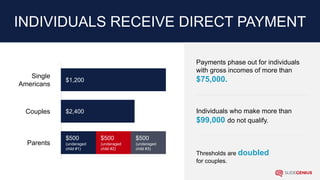
INDIVIDUALS RECEIVE DIRECT PAYMENT
Single
Americans
Couples
Parents
$1,200
$2,400
$500
(underaged
child #1)
$500
(underaged
child #2)
$500
(underaged
child #3)
$1,200
$2,400
$500
(underaged
child #1)
$500
(underaged
child #2)
$500
(underaged
child #3)
Payments phase out for individuals
with gross incomes of more than
$75,000.
Thresholds are doubled
for couples.
Individuals who make more than
$99,000 do not qualify.
USE OF
RETIREMENT FUNDS
The bill waives the 10% early withdrawal penalty
for distributions up to $100,000 for coronavirus-related
purposes, retroactive to Jan. 1.
STUDENT LOAN PAYMENTS
SUSPENDED
As decided by the Department of Education,
the suspension of payments are without penalty
through September 30.
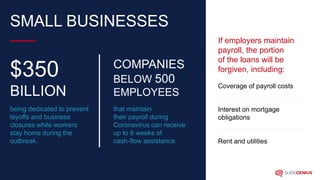
SMALL BUSINESSES
being dedicated to prevent
layoffs and business
closures while workers
stay home during the
outbreak.
$350
BILLION
that maintain
their payroll during
Coronavirus can receive
up to 8 weeks of
cash-flow assistance.
COMPANIES
BELOW 500
EMPLOYEES
Coverage of payroll costs
If employers maintain
payroll, the portion
of the loans will be
forgiven, including:
Interest on mortgage
obligations
Rent and utilities
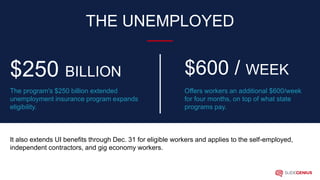
THE UNEMPLOYED
It also extends UI benefits through Dec. 31 for eligible workers and applies to the self-employed,
independent contractors, and gig economy workers.
The program's $250 billion extended
unemployment insurance program expands
eligibility.
$250 BILLION
Offers workers an additional $600/week
for four months, on top of what state
programs pay.
$600 / WEEK
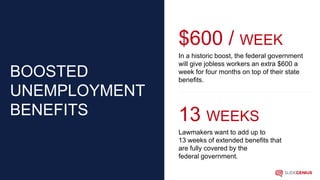
BOOSTED
UNEMPLOYMENT
BENEFITS
Lawmakers want to add up to
13 weeks of extended benefits that
are fully covered by the
federal government.
In a historic boost, the federal government
will give jobless workers an extra $600 a
week for four months on top of their state
benefits.
$600 / WEEK
13 WEEKS
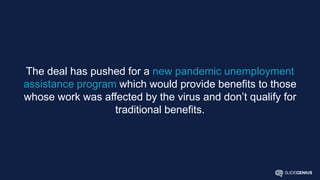
The deal has pushed for a new pandemic unemployment
assistance program which would provide benefits to those
whose work was affected by the virus and don’t qualify for
traditional benefits.
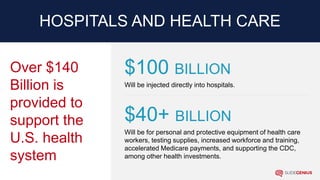
HOSPITALS AND HEALTH CARE
Over $140
Billion is
provided to
support the
U.S. health
system
Will be for personal and protective equipment of health care
workers, testing supplies, increased workforce and training,
accelerated Medicare payments, and supporting the CDC,
among other health investments.
Will be injected directly into hospitals.
$100 BILLION
$40+ BILLION
CORONAVIRUS TESTING
All testing and potential vaccines for COVID-19
will be covered at no cost to patients.
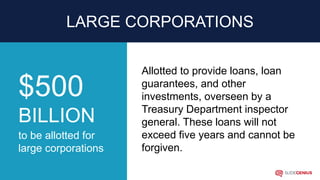
Allotted to provide loans, loan
guarantees, and other
investments, overseen by a
Treasury Department inspector
general. These loans will not
exceed five years and cannot be
forgiven.
LARGE CORPORATIONS
$500
BILLION
to be allotted for
large corporations
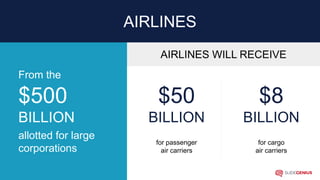
$500
BILLION
AIRLINES WILL RECEIVE
allotted for large
corporations
From the
for passenger
air carriers
for cargo
air carriers
$50
BILLION
$8
BILLION
AIRLINES
PAYROLL TAXES
The measure allows individuals to delay the payment
of their 2020 payroll taxes until 2021 and 2022.
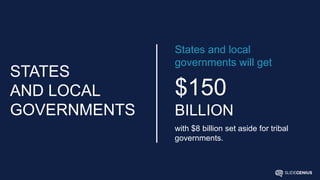
STATES
AND LOCAL
GOVERNMENTS
States and local
governments will get
with $8 billion set aside for tribal
governments.
$150
BILLION
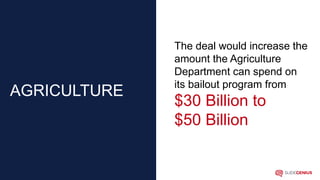
AGRICULTURE
The deal would increase the
amount the Agriculture
Department can spend on
its bailout program from
$30 Billion to
$50 Billion
The House plans to vote on the package
via a voice vote on Friday.
THE SENATE PASSED
THE BILL LATE
WEDNESDAY NIGHT
This gives members who wish to debate the bill
in person the option to do so,
while also enabling those unable to return to Washington
during coronavirus an option to stay in their home districts.

THE CORONAVIRUS STIMULUS BILL

  • 1.
    THE CORONAVIRUS STIMULUSBILL MARCH 26, 2020
  • 2.
  • 3.
    $2T CORONAVIRUS STIMULUS This isa rare legislative agreement from Congress that will have an immediate and lasting impact on ordinary citizens across the U.S.
  • 4.
    In response tothe global pandemic, Congress has assembled a stimulus bill that grants cash and assistance for regular Americans and businesses. What makes up the $2T CORONAVIRUS STIMULUS BILL?
  • 5.
  • 6.
    THE CARES ACT The880-page bill includes thousands of dollars in direct payments to most Americans, and huge loan packages designed to help small businesses and corporations.
  • 7.
  • 8.
    Here are thehighlights of the 880-page bill.
  • 9.
    INDIVIDUALS RECEIVE DIRECTPAYMENT Single Americans Couples Parents $1,200 $2,400 $500 (underaged child #1) $500 (underaged child #2) $500 (underaged child #3) $1,200 $2,400 $500 (underaged child #1) $500 (underaged child #2) $500 (underaged child #3) Payments phase out for individuals with gross incomes of more than $75,000. Thresholds are doubled for couples. Individuals who make more than $99,000 do not qualify.
  • 10.
    USE OF RETIREMENT FUNDS Thebill waives the 10% early withdrawal penalty for distributions up to $100,000 for coronavirus-related purposes, retroactive to Jan. 1.
  • 11.
    STUDENT LOAN PAYMENTS SUSPENDED Asdecided by the Department of Education, the suspension of payments are without penalty through September 30.
  • 12.
    SMALL BUSINESSES being dedicatedto prevent layoffs and business closures while workers stay home during the outbreak. $350 BILLION that maintain their payroll during Coronavirus can receive up to 8 weeks of cash-flow assistance. COMPANIES BELOW 500 EMPLOYEES Coverage of payroll costs If employers maintain payroll, the portion of the loans will be forgiven, including: Interest on mortgage obligations Rent and utilities
  • 13.
    THE UNEMPLOYED It alsoextends UI benefits through Dec. 31 for eligible workers and applies to the self-employed, independent contractors, and gig economy workers. The program's $250 billion extended unemployment insurance program expands eligibility. $250 BILLION Offers workers an additional $600/week for four months, on top of what state programs pay. $600 / WEEK
  • 14.
    BOOSTED UNEMPLOYMENT BENEFITS Lawmakers want toadd up to 13 weeks of extended benefits that are fully covered by the federal government. In a historic boost, the federal government will give jobless workers an extra $600 a week for four months on top of their state benefits. $600 / WEEK 13 WEEKS
  • 15.
    The deal haspushed for a new pandemic unemployment assistance program which would provide benefits to those whose work was affected by the virus and don’t qualify for traditional benefits.
  • 16.
    HOSPITALS AND HEALTHCARE Over $140 Billion is provided to support the U.S. health system Will be for personal and protective equipment of health care workers, testing supplies, increased workforce and training, accelerated Medicare payments, and supporting the CDC, among other health investments. Will be injected directly into hospitals. $100 BILLION $40+ BILLION
  • 17.
    CORONAVIRUS TESTING All testingand potential vaccines for COVID-19 will be covered at no cost to patients.
  • 18.
    Allotted to provideloans, loan guarantees, and other investments, overseen by a Treasury Department inspector general. These loans will not exceed five years and cannot be forgiven. LARGE CORPORATIONS $500 BILLION to be allotted for large corporations
  • 19.
    $500 BILLION AIRLINES WILL RECEIVE allottedfor large corporations From the for passenger air carriers for cargo air carriers $50 BILLION $8 BILLION AIRLINES
  • 20.
    PAYROLL TAXES The measureallows individuals to delay the payment of their 2020 payroll taxes until 2021 and 2022.
  • 21.
    STATES AND LOCAL GOVERNMENTS States andlocal governments will get with $8 billion set aside for tribal governments. $150 BILLION
  • 22.
    AGRICULTURE The deal wouldincrease the amount the Agriculture Department can spend on its bailout program from $30 Billion to $50 Billion
  • 23.
    The House plansto vote on the package via a voice vote on Friday. THE SENATE PASSED THE BILL LATE WEDNESDAY NIGHT
  • 24.
    This gives memberswho wish to debate the bill in person the option to do so, while also enabling those unable to return to Washington during coronavirus an option to stay in their home districts.

Editor's Notes