



The Changing Journals Landscape Eve Gray and Laura Czerniewicz ERP Seminar 4 October 2011
@UCTCentre for Educational Technology (CET)Scholarly Communication in Africa Programme (SCAP)OpenUCT Initiative (OUI)Laura.czerniewicz@uct.ac.zaMichelle.willmers@uct.ac.zaEve.gray@uct.ac.za
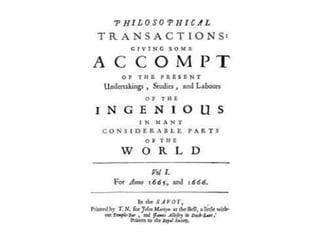
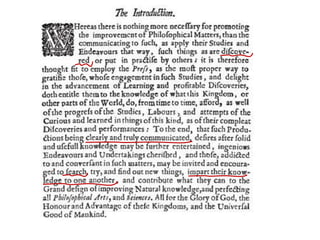
From the Royal Society and  PhilosophicalTransactions... (1655)...
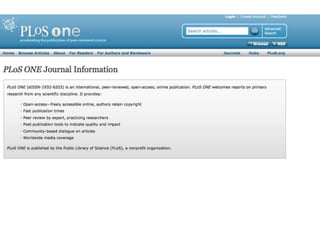
...to PLOS ONE
Getting back to the roots...
Journals as... Exchange of ideas and sharing of knowledge in a community of scholars;
Importance of effective communication with a wider audience;
Recognition of the value of research and innovation;
Contribution to the ‘Universal good of Mankind’.The trajectory of  journal publishingFrom 17th to 20th century, mostly society and independent journals, slow growth;
1655 Transactions and Journal des Savans; by 1850, 100 journals;
Most journals were society journals. Alma Swan 2011; McGuigan and Russell 2008; Jean-Claude Guedon 2001.
The rise of the journalindustryThe trajectory of  journal publishingPost war, the information society provides opportunities for commercial players;
Massification of universities fuels journal growth;
Now around 25,000 journals;
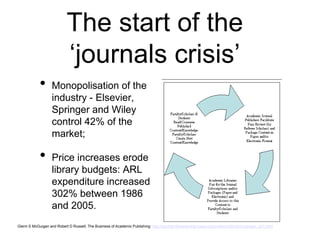
Promotions and recognition driven by industry-controlled metricsThe start of the ‘journals crisis’Monopolisation of the industry - Elsevier, Springer and Wiley control 42% of the market;
Price increases erode library budgets: ARL expenditure increased 302% between 1986 and 2005.  Glenn S McGuigan and Robert D Russell, The Business of Academic Publishing: http://southernlibrarianship.icaap.org/content/v09n03/mcguigan_g01.html
Countervailing forces - scholarship goes digital
Journals move online - a mixed blessingEasier and more comprehensive access;
A licensing model - pay-per-view and limitations on ownership;
The leveraging of reputation becomes a business - the ‘impact factor’;
‘Bundling’ and subscription monopolies. New digital publishing models emergeDepend upon linking and interoperability;
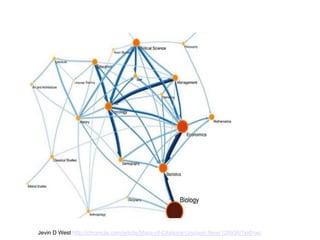
Collaboration and inter-disciplinarity;
Web 2.0 and community building;
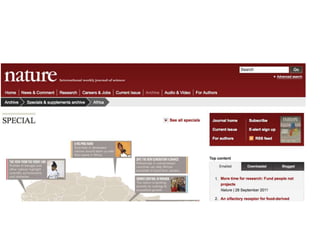
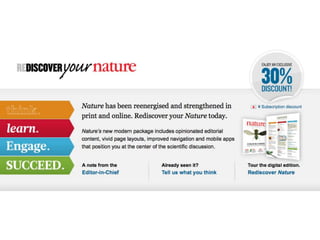
New ‘freemium’ business models: adding content and adding value.  ‘I think of Nature as a scientific communication company  rather than a journal publisher.’    Timmo Hannay (Nature Publishing), Publishing Open Content (video) 2008. Produced by Belsizen3ws.   http://www.youtube.com/user/belsizenw3
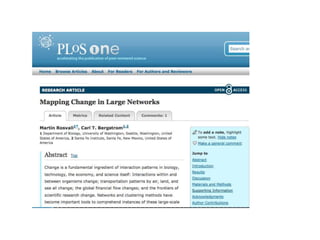
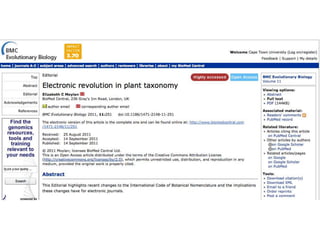
Linking and interoperability
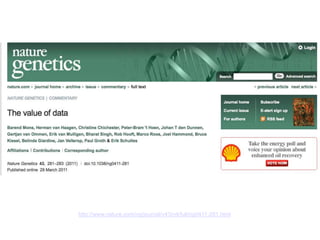
Linking to data resources becomes important
http://www.nature.com/ng/journal/v43/n4/full/ng0411-281.html
Collaboration and interdisciplinarity
Jevin D West http://chronicle.com/article/Maps-of-Citations-Uncover-New/128938/?sid=wc
New business models: ‘freemium’ and value-add
Community building
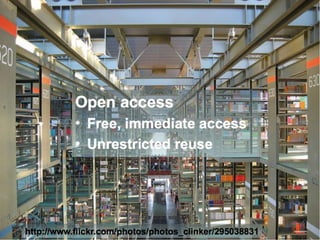
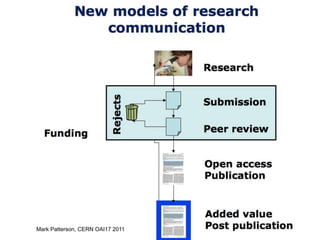
 The emergence of Open Access
An old tradition and a new technology have converged to make possible an unprecedented public good. The old tradition is the willingness of scientists and scholars to publish the fruits of their research in scholarly journals without payment, for the sake of inquiry and knowledge. The new technology is the internet. The public good they make possible is the world-wide electronic distribution of the peer-reviewed journal literature and completely free and unrestricted access to it by all scientists, scholars, teachers, students, and other curious minds. Removing access barriers to this literature will accelerate research, enrich education, share the learning of the rich with the poor and the poor with the rich, make this literature as useful as it can be, and lay the foundation for uniting humanity in a common intellectual conversation and quest for knowledge.The Budapest Open Access Initiative, December 1-2 2001.Open Society Institute http://www.soros.org/openaccessThe Budapest Open Access Initiative
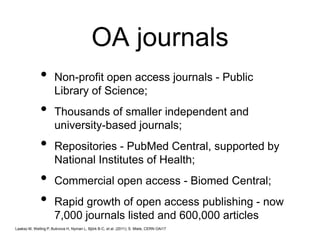
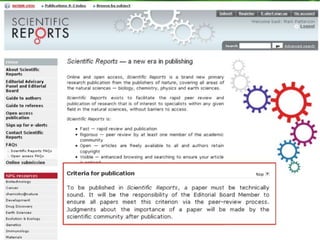
OA journalsNon-profit open access journals - Public Library of Science;
Thousands of smaller independent and university-based journals;
Repositories - PubMed Central, supported by National Institutes of Health;
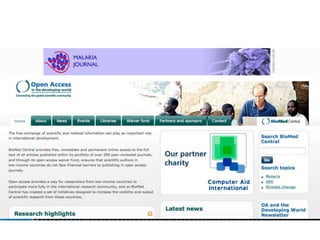
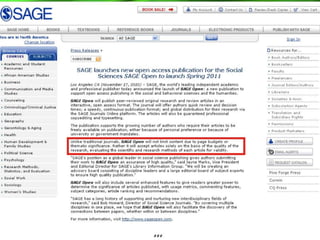
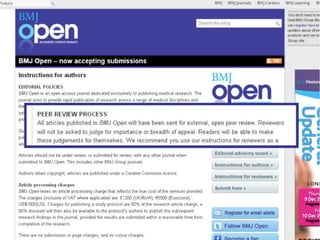
Commercial open access - Biomed Central;
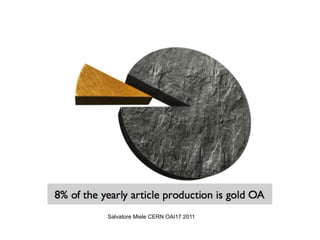
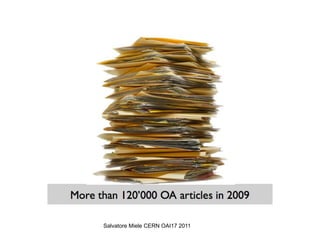
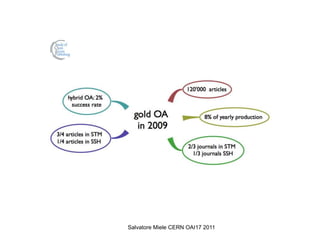
Rapid growth of open access publishing - now 7,000 journals listed and 600,000 articlesLaakso M, Welling P, Bukvova H, Nyman L, Björk B-C, et al. (2011); S. Miele, CERN OAI17
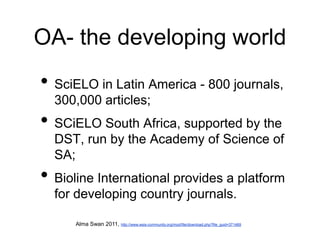
OA- the developing worldSciELO in Latin America - 800 journals, 300,000 articles;
SCiELO South Africa, supported by the DST, run by the Academy of Science of SA;
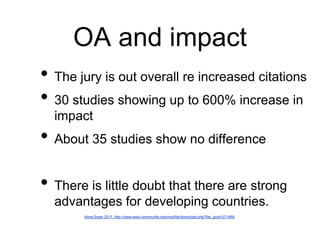
Bioline International provides a platform for developing country journals.  Alma Swan 2011, http://www.wsis-community.org/mod/file/download.php?file_guid=371469

The Changing Journal Landscape

  • 1.
    The Changing JournalsLandscape Eve Gray and Laura Czerniewicz ERP Seminar 4 October 2011
  • 2.
    @UCTCentre for EducationalTechnology (CET)Scholarly Communication in Africa Programme (SCAP)OpenUCT Initiative (OUI)Laura.czerniewicz@uct.ac.zaMichelle.willmers@uct.ac.zaEve.gray@uct.ac.za
  • 3.
    From the RoyalSociety and PhilosophicalTransactions... (1655)...
  • 5.
  • 7.
    Getting back tothe roots...
  • 9.
    Journals as... Exchangeof ideas and sharing of knowledge in a community of scholars;
  • 10.
    Importance of effectivecommunication with a wider audience;
  • 11.
    Recognition of thevalue of research and innovation;
  • 12.
    Contribution to the‘Universal good of Mankind’.The trajectory of journal publishingFrom 17th to 20th century, mostly society and independent journals, slow growth;
  • 13.
    1655 Transactions andJournal des Savans; by 1850, 100 journals;
  • 14.
    Most journals weresociety journals. Alma Swan 2011; McGuigan and Russell 2008; Jean-Claude Guedon 2001.
  • 15.
    The rise ofthe journalindustryThe trajectory of journal publishingPost war, the information society provides opportunities for commercial players;
  • 16.
    Massification of universitiesfuels journal growth;
  • 17.
  • 18.
    Promotions and recognitiondriven by industry-controlled metricsThe start of the ‘journals crisis’Monopolisation of the industry - Elsevier, Springer and Wiley control 42% of the market;
  • 19.
    Price increases erodelibrary budgets: ARL expenditure increased 302% between 1986 and 2005. Glenn S McGuigan and Robert D Russell, The Business of Academic Publishing: http://southernlibrarianship.icaap.org/content/v09n03/mcguigan_g01.html
  • 20.
    Countervailing forces -scholarship goes digital
  • 21.
    Journals move online- a mixed blessingEasier and more comprehensive access;
  • 22.
    A licensing model- pay-per-view and limitations on ownership;
  • 23.
    The leveraging ofreputation becomes a business - the ‘impact factor’;
  • 24.
    ‘Bundling’ and subscriptionmonopolies. New digital publishing models emergeDepend upon linking and interoperability;
  • 25.
  • 26.
    Web 2.0 andcommunity building;
  • 27.
    New ‘freemium’ businessmodels: adding content and adding value. ‘I think of Nature as a scientific communication company rather than a journal publisher.’ Timmo Hannay (Nature Publishing), Publishing Open Content (video) 2008. Produced by Belsizen3ws. http://www.youtube.com/user/belsizenw3
  • 29.
  • 32.
    Linking to dataresources becomes important
  • 33.
  • 34.
  • 35.
    Jevin D Westhttp://chronicle.com/article/Maps-of-Citations-Uncover-New/128938/?sid=wc
  • 36.
    New business models:‘freemium’ and value-add
  • 38.
  • 40.
    The emergenceof Open Access
  • 41.
    An old traditionand a new technology have converged to make possible an unprecedented public good. The old tradition is the willingness of scientists and scholars to publish the fruits of their research in scholarly journals without payment, for the sake of inquiry and knowledge. The new technology is the internet. The public good they make possible is the world-wide electronic distribution of the peer-reviewed journal literature and completely free and unrestricted access to it by all scientists, scholars, teachers, students, and other curious minds. Removing access barriers to this literature will accelerate research, enrich education, share the learning of the rich with the poor and the poor with the rich, make this literature as useful as it can be, and lay the foundation for uniting humanity in a common intellectual conversation and quest for knowledge.The Budapest Open Access Initiative, December 1-2 2001.Open Society Institute http://www.soros.org/openaccessThe Budapest Open Access Initiative
  • 43.
    OA journalsNon-profit openaccess journals - Public Library of Science;
  • 44.
    Thousands of smallerindependent and university-based journals;
  • 45.
    Repositories - PubMedCentral, supported by National Institutes of Health;
  • 46.
    Commercial open access- Biomed Central;
  • 47.
    Rapid growth ofopen access publishing - now 7,000 journals listed and 600,000 articlesLaakso M, Welling P, Bukvova H, Nyman L, Björk B-C, et al. (2011); S. Miele, CERN OAI17
  • 48.
    OA- the developingworldSciELO in Latin America - 800 journals, 300,000 articles;
  • 49.
    SCiELO South Africa,supported by the DST, run by the Academy of Science of SA;
  • 50.
    Bioline International providesa platform for developing country journals. Alma Swan 2011, http://www.wsis-community.org/mod/file/download.php?file_guid=371469