DRIVING GROWTH AND INNOVATION THROUGH TECHNOLOGY-ENABLED LEARNING
David Porter, Ed.D.
CEO, eCampusOntario.ca 	
November 26, 2016
Beyond Free
Slides reused, remixed, and re-engineered from original slides by David Porter BCIT.ca,
Amanda Coolidge, BCcampus, and Clint Lalonde BCcampus.ca. Unless otherwise noted, this
work is licensed under a Creative Commons Attribution Share Alike License. 

Feel free to use, modify, reuse or redistribute any or all of this presentation with attribution.
Harnessing the resonant value in open 

and collaborative practices for public good
Twitter @dendroglyph
The Power of Open
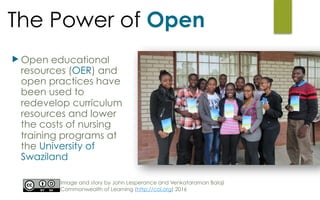
u Open educational
resources (OER) and
open practices have
been used to
redevelop curriculum
resources and lower
the costs of nursing
training programs at
the University of
Swaziland
Image and story by John Lesperance and Venkataraman Balaji
Commonwealth of Learning (http://col.org) 2016
Open Lives in Canada, too
Why OPEN?
Image	by	Craig	Garner
PD-US via Wikimedia Commons
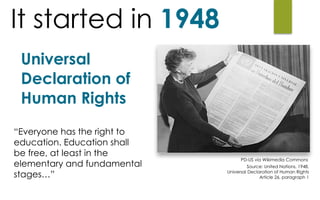
“Everyone has the right to
education. Education shall
be free, at least in the
elementary and fundamental
stages…”
Source: United Nations, 1948, 

Universal Declaration of Human Rights 

Article 26, paragraph 1
Universal
Declaration of
Human Rights
It started in 1948
UNESCO
http://www.unesco.org/new/en/communication-and-information/access-to-knowledge/

open-educational-resources/what-are-open-educational-resources-oers/

UNESCO
“Open Educational Resources (OERs) are any type
of educational materials that are in the public
domain or introduced with an open license. The
nature of these open materials means that
anyone can legally and freely copy, use, adapt
and re-share them.”
Open	(free)	Culture
“social	movement	that	promotes	the	freedom	to	distribute	
and	modify	creative	works	in	the	form	of	free	content	by	
using	the	Internet	and	other	forms	of	media.
Free	Culture	Movement	Wikipedia
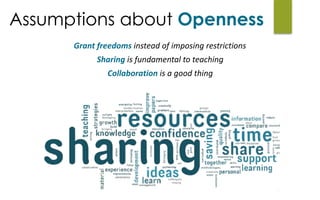
Grant	freedoms	instead	of	imposing	restrictions	
Sharing	is	fundamental	to	teaching	
Collaboration	is	a	good	thing
Assumptions about Openness
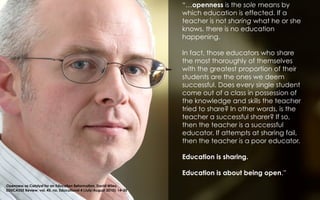
“…openness is the sole means by
which education is effected. If a
teacher is not sharing what he or she
knows, there is no education
happening.
In fact, those educators who share
the most thoroughly of themselves
with the greatest proportion of their
students are the ones we deem
successful. Does every single student
come out of a class in possession of
the knowledge and skills the teacher
tried to share? In other words, is the
teacher a successful sharer? If so,
then the teacher is a successful
educator. If attempts at sharing fail,
then the teacher is a poor educator.
Education is sharing.
Education is about being open.”
Openness as Catalyst for an Education Reformation, David Wiley, 

EDUCAUSE Review, vol. 45, no. Educational 4 (July/August 2010): 14–20
Beyond Free
Benefit #1
Teachers have full legal control
to customize and contextualize
learning resources for their
students
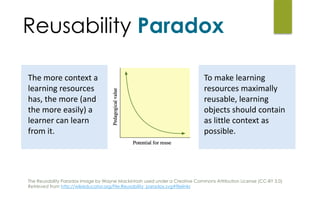
The	more	context	a	
learning	resources	
has,	the	more	(and	
the	more	easily)	a	
learner	can	learn	
from	it.
To	make	learning	
resources	maximally	
reusable,	learning	
objects	should	contain	
as	little	context	as	
possible.
The Reusability Paradox image by Wayne Mackintosh used under a Creative Commons Attribution License (CC-BY 3.0)
Retrieved from http://wikieducator.org/File:Reusability_paradox.svg#filelinks
Reusability Paradox
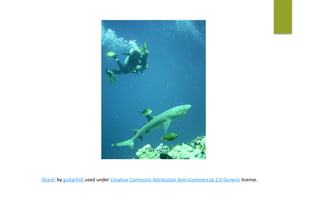
Shark!	by	guitarfish	used	under	Creative	Commons	Attribution	Non-Commercial	2.0	Generic	license.
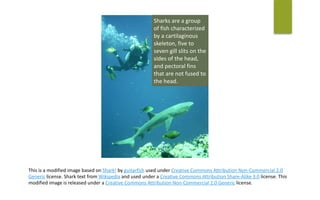
Sharks	are	a	group	
of	fish	characterized	
by	a	cartilaginous	
skeleton,	five	to	
seven	gill	slits	on	the	
sides	of	the	head,	
and	pectoral	fins	
that	are	not	fused	to	
the	head.
This	is	a	modified	image	based	on	Shark!	by	guitarfish	used	under	Creative	Commons	Attribution	Non-Commercial	2.0	
Generic	license.	Shark	text	from	Wikipedia	and	used	under	a	Creative	Commons	Attribution	Share-Alike	3.0	license.	This	
modified	image	is	released	under	a	Creative	Commons	Attribution	Non-Commercial	2.0	Generic	license.
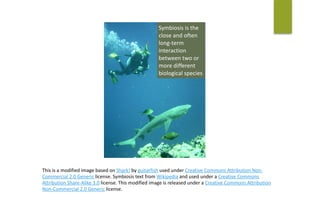
Symbiosis	is	the	
close	and	often	
long-term	
interaction	
between	two	or	
more	different	
biological	species
This	is	a	modified	image	based	on	Shark!	by	guitarfish	used	under	Creative	Commons	Attribution	Non-
Commercial	2.0	Generic	license.	Symbiosis	text	from	Wikipedia	and	used	under	a	Creative	Commons	
Attribution	Share-Alike	3.0	license.	This	modified	image	is	released	under	a	Creative	Commons	Attribution	
Non-Commercial	2.0	Generic	license.
“Therefore, pedagogical
effectiveness and potential for
reuse are completely at odds
with one another, unless the
end user is permitted to edit
the learning resource.”
Source: The Reusability Paradox, David Wiley, Connexions. http://cnx.org/content/m11898/latest/
A simple,
standardized

way to grant
copyright permissions
to your creative
work.
Some Rights Reserved
Creative Commons logo by Creative Commons used under under a Creative Commons Attribution 3.0 License
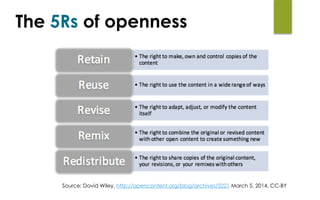
24Source: David Wiley, http://opencontent.org/blog/archives/3221 March 5, 2014, CC-BY
The 5Rs of openness
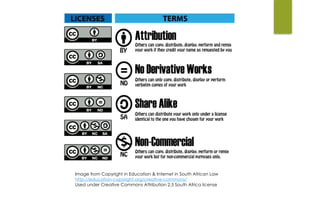
Image from Copyright in Education & Internet in South African Law	http://education-copyright.org/creative-commons/
Used under Creative Commons Attribution 2.5 South Africa license
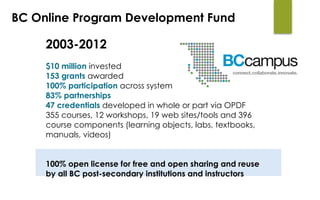
2003-2012
$10 million invested
153 grants awarded
100% participation across system
83% partnerships
47 credentials developed in whole or part via OPDF
355 courses, 12 workshops, 19 web sites/tools and 396
course components (learning objects, labs, textbooks,
manuals, videos)
100% open license for free and open sharing and reuse
by all BC post-secondary institutions and instructors
BC Online Program Development Fund
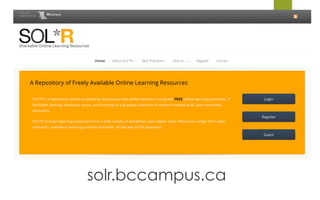
solr.bccampus.ca
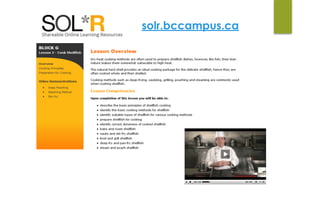
solr.bccampus.ca
A textbook licensed under an open copyright
license, and made available to be freely used by
students, teachers and members of the public.
Look here à open.bccampus.ca
What’s an Open Textbook?
Where do they come from?
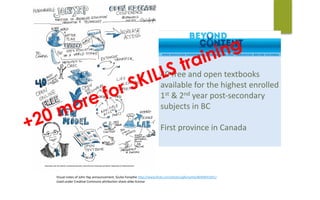
Visual	notes	of	John	Yap	announcement,	Giulia	Forsythe	http://www.flickr.com/photos/gforsythe/8094691691/		Used	under	Creative	Commons	attribution	share-alike	license
40	free	and	open	textbooks	
available	for	the	highest	enrolled	
1st	&	2nd	year	post-secondary	
subjects	in	BC
First	province	in	Canada+20 more for SKILLS training
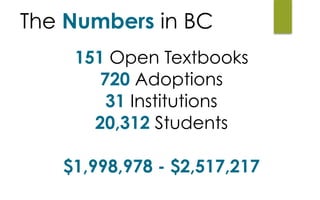
The Numbers in BC
151 Open Textbooks
720 Adoptions
31 Institutions
20,312 Students
$1,998,978 - $2,517,217
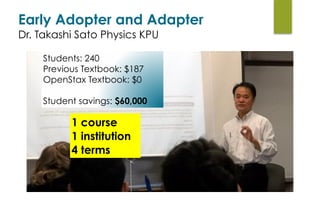
Students: 240
Previous Textbook: $187
OpenStax Textbook: $0
Student savings: $60,000
1 course	
1 institution 	
4 terms
Early Adopter and Adapter 

Dr. Takashi Sato Physics KPU
Images	from	Oxfam.org	CC-BY	and		http://en.wikipedia.org/wiki/User:Daniel_Mietchen/Talks/World_Open_Educational_Resources_Congress_2012	/How_Open_Access_and_Open_Science_can_mutually_fertilize_with_Open_Educational_Resources	CC-BY
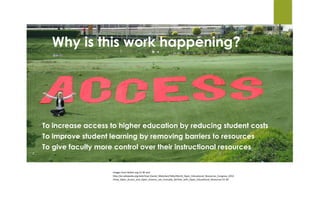
Why is this work happening?
To increase access to higher education by reducing student costs 	
To improve student learning by removing barriers to resources	
To give faculty more control over their instructional resources
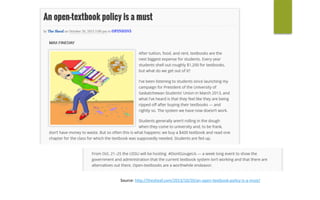
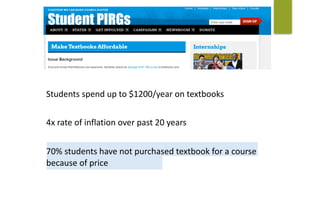
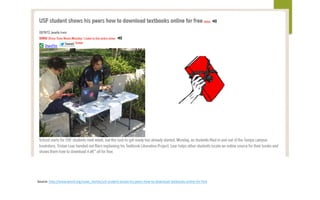
Students	spend	up	to	$1200/year	on	textbooks	
4x	rate	of	inflation	over	past	20	years	
70%	students	have	not	purchased	textbook	for	a	course	
because	of	price
Source:	http://thesheaf.com/2013/10/20/an-open-textbook-policy-is-a-must/
Source:	http://www.wmnf.org/news_stories/usf-student-shows-his-peers-how-to-download-textbooks-online-for-free
But, free is
more than just
a good deal
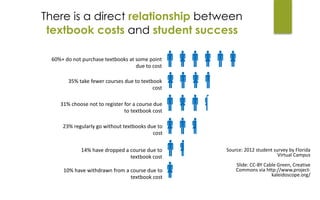
There is a direct relationship between
textbook costs and student success
!"!"!"
"!"!
!"!"
"!"
!"
"
60%+	do	not	purchase	textbooks	at	some	point	
due	to	cost	
35%	take	fewer	courses	due	to	textbook	
cost	
31%	choose	not	to	register	for	a	course	due	
to	textbook	cost
23%	regularly	go	without	textbooks	due	to	
cost
14%	have	dropped	a	course	due	to	
textbook	cost
10%	have	withdrawn	from	a	course	due	to	
textbook	cost
Source:	2012	student	survey	by	Florida	
Virtual	Campus
Slide:	CC-BY	Cable	Green,	Creative	
Commons	via	http://www.project-
kaleidoscope.org/
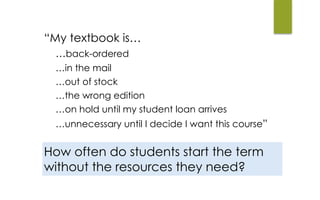
“My textbook is…
…back-ordered
…in the mail
…out of stock
…the wrong edition
…on hold until my student loan arrives
…unnecessary until I decide I want this course”
How often do students start the term
without the resources they need?
Beyond Free 

Benefit #2
Access to customized
resources improves learning
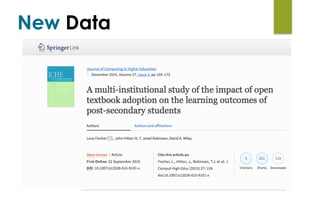
New Data
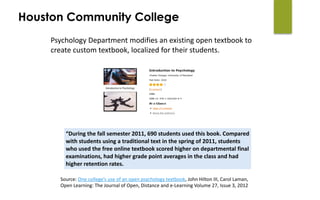
Psychology	Department	modifies	an	existing	open	textbook	to	
create	custom	textbook,	localized	for	their	students.	
Source:	One	college’s	use	of	an	open	psychology	textbook,	John	Hilton	III,	Carol	Laman,	
Open	Learning:	The	Journal	of	Open,	Distance	and	e-Learning	Volume	27,	Issue	3,	2012	
“During	the	fall	semester	2011,	690	students	used	this	book.	Compared	
with	students	using	a	traditional	text	in	the	spring	of	2011,	students	
who	used	the	free	online	textbook	scored	higher	on	departmental	final	
examinations,	had	higher	grade	point	averages	in	the	class	and	had	
higher	retention	rates.
Houston Community College
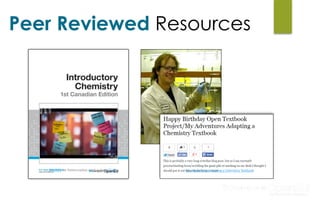
Peer Reviewed Resources
My	Adventures	Adapting	a	Chemistry	Textbook291/365		by	thebarrowboy	used	under	a	CC-BY
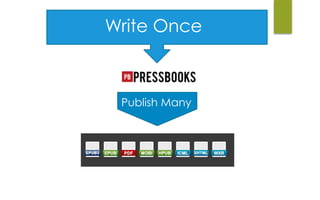
Publish Many
Write Once
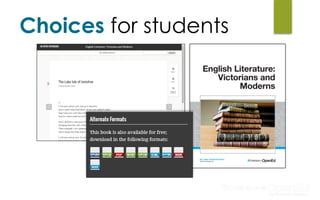
Choices for students
Beyond Free 

Benefit #3
Opportunities for authentic
learning activities
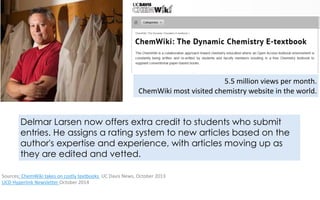
5.5	million	views	per	month.

ChemWiki	most	visited	chemistry	website	in	the	world.
Delmar Larsen now offers extra credit to students who submit
entries. He assigns a rating system to new articles based on the
author's expertise and experience, with articles moving up as
they are edited and vetted.
Sources:	ChemWiki	takes	on	costly	textbooks		UC	Davis	News,	October	2013		
UCD	Hyperlink	Newsletter	October	2014
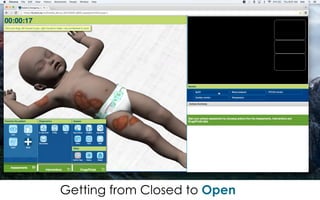
Getting from Closed to Open
Beyond Free 

Benefit #4
Collegial collaboration
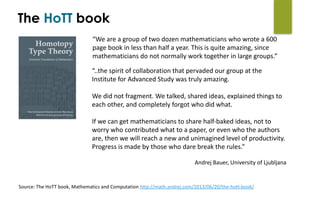
“We	are	a	group	of	two	dozen	mathematicians	who	wrote	a	600	
page	book	in	less	than	half	a	year.	This	is	quite	amazing,	since	
mathematicians	do	not	normally	work	together	in	large	groups.”
“..the	spirit	of	collaboration	that	pervaded	our	group	at	the	
Institute	for	Advanced	Study	was	truly	amazing.		
We	did	not	fragment.	We	talked,	shared	ideas,	explained	things	to	
each	other,	and	completely	forgot	who	did	what.	
If	we	can	get	mathematicians	to	share	half-baked	ideas,	not	to	
worry	who	contributed	what	to	a	paper,	or	even	who	the	authors	
are,	then	we	will	reach	a	new	and	unimagined	level	of	productivity.	
Progress	is	made	by	those	who	dare	break	the	rules.”	
Andrej	Bauer,	University	of	Ljubljana
Source:	The	HoTT	book,	Mathematics	and	Computation	http://math.andrej.com/2013/06/20/the-hott-book/
The HoTT book
Source:	Open	Textbook	Publishing,	Joe	Moxley,	World.edu	http://world.edu/open-textbook-publishing/	
“Rather than working as employees on by-the-piece rates for global
companies like Pearson, faculty members can assume the role of
publishers.
Using free content-management systems like Joomla, Drupal, or
WordPress in conjunction with inexpensive web hosting packages, we
can build communities around our educational materials.”
“We need to realize our power as authors and publishers. Working
collaboratively, we can create dynamic teaching and learning
environments.”
Joe Moxley, University of South Florida
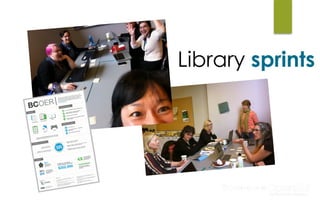
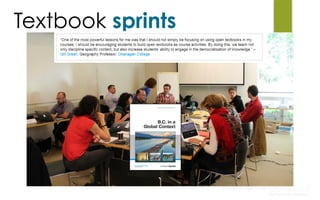
Library sprints
Textbook sprints
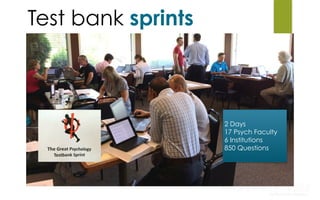
Test bank sprints
2 Days
17 Psych Faculty
6 Institutions
850 Questions
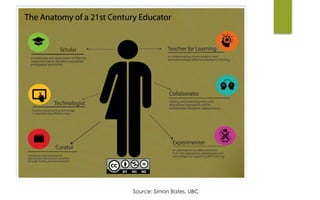
Source: Simon Bates, UBC
Beyond Free 

Benefit #5
Demonstration of the service
mission of the institution
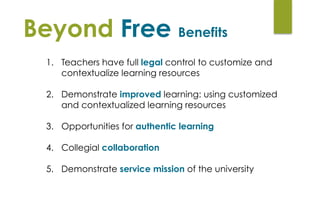
Beyond Free Benefits
1. Teachers have full legal control to customize and
contextualize learning resources

2. Demonstrate improved learning: using customized
and contextualized learning resources

3. Opportunities for authentic learning

4. Collegial collaboration
5. Demonstrate service mission of the university
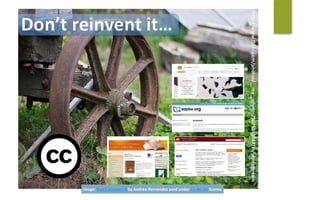
Image:	Don’t	reinvent	it	by	Andrea	Hernendez	used	under	CC-NC-SA	license
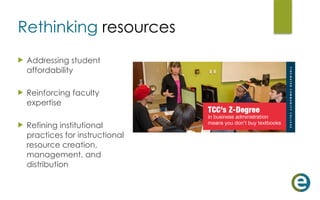
Rethinking resources
u Addressing student
affordability

u Reinforcing faculty
expertise

u Refining institutional
practices for instructional
resource creation,
management, and
distribution
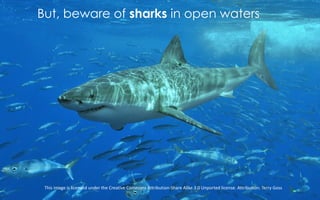
This	image	is	licensed	under	the	Creative	Commons	Attribution-Share	Alike	3.0	Unported	license.	Attribution:	Terry	Goss
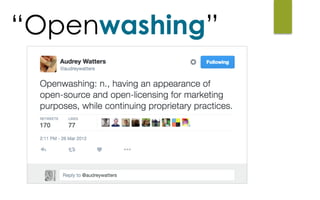
But, beware of sharks in open waters
“Openwashing”
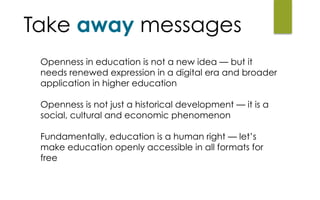
Openness in education is not a new idea — but it
needs renewed expression in a digital era and broader
application in higher education
Openness is not just a historical development — it is a
social, cultural and economic phenomenon
Fundamentally, education is a human right — let’s
make education openly accessible in all formats for
free
Take away messages
Be OPEN!
David Porter • davidp@ecampusontario.ca
Slides reused, remixed, and re-engineered from original slides by David Porter BCIT.ca,
Amanda Coolidge, BCcampus, and Clint Lalonde BCcampus.ca. Unless otherwise noted, this
work is licensed under a Creative Commons Attribution Share Alike License. 

Feel free to use, modify, reuse or redistribute any or all of this presentation with attribution.

Porter_Open_Con_2016_TO