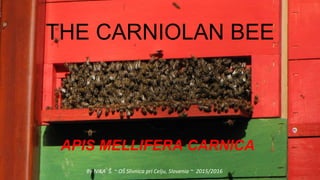
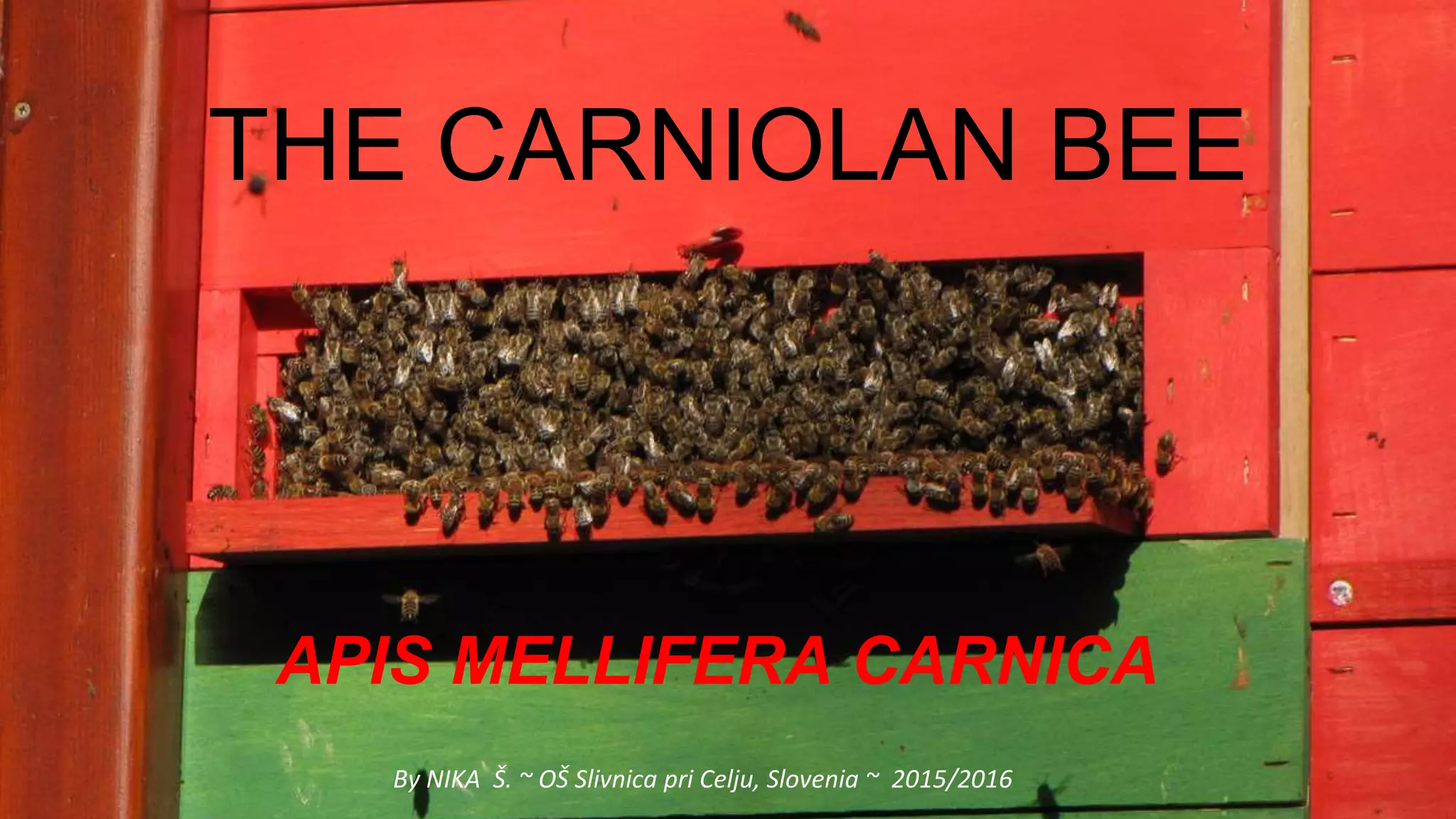
THE CARNIOLAN BEE
APIS MELLIFERA CARNICA
By NIKA Š. ~ OŠ Slivnica pri Celju, Slovenia ~ 2015/2016
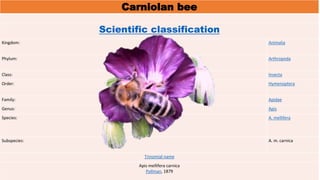
Carniolan bee
Scientific classification
Kingdom: Animalia
Phylum: Arthropoda
Class: Insecta
Order: Hymenoptera
Family: Apidae
Genus: Apis
Species: A. mellifera
Subspecies: A. m. carnica
Trinomial name
Apis mellifera carnica
Pollman, 1879
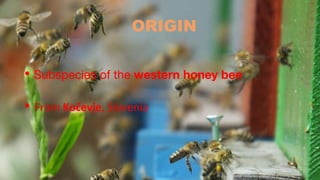
ORIGIN
• Subspecies of the western honey bee
• From Kočevje, Slovenia
INTRODUCTION
• In 1879, August Pollmann
introduced and described this bee species to other beekeepers
• In 1866, Emil Rothschütz started selling the Carniolan bees
(“commercial bee breeding”)
HOMELAND
• Slovenia
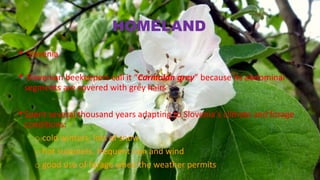
• Slovenian beekeepers call it “Carniolan grey” because its abdominal
segments are covered with grey hairs
•Spent several thousand years adapting to Slovenia’s climate and forage
conditions:
o cold winters, lots of snow
o hot summers, frequent rain and wind
o good use of forage when the weather permits
ANATOMY AND APPEARANCE
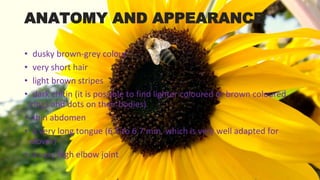
• dusky brown-grey colour
• very short hair
• light brown stripes
• dark chitin (it is possible to find lighter coloured or brown coloured
rings and dots on their bodies)
• thin abdomen
• a very long tongue (6.5 to 6.7 mm, which is very well adapted for
clover)
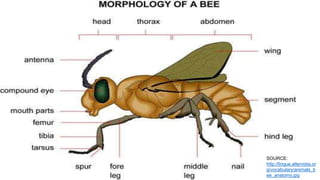
• a very high elbow joint
SOURCE:
http://lingue.altervista.or
g/vocabulary/animals_b
ee_anatomy.jpg
MORPHOLOGICAL CHARACTERISTICS
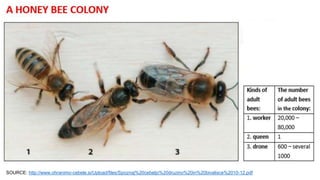
• QUEEN: a well-developed, resistant thorax and a long,
pointed abdomen
• WORKER: medium-sized, thin, generally grey, long
legs, a pointed and dark abdomen, tomentum* is grey
• DRONE: a dark abdomen (never yellow!)
*TOMENTUM = a dense covering of matted hair
SOURCE: http://www.ohranimo-cebele.si/Upload/files/Spoznaj%20cebeljo%20druzino%20in%20bivalisce%2010-12.pdf
TEMPERAMENT
• gentle, non-aggressive
• hardworking
• frugal
• an excellent sense of orientation
• a good cleaning instinct → less susceptible to various
diseases
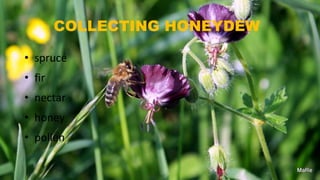
COLLECTING HONEYDEW
• spruce
• fir
• nectar
• honey
• pollen
“THE BRISK TRADE”
• News of its good characteristics reached beekeepers of all countries.
• The trade began at the end of the 19th century (Apis mellifera
mellifera Apis mellifera carnica).
• Until the First World War we exported several thousands of bee
colonies.
• The Carniolan bee is now all over the world.
• It is the most popular bee species in the world.
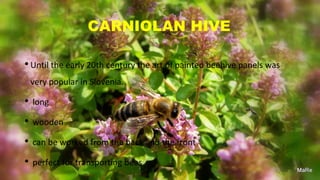
CARNIOLAN HIVE
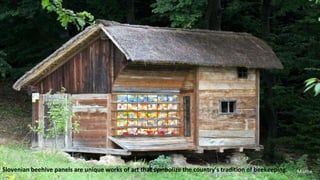
•Until the early 20th century the art of painted beehive panels was
very popular in Slovenia.
• long
• wooden
• can be worked from the back and the front
• perfect for transporting bees
Slovenian beehive panels are unique works of art that symbolize the country’s tradition of beekeeping.
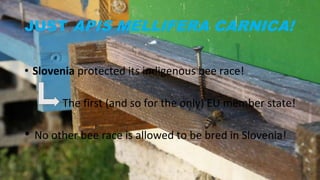
JUST APIS MELLIFERA CARNICA!
• Slovenia protected its indigenous bee race!
The first (and so for the only) EU member state!
• No other bee race is allowed to be bred in Slovenia!
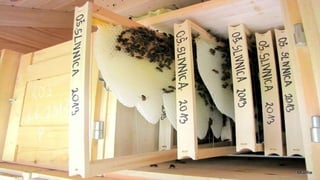
Our school’s
bee house
https://youtu.be/SukTKxfUCR8
http://www.purposegames.com/game/anatomy-
of-a-honey-bee-game
WATCH AND LEARN!
A SMART MAN ONCE SAID …
If the bee disappeared off the surface of the globe then man
would only have four years of life left. No more bees, no
more pollination, no more plants, no more animals, no more
man.
(Albert Einstein)

The Carniolan Honey Bee