
The Balanced Scorecard Methodology
Presentation by:
KAPP Edge Solutions.
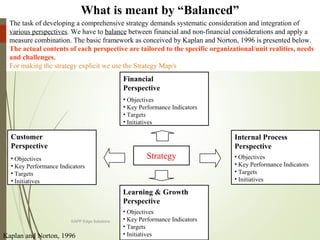
Financial
Perspective
• Objectives
• Key Performance Indicators
• Targets
• Initiatives
Strategy
Learning & Growth
Perspective
• Objectives
• Key Performance Indicators
• Targets
• Initiatives
Customer
Perspective
• Objectives
• Key Performance Indicators
• Targets
• Initiatives
Internal Process
Perspective
• Objectives
• Key Performance Indicators
• Targets
• Initiatives
Kaplan and Norton, 1996
What is meant by “Balanced”
The task of developing a comprehensive strategy demands systematic consideration and integration of
various perspectives. We have to balance between financial and non-financial considerations and apply a
measure combination. The basic framework as conceived by Kaplan and Norton, 1996 is presented below.
The actual contents of each perspective are tailored to the specific organizational/unit realities, needs
and challenges.
For making the strategy explicit we use the Strategy Map/s
KAPP Edge Solutions
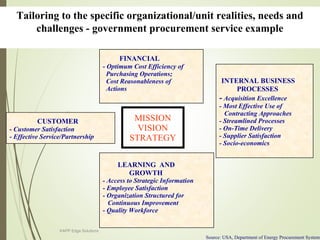
CUSTOMER
- Customer Satisfaction
- Effective Service/Partnership
MISSION
VISION
STRATEGY
LEARNING AND
GROWTH
- Access to Strategic Information
- Employee Satisfaction
- Organization Structured for
Continuous Improvement
- Quality Workforce
FINANCIAL
- Optimum Cost Efficiency of
Purchasing Operations;
Cost Reasonableness of
Actions
INTERNAL BUSINESS
PROCESSES
- Acquisition Excellence
- Most Effective Use of
Contracting Approaches
- Streamlined Processes
- On-Time Delivery
- Supplier Satisfaction
- Socio-economics
Source: USA, Department of Energy Procurement System
Tailoring to the specific organizational/unit realities, needs and
challenges - government procurement service example
KAPP Edge Solutions
What do we balance
 Financial versus Non-financial measures
 Tangible versus Intangible assets
 Long-term versus Short-term Goals
 Internal versus External Perspective
 Performance Drivers versus Outcomes
KAPP Edge Solutions
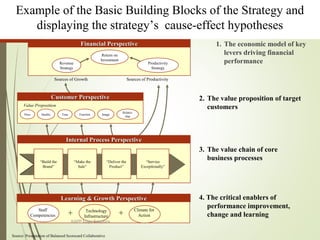
Internal Process PerspectiveInternal Process Perspective
Financial PerspectiveFinancial Perspective
Learning & Growth PerspectiveLearning & Growth Perspective
Customer PerspectiveCustomer Perspective
Return on
Investment
Price Quality Time Function Image
Relatio-
ship
Value Proposition
Sources of Growth Sources of Productivity
Technology
Infrastructure
Climate for
Action+ +
“Build the
Brand”
“Make the
Sale”
“Deliver the
Product”
“Service
Exceptionally”
Revenue
Strategy
Productivity
Strategy
1. The economic model of key
levers driving financial
performance
2. The value proposition of target
customers
3. The value chain of core
business processes
4. The critical enablers of
performance improvement,
change and learning
Staff
Competencies
Source: Presentation of Balanced Scorecard Collaborative
Example of the Basic Building Blocks of the Strategy and
displaying the strategy’s cause-effect hypotheses
KAPP Edge Solutions
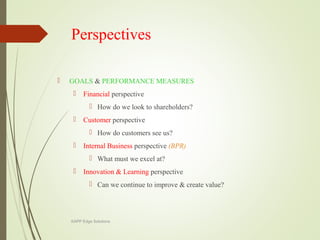
Perspectives
 GOALS & PERFORMANCE MEASURES
 Financial perspective
 How do we look to shareholders?
 Customer perspective
 How do customers see us?
 Internal Business perspective (BPR)
 What must we excel at?
 Innovation & Learning perspective
 Can we continue to improve & create value?
KAPP Edge Solutions
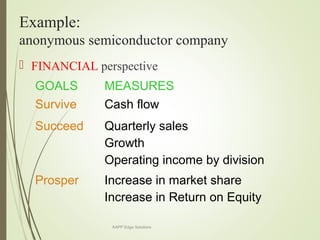
Example:
anonymous semiconductor company
 FINANCIAL perspective
GOALS MEASURES
Survive Cash flow
Succeed Quarterly sales
Growth
Operating income by division
Prosper Increase in market share
Increase in Return on Equity
KAPP Edge Solutions
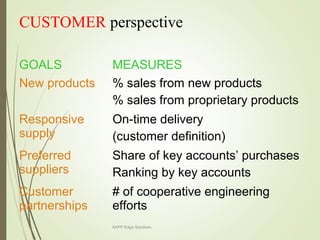
CUSTOMER perspective
GOALS MEASURES
New products % sales from new products
% sales from proprietary products
Responsive
supply
On-time delivery
(customer definition)
Preferred
suppliers
Share of key accounts’ purchases
Ranking by key accounts
Customer
partnerships
# of cooperative engineering
efforts
KAPP Edge Solutions
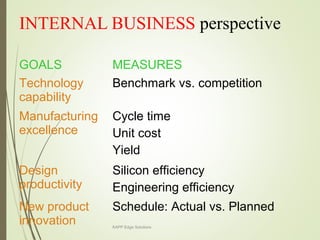
INTERNAL BUSINESS perspective
GOALS MEASURES
Technology
capability
Benchmark vs. competition
Manufacturing
excellence
Cycle time
Unit cost
Yield
Design
productivity
Silicon efficiency
Engineering efficiency
New product
innovation
Schedule: Actual vs. Planned
KAPP Edge Solutions
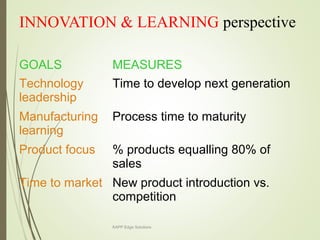
INNOVATION & LEARNING perspective
GOALS MEASURES
Technology
leadership
Time to develop next generation
Manufacturing
learning
Process time to maturity
Product focus % products equalling 80% of
sales
Time to market New product introduction vs.
competition
KAPP Edge Solutions
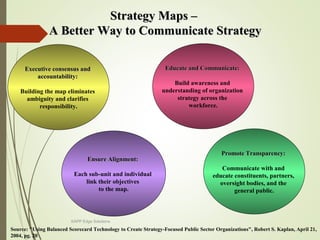
Executive consensus andExecutive consensus and
accountability:accountability:
Building the map eliminates
ambiguity and clarifies
responsibility.
Educate and Communicate:Educate and Communicate:
Build awareness and
understanding of organization
strategy across the
workforce.
Ensure Alignment:Ensure Alignment:
Each sub-unit and individual
link their objectives
to the map.
Source: "Using Balanced Scorecard Technology to Create Strategy-Focused Public Sector Organizations", Robert S. Kaplan, April 21,
2004, pg. 20
Promote Transparency:Promote Transparency:
Communicate with and
educate constituents, partners,
oversight bodies, and the
general public.
Strategy Maps –Strategy Maps –
A Better Way to Communicate StrategyA Better Way to Communicate Strategy
KAPP Edge Solutions
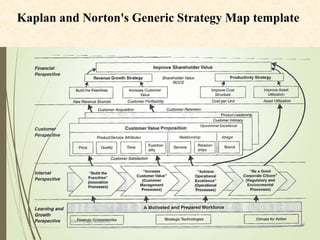
Kaplan and Norton's Generic Strategy Map template
KAPP Edge Solutions
Customer Value Proposition
SelectionAvailabilityQualityPrice
Organization Capital
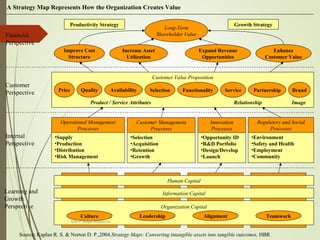
A Strategy Map Represents How the Organization Creates Value
•Supply
•Production
•Distribution
•Risk Management
Operational Management
Processes
•Selection
•Acquisition
•Retention
•Growth
Customer Management
Processes
•Opportunity ID
•R&D Portfolio
•Design/Develop
•Launch
Innovation
Processes
•Environment
•Safety and Health
•Employment
•Community
Regulatory and Social
Processes
Internal
Perspective
Human Capital
Information Capital
Culture Leadership Alignment Teamwork
Learning and
Growth
Perspective
Customer
Perspective
Financial
Perspective
Functionality Service Partnership Brand
Product / Service Attributes Relationship Image
Improve Cost
Structure
Increase Asset
Utilization
Long-Term
Shareholder Value
Expand Revenue
Opportunities
Enhance
Customer Value
Productivity Strategy Growth Strategy
Source: Kaplan R. S. & Norton D. P.,2004,Strategy Maps: Converting intangible assets into tangible outcomes, HBR
KAPP Edge Solutions
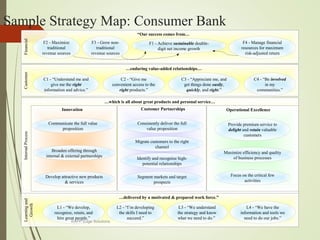
Sample Strategy Map: Consumer BankInternalProcess
…which is all about great products and personal service…
Customer
…enduring value-added relationships…
Financial
“Our success comes from…
C3 - “Appreciate me, and
get things done easily,
quickly, and right.”
C1 - “Understand me and
give me the right
information and advice.”
C4 - “Be involved
in my
communities.”
C2 - “Give me
convenient access to the
right products.”
F1 - Achieve sustainable double-
digit net income growth
F2 - Maximize
traditional
revenue sources
F4 - Manage financial
resources for maximum
risk-adjusted return
F3 - Grow non-
traditional
revenue sources
Learningand
Growth
…delivered by a motivated & prepared work force.”
L4 - “We have the
information and tools we
need to do our jobs.”
L1 - “We develop,
recognize, retain, and
hire great people.”
L3 - “We understand
the strategy and know
what we need to do.”
L2 - “I’m developing
the skills I need to
succeed.”
Innovation Customer Partnerships Operational Excellence
Provide premium service to
delight and retain valuable
customers
Maximize efficiency and quality
of business processes
Focus on the critical few
activities
Consistently deliver the full
value proposition
Migrate customers to the right
channel
Identify and recognize high-
potential relationships
Segment markets and target
prospects
Communicate the full value
proposition
Broaden offering through
internal & external partnerships
Develop attractive new products
& services
KAPP Edge Solutions
Strategy
Department
Team/
Individual
MeasuresObjectives
The Organizational Framework
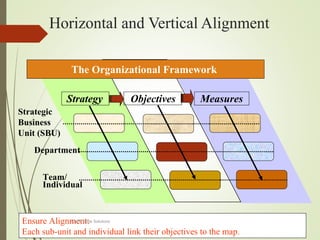
Horizontal and Vertical Alignment
Strategic
Business
Unit (SBU)
Ensure Alignment:
Each sub-unit and individual link their objectives to the map.
KAPP Edge Solutions
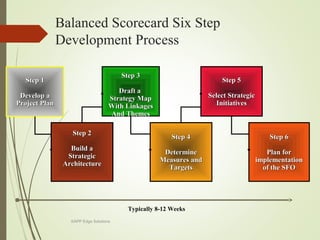
Balanced Scorecard Development
Process
Typically 8-12 Weeks
Step 1Step 1
Develop aDevelop a
Project PlanProject Plan
Step 2Step 2
Build aBuild a
StrategicStrategic
ArchitectureArchitecture
Step 3Step 3
Draft aDraft a
Strategy MapStrategy Map
With LinkagesWith Linkages
And ThemesAnd Themes
Step 4Step 4
DetermineDetermine
Measures andMeasures and
TargetsTargets
Step 5Step 5
Select StrategicSelect Strategic
InitiativesInitiatives
Step 6Step 6
Plan forPlan for
implementationimplementation
of the SFOof the SFO
Balanced Scorecard Six Step
Development Process
KAPP Edge Solutions
Putting the BSC to work
Presentation of the metrics and their visualization
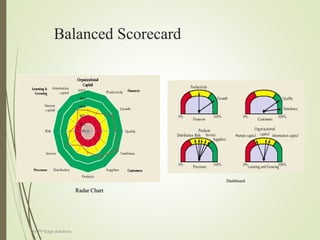
Balanced Scorecard
Radar ChartRadar Chart
DashboardDashboard
KAPP Edge Solutions
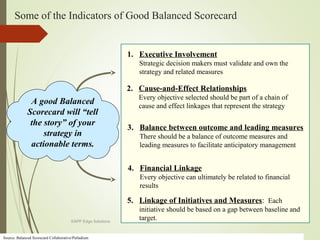
Some of the Indicators of Good Balanced Scorecard
4. Financial Linkage
Every objective can ultimately be related to financial
results
1. Executive Involvement
Strategic decision makers must validate and own the
strategy and related measures
2. Cause-and-Effect Relationships
Every objective selected should be part of a chain of
cause and effect linkages that represent the strategy
3. Balance between outcome and leading measures
There should be a balance of outcome measures and
leading measures to facilitate anticipatory management
5. Linkage of Initiatives and Measures: Each
initiative should be based on a gap between baseline and
target.
A good Balanced
Scorecard will “tell
the story” of your
strategy in
actionable terms.
Source: Balanced Scorecard Collaborative/Palladium
KAPP Edge Solutions
Thanks
KAPP Edge Solutions Pvt ltd
www.onlineglobalcareer.com
KAPP Edge Solutions

The Balanced scorecard methodology

  • 1.
    The Balanced ScorecardMethodology Presentation by: KAPP Edge Solutions.
  • 2.
    Financial Perspective • Objectives • KeyPerformance Indicators • Targets • Initiatives Strategy Learning & Growth Perspective • Objectives • Key Performance Indicators • Targets • Initiatives Customer Perspective • Objectives • Key Performance Indicators • Targets • Initiatives Internal Process Perspective • Objectives • Key Performance Indicators • Targets • Initiatives Kaplan and Norton, 1996 What is meant by “Balanced” The task of developing a comprehensive strategy demands systematic consideration and integration of various perspectives. We have to balance between financial and non-financial considerations and apply a measure combination. The basic framework as conceived by Kaplan and Norton, 1996 is presented below. The actual contents of each perspective are tailored to the specific organizational/unit realities, needs and challenges. For making the strategy explicit we use the Strategy Map/s KAPP Edge Solutions
  • 3.
    CUSTOMER - Customer Satisfaction -Effective Service/Partnership MISSION VISION STRATEGY LEARNING AND GROWTH - Access to Strategic Information - Employee Satisfaction - Organization Structured for Continuous Improvement - Quality Workforce FINANCIAL - Optimum Cost Efficiency of Purchasing Operations; Cost Reasonableness of Actions INTERNAL BUSINESS PROCESSES - Acquisition Excellence - Most Effective Use of Contracting Approaches - Streamlined Processes - On-Time Delivery - Supplier Satisfaction - Socio-economics Source: USA, Department of Energy Procurement System Tailoring to the specific organizational/unit realities, needs and challenges - government procurement service example KAPP Edge Solutions
  • 4.
    What do webalance  Financial versus Non-financial measures  Tangible versus Intangible assets  Long-term versus Short-term Goals  Internal versus External Perspective  Performance Drivers versus Outcomes KAPP Edge Solutions
  • 5.
    Internal Process PerspectiveInternalProcess Perspective Financial PerspectiveFinancial Perspective Learning & Growth PerspectiveLearning & Growth Perspective Customer PerspectiveCustomer Perspective Return on Investment Price Quality Time Function Image Relatio- ship Value Proposition Sources of Growth Sources of Productivity Technology Infrastructure Climate for Action+ + “Build the Brand” “Make the Sale” “Deliver the Product” “Service Exceptionally” Revenue Strategy Productivity Strategy 1. The economic model of key levers driving financial performance 2. The value proposition of target customers 3. The value chain of core business processes 4. The critical enablers of performance improvement, change and learning Staff Competencies Source: Presentation of Balanced Scorecard Collaborative Example of the Basic Building Blocks of the Strategy and displaying the strategy’s cause-effect hypotheses KAPP Edge Solutions
  • 6.
    Perspectives  GOALS &PERFORMANCE MEASURES  Financial perspective  How do we look to shareholders?  Customer perspective  How do customers see us?  Internal Business perspective (BPR)  What must we excel at?  Innovation & Learning perspective  Can we continue to improve & create value? KAPP Edge Solutions
  • 7.
    Example: anonymous semiconductor company FINANCIAL perspective GOALS MEASURES Survive Cash flow Succeed Quarterly sales Growth Operating income by division Prosper Increase in market share Increase in Return on Equity KAPP Edge Solutions
  • 8.
    CUSTOMER perspective GOALS MEASURES Newproducts % sales from new products % sales from proprietary products Responsive supply On-time delivery (customer definition) Preferred suppliers Share of key accounts’ purchases Ranking by key accounts Customer partnerships # of cooperative engineering efforts KAPP Edge Solutions
  • 9.
    INTERNAL BUSINESS perspective GOALSMEASURES Technology capability Benchmark vs. competition Manufacturing excellence Cycle time Unit cost Yield Design productivity Silicon efficiency Engineering efficiency New product innovation Schedule: Actual vs. Planned KAPP Edge Solutions
  • 10.
    INNOVATION & LEARNINGperspective GOALS MEASURES Technology leadership Time to develop next generation Manufacturing learning Process time to maturity Product focus % products equalling 80% of sales Time to market New product introduction vs. competition KAPP Edge Solutions
  • 11.
    Executive consensus andExecutiveconsensus and accountability:accountability: Building the map eliminates ambiguity and clarifies responsibility. Educate and Communicate:Educate and Communicate: Build awareness and understanding of organization strategy across the workforce. Ensure Alignment:Ensure Alignment: Each sub-unit and individual link their objectives to the map. Source: "Using Balanced Scorecard Technology to Create Strategy-Focused Public Sector Organizations", Robert S. Kaplan, April 21, 2004, pg. 20 Promote Transparency:Promote Transparency: Communicate with and educate constituents, partners, oversight bodies, and the general public. Strategy Maps –Strategy Maps – A Better Way to Communicate StrategyA Better Way to Communicate Strategy KAPP Edge Solutions
  • 12.
    Kaplan and Norton'sGeneric Strategy Map template KAPP Edge Solutions
  • 13.
    Customer Value Proposition SelectionAvailabilityQualityPrice OrganizationCapital A Strategy Map Represents How the Organization Creates Value •Supply •Production •Distribution •Risk Management Operational Management Processes •Selection •Acquisition •Retention •Growth Customer Management Processes •Opportunity ID •R&D Portfolio •Design/Develop •Launch Innovation Processes •Environment •Safety and Health •Employment •Community Regulatory and Social Processes Internal Perspective Human Capital Information Capital Culture Leadership Alignment Teamwork Learning and Growth Perspective Customer Perspective Financial Perspective Functionality Service Partnership Brand Product / Service Attributes Relationship Image Improve Cost Structure Increase Asset Utilization Long-Term Shareholder Value Expand Revenue Opportunities Enhance Customer Value Productivity Strategy Growth Strategy Source: Kaplan R. S. & Norton D. P.,2004,Strategy Maps: Converting intangible assets into tangible outcomes, HBR KAPP Edge Solutions
  • 14.
    Sample Strategy Map:Consumer BankInternalProcess …which is all about great products and personal service… Customer …enduring value-added relationships… Financial “Our success comes from… C3 - “Appreciate me, and get things done easily, quickly, and right.” C1 - “Understand me and give me the right information and advice.” C4 - “Be involved in my communities.” C2 - “Give me convenient access to the right products.” F1 - Achieve sustainable double- digit net income growth F2 - Maximize traditional revenue sources F4 - Manage financial resources for maximum risk-adjusted return F3 - Grow non- traditional revenue sources Learningand Growth …delivered by a motivated & prepared work force.” L4 - “We have the information and tools we need to do our jobs.” L1 - “We develop, recognize, retain, and hire great people.” L3 - “We understand the strategy and know what we need to do.” L2 - “I’m developing the skills I need to succeed.” Innovation Customer Partnerships Operational Excellence Provide premium service to delight and retain valuable customers Maximize efficiency and quality of business processes Focus on the critical few activities Consistently deliver the full value proposition Migrate customers to the right channel Identify and recognize high- potential relationships Segment markets and target prospects Communicate the full value proposition Broaden offering through internal & external partnerships Develop attractive new products & services KAPP Edge Solutions
  • 15.
    Strategy Department Team/ Individual MeasuresObjectives The Organizational Framework Horizontaland Vertical Alignment Strategic Business Unit (SBU) Ensure Alignment: Each sub-unit and individual link their objectives to the map. KAPP Edge Solutions
  • 16.
  • 17.
    Typically 8-12 Weeks Step1Step 1 Develop aDevelop a Project PlanProject Plan Step 2Step 2 Build aBuild a StrategicStrategic ArchitectureArchitecture Step 3Step 3 Draft aDraft a Strategy MapStrategy Map With LinkagesWith Linkages And ThemesAnd Themes Step 4Step 4 DetermineDetermine Measures andMeasures and TargetsTargets Step 5Step 5 Select StrategicSelect Strategic InitiativesInitiatives Step 6Step 6 Plan forPlan for implementationimplementation of the SFOof the SFO Balanced Scorecard Six Step Development Process KAPP Edge Solutions
  • 18.
    Putting the BSCto work Presentation of the metrics and their visualization
  • 19.
    Balanced Scorecard Radar ChartRadarChart DashboardDashboard KAPP Edge Solutions
  • 20.
    Some of theIndicators of Good Balanced Scorecard 4. Financial Linkage Every objective can ultimately be related to financial results 1. Executive Involvement Strategic decision makers must validate and own the strategy and related measures 2. Cause-and-Effect Relationships Every objective selected should be part of a chain of cause and effect linkages that represent the strategy 3. Balance between outcome and leading measures There should be a balance of outcome measures and leading measures to facilitate anticipatory management 5. Linkage of Initiatives and Measures: Each initiative should be based on a gap between baseline and target. A good Balanced Scorecard will “tell the story” of your strategy in actionable terms. Source: Balanced Scorecard Collaborative/Palladium KAPP Edge Solutions
  • 21.
    Thanks KAPP Edge SolutionsPvt ltd www.onlineglobalcareer.com KAPP Edge Solutions