Text Detection and Character Recognition from ImagesBadruzNasrin Bin Basri1051101534 Supervisor : MohdHaris Lye Abdullah1
ContentsIntroduction1Literature review  2Method Used 3Experiment and Result4Future works   52
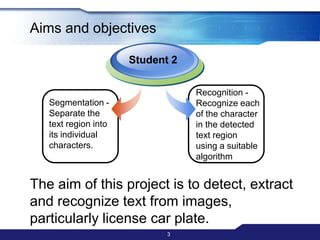
Aims and objectivesStudent 2Recognition -Recognize each of the character in the detected text region using a suitable algorithmSegmentation -Separate the text region into its individual characters. 3The aim of this project is to detect, extract and recognize text from images, particularly license car plate.
Motivation 4Text detection and recognition in general have quite a lot of relevant application for automatic indexing or information retrieval such document indexing, content-based image retrieval, and license car plate recognition which further opens up the possibility for more improved and advanced systems.
Problem statement5To segment the image to individual characters, we need to find the characteristic to be used as boundary to segment the image. To classify, we need to use the best template to compare with the segmented image and to determine how the template will be used to compare with the image.
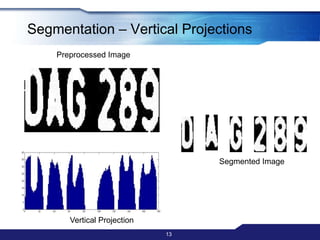
Literature review6SegmentationKlouverin research on recognition text in PayPal HIP [1] proposed the use of vertical projection to segment the characters in images. There are several reasons vertical segmentation been proposed by Klouver:PayPal HIP image is computer generated only minor preprocessing needed.
There are obvious separation between each character
Character size in PayPal HIP is fixedStudy on Malaysian License Plate Recognition by Othman [3] proposed a model specifically to detect and recognize the text in Malaysian license plate. For segmentation, connected components method has been proposed however this method only can use if the license plates are single row license plate and the study only been made on single row license plate. Same method also been use by Ganapathy and Lui in [4]
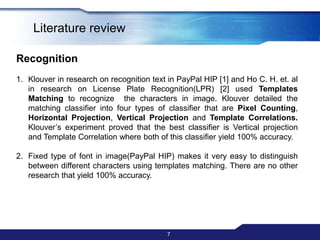
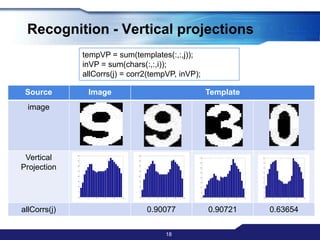
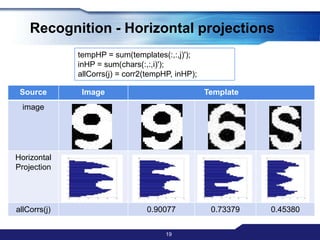
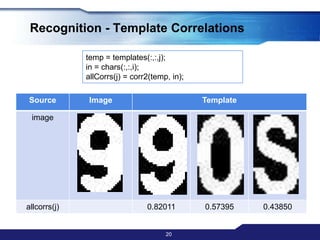
7Literature reviewRecognitionKlouverin research on recognition text in PayPal HIP [1] and Ho C. H. et. al in research on License Plate Recognition(LPR) [2] used Templates Matching to recognize  the characters in image. Klouver detailed the matching classifier into four types of classifier that are Pixel Counting, Horizontal Projection, Vertical Projection and Template Correlations. Klouver’s experiment proved that the best classifier is Vertical projection and Template Correlation where both of this classifier yield 100% accuracy.Fixed type of font in image(PayPal HIP) makes it very easy to distinguish between different characters using templates matching. There are no other research that yield 100% accuracy.
8Literature reviewRecognitionStudy on Malaysian License Plate Recognition by Othman [3],Ganapathy and Lui in [4], M.Fukumi et. Al  [6] , AnasJ.A. Husain et. Al [7] used Neural Network to recognized the text. Compared to templates matching, neural network consume more time. Neural network also need training before it can be used and it only can achieve high accuracy if the sampled image is almost same with the training images. Andrew Vogt and Joe G. Bared [5] concluded the disadvantages of  neural network are :Minimizing overfitting in neural networks requires a great deal of computational effort The individual relations between the input variables and the output variables are not developed by engineering judgment so the model tends to be a black box or input/output table without analytical basis and to make the accuracy level high the sample size has to be large.
9Literature reviewRecognitionJared Hopkins and Tim Anderson  in [9], used Fourier Descriptor to recognize text in image. In most of the researches, Fourier descriptor been used to recognize more complex shape such as for logo classification by Folkers and Samet [10] and for Sinhala Script by Rohana, Ruvan and Kevin [11].Basically there are no research on LPR using Fourier descriptor(FD), hence, this research will also test the usage of FD to recognize text in Malaysian License Plate.WisamAl Faqheri and SyamsiahMashohor in A Real-Time Malaysian Automatic License Plate Recognition (M-ALPR) using Hybrid Fuzzy [12] used the hybrid Fuzzy method to recognize the license number. Compared to other study previously done on license plate detection where almost all of the previous work relied on a single method like template matching or neural network Wisamand Syamsiah proposed combination of more than one method based on the type of license plate.
Approach - Flowchart to recognize the characters in image10
Make templateTo create templete.mat to be use for classification:11……Matrix size 24 X 42 X 36 Saved as template.mat36 images of charactersSize = 42 X 24
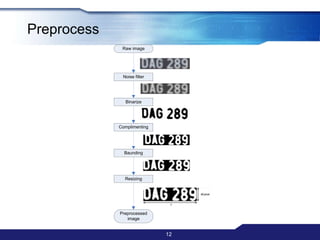
Preprocess12
Segmentation – Vertical Projections Preprocessed ImageVertical projection analysisSegmented ImageVertical Projection13
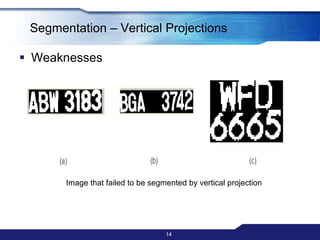
Segmentation – Vertical Projections Weaknesses14Image that failed to be segmented by vertical projection
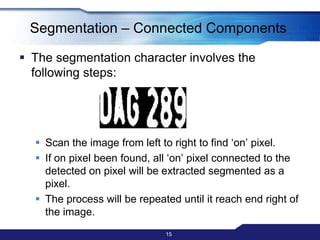
The segmentation character involves the following steps:Scan the image from left to right to find ‘on’ pixel.If on pixel been found, all ‘on’ pixel connected to the detected on pixel will be extracted segmented as a pixel.The process will be repeated until it reach end right of the image.15Segmentation – Connected Components 
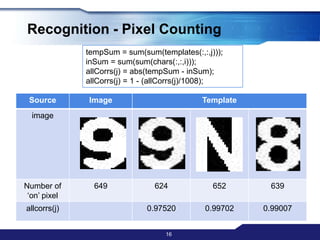
Recognition - Pixel Counting16tempSum = sum(sum(templates(:,:,j)));                inSum = sum(sum(chars(:,:,i)));                allCorrs(j) = abs(tempSum - inSum);allCorrs(j) = 1 - (allCorrs(j)/1008);
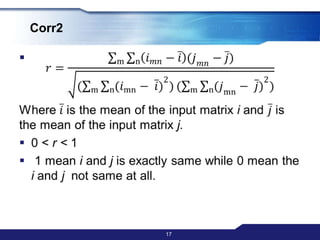
Corr2𝑟=mn𝑖𝑚𝑛−𝑖(𝑗𝑚𝑛−𝑗)(mn(𝑖mn− 𝑖)2)(mn(𝑗mn− 𝑗)2)Where 𝑖 is the mean of the input matrix i and 𝑗 is the mean of the input matrix j.0 < r < 11 mean i and j is exactly same while 0 mean the i and j not same at all. 17
Recognition - Vertical projections18tempVP = sum(templates(:,:,j));                inVP = sum(chars(:,:,i));                allCorrs(j) = corr2(tempVP, inVP);
Recognition - Horizontal projections 19tempHP = sum(templates(:,:,j)');                inHP = sum(chars(:,:,i)');                allCorrs(j) = corr2(tempHP, inHP);
20Recognition - Template Correlationstemp = templates(:,:,j);                in = chars(:,:,i);                allCorrs(j) = corr2(temp, in);
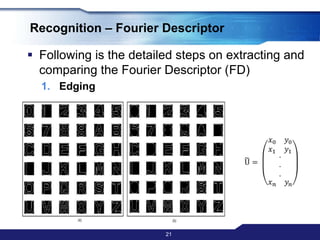
Recognition – Fourier DescriptorFollowing is the detailed steps on extracting and comparing the Fourier Descriptor (FD)Edging21U= 𝑥0𝑦0𝑥1𝑦1...𝑥𝑛𝑦𝑛 
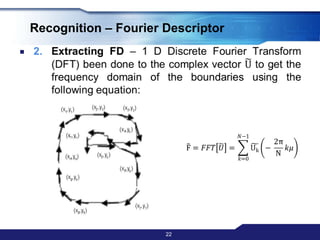
Recognition – Fourier DescriptorExtracting FD – 1 D Discrete Fourier Transform (DFT) been done to the complex vector U to get the frequency domain of the boundaries using the following equation: 22F=𝐹𝐹𝑇𝑈=𝑘=0𝑁−1Uk− 2πN𝑘𝜇 
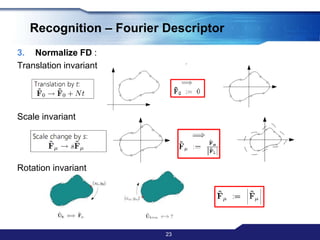
Recognition – Fourier DescriptorNormalize FD: Translation invariantScale invariantRotation invariant23
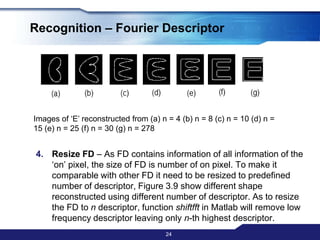
Recognition – Fourier DescriptorImages of ‘E’ reconstructed from (a) n = 4 (b) n = 8 (c) n = 10 (d) n = 15 (e) n = 25 (f) n = 30 (g) n = 278Resize FD – As FD contains information of all information of the ‘on’ pixel, the size of FD is number of on pixel. To make it comparable with other FD it need to be resized to predefined number of descriptor, Figure 3.9 show different shape reconstructed using different number of descriptor. As to resize the FD to n descriptor, function shiftfft in Matlab will remove low frequency descriptor leaving only n-th highest descriptor. 24
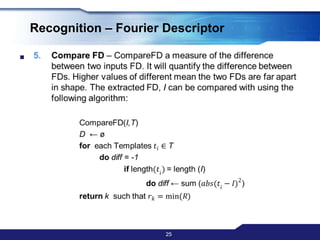
Recognition – Fourier DescriptorCompare FD – CompareFD a measure of the difference between two inputs FD. It will quantify the difference between FDs. Higher values of different mean the two FDs are far apart in shape. The extracted FD, I can be compared with using the following algorithm:CompareFD(I,T)D  ← øfor  each Templates 𝑡𝑖∈T         do diff = -1                    if length(𝑡𝑖) = length (I)                              do diff ← sum(𝑎𝑏𝑠(𝑡𝑖−𝐼)2)return k  such that 𝑟𝑘=min(𝑅) 25
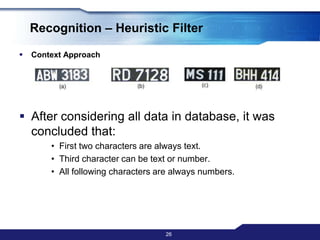
Recognition – Heuristic FilterContext ApproachAfter considering all data in database, it was concluded that:First two characters are always text.Third character can be text or number.All following characters are always numbers. 26
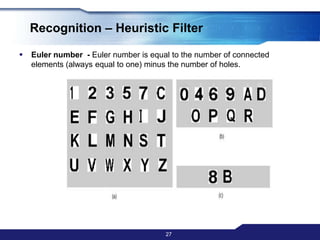
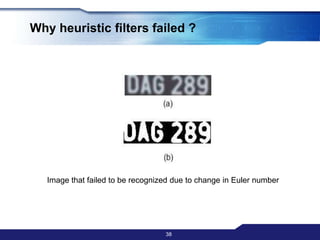
Recognition – Heuristic FilterEuler number  - Euler number is equal to the number of connected elements (always equal to one) minus the number of holes.27
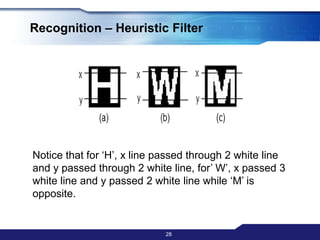
Recognition – Heuristic Filter28Notice that for ‘H’, x line passed through 2 white line and y passed through 2 white line, for’ W’, x passed 3 white line and y passed 2 white line while ‘M’ is opposite.
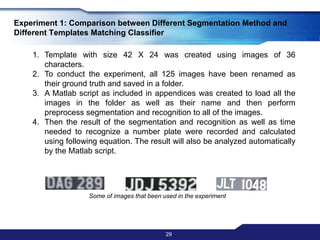
Experiment 1: Comparison between Different Segmentation Method and Different Templates Matching Classifier29Template with size 42 X 24 was created using images of 36 characters.To conduct the experiment, all 125 images have been renamed as their ground truth and saved in a folder. A Matlab script as included in appendices was created to load all the images in the folder as well as their name and then perform preprocess segmentation and recognition to all of the images. Then the result of the segmentation and recognition as well as time needed to recognize a number plate were recorded and calculated using following equation. The result will also be analyzed automatically by the Matlab script.Some of images that been used in the experiment
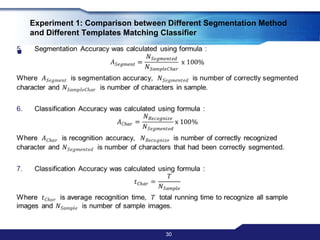
Segmentation Accuracy was calculated using formula :𝐴𝑆𝑒𝑔𝑚𝑒𝑛𝑡=𝑁𝑆𝑒𝑔𝑚𝑒𝑛𝑡𝑒𝑑𝑁𝑆𝑎𝑚𝑝𝑙𝑒𝐶h𝑎𝑟 x 100%Where  𝐴𝑆𝑒𝑔𝑚𝑒𝑛𝑡  is segmentation accuracy,  𝑁𝑆𝑒𝑔𝑚𝑒𝑛𝑡𝑒𝑑  is number of correctly segmented character and 𝑁𝑆𝑎𝑚𝑝𝑙𝑒𝐶h𝑎𝑟  is number of characters in sample.Classification Accuracy was calculated using formula :𝐴𝐶h𝑎𝑟=𝑁𝑅𝑒𝑐𝑜𝑔𝑛𝑖𝑧𝑒𝑁𝑆𝑒𝑔𝑚𝑒𝑛𝑡𝑒𝑑x 100%Where  𝐴𝐶h𝑎𝑟  is recognition accuracy,  𝑁𝑅𝑒𝑐𝑜𝑔𝑛𝑖𝑧𝑒  is number of correctly recognized character and 𝑁𝑆𝑒𝑔𝑚𝑒𝑛𝑡𝑒𝑑  is number of characters that had been correctly segmented.Classification Accuracy was calculated using formula :𝑡𝐶h𝑎𝑟=𝑇𝑁𝑆𝑎𝑚𝑝𝑙𝑒Where  𝑡𝐶h𝑎𝑟  is average recognition time,  𝑇  total running time to recognize all sample images and 𝑁𝑆𝑎𝑚𝑝𝑙𝑒  is number of sample images. 30Experiment 1: Comparison between Different Segmentation Method and Different Templates Matching Classifier
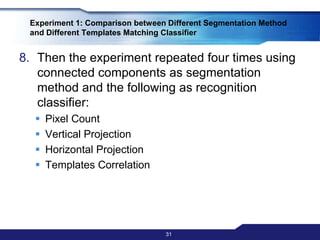
Then the experiment repeated four times using connected components as segmentation method and the following as recognition classifier:Pixel CountVertical ProjectionHorizontal ProjectionTemplates Correlation31Experiment 1: Comparison between Different Segmentation Method and Different Templates Matching Classifier
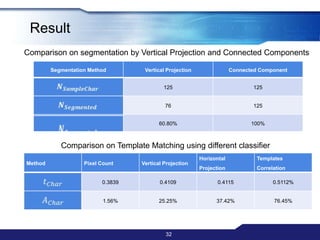
Result32Comparison on segmentation by Vertical Projection and Connected ComponentsComparison on Template Matching using different classifier
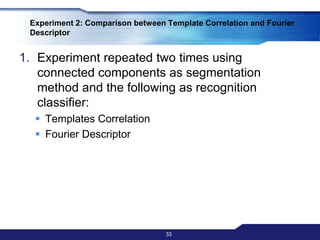
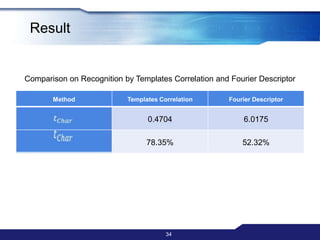
Experiment repeated two times using connected components as segmentation method and the following as recognition classifier:Templates CorrelationFourier Descriptor 33Experiment 2: Comparison between Template Correlation and Fourier Descriptor
Result34Comparison on Recognition by Templates Correlation and Fourier Descriptor
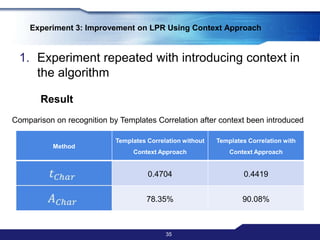
Experiment repeated with introducing context in the algorithm35Experiment 3: Improvement on LPR Using Context ApproachResultComparison on recognition by Templates Correlation after context been introduced
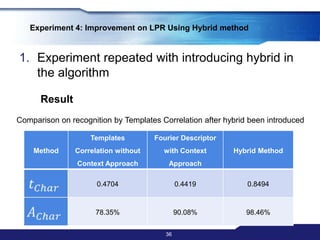
Experiment repeated with introducing hybrid in the algorithm36Experiment 4: Improvement on LPR Using Hybrid methodResultComparison on recognition by Templates Correlation after hybrid been introduced
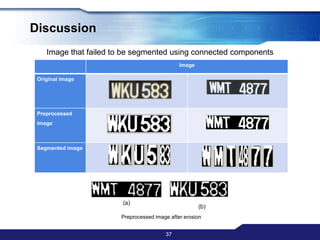
Discussion37Image that failed to be segmented using connected componentsPreprocessed image after erosion
Why heuristic filters failed ?38Image that failed to be recognized due to change in Euler number
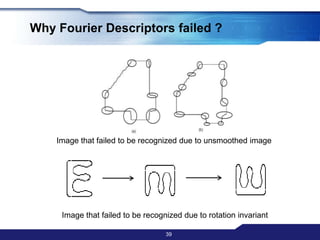
Why Fourier Descriptors failed ?39Image that failed to be recognized due to unsmoothed imageImage that failed to be recognized due to rotation invariant
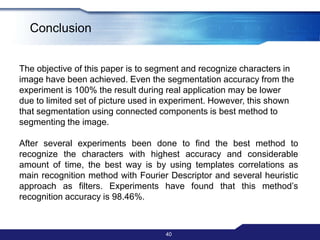
ConclusionThe objective of this paper is to segment and recognize characters in image have been achieved. Even the segmentation accuracy from the experiment is 100% the result during real application may be lower due to limited set of picture used in experiment. However, this shown that segmentation using connected components is best method to segmenting the image. After several experiments been done to find the best method to recognize the characters with highest accuracy and considerable amount of time, the best way is by using templates correlations as main recognition method with Fourier Descriptor and several heuristic approach as filters. Experiments have found that this method’s recognition accuracy is 98.46%.40
References41[1]  Kurt Alfred Kluever. (2008) Digital Media Library : RIT Scholars. [Online]. https://ritdml.rit.edu/bitstream/handle/1850/7813/KKlueverTechPaper05-20-2008.pdf[2]  C. H. Ho, S. B. Koay, M. H. Lee, M. Moghavvemi, and M. Tamjis, "License Plate Recognition (Software)," Universiti Malaya, No Date.[3]  SherozKhan, Rafiqul Islam Othman khalifa, "Malaysian Vehicle License Plate Recognition," The International Arab Journal of Information Technology , pp. 359-364, 2007.[4]  VelappaGanapathy and Wen Lik Dennis Lui, "A Malaysian Vehicle License Plate Localization and Recognition System," Monash University Malaysia,.[5]  Office of Safety and Traffic, Operations Research and Development, USA. (2010, February) Literature Review : Artificial Neural Network. [Online]. http://www.tfhrc.gov/safety/98133/ch02/body_ch02_05.html[6]  M. Fukumi, Y. Takeuchi, and M. Khalid, "Neural Network Based Threshold Determination for Malaysia License Plate Character Recognition," UniversitiTechnologi Malaysia, No Date.

Text Detection and Recognition

  • 1.
    Text Detection andCharacter Recognition from ImagesBadruzNasrin Bin Basri1051101534 Supervisor : MohdHaris Lye Abdullah1
  • 2.
  • 3.
    Aims and objectivesStudent2Recognition -Recognize each of the character in the detected text region using a suitable algorithmSegmentation -Separate the text region into its individual characters. 3The aim of this project is to detect, extract and recognize text from images, particularly license car plate.
  • 4.
    Motivation 4Text detection andrecognition in general have quite a lot of relevant application for automatic indexing or information retrieval such document indexing, content-based image retrieval, and license car plate recognition which further opens up the possibility for more improved and advanced systems.
  • 5.
    Problem statement5To segmentthe image to individual characters, we need to find the characteristic to be used as boundary to segment the image. To classify, we need to use the best template to compare with the segmented image and to determine how the template will be used to compare with the image.
  • 6.
    Literature review6SegmentationKlouverin researchon recognition text in PayPal HIP [1] proposed the use of vertical projection to segment the characters in images. There are several reasons vertical segmentation been proposed by Klouver:PayPal HIP image is computer generated only minor preprocessing needed.
  • 7.
    There are obviousseparation between each character
  • 8.
    Character size inPayPal HIP is fixedStudy on Malaysian License Plate Recognition by Othman [3] proposed a model specifically to detect and recognize the text in Malaysian license plate. For segmentation, connected components method has been proposed however this method only can use if the license plates are single row license plate and the study only been made on single row license plate. Same method also been use by Ganapathy and Lui in [4]
  • 9.
    7Literature reviewRecognitionKlouverin researchon recognition text in PayPal HIP [1] and Ho C. H. et. al in research on License Plate Recognition(LPR) [2] used Templates Matching to recognize the characters in image. Klouver detailed the matching classifier into four types of classifier that are Pixel Counting, Horizontal Projection, Vertical Projection and Template Correlations. Klouver’s experiment proved that the best classifier is Vertical projection and Template Correlation where both of this classifier yield 100% accuracy.Fixed type of font in image(PayPal HIP) makes it very easy to distinguish between different characters using templates matching. There are no other research that yield 100% accuracy.
  • 10.
    8Literature reviewRecognitionStudy onMalaysian License Plate Recognition by Othman [3],Ganapathy and Lui in [4], M.Fukumi et. Al [6] , AnasJ.A. Husain et. Al [7] used Neural Network to recognized the text. Compared to templates matching, neural network consume more time. Neural network also need training before it can be used and it only can achieve high accuracy if the sampled image is almost same with the training images. Andrew Vogt and Joe G. Bared [5] concluded the disadvantages of neural network are :Minimizing overfitting in neural networks requires a great deal of computational effort The individual relations between the input variables and the output variables are not developed by engineering judgment so the model tends to be a black box or input/output table without analytical basis and to make the accuracy level high the sample size has to be large.
  • 11.
    9Literature reviewRecognitionJared Hopkinsand Tim Anderson in [9], used Fourier Descriptor to recognize text in image. In most of the researches, Fourier descriptor been used to recognize more complex shape such as for logo classification by Folkers and Samet [10] and for Sinhala Script by Rohana, Ruvan and Kevin [11].Basically there are no research on LPR using Fourier descriptor(FD), hence, this research will also test the usage of FD to recognize text in Malaysian License Plate.WisamAl Faqheri and SyamsiahMashohor in A Real-Time Malaysian Automatic License Plate Recognition (M-ALPR) using Hybrid Fuzzy [12] used the hybrid Fuzzy method to recognize the license number. Compared to other study previously done on license plate detection where almost all of the previous work relied on a single method like template matching or neural network Wisamand Syamsiah proposed combination of more than one method based on the type of license plate.
  • 12.
    Approach - Flowchart torecognize the characters in image10
  • 13.
    Make templateTo createtemplete.mat to be use for classification:11……Matrix size 24 X 42 X 36 Saved as template.mat36 images of charactersSize = 42 X 24
  • 14.
  • 15.
    Segmentation – VerticalProjections Preprocessed ImageVertical projection analysisSegmented ImageVertical Projection13
  • 16.
    Segmentation – VerticalProjections Weaknesses14Image that failed to be segmented by vertical projection
  • 17.
    The segmentation characterinvolves the following steps:Scan the image from left to right to find ‘on’ pixel.If on pixel been found, all ‘on’ pixel connected to the detected on pixel will be extracted segmented as a pixel.The process will be repeated until it reach end right of the image.15Segmentation – Connected Components 
  • 18.
    Recognition - PixelCounting16tempSum = sum(sum(templates(:,:,j))); inSum = sum(sum(chars(:,:,i))); allCorrs(j) = abs(tempSum - inSum);allCorrs(j) = 1 - (allCorrs(j)/1008);
  • 19.
    Corr2𝑟=mn𝑖𝑚𝑛−𝑖(𝑗𝑚𝑛−𝑗)(mn(𝑖mn− 𝑖)2)(mn(𝑗mn− 𝑗)2)Where 𝑖 isthe mean of the input matrix i and 𝑗 is the mean of the input matrix j.0 < r < 11 mean i and j is exactly same while 0 mean the i and j not same at all. 17
  • 20.
    Recognition - Verticalprojections18tempVP = sum(templates(:,:,j)); inVP = sum(chars(:,:,i)); allCorrs(j) = corr2(tempVP, inVP);
  • 21.
    Recognition - Horizontalprojections 19tempHP = sum(templates(:,:,j)'); inHP = sum(chars(:,:,i)'); allCorrs(j) = corr2(tempHP, inHP);
  • 22.
    20Recognition - TemplateCorrelationstemp = templates(:,:,j); in = chars(:,:,i); allCorrs(j) = corr2(temp, in);
  • 23.
    Recognition – FourierDescriptorFollowing is the detailed steps on extracting and comparing the Fourier Descriptor (FD)Edging21U= 𝑥0𝑦0𝑥1𝑦1...𝑥𝑛𝑦𝑛 
  • 24.
    Recognition – FourierDescriptorExtracting FD – 1 D Discrete Fourier Transform (DFT) been done to the complex vector U to get the frequency domain of the boundaries using the following equation: 22F=𝐹𝐹𝑇𝑈=𝑘=0𝑁−1Uk− 2πN𝑘𝜇 
  • 25.
    Recognition – FourierDescriptorNormalize FD: Translation invariantScale invariantRotation invariant23
  • 26.
    Recognition – FourierDescriptorImages of ‘E’ reconstructed from (a) n = 4 (b) n = 8 (c) n = 10 (d) n = 15 (e) n = 25 (f) n = 30 (g) n = 278Resize FD – As FD contains information of all information of the ‘on’ pixel, the size of FD is number of on pixel. To make it comparable with other FD it need to be resized to predefined number of descriptor, Figure 3.9 show different shape reconstructed using different number of descriptor. As to resize the FD to n descriptor, function shiftfft in Matlab will remove low frequency descriptor leaving only n-th highest descriptor. 24
  • 27.
    Recognition – FourierDescriptorCompare FD – CompareFD a measure of the difference between two inputs FD. It will quantify the difference between FDs. Higher values of different mean the two FDs are far apart in shape. The extracted FD, I can be compared with using the following algorithm:CompareFD(I,T)D ← øfor each Templates 𝑡𝑖∈T do diff = -1 if length(𝑡𝑖) = length (I) do diff ← sum(𝑎𝑏𝑠(𝑡𝑖−𝐼)2)return k such that 𝑟𝑘=min(𝑅) 25
  • 28.
    Recognition – HeuristicFilterContext ApproachAfter considering all data in database, it was concluded that:First two characters are always text.Third character can be text or number.All following characters are always numbers. 26
  • 29.
    Recognition – HeuristicFilterEuler number - Euler number is equal to the number of connected elements (always equal to one) minus the number of holes.27
  • 30.
    Recognition – HeuristicFilter28Notice that for ‘H’, x line passed through 2 white line and y passed through 2 white line, for’ W’, x passed 3 white line and y passed 2 white line while ‘M’ is opposite.
  • 31.
    Experiment 1: Comparisonbetween Different Segmentation Method and Different Templates Matching Classifier29Template with size 42 X 24 was created using images of 36 characters.To conduct the experiment, all 125 images have been renamed as their ground truth and saved in a folder. A Matlab script as included in appendices was created to load all the images in the folder as well as their name and then perform preprocess segmentation and recognition to all of the images. Then the result of the segmentation and recognition as well as time needed to recognize a number plate were recorded and calculated using following equation. The result will also be analyzed automatically by the Matlab script.Some of images that been used in the experiment
  • 32.
    Segmentation Accuracy wascalculated using formula :𝐴𝑆𝑒𝑔𝑚𝑒𝑛𝑡=𝑁𝑆𝑒𝑔𝑚𝑒𝑛𝑡𝑒𝑑𝑁𝑆𝑎𝑚𝑝𝑙𝑒𝐶h𝑎𝑟 x 100%Where 𝐴𝑆𝑒𝑔𝑚𝑒𝑛𝑡 is segmentation accuracy, 𝑁𝑆𝑒𝑔𝑚𝑒𝑛𝑡𝑒𝑑 is number of correctly segmented character and 𝑁𝑆𝑎𝑚𝑝𝑙𝑒𝐶h𝑎𝑟 is number of characters in sample.Classification Accuracy was calculated using formula :𝐴𝐶h𝑎𝑟=𝑁𝑅𝑒𝑐𝑜𝑔𝑛𝑖𝑧𝑒𝑁𝑆𝑒𝑔𝑚𝑒𝑛𝑡𝑒𝑑x 100%Where 𝐴𝐶h𝑎𝑟 is recognition accuracy, 𝑁𝑅𝑒𝑐𝑜𝑔𝑛𝑖𝑧𝑒 is number of correctly recognized character and 𝑁𝑆𝑒𝑔𝑚𝑒𝑛𝑡𝑒𝑑 is number of characters that had been correctly segmented.Classification Accuracy was calculated using formula :𝑡𝐶h𝑎𝑟=𝑇𝑁𝑆𝑎𝑚𝑝𝑙𝑒Where 𝑡𝐶h𝑎𝑟 is average recognition time, 𝑇 total running time to recognize all sample images and 𝑁𝑆𝑎𝑚𝑝𝑙𝑒 is number of sample images. 30Experiment 1: Comparison between Different Segmentation Method and Different Templates Matching Classifier
  • 33.
    Then the experimentrepeated four times using connected components as segmentation method and the following as recognition classifier:Pixel CountVertical ProjectionHorizontal ProjectionTemplates Correlation31Experiment 1: Comparison between Different Segmentation Method and Different Templates Matching Classifier
  • 34.
    Result32Comparison on segmentationby Vertical Projection and Connected ComponentsComparison on Template Matching using different classifier
  • 35.
    Experiment repeated twotimes using connected components as segmentation method and the following as recognition classifier:Templates CorrelationFourier Descriptor 33Experiment 2: Comparison between Template Correlation and Fourier Descriptor
  • 36.
    Result34Comparison on Recognitionby Templates Correlation and Fourier Descriptor
  • 37.
    Experiment repeated withintroducing context in the algorithm35Experiment 3: Improvement on LPR Using Context ApproachResultComparison on recognition by Templates Correlation after context been introduced
  • 38.
    Experiment repeated withintroducing hybrid in the algorithm36Experiment 4: Improvement on LPR Using Hybrid methodResultComparison on recognition by Templates Correlation after hybrid been introduced
  • 39.
    Discussion37Image that failedto be segmented using connected componentsPreprocessed image after erosion
  • 40.
    Why heuristic filtersfailed ?38Image that failed to be recognized due to change in Euler number
  • 41.
    Why Fourier Descriptorsfailed ?39Image that failed to be recognized due to unsmoothed imageImage that failed to be recognized due to rotation invariant
  • 42.
    ConclusionThe objective ofthis paper is to segment and recognize characters in image have been achieved. Even the segmentation accuracy from the experiment is 100% the result during real application may be lower due to limited set of picture used in experiment. However, this shown that segmentation using connected components is best method to segmenting the image. After several experiments been done to find the best method to recognize the characters with highest accuracy and considerable amount of time, the best way is by using templates correlations as main recognition method with Fourier Descriptor and several heuristic approach as filters. Experiments have found that this method’s recognition accuracy is 98.46%.40
  • 43.
    References41[1] KurtAlfred Kluever. (2008) Digital Media Library : RIT Scholars. [Online]. https://ritdml.rit.edu/bitstream/handle/1850/7813/KKlueverTechPaper05-20-2008.pdf[2] C. H. Ho, S. B. Koay, M. H. Lee, M. Moghavvemi, and M. Tamjis, "License Plate Recognition (Software)," Universiti Malaya, No Date.[3] SherozKhan, Rafiqul Islam Othman khalifa, "Malaysian Vehicle License Plate Recognition," The International Arab Journal of Information Technology , pp. 359-364, 2007.[4] VelappaGanapathy and Wen Lik Dennis Lui, "A Malaysian Vehicle License Plate Localization and Recognition System," Monash University Malaysia,.[5] Office of Safety and Traffic, Operations Research and Development, USA. (2010, February) Literature Review : Artificial Neural Network. [Online]. http://www.tfhrc.gov/safety/98133/ch02/body_ch02_05.html[6] M. Fukumi, Y. Takeuchi, and M. Khalid, "Neural Network Based Threshold Determination for Malaysia License Plate Character Recognition," UniversitiTechnologi Malaysia, No Date.