1
TEXAS CIVIL LITIGATION QUICK REFERENCE GUIDE
Court System and Jurisdictional Limits (Texas Government Code, Title II):
*Discussion limited to those Courts with Jurisdiction over Civil Cases
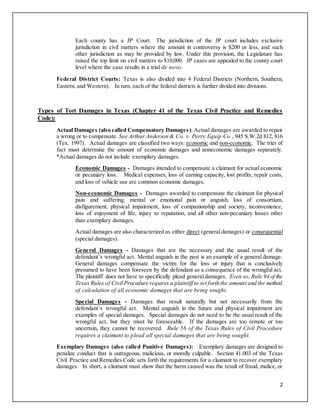
The Texas Civil Court System (at the trial level) is divided generally by jurisdictional limits and
case type, as follows:
District Courts: The Texas District Courts are the trial courts of general jurisdiction. Texas
currently has 457 District Courts.
The district courts have jurisdiction in civil matters with a minimum monetary limit but
no maximum limit. In counties having statutory county courts, the district courts
generally have exclusive jurisdiction in civil cases where the amount in controversy is
$200,000 or more, and concurrent jurisdiction with the statutory county courts in cases
where the amount in controversy exceeds $500 but is less than $200,000.
Some smaller counties share a district court while the larger counties have multiple
district courts. The geographical area served by each district court is established by the
specific statute creating that court.
Unlike most other jurisdictions, Texas trial courts, including district courts, have only one
judge per trial court. Instead of adding more departments to existing courts in response to
population growth, Texas simply adds more courts.
Constitutional County Court: Each of the 254 counties in Texas has a constitutional county
court. The Texas Constitution states that "[t]here shall be established in each county in this State
a County Court ..." These courts do not always exercise judicial functions. In populous counties,
the “county judge” may devote her full attention to the administration of county government.
Generally, the “constitutional” county courts have concurrent jurisdiction with justice
courts in civil cases where the matter in controversy exceeds $200 but does not exceed
$10,000 and concurrent jurisdiction with the district courts in civil cases where the matter
in controversy exceeds $500 but does not exceed $10,000.
Statutory County Court (County Court at Law): Because the Texas Constitution limits each
county to a single county court, the Legislature has created statutory county courts in the larger
counties to aid the single county court in its judicial functions.
The legal jurisdiction of the special county-level trial courts varies considerably and is
established by the statute which creates the particular court. In general, statutory county
courts that exercise civil jurisdiction concurrent with the constitutional county court also
have concurrent civil jurisdiction with the district courts in civil cases in which the matter
in controversy exceeds $500 but does not exceed $200,000. County courts at law usually
have appellate jurisdiction in cases appealed from justice of the peace and municipal
courts.
Justice of the Peace Courts: The lowest court level in Texas is the Justice of the Peace Court
(also called Justice Court or JP Court). Texas recently enacted a separate set of procedural rules
for cases that are pending in Justice of the Peace Courts. See Rules 500 to 510 of the Texas Rules
of Civil Procedure.
2
Each county has a JP Court. The jurisdiction of the JP court includes exclusive
jurisdiction in civil matters where the amount in controversy is $200 or less, and such
other jurisdiction as may be provided by law. Under this provision, the Legislature has
raised the top limit on civil matters to $10,000. JP cases are appealed to the county court
level where the case results in a trial de novo.
Federal District Courts: Texas is also divided into 4 Federal Districts (Northern, Southern,
Eastern, and Western). In turn, each of the federal districts is further divided into divisions.
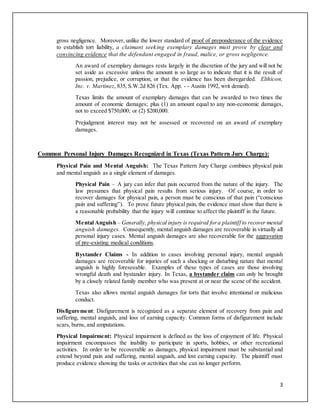
Types of Tort Damages in Texas (Chapter 41 of the Texas Civil Practice and Remedies
Code):
Actual Damages (also called Compensatory Damages): Actual damages are awarded to repair
a wrong or to compensate. See Arthur Anderson & Co. v. Perry Equip Co., 945 S.W.2d 812, 816
(Tex. 1997). Actual damages are classified two ways: economic and non-economic. The trier of
fact must determine the amount of economic damages and noneconomic damages separately.
*Actual damages do not include exemplary damages.
Economic Damages - Damages intended to compensate a claimant for actual economic
or pecuniary loss. Medical expenses, loss of earning capacity, lost profits, repair costs,
and loss of vehicle use are common economic damages.
Non-economic Damages - Damages awarded to compensate the claimant for physical
pain and suffering, mental or emotional pain or anguish, loss of consortium,
disfigurement, physical impairment, loss of companionship and society, inconvenience,
loss of enjoyment of life, injury to reputation, and all other non-pecuniary losses other
than exemplary damages.
Actual damages are also characterized as either direct (general damages) or consequential
(special damages).
General Damages - Damages that are the necessary and the usual result of the
defendant’s wrongful act. Mental anguish in the past is an example of a general damage.
General damages compensate the victim for the loss or injury that is conclusively
presumed to have been foreseen by the defendant as a consequence of the wrongful act.
The plaintiff does not have to specifically plead generaldamages. Even so, Rule 94 of the
Texas Rules of Civil Procedure requires a plaintiff to set forth the amount and the method
of calculation of all economic damages that are being sought.
Special Damages - Damages that result naturally but not necessarily from the
defendant’s wrongful act. Mental anguish in the future and physical impairment are
examples of special damages. Special damages do not need to be the usual result of the
wrongful act, but they must be foreseeable. If the damages are too remote or too
uncertain, they cannot be recovered. Rule 56 of the Texas Rules of Civil Procedure
requires a claimant to plead all special damages that are being sought.
Exemplary Damages (also called Punitive Damages): Exemplary damages are designed to
penalize conduct that is outrageous, malicious, or morally culpable. Section 41.003 of the Texas
Civil Practice and Remedies Code sets forth the requirements for a claimant to recover exemplary
damages. In short, a claimant must show that the harm caused was the result of fraud, malice, or
3
gross negligence. Moreover, unlike the lower standard of proof of preponderance of the evidence
to establish tort liability, a claimant seeking exemplary damages must prove by clear and
convincing evidence that the defendant engaged in fraud, malice, or gross negligence.
An award of exemplary damages rests largely in the discretion of the jury and will not be
set aside as excessive unless the amount is so large as to indicate that it is the result of
passion, prejudice, or corruption, or that the evidence has been disregarded. Elthicon,
Inc. v. Martinez, 835, S.W.2d 826 (Tex. App. - - Austin 1992, writ denied).
Texas limits the amount of exemplary damages that can be awarded to two times the
amount of economic damages; plus (1) an amount equal to any non-economic damages,
not to exceed $750,000; or (2) $200,000.
Prejudgment interest may not be assessed or recovered on an award of exemplary
damages.
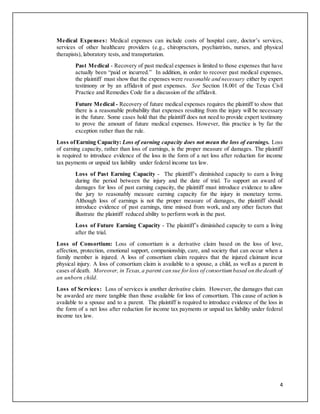
Common Personal Injury Damages Recognized in Texas (Texas Pattern Jury Charge):
Physical Pain and Mental Anguish: The Texas Pattern Jury Charge combines physical pain
and mental anguish as a single element of damages.
Physical Pain – A jury can infer that pain occurred from the nature of the injury. The
law presumes that physical pain results from serious injury. Of course, in order to
recover damages for physical pain, a person must be conscious of that pain (“conscious
pain and suffering”). To prove future physical pain, the evidence must show that there is
a reasonable probability that the injury will continue to affect the plaintiff in the future.
Mental Anguish – Generally, physical injury is required fora plaintiff to recover mental
anguish damages. Consequently, mental anguish damages are recoverable in virtually all
personal injury cases. Mental anguish damages are also recoverable for the aggravation
of pre-existing medical conditions.
Bystander Claims - In addition to cases involving personal injury, mental anguish
damages are recoverable for injuries of such a shocking or disturbing nature that mental
anguish is highly foreseeable. Examples of these types of cases are those involving
wrongful death and bystander injury. In Texas, a bystander claim can only be brought
by a closely related family member who was present at or near the scene of the accident.
Texas also allows mental anguish damages for torts that involve intentional or malicious
conduct.
Disfigurement: Disfigurement is recognized as a separate element of recovery from pain and
suffering, mental anguish, and loss of earning capacity. Common forms of disfigurement include
scars, burns, and amputations.
Physical Impairment: Physical impairment is defined as the loss of enjoyment of life. Physical
impairment encompasses the inability to participate in sports, hobbies, or other recreational
activities. In order to be recoverable as damages, physical impairment must be substantial and
extend beyond pain and suffering, mental anguish, and lost earning capacity. The plaintiff must
produce evidence showing the tasks or activities that she can no longer perform.
4
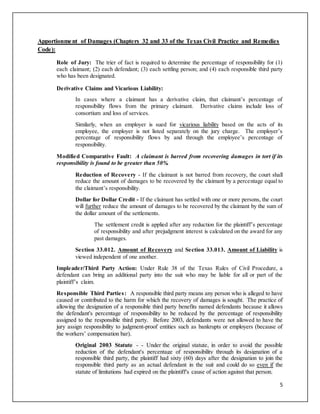
Medical Expenses: Medical expenses can include costs of hospital care, doctor’s services,
services of other healthcare providers (e.g., chiropractors, psychiatrists, nurses, and physical
therapists), laboratory tests, and transportation.
Past Medical - Recovery of past medical expenses is limited to those expenses that have
actually been “paid or incurred.” In addition, in order to recover past medical expenses,
the plaintiff must show that the expenses were reasonable and necessary either by expert
testimony or by an affidavit of past expenses. See Section 18.001 of the Texas Civil
Practice and Remedies Code for a discussion of the affidavit.
Future Medical - Recovery of future medical expenses requires the plaintiff to show that
there is a reasonable probability that expenses resulting from the injury will be necessary
in the future. Some cases hold that the plaintiff does not need to provide expert testimony
to prove the amount of future medical expenses. However, this practice is by far the
exception rather than the rule.
Loss ofEarning Capacity: Loss of earning capacity does not mean the loss of earnings. Loss
of earning capacity, rather than loss of earnings, is the proper measure of damages. The plaintiff
is required to introduce evidence of the loss in the form of a net loss after reduction for income
tax payments or unpaid tax liability under federal income tax law.
Loss of Past Earning Capacity - The plaintiff’s diminished capacity to earn a living
during the period between the injury and the date of trial. To support an award of
damages for loss of past earning capacity, the plaintiff must introduce evidence to allow
the jury to reasonably measure earning capacity for the injury in monetary terms.
Although loss of earnings is not the proper measure of damages, the plaintiff should
introduce evidence of past earnings, time missed from work, and any other factors that
illustrate the plaintiff reduced ability to perform work in the past.
Loss of Future Earning Capacity - The plaintiff’s diminished capacity to earn a living
after the trial.
Loss of Consortium: Loss of consortium is a derivative claim based on the loss of love,
affection, protection, emotional support, companionship, care, and society that can occur when a
family member is injured. A loss of consortium claim requires that the injured claimant incur
physical injury. A loss of consortium claim is available to a spouse, a child, as well as a parent in
cases of death. Moreover, in Texas,a parent can sue forloss of consortiumbased on the death of
an unborn child.
Loss of Services: Loss of services is another derivative claim. However, the damages that can
be awarded are more tangible than those available for loss of consortium. This cause of action is
available to a spouse and to a parent. The plaintiff is required to introduce evidence of the loss in
the form of a net loss after reduction for income tax payments or unpaid tax liability under federal
income tax law.
5
Apportionment of Damages (Chapters 32 and 33 of the Texas Civil Practice and Remedies
Code):
Role of Jury: The trier of fact is required to determine the percentage of responsibility for (1)
each claimant; (2) each defendant; (3) each settling person; and (4) each responsible third party
who has been designated.
Derivative Claims and Vicarious Liability:
In cases where a claimant has a derivative claim, that claimant’s percentage of
responsibility flows from the primary claimant. Derivative claims include loss of
consortium and loss of services.
Similarly, when an employer is sued for vicarious liability based on the acts of its
employee, the employer is not listed separately on the jury charge. The employer’s
percentage of responsibility flows by and through the employee’s percentage of
responsibility.
Modified Comparative Fault: A claimant is barred from recovering damages in tort if its
responsibility is found to be greater than 50%.
Reduction of Recovery - If the claimant is not barred from recovery, the court shall
reduce the amount of damages to be recovered by the claimant by a percentage equal to
the claimant’s responsibility.
Dollar for Dollar Credit - If the claimant has settled with one or more persons, the court
will further reduce the amount of damages to be recovered by the claimant by the sum of
the dollar amount of the settlements.
The settlement credit is applied after any reduction for the plaintiff’s percentage
of responsibility and after prejudgment interest is calculated on the award for any
past damages.
Section 33.012. Amount of Recovery and Section 33.013. Amount of Liability is
viewed independent of one another.
Impleader/Third Party Action: Under Rule 38 of the Texas Rules of Civil Procedure, a
defendant can bring an additional party into the suit who may be liable for all or part of the
plaintiff’s claim.
Responsible Third Parties: A responsible third party means any person who is alleged to have
caused or contributed to the harm for which the recovery of damages is sought. The practice of
allowing the designation of a responsible third party benefits named defendants because it allows
the defendant's percentage of responsibility to be reduced by the percentage of responsibility
assigned to the responsible third party. Before 2003, defendants were not allowed to have the
jury assign responsibility to judgment-proof entities such as bankrupts or employers (because of
the workers’ compensation bar).
Original 2003 Statute - - Under the original statute, in order to avoid the possible
reduction of the defendant's percentage of responsibility through its designation of a
responsible third party, the plaintiff had sixty (60) days after the designation to join the
responsible third party as an actual defendant in the suit and could do so even if the
statute of limitations had expired on the plaintiff's cause of action against that person.
6
Revised 2011 Statute - - Under the new law, if a defendant designates a person or entity
as a responsible third party and the statute of limitations has run on the plaintiff's cause of
action against that person, the plaintiff will no longer be able to avoid the statute of
limitations by joining the responsible third party to the suit.
General Procedure - A designation of a responsible third party does not require the
named defendant to actually serve the responsible third party with service as would be the
case with a third party action under Rule 38. On the other hand, a responsible third party
is not a party to the action in the traditional sense so a different set of rules will apply
when attempting to serve discovery and take depositions of the designees.
Joint & Several Liability: In Texas, a defendant is jointly and severally liable for the plaintiff’s
damages if the defendant’s percentage of responsibility for a cause of action is 51% or more.
Because it is mathematically impossible for more than one party to be 51% or more responsible,
only one defendant can be jointly and severally liable (in most types of cases).
A defendant that is not jointly and severally liable is liable only for the percentage of
damages equal to that defendant’s own percentage of responsibility.
If the defendant is jointly and severally liable, the defendant is liable for the entire
amount of the damages regardless of that defendant’s percentage of responsibility. That
defendant then has a right to contribution from the other defendant(s) for the
overpayment to the extent of the other defendant’s percentage of liability.
Statute of Limitations (Chapter 16 of the Texas Civil Practice and Remedies Code):
*The list belowis NOTa comprehensive list of all potential causes of action or limitations periods
Tolling Periods: Limitations are tolled for persons under a legal disability. Those persons
include a person younger than 18 years of age, regardless of whether the person is married or of
unsound mind. In addition, if the defendant is absent from the state, the applicable statute of
limitations is tolled during that period’s absence. Also, the death of a person (either the plaintiff
or defendant) tolls the statute of limitations for 12 months.
Discovery Period: The discovery rule is applied and limited categories of cases for accrual of a
cause of action until the plaintiff knew or, exercising reasonable diligence, should have known of
the facts giving rise to a cause of action. For the discovery rule to apply, the nature of the injury
must be inherently undiscoverable and the injury itself must be objectively verifiable. HECI
Expl. Co. v. Neel, 982 S.W.2d 881 (Tex. 1988).
Counterclaims and Cross-Claims: Counterclaims and cross-claims that are otherwise barred by
limitations must be filed within 30 days after the defendant’s answer is due.
Service of Process: A plaintiff must use due diligence in serving the defendant with process.
When a plaintiff files a petition within the limitations period, but does not serve the defendant
until after the statutory period has expired, the date of service relates back to the date of filing if
the plaintiff exercise diligence in effecting service.
Statute ofRepose: Texas also has certain statutory statutes of repose. These statutes set forth the
outer limit by which a person must file suit, regardless of the date of the injury or the application
7
of the discovery rule. For example, a products liability suit must be brought within 15 years of
the date the product is sold.
One Year: Defamation
Libel and Slander - The limitations period for causes of action for libel and slander
begin to run when the person defamed learns of, or should by reasonable diligence have
learned of, the existence of the defamation.
Two Years: Personal injury, negligence, conversion, false imprisonment, loss of consortium, loss
of services, and wrongful death.
Negligence - A negligence claim arising from a personal injury must be brought within 2
years from the date of injury
Conversion of Personal Property - The general rule is that limitations begins to run at
the time of the unlawful taking. However, if the original possession is lawful, the
limitation period does not begin to run until the return of the property has been demanded
and refused, or until the person in possession has unequivocally exercised acts of
dominion over the property inconsistent with the claims of the owner or person entitled to
possession.
Loss of Consortium and Loss of Services - Claims for loss of consortium and loss of
services are derivative of the injured family member’s cause of action for personal
injuries and are subject to the same statute of limitations and defenses that preclude
liability.
Wrongful Death - The cause of action for wrongful death accrues on the death of the
injured person and not on the date of the injury.
Three Years: Misappropriation of Trade Secrets
Four Years: Fraud and Breach of Fiduciary Duty
Pleading Requirements for Asserting Causes of Action (Rule 47 of the Texas Rules of Civil
Procedure):
Fair Notice Rule: In addition to the decade’s old requirement that a party must set forth a short
statement of the cause of action sufficient to give fair notice of the claim involved, Rule 47 now
requires a party to make a more specific statement of the relief sought. A party is now required to
also plead whether it seeks monetary relief (1) of $100,000 or less, (2) over $100,000 but not
more than $200,000, (3) over $200,000 but not more than $1,000,000, or (4) over $1,000,000.
A party that fails to comply with this rule cannot conduct discovery until the pleading is
amended to comply.
8
Answering a Lawsuit (Rules 92 and 93 of the Texas Rules of Civil Procedure):
Due Order of Pleadings: Under the due-order-of-pleading rule, a defendant must file certain
pleadings or motions in a specific order. Otherwise,the pleading is waived. Exito Elecs.Co. v.
Trejo, 142 S.W.3d 302 (Tex. 2004). The order is as follows: special appearance, venue
challenges, special exceptions, and then other pleadings or motions.
Verified Pleas Under Rule 93 of the Texas Rules of Civil Procedure: There are 16 different
defensive pleas that require a defendant’s verification. Otherwise, the defenses are waived.
Examples include lack of legal capacity to sue and defect in the parties.
Rule 11 Agreements (Rule 11 of the Texas Rules of Civil Procedure):
All settlement agreements need to be memorialized in writing as soon as an agreement is
reached!!!
Rule 11 of the Texas Rules of Civil Procedure: No agreement between attorneys or parties
touching any suit pending will be enforced unless is in writing, signed and filed with the papers as
part of the record, or unless it is made in open court and entered of record. The purpose of Rule
11 is to remove misunderstandings and controversies accompany verbal assurances. Fortis
Benefits v. Cantu, 234 S.W.3d 642, 651 (Tex. 2007).
Enforcement: Even if a Rule 11 agreement is filed with the Court, a judgment cannot be entered
based on the settlement agreement alone. Rather, the Rule 11 agreement serves as a basis upon
which a breach of contact action may lie. When one party fails to honor the settlement terms set
forth within the agreement, the other party should sue for breach of contract and move for
summary judgment to have the terms enforced.
“Paid or Incurred” and the Collateral Source Rule (Section 41.0105 of the Texas Civil
Practice and Remedies Code):
Medical Expenses Charged But Not Paid: Recovery of medical or health care expenses
incurred is limited to the amount actually paid or incurred by or on behalf of the plaintiff.
Recovery of medical expenses is limited to what has been paid by or on behalf of the plaintiff and
not what has been charged by the provider. Only evidence of recoverable medical expenses is
admissible at trial. Haygood v. Garza De Escabedo, 356 S.W.3d 390 (Tex. 2011).
Collateral Source: Even with the paid or incurred requirement, the collateral source rule remains
in effect. Therefore, the jury cannot be told that the medical expenses will be covered in whole or
in part by medical insurance. In addition, the jury cannot be told that a healthcare provider
adjusted charges because of insurance.
Ownership of Medical Expenses: The parent of a minor child maintains a cause of action for
that minor’s medical expenses, and this fact must be considered when resolving any claim
asserted on behalf of the minor.
Hospital Liens (Chapter 55 of the Texas Property Code) – A hospital lien must be paid in
connection with any settlement. A hospital has a lien on a cause of action or claim of an
9
individual who receives hospital services for injuries caused by an accident that is attributed to
the negligence of another person. For the lien to attach, the individual must be admitted to a
hospital not later than 72 hours after the accident.
Attachment of Lien - A hospital lien attaches to (1) a cause of action for damages
arising from an injury for which the injured individual is admitted to the hospital or
receives emergency medical services; (2) a judgment of a court in this state or the
decision of a public agency in a proceeding brought by the injured individual or by
another person entitled to bring the suit in case of the death of the individual to recover
damages arising from an injury for which the injured individual is admitted to the
hospital or receives emergency medical services; and (3) the proceeds of a settlement of a
cause of action or a claim by the injured individual or another person entitled to make the
claim, arising from an injury for which the injured individual is admitted to the hospital
or receives emergency medical services.
*Validity of Release - A release in connection with the settlement of the underlying tort
claim is INVALID unless (1) the charges of the hospital or emergency medical services
provider claiming the lien were paid in full before the execution and delivery of the
release; (2) the charges of the hospital or emergency medical services provider claiming
the lien were paid before the execution and delivery of the release to the extent of any full
and true consideration paid to the injured individual by or on behalf of the other parties to
the release; or (3) the hospital or emergency medical services provider claiming the lien
is a party to the release.
Judgments - A judgment to which a lien under this chapter has attached remains in effect
until the charges of the hospital or emergency medical services provider claiming the lien
are paid in full or to the extent set out in the judgment.
Prejudgment and Post-Judgment Interest (Chapter 304 of the Texas Finance Code):
Pre-Judgment Interest: Prejudgment interest in computed as simple interest. It does not
compound. Simple interest is calculated on the principal amount only and not on previously
accumulated interest.
Principal is the amount of damages found by the trier of fact less any amounts on which
interest in prohibited by statute of case law. These legal exclusions include exemplary
damages, future damages, attorneys’ fees, and court costs.
The rate for prejudgment interest in Texas is the same as post-judgment interest.
Prejudgment interest accrues on the amount of a judgment during the period beginning on
the earlier of the 180th
day after the date the defendant received written notice of a claim
OR the date the suit is filed and ending on the day preceding the date judgment is
rendered.
Post-Judgment Interest: Post-Judgment interest on a money judgment begins accruing on the
day judgment is rendered and stops accruing on the day the judgment is satisfied. Phillips v.
Bramlett, 407 S.W.3d 229 (Tex. 2013). The rate for post-judgment interest in Texas is the same
as prejudgment interest.
10
Alternative Dispute Resolution (Title 7 of the Texas Civil Practice and Remedies Code):
Mediation: Mediation can be voluntary or ordered by the court where the case is pending.
Mediation is required in most counties by local rule. Mediation is a forum in which an impartial
person, the mediator, facilitates communication between parties to promote reconciliation,
settlement, or understanding. A mediator may not impose his own judgment on the issues for that
of the parties.
Confidentiality - Settlement offers and communications made during mediation are
confidential and may not be disclosed during the discovery process or used at trial. Even
if the mediation of court ordered, it does not require a party to offer or accept
consideration. It only requires attendance at the mediation.
Arbitration: Arbitration is a forum in which each party and counsel for the party present the
position of the party before an impartial third party who renders a specific award. Because of the
cost usually associated with arbitration, a binding arbitration is more common.
Other Authorized ADR Procedures: Mini-Trial, Moderated Settlement Conference, Summary
Jury Trial, and Special Judge. Each of these procedures is rarely used, and the reason is usually
the cost associated with the procedure.
NEW in 2013 - Expedited Actions Procedure (Rule 169 of the Texas Rules of Civil
Procedure):
*Effective March 1, 2013, the Texas Supreme Court enacted a new “expedited actions”
procedure. It provides a means for claimants seeking less than $100,000 (inclusive of all
damages, costs, and attorneys’ fees) to resolve their cases more quickly and with less expense.
The process is mandatory for cases in which each claimant seeks less than $100,000, but
excludes family law, tax, property, and medical liability cases.
Good Cause Exception: Courts may allow a case in which the claimant seeks less than $100,000
to be excluded from the “expedited actions” process upon a showing of “good cause,” after
considering the number of parties and witnesses, the complexity of legal and factual issues, the
aggregate claims against one defendant, and the relief sought by counterclaim, among other
factors.
Amendment of Pleadings: A claimant may amend the pleadings and allege an amount in
controversy above $100,000. If this occurs, the suit is removed from the expedited actions
procedure and discovery is reopened under Rule 190.2(c).
New Procedure:
Discovery - The expedited actions process limits the amount of discovery that can be
conducted. For written discovery, each party may serve only 15 interrogatories, 15
requests for production, and 15 requests for admissions. Deposition time is limited to
only six total hours per party to question and cross-examine all witnesses. Absent a court
order, the parties may only agree to extend this total to 10 hours. The overall discovery
period is also limited by the new rules, now ending 180 days after discovery is
11
commenced. Consequently, a plaintiff has control over the beginning date of discovery,
which could be as early as the date of service on defendants, if discovery requests are
contained with the petition.
Alternative Dispute Resolution - Additionally, in direct opposition of usual practice, the
expedited actions rules allow parties to opt out of alternative dispute resolution (ADR)
entirely. However, if the parties have agreed to participate, the rule provides that the
court can refer the parties to ADR only once, not to exceed one half-day in duration, and
at a cost that does not exceed twice the amount of a civil filing fee.
Trial Date - The trial setting requirement significantly limits judicial discretion regarding
the scheduling of the trial. Upon a party’s request, the court must set a trial date that is
within 90 days of the conclusion of the discovery period. Furthermore, the court may
issue only two continuances, which cannot exceed a combined total of 60 days. Basically,
the new “expedited actions” procedure creates a new class of “preferentially set” cases on
each court’s trial docket, which may affect the ability of larger cases to be reached on a
given court docket.
Trial Process - Each side receives only eight hours of trial time, which includes jury
selection, opening statements, closing arguments, presentation of evidence, and all
examination of witnesses, including Robinson/Daubert challenges to the admissibility of
expert testimony. These time limitations are per side, and not per party. If a party shows
good cause, the trial court may extend the time limit to 12 hours per side, but it has no
discretion to extend the limits beyond that point.
Pretrial Robinson/Daubert motions challenging the qualifications or reliability of
experts and their opinions are not allowed. Such challenges may be made, but
only at trial or as an objection to summary judgment evidence.
Motion Practice (How to End the Lawsuit Short of Settlement or Trial):
Motion to Dismiss (Rule 91a of the Texas Rules of Civil Procedure): A party may move to
dismiss a cause of action that has “no basis in law or fact.” A claim has “no basis in law” if the
allegations, taken as true, together with any reasonable inferences, “do not entitle the claimant to
relief.” A claim has “no basis in fact” if “no reasonable person could believe the facts as
pleaded.”
A motion to dismiss a baseless case under Rule 91a must state that (1) it is made pursuant
to Rule 91a, (2) identify each cause of action to which it is addressed, and (3) specifically
state the reasons that the cause of action has no basis in law, fact, or both.
A Rule 91a movant must file the motion within 60 days after the first pleading that
contains the cause of action at issue is served on the movant and at least 21 days before
the hearing on the motion. Each party is entitled to 14 days’ notice of the hearing,
although the court may decide the motion on the written submissions. The response is
12
due seven days before the hearing. If the respondent amends the cause of action at least
three days before the hearing, the movant may withdraw or amend the motion.
If the movant amends the motion, the Rule 91a time periods begin again. If the
respondent nonsuits at least three days before the hearing, the court may not rule on the
motion to dismiss. If the respondent’s amendment or nonsuit is not timely, however, the
court must rule on the motion and may not consider the amendment or nonsuit.
The court must rule on the motion within 45 days after its filing. The court may not
consider any evidence in deciding the motion.
Motion Has Teeth - The prevailing party on a Rule 91a motion is entitled to an award of
fees and costs incurred on the challenged cause of action. The trial court must consider
evidence in deciding the amount of the mandatory award.
Motion for Summary Judgment (Rule 166 ofthe Texas Rules ofCivil Procedure): Summary
judgment is a procedural mechanism designed to allow for the efficient resolution of legal
disputes which can be decided as a matter of law. Summary judgment allows for the resolution of
disputes that do not present fact issues. Texas provides for two distinct types of summary
judgments: a “traditional” motion for summary judgment and a “no-evidence” motion for
summary judgment.
Traditional Motion for Summary Judgment - In a traditional motion for summary
judgment: (1) the movant has the burden of showing that there is no genuine issue of
material fact and that it is entitled to judgment as a matter of law; (2) in deciding whether
there is a disputed material fact issue precluding summary judgment, evidence favorable
to the non-movant will be taken as true; and (3) every reasonable inference must be
indulged in favor of the non-movant and any doubts resolved in its favor. Nixon v. Mr.
Prop. Mgmt. Co., 690 S.W.2d 546 (Tex. 1985).
No-Evidence Motion for Summary Judgment - In 1997, Texas modified its summary
judgment rules to include a “no-evidence” motion for summary judgment. The motion
should only be filed “after an adequate time for discovery.” Therefore, it is usually filed
after written discovery and depositions have occurred, unless the other party has failed to
prosecute its claims in a timely manner.
The no-evidence summary judgment motion is a streamlined procedure in that
the movant is merely required to point to specific elements of an opponent’s
claim or defense to which the non-moving party cannot produce sufficient
summary judgment proof to raise a fact issue. It is then the burden of the other
party to provide summary judgment proof in support of its claim or defense. A
no-evidence summary judgment is essentially a pre-trial directed verdict.
Nonsuit: A nonsuit can be taken at any time prior to the plaintiff resting its case or in the
summary judgment context, before a ruling on the summary judgment. Typically, a Notice of
Nonsuit is filed. However, when a party omits parties or claims in an amended petition, then the
party has “nonsuited” the parties or claims that have been omitted. A nonsuit is without prejudice
meaning that the nonsuiting party is not barred from bringing the action in the future. However, a
nonsuit does not toll or otherwise extend the limitations period for any subsequently filed suit.
13
Offer of Settlement Procedure (Rule 167 of the Texas Rules of Civil Procedure):
Texas is NOT a “Fee Shifting” or “Loser Pays” Jurisdiction: Rule 167 of the Texas Rules of
Civil Procedure alters this rule in limited circumstances. Because of the potential for the
imposition of attorney’s fees against the losing party, this procedure is used sparingly. The fees
and costs are shifted pursuant to the amount of the offer(s) made and not based upon the
prevailing party.
Texas Offer of Settlement Procedure:
1. A defendant must file a declaration to invoke the rule no later than 45 days before the
trial setting.
2. Only a defendant can invoke the offer of judgment procedure.
3. The defendant cannot invoke the procedure until at least 60 days after both the
plaintiff and defendant have appeared in the case.
4. Once the defendant has invoked Rule 167 by filing a declaration, either party may
make a settlement offer under the offer of settlement procedure.
5. The terms of the offer must be in writing and served on all parties to whom it is
made. The offer must not attempt to settle less than all monetary claims and may not
include non-monetary claims.
6. The offer must not include "unreasonable conditions," but may contain conditions to
acceptance.
7. The offer may not be made at mediation or arbitration.
8. The offer must state an acceptance deadline, which must be at least 14 days after the
offer is made.
9. Before the offer is accepted, it may be withdrawn.
10. After a defendant invokes the process, the plaintiff can then invoke the procedure as
well. Thus, a defendant may end up paying the plaintiff's litigation costs under this
procedure.
Consequences of Invoking the Rule: The offering party is entitled to recover litigation "costs" if
the judgment is "significantly less favorable than the rejected offer." A judgment is considered
significantly less favorable if (1) the amount of the judgment is less than 80% of the offer rejected
by the plaintiff; or (2) more than 120% of the offer rejected by the defendant.
Litigation “costs” are defined as the money spent and obligations incurred that directly
relate to the claims in the settlement offer. They include (1) court costs; (2) reasonable
deposition costs; (3) reasonable fees for no more than two testifying experts; and (4)
reasonable attorneys' fees.
Litigation costs cannot exceed the total amount that the claimant recovers or would
recover before adding an award of litigation costs under this rule in favor of the claimant
or subtracting as an offset an award of litigation costs under this rule in favor of the
defendant.
If the defendant recovers litigation costs,those costs are awarded as an offset against any
judgment obtained by the adverse party. The litigations costs are incorporated into the
final judgment.
Example: If a plaintiff rejected an Offer of Settlement of $100,000, litigation costs will be
assessed if the amount of the judgment (considering proportionate responsibility, settlement
14
credits, and prejudgment interest) is less than $80,000. Similarly, for a defendant who rejected a
plaintiff's Offer of Settlement of $80,000, litigation costs will be assessed if the amount of the
judgment is more than $96,000. It is important to note that the litigation costs only include those
costs incurred between the date the offer was rejected and the time of judgment.
Risks: Because the plaintiff must obtain a judgment in order for a defendant to recover its costs,
the Texas rule is more risky for defendants in tort cases as a plaintiff would not ordinarily recover
attorney's fees. In fact, a plaintiff will never have to pay a defendant as it can merely have a
judgment in its favor reduced. As a practical matter, in tort cases, an Offer of Settlement creates
little additional risk for the plaintiff but considerable risk for the defendant.
Minor Settlements (Rules 44 and 173 of the Texas Rules of Civil Procedure):
Context: In the settlement of cases involving a minor, even if the parties and any court-appointed
ad litem agree to the settlement, a judgment ratifying the compromise cannot be rendered without
a hearing and evidence that the settlement serves the minor’s “best interest.” Because a minor
lacks the legal capacity to agree to a settlement, the court must approve any payments to be made
on the minor’s behalf.
Procedure: When a claim is settled pre-suit, the appropriate way to memorialize the agreement is
to file a “friendly suit.” Absent a friendly suit, a judgment entered in favor of a minor represented
by a next friend is not binding on the minor, and she can sue to have it set aside on the basis of
inadequate representation of her interests. The friendly suit allows the district court to adjudicate
the legal issues involved, approve the settlement, and enter a final judgment. The settlement
agreement, once approved by the court, becomes forever binding and conclusive on the minor. A
friendly suit does not differ in procedure from a conventional lawsuit, except that the parties have
already agreed on a settlement amount. The parties conduct no discovery, and simply proceed
directly to the settlement hearing.
Guardian Ad Litem: The only question in a friendly suit is whether the parent will represent the
minor’s interest, or the court should appoint a guardian ad litem. A guardian ad litem owes a
fiduciary duty to a minor, and can be held liable for the breach of that duty. The guardian is not
an attorney for the minor, nor is he a party to the lawsuit, but is rather an officer appointed by the
court to assist it in properly protecting the minor’s interests. The guardian ad litem recommends
to the court an appropriate allocation of settlement funds between minor, parents, and plaintiff’s
counsel. Although it is atypical, the court can alter the contingency fee percentage requested by
the attorney as it relates to the child’s portion of the settlement.
Information Required by the Court in Every Minor Settlement: At a bare minimum, the
Court will require the following information before approving a minor settlement: (1) identifying
information regarding the minor, (2) date of injury, (3) how minor was injured, (4) specific details
of injury, (5) the amount of the settlement, (6) how the settlement amounts will be apportioned
between the parties, (7) how the money for the minor will be invested, (8) the plaintiff attorney’s
reasonable fees and expenses, (9) guardian ad litem fees and expenses, (10) whether the plaintiffs
agree to the settlement, and (11) whether the plaintiffs believe settlement is in the best interest of
the minor.
15
Common Causes of Action in Insurance Defense Litigation:
*Affirmative Defenses Not Included in the Below Causes of Action
Negligence - - Standard Automobile Case:
1. The defendant owned a legal duty to the plaintiff;
2. The defendant breached the duty; and
3. The breach proximately caused the plaintiff’s injury.
Negligence Per Se:
1. The plaintiff belongs to the class of persons the statute was designed to protect, and her injury
is of the type the statute was designed to prevent;
2. The statute is one for which tort liability may be imposed when violated;
3. The defendant violated the statute without excuse; and
4. The defendant’s act or omission proximately caused the plaintiff’s injury.
Negligent Entrustment of a Motor Vehicle:
1. The owner entrusted its vehicle to another person;
2. That person was an unlicensed, incompetent, or reckless driver;
3. The owner knew or should have known the driver was unlicensed, incompetent, or reckless;
4. The driver was negligent on the occasion in question; and
5. The driver’s negligence proximately caused the plaintiff’s injury.
Premises Liability:
Invitee Status:
1. The plaintiff was an invitee (i.e., a person who entered the defendant’s premises with the
defendant’s knowledge and for their mutual benefit);
2. The defendant was a possessor of the premises;
3. A condition on the premises posed an unreasonable risk of harm;
4. The defendant knew or reasonably should have known of the condition;
5. The defendant breached its duty of ordinary care by both
a. failing to adequately warn the plaintiff of the condition, and
b. failing to make the condition reasonably safe; and
6. The defendant’s breach proximately caused the plaintiff’s injury.
Licensee Status:
1. The plaintiff was a licensee (i.e., a person who had the express or implied permission of
defendant to enter and remain on the premises);
2. The defendant was a possessor of the premises;
3. A condition on the premises posed an unreasonable risk of harm;
4. The defendant had actual knowledge of the danger;
5. The plaintiff did not have actual knowledge of the danger;
6. The defendant breached its duty of ordinary care by both
a. failing to adequately warn the plaintiff of the condition, and
b. failing to make the condition reasonably safe; and
16
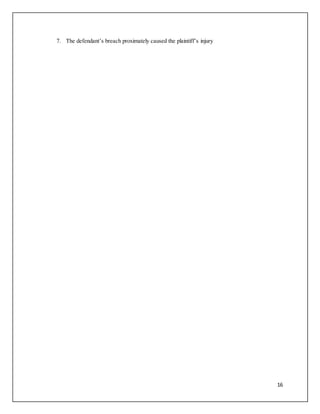
7. The defendant’s breach proximately caused the plaintiff’s injury
17
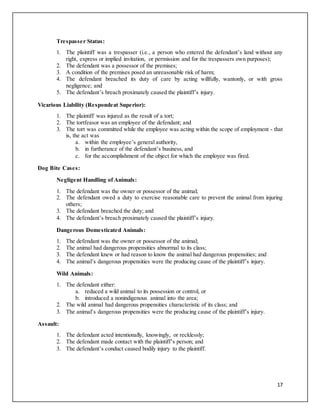
Trespasser Status:
1. The plaintiff was a trespasser (i.e., a person who entered the defendant’s land without any
right, express or implied invitation, or permission and for the trespassers own purposes);
2. The defendant was a possessor of the premises;
3. A condition of the premises posed an unreasonable risk of harm;
4. The defendant breached its duty of care by acting willfully, wantonly, or with gross
negligence; and
5. The defendant’s breach proximately caused the plaintiff’s injury.
Vicarious Liability (Respondeat Superior):
1. The plaintiff was injured as the result of a tort;
2. The tortfeasor was an employee of the defendant; and
3. The tort was committed while the employee was acting within the scope of employment - that
is, the act was
a. within the employee’s general authority,
b. in furtherance of the defendant’s business, and
c. for the accomplishment of the object for which the employee was fired.
Dog Bite Cases:
Negligent Handling of Animals:
1. The defendant was the owner or possessor of the animal;
2. The defendant owed a duty to exercise reasonable care to prevent the animal from injuring
others;
3. The defendant breached the duty; and
4. The defendant’s breach proximately caused the plaintiff’s injury.
Dangerous Domesticated Animals:
1. The defendant was the owner or possessor of the animal;
2. The animal had dangerous propensities abnormal to its class;
3. The defendant knew or had reason to know the animal had dangerous propensities; and
4. The animal’s dangerous propensities were the producing cause of the plaintiff’s injury.
Wild Animals:
1. The defendant either:
a. reduced a wild animal to its possession or control, or
b. introduced a nonindigenous animal into the area;
2. The wild animal had dangerous propensities characteristic of its class; and
3. The animal’s dangerous propensities were the producing cause of the plaintiff’s injury.
Assault:
1. The defendant acted intentionally, knowingly, or recklessly;
2. The defendant made contact with the plaintiff’s person; and
3. The defendant’s conduct caused bodily injury to the plaintiff.
18
Serving Alcohol to Minors:
1. The defendant was an adult at least 21 years of age who was not the minor’s parent, guardian,
spouse, or custodian;
2. The defendant knowingly
a. served or provided an alcoholic beverage to the minor, or
b. allowed an alcoholic beverage to be served or provided to the minor on the
defendant’s premises;
3. The alcoholic beverage contributed to the minor’s intoxication; and
4. The minor’s intoxication proximately caused the plaintiff’s injury.
Dram Shop Liability:
1. The defendant,
a. who had a Texas Alcoholic Beverage Commission license, sold or served an
alcoholic beverage to an adult recipient, or
b. who did not have a Texas Alcoholic Beverage Commission license, sold an alcoholic
beverage to an adult recipient,
2. When the defendant provided the alcoholic beverage to the recipient, it was apparent to the
defendant that the recipient was obviously intoxicated; and
3. The recipient’s intoxication proximately caused the plaintiff’s injury.
False Imprisonment:
1. The defendant willfully detained the plaintiff;
2. The detention was without the plaintiff’s consent; and
3. The detention was without legal authority or justification.
Conversion:
1. The plaintiff, owned, possessed, or had the right to immediate possession of property;
2. The property was personal property;
3. The defendant wrongfully exercised dominion or control over the property; and
4. The plaintiff suffered injury.
DTPA (Texas Deceptive Trade Practices Act):
1. The plaintiff is a consumer;
2. The defendant can be sued under the DTPA;
3. The defendant committed one or more of the following wrongful acts:
a. A false, misleading, or deceptive act or practice that is specifically enumerated in the
“laundry list” of Texas Business & Commerce Code Section 17.46(b) and that was
relied on by the plaintiff to the plaintiff’s detriment,
b. A breach of an express or implied warranty,
c. Any unconscionable action or course of action,
d. The use or employment of an act or practice in violation of Texas Insurance Code
Chapter 541, or
e. A violation of one of the tie-in consumer statutes, as authorized by Texas Business &
Commerce Code Section 17.50(h), which are classified as “false, misleading, or
deceptive acts or practices”; and
4. The defendant’s action was a producing cause of the plaintiff’s damages.
19
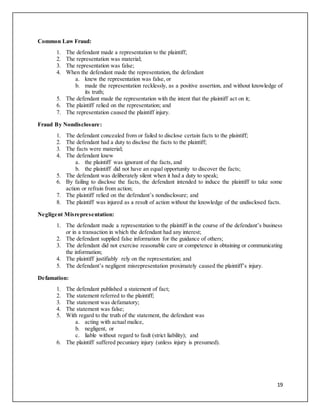
Common Law Fraud:
1. The defendant made a representation to the plaintiff;
2. The representation was material;
3. The representation was false;
4. When the defendant made the representation, the defendant
a. knew the representation was false, or
b. made the representation recklessly, as a positive assertion, and without knowledge of
its truth;
5. The defendant made the representation with the intent that the plaintiff act on it;
6. The plaintiff relied on the representation; and
7. The representation caused the plaintiff injury.
Fraud By Nondisclosure:
1. The defendant concealed from or failed to disclose certain facts to the plaintiff;
2. The defendant had a duty to disclose the facts to the plaintiff;
3. The facts were material;
4. The defendant knew
a. the plaintiff was ignorant of the facts, and
b. the plaintiff did not have an equal opportunity to discover the facts;
5. The defendant was deliberately silent when it had a duty to speak;
6. By failing to disclose the facts, the defendant intended to induce the plaintiff to take some
action or refrain from action;
7. The plaintiff relied on the defendant’s nondisclosure; and
8. The plaintiff was injured as a result of action without the knowledge of the undisclosed facts.
Negligent Misrepresentation:
1. The defendant made a representation to the plaintiff in the course of the defendant’s business
or in a transaction in which the defendant had any interest;
2. The defendant supplied false information for the guidance of others;
3. The defendant did not exercise reasonable care or competence in obtaining or communicating
the information;
4. The plaintiff justifiably rely on the representation; and
5. The defendant’s negligent misrepresentation proximately caused the plaintiff’s injury.
Defamation:
1. The defendant published a statement of fact;
2. The statement referred to the plaintiff;
3. The statement was defamatory;
4. The statement was false;
5. With regard to the truth of the statement, the defendant was
a. acting with actual malice,
b. negligent, or
c. liable without regard to fault (strict liability); and
6. The plaintiff suffered pecuniary injury (unless injury is presumed).
20
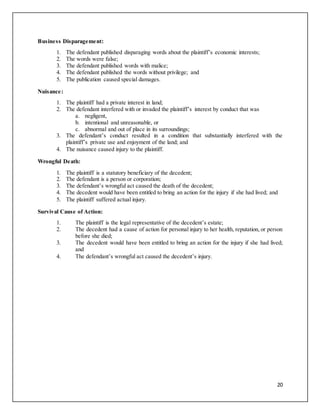
Business Disparagement:
1. The defendant published disparaging words about the plaintiff’s economic interests;
2. The words were false;
3. The defendant published words with malice;
4. The defendant published the words without privilege; and
5. The publication caused special damages.
Nuisance:
1. The plaintiff had a private interest in land;
2. The defendant interfered with or invaded the plaintiff’s interest by conduct that was
a. negligent,
b. intentional and unreasonable, or
c. abnormal and out of place in its surroundings;
3. The defendant’s conduct resulted in a condition that substantially interfered with the
plaintiff’s private use and enjoyment of the land; and
4. The nuisance caused injury to the plaintiff.
Wrongful Death:
1. The plaintiff is a statutory beneficiary of the decedent;
2. The defendant is a person or corporation;
3. The defendant’s wrongful act caused the death of the decedent;
4. The decedent would have been entitled to bring an action for the injury if she had lived; and
5. The plaintiff suffered actual injury.
Survival Cause of Action:
1. The plaintiff is the legal representative of the decedent’s estate;
2. The decedent had a cause of action for personal injury to her health, reputation, or person
before she died;
3. The decedent would have been entitled to bring an action for the injury if she had lived;
and
4. The defendant’s wrongful act caused the decedent’s injury.

Texas Civil Litigation Quick Reference Guide

  • 1.
    1 TEXAS CIVIL LITIGATIONQUICK REFERENCE GUIDE Court System and Jurisdictional Limits (Texas Government Code, Title II): *Discussion limited to those Courts with Jurisdiction over Civil Cases The Texas Civil Court System (at the trial level) is divided generally by jurisdictional limits and case type, as follows: District Courts: The Texas District Courts are the trial courts of general jurisdiction. Texas currently has 457 District Courts. The district courts have jurisdiction in civil matters with a minimum monetary limit but no maximum limit. In counties having statutory county courts, the district courts generally have exclusive jurisdiction in civil cases where the amount in controversy is $200,000 or more, and concurrent jurisdiction with the statutory county courts in cases where the amount in controversy exceeds $500 but is less than $200,000. Some smaller counties share a district court while the larger counties have multiple district courts. The geographical area served by each district court is established by the specific statute creating that court. Unlike most other jurisdictions, Texas trial courts, including district courts, have only one judge per trial court. Instead of adding more departments to existing courts in response to population growth, Texas simply adds more courts. Constitutional County Court: Each of the 254 counties in Texas has a constitutional county court. The Texas Constitution states that "[t]here shall be established in each county in this State a County Court ..." These courts do not always exercise judicial functions. In populous counties, the “county judge” may devote her full attention to the administration of county government. Generally, the “constitutional” county courts have concurrent jurisdiction with justice courts in civil cases where the matter in controversy exceeds $200 but does not exceed $10,000 and concurrent jurisdiction with the district courts in civil cases where the matter in controversy exceeds $500 but does not exceed $10,000. Statutory County Court (County Court at Law): Because the Texas Constitution limits each county to a single county court, the Legislature has created statutory county courts in the larger counties to aid the single county court in its judicial functions. The legal jurisdiction of the special county-level trial courts varies considerably and is established by the statute which creates the particular court. In general, statutory county courts that exercise civil jurisdiction concurrent with the constitutional county court also have concurrent civil jurisdiction with the district courts in civil cases in which the matter in controversy exceeds $500 but does not exceed $200,000. County courts at law usually have appellate jurisdiction in cases appealed from justice of the peace and municipal courts. Justice of the Peace Courts: The lowest court level in Texas is the Justice of the Peace Court (also called Justice Court or JP Court). Texas recently enacted a separate set of procedural rules for cases that are pending in Justice of the Peace Courts. See Rules 500 to 510 of the Texas Rules of Civil Procedure.
  • 2.
    2 Each county hasa JP Court. The jurisdiction of the JP court includes exclusive jurisdiction in civil matters where the amount in controversy is $200 or less, and such other jurisdiction as may be provided by law. Under this provision, the Legislature has raised the top limit on civil matters to $10,000. JP cases are appealed to the county court level where the case results in a trial de novo. Federal District Courts: Texas is also divided into 4 Federal Districts (Northern, Southern, Eastern, and Western). In turn, each of the federal districts is further divided into divisions. Types of Tort Damages in Texas (Chapter 41 of the Texas Civil Practice and Remedies Code): Actual Damages (also called Compensatory Damages): Actual damages are awarded to repair a wrong or to compensate. See Arthur Anderson & Co. v. Perry Equip Co., 945 S.W.2d 812, 816 (Tex. 1997). Actual damages are classified two ways: economic and non-economic. The trier of fact must determine the amount of economic damages and noneconomic damages separately. *Actual damages do not include exemplary damages. Economic Damages - Damages intended to compensate a claimant for actual economic or pecuniary loss. Medical expenses, loss of earning capacity, lost profits, repair costs, and loss of vehicle use are common economic damages. Non-economic Damages - Damages awarded to compensate the claimant for physical pain and suffering, mental or emotional pain or anguish, loss of consortium, disfigurement, physical impairment, loss of companionship and society, inconvenience, loss of enjoyment of life, injury to reputation, and all other non-pecuniary losses other than exemplary damages. Actual damages are also characterized as either direct (general damages) or consequential (special damages). General Damages - Damages that are the necessary and the usual result of the defendant’s wrongful act. Mental anguish in the past is an example of a general damage. General damages compensate the victim for the loss or injury that is conclusively presumed to have been foreseen by the defendant as a consequence of the wrongful act. The plaintiff does not have to specifically plead generaldamages. Even so, Rule 94 of the Texas Rules of Civil Procedure requires a plaintiff to set forth the amount and the method of calculation of all economic damages that are being sought. Special Damages - Damages that result naturally but not necessarily from the defendant’s wrongful act. Mental anguish in the future and physical impairment are examples of special damages. Special damages do not need to be the usual result of the wrongful act, but they must be foreseeable. If the damages are too remote or too uncertain, they cannot be recovered. Rule 56 of the Texas Rules of Civil Procedure requires a claimant to plead all special damages that are being sought. Exemplary Damages (also called Punitive Damages): Exemplary damages are designed to penalize conduct that is outrageous, malicious, or morally culpable. Section 41.003 of the Texas Civil Practice and Remedies Code sets forth the requirements for a claimant to recover exemplary damages. In short, a claimant must show that the harm caused was the result of fraud, malice, or
  • 3.
    3 gross negligence. Moreover,unlike the lower standard of proof of preponderance of the evidence to establish tort liability, a claimant seeking exemplary damages must prove by clear and convincing evidence that the defendant engaged in fraud, malice, or gross negligence. An award of exemplary damages rests largely in the discretion of the jury and will not be set aside as excessive unless the amount is so large as to indicate that it is the result of passion, prejudice, or corruption, or that the evidence has been disregarded. Elthicon, Inc. v. Martinez, 835, S.W.2d 826 (Tex. App. - - Austin 1992, writ denied). Texas limits the amount of exemplary damages that can be awarded to two times the amount of economic damages; plus (1) an amount equal to any non-economic damages, not to exceed $750,000; or (2) $200,000. Prejudgment interest may not be assessed or recovered on an award of exemplary damages. Common Personal Injury Damages Recognized in Texas (Texas Pattern Jury Charge): Physical Pain and Mental Anguish: The Texas Pattern Jury Charge combines physical pain and mental anguish as a single element of damages. Physical Pain – A jury can infer that pain occurred from the nature of the injury. The law presumes that physical pain results from serious injury. Of course, in order to recover damages for physical pain, a person must be conscious of that pain (“conscious pain and suffering”). To prove future physical pain, the evidence must show that there is a reasonable probability that the injury will continue to affect the plaintiff in the future. Mental Anguish – Generally, physical injury is required fora plaintiff to recover mental anguish damages. Consequently, mental anguish damages are recoverable in virtually all personal injury cases. Mental anguish damages are also recoverable for the aggravation of pre-existing medical conditions. Bystander Claims - In addition to cases involving personal injury, mental anguish damages are recoverable for injuries of such a shocking or disturbing nature that mental anguish is highly foreseeable. Examples of these types of cases are those involving wrongful death and bystander injury. In Texas, a bystander claim can only be brought by a closely related family member who was present at or near the scene of the accident. Texas also allows mental anguish damages for torts that involve intentional or malicious conduct. Disfigurement: Disfigurement is recognized as a separate element of recovery from pain and suffering, mental anguish, and loss of earning capacity. Common forms of disfigurement include scars, burns, and amputations. Physical Impairment: Physical impairment is defined as the loss of enjoyment of life. Physical impairment encompasses the inability to participate in sports, hobbies, or other recreational activities. In order to be recoverable as damages, physical impairment must be substantial and extend beyond pain and suffering, mental anguish, and lost earning capacity. The plaintiff must produce evidence showing the tasks or activities that she can no longer perform.
  • 4.
    4 Medical Expenses: Medicalexpenses can include costs of hospital care, doctor’s services, services of other healthcare providers (e.g., chiropractors, psychiatrists, nurses, and physical therapists), laboratory tests, and transportation. Past Medical - Recovery of past medical expenses is limited to those expenses that have actually been “paid or incurred.” In addition, in order to recover past medical expenses, the plaintiff must show that the expenses were reasonable and necessary either by expert testimony or by an affidavit of past expenses. See Section 18.001 of the Texas Civil Practice and Remedies Code for a discussion of the affidavit. Future Medical - Recovery of future medical expenses requires the plaintiff to show that there is a reasonable probability that expenses resulting from the injury will be necessary in the future. Some cases hold that the plaintiff does not need to provide expert testimony to prove the amount of future medical expenses. However, this practice is by far the exception rather than the rule. Loss ofEarning Capacity: Loss of earning capacity does not mean the loss of earnings. Loss of earning capacity, rather than loss of earnings, is the proper measure of damages. The plaintiff is required to introduce evidence of the loss in the form of a net loss after reduction for income tax payments or unpaid tax liability under federal income tax law. Loss of Past Earning Capacity - The plaintiff’s diminished capacity to earn a living during the period between the injury and the date of trial. To support an award of damages for loss of past earning capacity, the plaintiff must introduce evidence to allow the jury to reasonably measure earning capacity for the injury in monetary terms. Although loss of earnings is not the proper measure of damages, the plaintiff should introduce evidence of past earnings, time missed from work, and any other factors that illustrate the plaintiff reduced ability to perform work in the past. Loss of Future Earning Capacity - The plaintiff’s diminished capacity to earn a living after the trial. Loss of Consortium: Loss of consortium is a derivative claim based on the loss of love, affection, protection, emotional support, companionship, care, and society that can occur when a family member is injured. A loss of consortium claim requires that the injured claimant incur physical injury. A loss of consortium claim is available to a spouse, a child, as well as a parent in cases of death. Moreover, in Texas,a parent can sue forloss of consortiumbased on the death of an unborn child. Loss of Services: Loss of services is another derivative claim. However, the damages that can be awarded are more tangible than those available for loss of consortium. This cause of action is available to a spouse and to a parent. The plaintiff is required to introduce evidence of the loss in the form of a net loss after reduction for income tax payments or unpaid tax liability under federal income tax law.
  • 5.
    5 Apportionment of Damages(Chapters 32 and 33 of the Texas Civil Practice and Remedies Code): Role of Jury: The trier of fact is required to determine the percentage of responsibility for (1) each claimant; (2) each defendant; (3) each settling person; and (4) each responsible third party who has been designated. Derivative Claims and Vicarious Liability: In cases where a claimant has a derivative claim, that claimant’s percentage of responsibility flows from the primary claimant. Derivative claims include loss of consortium and loss of services. Similarly, when an employer is sued for vicarious liability based on the acts of its employee, the employer is not listed separately on the jury charge. The employer’s percentage of responsibility flows by and through the employee’s percentage of responsibility. Modified Comparative Fault: A claimant is barred from recovering damages in tort if its responsibility is found to be greater than 50%. Reduction of Recovery - If the claimant is not barred from recovery, the court shall reduce the amount of damages to be recovered by the claimant by a percentage equal to the claimant’s responsibility. Dollar for Dollar Credit - If the claimant has settled with one or more persons, the court will further reduce the amount of damages to be recovered by the claimant by the sum of the dollar amount of the settlements. The settlement credit is applied after any reduction for the plaintiff’s percentage of responsibility and after prejudgment interest is calculated on the award for any past damages. Section 33.012. Amount of Recovery and Section 33.013. Amount of Liability is viewed independent of one another. Impleader/Third Party Action: Under Rule 38 of the Texas Rules of Civil Procedure, a defendant can bring an additional party into the suit who may be liable for all or part of the plaintiff’s claim. Responsible Third Parties: A responsible third party means any person who is alleged to have caused or contributed to the harm for which the recovery of damages is sought. The practice of allowing the designation of a responsible third party benefits named defendants because it allows the defendant's percentage of responsibility to be reduced by the percentage of responsibility assigned to the responsible third party. Before 2003, defendants were not allowed to have the jury assign responsibility to judgment-proof entities such as bankrupts or employers (because of the workers’ compensation bar). Original 2003 Statute - - Under the original statute, in order to avoid the possible reduction of the defendant's percentage of responsibility through its designation of a responsible third party, the plaintiff had sixty (60) days after the designation to join the responsible third party as an actual defendant in the suit and could do so even if the statute of limitations had expired on the plaintiff's cause of action against that person.
  • 6.
    6 Revised 2011 Statute- - Under the new law, if a defendant designates a person or entity as a responsible third party and the statute of limitations has run on the plaintiff's cause of action against that person, the plaintiff will no longer be able to avoid the statute of limitations by joining the responsible third party to the suit. General Procedure - A designation of a responsible third party does not require the named defendant to actually serve the responsible third party with service as would be the case with a third party action under Rule 38. On the other hand, a responsible third party is not a party to the action in the traditional sense so a different set of rules will apply when attempting to serve discovery and take depositions of the designees. Joint & Several Liability: In Texas, a defendant is jointly and severally liable for the plaintiff’s damages if the defendant’s percentage of responsibility for a cause of action is 51% or more. Because it is mathematically impossible for more than one party to be 51% or more responsible, only one defendant can be jointly and severally liable (in most types of cases). A defendant that is not jointly and severally liable is liable only for the percentage of damages equal to that defendant’s own percentage of responsibility. If the defendant is jointly and severally liable, the defendant is liable for the entire amount of the damages regardless of that defendant’s percentage of responsibility. That defendant then has a right to contribution from the other defendant(s) for the overpayment to the extent of the other defendant’s percentage of liability. Statute of Limitations (Chapter 16 of the Texas Civil Practice and Remedies Code): *The list belowis NOTa comprehensive list of all potential causes of action or limitations periods Tolling Periods: Limitations are tolled for persons under a legal disability. Those persons include a person younger than 18 years of age, regardless of whether the person is married or of unsound mind. In addition, if the defendant is absent from the state, the applicable statute of limitations is tolled during that period’s absence. Also, the death of a person (either the plaintiff or defendant) tolls the statute of limitations for 12 months. Discovery Period: The discovery rule is applied and limited categories of cases for accrual of a cause of action until the plaintiff knew or, exercising reasonable diligence, should have known of the facts giving rise to a cause of action. For the discovery rule to apply, the nature of the injury must be inherently undiscoverable and the injury itself must be objectively verifiable. HECI Expl. Co. v. Neel, 982 S.W.2d 881 (Tex. 1988). Counterclaims and Cross-Claims: Counterclaims and cross-claims that are otherwise barred by limitations must be filed within 30 days after the defendant’s answer is due. Service of Process: A plaintiff must use due diligence in serving the defendant with process. When a plaintiff files a petition within the limitations period, but does not serve the defendant until after the statutory period has expired, the date of service relates back to the date of filing if the plaintiff exercise diligence in effecting service. Statute ofRepose: Texas also has certain statutory statutes of repose. These statutes set forth the outer limit by which a person must file suit, regardless of the date of the injury or the application
  • 7.
    7 of the discoveryrule. For example, a products liability suit must be brought within 15 years of the date the product is sold. One Year: Defamation Libel and Slander - The limitations period for causes of action for libel and slander begin to run when the person defamed learns of, or should by reasonable diligence have learned of, the existence of the defamation. Two Years: Personal injury, negligence, conversion, false imprisonment, loss of consortium, loss of services, and wrongful death. Negligence - A negligence claim arising from a personal injury must be brought within 2 years from the date of injury Conversion of Personal Property - The general rule is that limitations begins to run at the time of the unlawful taking. However, if the original possession is lawful, the limitation period does not begin to run until the return of the property has been demanded and refused, or until the person in possession has unequivocally exercised acts of dominion over the property inconsistent with the claims of the owner or person entitled to possession. Loss of Consortium and Loss of Services - Claims for loss of consortium and loss of services are derivative of the injured family member’s cause of action for personal injuries and are subject to the same statute of limitations and defenses that preclude liability. Wrongful Death - The cause of action for wrongful death accrues on the death of the injured person and not on the date of the injury. Three Years: Misappropriation of Trade Secrets Four Years: Fraud and Breach of Fiduciary Duty Pleading Requirements for Asserting Causes of Action (Rule 47 of the Texas Rules of Civil Procedure): Fair Notice Rule: In addition to the decade’s old requirement that a party must set forth a short statement of the cause of action sufficient to give fair notice of the claim involved, Rule 47 now requires a party to make a more specific statement of the relief sought. A party is now required to also plead whether it seeks monetary relief (1) of $100,000 or less, (2) over $100,000 but not more than $200,000, (3) over $200,000 but not more than $1,000,000, or (4) over $1,000,000. A party that fails to comply with this rule cannot conduct discovery until the pleading is amended to comply.
  • 8.
    8 Answering a Lawsuit(Rules 92 and 93 of the Texas Rules of Civil Procedure): Due Order of Pleadings: Under the due-order-of-pleading rule, a defendant must file certain pleadings or motions in a specific order. Otherwise,the pleading is waived. Exito Elecs.Co. v. Trejo, 142 S.W.3d 302 (Tex. 2004). The order is as follows: special appearance, venue challenges, special exceptions, and then other pleadings or motions. Verified Pleas Under Rule 93 of the Texas Rules of Civil Procedure: There are 16 different defensive pleas that require a defendant’s verification. Otherwise, the defenses are waived. Examples include lack of legal capacity to sue and defect in the parties. Rule 11 Agreements (Rule 11 of the Texas Rules of Civil Procedure): All settlement agreements need to be memorialized in writing as soon as an agreement is reached!!! Rule 11 of the Texas Rules of Civil Procedure: No agreement between attorneys or parties touching any suit pending will be enforced unless is in writing, signed and filed with the papers as part of the record, or unless it is made in open court and entered of record. The purpose of Rule 11 is to remove misunderstandings and controversies accompany verbal assurances. Fortis Benefits v. Cantu, 234 S.W.3d 642, 651 (Tex. 2007). Enforcement: Even if a Rule 11 agreement is filed with the Court, a judgment cannot be entered based on the settlement agreement alone. Rather, the Rule 11 agreement serves as a basis upon which a breach of contact action may lie. When one party fails to honor the settlement terms set forth within the agreement, the other party should sue for breach of contract and move for summary judgment to have the terms enforced. “Paid or Incurred” and the Collateral Source Rule (Section 41.0105 of the Texas Civil Practice and Remedies Code): Medical Expenses Charged But Not Paid: Recovery of medical or health care expenses incurred is limited to the amount actually paid or incurred by or on behalf of the plaintiff. Recovery of medical expenses is limited to what has been paid by or on behalf of the plaintiff and not what has been charged by the provider. Only evidence of recoverable medical expenses is admissible at trial. Haygood v. Garza De Escabedo, 356 S.W.3d 390 (Tex. 2011). Collateral Source: Even with the paid or incurred requirement, the collateral source rule remains in effect. Therefore, the jury cannot be told that the medical expenses will be covered in whole or in part by medical insurance. In addition, the jury cannot be told that a healthcare provider adjusted charges because of insurance. Ownership of Medical Expenses: The parent of a minor child maintains a cause of action for that minor’s medical expenses, and this fact must be considered when resolving any claim asserted on behalf of the minor. Hospital Liens (Chapter 55 of the Texas Property Code) – A hospital lien must be paid in connection with any settlement. A hospital has a lien on a cause of action or claim of an
  • 9.
    9 individual who receiveshospital services for injuries caused by an accident that is attributed to the negligence of another person. For the lien to attach, the individual must be admitted to a hospital not later than 72 hours after the accident. Attachment of Lien - A hospital lien attaches to (1) a cause of action for damages arising from an injury for which the injured individual is admitted to the hospital or receives emergency medical services; (2) a judgment of a court in this state or the decision of a public agency in a proceeding brought by the injured individual or by another person entitled to bring the suit in case of the death of the individual to recover damages arising from an injury for which the injured individual is admitted to the hospital or receives emergency medical services; and (3) the proceeds of a settlement of a cause of action or a claim by the injured individual or another person entitled to make the claim, arising from an injury for which the injured individual is admitted to the hospital or receives emergency medical services. *Validity of Release - A release in connection with the settlement of the underlying tort claim is INVALID unless (1) the charges of the hospital or emergency medical services provider claiming the lien were paid in full before the execution and delivery of the release; (2) the charges of the hospital or emergency medical services provider claiming the lien were paid before the execution and delivery of the release to the extent of any full and true consideration paid to the injured individual by or on behalf of the other parties to the release; or (3) the hospital or emergency medical services provider claiming the lien is a party to the release. Judgments - A judgment to which a lien under this chapter has attached remains in effect until the charges of the hospital or emergency medical services provider claiming the lien are paid in full or to the extent set out in the judgment. Prejudgment and Post-Judgment Interest (Chapter 304 of the Texas Finance Code): Pre-Judgment Interest: Prejudgment interest in computed as simple interest. It does not compound. Simple interest is calculated on the principal amount only and not on previously accumulated interest. Principal is the amount of damages found by the trier of fact less any amounts on which interest in prohibited by statute of case law. These legal exclusions include exemplary damages, future damages, attorneys’ fees, and court costs. The rate for prejudgment interest in Texas is the same as post-judgment interest. Prejudgment interest accrues on the amount of a judgment during the period beginning on the earlier of the 180th day after the date the defendant received written notice of a claim OR the date the suit is filed and ending on the day preceding the date judgment is rendered. Post-Judgment Interest: Post-Judgment interest on a money judgment begins accruing on the day judgment is rendered and stops accruing on the day the judgment is satisfied. Phillips v. Bramlett, 407 S.W.3d 229 (Tex. 2013). The rate for post-judgment interest in Texas is the same as prejudgment interest.
  • 10.
    10 Alternative Dispute Resolution(Title 7 of the Texas Civil Practice and Remedies Code): Mediation: Mediation can be voluntary or ordered by the court where the case is pending. Mediation is required in most counties by local rule. Mediation is a forum in which an impartial person, the mediator, facilitates communication between parties to promote reconciliation, settlement, or understanding. A mediator may not impose his own judgment on the issues for that of the parties. Confidentiality - Settlement offers and communications made during mediation are confidential and may not be disclosed during the discovery process or used at trial. Even if the mediation of court ordered, it does not require a party to offer or accept consideration. It only requires attendance at the mediation. Arbitration: Arbitration is a forum in which each party and counsel for the party present the position of the party before an impartial third party who renders a specific award. Because of the cost usually associated with arbitration, a binding arbitration is more common. Other Authorized ADR Procedures: Mini-Trial, Moderated Settlement Conference, Summary Jury Trial, and Special Judge. Each of these procedures is rarely used, and the reason is usually the cost associated with the procedure. NEW in 2013 - Expedited Actions Procedure (Rule 169 of the Texas Rules of Civil Procedure): *Effective March 1, 2013, the Texas Supreme Court enacted a new “expedited actions” procedure. It provides a means for claimants seeking less than $100,000 (inclusive of all damages, costs, and attorneys’ fees) to resolve their cases more quickly and with less expense. The process is mandatory for cases in which each claimant seeks less than $100,000, but excludes family law, tax, property, and medical liability cases. Good Cause Exception: Courts may allow a case in which the claimant seeks less than $100,000 to be excluded from the “expedited actions” process upon a showing of “good cause,” after considering the number of parties and witnesses, the complexity of legal and factual issues, the aggregate claims against one defendant, and the relief sought by counterclaim, among other factors. Amendment of Pleadings: A claimant may amend the pleadings and allege an amount in controversy above $100,000. If this occurs, the suit is removed from the expedited actions procedure and discovery is reopened under Rule 190.2(c). New Procedure: Discovery - The expedited actions process limits the amount of discovery that can be conducted. For written discovery, each party may serve only 15 interrogatories, 15 requests for production, and 15 requests for admissions. Deposition time is limited to only six total hours per party to question and cross-examine all witnesses. Absent a court order, the parties may only agree to extend this total to 10 hours. The overall discovery period is also limited by the new rules, now ending 180 days after discovery is
  • 11.
    11 commenced. Consequently, aplaintiff has control over the beginning date of discovery, which could be as early as the date of service on defendants, if discovery requests are contained with the petition. Alternative Dispute Resolution - Additionally, in direct opposition of usual practice, the expedited actions rules allow parties to opt out of alternative dispute resolution (ADR) entirely. However, if the parties have agreed to participate, the rule provides that the court can refer the parties to ADR only once, not to exceed one half-day in duration, and at a cost that does not exceed twice the amount of a civil filing fee. Trial Date - The trial setting requirement significantly limits judicial discretion regarding the scheduling of the trial. Upon a party’s request, the court must set a trial date that is within 90 days of the conclusion of the discovery period. Furthermore, the court may issue only two continuances, which cannot exceed a combined total of 60 days. Basically, the new “expedited actions” procedure creates a new class of “preferentially set” cases on each court’s trial docket, which may affect the ability of larger cases to be reached on a given court docket. Trial Process - Each side receives only eight hours of trial time, which includes jury selection, opening statements, closing arguments, presentation of evidence, and all examination of witnesses, including Robinson/Daubert challenges to the admissibility of expert testimony. These time limitations are per side, and not per party. If a party shows good cause, the trial court may extend the time limit to 12 hours per side, but it has no discretion to extend the limits beyond that point. Pretrial Robinson/Daubert motions challenging the qualifications or reliability of experts and their opinions are not allowed. Such challenges may be made, but only at trial or as an objection to summary judgment evidence. Motion Practice (How to End the Lawsuit Short of Settlement or Trial): Motion to Dismiss (Rule 91a of the Texas Rules of Civil Procedure): A party may move to dismiss a cause of action that has “no basis in law or fact.” A claim has “no basis in law” if the allegations, taken as true, together with any reasonable inferences, “do not entitle the claimant to relief.” A claim has “no basis in fact” if “no reasonable person could believe the facts as pleaded.” A motion to dismiss a baseless case under Rule 91a must state that (1) it is made pursuant to Rule 91a, (2) identify each cause of action to which it is addressed, and (3) specifically state the reasons that the cause of action has no basis in law, fact, or both. A Rule 91a movant must file the motion within 60 days after the first pleading that contains the cause of action at issue is served on the movant and at least 21 days before the hearing on the motion. Each party is entitled to 14 days’ notice of the hearing, although the court may decide the motion on the written submissions. The response is
  • 12.
    12 due seven daysbefore the hearing. If the respondent amends the cause of action at least three days before the hearing, the movant may withdraw or amend the motion. If the movant amends the motion, the Rule 91a time periods begin again. If the respondent nonsuits at least three days before the hearing, the court may not rule on the motion to dismiss. If the respondent’s amendment or nonsuit is not timely, however, the court must rule on the motion and may not consider the amendment or nonsuit. The court must rule on the motion within 45 days after its filing. The court may not consider any evidence in deciding the motion. Motion Has Teeth - The prevailing party on a Rule 91a motion is entitled to an award of fees and costs incurred on the challenged cause of action. The trial court must consider evidence in deciding the amount of the mandatory award. Motion for Summary Judgment (Rule 166 ofthe Texas Rules ofCivil Procedure): Summary judgment is a procedural mechanism designed to allow for the efficient resolution of legal disputes which can be decided as a matter of law. Summary judgment allows for the resolution of disputes that do not present fact issues. Texas provides for two distinct types of summary judgments: a “traditional” motion for summary judgment and a “no-evidence” motion for summary judgment. Traditional Motion for Summary Judgment - In a traditional motion for summary judgment: (1) the movant has the burden of showing that there is no genuine issue of material fact and that it is entitled to judgment as a matter of law; (2) in deciding whether there is a disputed material fact issue precluding summary judgment, evidence favorable to the non-movant will be taken as true; and (3) every reasonable inference must be indulged in favor of the non-movant and any doubts resolved in its favor. Nixon v. Mr. Prop. Mgmt. Co., 690 S.W.2d 546 (Tex. 1985). No-Evidence Motion for Summary Judgment - In 1997, Texas modified its summary judgment rules to include a “no-evidence” motion for summary judgment. The motion should only be filed “after an adequate time for discovery.” Therefore, it is usually filed after written discovery and depositions have occurred, unless the other party has failed to prosecute its claims in a timely manner. The no-evidence summary judgment motion is a streamlined procedure in that the movant is merely required to point to specific elements of an opponent’s claim or defense to which the non-moving party cannot produce sufficient summary judgment proof to raise a fact issue. It is then the burden of the other party to provide summary judgment proof in support of its claim or defense. A no-evidence summary judgment is essentially a pre-trial directed verdict. Nonsuit: A nonsuit can be taken at any time prior to the plaintiff resting its case or in the summary judgment context, before a ruling on the summary judgment. Typically, a Notice of Nonsuit is filed. However, when a party omits parties or claims in an amended petition, then the party has “nonsuited” the parties or claims that have been omitted. A nonsuit is without prejudice meaning that the nonsuiting party is not barred from bringing the action in the future. However, a nonsuit does not toll or otherwise extend the limitations period for any subsequently filed suit.
  • 13.
    13 Offer of SettlementProcedure (Rule 167 of the Texas Rules of Civil Procedure): Texas is NOT a “Fee Shifting” or “Loser Pays” Jurisdiction: Rule 167 of the Texas Rules of Civil Procedure alters this rule in limited circumstances. Because of the potential for the imposition of attorney’s fees against the losing party, this procedure is used sparingly. The fees and costs are shifted pursuant to the amount of the offer(s) made and not based upon the prevailing party. Texas Offer of Settlement Procedure: 1. A defendant must file a declaration to invoke the rule no later than 45 days before the trial setting. 2. Only a defendant can invoke the offer of judgment procedure. 3. The defendant cannot invoke the procedure until at least 60 days after both the plaintiff and defendant have appeared in the case. 4. Once the defendant has invoked Rule 167 by filing a declaration, either party may make a settlement offer under the offer of settlement procedure. 5. The terms of the offer must be in writing and served on all parties to whom it is made. The offer must not attempt to settle less than all monetary claims and may not include non-monetary claims. 6. The offer must not include "unreasonable conditions," but may contain conditions to acceptance. 7. The offer may not be made at mediation or arbitration. 8. The offer must state an acceptance deadline, which must be at least 14 days after the offer is made. 9. Before the offer is accepted, it may be withdrawn. 10. After a defendant invokes the process, the plaintiff can then invoke the procedure as well. Thus, a defendant may end up paying the plaintiff's litigation costs under this procedure. Consequences of Invoking the Rule: The offering party is entitled to recover litigation "costs" if the judgment is "significantly less favorable than the rejected offer." A judgment is considered significantly less favorable if (1) the amount of the judgment is less than 80% of the offer rejected by the plaintiff; or (2) more than 120% of the offer rejected by the defendant. Litigation “costs” are defined as the money spent and obligations incurred that directly relate to the claims in the settlement offer. They include (1) court costs; (2) reasonable deposition costs; (3) reasonable fees for no more than two testifying experts; and (4) reasonable attorneys' fees. Litigation costs cannot exceed the total amount that the claimant recovers or would recover before adding an award of litigation costs under this rule in favor of the claimant or subtracting as an offset an award of litigation costs under this rule in favor of the defendant. If the defendant recovers litigation costs,those costs are awarded as an offset against any judgment obtained by the adverse party. The litigations costs are incorporated into the final judgment. Example: If a plaintiff rejected an Offer of Settlement of $100,000, litigation costs will be assessed if the amount of the judgment (considering proportionate responsibility, settlement
  • 14.
    14 credits, and prejudgmentinterest) is less than $80,000. Similarly, for a defendant who rejected a plaintiff's Offer of Settlement of $80,000, litigation costs will be assessed if the amount of the judgment is more than $96,000. It is important to note that the litigation costs only include those costs incurred between the date the offer was rejected and the time of judgment. Risks: Because the plaintiff must obtain a judgment in order for a defendant to recover its costs, the Texas rule is more risky for defendants in tort cases as a plaintiff would not ordinarily recover attorney's fees. In fact, a plaintiff will never have to pay a defendant as it can merely have a judgment in its favor reduced. As a practical matter, in tort cases, an Offer of Settlement creates little additional risk for the plaintiff but considerable risk for the defendant. Minor Settlements (Rules 44 and 173 of the Texas Rules of Civil Procedure): Context: In the settlement of cases involving a minor, even if the parties and any court-appointed ad litem agree to the settlement, a judgment ratifying the compromise cannot be rendered without a hearing and evidence that the settlement serves the minor’s “best interest.” Because a minor lacks the legal capacity to agree to a settlement, the court must approve any payments to be made on the minor’s behalf. Procedure: When a claim is settled pre-suit, the appropriate way to memorialize the agreement is to file a “friendly suit.” Absent a friendly suit, a judgment entered in favor of a minor represented by a next friend is not binding on the minor, and she can sue to have it set aside on the basis of inadequate representation of her interests. The friendly suit allows the district court to adjudicate the legal issues involved, approve the settlement, and enter a final judgment. The settlement agreement, once approved by the court, becomes forever binding and conclusive on the minor. A friendly suit does not differ in procedure from a conventional lawsuit, except that the parties have already agreed on a settlement amount. The parties conduct no discovery, and simply proceed directly to the settlement hearing. Guardian Ad Litem: The only question in a friendly suit is whether the parent will represent the minor’s interest, or the court should appoint a guardian ad litem. A guardian ad litem owes a fiduciary duty to a minor, and can be held liable for the breach of that duty. The guardian is not an attorney for the minor, nor is he a party to the lawsuit, but is rather an officer appointed by the court to assist it in properly protecting the minor’s interests. The guardian ad litem recommends to the court an appropriate allocation of settlement funds between minor, parents, and plaintiff’s counsel. Although it is atypical, the court can alter the contingency fee percentage requested by the attorney as it relates to the child’s portion of the settlement. Information Required by the Court in Every Minor Settlement: At a bare minimum, the Court will require the following information before approving a minor settlement: (1) identifying information regarding the minor, (2) date of injury, (3) how minor was injured, (4) specific details of injury, (5) the amount of the settlement, (6) how the settlement amounts will be apportioned between the parties, (7) how the money for the minor will be invested, (8) the plaintiff attorney’s reasonable fees and expenses, (9) guardian ad litem fees and expenses, (10) whether the plaintiffs agree to the settlement, and (11) whether the plaintiffs believe settlement is in the best interest of the minor.
  • 15.
    15 Common Causes ofAction in Insurance Defense Litigation: *Affirmative Defenses Not Included in the Below Causes of Action Negligence - - Standard Automobile Case: 1. The defendant owned a legal duty to the plaintiff; 2. The defendant breached the duty; and 3. The breach proximately caused the plaintiff’s injury. Negligence Per Se: 1. The plaintiff belongs to the class of persons the statute was designed to protect, and her injury is of the type the statute was designed to prevent; 2. The statute is one for which tort liability may be imposed when violated; 3. The defendant violated the statute without excuse; and 4. The defendant’s act or omission proximately caused the plaintiff’s injury. Negligent Entrustment of a Motor Vehicle: 1. The owner entrusted its vehicle to another person; 2. That person was an unlicensed, incompetent, or reckless driver; 3. The owner knew or should have known the driver was unlicensed, incompetent, or reckless; 4. The driver was negligent on the occasion in question; and 5. The driver’s negligence proximately caused the plaintiff’s injury. Premises Liability: Invitee Status: 1. The plaintiff was an invitee (i.e., a person who entered the defendant’s premises with the defendant’s knowledge and for their mutual benefit); 2. The defendant was a possessor of the premises; 3. A condition on the premises posed an unreasonable risk of harm; 4. The defendant knew or reasonably should have known of the condition; 5. The defendant breached its duty of ordinary care by both a. failing to adequately warn the plaintiff of the condition, and b. failing to make the condition reasonably safe; and 6. The defendant’s breach proximately caused the plaintiff’s injury. Licensee Status: 1. The plaintiff was a licensee (i.e., a person who had the express or implied permission of defendant to enter and remain on the premises); 2. The defendant was a possessor of the premises; 3. A condition on the premises posed an unreasonable risk of harm; 4. The defendant had actual knowledge of the danger; 5. The plaintiff did not have actual knowledge of the danger; 6. The defendant breached its duty of ordinary care by both a. failing to adequately warn the plaintiff of the condition, and b. failing to make the condition reasonably safe; and
  • 16.
    16 7. The defendant’sbreach proximately caused the plaintiff’s injury
  • 17.
    17 Trespasser Status: 1. Theplaintiff was a trespasser (i.e., a person who entered the defendant’s land without any right, express or implied invitation, or permission and for the trespassers own purposes); 2. The defendant was a possessor of the premises; 3. A condition of the premises posed an unreasonable risk of harm; 4. The defendant breached its duty of care by acting willfully, wantonly, or with gross negligence; and 5. The defendant’s breach proximately caused the plaintiff’s injury. Vicarious Liability (Respondeat Superior): 1. The plaintiff was injured as the result of a tort; 2. The tortfeasor was an employee of the defendant; and 3. The tort was committed while the employee was acting within the scope of employment - that is, the act was a. within the employee’s general authority, b. in furtherance of the defendant’s business, and c. for the accomplishment of the object for which the employee was fired. Dog Bite Cases: Negligent Handling of Animals: 1. The defendant was the owner or possessor of the animal; 2. The defendant owed a duty to exercise reasonable care to prevent the animal from injuring others; 3. The defendant breached the duty; and 4. The defendant’s breach proximately caused the plaintiff’s injury. Dangerous Domesticated Animals: 1. The defendant was the owner or possessor of the animal; 2. The animal had dangerous propensities abnormal to its class; 3. The defendant knew or had reason to know the animal had dangerous propensities; and 4. The animal’s dangerous propensities were the producing cause of the plaintiff’s injury. Wild Animals: 1. The defendant either: a. reduced a wild animal to its possession or control, or b. introduced a nonindigenous animal into the area; 2. The wild animal had dangerous propensities characteristic of its class; and 3. The animal’s dangerous propensities were the producing cause of the plaintiff’s injury. Assault: 1. The defendant acted intentionally, knowingly, or recklessly; 2. The defendant made contact with the plaintiff’s person; and 3. The defendant’s conduct caused bodily injury to the plaintiff.
  • 18.
    18 Serving Alcohol toMinors: 1. The defendant was an adult at least 21 years of age who was not the minor’s parent, guardian, spouse, or custodian; 2. The defendant knowingly a. served or provided an alcoholic beverage to the minor, or b. allowed an alcoholic beverage to be served or provided to the minor on the defendant’s premises; 3. The alcoholic beverage contributed to the minor’s intoxication; and 4. The minor’s intoxication proximately caused the plaintiff’s injury. Dram Shop Liability: 1. The defendant, a. who had a Texas Alcoholic Beverage Commission license, sold or served an alcoholic beverage to an adult recipient, or b. who did not have a Texas Alcoholic Beverage Commission license, sold an alcoholic beverage to an adult recipient, 2. When the defendant provided the alcoholic beverage to the recipient, it was apparent to the defendant that the recipient was obviously intoxicated; and 3. The recipient’s intoxication proximately caused the plaintiff’s injury. False Imprisonment: 1. The defendant willfully detained the plaintiff; 2. The detention was without the plaintiff’s consent; and 3. The detention was without legal authority or justification. Conversion: 1. The plaintiff, owned, possessed, or had the right to immediate possession of property; 2. The property was personal property; 3. The defendant wrongfully exercised dominion or control over the property; and 4. The plaintiff suffered injury. DTPA (Texas Deceptive Trade Practices Act): 1. The plaintiff is a consumer; 2. The defendant can be sued under the DTPA; 3. The defendant committed one or more of the following wrongful acts: a. A false, misleading, or deceptive act or practice that is specifically enumerated in the “laundry list” of Texas Business & Commerce Code Section 17.46(b) and that was relied on by the plaintiff to the plaintiff’s detriment, b. A breach of an express or implied warranty, c. Any unconscionable action or course of action, d. The use or employment of an act or practice in violation of Texas Insurance Code Chapter 541, or e. A violation of one of the tie-in consumer statutes, as authorized by Texas Business & Commerce Code Section 17.50(h), which are classified as “false, misleading, or deceptive acts or practices”; and 4. The defendant’s action was a producing cause of the plaintiff’s damages.
  • 19.
    19 Common Law Fraud: 1.The defendant made a representation to the plaintiff; 2. The representation was material; 3. The representation was false; 4. When the defendant made the representation, the defendant a. knew the representation was false, or b. made the representation recklessly, as a positive assertion, and without knowledge of its truth; 5. The defendant made the representation with the intent that the plaintiff act on it; 6. The plaintiff relied on the representation; and 7. The representation caused the plaintiff injury. Fraud By Nondisclosure: 1. The defendant concealed from or failed to disclose certain facts to the plaintiff; 2. The defendant had a duty to disclose the facts to the plaintiff; 3. The facts were material; 4. The defendant knew a. the plaintiff was ignorant of the facts, and b. the plaintiff did not have an equal opportunity to discover the facts; 5. The defendant was deliberately silent when it had a duty to speak; 6. By failing to disclose the facts, the defendant intended to induce the plaintiff to take some action or refrain from action; 7. The plaintiff relied on the defendant’s nondisclosure; and 8. The plaintiff was injured as a result of action without the knowledge of the undisclosed facts. Negligent Misrepresentation: 1. The defendant made a representation to the plaintiff in the course of the defendant’s business or in a transaction in which the defendant had any interest; 2. The defendant supplied false information for the guidance of others; 3. The defendant did not exercise reasonable care or competence in obtaining or communicating the information; 4. The plaintiff justifiably rely on the representation; and 5. The defendant’s negligent misrepresentation proximately caused the plaintiff’s injury. Defamation: 1. The defendant published a statement of fact; 2. The statement referred to the plaintiff; 3. The statement was defamatory; 4. The statement was false; 5. With regard to the truth of the statement, the defendant was a. acting with actual malice, b. negligent, or c. liable without regard to fault (strict liability); and 6. The plaintiff suffered pecuniary injury (unless injury is presumed).
  • 20.
    20 Business Disparagement: 1. Thedefendant published disparaging words about the plaintiff’s economic interests; 2. The words were false; 3. The defendant published words with malice; 4. The defendant published the words without privilege; and 5. The publication caused special damages. Nuisance: 1. The plaintiff had a private interest in land; 2. The defendant interfered with or invaded the plaintiff’s interest by conduct that was a. negligent, b. intentional and unreasonable, or c. abnormal and out of place in its surroundings; 3. The defendant’s conduct resulted in a condition that substantially interfered with the plaintiff’s private use and enjoyment of the land; and 4. The nuisance caused injury to the plaintiff. Wrongful Death: 1. The plaintiff is a statutory beneficiary of the decedent; 2. The defendant is a person or corporation; 3. The defendant’s wrongful act caused the death of the decedent; 4. The decedent would have been entitled to bring an action for the injury if she had lived; and 5. The plaintiff suffered actual injury. Survival Cause of Action: 1. The plaintiff is the legal representative of the decedent’s estate; 2. The decedent had a cause of action for personal injury to her health, reputation, or person before she died; 3. The decedent would have been entitled to bring an action for the injury if she had lived; and 4. The defendant’s wrongful act caused the decedent’s injury.