TestNG Framework
Introduction
Levon Apreyan
QA Automation Engineer
Test Automation Framework
What is test automation framework?
• wikipedia - A test automation framework is an integrated system that sets the rules
of automation of a specific product.
Types of test automation frameworks exists for many languages, like Java, C#, PHP,
etc..
Examples: JUnit, Mockito, TestNG, etc..
TestNG is a testing framework, that supports:
•Unit Testing
•Integration Testing
•Annotations
•Annotation Transformers
•Parameters
•Listeners
•Group testing
•Dependencies
•Etc..
What is TestNG?
TestNG vs JUnit
Why TestNG?
Annotations
@BeforeSuite, @BeforeTest, @BeforeGroups, @BeforeClass, @BeforeMethod
@AfterSuite, @AfterTest, @AfterGroups, @AfterClass, @AfterMethod
@Test
@DataProvider
@Factory
@Listeners
Annotations
@BeforeSuite - runs before all tests in this suite have run.
@BeforeTest - runs before any test method belonging to the classes inside the <test>
tag is run.
@BeforeGroups - runs shortly before the first test method that belongs to any of these
groups is invoked.
@BeforeClass - runs before the first test method in the current class is invoked.
@BeforeMethod - run before each test method.
@AfterSuite, @AfterTest, @AfterGroups, @AfterClass, @AfterMethod - the same,
but after
Annotations
@Test annotation attributes
dataProvider - The name of the data provider for test method.
groups - The list of groups this class/method belongs to.
expectedExceptions - The list of exceptions that a test method is expected
to throw.
timeOut - The maximum number of milliseconds this test should take.
etc...
Annotation Transformers
TestNG allows to modify the content of all the annotations at runtime.
An Annotation Transformer is a class that implements IAnnotationTransformer or
IAnnotationTransformer2 interface.
Annotation Transformers
Example: override the attribute invocationCount but only on the test method invoke()
of one of test classes:
public class MyTransformer implements IAnnotationTransformer {
public void transform(ITest annotation, Class testClass, Constructor testConstructor, Method
testMethod)
{
if ("invoke".equals(testMethod.getName())) {
annotation.setInvocationCount(5);
}
}
}
Parameters
Parameters can be passed to test methods.
There are two ways to set these parameters: with testng.xml or programmatically.
Parameters
Example 1: Parameters from testing.xml (for simple values only)
@Parameters({ "first-name" })
@Test
public void testSingleString(String firstName) {
System.out.println("Invoked testString " + firstName);
assert "Cedric".equals(firstName);
}
This XML parameter is defined in testng.xml:
<suite name="My suite">
<parameter name="first-name" value="Cedric"/>
Parameters
Example 2: Parameters with DataProviders
//This method will provide data to any test method that declares that its
Data Provider is named "test1"
@DataProvider(name = "test1")
public Object[ ][ ] createData1() {
return new Object[ ][ ] {
{ "Cedric", new Integer(36) },
{ "Anne", new Integer(37)},
};
}
Parameters
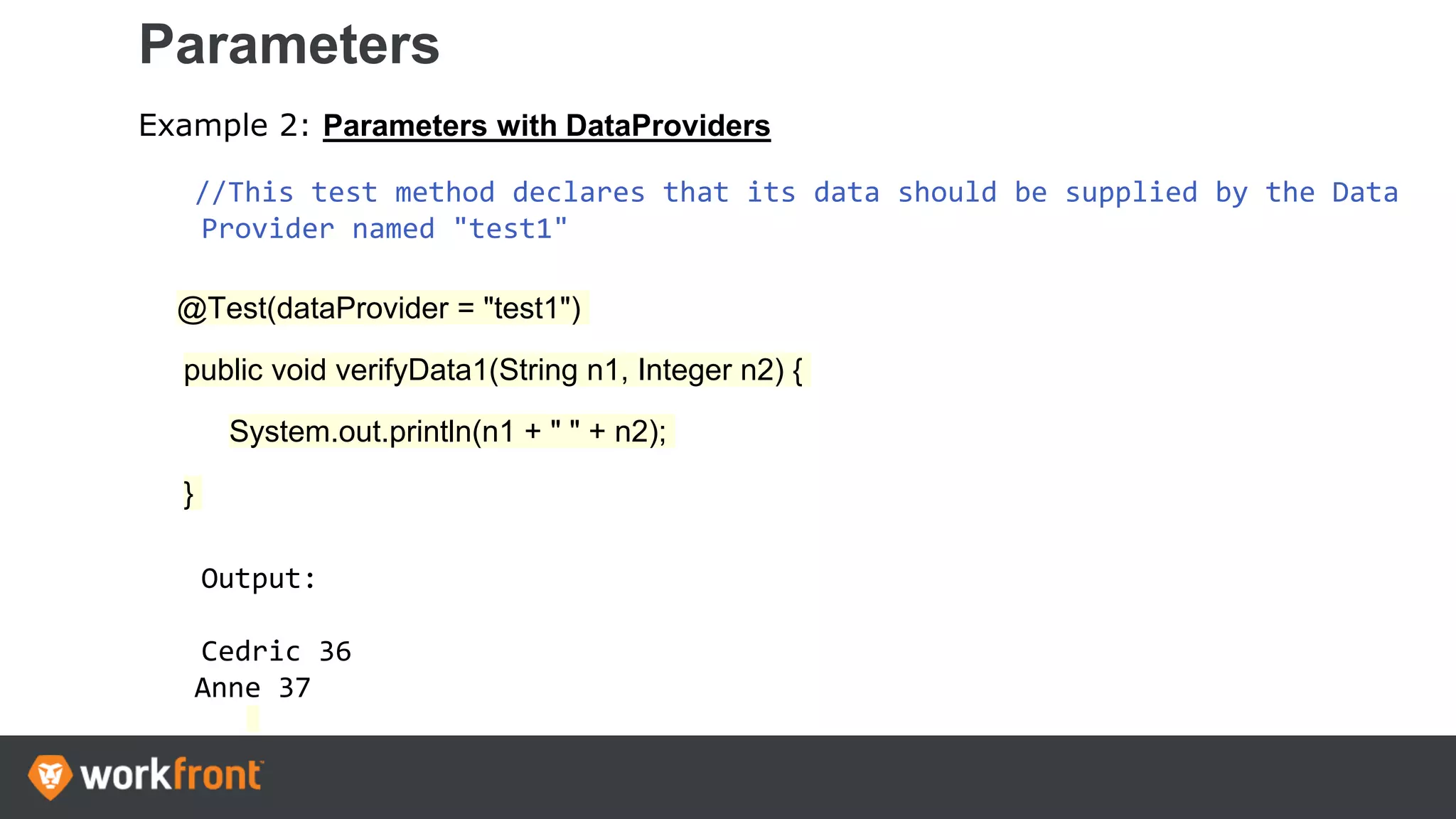
Example 2: Parameters with DataProviders
//This test method declares that its data should be supplied by the Data
Provider named "test1"
@Test(dataProvider = "test1")
public void verifyData1(String n1, Integer n2) {
System.out.println(n1 + " " + n2);
}
Output:
Cedric 36
Anne 37
Listeners
"TestNG Listeners" allow to modify TestNG's behavior or implement some
actions.
There are several listener interfaces.
Listeners
Here are a few listeners:
● IAnnotationTransformer - allows to modify the content of @Test annotation
● IAnnotationTransformer2 - allows to modify the content of other annotations
● IHookable - allows to override and possibly skip the invocation of test methods
● IInvokedMethodListener - allows to be notified whenever TestNG is about to
invoke a test (annotated with @Test) or configuration (annotated with any of the @Before
or @After annotation) method
Listeners
Here are a few listeners (continuation):
● IMethodInterceptor - allows control over running order of methods that don’t have
dependencies or dependents
● IReporter - will generate test report after all the suites have been run
● ISuiteListener - listener for test suites
● ITestListener - listener for test methods
Listeners
After implementing one of these interfaces, you can let TestNG know about it with either of the
following ways:
● Using -listener on the command line.
● Using <listeners> with ant.
● Using <listeners> in your testng.xml file.
● Using the @Listeners annotation on any of your test classes.
● Using ServiceLoader.
Listeners
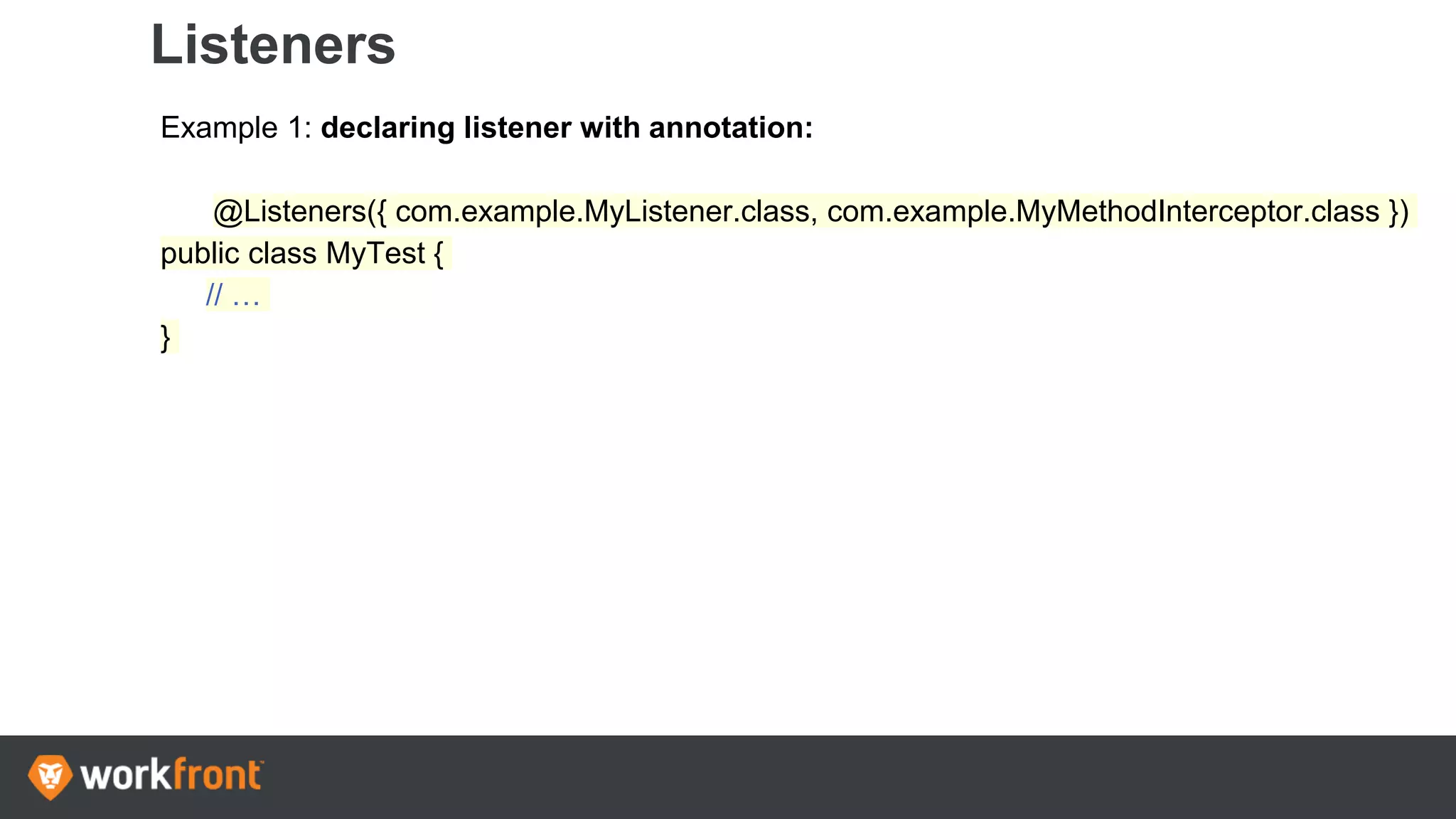
Example 1: declaring listener with annotation:
@Listeners({ com.example.MyListener.class, com.example.MyMethodInterceptor.class })
public class MyTest {
// …
}
Listeners
Example 2: declaring annotation with ServiceLoader (which Workfront uses).
Assume we have listener - test.tmp.TmpSuiteListener
Create a file at the location META-INF/services/org.testng.ITestNGListener, which will name the
implementation(s) of listeners:
$ cat META-INF/services/org.testng.ITestNGListener
test.tmp.TmpSuiteListener
$ tree
|____META-INF
| |____services
| | |____org.testng.ITestNGListener
Test Groups
• Test methods can be grouped together.
• Test groups can contain other groups.
This allows TestNG to be invoked and asked to include a certain set of groups (or regular
expressions) while excluding another set.
Test Groups
For example, we have two categories of tests:
● Check-in tests. These tests should be run before you submit new code. They should
typically be fast and just make sure no basic functionality was broken.
● Functional tests. These tests should cover all the functionalities of your software and be run
at least once a day, although ideally you would want to run them continuously.
Test Groups
And we have following tests:
public class Test1 {
@Test(groups = { "functest", "checkintest" })
public void testMethod1() {
}
@Test(groups = {"functest", "checkintest"} )
public void testMethod2() {
}
@Test(groups = { "functest" })
public void testMethod3() {
}
}
Test Groups
Invoking TestNG with the following configuration will run all the test methods:
<test name="Test1">
<groups>
<run>
<include name="functest"/>
</run>
</groups>
<classes>
<class name="example1.Test1"/>
</classes>
</test>
Invoking it with checkintest will only run testMethod1() and testMethod2().
Test Groups
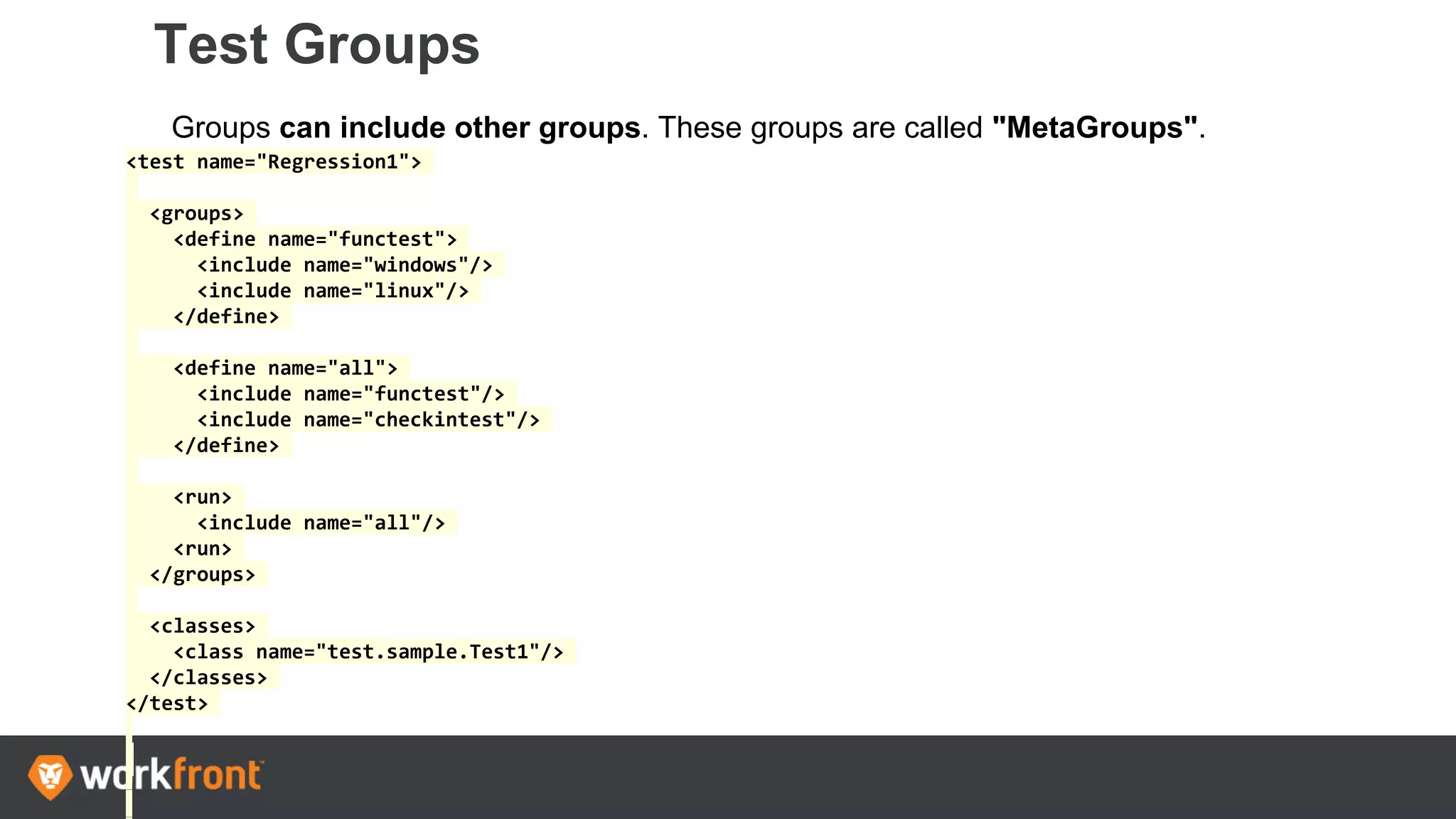
Groups can include other groups. These groups are called "MetaGroups".
<test name="Regression1">
<groups>
<define name="functest">
<include name="windows"/>
<include name="linux"/>
</define>
<define name="all">
<include name="functest"/>
<include name="checkintest"/>
</define>
<run>
<include name="all"/>
<run>
</groups>
<classes>
<class name="test.sample.Test1"/>
</classes>
</test>
Test Groups
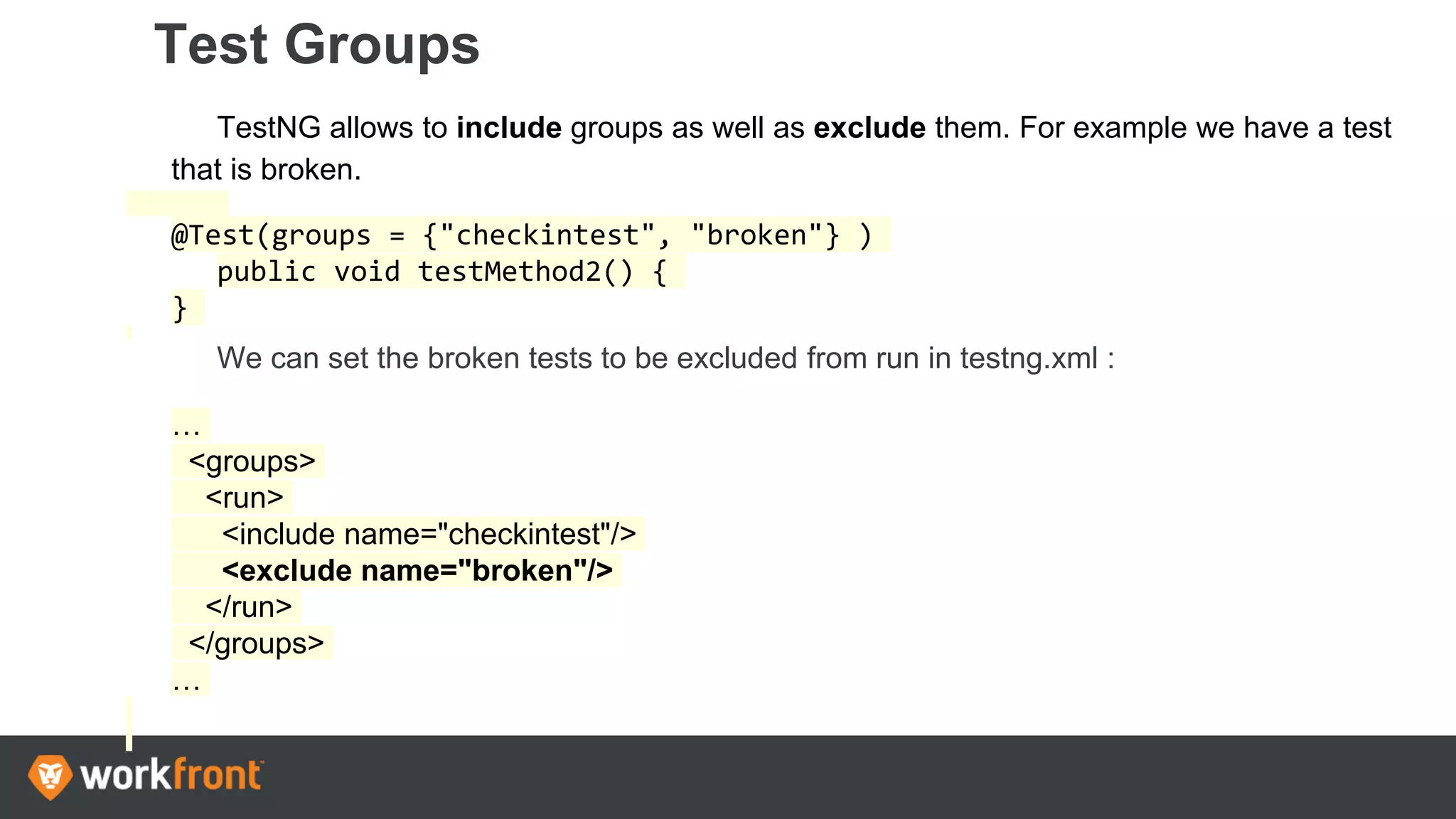
TestNG allows to include groups as well as exclude them. For example we have a test
that is broken.
@Test(groups = {"checkintest", "broken"} )
public void testMethod2() {
}
We can set the broken tests to be excluded from run in testng.xml :
…
<groups>
<run>
<include name="checkintest"/>
<exclude name="broken"/>
</run>
</groups>
…
Test Groups
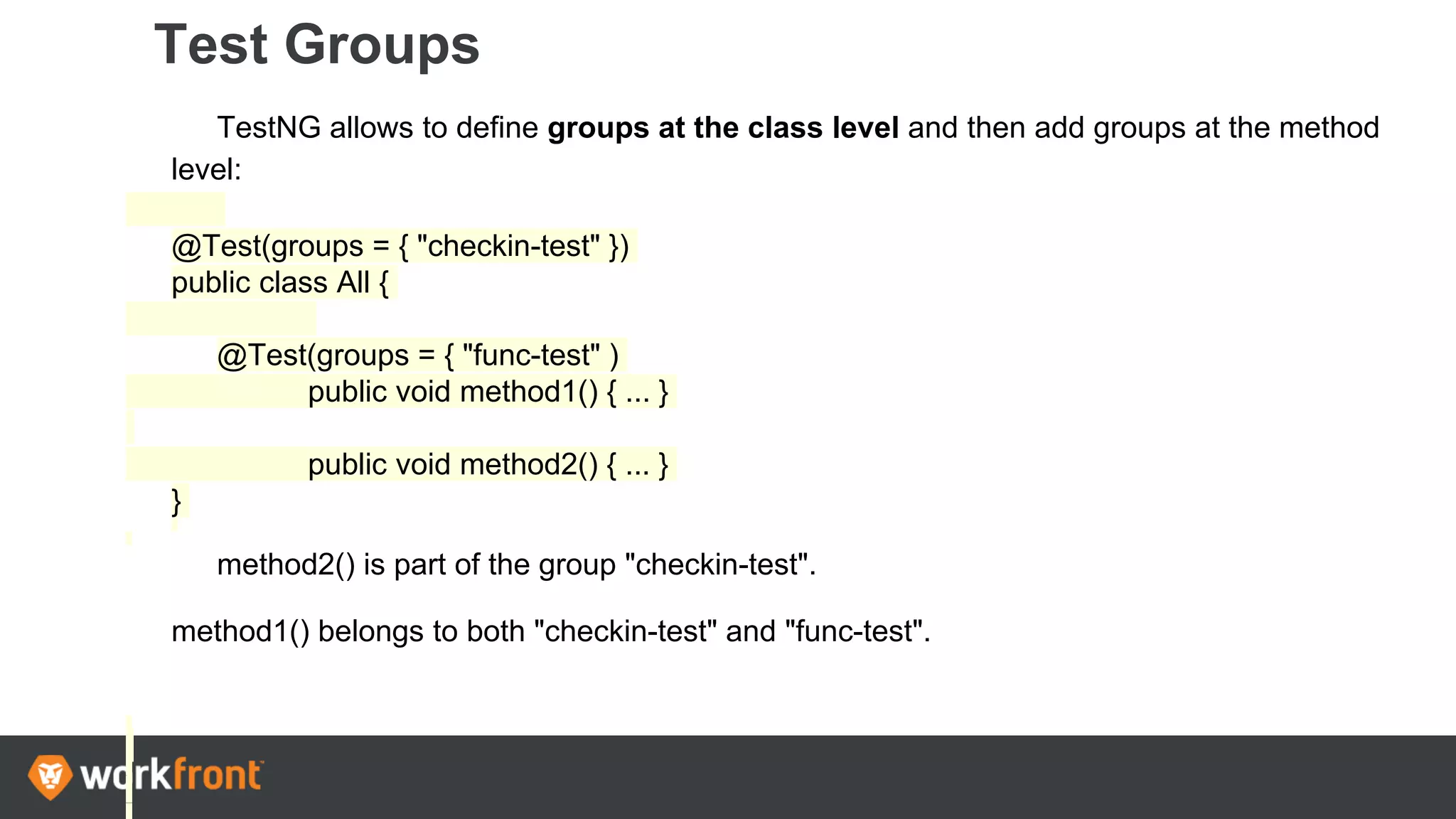
TestNG allows to define groups at the class level and then add groups at the method
level:
@Test(groups = { "checkin-test" })
public class All {
@Test(groups = { "func-test" )
public void method1() { ... }
public void method2() { ... }
}
method2() is part of the group "checkin-test".
method1() belongs to both "checkin-test" and "func-test".
Dependencies
Dependencies are for test methods to be invoked in a certain order.
TestNG allows to specify dependencies either with annotations or in XML.
Dependencies
Two types of Dependencies:
• Hard dependencies. All the dependent methods must have run and succeeded for you to
run.
• Soft dependencies. Dependent method will always be run after the methods you depend
on, even if some of them have failed. This is done by adding "alwaysRun=true" in @Test
annotation.
Dependencies
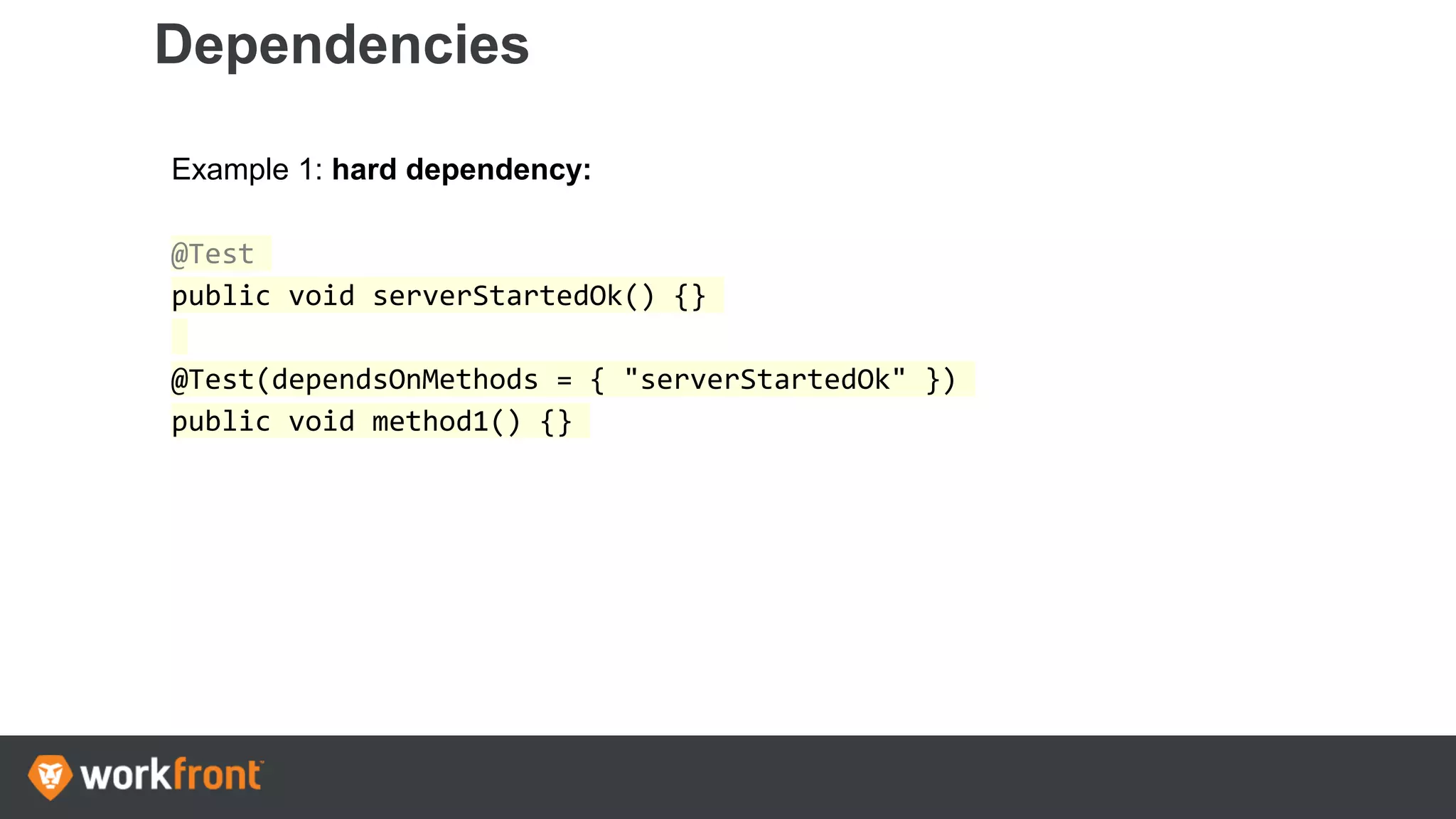
Example 1: hard dependency:
@Test
public void serverStartedOk() {}
@Test(dependsOnMethods = { "serverStartedOk" })
public void method1() {}
Dependencies
Example 2: Soft dependency:
@Test
public void serverStartedOk() {}
@Test(dependsOnMethods = { "serverStartedOk" }, alwaysRun=true)
public void method1() {}
Dependencies
We can also have methods that depend on entire groups:
@Test(groups = { "init" })
public void serverStartedOk() {}
@Test(groups = { "init" })
public void initEnvironment() {}
@Test(dependsOnGroups = { "init.*" })
public void method1() {}
In this example, method1() is declared as depending on any group matching the regular
expression "init.*".
Running TestNG
TestNG can be invoked in different ways:
● Command line
● ant
● Eclipse
● IntelliJ IDEA
Running TestNG
The simplest way to invoke TestNG from command line is as follows:
java org.testng.TestNG testng1.xml [testng2.xml testng3.xml ...]
where:
org.testng.TestNG is the main class;
testng1.xml [testng2.xml testng3.xml ...] are configuration files.
Running TestNG
We can run tests without testng.xml:
java org.testng.TestNG -groups windows,linux -testclass org.test.MyTest
where:
org.testng.TestNG is the main class;
-groups windows,linux specify which group tests should run;
-testclass org.test.MyTest specity which test clssses should run.
Logging and results
The results of the test run are created in a file called index.html.
It is possible to generate own reports with TestNG listeners and reporters:
● Listeners are notified in real time of when a test starts, passes, fails, etc…
● Reporters are notified when all the suites have been run by TestNG.
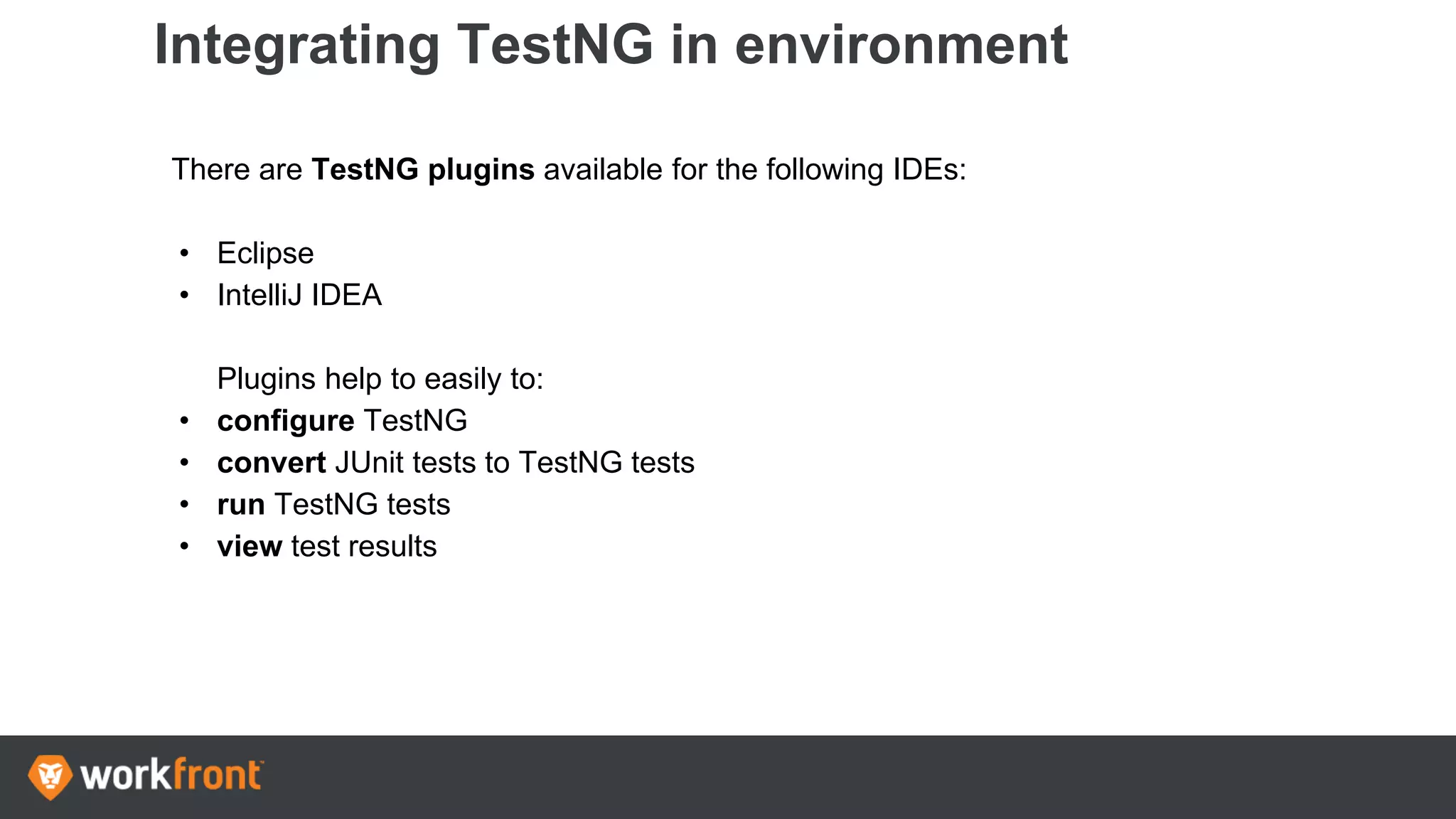
Integrating TestNG in environment
There are TestNG plugins available for the following IDEs:
• Eclipse
• IntelliJ IDEA
Plugins help to easily to:
• configure TestNG
• convert JUnit tests to TestNG tests
• run TestNG tests
• view test results
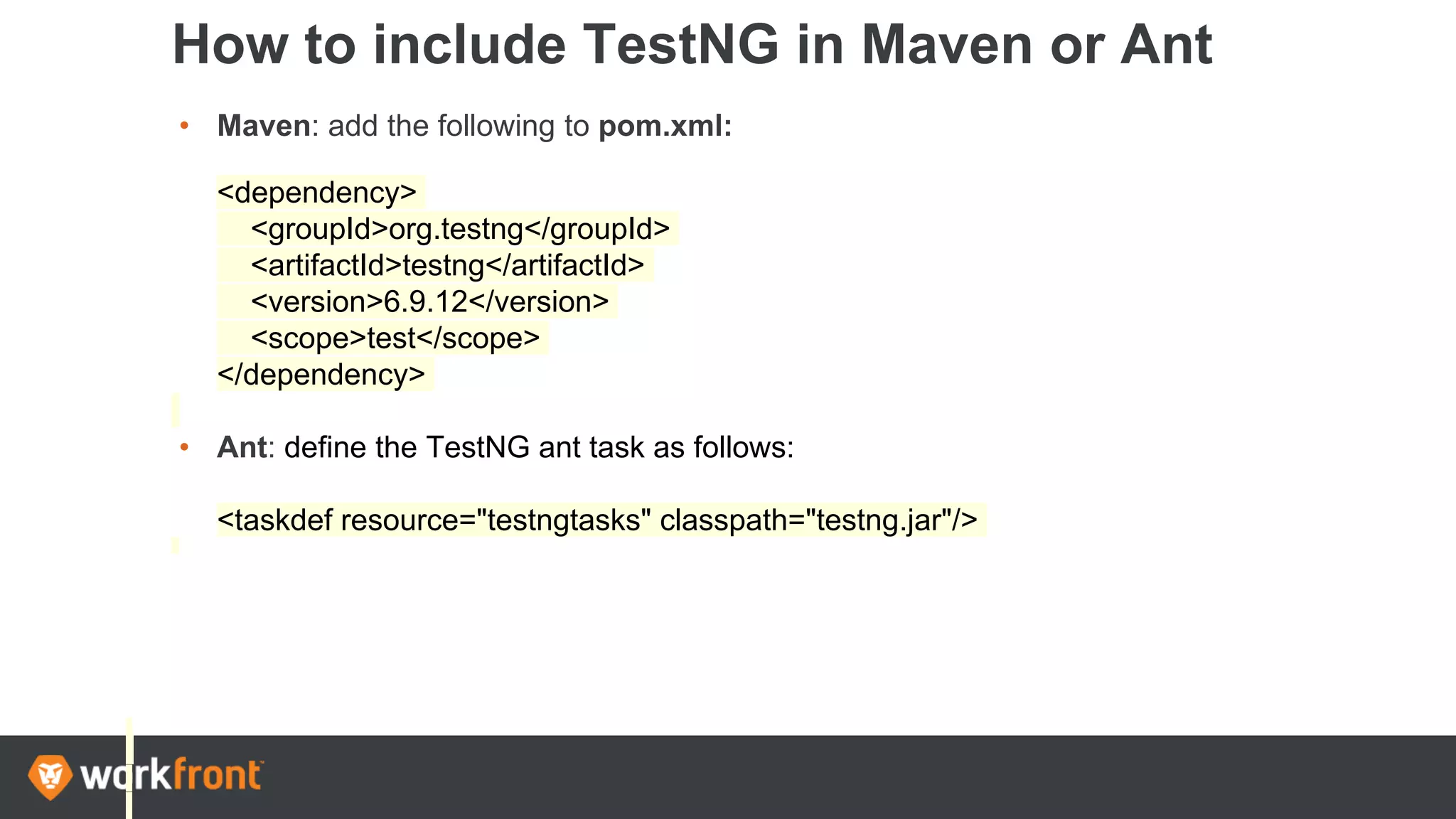
How to include TestNG in Maven or Ant
• Maven: add the following to pom.xml:
<dependency>
<groupId>org.testng</groupId>
<artifactId>testng</artifactId>
<version>6.9.12</version>
<scope>test</scope>
</dependency>
• Ant: define the TestNG ant task as follows:
<taskdef resource="testngtasks" classpath="testng.jar"/>
References
• http://testng.org/doc/index.html - TestNG site
• http://testng.org/doc/documentation-main.html
- Documentation
THANK YOU!
Questions?
Contact: lapreyan@gmail.com

TestNG Framework

  • 1.
  • 2.
    Test Automation Framework Whatis test automation framework? • wikipedia - A test automation framework is an integrated system that sets the rules of automation of a specific product. Types of test automation frameworks exists for many languages, like Java, C#, PHP, etc.. Examples: JUnit, Mockito, TestNG, etc..
  • 3.
    TestNG is atesting framework, that supports: •Unit Testing •Integration Testing •Annotations •Annotation Transformers •Parameters •Listeners •Group testing •Dependencies •Etc.. What is TestNG?
  • 4.
  • 5.
    Annotations @BeforeSuite, @BeforeTest, @BeforeGroups,@BeforeClass, @BeforeMethod @AfterSuite, @AfterTest, @AfterGroups, @AfterClass, @AfterMethod @Test @DataProvider @Factory @Listeners
  • 6.
    Annotations @BeforeSuite - runsbefore all tests in this suite have run. @BeforeTest - runs before any test method belonging to the classes inside the <test> tag is run. @BeforeGroups - runs shortly before the first test method that belongs to any of these groups is invoked. @BeforeClass - runs before the first test method in the current class is invoked. @BeforeMethod - run before each test method. @AfterSuite, @AfterTest, @AfterGroups, @AfterClass, @AfterMethod - the same, but after
  • 7.
    Annotations @Test annotation attributes dataProvider- The name of the data provider for test method. groups - The list of groups this class/method belongs to. expectedExceptions - The list of exceptions that a test method is expected to throw. timeOut - The maximum number of milliseconds this test should take. etc...
  • 8.
    Annotation Transformers TestNG allowsto modify the content of all the annotations at runtime. An Annotation Transformer is a class that implements IAnnotationTransformer or IAnnotationTransformer2 interface.
  • 9.
    Annotation Transformers Example: overridethe attribute invocationCount but only on the test method invoke() of one of test classes: public class MyTransformer implements IAnnotationTransformer { public void transform(ITest annotation, Class testClass, Constructor testConstructor, Method testMethod) { if ("invoke".equals(testMethod.getName())) { annotation.setInvocationCount(5); } } }
  • 10.
    Parameters Parameters can bepassed to test methods. There are two ways to set these parameters: with testng.xml or programmatically.
  • 11.
    Parameters Example 1: Parametersfrom testing.xml (for simple values only) @Parameters({ "first-name" }) @Test public void testSingleString(String firstName) { System.out.println("Invoked testString " + firstName); assert "Cedric".equals(firstName); } This XML parameter is defined in testng.xml: <suite name="My suite"> <parameter name="first-name" value="Cedric"/>
  • 12.
    Parameters Example 2: Parameterswith DataProviders //This method will provide data to any test method that declares that its Data Provider is named "test1" @DataProvider(name = "test1") public Object[ ][ ] createData1() { return new Object[ ][ ] { { "Cedric", new Integer(36) }, { "Anne", new Integer(37)}, }; }
  • 13.
    Parameters Example 2: Parameterswith DataProviders //This test method declares that its data should be supplied by the Data Provider named "test1" @Test(dataProvider = "test1") public void verifyData1(String n1, Integer n2) { System.out.println(n1 + " " + n2); } Output: Cedric 36 Anne 37
  • 14.
    Listeners "TestNG Listeners" allowto modify TestNG's behavior or implement some actions. There are several listener interfaces.
  • 15.
    Listeners Here are afew listeners: ● IAnnotationTransformer - allows to modify the content of @Test annotation ● IAnnotationTransformer2 - allows to modify the content of other annotations ● IHookable - allows to override and possibly skip the invocation of test methods ● IInvokedMethodListener - allows to be notified whenever TestNG is about to invoke a test (annotated with @Test) or configuration (annotated with any of the @Before or @After annotation) method
  • 16.
    Listeners Here are afew listeners (continuation): ● IMethodInterceptor - allows control over running order of methods that don’t have dependencies or dependents ● IReporter - will generate test report after all the suites have been run ● ISuiteListener - listener for test suites ● ITestListener - listener for test methods
  • 17.
    Listeners After implementing oneof these interfaces, you can let TestNG know about it with either of the following ways: ● Using -listener on the command line. ● Using <listeners> with ant. ● Using <listeners> in your testng.xml file. ● Using the @Listeners annotation on any of your test classes. ● Using ServiceLoader.
  • 18.
    Listeners Example 1: declaringlistener with annotation: @Listeners({ com.example.MyListener.class, com.example.MyMethodInterceptor.class }) public class MyTest { // … }
  • 19.
    Listeners Example 2: declaringannotation with ServiceLoader (which Workfront uses). Assume we have listener - test.tmp.TmpSuiteListener Create a file at the location META-INF/services/org.testng.ITestNGListener, which will name the implementation(s) of listeners: $ cat META-INF/services/org.testng.ITestNGListener test.tmp.TmpSuiteListener $ tree |____META-INF | |____services | | |____org.testng.ITestNGListener
  • 20.
    Test Groups • Testmethods can be grouped together. • Test groups can contain other groups. This allows TestNG to be invoked and asked to include a certain set of groups (or regular expressions) while excluding another set.
  • 21.
    Test Groups For example,we have two categories of tests: ● Check-in tests. These tests should be run before you submit new code. They should typically be fast and just make sure no basic functionality was broken. ● Functional tests. These tests should cover all the functionalities of your software and be run at least once a day, although ideally you would want to run them continuously.
  • 22.
    Test Groups And wehave following tests: public class Test1 { @Test(groups = { "functest", "checkintest" }) public void testMethod1() { } @Test(groups = {"functest", "checkintest"} ) public void testMethod2() { } @Test(groups = { "functest" }) public void testMethod3() { } }
  • 23.
    Test Groups Invoking TestNGwith the following configuration will run all the test methods: <test name="Test1"> <groups> <run> <include name="functest"/> </run> </groups> <classes> <class name="example1.Test1"/> </classes> </test> Invoking it with checkintest will only run testMethod1() and testMethod2().
  • 24.
    Test Groups Groups caninclude other groups. These groups are called "MetaGroups". <test name="Regression1"> <groups> <define name="functest"> <include name="windows"/> <include name="linux"/> </define> <define name="all"> <include name="functest"/> <include name="checkintest"/> </define> <run> <include name="all"/> <run> </groups> <classes> <class name="test.sample.Test1"/> </classes> </test>
  • 25.
    Test Groups TestNG allowsto include groups as well as exclude them. For example we have a test that is broken. @Test(groups = {"checkintest", "broken"} ) public void testMethod2() { } We can set the broken tests to be excluded from run in testng.xml : … <groups> <run> <include name="checkintest"/> <exclude name="broken"/> </run> </groups> …
  • 26.
    Test Groups TestNG allowsto define groups at the class level and then add groups at the method level: @Test(groups = { "checkin-test" }) public class All { @Test(groups = { "func-test" ) public void method1() { ... } public void method2() { ... } } method2() is part of the group "checkin-test". method1() belongs to both "checkin-test" and "func-test".
  • 27.
    Dependencies Dependencies are fortest methods to be invoked in a certain order. TestNG allows to specify dependencies either with annotations or in XML.
  • 28.
    Dependencies Two types ofDependencies: • Hard dependencies. All the dependent methods must have run and succeeded for you to run. • Soft dependencies. Dependent method will always be run after the methods you depend on, even if some of them have failed. This is done by adding "alwaysRun=true" in @Test annotation.
  • 29.
    Dependencies Example 1: harddependency: @Test public void serverStartedOk() {} @Test(dependsOnMethods = { "serverStartedOk" }) public void method1() {}
  • 30.
    Dependencies Example 2: Softdependency: @Test public void serverStartedOk() {} @Test(dependsOnMethods = { "serverStartedOk" }, alwaysRun=true) public void method1() {}
  • 31.
    Dependencies We can alsohave methods that depend on entire groups: @Test(groups = { "init" }) public void serverStartedOk() {} @Test(groups = { "init" }) public void initEnvironment() {} @Test(dependsOnGroups = { "init.*" }) public void method1() {} In this example, method1() is declared as depending on any group matching the regular expression "init.*".
  • 32.
    Running TestNG TestNG canbe invoked in different ways: ● Command line ● ant ● Eclipse ● IntelliJ IDEA
  • 33.
    Running TestNG The simplestway to invoke TestNG from command line is as follows: java org.testng.TestNG testng1.xml [testng2.xml testng3.xml ...] where: org.testng.TestNG is the main class; testng1.xml [testng2.xml testng3.xml ...] are configuration files.
  • 34.
    Running TestNG We canrun tests without testng.xml: java org.testng.TestNG -groups windows,linux -testclass org.test.MyTest where: org.testng.TestNG is the main class; -groups windows,linux specify which group tests should run; -testclass org.test.MyTest specity which test clssses should run.
  • 35.
    Logging and results Theresults of the test run are created in a file called index.html. It is possible to generate own reports with TestNG listeners and reporters: ● Listeners are notified in real time of when a test starts, passes, fails, etc… ● Reporters are notified when all the suites have been run by TestNG.
  • 36.
    Integrating TestNG inenvironment There are TestNG plugins available for the following IDEs: • Eclipse • IntelliJ IDEA Plugins help to easily to: • configure TestNG • convert JUnit tests to TestNG tests • run TestNG tests • view test results
  • 37.
    How to includeTestNG in Maven or Ant • Maven: add the following to pom.xml: <dependency> <groupId>org.testng</groupId> <artifactId>testng</artifactId> <version>6.9.12</version> <scope>test</scope> </dependency> • Ant: define the TestNG ant task as follows: <taskdef resource="testngtasks" classpath="testng.jar"/>
  • 38.
    References • http://testng.org/doc/index.html -TestNG site • http://testng.org/doc/documentation-main.html - Documentation
  • 39.