Test Plan for Mobile Banking
Application
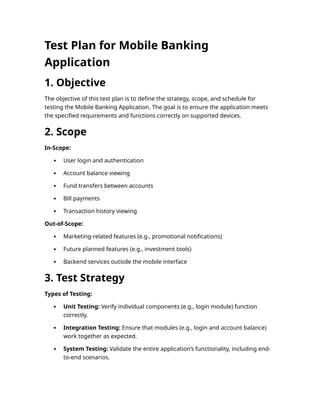
1. Objective
The objective of this test plan is to define the strategy, scope, and schedule for
testing the Mobile Banking Application. The goal is to ensure the application meets
the specified requirements and functions correctly on supported devices.
2. Scope
In-Scope:
 User login and authentication
 Account balance viewing
 Fund transfers between accounts
 Bill payments
 Transaction history viewing
Out-of-Scope:
 Marketing-related features (e.g., promotional notifications)
 Future planned features (e.g., investment tools)
 Backend services outside the mobile interface
3. Test Strategy
Types of Testing:
 Unit Testing: Verify individual components (e.g., login module) function
correctly.
 Integration Testing: Ensure that modules (e.g., login and account balance)
work together as expected.
 System Testing: Validate the entire application’s functionality, including end-
to-end scenarios.
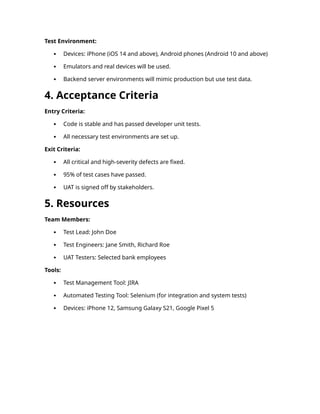
 User Acceptance Testing (UAT): Perform tests with a group of end-users to
validate the application against user requirements.
Test Environment:
 Devices: iPhone (iOS 14 and above), Android phones (Android 10 and above)
 Emulators and real devices will be used.
 Backend server environments will mimic production but use test data.
4. Acceptance Criteria
Entry Criteria:
 Code is stable and has passed developer unit tests.
 All necessary test environments are set up.
Exit Criteria:
 All critical and high-severity defects are fixed.
 95% of test cases have passed.
 UAT is signed off by stakeholders.
5. Resources
Team Members:
 Test Lead: John Doe
 Test Engineers: Jane Smith, Richard Roe
 UAT Testers: Selected bank employees
Tools:
 Test Management Tool: JIRA
 Automated Testing Tool: Selenium (for integration and system tests)
 Devices: iPhone 12, Samsung Galaxy S21, Google Pixel 5
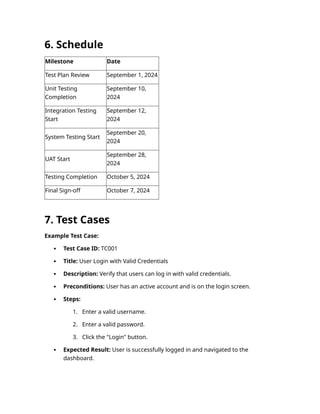
6. Schedule
Milestone Date
Test Plan Review September 1, 2024
Unit Testing
Completion
September 10,
2024
Integration Testing
Start
September 12,
2024
System Testing Start
September 20,
2024
UAT Start
September 28,
2024
Testing Completion October 5, 2024
Final Sign-off October 7, 2024
7. Test Cases
Example Test Case:
 Test Case ID: TC001
 Title: User Login with Valid Credentials
 Description: Verify that users can log in with valid credentials.
 Preconditions: User has an active account and is on the login screen.
 Steps:
1. Enter a valid username.
2. Enter a valid password.
3. Click the "Login" button.
 Expected Result: User is successfully logged in and navigated to the
dashboard.
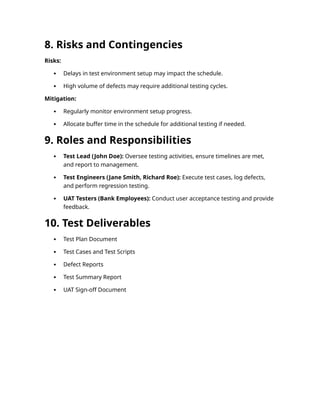
8. Risks and Contingencies
Risks:
 Delays in test environment setup may impact the schedule.
 High volume of defects may require additional testing cycles.
Mitigation:
 Regularly monitor environment setup progress.
 Allocate buffer time in the schedule for additional testing if needed.
9. Roles and Responsibilities
 Test Lead (John Doe): Oversee testing activities, ensure timelines are met,
and report to management.
 Test Engineers (Jane Smith, Richard Roe): Execute test cases, log defects,
and perform regression testing.
 UAT Testers (Bank Employees): Conduct user acceptance testing and provide
feedback.
10. Test Deliverables
 Test Plan Document
 Test Cases and Test Scripts
 Defect Reports
 Test Summary Report
 UAT Sign-off Document

Test Plan for Mobile Banking Application.docx

  • 1.
    Test Plan forMobile Banking Application 1. Objective The objective of this test plan is to define the strategy, scope, and schedule for testing the Mobile Banking Application. The goal is to ensure the application meets the specified requirements and functions correctly on supported devices. 2. Scope In-Scope:  User login and authentication  Account balance viewing  Fund transfers between accounts  Bill payments  Transaction history viewing Out-of-Scope:  Marketing-related features (e.g., promotional notifications)  Future planned features (e.g., investment tools)  Backend services outside the mobile interface 3. Test Strategy Types of Testing:  Unit Testing: Verify individual components (e.g., login module) function correctly.  Integration Testing: Ensure that modules (e.g., login and account balance) work together as expected.  System Testing: Validate the entire application’s functionality, including end- to-end scenarios.
  • 2.
     User AcceptanceTesting (UAT): Perform tests with a group of end-users to validate the application against user requirements.
  • 3.
    Test Environment:  Devices:iPhone (iOS 14 and above), Android phones (Android 10 and above)  Emulators and real devices will be used.  Backend server environments will mimic production but use test data. 4. Acceptance Criteria Entry Criteria:  Code is stable and has passed developer unit tests.  All necessary test environments are set up. Exit Criteria:  All critical and high-severity defects are fixed.  95% of test cases have passed.  UAT is signed off by stakeholders. 5. Resources Team Members:  Test Lead: John Doe  Test Engineers: Jane Smith, Richard Roe  UAT Testers: Selected bank employees Tools:  Test Management Tool: JIRA  Automated Testing Tool: Selenium (for integration and system tests)  Devices: iPhone 12, Samsung Galaxy S21, Google Pixel 5
  • 4.
    6. Schedule Milestone Date TestPlan Review September 1, 2024 Unit Testing Completion September 10, 2024 Integration Testing Start September 12, 2024 System Testing Start September 20, 2024 UAT Start September 28, 2024 Testing Completion October 5, 2024 Final Sign-off October 7, 2024 7. Test Cases Example Test Case:  Test Case ID: TC001  Title: User Login with Valid Credentials  Description: Verify that users can log in with valid credentials.  Preconditions: User has an active account and is on the login screen.  Steps: 1. Enter a valid username. 2. Enter a valid password. 3. Click the "Login" button.  Expected Result: User is successfully logged in and navigated to the dashboard.
  • 5.
    8. Risks andContingencies Risks:  Delays in test environment setup may impact the schedule.  High volume of defects may require additional testing cycles. Mitigation:  Regularly monitor environment setup progress.  Allocate buffer time in the schedule for additional testing if needed. 9. Roles and Responsibilities  Test Lead (John Doe): Oversee testing activities, ensure timelines are met, and report to management.  Test Engineers (Jane Smith, Richard Roe): Execute test cases, log defects, and perform regression testing.  UAT Testers (Bank Employees): Conduct user acceptance testing and provide feedback. 10. Test Deliverables  Test Plan Document  Test Cases and Test Scripts  Defect Reports  Test Summary Report  UAT Sign-off Document