Test Bank for Systems Analysis and Design 8th
Edition: Kendall download
http://testbankbell.com/product/test-bank-for-systems-analysis-
and-design-8th-edition-kendall/
Download more testbank from https://testbankbell.com
We believe these products will be a great fit for you. Click
the link to download now, or visit testbankbell.com
to discover even more!
Solution Manual for Systems Analysis and Design 8th
Edition by Kendall
https://testbankbell.com/product/solution-manual-for-systems-
analysis-and-design-8th-edition-by-kendall/
Test Bank for Systems Analysis and Design, 10th
Ediiton, Kenneth E. Kendall
https://testbankbell.com/product/test-bank-for-systems-analysis-
and-design-10th-ediiton-kenneth-e-kendall/
Test Bank for Systems Analysis and Design 9/E 9th
Edition Kenneth E. Kendall Julie E. Kendall
https://testbankbell.com/product/test-bank-for-systems-analysis-
and-design-9-e-9th-edition-kenneth-e-kendall-julie-e-kendall/
Solution Manual for Systems Analysis and Design, 10th
Ediiton, Kenneth E. Kendall
https://testbankbell.com/product/solution-manual-for-systems-
analysis-and-design-10th-ediiton-kenneth-e-kendall/
Solutions Manual for Systems Analysis and Design, 9/E
9th Edition Kenneth E. Kendall, Julie E. Kendall
https://testbankbell.com/product/solutions-manual-for-systems-
analysis-and-design-9-e-9th-edition-kenneth-e-kendall-julie-e-
kendall/
Test Bank for Systems Analysis and Design, 8th Edition:
Shelly
https://testbankbell.com/product/test-bank-for-systems-analysis-
and-design-8th-edition-shelly/
Systems Analysis and Design Rosenblatt 10th Edition
Test Bank
https://testbankbell.com/product/systems-analysis-and-design-
rosenblatt-10th-edition-test-bank/
Test Bank for Systems Analysis and Design, 9th Edition:
Shelly
https://testbankbell.com/product/test-bank-for-systems-analysis-
and-design-9th-edition-shelly/
Test Bank for Systems Analysis and Design, 3rd Edition:
Dennis
https://testbankbell.com/product/test-bank-for-systems-analysis-
and-design-3rd-edition-dennis/
1
Copyright © 2011 Pearson Education, Inc.
Test Bank for Systems Analysis and Design 8th
Edition: Kendall
Full chapter at: https://testbankbell.com/product/test-bank-for-
systems-analysis-and-design-8th-edition-kendall/
Systems, Roles, and Development Methodologies, 8e (Kendall/Kendall)
Chapter 1 Systems, Roles, and Development Methodologies
1.1 Multiple Choice
1) Which of these systems processes large amounts of data for routine transactions?
A) transaction processing systems
B) decision support systems
C) expert systems
D) management information systems
Answer: A
Diff: 1 Page Ref: 2
2) Which of these is the most personalized?
A) transaction processing systems
B) decision support systems
C) expert systems
D) management information systems
Answer: B
Diff: 2 Page Ref: 3
3) Which of these systems allows management to think about strategic problems?
A) transaction processing systems
B) strategic support system
C) executive support systems
D) management information systems
Answer: C
Diff: 1 Page Ref: 4
4) Which of these is NOT a benefit to mounting or improving an application on the Web?
A) Increasing user awareness of the availability of a service, product, industry, person, or group.
B) Improving the usefulness and usability of the interface design.
C) Creating a system that can extend globally rather than remain local, thus reaching people in
remote locations without worry of the time zone in which they are located.
D) Limiting user access to standard business hours only.
Answer: D
Diff: 1 Page Ref: 4-5
2
Copyright © 2011 Pearson Education, Inc.
5) Which of these software packages are NOT open source software (OSS)?
A) Microsoft Windows Vista
B) Mozilla Firefox web browser
C) Apache web server
D) a Linux operating system
Answer: A
Diff: 1 Page Ref: 5
3
Copyright © 2011 Pearson Education, Inc.
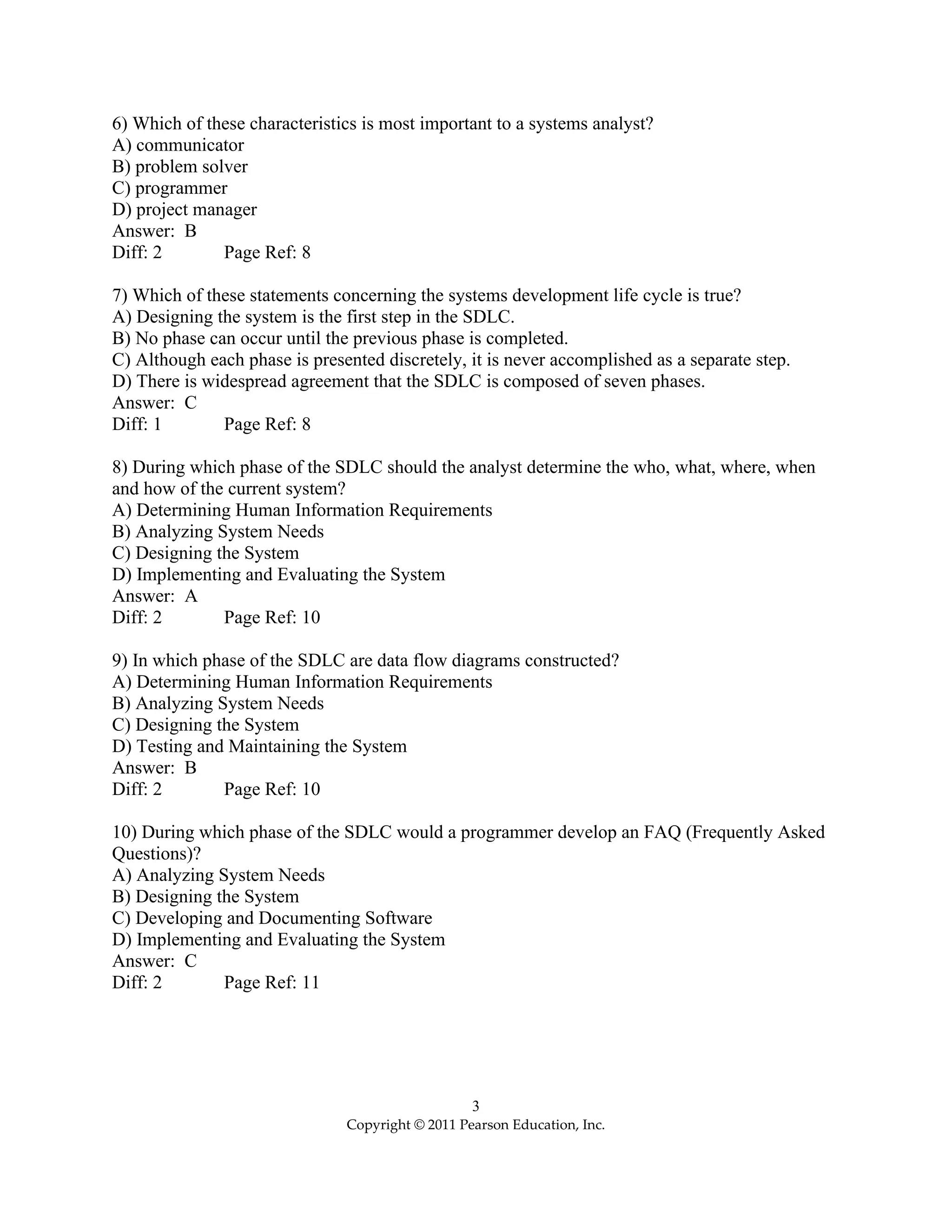
6) Which of these characteristics is most important to a systems analyst?
A) communicator
B) problem solver
C) programmer
D) project manager
Answer: B
Diff: 2 Page Ref: 8
7) Which of these statements concerning the systems development life cycle is true?
A) Designing the system is the first step in the SDLC.
B) No phase can occur until the previous phase is completed.
C) Although each phase is presented discretely, it is never accomplished as a separate step.
D) There is widespread agreement that the SDLC is composed of seven phases.
Answer: C
Diff: 1 Page Ref: 8
8) During which phase of the SDLC should the analyst determine the who, what, where, when
and how of the current system?
A) Determining Human Information Requirements
B) Analyzing System Needs
C) Designing the System
D) Implementing and Evaluating the System
Answer: A
Diff: 2 Page Ref: 10
9) In which phase of the SDLC are data flow diagrams constructed?
A) Determining Human Information Requirements
B) Analyzing System Needs
C) Designing the System
D) Testing and Maintaining the System
Answer: B
Diff: 2 Page Ref: 10
10) During which phase of the SDLC would a programmer develop an FAQ (Frequently Asked
Questions)?
A) Analyzing System Needs
B) Designing the System
C) Developing and Documenting Software
D) Implementing and Evaluating the System
Answer: C
Diff: 2 Page Ref: 11
4
Copyright © 2011 Pearson Education, Inc.
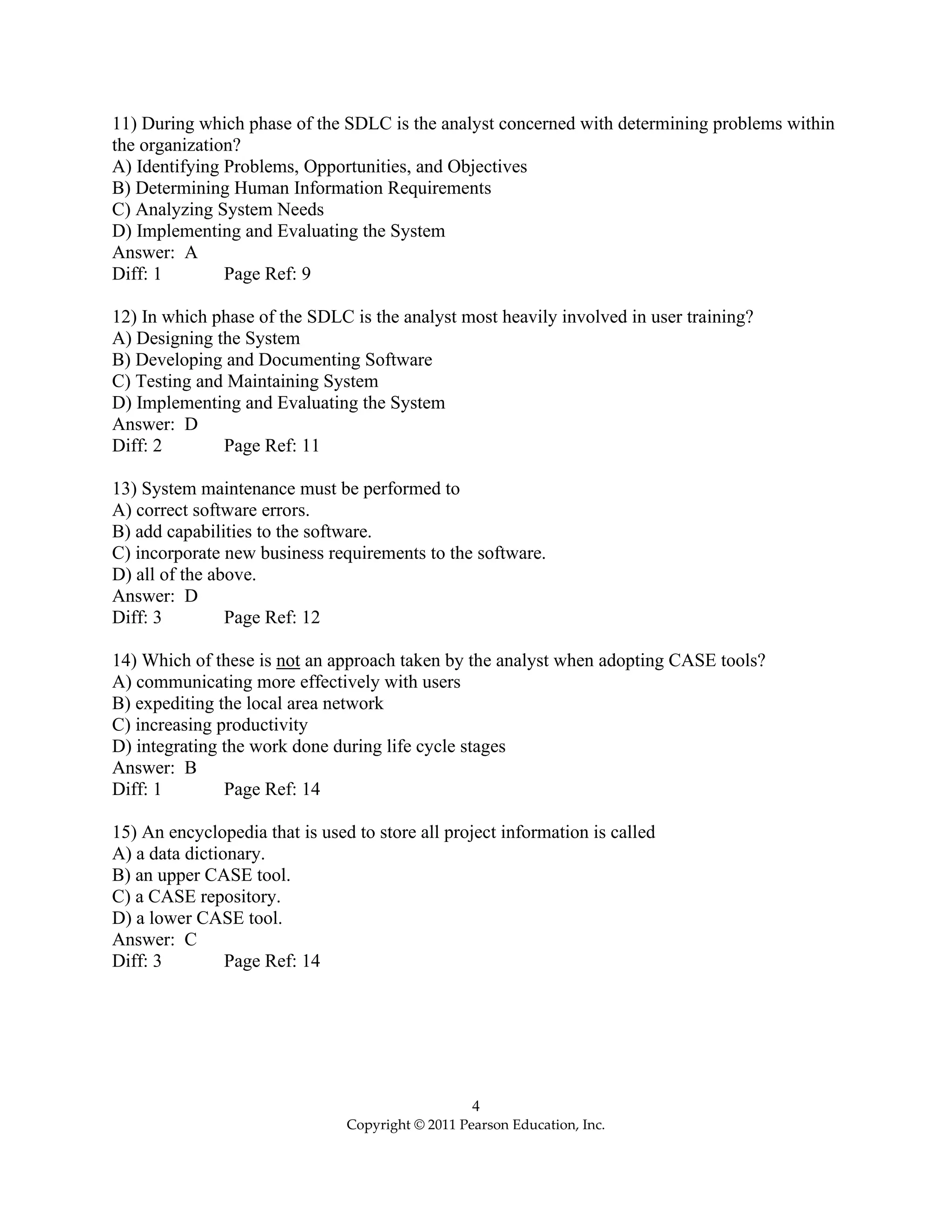
11) During which phase of the SDLC is the analyst concerned with determining problems within
the organization?
A) Identifying Problems, Opportunities, and Objectives
B) Determining Human Information Requirements
C) Analyzing System Needs
D) Implementing and Evaluating the System
Answer: A
Diff: 1 Page Ref: 9
12) In which phase of the SDLC is the analyst most heavily involved in user training?
A) Designing the System
B) Developing and Documenting Software
C) Testing and Maintaining System
D) Implementing and Evaluating the System
Answer: D
Diff: 2 Page Ref: 11
13) System maintenance must be performed to
A) correct software errors.
B) add capabilities to the software.
C) incorporate new business requirements to the software.
D) all of the above.
Answer: D
Diff: 3 Page Ref: 12
14) Which of these is not an approach taken by the analyst when adopting CASE tools?
A) communicating more effectively with users
B) expediting the local area network
C) increasing productivity
D) integrating the work done during life cycle stages
Answer: B
Diff: 1 Page Ref: 14
15) An encyclopedia that is used to store all project information is called
A) a data dictionary.
B) an upper CASE tool.
C) a CASE repository.
D) a lower CASE tool.
Answer: C
Diff: 3 Page Ref: 14
5
Copyright © 2011 Pearson Education, Inc.
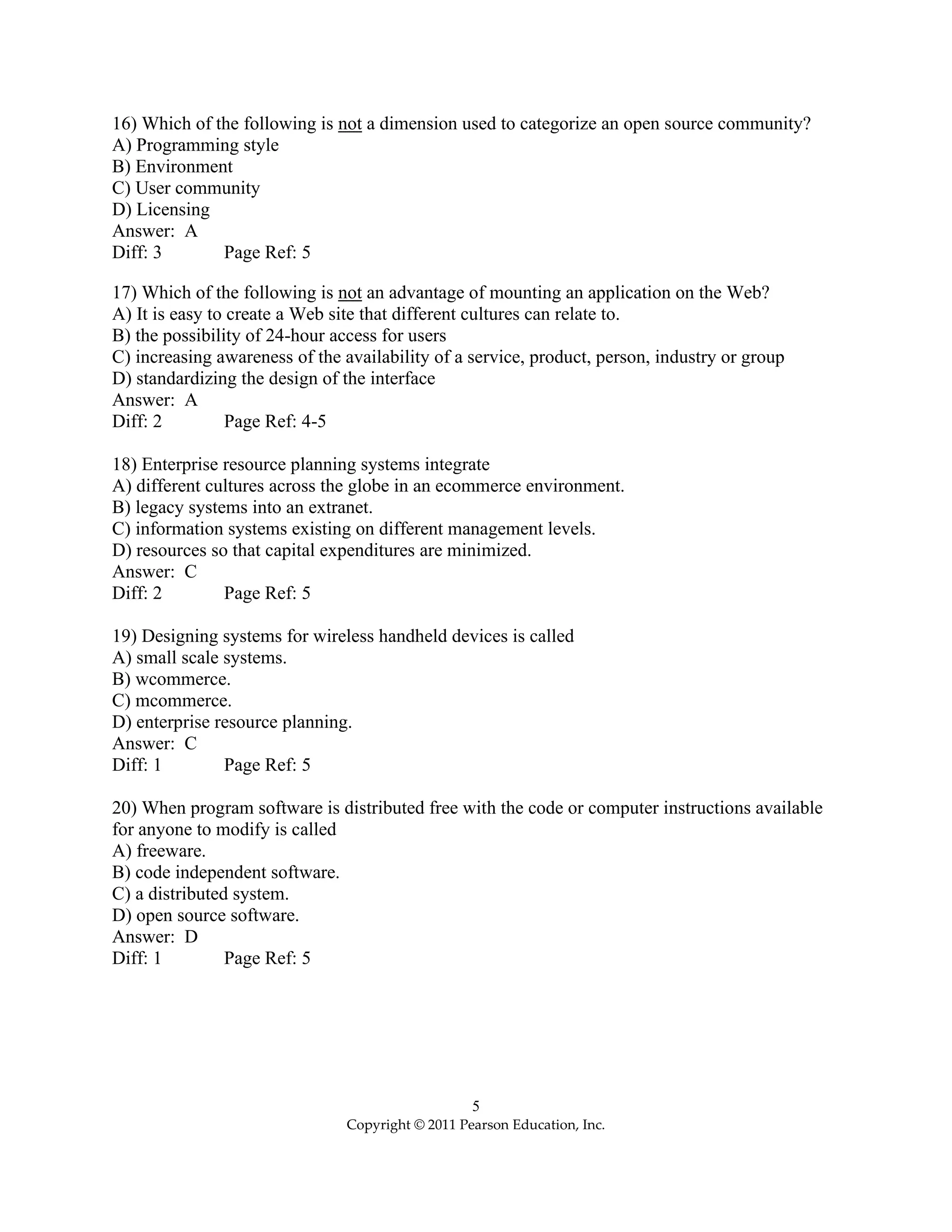
16) Which of the following is not a dimension used to categorize an open source community?
A) Programming style
B) Environment
C) User community
D) Licensing
Answer: A
Diff: 3 Page Ref: 5
17) Which of the following is not an advantage of mounting an application on the Web?
A) It is easy to create a Web site that different cultures can relate to.
B) the possibility of 24-hour access for users
C) increasing awareness of the availability of a service, product, person, industry or group
D) standardizing the design of the interface
Answer: A
Diff: 2 Page Ref: 4-5
18) Enterprise resource planning systems integrate
A) different cultures across the globe in an ecommerce environment.
B) legacy systems into an extranet.
C) information systems existing on different management levels.
D) resources so that capital expenditures are minimized.
Answer: C
Diff: 2 Page Ref: 5
19) Designing systems for wireless handheld devices is called
A) small scale systems.
B) wcommerce.
C) mcommerce.
D) enterprise resource planning.
Answer: C
Diff: 1 Page Ref: 5
20) When program software is distributed free with the code or computer instructions available
for anyone to modify is called
A) freeware.
B) code independent software.
C) a distributed system.
D) open source software.
Answer: D
Diff: 1 Page Ref: 5
6
Copyright © 2011 Pearson Education, Inc.
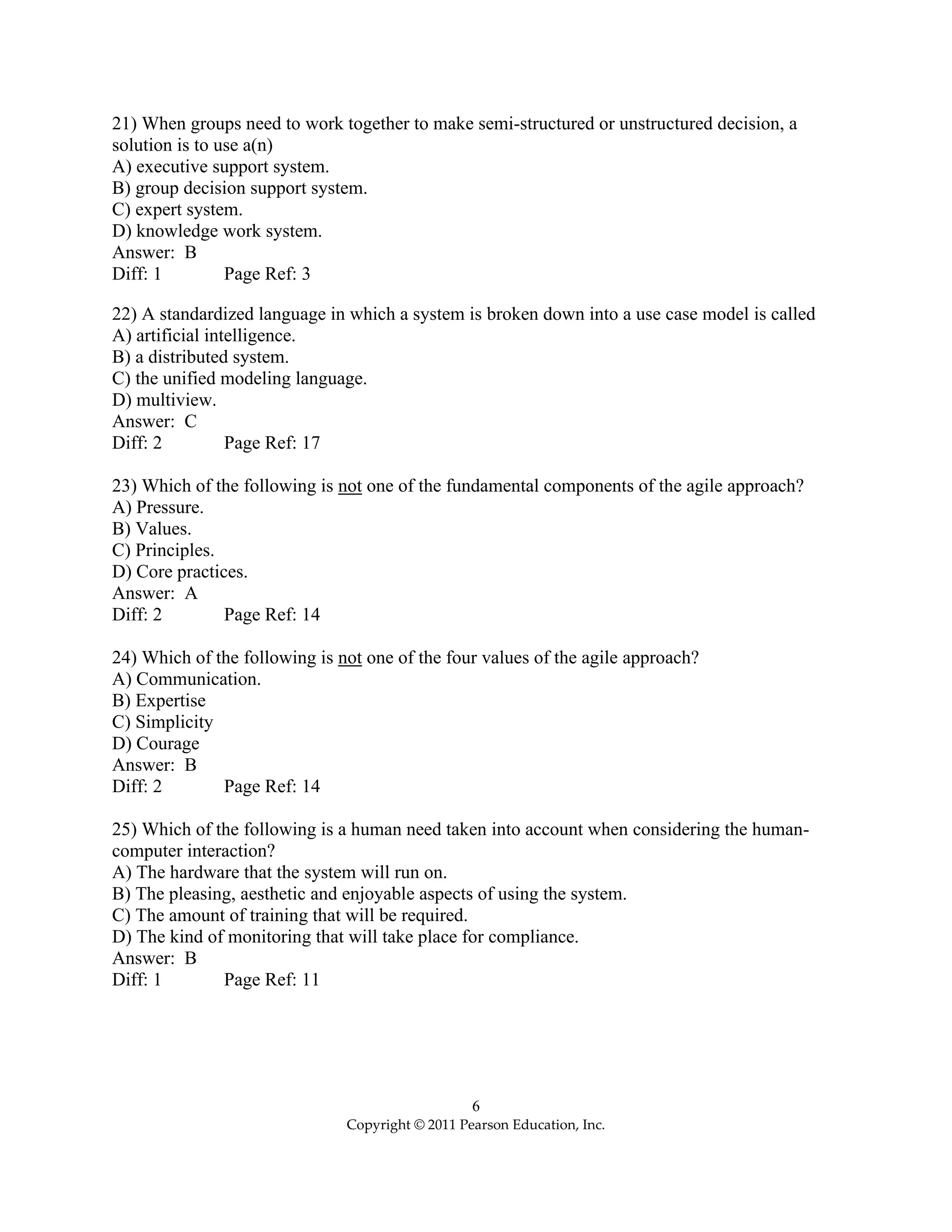
21) When groups need to work together to make semi-structured or unstructured decision, a
solution is to use a(n)
A) executive support system.
B) group decision support system.
C) expert system.
D) knowledge work system.
Answer: B
Diff: 1 Page Ref: 3
22) A standardized language in which a system is broken down into a use case model is called
A) artificial intelligence.
B) a distributed system.
C) the unified modeling language.
D) multiview.
Answer: C
Diff: 2 Page Ref: 17
23) Which of the following is not one of the fundamental components of the agile approach?
A) Pressure.
B) Values.
C) Principles.
D) Core practices.
Answer: A
Diff: 2 Page Ref: 14
24) Which of the following is not one of the four values of the agile approach?
A) Communication.
B) Expertise
C) Simplicity
D) Courage
Answer: B
Diff: 2 Page Ref: 14
25) Which of the following is a human need taken into account when considering the human-
computer interaction?
A) The hardware that the system will run on.
B) The pleasing, aesthetic and enjoyable aspects of using the system.
C) The amount of training that will be required.
D) The kind of monitoring that will take place for compliance.
Answer: B
Diff: 1 Page Ref: 11
7
Copyright © 2011 Pearson Education, Inc.
1.2 True/False
1) A management information system departs from the traditional transaction processing system
in that it emphasizes the support of decision making in all its phases.
Answer: FALSE
Diff: 2 Page Ref: 3
2) Knowledge work systems use common software tools to manipulate but not create new
information.
Answer: FALSE
Diff: 1 Page Ref: 3
3) Computer supported collaborative work might include groupware for teams via networked
computers.
Answer: TRUE
Diff: 2 Page Ref: 4
4) User involvement throughout the systems project is of little importance in the successful
development of business information systems.
Answer: FALSE
Diff: 1 Page Ref: 6
5) The three primary roles of the systems analyst are as consultant, supporting expert, and
change agent.
Answer: TRUE
Diff: 2 Page Ref: 6
6) When analysts are hired specifically from outside the business to address information systems
issues within a business, they are acting as supporting experts.
Answer: FALSE
Diff: 1 Page Ref: 6
7) Each phase of the system development life cycle is accomplished as a discrete, separate step.
Answer: FALSE
Diff: 2 Page Ref: 8
8) The first phase that the analyst enters into is that of determining information requirements for
the particular users involved.
Answer: FALSE
Diff: 2 Page Ref: 9
9) A systems proposal is prepared after the analysis of system needs.
Answer: TRUE
Diff: 1 Page Ref: 10
8
Copyright © 2011 Pearson Education, Inc.
10) Structured techniques like the structure charts and pseudocode are chiefly useful during the
system evaluation and implementation phase.
Answer: FALSE
Diff: 2 Page Ref: 11
11) During the life cycle of an information system, more time is spend in system maintenance
than it took to design and develop the system.
Answer: TRUE
Diff: 1 Page Ref: 13
12) CASE tools have the potential of increasing systems analysts' productivity.
Answer: TRUE
Diff: 1 Page Ref: 14
13) CASE tools allow the user to easily draw and modify diagrams.
Answer: TRUE
Diff: 1 Page Ref: 14
14) It is the drawing of diagrams rather than in their modification that CASE tools excel over the
use of templates.
Answer: FALSE
Diff: 1 Page Ref: 14
15) Upper CASE tools store data in an encyclopedia called a CASE repository.
Answer: TRUE
Diff: 1 Page Ref: 14
16) A disadvantage of using lower CASE tools is that time to maintain systems is increased.
Answer: FALSE
Diff: 1 Page Ref: 14
17) Code generators create error free computer programs.
Answer: TRUE
Diff: 1 Page Ref: 14
18) Object oriented techniques are used when systems must change rapidly in response to
dynamic business environments.
Answer: TRUE
Diff: 2 Page Ref: 17
19) The four values of the agile approach are communication, simplicity, feedback and courage.
Answer: TRUE
Diff: 2 Page Ref: 14
20) One of the advantages of ecommerce is creating a system that can extend globally.
9
Copyright © 2011 Pearson Education, Inc.
Answer: TRUE
Diff: 2 Page Ref: 5
21) ERP is a method for developing Web sites for a single user group.
Answer: FALSE
Diff: 1 Page Ref: 5
22) Mcommerce systems are developed for handheld wireless devices.
Answer: TRUE
Diff: 1 Page Ref: 5
23) Open source software is distributed for free and then users pay for updates to the software.
Answer: FALSE
Diff: 1 Page Ref: 5
24) The open source software community is a monoculture, a single unified community.
Answer: FALSE
Diff: 2 Page Ref: 5
25) The human-computer interaction takes into account human frustrations and feelings.
Answer: TRUE
Diff: 1 Page Ref: 9
1.3 Fill-in-the-Blank
1) Decision makers are beginning to understand that ________ is not just a byproduct of
conducting business, but a critical factor in determining the success or failure of a business.
Answer: information
Diff: 1 Page Ref: 1
2) ________ are computerized information systems developed to process large amounts of data
for routine business transactions such as payroll and inventory.
Answer: Transaction processing systems
Diff: 3 Page Ref: 2
3) ________ are intended to bring a group together to solve a problem with the help of various
supports such as polling, questionnaires, brainstorming, and scenario creation.
Answer: Group decision support systems
Diff: 3 Page Ref: 3
4) An ________, also called a knowledge based system, effectively captures and uses the
knowledge of an expert for solving a particular problem experienced in an organization.
Answer: expert system
Diff: 2 Page Ref: 3
5) When analysts perform any activities in the systems development life cycle and are present in
10
Copyright © 2011 Pearson Education, Inc.
the business for an extended period of time, they are acting as ________.
Answer: change agents
Diff: 2 Page Ref: 7
6) The most prominent quality of an analyst is that of a ________.
Answer: problem solver
Diff: 1 Page Ref: 8
7) ________ are situations that the analyst believes can be improved through the use of
information systems.
Answer: Opportunities
Diff: 2 Page Ref: 9
8) The ________ summarizes what has been found during the systems analysis phase, provides
cost/benefit analyses of alternatives, and makes recommendations on what should be done.
Answer: systems proposal
Diff: 2 Page Ref: 10
9) The ________ contains input and output layouts, file specifications, and processing details for
programmers.
Answer: program specifications packet
Diff: 2 Page Ref: 11
10) ________ involves training users to use the system and planning for the smooth conversion
of the old system to the new one.
Answer: Implementation
Diff: 2 Page Ref: 11
11) One important justification for CASE tools is to increase analyst ________.
Answer: productivity
Diff: 3 Page Ref: 14
12) ________ tools generate computer code.
Answer: Lower CASE
Diff: 2 Page Ref: 14
13) The ________ is the layer of the computer that is between humans and the computer.
Answer: human computer interaction
Diff: 2 Page Ref: 9
14) ________ are available 24/7 and extend globally.
Answer: Web-based Technologies or Ecommerce Applications
Diff: 2 Page Ref: 4
11
Copyright © 2011 Pearson Education, Inc.
15) ________ is the integration of many information systems existing on different management
levels and within different functions.
Answer: Enterprise resource planning
Diff: 2 Page Ref: 5
12
Copyright © 2011 Pearson Education, Inc.
16) Wireless ecommerce is referred to as ________.
Answer: mcommerce
Diff: 2 Page Ref: 5
17) Software that is distributed free along with the program source code is called ________.
Answer: open source software
Diff: 2 Page Ref: 5
18) The ________ is based on values, principles, and core practices.
Answer: agile approach
Diff: 1 Page Ref: 14
19) The most comprehensive and responsible role that the systems analyst takes on is that of an
________.
Answer: agent of change
Diff: 1 Page Ref: 7
20) The ________ is a phased approach to analysis and design that holds that systems are best
developed through the use of a specific cycle of analyst and user activities.
Answer: systems development life cycle
Diff: 2 Page Ref: 8
21) An online manual or Frequently Asked Questions (FAQ) would be developed during the
________ phase.
Answer: Developing and Documenting Software
Diff: 2 Page Ref: 11
22) After the system is installed, it must be ________, meaning that the computer programs must
be
modified and kept up to date.
Answer: maintained
Diff: 2 Page Ref: 12
23) By requiring people, software, and hardware to function in concert, ________ support users
in accomplishing a broader spectrum of organizational tasks than transaction processing systems,
including decision analysis and decision making.
Answer: management information systems
Diff: 1 Page Ref: 3
24) ________ help executives organize their interactions with the external environment by
providing graphics and communications technologies in accessible places such as boardrooms or
personal corporate offices.
Answer: Executive support systems (ESS)
Diff: 1 Page Ref: 4
13
Copyright © 2011 Pearson Education, Inc.
25) ________ is an approach that is intended to facilitate the development of systems that must
change rapidly in response to dynamic business environments.
Answer: Object-oriented analysis and design
Diff: 2 Page Ref: 17
1.4 Short Answer
1) List the three primary roles of the systems analyst.
Answer: The three primary roles of the systems analyst are consultant, supporting expert, and
agent of change.
Diff: 1 Page Ref: 6
2) Describe how a transaction processing system is different from a decision support system.
Answer: A transaction processing system is used for large amounts of routine transactional data
(company inventory or payroll), while decision support systems offers personalized data to an
individual or group that is designed to support decision making in all its phases.
Diff: 1 Page Ref: 2
3) List four of the seven phases of the systems development life cycle.
Answer: Identifying problems, opportunities, and objectives - Determining human information
requirements - Analyzing system needs - Designing the recommended system - Developing and
documenting software - Testing and maintaining the system - Implementing and evaluating the
system
Diff: 2 Page Ref: 8
4) Describe the differences between upper CASE tools and lower CASE tools.
Answer: Upper CASE tools allow the analyst to create and modify the system design, while
lower CASE tools are used to generate the program code itself.
Diff: 2 Page Ref: 14
5) Describe a situation in which an analyst would choose to use object-oriented systems analysis
and design, rather than the systems development life cycle.
Answer: Students should describe a situation in which the system to be designed must change
rapidly in response to dynamic business environments or are undergoing continuous
maintenance, adaptation and redesign.
Diff: 3 Page Ref: 17
Another Random Document on
Scribd Without Any Related Topics
“But why should I hush? Hugh says just the same as Mrs. Crofton—it’s
very provoking—but these active people do not take into consideration the
troubles of a thoughtful mind, Maurice says.”
“That is very likely,” said I, with a little complacency—“but remember
this is all a digression—Alice, will you come to London or will you not?”
Alice got up and made me a very pretty curtsey. “No, please, Mrs.
Crofton, I will not,” said that very unmanageable young lady. She looked so
provokingly pretty, piquant, and attractive at the moment that I longed to
punish her. And Bertie was coming home! and her mind was irretrievably
prejudiced against him; it was almost too much for human patience—but to
be sure, when a woman is seven-and-twenty, she has some sort of right to
know her own mind.
At that moment little Clary Sedgwick, all in a flutter of pink ribbons,
came rustling into the room, her very brief little skirt inflated with crinoline,
and rustling half as much as her mamma’s—a miniature fine lady, with
perfect little gloves, a miraculous little hat, and ineffable embroideries all
over her; but with a child’s face so sweet, and a little princess’s air so
enchanting, that one could no more find fault with her splendor than one
could find fault with the still more exquisite decorations of a bird or a
flower. Clary came to tell her mamma that the carriage was at the door, and
little Mrs. Sedgwick swept off immediately, followed by Alice, to get ready
for her drive. They were going to call upon somebody near. Clary remained
with me till they came back, and Derwie was not long of finding out his
playfellow. Derwie (my boy was a vulgar-minded boy, with a strong
preference for things over thoughts, as I have before said) stood speechless,
lost in admiration of Clary’s grandeur. Then he cast a certain glance of half-
comical comparison upon his own coat, worn into unspeakable shabbiness
by three weeks of holidays, and upon his brown little hands, garnished with
cuts and scratches, and I am grieved to say not even so clean as they might
have been. When he had a little recovered his first amazement, Derwie
turned her round and round with the tips of his fingers. Clary was by no
means unwilling; she exhibited her Easter splendor with all the grace of a
little belle.
“Mamma, isn’t she grand?” said Derwie—“isn’t she pretty? I never saw
her look so pretty before.”
“Oh, Derwie, for shame!” said Clary, holding down her head with a
pretty little affectation of confusion wonderful to behold.
“For shame?—Why?—For you know you are pretty,” said my
straightforward son, “whether you are dressed grand or not. Mamma, did
you ever see her like this before?—I never did. I should just like to have a
great big glass case and put you in, Clary, so that you might always look
just as you look now.”
“Oh, Derwie!” cried Clary, again, but this time with unaffected horror,
“I’d starve if you put me in there!”
“No, because I’d bring you something every day,” said Derwie—“all my
own pudding, and every cake I got, and the poor women in the village
would be so pleased to come and look at you, Clary. Tell me what’s the
name of this thing; I’ll tell Susan Stubbs, the dressmaker, all about you.
They like to see ladies in grand dresses, all the cottage people; so do I; but I
like to see you best of all. Here, Clary, Clary! don’t go away! Look at her
pink little gloves, mamma!—and I say, Clary, haven’t you got a parasol?”
“You silly boy! what do you suppose I want with a parasol when I’m
going to drive with mamma?” cried Clary, with that indescribable little toss
of her head.
At that interesting moment the mamma, of whom this delightful little
beauty was a reproduction, made her appearance, buttoning pink gloves like
Clary’s, and rustling in her rosy, shining, silken draperies, like a perfect
rose, all dewy and fragrant, not even quite full-blown yet, in spite of the bud
by her side. Alice came after her, a little demure, in her brown silk gown,
very affectionate, and just a little patronizing to the pretty mother and
daughter—on the whole rather superior to these lovely fooleries of theirs,
on her eminence of unmarried woman. My pretty Alice! Her gravity,
notwithstanding she was quite as much a child as either of them, was
wonderfully amusing, though she did not know it. They went down-stairs
with their pleasant feminine rustle, charming the echoes with their pleasant
voices. My boy Derwie, entirely captivated by Mrs. Sedgwick’s sudden
appearance on the scene—an enlarged edition of Clary—followed them to
the door, vainly attempting to lay up some memoranda in his boyish mind
for the benefit of Susan Stubbs. Pleased with them all, I turned to the
window to see them drive away, when, lo! there suddenly emerged out of
the curtains the dark and agitated face of Johnnie Harley. Had we said
anything in our late conversation to wound the sensitive mind of the
cripple? He had been there all the time.
CHAPTER XI.
“Johnnie, is there anything the matter. Why have you been sitting
there?” cried I.
“Oh, no, there’s nothing the matter,” said Johnnie, in such a tone as a
wild beast making a snap at one might have used if it had possessed the
faculty of words. “I was there because I happened to be there before you
came into the room, Mrs. Crofton; I beg your pardon! I don’t mean to be
rude.”
“I think it is quite necessary you should say as much,” said I. “Your
sisters and I have been talking here for some time, quite unaware of your
presence. That is not becoming. No one ought to do such things, especially
a young man of right feeling like yourself.”
“Oh, you think I have right feelings,” cried Johnnie, bitterly, “you think I
am man enough to know what honor means? That is something, at least. I
have been well brought up, haven’t I? Mrs. Crofton,” continued the
unfortunate youth, “you were rather hard upon Maurice just now—I heard
you, and he deserves it. If I were like Maurice, I should be ashamed to be as
useless as he is. I’m not so useless now, in spite of everything; but you’ll be
frank with me—why does Alice speak of keeping house with my mother
and Johnnie? Why, when Kate, and even little Mary, are supposed to have
homes of their own, and Maurice, of course, to be provided for—why is
there to be a special establishment, all neutral colored and in the shade, for
my mother, and Alice, and me?”
I sat gazing at the poor youth in the most profound confusion and
amazement. What could I say to him? How, if he did not perceive it
himself, could I explain the naturalness of poor Alice’s anticipations? I had
not a word to say; his question took me entirely by surprise, and struck me
dumb—it was unanswerable.
“You do not say anything,” said Johnnie, vehemently. “Why does Alice
suppose she will have to take care of me all my life through? Why should I
go to contribute that alternative of shade which makes the landscape
picturesque?—picturesque!” exclaimed poor Johnnie, breathing out the
words upon a long breath of wrath and indignation; “is that all I am good
for? Do you suppose God has made me in a man’s form, with a man’s heart,
only to add a subtle charm to another man’s happiness by the contrast of my
misery? I believe in no such thing, Mrs. Crofton. Is that what Alice means?”
“I believe in no such thing either,” said I, relieved to be able to say
something; “and you forget, Johnnie, that the same life which Alice
assigned to you she chose for herself. She thought, I suppose, because your
health is not strong, that you would choose to live at home—she
thought”——
“Mrs. Crofton,” said Johnnie, “why don’t you say it out? she thought—
but why say thought—she knew I was a cripple, and debarred from the
joyous life of man; she thought that to such as me no heavenly help could
come; it did not occur to her that perhaps there might be an angel in the
spheres who would love me, succor me, give me a place among the happy
—yes, even me! You think I speak like a fool,” continued the young man,
the flush of his excitement brightening all his face, and the natural
superlatives of youth, all the warmer and stronger for the physical
infirmities which seemed to shut him out from their legitimate use, pouring
to his lips, “and so I should have been, but for the divine chance that
brought me here. Ah, Mrs. Crofton, you did not know what an Easter of the
soul you were asking me to! I came only a boy, scarcely aware of the dreary
colors in which life lay before me. Now I can look at these dreary colors
only by way of Alice’s contrast—to make the reality more glorious—for I
too shall have the home and the life of a man!”
He stopped, not because his words were exhausted, but because breath
failed him—he stood before me, raising himself erect out of his habitual
stoop of weakness, strengthened by the inspiring force of the great delusion,
which gave color to his face and nerve to his hand. Looking at him so, his
words did not seem such sad, bitter, heart-breaking folly as they were. Poor
boy! poor Johnnie! how would he fall prostrate upon the cold,
unconsolatory earth, when this spell was broken! I could have cried over
him, as he stood there defying me; he had drunk that cup of Circe—but he
did not know in his momentary intoxication that it was poison to him.
“My dear Johnnie,” said I, “I am very glad of anything that makes you
happy—but there is surely no occasion to speak so strongly. Alice, I must
remind you again, chose exactly the same life for herself that she supposed
for you”——
“Alice has had her youth and her choice,” said Johnnie, with a calmer
tone, and sinking, his first excitement over, into a chair; “but she does not
think Maurice is likely to share that gray life of hers—Maurice, who, as you
say yourself, is of no use in the world—nor Harry, whom they have all
forgotten now he is in Australia, nor the children at home; only mamma
when she is old, and Johnnie—well, it is of no use speaking. A man’s
business is not to speak, but to work.”
“That is very true, certainly,” said I: “but tell me, will you—if it is not
wrong to ask—what has made this great change in your ideas, all at once?”
“Ah, Mrs. Crofton, don’t you know?” cried Johnnie, blushing, a soft
overpowering youthful blush, which would have done no discredit to Clara
herself; and the poor, foolish boy looked at me with an appealing
triumphant look, as if he at once entreated me to say, and defied me to deny
that she was altogether an angel, and he the very happiest of boys or men.
“My dear boy,” said I, “don’t be angry with me. I’ve known you all your
life, Johnnie. I don’t mean to say a word against Miss Reredos—but tell me,
has there been any explanation between her and you?”
He hesitated a moment, blushing still.
“No,” he said, after a pause; “no—I have not been able to arrange my
thoughts at all yet. I have thought of nothing but—but herself—and this
unimaginable hope of happiness—and I am a man of honor, Mrs. Crofton. I
will not speak to her till I know whether I have anything but love to offer—
not because I am so base as to suppose that money could recommend a man
to her, or so foolish as to think that I will ever have anything beyond
income; but when I do speak, you understand, Mrs. Crofton, it is not for
vague love-making, but to ask her to be my wife.”
He looked at me with his sudden air of manhood and independence,
again somewhat defiant. Heaven help the poor boy! I heard myself groaning
aloud in the extremity of my bewilderment and confusion; poor Johnnie,
with his superb self-assumption!—he, a fortnight ago, the cheerfulest of
boy invalids, the kindest of widow’s sons!—and she, five years older than
he, at the lowest reckoning, an experienced young lady, with dreams of
settlements and trousseaux occupying her mature mind! Alack, alack! what
was to come of it? I sat silent, almost gaping with wonderment at the boy.
At last I caught at the idea of asking him what his prospects or intentions
were—though without an idea that he had any prospects, or knew in the
least what he was talking about.
“You spoke of income, Johnnie—may I ask what you were thinking of?”
Johnnie blushed once more, though after a different fashion; he grew
confidential and eager—like himself.
“I have told no one else,” he said, “but I will tell you, Mrs. Crofton, not
only because you are our oldest friend, but because I have just told you
something so much more important. I—I have written something—nobody
knows!”
“Oh, you poor boy!” cried I, quite thankful to be able on less delicate
ground to make an outcry over him; “don’t you think half the people in the
country have written something?—and are you to make an income by that?”
“I beg your pardon,” said Johnnie, with dignity, “but it’s accepted, Mrs.
Crofton—that makes all the difference. Half the country don’t have letters
from the booksellers saying that it’s very good and they’ll publish it on the
usual terms. I could show you the letter,” added my young author, blushing
once more, and putting his hand to his breast-pocket—“I have it here.”
And there it was, accordingly, to my intense wonderment—and
Johnnie’s hopes had, however small, an actual foundation. On the book
about to be published on “the usual terms” the poor boy had built up his
castle. Here he was to bring Miss Reredos to a fairy bower of love and
literature—which, alas! I doubted would be very little to that young lady’s
taste; but I dared not tell Johnnie so—poor, dreaming, foolish cripple-boy!
Nothing afterwards, perhaps, would taste so sweet as that delusion, and
though the natural idea that “it would be kindness to undeceive him” of
course moved me strongly, I had not the boldness to try, knowing very well
that it would do no good. He must undeceive himself, that was evident.
Thank Heaven he was so young! When his eyes were opened he would be
the bitterest and most miserable of misanthropes for a few months, and
then, it was to be hoped, things would mend. I saw no other ending to
Johnnie’s romance. But he went hobbling away from me with his stick and
his stoop, as full of his momentary fallacious happiness, as if he had been
the handsome young prince of the fairy tale, whom the love of Miss
Reredos would charm back to his proper comeliness. Alas, poor Johnnie! If
his Laura could have wrought that miracle I fear the spell was still
impossible, for lack of the love—miraculous magic! the only talisman
which even in a fairy tale can charm the lost beauty back.
CHAPTER XII.
“Now, if I had the luck to hold a confidential talk with Maurice, I should
have gone round the entire Harley family,” said I to myself the next
morning, “and be in the secret of sundry imaginations which have not seen
the light of day—but Maurice, fortunately, is not likely to make me nor any
one else his confidante. I wonder if there is anything at all concerning him
which it would be worth one’s while to be curious about?”
The question was solved sooner than I thought. When everybody had left
our pleasant breakfast-room but myself, and I, with my little basket of keys
in my hand, was preparing to follow, Maurice, who had been lingering by
the great window, startled me by asking for a few minutes’ conversation, “if
I was quite at leisure.” I put down my basket with the utmost promptitude.
Curiosity, if not courtesy, made me perfectly at leisure to hear anything he
might have to say.
“I have undertaken a very foolish office,” said Maurice—“I have had the
supreme conceit and presumption of supposing that I could perhaps plead
with you, Mrs. Crofton, the cause of a friend.”
“I trust I shall feel sufficiently flattered,” said I, assuming the same tone.
“And pray who is the friend who has the advantage of your support,
Maurice? and what does he want of me?”
The young man colored and looked affronted—he was highly sensitive
to ridicule, like all self-regarding men.
“Nay, pray don’t convince me so distinctly of my folly before I start,” he
said; “the friend is a college friend of mine, who was so absurd as to marry
before he had anything to live on; a very good fellow with—oh! don’t be
afraid—perfectly sound views, I assure you, Mrs. Crofton, though he is
acquainted with me.”
“I should think being acquainted with you very likely to help a sensible
man to sound views,” said I, with some natural spite, thankful for the
opportunity of sending a private arrow into him in passing; “and what does
your friend want that I can help him in?”
“The Rector of Estcourt is an old man, and very ill,” said Maurice, after
a pause of offence; “Owen, my friend, has a curacy in Simonborough. I told
him I should venture—though of course aware I had not the slightest title to
influence you—to name him to Mrs. Crofton, in case of anything
happening.”
“Aware that you have not the slightest title to influence me—that means,
does it not, Maurice?” said I, “that you rather think you have some claim
upon that Rectory at Estcourt, and that you magnanimously resign it in
favor of your friend? It was your father’s—it is your mother’s desire to see
you in his place—you have thought of it vaguely all your life as a kind of
inheritance, which you were at liberty to accept or withdraw from; now, to
be sure, we are very, very old friends—is not that plainly, and without any
superfluity of words, what you mean?”
Maurice made a still longer pause—he was seized with the restlessness
common to men when they are rather hard tested in conversation. He got up
unawares, picked up a book off the nearest table, as if he meant to answer
me by means of that, and then returned to his chair. Then, after a little
further struggle, he laughed, growing very red at the same time.
“You put the case strongly, but I will not say you are wrong,” he
answered; “after all, I believe, if it must be put into words, that is about how
the thing stands; but, of course, you know I am perfectly aware”——
“Exactly,” said I; “we both understand it, and it is not necessary to enter
further into that part of the subject; but now, tell me, Maurice, supposing
your rights of natural succession to be perfectly acknowledged, why is it
that you substitute another person, and postpone your own settlement to
his?”
“My dear Mrs. Crofton,” cried Maurice, restored to himself by the
question, “what would not I give to be able to accept as mine that calm,
religious life?—what would not I relinquish for a faith as entire and simple
as my friend Owen’s? But that is my misfortune. I suppose my mind is not
so wholesomely constituted as other people’s. I cannot believe so and so,
just because I am told to believe it—I cannot shape my creed according to
the received pattern. If I could, I should be but too happy; but que voulez-
vous? a man cannot act against his convictions—against his nature.”
“Nay, I assure you I am a very calm spectator,” said I; “I would not have
either one thing or another. I have not the least doubt that you will know
better some day, and why should I concern myself about the matter?”
“Why, indeed?” echoed Maurice, faintly; but he was mortified; he
expected a little honor, at the very least, as his natural due, if not a
womanish attempt at proselytizing. The discomfiture of my adversary was
balm to my eyes—I was, as may be perceived, in a perfectly unchristian
state of mind.
“And how then about yourself?—what do you mean to do?” asked I;
“you are getting towards the age when men begin to think of setting up
houses and families for themselves. Do you mean to be a College Don all
your life, Maurice? I fear that must be rather an unsatisfactory kind of
existence; and one must take care, if that is the case, not to ask any young
ladies again to meet you—some one might happen to be too captivating for
your peace of mind—a Miss Reredos might outweigh a fellowship;—such
things have been even with men of minds as original as your own.”
“Miss Reredos! ah, she amuses herself!” said Maurice, with a conscious
smile.
“Yes, I think you are very well matched,” said I, calmly; “you will not do
her much harm, nor she inflict a very deep wound on your heart, but it
might have happened differently. People as wise as yourself, when their
turn comes, are often the most foolish in these concerns.”
“Ah, you forget that I am past youth,” said Maurice; “you, Mrs. Crofton,
have made a private agreement, I suppose, with the old enemy, but I have
no such privilege—I have done with that sort of thing long ago. However,
about Owen, if I may remind you, is there anything to say?”
“Somebody asked me for the living of Estcourt when your father lay
dying; I was younger then, as you say—I was deeply horrified,” said I. “We
must wait.”
“Ah, yes; but my father was a man in the prime of life, and this is an old
man, whom even his own family cannot expect to live long,” said Maurice;
“but, of course, if you do not like it, I have not another word to say.”
“Ah, Maurice,” said I, forgetting for a moment the personage who sat
before me, and thinking of Dr. Harley’s death-bed, and the fatherless
children there so helpless and dependent on other people’s judgment, “your
father was a good man, but he had not the heart to live after he lost his
fortune, and your mother is a good woman, but she had not the heart to
bring you up poorly and bravely in your own home. They are my dear
friends, and I dare speak of them even to you. Why did she send you to that
idle uncle of yours, to be brought up in idleness?—you big, strong, indolent
man! What is the good of you, though you are Fellow of Exeter? You might
have been of some use in the world by this time if you had lived among
your brothers and sisters, a widow’s son.”
Maurice started—rose up—made a surprised exclamation of my name—
and then dropped into his chair again without saying anything. He did not
answer me a word. The offence melted out of his face, but he kept his eyes
down and did not look at me. I could not tell whether he was angry—I had
been moved by my own feelings beyond, for the moment, thinking of his.
“Ask your friend to come and see you here,” I said, after an awkward
little pause; “say, Mr. Crofton and I will be glad if he will dine with us
before you go—perhaps, to-morrow, Maurice, and that will leave him time
to get home on Saturday—and we will think about it, should the living of
Estcourt fall vacant. Forgive me,” I continued, as I rose to go away, “I said
more than I ought to have said.”
He took my hand and wrung it with an emphatic pressure; what he said I
made out only with difficulty, I think it was, “No more than is true.”
And I left him with somewhat uncomfortable feelings. I had not the very
least right to lecture this young man; quite the other way—for was not I a
woman and an illiterate person, and he Fellow of his College? I confess I
did not feel very self-complacent as I left the room. This third confidential
interview, in which I had over-passed the prudent limits of friendliness, did
not feel at all satisfactory. Nevertheless, I was glad to see that Maurice was
magnanimous—that he was likely to forgive me—and that possibly there
were elements of better things even in his regarding indolence. All which
symptoms, though in a moral point of view highly gratifying, made me but
feel the more strongly that I had gone beyond due limits, and exceeded the
margin of truth-telling and disagreeableness which one is not allowed
towards one’s guests, and in one’s own house.
CHAPTER XIII.
It may be allowed to me to confess that I watched during the remainder
of that day with a little natural, but extremely absurd curiosity to see “what
effect” our conversation had upon Maurice Harley. After I had got over my
own unpleasant sensations, I began to flatter myself, with natural vanity,
that perhaps I might have “done him good.” I had an inkling that it was
absurd, but that made very little difference, and I acknowledge that I felt
quite a new spur and stimulus of interest in the young man. I listened to his
chance observations during the day with an attention which I had never
before bestowed upon them. For the moment, instead of simple impatience
of his indolence, and virtuous, gentlemanly good-for-nothingness, I began
to sympathize somewhat in the lamenting admiration of his friends that so
much talent should be lost to the world. Altogether, in my capacity of
hostess to Maurice, I was for that day a reformed and penitent person, full
of compunction for my offence. I am obliged to confess, however, that there
was no corresponding change upon my guest. Maurice demeaned himself
that day exactly as he had done the day before—was as superior, and
critical, and indifferent, as much above the common uses of life and
motives of humanity as he had ever been. Still, my penitential feelings
lasted out the day, and it was not till I perceived how entirely he was laying
himself out to charm and captivate Miss Reredos and make up to her for the
attentions she had paid him, that I detected myself in the simple-minded
vanity of expecting to have “done him good.” The flirtation that evening
was so evident, and Maurice threw himself so much more warmly into it
than on any former occasion, that we, the spectators, were all roused to
double observation. Johnnie sat behind the little table in the corner, with the
stereoscope before him, blazing the wildest rage out of his half-hidden eyes
upon his brother, and sometimes quite trembling with passion. Alice moved
about with a little indignant dilation of her person and elevation of her head
—half out of regard to the honor of her “sex,” which Miss Reredos, she
supposed, was compromising, and half out of shame and annoyance at the
“infatuation” of her brother. And not quite knowing what this new fervor
might portend, I took an opportunity as I passed by Maurice’s chair to speak
to him quietly—
“Is Miss Reredos, then, to be more attractive than the fellowship?” I
said, lingering a moment as I passed.
Maurice looked up at me with a certain gleam of boyish malice and
temper in his eye.
“You know we are very well matched, and I cannot do her much harm,”
he said, quoting my own words.
This was the good I had done him—this, out of a conversation which
ended so seriously, was the only seed that had remained in that fertile and
productive soil, the mind of Maurice Harley, and behold already its
fructifications. I went back to my seat, and sat down speechless. I was
inexpressibly angry and mortified for the moment. To be sure it was a little
private and personal vanity which made the special sting. Yet he had been
unquestionably moved by my candid opinion of him, in which very little
admiration was mingled with the regret—but had I not piqued his vanity as
well?
As for Johnnie, having been taken into his confidence, I was doubly
alive to the feelings with which he watched his brother. Miss Reredos
managed admirably well between the lover real and the lover make-believe,
her vanity being of course in play even more decidedly than anybody else’s.
I believe she was quite deceived by the sudden warmth of Maurice. I
believe the innocent young woman fell captive in an instant, not to his
fascinations, but to the delusion of believing that she had fascinated him,
and that the name of the Fellow of Exeter was that evening inscribed upon
her long list of victims; but, notwithstanding, she would not give up
Johnnie; I suppose his youthful adoration was something new and sweet to
the experienced young lady—the absoluteness of his trust in her and
admiration of her was delicious to the pretty coquette, with whom warier
men were on their guard. Over Johnnie she was absolute, undisputed
sovereign—he was ready to defy the whole world in her behalf, and disown
every friend he had at her bidding. Such homage, even from a cripple, was
too sweet to be parted with. Somehow, by means of those clever eyes of
hers, even while at the height of her flirtation with Maurice, she kept
Johnnie in hand, propitiated, and calmed him. I don’t know how it is done
—I don’t think Alice knew either; but I am not sure that a certain instinctive
perception of the manner of that skilful double movement did not come
natural to Clara Sedgwick, and stimulate her disgust at the proceeding. If
she had not been married so early and been so happy a little wife, Clara
might have been a little flirt herself—who knows? I saw that she had an
intuition how it was done.
As for Miss Polly, she could do nothing but talk about the advantages of
useful training for girls. “If these poor children should turn out flirts,
Clare!” she cried, in dismay. To be sure, Emmy, the pretty one, was only ten
and a half—but still if education could hinder such a catastrophe, there was
certainly no time to be lost.
Mr. Owen came to dinner next day, according to my invitation. He was a
young man, younger than Maurice, and a hundred times more agreeable. He
was curate of St. Peter’s, in Simonborough, where a curate among the
multitude of divines congregated about the cathedral, was as hard to find or
make any note of as the famous needle in the bundle of hay. And it is very
probable that he was not a brilliant preacher, or noted for any gift in
particular; but I liked the honest, manful young fellow, who was not
ashamed either to do his work or to talk of it when occasion called—nor
afraid to marry upon his minute income, nor to tell me with a passing blush
and a happy laugh, which became him, what a famous little housekeeper his
wife was, and what fun they had over her economics. Maurice heard and
smiled—calm, ineffable, superior—and wished he could only submit his
unhappily more enlightened mind to a simple faith like Owen’s. And Owen,
on his part, was respectful of the dainty disbeliever, and took off his hat to
that scepticism, born of idleness and an unoccupied mind, for which I, in
my secret heart, for sheer impatience and disgust, could have whipped the
Fellow of Exeter. Mr. Owen was as respectful of it as if that pensive
negation had been something actual and of solemn importance. He shook
his head and talked to me mysteriously of poor Harley. Maurice had rather
distinguished himself at college before he sank into his fellowship. His old
companions who were of the same standing were a little proud of his
scholarly attainments. “He could be anything if he chose,” they said to
themselves; and because Maurice did not choose, his capabilities looked all
the grander. Owen was quite a partisan of Harley. “What a pity it was!” the
honest fellow said, “with such a mind, if he could but get right views”——
At which juncture I struck the excellent young man dumb and breathless
by uttering aloud a fervent desire and prayer that by some happy chance
Maurice should fall in love.
Mr. Owen looked at me for a moment thunderstruck, the words of his
own former sensible sentence hanging half-formed about his lips; then,
when he had recovered himself a little, he smiled and said, “You have so
much confidence in a female preacher? No doubt they are irresistible—but
not in matters of doctrine, perhaps.”
“No such thing,” said I, “I have no confidence in female preachers or
religious courtship; but apart from the intense satisfaction which I own I
should have in seeing Maurice make, as people say, a fool of himself, that is
the only means I see of bringing him back to life.”
“To life!” said my new acquaintance, with a lively look of interrogation.
“Oh, I do not mean anything grand; I mean common life, with the
housekeeping to be provided for,” said I smiling, “and the daily bread, and
the other mouths that have to eat it. I daresay, even you yourself, who seem
to stand in no such need as Maurice, have found out something in the
pleasant jingle you were talking of—of Mrs. Owen’s basket of keys.”
The young man blushed once more that slight passing color of
happiness, and answered gravely, yet with a smile, “It is true, I see what
you mean—and it is very possible indeed—but,” he added, stopping
abruptly, and looking at his friend, who was in the full tide of flirtation with
Miss Reredos, “Mrs. Crofton, look there!”
I shook my head. “Nothing will come of it,” said I; “they are amusing
themselves.”
Condign punishment came upon my head almost as I spoke; I had turned
my head incautiously, and Johnnie and Alice had both heard me.
“Amusing themselves!” cried Johnnie, hissing the words into my ears in
a whisper. “Amusing! do you suppose that it is anything but her angel-
sweetness, Mrs. Crofton, that makes her so forbearing with Maurice—my
brother? I adore her for it,” cried (but in a whisper) the deluded boy.
“Amusing themselves!” cried Alice, raising her head, “and you can say
so, Mrs. Crofton? Oh, I am ashamed, to think a woman should forget
herself so strangely; I could forgive anything—almost anything,” said
Alice, correcting herself with a blush, “which really sprang from true strong
feeling; but flirting—amusing themselves! Oh, Mrs. Crofton!”
“My dear child, it is not my fault,” said I, “I have no hand in the matter,
either one way or the other.”
“Yes, that is true,” said Alice, with that lively impatience and
disinclination to suffer a dear friend to rest in an opinion different from her
own, which I have felt myself and understood perfectly,—“but you will not
see how unworthy it is—how dishonoring to women! That is what wounds
me.”
“Is it not dishonoring to men as well?—two are playing at it, and the
other creature is accountable likewise. Are you not concerned for the credit
of your sex?” said I, turning to Owen.
The young curate laughed, Alice blushed and looked deeply affronted,
and Johnnie, turning all the fury of his jealousy upon me, looked as if it
would have pleased him to do me some bodily harm. Well, well, one can
bear all that—and I am happy to say that I think I accelerated distantly and
humbly by this said conversation, the coming on of Maurice Harley’s fate.
CHAPTER XIV.
Very shortly after our little party separated, it was time to go back to
London to Derwent’s treadmill; our holiday was over—and as Alice had
positively declined my invitation to go with us to London, we were again
for several months quite separated from our country friends. I heard from
them in the meantime various scraps of information, from which I could
gather vaguely how their individual concerns went on. Mr. Reredos was
again a visitor at the cottage, and Mrs. Harley, who was not in the secret of
his previous rejection, wrote to me two or three long, anxious, confidential
letters about his evident devotion to her dear girl—and what did I think of
it? It was, the good mother said, the position of all others which she would
choose for her daughter, if it lay in her decision—a country clergyman’s
wife, the same position which she herself had held long ago, when Dr.
Harley lived, and she was happy!—but she could not make out what Alice’s
mind was. Alice was sometimes cordial and sometimes distant to this
candidate for her favor—“And I often fear that it will just be with Mr.
Reredos as with the rest,” said Mrs. Harley, despondingly—“and I like him
so much—he reminds me of what her dear father was once—and the
connection would altogether be so eligible that I should be very sorry if it
came to nothing. Do you think, dear Mrs. Crofton, that you could use your
influence with her on this subject? My dear girl is so shocked and disgusted
with the idea of people marrying for an establishment, that I really do not
venture to say a word to her about her own establishment in life; but you
know as well as I do, dear Mrs. Crofton, that such things must be thought
of, and really this is so thoroughly eligible”——
Alice followed on the same key.
“Mamma teases me again on that everlasting subject, dear Mrs. Crofton;
there is some one so completely eligible, she says—and I quite feel it—so
entirely eligible that if there was not another in the world! Mamma is
provoked, and says if somebody came who was quite the reverse of eligible
that I should answer differently—and indeed I am not sure but there is
justice in what she says. But do interfere on my behalf, please; I prefer to be
always Alice Harley—do, please, dear Mrs. Crofton, persuade my mother
not to worry me, but to believe that I know my own mind.”
From which double correspondence I inferred that Mr. Reredos had
somehow managed to resume his suit and to make a partisan of Mrs. Harley
without giving a desperate and hopeless affront to the pride of Alice, which
raised my opinion of his generalship so greatly that I began to imagine there
might possibly be some likelihood of success for the Rector—a conclusion
which I fear did not gratify me so much as Mrs. Harley had imagined it
should.
Along with this information I heard of a sister of Mr. Owen’s, who was
paying them a visit—of repeated excursions into Simonborough—of
Maurice’s growing relish for home, and some anxieties on the young man’s
part about his future life. And Johnnie’s book was published—a book which
in my wildest imagination I could not have supposed to be produced by the
cripple boy, who, out of the cottage, knew nothing whatever of life.
Johnnie’s hero was a hero who did feats of strength and skill unimaginable
—tamed horses, knocked down bullies, fought, rode, rowed, and cricketed,
after the most approved fashion of the modern youth, heroical and muscular
—and in his leisure hours made love!—such love!—full of ecstasies and
despairs, quite inconceivable to any imagination above twenty—but all
enforced and explained with such perfect ingenuousness and good faith that
one could have hugged the boy all the time for the exquisite and delightful
folly, in which there did not mix an evil thought. Nothing could well be
more remarkable than this fiery outburst of confined and restrained life
from the bosom of the cripple, to whom all these active delights were
impossible—it was profoundly pathetic too, to me. Poor Johnnie! with that
fervid imagination in him, how was he to bear the gray life which Alice had
predicted—the life which must be his, notwithstanding all his dreams and
hopes? How, when it came to that, was he to undergo the downfall of his
first miraculous castle in the air, his vain and violent love-passion? Poor
heart, foredoomed! would he ever learn to bring the music of Patience, so
lovely to those who hear, so hard to those who make it, out of those life-
chords which were drawn all awry, beyond the reach of happiness? I was
happy myself in those days. I had little desire to think of the marvellous life
to come in which all these problems shall be made clear. I could not cast
forward my mind beyond this existence—and the strange inequality
between this boy’s mind and his fate vexed me at the heart.
And so, quite quietly and gradually, the time stole on. I heard nothing
more from poor Bertie Nugent, in India; he meant to come home, but he
had not yet obtained his leave of absence, and it remained quite uncertain
when we should see him. Everything was very quiet at home. Our fighting
was over—our national pride and confidence in our own arms and soldiers,
revived by actual experience; everything looking prosperous within the
country, and nothing dangerous without.
It was at this time that the dreadful news of the Indian mutiny came upon
the country like the shock of an earthquake. News more frightful never
startled a peaceful people. Faces paled, and hearts sickened, even among
people who had no friends in that deadly peril; and as for us, who had
relatives and connections to be anxious for, it is impossible to describe the
fear that took possession of us. I knew nobody there but Bertie, and he,
thank Heaven, was but a man, and could only be killed at the worst; but I
had people belonging to me there, though I did not know them; people
whom I had heard of for years and years, though I had never seen them;
cousins, and such like—Nugents—with women among them—God help us!
creatures who might have to bear tortures more cruel than death. The
thought woke me up into a restless fever of horror and anxiety, which I
cannot describe. Perhaps I felt the hideous contrast more because of my
own perfect safety and happiness, but I could neither sleep by night nor
smile by day, for the vision of that horrible anguish which had fallen upon
some, and might be—might be—for anything I knew—at any moment—ah!
the thought was too much for flesh and blood. It was growing towards
autumn, yet I, who hated London, was reluctant that year to leave it. We
were nearer to those news which it was so sickening to hear, yet so dreadful
to be out of reach of, and it seemed to me as if it would be impossible to go
into those tranquil country places, where all was happy, and still, and
prosperous, with such a cloud of horror, and fear, and rage about one’s
heart. At that time I almost think I could have heard without any great
additional pang that Bertie himself had been killed. He was a man, thank
Heaven, and they could only kill him! Mere family affection was lost for
the moment in the overpowering horror of the time.
But the first miseries were over by the time we went to Hilfont—it had
begun to be a fight of man to man—that is to say, of one man to some
certain number of heathen creatures, from a dozen to a hundred—and the
news, breathless news, mad with gasps of grief, anxiety, and thanksgiving,
did not now strike such horror and chill to our blood. We went home and
quieted ourselves, and grew anxious about Bertie—very anxious. Of course
he was in the thick of the fight. If he had not been, could we ever have
forgiven him?—but he was, and we had only to wait, and long, and tremble
for news, to catch here and there a glimpse of him through obscure
telegraphic reports, and slow dispatches, coming long, long, and slow, after
that bewildering, tantalizing snatch of half-comprehensible tidings. Then I
saw, for the first time, how thoroughly the young man, though he had been
away eight years, kept his hold upon our hearts. Derwent would ride a
dozen miles to the railway for a chance of hearing a little earlier than was
possible at Hilfont, when the new news came in; everybody about the house
looked breathless till they heard if the Captain, as they called him, was still
safe. As for Alice Harley, I do not remember that she ever asked a question
—she went and came about the house, read all the papers, listened to all the
conversations, stood by and heard everything, while her sister Clara poured
forth inquiry upon inquiry, while the gentlemen discussed the whole matter,
and decided what everybody must do; while even Lady Greenfield, drawn
towards me, though we were but indifferent friends, by a common touch of
nature (for I cannot deny that she liked her nephews), consulted and argued
where Bertie could be now, and wished him safe home. My little Derwent,
with a flush on his childish cheeks, and tears in his eyes, cried out against
her; “Do you think Bertie will come safe home when they are murdering the
women and the babies?” cried Derwie, with a half-scream of childish
excitement. “Bertie?—if he did, I would like to kill him; but he never,
never, will till they’re all on board the ships—he had better be killed than
come safe home!”
The tears were in my own eyes, so that I did not see the child very
clearly as he spoke; but I saw Alice bend quickly down to kiss him, and
heard in the room the sound of one sob—a sound surprised out of
somebody’s heart. Not Lady Greenfield’s, who put her handkerchief to her
eyes, and said that really she was only human, and might be forgiven for
wishing her own relations safe. Miss Polly had come with her sister-in-law
that day—she was paler than ever, the tender old lady. She cried a little as
we talked, but it was not out of her calm old heart that such a sob of anguish
and passion came.
“My dear,” said Miss Polly, speaking as if she addressed me, but not
looking in my direction, “I’m afraid Derwie’s right; if he die he must do his
duty—there’s no talk of being safe in such times.”
“It is very easy for you to speak,” said Lady Greenfield, and I believe
she thought so; “but Clare and I feel differently—he is not a relation of
yours.”
“I pray for the dear boy, night and morning, all the same. God bless him,
at this moment, wherever he may be!” said Miss Polly. I was conscious of a
quick, sudden movement as the words fell, soft and grave, from her dear old
lips. It was Alice who had left the room.
She could not bear it any longer. She did not belong to him—she was not
old enough to speak like Miss Polly—she durst not flutter forth her anxiety
for her old playfellow as Clara did. Her heart was throbbing and burning in
her young warm breast. She did not say a word or ask a question; but when
the tender old woman bade God bless him, Alice could stand quiet no
longer. I knew it, though she had not a word to say.
CHAPTER XV.
This time of anxiety was one which, in that great common interest and
grief, drew many people together who had little sympathy with each other
in ordinary times. Many a close, private, confidential talk, deluged with
tears, or tremulous with hope, I had within these days with many a troubled
woman, who up to that time had been only an acquaintance, or very slightly
known to me, but who was now ready, at the touch of this magical
sympathy, to take me into her heart. Derwent’s custom of riding to the
railway for the earliest perusable news, and an occasional message by
telegraph, which came to him when any important intelligence arrived,
made our house besieged by anxious people, to whom the greatest joy of
their lives was to find no mention in these breathless dispatches of the
individual or the place in which they were interested. Nugents, whom I had
never heard of, started up everywhere, asking from me information about
Bertie and his family. The girls who had been brought up at Estcourt
deluged me with letters asking after him. I am not sure that our entire
household did not feel, amid all its anxiety, a little pride in the
consciousness of thus having a share in the universal national sympathy
which was bestowed so warmly and freely upon all who had friends in
India. As for little Derwie, he devoted himself entirely now to the business
of carrying news. He knew already by heart the list of all the families—I
had almost said in all the county, certainly between Hilfont and
Simonborough—who had soldier-sons; and Derwie and his pony flew along
all the country roads for days together when news came, the child carrying
in his faithful childish memory every detail of the dispatch to the cottage
women, who had no other means of hearing it. The people about—that is to
say, Miss Reredos and the important people of the village—called my boy
the telegraph-boy, and I am not quite sure that I was not rather proud of the
name. Whether his news-carrying always did good I will not say—perhaps
it was little comfort to the mother of a nameless rank-and-file man to hear
that another battle had been won, or a successful march made, in which,
perhaps, God knows, that undistinguished boy of hers might have fainted
and fallen aside to die. But the common people—God bless them!—are
more hopeful in their laborious hearts than we who have leisure to think all
our anxieties out, and grow sick over them.
Derwie flew here and there on his pony, telling the news—possessed
with it to the exclusion of every other thought—and I could but be thankful
that he was a child, and the telegraph-boy, not a man, able to set out with a
heart of flame to that desperate and furious strife.
I surprised a nursery party at this memorable period in the expression of
their sentiments. It was somebody’s birthday at Waterflag, and all the little
people were collected there. Derwent had been telling them of a feat
performed in India by a Flintshire man, which all the newspapers had
celebrated, and which we were all rather proud of. Derwie, in his capacity
of newsboy, read the papers to the best of his ability, with very original
readings of the Indian names, but he was much more thoroughly informed
than any of the others—by reason of his trade—and they listened to him as
to an oracle. Then came an account of the mutiny and all its frightful
consequences, as well as Derwie knew. The children listened absorbed, the
girls being, as I rather think is very common, much the most greatly
excited. Willie Sedgwick, the chubby pink and white heir, who looked so
much younger than Derwie, sat silent, fingering his buttons, and with no
remarkable expression in his face; but Miss Polly’s two nieces bent down
from their height of superior stature to listen, and Clara Sedgwick—lovely
little coquette—stood in the middle of the room, arrested in something she
had been doing, breathless, her little face burning with the strongest childish
excitement. She was not now arrayed in that glorious apparel which had
captivated Derwie and myself in the spring. It was only a simple gray
morning frock, which was expanded upon her infantine crinoline at this
moment; but her beautiful little figure, all palpitating with wonder, wrath,
and excitement, was a sight to see.
“Oh!” cried out the child, stamping her little foot, as Derwie, breathless
himself, paused in his tale—“oh! if I had only a gun, I would take hold of
papa’s hand and shoot them all!”
“Ah!” cried Emmy, whose thoughts had been doubtless following the
same track, and to whom this sudden sense of a want which, perhaps, she
scarcely realized in ordinary times, came sharp in sudden contrast with that
exclamation of Clary’s—“Ah, Clary!” cried the poor child, with a shrill
accent in the momentary pang it gave her, “but we have no papa.” It struck
me like a sudden passionate, artless postscript of personal grief, striking its
key-note upon the big impersonal calamity which raised, even in these
children’s bosoms, such generous horror and indignation.
“He was killed in India,” said Di, in a low tone, her womanly little face
growing dark with a sudden twilight of feeling more serious than her years.
“They don’t want us to fight,” said Derwie, whom this personal
digression did not withdraw from his main interest; “you may be sure,
Clary, they don’t want a little thing like you, or me, or Willie; to be sure, if
we had been older!—but never mind, there’s sure to be somebody to fight
with when we’re big enough; and then there’s such famous fellows there—
there’s Sam Rivers, I was telling you of, that Huntingdonshire man; I know
his mother, I’ll take you to see her, if you like; and there’s Bertie—there’s
our Bertie, don’t you know?—he’ll never come home till they’re all safe, or
till he’s killed.”
“If he’s killed he’ll never come back,” said Willie Sedgwick.
“Oh, I wish you would go away, you horrid great boy!” cried Clary,
indignantly—“Killed! when you know mamma is so fond of Mrs. Crofton’s
Bertie, and loves him as much as Uncle Maurice!—but Willie doesn’t care
for anything,” she said, in an aggrieved tone, turning away from her brother
with a disgust which I slightly shared.
“I could bear him to be killed,” said Derwie, who, poor child, had never
seen the hero he discussed, “if he did something worth while first—like that
one, you know, who blew himself up, or that one”——
“But, Derwie, what was the good of blowing himself up,” said Clary,
with wondering round eyes.
“Don’t you see?” cried Derwie, impatiently; “why, to destroy the powder
and things, to be sure, that they might not have it to fire at us.”
“I’d have poured water all on the powder, if it had been me, and spoiled
it without hurting any one,” said the prudent Willie.
“As if he had time to think about hurting any one!” said Derwie—“as if
he didn’t just do it—the first thought that came into his head.”
“Oh, Derwent!” cried Clary again, “if they were all—every one—ten
thousand thousand, standing up before one big gun, and papa would only
take hold of my hand, I would fire it off!”
“Aunty says we should forgive,” said Miss Polly’s gentle Di, in a low
voice; “ ’tis dreadful to be killed, but it would be worse to kill somebody
else.”
“I don’t think so at all,” cried Clary, “I would kill them every one if I
could—every one that did such horrid, cruel, wicked things. I hope Bertie
will kill ever so many—hundreds! Don’t you hope so, Derwie? I would if I
were him.”
This sanguinary speech was interrupted by an arrival of nurses and
attendants, and Clary, quite beautiful in her childish fury, went off to make a
captivating toilette for the early childs’ dinner, where everybody was to
appear in gala costume, to do honor to the birthday hero. The elder Clara,
the child’s mother, had been standing with me in one end of the great
nursery, listening to this discussion. She turned round with a laugh when the
party had dispersed.
“What a little wretch!” said Clara; “but oh! Mrs. Crofton, isn’t it absurd
what people say about children’s gentleness and sweetness, and all that? I
know there is never a story told in my nursery of a wicked giant, or a bad
uncle, or anything of that sort, but the very baby, if he could speak, would
give his vote for cutting the villain up in little pieces. There never were such
cruel imps. They quite shout with satisfaction when that poor innocent
giant, who never did any harm that I can see, tumbles down the beanstalk
and gets killed—though I am sure that impudent little thief Jack deserves it
a great deal more. But what a memory Derwie has!—and how he
understands! I am sure, I hope most sincerely that Bertie, after all, will get
safe home. Is there any more news?”
“No more,” said I, “I have not heard from himself a long time now—and
the public news only keeps us anxious. I am not quite so philosophical as
Derwie—few things would make me so thankful as to hear that Bertie was
on his way home.”
“Oh, I should be so glad!” said Clara, eagerly; then, after a pause and
with a smile, “young men who want their friends to get dreadfully
interested about them should all go out—don’t you think, Mrs. Crofton?
There is Alice, for example. I thought everything was coming round quite
nicely, and that Alice was going to be quite rational, and settle like other
people, at last—but just when everything seemed in such excellent train, lo!
here came this Indian business, and upset the whole again.”
“Upset what? I don’t understand what you mean,” said I, with a little
wonder, partly affected and partly real.
“Oh, Mrs. Crofton! you do,” cried Clara; “you know mamma and I had
just been making up our minds that Mr. Reredos was the person, and that all
was to be quite pleasant and comfortable. He was so attentive, and Alice
really so much better behaved than she had ever been before. Then this
Indian business, you know, happened, and she was all in a craze again. She
doesn’t say much, but I am quite sure it is nothing else that has upset her. Of
course, looking at it in a rational way, Bertie and Alice can’t really be
anything to each other. But he’s far away, and he’s in danger, and there’s
quite an air of romance about him. And Alice is so ridiculous! I am quite
sure in my own mind that this is the only reason why she’s so very cool to
the Rector again.”
“It is very injudicious to say so, Clara,” said I; “of course she must be
interested—her old playfellow—like a brother to you both; but as for
interposing between her and an eligible”——
“Now, please don’t be rational,” pleaded Clara, “I know exactly what
you are going to say—but after all she must marry somebody, you know,
and where is the harm of an eligible establishment? Perhaps it would be as
well if mamma did not use the word—but still!—oh! to be sure, dear, good,
kind Bertie—the children are quite right,” said Clara, with a sweet suffusion
of kindness and good feeling over all her face—“I am sure I love him every
bit as much as I love Maurice—he was always like a brother, the dear
fellow! I don’t say Alice should not be interested in him; but only it’s all her
romance, you know. She’s not in love with him—if she were in love with
him, I couldn’t say a word—it’s only sympathy, and friendship, and
sisterhood, and all that; and because he’s in trouble she’ll forget all about
herself, and send this good man, who is very fond of her, away.”
“These young ladies, you see, Clara,” said I, “they are not at all to be
depended on; they never will attend to what we experienced people say.”
“Ah, yes, that is true,” said Alice’s younger sister, with a sigh of serious
acquiescence, and the simplest good faith.
Clara, with her five babies, had forgotten that she was not her sister’s
senior—while Alice, for her part, looking down from her quiet observatory
in her brown silk dress upon Clara’s wonderful toilettes and blooming
beauty, felt herself a whole century older than that pretty matron-sister, who
was always so sweetly occupied with life, and had so little time for thought.
I smiled upon them both, being near twenty years their senior, and thought
them a couple of children still. So we all go on, thinking ourself the wisest
always. In these days I began to moralize a little. I have no doubt Miss
Polly had similar thoughts of me.
CHAPTER XVI.
That evening I had the satisfaction (or dissatisfaction) of beholding a
very similar condition of things to that which had occupied my attention in
my own house at Easter. All the Harleys were at Waterflag, in honor of
Willie’s birthday, including the pretty little Kate, whose first party this was,
and—a more perplexing addition—their mother. Mrs. Harley was exactly
what she had always been, but age had made her uncertain mind more
uncertain, while it increased her anxiety to have her children “provided for,”
as she called it. The colder Alice was to Mr. Reredos, the more warmly and
tenderly her mother conciliated and courted him. Here was a good match,
which might be lost for a caprice, one might have supposed the good
woman to be thinking; and it was her duty to prevent that consummation, if
possible. Mrs. Harley quite gave herself up to the task of soothing down the
temper which Alice had ruffled, and whispering perseverance to the
discouraged suitor. She referred to him on all occasions, thrust his opinions
into anything that was going forward, contrived means of bringing him into
immediate contact with Alice, which last brought many a little sting and
slight to the unfortunate and too well-befriended lover—on the whole,
conducted herself as a nervous, anxious, well-meaning woman, to whom
Providence has not given the gift of comprehending other people’s
individualities, might be supposed likely to do. As Mrs. Harley sat in her
great chair by the fire in the Waterflag drawing-room, and looked round her
upon her children and descendants, I did not wonder that she was both
proud and anxious. There was Maurice with a new world of troublous
thoughts in his face. I could no more understand what was their cause than I
could interfere with them. Was it that dread following out of his
investigations into Truth, wherever she might lead him, which he had
contemplated with tragical but complacent placidity six months since—or
had other troubles, more material, overtaken the Fellow of Exeter? I was
somewhat curious, but how could I hope to know? Then there was Johnnie,
poor, happy, deluded boy! Miss Reredos was of the company—and while
she still saw nobody else who was more likely game, she amused herself
with Johnnie, and overwhelmed his simple soul with joy. His book and his
love together had changed him much, poor fellow; he was sadly impatient
of being spoken to as a youth, or almost as a child, in the old sympathetic,
tender custom which all his family had fallen into. He was jealous of being
distinguished in any way from other people, and took the indulgences long
accorded to his ill-health and helplessness fiercely, as if they had been so
many insults. Poor Johnnie! he thought himself quite lifted above the old
warm family affection, which clung so close to the weakest of the flock, by
this new imaginary love of his. I wonder what that syren of his imagination
felt when she saw what she had done! I imagine nothing but amusement,
and a little pleasurable thrill of vanity. Many men made love to Miss
Reredos, or had done so during the past career of that experienced young
lady; few perhaps had thrown themselves at her feet tout entier, like our
poor cripple Johnnie. She felt the flattery, though she cared little about the
victim. I believe, while she foresaw quite coolly the misery she was
bringing on the boy, she yet had and would retain a certain grateful memory
of him all her life.
But it appeared that she had either tired of Maurice, or recognized as
impracticable her flirtation with that accomplished young gentleman. They
were on somewhat spiteful terms, having a little passing encounter of pique
on the one side and anger on the other, whenever they chanced to come in
contact. The pique was on the lady’s side; but as for Maurice, he looked as
if it would have been a decided relief to his feelings to do her some small
personal injury. There was a kind of snarl in his voice when he addressed
her, such as I have heard men use to a woman who had somehow injured
them, and whom they supposed to have taken a mean advantage of her
woman’s exemption from accountability. “If you were a man I could punish
you; but you are not a man, and I have to be polite to you, you cowardly
female creature,” said the tone, but not the words of Maurice’s voice; and I
could discover by that tone that something new must have happened which
I did not know of. All the more fervently for the coolness of his mother and
sisters to her, and for the constraint and gloomy looks of Maurice, did
Johnnie, poor boy, hang upon the words and watch the looks of the
enchantress—he saw nobody else in the room, cared for nobody else—was
entirely carried beyond all other affections, beyond gratitude, beyond every
sentiment but that of the exalted boyish passion which had, to his own
consciousness, changed all his life and thoughts.
And there, on the other hand, was Alice, thwarting all the wishes and
inclinations of her friends. Mrs. Harley forgave Johnnie, and turned all her
wrath for his foolishness upon Miss Reredos; but she did not forgive Alice
for those cold and brief answers, that unapproachable aspect which daunted
the Rector, comfortable and satisfactory as was his opinion of himself. I
could not help looking at these young people with a passing wonder in my
mind over the strange caprices and cross-purposes of their period of life.
Maurice, for instance—what was it that had set Maurice all astray from his
comfortable self-complacency and dilettante leisure? Somehow the
pleasure-boat of his life had got among the rocks, and nothing but
dissatisfaction—extreme, utter, unmitigated dissatisfaction—was left to the
young man, as I could perceive, of all his accomplishments and perfections.
Alice was thrusting ordinary life away from her—thrusting aside love, and
independence, and “an eligible establishment,” trying to persuade herself
that there were other pursuits more dignified than the common life of
woman—for—a caprice, Clara said. Johnnie, poor Johnnie, was happy in
the merest folly of self-deception that ever innocent boy practised. Alas!
and that was but the threshold of hard, sober existence, and who could tell
what bitter things were yet in store for them? How hard is life! Perhaps
Bertie Nugent at that moment lay stark upon some Eastern field of battle;
perhaps he was pledging his heart and life to some of those languid-lively
Indian Englishwomen, ever so many thousand miles off—who can tell?
And why, because Bertie was in danger, should Alice Harley snub that
excellent young Rector, and turn from his attentions with such an air of
impatience, almost of disgust? Nobody could answer me these simple
questions. Indeed, to tell the truth, I did not ask anybody, but quietly
pursued the elucidation of them for myself.
And of course our conversation during the course of the evening ran
upon matters connected with India and the last news. Derwent and Mr.
Sedgwick held grave consultations on the political aspect of the matter and
the future government of India. Miss Reredos shuddered, and put on pretty
looks of earnest attention; Clara told the story of the conversation in the
nursery; while, in the mean time, Alice expressed her interest neither by
look nor word—only betrayed it by sitting stock-still, taking no part in the
conversation, and restraining more than was natural every appearance of
feeling. That silence would have been enough, if there had been nothing
else, to betray her to me.
But I confess I was surprised to hear the eager part which Maurice took
in the conversation, and the heat and earnestness with which he spoke.
“If there is one man on earth whom I envy it is Bertie Nugent,” said
Maurice, when Clara had ended her nursery story. “I remember him well
enough, and I know the interest Mrs. Crofton takes in him. You need not
make faces at me, Clara—I don’t think he’s very brilliant, and neither, I
daresay, does Mrs. Crofton; but he’s in his proper place.”
“Maurice, my dear, the place Providence appoints to us is always our
proper place,” said Mrs. Harley, with the true professional spirit of a
clergyman’s wife.
“Oh! just so, mother,” said the Fellow of Exeter, with a momentary
return of his old, superb, superior smile, “only, you know, one differs in
opinion with Providence now and then. Bertie Nugent, however, has no
doubt about it, I am certain. I envy him,” added the young man, with a
certain glance at me, as if he expected me to appreciate the change in his
sentiments, and to feel rather complimented that my poor Bertie was
promoted to the envy of so exalted a personage.
“I thought Mr. Maurice Harley despised soldiers,” said Miss Reredos,
dropping her words slowly out of her mouth, as if with a pleasant
consciousness that they contained a sting.
“On the contrary, I think soldiering the only natural profession to which
we are born,” said Maurice, starting with an angry flush, and all but
rudeness of tone.
“Don’t say so, please, before the children,” cried Clara. “War’s
disgusting. For one thing, nobody can talk of anything else when it’s going
on. And then only think what shoals of poor men it carries away, never to
bring them back again. Ah, poor Bertie!” cried Clara, with a little feeling, “I
wish the war were over, and he was safe home.”
“I am not sure that war is not the most wholesome of standing
institutions,” said Maurice, philosophically. “Your shoals of poor men who
go away, and never return, don’t matter much to general humanity. There
were more went off in the Irish exodus than we shall lose in India. We can
afford to lose a little blood.”
“Oh, yes, and sometimes it takes troublesome people out of the way,”
said the Rector’s sister—“one should not forget that.”
“Extremely true, and very philosophical, for a woman,” said Maurice,
with a savage look. “It drains the surplus population off, and makes room
for those who remain.”
Clara and her mother, both of them, rushed into the conversation with
the same breath as women rush to separate combatants. I should have been
very much surprised had I been more deeply interested. But at present I was
occupied with that imperturbable, uninterfering quietness with which Alice
sat at the table, saying nothing;—how elaborately unconscious and
unconcerned she looked!—that was much more important to me than any
squabble between Maurice and the Rector’s sister—or than the Rector
himself, or any one of the many and various individual concerns which, like
the different threads of a web, were woven into the quiet household circle—
giving a deep dramatic interest to the well-bred, unpicturesque pose of the
little company in that quiet English room.


Test Bank for Systems Analysis and Design 8th Edition: Kendall

  • 1.
    Test Bank forSystems Analysis and Design 8th Edition: Kendall download http://testbankbell.com/product/test-bank-for-systems-analysis- and-design-8th-edition-kendall/ Download more testbank from https://testbankbell.com
  • 2.
    We believe theseproducts will be a great fit for you. Click the link to download now, or visit testbankbell.com to discover even more! Solution Manual for Systems Analysis and Design 8th Edition by Kendall https://testbankbell.com/product/solution-manual-for-systems- analysis-and-design-8th-edition-by-kendall/ Test Bank for Systems Analysis and Design, 10th Ediiton, Kenneth E. Kendall https://testbankbell.com/product/test-bank-for-systems-analysis- and-design-10th-ediiton-kenneth-e-kendall/ Test Bank for Systems Analysis and Design 9/E 9th Edition Kenneth E. Kendall Julie E. Kendall https://testbankbell.com/product/test-bank-for-systems-analysis- and-design-9-e-9th-edition-kenneth-e-kendall-julie-e-kendall/ Solution Manual for Systems Analysis and Design, 10th Ediiton, Kenneth E. Kendall https://testbankbell.com/product/solution-manual-for-systems- analysis-and-design-10th-ediiton-kenneth-e-kendall/
  • 3.
    Solutions Manual forSystems Analysis and Design, 9/E 9th Edition Kenneth E. Kendall, Julie E. Kendall https://testbankbell.com/product/solutions-manual-for-systems- analysis-and-design-9-e-9th-edition-kenneth-e-kendall-julie-e- kendall/ Test Bank for Systems Analysis and Design, 8th Edition: Shelly https://testbankbell.com/product/test-bank-for-systems-analysis- and-design-8th-edition-shelly/ Systems Analysis and Design Rosenblatt 10th Edition Test Bank https://testbankbell.com/product/systems-analysis-and-design- rosenblatt-10th-edition-test-bank/ Test Bank for Systems Analysis and Design, 9th Edition: Shelly https://testbankbell.com/product/test-bank-for-systems-analysis- and-design-9th-edition-shelly/ Test Bank for Systems Analysis and Design, 3rd Edition: Dennis https://testbankbell.com/product/test-bank-for-systems-analysis- and-design-3rd-edition-dennis/
  • 4.
    1 Copyright © 2011Pearson Education, Inc. Test Bank for Systems Analysis and Design 8th Edition: Kendall Full chapter at: https://testbankbell.com/product/test-bank-for- systems-analysis-and-design-8th-edition-kendall/ Systems, Roles, and Development Methodologies, 8e (Kendall/Kendall) Chapter 1 Systems, Roles, and Development Methodologies 1.1 Multiple Choice 1) Which of these systems processes large amounts of data for routine transactions? A) transaction processing systems B) decision support systems C) expert systems D) management information systems Answer: A Diff: 1 Page Ref: 2 2) Which of these is the most personalized? A) transaction processing systems B) decision support systems C) expert systems D) management information systems Answer: B Diff: 2 Page Ref: 3 3) Which of these systems allows management to think about strategic problems? A) transaction processing systems B) strategic support system C) executive support systems D) management information systems Answer: C Diff: 1 Page Ref: 4 4) Which of these is NOT a benefit to mounting or improving an application on the Web? A) Increasing user awareness of the availability of a service, product, industry, person, or group. B) Improving the usefulness and usability of the interface design. C) Creating a system that can extend globally rather than remain local, thus reaching people in remote locations without worry of the time zone in which they are located. D) Limiting user access to standard business hours only. Answer: D Diff: 1 Page Ref: 4-5
  • 5.
    2 Copyright © 2011Pearson Education, Inc. 5) Which of these software packages are NOT open source software (OSS)? A) Microsoft Windows Vista B) Mozilla Firefox web browser C) Apache web server D) a Linux operating system Answer: A Diff: 1 Page Ref: 5
  • 6.
    3 Copyright © 2011Pearson Education, Inc. 6) Which of these characteristics is most important to a systems analyst? A) communicator B) problem solver C) programmer D) project manager Answer: B Diff: 2 Page Ref: 8 7) Which of these statements concerning the systems development life cycle is true? A) Designing the system is the first step in the SDLC. B) No phase can occur until the previous phase is completed. C) Although each phase is presented discretely, it is never accomplished as a separate step. D) There is widespread agreement that the SDLC is composed of seven phases. Answer: C Diff: 1 Page Ref: 8 8) During which phase of the SDLC should the analyst determine the who, what, where, when and how of the current system? A) Determining Human Information Requirements B) Analyzing System Needs C) Designing the System D) Implementing and Evaluating the System Answer: A Diff: 2 Page Ref: 10 9) In which phase of the SDLC are data flow diagrams constructed? A) Determining Human Information Requirements B) Analyzing System Needs C) Designing the System D) Testing and Maintaining the System Answer: B Diff: 2 Page Ref: 10 10) During which phase of the SDLC would a programmer develop an FAQ (Frequently Asked Questions)? A) Analyzing System Needs B) Designing the System C) Developing and Documenting Software D) Implementing and Evaluating the System Answer: C Diff: 2 Page Ref: 11
  • 7.
    4 Copyright © 2011Pearson Education, Inc. 11) During which phase of the SDLC is the analyst concerned with determining problems within the organization? A) Identifying Problems, Opportunities, and Objectives B) Determining Human Information Requirements C) Analyzing System Needs D) Implementing and Evaluating the System Answer: A Diff: 1 Page Ref: 9 12) In which phase of the SDLC is the analyst most heavily involved in user training? A) Designing the System B) Developing and Documenting Software C) Testing and Maintaining System D) Implementing and Evaluating the System Answer: D Diff: 2 Page Ref: 11 13) System maintenance must be performed to A) correct software errors. B) add capabilities to the software. C) incorporate new business requirements to the software. D) all of the above. Answer: D Diff: 3 Page Ref: 12 14) Which of these is not an approach taken by the analyst when adopting CASE tools? A) communicating more effectively with users B) expediting the local area network C) increasing productivity D) integrating the work done during life cycle stages Answer: B Diff: 1 Page Ref: 14 15) An encyclopedia that is used to store all project information is called A) a data dictionary. B) an upper CASE tool. C) a CASE repository. D) a lower CASE tool. Answer: C Diff: 3 Page Ref: 14
  • 8.
    5 Copyright © 2011Pearson Education, Inc. 16) Which of the following is not a dimension used to categorize an open source community? A) Programming style B) Environment C) User community D) Licensing Answer: A Diff: 3 Page Ref: 5 17) Which of the following is not an advantage of mounting an application on the Web? A) It is easy to create a Web site that different cultures can relate to. B) the possibility of 24-hour access for users C) increasing awareness of the availability of a service, product, person, industry or group D) standardizing the design of the interface Answer: A Diff: 2 Page Ref: 4-5 18) Enterprise resource planning systems integrate A) different cultures across the globe in an ecommerce environment. B) legacy systems into an extranet. C) information systems existing on different management levels. D) resources so that capital expenditures are minimized. Answer: C Diff: 2 Page Ref: 5 19) Designing systems for wireless handheld devices is called A) small scale systems. B) wcommerce. C) mcommerce. D) enterprise resource planning. Answer: C Diff: 1 Page Ref: 5 20) When program software is distributed free with the code or computer instructions available for anyone to modify is called A) freeware. B) code independent software. C) a distributed system. D) open source software. Answer: D Diff: 1 Page Ref: 5
  • 9.
    6 Copyright © 2011Pearson Education, Inc. 21) When groups need to work together to make semi-structured or unstructured decision, a solution is to use a(n) A) executive support system. B) group decision support system. C) expert system. D) knowledge work system. Answer: B Diff: 1 Page Ref: 3 22) A standardized language in which a system is broken down into a use case model is called A) artificial intelligence. B) a distributed system. C) the unified modeling language. D) multiview. Answer: C Diff: 2 Page Ref: 17 23) Which of the following is not one of the fundamental components of the agile approach? A) Pressure. B) Values. C) Principles. D) Core practices. Answer: A Diff: 2 Page Ref: 14 24) Which of the following is not one of the four values of the agile approach? A) Communication. B) Expertise C) Simplicity D) Courage Answer: B Diff: 2 Page Ref: 14 25) Which of the following is a human need taken into account when considering the human- computer interaction? A) The hardware that the system will run on. B) The pleasing, aesthetic and enjoyable aspects of using the system. C) The amount of training that will be required. D) The kind of monitoring that will take place for compliance. Answer: B Diff: 1 Page Ref: 11
  • 10.
    7 Copyright © 2011Pearson Education, Inc. 1.2 True/False 1) A management information system departs from the traditional transaction processing system in that it emphasizes the support of decision making in all its phases. Answer: FALSE Diff: 2 Page Ref: 3 2) Knowledge work systems use common software tools to manipulate but not create new information. Answer: FALSE Diff: 1 Page Ref: 3 3) Computer supported collaborative work might include groupware for teams via networked computers. Answer: TRUE Diff: 2 Page Ref: 4 4) User involvement throughout the systems project is of little importance in the successful development of business information systems. Answer: FALSE Diff: 1 Page Ref: 6 5) The three primary roles of the systems analyst are as consultant, supporting expert, and change agent. Answer: TRUE Diff: 2 Page Ref: 6 6) When analysts are hired specifically from outside the business to address information systems issues within a business, they are acting as supporting experts. Answer: FALSE Diff: 1 Page Ref: 6 7) Each phase of the system development life cycle is accomplished as a discrete, separate step. Answer: FALSE Diff: 2 Page Ref: 8 8) The first phase that the analyst enters into is that of determining information requirements for the particular users involved. Answer: FALSE Diff: 2 Page Ref: 9 9) A systems proposal is prepared after the analysis of system needs. Answer: TRUE Diff: 1 Page Ref: 10
  • 11.
    8 Copyright © 2011Pearson Education, Inc. 10) Structured techniques like the structure charts and pseudocode are chiefly useful during the system evaluation and implementation phase. Answer: FALSE Diff: 2 Page Ref: 11 11) During the life cycle of an information system, more time is spend in system maintenance than it took to design and develop the system. Answer: TRUE Diff: 1 Page Ref: 13 12) CASE tools have the potential of increasing systems analysts' productivity. Answer: TRUE Diff: 1 Page Ref: 14 13) CASE tools allow the user to easily draw and modify diagrams. Answer: TRUE Diff: 1 Page Ref: 14 14) It is the drawing of diagrams rather than in their modification that CASE tools excel over the use of templates. Answer: FALSE Diff: 1 Page Ref: 14 15) Upper CASE tools store data in an encyclopedia called a CASE repository. Answer: TRUE Diff: 1 Page Ref: 14 16) A disadvantage of using lower CASE tools is that time to maintain systems is increased. Answer: FALSE Diff: 1 Page Ref: 14 17) Code generators create error free computer programs. Answer: TRUE Diff: 1 Page Ref: 14 18) Object oriented techniques are used when systems must change rapidly in response to dynamic business environments. Answer: TRUE Diff: 2 Page Ref: 17 19) The four values of the agile approach are communication, simplicity, feedback and courage. Answer: TRUE Diff: 2 Page Ref: 14 20) One of the advantages of ecommerce is creating a system that can extend globally.
  • 12.
    9 Copyright © 2011Pearson Education, Inc. Answer: TRUE Diff: 2 Page Ref: 5 21) ERP is a method for developing Web sites for a single user group. Answer: FALSE Diff: 1 Page Ref: 5 22) Mcommerce systems are developed for handheld wireless devices. Answer: TRUE Diff: 1 Page Ref: 5 23) Open source software is distributed for free and then users pay for updates to the software. Answer: FALSE Diff: 1 Page Ref: 5 24) The open source software community is a monoculture, a single unified community. Answer: FALSE Diff: 2 Page Ref: 5 25) The human-computer interaction takes into account human frustrations and feelings. Answer: TRUE Diff: 1 Page Ref: 9 1.3 Fill-in-the-Blank 1) Decision makers are beginning to understand that ________ is not just a byproduct of conducting business, but a critical factor in determining the success or failure of a business. Answer: information Diff: 1 Page Ref: 1 2) ________ are computerized information systems developed to process large amounts of data for routine business transactions such as payroll and inventory. Answer: Transaction processing systems Diff: 3 Page Ref: 2 3) ________ are intended to bring a group together to solve a problem with the help of various supports such as polling, questionnaires, brainstorming, and scenario creation. Answer: Group decision support systems Diff: 3 Page Ref: 3 4) An ________, also called a knowledge based system, effectively captures and uses the knowledge of an expert for solving a particular problem experienced in an organization. Answer: expert system Diff: 2 Page Ref: 3 5) When analysts perform any activities in the systems development life cycle and are present in
  • 13.
    10 Copyright © 2011Pearson Education, Inc. the business for an extended period of time, they are acting as ________. Answer: change agents Diff: 2 Page Ref: 7 6) The most prominent quality of an analyst is that of a ________. Answer: problem solver Diff: 1 Page Ref: 8 7) ________ are situations that the analyst believes can be improved through the use of information systems. Answer: Opportunities Diff: 2 Page Ref: 9 8) The ________ summarizes what has been found during the systems analysis phase, provides cost/benefit analyses of alternatives, and makes recommendations on what should be done. Answer: systems proposal Diff: 2 Page Ref: 10 9) The ________ contains input and output layouts, file specifications, and processing details for programmers. Answer: program specifications packet Diff: 2 Page Ref: 11 10) ________ involves training users to use the system and planning for the smooth conversion of the old system to the new one. Answer: Implementation Diff: 2 Page Ref: 11 11) One important justification for CASE tools is to increase analyst ________. Answer: productivity Diff: 3 Page Ref: 14 12) ________ tools generate computer code. Answer: Lower CASE Diff: 2 Page Ref: 14 13) The ________ is the layer of the computer that is between humans and the computer. Answer: human computer interaction Diff: 2 Page Ref: 9 14) ________ are available 24/7 and extend globally. Answer: Web-based Technologies or Ecommerce Applications Diff: 2 Page Ref: 4
  • 14.
    11 Copyright © 2011Pearson Education, Inc. 15) ________ is the integration of many information systems existing on different management levels and within different functions. Answer: Enterprise resource planning Diff: 2 Page Ref: 5
  • 15.
    12 Copyright © 2011Pearson Education, Inc. 16) Wireless ecommerce is referred to as ________. Answer: mcommerce Diff: 2 Page Ref: 5 17) Software that is distributed free along with the program source code is called ________. Answer: open source software Diff: 2 Page Ref: 5 18) The ________ is based on values, principles, and core practices. Answer: agile approach Diff: 1 Page Ref: 14 19) The most comprehensive and responsible role that the systems analyst takes on is that of an ________. Answer: agent of change Diff: 1 Page Ref: 7 20) The ________ is a phased approach to analysis and design that holds that systems are best developed through the use of a specific cycle of analyst and user activities. Answer: systems development life cycle Diff: 2 Page Ref: 8 21) An online manual or Frequently Asked Questions (FAQ) would be developed during the ________ phase. Answer: Developing and Documenting Software Diff: 2 Page Ref: 11 22) After the system is installed, it must be ________, meaning that the computer programs must be modified and kept up to date. Answer: maintained Diff: 2 Page Ref: 12 23) By requiring people, software, and hardware to function in concert, ________ support users in accomplishing a broader spectrum of organizational tasks than transaction processing systems, including decision analysis and decision making. Answer: management information systems Diff: 1 Page Ref: 3 24) ________ help executives organize their interactions with the external environment by providing graphics and communications technologies in accessible places such as boardrooms or personal corporate offices. Answer: Executive support systems (ESS) Diff: 1 Page Ref: 4
  • 16.
    13 Copyright © 2011Pearson Education, Inc. 25) ________ is an approach that is intended to facilitate the development of systems that must change rapidly in response to dynamic business environments. Answer: Object-oriented analysis and design Diff: 2 Page Ref: 17 1.4 Short Answer 1) List the three primary roles of the systems analyst. Answer: The three primary roles of the systems analyst are consultant, supporting expert, and agent of change. Diff: 1 Page Ref: 6 2) Describe how a transaction processing system is different from a decision support system. Answer: A transaction processing system is used for large amounts of routine transactional data (company inventory or payroll), while decision support systems offers personalized data to an individual or group that is designed to support decision making in all its phases. Diff: 1 Page Ref: 2 3) List four of the seven phases of the systems development life cycle. Answer: Identifying problems, opportunities, and objectives - Determining human information requirements - Analyzing system needs - Designing the recommended system - Developing and documenting software - Testing and maintaining the system - Implementing and evaluating the system Diff: 2 Page Ref: 8 4) Describe the differences between upper CASE tools and lower CASE tools. Answer: Upper CASE tools allow the analyst to create and modify the system design, while lower CASE tools are used to generate the program code itself. Diff: 2 Page Ref: 14 5) Describe a situation in which an analyst would choose to use object-oriented systems analysis and design, rather than the systems development life cycle. Answer: Students should describe a situation in which the system to be designed must change rapidly in response to dynamic business environments or are undergoing continuous maintenance, adaptation and redesign. Diff: 3 Page Ref: 17
  • 17.
    Another Random Documenton Scribd Without Any Related Topics
  • 18.
    “But why shouldI hush? Hugh says just the same as Mrs. Crofton—it’s very provoking—but these active people do not take into consideration the troubles of a thoughtful mind, Maurice says.” “That is very likely,” said I, with a little complacency—“but remember this is all a digression—Alice, will you come to London or will you not?” Alice got up and made me a very pretty curtsey. “No, please, Mrs. Crofton, I will not,” said that very unmanageable young lady. She looked so provokingly pretty, piquant, and attractive at the moment that I longed to punish her. And Bertie was coming home! and her mind was irretrievably prejudiced against him; it was almost too much for human patience—but to be sure, when a woman is seven-and-twenty, she has some sort of right to know her own mind. At that moment little Clary Sedgwick, all in a flutter of pink ribbons, came rustling into the room, her very brief little skirt inflated with crinoline, and rustling half as much as her mamma’s—a miniature fine lady, with perfect little gloves, a miraculous little hat, and ineffable embroideries all over her; but with a child’s face so sweet, and a little princess’s air so enchanting, that one could no more find fault with her splendor than one could find fault with the still more exquisite decorations of a bird or a flower. Clary came to tell her mamma that the carriage was at the door, and little Mrs. Sedgwick swept off immediately, followed by Alice, to get ready for her drive. They were going to call upon somebody near. Clary remained with me till they came back, and Derwie was not long of finding out his playfellow. Derwie (my boy was a vulgar-minded boy, with a strong preference for things over thoughts, as I have before said) stood speechless, lost in admiration of Clary’s grandeur. Then he cast a certain glance of half- comical comparison upon his own coat, worn into unspeakable shabbiness by three weeks of holidays, and upon his brown little hands, garnished with cuts and scratches, and I am grieved to say not even so clean as they might have been. When he had a little recovered his first amazement, Derwie turned her round and round with the tips of his fingers. Clary was by no means unwilling; she exhibited her Easter splendor with all the grace of a little belle. “Mamma, isn’t she grand?” said Derwie—“isn’t she pretty? I never saw her look so pretty before.”
  • 19.
    “Oh, Derwie, forshame!” said Clary, holding down her head with a pretty little affectation of confusion wonderful to behold. “For shame?—Why?—For you know you are pretty,” said my straightforward son, “whether you are dressed grand or not. Mamma, did you ever see her like this before?—I never did. I should just like to have a great big glass case and put you in, Clary, so that you might always look just as you look now.” “Oh, Derwie!” cried Clary, again, but this time with unaffected horror, “I’d starve if you put me in there!” “No, because I’d bring you something every day,” said Derwie—“all my own pudding, and every cake I got, and the poor women in the village would be so pleased to come and look at you, Clary. Tell me what’s the name of this thing; I’ll tell Susan Stubbs, the dressmaker, all about you. They like to see ladies in grand dresses, all the cottage people; so do I; but I like to see you best of all. Here, Clary, Clary! don’t go away! Look at her pink little gloves, mamma!—and I say, Clary, haven’t you got a parasol?” “You silly boy! what do you suppose I want with a parasol when I’m going to drive with mamma?” cried Clary, with that indescribable little toss of her head. At that interesting moment the mamma, of whom this delightful little beauty was a reproduction, made her appearance, buttoning pink gloves like Clary’s, and rustling in her rosy, shining, silken draperies, like a perfect rose, all dewy and fragrant, not even quite full-blown yet, in spite of the bud by her side. Alice came after her, a little demure, in her brown silk gown, very affectionate, and just a little patronizing to the pretty mother and daughter—on the whole rather superior to these lovely fooleries of theirs, on her eminence of unmarried woman. My pretty Alice! Her gravity, notwithstanding she was quite as much a child as either of them, was wonderfully amusing, though she did not know it. They went down-stairs with their pleasant feminine rustle, charming the echoes with their pleasant voices. My boy Derwie, entirely captivated by Mrs. Sedgwick’s sudden appearance on the scene—an enlarged edition of Clary—followed them to the door, vainly attempting to lay up some memoranda in his boyish mind for the benefit of Susan Stubbs. Pleased with them all, I turned to the window to see them drive away, when, lo! there suddenly emerged out of the curtains the dark and agitated face of Johnnie Harley. Had we said
  • 20.
    anything in ourlate conversation to wound the sensitive mind of the cripple? He had been there all the time.
  • 21.
    CHAPTER XI. “Johnnie, isthere anything the matter. Why have you been sitting there?” cried I. “Oh, no, there’s nothing the matter,” said Johnnie, in such a tone as a wild beast making a snap at one might have used if it had possessed the faculty of words. “I was there because I happened to be there before you came into the room, Mrs. Crofton; I beg your pardon! I don’t mean to be rude.” “I think it is quite necessary you should say as much,” said I. “Your sisters and I have been talking here for some time, quite unaware of your presence. That is not becoming. No one ought to do such things, especially a young man of right feeling like yourself.” “Oh, you think I have right feelings,” cried Johnnie, bitterly, “you think I am man enough to know what honor means? That is something, at least. I have been well brought up, haven’t I? Mrs. Crofton,” continued the unfortunate youth, “you were rather hard upon Maurice just now—I heard you, and he deserves it. If I were like Maurice, I should be ashamed to be as useless as he is. I’m not so useless now, in spite of everything; but you’ll be frank with me—why does Alice speak of keeping house with my mother and Johnnie? Why, when Kate, and even little Mary, are supposed to have homes of their own, and Maurice, of course, to be provided for—why is there to be a special establishment, all neutral colored and in the shade, for my mother, and Alice, and me?” I sat gazing at the poor youth in the most profound confusion and amazement. What could I say to him? How, if he did not perceive it himself, could I explain the naturalness of poor Alice’s anticipations? I had not a word to say; his question took me entirely by surprise, and struck me dumb—it was unanswerable. “You do not say anything,” said Johnnie, vehemently. “Why does Alice suppose she will have to take care of me all my life through? Why should I go to contribute that alternative of shade which makes the landscape picturesque?—picturesque!” exclaimed poor Johnnie, breathing out the words upon a long breath of wrath and indignation; “is that all I am good
  • 22.
    for? Do yousuppose God has made me in a man’s form, with a man’s heart, only to add a subtle charm to another man’s happiness by the contrast of my misery? I believe in no such thing, Mrs. Crofton. Is that what Alice means?” “I believe in no such thing either,” said I, relieved to be able to say something; “and you forget, Johnnie, that the same life which Alice assigned to you she chose for herself. She thought, I suppose, because your health is not strong, that you would choose to live at home—she thought”—— “Mrs. Crofton,” said Johnnie, “why don’t you say it out? she thought— but why say thought—she knew I was a cripple, and debarred from the joyous life of man; she thought that to such as me no heavenly help could come; it did not occur to her that perhaps there might be an angel in the spheres who would love me, succor me, give me a place among the happy —yes, even me! You think I speak like a fool,” continued the young man, the flush of his excitement brightening all his face, and the natural superlatives of youth, all the warmer and stronger for the physical infirmities which seemed to shut him out from their legitimate use, pouring to his lips, “and so I should have been, but for the divine chance that brought me here. Ah, Mrs. Crofton, you did not know what an Easter of the soul you were asking me to! I came only a boy, scarcely aware of the dreary colors in which life lay before me. Now I can look at these dreary colors only by way of Alice’s contrast—to make the reality more glorious—for I too shall have the home and the life of a man!” He stopped, not because his words were exhausted, but because breath failed him—he stood before me, raising himself erect out of his habitual stoop of weakness, strengthened by the inspiring force of the great delusion, which gave color to his face and nerve to his hand. Looking at him so, his words did not seem such sad, bitter, heart-breaking folly as they were. Poor boy! poor Johnnie! how would he fall prostrate upon the cold, unconsolatory earth, when this spell was broken! I could have cried over him, as he stood there defying me; he had drunk that cup of Circe—but he did not know in his momentary intoxication that it was poison to him. “My dear Johnnie,” said I, “I am very glad of anything that makes you happy—but there is surely no occasion to speak so strongly. Alice, I must remind you again, chose exactly the same life for herself that she supposed for you”——
  • 23.
    “Alice has hadher youth and her choice,” said Johnnie, with a calmer tone, and sinking, his first excitement over, into a chair; “but she does not think Maurice is likely to share that gray life of hers—Maurice, who, as you say yourself, is of no use in the world—nor Harry, whom they have all forgotten now he is in Australia, nor the children at home; only mamma when she is old, and Johnnie—well, it is of no use speaking. A man’s business is not to speak, but to work.” “That is very true, certainly,” said I: “but tell me, will you—if it is not wrong to ask—what has made this great change in your ideas, all at once?” “Ah, Mrs. Crofton, don’t you know?” cried Johnnie, blushing, a soft overpowering youthful blush, which would have done no discredit to Clara herself; and the poor, foolish boy looked at me with an appealing triumphant look, as if he at once entreated me to say, and defied me to deny that she was altogether an angel, and he the very happiest of boys or men. “My dear boy,” said I, “don’t be angry with me. I’ve known you all your life, Johnnie. I don’t mean to say a word against Miss Reredos—but tell me, has there been any explanation between her and you?” He hesitated a moment, blushing still. “No,” he said, after a pause; “no—I have not been able to arrange my thoughts at all yet. I have thought of nothing but—but herself—and this unimaginable hope of happiness—and I am a man of honor, Mrs. Crofton. I will not speak to her till I know whether I have anything but love to offer— not because I am so base as to suppose that money could recommend a man to her, or so foolish as to think that I will ever have anything beyond income; but when I do speak, you understand, Mrs. Crofton, it is not for vague love-making, but to ask her to be my wife.” He looked at me with his sudden air of manhood and independence, again somewhat defiant. Heaven help the poor boy! I heard myself groaning aloud in the extremity of my bewilderment and confusion; poor Johnnie, with his superb self-assumption!—he, a fortnight ago, the cheerfulest of boy invalids, the kindest of widow’s sons!—and she, five years older than he, at the lowest reckoning, an experienced young lady, with dreams of settlements and trousseaux occupying her mature mind! Alack, alack! what was to come of it? I sat silent, almost gaping with wonderment at the boy. At last I caught at the idea of asking him what his prospects or intentions
  • 24.
    were—though without anidea that he had any prospects, or knew in the least what he was talking about. “You spoke of income, Johnnie—may I ask what you were thinking of?” Johnnie blushed once more, though after a different fashion; he grew confidential and eager—like himself. “I have told no one else,” he said, “but I will tell you, Mrs. Crofton, not only because you are our oldest friend, but because I have just told you something so much more important. I—I have written something—nobody knows!” “Oh, you poor boy!” cried I, quite thankful to be able on less delicate ground to make an outcry over him; “don’t you think half the people in the country have written something?—and are you to make an income by that?” “I beg your pardon,” said Johnnie, with dignity, “but it’s accepted, Mrs. Crofton—that makes all the difference. Half the country don’t have letters from the booksellers saying that it’s very good and they’ll publish it on the usual terms. I could show you the letter,” added my young author, blushing once more, and putting his hand to his breast-pocket—“I have it here.” And there it was, accordingly, to my intense wonderment—and Johnnie’s hopes had, however small, an actual foundation. On the book about to be published on “the usual terms” the poor boy had built up his castle. Here he was to bring Miss Reredos to a fairy bower of love and literature—which, alas! I doubted would be very little to that young lady’s taste; but I dared not tell Johnnie so—poor, dreaming, foolish cripple-boy! Nothing afterwards, perhaps, would taste so sweet as that delusion, and though the natural idea that “it would be kindness to undeceive him” of course moved me strongly, I had not the boldness to try, knowing very well that it would do no good. He must undeceive himself, that was evident. Thank Heaven he was so young! When his eyes were opened he would be the bitterest and most miserable of misanthropes for a few months, and then, it was to be hoped, things would mend. I saw no other ending to Johnnie’s romance. But he went hobbling away from me with his stick and his stoop, as full of his momentary fallacious happiness, as if he had been the handsome young prince of the fairy tale, whom the love of Miss Reredos would charm back to his proper comeliness. Alas, poor Johnnie! If his Laura could have wrought that miracle I fear the spell was still
  • 25.
    impossible, for lackof the love—miraculous magic! the only talisman which even in a fairy tale can charm the lost beauty back.
  • 26.
    CHAPTER XII. “Now, ifI had the luck to hold a confidential talk with Maurice, I should have gone round the entire Harley family,” said I to myself the next morning, “and be in the secret of sundry imaginations which have not seen the light of day—but Maurice, fortunately, is not likely to make me nor any one else his confidante. I wonder if there is anything at all concerning him which it would be worth one’s while to be curious about?” The question was solved sooner than I thought. When everybody had left our pleasant breakfast-room but myself, and I, with my little basket of keys in my hand, was preparing to follow, Maurice, who had been lingering by the great window, startled me by asking for a few minutes’ conversation, “if I was quite at leisure.” I put down my basket with the utmost promptitude. Curiosity, if not courtesy, made me perfectly at leisure to hear anything he might have to say. “I have undertaken a very foolish office,” said Maurice—“I have had the supreme conceit and presumption of supposing that I could perhaps plead with you, Mrs. Crofton, the cause of a friend.” “I trust I shall feel sufficiently flattered,” said I, assuming the same tone. “And pray who is the friend who has the advantage of your support, Maurice? and what does he want of me?” The young man colored and looked affronted—he was highly sensitive to ridicule, like all self-regarding men. “Nay, pray don’t convince me so distinctly of my folly before I start,” he said; “the friend is a college friend of mine, who was so absurd as to marry before he had anything to live on; a very good fellow with—oh! don’t be afraid—perfectly sound views, I assure you, Mrs. Crofton, though he is acquainted with me.” “I should think being acquainted with you very likely to help a sensible man to sound views,” said I, with some natural spite, thankful for the opportunity of sending a private arrow into him in passing; “and what does your friend want that I can help him in?” “The Rector of Estcourt is an old man, and very ill,” said Maurice, after a pause of offence; “Owen, my friend, has a curacy in Simonborough. I told
  • 27.
    him I shouldventure—though of course aware I had not the slightest title to influence you—to name him to Mrs. Crofton, in case of anything happening.” “Aware that you have not the slightest title to influence me—that means, does it not, Maurice?” said I, “that you rather think you have some claim upon that Rectory at Estcourt, and that you magnanimously resign it in favor of your friend? It was your father’s—it is your mother’s desire to see you in his place—you have thought of it vaguely all your life as a kind of inheritance, which you were at liberty to accept or withdraw from; now, to be sure, we are very, very old friends—is not that plainly, and without any superfluity of words, what you mean?” Maurice made a still longer pause—he was seized with the restlessness common to men when they are rather hard tested in conversation. He got up unawares, picked up a book off the nearest table, as if he meant to answer me by means of that, and then returned to his chair. Then, after a little further struggle, he laughed, growing very red at the same time. “You put the case strongly, but I will not say you are wrong,” he answered; “after all, I believe, if it must be put into words, that is about how the thing stands; but, of course, you know I am perfectly aware”—— “Exactly,” said I; “we both understand it, and it is not necessary to enter further into that part of the subject; but now, tell me, Maurice, supposing your rights of natural succession to be perfectly acknowledged, why is it that you substitute another person, and postpone your own settlement to his?” “My dear Mrs. Crofton,” cried Maurice, restored to himself by the question, “what would not I give to be able to accept as mine that calm, religious life?—what would not I relinquish for a faith as entire and simple as my friend Owen’s? But that is my misfortune. I suppose my mind is not so wholesomely constituted as other people’s. I cannot believe so and so, just because I am told to believe it—I cannot shape my creed according to the received pattern. If I could, I should be but too happy; but que voulez- vous? a man cannot act against his convictions—against his nature.” “Nay, I assure you I am a very calm spectator,” said I; “I would not have either one thing or another. I have not the least doubt that you will know better some day, and why should I concern myself about the matter?”
  • 28.
    “Why, indeed?” echoedMaurice, faintly; but he was mortified; he expected a little honor, at the very least, as his natural due, if not a womanish attempt at proselytizing. The discomfiture of my adversary was balm to my eyes—I was, as may be perceived, in a perfectly unchristian state of mind. “And how then about yourself?—what do you mean to do?” asked I; “you are getting towards the age when men begin to think of setting up houses and families for themselves. Do you mean to be a College Don all your life, Maurice? I fear that must be rather an unsatisfactory kind of existence; and one must take care, if that is the case, not to ask any young ladies again to meet you—some one might happen to be too captivating for your peace of mind—a Miss Reredos might outweigh a fellowship;—such things have been even with men of minds as original as your own.” “Miss Reredos! ah, she amuses herself!” said Maurice, with a conscious smile. “Yes, I think you are very well matched,” said I, calmly; “you will not do her much harm, nor she inflict a very deep wound on your heart, but it might have happened differently. People as wise as yourself, when their turn comes, are often the most foolish in these concerns.” “Ah, you forget that I am past youth,” said Maurice; “you, Mrs. Crofton, have made a private agreement, I suppose, with the old enemy, but I have no such privilege—I have done with that sort of thing long ago. However, about Owen, if I may remind you, is there anything to say?” “Somebody asked me for the living of Estcourt when your father lay dying; I was younger then, as you say—I was deeply horrified,” said I. “We must wait.” “Ah, yes; but my father was a man in the prime of life, and this is an old man, whom even his own family cannot expect to live long,” said Maurice; “but, of course, if you do not like it, I have not another word to say.” “Ah, Maurice,” said I, forgetting for a moment the personage who sat before me, and thinking of Dr. Harley’s death-bed, and the fatherless children there so helpless and dependent on other people’s judgment, “your father was a good man, but he had not the heart to live after he lost his fortune, and your mother is a good woman, but she had not the heart to bring you up poorly and bravely in your own home. They are my dear friends, and I dare speak of them even to you. Why did she send you to that
  • 29.
    idle uncle ofyours, to be brought up in idleness?—you big, strong, indolent man! What is the good of you, though you are Fellow of Exeter? You might have been of some use in the world by this time if you had lived among your brothers and sisters, a widow’s son.” Maurice started—rose up—made a surprised exclamation of my name— and then dropped into his chair again without saying anything. He did not answer me a word. The offence melted out of his face, but he kept his eyes down and did not look at me. I could not tell whether he was angry—I had been moved by my own feelings beyond, for the moment, thinking of his. “Ask your friend to come and see you here,” I said, after an awkward little pause; “say, Mr. Crofton and I will be glad if he will dine with us before you go—perhaps, to-morrow, Maurice, and that will leave him time to get home on Saturday—and we will think about it, should the living of Estcourt fall vacant. Forgive me,” I continued, as I rose to go away, “I said more than I ought to have said.” He took my hand and wrung it with an emphatic pressure; what he said I made out only with difficulty, I think it was, “No more than is true.” And I left him with somewhat uncomfortable feelings. I had not the very least right to lecture this young man; quite the other way—for was not I a woman and an illiterate person, and he Fellow of his College? I confess I did not feel very self-complacent as I left the room. This third confidential interview, in which I had over-passed the prudent limits of friendliness, did not feel at all satisfactory. Nevertheless, I was glad to see that Maurice was magnanimous—that he was likely to forgive me—and that possibly there were elements of better things even in his regarding indolence. All which symptoms, though in a moral point of view highly gratifying, made me but feel the more strongly that I had gone beyond due limits, and exceeded the margin of truth-telling and disagreeableness which one is not allowed towards one’s guests, and in one’s own house.
  • 30.
    CHAPTER XIII. It maybe allowed to me to confess that I watched during the remainder of that day with a little natural, but extremely absurd curiosity to see “what effect” our conversation had upon Maurice Harley. After I had got over my own unpleasant sensations, I began to flatter myself, with natural vanity, that perhaps I might have “done him good.” I had an inkling that it was absurd, but that made very little difference, and I acknowledge that I felt quite a new spur and stimulus of interest in the young man. I listened to his chance observations during the day with an attention which I had never before bestowed upon them. For the moment, instead of simple impatience of his indolence, and virtuous, gentlemanly good-for-nothingness, I began to sympathize somewhat in the lamenting admiration of his friends that so much talent should be lost to the world. Altogether, in my capacity of hostess to Maurice, I was for that day a reformed and penitent person, full of compunction for my offence. I am obliged to confess, however, that there was no corresponding change upon my guest. Maurice demeaned himself that day exactly as he had done the day before—was as superior, and critical, and indifferent, as much above the common uses of life and motives of humanity as he had ever been. Still, my penitential feelings lasted out the day, and it was not till I perceived how entirely he was laying himself out to charm and captivate Miss Reredos and make up to her for the attentions she had paid him, that I detected myself in the simple-minded vanity of expecting to have “done him good.” The flirtation that evening was so evident, and Maurice threw himself so much more warmly into it than on any former occasion, that we, the spectators, were all roused to double observation. Johnnie sat behind the little table in the corner, with the stereoscope before him, blazing the wildest rage out of his half-hidden eyes upon his brother, and sometimes quite trembling with passion. Alice moved about with a little indignant dilation of her person and elevation of her head —half out of regard to the honor of her “sex,” which Miss Reredos, she supposed, was compromising, and half out of shame and annoyance at the “infatuation” of her brother. And not quite knowing what this new fervor might portend, I took an opportunity as I passed by Maurice’s chair to speak to him quietly—
  • 31.
    “Is Miss Reredos,then, to be more attractive than the fellowship?” I said, lingering a moment as I passed. Maurice looked up at me with a certain gleam of boyish malice and temper in his eye. “You know we are very well matched, and I cannot do her much harm,” he said, quoting my own words. This was the good I had done him—this, out of a conversation which ended so seriously, was the only seed that had remained in that fertile and productive soil, the mind of Maurice Harley, and behold already its fructifications. I went back to my seat, and sat down speechless. I was inexpressibly angry and mortified for the moment. To be sure it was a little private and personal vanity which made the special sting. Yet he had been unquestionably moved by my candid opinion of him, in which very little admiration was mingled with the regret—but had I not piqued his vanity as well? As for Johnnie, having been taken into his confidence, I was doubly alive to the feelings with which he watched his brother. Miss Reredos managed admirably well between the lover real and the lover make-believe, her vanity being of course in play even more decidedly than anybody else’s. I believe she was quite deceived by the sudden warmth of Maurice. I believe the innocent young woman fell captive in an instant, not to his fascinations, but to the delusion of believing that she had fascinated him, and that the name of the Fellow of Exeter was that evening inscribed upon her long list of victims; but, notwithstanding, she would not give up Johnnie; I suppose his youthful adoration was something new and sweet to the experienced young lady—the absoluteness of his trust in her and admiration of her was delicious to the pretty coquette, with whom warier men were on their guard. Over Johnnie she was absolute, undisputed sovereign—he was ready to defy the whole world in her behalf, and disown every friend he had at her bidding. Such homage, even from a cripple, was too sweet to be parted with. Somehow, by means of those clever eyes of hers, even while at the height of her flirtation with Maurice, she kept Johnnie in hand, propitiated, and calmed him. I don’t know how it is done —I don’t think Alice knew either; but I am not sure that a certain instinctive perception of the manner of that skilful double movement did not come natural to Clara Sedgwick, and stimulate her disgust at the proceeding. If
  • 32.
    she had notbeen married so early and been so happy a little wife, Clara might have been a little flirt herself—who knows? I saw that she had an intuition how it was done. As for Miss Polly, she could do nothing but talk about the advantages of useful training for girls. “If these poor children should turn out flirts, Clare!” she cried, in dismay. To be sure, Emmy, the pretty one, was only ten and a half—but still if education could hinder such a catastrophe, there was certainly no time to be lost. Mr. Owen came to dinner next day, according to my invitation. He was a young man, younger than Maurice, and a hundred times more agreeable. He was curate of St. Peter’s, in Simonborough, where a curate among the multitude of divines congregated about the cathedral, was as hard to find or make any note of as the famous needle in the bundle of hay. And it is very probable that he was not a brilliant preacher, or noted for any gift in particular; but I liked the honest, manful young fellow, who was not ashamed either to do his work or to talk of it when occasion called—nor afraid to marry upon his minute income, nor to tell me with a passing blush and a happy laugh, which became him, what a famous little housekeeper his wife was, and what fun they had over her economics. Maurice heard and smiled—calm, ineffable, superior—and wished he could only submit his unhappily more enlightened mind to a simple faith like Owen’s. And Owen, on his part, was respectful of the dainty disbeliever, and took off his hat to that scepticism, born of idleness and an unoccupied mind, for which I, in my secret heart, for sheer impatience and disgust, could have whipped the Fellow of Exeter. Mr. Owen was as respectful of it as if that pensive negation had been something actual and of solemn importance. He shook his head and talked to me mysteriously of poor Harley. Maurice had rather distinguished himself at college before he sank into his fellowship. His old companions who were of the same standing were a little proud of his scholarly attainments. “He could be anything if he chose,” they said to themselves; and because Maurice did not choose, his capabilities looked all the grander. Owen was quite a partisan of Harley. “What a pity it was!” the honest fellow said, “with such a mind, if he could but get right views”—— At which juncture I struck the excellent young man dumb and breathless by uttering aloud a fervent desire and prayer that by some happy chance Maurice should fall in love.
  • 33.
    Mr. Owen lookedat me for a moment thunderstruck, the words of his own former sensible sentence hanging half-formed about his lips; then, when he had recovered himself a little, he smiled and said, “You have so much confidence in a female preacher? No doubt they are irresistible—but not in matters of doctrine, perhaps.” “No such thing,” said I, “I have no confidence in female preachers or religious courtship; but apart from the intense satisfaction which I own I should have in seeing Maurice make, as people say, a fool of himself, that is the only means I see of bringing him back to life.” “To life!” said my new acquaintance, with a lively look of interrogation. “Oh, I do not mean anything grand; I mean common life, with the housekeeping to be provided for,” said I smiling, “and the daily bread, and the other mouths that have to eat it. I daresay, even you yourself, who seem to stand in no such need as Maurice, have found out something in the pleasant jingle you were talking of—of Mrs. Owen’s basket of keys.” The young man blushed once more that slight passing color of happiness, and answered gravely, yet with a smile, “It is true, I see what you mean—and it is very possible indeed—but,” he added, stopping abruptly, and looking at his friend, who was in the full tide of flirtation with Miss Reredos, “Mrs. Crofton, look there!” I shook my head. “Nothing will come of it,” said I; “they are amusing themselves.” Condign punishment came upon my head almost as I spoke; I had turned my head incautiously, and Johnnie and Alice had both heard me. “Amusing themselves!” cried Johnnie, hissing the words into my ears in a whisper. “Amusing! do you suppose that it is anything but her angel- sweetness, Mrs. Crofton, that makes her so forbearing with Maurice—my brother? I adore her for it,” cried (but in a whisper) the deluded boy. “Amusing themselves!” cried Alice, raising her head, “and you can say so, Mrs. Crofton? Oh, I am ashamed, to think a woman should forget herself so strangely; I could forgive anything—almost anything,” said Alice, correcting herself with a blush, “which really sprang from true strong feeling; but flirting—amusing themselves! Oh, Mrs. Crofton!” “My dear child, it is not my fault,” said I, “I have no hand in the matter, either one way or the other.”
  • 34.
    “Yes, that istrue,” said Alice, with that lively impatience and disinclination to suffer a dear friend to rest in an opinion different from her own, which I have felt myself and understood perfectly,—“but you will not see how unworthy it is—how dishonoring to women! That is what wounds me.” “Is it not dishonoring to men as well?—two are playing at it, and the other creature is accountable likewise. Are you not concerned for the credit of your sex?” said I, turning to Owen. The young curate laughed, Alice blushed and looked deeply affronted, and Johnnie, turning all the fury of his jealousy upon me, looked as if it would have pleased him to do me some bodily harm. Well, well, one can bear all that—and I am happy to say that I think I accelerated distantly and humbly by this said conversation, the coming on of Maurice Harley’s fate.
  • 35.
    CHAPTER XIV. Very shortlyafter our little party separated, it was time to go back to London to Derwent’s treadmill; our holiday was over—and as Alice had positively declined my invitation to go with us to London, we were again for several months quite separated from our country friends. I heard from them in the meantime various scraps of information, from which I could gather vaguely how their individual concerns went on. Mr. Reredos was again a visitor at the cottage, and Mrs. Harley, who was not in the secret of his previous rejection, wrote to me two or three long, anxious, confidential letters about his evident devotion to her dear girl—and what did I think of it? It was, the good mother said, the position of all others which she would choose for her daughter, if it lay in her decision—a country clergyman’s wife, the same position which she herself had held long ago, when Dr. Harley lived, and she was happy!—but she could not make out what Alice’s mind was. Alice was sometimes cordial and sometimes distant to this candidate for her favor—“And I often fear that it will just be with Mr. Reredos as with the rest,” said Mrs. Harley, despondingly—“and I like him so much—he reminds me of what her dear father was once—and the connection would altogether be so eligible that I should be very sorry if it came to nothing. Do you think, dear Mrs. Crofton, that you could use your influence with her on this subject? My dear girl is so shocked and disgusted with the idea of people marrying for an establishment, that I really do not venture to say a word to her about her own establishment in life; but you know as well as I do, dear Mrs. Crofton, that such things must be thought of, and really this is so thoroughly eligible”—— Alice followed on the same key. “Mamma teases me again on that everlasting subject, dear Mrs. Crofton; there is some one so completely eligible, she says—and I quite feel it—so entirely eligible that if there was not another in the world! Mamma is provoked, and says if somebody came who was quite the reverse of eligible that I should answer differently—and indeed I am not sure but there is justice in what she says. But do interfere on my behalf, please; I prefer to be always Alice Harley—do, please, dear Mrs. Crofton, persuade my mother not to worry me, but to believe that I know my own mind.”
  • 36.
    From which doublecorrespondence I inferred that Mr. Reredos had somehow managed to resume his suit and to make a partisan of Mrs. Harley without giving a desperate and hopeless affront to the pride of Alice, which raised my opinion of his generalship so greatly that I began to imagine there might possibly be some likelihood of success for the Rector—a conclusion which I fear did not gratify me so much as Mrs. Harley had imagined it should. Along with this information I heard of a sister of Mr. Owen’s, who was paying them a visit—of repeated excursions into Simonborough—of Maurice’s growing relish for home, and some anxieties on the young man’s part about his future life. And Johnnie’s book was published—a book which in my wildest imagination I could not have supposed to be produced by the cripple boy, who, out of the cottage, knew nothing whatever of life. Johnnie’s hero was a hero who did feats of strength and skill unimaginable —tamed horses, knocked down bullies, fought, rode, rowed, and cricketed, after the most approved fashion of the modern youth, heroical and muscular —and in his leisure hours made love!—such love!—full of ecstasies and despairs, quite inconceivable to any imagination above twenty—but all enforced and explained with such perfect ingenuousness and good faith that one could have hugged the boy all the time for the exquisite and delightful folly, in which there did not mix an evil thought. Nothing could well be more remarkable than this fiery outburst of confined and restrained life from the bosom of the cripple, to whom all these active delights were impossible—it was profoundly pathetic too, to me. Poor Johnnie! with that fervid imagination in him, how was he to bear the gray life which Alice had predicted—the life which must be his, notwithstanding all his dreams and hopes? How, when it came to that, was he to undergo the downfall of his first miraculous castle in the air, his vain and violent love-passion? Poor heart, foredoomed! would he ever learn to bring the music of Patience, so lovely to those who hear, so hard to those who make it, out of those life- chords which were drawn all awry, beyond the reach of happiness? I was happy myself in those days. I had little desire to think of the marvellous life to come in which all these problems shall be made clear. I could not cast forward my mind beyond this existence—and the strange inequality between this boy’s mind and his fate vexed me at the heart. And so, quite quietly and gradually, the time stole on. I heard nothing more from poor Bertie Nugent, in India; he meant to come home, but he
  • 37.
    had not yetobtained his leave of absence, and it remained quite uncertain when we should see him. Everything was very quiet at home. Our fighting was over—our national pride and confidence in our own arms and soldiers, revived by actual experience; everything looking prosperous within the country, and nothing dangerous without. It was at this time that the dreadful news of the Indian mutiny came upon the country like the shock of an earthquake. News more frightful never startled a peaceful people. Faces paled, and hearts sickened, even among people who had no friends in that deadly peril; and as for us, who had relatives and connections to be anxious for, it is impossible to describe the fear that took possession of us. I knew nobody there but Bertie, and he, thank Heaven, was but a man, and could only be killed at the worst; but I had people belonging to me there, though I did not know them; people whom I had heard of for years and years, though I had never seen them; cousins, and such like—Nugents—with women among them—God help us! creatures who might have to bear tortures more cruel than death. The thought woke me up into a restless fever of horror and anxiety, which I cannot describe. Perhaps I felt the hideous contrast more because of my own perfect safety and happiness, but I could neither sleep by night nor smile by day, for the vision of that horrible anguish which had fallen upon some, and might be—might be—for anything I knew—at any moment—ah! the thought was too much for flesh and blood. It was growing towards autumn, yet I, who hated London, was reluctant that year to leave it. We were nearer to those news which it was so sickening to hear, yet so dreadful to be out of reach of, and it seemed to me as if it would be impossible to go into those tranquil country places, where all was happy, and still, and prosperous, with such a cloud of horror, and fear, and rage about one’s heart. At that time I almost think I could have heard without any great additional pang that Bertie himself had been killed. He was a man, thank Heaven, and they could only kill him! Mere family affection was lost for the moment in the overpowering horror of the time. But the first miseries were over by the time we went to Hilfont—it had begun to be a fight of man to man—that is to say, of one man to some certain number of heathen creatures, from a dozen to a hundred—and the news, breathless news, mad with gasps of grief, anxiety, and thanksgiving, did not now strike such horror and chill to our blood. We went home and quieted ourselves, and grew anxious about Bertie—very anxious. Of course
  • 38.
    he was inthe thick of the fight. If he had not been, could we ever have forgiven him?—but he was, and we had only to wait, and long, and tremble for news, to catch here and there a glimpse of him through obscure telegraphic reports, and slow dispatches, coming long, long, and slow, after that bewildering, tantalizing snatch of half-comprehensible tidings. Then I saw, for the first time, how thoroughly the young man, though he had been away eight years, kept his hold upon our hearts. Derwent would ride a dozen miles to the railway for a chance of hearing a little earlier than was possible at Hilfont, when the new news came in; everybody about the house looked breathless till they heard if the Captain, as they called him, was still safe. As for Alice Harley, I do not remember that she ever asked a question —she went and came about the house, read all the papers, listened to all the conversations, stood by and heard everything, while her sister Clara poured forth inquiry upon inquiry, while the gentlemen discussed the whole matter, and decided what everybody must do; while even Lady Greenfield, drawn towards me, though we were but indifferent friends, by a common touch of nature (for I cannot deny that she liked her nephews), consulted and argued where Bertie could be now, and wished him safe home. My little Derwent, with a flush on his childish cheeks, and tears in his eyes, cried out against her; “Do you think Bertie will come safe home when they are murdering the women and the babies?” cried Derwie, with a half-scream of childish excitement. “Bertie?—if he did, I would like to kill him; but he never, never, will till they’re all on board the ships—he had better be killed than come safe home!” The tears were in my own eyes, so that I did not see the child very clearly as he spoke; but I saw Alice bend quickly down to kiss him, and heard in the room the sound of one sob—a sound surprised out of somebody’s heart. Not Lady Greenfield’s, who put her handkerchief to her eyes, and said that really she was only human, and might be forgiven for wishing her own relations safe. Miss Polly had come with her sister-in-law that day—she was paler than ever, the tender old lady. She cried a little as we talked, but it was not out of her calm old heart that such a sob of anguish and passion came. “My dear,” said Miss Polly, speaking as if she addressed me, but not looking in my direction, “I’m afraid Derwie’s right; if he die he must do his duty—there’s no talk of being safe in such times.”
  • 39.
    “It is veryeasy for you to speak,” said Lady Greenfield, and I believe she thought so; “but Clare and I feel differently—he is not a relation of yours.” “I pray for the dear boy, night and morning, all the same. God bless him, at this moment, wherever he may be!” said Miss Polly. I was conscious of a quick, sudden movement as the words fell, soft and grave, from her dear old lips. It was Alice who had left the room. She could not bear it any longer. She did not belong to him—she was not old enough to speak like Miss Polly—she durst not flutter forth her anxiety for her old playfellow as Clara did. Her heart was throbbing and burning in her young warm breast. She did not say a word or ask a question; but when the tender old woman bade God bless him, Alice could stand quiet no longer. I knew it, though she had not a word to say.
  • 40.
    CHAPTER XV. This timeof anxiety was one which, in that great common interest and grief, drew many people together who had little sympathy with each other in ordinary times. Many a close, private, confidential talk, deluged with tears, or tremulous with hope, I had within these days with many a troubled woman, who up to that time had been only an acquaintance, or very slightly known to me, but who was now ready, at the touch of this magical sympathy, to take me into her heart. Derwent’s custom of riding to the railway for the earliest perusable news, and an occasional message by telegraph, which came to him when any important intelligence arrived, made our house besieged by anxious people, to whom the greatest joy of their lives was to find no mention in these breathless dispatches of the individual or the place in which they were interested. Nugents, whom I had never heard of, started up everywhere, asking from me information about Bertie and his family. The girls who had been brought up at Estcourt deluged me with letters asking after him. I am not sure that our entire household did not feel, amid all its anxiety, a little pride in the consciousness of thus having a share in the universal national sympathy which was bestowed so warmly and freely upon all who had friends in India. As for little Derwie, he devoted himself entirely now to the business of carrying news. He knew already by heart the list of all the families—I had almost said in all the county, certainly between Hilfont and Simonborough—who had soldier-sons; and Derwie and his pony flew along all the country roads for days together when news came, the child carrying in his faithful childish memory every detail of the dispatch to the cottage women, who had no other means of hearing it. The people about—that is to say, Miss Reredos and the important people of the village—called my boy the telegraph-boy, and I am not quite sure that I was not rather proud of the name. Whether his news-carrying always did good I will not say—perhaps it was little comfort to the mother of a nameless rank-and-file man to hear that another battle had been won, or a successful march made, in which, perhaps, God knows, that undistinguished boy of hers might have fainted and fallen aside to die. But the common people—God bless them!—are
  • 41.
    more hopeful intheir laborious hearts than we who have leisure to think all our anxieties out, and grow sick over them. Derwie flew here and there on his pony, telling the news—possessed with it to the exclusion of every other thought—and I could but be thankful that he was a child, and the telegraph-boy, not a man, able to set out with a heart of flame to that desperate and furious strife. I surprised a nursery party at this memorable period in the expression of their sentiments. It was somebody’s birthday at Waterflag, and all the little people were collected there. Derwent had been telling them of a feat performed in India by a Flintshire man, which all the newspapers had celebrated, and which we were all rather proud of. Derwie, in his capacity of newsboy, read the papers to the best of his ability, with very original readings of the Indian names, but he was much more thoroughly informed than any of the others—by reason of his trade—and they listened to him as to an oracle. Then came an account of the mutiny and all its frightful consequences, as well as Derwie knew. The children listened absorbed, the girls being, as I rather think is very common, much the most greatly excited. Willie Sedgwick, the chubby pink and white heir, who looked so much younger than Derwie, sat silent, fingering his buttons, and with no remarkable expression in his face; but Miss Polly’s two nieces bent down from their height of superior stature to listen, and Clara Sedgwick—lovely little coquette—stood in the middle of the room, arrested in something she had been doing, breathless, her little face burning with the strongest childish excitement. She was not now arrayed in that glorious apparel which had captivated Derwie and myself in the spring. It was only a simple gray morning frock, which was expanded upon her infantine crinoline at this moment; but her beautiful little figure, all palpitating with wonder, wrath, and excitement, was a sight to see. “Oh!” cried out the child, stamping her little foot, as Derwie, breathless himself, paused in his tale—“oh! if I had only a gun, I would take hold of papa’s hand and shoot them all!” “Ah!” cried Emmy, whose thoughts had been doubtless following the same track, and to whom this sudden sense of a want which, perhaps, she scarcely realized in ordinary times, came sharp in sudden contrast with that exclamation of Clary’s—“Ah, Clary!” cried the poor child, with a shrill accent in the momentary pang it gave her, “but we have no papa.” It struck
  • 42.
    me like asudden passionate, artless postscript of personal grief, striking its key-note upon the big impersonal calamity which raised, even in these children’s bosoms, such generous horror and indignation. “He was killed in India,” said Di, in a low tone, her womanly little face growing dark with a sudden twilight of feeling more serious than her years. “They don’t want us to fight,” said Derwie, whom this personal digression did not withdraw from his main interest; “you may be sure, Clary, they don’t want a little thing like you, or me, or Willie; to be sure, if we had been older!—but never mind, there’s sure to be somebody to fight with when we’re big enough; and then there’s such famous fellows there— there’s Sam Rivers, I was telling you of, that Huntingdonshire man; I know his mother, I’ll take you to see her, if you like; and there’s Bertie—there’s our Bertie, don’t you know?—he’ll never come home till they’re all safe, or till he’s killed.” “If he’s killed he’ll never come back,” said Willie Sedgwick. “Oh, I wish you would go away, you horrid great boy!” cried Clary, indignantly—“Killed! when you know mamma is so fond of Mrs. Crofton’s Bertie, and loves him as much as Uncle Maurice!—but Willie doesn’t care for anything,” she said, in an aggrieved tone, turning away from her brother with a disgust which I slightly shared. “I could bear him to be killed,” said Derwie, who, poor child, had never seen the hero he discussed, “if he did something worth while first—like that one, you know, who blew himself up, or that one”—— “But, Derwie, what was the good of blowing himself up,” said Clary, with wondering round eyes. “Don’t you see?” cried Derwie, impatiently; “why, to destroy the powder and things, to be sure, that they might not have it to fire at us.” “I’d have poured water all on the powder, if it had been me, and spoiled it without hurting any one,” said the prudent Willie. “As if he had time to think about hurting any one!” said Derwie—“as if he didn’t just do it—the first thought that came into his head.” “Oh, Derwent!” cried Clary again, “if they were all—every one—ten thousand thousand, standing up before one big gun, and papa would only take hold of my hand, I would fire it off!”
  • 43.
    “Aunty says weshould forgive,” said Miss Polly’s gentle Di, in a low voice; “ ’tis dreadful to be killed, but it would be worse to kill somebody else.” “I don’t think so at all,” cried Clary, “I would kill them every one if I could—every one that did such horrid, cruel, wicked things. I hope Bertie will kill ever so many—hundreds! Don’t you hope so, Derwie? I would if I were him.” This sanguinary speech was interrupted by an arrival of nurses and attendants, and Clary, quite beautiful in her childish fury, went off to make a captivating toilette for the early childs’ dinner, where everybody was to appear in gala costume, to do honor to the birthday hero. The elder Clara, the child’s mother, had been standing with me in one end of the great nursery, listening to this discussion. She turned round with a laugh when the party had dispersed. “What a little wretch!” said Clara; “but oh! Mrs. Crofton, isn’t it absurd what people say about children’s gentleness and sweetness, and all that? I know there is never a story told in my nursery of a wicked giant, or a bad uncle, or anything of that sort, but the very baby, if he could speak, would give his vote for cutting the villain up in little pieces. There never were such cruel imps. They quite shout with satisfaction when that poor innocent giant, who never did any harm that I can see, tumbles down the beanstalk and gets killed—though I am sure that impudent little thief Jack deserves it a great deal more. But what a memory Derwie has!—and how he understands! I am sure, I hope most sincerely that Bertie, after all, will get safe home. Is there any more news?” “No more,” said I, “I have not heard from himself a long time now—and the public news only keeps us anxious. I am not quite so philosophical as Derwie—few things would make me so thankful as to hear that Bertie was on his way home.” “Oh, I should be so glad!” said Clara, eagerly; then, after a pause and with a smile, “young men who want their friends to get dreadfully interested about them should all go out—don’t you think, Mrs. Crofton? There is Alice, for example. I thought everything was coming round quite nicely, and that Alice was going to be quite rational, and settle like other people, at last—but just when everything seemed in such excellent train, lo! here came this Indian business, and upset the whole again.”
  • 44.
    “Upset what? Idon’t understand what you mean,” said I, with a little wonder, partly affected and partly real. “Oh, Mrs. Crofton! you do,” cried Clara; “you know mamma and I had just been making up our minds that Mr. Reredos was the person, and that all was to be quite pleasant and comfortable. He was so attentive, and Alice really so much better behaved than she had ever been before. Then this Indian business, you know, happened, and she was all in a craze again. She doesn’t say much, but I am quite sure it is nothing else that has upset her. Of course, looking at it in a rational way, Bertie and Alice can’t really be anything to each other. But he’s far away, and he’s in danger, and there’s quite an air of romance about him. And Alice is so ridiculous! I am quite sure in my own mind that this is the only reason why she’s so very cool to the Rector again.” “It is very injudicious to say so, Clara,” said I; “of course she must be interested—her old playfellow—like a brother to you both; but as for interposing between her and an eligible”—— “Now, please don’t be rational,” pleaded Clara, “I know exactly what you are going to say—but after all she must marry somebody, you know, and where is the harm of an eligible establishment? Perhaps it would be as well if mamma did not use the word—but still!—oh! to be sure, dear, good, kind Bertie—the children are quite right,” said Clara, with a sweet suffusion of kindness and good feeling over all her face—“I am sure I love him every bit as much as I love Maurice—he was always like a brother, the dear fellow! I don’t say Alice should not be interested in him; but only it’s all her romance, you know. She’s not in love with him—if she were in love with him, I couldn’t say a word—it’s only sympathy, and friendship, and sisterhood, and all that; and because he’s in trouble she’ll forget all about herself, and send this good man, who is very fond of her, away.” “These young ladies, you see, Clara,” said I, “they are not at all to be depended on; they never will attend to what we experienced people say.” “Ah, yes, that is true,” said Alice’s younger sister, with a sigh of serious acquiescence, and the simplest good faith. Clara, with her five babies, had forgotten that she was not her sister’s senior—while Alice, for her part, looking down from her quiet observatory in her brown silk dress upon Clara’s wonderful toilettes and blooming beauty, felt herself a whole century older than that pretty matron-sister, who
  • 45.
    was always sosweetly occupied with life, and had so little time for thought. I smiled upon them both, being near twenty years their senior, and thought them a couple of children still. So we all go on, thinking ourself the wisest always. In these days I began to moralize a little. I have no doubt Miss Polly had similar thoughts of me.
  • 46.
    CHAPTER XVI. That eveningI had the satisfaction (or dissatisfaction) of beholding a very similar condition of things to that which had occupied my attention in my own house at Easter. All the Harleys were at Waterflag, in honor of Willie’s birthday, including the pretty little Kate, whose first party this was, and—a more perplexing addition—their mother. Mrs. Harley was exactly what she had always been, but age had made her uncertain mind more uncertain, while it increased her anxiety to have her children “provided for,” as she called it. The colder Alice was to Mr. Reredos, the more warmly and tenderly her mother conciliated and courted him. Here was a good match, which might be lost for a caprice, one might have supposed the good woman to be thinking; and it was her duty to prevent that consummation, if possible. Mrs. Harley quite gave herself up to the task of soothing down the temper which Alice had ruffled, and whispering perseverance to the discouraged suitor. She referred to him on all occasions, thrust his opinions into anything that was going forward, contrived means of bringing him into immediate contact with Alice, which last brought many a little sting and slight to the unfortunate and too well-befriended lover—on the whole, conducted herself as a nervous, anxious, well-meaning woman, to whom Providence has not given the gift of comprehending other people’s individualities, might be supposed likely to do. As Mrs. Harley sat in her great chair by the fire in the Waterflag drawing-room, and looked round her upon her children and descendants, I did not wonder that she was both proud and anxious. There was Maurice with a new world of troublous thoughts in his face. I could no more understand what was their cause than I could interfere with them. Was it that dread following out of his investigations into Truth, wherever she might lead him, which he had contemplated with tragical but complacent placidity six months since—or had other troubles, more material, overtaken the Fellow of Exeter? I was somewhat curious, but how could I hope to know? Then there was Johnnie, poor, happy, deluded boy! Miss Reredos was of the company—and while she still saw nobody else who was more likely game, she amused herself with Johnnie, and overwhelmed his simple soul with joy. His book and his love together had changed him much, poor fellow; he was sadly impatient
  • 47.
    of being spokento as a youth, or almost as a child, in the old sympathetic, tender custom which all his family had fallen into. He was jealous of being distinguished in any way from other people, and took the indulgences long accorded to his ill-health and helplessness fiercely, as if they had been so many insults. Poor Johnnie! he thought himself quite lifted above the old warm family affection, which clung so close to the weakest of the flock, by this new imaginary love of his. I wonder what that syren of his imagination felt when she saw what she had done! I imagine nothing but amusement, and a little pleasurable thrill of vanity. Many men made love to Miss Reredos, or had done so during the past career of that experienced young lady; few perhaps had thrown themselves at her feet tout entier, like our poor cripple Johnnie. She felt the flattery, though she cared little about the victim. I believe, while she foresaw quite coolly the misery she was bringing on the boy, she yet had and would retain a certain grateful memory of him all her life. But it appeared that she had either tired of Maurice, or recognized as impracticable her flirtation with that accomplished young gentleman. They were on somewhat spiteful terms, having a little passing encounter of pique on the one side and anger on the other, whenever they chanced to come in contact. The pique was on the lady’s side; but as for Maurice, he looked as if it would have been a decided relief to his feelings to do her some small personal injury. There was a kind of snarl in his voice when he addressed her, such as I have heard men use to a woman who had somehow injured them, and whom they supposed to have taken a mean advantage of her woman’s exemption from accountability. “If you were a man I could punish you; but you are not a man, and I have to be polite to you, you cowardly female creature,” said the tone, but not the words of Maurice’s voice; and I could discover by that tone that something new must have happened which I did not know of. All the more fervently for the coolness of his mother and sisters to her, and for the constraint and gloomy looks of Maurice, did Johnnie, poor boy, hang upon the words and watch the looks of the enchantress—he saw nobody else in the room, cared for nobody else—was entirely carried beyond all other affections, beyond gratitude, beyond every sentiment but that of the exalted boyish passion which had, to his own consciousness, changed all his life and thoughts. And there, on the other hand, was Alice, thwarting all the wishes and inclinations of her friends. Mrs. Harley forgave Johnnie, and turned all her
  • 48.
    wrath for hisfoolishness upon Miss Reredos; but she did not forgive Alice for those cold and brief answers, that unapproachable aspect which daunted the Rector, comfortable and satisfactory as was his opinion of himself. I could not help looking at these young people with a passing wonder in my mind over the strange caprices and cross-purposes of their period of life. Maurice, for instance—what was it that had set Maurice all astray from his comfortable self-complacency and dilettante leisure? Somehow the pleasure-boat of his life had got among the rocks, and nothing but dissatisfaction—extreme, utter, unmitigated dissatisfaction—was left to the young man, as I could perceive, of all his accomplishments and perfections. Alice was thrusting ordinary life away from her—thrusting aside love, and independence, and “an eligible establishment,” trying to persuade herself that there were other pursuits more dignified than the common life of woman—for—a caprice, Clara said. Johnnie, poor Johnnie, was happy in the merest folly of self-deception that ever innocent boy practised. Alas! and that was but the threshold of hard, sober existence, and who could tell what bitter things were yet in store for them? How hard is life! Perhaps Bertie Nugent at that moment lay stark upon some Eastern field of battle; perhaps he was pledging his heart and life to some of those languid-lively Indian Englishwomen, ever so many thousand miles off—who can tell? And why, because Bertie was in danger, should Alice Harley snub that excellent young Rector, and turn from his attentions with such an air of impatience, almost of disgust? Nobody could answer me these simple questions. Indeed, to tell the truth, I did not ask anybody, but quietly pursued the elucidation of them for myself. And of course our conversation during the course of the evening ran upon matters connected with India and the last news. Derwent and Mr. Sedgwick held grave consultations on the political aspect of the matter and the future government of India. Miss Reredos shuddered, and put on pretty looks of earnest attention; Clara told the story of the conversation in the nursery; while, in the mean time, Alice expressed her interest neither by look nor word—only betrayed it by sitting stock-still, taking no part in the conversation, and restraining more than was natural every appearance of feeling. That silence would have been enough, if there had been nothing else, to betray her to me. But I confess I was surprised to hear the eager part which Maurice took in the conversation, and the heat and earnestness with which he spoke.
  • 49.
    “If there isone man on earth whom I envy it is Bertie Nugent,” said Maurice, when Clara had ended her nursery story. “I remember him well enough, and I know the interest Mrs. Crofton takes in him. You need not make faces at me, Clara—I don’t think he’s very brilliant, and neither, I daresay, does Mrs. Crofton; but he’s in his proper place.” “Maurice, my dear, the place Providence appoints to us is always our proper place,” said Mrs. Harley, with the true professional spirit of a clergyman’s wife. “Oh! just so, mother,” said the Fellow of Exeter, with a momentary return of his old, superb, superior smile, “only, you know, one differs in opinion with Providence now and then. Bertie Nugent, however, has no doubt about it, I am certain. I envy him,” added the young man, with a certain glance at me, as if he expected me to appreciate the change in his sentiments, and to feel rather complimented that my poor Bertie was promoted to the envy of so exalted a personage. “I thought Mr. Maurice Harley despised soldiers,” said Miss Reredos, dropping her words slowly out of her mouth, as if with a pleasant consciousness that they contained a sting. “On the contrary, I think soldiering the only natural profession to which we are born,” said Maurice, starting with an angry flush, and all but rudeness of tone. “Don’t say so, please, before the children,” cried Clara. “War’s disgusting. For one thing, nobody can talk of anything else when it’s going on. And then only think what shoals of poor men it carries away, never to bring them back again. Ah, poor Bertie!” cried Clara, with a little feeling, “I wish the war were over, and he was safe home.” “I am not sure that war is not the most wholesome of standing institutions,” said Maurice, philosophically. “Your shoals of poor men who go away, and never return, don’t matter much to general humanity. There were more went off in the Irish exodus than we shall lose in India. We can afford to lose a little blood.” “Oh, yes, and sometimes it takes troublesome people out of the way,” said the Rector’s sister—“one should not forget that.” “Extremely true, and very philosophical, for a woman,” said Maurice, with a savage look. “It drains the surplus population off, and makes room for those who remain.”
  • 50.
    Clara and hermother, both of them, rushed into the conversation with the same breath as women rush to separate combatants. I should have been very much surprised had I been more deeply interested. But at present I was occupied with that imperturbable, uninterfering quietness with which Alice sat at the table, saying nothing;—how elaborately unconscious and unconcerned she looked!—that was much more important to me than any squabble between Maurice and the Rector’s sister—or than the Rector himself, or any one of the many and various individual concerns which, like the different threads of a web, were woven into the quiet household circle— giving a deep dramatic interest to the well-bred, unpicturesque pose of the little company in that quiet English room.