Republic of the Philippines
Department of Education
MIMAROPA REGION
SCHOOLS DIVISION OF __________________________
___________________ ELEMENTARY SCHOOL
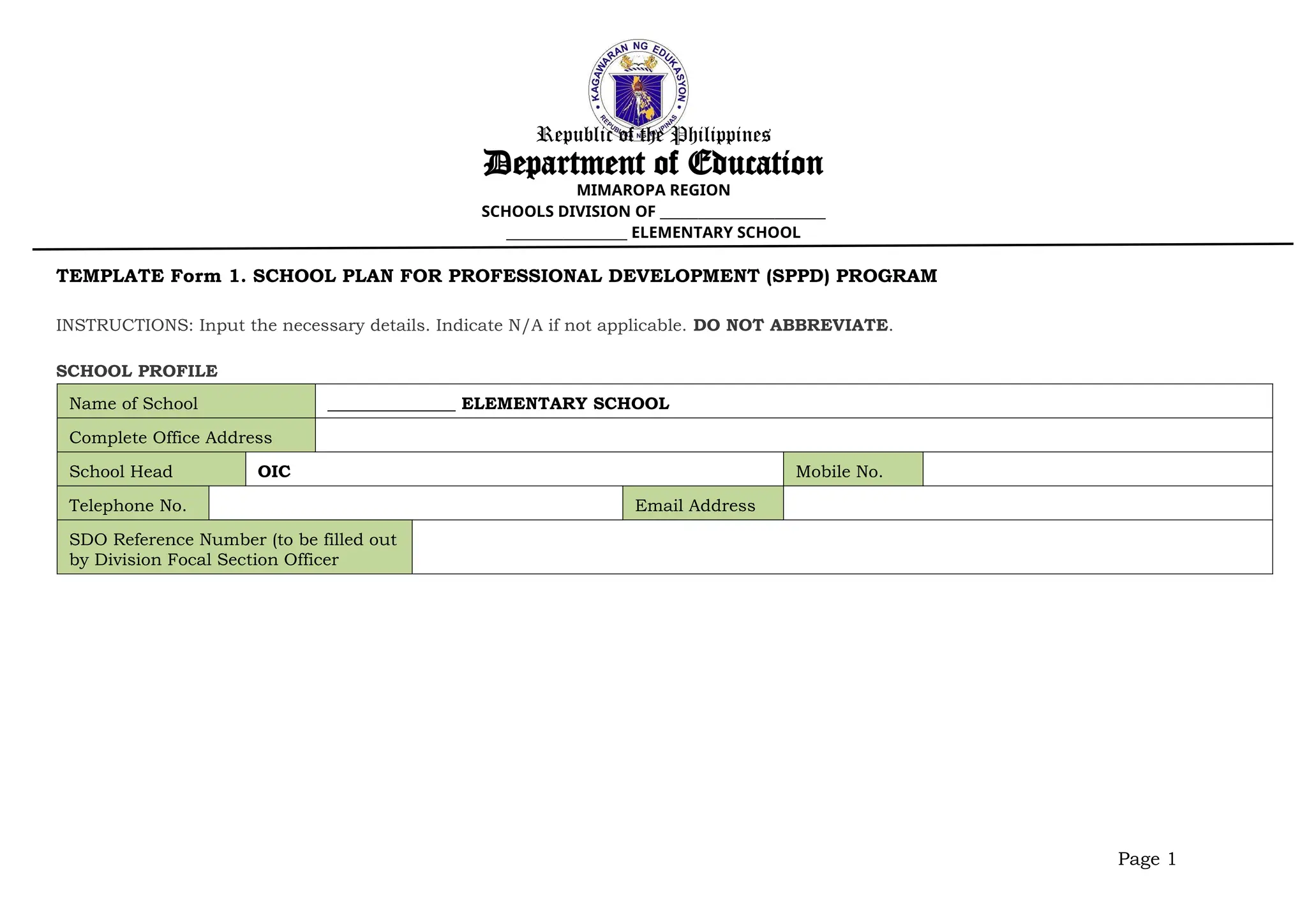
TEMPLATE Form 1. SCHOOL PLAN FOR PROFESSIONAL DEVELOPMENT (SPPD) PROGRAM
INSTRUCTIONS: Input the necessary details. Indicate N/A if not applicable. DO NOT ABBREVIATE.
SCHOOL PROFILE
Name of School _______________ ELEMENTARY SCHOOL
Complete Office Address
School Head OIC Mobile No.
Telephone No. Email Address
SDO Reference Number (to be filled out
by Division Focal Section Officer
Page 1
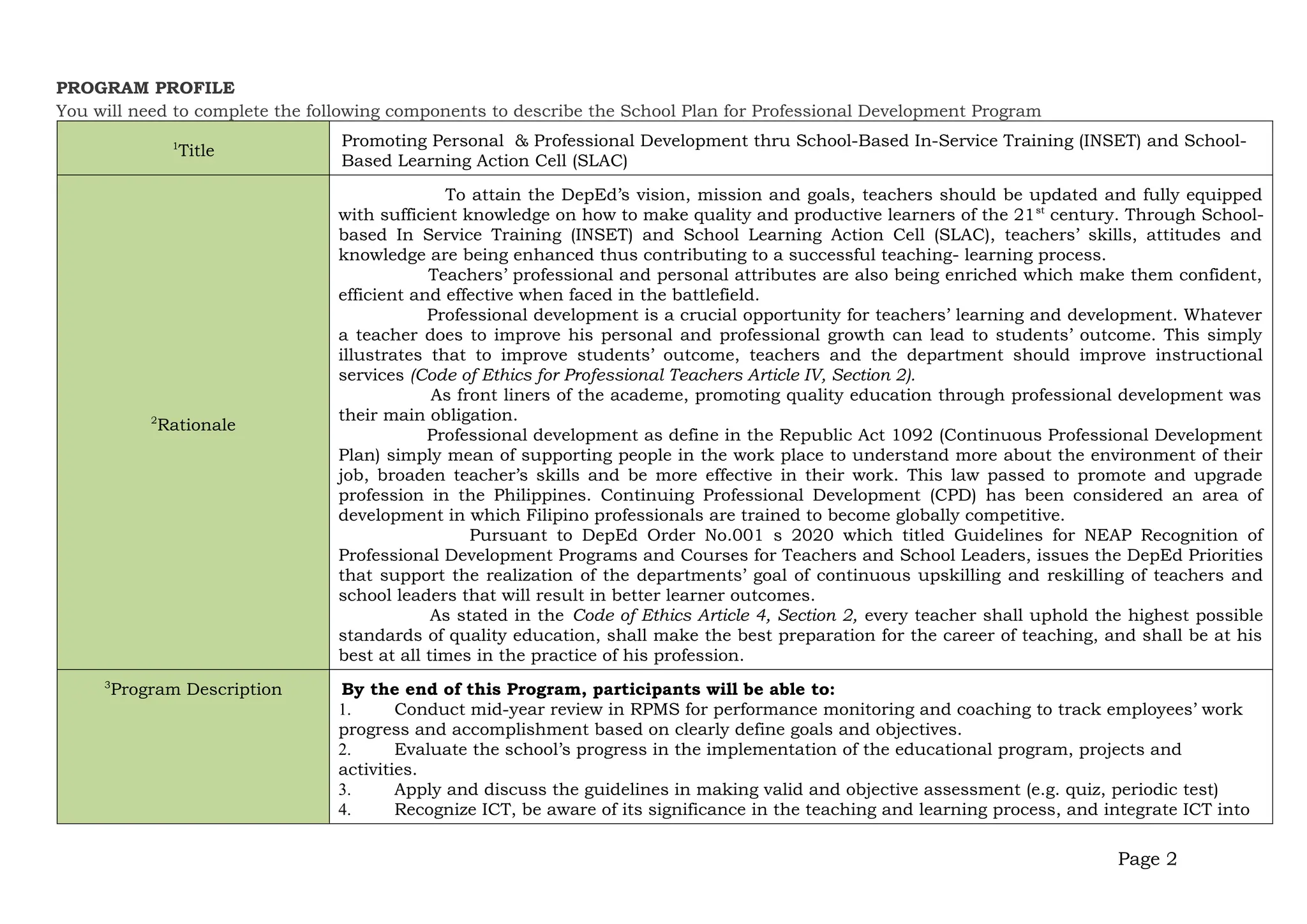
PROGRAM PROFILE
You will need to complete the following components to describe the School Plan for Professional Development Program
1
Title
Promoting Personal & Professional Development thru School-Based In-Service Training (INSET) and School-
Based Learning Action Cell (SLAC)
2
Rationale
To attain the DepEd’s vision, mission and goals, teachers should be updated and fully equipped
with sufficient knowledge on how to make quality and productive learners of the 21st
century. Through School-
based In Service Training (INSET) and School Learning Action Cell (SLAC), teachers’ skills, attitudes and
knowledge are being enhanced thus contributing to a successful teaching- learning process.
Teachers’ professional and personal attributes are also being enriched which make them confident,
efficient and effective when faced in the battlefield.
Professional development is a crucial opportunity for teachers’ learning and development. Whatever
a teacher does to improve his personal and professional growth can lead to students’ outcome. This simply
illustrates that to improve students’ outcome, teachers and the department should improve instructional
services (Code of Ethics for Professional Teachers Article IV, Section 2).
As front liners of the academe, promoting quality education through professional development was
their main obligation.
Professional development as define in the Republic Act 1092 (Continuous Professional Development
Plan) simply mean of supporting people in the work place to understand more about the environment of their
job, broaden teacher’s skills and be more effective in their work. This law passed to promote and upgrade
profession in the Philippines. Continuing Professional Development (CPD) has been considered an area of
development in which Filipino professionals are trained to become globally competitive.
Pursuant to DepEd Order No.001 s 2020 which titled Guidelines for NEAP Recognition of
Professional Development Programs and Courses for Teachers and School Leaders, issues the DepEd Priorities
that support the realization of the departments’ goal of continuous upskilling and reskilling of teachers and
school leaders that will result in better learner outcomes.
As stated in the Code of Ethics Article 4, Section 2, every teacher shall uphold the highest possible
standards of quality education, shall make the best preparation for the career of teaching, and shall be at his
best at all times in the practice of his profession.
3
Program Description By the end of this Program, participants will be able to:
1. Conduct mid-year review in RPMS for performance monitoring and coaching to track employees’ work
progress and accomplishment based on clearly define goals and objectives.
2. Evaluate the school’s progress in the implementation of the educational program, projects and
activities.
3. Apply and discuss the guidelines in making valid and objective assessment (e.g. quiz, periodic test)
4. Recognize ICT, be aware of its significance in the teaching and learning process, and integrate ICT into
Page 2
the process with the traditional and contemporary teaching resources.
5. Appreciate the importance of Fair Learning Environment and enumerate ways on how to create a fair
learning environment.
6. Generate ideas that will help in the choice of a good action research.
7. Determine the development needs of teachers in providing education in this recovery time and
compare it with the Professional Development Plan
4
Professional Development
Priorities
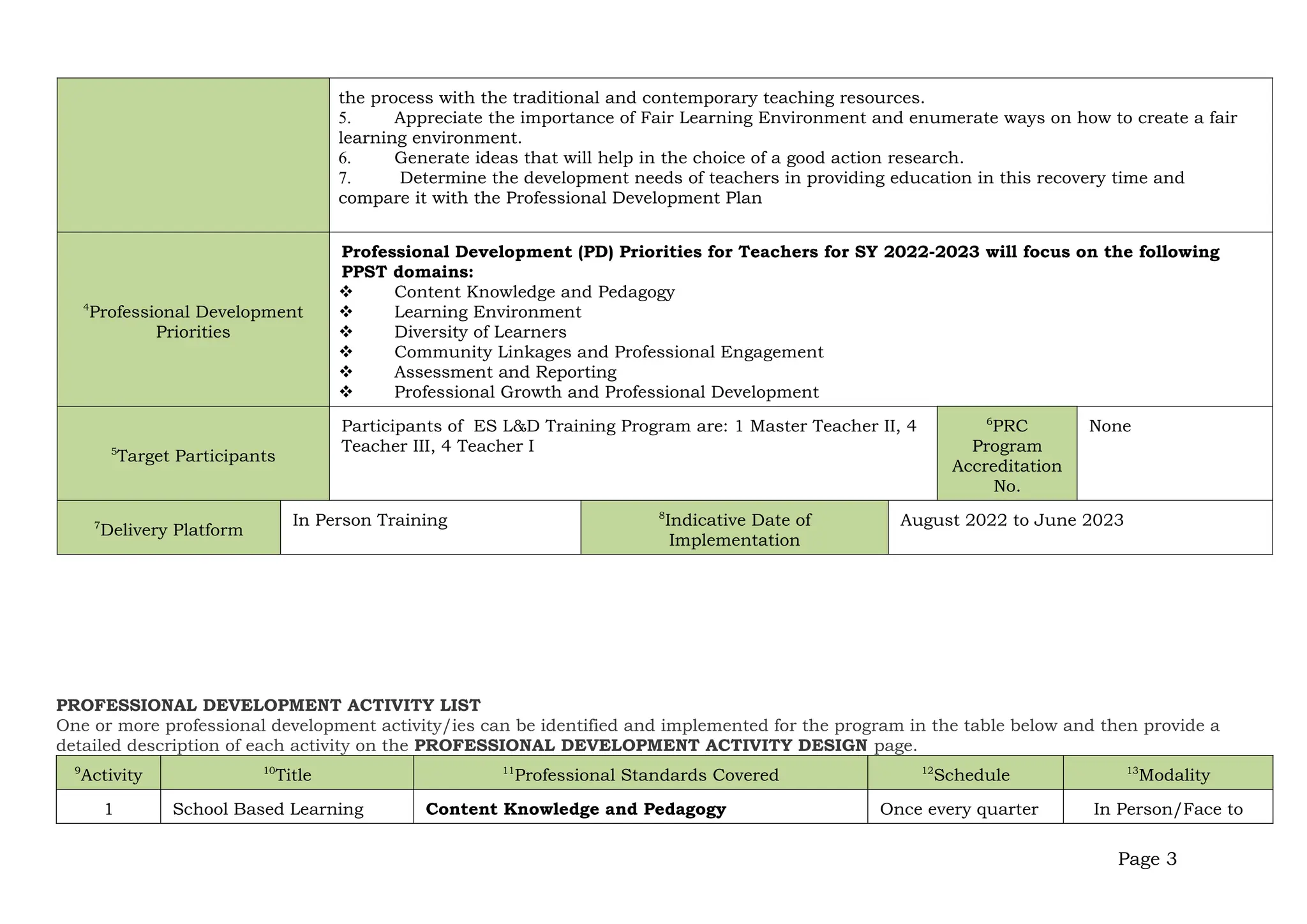
Professional Development (PD) Priorities for Teachers for SY 2022-2023 will focus on the following
PPST domains:
 Content Knowledge and Pedagogy
 Learning Environment
 Diversity of Learners
 Community Linkages and Professional Engagement
 Assessment and Reporting
 Professional Growth and Professional Development
5
Target Participants
Participants of ES L&D Training Program are: 1 Master Teacher II, 4
Teacher III, 4 Teacher I
6
PRC
Program
Accreditation
No.
None
7
Delivery Platform
In Person Training 8
Indicative Date of
Implementation
August 2022 to June 2023
PROFESSIONAL DEVELOPMENT ACTIVITY LIST
One or more professional development activity/ies can be identified and implemented for the program in the table below and then provide a
detailed description of each activity on the PROFESSIONAL DEVELOPMENT ACTIVITY DESIGN page.
9
Activity 10
Title 11
Professional Standards Covered 12
Schedule 13
Modality
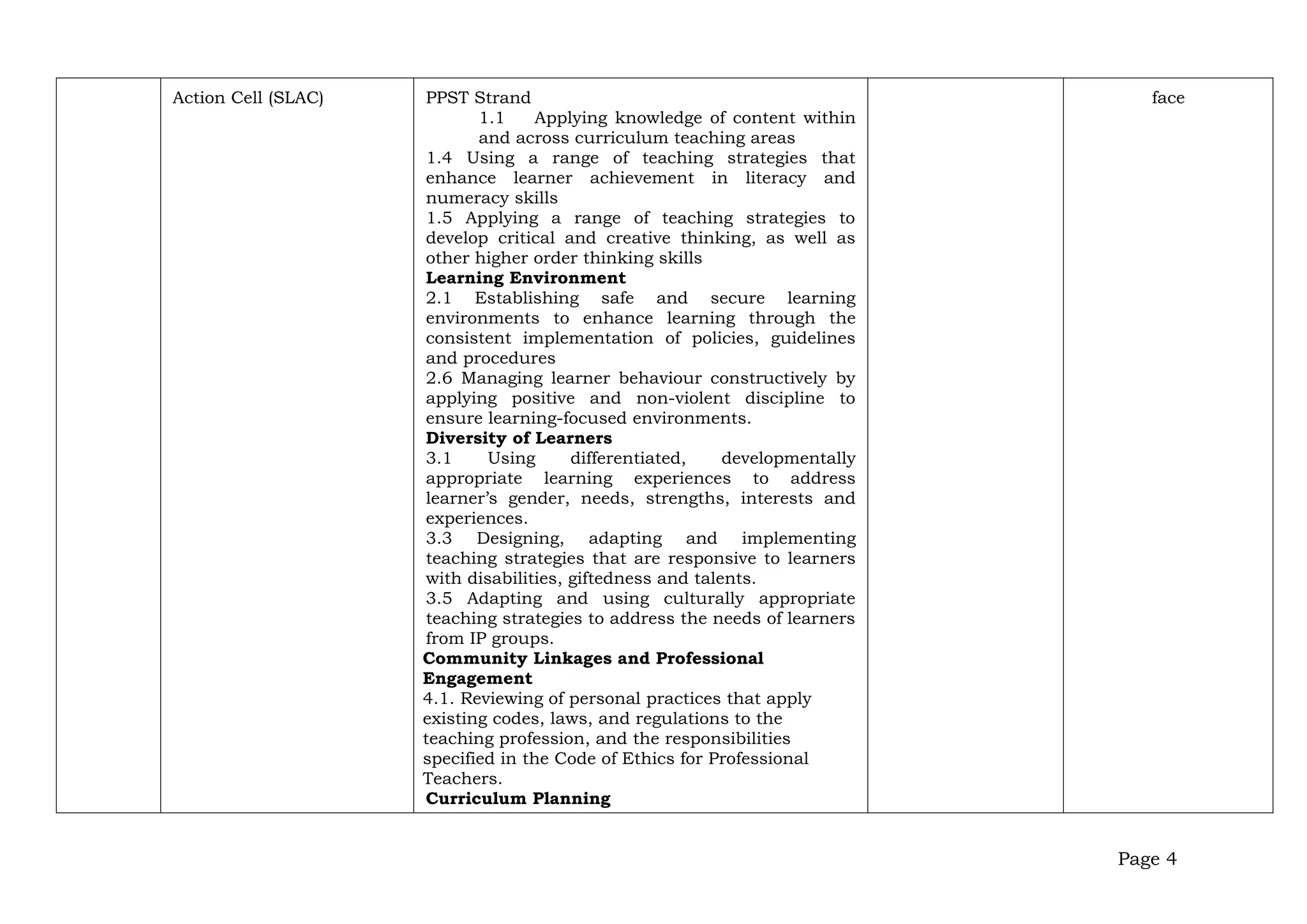
1 School Based Learning Content Knowledge and Pedagogy Once every quarter In Person/Face to
Page 3
Action Cell (SLAC) PPST Strand
1.1 Applying knowledge of content within
and across curriculum teaching areas
1.4 Using a range of teaching strategies that
enhance learner achievement in literacy and
numeracy skills
1.5 Applying a range of teaching strategies to
develop critical and creative thinking, as well as
other higher order thinking skills
Learning Environment
2.1 Establishing safe and secure learning
environments to enhance learning through the
consistent implementation of policies, guidelines
and procedures
2.6 Managing learner behaviour constructively by
applying positive and non-violent discipline to
ensure learning-focused environments.
Diversity of Learners
3.1 Using differentiated, developmentally
appropriate learning experiences to address
learner’s gender, needs, strengths, interests and
experiences.
3.3 Designing, adapting and implementing
teaching strategies that are responsive to learners
with disabilities, giftedness and talents.
3.5 Adapting and using culturally appropriate
teaching strategies to address the needs of learners
from IP groups.
Community Linkages and Professional
Engagement
4.1. Reviewing of personal practices that apply
existing codes, laws, and regulations to the
teaching profession, and the responsibilities
specified in the Code of Ethics for Professional
Teachers.
Curriculum Planning
face
Page 4
5.1 Planning, managing, and implementing
developmentally sequenced teaching and learning
process for varied learning needs and contexts.
Assessment and Reporting
6.1 Designing, selecting, organizing and using
diagnostic, formative and summative assessment
strategies consistent with curriculum
requirements.
6.2 Monitoring and evaluating learner progress and
achievement using learner data.
2 School-Based In-service
Training (INSET)
Content Knowledge and Pedagogy
PPST Strand
1.2 Applying knowledge of content within
and across curriculum teaching areas
1.4 Using a range of teaching strategies that
enhance learner achievement in literacy and
numeracy skills
1.5 Applying a range of teaching strategies to
develop critical and creative thinking, as well as
other higher order thinking skills
Learning Environment
2.1 Establishing safe and secure learning
environments to enhance learning through the
consistent implementation of policies, guidelines
and procedures
2.6 Managing learner behavior constructively by
applying positive and non-violent discipline to
ensure learning-focused environments.
Diversity of Learners
3.1 Using differentiated, developmentally
appropriate learning experiences to address
learner’s gender, needs, strengths, interests and
experiences.
3.3 Designing, adapting and implementing
teaching strategies that are responsive to learners
February 6-10,
2023
In-person/ Face to
Face
Page 5
with disabilities, giftedness and talents.
3.5 Adapting and using culturally appropriate
teaching strategies to address the needs of learners
from IP groups.
Curriculum Planning
4.1 Planning, managing, and implementing
developmentally sequenced teaching and learning
process for varied learning needs and contexts.
Assessment and Reporting
5.1 Designing, selecting, organizing and using
diagnostic, formative and summative assessment
strategies consistent with curriculum
requirements.
5.2 Monitoring and evaluating learner progress and
achievement using learner data.
3 Team Building Personal Growth and Professional Development
7.2.1 Demonstrate behaviors that uphold the
dignity of teaching as a profession by exhibiting
qualities such as caring attitude, respect and
integrity.
May 2023 In Person
4 Personal Growth and
Professional Development
of Teachers
Content Knowledge and Pedagogy
PPST Strand
1.3 Applying knowledge of content within
and across curriculum teaching areas
1.4 Using a range of teaching strategies that
enhance learner achievement in literacy and
numeracy skills
1.5 Applying a range of teaching strategies to
develop critical and creative thinking, as well as
other higher order thinking skills
Learning Environment
2.1 Establishing safe and secure learning
environments to enhance learning through the
consistent implementation of policies, guidelines
and procedures
August 2022-June
2023
Virtual and In Person
Page 6
2.6 Managing learner behaviour constructively by
applying positive and non-violent discipline to
ensure learning-focused environments.
Diversity of Learners
3.1 Using differentiated, developmentally
appropriate learning experiences to address
learner’s gender, needs, strengths, interests and
experiences.
3.3 Designing, adapting and implementing
teaching strategies that are responsive to learners
with disabilities, giftedness and talents.
3.5 Adapting and using culturally appropriate
teaching strategies to address the needs of learners
from IP groups.
Community Linkages and Professional
Engagement
4.1. Reviewing of personal practices that apply
existing codes, laws, and regulations to the
teaching profession, and the responsibilities
specified in the Code of Ethics for Professional
Teachers.
Curriculum Planning
5.1 Planning, managing, and implementing
developmentally sequenced teaching and learning
process for varied learning needs and contexts.
Assessment and Reporting
6.1 Designing, selecting, organizing and using
diagnostic, formative and summative assessment
strategies consistent with curriculum
requirements.
6.2 Monitoring and evaluating learner progress and
achievement using learner data.
Add more rows to add courses.
Page 7
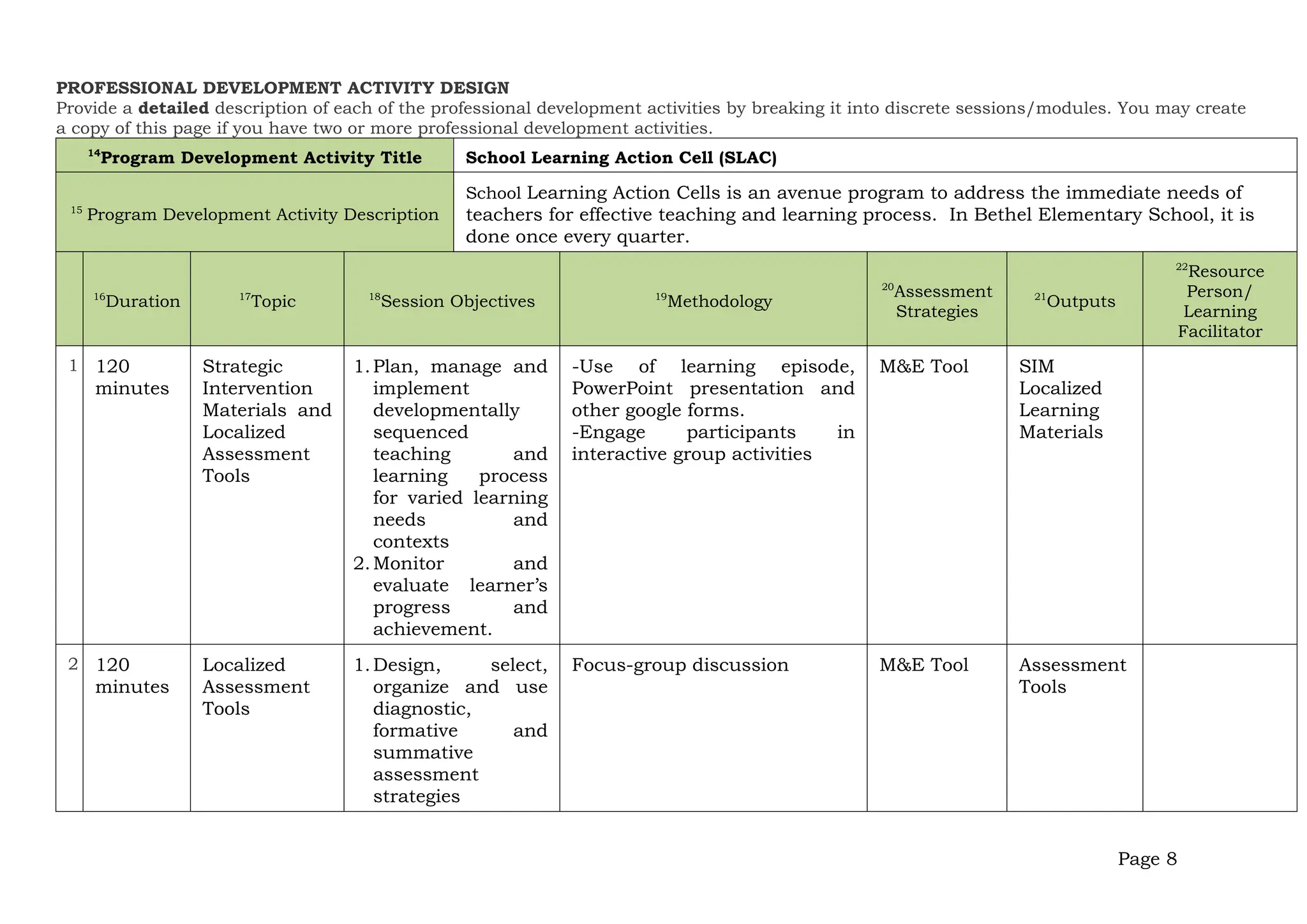
PROFESSIONAL DEVELOPMENT ACTIVITY DESIGN
Provide a detailed description of each of the professional development activities by breaking it into discrete sessions/modules. You may create
a copy of this page if you have two or more professional development activities.
14
Program Development Activity Title School Learning Action Cell (SLAC)
15
Program Development Activity Description
School Learning Action Cells is an avenue program to address the immediate needs of
teachers for effective teaching and learning process. In Bethel Elementary School, it is
done once every quarter.
16
Duration 17
Topic 18
Session Objectives 19
Methodology
20
Assessment
Strategies
21
Outputs
22
Resource
Person/
Learning
Facilitator
1 120
minutes
Strategic
Intervention
Materials and
Localized
Assessment
Tools
1.Plan, manage and
implement
developmentally
sequenced
teaching and
learning process
for varied learning
needs and
contexts
2.Monitor and
evaluate learner’s
progress and
achievement.
-Use of learning episode,
PowerPoint presentation and
other google forms.
-Engage participants in
interactive group activities
M&E Tool SIM
Localized
Learning
Materials
2 120
minutes
Localized
Assessment
Tools
1.Design, select,
organize and use
diagnostic,
formative and
summative
assessment
strategies
Focus-group discussion M&E Tool Assessment
Tools
Page 8
3 120
minutes
Principles of
Test
Construction
1.Review the
principles of test
construction
including Higher
Order Thinking
Skills
2.Construct
Quarterly Tests
Questions
-Use of learning episode,
PowerPoint presentation and
other goggle forms.
-Engage participants in
interactive group activities
M&E Tools Quarterly
Tests
4 120
minutes
Crafting
Reading and
Writing
Interventions
1.Analyze reading
and writing
assessment result
2.Craft reading and
writing
intervention
- Focus group discussion M&E Tools Reading
and writing
intervention
plan
14
Program Development Activity Title School-Based In-Service Training (INSET)
15
Program Development Activity Description
School InSeT will capacitate teaching and non-teaching personnel on their needs based
on the PD Priorities and development plan. It is done simultaneously with the mid-year
break of the pupils on February 6-10, 2023.
16
Duration 17
Topic 18
Session Objectives 19
Methodology
20
Assessment
Strategies
21
Outputs
22
Resource
Person/
Learning
Facilitator
1 150
minutes
Guidelines of
the Result-
based
Performance
Management
System (RPMS)
1. Prepare proficient
teachers and raters who are
involved in the Results-
based Performance
Management System (RPMS)
in implementing the Phase
-Use of learning
episode, session
guides and slide deck
M&E Tool -Teaching
Strategies
Page 9
-Philippine
Professional
Standards for
Teachers
Implementing
the Phase III
for the S.Y.
2022-2023
III of the RPMS Cycle for
School Year (SY) 2022-2023
2. Orient proficient
teachers (TI-TIII) in
accomplishing Means of
Verifications (MOVs) for
Individual Performance
Commitment &Review Form
(IPCRF)
2 120
minutes
Generating
Appropriate
Topic for
Research
1. Apply knowledge of
content within and across
curriculum teaching areas
2. Use a range of
teaching strategies that will
enhance learner
achievement in literacy and
numeracy skills
3. Apply a range of
teaching strategies to
develop critical and creative
thinking.
-Use of learning
episode, session
guides and slide deck
M&E Tool -Teaching
Strategies
3 120
minutes
Inclusive
Education
Learning Environment
1. Establish a safe and secure
learning environments to
enhance learning
2. Manage learner behavior
constructively by applying
positive and non-violent
discipline
3. Use teaching strategies that are
responsive for diverse learners
Diversity of Learner
3.1 using differentiated,
developmentally appropriate
learning experiences to address
-Use of learning
episode, session
guides and slide deck
Use of learning
episode, session
guides and slide
deck.
M&E Tool
M&E Tool
-Conducive
learning
environment
Teaching
strategies for
diverse
learners.
Page 10
learners’ gender, needs,
strengths, interests and
experiences.
3.2Designing, adapting and
implementing teaching
strategies that are responsive to
learners with disabilities,
giftedness and talents.
5 120
minutes
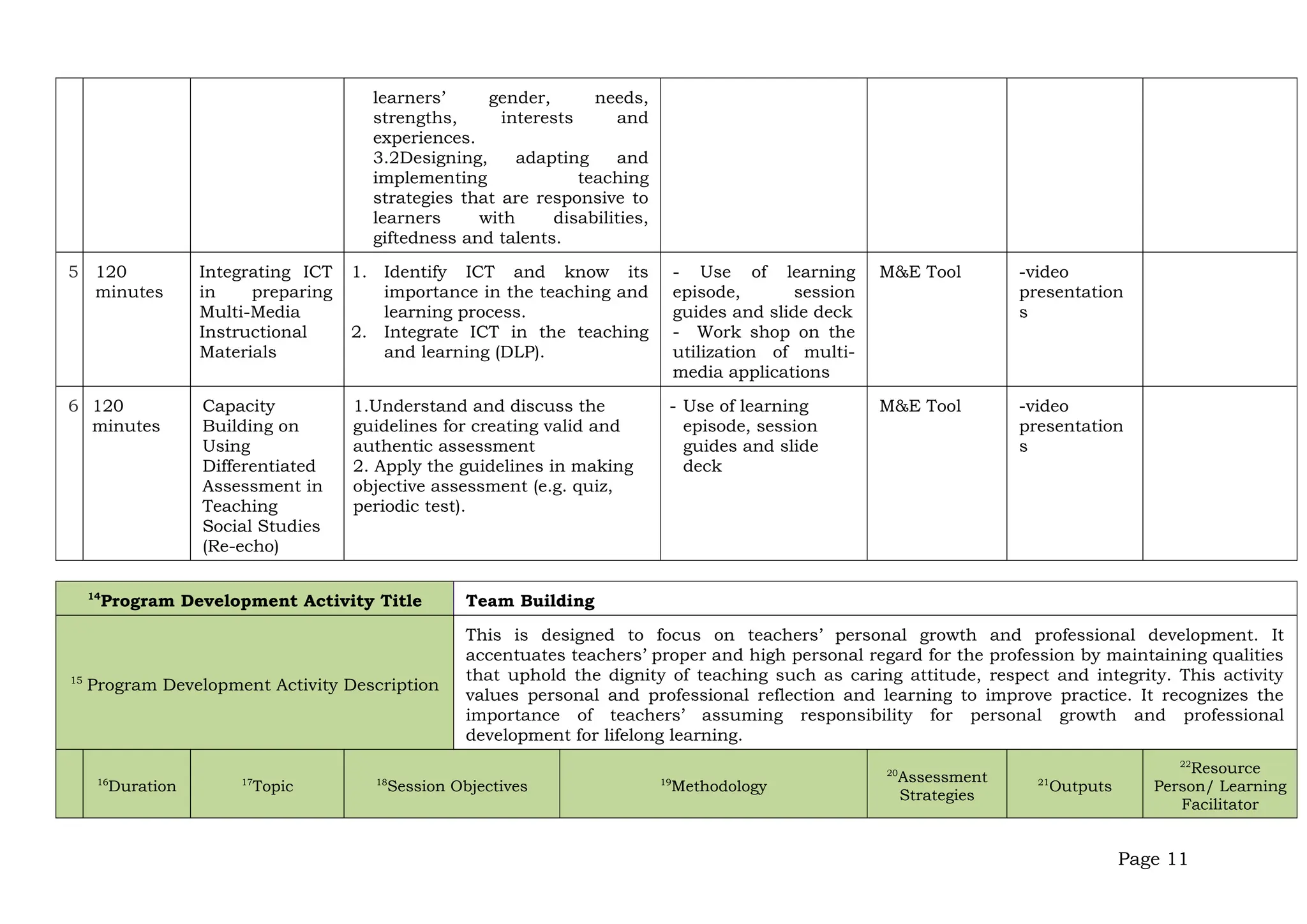
Integrating ICT
in preparing
Multi-Media
Instructional
Materials
1. Identify ICT and know its
importance in the teaching and
learning process.
2. Integrate ICT in the teaching
and learning (DLP).
- Use of learning
episode, session
guides and slide deck
- Work shop on the
utilization of multi-
media applications
M&E Tool -video
presentation
s
6 120
minutes
Capacity
Building on
Using
Differentiated
Assessment in
Teaching
Social Studies
(Re-echo)
1.Understand and discuss the
guidelines for creating valid and
authentic assessment
2. Apply the guidelines in making
objective assessment (e.g. quiz,
periodic test).
- Use of learning
episode, session
guides and slide
deck
M&E Tool -video
presentation
s
14
Program Development Activity Title Team Building
15
Program Development Activity Description
This is designed to focus on teachers’ personal growth and professional development. It
accentuates teachers’ proper and high personal regard for the profession by maintaining qualities
that uphold the dignity of teaching such as caring attitude, respect and integrity. This activity
values personal and professional reflection and learning to improve practice. It recognizes the
importance of teachers’ assuming responsibility for personal growth and professional
development for lifelong learning.
16
Duration 17
Topic 18
Session Objectives 19
Methodology
20
Assessment
Strategies
21
Outputs
22
Resource
Person/ Learning
Facilitator
Page 11
1 60
minutes
Professionalis
m
1. Review personal
teaching practice
based on the Code of
Ethics for
Professional
Teachers.
2. Reflected and
reminded about the
personal practices
on the existing laws
and regulations in
the teaching
profession and Code
of Ethics for
Professional
Teachers through an
acrostic.
-Use of learning episode, session
guides and slide deck
M&E Tool -Journal
2 120
minutes
Professional
development
Goal Setting
1. Analyze present
personal
development stage
2. Set personal
development goal
- Focus group discussion and
sharing
M&E Tools -updated
Individual
Plan for
Professional
Development
3 120
minutes
Strategic
Intervention
Materials and
Localized
Assessment
Tools
Assessment and
Reporting
1.Designing, selecting,
organizing and using
diagnostic, formative
and summative
assessment strategies
consistent with
curriculum
requirements.
2. Monitoring and
evaluating learner
progress and
Focus-group discussion M&E Tool Assessment
file, quizzes,
summative
and
formative
tests.
Page 12
achievement using
learner data.
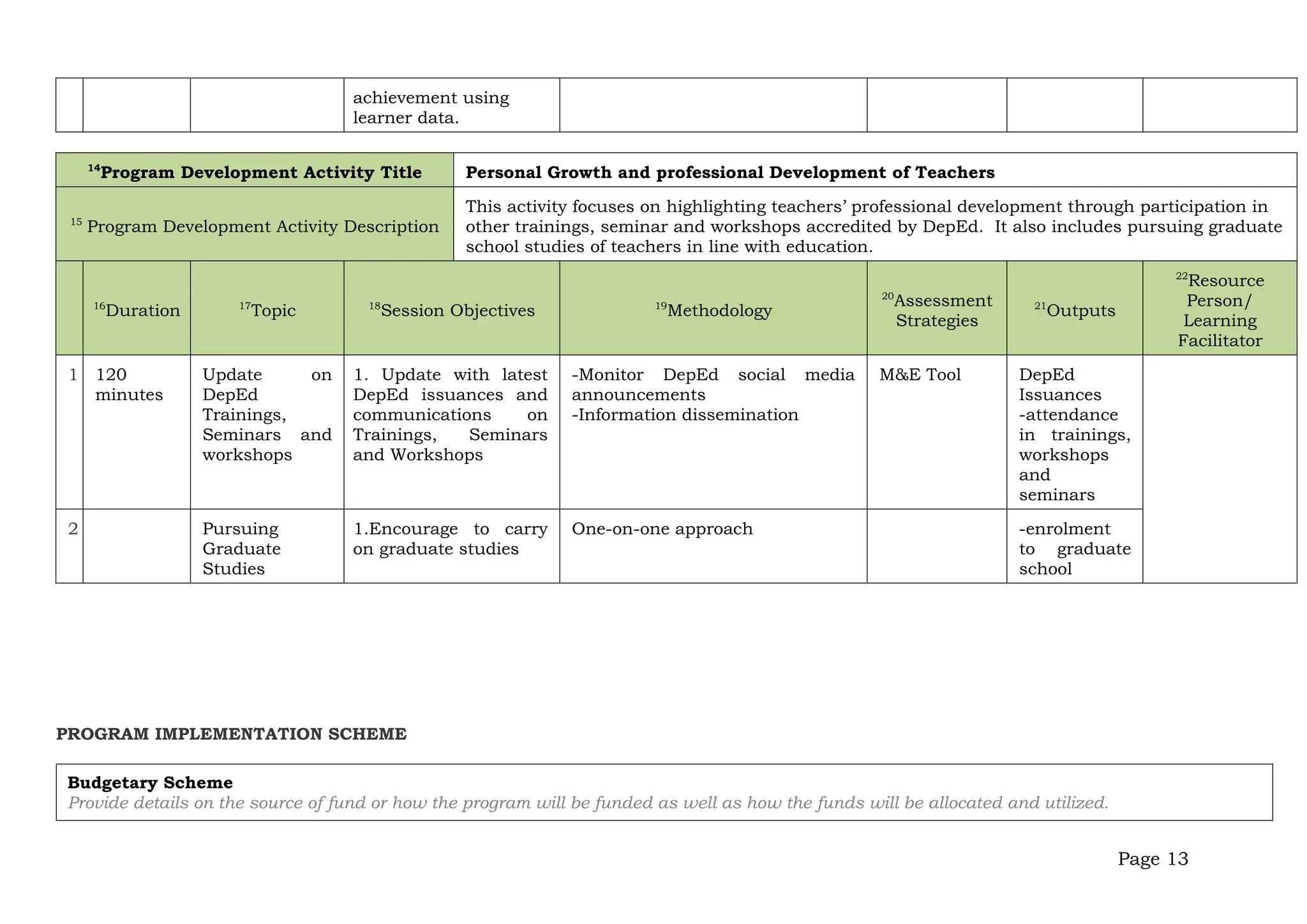
14
Program Development Activity Title Personal Growth and professional Development of Teachers
15
Program Development Activity Description
This activity focuses on highlighting teachers’ professional development through participation in
other trainings, seminar and workshops accredited by DepEd. It also includes pursuing graduate
school studies of teachers in line with education.
16
Duration 17
Topic 18
Session Objectives 19
Methodology
20
Assessment
Strategies
21
Outputs
22
Resource
Person/
Learning
Facilitator
1 120
minutes
Update on
DepEd
Trainings,
Seminars and
workshops
1. Update with latest
DepEd issuances and
communications on
Trainings, Seminars
and Workshops
-Monitor DepEd social media
announcements
-Information dissemination
M&E Tool DepEd
Issuances
-attendance
in trainings,
workshops
and
seminars
2 Pursuing
Graduate
Studies
1.Encourage to carry
on graduate studies
One-on-one approach -enrolment
to graduate
school
PROGRAM IMPLEMENTATION SCHEME
Budgetary Scheme
Provide details on the source of fund or how the program will be funded as well as how the funds will be allocated and utilized.
Page 13
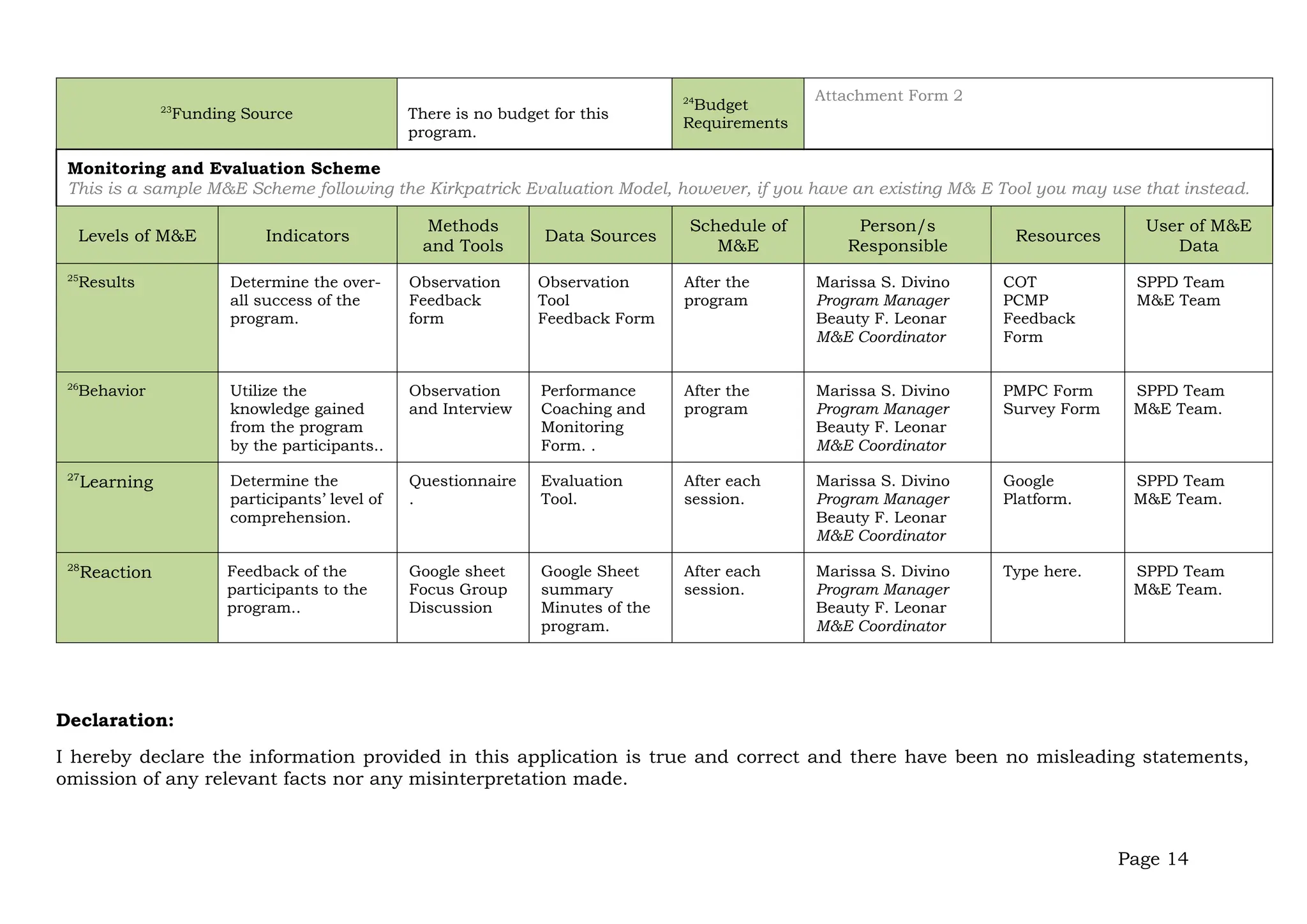
23
Funding Source There is no budget for this
program.
24
Budget
Requirements
Attachment Form 2
Monitoring and Evaluation Scheme
This is a sample M&E Scheme following the Kirkpatrick Evaluation Model, however, if you have an existing M& E Tool you may use that instead.
Levels of M&E Indicators
Methods
and Tools
Data Sources
Schedule of
M&E
Person/s
Responsible
Resources
User of M&E
Data
25
Results Determine the over-
all success of the
program.
Observation
Feedback
form
Observation
Tool
Feedback Form
After the
program
Marissa S. Divino
Program Manager
Beauty F. Leonar
M&E Coordinator
COT
PCMP
Feedback
Form
SPPD Team
M&E Team
26
Behavior Utilize the
knowledge gained
from the program
by the participants..
Observation
and Interview
Performance
Coaching and
Monitoring
Form. .
After the
program
Marissa S. Divino
Program Manager
Beauty F. Leonar
M&E Coordinator
PMPC Form
Survey Form
SPPD Team
M&E Team.
27
Learning Determine the
participants’ level of
comprehension.
Questionnaire
.
Evaluation
Tool.
After each
session.
Marissa S. Divino
Program Manager
Beauty F. Leonar
M&E Coordinator
Google
Platform.
SPPD Team
M&E Team.
28
Reaction Feedback of the
participants to the
program..
Google sheet
Focus Group
Discussion
Google Sheet
summary
Minutes of the
program.
After each
session.
Marissa S. Divino
Program Manager
Beauty F. Leonar
M&E Coordinator
Type here. SPPD Team
M&E Team.
Declaration:
I hereby declare the information provided in this application is true and correct and there have been no misleading statements,
omission of any relevant facts nor any misinterpretation made.
Page 14
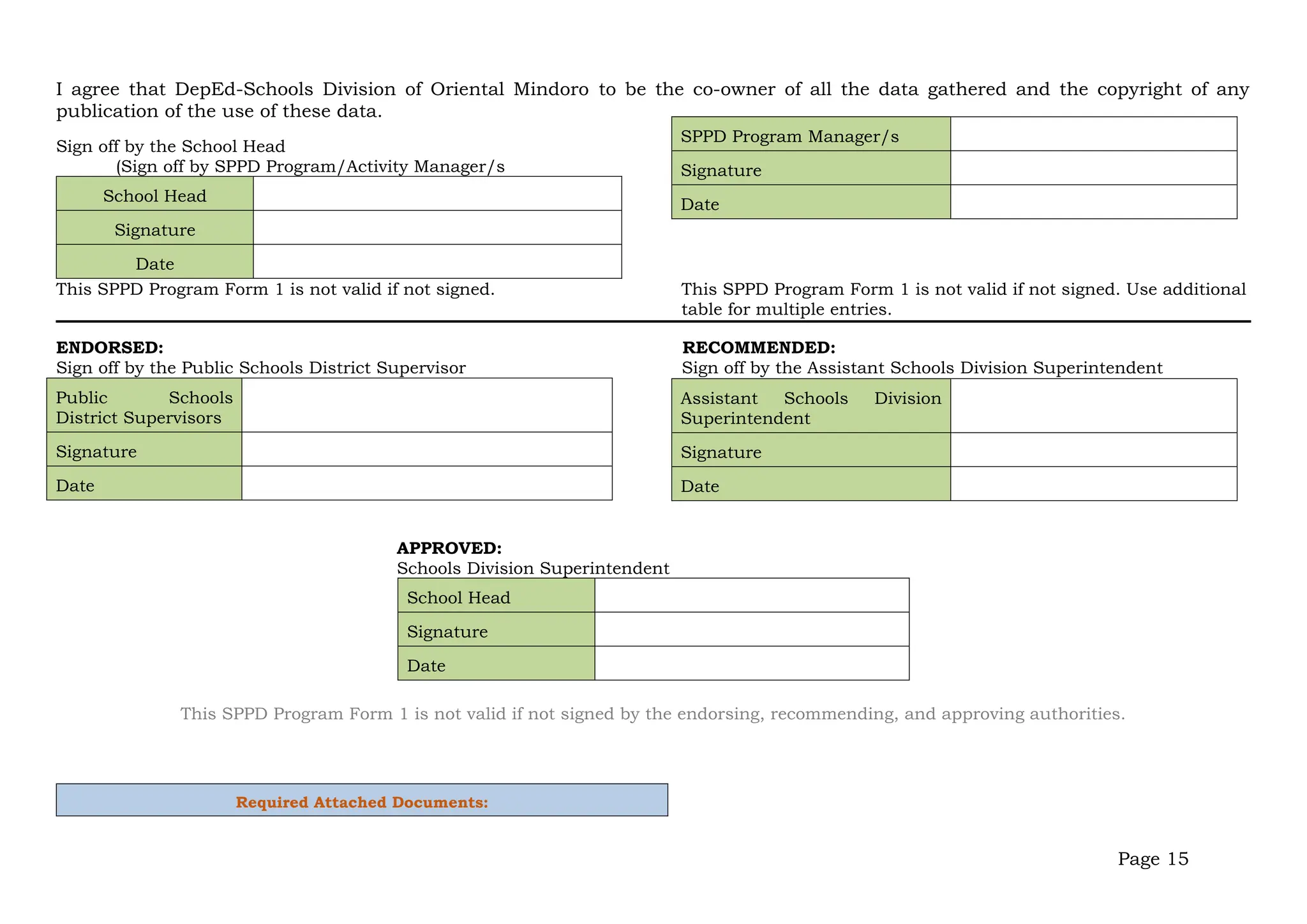
I agree that DepEd-Schools Division of Oriental Mindoro to be the co-owner of all the data gathered and the copyright of any
publication of the use of these data.
Sign off by the School Head
(Sign off by SPPD Program/Activity Manager/s
School Head
Signature
Date
This SPPD Program Form 1 is not valid if not signed. This SPPD Program Form 1 is not valid if not signed. Use additional
table for multiple entries.
ENDORSED: RECOMMENDED:
Sign off by the Public Schools District Supervisor Sign off by the Assistant Schools Division Superintendent
APPROVED:
Schools Division Superintendent
School Head
Signature
Date
This SPPD Program Form 1 is not valid if not signed by the endorsing, recommending, and approving authorities.
Required Attached Documents:
Page 15
SPPD Program Manager/s
Signature
Date
Public Schools
District Supervisors
Signature
Date
Assistant Schools Division
Superintendent
Signature
Date
Detailed Course Design
Sample Learning Resources (Modules, Worksheets, etc.)
Sample Session Guides
Sample Assessment Tools
CVs of Primary, Secondary, or Alternate Resource Persons
Budget Estimate Form
Monitoring and Evaluation Plan
Page 16

template form 1 School plan for Professional development (SPPD) Program

  • 1.
    Republic of thePhilippines Department of Education MIMAROPA REGION SCHOOLS DIVISION OF __________________________ ___________________ ELEMENTARY SCHOOL TEMPLATE Form 1. SCHOOL PLAN FOR PROFESSIONAL DEVELOPMENT (SPPD) PROGRAM INSTRUCTIONS: Input the necessary details. Indicate N/A if not applicable. DO NOT ABBREVIATE. SCHOOL PROFILE Name of School _______________ ELEMENTARY SCHOOL Complete Office Address School Head OIC Mobile No. Telephone No. Email Address SDO Reference Number (to be filled out by Division Focal Section Officer Page 1
  • 2.
    PROGRAM PROFILE You willneed to complete the following components to describe the School Plan for Professional Development Program 1 Title Promoting Personal & Professional Development thru School-Based In-Service Training (INSET) and School- Based Learning Action Cell (SLAC) 2 Rationale To attain the DepEd’s vision, mission and goals, teachers should be updated and fully equipped with sufficient knowledge on how to make quality and productive learners of the 21st century. Through School- based In Service Training (INSET) and School Learning Action Cell (SLAC), teachers’ skills, attitudes and knowledge are being enhanced thus contributing to a successful teaching- learning process. Teachers’ professional and personal attributes are also being enriched which make them confident, efficient and effective when faced in the battlefield. Professional development is a crucial opportunity for teachers’ learning and development. Whatever a teacher does to improve his personal and professional growth can lead to students’ outcome. This simply illustrates that to improve students’ outcome, teachers and the department should improve instructional services (Code of Ethics for Professional Teachers Article IV, Section 2). As front liners of the academe, promoting quality education through professional development was their main obligation. Professional development as define in the Republic Act 1092 (Continuous Professional Development Plan) simply mean of supporting people in the work place to understand more about the environment of their job, broaden teacher’s skills and be more effective in their work. This law passed to promote and upgrade profession in the Philippines. Continuing Professional Development (CPD) has been considered an area of development in which Filipino professionals are trained to become globally competitive. Pursuant to DepEd Order No.001 s 2020 which titled Guidelines for NEAP Recognition of Professional Development Programs and Courses for Teachers and School Leaders, issues the DepEd Priorities that support the realization of the departments’ goal of continuous upskilling and reskilling of teachers and school leaders that will result in better learner outcomes. As stated in the Code of Ethics Article 4, Section 2, every teacher shall uphold the highest possible standards of quality education, shall make the best preparation for the career of teaching, and shall be at his best at all times in the practice of his profession. 3 Program Description By the end of this Program, participants will be able to: 1. Conduct mid-year review in RPMS for performance monitoring and coaching to track employees’ work progress and accomplishment based on clearly define goals and objectives. 2. Evaluate the school’s progress in the implementation of the educational program, projects and activities. 3. Apply and discuss the guidelines in making valid and objective assessment (e.g. quiz, periodic test) 4. Recognize ICT, be aware of its significance in the teaching and learning process, and integrate ICT into Page 2
  • 3.
    the process withthe traditional and contemporary teaching resources. 5. Appreciate the importance of Fair Learning Environment and enumerate ways on how to create a fair learning environment. 6. Generate ideas that will help in the choice of a good action research. 7. Determine the development needs of teachers in providing education in this recovery time and compare it with the Professional Development Plan 4 Professional Development Priorities Professional Development (PD) Priorities for Teachers for SY 2022-2023 will focus on the following PPST domains:  Content Knowledge and Pedagogy  Learning Environment  Diversity of Learners  Community Linkages and Professional Engagement  Assessment and Reporting  Professional Growth and Professional Development 5 Target Participants Participants of ES L&D Training Program are: 1 Master Teacher II, 4 Teacher III, 4 Teacher I 6 PRC Program Accreditation No. None 7 Delivery Platform In Person Training 8 Indicative Date of Implementation August 2022 to June 2023 PROFESSIONAL DEVELOPMENT ACTIVITY LIST One or more professional development activity/ies can be identified and implemented for the program in the table below and then provide a detailed description of each activity on the PROFESSIONAL DEVELOPMENT ACTIVITY DESIGN page. 9 Activity 10 Title 11 Professional Standards Covered 12 Schedule 13 Modality 1 School Based Learning Content Knowledge and Pedagogy Once every quarter In Person/Face to Page 3
  • 4.
    Action Cell (SLAC)PPST Strand 1.1 Applying knowledge of content within and across curriculum teaching areas 1.4 Using a range of teaching strategies that enhance learner achievement in literacy and numeracy skills 1.5 Applying a range of teaching strategies to develop critical and creative thinking, as well as other higher order thinking skills Learning Environment 2.1 Establishing safe and secure learning environments to enhance learning through the consistent implementation of policies, guidelines and procedures 2.6 Managing learner behaviour constructively by applying positive and non-violent discipline to ensure learning-focused environments. Diversity of Learners 3.1 Using differentiated, developmentally appropriate learning experiences to address learner’s gender, needs, strengths, interests and experiences. 3.3 Designing, adapting and implementing teaching strategies that are responsive to learners with disabilities, giftedness and talents. 3.5 Adapting and using culturally appropriate teaching strategies to address the needs of learners from IP groups. Community Linkages and Professional Engagement 4.1. Reviewing of personal practices that apply existing codes, laws, and regulations to the teaching profession, and the responsibilities specified in the Code of Ethics for Professional Teachers. Curriculum Planning face Page 4
  • 5.
    5.1 Planning, managing,and implementing developmentally sequenced teaching and learning process for varied learning needs and contexts. Assessment and Reporting 6.1 Designing, selecting, organizing and using diagnostic, formative and summative assessment strategies consistent with curriculum requirements. 6.2 Monitoring and evaluating learner progress and achievement using learner data. 2 School-Based In-service Training (INSET) Content Knowledge and Pedagogy PPST Strand 1.2 Applying knowledge of content within and across curriculum teaching areas 1.4 Using a range of teaching strategies that enhance learner achievement in literacy and numeracy skills 1.5 Applying a range of teaching strategies to develop critical and creative thinking, as well as other higher order thinking skills Learning Environment 2.1 Establishing safe and secure learning environments to enhance learning through the consistent implementation of policies, guidelines and procedures 2.6 Managing learner behavior constructively by applying positive and non-violent discipline to ensure learning-focused environments. Diversity of Learners 3.1 Using differentiated, developmentally appropriate learning experiences to address learner’s gender, needs, strengths, interests and experiences. 3.3 Designing, adapting and implementing teaching strategies that are responsive to learners February 6-10, 2023 In-person/ Face to Face Page 5
  • 6.
    with disabilities, giftednessand talents. 3.5 Adapting and using culturally appropriate teaching strategies to address the needs of learners from IP groups. Curriculum Planning 4.1 Planning, managing, and implementing developmentally sequenced teaching and learning process for varied learning needs and contexts. Assessment and Reporting 5.1 Designing, selecting, organizing and using diagnostic, formative and summative assessment strategies consistent with curriculum requirements. 5.2 Monitoring and evaluating learner progress and achievement using learner data. 3 Team Building Personal Growth and Professional Development 7.2.1 Demonstrate behaviors that uphold the dignity of teaching as a profession by exhibiting qualities such as caring attitude, respect and integrity. May 2023 In Person 4 Personal Growth and Professional Development of Teachers Content Knowledge and Pedagogy PPST Strand 1.3 Applying knowledge of content within and across curriculum teaching areas 1.4 Using a range of teaching strategies that enhance learner achievement in literacy and numeracy skills 1.5 Applying a range of teaching strategies to develop critical and creative thinking, as well as other higher order thinking skills Learning Environment 2.1 Establishing safe and secure learning environments to enhance learning through the consistent implementation of policies, guidelines and procedures August 2022-June 2023 Virtual and In Person Page 6
  • 7.
    2.6 Managing learnerbehaviour constructively by applying positive and non-violent discipline to ensure learning-focused environments. Diversity of Learners 3.1 Using differentiated, developmentally appropriate learning experiences to address learner’s gender, needs, strengths, interests and experiences. 3.3 Designing, adapting and implementing teaching strategies that are responsive to learners with disabilities, giftedness and talents. 3.5 Adapting and using culturally appropriate teaching strategies to address the needs of learners from IP groups. Community Linkages and Professional Engagement 4.1. Reviewing of personal practices that apply existing codes, laws, and regulations to the teaching profession, and the responsibilities specified in the Code of Ethics for Professional Teachers. Curriculum Planning 5.1 Planning, managing, and implementing developmentally sequenced teaching and learning process for varied learning needs and contexts. Assessment and Reporting 6.1 Designing, selecting, organizing and using diagnostic, formative and summative assessment strategies consistent with curriculum requirements. 6.2 Monitoring and evaluating learner progress and achievement using learner data. Add more rows to add courses. Page 7
  • 8.
    PROFESSIONAL DEVELOPMENT ACTIVITYDESIGN Provide a detailed description of each of the professional development activities by breaking it into discrete sessions/modules. You may create a copy of this page if you have two or more professional development activities. 14 Program Development Activity Title School Learning Action Cell (SLAC) 15 Program Development Activity Description School Learning Action Cells is an avenue program to address the immediate needs of teachers for effective teaching and learning process. In Bethel Elementary School, it is done once every quarter. 16 Duration 17 Topic 18 Session Objectives 19 Methodology 20 Assessment Strategies 21 Outputs 22 Resource Person/ Learning Facilitator 1 120 minutes Strategic Intervention Materials and Localized Assessment Tools 1.Plan, manage and implement developmentally sequenced teaching and learning process for varied learning needs and contexts 2.Monitor and evaluate learner’s progress and achievement. -Use of learning episode, PowerPoint presentation and other google forms. -Engage participants in interactive group activities M&E Tool SIM Localized Learning Materials 2 120 minutes Localized Assessment Tools 1.Design, select, organize and use diagnostic, formative and summative assessment strategies Focus-group discussion M&E Tool Assessment Tools Page 8
  • 9.
    3 120 minutes Principles of Test Construction 1.Reviewthe principles of test construction including Higher Order Thinking Skills 2.Construct Quarterly Tests Questions -Use of learning episode, PowerPoint presentation and other goggle forms. -Engage participants in interactive group activities M&E Tools Quarterly Tests 4 120 minutes Crafting Reading and Writing Interventions 1.Analyze reading and writing assessment result 2.Craft reading and writing intervention - Focus group discussion M&E Tools Reading and writing intervention plan 14 Program Development Activity Title School-Based In-Service Training (INSET) 15 Program Development Activity Description School InSeT will capacitate teaching and non-teaching personnel on their needs based on the PD Priorities and development plan. It is done simultaneously with the mid-year break of the pupils on February 6-10, 2023. 16 Duration 17 Topic 18 Session Objectives 19 Methodology 20 Assessment Strategies 21 Outputs 22 Resource Person/ Learning Facilitator 1 150 minutes Guidelines of the Result- based Performance Management System (RPMS) 1. Prepare proficient teachers and raters who are involved in the Results- based Performance Management System (RPMS) in implementing the Phase -Use of learning episode, session guides and slide deck M&E Tool -Teaching Strategies Page 9
  • 10.
    -Philippine Professional Standards for Teachers Implementing the PhaseIII for the S.Y. 2022-2023 III of the RPMS Cycle for School Year (SY) 2022-2023 2. Orient proficient teachers (TI-TIII) in accomplishing Means of Verifications (MOVs) for Individual Performance Commitment &Review Form (IPCRF) 2 120 minutes Generating Appropriate Topic for Research 1. Apply knowledge of content within and across curriculum teaching areas 2. Use a range of teaching strategies that will enhance learner achievement in literacy and numeracy skills 3. Apply a range of teaching strategies to develop critical and creative thinking. -Use of learning episode, session guides and slide deck M&E Tool -Teaching Strategies 3 120 minutes Inclusive Education Learning Environment 1. Establish a safe and secure learning environments to enhance learning 2. Manage learner behavior constructively by applying positive and non-violent discipline 3. Use teaching strategies that are responsive for diverse learners Diversity of Learner 3.1 using differentiated, developmentally appropriate learning experiences to address -Use of learning episode, session guides and slide deck Use of learning episode, session guides and slide deck. M&E Tool M&E Tool -Conducive learning environment Teaching strategies for diverse learners. Page 10
  • 11.
    learners’ gender, needs, strengths,interests and experiences. 3.2Designing, adapting and implementing teaching strategies that are responsive to learners with disabilities, giftedness and talents. 5 120 minutes Integrating ICT in preparing Multi-Media Instructional Materials 1. Identify ICT and know its importance in the teaching and learning process. 2. Integrate ICT in the teaching and learning (DLP). - Use of learning episode, session guides and slide deck - Work shop on the utilization of multi- media applications M&E Tool -video presentation s 6 120 minutes Capacity Building on Using Differentiated Assessment in Teaching Social Studies (Re-echo) 1.Understand and discuss the guidelines for creating valid and authentic assessment 2. Apply the guidelines in making objective assessment (e.g. quiz, periodic test). - Use of learning episode, session guides and slide deck M&E Tool -video presentation s 14 Program Development Activity Title Team Building 15 Program Development Activity Description This is designed to focus on teachers’ personal growth and professional development. It accentuates teachers’ proper and high personal regard for the profession by maintaining qualities that uphold the dignity of teaching such as caring attitude, respect and integrity. This activity values personal and professional reflection and learning to improve practice. It recognizes the importance of teachers’ assuming responsibility for personal growth and professional development for lifelong learning. 16 Duration 17 Topic 18 Session Objectives 19 Methodology 20 Assessment Strategies 21 Outputs 22 Resource Person/ Learning Facilitator Page 11
  • 12.
    1 60 minutes Professionalis m 1. Reviewpersonal teaching practice based on the Code of Ethics for Professional Teachers. 2. Reflected and reminded about the personal practices on the existing laws and regulations in the teaching profession and Code of Ethics for Professional Teachers through an acrostic. -Use of learning episode, session guides and slide deck M&E Tool -Journal 2 120 minutes Professional development Goal Setting 1. Analyze present personal development stage 2. Set personal development goal - Focus group discussion and sharing M&E Tools -updated Individual Plan for Professional Development 3 120 minutes Strategic Intervention Materials and Localized Assessment Tools Assessment and Reporting 1.Designing, selecting, organizing and using diagnostic, formative and summative assessment strategies consistent with curriculum requirements. 2. Monitoring and evaluating learner progress and Focus-group discussion M&E Tool Assessment file, quizzes, summative and formative tests. Page 12
  • 13.
    achievement using learner data. 14 ProgramDevelopment Activity Title Personal Growth and professional Development of Teachers 15 Program Development Activity Description This activity focuses on highlighting teachers’ professional development through participation in other trainings, seminar and workshops accredited by DepEd. It also includes pursuing graduate school studies of teachers in line with education. 16 Duration 17 Topic 18 Session Objectives 19 Methodology 20 Assessment Strategies 21 Outputs 22 Resource Person/ Learning Facilitator 1 120 minutes Update on DepEd Trainings, Seminars and workshops 1. Update with latest DepEd issuances and communications on Trainings, Seminars and Workshops -Monitor DepEd social media announcements -Information dissemination M&E Tool DepEd Issuances -attendance in trainings, workshops and seminars 2 Pursuing Graduate Studies 1.Encourage to carry on graduate studies One-on-one approach -enrolment to graduate school PROGRAM IMPLEMENTATION SCHEME Budgetary Scheme Provide details on the source of fund or how the program will be funded as well as how the funds will be allocated and utilized. Page 13
  • 14.
    23 Funding Source Thereis no budget for this program. 24 Budget Requirements Attachment Form 2 Monitoring and Evaluation Scheme This is a sample M&E Scheme following the Kirkpatrick Evaluation Model, however, if you have an existing M& E Tool you may use that instead. Levels of M&E Indicators Methods and Tools Data Sources Schedule of M&E Person/s Responsible Resources User of M&E Data 25 Results Determine the over- all success of the program. Observation Feedback form Observation Tool Feedback Form After the program Marissa S. Divino Program Manager Beauty F. Leonar M&E Coordinator COT PCMP Feedback Form SPPD Team M&E Team 26 Behavior Utilize the knowledge gained from the program by the participants.. Observation and Interview Performance Coaching and Monitoring Form. . After the program Marissa S. Divino Program Manager Beauty F. Leonar M&E Coordinator PMPC Form Survey Form SPPD Team M&E Team. 27 Learning Determine the participants’ level of comprehension. Questionnaire . Evaluation Tool. After each session. Marissa S. Divino Program Manager Beauty F. Leonar M&E Coordinator Google Platform. SPPD Team M&E Team. 28 Reaction Feedback of the participants to the program.. Google sheet Focus Group Discussion Google Sheet summary Minutes of the program. After each session. Marissa S. Divino Program Manager Beauty F. Leonar M&E Coordinator Type here. SPPD Team M&E Team. Declaration: I hereby declare the information provided in this application is true and correct and there have been no misleading statements, omission of any relevant facts nor any misinterpretation made. Page 14
  • 15.
    I agree thatDepEd-Schools Division of Oriental Mindoro to be the co-owner of all the data gathered and the copyright of any publication of the use of these data. Sign off by the School Head (Sign off by SPPD Program/Activity Manager/s School Head Signature Date This SPPD Program Form 1 is not valid if not signed. This SPPD Program Form 1 is not valid if not signed. Use additional table for multiple entries. ENDORSED: RECOMMENDED: Sign off by the Public Schools District Supervisor Sign off by the Assistant Schools Division Superintendent APPROVED: Schools Division Superintendent School Head Signature Date This SPPD Program Form 1 is not valid if not signed by the endorsing, recommending, and approving authorities. Required Attached Documents: Page 15 SPPD Program Manager/s Signature Date Public Schools District Supervisors Signature Date Assistant Schools Division Superintendent Signature Date
  • 16.
    Detailed Course Design SampleLearning Resources (Modules, Worksheets, etc.) Sample Session Guides Sample Assessment Tools CVs of Primary, Secondary, or Alternate Resource Persons Budget Estimate Form Monitoring and Evaluation Plan Page 16