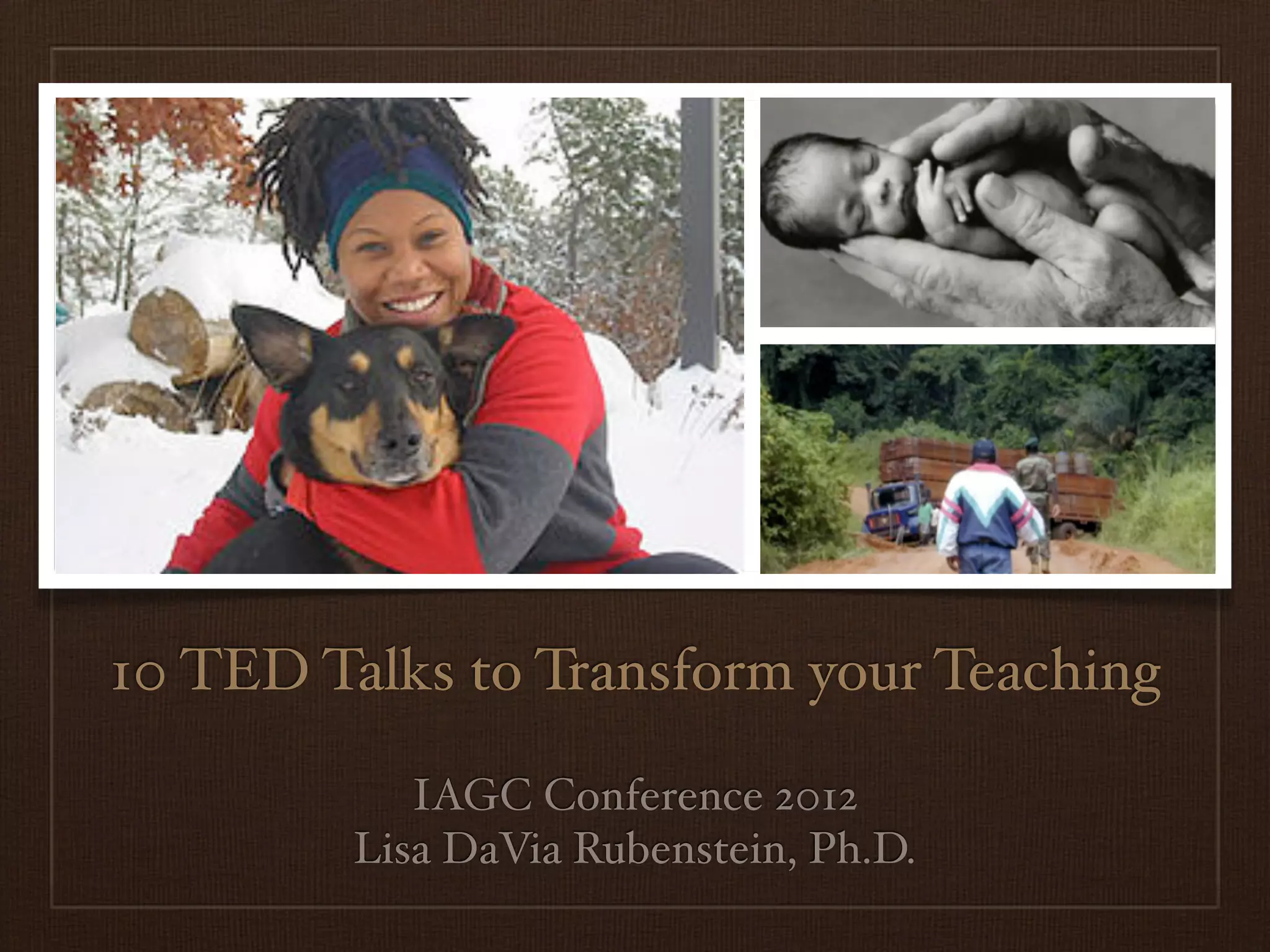
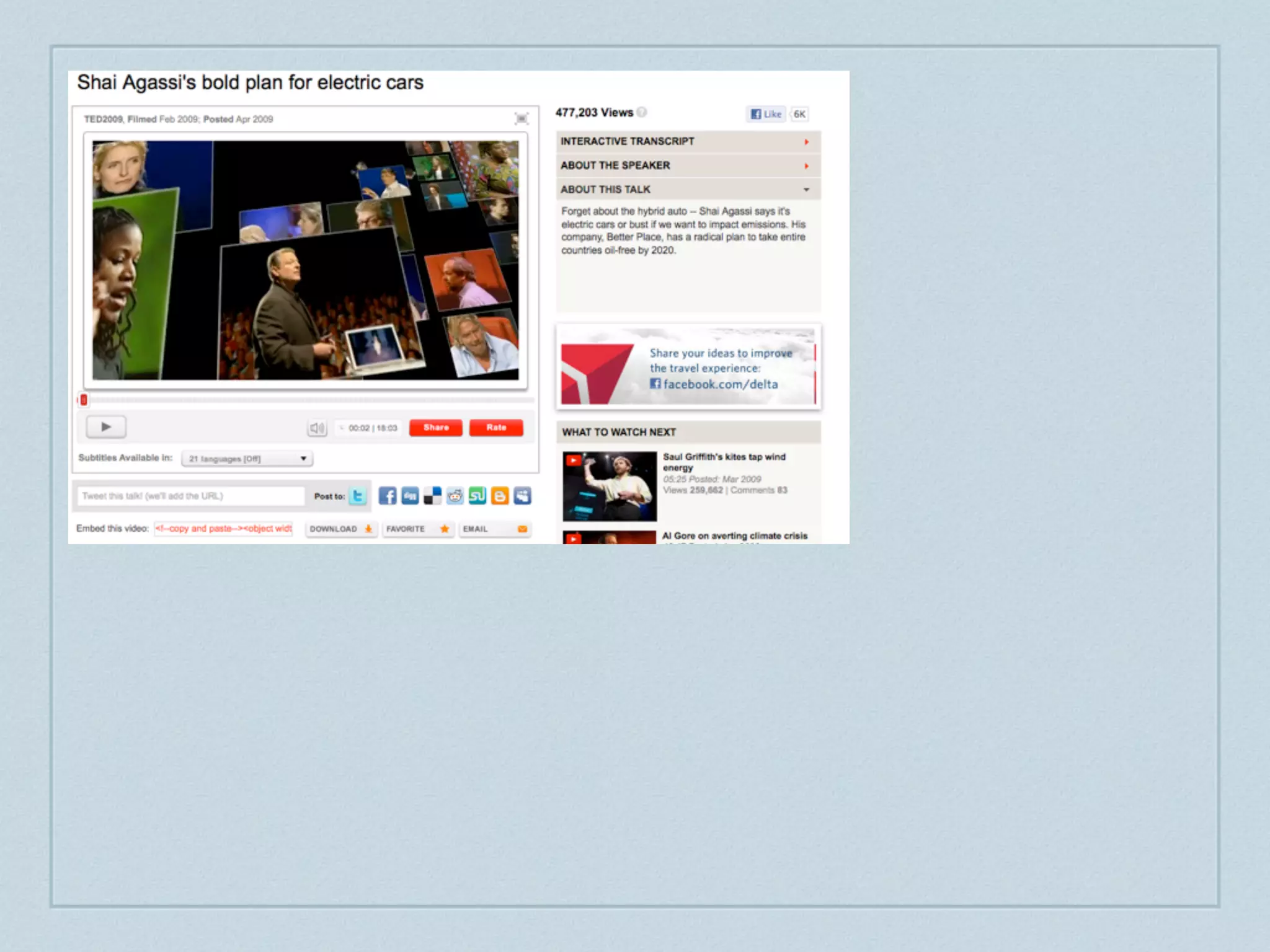
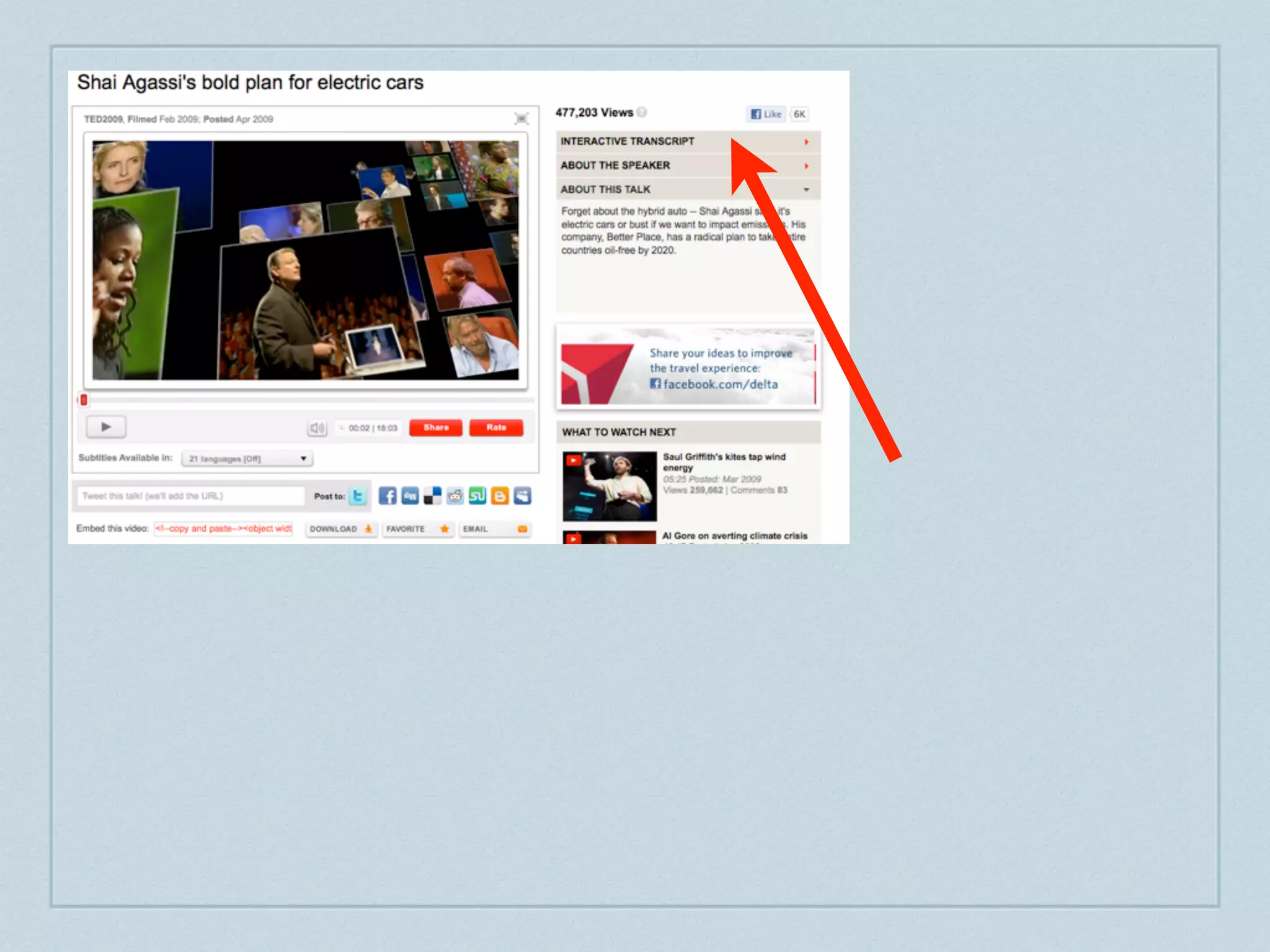
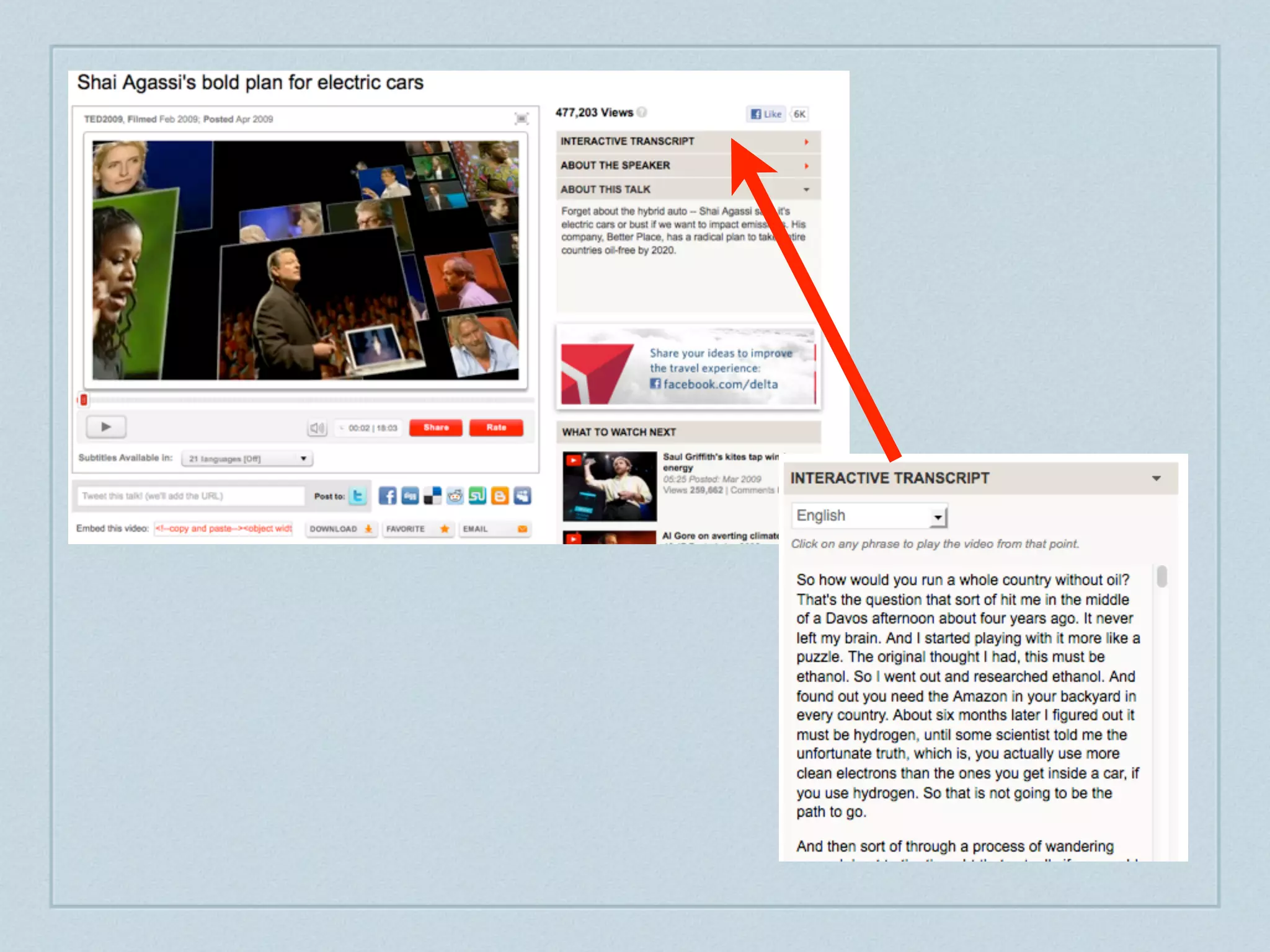
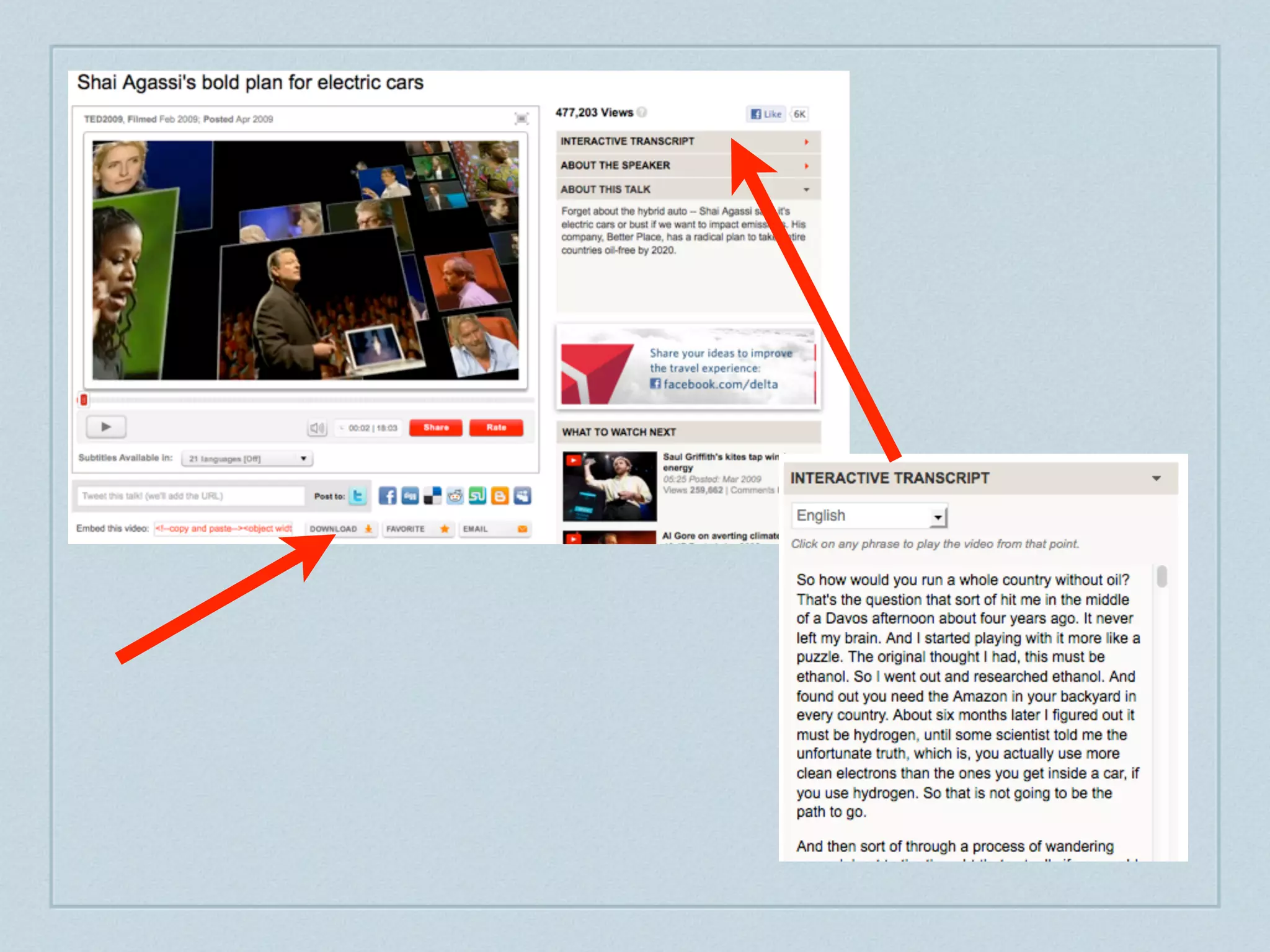







10 TED Talks to Transform your Teaching

            IAGC Conference 2012
         Lisa DaVia Rubenstein, Ph.D.
What makes an idea
 worth spreading?
What makes an idea
  worth spreading?
Are we spreading those ideas in our classrooms?
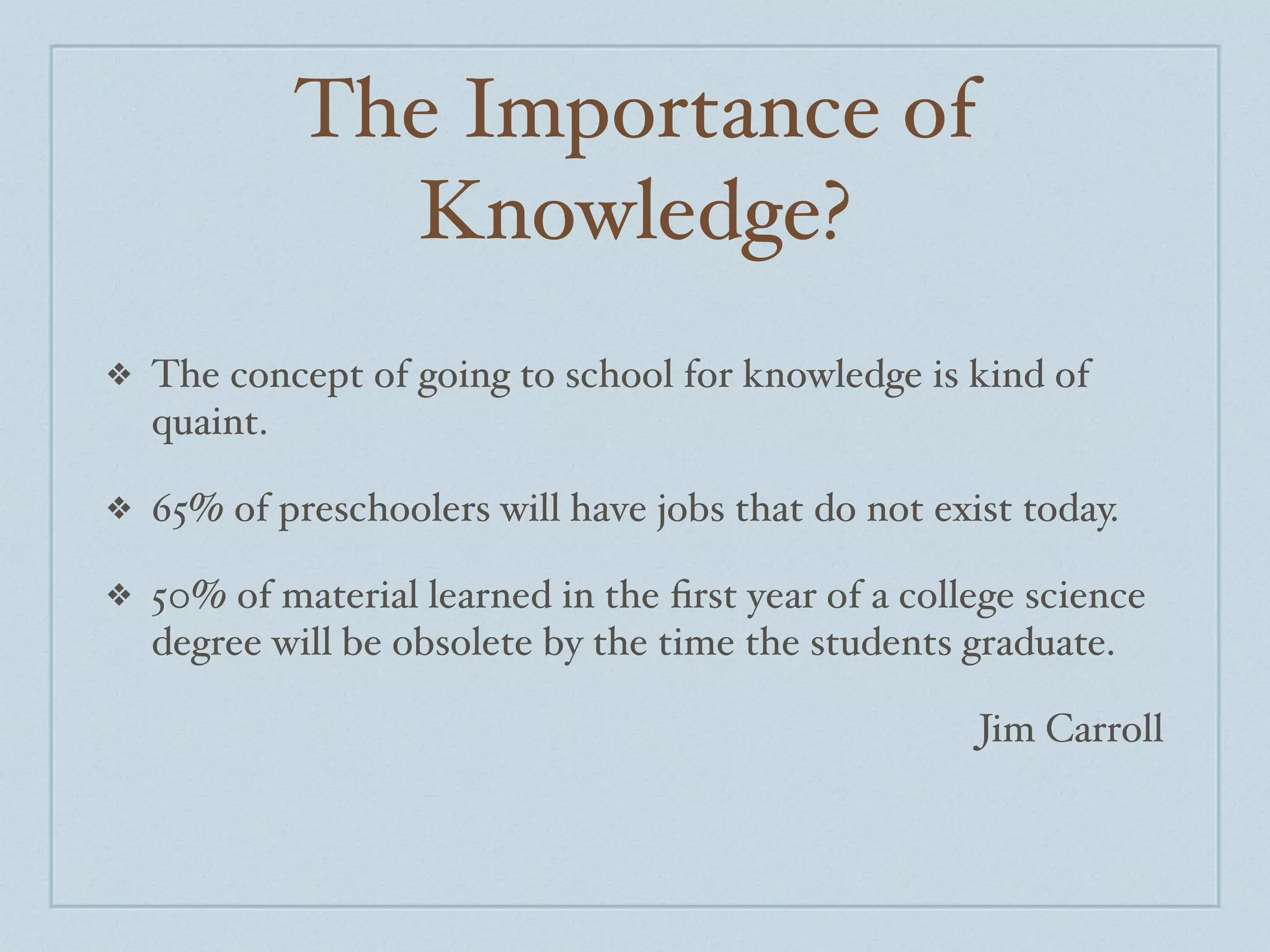
The Importance of
              Knowledge?
❖   The concept of going to school for knowledge is kind of
    quaint.

❖   65% of preschoolers will have jobs that do not exist today.

❖   50% of material learned in the first year of a college science
    degree will be obsolete by the time the students graduate.

                                                      Jim Carroll
Curriculum Evaluation
❖   Honorable: Is it worth their time? Could they easily look
    up the information? Does it honor the world we live in and
    the students we teach?

❖   Transferrable: Is it teaching a thought process? Could this
    idea be adjusted to apply in other areas? Are we explicitly
    teaching this transfer?

❖   Transformational: Will it change the world? Will it
    change the students’ perspective?

❖   Beneficial: Will it make the world better? Is it useful?

❖   Exciting: Does it engage the students? Does it inspire
    students to think about how they want to use their talents?
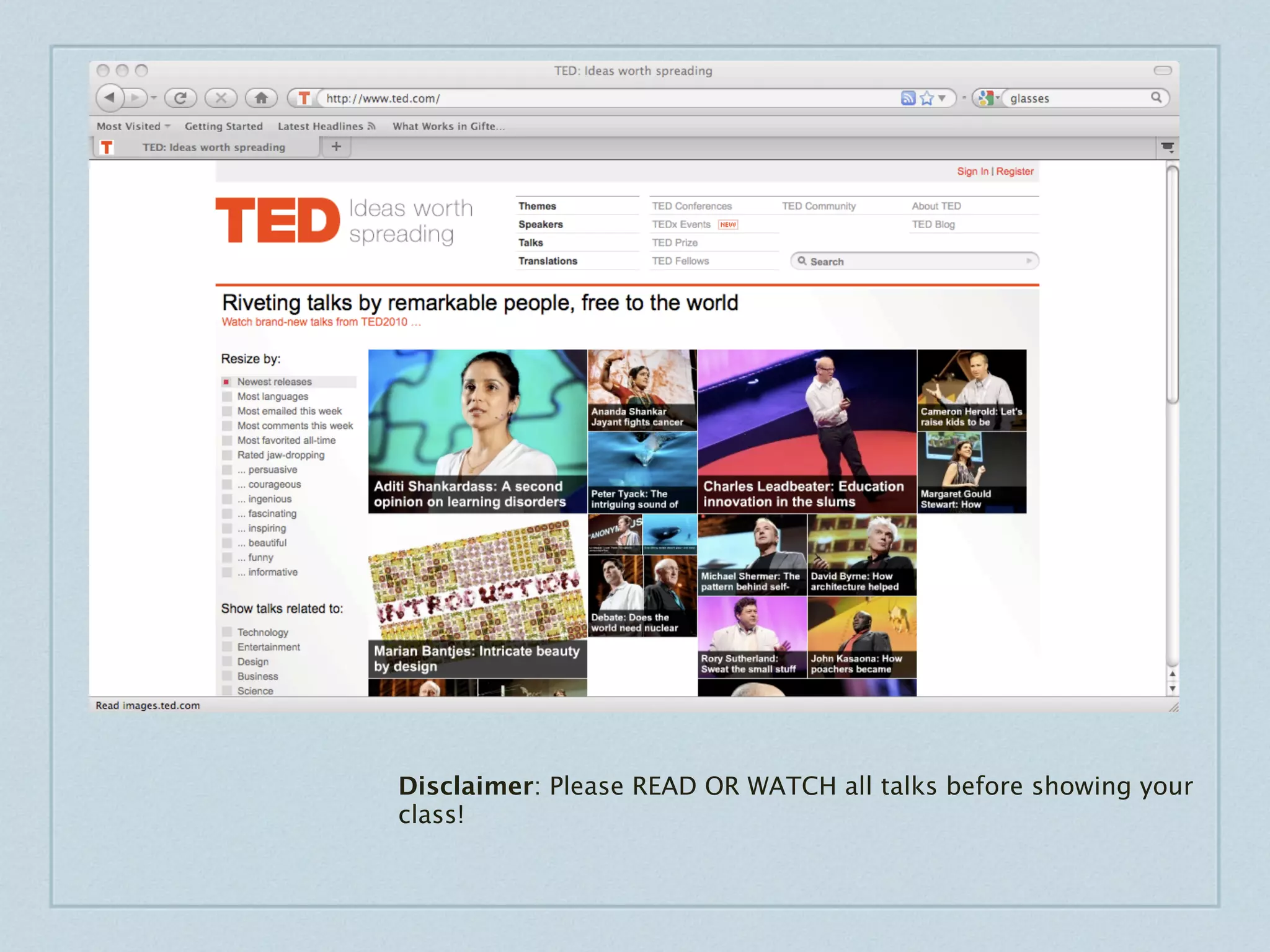
Disclaimer: Please READ OR WATCH all talks before showing your
class!
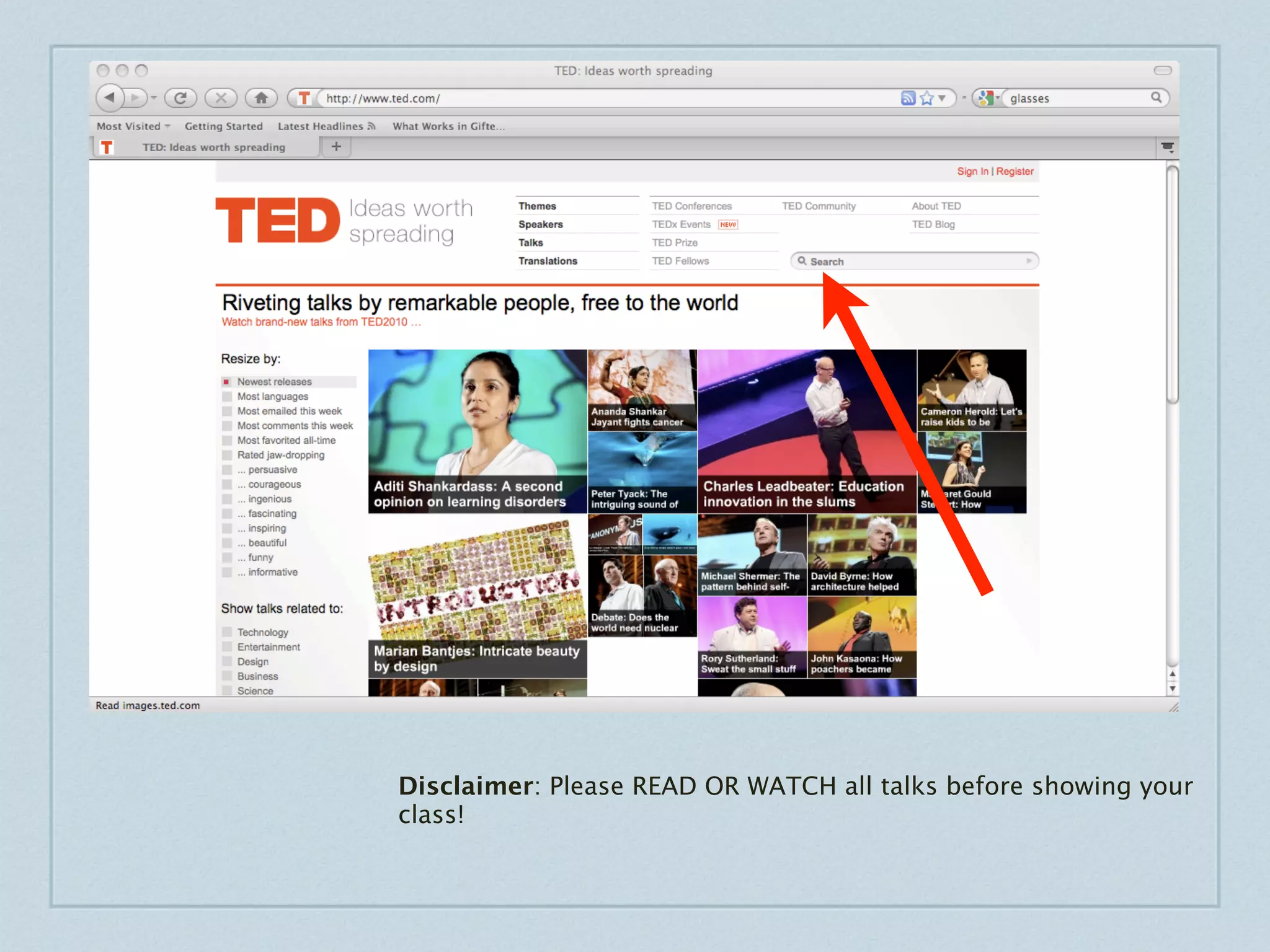
Disclaimer: Please READ OR WATCH all talks before showing your
class!
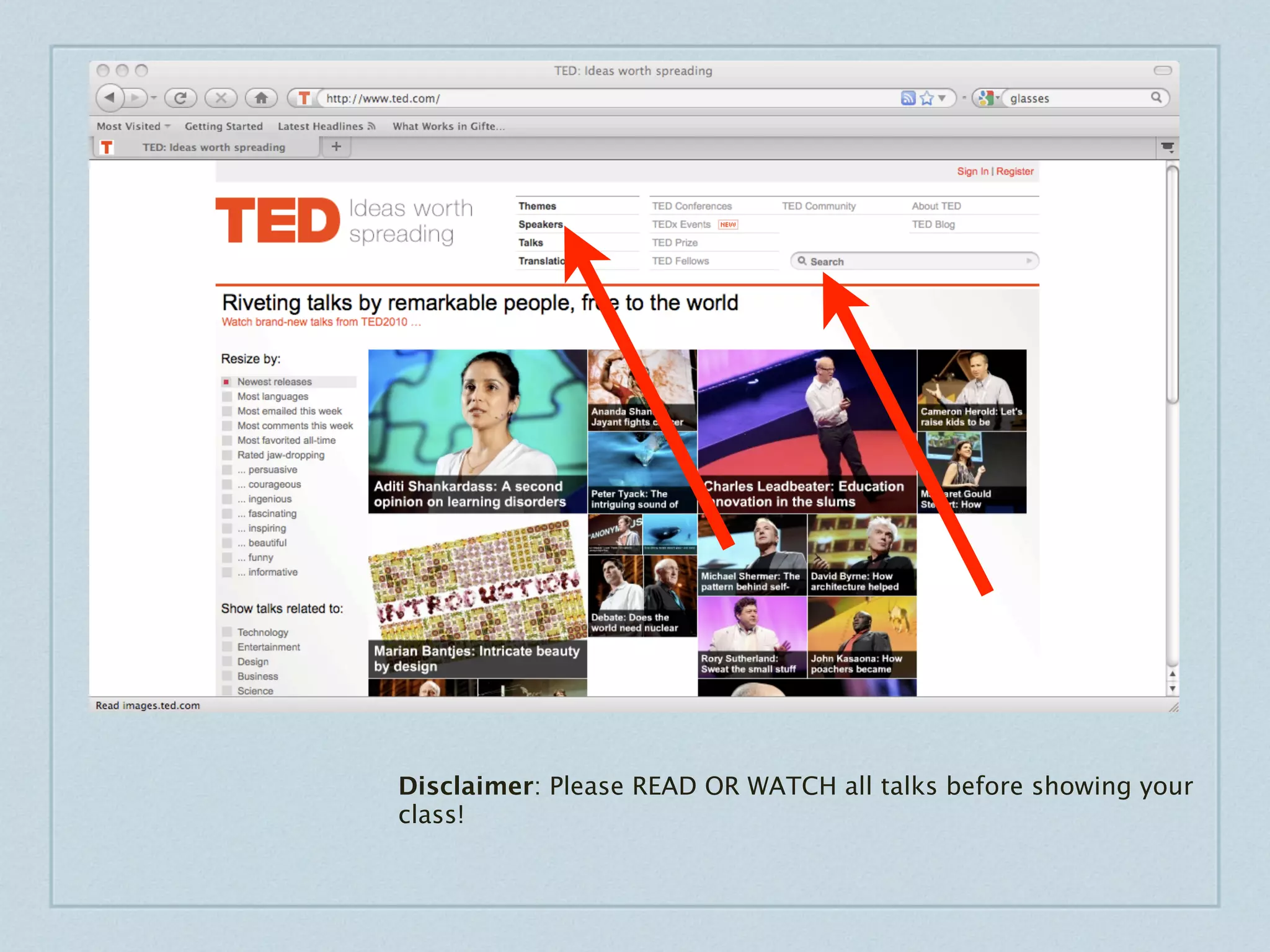
Disclaimer: Please READ OR WATCH all talks before showing your
class!
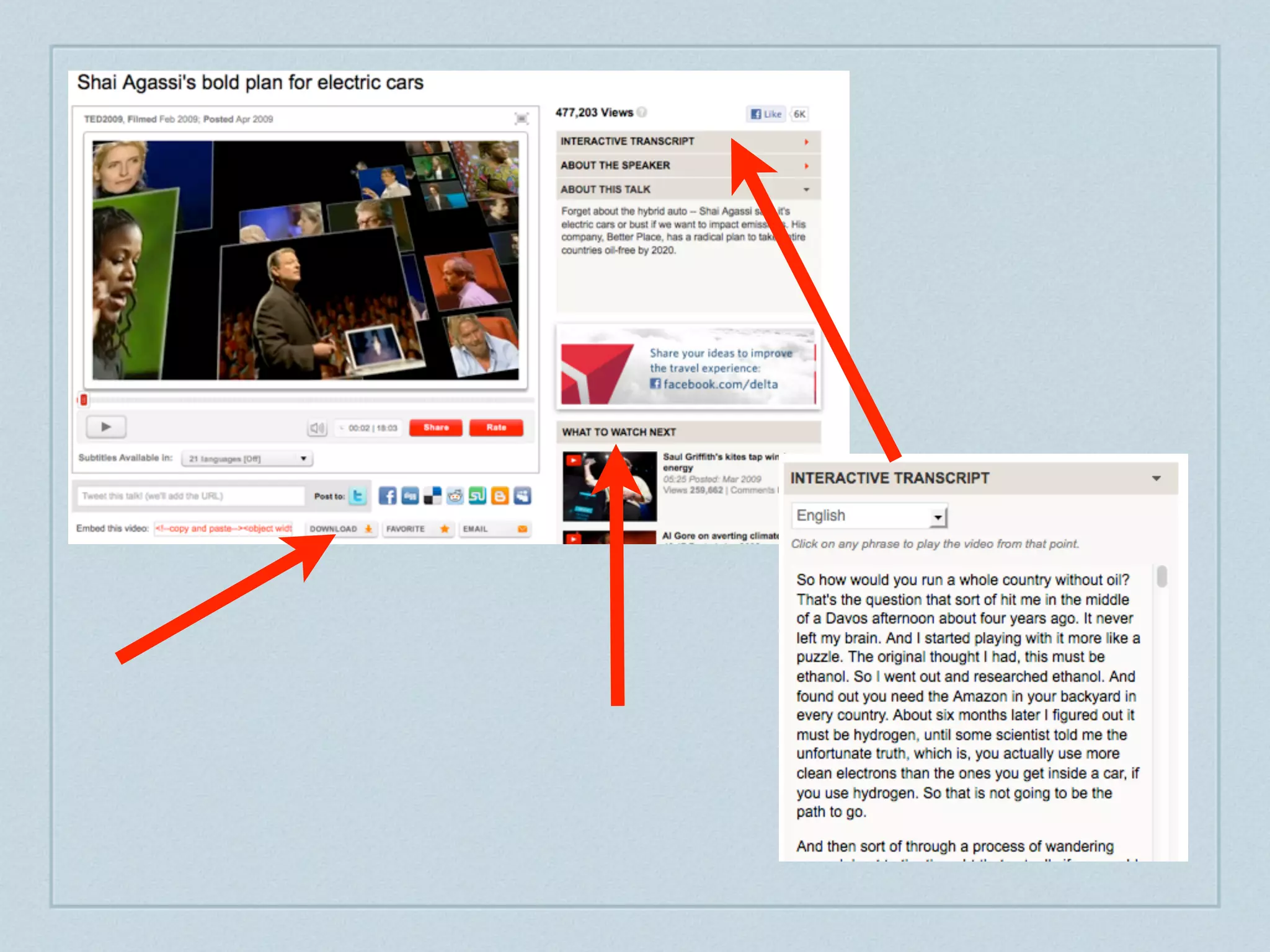
Teaching this lesson allowed me to experience the power of a TED
Talk. I have students who went home and looked up TED Talks
about topics they were interested in, and I had one student bring
headphones to school so he could watch one about his modern
explorer during in-class research time. Considering that I did not give
students much background information about TED Talks and I did not
actually encourage them to check them out on their own (which
maybe I should have!), I have been amazed at the positive response
students have shown. I was excited when I learned that my students
were actually pursuing TED Talks outside of class! Originally, I was
concerned that TED Talks might be too advanced for my 5th grade
class. However, my students enjoyed it, and they understood most of
it. Now, I am exploring the TED Talk website to find other talks that
relate to topics we study so that I can include them in more lessons in
the future.
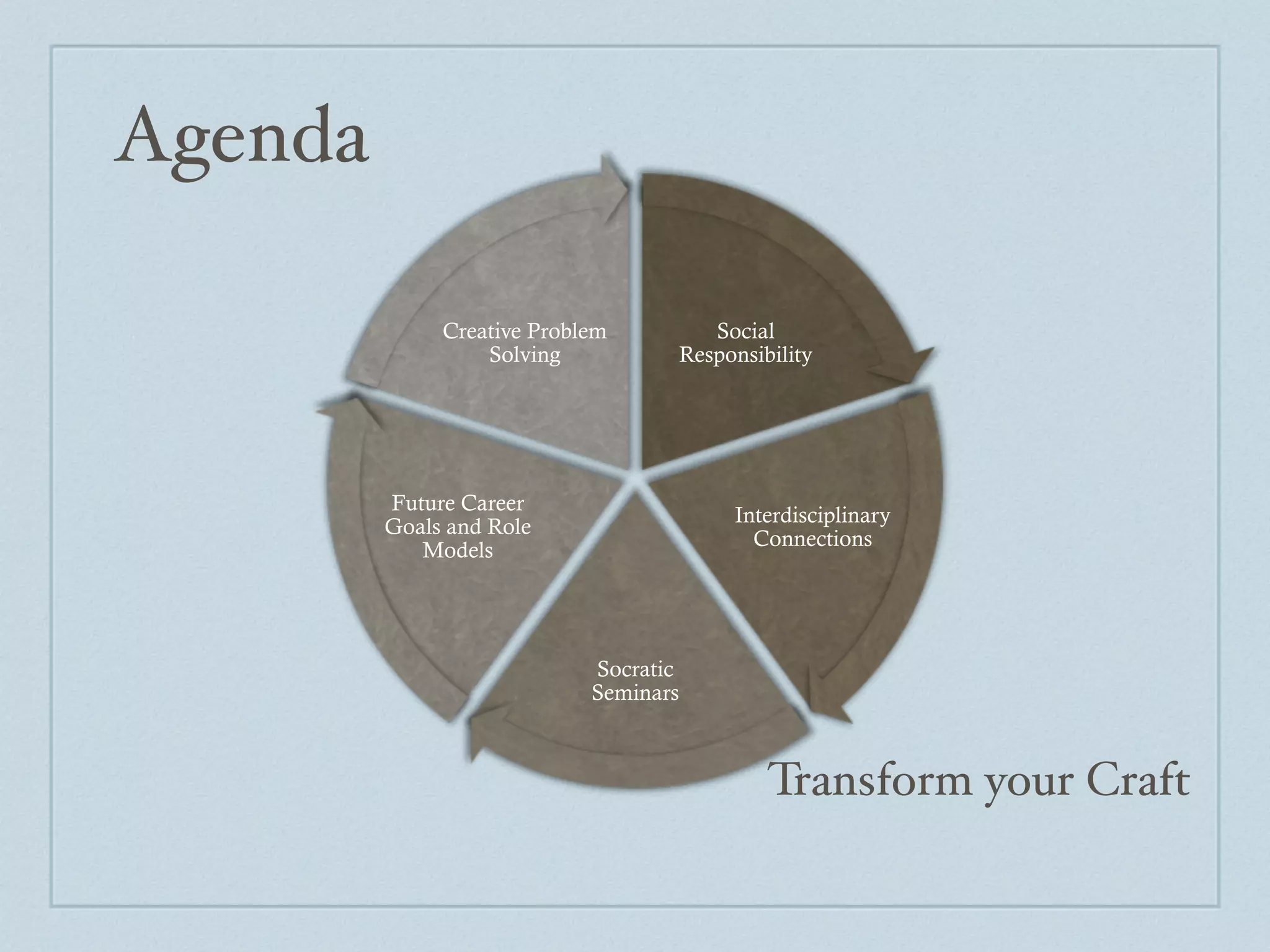
Agenda

              Creative Problem            Social
                  Solving              Responsibility


         Future Career
                                            Interdisciplinary
         Goals and Role
                                              Connections
            Models


                            Socratic
                            Seminars


                                                Transform your Craft
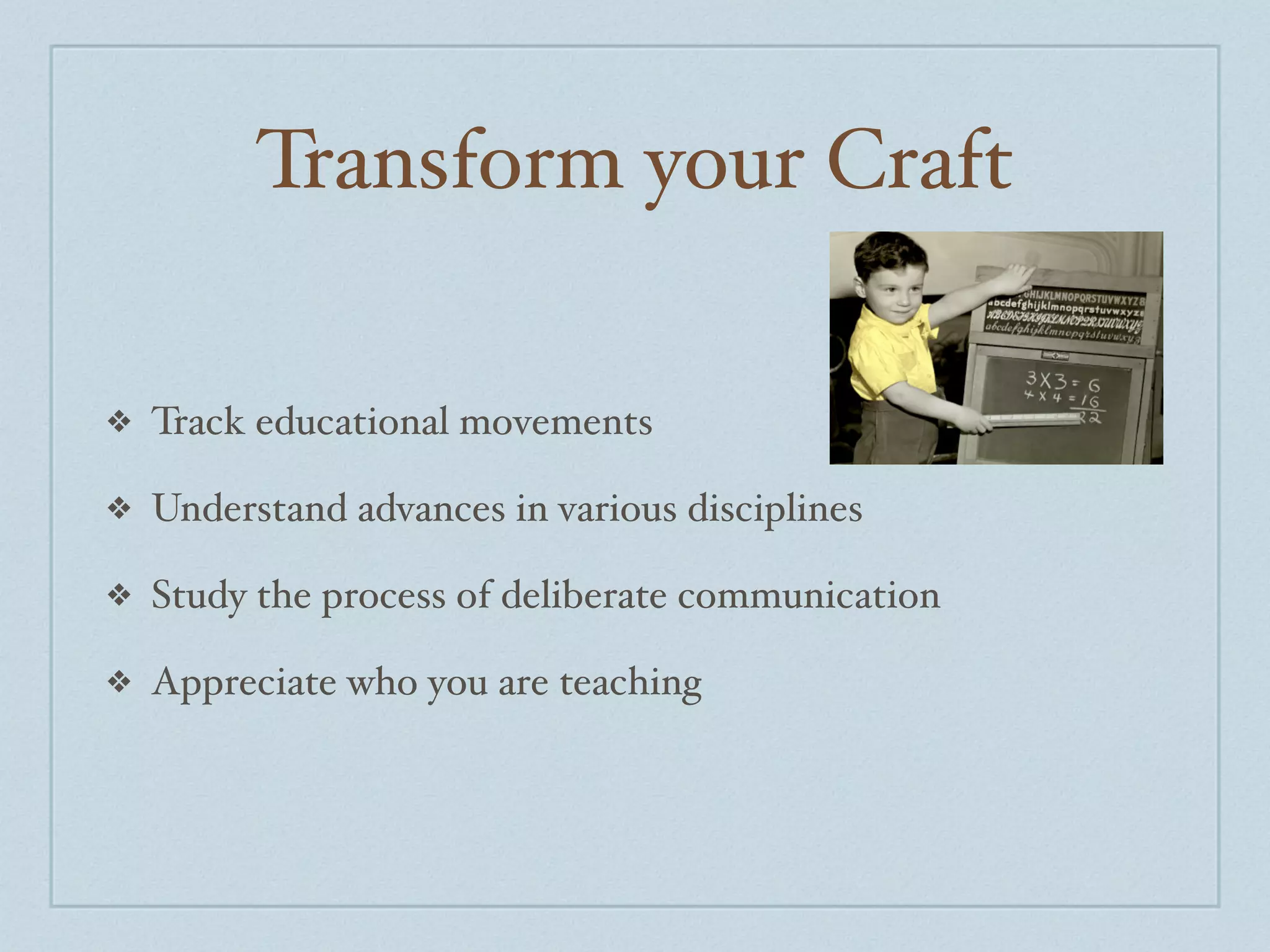
Transform your Craft

❖   Track educational movements

❖   Understand advances in various disciplines

❖   Study the process of deliberate communication

❖   Appreciate who you are teaching
Kiran BiSethi


Transform your Craft
Sir Ken Robinson


Transform your Craft
Dan Meyer


Math Class Needs a Makeover
Sugata Mitra


Transform your Craft
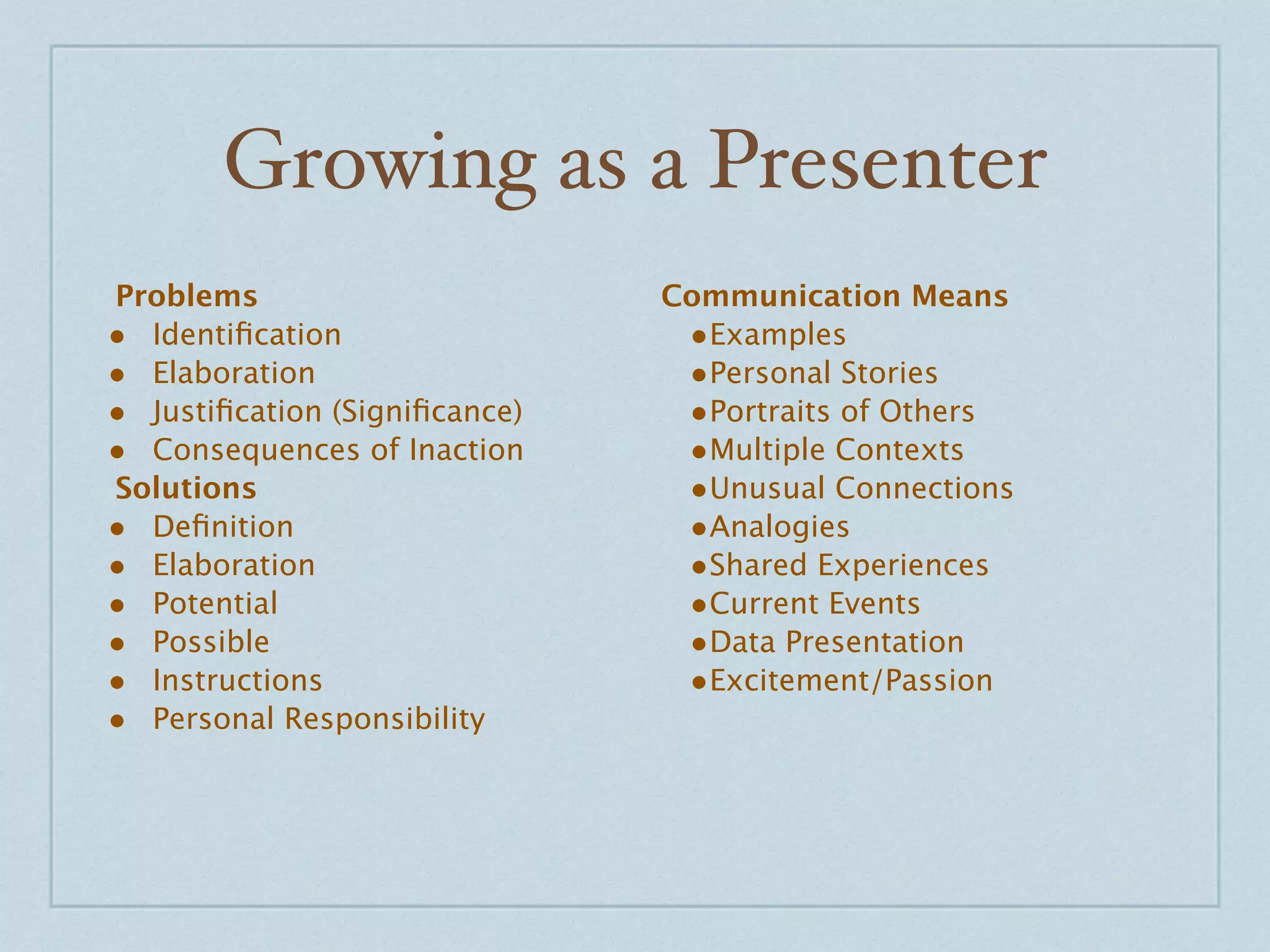
Growing as a Presenter
Problems                       Communication Means
• Identification                 •Examples
• Elaboration                   •Personal Stories
• Justification (Significance)    •Portraits of Others
• Consequences of Inaction      •Multiple Contexts
Solutions                       •Unusual Connections
• Definition                     •Analogies
• Elaboration                   •Shared Experiences
• Potential                     •Current Events
• Possible                      •Data Presentation
• Instructions                  •Excitement/Passion
• Personal Responsibility
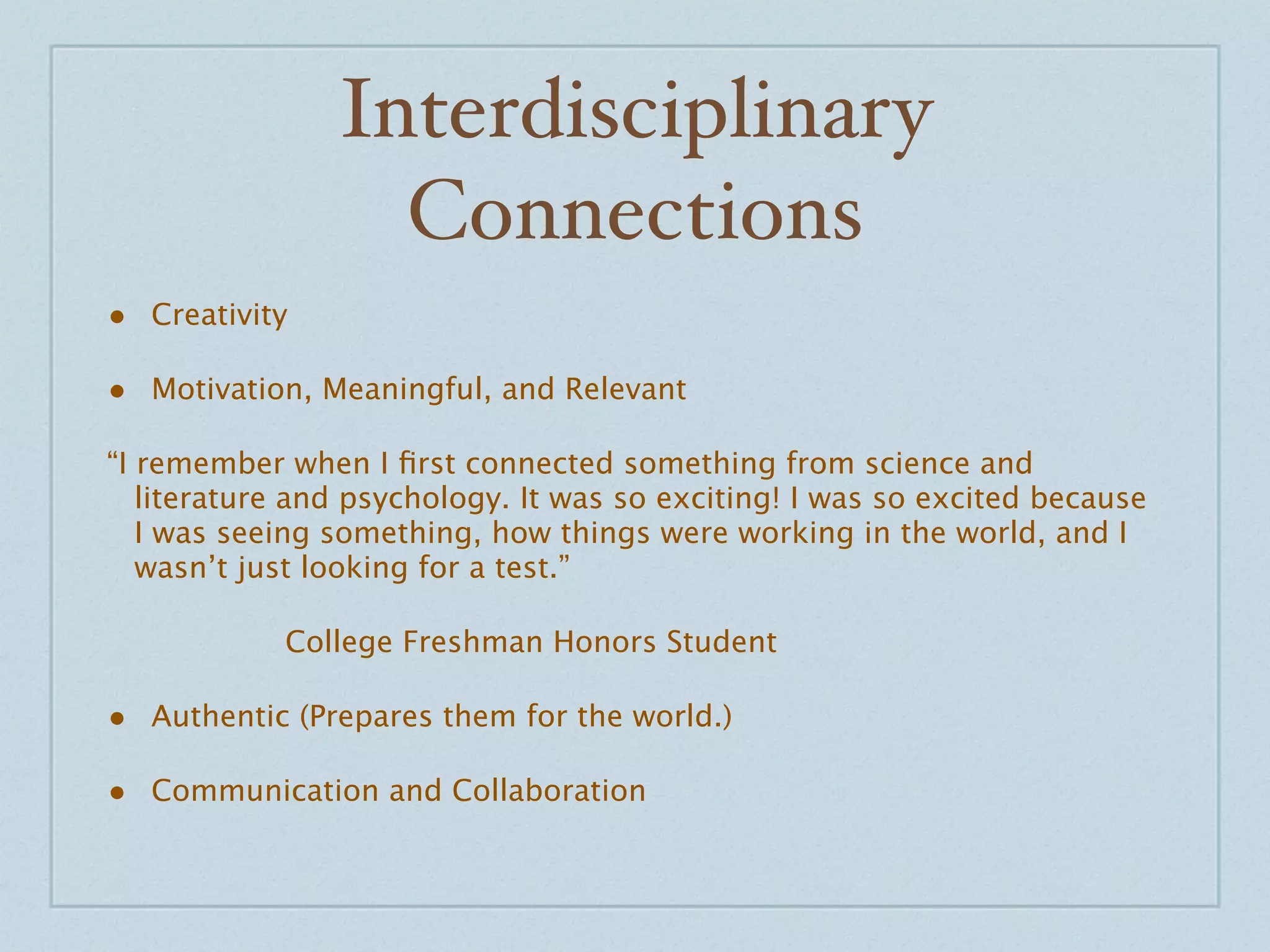
Interdisciplinary
                   Connections
• Creativity

• Motivation, Meaningful, and Relevant
“I remember when I first connected something from science and
   literature and psychology. It was so exciting! I was so excited because
   I was seeing something, how things were working in the world, and I
   wasn’t just looking for a test.”


   College Freshman Honors Student

• Authentic (Prepares them for the world.)

• Communication and Collaboration
Eric Whitacre


Interdisciplinary Connections
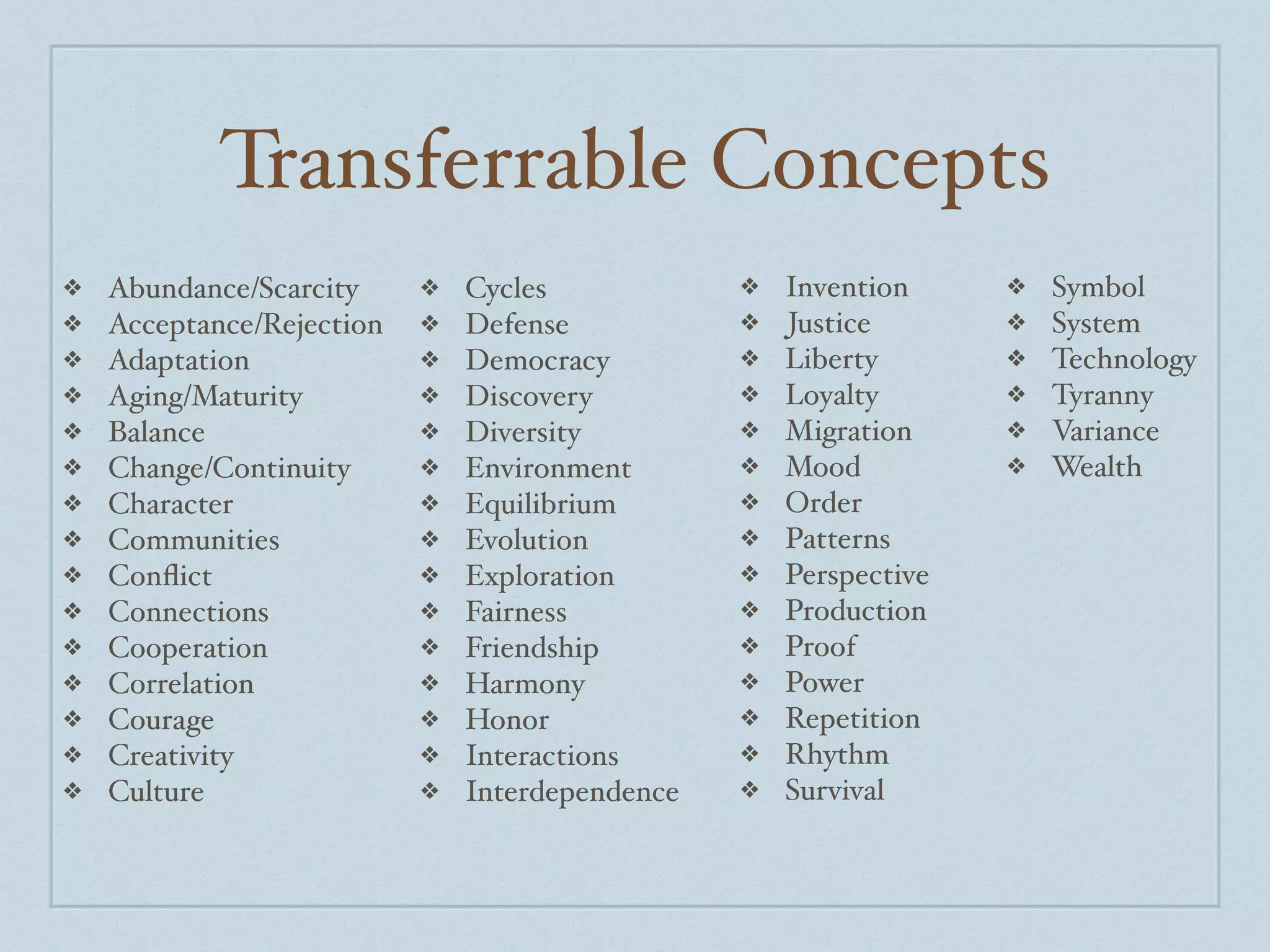
Transferrable Concepts
❖   Abundance/Scarcity     ❖   Cycles            ❖   Invention     ❖   Symbol
❖   Acceptance/Rejection   ❖   Defense           ❖   Justice       ❖   System
❖   Adaptation             ❖   Democracy         ❖   Liberty       ❖   Technology
❖   Aging/Maturity         ❖   Discovery         ❖   Loyalty       ❖   Tyranny
❖   Balance                ❖   Diversity         ❖   Migration     ❖   Variance
❖   Change/Continuity      ❖   Environment       ❖   Mood          ❖   Wealth
❖   Character              ❖   Equilibrium       ❖   Order
❖   Communities            ❖   Evolution         ❖   Patterns
❖   Conflict                ❖   Exploration       ❖   Perspective
❖   Connections            ❖   Fairness          ❖   Production
❖   Cooperation            ❖   Friendship        ❖   Proof
❖   Correlation            ❖   Harmony           ❖   Power
❖   Courage                ❖   Honor             ❖   Repetition
❖   Creativity             ❖   Interactions      ❖   Rhythm
❖   Culture                ❖   Interdependence   ❖   Survival
Jacek Utko


Interdisciplinary Connections
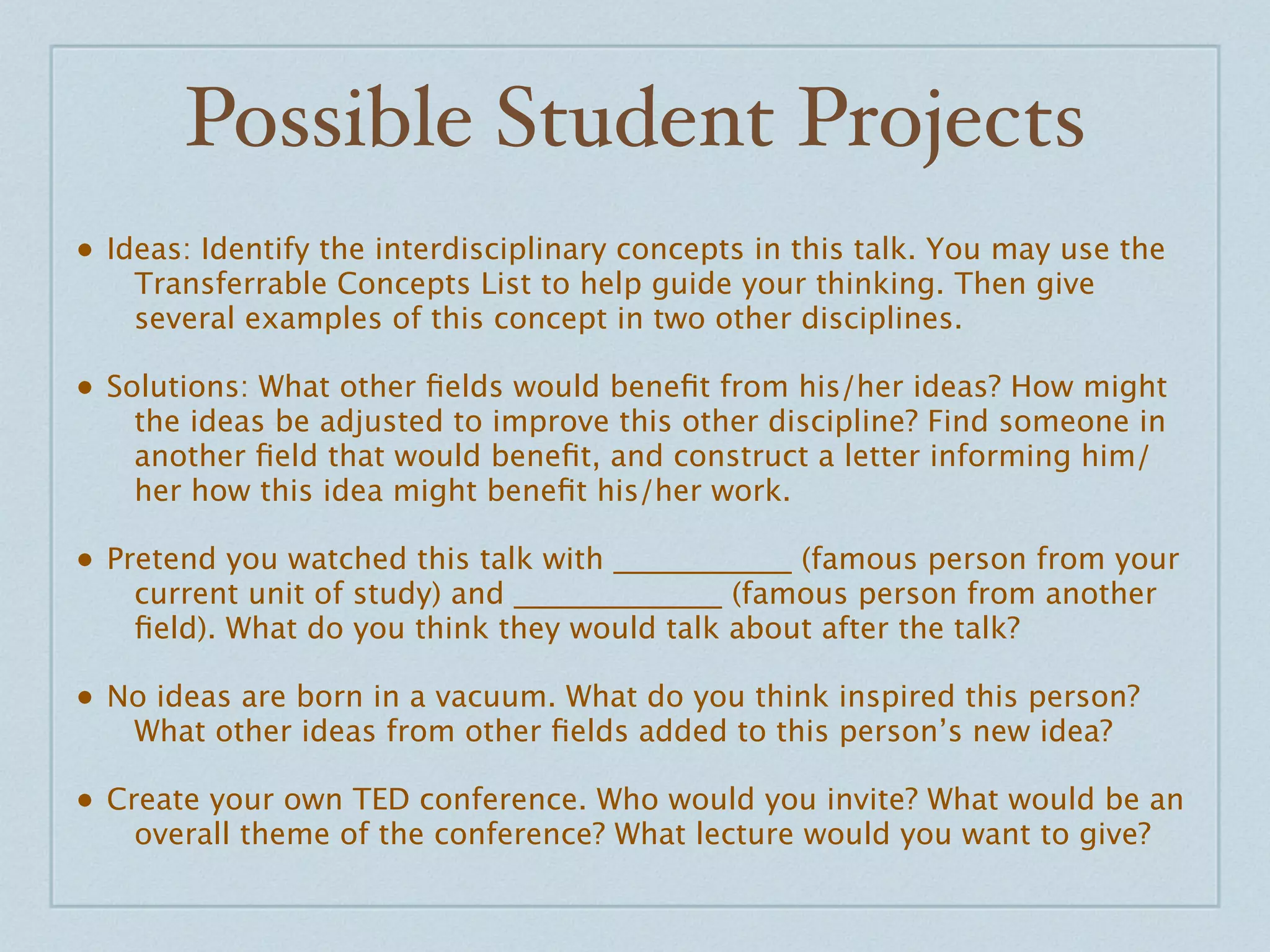
Possible Student Projects
• Ideas: Identify the interdisciplinary concepts in this talk. You may use the
    Transferrable Concepts List to help guide your thinking. Then give
    several examples of this concept in two other disciplines.

• Solutions: What other fields would benefit from his/her ideas? How might
    the ideas be adjusted to improve this other discipline? Find someone in
    another field that would benefit, and construct a letter informing him/
    her how this idea might benefit his/her work.

• Pretend you watched this talk with ____________ (famous person from your
    current unit of study) and ______________ (famous person from another
    field). What do you think they would talk about after the talk?

• No ideas are born in a vacuum. What do you think inspired this person?
    What other ideas from other fields added to this person’s new idea?

• Create your own TED conference. Who would you invite? What would be an
    overall theme of the conference? What lecture would you want to give?
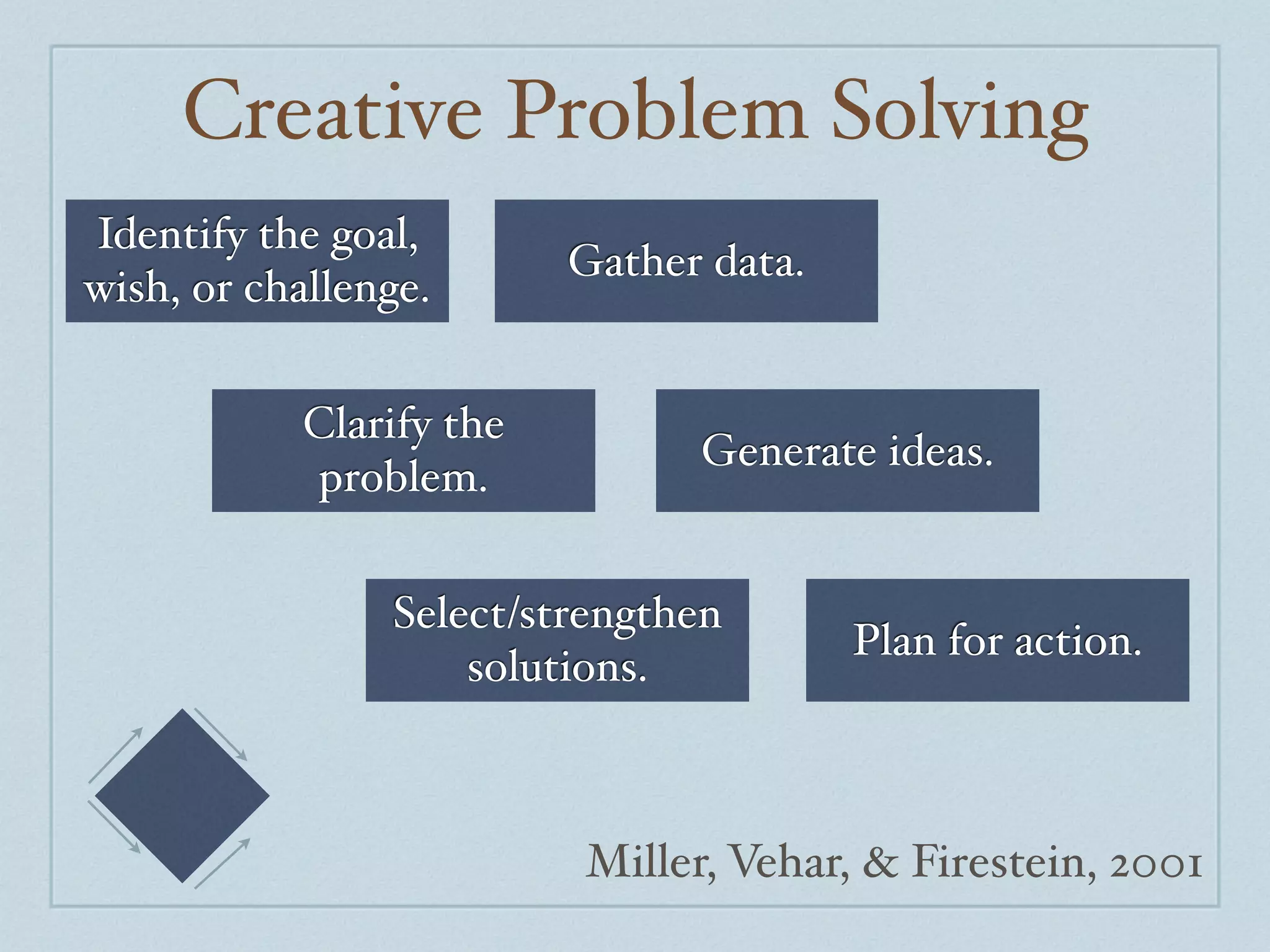
Creative Problem Solving
Identify the goal,
                         Gather data.
wish, or challenge.


           Clarify the
                               Generate ideas.
           problem.


                Select/strengthen
                                        Plan for action.
                    solutions.


                         Miller, Vehar, & Firestein, 2001
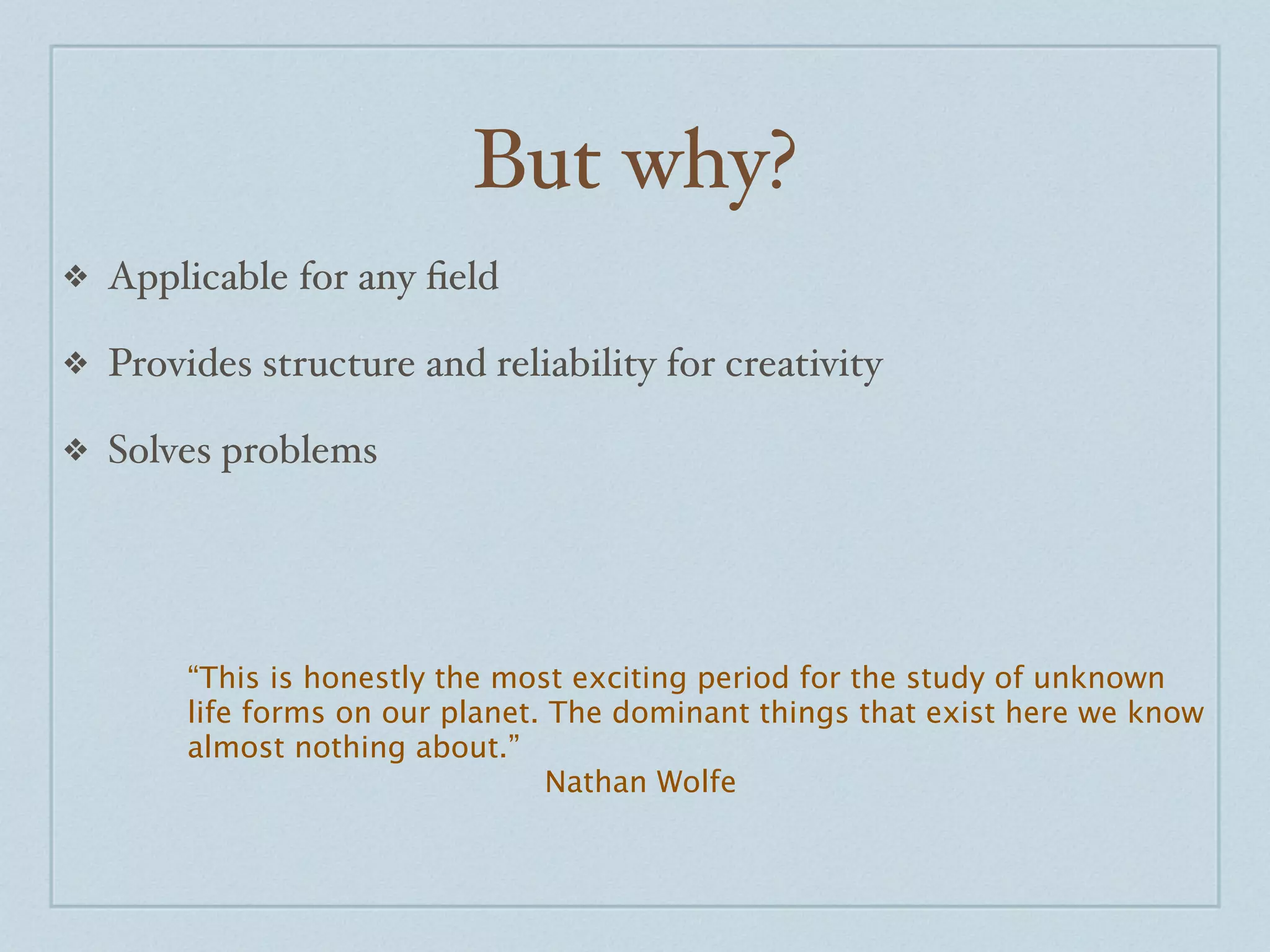
But why?
❖   Applicable for any field

❖   Provides structure and reliability for creativity

❖   Solves problems


         “This is honestly the most exciting period for the study of unknown
         life forms on our planet. The dominant things that exist here we know
         almost nothing about.”
                                   Nathan Wolfe
Nathan Wolfe


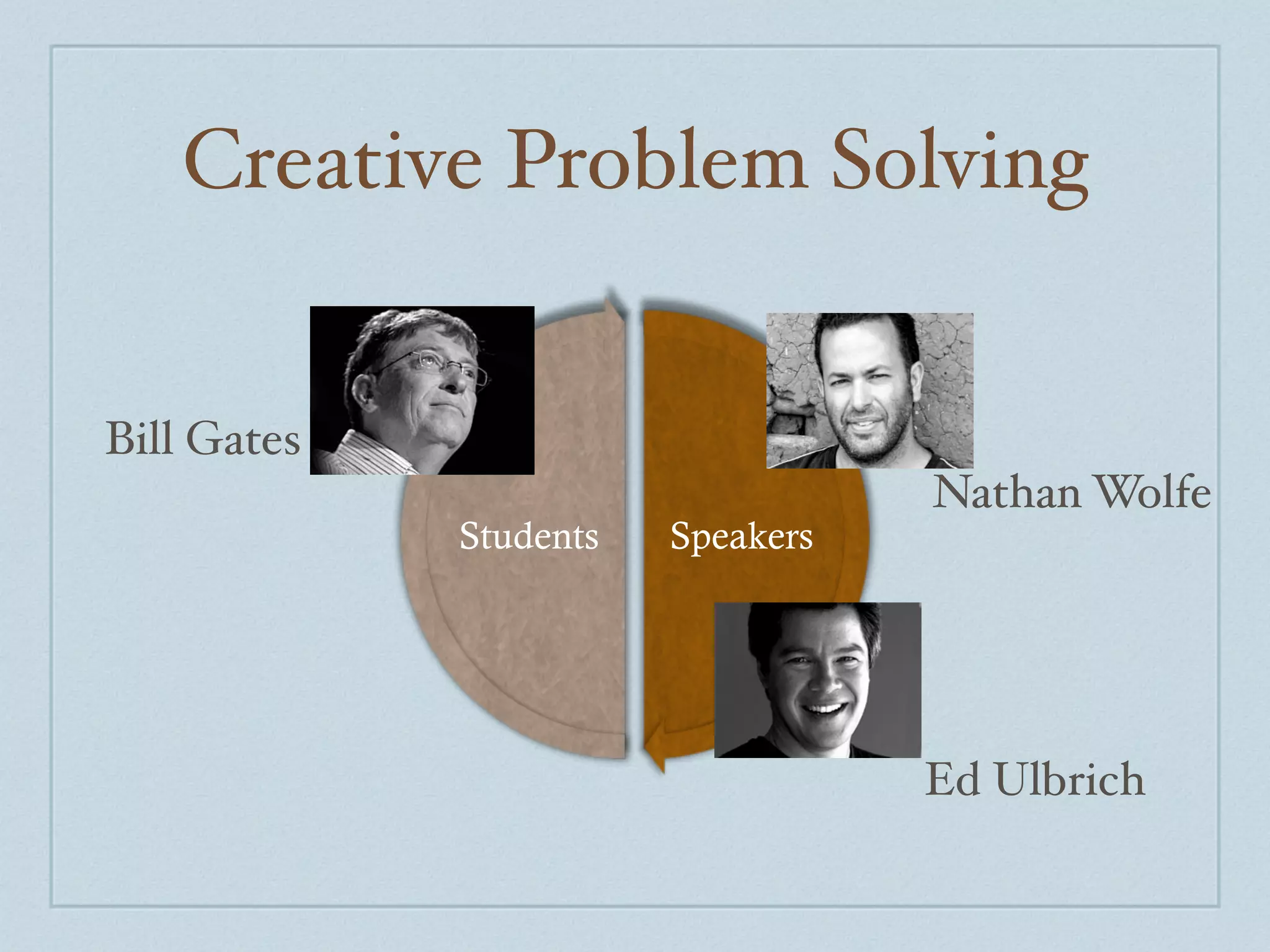
Creative Problem Solving
Ed Ulbrich


Creative Problem Solving


Bill Gates
                                   Nathan Wolfe
             Students   Speakers


                                   Ed Ulbrich
Student Projects
Speaker CPS
  Evaluate how the speaker solves the problem. What steps does he/she
    take? Would you have done it any differently? Was it effective? Why?
  Missing steps: What steps did the speaker neglect? Why do you think
    they were left out? Write a letter to the speaker to ask for further
    clarification on their problem solving experiences.

Student CPS
  Using the CPS framework, create another possible solution for the
    presented problem. Create a presentation for the building acceptance
    portion.
  Inevitably solving one problem brings to light several others. Examine
    potential problems that the speakers’ solution will trigger. Using the
    CPS framework, think though several possible solutions to this new
    problem.

TED Talks for Transformative Teaching Part 1

  • 1.
    10 TED Talksto Transform your Teaching IAGC Conference 2012 Lisa DaVia Rubenstein, Ph.D.
  • 2.
    What makes anidea worth spreading?
  • 3.
    What makes anidea worth spreading? Are we spreading those ideas in our classrooms?
  • 4.
    The Importance of Knowledge? ❖ The concept of going to school for knowledge is kind of quaint. ❖ 65% of preschoolers will have jobs that do not exist today. ❖ 50% of material learned in the first year of a college science degree will be obsolete by the time the students graduate. Jim Carroll
  • 5.
    Curriculum Evaluation ❖ Honorable: Is it worth their time? Could they easily look up the information? Does it honor the world we live in and the students we teach? ❖ Transferrable: Is it teaching a thought process? Could this idea be adjusted to apply in other areas? Are we explicitly teaching this transfer? ❖ Transformational: Will it change the world? Will it change the students’ perspective? ❖ Beneficial: Will it make the world better? Is it useful? ❖ Exciting: Does it engage the students? Does it inspire students to think about how they want to use their talents?
  • 6.
    Disclaimer: Please READOR WATCH all talks before showing your class!
  • 7.
    Disclaimer: Please READOR WATCH all talks before showing your class!
  • 8.
    Disclaimer: Please READOR WATCH all talks before showing your class!
  • 14.
    Teaching this lessonallowed me to experience the power of a TED Talk. I have students who went home and looked up TED Talks about topics they were interested in, and I had one student bring headphones to school so he could watch one about his modern explorer during in-class research time. Considering that I did not give students much background information about TED Talks and I did not actually encourage them to check them out on their own (which maybe I should have!), I have been amazed at the positive response students have shown. I was excited when I learned that my students were actually pursuing TED Talks outside of class! Originally, I was concerned that TED Talks might be too advanced for my 5th grade class. However, my students enjoyed it, and they understood most of it. Now, I am exploring the TED Talk website to find other talks that relate to topics we study so that I can include them in more lessons in the future.
  • 15.
    Agenda Creative Problem Social Solving Responsibility Future Career Interdisciplinary Goals and Role Connections Models Socratic Seminars Transform your Craft
  • 16.
    Transform your Craft ❖ Track educational movements ❖ Understand advances in various disciplines ❖ Study the process of deliberate communication ❖ Appreciate who you are teaching
  • 17.
  • 18.
  • 19.
    Dan Meyer Math ClassNeeds a Makeover
  • 20.
  • 21.
    Growing as aPresenter Problems Communication Means • Identification •Examples • Elaboration •Personal Stories • Justification (Significance) •Portraits of Others • Consequences of Inaction •Multiple Contexts Solutions •Unusual Connections • Definition •Analogies • Elaboration •Shared Experiences • Potential •Current Events • Possible •Data Presentation • Instructions •Excitement/Passion • Personal Responsibility
  • 22.
    Interdisciplinary Connections • Creativity • Motivation, Meaningful, and Relevant “I remember when I first connected something from science and literature and psychology. It was so exciting! I was so excited because I was seeing something, how things were working in the world, and I wasn’t just looking for a test.” College Freshman Honors Student • Authentic (Prepares them for the world.) • Communication and Collaboration
  • 23.
  • 24.
    Transferrable Concepts ❖ Abundance/Scarcity ❖ Cycles ❖ Invention ❖ Symbol ❖ Acceptance/Rejection ❖ Defense ❖ Justice ❖ System ❖ Adaptation ❖ Democracy ❖ Liberty ❖ Technology ❖ Aging/Maturity ❖ Discovery ❖ Loyalty ❖ Tyranny ❖ Balance ❖ Diversity ❖ Migration ❖ Variance ❖ Change/Continuity ❖ Environment ❖ Mood ❖ Wealth ❖ Character ❖ Equilibrium ❖ Order ❖ Communities ❖ Evolution ❖ Patterns ❖ Conflict ❖ Exploration ❖ Perspective ❖ Connections ❖ Fairness ❖ Production ❖ Cooperation ❖ Friendship ❖ Proof ❖ Correlation ❖ Harmony ❖ Power ❖ Courage ❖ Honor ❖ Repetition ❖ Creativity ❖ Interactions ❖ Rhythm ❖ Culture ❖ Interdependence ❖ Survival
  • 25.
  • 26.
    Possible Student Projects •Ideas: Identify the interdisciplinary concepts in this talk. You may use the Transferrable Concepts List to help guide your thinking. Then give several examples of this concept in two other disciplines. • Solutions: What other fields would benefit from his/her ideas? How might the ideas be adjusted to improve this other discipline? Find someone in another field that would benefit, and construct a letter informing him/ her how this idea might benefit his/her work. • Pretend you watched this talk with ____________ (famous person from your current unit of study) and ______________ (famous person from another field). What do you think they would talk about after the talk? • No ideas are born in a vacuum. What do you think inspired this person? What other ideas from other fields added to this person’s new idea? • Create your own TED conference. Who would you invite? What would be an overall theme of the conference? What lecture would you want to give?
  • 27.
    Creative Problem Solving Identifythe goal, Gather data. wish, or challenge. Clarify the Generate ideas. problem. Select/strengthen Plan for action. solutions. Miller, Vehar, & Firestein, 2001
  • 28.
    But why? ❖ Applicable for any field ❖ Provides structure and reliability for creativity ❖ Solves problems “This is honestly the most exciting period for the study of unknown life forms on our planet. The dominant things that exist here we know almost nothing about.” Nathan Wolfe
  • 29.
  • 30.
  • 31.
    Creative Problem Solving BillGates Nathan Wolfe Students Speakers Ed Ulbrich
  • 32.
    Student Projects Speaker CPS Evaluate how the speaker solves the problem. What steps does he/she take? Would you have done it any differently? Was it effective? Why? Missing steps: What steps did the speaker neglect? Why do you think they were left out? Write a letter to the speaker to ask for further clarification on their problem solving experiences. Student CPS Using the CPS framework, create another possible solution for the presented problem. Create a presentation for the building acceptance portion. Inevitably solving one problem brings to light several others. Examine potential problems that the speakers’ solution will trigger. Using the CPS framework, think though several possible solutions to this new problem.

Editor's Notes