XL-PS20005BM-en-US Rev B
LSZ13 Suspension
Installation and Operation Manual
2 XL-PS20005BM-en-US Rev A · 2015-08-13 · Amendments and Errors Reserved © SAF-HOLLAND, Inc., SAF-HOLLAND, HOLLAND, NEWAY, SAF, and logos are trademarks of
SAF-HOLLAND S.A., SAF-HOLLAND GmbH, and SAF-HOLLAND, Inc.
Contents
Contents Page
Introduction......................................................................... 2
Warranty.............................................................................. 2
Notes, Cautions, and Warnings............................................. 2
Section 1 – Safety Instructions ............................................. 3
Section 2 – Decal Requirements ........................................... 4
Section 3 – Model Identification .......................................... 4
Section 4 – Model Nomenclature ......................................... 5
NEWAY®
LSZ13 Series Suspension – Exploded View.............. 6
NEWAY®
LSZ13 Series Suspension – Parts List ...................... 7
Section 5 – Welding Standards............................................. 8
Contents Page
Section 6 – Pre-Installation ................................................. 9
Section 7 – Installation ...................................................... 10
Section 8 – Alignment........................................................ 14
Section 9 – Pre-Operation .................................................. 15
Section 10 – Torque Specifications ..................................... 17
Section 11 – Lubrication Specifications .............................. 17
Section 12 – Routine Maintenance and Inspection ............. 18
Section 13 – Troubleshooting ............................................. 21
Section 14 – Service Repair Kits ......................................... 23
Notes, Cautions, and Warnings
Before starting any work on the unit, read and understand all
the safety procedures presented in this manual. This manual
contains the terms “NOTE”, “IMPORTANT”, “CAUTION”, and
“WARNING” followed by important product information. These
terms are defined as follows:
NOTE: Includes additional information to enable accurate
and easy performance of procedures.
IMPORTANT: Includes additional information that
if not followed could lead to hindered
product performance.
Used without the safety alert symbol,
indicates a potentially hazardous
situation which, if not avoided, could
result in property damage.
Indicates a potentially hazardous
situation which, if not avoided, could
result in minor or moderate injury.
Indicates a potentially hazardous
situation which, if not avoided, could
result in death or serious injury.
Introduction
This manual provides the necessary information for the
installation, maintenance, inspection, and safe operation
of the Neway®
LSZ Series Auxiliary Air Suspension.
NOTE: To assist with installation, customer inspection
drawing LSZ13_TAB_CI is required and is included
in the literature kit.
Read this manual before using or servicing this product and
keep it in a safe location for future reference. Updates to this
manual, which are published as necessary, are available on
the internet at www.safholland.us.
When replacement parts are required, SAF-HOLLAND®
highly
recommends the use of only SAF-HOLLAND®
Original Parts.
A list of technical support locations that supply SAF-HOLLAND®
Original Parts and an Aftermarket Parts Catalog are available
on the internet at www.safholland.us or contact Customer
Service at 888-396-6501.
Warranty
Refer to the complete warranty for the country in which
the product will be used. A copy of the written warranty
is included with the product or available on the internet
at www.safholland.com.
3XL-PS20005BM-en-US Rev B · 2015-08-13 · Amendments and Errors Reserved © SAF-HOLLAND, Inc., SAF-HOLLAND, HOLLAND, NEWAY, SAF, and logos are trademarks of
SAF-HOLLAND S.A., SAF-HOLLAND GmbH, and SAF-HOLLAND, Inc.
General Safety
Operational and Road Safety Instructions
Before operating vehicle, ensure that the maximum permissible
axle load is NOT exceeded and that the load is distributed
equally and uniformly and in accordance with state and
federal bridge laws.
Make sure that the brakes are NOT overheated from
continuous operation.
Failure to minimize the use of brakes during
overheating conditions could result in
deterioration of brake efficiency which, if not
avoided, could result in death or serious injury.
Observe the operating recommendation of the truck
manufacturer for off-road operation of the installed axles.
IMPORTANT: The definition of OFF-ROAD means driving
on non-asphalt/non-concrete routes, e.g.
gravel roads, agricultural and forestry tracks,
on construction sites and in gravel pits.
IMPORTANT: Off-road operation of axles beyond
the approved application design could
result in damage and impair suspension
system performance.
Follow the recommended routine maintenance and inspections
described in this manual. These procedures are designed so
that optimum performance and operational safety are achieved.
The suspension springs should always be operated with
a static operating pressure between 20 psi (1.38 bar)
and 107 psi (7.38 bar).
Failure to operate the air springs with a
proper static operating pressure could
cause premature component failure and
loss of vehicle control which, if not avoided,
could result in death or serious injury.
In the event of suspension air pressure loss, quickly reduce
speed as safely as possible and remove the vehicle from
traffic. If unable to remove vehicle from traffic, follow DOT
safety requirements regarding emergency situations.
Contact a qualified towing and/or service company to assist
in repairing the vehicle or to move it to a qualified repair facility.
DO NOT operate the vehicle in the absence of suspension
air pressure; however in the event of an air system failure
while in service, an internal rubber bumper built into the
air spring will make it possible to temporarily operate the
vehicle at reduced speed determined by road conditions.
Operating the vehicle without proper air
pressure can cause tire failure, fire, or loss
of vehicle control which, if not avoided,
could result in death or serious injury.
The suspension MUST be lifted when the vehicle is moving
in reverse.
Failure to lift axle when in reverse could
result in tire or axle damage.
1. Safety Instructions
General and Servicing Safety Instructions
Read and observe all Warning and Caution hazard alert
messages.The alerts provide information that can help prevent
serious personal injury, damage to components, or both.
Failure to follow the instructions and safety
precautions in this manual could result in
improper servicing or operation leading
to component failure which, if not avoided,
could result in death or serious injury.
All installations should be performed by a properly trained
technician using proper/special tools, and safe procedures.
NOTE: In the United States, workshop safety requirements
are defined by federal and/or state Occupational
Safety and Health Act (OSHA). Equivalent laws may
exist in other countries.This manual is written based
on the assumption that OSHA or other applicable
employee safety regulations are followed by the
location where work is performed.
Properly support and secure the vehicle from unexpected
movement when servicing the unit.
Failure to properly support and secure the
vehicle and axles prior to commencing work
could create a crush hazard which, if not
avoided, could result in death or serious injury.
Service both roadside and curbside of an axle. Worn parts
should be replaced in sets. Key components on each axle’s
braking system, such as friction material, rotors and drums
will normally wear over time.
Follow all manufacturer’s instructions on spring pressure
and air pressure controls.
Failure to follow manufacturer’s instructions
regarding spring pressure or air pressure
control could allow unexpected release of
energy which, if not avoided, could result
in death or serious injury.
The wheel contact surfaces between the wheel and hub/drum
MUST NOT be additionally painted.
IMPORTANT: The wheel contact surfaces MUST be clean,
smooth and free from grease.
Failure to keep wheel and hub contact surfaces
clean and clear of foreign material could
allow wheel/hub separations which, if not
avoided, could result in death or serious injury.
Only the wheel and tire sizes approved by SAF-HOLLAND®
can be used.
Tire clearance between tires and the suspension MUST be
regularly monitored and maintained.
Failure to maintain tire clearance between
tires and the nearest point of contact on
the suspension or vehicle could cause fire
or loss of vehicle control which, if not avoided,
could result in death or serious injury.
4 XL-PS20005BM-en-US Rev B · 2015-08-13 · Amendments and Errors Reserved © SAF-HOLLAND, Inc., SAF-HOLLAND, HOLLAND, NEWAY, SAF, and logos are trademarks of
SAF-HOLLAND S.A., SAF-HOLLAND GmbH, and SAF-HOLLAND, Inc.
LSZ SERIES SUSPENSION TORQUE SPECIFICATIONS
Copyright © 2015 SAF-HOLLAND®
, Inc.
XL-PS20006DC-en-US Rev A
www.safholland.us 888-396-6501
Tie Rod
Pivot
Connections,
Lift Bracket,
Kingpin
Steering
Damper
Drum
Brake
Mount
Super-
Chamber™
,
Service
Brake
Chamber
Lower
Air
Spring
Lift
Bracket
Retainer
Plates
Upper Air
Spring
Bracket
Torque
Plate Caliper
Fastener Size 3/4"-16 3/4"-10 3/4"-10 5/8"-18 5/8"-11 1/2"-13 1/2"-13 3/8"-16 3/8"-16 3/4"-16 M20
Torque ft-lb
(271-339) (271-339) (188-210) (203-217)
133-155
(188-210) (34-47)
47-63
(64-85) (34-47)
15-20
(20-27) (271-339)
350-400
(475-542)
possible.
Required re-torquing schedule:
miles.
relining.
Disc Brake
Figure 1
Decal Requirements and Model Identification
Figure 4
2. Standard Decal Requirements
The following two (2) decals MUST be properly installed
on the truck prior to putting it in service.
Torque Decal: XL-PS20006DC-en-US (Figure 1).
Tire Clearance Warning Decal: XL-AR356-01 (Figure 2).
It is the responsibility of the end user to periodically inspect all
decals and ensure that they are clean and completely legible.
If any decals are missing, loose, damaged or difficult to read,
contact SAF-HOLLAND®
Customer Service at 888-396-6501 to
order replacements immediately.
3. Model Identification
A serial tag is attached to the front face of the roadside frame
bracket (Figure 3).The tag supplies valuable information regarding
the exact components used to manufacture the suspension
(Figure 4). In order to properly identify the NEWAY®
suspension
and its components when communicating with SAF-HOLLAND®
,
please record the specific model, serial number, and in-service
date and refer to them when ordering replacement parts.
Figure 2
WARNING
Minimum tire clearance MUST be maintained between tires and
nearest point of contact on the suspension or vehicle. Premature
tire wear, fire or loss of vehicle control could result from contact
with the tires if clearances are not maintained.
XL-AR356-01
TIRE CLEARANCE REQUIREMENTS
1 INCH (25.4 mm) MINIMUM VERTICAL
equipped
feature.
2 INCH (50.8 mm) MINIMUM LATERAL sides
suspension.
an
SAF®
NEWAY®
Axle.www.safholland.usCopyright © 2014 SAF-HOLLAND®
, Inc.
Figure 3
SERIAL TAG
5XL-PS20005BM-en-US Rev B · 2015-08-13 · Amendments and Errors Reserved © SAF-HOLLAND, Inc., SAF-HOLLAND, HOLLAND, NEWAY, SAF, and logos are trademarks of SAF-
HOLLAND S.A., SAF-HOLLAND GmbH, and SAF-HOLLAND, Inc.
Model Information
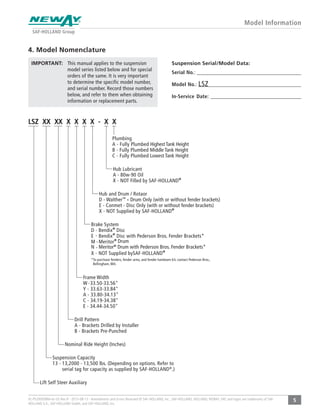
4. Model Nomenclature
IMPORTANT: This manual applies to the suspension
model series listed below and for special
orders of the same. It is very important
to determine the specific model number,
and serial number. Record those numbers
below, and refer to them when obtaining
information or replacement parts.
Serial No.: __________________________________________
Model No.: _________________________________________
In-Service Date: ____________________________________
Suspension Serial/Model Data:
LSZ
LSZ XX XX X X X X - X X
Lift Self Steer Auxiliary
Suspension Capacity
13 - 13,2000 - 13,500 lbs. (Depending on options. Refer to
serial tag for capacity as supplied by SAF-HOLLAND®
.)
Nominal Ride Height (Inches)
Drill Pattern
A - Brackets Drilled by Installer
B - Brackets Pre-Punched
Frame Width
W -33.50-33.56"
Y - 33.63-33.84"
A - 33.80-34.13"
C - 34.19-34.38"
E - 34.44-34.50"
Brake System
D - Bendix®
Disc
E - Bendix®
Disc with Pederson Bros. Fender Brackets*
M - Meritor®
Drum
N - Meritor®
Drum with Pederson Bros. Fender Brackets*
X - NOT Supplied bySAF-HOLLAND®
*To purchase fenders, fender arms, and fender hardware kit, contact Pederson Bros.,
Bellingham, WA.
Hub and Drum / Rotaor
D - Walther™
- Drum Only (with or without fender brackets)
E - Conmet - Disc Only (with or without fender brackets)
X - NOT Supplied by SAF-HOLLAND®
Hub Lubricant
A - 80w-90 Oil
X - NOT Filled by SAF-HOLLAND®
Plumbing
A - Fully Plumbed Highest Tank Height
B - Fully Plumbed Middle Tank Height
C - Fully Plumbed Lowest Tank Height
6 XL-PS20005BM-en-US Rev B · 2015-08-13 · Amendments and Errors Reserved © SAF-HOLLAND, Inc., SAF-HOLLAND, HOLLAND, NEWAY, SAF, and logos are trademarks of
SAF-HOLLAND S.A., SAF-HOLLAND GmbH, and SAF-HOLLAND, Inc.
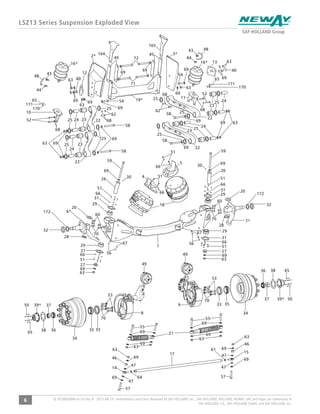
LSZ13 Series Suspension Exploded View
16*
2* 45
69
69
45
63
63
69
69
68
63
63
69
48
43
44
43
3*
48
6313
11
16*
5
30
59
69
26
51
66
31
29
6*
60
32
172
20
172
28
29
29
67
67
56
56
31
31
66
66
51
51
27
27
69
69
63
8
9
53
70
50
65 38 36 35
35
33
33
34
34
39* 37
36
37
38
39*
65
50
49
49
63
30
59
69
26
51
66
31
29
20
63
6961
17
63
64
47
47
69
57
46
14
69
47
57
46
15
69
47
60
32
7*
28
40
54
69
6968
25
2558
58
4
22
62
12
44
22
58
58
22
25 69
52
68
164
72
71
165
69
19*
69
62
68
54
171
171
25
63
40
170
170
65
65
52
10
70
70
53
70
25
24
25
24
25
24
23
23
23
6969
69
66
66
51
51
22
24
25
25
23
18
1
63
63
69
69
69 21
69
55
55
7XL-PS20005BM-en-US Rev B · 2015-08-13 · Amendments and Errors Reserved © SAF-HOLLAND, Inc., SAF-HOLLAND, HOLLAND, NEWAY, SAF, and logos are trademarks of
SAF-HOLLAND S.A., SAF-HOLLAND GmbH, and SAF-HOLLAND, Inc.
LSZ13 Series Suspension Parts List
LSZ13 PARTS LIST
ITEM. DESCRIPTION PART NUMBER QTY.
1 Axle/Knuckle Weldment 90550252 1
2*
Frame Bracket Assembly, LH, 8-1/2"- 11-1/2"
Ride HGT - Paint
90522440
1
Frame Bracket Assembly, LH, 11-1/2" - 14-1/2"
Ride HGT - Paint
90522444
Frame Bracket Assembly, LH, 8-1/2"- 11-1/2"
Ride HGT, Pre-punched
90522823
Frame Bracket Assembly, LH, 11-1/2" - 14-1/2"
Ride HGT, LH, Pre-punched
90522819
3*
Frame Bracket Assembly, RH, 8-1/2"- 11-1/2"
Ride HGT - Paint
90522442
1
Frame Bracket Assembly, RH, 11-1/2" - 14-1/2"
Ride HGT - Paint
90522446
Frame Bracket Assembly, RH, 8-1/2"- 11-1/2"
Ride HGT, Pre-punched
90522825
Frame Bracket Assembly, RH, 11-1/2" - 14-1/2"
Ride HGT, Pre-punched
90522822
4
Bracket, Air Spring Mount, LH,
8-1/2" - 11-1/2" Ride HGT
90531399
1
Bracket, Air Spring Mount, LH,
11-1/2" - 14-1/2" Ride HGT
90531403
Bracket, Upper Air Spring, LH, 8-1/2"-
11-1/2" Ride HGT, Pre-punched
90531411
Bracket, Upper Air Spring, LH, 11-1/2" - 14-1/2"
Ride HGT, Pre-punched
90531407
5
Bracket, Air Spring Mount, RH,
8-1/2" - 11-1/2" Ride HGT
90531400
1
Bracket, Air Spring Mount, RH,
11-1/2" - 14-1/2" Ride HGT
90531404
Bracket, Upper Air Spring, RH, 8-1/2"-
11-1/2" Ride HGT, Pre-punched
90531412
Bracket, Upper Air Spring, RH, 11-1/2" - 14-1/2"
Ride HGT, Pre-punched
90531408
6*
Spindle Assembly - Left Hand, Drum 90549820
1
Spindle Assembly - Left Hand, Drum with
Fender Bracket
90550232
Spindle Assembly - Left Hand, Disc 90550240
7*
Spindle Assembly - Right Hand, Drum 90549838
1
Spindle Assembly - Right Hand, Drum with Fender
Bracket
90550233
Spindle Assembly - Right Hand, Disc 90550241
8 Drum Brake Assembly, Bolt-On, Left-Hand, Meritor®
90566001 1
9 Drum Brake Assembly, Bolt-On, Right-Hand, Meritor®
90566002 1
10 Bracket, SuperChamber™
, Left-Hand 90550260 1
11 Bracket, SuperChamber™
, Right-Hand 90550262 1
12 Bracket, Lift, Left-Hand 90026856 1
13 Bracket, Lift, Right-Hand 90026854 1
14 Rod End, 3/4"-16, Left-Hand 90045696 1
15 Rod End, 3/4"-16, Right-Hand 90045695 1
16* SuperChamber™
90550266 2
17 Tie Rod Weldment 90549910 1
18 Air Spring Assembly 90557417 2
19* Crossmember 90026642 1
20 Washer 93600572 2
21 Steering Damper 90045662 2
22 Control Arm - Machined 90015168 4
23 Bushing 90008280 8
24 Core Pin 90038544 8
25 Flat Washer, Lock-Out 93600566 16
26 King Pin 90038548 2
27 End Cap 90010068 2
LSZ13 PARTS LIST
ITEM. DESCRIPTION PART NUMBER QTY.
28 Spacer 93600571 2
29 Bearing, Spherical, Plain 90045663 4
30 Fitting Grease 93800229 2
31 Retainer 90034869 4
32 Spacer, Seal 90036295 2
33 Seal 90070000 2
34
Hub and Drum Assembly, Webb®
90570000 2
Hub and Drum Assembly, KIC™
90570004 2
Hub and Drum Assembly, Walther™
90570005 2
35 Taper Bearing Cone, 2-5/8" Inboard 90070001 2
36 Taper Bearing Cone, 1-3/4" Outboard 90070002 2
37 Nut, Pro-Torque 90070005 2
38 Gasket 90070004 2
39* Hub Cap 90070003 2
40 Bearing, Lift Bracket 90045716 2
43 3/8" Male Run Tee 93800338 2
44 3/8" Male Elbow 93800339 2
45 Spacer 90034902 2
46 Spacer, Rod End 90036293 2
47 Rod Seal 90045707 4
48 Tube, 3/8" Diameter x 7" Long Neway®
Supplied 2
49 Service Chamber, Type 20 90566003 2
50 Hex Head Cap Screw, 5/16"-18 x 1"GR 5 93002463 12
51 Bolt, Hex, 3/8"-16 x 1" GR 8 93002573 20
52 Bolt, Hex, 1/2"-13 x 2-3/4" GR 5 93002937 4
53 Cap Screw, Hex, 5/8"-18 x 2" GR 8 93003348 10
54 Cap Screw, Hex, 3/4"-10 x 2-1/4" GR 8 93003569 2
55 Cap Screw, Hex, 3/4"-10 x 4" GR 5 93003609 4
57 Cap Screw, Hex, 3/4"-10 x 4-1/4" GR 8 93003617 2
58 Cap Screw, Hex, 3/4-10 GR 8 6.00” 93003659 4
59 Cap Screw, Hex, 3/4"-10 x 9-1/2" GR 8 93003743 2
60 Nut, Hex, Lock, 5/8"-18 GR C 93400491 10
61 Jam Nut, 3/4"-16 GR C 93400271 1
62 Nut, Hex, Lock, 1/2"-13 GR B 93400480 4
63 Nut, Hex, Lock .75-10 GR C 93400494 18
64 Jam Nut, 3/4"-16, LH 93400631 1
65 Washer, Lock, 5/16" 93600043 14
66 Washer, Lock, 3/8" 93600045 20
67 Washer, Lock, 1/2" 93600049 4
68 Washer, Flat, Hard, 1/2" 93600138 8
69 Washer, Flat Narrow 0.75 93600156 34
70 Washer, Flat, Hard, 5/8" 93600555 20
71 Cap Screw, Hex 3/4-10 x 6.5 GR 8 93003671 2
72 Cap Screw, Hex 3/4"- 10 x 6.75 GR 8 93003677 2
164
Shelf Bracket - LH 8-1/2"- 11-1/2" Ride HGT 90026726 1
Shelf Bracket - LH 11-1/2" - 14-1/2" Ride HGT 90026728 1
165
Shelf Bracket - RH 8-1/2"- 11-1/2" Ride HGT 90026725 1
Shelf Bracket - RH 11-1/2" - 14-1/2" Ride HGT 90026727 1
170 Pin, Clevis 90501539 2
171 Hex Head Cap Screw, 5/16-18 x 3/4" GR8 93002459 2
172 Quad Ring 90070012 2
*NOT sold individually - must be purchased in kit.
8 XL-PS20005BM-en-US Rev B · 2015-08-13 · Amendments and Errors Reserved © SAF-HOLLAND, Inc., SAF-HOLLAND, HOLLAND, NEWAY, SAF, and logos are trademarks of
SAF-HOLLAND S.A., SAF-HOLLAND GmbH, and SAF-HOLLAND, Inc.
Welding Standards
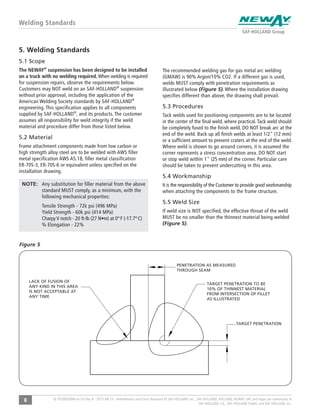
5. Welding Standards
5.1 Scope
The NEWAY®
suspension has been designed to be installed
on a truck with no welding required. When welding is required
for suspension repairs, observe the requirements below.
Customers may NOT weld on an SAF-HOLLAND®
suspension
without prior approval, including the application of the
American Welding Society standards by SAF-HOLLAND®
engineering. This specification applies to all components
supplied by SAF-HOLLAND®
, and its products. The customer
assumes all responsibility for weld integrity if the weld
material and procedure differ from those listed below.
5.2 Material
Frame attachment components made from low carbon or
high strength alloy steel are to be welded with AWS filler
metal specification AWS A5.18, filler metal classification
ER-70S-3, ER-70S-6 or equivalent unless specified on the
installation drawing.
NOTE: Any substitution for filler material from the above
standard MUST comply, as a minimum, with the
following mechanical properties:
Tensile Strength - 72k psi (496 MPa)
Yield Strength - 60k psi (414 MPa)
C)
% Elongation - 22%
The recommended welding gas for gas metal arc welding
(GMAW) is 90% Argon/10% CO2. If a different gas is used,
welds MUST comply with penetration requirements as
illustrated below (Figure 5). Where the installation drawing
specifies different than above, the drawing shall prevail.
5.3 Procedures
Tack welds used for positioning components are to be located
in the center of the final weld, where practical. Tack weld should
be completely fused to the finish weld. DO NOT break arc at the
end of the weld. Back up all finish welds at least 1/2" (12 mm)
or a sufficient amount to prevent craters at the end of the weld.
Where weld is shown to go around corners, it is assumed the
corner represents a stress concentration area. DO NOT start
or stop weld within 1" (25 mm) of the corner. Particular care
should be taken to prevent undercutting in this area.
5.4 Workmanship
It is the responsibility of the Customer to provide good workmanship
when attaching the components to the frame structure.
5.5 Weld Size
If weld size is NOT specified, the effective throat of the weld
MUST be no smaller than the thinnest material being welded
(Figure 5).
Figure 5
LACK OF FUSION OF
ANY KIND IN THIS AREA
IS NOT ACCEPTABLE AT
ANY TIME
PENETRATION AS MEASURED
THROUGH SEAM
TARGET PENETRATION TO BE
10% OF THINNEST MATERIAL
FROM INTERSECTION OF FILLET
AS ILLUSTRATED
TARGET PENETRATION
9XL-PS20005BM-en-US Rev B · 2015-08-13 · Amendments and Errors Reserved © SAF-HOLLAND, Inc., SAF-HOLLAND, HOLLAND, NEWAY, SAF, and logos are trademarks of SAF-
HOLLAND S.A., SAF-HOLLAND GmbH, and SAF-HOLLAND, Inc.
6. Pre-Installation
Required Tools: 1-1/8" wrench 1-1/8" socket
hammer drift punch
1. With the vehicle on a level surface, set the parking brakes
and chock the drive tires to prevent the vehicle from
rolling forward or backward.
Failure to properly secure the vehicle prior
to commencing work could create a crush
hazard which, if not avoided, could result
in death or serious injury.
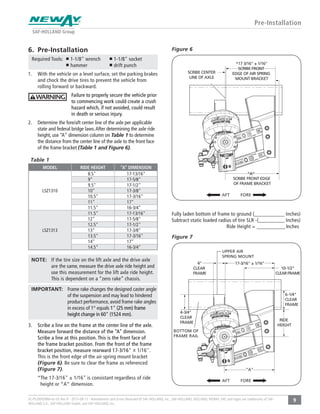
2. Determine the fore/aft center line of the axle per applicable
state and federal bridge laws.After determining the axle ride
height, use “A“ dimension column on Table 1 to determine
the distance from the center line of the axle to the front face
of the frame bracket (Table 1 and Figure 6).
Table 1
MODEL RIDE HEIGHT “A” DIMENSION
LSZ1310
8.5" 17-13/16"
9" 17-5/8"
9.5" 17-1/2"
10" 17-3/8"
10.5" 17-3/16"
11" 17"
11.5" 16-3/4"
LSZ1313
11.5" 17-13/16"
12" 17-5/8"
12.5" 17-1/2"
13" 17-3/8"
13.5" 17-3/16"
14" 17"
14.5" 16-3/4"
10-1/2"
CLEARFRAME
4-3/4"
CLEAR
FRAME
4"
CLEAR
FRAME
RIDE
HEIGHT
"A"
6-1/4"
CLEAR
FRAME
17-3/16" ± 1/16"
Figure 6
Figure 7
Pre-Installation
UPPER AIR
SPRING MOUNT
BOTTOM OF
FRAME RAIL
AFT FORE
SCRIBE CENTER
LINE OF AXLE
“A”
*17 3/16" ± 1/16"
SCRIBE FRONT
EDGE OF AIR SPRING
MOUNT BRACKET
SCRIBE FRONT EDGE
OF FRAME BRACKET
AFT FORE
NOTE: If the tire size on the lift axle and the drive axle
are the same, measure the drive axle ride height and
use this measurement for the lift axle ride height.
This is dependent on a “zero rake” chassis.
IMPORTANT: Frame rake changes the designed caster angle
of the suspension and may lead to hindered
product performance, avoid frame rake angles
1" (25 mm) frame
height change in 60" (1524 mm).
3. Scribe a line on the frame at the center line of the axle.
Measure forward the distance of the “A” dimension.
Scribe a line at this position. This is the front face of
the frame bracket position. From the front of the frame
bracket position, measure rearward 17-3/16" ± 1/16".
This is the front edge of the air spring mount bracket
(Figure 6). Be sure to clear the frame as referenced
(Figure 7).
*The 17-3/16" ± 1/16" is consistant regardless of ride
height or "A" dimension.
Fully laden bottom of frame to ground (____________ Inches)
Subtract static loaded radius of tire SLR -(___________ Inches)
Ride Height = ____________ Inches
10 XL-PS20005BM-en-US Rev B · 2015-08-13 · Amendments and Errors Reserved © SAF-HOLLAND, Inc., SAF-HOLLAND, HOLLAND, NEWAY, SAF, and logos are trademarks of
SAF-HOLLAND S.A., SAF-HOLLAND GmbH, and SAF-HOLLAND, Inc.
Pre-Installation and Installation
Figure 84. Measure the frame width, using (Table 2 and Figure 8).
Determine the crossmember and the spacer position.
NOTE: The distance between the frame brackets should
be slightly greater than the frame width by less
than a 1/16" (1.5 mm). Achieve clearance by
loosening both 3/4" pivot nuts on one (1) side.
This will allow easier installation of the lift axle.
* Shelf Spacer - Always installed in the most outboard
position towards the wheel.
◊ Tank Mount - Always installed when unit is “fully plumbed”
and installed in the middle position between the shelf, spacer
and inboard spacer.
† Spacer - Installed if the unit is NOT “fully plumbed”.The spacer
is installed between the shelf spacer and inboard spacer.
7. Installation
Required Tools: 15/16" wrench
1" x 2" block, six inches (6") long
NOTE: If drilling the frame bracket from inside the frame
outward, continue to Step 6.
1. Remove and retain both 5/8"-11 nuts and lock washers
from the SuperChamber™
studs (Figure 9).
2. Lift the SuperChamber™
from the SuperChamber™
bracket
and install the 1" x 2" block to increase access for drilling
the frame bracket (Figure 9).
3. Repeat Step 1 and 2 on the opposite side.
IMPORTANT: Failure to properly align the lift axle to the
drive axle could lead to reduced maximum
steer angle.
Failure to properly align the lift axle to
the drive axle could lead to reduction
of maximum steer angle which, if not
avoided, could result in excessive tire wear.
SHIM
POSITION NOMINAL FROM TO
CROSSMEMBER
MOUNTING
FLANGES
SHIMS
INSIDE
SHIMS
OUTSIDE
W 33-1/2" 33-1/2" 33-1/2" 4 0
Y 33-3/4" 33-3/4" 33-5/8" 3 1
A 34" 33-7/8" 34-1/8" 2 2
C 34-1/4" 34-1/4" 34-3/8" 1 3
E 34-1/2" 34-1/2" 34-1/2" 0 4
Table 2
Figure 9
SHIPPED IN CONFIGURATION “A“
5/8" LOCK
WASHERS
5/8" NUTS
1" x 2" BLOCK
SUPERCHAMBER™
RECOMMENDED
HOLE PATTERN
W.
Y.
A.
C.
E.
*
◊
†
11XL-PS20005BM-en-US Rev B · 2015-08-13 · Amendments and Errors Reserved © SAF-HOLLAND, Inc., SAF-HOLLAND, HOLLAND, NEWAY, SAF, and logos are trademarks of SAF-
HOLLAND S.A., SAF-HOLLAND GmbH, and SAF-HOLLAND, Inc.
Installation
4. Clamp both frame brackets to the frame rails at the “A“
dimension position, forward of the axle center line.
5. Position both the upper air spring mounts relative to the
frame brackets (Figure 10). The slot on the mounting
plate MUST be toward the frame bracket.
NOTE: Refer to the customer inspection drawing
LSZ13_TAB included in the literature kit.
IMPORTANT: Make sure the horizontal surface of the
air spring mount assemblies are tight up
against the bottom of the frame rail flange.
6. Clamp both the upper air spring mount assemblies to the
frame rails.
IMPORTANT: Use a drill bit no greater than 1/16" larger
than bolt diameter when drilling the frame
brackets and the air spring mounts.
IMPORTANT: Make sure the distance from the forward
face of the frame bracket to the air spring
bracket is 17-3/16" ± 1/16".
7. Be sure to locate all the air lines and electrical wires out
of the area to be drilled.
Failure to relocate air lines and electrical
wire prior to drilling could result in damaged
lines and wires which, if not avoided, could
result in component damage.
8. Drill both frame brackets, upper air spring mounts and
frame rails. Install the fastening hardware to attach the
frame bracket and the upper air spring mount to the
frame rails on both sides (Figure 11).
Failure to use the required minimum
number and size of fasteners may cause
premature component failure and a loss
of vehicle control which, if not avoided,
could result in death or serious injury.
Frame bracket minimum bolt requirements:
Six (6) 5/8" for LSZ1310 or six (6) 3/4" for LSZ1313
Grade 8 bolts with hardened flat washers under both
the bolt heads and lock nuts. Refer to Section 10 and
torque fasteners to manufacturer's specifications.
Upper air spring mount minimum bolt requirements:
Two (2) 5/8" for LSZ1310 or two (2) 3/4" for LSZ1313
Grade 8 bolts with hardened flat washers under both
the bolt heads and lock nuts. Refer to Section 10 and
torque fasteners to manufacturer's specifications.
9. Torque all fasteners on both sides per fastener
manufacturer's specifications, Refer to Section 10.
10. Lift the SuperChamber™
enough to remove block and
install SuperChamber™
studs into bracket. Re-install the
two (2) 5/8-11" nuts and lock washers. Torque nuts to
torque specified in Table 5, Section 10.
11. Repeat Step 10 on the opposite side.
Figure 10
AXLE CENTER LINE “A”
17-3/16" ± 1/16"
Figure 11
MOUNTING PLATE
FRAME BRACKET
*17-3/16" ± 1/16"
6 1/2"
1 1/2"
1 1/4"
1 1/2"
1 3/8"
2 3/4"2 1/8"
3 1/4"
MOUNTING PLATE SLOT
12 XL-PS20005BM-en-US Rev B · 2015-08-13 · Amendments and Errors Reserved © SAF-HOLLAND, Inc., SAF-HOLLAND, HOLLAND, NEWAY, SAF, and logos are trademarks of
SAF-HOLLAND S.A., SAF-HOLLAND GmbH, and SAF-HOLLAND, Inc.
Installation
12. Wheel end component installation varies per manufacturer.
If the wheel end components were NOT included from
SAF-HOLLAND®
, follow the manufacturer’s instructions.
13. If unit is fully plumbed, skip to Step 16.
14 Install the supply fitting into the top of the air spring.
15. Plumb the air springs and SuperChambers™
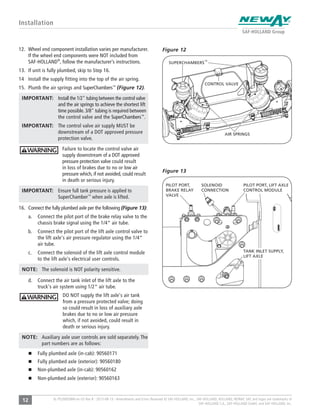
(Figure 12).
IMPORTANT: Install the 1/2" tubing between the control valve
and the air springs to achieve the shortest lift
time possible. 3/8" tubing is required between
the control valve and the SuperChambers™
.
IMPORTANT: The control valve air supply MUST be
downstream of a DOT approved pressure
protection valve.
Failure to locate the control valve air
supply downstream of a DOT approved
pressure protection valve could result
in loss of brakes due to no or low air
pressure which, if not avoided, could result
in death or serious injury.
IMPORTANT: Ensure full tank pressure is applied to
SuperChamber™
when axle is lifted.
16. Connect the fully plumbed axle per the following (Figure 13):
a. Connect the pilot port of the brake relay valve to the
chassis brake signal using the 1/4" air tube.
b. Connect the pilot port of the lift axle control valve to
the lift axle's air pressure regulator using the 1/4"
air tube.
c. Connect the solenoid of the lift axle control module
to the lift axle's electrical user controls.
NOTE: The solenoid is NOT polarity sensitive.
d. Connect the air tank inlet of the lift axle to the
truck's air system using 1/2" air tube.
DO NOT supply the lift axle's air tank
from a pressure protected valve; doing
so could result in loss of auxiliary axle
brakes due to no or low air pressure
which, if not avoided, could result in
death or serious injury.
NOTE: Auxiliary axle user controls are sold separately. The
part numbers are as follows:
Fully plumbed axle (in-cab): 90560171
Fully plumbed axle (exterior): 90560180
Non-plumbed axle (in-cab): 90560162
Non-plumbed axle (exterior): 90560163
Figure 13
AIR SPRINGS
Figure 12
SUPERCHAMBERS™
CONTROL VALVE
PILOT PORT, LIFT AXLE
CONTROL MODULE
TANK INLET SUPPLY,
LIFT AXLE
SOLENOID
CONNECTION
PILOT PORT,
BRAKE RELAY
VALVE
13XL-PS20005BM-en-US Rev B · 2015-08-13 · Amendments and Errors Reserved © SAF-HOLLAND, Inc., SAF-HOLLAND, HOLLAND, NEWAY, SAF, and logos are trademarks of SAF-
HOLLAND S.A., SAF-HOLLAND GmbH, and SAF-HOLLAND, Inc.
Installation and Alignment
17. If hub is NOT filled by SAF-HOLLAND®
,verify that proper
lubrication level is in accordance with the hub manufacturer’s
specifications in the wheel end hub. Refer to Table 7.
IMPORTANT: ALWAYS make sure proper lubrication and
proper levels are maintained.
Failure to operate the vehicle with lubricant
levels in the hub could lead to premature
bearing failure and possible separation of
the wheel from axle which, if not avoided,
could result in death or serious injury.
18. Attach the wheel tire assemblies with twenty (20)
flange nuts, ten (10) on each side, to hand tight only.
Torque the bolts as specified in the wheel manufacturer’s
instructions in a cross pattern (Figure 14).
19. With axle in the in service position, apply a minimum of
30 p.s.i. air pressure into the air springs. Check for leaks by
applying a soapy water solution and checking for bubbles
at the fittings and at the tube to the fitting connection.
20. Test operation by lifting the axle. Check for leaks at the
SuperChamber™
by applying a soapy water solution and
checking for bubbles at the fittings and at the tube to the
fitting connection. Repair if needed.
21. The vehicle MUST be aligned after installation. Refer to
procedures in Section 8.
1
2
3
4
5
6
7
8
9
10
Figure 14
14 XL-PS20005BM-en-US Rev B · 2015-08-13 · Amendments and Errors Reserved © SAF-HOLLAND, Inc., SAF-HOLLAND, HOLLAND, NEWAY, SAF, and logos are trademarks of
SAF-HOLLAND S.A., SAF-HOLLAND GmbH, and SAF-HOLLAND, Inc.
Alignment
8. Alignment
IMPORTANT: Proper axle toe-in is essential to prevent
excessive tire wear.
Required Tools: 1-1/8" open end wrench
10' tape measure (minimum length),
Three (3) jack stands
Standard screwdriver
1. With the vehicle on a level blade surface, set the parking
brakes and chock the drive tires to prevent the vehicle
from rolling forward or backward.
Failure to properly secure the vehicle prior
to commencing work could create a crush
hazard which, if not avoided, could result
in death or serious injury.
2. Place the axle in the stowed position.
3. Position a jack stand under the axle at both ends.
4. This procedure requires two (2) people. Utilizing a jack stand,
place a standard head screwdriver on top of the stand to
scribe a line onto the tire tread. One person secures the
position of the screwdriver while the other person slowly
rotates the tire one full rotation. The resulting scribe line
MUST overlap at both ends. If not, scribe in another position
(Figure 15).
5. Repeat Step 4 on the opposite side.
6. Using a measuring tape, measure the cross-body distance
at the front and rear of the tires from the scribe lines.
7. The rear dimension should be 1/8" ± 1/16" larger than
the front dimension. If not, loosen both 3/4" jam nuts on
the tie rod assembly (Figure 16).
NOTE: One end of the tie rod assembly has left handed
threads. This end can be identified with a groove
around the tapered section close to the 3/4"
jam nut (Figure 16).
8. Rotate the tie rod until the rear dimension is 1/8" ± 1/16"
larger than the front dimension.
NEVER rotate the center section of the tie
rod to expose more than 5/8" of the rod
end threads. If more than 5/8" of the rod
end thread is exposed in operation or during
service the steering damper forces could
cause the rod to fail prematurely which,
if not avoided, could result in minor or
moderate injury.
Figure 15
Figure 16
LEFT HAND THREAD
INDICATED BY GROOVE
15XL-PS20005BM-en-US Rev B · 2015-08-13 · Amendments and Errors Reserved © SAF-HOLLAND, Inc., SAF-HOLLAND, HOLLAND, NEWAY, SAF, and logos are trademarks of SAF-
HOLLAND S.A., SAF-HOLLAND GmbH, and SAF-HOLLAND, Inc.
Pre-Operation
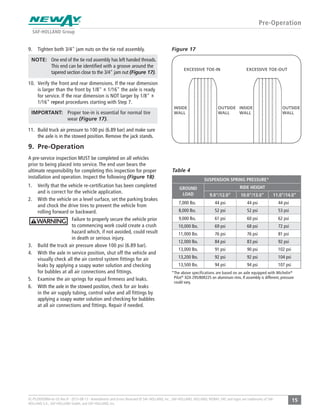
9. Tighten both 3/4" jam nuts on the tie rod assembly.
NOTE: One end of the tie rod assembly has left handed threads.
This end can be identified with a groove around the
tapered section close to the 3/4" jam nut (Figure 17).
10. Verify the front and rear dimensions. If the rear dimension
is larger than the front by 1/8" ± 1/16" the axle is ready
for service. If the rear dimension is NOT larger by 1/8" ±
1/16" repeat procedures starting with Step 7.
IMPORTANT: Proper toe-in is essential for normal tire
wear (Figure 17).
11. Build truck air pressure to 100 psi (6.89 bar) and make sure
the axle is in the stowed position. Remove the jack stands.
9. Pre-Operation
A pre-service inspection MUST be completed on all vehicles
prior to being placed into service. The end user bears the
ultimate responsibility for completing this inspection for proper
installation and operation. Inspect the following (Figure 18):
1. Verify that the vehicle re-certification has been completed
and is correct for the vehicle application.
2. With the vehicle on a level surface, set the parking brakes
and chock the drive tires to prevent the vehicle from
rolling forward or backward.
Failure to properly secure the vehicle prior
to commencing work could create a crush
hazard which, if not avoided, could result
in death or serious injury.
3. Build the truck air pressure above 100 psi (6.89 bar).
4. With the axle in service position, shut off the vehicle and
visually check all the air control system fittings for air
leaks by applying a soapy water solution and checking
for bubbles at all air connections and fittings.
5. Examine the air springs for equal firmness and leaks.
6. With the axle in the stowed position, check for air leaks
in the air supply tubing, control valve and all fittings by
applying a soapy water solution and checking for bubbles
at all air connections and fittings. Repair if needed.
SUSPENSION SPRING PRESSURE*
GROUND
LOAD
RIDE HEIGHT
9.0"/12.0" 10.0"/13.0" 11.0"/14.0"
7,000 lbs. 44 psi 44 psi 44 psi
8,000 lbs. 52 psi 52 psi 53 psi
9,000 lbs. 61 psi 60 psi 62 psi
10,000 lbs. 69 psi 68 psi 72 psi
11,000 lbs. 76 psi 76 psi 81 psi
12,000 lbs. 84 psi 83 psi 92 psi
13,000 lbs. 91 psi 90 psi 102 psi
13,200 lbs. 92 psi 92 psi 104 psi
13,500 lbs. 94 psi 94 psi 107 psi
Table 4
Figure 17
EXCESSIVE TOE-IN EXCESSIVE TOE-OUT
INSIDE
WALL
INSIDE
WALL
OUTSIDE
WALL
OUTSIDE
WALL
*The above specifications are based on an axle equipped with Michelin®
Pilot®
XZA 295/80R225 on aluminum rims. If assembly is different, pressure
could vary.
16 XL-PS20005BM-en-US Rev B · 2015-08-13 · Amendments and Errors Reserved © SAF-HOLLAND, Inc., SAF-HOLLAND, HOLLAND, NEWAY, SAF, and logos are trademarks of
SAF-HOLLAND S.A., SAF-HOLLAND GmbH, and SAF-HOLLAND, Inc.
Pre-Operation
7. Check the clearance of the suspension and the axle
assembly for interference with outside components. With
the vehicle loaded at design capacity, check that there is a
1" (25 mm) minimum clearance around the air springs. If
1" (25 mm) clearance is NOT achieved, verify that the air
spring mount bracket is positioned properly (Figure 10).
8. Inspect for loose or missing fasteners on the entire suspension
and axle assembly. Re-torque any loose fasteners.
9. Make sure fasteners are tightened to the OEM recommended
torque specification using a calibrated torque wrench in
a tightening direction. The following fasteners should
be inspected: Refer to Section 10.
Frame attachment fasteners (including Huck®
bolts)
Suspension attachment fasteners
Steering damper hardware
Air spring and SuperChamber™
hardware
Tie rod to steer arm attachment hardware
10. Check the alignment, refer to Section 8.
11. Inspect the axle assembly steering dampers and the
brake assemblies.
12. Locate and make sure all the axle grease fittings are properly
lubricated. Refer to Lubrication Specifications Section 11.
IMPORTANT: Always grease kingpin while axle is in stowed
position for proper grease distribution.
13. Inspect the adjustment of wheel end assemblies, bearing
free play, and brakes according to manufacturer’s specification
instructions from each assembly manufacturer.
Figure 18
GREASE FITTING
CONTROL VALVEAIR FITTING
AIR FITTING
AIR FITTING
BRAKE ASSEMBLY
AIR SPRINGS TIE ROD STEERING DAMPER
SUPERCHAMBER™
SUPERCHAMBER™
STEERING DAMPER
AIR SUPPLY TUBING
14. Verify that the proper lubrication level is in accordance with
the hub manufacturer’s specifications in the wheel end hub.
IMPORTANT: ALWAYS make sure proper lubrication
levels are maintained.
Failure to operate the vehicle with proper
lubricant levels in the hub could lead to
premature bearing failure and possible
separation of the wheel from the axle
which, if not avoided, could result in death
or serious injury.
15. Check for proper tire inflation and that the tire size meets
load range specifications.
IMPORTANT: Improper tire inflation may result in poor
steering and increased tire wear. Consult
with tire manufacturer for proper inflation
pressure per the tire's load.
16. Make sure the wheel flange nuts are torqued to the wheel
manufacturer’s specification.
17. Verify that the axle controls are properly located per
State, Federal, and/or Provincial guidelines.
18. Identify and verify “specific” suspension adjustments per
OEM guidelines:
Weigh the entire fully loaded vehicle with auxiliary
axle(s) raised
Lower the auxiliary axle(s) and adjust air pressure per
OEM guidelines for desired load (Table 4).
19. Remove the chocks from the drive tires.
17XL-PS20005BM-en-US Rev B · 2015-08-13 · Amendments and Errors Reserved © SAF-HOLLAND, Inc., SAF-HOLLAND, HOLLAND, NEWAY, SAF, and logos are trademarks of
SAF-HOLLAND S.A., SAF-HOLLAND GmbH, and SAF-HOLLAND, Inc.
Torque and Lubrication Specifications
10. Torque Specifications
NOTE: Torque specifications listed (Table 5) are with clean
lubricated/coated threads, supplied by SAF-HOLLAND®
.
IMPORTANT: The use of special lubricants with friction
modifiers, such as Anti-Seize or Never-Seez®
,
without written approval from SAF-HOLLAND®
Engineering, will void warranty and could
lead to over torquing of fasteners or other
component issues.
General Information
The torque specifications listed throughout the manual are
applied to the lock nut and NOT the bolt.
IMPORTANT: Most of the fasteners used in this suspension
are Grade 8 bolts and Grade C lock nuts.
These fasteners have the strength and
hardness properties required for their
particular function. They MUST be replaced
with fasteners of the same grade, size and
form as the original in order to prevent
failure (Figure 19).
Failure to use the proper fasteners when
servicing the suspension could cause
component failure which, if not avoided,
could result in death or serious injury.
Failure to properly torque all fasteners
will result in component failure which,
if not avoided, could result in death or
serious injury.
All fasteners MUST be re-torqued after the first 100 hours
of service or 5,000 miles (8,000 km).
Refer to vehicle OEM for torque specifications for the
vehicle frame fastener hardware.
11. Lubrication Specifications
Lubricate the suspension in accordance with the approved
lubricants (Table 6).
IMPORTANT: Replacement of SAF-HOLLAND®
supplied
fasteners with non-SAF-HOLLAND®
may result
in unpredictable performance.
Failure to maintain the LSZ suspension
with SAF-HOLLAND®
original parts can
result in unpredictable performance
which, if not avoided, could result in
death or serious injury.
COMPONENT TORQUE RANGE SIZE
Hub Cap
12-16 ft-lb
5/16"-18
Retainer
25-35 ft-lb
3/8"-16
Upper Air Spring
15-20 ft-lb
3/8"-16
Lower Air Spring
25-35 ft-lb
1/2"-13
Chamber Bracket
37-50 ft-lb
1/2"-13
Bolt-on Drum Brake Assembly
150-160 ft-lb
5/8"-11
SuperChamber™
and
Service Brake Chamber
133-155 ft-lb
5/8"-11
Pivot Connections, Lift Bracket
and King Pin Bolt and Tie Rod
200-250 ft-lb
3/4"-10
Steering Damper
133-155 ft-lb
3/4"-10
Disc Brake Torque Plate
200-250 ft-lb
3/4"-16
Disc Brake Caliper
350-400 ft-lb
M20
Table 5
GREASE HUB OIL
CITGO SynDurance Premium
Synthetic 460
Exxon Mobil Mobilube HD Plus
80W-90
Mystik JT-6 Hi Temp with Moly Shell Spirax S 75W-90
Valvoline Palladium Grease Shell Spirax ASX 75W-90
Chevron Delo Heavy Duty Moly
5% EP
Exxon Mobil Mobilube 1 SHC
75W-90
SAF Grease - 50844001 Exxon Mobil Delvac 75W-90
Table 6
Figure 19
GRADE 1 OR 2
BOLT GRADE MARKINGS
LOCK NUT GRADE MARKINGS
3 DOTS
LOCK NUT
GRADE B
LOCK NUT
GRADE C
6 DOTS
GRADE 5 GRADE 8
HUB BRAND OIL QUANTITY
KIC™
12 fl. Oz.
Webb®
14.5 fl. Oz.
Walther™
12.9 fl. Oz.
Table 7
18 XL-PS20005BM-en-US Rev B · 2015-08-13 · Amendments and Errors Reserved © SAF-HOLLAND, Inc., SAF-HOLLAND, HOLLAND, NEWAY, SAF, and logos are trademarks of
SAF-HOLLAND S.A., SAF-HOLLAND GmbH, and SAF-HOLLAND, Inc.
Routine Maintenance and Inspection Schedule
12.3 Initial Service Inspection
(30 Days or 200 Hours of Service)
It is recommend that the initial service inspection for auxiliary
axles be completed after 30 days or 200 hours of service
(whichever one comes first). Inspect the following:
1. Visually inspect the suspension for proper assembly
and operation.
2. Check the clearance of suspension and axle assembly for
interference with outside components.
3. Fasteners: Visually inspect for loose, damaged or missing
fasteners on the entire suspension and axle assembly.
Signs of movement or looseness are bright rust and
polishing. Make sure all the fasteners are tightened to
the specified torque. Refer to OEM torque specifications
for recommended torque requirements. Use a calibrated
torque wrench to check torque in a tightening direction.
Re-torque if necessary. Replace any worn or damaged
fasteners. The following fasteners should be inspected:
Frame attachment fasteners (including Huck®
bolts).
Upper air spring mount assembly attachment fasteners.
Axle connection/pivot bolts – Re-torque of these fasteners
is mandatory.
Steering damper hardware.
Tie rod to steer arm attachment hardware.
4. Inspect air springs for:
Leaks; repair as required.
Any signs of component contact, component damage,
or signs of rubbing on the air spring or SuperChamber™
;
correct condition and replace as required.
5. Inspect axle assembly
Visually inspect for proper installation.
Steering knuckle and tie rod assemblies (if equipped)
for proper adjustment and free rotational movement.
Check the steering damper coil spring.
Examine the steering dampers for oil leakage at the rod
seal (located where the rod enters the shock body).
Some oil will exit the shock body via a mist from the
shock body. Misting is a normal occurrence.
Locate all grease fittings, and verify proper lubrication
according to OEM guidelines.
IMPORTANT: For proper grease distribution, grease kingpin
while axle is in the lifted position.
Inspect brake assemblies for proper installation and operation.
12. Routine Maintenance and
Inspection Schedule
12.1 Daily Driver Inspections
According to Federal regulations, a daily “walk around” pre-trip
inspection MUST be performed before a vehicle is placed into
service. A daily post trip inspection MUST also be completed.
The inspection below is an example of what should be checked
per DOT requirements. Federal and State requirements may
vary and the end user should identify their specific needs.
Inspect vehicle for:
Bent, cracked, or broken main structural components.
Loose, damaged or missing fasteners (signs of movement or
looseness are bright rust and polishing).
Suspension components for visual signs of irregular movement.
Bushings for missing, cracked, torn, or excessive gapping.
Air springs and SuperChamber™
for damage and leaks.
Axle assemblies for damage or signs of loose components.
Brakes for damage, proper function, and adequate
friction material.
Wheel ends for damage, hub oil level or seal leakage.
Tires for proper inflation, unusual or excessive tire wear,
and/or damage.
Air controls for proper operation.
19XL-PS20005BM-en-US Rev B · 2015-08-13 · Amendments and Errors Reserved © SAF-HOLLAND, Inc., SAF-HOLLAND, HOLLAND, NEWAY, SAF, and logos are trademarks of
SAF-HOLLAND S.A., SAF-HOLLAND GmbH, and SAF-HOLLAND, Inc.
6. Inspect wheel end assemblies:
Inspect the wheel end assemblies for seal leakage and
wheel bearing free play.
Verify proper lubrication.
Failure to operate the vehicle with proper
lubricant levels in the hub could lead to
premature bearing failure and possible
separation of the wheel from axle which,
if not avoided, could result in death or
serious injury.
Inspect the tires for damage or excessive wear and
replace if required.
Verify proper tire inflation.
Check that the wheel flange nuts are torqued in
accordance with the OEM specification.
7. Inspect the air controls for proper function.
8. Verify all grease points are properly lubricated.
9. Inspect the lift mechanism:
With the axle in the stowed position, check for
leaks within the SuperChamber™
, all fittings and
air supply tubing.
Check the pivot bearing within the chamber clevis for
excessive wear. This can be visually checked by lifting
and lowering the axle. If there is wear within the lift
bearing, the chamber clevis pin will have relative motion
between the pin and bushing during the lift/lowering
axle movement.
If excessive wear in the pivot bearing is exhibited,
replace the bearing.
12.4 Periodic Inspections
(Every 90 Days or 600 Hours)
It is recommended that periodic maintenance inspections of
auxiliary axles be completed every 90 days or 600 hours of
service (whichever comes first). Inspect the following:
1. Visually inspect suspension for proper assembly and operation.
2. Check clearance of the suspension and the axle assembly
for interference with outside components.
3. Fasteners: Visually inspect for loose, damaged or missing
fasteners on the entire suspension and axle assembly.
Signs of movement or looseness are bright rust and
polishing. Make sure all the fasteners are tightened to
the specified torque. Refer to OEM torque specifications
for recommended torque requirements. Use a calibrated
torque wrench to check torque in a tightening direction.
Correct the torque if necessary. Replace any worn or damaged
fasteners. The following fasteners should be inspected:
Frame attachment fasteners (including Huck®
bolts).
Upper air spring mount assembly attachment fasteners.
Pivot connections.
Steering damper hardware.
Kingpin bolts.
4. Inspect air springs for:
Leaks; repair as required.
Any signs of component contact, component damage,
or signs of rubbing on the air spring or SuperChamber™
;
correct condition and replace as required.
5. Inspect axle assembly:
Visually inspect for proper installation.
Steering knuckle and tie rod assemblies for proper
adjustment and free rotational movement.
Inspect steering dampers for leakage and proper function.
Locate all grease fittings, and verify proper lubrication
according to OEM guidelines.
Inspect brake assemblies for proper installation and operation.
6. Inspect wheel end assemblies:
Inspect the wheel end assemblies for seal leakage and
wheel bearing free play.
Verify proper lubrication.
Failure to operate the vehicle with proper
lubricant levels in the hub could lead to
premature bearing failure and possible
separation of the wheel from axle which,
if not avoided, could result in death or
serious injury.
Inspect tires for damage or excessive wear and replace,
if required.
Verify proper tire inflation.
Check that the wheel flange nuts are torqued in
accordance with the OEM specification.
20 XL-PS20005BM-en-US Rev B · 2015-08-13 · Amendments and Errors Reserved © SAF-HOLLAND, Inc., SAF-HOLLAND, HOLLAND, NEWAY, SAF, and logos are trademarks of
SAF-HOLLAND S.A., SAF-HOLLAND GmbH, and SAF-HOLLAND, Inc.
Maintenance and Inspection Schedule
7. Inspect air controls for proper function.
8. Verify all grease points are properly lubricated.
12.5 Annual Inspection
(As Part of Federal DOT Inspection)
1. Visually inspect suspension for proper assembly
and operation.
2. Check clearance of the suspension and the axle assembly
for interference with outside components.
3. Fasteners: Visually inspect for loose, damaged or missing
fasteners on the entire suspension and axle assembly.
Signs of movement or looseness are bright rust and
polishing. Make sure all the fasteners are tightened to
the specified torque. Refer to OEM torque specifications
for recommended torque requirements. Use a calibrated
torque wrench to check torque in a tightening direction.
Correct the torque if necessary. Replace any worn or damaged
fasteners. The following fasteners should be inspected:
Frame attachment fasteners (including Huck®
bolts).
Suspension attachment fasteners.
Pivot connections.
NOTE: Re-torque of these fasteners is recommended as
part of the annual inspection.
Kingpin bolts.
Steering damper hardware.
Air spring/lift mechanism hardware.
4. Inspect air springs for:
Leaks in flex member or bead plate (top of air spring),
replace air spring if leaks are detected.
Any sign of rubbing on the flex member.
Inspect SuperChambers™
for leaks, replace
SuperChamber™
as required.
SuperChamber™
contact with frame brackets, replace
SuperChamber™
and SuperChamber™
bracket, as required.
5. Identify and verify “specific” suspension adjustments per
OEM guidelines.
6. Inspect axle assembly:
Visually inspect for proper installation.
Steering knuckle and tie rod assemblies for proper
adjustment and free rotational movement.
Inspect steering dampers for leakage and proper function.
Locate all grease fittings, and verify proper lubrication
according to OEM guidelines, refer to (Figure 16).
Inspect brake assemblies for proper installation,
operation, and adequate friction material.
7. Inspect wheel end assemblies:
Inspect the wheel end assemblies for seal leakage and
wheel bearing free play.
Verify proper lubrication level in hub.
Failure to operate the vehicle with proper
lubricant levels in the hub could lead to
premature bearing failure and possible
separation of the wheel from axle which,
if not avoided, could result in death or
serious injury.
Inspect tires for damage or excessive wear and replace,
if required.
Verify proper tire inflation.
Check that wheel flange nuts are torqued in accordance
with the OEM specification.
8. Inspect the axle air controls to verify controls are
operating correctly.
9. Re-verify “specific” suspension adjustments according to
OEM guidelines:
Weigh the entire fully loaded vehicle with auxiliary
axle(s) raised.
Lower auxiliary axle(s) and adjust air pressure in accordance
with OEM guidelines for desired load to be carried.
Re-weigh entire fully loaded vehicle with auxiliary axle(s)
on the ground to verify proper load distribution on all
axles per State/Federal/Provincial requirements.
21XL-PS20005BM-en-US Rev B · 2015-08-13 · Amendments and Errors Reserved © SAF-HOLLAND, Inc., SAF-HOLLAND, HOLLAND, NEWAY, SAF, and logos are trademarks of
SAF-HOLLAND S.A., SAF-HOLLAND GmbH, and SAF-HOLLAND, Inc.
Troubleshooting
PROBLEM POSSIBLE CAUSE SOLUTION
All air springs are flat Insufficient air pressure
in the vehicle air system
Check the air pressure gauge on instrument panel. If air pressure is
low, run the engine until a minimum pressure of 70 psig (4.83 bars) is
indicated on the gauge. If air pressure is 70 psig (4.83 bars) or above
and the air springs are NOT inflated, the problem may be with the
pressure protection valve or faulty air pressure regulator.
Air leakage from the
suspension air system
or the air brake system
Visually check all air control system fittings by applying a soapy water
solution and checking for bubbles at all air connections and fittings.
Check for loose or damaged fittings, air lines, air springs, brake
actuators or control valve.Tighten loose fittings to stop leakage
and replace worn or damaged parts as necessary.
Air spring(s) deflate
rapidly when vehicle
is parked
Air leakage from the
suspension air system
Test for air leakage due to loose fittings between air tank and air sus-
pension or damaged air lines, air springs or height control valve.
Visually check all air control system fittings by applying a soapy water
solution and checking for bubbles at all air connections and fittings.
Tighten loose fittings to stop leakage and replace worn or damaged
parts as necessary.
Air spring(s) ruptured Tires, rims, chains
or other objects are
rubbing against the
air spring
Check for proper clearance between the air spring and the tire. If the
tire, rim, chains or other objects contact the inflated air spring when
the vehicle is loaded, a narrower set of tires and rims are necessary
to provide clearance for tires with chains (contact the vehicle
manufacturer for recommendations).
Air spring(s) fail Continual or repeated
over-extension of the
air spring(s)
Visually inspect for broken or loose SuperChamber™
brackets or lower lift
brackets.
Re-connect loose parts and replace any worn or damaged parts
as necessary.
Check the adjustment of the pressure regulator. Refer to the
manufacturer’s instructions for adjustment.
Air spring(s) worn out Replace the air spring(s).
NOTE: If the air spring piston contacts the upper bead plate, it may
fracture and leak air.
Air spring(s) fail to fully deflate
when all air pressure is removed
from the suspension
Restricted air line(s)
between the air pressure
regulating valve and the
air spring(s)
Check control and regulating valve.
Excessive tire wear Axle toe-in NOT set
to specifications
Re-align axle. Refer to alignment, Section 8, and tire wear
illustration (Figure 17).
Axle chamber NOT
at specifications
Check the axle camber.
Brakes dragging Check the brake adjustment.
Improper tire pressure Consult with tire manufacturer to ensure proper tire pressure for
the tire load.
13. Troubleshooting
22 XL-PS20005BM-en-US Rev B · 2015-08-13 · Amendments and Errors Reserved © SAF-HOLLAND, Inc., SAF-HOLLAND, HOLLAND, NEWAY, SAF, and logos are trademarks of
SAF-HOLLAND S.A., SAF-HOLLAND GmbH, and SAF-HOLLAND, Inc.
Troubleshooting
PROBLEM POSSIBLE CAUSE SOLUTION
Pivot connection worn
or loose
Worn bushings or loss of
pivot bolt torque
Check pivot connection for worn bushings or looseness by inserting a 2' pry
bar between the frame bracket and the nose of the control arm assembly.
Visually check for movement while moving the pry bar back and forth. Exercise
care NOT to gouge or damage the components while prying back and forth.
If .25" or more movement is detected, disassemble the pivot connection and
visually inspect the rubber bushing.
Check pivot connection bolt to specifications in Section 10. If it DOES NOT fall
within specification, perform bushing replacement procedure per Section 10.
Replace the pivot connection bushing if wear is detected.
If the bushing appears to be in proper working condition, re-assemble the
pivot connection and torque the pivot connection to the specification listed
in Section 10.
Worn out due to length
of service
Replace pivot connection.
Vehicle unstable or
handles poorly
Loose frame bolts
or attachments
Tighten frame bolts and attaching parts to proper specifications.
Incorrect Bushings Replace as necessary.
Loose or worn
pivot connection
Check pivot connection for worn bushings or looseness by inserting a 2' pry bar
between the frame bracket and the nose of the lower control arm assembly.
Visually check for movement while moving the pry bar back and forth. Exercise
care NOT to gouge or damage the components while prying back and forth. If
.25" (6 mm) or more movement is detected, disassemble the pivot connection
and visually inspect the rubber bushing.
Replace the pivot connection bushing if wear is detected.
If the bushing appears to be in proper working condition, reassemble the pivot
connection and, with the suspension set at the proper ride height, torque the
pivot connection to the specification listed in Section 10.
Wheel wobble or shimmy Loose steering dampers Tighten damper bolts to proper specification.
Worn steering dampers Replace the steering dampers.
Check axle caster angle Check if front surface of frame brackets are perpendicular to frame rails. If NOT,
loosen frame bracket attachment hardware and adjust frame bracket. Check
control arm bushings for excessive wear.
Vertical play in
kingpin connection
Loose kingpin bolt Tighten kingpin bolts to proper specifications.
Worn bearings Rebuild kingpin connection – Refer to kingpin replacement kit.
Oil on steering
damper rod
Misting Some oil will exit the damper body via a mist. Misting is a normal occurrence.
Leaking Replace the damper.
Poor Steering Dry kingpin bearing Grease kingpin. If not resolved, a kingpin rebuild may be necessary.
Axle toe-in not set to specs Re-align axle. Refer to alignment Section 8, and tire wear illustration (Figure 17).
Improper tire pressure Consult with tire manufacturer to ensure proper tire pressure for the tire load.
If problems still persist, contact vehicle OEM or SAF-HOLLAND®
Customer Service at 888-396-6501.
23XL-PS20005BM-en-US Rev B · 2015-08-13 · Amendments and Errors Reserved © SAF-HOLLAND, Inc., SAF-HOLLAND, HOLLAND, NEWAY, SAF, and logos are trademarks of
SAF-HOLLAND S.A., SAF-HOLLAND GmbH, and SAF-HOLLAND, Inc.
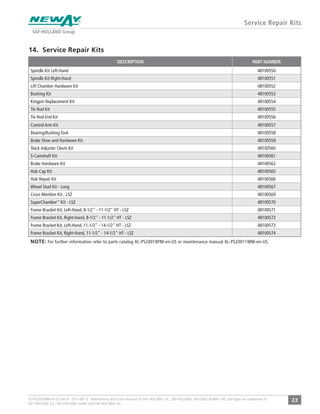
Service Repair Kits
DESCRIPTION PART NUMBER
Spindle Kit Left-Hand 48100550
Spindle Kit Right-Hand 48100551
Lift Chamber Hardware Kit 48100552
Bushing Kit 48100553
Kingpin Replacement Kit 48100554
Tie Rod Kit 48100555
Tie Rod End Kit 48100556
Control Arm Kit 48100557
Bearing/Bushing Tool 48100558
Brake Shoe and Hardware Kit 48100559
Slack Adjuster Clevis Kit 48100560
S-Camshaft Kit 48100561
Brake Hardware Kit 48100562
Hub Cap Kit 48100565
Hub Repair Kit 48100566
Wheel Stud Kit - Long 48100567
Cross Member Kit - LSZ 48100569
SuperChamber™
Kit - LSZ 48100570
Frame Bracket Kit, Left-Hand, 8-1/2" - 11-1/2" HT - LSZ 48100571
Frame Bracket Kit, Right-Hand, 8-1/2" - 11-1/2" HT - LSZ 48100572
Frame Bracket Kit, Left-Hand, 11-1/2" - 14-1/2" HT - LSZ 48100573
Frame Bracket Kit, Right-Hand, 11-1/2" - 14-1/2" HT - LSZ 48100574
14. Service Repair Kits
NOTE: For further information refer to parts catalog XL-PS20018PM-en-US or maintenance manual XL-PS20011MM-en-US.
SAF-HOLLAND USA · 888.396.6501 · Fax 800.356.3929
www.safholland.us
SAF-HOLLAND CANADA · 519.537.3494 · Fax 800.565.7753
WESTERN CANADA · 604.574.7491 · Fax 604.574.0244
www.safholland.ca
SAF-HOLLAND MEXICO · 55.55.5362.8743 · Fax 52.55.5362.8743
www.safholland.com.mx
info@safholland.com
From fifth wheel rebuild kits to suspension bushing repair kits,
SAF-HOLLAND Original Parts are the same quality components used
in the original component assembly.
SAF-HOLLAND Original Parts are tested and designed to provide
maximum performance and durability. Will-fits, look-alikes or, worse
yet, counterfeit parts will only limit the performance potential and
could possibly void SAF-HOLLAND’s warranty. Always be sure to spec
SAF-HOLLAND Original Parts when servicing your
SAF-HOLLAND product.
SAF-HOLLAND USA, INC.
1950 Industrial Blvd., Muskegon, MI 49442
www.safholland.com
XL-PS20005BM-en-USRevB·2015-08-13·AmendmentsandErrorsReserved©SAF-HOLLAND,Inc.,SAF-HOLLAND,HOLLAND,NEWAY,SAF,andlogosaretrademarksofSAF-HOLLANDS.A.,SAF-HOLLANDGmbH,andSAF-HOLLAND,Inc.

Technical Literature

  • 1.
    XL-PS20005BM-en-US Rev B LSZ13Suspension Installation and Operation Manual
  • 2.
    2 XL-PS20005BM-en-US RevA · 2015-08-13 · Amendments and Errors Reserved © SAF-HOLLAND, Inc., SAF-HOLLAND, HOLLAND, NEWAY, SAF, and logos are trademarks of SAF-HOLLAND S.A., SAF-HOLLAND GmbH, and SAF-HOLLAND, Inc. Contents Contents Page Introduction......................................................................... 2 Warranty.............................................................................. 2 Notes, Cautions, and Warnings............................................. 2 Section 1 – Safety Instructions ............................................. 3 Section 2 – Decal Requirements ........................................... 4 Section 3 – Model Identification .......................................... 4 Section 4 – Model Nomenclature ......................................... 5 NEWAY® LSZ13 Series Suspension – Exploded View.............. 6 NEWAY® LSZ13 Series Suspension – Parts List ...................... 7 Section 5 – Welding Standards............................................. 8 Contents Page Section 6 – Pre-Installation ................................................. 9 Section 7 – Installation ...................................................... 10 Section 8 – Alignment........................................................ 14 Section 9 – Pre-Operation .................................................. 15 Section 10 – Torque Specifications ..................................... 17 Section 11 – Lubrication Specifications .............................. 17 Section 12 – Routine Maintenance and Inspection ............. 18 Section 13 – Troubleshooting ............................................. 21 Section 14 – Service Repair Kits ......................................... 23 Notes, Cautions, and Warnings Before starting any work on the unit, read and understand all the safety procedures presented in this manual. This manual contains the terms “NOTE”, “IMPORTANT”, “CAUTION”, and “WARNING” followed by important product information. These terms are defined as follows: NOTE: Includes additional information to enable accurate and easy performance of procedures. IMPORTANT: Includes additional information that if not followed could lead to hindered product performance. Used without the safety alert symbol, indicates a potentially hazardous situation which, if not avoided, could result in property damage. Indicates a potentially hazardous situation which, if not avoided, could result in minor or moderate injury. Indicates a potentially hazardous situation which, if not avoided, could result in death or serious injury. Introduction This manual provides the necessary information for the installation, maintenance, inspection, and safe operation of the Neway® LSZ Series Auxiliary Air Suspension. NOTE: To assist with installation, customer inspection drawing LSZ13_TAB_CI is required and is included in the literature kit. Read this manual before using or servicing this product and keep it in a safe location for future reference. Updates to this manual, which are published as necessary, are available on the internet at www.safholland.us. When replacement parts are required, SAF-HOLLAND® highly recommends the use of only SAF-HOLLAND® Original Parts. A list of technical support locations that supply SAF-HOLLAND® Original Parts and an Aftermarket Parts Catalog are available on the internet at www.safholland.us or contact Customer Service at 888-396-6501. Warranty Refer to the complete warranty for the country in which the product will be used. A copy of the written warranty is included with the product or available on the internet at www.safholland.com.
  • 3.
    3XL-PS20005BM-en-US Rev B· 2015-08-13 · Amendments and Errors Reserved © SAF-HOLLAND, Inc., SAF-HOLLAND, HOLLAND, NEWAY, SAF, and logos are trademarks of SAF-HOLLAND S.A., SAF-HOLLAND GmbH, and SAF-HOLLAND, Inc. General Safety Operational and Road Safety Instructions Before operating vehicle, ensure that the maximum permissible axle load is NOT exceeded and that the load is distributed equally and uniformly and in accordance with state and federal bridge laws. Make sure that the brakes are NOT overheated from continuous operation. Failure to minimize the use of brakes during overheating conditions could result in deterioration of brake efficiency which, if not avoided, could result in death or serious injury. Observe the operating recommendation of the truck manufacturer for off-road operation of the installed axles. IMPORTANT: The definition of OFF-ROAD means driving on non-asphalt/non-concrete routes, e.g. gravel roads, agricultural and forestry tracks, on construction sites and in gravel pits. IMPORTANT: Off-road operation of axles beyond the approved application design could result in damage and impair suspension system performance. Follow the recommended routine maintenance and inspections described in this manual. These procedures are designed so that optimum performance and operational safety are achieved. The suspension springs should always be operated with a static operating pressure between 20 psi (1.38 bar) and 107 psi (7.38 bar). Failure to operate the air springs with a proper static operating pressure could cause premature component failure and loss of vehicle control which, if not avoided, could result in death or serious injury. In the event of suspension air pressure loss, quickly reduce speed as safely as possible and remove the vehicle from traffic. If unable to remove vehicle from traffic, follow DOT safety requirements regarding emergency situations. Contact a qualified towing and/or service company to assist in repairing the vehicle or to move it to a qualified repair facility. DO NOT operate the vehicle in the absence of suspension air pressure; however in the event of an air system failure while in service, an internal rubber bumper built into the air spring will make it possible to temporarily operate the vehicle at reduced speed determined by road conditions. Operating the vehicle without proper air pressure can cause tire failure, fire, or loss of vehicle control which, if not avoided, could result in death or serious injury. The suspension MUST be lifted when the vehicle is moving in reverse. Failure to lift axle when in reverse could result in tire or axle damage. 1. Safety Instructions General and Servicing Safety Instructions Read and observe all Warning and Caution hazard alert messages.The alerts provide information that can help prevent serious personal injury, damage to components, or both. Failure to follow the instructions and safety precautions in this manual could result in improper servicing or operation leading to component failure which, if not avoided, could result in death or serious injury. All installations should be performed by a properly trained technician using proper/special tools, and safe procedures. NOTE: In the United States, workshop safety requirements are defined by federal and/or state Occupational Safety and Health Act (OSHA). Equivalent laws may exist in other countries.This manual is written based on the assumption that OSHA or other applicable employee safety regulations are followed by the location where work is performed. Properly support and secure the vehicle from unexpected movement when servicing the unit. Failure to properly support and secure the vehicle and axles prior to commencing work could create a crush hazard which, if not avoided, could result in death or serious injury. Service both roadside and curbside of an axle. Worn parts should be replaced in sets. Key components on each axle’s braking system, such as friction material, rotors and drums will normally wear over time. Follow all manufacturer’s instructions on spring pressure and air pressure controls. Failure to follow manufacturer’s instructions regarding spring pressure or air pressure control could allow unexpected release of energy which, if not avoided, could result in death or serious injury. The wheel contact surfaces between the wheel and hub/drum MUST NOT be additionally painted. IMPORTANT: The wheel contact surfaces MUST be clean, smooth and free from grease. Failure to keep wheel and hub contact surfaces clean and clear of foreign material could allow wheel/hub separations which, if not avoided, could result in death or serious injury. Only the wheel and tire sizes approved by SAF-HOLLAND® can be used. Tire clearance between tires and the suspension MUST be regularly monitored and maintained. Failure to maintain tire clearance between tires and the nearest point of contact on the suspension or vehicle could cause fire or loss of vehicle control which, if not avoided, could result in death or serious injury.
  • 4.
    4 XL-PS20005BM-en-US RevB · 2015-08-13 · Amendments and Errors Reserved © SAF-HOLLAND, Inc., SAF-HOLLAND, HOLLAND, NEWAY, SAF, and logos are trademarks of SAF-HOLLAND S.A., SAF-HOLLAND GmbH, and SAF-HOLLAND, Inc. LSZ SERIES SUSPENSION TORQUE SPECIFICATIONS Copyright © 2015 SAF-HOLLAND® , Inc. XL-PS20006DC-en-US Rev A www.safholland.us 888-396-6501 Tie Rod Pivot Connections, Lift Bracket, Kingpin Steering Damper Drum Brake Mount Super- Chamber™ , Service Brake Chamber Lower Air Spring Lift Bracket Retainer Plates Upper Air Spring Bracket Torque Plate Caliper Fastener Size 3/4"-16 3/4"-10 3/4"-10 5/8"-18 5/8"-11 1/2"-13 1/2"-13 3/8"-16 3/8"-16 3/4"-16 M20 Torque ft-lb (271-339) (271-339) (188-210) (203-217) 133-155 (188-210) (34-47) 47-63 (64-85) (34-47) 15-20 (20-27) (271-339) 350-400 (475-542) possible. Required re-torquing schedule: miles. relining. Disc Brake Figure 1 Decal Requirements and Model Identification Figure 4 2. Standard Decal Requirements The following two (2) decals MUST be properly installed on the truck prior to putting it in service. Torque Decal: XL-PS20006DC-en-US (Figure 1). Tire Clearance Warning Decal: XL-AR356-01 (Figure 2). It is the responsibility of the end user to periodically inspect all decals and ensure that they are clean and completely legible. If any decals are missing, loose, damaged or difficult to read, contact SAF-HOLLAND® Customer Service at 888-396-6501 to order replacements immediately. 3. Model Identification A serial tag is attached to the front face of the roadside frame bracket (Figure 3).The tag supplies valuable information regarding the exact components used to manufacture the suspension (Figure 4). In order to properly identify the NEWAY® suspension and its components when communicating with SAF-HOLLAND® , please record the specific model, serial number, and in-service date and refer to them when ordering replacement parts. Figure 2 WARNING Minimum tire clearance MUST be maintained between tires and nearest point of contact on the suspension or vehicle. Premature tire wear, fire or loss of vehicle control could result from contact with the tires if clearances are not maintained. XL-AR356-01 TIRE CLEARANCE REQUIREMENTS 1 INCH (25.4 mm) MINIMUM VERTICAL equipped feature. 2 INCH (50.8 mm) MINIMUM LATERAL sides suspension. an SAF® NEWAY® Axle.www.safholland.usCopyright © 2014 SAF-HOLLAND® , Inc. Figure 3 SERIAL TAG
  • 5.
    5XL-PS20005BM-en-US Rev B· 2015-08-13 · Amendments and Errors Reserved © SAF-HOLLAND, Inc., SAF-HOLLAND, HOLLAND, NEWAY, SAF, and logos are trademarks of SAF- HOLLAND S.A., SAF-HOLLAND GmbH, and SAF-HOLLAND, Inc. Model Information 4. Model Nomenclature IMPORTANT: This manual applies to the suspension model series listed below and for special orders of the same. It is very important to determine the specific model number, and serial number. Record those numbers below, and refer to them when obtaining information or replacement parts. Serial No.: __________________________________________ Model No.: _________________________________________ In-Service Date: ____________________________________ Suspension Serial/Model Data: LSZ LSZ XX XX X X X X - X X Lift Self Steer Auxiliary Suspension Capacity 13 - 13,2000 - 13,500 lbs. (Depending on options. Refer to serial tag for capacity as supplied by SAF-HOLLAND® .) Nominal Ride Height (Inches) Drill Pattern A - Brackets Drilled by Installer B - Brackets Pre-Punched Frame Width W -33.50-33.56" Y - 33.63-33.84" A - 33.80-34.13" C - 34.19-34.38" E - 34.44-34.50" Brake System D - Bendix® Disc E - Bendix® Disc with Pederson Bros. Fender Brackets* M - Meritor® Drum N - Meritor® Drum with Pederson Bros. Fender Brackets* X - NOT Supplied bySAF-HOLLAND® *To purchase fenders, fender arms, and fender hardware kit, contact Pederson Bros., Bellingham, WA. Hub and Drum / Rotaor D - Walther™ - Drum Only (with or without fender brackets) E - Conmet - Disc Only (with or without fender brackets) X - NOT Supplied by SAF-HOLLAND® Hub Lubricant A - 80w-90 Oil X - NOT Filled by SAF-HOLLAND® Plumbing A - Fully Plumbed Highest Tank Height B - Fully Plumbed Middle Tank Height C - Fully Plumbed Lowest Tank Height
  • 6.
    6 XL-PS20005BM-en-US RevB · 2015-08-13 · Amendments and Errors Reserved © SAF-HOLLAND, Inc., SAF-HOLLAND, HOLLAND, NEWAY, SAF, and logos are trademarks of SAF-HOLLAND S.A., SAF-HOLLAND GmbH, and SAF-HOLLAND, Inc. LSZ13 Series Suspension Exploded View 16* 2* 45 69 69 45 63 63 69 69 68 63 63 69 48 43 44 43 3* 48 6313 11 16* 5 30 59 69 26 51 66 31 29 6* 60 32 172 20 172 28 29 29 67 67 56 56 31 31 66 66 51 51 27 27 69 69 63 8 9 53 70 50 65 38 36 35 35 33 33 34 34 39* 37 36 37 38 39* 65 50 49 49 63 30 59 69 26 51 66 31 29 20 63 6961 17 63 64 47 47 69 57 46 14 69 47 57 46 15 69 47 60 32 7* 28 40 54 69 6968 25 2558 58 4 22 62 12 44 22 58 58 22 25 69 52 68 164 72 71 165 69 19* 69 62 68 54 171 171 25 63 40 170 170 65 65 52 10 70 70 53 70 25 24 25 24 25 24 23 23 23 6969 69 66 66 51 51 22 24 25 25 23 18 1 63 63 69 69 69 21 69 55 55
  • 7.
    7XL-PS20005BM-en-US Rev B· 2015-08-13 · Amendments and Errors Reserved © SAF-HOLLAND, Inc., SAF-HOLLAND, HOLLAND, NEWAY, SAF, and logos are trademarks of SAF-HOLLAND S.A., SAF-HOLLAND GmbH, and SAF-HOLLAND, Inc. LSZ13 Series Suspension Parts List LSZ13 PARTS LIST ITEM. DESCRIPTION PART NUMBER QTY. 1 Axle/Knuckle Weldment 90550252 1 2* Frame Bracket Assembly, LH, 8-1/2"- 11-1/2" Ride HGT - Paint 90522440 1 Frame Bracket Assembly, LH, 11-1/2" - 14-1/2" Ride HGT - Paint 90522444 Frame Bracket Assembly, LH, 8-1/2"- 11-1/2" Ride HGT, Pre-punched 90522823 Frame Bracket Assembly, LH, 11-1/2" - 14-1/2" Ride HGT, LH, Pre-punched 90522819 3* Frame Bracket Assembly, RH, 8-1/2"- 11-1/2" Ride HGT - Paint 90522442 1 Frame Bracket Assembly, RH, 11-1/2" - 14-1/2" Ride HGT - Paint 90522446 Frame Bracket Assembly, RH, 8-1/2"- 11-1/2" Ride HGT, Pre-punched 90522825 Frame Bracket Assembly, RH, 11-1/2" - 14-1/2" Ride HGT, Pre-punched 90522822 4 Bracket, Air Spring Mount, LH, 8-1/2" - 11-1/2" Ride HGT 90531399 1 Bracket, Air Spring Mount, LH, 11-1/2" - 14-1/2" Ride HGT 90531403 Bracket, Upper Air Spring, LH, 8-1/2"- 11-1/2" Ride HGT, Pre-punched 90531411 Bracket, Upper Air Spring, LH, 11-1/2" - 14-1/2" Ride HGT, Pre-punched 90531407 5 Bracket, Air Spring Mount, RH, 8-1/2" - 11-1/2" Ride HGT 90531400 1 Bracket, Air Spring Mount, RH, 11-1/2" - 14-1/2" Ride HGT 90531404 Bracket, Upper Air Spring, RH, 8-1/2"- 11-1/2" Ride HGT, Pre-punched 90531412 Bracket, Upper Air Spring, RH, 11-1/2" - 14-1/2" Ride HGT, Pre-punched 90531408 6* Spindle Assembly - Left Hand, Drum 90549820 1 Spindle Assembly - Left Hand, Drum with Fender Bracket 90550232 Spindle Assembly - Left Hand, Disc 90550240 7* Spindle Assembly - Right Hand, Drum 90549838 1 Spindle Assembly - Right Hand, Drum with Fender Bracket 90550233 Spindle Assembly - Right Hand, Disc 90550241 8 Drum Brake Assembly, Bolt-On, Left-Hand, Meritor® 90566001 1 9 Drum Brake Assembly, Bolt-On, Right-Hand, Meritor® 90566002 1 10 Bracket, SuperChamber™ , Left-Hand 90550260 1 11 Bracket, SuperChamber™ , Right-Hand 90550262 1 12 Bracket, Lift, Left-Hand 90026856 1 13 Bracket, Lift, Right-Hand 90026854 1 14 Rod End, 3/4"-16, Left-Hand 90045696 1 15 Rod End, 3/4"-16, Right-Hand 90045695 1 16* SuperChamber™ 90550266 2 17 Tie Rod Weldment 90549910 1 18 Air Spring Assembly 90557417 2 19* Crossmember 90026642 1 20 Washer 93600572 2 21 Steering Damper 90045662 2 22 Control Arm - Machined 90015168 4 23 Bushing 90008280 8 24 Core Pin 90038544 8 25 Flat Washer, Lock-Out 93600566 16 26 King Pin 90038548 2 27 End Cap 90010068 2 LSZ13 PARTS LIST ITEM. DESCRIPTION PART NUMBER QTY. 28 Spacer 93600571 2 29 Bearing, Spherical, Plain 90045663 4 30 Fitting Grease 93800229 2 31 Retainer 90034869 4 32 Spacer, Seal 90036295 2 33 Seal 90070000 2 34 Hub and Drum Assembly, Webb® 90570000 2 Hub and Drum Assembly, KIC™ 90570004 2 Hub and Drum Assembly, Walther™ 90570005 2 35 Taper Bearing Cone, 2-5/8" Inboard 90070001 2 36 Taper Bearing Cone, 1-3/4" Outboard 90070002 2 37 Nut, Pro-Torque 90070005 2 38 Gasket 90070004 2 39* Hub Cap 90070003 2 40 Bearing, Lift Bracket 90045716 2 43 3/8" Male Run Tee 93800338 2 44 3/8" Male Elbow 93800339 2 45 Spacer 90034902 2 46 Spacer, Rod End 90036293 2 47 Rod Seal 90045707 4 48 Tube, 3/8" Diameter x 7" Long Neway® Supplied 2 49 Service Chamber, Type 20 90566003 2 50 Hex Head Cap Screw, 5/16"-18 x 1"GR 5 93002463 12 51 Bolt, Hex, 3/8"-16 x 1" GR 8 93002573 20 52 Bolt, Hex, 1/2"-13 x 2-3/4" GR 5 93002937 4 53 Cap Screw, Hex, 5/8"-18 x 2" GR 8 93003348 10 54 Cap Screw, Hex, 3/4"-10 x 2-1/4" GR 8 93003569 2 55 Cap Screw, Hex, 3/4"-10 x 4" GR 5 93003609 4 57 Cap Screw, Hex, 3/4"-10 x 4-1/4" GR 8 93003617 2 58 Cap Screw, Hex, 3/4-10 GR 8 6.00” 93003659 4 59 Cap Screw, Hex, 3/4"-10 x 9-1/2" GR 8 93003743 2 60 Nut, Hex, Lock, 5/8"-18 GR C 93400491 10 61 Jam Nut, 3/4"-16 GR C 93400271 1 62 Nut, Hex, Lock, 1/2"-13 GR B 93400480 4 63 Nut, Hex, Lock .75-10 GR C 93400494 18 64 Jam Nut, 3/4"-16, LH 93400631 1 65 Washer, Lock, 5/16" 93600043 14 66 Washer, Lock, 3/8" 93600045 20 67 Washer, Lock, 1/2" 93600049 4 68 Washer, Flat, Hard, 1/2" 93600138 8 69 Washer, Flat Narrow 0.75 93600156 34 70 Washer, Flat, Hard, 5/8" 93600555 20 71 Cap Screw, Hex 3/4-10 x 6.5 GR 8 93003671 2 72 Cap Screw, Hex 3/4"- 10 x 6.75 GR 8 93003677 2 164 Shelf Bracket - LH 8-1/2"- 11-1/2" Ride HGT 90026726 1 Shelf Bracket - LH 11-1/2" - 14-1/2" Ride HGT 90026728 1 165 Shelf Bracket - RH 8-1/2"- 11-1/2" Ride HGT 90026725 1 Shelf Bracket - RH 11-1/2" - 14-1/2" Ride HGT 90026727 1 170 Pin, Clevis 90501539 2 171 Hex Head Cap Screw, 5/16-18 x 3/4" GR8 93002459 2 172 Quad Ring 90070012 2 *NOT sold individually - must be purchased in kit.
  • 8.
    8 XL-PS20005BM-en-US RevB · 2015-08-13 · Amendments and Errors Reserved © SAF-HOLLAND, Inc., SAF-HOLLAND, HOLLAND, NEWAY, SAF, and logos are trademarks of SAF-HOLLAND S.A., SAF-HOLLAND GmbH, and SAF-HOLLAND, Inc. Welding Standards 5. Welding Standards 5.1 Scope The NEWAY® suspension has been designed to be installed on a truck with no welding required. When welding is required for suspension repairs, observe the requirements below. Customers may NOT weld on an SAF-HOLLAND® suspension without prior approval, including the application of the American Welding Society standards by SAF-HOLLAND® engineering. This specification applies to all components supplied by SAF-HOLLAND® , and its products. The customer assumes all responsibility for weld integrity if the weld material and procedure differ from those listed below. 5.2 Material Frame attachment components made from low carbon or high strength alloy steel are to be welded with AWS filler metal specification AWS A5.18, filler metal classification ER-70S-3, ER-70S-6 or equivalent unless specified on the installation drawing. NOTE: Any substitution for filler material from the above standard MUST comply, as a minimum, with the following mechanical properties: Tensile Strength - 72k psi (496 MPa) Yield Strength - 60k psi (414 MPa) C) % Elongation - 22% The recommended welding gas for gas metal arc welding (GMAW) is 90% Argon/10% CO2. If a different gas is used, welds MUST comply with penetration requirements as illustrated below (Figure 5). Where the installation drawing specifies different than above, the drawing shall prevail. 5.3 Procedures Tack welds used for positioning components are to be located in the center of the final weld, where practical. Tack weld should be completely fused to the finish weld. DO NOT break arc at the end of the weld. Back up all finish welds at least 1/2" (12 mm) or a sufficient amount to prevent craters at the end of the weld. Where weld is shown to go around corners, it is assumed the corner represents a stress concentration area. DO NOT start or stop weld within 1" (25 mm) of the corner. Particular care should be taken to prevent undercutting in this area. 5.4 Workmanship It is the responsibility of the Customer to provide good workmanship when attaching the components to the frame structure. 5.5 Weld Size If weld size is NOT specified, the effective throat of the weld MUST be no smaller than the thinnest material being welded (Figure 5). Figure 5 LACK OF FUSION OF ANY KIND IN THIS AREA IS NOT ACCEPTABLE AT ANY TIME PENETRATION AS MEASURED THROUGH SEAM TARGET PENETRATION TO BE 10% OF THINNEST MATERIAL FROM INTERSECTION OF FILLET AS ILLUSTRATED TARGET PENETRATION
  • 9.
    9XL-PS20005BM-en-US Rev B· 2015-08-13 · Amendments and Errors Reserved © SAF-HOLLAND, Inc., SAF-HOLLAND, HOLLAND, NEWAY, SAF, and logos are trademarks of SAF- HOLLAND S.A., SAF-HOLLAND GmbH, and SAF-HOLLAND, Inc. 6. Pre-Installation Required Tools: 1-1/8" wrench 1-1/8" socket hammer drift punch 1. With the vehicle on a level surface, set the parking brakes and chock the drive tires to prevent the vehicle from rolling forward or backward. Failure to properly secure the vehicle prior to commencing work could create a crush hazard which, if not avoided, could result in death or serious injury. 2. Determine the fore/aft center line of the axle per applicable state and federal bridge laws.After determining the axle ride height, use “A“ dimension column on Table 1 to determine the distance from the center line of the axle to the front face of the frame bracket (Table 1 and Figure 6). Table 1 MODEL RIDE HEIGHT “A” DIMENSION LSZ1310 8.5" 17-13/16" 9" 17-5/8" 9.5" 17-1/2" 10" 17-3/8" 10.5" 17-3/16" 11" 17" 11.5" 16-3/4" LSZ1313 11.5" 17-13/16" 12" 17-5/8" 12.5" 17-1/2" 13" 17-3/8" 13.5" 17-3/16" 14" 17" 14.5" 16-3/4" 10-1/2" CLEARFRAME 4-3/4" CLEAR FRAME 4" CLEAR FRAME RIDE HEIGHT "A" 6-1/4" CLEAR FRAME 17-3/16" ± 1/16" Figure 6 Figure 7 Pre-Installation UPPER AIR SPRING MOUNT BOTTOM OF FRAME RAIL AFT FORE SCRIBE CENTER LINE OF AXLE “A” *17 3/16" ± 1/16" SCRIBE FRONT EDGE OF AIR SPRING MOUNT BRACKET SCRIBE FRONT EDGE OF FRAME BRACKET AFT FORE NOTE: If the tire size on the lift axle and the drive axle are the same, measure the drive axle ride height and use this measurement for the lift axle ride height. This is dependent on a “zero rake” chassis. IMPORTANT: Frame rake changes the designed caster angle of the suspension and may lead to hindered product performance, avoid frame rake angles 1" (25 mm) frame height change in 60" (1524 mm). 3. Scribe a line on the frame at the center line of the axle. Measure forward the distance of the “A” dimension. Scribe a line at this position. This is the front face of the frame bracket position. From the front of the frame bracket position, measure rearward 17-3/16" ± 1/16". This is the front edge of the air spring mount bracket (Figure 6). Be sure to clear the frame as referenced (Figure 7). *The 17-3/16" ± 1/16" is consistant regardless of ride height or "A" dimension. Fully laden bottom of frame to ground (____________ Inches) Subtract static loaded radius of tire SLR -(___________ Inches) Ride Height = ____________ Inches
  • 10.
    10 XL-PS20005BM-en-US RevB · 2015-08-13 · Amendments and Errors Reserved © SAF-HOLLAND, Inc., SAF-HOLLAND, HOLLAND, NEWAY, SAF, and logos are trademarks of SAF-HOLLAND S.A., SAF-HOLLAND GmbH, and SAF-HOLLAND, Inc. Pre-Installation and Installation Figure 84. Measure the frame width, using (Table 2 and Figure 8). Determine the crossmember and the spacer position. NOTE: The distance between the frame brackets should be slightly greater than the frame width by less than a 1/16" (1.5 mm). Achieve clearance by loosening both 3/4" pivot nuts on one (1) side. This will allow easier installation of the lift axle. * Shelf Spacer - Always installed in the most outboard position towards the wheel. ◊ Tank Mount - Always installed when unit is “fully plumbed” and installed in the middle position between the shelf, spacer and inboard spacer. † Spacer - Installed if the unit is NOT “fully plumbed”.The spacer is installed between the shelf spacer and inboard spacer. 7. Installation Required Tools: 15/16" wrench 1" x 2" block, six inches (6") long NOTE: If drilling the frame bracket from inside the frame outward, continue to Step 6. 1. Remove and retain both 5/8"-11 nuts and lock washers from the SuperChamber™ studs (Figure 9). 2. Lift the SuperChamber™ from the SuperChamber™ bracket and install the 1" x 2" block to increase access for drilling the frame bracket (Figure 9). 3. Repeat Step 1 and 2 on the opposite side. IMPORTANT: Failure to properly align the lift axle to the drive axle could lead to reduced maximum steer angle. Failure to properly align the lift axle to the drive axle could lead to reduction of maximum steer angle which, if not avoided, could result in excessive tire wear. SHIM POSITION NOMINAL FROM TO CROSSMEMBER MOUNTING FLANGES SHIMS INSIDE SHIMS OUTSIDE W 33-1/2" 33-1/2" 33-1/2" 4 0 Y 33-3/4" 33-3/4" 33-5/8" 3 1 A 34" 33-7/8" 34-1/8" 2 2 C 34-1/4" 34-1/4" 34-3/8" 1 3 E 34-1/2" 34-1/2" 34-1/2" 0 4 Table 2 Figure 9 SHIPPED IN CONFIGURATION “A“ 5/8" LOCK WASHERS 5/8" NUTS 1" x 2" BLOCK SUPERCHAMBER™ RECOMMENDED HOLE PATTERN W. Y. A. C. E. * ◊ †
  • 11.
    11XL-PS20005BM-en-US Rev B· 2015-08-13 · Amendments and Errors Reserved © SAF-HOLLAND, Inc., SAF-HOLLAND, HOLLAND, NEWAY, SAF, and logos are trademarks of SAF- HOLLAND S.A., SAF-HOLLAND GmbH, and SAF-HOLLAND, Inc. Installation 4. Clamp both frame brackets to the frame rails at the “A“ dimension position, forward of the axle center line. 5. Position both the upper air spring mounts relative to the frame brackets (Figure 10). The slot on the mounting plate MUST be toward the frame bracket. NOTE: Refer to the customer inspection drawing LSZ13_TAB included in the literature kit. IMPORTANT: Make sure the horizontal surface of the air spring mount assemblies are tight up against the bottom of the frame rail flange. 6. Clamp both the upper air spring mount assemblies to the frame rails. IMPORTANT: Use a drill bit no greater than 1/16" larger than bolt diameter when drilling the frame brackets and the air spring mounts. IMPORTANT: Make sure the distance from the forward face of the frame bracket to the air spring bracket is 17-3/16" ± 1/16". 7. Be sure to locate all the air lines and electrical wires out of the area to be drilled. Failure to relocate air lines and electrical wire prior to drilling could result in damaged lines and wires which, if not avoided, could result in component damage. 8. Drill both frame brackets, upper air spring mounts and frame rails. Install the fastening hardware to attach the frame bracket and the upper air spring mount to the frame rails on both sides (Figure 11). Failure to use the required minimum number and size of fasteners may cause premature component failure and a loss of vehicle control which, if not avoided, could result in death or serious injury. Frame bracket minimum bolt requirements: Six (6) 5/8" for LSZ1310 or six (6) 3/4" for LSZ1313 Grade 8 bolts with hardened flat washers under both the bolt heads and lock nuts. Refer to Section 10 and torque fasteners to manufacturer's specifications. Upper air spring mount minimum bolt requirements: Two (2) 5/8" for LSZ1310 or two (2) 3/4" for LSZ1313 Grade 8 bolts with hardened flat washers under both the bolt heads and lock nuts. Refer to Section 10 and torque fasteners to manufacturer's specifications. 9. Torque all fasteners on both sides per fastener manufacturer's specifications, Refer to Section 10. 10. Lift the SuperChamber™ enough to remove block and install SuperChamber™ studs into bracket. Re-install the two (2) 5/8-11" nuts and lock washers. Torque nuts to torque specified in Table 5, Section 10. 11. Repeat Step 10 on the opposite side. Figure 10 AXLE CENTER LINE “A” 17-3/16" ± 1/16" Figure 11 MOUNTING PLATE FRAME BRACKET *17-3/16" ± 1/16" 6 1/2" 1 1/2" 1 1/4" 1 1/2" 1 3/8" 2 3/4"2 1/8" 3 1/4" MOUNTING PLATE SLOT
  • 12.
    12 XL-PS20005BM-en-US RevB · 2015-08-13 · Amendments and Errors Reserved © SAF-HOLLAND, Inc., SAF-HOLLAND, HOLLAND, NEWAY, SAF, and logos are trademarks of SAF-HOLLAND S.A., SAF-HOLLAND GmbH, and SAF-HOLLAND, Inc. Installation 12. Wheel end component installation varies per manufacturer. If the wheel end components were NOT included from SAF-HOLLAND® , follow the manufacturer’s instructions. 13. If unit is fully plumbed, skip to Step 16. 14 Install the supply fitting into the top of the air spring. 15. Plumb the air springs and SuperChambers™ (Figure 12). IMPORTANT: Install the 1/2" tubing between the control valve and the air springs to achieve the shortest lift time possible. 3/8" tubing is required between the control valve and the SuperChambers™ . IMPORTANT: The control valve air supply MUST be downstream of a DOT approved pressure protection valve. Failure to locate the control valve air supply downstream of a DOT approved pressure protection valve could result in loss of brakes due to no or low air pressure which, if not avoided, could result in death or serious injury. IMPORTANT: Ensure full tank pressure is applied to SuperChamber™ when axle is lifted. 16. Connect the fully plumbed axle per the following (Figure 13): a. Connect the pilot port of the brake relay valve to the chassis brake signal using the 1/4" air tube. b. Connect the pilot port of the lift axle control valve to the lift axle's air pressure regulator using the 1/4" air tube. c. Connect the solenoid of the lift axle control module to the lift axle's electrical user controls. NOTE: The solenoid is NOT polarity sensitive. d. Connect the air tank inlet of the lift axle to the truck's air system using 1/2" air tube. DO NOT supply the lift axle's air tank from a pressure protected valve; doing so could result in loss of auxiliary axle brakes due to no or low air pressure which, if not avoided, could result in death or serious injury. NOTE: Auxiliary axle user controls are sold separately. The part numbers are as follows: Fully plumbed axle (in-cab): 90560171 Fully plumbed axle (exterior): 90560180 Non-plumbed axle (in-cab): 90560162 Non-plumbed axle (exterior): 90560163 Figure 13 AIR SPRINGS Figure 12 SUPERCHAMBERS™ CONTROL VALVE PILOT PORT, LIFT AXLE CONTROL MODULE TANK INLET SUPPLY, LIFT AXLE SOLENOID CONNECTION PILOT PORT, BRAKE RELAY VALVE
  • 13.
    13XL-PS20005BM-en-US Rev B· 2015-08-13 · Amendments and Errors Reserved © SAF-HOLLAND, Inc., SAF-HOLLAND, HOLLAND, NEWAY, SAF, and logos are trademarks of SAF- HOLLAND S.A., SAF-HOLLAND GmbH, and SAF-HOLLAND, Inc. Installation and Alignment 17. If hub is NOT filled by SAF-HOLLAND® ,verify that proper lubrication level is in accordance with the hub manufacturer’s specifications in the wheel end hub. Refer to Table 7. IMPORTANT: ALWAYS make sure proper lubrication and proper levels are maintained. Failure to operate the vehicle with lubricant levels in the hub could lead to premature bearing failure and possible separation of the wheel from axle which, if not avoided, could result in death or serious injury. 18. Attach the wheel tire assemblies with twenty (20) flange nuts, ten (10) on each side, to hand tight only. Torque the bolts as specified in the wheel manufacturer’s instructions in a cross pattern (Figure 14). 19. With axle in the in service position, apply a minimum of 30 p.s.i. air pressure into the air springs. Check for leaks by applying a soapy water solution and checking for bubbles at the fittings and at the tube to the fitting connection. 20. Test operation by lifting the axle. Check for leaks at the SuperChamber™ by applying a soapy water solution and checking for bubbles at the fittings and at the tube to the fitting connection. Repair if needed. 21. The vehicle MUST be aligned after installation. Refer to procedures in Section 8. 1 2 3 4 5 6 7 8 9 10 Figure 14
  • 14.
    14 XL-PS20005BM-en-US RevB · 2015-08-13 · Amendments and Errors Reserved © SAF-HOLLAND, Inc., SAF-HOLLAND, HOLLAND, NEWAY, SAF, and logos are trademarks of SAF-HOLLAND S.A., SAF-HOLLAND GmbH, and SAF-HOLLAND, Inc. Alignment 8. Alignment IMPORTANT: Proper axle toe-in is essential to prevent excessive tire wear. Required Tools: 1-1/8" open end wrench 10' tape measure (minimum length), Three (3) jack stands Standard screwdriver 1. With the vehicle on a level blade surface, set the parking brakes and chock the drive tires to prevent the vehicle from rolling forward or backward. Failure to properly secure the vehicle prior to commencing work could create a crush hazard which, if not avoided, could result in death or serious injury. 2. Place the axle in the stowed position. 3. Position a jack stand under the axle at both ends. 4. This procedure requires two (2) people. Utilizing a jack stand, place a standard head screwdriver on top of the stand to scribe a line onto the tire tread. One person secures the position of the screwdriver while the other person slowly rotates the tire one full rotation. The resulting scribe line MUST overlap at both ends. If not, scribe in another position (Figure 15). 5. Repeat Step 4 on the opposite side. 6. Using a measuring tape, measure the cross-body distance at the front and rear of the tires from the scribe lines. 7. The rear dimension should be 1/8" ± 1/16" larger than the front dimension. If not, loosen both 3/4" jam nuts on the tie rod assembly (Figure 16). NOTE: One end of the tie rod assembly has left handed threads. This end can be identified with a groove around the tapered section close to the 3/4" jam nut (Figure 16). 8. Rotate the tie rod until the rear dimension is 1/8" ± 1/16" larger than the front dimension. NEVER rotate the center section of the tie rod to expose more than 5/8" of the rod end threads. If more than 5/8" of the rod end thread is exposed in operation or during service the steering damper forces could cause the rod to fail prematurely which, if not avoided, could result in minor or moderate injury. Figure 15 Figure 16 LEFT HAND THREAD INDICATED BY GROOVE
  • 15.
    15XL-PS20005BM-en-US Rev B· 2015-08-13 · Amendments and Errors Reserved © SAF-HOLLAND, Inc., SAF-HOLLAND, HOLLAND, NEWAY, SAF, and logos are trademarks of SAF- HOLLAND S.A., SAF-HOLLAND GmbH, and SAF-HOLLAND, Inc. Pre-Operation 9. Tighten both 3/4" jam nuts on the tie rod assembly. NOTE: One end of the tie rod assembly has left handed threads. This end can be identified with a groove around the tapered section close to the 3/4" jam nut (Figure 17). 10. Verify the front and rear dimensions. If the rear dimension is larger than the front by 1/8" ± 1/16" the axle is ready for service. If the rear dimension is NOT larger by 1/8" ± 1/16" repeat procedures starting with Step 7. IMPORTANT: Proper toe-in is essential for normal tire wear (Figure 17). 11. Build truck air pressure to 100 psi (6.89 bar) and make sure the axle is in the stowed position. Remove the jack stands. 9. Pre-Operation A pre-service inspection MUST be completed on all vehicles prior to being placed into service. The end user bears the ultimate responsibility for completing this inspection for proper installation and operation. Inspect the following (Figure 18): 1. Verify that the vehicle re-certification has been completed and is correct for the vehicle application. 2. With the vehicle on a level surface, set the parking brakes and chock the drive tires to prevent the vehicle from rolling forward or backward. Failure to properly secure the vehicle prior to commencing work could create a crush hazard which, if not avoided, could result in death or serious injury. 3. Build the truck air pressure above 100 psi (6.89 bar). 4. With the axle in service position, shut off the vehicle and visually check all the air control system fittings for air leaks by applying a soapy water solution and checking for bubbles at all air connections and fittings. 5. Examine the air springs for equal firmness and leaks. 6. With the axle in the stowed position, check for air leaks in the air supply tubing, control valve and all fittings by applying a soapy water solution and checking for bubbles at all air connections and fittings. Repair if needed. SUSPENSION SPRING PRESSURE* GROUND LOAD RIDE HEIGHT 9.0"/12.0" 10.0"/13.0" 11.0"/14.0" 7,000 lbs. 44 psi 44 psi 44 psi 8,000 lbs. 52 psi 52 psi 53 psi 9,000 lbs. 61 psi 60 psi 62 psi 10,000 lbs. 69 psi 68 psi 72 psi 11,000 lbs. 76 psi 76 psi 81 psi 12,000 lbs. 84 psi 83 psi 92 psi 13,000 lbs. 91 psi 90 psi 102 psi 13,200 lbs. 92 psi 92 psi 104 psi 13,500 lbs. 94 psi 94 psi 107 psi Table 4 Figure 17 EXCESSIVE TOE-IN EXCESSIVE TOE-OUT INSIDE WALL INSIDE WALL OUTSIDE WALL OUTSIDE WALL *The above specifications are based on an axle equipped with Michelin® Pilot® XZA 295/80R225 on aluminum rims. If assembly is different, pressure could vary.
  • 16.
    16 XL-PS20005BM-en-US RevB · 2015-08-13 · Amendments and Errors Reserved © SAF-HOLLAND, Inc., SAF-HOLLAND, HOLLAND, NEWAY, SAF, and logos are trademarks of SAF-HOLLAND S.A., SAF-HOLLAND GmbH, and SAF-HOLLAND, Inc. Pre-Operation 7. Check the clearance of the suspension and the axle assembly for interference with outside components. With the vehicle loaded at design capacity, check that there is a 1" (25 mm) minimum clearance around the air springs. If 1" (25 mm) clearance is NOT achieved, verify that the air spring mount bracket is positioned properly (Figure 10). 8. Inspect for loose or missing fasteners on the entire suspension and axle assembly. Re-torque any loose fasteners. 9. Make sure fasteners are tightened to the OEM recommended torque specification using a calibrated torque wrench in a tightening direction. The following fasteners should be inspected: Refer to Section 10. Frame attachment fasteners (including Huck® bolts) Suspension attachment fasteners Steering damper hardware Air spring and SuperChamber™ hardware Tie rod to steer arm attachment hardware 10. Check the alignment, refer to Section 8. 11. Inspect the axle assembly steering dampers and the brake assemblies. 12. Locate and make sure all the axle grease fittings are properly lubricated. Refer to Lubrication Specifications Section 11. IMPORTANT: Always grease kingpin while axle is in stowed position for proper grease distribution. 13. Inspect the adjustment of wheel end assemblies, bearing free play, and brakes according to manufacturer’s specification instructions from each assembly manufacturer. Figure 18 GREASE FITTING CONTROL VALVEAIR FITTING AIR FITTING AIR FITTING BRAKE ASSEMBLY AIR SPRINGS TIE ROD STEERING DAMPER SUPERCHAMBER™ SUPERCHAMBER™ STEERING DAMPER AIR SUPPLY TUBING 14. Verify that the proper lubrication level is in accordance with the hub manufacturer’s specifications in the wheel end hub. IMPORTANT: ALWAYS make sure proper lubrication levels are maintained. Failure to operate the vehicle with proper lubricant levels in the hub could lead to premature bearing failure and possible separation of the wheel from the axle which, if not avoided, could result in death or serious injury. 15. Check for proper tire inflation and that the tire size meets load range specifications. IMPORTANT: Improper tire inflation may result in poor steering and increased tire wear. Consult with tire manufacturer for proper inflation pressure per the tire's load. 16. Make sure the wheel flange nuts are torqued to the wheel manufacturer’s specification. 17. Verify that the axle controls are properly located per State, Federal, and/or Provincial guidelines. 18. Identify and verify “specific” suspension adjustments per OEM guidelines: Weigh the entire fully loaded vehicle with auxiliary axle(s) raised Lower the auxiliary axle(s) and adjust air pressure per OEM guidelines for desired load (Table 4). 19. Remove the chocks from the drive tires.
  • 17.
    17XL-PS20005BM-en-US Rev B· 2015-08-13 · Amendments and Errors Reserved © SAF-HOLLAND, Inc., SAF-HOLLAND, HOLLAND, NEWAY, SAF, and logos are trademarks of SAF-HOLLAND S.A., SAF-HOLLAND GmbH, and SAF-HOLLAND, Inc. Torque and Lubrication Specifications 10. Torque Specifications NOTE: Torque specifications listed (Table 5) are with clean lubricated/coated threads, supplied by SAF-HOLLAND® . IMPORTANT: The use of special lubricants with friction modifiers, such as Anti-Seize or Never-Seez® , without written approval from SAF-HOLLAND® Engineering, will void warranty and could lead to over torquing of fasteners or other component issues. General Information The torque specifications listed throughout the manual are applied to the lock nut and NOT the bolt. IMPORTANT: Most of the fasteners used in this suspension are Grade 8 bolts and Grade C lock nuts. These fasteners have the strength and hardness properties required for their particular function. They MUST be replaced with fasteners of the same grade, size and form as the original in order to prevent failure (Figure 19). Failure to use the proper fasteners when servicing the suspension could cause component failure which, if not avoided, could result in death or serious injury. Failure to properly torque all fasteners will result in component failure which, if not avoided, could result in death or serious injury. All fasteners MUST be re-torqued after the first 100 hours of service or 5,000 miles (8,000 km). Refer to vehicle OEM for torque specifications for the vehicle frame fastener hardware. 11. Lubrication Specifications Lubricate the suspension in accordance with the approved lubricants (Table 6). IMPORTANT: Replacement of SAF-HOLLAND® supplied fasteners with non-SAF-HOLLAND® may result in unpredictable performance. Failure to maintain the LSZ suspension with SAF-HOLLAND® original parts can result in unpredictable performance which, if not avoided, could result in death or serious injury. COMPONENT TORQUE RANGE SIZE Hub Cap 12-16 ft-lb 5/16"-18 Retainer 25-35 ft-lb 3/8"-16 Upper Air Spring 15-20 ft-lb 3/8"-16 Lower Air Spring 25-35 ft-lb 1/2"-13 Chamber Bracket 37-50 ft-lb 1/2"-13 Bolt-on Drum Brake Assembly 150-160 ft-lb 5/8"-11 SuperChamber™ and Service Brake Chamber 133-155 ft-lb 5/8"-11 Pivot Connections, Lift Bracket and King Pin Bolt and Tie Rod 200-250 ft-lb 3/4"-10 Steering Damper 133-155 ft-lb 3/4"-10 Disc Brake Torque Plate 200-250 ft-lb 3/4"-16 Disc Brake Caliper 350-400 ft-lb M20 Table 5 GREASE HUB OIL CITGO SynDurance Premium Synthetic 460 Exxon Mobil Mobilube HD Plus 80W-90 Mystik JT-6 Hi Temp with Moly Shell Spirax S 75W-90 Valvoline Palladium Grease Shell Spirax ASX 75W-90 Chevron Delo Heavy Duty Moly 5% EP Exxon Mobil Mobilube 1 SHC 75W-90 SAF Grease - 50844001 Exxon Mobil Delvac 75W-90 Table 6 Figure 19 GRADE 1 OR 2 BOLT GRADE MARKINGS LOCK NUT GRADE MARKINGS 3 DOTS LOCK NUT GRADE B LOCK NUT GRADE C 6 DOTS GRADE 5 GRADE 8 HUB BRAND OIL QUANTITY KIC™ 12 fl. Oz. Webb® 14.5 fl. Oz. Walther™ 12.9 fl. Oz. Table 7
  • 18.
    18 XL-PS20005BM-en-US RevB · 2015-08-13 · Amendments and Errors Reserved © SAF-HOLLAND, Inc., SAF-HOLLAND, HOLLAND, NEWAY, SAF, and logos are trademarks of SAF-HOLLAND S.A., SAF-HOLLAND GmbH, and SAF-HOLLAND, Inc. Routine Maintenance and Inspection Schedule 12.3 Initial Service Inspection (30 Days or 200 Hours of Service) It is recommend that the initial service inspection for auxiliary axles be completed after 30 days or 200 hours of service (whichever one comes first). Inspect the following: 1. Visually inspect the suspension for proper assembly and operation. 2. Check the clearance of suspension and axle assembly for interference with outside components. 3. Fasteners: Visually inspect for loose, damaged or missing fasteners on the entire suspension and axle assembly. Signs of movement or looseness are bright rust and polishing. Make sure all the fasteners are tightened to the specified torque. Refer to OEM torque specifications for recommended torque requirements. Use a calibrated torque wrench to check torque in a tightening direction. Re-torque if necessary. Replace any worn or damaged fasteners. The following fasteners should be inspected: Frame attachment fasteners (including Huck® bolts). Upper air spring mount assembly attachment fasteners. Axle connection/pivot bolts – Re-torque of these fasteners is mandatory. Steering damper hardware. Tie rod to steer arm attachment hardware. 4. Inspect air springs for: Leaks; repair as required. Any signs of component contact, component damage, or signs of rubbing on the air spring or SuperChamber™ ; correct condition and replace as required. 5. Inspect axle assembly Visually inspect for proper installation. Steering knuckle and tie rod assemblies (if equipped) for proper adjustment and free rotational movement. Check the steering damper coil spring. Examine the steering dampers for oil leakage at the rod seal (located where the rod enters the shock body). Some oil will exit the shock body via a mist from the shock body. Misting is a normal occurrence. Locate all grease fittings, and verify proper lubrication according to OEM guidelines. IMPORTANT: For proper grease distribution, grease kingpin while axle is in the lifted position. Inspect brake assemblies for proper installation and operation. 12. Routine Maintenance and Inspection Schedule 12.1 Daily Driver Inspections According to Federal regulations, a daily “walk around” pre-trip inspection MUST be performed before a vehicle is placed into service. A daily post trip inspection MUST also be completed. The inspection below is an example of what should be checked per DOT requirements. Federal and State requirements may vary and the end user should identify their specific needs. Inspect vehicle for: Bent, cracked, or broken main structural components. Loose, damaged or missing fasteners (signs of movement or looseness are bright rust and polishing). Suspension components for visual signs of irregular movement. Bushings for missing, cracked, torn, or excessive gapping. Air springs and SuperChamber™ for damage and leaks. Axle assemblies for damage or signs of loose components. Brakes for damage, proper function, and adequate friction material. Wheel ends for damage, hub oil level or seal leakage. Tires for proper inflation, unusual or excessive tire wear, and/or damage. Air controls for proper operation.
  • 19.
    19XL-PS20005BM-en-US Rev B· 2015-08-13 · Amendments and Errors Reserved © SAF-HOLLAND, Inc., SAF-HOLLAND, HOLLAND, NEWAY, SAF, and logos are trademarks of SAF-HOLLAND S.A., SAF-HOLLAND GmbH, and SAF-HOLLAND, Inc. 6. Inspect wheel end assemblies: Inspect the wheel end assemblies for seal leakage and wheel bearing free play. Verify proper lubrication. Failure to operate the vehicle with proper lubricant levels in the hub could lead to premature bearing failure and possible separation of the wheel from axle which, if not avoided, could result in death or serious injury. Inspect the tires for damage or excessive wear and replace if required. Verify proper tire inflation. Check that the wheel flange nuts are torqued in accordance with the OEM specification. 7. Inspect the air controls for proper function. 8. Verify all grease points are properly lubricated. 9. Inspect the lift mechanism: With the axle in the stowed position, check for leaks within the SuperChamber™ , all fittings and air supply tubing. Check the pivot bearing within the chamber clevis for excessive wear. This can be visually checked by lifting and lowering the axle. If there is wear within the lift bearing, the chamber clevis pin will have relative motion between the pin and bushing during the lift/lowering axle movement. If excessive wear in the pivot bearing is exhibited, replace the bearing. 12.4 Periodic Inspections (Every 90 Days or 600 Hours) It is recommended that periodic maintenance inspections of auxiliary axles be completed every 90 days or 600 hours of service (whichever comes first). Inspect the following: 1. Visually inspect suspension for proper assembly and operation. 2. Check clearance of the suspension and the axle assembly for interference with outside components. 3. Fasteners: Visually inspect for loose, damaged or missing fasteners on the entire suspension and axle assembly. Signs of movement or looseness are bright rust and polishing. Make sure all the fasteners are tightened to the specified torque. Refer to OEM torque specifications for recommended torque requirements. Use a calibrated torque wrench to check torque in a tightening direction. Correct the torque if necessary. Replace any worn or damaged fasteners. The following fasteners should be inspected: Frame attachment fasteners (including Huck® bolts). Upper air spring mount assembly attachment fasteners. Pivot connections. Steering damper hardware. Kingpin bolts. 4. Inspect air springs for: Leaks; repair as required. Any signs of component contact, component damage, or signs of rubbing on the air spring or SuperChamber™ ; correct condition and replace as required. 5. Inspect axle assembly: Visually inspect for proper installation. Steering knuckle and tie rod assemblies for proper adjustment and free rotational movement. Inspect steering dampers for leakage and proper function. Locate all grease fittings, and verify proper lubrication according to OEM guidelines. Inspect brake assemblies for proper installation and operation. 6. Inspect wheel end assemblies: Inspect the wheel end assemblies for seal leakage and wheel bearing free play. Verify proper lubrication. Failure to operate the vehicle with proper lubricant levels in the hub could lead to premature bearing failure and possible separation of the wheel from axle which, if not avoided, could result in death or serious injury. Inspect tires for damage or excessive wear and replace, if required. Verify proper tire inflation. Check that the wheel flange nuts are torqued in accordance with the OEM specification.
  • 20.
    20 XL-PS20005BM-en-US RevB · 2015-08-13 · Amendments and Errors Reserved © SAF-HOLLAND, Inc., SAF-HOLLAND, HOLLAND, NEWAY, SAF, and logos are trademarks of SAF-HOLLAND S.A., SAF-HOLLAND GmbH, and SAF-HOLLAND, Inc. Maintenance and Inspection Schedule 7. Inspect air controls for proper function. 8. Verify all grease points are properly lubricated. 12.5 Annual Inspection (As Part of Federal DOT Inspection) 1. Visually inspect suspension for proper assembly and operation. 2. Check clearance of the suspension and the axle assembly for interference with outside components. 3. Fasteners: Visually inspect for loose, damaged or missing fasteners on the entire suspension and axle assembly. Signs of movement or looseness are bright rust and polishing. Make sure all the fasteners are tightened to the specified torque. Refer to OEM torque specifications for recommended torque requirements. Use a calibrated torque wrench to check torque in a tightening direction. Correct the torque if necessary. Replace any worn or damaged fasteners. The following fasteners should be inspected: Frame attachment fasteners (including Huck® bolts). Suspension attachment fasteners. Pivot connections. NOTE: Re-torque of these fasteners is recommended as part of the annual inspection. Kingpin bolts. Steering damper hardware. Air spring/lift mechanism hardware. 4. Inspect air springs for: Leaks in flex member or bead plate (top of air spring), replace air spring if leaks are detected. Any sign of rubbing on the flex member. Inspect SuperChambers™ for leaks, replace SuperChamber™ as required. SuperChamber™ contact with frame brackets, replace SuperChamber™ and SuperChamber™ bracket, as required. 5. Identify and verify “specific” suspension adjustments per OEM guidelines. 6. Inspect axle assembly: Visually inspect for proper installation. Steering knuckle and tie rod assemblies for proper adjustment and free rotational movement. Inspect steering dampers for leakage and proper function. Locate all grease fittings, and verify proper lubrication according to OEM guidelines, refer to (Figure 16). Inspect brake assemblies for proper installation, operation, and adequate friction material. 7. Inspect wheel end assemblies: Inspect the wheel end assemblies for seal leakage and wheel bearing free play. Verify proper lubrication level in hub. Failure to operate the vehicle with proper lubricant levels in the hub could lead to premature bearing failure and possible separation of the wheel from axle which, if not avoided, could result in death or serious injury. Inspect tires for damage or excessive wear and replace, if required. Verify proper tire inflation. Check that wheel flange nuts are torqued in accordance with the OEM specification. 8. Inspect the axle air controls to verify controls are operating correctly. 9. Re-verify “specific” suspension adjustments according to OEM guidelines: Weigh the entire fully loaded vehicle with auxiliary axle(s) raised. Lower auxiliary axle(s) and adjust air pressure in accordance with OEM guidelines for desired load to be carried. Re-weigh entire fully loaded vehicle with auxiliary axle(s) on the ground to verify proper load distribution on all axles per State/Federal/Provincial requirements.
  • 21.
    21XL-PS20005BM-en-US Rev B· 2015-08-13 · Amendments and Errors Reserved © SAF-HOLLAND, Inc., SAF-HOLLAND, HOLLAND, NEWAY, SAF, and logos are trademarks of SAF-HOLLAND S.A., SAF-HOLLAND GmbH, and SAF-HOLLAND, Inc. Troubleshooting PROBLEM POSSIBLE CAUSE SOLUTION All air springs are flat Insufficient air pressure in the vehicle air system Check the air pressure gauge on instrument panel. If air pressure is low, run the engine until a minimum pressure of 70 psig (4.83 bars) is indicated on the gauge. If air pressure is 70 psig (4.83 bars) or above and the air springs are NOT inflated, the problem may be with the pressure protection valve or faulty air pressure regulator. Air leakage from the suspension air system or the air brake system Visually check all air control system fittings by applying a soapy water solution and checking for bubbles at all air connections and fittings. Check for loose or damaged fittings, air lines, air springs, brake actuators or control valve.Tighten loose fittings to stop leakage and replace worn or damaged parts as necessary. Air spring(s) deflate rapidly when vehicle is parked Air leakage from the suspension air system Test for air leakage due to loose fittings between air tank and air sus- pension or damaged air lines, air springs or height control valve. Visually check all air control system fittings by applying a soapy water solution and checking for bubbles at all air connections and fittings. Tighten loose fittings to stop leakage and replace worn or damaged parts as necessary. Air spring(s) ruptured Tires, rims, chains or other objects are rubbing against the air spring Check for proper clearance between the air spring and the tire. If the tire, rim, chains or other objects contact the inflated air spring when the vehicle is loaded, a narrower set of tires and rims are necessary to provide clearance for tires with chains (contact the vehicle manufacturer for recommendations). Air spring(s) fail Continual or repeated over-extension of the air spring(s) Visually inspect for broken or loose SuperChamber™ brackets or lower lift brackets. Re-connect loose parts and replace any worn or damaged parts as necessary. Check the adjustment of the pressure regulator. Refer to the manufacturer’s instructions for adjustment. Air spring(s) worn out Replace the air spring(s). NOTE: If the air spring piston contacts the upper bead plate, it may fracture and leak air. Air spring(s) fail to fully deflate when all air pressure is removed from the suspension Restricted air line(s) between the air pressure regulating valve and the air spring(s) Check control and regulating valve. Excessive tire wear Axle toe-in NOT set to specifications Re-align axle. Refer to alignment, Section 8, and tire wear illustration (Figure 17). Axle chamber NOT at specifications Check the axle camber. Brakes dragging Check the brake adjustment. Improper tire pressure Consult with tire manufacturer to ensure proper tire pressure for the tire load. 13. Troubleshooting
  • 22.
    22 XL-PS20005BM-en-US RevB · 2015-08-13 · Amendments and Errors Reserved © SAF-HOLLAND, Inc., SAF-HOLLAND, HOLLAND, NEWAY, SAF, and logos are trademarks of SAF-HOLLAND S.A., SAF-HOLLAND GmbH, and SAF-HOLLAND, Inc. Troubleshooting PROBLEM POSSIBLE CAUSE SOLUTION Pivot connection worn or loose Worn bushings or loss of pivot bolt torque Check pivot connection for worn bushings or looseness by inserting a 2' pry bar between the frame bracket and the nose of the control arm assembly. Visually check for movement while moving the pry bar back and forth. Exercise care NOT to gouge or damage the components while prying back and forth. If .25" or more movement is detected, disassemble the pivot connection and visually inspect the rubber bushing. Check pivot connection bolt to specifications in Section 10. If it DOES NOT fall within specification, perform bushing replacement procedure per Section 10. Replace the pivot connection bushing if wear is detected. If the bushing appears to be in proper working condition, re-assemble the pivot connection and torque the pivot connection to the specification listed in Section 10. Worn out due to length of service Replace pivot connection. Vehicle unstable or handles poorly Loose frame bolts or attachments Tighten frame bolts and attaching parts to proper specifications. Incorrect Bushings Replace as necessary. Loose or worn pivot connection Check pivot connection for worn bushings or looseness by inserting a 2' pry bar between the frame bracket and the nose of the lower control arm assembly. Visually check for movement while moving the pry bar back and forth. Exercise care NOT to gouge or damage the components while prying back and forth. If .25" (6 mm) or more movement is detected, disassemble the pivot connection and visually inspect the rubber bushing. Replace the pivot connection bushing if wear is detected. If the bushing appears to be in proper working condition, reassemble the pivot connection and, with the suspension set at the proper ride height, torque the pivot connection to the specification listed in Section 10. Wheel wobble or shimmy Loose steering dampers Tighten damper bolts to proper specification. Worn steering dampers Replace the steering dampers. Check axle caster angle Check if front surface of frame brackets are perpendicular to frame rails. If NOT, loosen frame bracket attachment hardware and adjust frame bracket. Check control arm bushings for excessive wear. Vertical play in kingpin connection Loose kingpin bolt Tighten kingpin bolts to proper specifications. Worn bearings Rebuild kingpin connection – Refer to kingpin replacement kit. Oil on steering damper rod Misting Some oil will exit the damper body via a mist. Misting is a normal occurrence. Leaking Replace the damper. Poor Steering Dry kingpin bearing Grease kingpin. If not resolved, a kingpin rebuild may be necessary. Axle toe-in not set to specs Re-align axle. Refer to alignment Section 8, and tire wear illustration (Figure 17). Improper tire pressure Consult with tire manufacturer to ensure proper tire pressure for the tire load. If problems still persist, contact vehicle OEM or SAF-HOLLAND® Customer Service at 888-396-6501.
  • 23.
    23XL-PS20005BM-en-US Rev B· 2015-08-13 · Amendments and Errors Reserved © SAF-HOLLAND, Inc., SAF-HOLLAND, HOLLAND, NEWAY, SAF, and logos are trademarks of SAF-HOLLAND S.A., SAF-HOLLAND GmbH, and SAF-HOLLAND, Inc. Service Repair Kits DESCRIPTION PART NUMBER Spindle Kit Left-Hand 48100550 Spindle Kit Right-Hand 48100551 Lift Chamber Hardware Kit 48100552 Bushing Kit 48100553 Kingpin Replacement Kit 48100554 Tie Rod Kit 48100555 Tie Rod End Kit 48100556 Control Arm Kit 48100557 Bearing/Bushing Tool 48100558 Brake Shoe and Hardware Kit 48100559 Slack Adjuster Clevis Kit 48100560 S-Camshaft Kit 48100561 Brake Hardware Kit 48100562 Hub Cap Kit 48100565 Hub Repair Kit 48100566 Wheel Stud Kit - Long 48100567 Cross Member Kit - LSZ 48100569 SuperChamber™ Kit - LSZ 48100570 Frame Bracket Kit, Left-Hand, 8-1/2" - 11-1/2" HT - LSZ 48100571 Frame Bracket Kit, Right-Hand, 8-1/2" - 11-1/2" HT - LSZ 48100572 Frame Bracket Kit, Left-Hand, 11-1/2" - 14-1/2" HT - LSZ 48100573 Frame Bracket Kit, Right-Hand, 11-1/2" - 14-1/2" HT - LSZ 48100574 14. Service Repair Kits NOTE: For further information refer to parts catalog XL-PS20018PM-en-US or maintenance manual XL-PS20011MM-en-US.
  • 24.
    SAF-HOLLAND USA ·888.396.6501 · Fax 800.356.3929 www.safholland.us SAF-HOLLAND CANADA · 519.537.3494 · Fax 800.565.7753 WESTERN CANADA · 604.574.7491 · Fax 604.574.0244 www.safholland.ca SAF-HOLLAND MEXICO · 55.55.5362.8743 · Fax 52.55.5362.8743 www.safholland.com.mx info@safholland.com From fifth wheel rebuild kits to suspension bushing repair kits, SAF-HOLLAND Original Parts are the same quality components used in the original component assembly. SAF-HOLLAND Original Parts are tested and designed to provide maximum performance and durability. Will-fits, look-alikes or, worse yet, counterfeit parts will only limit the performance potential and could possibly void SAF-HOLLAND’s warranty. Always be sure to spec SAF-HOLLAND Original Parts when servicing your SAF-HOLLAND product. SAF-HOLLAND USA, INC. 1950 Industrial Blvd., Muskegon, MI 49442 www.safholland.com XL-PS20005BM-en-USRevB·2015-08-13·AmendmentsandErrorsReserved©SAF-HOLLAND,Inc.,SAF-HOLLAND,HOLLAND,NEWAY,SAF,andlogosaretrademarksofSAF-HOLLANDS.A.,SAF-HOLLANDGmbH,andSAF-HOLLAND,Inc.