Submitted by:
Nidhi tigga ,(30)
Sushmita saha, (31)
Shipra, (32)
Shweta shinde, (33)
 The methods used to analyze securities and make investment decisions
fall into two broad categories:
 Fundamental analysis
 Technical analysis
Fundamental analysis involves analyzing the characteristics of a company in order
to estimate its value.
Technical analysis doesn't care about the "value" of a company, it is about the price
movement in the market.
 It is a method of evaluating securities by analyzing the statistics
generated by market activity, such as past prices and volume.
 It is the study of investor behavior and its effect on the subsequent
price action of financial instruments.
 Do not attempt to measure a security's intrinsic value.
 Use charts and other tools to identify patterns that can suggest future
activity.
 It studies supply and demand in a market in an attempt to determine
what direction, or trend, will continue in the future.
 The field of technical analysis is based on three assumptions:
1. The market discounts everything.
2. Price moves in trends.
3. History tends to repeat itself
 Helps to know stock market trend.
 Holds the key to monitoring investor sentiment.
 It forecast the future financial price movement.
 Help investors anticipate what is “likely” to happen to prices over time
 Technical analysis gives that guide for stock trading, day trading or long
term investment.
 It cannot be used for a longer period of time to analyze the
prices and the movement of the shares.
 It show a buy signal in one technical indicators and another
show a sell signal
 The forecasting accuracy isn’t 100%
 One technical analyst’s opinion may contradict another
analyst’s.
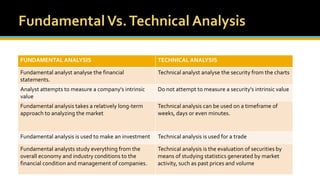
FUNDAMENTAL ANALYSIS TECHNICAL ANALYSIS
Fundamental analyst analyse the financial
statements.
Technical analyst analyse the security from the charts
Analyst attempts to measure a company's intrinsic
value
Do not attempt to measure a security's intrinsic value
Fundamental analysis takes a relatively long-term
approach to analyzing the market
Technical analysis can be used on a timeframe of
weeks, days or even minutes.
Fundamental analysis is used to make an investment Technical analysis is used for a trade
Fundamental analysts study everything from the
overall economy and industry conditions to the
financial condition and management of companies.
Technical analysis is the evaluation of securities by
means of studying statistics generated by market
activity, such as past prices and volume
 Chart patterns are used to predict the market movements.
 Basic concepts underlying the chart analysis-
a) Persistence of trends
b) Relationship between volume and trend
c) Resistance and support levels.
 The stock price move continuous along a path until it meet an opposing force due
to supply demand changes.
 The technical theory attempts to predict whether a trend is discernible, if so,
predict whether it will continue or reverse.
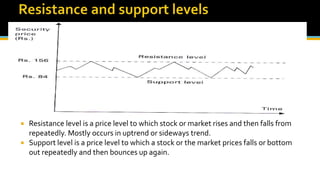
 Resistance level is a price level to which stock or market rises and then falls from
repeatedly. Mostly occurs in uptrend or sideways trend.
 Support level is a price level to which a stock or the market prices falls or bottom
out repeatedly and then bounces up again.
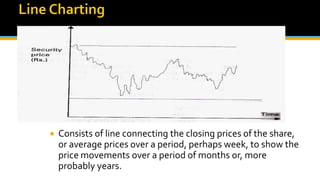
 Consists of line connecting the closing prices of the share,
or average prices over a period, perhaps week, to show the
price movements over a period of months or, more
probably years.
 Trend is the direction in which the market is moving.
 Three types of market trends- uptrend, downtrend and
sideways trend.
 Uptrend/downtrend/sidetrend is the
upward/downward/sideways movement of a stock’s price or
of a market by an average or index over a period of time.
 Usually longer than six months.
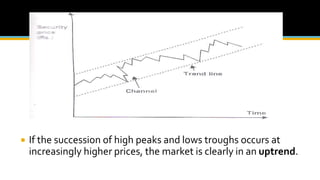
 If the succession of high peaks and lows troughs occurs at
increasingly higher prices, the market is clearly in an uptrend.
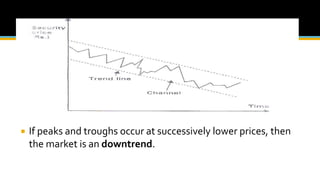
 If peaks and troughs occur at successively lower prices, then
the market is an downtrend.
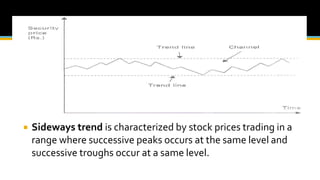
 Sideways trend is characterized by stock prices trading in a
range where successive peaks occurs at the same level and
successive troughs occur at a same level.
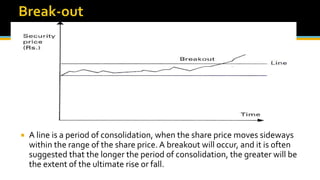
 A line is a period of consolidation, when the share price moves sideways
within the range of the share price. A breakout will occur, and it is often
suggested that the longer the period of consolidation, the greater will be
the extent of the ultimate rise or fall.
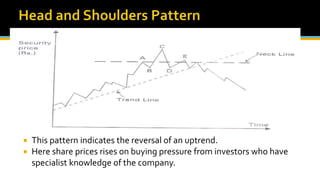
 This pattern indicates the reversal of an uptrend.
 Here share prices rises on buying pressure from investors who have
specialist knowledge of the company.
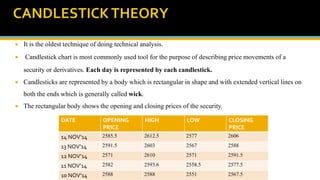
 It is the oldest technique of doing technical analysis.
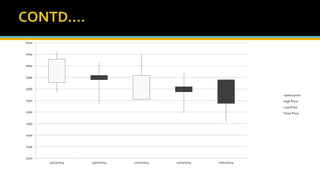
 Candlestick chart is most commonly used tool for the purpose of describing price movements of a
security or derivatives. Each day is represented by each candlestick.
 Candlesticks are represented by a body which is rectangular in shape and with extended vertical lines on
both the ends which is generally called wick.
 The rectangular body shows the opening and closing prices of the security.
DATE OPENING
PRICE
HIGH LOW CLOSING
PRICE
14 NOV’14 2585.5 2612.5 2577 2606
13 NOV’14 2591.5 2603 2567 2588
12 NOV’14 2571 2610 2571 2591.5
11 NOV’14 2582 2593.6 2558.5 2577.5
10 NOV’14 2588 2588 2551 2567.5
2520
2530
2540
2550
2560
2570
2580
2590
2600
2610
2620
14/11/2014 13/11/2014 12/11/2014 11/11/2014 10/11/2014
openin price
High Price
Low Price
Close Price
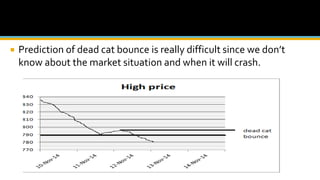
 It is also a type of technical analysis that came into existence from the
idiom that even a cat would bounce back if it falls from a great height.
The same thing applies to securities as well whereby in this at first the
securities follow a downward move.
 They fall to such a great low that it touches the bottom and that’s the
point where the investors invests in the stock assuming that the prices
would rally up to some extent. However after a certain minimal increase
the stocks tend to fall again.
 It generally occurs when the investor gets affected by some market news
and the stock tends to get oversold in that condition. Dead cat bounce can
be found in examples of recession period that happened in year 2008
when the whole globe was suffering from great depression.
 Prediction of dead cat bounce is really difficult since we don’t
know about the market situation and when it will crash.
 Indicators are calculations that measures things such as money flow, trends & momentum based on
price and volume of a security that helps in having additional information for the analysis of securities.
 The two main ways through which it is helpful are:
1. It confirms price movement and the quality of chart patterns
2. It forms buy and sell signals
 Two main types of Indicators are:
1. Leading-A leading indicator is one where the price movements are fairly predictable. It is
considered to strongest during the periods of non-trending trading.
2. Lagging-On the other hand Lagging indicator is one where price movement follows the lagging
indicator. It is useful during trending periods.
 As per this indicator, it tries to determine whether a particular stock is bought
(accumulating) or sold (distributing) by the investor.
 It ascertains the inflow and the outflow of the money in a security and hence
helps in identifying the differences between the price and the volume of the
same stock.
 Assumptions:
1. Money flow multiplier will always fluctuate between +1 and -1.
2. The AD line rises and falls with the fall and rise in the multiplier.
3. Multiplier will be positive when the closing prices are on high and vice versa.
Formula for doing the same is
 Money flow multiplier = [(close-low)-(high-close)]/(high-low)
Taking first data we have,
(821.00-814.50)-(834.00-821.00)/(834.00-814.50)
= - 0.34
 MF volume = MF multiplier*volume
= 346600 * -0.34= 117844
 Accumulation-distribution line = prev. ADL * current period’s MF volume
= 1* 117844
= 117844
Date High Low close MF multiplier volume MF volume Accu-dist line
10nov 2014 834.00 814.50 821.00 - 0.34 346600 -117844 117844
11nov 2014 826.50 795.82 796.50 -0.95 471400 -447830 -329986
12nov 2014 806.00 785.50 796.50 0.073 406000 29638 -300348
13nov 2014 807.50 775.00 785.50 -0.35 592200 -207270 -807966
14nov 2014 797.50 783.50 791.50 0.14 438500 61390 -746576
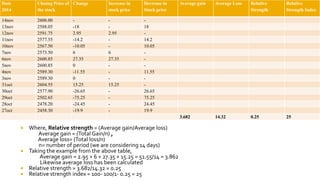
 Relative strength index is one of the Indicators of technical analysis of
securities which helps in comparing the level of gains to the level of loses
and then interpreting it within the range of 0 to 100.
 Assumptions:
1. Whenever the average gain exceeds the average loss the relative
strength index rises making it greater than 1.
2. The RSI should lie in between 0 to 100.
 Relative Strength Index = (100 -100/1+RS)
 Where, Relative strength = (Average gain/Average loss)
Average gain = (Total Gain/n) ,
Average loss= (Total loss/n)
n= number of period (we are considering 14 days)
 Taking the example from the above table,
Average gain = 2.95 + 6 + 27.35 + 15.25 = 51.55/14 = 3.862
Likewise average loss has been calculated
 Relative strength = 3.682/14.32 = 0.25
 Relative strength index = 100- 100/1- 0.25 = 25
Date
2014
Closing Price of
the stock
Change Increase in
stock price
Decrease in
Stock price
Average gain Average Loss Relative
Strength
Relative
Strength Index
14nov 2606.00 - - -
13nov 2588.05 -18 - 18
12nov 2591.75 2.95 2.95 -
11nov 2577.55 -14.2 - 14.2
10nov 2567.50 -10.05 - 10.05
7nov 2573.50 6 6 -
6nov 2600.85 27.35 27.35 -
5nov 2600.85 0 - -
4nov 2589.30 -11.55 - 11.55
3nov 2589.30 0 - -
31oct 2604.55 15.25 15.25 -
30oct 2577.90 -26.65 - 26.65
29oct 2502.65 -75.25 - 75.25
28oct 2478.20 -24.45 - 24.45
27oct 2458.30 -19.9 - 19.9
3.682 14.32 0.25 25
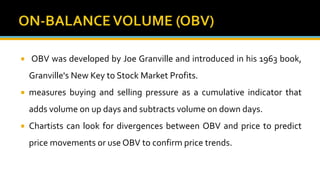
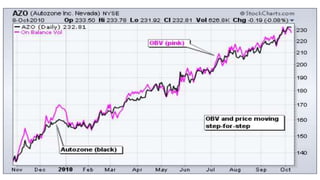
 OBV was developed by Joe Granville and introduced in his 1963 book,
Granville's New Key to Stock Market Profits.
 measures buying and selling pressure as a cumulative indicator that
adds volume on up days and subtracts volume on down days.
 Chartists can look for divergences between OBV and price to predict
price movements or use OBV to confirm price trends.
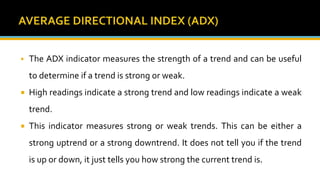
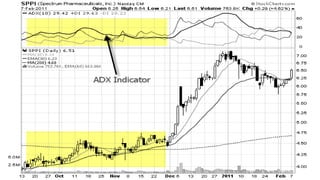
 The ADX indicator measures the strength of a trend and can be useful
to determine if a trend is strong or weak.
 High readings indicate a strong trend and low readings indicate a weak
trend.
 This indicator measures strong or weak trends. This can be either a
strong uptrend or a strong downtrend. It does not tell you if the trend
is up or down, it just tells you how strong the current trend is.
 The Aroon indicator was developed byTushar Chande in 1995.
 The indicator reports the time it is taking for the price to reach, from a
starting point, the highest and lowest points over a given time period,
each reported as a percentage of total time.
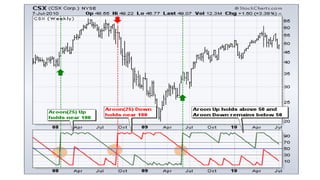
 It is made up of two lines: one line is called "Aroon up", which measures
the strength of the uptrend, and the other line is called "Aroon down",
which measures the downtrend.
 Both the Aroon up and the Aroon down fluctuate between
zero and 100, with values close to 100 indicating a strong
trend, and zero indicating a weak trend.
 The lower the Aroon up, the weaker the uptrend and the
stronger the downtrend, and vice versa.
 Developed by George C. Lane in the late 1950s, the Stochastic
Oscillator
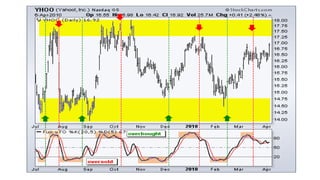
 it is a momentum indicator that shows the location of the close relative
to the high-low range over a set number of periods.
 It follows the speed or the momentum of price.
 Also used to identify bull and bear set-ups to anticipate a future
reversal.
 Because the Stochastic Oscillator is range bound, is also useful for
identifying overbought and oversold levels.
 Thus, we can infer that there are several ways of doing technical analysis of securities.
 To conclude, it is suggested that use of charting technique is a good option since in India,
in NSE and BSE the techniques that are mostly recommended are these few that have
been discussed.
 We saw that indicators are a tool essential to know the volume trend where as charting is
easily predictable if we have a proper know how about the same.Talking about
Candlestick it is the oldest and the most commonly used technique to analyze the
securities.
 There are several other ways to do the analysis as well such as DowTheory, Elliot-wave
theory, overlays and many more.We can use them as and when required.
Technical analysis

Technical analysis

  • 1.
    Submitted by: Nidhi tigga,(30) Sushmita saha, (31) Shipra, (32) Shweta shinde, (33)
  • 2.
     The methodsused to analyze securities and make investment decisions fall into two broad categories:  Fundamental analysis  Technical analysis Fundamental analysis involves analyzing the characteristics of a company in order to estimate its value. Technical analysis doesn't care about the "value" of a company, it is about the price movement in the market.
  • 3.
     It isa method of evaluating securities by analyzing the statistics generated by market activity, such as past prices and volume.  It is the study of investor behavior and its effect on the subsequent price action of financial instruments.  Do not attempt to measure a security's intrinsic value.  Use charts and other tools to identify patterns that can suggest future activity.  It studies supply and demand in a market in an attempt to determine what direction, or trend, will continue in the future.
  • 4.
     The fieldof technical analysis is based on three assumptions: 1. The market discounts everything. 2. Price moves in trends. 3. History tends to repeat itself
  • 5.
     Helps toknow stock market trend.  Holds the key to monitoring investor sentiment.  It forecast the future financial price movement.  Help investors anticipate what is “likely” to happen to prices over time  Technical analysis gives that guide for stock trading, day trading or long term investment.
  • 6.
     It cannotbe used for a longer period of time to analyze the prices and the movement of the shares.  It show a buy signal in one technical indicators and another show a sell signal  The forecasting accuracy isn’t 100%  One technical analyst’s opinion may contradict another analyst’s.
  • 7.
    FUNDAMENTAL ANALYSIS TECHNICALANALYSIS Fundamental analyst analyse the financial statements. Technical analyst analyse the security from the charts Analyst attempts to measure a company's intrinsic value Do not attempt to measure a security's intrinsic value Fundamental analysis takes a relatively long-term approach to analyzing the market Technical analysis can be used on a timeframe of weeks, days or even minutes. Fundamental analysis is used to make an investment Technical analysis is used for a trade Fundamental analysts study everything from the overall economy and industry conditions to the financial condition and management of companies. Technical analysis is the evaluation of securities by means of studying statistics generated by market activity, such as past prices and volume
  • 8.
     Chart patternsare used to predict the market movements.  Basic concepts underlying the chart analysis- a) Persistence of trends b) Relationship between volume and trend c) Resistance and support levels.  The stock price move continuous along a path until it meet an opposing force due to supply demand changes.  The technical theory attempts to predict whether a trend is discernible, if so, predict whether it will continue or reverse.
  • 9.
     Resistance levelis a price level to which stock or market rises and then falls from repeatedly. Mostly occurs in uptrend or sideways trend.  Support level is a price level to which a stock or the market prices falls or bottom out repeatedly and then bounces up again.
  • 10.
     Consists ofline connecting the closing prices of the share, or average prices over a period, perhaps week, to show the price movements over a period of months or, more probably years.
  • 11.
     Trend isthe direction in which the market is moving.  Three types of market trends- uptrend, downtrend and sideways trend.  Uptrend/downtrend/sidetrend is the upward/downward/sideways movement of a stock’s price or of a market by an average or index over a period of time.  Usually longer than six months.
  • 12.
     If thesuccession of high peaks and lows troughs occurs at increasingly higher prices, the market is clearly in an uptrend.
  • 13.
     If peaksand troughs occur at successively lower prices, then the market is an downtrend.
  • 14.
     Sideways trendis characterized by stock prices trading in a range where successive peaks occurs at the same level and successive troughs occur at a same level.
  • 15.
     A lineis a period of consolidation, when the share price moves sideways within the range of the share price. A breakout will occur, and it is often suggested that the longer the period of consolidation, the greater will be the extent of the ultimate rise or fall.
  • 16.
     This patternindicates the reversal of an uptrend.  Here share prices rises on buying pressure from investors who have specialist knowledge of the company.
  • 17.
     It isthe oldest technique of doing technical analysis.  Candlestick chart is most commonly used tool for the purpose of describing price movements of a security or derivatives. Each day is represented by each candlestick.  Candlesticks are represented by a body which is rectangular in shape and with extended vertical lines on both the ends which is generally called wick.  The rectangular body shows the opening and closing prices of the security. DATE OPENING PRICE HIGH LOW CLOSING PRICE 14 NOV’14 2585.5 2612.5 2577 2606 13 NOV’14 2591.5 2603 2567 2588 12 NOV’14 2571 2610 2571 2591.5 11 NOV’14 2582 2593.6 2558.5 2577.5 10 NOV’14 2588 2588 2551 2567.5
  • 18.
    2520 2530 2540 2550 2560 2570 2580 2590 2600 2610 2620 14/11/2014 13/11/2014 12/11/201411/11/2014 10/11/2014 openin price High Price Low Price Close Price
  • 19.
     It isalso a type of technical analysis that came into existence from the idiom that even a cat would bounce back if it falls from a great height. The same thing applies to securities as well whereby in this at first the securities follow a downward move.  They fall to such a great low that it touches the bottom and that’s the point where the investors invests in the stock assuming that the prices would rally up to some extent. However after a certain minimal increase the stocks tend to fall again.  It generally occurs when the investor gets affected by some market news and the stock tends to get oversold in that condition. Dead cat bounce can be found in examples of recession period that happened in year 2008 when the whole globe was suffering from great depression.
  • 20.
     Prediction ofdead cat bounce is really difficult since we don’t know about the market situation and when it will crash.
  • 21.
     Indicators arecalculations that measures things such as money flow, trends & momentum based on price and volume of a security that helps in having additional information for the analysis of securities.  The two main ways through which it is helpful are: 1. It confirms price movement and the quality of chart patterns 2. It forms buy and sell signals  Two main types of Indicators are: 1. Leading-A leading indicator is one where the price movements are fairly predictable. It is considered to strongest during the periods of non-trending trading. 2. Lagging-On the other hand Lagging indicator is one where price movement follows the lagging indicator. It is useful during trending periods.
  • 22.
     As perthis indicator, it tries to determine whether a particular stock is bought (accumulating) or sold (distributing) by the investor.  It ascertains the inflow and the outflow of the money in a security and hence helps in identifying the differences between the price and the volume of the same stock.  Assumptions: 1. Money flow multiplier will always fluctuate between +1 and -1. 2. The AD line rises and falls with the fall and rise in the multiplier. 3. Multiplier will be positive when the closing prices are on high and vice versa.
  • 23.
    Formula for doingthe same is  Money flow multiplier = [(close-low)-(high-close)]/(high-low) Taking first data we have, (821.00-814.50)-(834.00-821.00)/(834.00-814.50) = - 0.34  MF volume = MF multiplier*volume = 346600 * -0.34= 117844  Accumulation-distribution line = prev. ADL * current period’s MF volume = 1* 117844 = 117844 Date High Low close MF multiplier volume MF volume Accu-dist line 10nov 2014 834.00 814.50 821.00 - 0.34 346600 -117844 117844 11nov 2014 826.50 795.82 796.50 -0.95 471400 -447830 -329986 12nov 2014 806.00 785.50 796.50 0.073 406000 29638 -300348 13nov 2014 807.50 775.00 785.50 -0.35 592200 -207270 -807966 14nov 2014 797.50 783.50 791.50 0.14 438500 61390 -746576
  • 24.
     Relative strengthindex is one of the Indicators of technical analysis of securities which helps in comparing the level of gains to the level of loses and then interpreting it within the range of 0 to 100.  Assumptions: 1. Whenever the average gain exceeds the average loss the relative strength index rises making it greater than 1. 2. The RSI should lie in between 0 to 100.  Relative Strength Index = (100 -100/1+RS)
  • 25.
     Relative StrengthIndex = (100 -100/1+RS)  Where, Relative strength = (Average gain/Average loss) Average gain = (Total Gain/n) , Average loss= (Total loss/n) n= number of period (we are considering 14 days)  Taking the example from the above table, Average gain = 2.95 + 6 + 27.35 + 15.25 = 51.55/14 = 3.862 Likewise average loss has been calculated  Relative strength = 3.682/14.32 = 0.25  Relative strength index = 100- 100/1- 0.25 = 25 Date 2014 Closing Price of the stock Change Increase in stock price Decrease in Stock price Average gain Average Loss Relative Strength Relative Strength Index 14nov 2606.00 - - - 13nov 2588.05 -18 - 18 12nov 2591.75 2.95 2.95 - 11nov 2577.55 -14.2 - 14.2 10nov 2567.50 -10.05 - 10.05 7nov 2573.50 6 6 - 6nov 2600.85 27.35 27.35 - 5nov 2600.85 0 - - 4nov 2589.30 -11.55 - 11.55 3nov 2589.30 0 - - 31oct 2604.55 15.25 15.25 - 30oct 2577.90 -26.65 - 26.65 29oct 2502.65 -75.25 - 75.25 28oct 2478.20 -24.45 - 24.45 27oct 2458.30 -19.9 - 19.9 3.682 14.32 0.25 25
  • 26.
     OBV wasdeveloped by Joe Granville and introduced in his 1963 book, Granville's New Key to Stock Market Profits.  measures buying and selling pressure as a cumulative indicator that adds volume on up days and subtracts volume on down days.  Chartists can look for divergences between OBV and price to predict price movements or use OBV to confirm price trends.
  • 28.
     The ADXindicator measures the strength of a trend and can be useful to determine if a trend is strong or weak.  High readings indicate a strong trend and low readings indicate a weak trend.  This indicator measures strong or weak trends. This can be either a strong uptrend or a strong downtrend. It does not tell you if the trend is up or down, it just tells you how strong the current trend is.
  • 30.
     The Aroonindicator was developed byTushar Chande in 1995.  The indicator reports the time it is taking for the price to reach, from a starting point, the highest and lowest points over a given time period, each reported as a percentage of total time.  It is made up of two lines: one line is called "Aroon up", which measures the strength of the uptrend, and the other line is called "Aroon down", which measures the downtrend.
  • 31.
     Both theAroon up and the Aroon down fluctuate between zero and 100, with values close to 100 indicating a strong trend, and zero indicating a weak trend.  The lower the Aroon up, the weaker the uptrend and the stronger the downtrend, and vice versa.
  • 33.
     Developed byGeorge C. Lane in the late 1950s, the Stochastic Oscillator  it is a momentum indicator that shows the location of the close relative to the high-low range over a set number of periods.  It follows the speed or the momentum of price.  Also used to identify bull and bear set-ups to anticipate a future reversal.  Because the Stochastic Oscillator is range bound, is also useful for identifying overbought and oversold levels.
  • 35.
     Thus, wecan infer that there are several ways of doing technical analysis of securities.  To conclude, it is suggested that use of charting technique is a good option since in India, in NSE and BSE the techniques that are mostly recommended are these few that have been discussed.  We saw that indicators are a tool essential to know the volume trend where as charting is easily predictable if we have a proper know how about the same.Talking about Candlestick it is the oldest and the most commonly used technique to analyze the securities.  There are several other ways to do the analysis as well such as DowTheory, Elliot-wave theory, overlays and many more.We can use them as and when required.