Chapter 9 The Juvenile Court
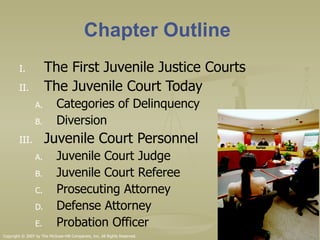
Chapter Outline  The First Juvenile Justice Courts The Juvenile Court Today Categories of Delinquency  Diversion Juvenile Court Personnel Juvenile Court Judge Juvenile Court Referee Prosecuting Attorney Defense Attorney Probation Officer Copyright © 2007 by The McGraw-Hill Companies, Inc. All Rights Reserved.
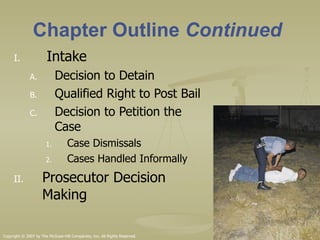
Chapter Outline  Continued   Intake Decision to Detain Qualified Right to Post Bail Decision to Petition the  Case Case Dismissals Cases Handled Informally Prosecutor Decision  Making Copyright © 2007 by The McGraw-Hill Companies, Inc. All Rights Reserved.
Chapter Outline  Continued Adjudication Arraignment Adjudication Hearing Disposition Predisposition Report Disposition Hearing The Future of the Juvenile Court Copyright © 2007 by The McGraw-Hill Companies, Inc. All Rights Reserved.
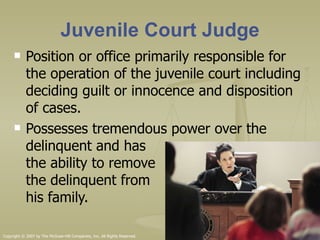
Juvenile Court Judge Position or office primarily responsible for the operation of the juvenile court including deciding guilt or innocence and disposition of cases.  Possesses tremendous power over the delinquent and has  the ability to remove  the delinquent from  his family.  Copyright © 2007 by The McGraw-Hill Companies, Inc. All Rights Reserved.
Selection of Juvenile Court Judges Elected – this is how judges are selected in most states.  Appointed by the Governor Appointed by the Legislature Appointed via the Missouri plan  Copyright © 2007 by The McGraw-Hill Companies, Inc. All Rights Reserved.
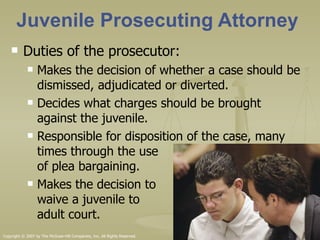
Juvenile Prosecuting Attorney Duties of the prosecutor: Makes the decision of whether a case should be dismissed, adjudicated or diverted. Decides what charges should be brought against the juvenile. Responsible for disposition of the case, many times through the use  of plea bargaining. Makes the decision to  waive a juvenile to  adult court.  Copyright © 2007 by The McGraw-Hill Companies, Inc. All Rights Reserved.
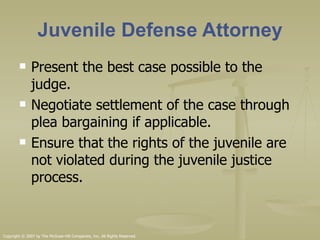
Juvenile Defense Attorney Present the best case possible to the judge. Negotiate settlement of the case through plea bargaining if applicable.  Ensure that the rights of the juvenile are not violated during the juvenile justice process.  Copyright © 2007 by The McGraw-Hill Companies, Inc. All Rights Reserved.
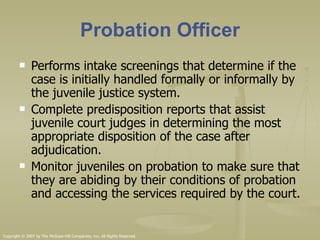
Probation Officer Performs intake screenings that determine if the case is initially handled formally or informally by the juvenile justice system. Complete predisposition reports that assist juvenile court judges in determining the most appropriate disposition of the case after adjudication. Monitor juveniles on probation to make sure that they are abiding by their conditions of probation and accessing the services required by the court.  Copyright © 2007 by The McGraw-Hill Companies, Inc. All Rights Reserved.
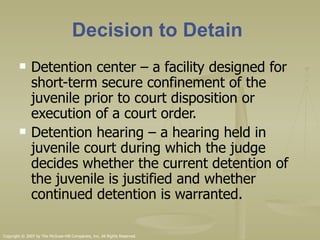
Decision to Detain  Detention center – a facility designed for short-term secure confinement of the juvenile prior to court disposition or execution of a court order.  Detention hearing – a hearing held in juvenile court during which the judge decides whether the current detention of the juvenile is justified and whether continued detention is warranted.  Copyright © 2007 by The McGraw-Hill Companies, Inc. All Rights Reserved.
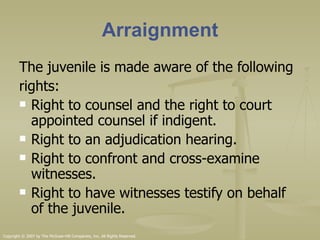
Arraignment The juvenile is made aware of the following  rights:  Right to counsel and the right to court appointed counsel if indigent. Right to an adjudication hearing. Right to confront and cross-examine witnesses. Right to have witnesses testify on behalf of the juvenile.  Copyright © 2007 by The McGraw-Hill Companies, Inc. All Rights Reserved.
Juvenile Terms Plea bargaining – the process by which a juvenile pleads guilty in exchange for concession made by the prosecutor. Adjudication hearing – a hearing to determine whether there is evidence beyond a reasonable doubt to support the allegations against the juvenile.  Dispositional hearing – a hearing held after a juvenile has been adjudicated to determine what sanction should be imposed on the juvenile.  Copyright © 2007 by The McGraw-Hill Companies, Inc. All Rights Reserved.

Taylor2 ppt ch9

  • 1.
    Chapter 9 TheJuvenile Court
  • 2.
    Chapter Outline The First Juvenile Justice Courts The Juvenile Court Today Categories of Delinquency Diversion Juvenile Court Personnel Juvenile Court Judge Juvenile Court Referee Prosecuting Attorney Defense Attorney Probation Officer Copyright © 2007 by The McGraw-Hill Companies, Inc. All Rights Reserved.
  • 3.
    Chapter Outline Continued Intake Decision to Detain Qualified Right to Post Bail Decision to Petition the Case Case Dismissals Cases Handled Informally Prosecutor Decision Making Copyright © 2007 by The McGraw-Hill Companies, Inc. All Rights Reserved.
  • 4.
    Chapter Outline Continued Adjudication Arraignment Adjudication Hearing Disposition Predisposition Report Disposition Hearing The Future of the Juvenile Court Copyright © 2007 by The McGraw-Hill Companies, Inc. All Rights Reserved.
  • 5.
    Juvenile Court JudgePosition or office primarily responsible for the operation of the juvenile court including deciding guilt or innocence and disposition of cases. Possesses tremendous power over the delinquent and has the ability to remove the delinquent from his family. Copyright © 2007 by The McGraw-Hill Companies, Inc. All Rights Reserved.
  • 6.
    Selection of JuvenileCourt Judges Elected – this is how judges are selected in most states. Appointed by the Governor Appointed by the Legislature Appointed via the Missouri plan Copyright © 2007 by The McGraw-Hill Companies, Inc. All Rights Reserved.
  • 7.
    Juvenile Prosecuting AttorneyDuties of the prosecutor: Makes the decision of whether a case should be dismissed, adjudicated or diverted. Decides what charges should be brought against the juvenile. Responsible for disposition of the case, many times through the use of plea bargaining. Makes the decision to waive a juvenile to adult court. Copyright © 2007 by The McGraw-Hill Companies, Inc. All Rights Reserved.
  • 8.
    Juvenile Defense AttorneyPresent the best case possible to the judge. Negotiate settlement of the case through plea bargaining if applicable. Ensure that the rights of the juvenile are not violated during the juvenile justice process. Copyright © 2007 by The McGraw-Hill Companies, Inc. All Rights Reserved.
  • 9.
    Probation Officer Performsintake screenings that determine if the case is initially handled formally or informally by the juvenile justice system. Complete predisposition reports that assist juvenile court judges in determining the most appropriate disposition of the case after adjudication. Monitor juveniles on probation to make sure that they are abiding by their conditions of probation and accessing the services required by the court. Copyright © 2007 by The McGraw-Hill Companies, Inc. All Rights Reserved.
  • 10.
    Decision to Detain Detention center – a facility designed for short-term secure confinement of the juvenile prior to court disposition or execution of a court order. Detention hearing – a hearing held in juvenile court during which the judge decides whether the current detention of the juvenile is justified and whether continued detention is warranted. Copyright © 2007 by The McGraw-Hill Companies, Inc. All Rights Reserved.
  • 11.
    Arraignment The juvenileis made aware of the following rights: Right to counsel and the right to court appointed counsel if indigent. Right to an adjudication hearing. Right to confront and cross-examine witnesses. Right to have witnesses testify on behalf of the juvenile. Copyright © 2007 by The McGraw-Hill Companies, Inc. All Rights Reserved.
  • 12.
    Juvenile Terms Pleabargaining – the process by which a juvenile pleads guilty in exchange for concession made by the prosecutor. Adjudication hearing – a hearing to determine whether there is evidence beyond a reasonable doubt to support the allegations against the juvenile. Dispositional hearing – a hearing held after a juvenile has been adjudicated to determine what sanction should be imposed on the juvenile. Copyright © 2007 by The McGraw-Hill Companies, Inc. All Rights Reserved.