Chapter 16

        Juvenile Corrections:
        End of an Era?


McGraw-Hill/Irwin               © 2013 McGraw-Hill Companies. All Rights Reserved.
Juveniles
   According to the Federal Bureau of
    Investigation (FBI), juveniles accounted for
    14 percent of all 2009 arrests and15
    percent of all 2009 violent crime arrests.


                                              16-2
A Brief History
   The English and American juvenile justice
    systems use the doctrine of parens patriae .
       Latin term that refers to the state as guardian of minors
        and incompetent people
   Historically, juvenile offenders in England were
    confined with adults.
   In 1704, John Howard introduced a Roman
    institutional model for juvenile offenders.
       American colonists brought his ideas to the new world.
   Reformers tailored Howard’s ideas to create
    houses of refuge, reform schools, and industrial
    schools for juveniles.                         16-3
A Brief History – Continued
   In 1825, the first legally chartered American
    custodial institution for juvenile offenders, the
    New York House of Refuge, was established
    by penal reformer Thomas Eddy, education
    reformer John Griscom, and the Society for the
    Prevention of Pauperism.
   The Lyman School, the first state-sponsored
    reform school, opened in Massachusetts in
    1848.
       Reform School – a penal institution to which
        especially young or first-time offenders are committed
        for training and reformation
                                                            16-4
The Juvenile Court
   People ex rel. O’Connell v. Turner (1870)– the
    Illinois Supreme Court began the movement
    toward creating a separate juvenile court
   That movement came to fruition in 1899, when
    the Illinois legislature established the nation’s
    first juvenile court in Cook County (Chicago)


                                                        16-5
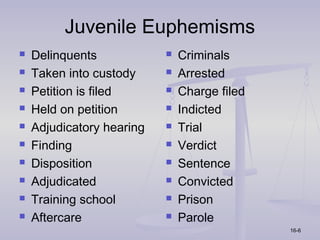
Juvenile Euphemisms
   Delinquents               Criminals
   Taken into custody        Arrested
   Petition is filed         Charge filed
   Held on petition          Indicted
   Adjudicatory hearing      Trial
   Finding                   Verdict
   Disposition               Sentence
   Adjudicated               Convicted
   Training school           Prison
   Aftercare                 Parole
                                              16-6
Landmark Cases
   Kent v. United States (1966) – in cases involving
    transfer of jurisdiction, juveniles are entitled to
    certain essential due process rights, such as a
    hearing, an attorney, access to records, a
    written statement of reasons for the transfer
   In re Gault (1967) – juvenile offenders have the
    right to reasonable notice of charges, appointed
    counsel, question witnesses, and protection
    against self-incrimination


                                                     16-7
Landmark Cases – Continued
   In re Winship (1970) – the guilty beyond a
    reasonable doubt standard should be required in
    all delinquency adjudications
   McKeiver v. Pennsylvania (1971) – the due
    process clause of the Fourteenth Amendment
    does not require jury trials in juvenile court
   Breed v. Jones (1975) – the double jeopardy
    protection applies to juvenile adjudication
    proceedings
   Shall v. Martin (1984) – preventive detention
    may be used for juveniles

                                                 16-8
Juvenile Crime
   Delinquent offenses - acts committed by
    juveniles that, if committed by adults, could
    result in criminal prosecution
   Status offenses - acts that are law violations
    only for juveniles such as running away, truancy,
    or ungovernability
       Sometimes referred to as incorrigibility or being
        beyond parental control


                                                            16-9
The Juvenile Justice Process
The three phases of the juvenile justice
process are:
 Intake

 Adjudication

 Disposition


                                           16-10
Intake
   The first stage of the juvenile justice process.
   A court-appointed officer reviews the case and
    recommends a course of action—
       dismissal,
       informal disposition,
       formal disposition, or
       transfer to adult criminal court


                                                   16-11
Detention
   Detention Hearing – a judicial review of the
    intake officer’s detention decision
   Juvenile detention facility – a facility for
    keeping juvenile offenders in secure custody, as
    necessary, through various stages of the
    juvenile justice process
   Guardian Ad Litem – a person appointed by
    the juvenile court, often defense counsel, to
    serve as a special guardian for the youth being
    processed through the juvenile justice system

                                                  16-12
Adjudication
   The process by which a court arrives at a final
    disposition in a case; also the second stage in
    the juvenile justice process
   The court decides whether the offender is
    formally responsible for (guilty of) the alleged
    offense
   Equivalent to the trial in adult criminal cases


                                                       16-13
Disposition
   The third stage of the juvenile justice process in
    which the court decides the disposition
    (sentence) for a juvenile case
   Equivalent to the sentencing of an adult offender
   Predisposition report – a report that
    documents (1) the juvenile’s background; (2)
    educational history; (3) information gathered
    from interviews with the juvenile, family
    members, and others; (4) available placement
    options; and (5) recommended dispositions

                                                   16-14
Types of Dispositions
   Probation
   Commitment to group homes
       A non-secure residential facility for juveniles
   Residential treatment
       A residential facility that provides intensive treatment
        services to juveniles
   Boot camp
   Juvenile correctional institutions
   Blended sentencing
       A two-part (juvenile and adult) sentence in which the
        adult sentence may be waved if the offender complies
        with all provisions of the juvenile sentence        16-15
Evidence-Based Practice and
        Juvenile Corrections
   Few studies have focused on reducing
    recidivism among juvenile offenders
   Most effective strategy for treating and
    rehabilitating juvenile offenders
       Prevention programming
       Continuum of pre-trial and sentencing placement
        options
       Services and sanctions
       Aftercare programs
   An example is the approach used by the
    California Division of Juvenile Justice (DJJ)
                                                          16-16
Transfer
Juveniles may be transferred to adult court under
one of three provisions:
 Waiver Provisions – the juvenile court orders
  transfer of the case to adult criminal court
 Direct File Provisions – the prosecutor
  determines whether to initiate a case against a
  juvenile in juvenile court or in adult criminal court
 Statutory Exclusion Provisions – the adult
  criminal court jurisdiction for certain juvenile
  cases is established by state law


                                                    16-17
Juvenile Correctional Facilities
   Juvenile corrections functions are placed in various
    state agencies by the different states.
   Operating budgets for the agencies ranged from
    $642 million (Florida) to about $10 million (North
    Dakota).
   Nationwide, the number of delinquency cases
    involving detention increased 42 percent between
    1985 and 2002, from 231,400 to 329,800.


                                                    16-18
Teen Courts

   Courts in which youths adjudicate and impose
    disposition for a juvenile offense
   Also called peer and youth courts
   Have become a popular alternative to the
    traditional juvenile court for young or first-time
    offenders
   Teen courts handled approximately 125,000
    cases in 2005


                                                         16-19
Four Models of Teen Courts
   The Adult Judge model – an adult serves as
    judge and youth serve as attorneys and court
    staff
   The Youth Judge model – parallels the Adult
    Judge model, with the exception that a youth
    serves as judge
   The Tribunal model – youth attorneys present
    the case to a panel of three youth judges
   The Peer Jury model – uses no attorneys; the
    case is presented to the jury by a youth or adult
    and the jury questions the defendant

                                                   16-20
Youth Gangs
   Gang: a criminal enterprise having an
    organizational structure, acting as a continuing
    criminal conspiracy, that employs violence and
    any other criminal activity to sustain itself
   Youth gang: a gang whose membership is
    generally comprised of people between the ages
    of 12 and 24
   Street gang: an organized group of people on
    the street often engaged in significant
    illegitimate or criminal activity

                                                 16-21

Ppt chapter 16

  • 1.
    Chapter 16 Juvenile Corrections: End of an Era? McGraw-Hill/Irwin © 2013 McGraw-Hill Companies. All Rights Reserved.
  • 2.
    Juveniles  According to the Federal Bureau of Investigation (FBI), juveniles accounted for 14 percent of all 2009 arrests and15 percent of all 2009 violent crime arrests. 16-2
  • 3.
    A Brief History  The English and American juvenile justice systems use the doctrine of parens patriae .  Latin term that refers to the state as guardian of minors and incompetent people  Historically, juvenile offenders in England were confined with adults.  In 1704, John Howard introduced a Roman institutional model for juvenile offenders.  American colonists brought his ideas to the new world.  Reformers tailored Howard’s ideas to create houses of refuge, reform schools, and industrial schools for juveniles. 16-3
  • 4.
    A Brief History– Continued  In 1825, the first legally chartered American custodial institution for juvenile offenders, the New York House of Refuge, was established by penal reformer Thomas Eddy, education reformer John Griscom, and the Society for the Prevention of Pauperism.  The Lyman School, the first state-sponsored reform school, opened in Massachusetts in 1848.  Reform School – a penal institution to which especially young or first-time offenders are committed for training and reformation 16-4
  • 5.
    The Juvenile Court  People ex rel. O’Connell v. Turner (1870)– the Illinois Supreme Court began the movement toward creating a separate juvenile court  That movement came to fruition in 1899, when the Illinois legislature established the nation’s first juvenile court in Cook County (Chicago) 16-5
  • 6.
    Juvenile Euphemisms  Delinquents  Criminals  Taken into custody  Arrested  Petition is filed  Charge filed  Held on petition  Indicted  Adjudicatory hearing  Trial  Finding  Verdict  Disposition  Sentence  Adjudicated  Convicted  Training school  Prison  Aftercare  Parole 16-6
  • 7.
    Landmark Cases  Kent v. United States (1966) – in cases involving transfer of jurisdiction, juveniles are entitled to certain essential due process rights, such as a hearing, an attorney, access to records, a written statement of reasons for the transfer  In re Gault (1967) – juvenile offenders have the right to reasonable notice of charges, appointed counsel, question witnesses, and protection against self-incrimination 16-7
  • 8.
    Landmark Cases –Continued  In re Winship (1970) – the guilty beyond a reasonable doubt standard should be required in all delinquency adjudications  McKeiver v. Pennsylvania (1971) – the due process clause of the Fourteenth Amendment does not require jury trials in juvenile court  Breed v. Jones (1975) – the double jeopardy protection applies to juvenile adjudication proceedings  Shall v. Martin (1984) – preventive detention may be used for juveniles 16-8
  • 9.
    Juvenile Crime  Delinquent offenses - acts committed by juveniles that, if committed by adults, could result in criminal prosecution  Status offenses - acts that are law violations only for juveniles such as running away, truancy, or ungovernability  Sometimes referred to as incorrigibility or being beyond parental control 16-9
  • 10.
    The Juvenile JusticeProcess The three phases of the juvenile justice process are:  Intake  Adjudication  Disposition 16-10
  • 11.
    Intake  The first stage of the juvenile justice process.  A court-appointed officer reviews the case and recommends a course of action—  dismissal,  informal disposition,  formal disposition, or  transfer to adult criminal court 16-11
  • 12.
    Detention  Detention Hearing – a judicial review of the intake officer’s detention decision  Juvenile detention facility – a facility for keeping juvenile offenders in secure custody, as necessary, through various stages of the juvenile justice process  Guardian Ad Litem – a person appointed by the juvenile court, often defense counsel, to serve as a special guardian for the youth being processed through the juvenile justice system 16-12
  • 13.
    Adjudication  The process by which a court arrives at a final disposition in a case; also the second stage in the juvenile justice process  The court decides whether the offender is formally responsible for (guilty of) the alleged offense  Equivalent to the trial in adult criminal cases 16-13
  • 14.
    Disposition  The third stage of the juvenile justice process in which the court decides the disposition (sentence) for a juvenile case  Equivalent to the sentencing of an adult offender  Predisposition report – a report that documents (1) the juvenile’s background; (2) educational history; (3) information gathered from interviews with the juvenile, family members, and others; (4) available placement options; and (5) recommended dispositions 16-14
  • 15.
    Types of Dispositions  Probation  Commitment to group homes  A non-secure residential facility for juveniles  Residential treatment  A residential facility that provides intensive treatment services to juveniles  Boot camp  Juvenile correctional institutions  Blended sentencing  A two-part (juvenile and adult) sentence in which the adult sentence may be waved if the offender complies with all provisions of the juvenile sentence 16-15
  • 16.
    Evidence-Based Practice and Juvenile Corrections  Few studies have focused on reducing recidivism among juvenile offenders  Most effective strategy for treating and rehabilitating juvenile offenders  Prevention programming  Continuum of pre-trial and sentencing placement options  Services and sanctions  Aftercare programs  An example is the approach used by the California Division of Juvenile Justice (DJJ) 16-16
  • 17.
    Transfer Juveniles may betransferred to adult court under one of three provisions:  Waiver Provisions – the juvenile court orders transfer of the case to adult criminal court  Direct File Provisions – the prosecutor determines whether to initiate a case against a juvenile in juvenile court or in adult criminal court  Statutory Exclusion Provisions – the adult criminal court jurisdiction for certain juvenile cases is established by state law 16-17
  • 18.
    Juvenile Correctional Facilities  Juvenile corrections functions are placed in various state agencies by the different states.  Operating budgets for the agencies ranged from $642 million (Florida) to about $10 million (North Dakota).  Nationwide, the number of delinquency cases involving detention increased 42 percent between 1985 and 2002, from 231,400 to 329,800. 16-18
  • 19.
    Teen Courts  Courts in which youths adjudicate and impose disposition for a juvenile offense  Also called peer and youth courts  Have become a popular alternative to the traditional juvenile court for young or first-time offenders  Teen courts handled approximately 125,000 cases in 2005 16-19
  • 20.
    Four Models ofTeen Courts  The Adult Judge model – an adult serves as judge and youth serve as attorneys and court staff  The Youth Judge model – parallels the Adult Judge model, with the exception that a youth serves as judge  The Tribunal model – youth attorneys present the case to a panel of three youth judges  The Peer Jury model – uses no attorneys; the case is presented to the jury by a youth or adult and the jury questions the defendant 16-20
  • 21.
    Youth Gangs  Gang: a criminal enterprise having an organizational structure, acting as a continuing criminal conspiracy, that employs violence and any other criminal activity to sustain itself  Youth gang: a gang whose membership is generally comprised of people between the ages of 12 and 24  Street gang: an organized group of people on the street often engaged in significant illegitimate or criminal activity 16-21