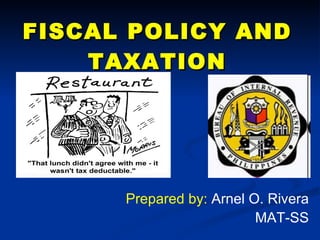
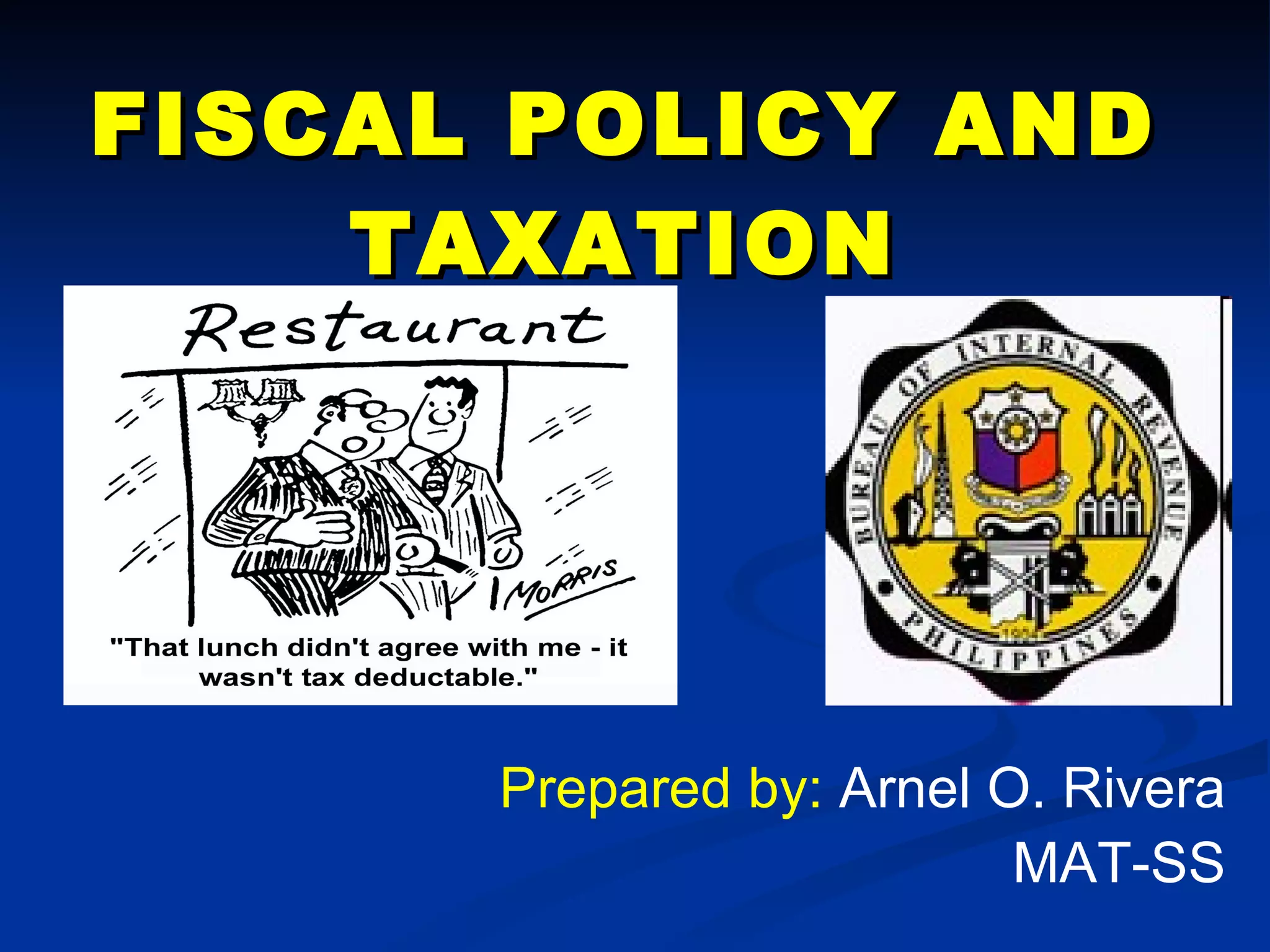
FISCAL POLICY AND TAXATION Prepared by:  Arnel O. Rivera MAT-SS
Fiscal Policy It is the  process  by which revenues are generated used to defray expenses of government. The authority of the law in  increasing its revenue  under, purposely used to promote welfare and protection of its citizenry. It is the  collection  of the share of individual and organizational income by a government under the authority of the law.
Concept of Taxation Taxation   is the inherent power of the state to impose and demand contribution upon persons, properties, or rights for the purpose of generating revenues for public purposes.
Significance of Taxation Primary purpose:   To generate funds to defray expenses incurred by the government in promoting the general welfare of its citizenry. Other purposes:   to equitably contribute to the  wealth of the nation to protect new industries to protect local producers
Principles and Theories of Taxation The Benefit Principle .  This principle holds the  individuals should be taxed in proportion to the benefits they receive from the governments  and that taxes should be paid by those people who receive the direct benefit of the government programs and projects out of the taxes paid.
Principles and Theories of Taxation The Ability-to-Pay Principle .   This principle holds that  taxes should relate with the people’s income or the ability to pay , that is, people with greater income or wealth and can afford to pay more taxes should be taxed at a higher rate than people with less wealth. Ex. Individual income tax.
Principles and Theories of Taxation The Equal-Distribution Principle .  This principle states that  income, wealth, and transaction should be taxed at a fixed percentage ; that is, people who earn more and buy more should pay more taxes, but will not pay a higher rate of taxes.
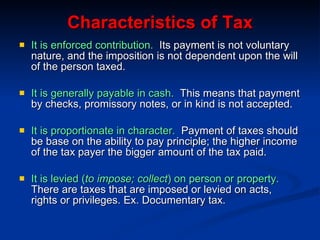
Characteristics of Tax It is enforced contribution.   Its payment is not voluntary nature, and the imposition is not dependent upon the will of the person taxed. It is generally payable in cash.   This means that payment by checks, promissory notes, or in kind is not accepted. It is proportionate in character.   Payment of taxes should be base on the ability to pay principle; the higher income of the tax payer the bigger amount of the tax paid. It is levied ( to impose; collect ) on person or property.   There are taxes that are imposed or levied on acts, rights or privileges. Ex. Documentary tax.
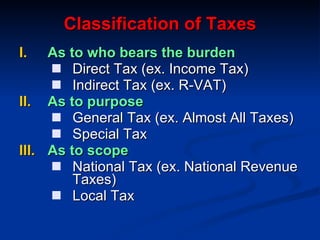
Classification of Taxes As to who bears the burden Direct Tax (ex. Income Tax) Indirect Tax (ex. R-VAT) As to purpose  General Tax (ex. Almost All Taxes) Special Tax  As to scope National Tax (ex. National Revenue Taxes) Local Tax
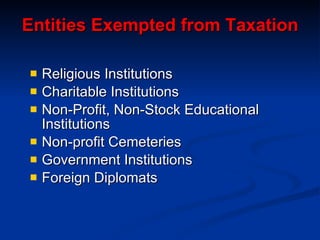
Entities Exempted from Taxation Religious Institutions Charitable Institutions Non-Profit, Non-Stock Educational Institutions Non-profit Cemeteries Government Institutions Foreign Diplomats
To download this file, go to: http://www.slideshare.net/ArnelSSI Thank Y  u!

Taxation

  • 1.
    FISCAL POLICY ANDTAXATION Prepared by: Arnel O. Rivera MAT-SS
  • 2.
    Fiscal Policy Itis the process by which revenues are generated used to defray expenses of government. The authority of the law in increasing its revenue under, purposely used to promote welfare and protection of its citizenry. It is the collection of the share of individual and organizational income by a government under the authority of the law.
  • 3.
    Concept of TaxationTaxation is the inherent power of the state to impose and demand contribution upon persons, properties, or rights for the purpose of generating revenues for public purposes.
  • 4.
    Significance of TaxationPrimary purpose: To generate funds to defray expenses incurred by the government in promoting the general welfare of its citizenry. Other purposes: to equitably contribute to the wealth of the nation to protect new industries to protect local producers
  • 5.
    Principles and Theoriesof Taxation The Benefit Principle . This principle holds the individuals should be taxed in proportion to the benefits they receive from the governments and that taxes should be paid by those people who receive the direct benefit of the government programs and projects out of the taxes paid.
  • 6.
    Principles and Theoriesof Taxation The Ability-to-Pay Principle . This principle holds that taxes should relate with the people’s income or the ability to pay , that is, people with greater income or wealth and can afford to pay more taxes should be taxed at a higher rate than people with less wealth. Ex. Individual income tax.
  • 7.
    Principles and Theoriesof Taxation The Equal-Distribution Principle . This principle states that income, wealth, and transaction should be taxed at a fixed percentage ; that is, people who earn more and buy more should pay more taxes, but will not pay a higher rate of taxes.
  • 8.
    Characteristics of TaxIt is enforced contribution. Its payment is not voluntary nature, and the imposition is not dependent upon the will of the person taxed. It is generally payable in cash. This means that payment by checks, promissory notes, or in kind is not accepted. It is proportionate in character. Payment of taxes should be base on the ability to pay principle; the higher income of the tax payer the bigger amount of the tax paid. It is levied ( to impose; collect ) on person or property. There are taxes that are imposed or levied on acts, rights or privileges. Ex. Documentary tax.
  • 9.
    Classification of TaxesAs to who bears the burden Direct Tax (ex. Income Tax) Indirect Tax (ex. R-VAT) As to purpose General Tax (ex. Almost All Taxes) Special Tax As to scope National Tax (ex. National Revenue Taxes) Local Tax
  • 10.
    Entities Exempted fromTaxation Religious Institutions Charitable Institutions Non-Profit, Non-Stock Educational Institutions Non-profit Cemeteries Government Institutions Foreign Diplomats
  • 11.
    To download thisfile, go to: http://www.slideshare.net/ArnelSSI Thank Y u!