Tattoos www.jexpoz.com
Origine Meaning Tattoing methods old method modern method Tattoo machine Needle Application Shading coloring Risk www.jexpoz.com
origine 3300 B.C.  Tattoos found on  Egyptian   and   Nubian   mummies  date from about 2000 B.C Tattooing was rediscovered by Europeans when exploration brought them into contact with Polynesians and American Indians The word  tattoo  comes from the Tahitian word  tattau , which means "to mark,". tattoos were considered so exotic in European and U.S. societies www.jexpoz.com
The practice of tattooing means different things in different cultures. In early practice,  decoration  appears to have been the most common motive for tattooing, and that still holds true today. In some cultures, tattoos served as  identification  of the wearer’s rank or status in a group.. Tahitian tattoos served as  rites of passage , telling the history of the wearer’s life.  This Tahitian tattoo tells about rights of passage in the wearer's life. meaning www.jexpoz.com
Old tattoing methods An amazing variety of tattooing methods developed in different cultures.  In North and South America, many Indian tribes routinely tattooed the body or the face by simple pricking  Many tribes of the Arctic and Subarctic, mostly Inuit, and some people in eastern Siberia, made needle punctures through which a thread coated with pigment was drawn underneath the skin. In Polynesia and Micronesia, pigment was pricked into the skin by tapping on a tool shaped like a small rake.  The Maori people of New Zealand, who are world famous for their tattooing, applied their wood carving technique to tattooing by striking a small bone-cutting tool (used for shaping wood) into the skin.  www.jexpoz.com
Modern tattoing method Today, tattoos are created by  injecting ink  into the skin. Injection is done by a  needle  attached to a hand-held tool, in the skin by about one millimeter.  The ink is not in the  epidermis , which is the layer of skin that we see and the skin that gets replaced constantly, but instead intermingles with  cells  in the  dermis  and shows through the epidermis.  www.jexpoz.com
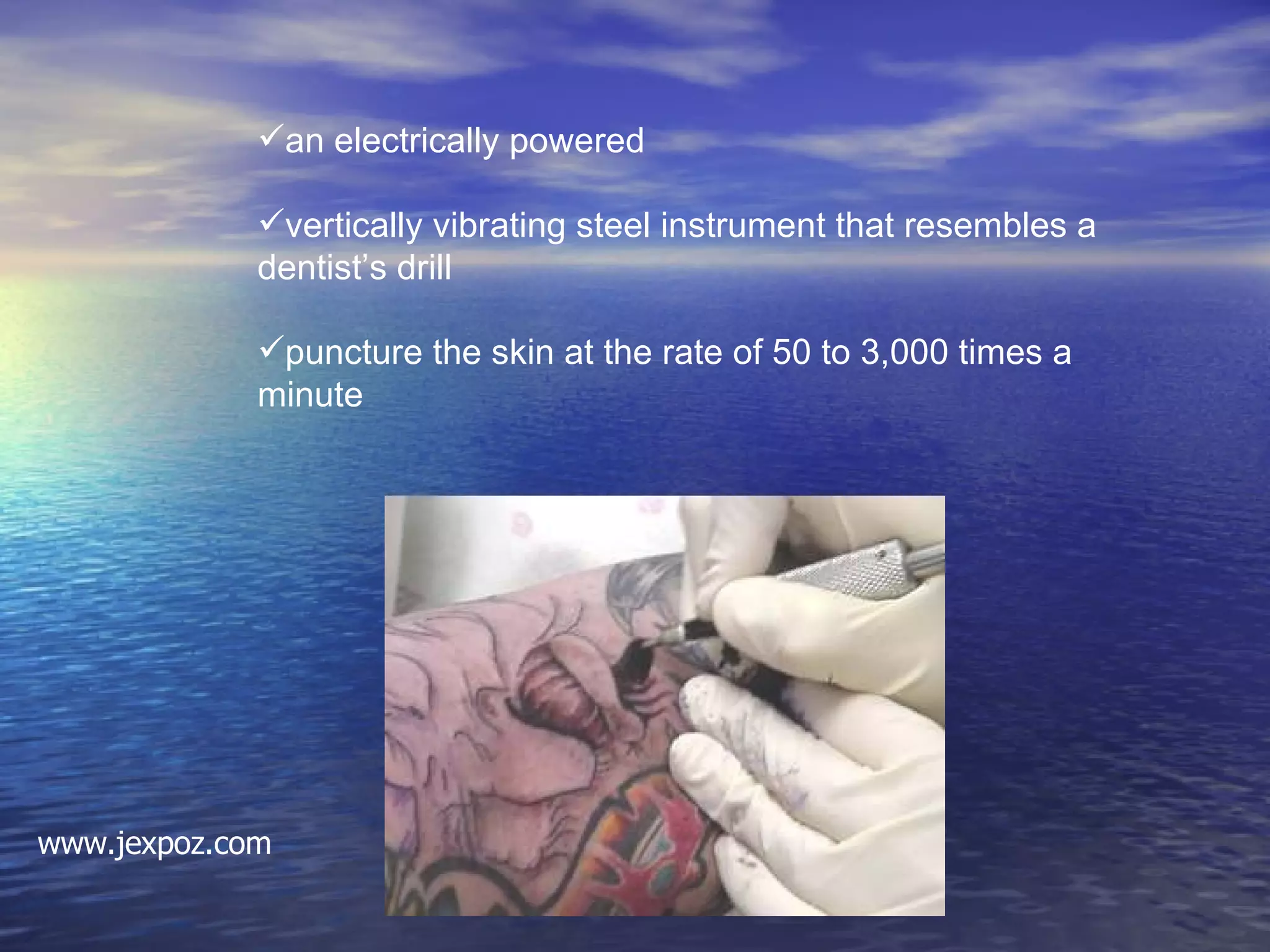
The tattoo machine The basic idea of the electrically powered tattoo machine is that a needle moves up and down like in a sewing machine, carrying ink into your skin in the process.  A tattoo machine involves a magnetic vibrator driving the needle up and down.  In 1876, Thomas Edison patented a tattooing device: the  autographic printer   www.jexpoz.com
an electrically powered vertically vibrating steel instrument that resembles a dentist’s drill  puncture the skin at the rate of 50 to 3,000 times a minute www.jexpoz.com
needle the tattoo machine is buzzing and smooth clear lines should be emerging as the needle pierces the skin applies the ink and gradually lifts out of the skin in a steady motion.  Not going deep enough will create scratchy lines after healing, and going too deep will cause excessive pain and bleeding  www.jexpoz.com
application Shading Once the  outline  is complete, the area is thoroughly  cleaned  with antiseptic soap and water the outline is thickened Shading  creates special effects.  www.jexpoz.com
coloring the tattoo is cleaned again and is now ready for  color . the artist overlaps each line of color to ensure solid uneven areas where color has either lifted out during healing to remove any blood and plasma excreted during the tattooing process. no alcohol or illegal drugs in the system, no fatigue, no tattooing over scar tissue www.jexpoz.com
risk The transmission of viral infections like hepatitis B, hepatitis C, the virus of the human immunodéficience (VIH), the syndrome of acquired immunodéficience (AIDS ) sterilization for killing every living microorganism is an  autoclave :a heat/steam/pressure unit that achieves and maintains 250 degrees Fahrenheit (121 C) under 10 pounds of pressure for 30 minutes or up to 270 F (132 C) under 15 pounds of pressure for 15 minutes.  www.jexpoz.com
conclusion www.jexpoz.com

Tattoos-tatouage

  • 1.
  • 2.
    Origine Meaning Tattoingmethods old method modern method Tattoo machine Needle Application Shading coloring Risk www.jexpoz.com
  • 3.
    origine 3300 B.C. Tattoos found on Egyptian and Nubian mummies date from about 2000 B.C Tattooing was rediscovered by Europeans when exploration brought them into contact with Polynesians and American Indians The word tattoo comes from the Tahitian word tattau , which means "to mark,". tattoos were considered so exotic in European and U.S. societies www.jexpoz.com
  • 4.
    The practice oftattooing means different things in different cultures. In early practice, decoration appears to have been the most common motive for tattooing, and that still holds true today. In some cultures, tattoos served as identification of the wearer’s rank or status in a group.. Tahitian tattoos served as rites of passage , telling the history of the wearer’s life. This Tahitian tattoo tells about rights of passage in the wearer's life. meaning www.jexpoz.com
  • 5.
    Old tattoing methodsAn amazing variety of tattooing methods developed in different cultures. In North and South America, many Indian tribes routinely tattooed the body or the face by simple pricking Many tribes of the Arctic and Subarctic, mostly Inuit, and some people in eastern Siberia, made needle punctures through which a thread coated with pigment was drawn underneath the skin. In Polynesia and Micronesia, pigment was pricked into the skin by tapping on a tool shaped like a small rake. The Maori people of New Zealand, who are world famous for their tattooing, applied their wood carving technique to tattooing by striking a small bone-cutting tool (used for shaping wood) into the skin. www.jexpoz.com
  • 6.
    Modern tattoing methodToday, tattoos are created by injecting ink into the skin. Injection is done by a needle attached to a hand-held tool, in the skin by about one millimeter. The ink is not in the epidermis , which is the layer of skin that we see and the skin that gets replaced constantly, but instead intermingles with cells in the dermis and shows through the epidermis. www.jexpoz.com
  • 7.
    The tattoo machineThe basic idea of the electrically powered tattoo machine is that a needle moves up and down like in a sewing machine, carrying ink into your skin in the process. A tattoo machine involves a magnetic vibrator driving the needle up and down. In 1876, Thomas Edison patented a tattooing device: the autographic printer www.jexpoz.com
  • 8.
    an electrically poweredvertically vibrating steel instrument that resembles a dentist’s drill puncture the skin at the rate of 50 to 3,000 times a minute www.jexpoz.com
  • 9.
    needle the tattoomachine is buzzing and smooth clear lines should be emerging as the needle pierces the skin applies the ink and gradually lifts out of the skin in a steady motion. Not going deep enough will create scratchy lines after healing, and going too deep will cause excessive pain and bleeding www.jexpoz.com
  • 10.
    application Shading Oncethe outline is complete, the area is thoroughly cleaned with antiseptic soap and water the outline is thickened Shading creates special effects. www.jexpoz.com
  • 11.
    coloring the tattoois cleaned again and is now ready for color . the artist overlaps each line of color to ensure solid uneven areas where color has either lifted out during healing to remove any blood and plasma excreted during the tattooing process. no alcohol or illegal drugs in the system, no fatigue, no tattooing over scar tissue www.jexpoz.com
  • 12.
    risk The transmissionof viral infections like hepatitis B, hepatitis C, the virus of the human immunodéficience (VIH), the syndrome of acquired immunodéficience (AIDS ) sterilization for killing every living microorganism is an autoclave :a heat/steam/pressure unit that achieves and maintains 250 degrees Fahrenheit (121 C) under 10 pounds of pressure for 30 minutes or up to 270 F (132 C) under 15 pounds of pressure for 15 minutes. www.jexpoz.com
  • 13.