Community Information Session
Tasman Region
13th February 2019
Presented by
Depha Miedecke, Senior Manager – Community Engagement
Sean Riley, Head of Environment
Peter Heard, Senior Manager – Marine R&D
Zack Wingfield, Senior Manager – Eastern Zone
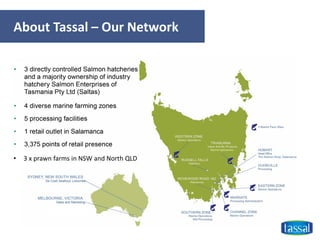
About Tassal – Our Network
• 3 x prawn farms in NSW and North QLD
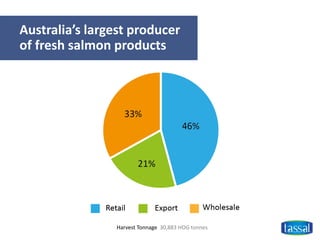
Harvest Tonnage 30,883 HOG tonnes
Australia’s largest producer
of fresh salmon products
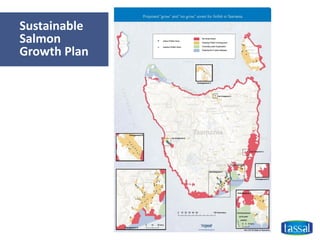
Sustainable
Salmon
Growth Plan
Tassal’s contribution to the
Tasmanian economy
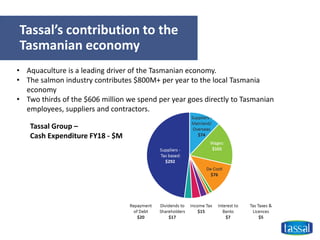
• Aquaculture is a leading driver of the Tasmanian economy.
• The salmon industry contributes $800M+ per year to the local Tasmania
economy
• Two thirds of the $606 million we spend per year goes directly to Tasmanian
employees, suppliers and contractors.
Tassal Group –
Cash Expenditure FY18 - $M
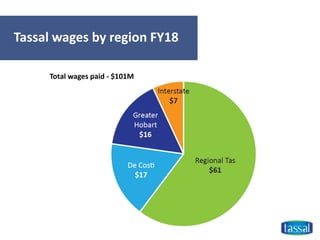
Tassal wages by region FY18
Total wages paid - $101M
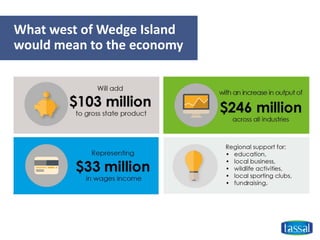
What west of Wedge Island
would mean to the economy
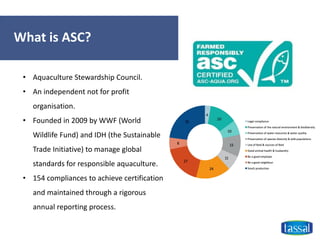
What is ASC?
• Aquaculture Stewardship Council.
• An independent not for profit
organisation.
• Founded in 2009 by WWF (World
Wildlife Fund) and IDH (the Sustainable
Trade Initiative) to manage global
standards for responsible aquaculture.
• 154 compliances to achieve certification
and maintained through a rigorous
annual reporting process.
ASC – key points
• Principle 2 of the Salmon
standard is intended to address
potential impacts on natural
habitat, local biodiversity and
ecosystem function: including
benthic impacts.
• Auditors review benthic survey
reports for our leases and
regulator sign off as a means to
assess compliance.
• The ASC program promotes
industry best practice addresses
the key environmental and social
impacts of Salmon farming.
• The standards require an
unprecedented level of
transparency on all farm
performance and environmental
data.
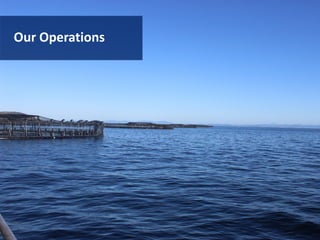
Our Operations
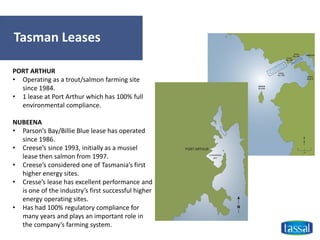
Tasman Leases
PORT ARTHUR
• Operating as a trout/salmon farming site
since 1984.
• 1 lease at Port Arthur which has 100% full
environmental compliance.
NUBEENA
• Parson’s Bay/Billie Blue lease has operated
since 1986.
• Creese’s since 1993, initially as a mussel
lease then salmon from 1997.
• Creese’s considered one of Tasmania’s first
higher energy sites.
• Cresse’s lease has excellent performance and
is one of the industry’s first successful higher
energy operating sites.
• Has had 100% regulatory compliance for
many years and plays an important role in
the company’s farming system.
On the farms
• The 2017yc fish at Port Arthur and Creese’s leases have completed harvesting.
• Optimal survival and Feed Conversion Rate (FCR) achieved at both sites.
• Exclusion of seals from the implementation of 168m pens and a strong safety focus by our staff at
Creese’s a main driver in better fish survival results.
• Favourable environmental conditions and central feeding innovation improved growth
performance and FCR reduction.
• 2018 Year Class (YC) fish inputted to Badger lease in Parson’s Bay, all fish are on Creese’s lease and
Badger is under fallow.
• 2019YC fish planned for input to Badger lease in late April.
• These fish will be then relocated to Creese’s later this year
• 2019YC fish planned for input to Port Arthur in August.
• The Port Arthur fish will be grown to 1 to 1.5kg then relocated to Okehampton lease early in 2020.
• Port Arthur and Okehampton now form a new bioregion. YC separation the primary focus.
• Nubeena and Storm Bay leases will operate as another bioregion.
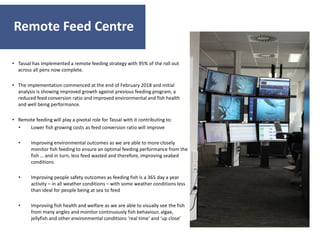
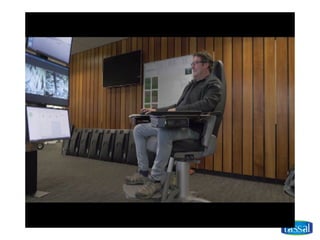
• Tassal has implemented a remote feeding strategy with 95% of the roll out
across all pens now complete.
• The implementation commenced at the end of February 2018 and initial
analysis is showing improved growth against previous feeding program, a
reduced feed conversion ratio and improved environmental and fish health
and well being performance.
• Remote feeding will play a pivotal role for Tassal with it contributing to:
• Lower fish growing costs as feed conversion ratio will improve
• Improving environmental outcomes as we are able to more closely
monitor fish feeding to ensure an optimal feeding performance from the
fish … and in turn, less feed wasted and therefore, improving seabed
conditions
• Improving people safety outcomes as feeding fish is a 365 day a year
activity – in all weather conditions – with some weather conditions less
than ideal for people being at sea to feed
• Improving fish health and welfare as we are able to visually see the fish
from many angles and monitor continuously fish behaviour, algae,
jellyfish and other environmental conditions ‘real time’ and ‘up close’
13
Remote Feed Centre
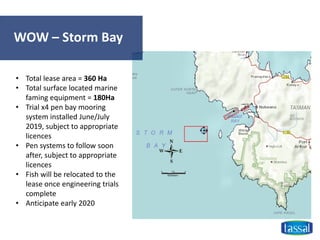
WOW – Storm Bay
• Total lease area = 360 Ha
• Total surface located marine
faming equipment = 180Ha
• Trial x4 pen bay mooring
system installed June/July
2019, subject to appropriate
licences
• Pen systems to follow soon
after, subject to appropriate
licences
• Fish will be relocated to the
lease once engineering trials
complete
• Anticipate early 2020
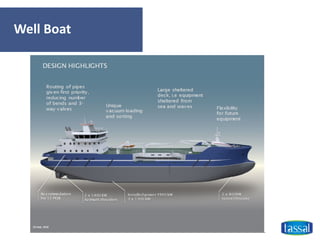
Well Boat
• Tassal will be taking possession of a Well Boat under a 10 year lease for delivery between September and
December 2019 (FY20). The Well Boat will have a 3,500m3 water capacity – enough to completely bathe one
of Tassal’s largest pens circa 3X quicker than current methods
• The Well Boat provides benefits through improvements in survival, enabling further Offshore / higher energy
farming and facilitating further lease optimisation from existing leases:
• Enabling bathing in higher energy / rougher sites
• Reduction in fresh water requirements
• Increased lease optimisation through allowing quicker and more efficient bathing process
• Increased lease optimisation through allowing transport of larger smolt to grow-out sites
• The following operational improvements should also result:
• A material improvement in the safety risk of fish bathing on farms by a reduction in high risk tasks, manual
handling, diving and towing
• Improved biosecurity and fish health and welfare
• Enabling grading fish during a bath, to better manage growth and sales optimisation
Well Boat
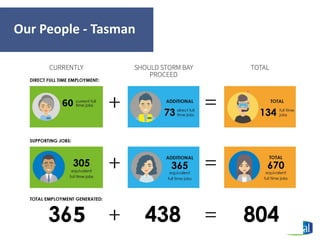
Our People - Tasman
5
60
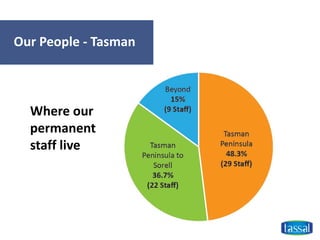
Our People - Tasman
Where our
permanent
staff live
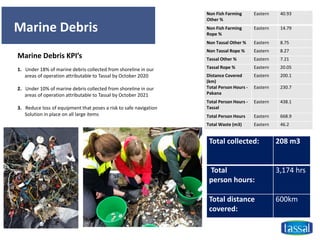
Marine Debris
Non Fish Farming
Other %
Eastern 40.93
Non Fish Farming
Rope %
Eastern 14.79
Non Tassal Other % Eastern 8.75
Non Tassal Rope % Eastern 8.27
Tassal Other % Eastern 7.21
Tassal Rope % Eastern 20.05
Distance Covered
(km)
Eastern 200.1
Total Person Hours -
Pakana
Eastern 230.7
Total Person Hours -
Tassal
Eastern 438.1
Total Person Hours Eastern 668.9
Total Waste (m3) Eastern 46.2
Marine Debris KPI’s
1. Under 18% of marine debris collected from shoreline in our
areas of operation attributable to Tassal by October 2020
2. Under 10% of marine debris collected from shoreline in our
areas of operation attributable to Tassal by October 2021
3. Reduce loss of equipment that poses a risk to safe navigation
Solution in place on all large items
Total collected: 208 m3
Total
person hours:
3,174 hrs
Total distance
covered:
600km
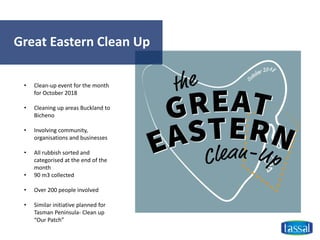
• Clean-up event for the month
for October 2018
• Cleaning up areas Buckland to
Bicheno
• Involving community,
organisations and businesses
• All rubbish sorted and
categorised at the end of the
month
• 90 m3 collected
• Over 200 people involved
• Similar initiative planned for
Tasman Peninsula- Clean up
“Our Patch”
Great Eastern Clean Up
Environmental Compliance
& Monitoring
Sean Riley, Head of Environment
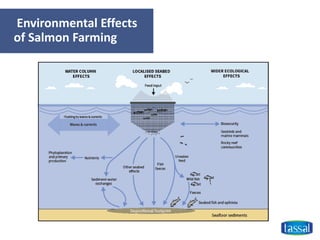
Environmental Effects
of Salmon Farming
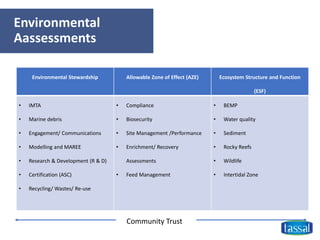
Environmental
Aassessments
Environmental Stewardship Allowable Zone of Effect (AZE) Ecosystem Structure and Function
(ESF)
• IMTA
• Marine debris
• Engagement/ Communications
• Modelling and MAREE
• Research & Development (R & D)
• Certification (ASC)
• Recycling/ Wastes/ Re-use
• Compliance
• Biosecurity
• Site Management /Performance
• Enrichment/ Recovery
Assessments
• Feed Management
• BEMP
• Water quality
• Sediment
• Rocky Reefs
• Wildlife
• Intertidal Zone
Community Trust
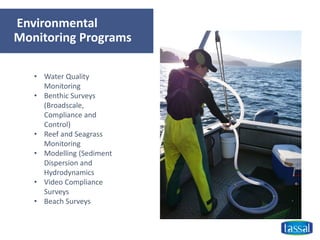
Environmental
Monitoring Programs
• Water Quality
Monitoring
• Benthic Surveys
(Broadscale,
Compliance and
Control)
• Reef and Seagrass
Monitoring
• Modelling (Sediment
Dispersion and
Hydrodynamics
• Video Compliance
Surveys
• Beach Surveys
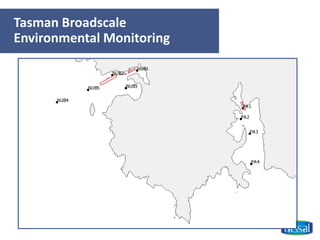
Tasman Broadscale
Environmental Monitoring
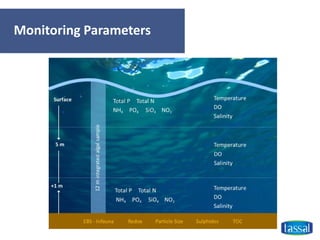
Monitoring Parameters
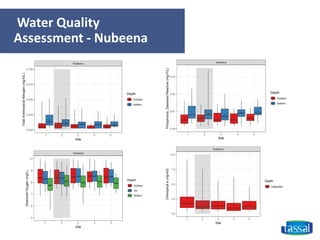
Water Quality
Assessment - Nubeena
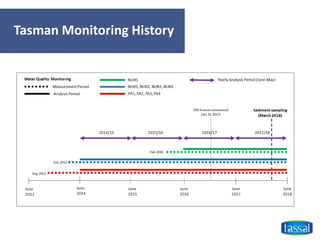
Tasman Monitoring History
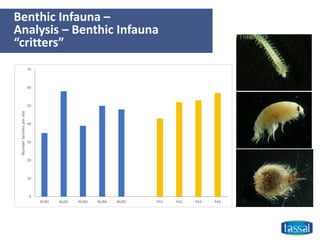
Benthic Infauna –
Analysis – Benthic Infauna
“critters”
0
10
20
30
40
50
60
70
NUB1 NUB2 NUB3 NUB4 NUB5 PA1 PA2 PA3 PA4
Numberfamiliespersite
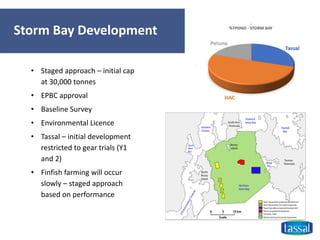
Storm Bay Development
• Staged approach – initial cap
at 30,000 tonnes
• EPBC approval
• Baseline Survey
• Environmental Licence
• Tassal – initial development
restricted to gear trials (Y1
and 2)
• Finfish farming will occur
slowly – staged approach
based on performance
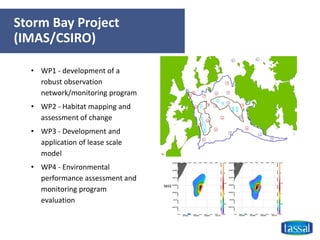
Storm Bay Project
(IMAS/CSIRO)
• WP1 - development of a
robust observation
network/monitoring program
• WP2 - Habitat mapping and
assessment of change
• WP3 - Development and
application of lease scale
model
• WP4 - Environmental
performance assessment and
monitoring program
evaluation
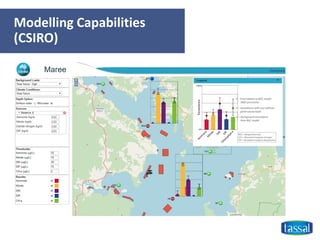
Modelling Capabilities
(CSIRO)
Questions?

Tasman Community Information Session

  • 1.
    Community Information Session TasmanRegion 13th February 2019 Presented by Depha Miedecke, Senior Manager – Community Engagement Sean Riley, Head of Environment Peter Heard, Senior Manager – Marine R&D Zack Wingfield, Senior Manager – Eastern Zone
  • 2.
    About Tassal –Our Network • 3 x prawn farms in NSW and North QLD
  • 3.
    Harvest Tonnage 30,883HOG tonnes Australia’s largest producer of fresh salmon products
  • 4.
  • 5.
    Tassal’s contribution tothe Tasmanian economy • Aquaculture is a leading driver of the Tasmanian economy. • The salmon industry contributes $800M+ per year to the local Tasmania economy • Two thirds of the $606 million we spend per year goes directly to Tasmanian employees, suppliers and contractors. Tassal Group – Cash Expenditure FY18 - $M
  • 6.
    Tassal wages byregion FY18 Total wages paid - $101M
  • 7.
    What west ofWedge Island would mean to the economy
  • 8.
    What is ASC? •Aquaculture Stewardship Council. • An independent not for profit organisation. • Founded in 2009 by WWF (World Wildlife Fund) and IDH (the Sustainable Trade Initiative) to manage global standards for responsible aquaculture. • 154 compliances to achieve certification and maintained through a rigorous annual reporting process.
  • 9.
    ASC – keypoints • Principle 2 of the Salmon standard is intended to address potential impacts on natural habitat, local biodiversity and ecosystem function: including benthic impacts. • Auditors review benthic survey reports for our leases and regulator sign off as a means to assess compliance. • The ASC program promotes industry best practice addresses the key environmental and social impacts of Salmon farming. • The standards require an unprecedented level of transparency on all farm performance and environmental data.
  • 10.
  • 11.
    Tasman Leases PORT ARTHUR •Operating as a trout/salmon farming site since 1984. • 1 lease at Port Arthur which has 100% full environmental compliance. NUBEENA • Parson’s Bay/Billie Blue lease has operated since 1986. • Creese’s since 1993, initially as a mussel lease then salmon from 1997. • Creese’s considered one of Tasmania’s first higher energy sites. • Cresse’s lease has excellent performance and is one of the industry’s first successful higher energy operating sites. • Has had 100% regulatory compliance for many years and plays an important role in the company’s farming system.
  • 12.
    On the farms •The 2017yc fish at Port Arthur and Creese’s leases have completed harvesting. • Optimal survival and Feed Conversion Rate (FCR) achieved at both sites. • Exclusion of seals from the implementation of 168m pens and a strong safety focus by our staff at Creese’s a main driver in better fish survival results. • Favourable environmental conditions and central feeding innovation improved growth performance and FCR reduction. • 2018 Year Class (YC) fish inputted to Badger lease in Parson’s Bay, all fish are on Creese’s lease and Badger is under fallow. • 2019YC fish planned for input to Badger lease in late April. • These fish will be then relocated to Creese’s later this year • 2019YC fish planned for input to Port Arthur in August. • The Port Arthur fish will be grown to 1 to 1.5kg then relocated to Okehampton lease early in 2020. • Port Arthur and Okehampton now form a new bioregion. YC separation the primary focus. • Nubeena and Storm Bay leases will operate as another bioregion.
  • 13.
    • Tassal hasimplemented a remote feeding strategy with 95% of the roll out across all pens now complete. • The implementation commenced at the end of February 2018 and initial analysis is showing improved growth against previous feeding program, a reduced feed conversion ratio and improved environmental and fish health and well being performance. • Remote feeding will play a pivotal role for Tassal with it contributing to: • Lower fish growing costs as feed conversion ratio will improve • Improving environmental outcomes as we are able to more closely monitor fish feeding to ensure an optimal feeding performance from the fish … and in turn, less feed wasted and therefore, improving seabed conditions • Improving people safety outcomes as feeding fish is a 365 day a year activity – in all weather conditions – with some weather conditions less than ideal for people being at sea to feed • Improving fish health and welfare as we are able to visually see the fish from many angles and monitor continuously fish behaviour, algae, jellyfish and other environmental conditions ‘real time’ and ‘up close’ 13 Remote Feed Centre
  • 15.
    WOW – StormBay • Total lease area = 360 Ha • Total surface located marine faming equipment = 180Ha • Trial x4 pen bay mooring system installed June/July 2019, subject to appropriate licences • Pen systems to follow soon after, subject to appropriate licences • Fish will be relocated to the lease once engineering trials complete • Anticipate early 2020
  • 16.
    Well Boat • Tassalwill be taking possession of a Well Boat under a 10 year lease for delivery between September and December 2019 (FY20). The Well Boat will have a 3,500m3 water capacity – enough to completely bathe one of Tassal’s largest pens circa 3X quicker than current methods • The Well Boat provides benefits through improvements in survival, enabling further Offshore / higher energy farming and facilitating further lease optimisation from existing leases: • Enabling bathing in higher energy / rougher sites • Reduction in fresh water requirements • Increased lease optimisation through allowing quicker and more efficient bathing process • Increased lease optimisation through allowing transport of larger smolt to grow-out sites • The following operational improvements should also result: • A material improvement in the safety risk of fish bathing on farms by a reduction in high risk tasks, manual handling, diving and towing • Improved biosecurity and fish health and welfare • Enabling grading fish during a bath, to better manage growth and sales optimisation
  • 17.
  • 18.
    Our People -Tasman 5 60
  • 19.
    Our People -Tasman Where our permanent staff live
  • 20.
    Marine Debris Non FishFarming Other % Eastern 40.93 Non Fish Farming Rope % Eastern 14.79 Non Tassal Other % Eastern 8.75 Non Tassal Rope % Eastern 8.27 Tassal Other % Eastern 7.21 Tassal Rope % Eastern 20.05 Distance Covered (km) Eastern 200.1 Total Person Hours - Pakana Eastern 230.7 Total Person Hours - Tassal Eastern 438.1 Total Person Hours Eastern 668.9 Total Waste (m3) Eastern 46.2 Marine Debris KPI’s 1. Under 18% of marine debris collected from shoreline in our areas of operation attributable to Tassal by October 2020 2. Under 10% of marine debris collected from shoreline in our areas of operation attributable to Tassal by October 2021 3. Reduce loss of equipment that poses a risk to safe navigation Solution in place on all large items Total collected: 208 m3 Total person hours: 3,174 hrs Total distance covered: 600km
  • 21.
    • Clean-up eventfor the month for October 2018 • Cleaning up areas Buckland to Bicheno • Involving community, organisations and businesses • All rubbish sorted and categorised at the end of the month • 90 m3 collected • Over 200 people involved • Similar initiative planned for Tasman Peninsula- Clean up “Our Patch” Great Eastern Clean Up
  • 23.
  • 24.
  • 25.
    Environmental Aassessments Environmental Stewardship AllowableZone of Effect (AZE) Ecosystem Structure and Function (ESF) • IMTA • Marine debris • Engagement/ Communications • Modelling and MAREE • Research & Development (R & D) • Certification (ASC) • Recycling/ Wastes/ Re-use • Compliance • Biosecurity • Site Management /Performance • Enrichment/ Recovery Assessments • Feed Management • BEMP • Water quality • Sediment • Rocky Reefs • Wildlife • Intertidal Zone Community Trust
  • 26.
    Environmental Monitoring Programs • WaterQuality Monitoring • Benthic Surveys (Broadscale, Compliance and Control) • Reef and Seagrass Monitoring • Modelling (Sediment Dispersion and Hydrodynamics • Video Compliance Surveys • Beach Surveys
  • 27.
  • 28.
  • 29.
  • 30.
  • 31.
    Benthic Infauna – Analysis– Benthic Infauna “critters” 0 10 20 30 40 50 60 70 NUB1 NUB2 NUB3 NUB4 NUB5 PA1 PA2 PA3 PA4 Numberfamiliespersite
  • 32.
    Storm Bay Development •Staged approach – initial cap at 30,000 tonnes • EPBC approval • Baseline Survey • Environmental Licence • Tassal – initial development restricted to gear trials (Y1 and 2) • Finfish farming will occur slowly – staged approach based on performance
  • 33.
    Storm Bay Project (IMAS/CSIRO) •WP1 - development of a robust observation network/monitoring program • WP2 - Habitat mapping and assessment of change • WP3 - Development and application of lease scale model • WP4 - Environmental performance assessment and monitoring program evaluation
  • 34.
  • 35.