Task specialization and size of the market
Evidence from the PIAAC
Lucas van der Velde
Warsaw School of Economics
March 2019
van der Velde Warsaw School of Economics
Task specialization and size of the market
Introduction
Introduction
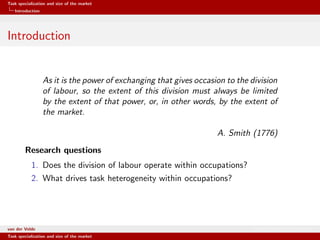
As it is the power of exchanging that gives occasion to the division
of labour, so the extent of this division must always be limited
by the extent of that power, or, in other words, by the extent of
the market.
A. Smith (1776)
Research questions
1. Does the division of labour operate within occupations?
2. What drives task heterogeneity within occupations?
van der Velde Warsaw School of Economics
Task specialization and size of the market
Introduction
Motivation
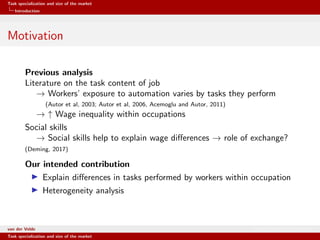
Previous analysis
Literature on the task content of job
→ Workers’ exposure to automation varies by tasks they perform
(Autor et al, 2003; Autor et al, 2006, Acemoglu and Autor, 2011)
→ ↑ Wage inequality within occupations
Social skills
→ Social skills help to explain wage differences → role of exchange?
(Deming, 2017)
Our intended contribution
Explain differences in tasks performed by workers within occupation
Heterogeneity analysis
van der Velde Warsaw School of Economics
Task specialization and size of the market
Introduction
A token model of trade of tasks
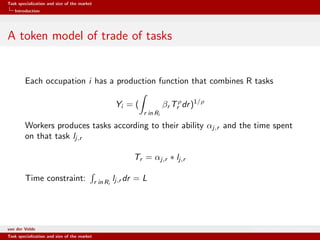
Each occupation i has a production function that combines R tasks
Yi = (
r in Ri
βr Tρ
r dr)1/ρ
Workers produces tasks according to their ability αj,r and the time spent
on that task lj,r
Tr = αj,r ∗ lj,r
Time constraint: r in Ri
lj,r dr = L
van der Velde Warsaw School of Economics
Task specialization and size of the market
Introduction
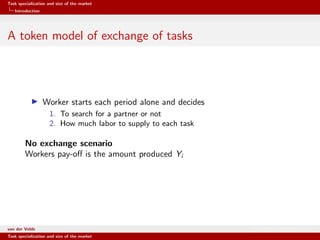
A token model of exchange of tasks
Worker starts each period alone and decides
1. To search for a partner or not
2. How much labor to supply to each task
No exchange scenario
Workers pay-off is the amount produced Yi
van der Velde Warsaw School of Economics
Task specialization and size of the market
Introduction
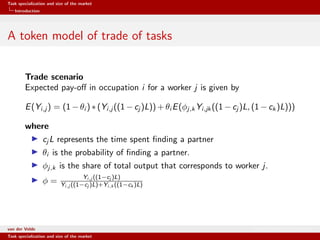
A token model of trade of tasks
Trade scenario
Expected pay-off in occupation i for a worker j is given by
E(Yi,j ) = (1 − θi ) ∗ (Yi,j ((1 − cj )L)) + θi E(φj,k Yi,jk ((1 − cj )L, (1 − ck )L)))
where
cj L represents the time spent finding a partner
θi is the probability of finding a partner.
φj,k is the share of total output that corresponds to worker j.
φ =
Yi,j ((1−cj )L)
Yi,j ((1−cj )L)+Yi,k ((1−ck )L)
van der Velde Warsaw School of Economics
Task specialization and size of the market
Introduction
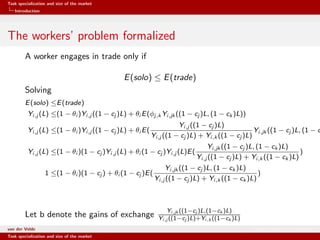
The workers’ problem formalized
A worker engages in trade only if
E(solo) ≤ E(trade)
Solving
E(solo) ≤E(trade)
Yi,j (L) ≤(1 − θi )Yi,j ((1 − cj )L) + θi E(φj,k Yi,jk ((1 − cj )L, (1 − ck )L))
Yi,j (L) ≤(1 − θi )Yi,j ((1 − cj )L) + θi E(
Yi,j ((1 − cj )L)
Yi,j ((1 − cj )L) + Yi,k ((1 − cj )L)
Yi,jk ((1 − cj )L, (1 − c
Yi,j (L) ≤(1 − θi )(1 − cj )Yi,j (L) + θi (1 − cj )Yi,j (L)E(
Yi,jk ((1 − cj )L, (1 − ck )L)
Yi,j ((1 − cj )L) + Yi,k ((1 − ck )L)
)
1 ≤(1 − θi )(1 − cj ) + θi (1 − cj )E(
Yi,jk ((1 − cj )L, (1 − ck )L)
Yi,j ((1 − cj )L) + Yi,k ((1 − ck )L)
)
Let b denote the gains of exchange
Yi,jk ((1−cj )L,(1−ck )L)
Yi,j ((1−cj )L)+Yi,k ((1−ck )L)
van der Velde Warsaw School of Economics
Task specialization and size of the market
Introduction
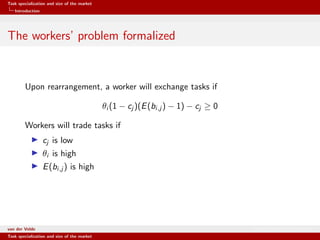
The workers’ problem formalized
Upon rearrangement, a worker will exchange tasks if
θi (1 − cj )(E(bi,j ) − 1) − cj ≥ 0
Workers will trade tasks if
cj is low
θi is high
E(bi,j ) is high
van der Velde Warsaw School of Economics
Task specialization and size of the market
Introduction
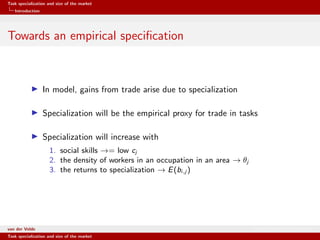
Towards an empirical specification
In model, gains from trade arise due to specialization
Specialization will be the empirical proxy for trade in tasks
Specialization will increase with
1. social skills →= low cj
2. the density of workers in an occupation in an area → θj
3. the returns to specialization → E(bi,j )
van der Velde Warsaw School of Economics
Task specialization and size of the market
Introduction
Data and method
Program for the International Assessment of Adult Competencies
Survey on skills and tasks collected in 2008-2016
Around 93000 observations from 22 countries
40+ variables describing tasks
Structure of Earnings Survey
Linked employee-employer data for EU countries
+ large sample size, detailed account of occupations
We use waves 2010 - 2014
Occupations are defined using 2-digits ISCO08 codes.
van der Velde Warsaw School of Economics
Task specialization and size of the market
Introduction
Data and method: On the task content of jobs
Which tasks...?
Follow Lewandowski et al (2018)
Data-driven approach to replicate O*NET measures in PIAAC
Characterize occupations in routine, non-routine and skill use.
Tasks
Routine Non-R. Analytical Non-R. Personal Manual
Filling forms Reading news Supervising Physical tasks
Change order of tasks reading professional titles Presenting
Solving problems
Programming
van der Velde Warsaw School of Economics
Task specialization and size of the market
Introduction
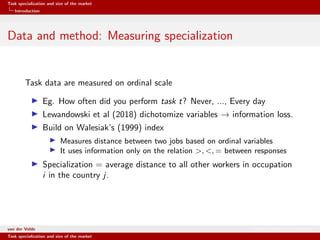
Data and method: Measuring specialization
Task data are measured on ordinal scale
Eg. How often did you perform task t? Never, ..., Every day
Lewandowski et al (2018) dichotomize variables → information loss.
Build on Walesiak’s (1999) index
Measures distance between two jobs based on ordinal variables
It uses information only on the relation >, <, = between responses
Specialization = average distance to all other workers in occupation
i in the country j.
van der Velde Warsaw School of Economics
Task specialization and size of the market
Introduction
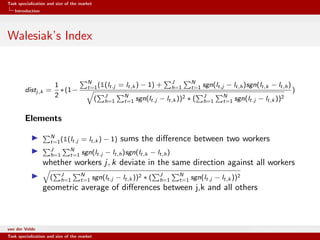
Walesiak’s Index
distj,k =
1
2
∗(1−
N
t=1(1(lt.j = lt,k ) − 1) + J
h=1
N
t=1 sgn(lt,j − lt,h)sgn(lt,k − lt,h)
( J
h=1
N
t=1 sgn(lt.j − lt,k ))2 ∗ ( J
h=1
N
t=1 sgn(lt.j − lt,k ))2
)
Elements
N
t=1(1(lt.j = lt,k ) − 1) sums the difference between two workers
J
h=1
N
t=1 sgn(lt.j − lt,h)sgn(lt,k − lt,h)
whether workers j, k deviate in the same direction against all workers
( J
h=1
N
t=1 sgn(lt.j − lt,k ))2 ∗ ( J
h=1
N
t=1 sgn(lt.j − lt,k ))2
geometric average of differences between j,k and all others
van der Velde Warsaw School of Economics
Task specialization and size of the market
Introduction
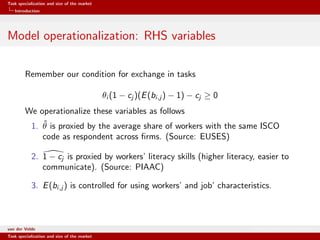
Model operationalization: RHS variables
Remember our condition for exchange in tasks
θi (1 − cj )(E(bi,j ) − 1) − cj ≥ 0
We operationalize these variables as follows
1. ˆθ is proxied by the average share of workers with the same ISCO
code as respondent across firms. (Source: EUSES)
2. 1 − cj is proxied by workers’ literacy skills (higher literacy, easier to
communicate). (Source: PIAAC)
3. E(bi,j ) is controlled for using workers’ and job’ characteristics.
van der Velde Warsaw School of Economics
Task specialization and size of the market
Results
Main specification
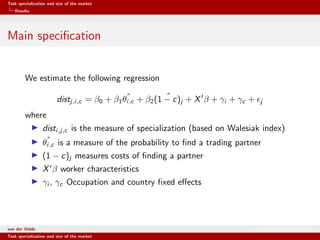
We estimate the following regression
distj,i,c = β0 + β1
ˆθi,c + β2
ˆ(1 − c)j + X β + γi + γc + j
where
disti,j,c is the measure of specialization (based on Walesiak index)
ˆθi,c is a measure of the probability to find a trading partner
(1 − c)j measures costs of finding a partner
X β worker characteristics
γi , γc Occupation and country fixed effects
van der Velde Warsaw School of Economics
Task specialization and size of the market
Results
Initial regressions
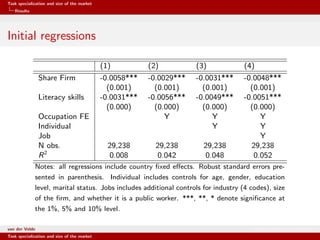
(1) (2) (3) (4)
Share Firm -0.0058*** -0.0029*** -0.0031*** -0.0048***
(0.001) (0.001) (0.001) (0.001)
Literacy skills -0.0031*** -0.0056*** -0.0049*** -0.0051***
(0.000) (0.000) (0.000) (0.000)
Occupation FE Y Y Y
Individual Y Y
Job Y
N obs. 29,238 29,238 29,238 29,238
R2
0.008 0.042 0.048 0.052
Notes: all regressions include country fixed effects. Robust standard errors pre-
sented in parenthesis. Individual includes controls for age, gender, education
level, marital status. Jobs includes additional controls for industry (4 codes), size
of the firm, and whether it is a public worker. ***, **, * denote significance at
the 1%, 5% and 10% level.
van der Velde Warsaw School of Economics
Task specialization and size of the market
Results
Non-linear effects
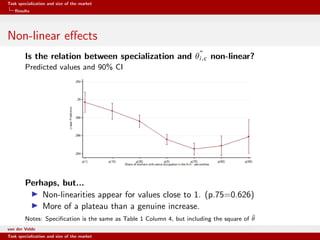
Is the relation between specialization and ˆθi,c non-linear?
Predicted values and 90% CI
Perhaps, but...
Non-linearities appear for values close to 1. (p.75=0.626)
More of a plateau than a genuine increase.
Notes: Specification is the same as Table 1 Column 4, but including the square of ˆθ
van der Velde Warsaw School of Economics
Task specialization and size of the market
Results
Results by occupation
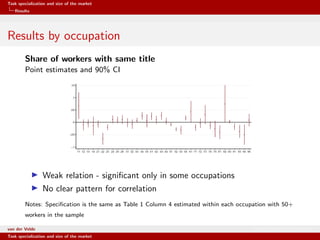
Share of workers with same title
Point estimates and 90% CI
Weak relation - significant only in some occupations
No clear pattern for correlation
Notes: Specification is the same as Table 1 Column 4 estimated within each occupation with 50+
workers in the sample
van der Velde Warsaw School of Economics
Task specialization and size of the market
Results
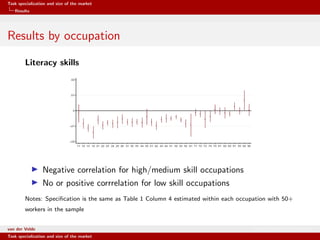
Results by occupation
Literacy skills
Negative correlation for high/medium skill occupations
No or positive corrrelation for low skill occupations
Notes: Specification is the same as Table 1 Column 4 estimated within each occupation with 50+
workers in the sample
van der Velde Warsaw School of Economics
Task specialization and size of the market
Results
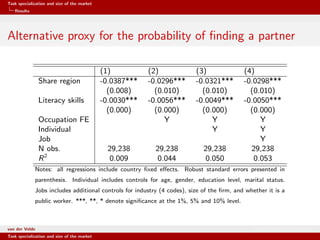
Alternative proxy for the probability of finding a partner
(1) (2) (3) (4)
Share region -0.0387*** -0.0296*** -0.0321*** -0.0298***
(0.008) (0.010) (0.010) (0.010)
Literacy skills -0.0030*** -0.0056*** -0.0049*** -0.0050***
(0.000) (0.000) (0.000) (0.000)
Occupation FE Y Y Y
Individual Y Y
Job Y
N obs. 29,238 29,238 29,238 29,238
R2
0.009 0.044 0.050 0.053
Notes: all regressions include country fixed effects. Robust standard errors presented in
parenthesis. Individual includes controls for age, gender, education level, marital status.
Jobs includes additional controls for industry (4 codes), size of the firm, and whether it is a
public worker. ***, **, * denote significance at the 1%, 5% and 10% level.
van der Velde Warsaw School of Economics
Task specialization and size of the market
Summmary
Summary
We presented a model where workers choose and exchange tasks
gains of excange comes from specialization → can potentially explain
dispersion in tasks.
We tested the model using PIAAC and SES data
Use a measure based on Walesiak’s Indexs to capture specialization
We also proxy for the probability of finding a suitable partner and the
skill level
Results were mostly against the predictions of the model
van der Velde Warsaw School of Economics
Task specialization and size of the market
Summmary
Next steps
What went wrong?
Model construction
Shortcoming: Model assummes workers exchange in vacuum
Possible solution: Introduce an employer who can extract rents (and
whose bargaining power depends on how substitutable a worker is)
Measuring specialization
Shortcoming: Is Walesiak index a good measure of specialization?
Possible solution: Simulate workers whose decisions follow the model
structure and apply index to the simulated data.
Other proxies
Shortcoming: Literacy and other skills could also proxy for innate
ability (α in our model)
Possible solution: look at other measures of friction.
van der Velde Warsaw School of Economics
Task specialization and size of the market
Summmary
Thank you for you attentionl
Lucas van der Velde
Contact: lvandervelde@grape.org.pl
lvelde@sgh.waw.pl
van der Velde Warsaw School of Economics
Task specialization and size of the market

Task specialization and market size

  • 1.
    Task specialization andsize of the market Task specialization and size of the market Evidence from the PIAAC Lucas van der Velde Warsaw School of Economics March 2019 van der Velde Warsaw School of Economics Task specialization and size of the market
  • 2.
    Task specialization andsize of the market Introduction Introduction As it is the power of exchanging that gives occasion to the division of labour, so the extent of this division must always be limited by the extent of that power, or, in other words, by the extent of the market. A. Smith (1776) Research questions 1. Does the division of labour operate within occupations? 2. What drives task heterogeneity within occupations? van der Velde Warsaw School of Economics Task specialization and size of the market
  • 3.
    Task specialization andsize of the market Introduction Motivation Previous analysis Literature on the task content of job → Workers’ exposure to automation varies by tasks they perform (Autor et al, 2003; Autor et al, 2006, Acemoglu and Autor, 2011) → ↑ Wage inequality within occupations Social skills → Social skills help to explain wage differences → role of exchange? (Deming, 2017) Our intended contribution Explain differences in tasks performed by workers within occupation Heterogeneity analysis van der Velde Warsaw School of Economics Task specialization and size of the market
  • 4.
    Task specialization andsize of the market Introduction A token model of trade of tasks Each occupation i has a production function that combines R tasks Yi = ( r in Ri βr Tρ r dr)1/ρ Workers produces tasks according to their ability αj,r and the time spent on that task lj,r Tr = αj,r ∗ lj,r Time constraint: r in Ri lj,r dr = L van der Velde Warsaw School of Economics Task specialization and size of the market
  • 5.
    Task specialization andsize of the market Introduction A token model of exchange of tasks Worker starts each period alone and decides 1. To search for a partner or not 2. How much labor to supply to each task No exchange scenario Workers pay-off is the amount produced Yi van der Velde Warsaw School of Economics Task specialization and size of the market
  • 6.
    Task specialization andsize of the market Introduction A token model of trade of tasks Trade scenario Expected pay-off in occupation i for a worker j is given by E(Yi,j ) = (1 − θi ) ∗ (Yi,j ((1 − cj )L)) + θi E(φj,k Yi,jk ((1 − cj )L, (1 − ck )L))) where cj L represents the time spent finding a partner θi is the probability of finding a partner. φj,k is the share of total output that corresponds to worker j. φ = Yi,j ((1−cj )L) Yi,j ((1−cj )L)+Yi,k ((1−ck )L) van der Velde Warsaw School of Economics Task specialization and size of the market
  • 7.
    Task specialization andsize of the market Introduction The workers’ problem formalized A worker engages in trade only if E(solo) ≤ E(trade) Solving E(solo) ≤E(trade) Yi,j (L) ≤(1 − θi )Yi,j ((1 − cj )L) + θi E(φj,k Yi,jk ((1 − cj )L, (1 − ck )L)) Yi,j (L) ≤(1 − θi )Yi,j ((1 − cj )L) + θi E( Yi,j ((1 − cj )L) Yi,j ((1 − cj )L) + Yi,k ((1 − cj )L) Yi,jk ((1 − cj )L, (1 − c Yi,j (L) ≤(1 − θi )(1 − cj )Yi,j (L) + θi (1 − cj )Yi,j (L)E( Yi,jk ((1 − cj )L, (1 − ck )L) Yi,j ((1 − cj )L) + Yi,k ((1 − ck )L) ) 1 ≤(1 − θi )(1 − cj ) + θi (1 − cj )E( Yi,jk ((1 − cj )L, (1 − ck )L) Yi,j ((1 − cj )L) + Yi,k ((1 − ck )L) ) Let b denote the gains of exchange Yi,jk ((1−cj )L,(1−ck )L) Yi,j ((1−cj )L)+Yi,k ((1−ck )L) van der Velde Warsaw School of Economics Task specialization and size of the market
  • 8.
    Task specialization andsize of the market Introduction The workers’ problem formalized Upon rearrangement, a worker will exchange tasks if θi (1 − cj )(E(bi,j ) − 1) − cj ≥ 0 Workers will trade tasks if cj is low θi is high E(bi,j ) is high van der Velde Warsaw School of Economics Task specialization and size of the market
  • 9.
    Task specialization andsize of the market Introduction Towards an empirical specification In model, gains from trade arise due to specialization Specialization will be the empirical proxy for trade in tasks Specialization will increase with 1. social skills →= low cj 2. the density of workers in an occupation in an area → θj 3. the returns to specialization → E(bi,j ) van der Velde Warsaw School of Economics Task specialization and size of the market
  • 10.
    Task specialization andsize of the market Introduction Data and method Program for the International Assessment of Adult Competencies Survey on skills and tasks collected in 2008-2016 Around 93000 observations from 22 countries 40+ variables describing tasks Structure of Earnings Survey Linked employee-employer data for EU countries + large sample size, detailed account of occupations We use waves 2010 - 2014 Occupations are defined using 2-digits ISCO08 codes. van der Velde Warsaw School of Economics Task specialization and size of the market
  • 11.
    Task specialization andsize of the market Introduction Data and method: On the task content of jobs Which tasks...? Follow Lewandowski et al (2018) Data-driven approach to replicate O*NET measures in PIAAC Characterize occupations in routine, non-routine and skill use. Tasks Routine Non-R. Analytical Non-R. Personal Manual Filling forms Reading news Supervising Physical tasks Change order of tasks reading professional titles Presenting Solving problems Programming van der Velde Warsaw School of Economics Task specialization and size of the market
  • 12.
    Task specialization andsize of the market Introduction Data and method: Measuring specialization Task data are measured on ordinal scale Eg. How often did you perform task t? Never, ..., Every day Lewandowski et al (2018) dichotomize variables → information loss. Build on Walesiak’s (1999) index Measures distance between two jobs based on ordinal variables It uses information only on the relation >, <, = between responses Specialization = average distance to all other workers in occupation i in the country j. van der Velde Warsaw School of Economics Task specialization and size of the market
  • 13.
    Task specialization andsize of the market Introduction Walesiak’s Index distj,k = 1 2 ∗(1− N t=1(1(lt.j = lt,k ) − 1) + J h=1 N t=1 sgn(lt,j − lt,h)sgn(lt,k − lt,h) ( J h=1 N t=1 sgn(lt.j − lt,k ))2 ∗ ( J h=1 N t=1 sgn(lt.j − lt,k ))2 ) Elements N t=1(1(lt.j = lt,k ) − 1) sums the difference between two workers J h=1 N t=1 sgn(lt.j − lt,h)sgn(lt,k − lt,h) whether workers j, k deviate in the same direction against all workers ( J h=1 N t=1 sgn(lt.j − lt,k ))2 ∗ ( J h=1 N t=1 sgn(lt.j − lt,k ))2 geometric average of differences between j,k and all others van der Velde Warsaw School of Economics Task specialization and size of the market
  • 14.
    Task specialization andsize of the market Introduction Model operationalization: RHS variables Remember our condition for exchange in tasks θi (1 − cj )(E(bi,j ) − 1) − cj ≥ 0 We operationalize these variables as follows 1. ˆθ is proxied by the average share of workers with the same ISCO code as respondent across firms. (Source: EUSES) 2. 1 − cj is proxied by workers’ literacy skills (higher literacy, easier to communicate). (Source: PIAAC) 3. E(bi,j ) is controlled for using workers’ and job’ characteristics. van der Velde Warsaw School of Economics Task specialization and size of the market
  • 15.
    Task specialization andsize of the market Results Main specification We estimate the following regression distj,i,c = β0 + β1 ˆθi,c + β2 ˆ(1 − c)j + X β + γi + γc + j where disti,j,c is the measure of specialization (based on Walesiak index) ˆθi,c is a measure of the probability to find a trading partner (1 − c)j measures costs of finding a partner X β worker characteristics γi , γc Occupation and country fixed effects van der Velde Warsaw School of Economics Task specialization and size of the market
  • 16.
    Task specialization andsize of the market Results Initial regressions (1) (2) (3) (4) Share Firm -0.0058*** -0.0029*** -0.0031*** -0.0048*** (0.001) (0.001) (0.001) (0.001) Literacy skills -0.0031*** -0.0056*** -0.0049*** -0.0051*** (0.000) (0.000) (0.000) (0.000) Occupation FE Y Y Y Individual Y Y Job Y N obs. 29,238 29,238 29,238 29,238 R2 0.008 0.042 0.048 0.052 Notes: all regressions include country fixed effects. Robust standard errors pre- sented in parenthesis. Individual includes controls for age, gender, education level, marital status. Jobs includes additional controls for industry (4 codes), size of the firm, and whether it is a public worker. ***, **, * denote significance at the 1%, 5% and 10% level. van der Velde Warsaw School of Economics Task specialization and size of the market
  • 17.
    Task specialization andsize of the market Results Non-linear effects Is the relation between specialization and ˆθi,c non-linear? Predicted values and 90% CI Perhaps, but... Non-linearities appear for values close to 1. (p.75=0.626) More of a plateau than a genuine increase. Notes: Specification is the same as Table 1 Column 4, but including the square of ˆθ van der Velde Warsaw School of Economics Task specialization and size of the market
  • 18.
    Task specialization andsize of the market Results Results by occupation Share of workers with same title Point estimates and 90% CI Weak relation - significant only in some occupations No clear pattern for correlation Notes: Specification is the same as Table 1 Column 4 estimated within each occupation with 50+ workers in the sample van der Velde Warsaw School of Economics Task specialization and size of the market
  • 19.
    Task specialization andsize of the market Results Results by occupation Literacy skills Negative correlation for high/medium skill occupations No or positive corrrelation for low skill occupations Notes: Specification is the same as Table 1 Column 4 estimated within each occupation with 50+ workers in the sample van der Velde Warsaw School of Economics Task specialization and size of the market
  • 20.
    Task specialization andsize of the market Results Alternative proxy for the probability of finding a partner (1) (2) (3) (4) Share region -0.0387*** -0.0296*** -0.0321*** -0.0298*** (0.008) (0.010) (0.010) (0.010) Literacy skills -0.0030*** -0.0056*** -0.0049*** -0.0050*** (0.000) (0.000) (0.000) (0.000) Occupation FE Y Y Y Individual Y Y Job Y N obs. 29,238 29,238 29,238 29,238 R2 0.009 0.044 0.050 0.053 Notes: all regressions include country fixed effects. Robust standard errors presented in parenthesis. Individual includes controls for age, gender, education level, marital status. Jobs includes additional controls for industry (4 codes), size of the firm, and whether it is a public worker. ***, **, * denote significance at the 1%, 5% and 10% level. van der Velde Warsaw School of Economics Task specialization and size of the market
  • 21.
    Task specialization andsize of the market Summmary Summary We presented a model where workers choose and exchange tasks gains of excange comes from specialization → can potentially explain dispersion in tasks. We tested the model using PIAAC and SES data Use a measure based on Walesiak’s Indexs to capture specialization We also proxy for the probability of finding a suitable partner and the skill level Results were mostly against the predictions of the model van der Velde Warsaw School of Economics Task specialization and size of the market
  • 22.
    Task specialization andsize of the market Summmary Next steps What went wrong? Model construction Shortcoming: Model assummes workers exchange in vacuum Possible solution: Introduce an employer who can extract rents (and whose bargaining power depends on how substitutable a worker is) Measuring specialization Shortcoming: Is Walesiak index a good measure of specialization? Possible solution: Simulate workers whose decisions follow the model structure and apply index to the simulated data. Other proxies Shortcoming: Literacy and other skills could also proxy for innate ability (α in our model) Possible solution: look at other measures of friction. van der Velde Warsaw School of Economics Task specialization and size of the market
  • 23.
    Task specialization andsize of the market Summmary Thank you for you attentionl Lucas van der Velde Contact: lvandervelde@grape.org.pl lvelde@sgh.waw.pl van der Velde Warsaw School of Economics Task specialization and size of the market