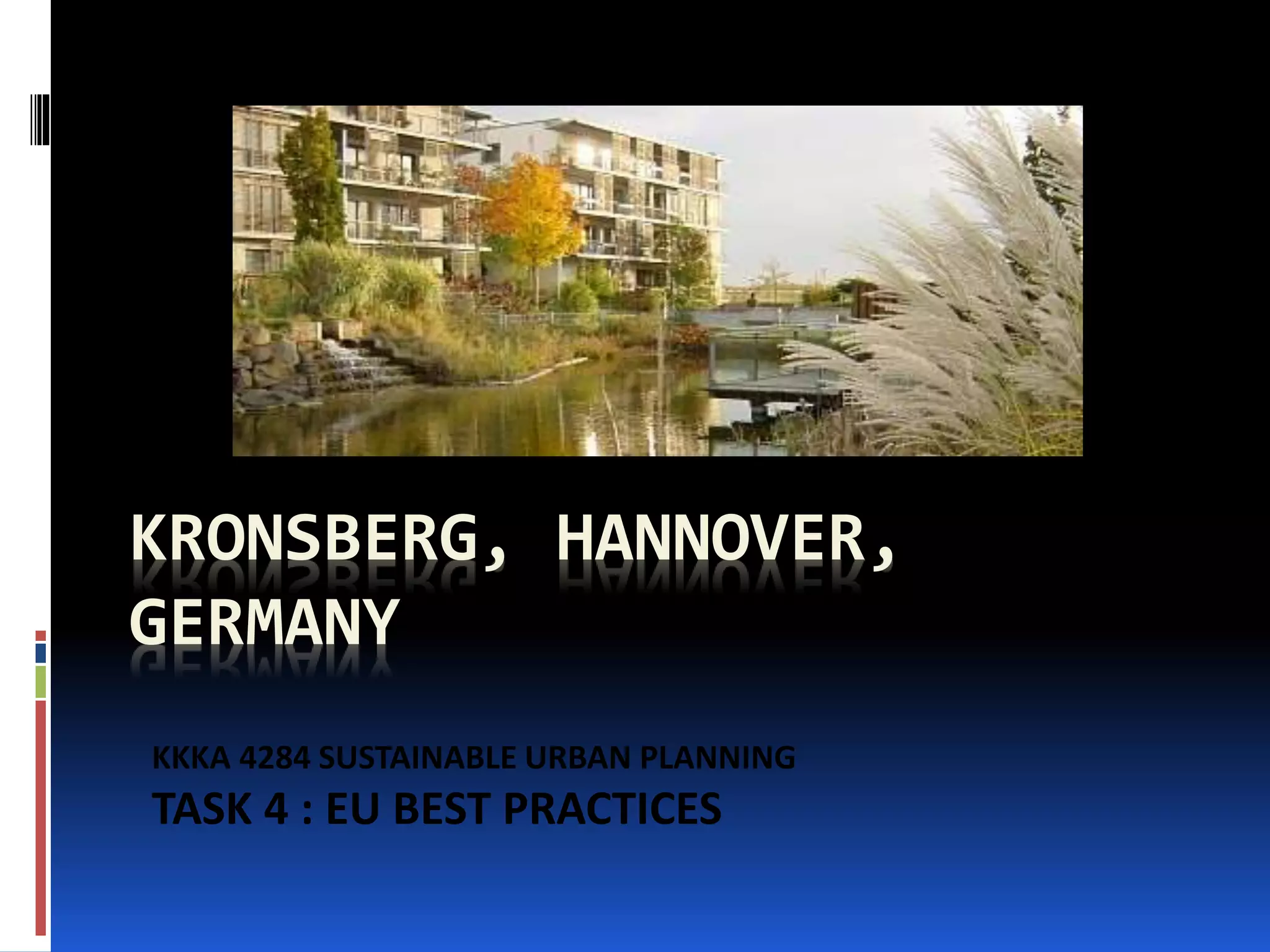
KRONSBERG, HANNOVER,
GERMANY
KKKA 4284 SUSTAINABLE URBAN PLANNING
TASK 4 : EU BEST PRACTICES
Group members
 NURUL IMAMAHTAJRI
 AZIZA BT ESA
 NURFAZLIN ERNY MOHD NORDIN
OBJECTIVE
 To build a district with a good mix of
functions (residences, leisure and cultural
facilities, commerce and agriculture) by
taking into account environment protection.
INTRODUCTION
 The local authority in the city of Hannover decided in the
1990s to develop the new district of Kronsberg, close to the
areas of the comingWorld Exposition Expo 2000.
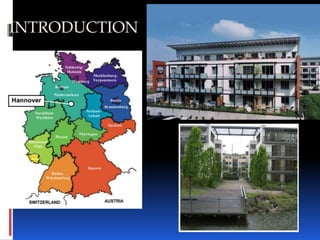
 Kronsberg is an eco-district in Hannover built on 1,200
hectares of mainly agricultural land on the city margins.
 It is located in the south-east of the city and was the last
remaining area in Hannover suitable for a large-scale
building project.
 Kronsberg is a settlement with exceptionally high ecological
standards, buildings offering above-average quality of
accommodation and semi-natural open space design.
INTRODUCTION
 It represents a comprehensive example of visionary
urban planning and construction where it enjoys all
the advantages offered by an urban neighbourhood,
yet it is in close vicinity to the countryside.
 In the early 1990s, the issue of housing shortage was
one of the central topics on the political agenda. A
study predicted that by the year 2000, there is a need
for 20,000 apartments in Hannover.
 Planned: To accommodate 6,000 dwellings for
15,000 people plus commercial areas with a clear
ecological ambition – “Ecological Optimization at
Kronsberg”
INTRODUCTION
CONCEPT
 The development of Kronsberg followed the regional planning
principle, according to which residential development should expand
along local rail public transport routes and be concentrated at urban
densities in the catchment areas of the stops and stations.
 The EXPO 2000 World Exposition was the occasion to apply this
planning approach to the Kronsberg area. Expo 2000 act as the
catalyst for the development of the Kronsberg area.
 A concept was devised in 1994 for the entire area that covered the
EXPO grounds, the new settlement and the countryside.
CONCEPT
 Principal planning aim
 To use space saving construction through high density.
 The apartment blocks closest to the tram line have a floor space index
relative to the site area of 1:2. The density decreases gradually the
farther away from the tram line the buildings are located.
 Sustainability
 It is a priority to have close links between living and working.
 2,000 jobs are located in the western section of the district. The district’s
services proposed were 3 daycare centres, a district art and community
centre, health centre, elderly care and shopping areas.
 Residential structure
 To secure a stable social of mix residents.
 10% of the housing stock were densely placed single-family homes, built
in the uphill building zones. They were mostly terraced and owner
occupied.Another 90% were apartments in multi storey buildings.
FUNDING
• Subsidies by the city and other sources, including
the EU, paid for the extra costs in both the larger
systems development and the building
construction to allow the project to function
within the guidelines of the ecological standards.
• Publicly owned land was sold to private
developers to raise money for public amenities.
• Federal, state, and local officials created a
housing fund to ensure that a mix of persons
from different income levels would be able to
afford to live in Kronsberg.
STRUCTURES
CONCEPTS
 Space saving construction through high density
 Mixed use : Residential and commercial
 Resource efficient construction
 Environment would not be disturbed by
reconstructions and alterations.
 Low energy house construction
 Non toxic certified materials used
 Traffic minimilisation concept
 Water saving fixtures
 Most buildings are alligned parallel to the contours,
enabling them to make use of natural light through
mainly west-east facing windows
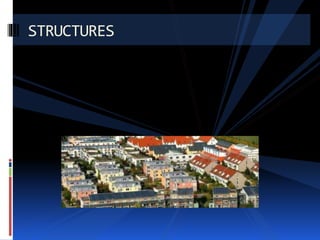
Compact Structures & High Building
Density
 Aim : Low land take by means of high density construction.
 Principle : Decreasing density and building height as one
approaches the countryside.
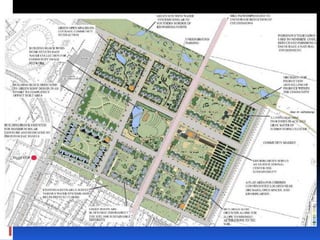
 The district is shaped by its wide meshed rectangular grid
layout – creates frames for very varied block structures.
 The built up, urban quality of the town scape is the result of
design parameters that set the no of storeys, building
heights and lines along the streets.
 The highest densities, with a floor space index of 1.2, were
achieved in the relatively compact 4 to 5-storey blocks
along the main access road. As one approaches the hilltop
the development becomes looser, with 3-storey blocks and
pavilion structures giving way to a terraced house
development beside the border avenue.
Low Energy House Standard
 This was only possible when the design had a compact
building form with few projections and recessions.
 Required space heating index – 55kWh/m² was made
possible through:
 Thicker insulation layer of walls.
 Airtight and windproof building envelops.
 Avoidance of thermal bridges.
 Installation of very well insulating windows.
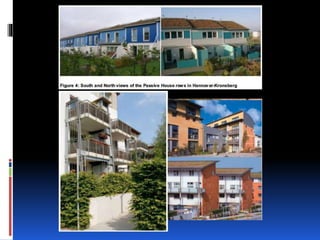
 Passive energy houses were also introduced:
 The grassed, ridged roofs were equipped with solar panels.
 Walls were pre-fabricated and super insulated.
 Houses were connected to district heating system.
 Required 1/7 of the heating energy compared with
conventional new house.
TRANSPORTATION
CONCEPTS
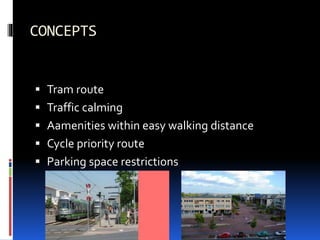
 Tram route
 Traffic calming
 Aamenities within easy walking distance
 Cycle priority route
 Parking space restrictions
CONCEPTS
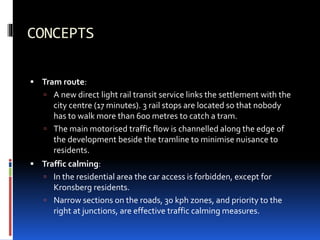
 Tram route:
 A new direct light rail transit service links the settlement with the
city centre (17 minutes). 3 rail stops are located so that nobody
has to walk more than 600 metres to catch a tram.
 The main motorised traffic flow is channelled along the edge of
the development beside the tramline to minimise nuisance to
residents.
 Traffic calming:
 In the residential area the car access is forbidden, except for
Kronsberg residents.
 Narrow sections on the roads, 30 kph zones, and priority to the
right at junctions, are effective traffic calming measures.
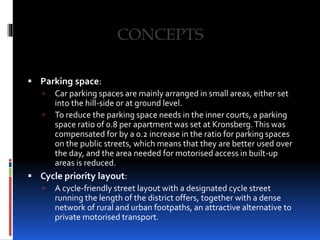
 Parking space:
 Car parking spaces are mainly arranged in small areas, either set
into the hill-side or at ground level.
 To reduce the parking space needs in the inner courts, a parking
space ratio of 0.8 per apartment was set at Kronsberg.This was
compensated for by a 0.2 increase in the ratio for parking spaces
on the public streets, which means that they are better used over
the day, and the area needed for motorised access in built-up
areas is reduced.
 Cycle priority layout:
 A cycle-friendly street layout with a designated cycle street
running the length of the district offers, together with a dense
network of rural and urban footpaths, an attractive alternative to
private motorised transport.
SOCIO-CULTURAL
CONCEPTS
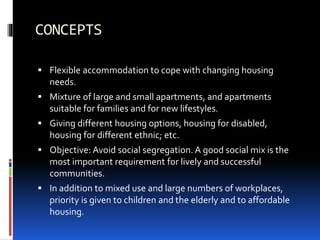
 Flexible accommodation to cope with changing housing
needs.
 Mixture of large and small apartments, and apartments
suitable for families and for new lifestyles.
 Giving different housing options, housing for disabled,
housing for different ethnic; etc.
 Objective: Avoid social segregation. A good social mix is the
most important requirement for lively and successful
communities.
 In addition to mixed use and large numbers of workplaces,
priority is given to children and the elderly and to affordable
housing.
 Central facilities:
 Arts, community & advice center
 Church & neighborhood center
 Health center
 Social Infrastructure:
 ‘Kinderhouse’ with community bakery
 Kindergartens
 Primary school
 Middle / secondary school
 ‘FOKUS’ housing project
 ‘Habitat’ international housing project
 Decentralized support for senior citizens
 Space allocation for community use
 NUTRITION
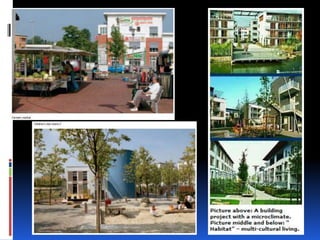
 Market
 Kronsberg Farm – ‘Hermannsdorfer Landwerkstätten’ am Kronsberg
ENVIRONMENT
CONCEPTS
 Planning and construction emphasised on:
 Environmentally friendly energy supply systems
 Environmentally friendly building.
 Preservation of natural resources.
 This developed into the “Kronsberg-Standard”,
obligatory for all developers, and was applied
across the board.
 It especially affected the areas of energy,
rainwater, building materials, and the ground.
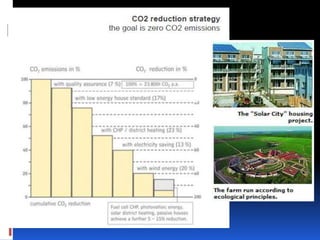
 The goal is to reduce CO2 emissions and
household energy consumption.
 Ecological standard energy:
 Energy use optimisation.
 District heating systems : Heating for all buildings is supplied
either through decentralised gas-fi red cogeneration (CHP)
plants, which are between 80-95% efficient, or through
alternative and renewable sources of energy.
 Low energy buildings.
 Electricity saving measures.
 ‘Solar City’:
 Solar district heating system
 Passive solar houses : Passive solar houses in the project use heat
exchangers to meet their heating needs. One of the CHP plants is
run by fuel cells, and was a demonstration project for the
Exposition.
 Wind turbines : Two wind turbines provide 3,000 dwellings with
electricity.
 Photovoltaic cell technology.
 Water:
 The Kronsberg Water Concept deals with the effects that a large
development can have on the local water table, the necessity for
water conservation, and raising awareness of water issues through
visible systems.
 “The ‘Mulden-Rigolen’system for decentralized retention and
infiltration of rainwater” was used throughout Kronsberg to create a
system of retention and infiltration that would not cause large
changes to the local water ecology.
 Drinking water economy measures.
 All precipitation on bult up and paved areas is absorbed., collected
and gradually released. Equiptment of all apartments with water
devices.
 Waste:
 The Kronsberg Waste Management Concept includes building
waste, and domestic and commercial waste.
 Developers are required to use materials for construction that are
non-toxic and recyclable, 80% of construction waste was not
landfilled.
 Systems for pre-sorted waste collection, encouragement of
home composting, and encouragement for retailers to use low-
packaging retail goods were part of the domestic and household
waste plan, as well as a “dense network of repair and alteration
services” throughout the development that encourage people to
follow the motto ‘mend it, don’t dump it’.
 Open spaces:
 Each building plan complemented to have open space; the space
need to meet up with high design and ecological standard set up
by municipality.
 Street lined with trees and front gardens. Several large
playground are laid out close to the apartments.
 Open space is generally deived from the hillside location; this is
particularly apparent in the front garden with terracing and
retaining walls.
task 4- EU best practice

task 4- EU best practice

  • 1.
    KRONSBERG, HANNOVER, GERMANY KKKA 4284SUSTAINABLE URBAN PLANNING TASK 4 : EU BEST PRACTICES
  • 2.
    Group members  NURULIMAMAHTAJRI  AZIZA BT ESA  NURFAZLIN ERNY MOHD NORDIN
  • 3.
    OBJECTIVE  To builda district with a good mix of functions (residences, leisure and cultural facilities, commerce and agriculture) by taking into account environment protection.
  • 4.
    INTRODUCTION  The localauthority in the city of Hannover decided in the 1990s to develop the new district of Kronsberg, close to the areas of the comingWorld Exposition Expo 2000.  Kronsberg is an eco-district in Hannover built on 1,200 hectares of mainly agricultural land on the city margins.  It is located in the south-east of the city and was the last remaining area in Hannover suitable for a large-scale building project.  Kronsberg is a settlement with exceptionally high ecological standards, buildings offering above-average quality of accommodation and semi-natural open space design.
  • 5.
    INTRODUCTION  It representsa comprehensive example of visionary urban planning and construction where it enjoys all the advantages offered by an urban neighbourhood, yet it is in close vicinity to the countryside.  In the early 1990s, the issue of housing shortage was one of the central topics on the political agenda. A study predicted that by the year 2000, there is a need for 20,000 apartments in Hannover.  Planned: To accommodate 6,000 dwellings for 15,000 people plus commercial areas with a clear ecological ambition – “Ecological Optimization at Kronsberg”
  • 6.
  • 7.
    CONCEPT  The developmentof Kronsberg followed the regional planning principle, according to which residential development should expand along local rail public transport routes and be concentrated at urban densities in the catchment areas of the stops and stations.  The EXPO 2000 World Exposition was the occasion to apply this planning approach to the Kronsberg area. Expo 2000 act as the catalyst for the development of the Kronsberg area.  A concept was devised in 1994 for the entire area that covered the EXPO grounds, the new settlement and the countryside.
  • 8.
    CONCEPT  Principal planningaim  To use space saving construction through high density.  The apartment blocks closest to the tram line have a floor space index relative to the site area of 1:2. The density decreases gradually the farther away from the tram line the buildings are located.  Sustainability  It is a priority to have close links between living and working.  2,000 jobs are located in the western section of the district. The district’s services proposed were 3 daycare centres, a district art and community centre, health centre, elderly care and shopping areas.  Residential structure  To secure a stable social of mix residents.  10% of the housing stock were densely placed single-family homes, built in the uphill building zones. They were mostly terraced and owner occupied.Another 90% were apartments in multi storey buildings.
  • 9.
    FUNDING • Subsidies bythe city and other sources, including the EU, paid for the extra costs in both the larger systems development and the building construction to allow the project to function within the guidelines of the ecological standards. • Publicly owned land was sold to private developers to raise money for public amenities. • Federal, state, and local officials created a housing fund to ensure that a mix of persons from different income levels would be able to afford to live in Kronsberg.
  • 10.
  • 11.
    CONCEPTS  Space savingconstruction through high density  Mixed use : Residential and commercial  Resource efficient construction  Environment would not be disturbed by reconstructions and alterations.  Low energy house construction  Non toxic certified materials used  Traffic minimilisation concept  Water saving fixtures  Most buildings are alligned parallel to the contours, enabling them to make use of natural light through mainly west-east facing windows
  • 13.
    Compact Structures &High Building Density  Aim : Low land take by means of high density construction.  Principle : Decreasing density and building height as one approaches the countryside.  The district is shaped by its wide meshed rectangular grid layout – creates frames for very varied block structures.  The built up, urban quality of the town scape is the result of design parameters that set the no of storeys, building heights and lines along the streets.  The highest densities, with a floor space index of 1.2, were achieved in the relatively compact 4 to 5-storey blocks along the main access road. As one approaches the hilltop the development becomes looser, with 3-storey blocks and pavilion structures giving way to a terraced house development beside the border avenue.
  • 14.
    Low Energy HouseStandard  This was only possible when the design had a compact building form with few projections and recessions.  Required space heating index – 55kWh/m² was made possible through:  Thicker insulation layer of walls.  Airtight and windproof building envelops.  Avoidance of thermal bridges.  Installation of very well insulating windows.  Passive energy houses were also introduced:  The grassed, ridged roofs were equipped with solar panels.  Walls were pre-fabricated and super insulated.  Houses were connected to district heating system.  Required 1/7 of the heating energy compared with conventional new house.
  • 16.
  • 17.
    CONCEPTS  Tram route Traffic calming  Aamenities within easy walking distance  Cycle priority route  Parking space restrictions
  • 18.
    CONCEPTS  Tram route: A new direct light rail transit service links the settlement with the city centre (17 minutes). 3 rail stops are located so that nobody has to walk more than 600 metres to catch a tram.  The main motorised traffic flow is channelled along the edge of the development beside the tramline to minimise nuisance to residents.  Traffic calming:  In the residential area the car access is forbidden, except for Kronsberg residents.  Narrow sections on the roads, 30 kph zones, and priority to the right at junctions, are effective traffic calming measures.
  • 19.
     Parking space: Car parking spaces are mainly arranged in small areas, either set into the hill-side or at ground level.  To reduce the parking space needs in the inner courts, a parking space ratio of 0.8 per apartment was set at Kronsberg.This was compensated for by a 0.2 increase in the ratio for parking spaces on the public streets, which means that they are better used over the day, and the area needed for motorised access in built-up areas is reduced.  Cycle priority layout:  A cycle-friendly street layout with a designated cycle street running the length of the district offers, together with a dense network of rural and urban footpaths, an attractive alternative to private motorised transport.
  • 20.
  • 21.
    CONCEPTS  Flexible accommodationto cope with changing housing needs.  Mixture of large and small apartments, and apartments suitable for families and for new lifestyles.  Giving different housing options, housing for disabled, housing for different ethnic; etc.  Objective: Avoid social segregation. A good social mix is the most important requirement for lively and successful communities.  In addition to mixed use and large numbers of workplaces, priority is given to children and the elderly and to affordable housing.
  • 22.
     Central facilities: Arts, community & advice center  Church & neighborhood center  Health center  Social Infrastructure:  ‘Kinderhouse’ with community bakery  Kindergartens  Primary school  Middle / secondary school  ‘FOKUS’ housing project  ‘Habitat’ international housing project  Decentralized support for senior citizens  Space allocation for community use
  • 23.
     NUTRITION  Market Kronsberg Farm – ‘Hermannsdorfer Landwerkstätten’ am Kronsberg
  • 25.
  • 26.
    CONCEPTS  Planning andconstruction emphasised on:  Environmentally friendly energy supply systems  Environmentally friendly building.  Preservation of natural resources.  This developed into the “Kronsberg-Standard”, obligatory for all developers, and was applied across the board.  It especially affected the areas of energy, rainwater, building materials, and the ground.  The goal is to reduce CO2 emissions and household energy consumption.
  • 27.
     Ecological standardenergy:  Energy use optimisation.  District heating systems : Heating for all buildings is supplied either through decentralised gas-fi red cogeneration (CHP) plants, which are between 80-95% efficient, or through alternative and renewable sources of energy.  Low energy buildings.  Electricity saving measures.
  • 28.
     ‘Solar City’: Solar district heating system  Passive solar houses : Passive solar houses in the project use heat exchangers to meet their heating needs. One of the CHP plants is run by fuel cells, and was a demonstration project for the Exposition.  Wind turbines : Two wind turbines provide 3,000 dwellings with electricity.  Photovoltaic cell technology.
  • 29.
     Water:  TheKronsberg Water Concept deals with the effects that a large development can have on the local water table, the necessity for water conservation, and raising awareness of water issues through visible systems.  “The ‘Mulden-Rigolen’system for decentralized retention and infiltration of rainwater” was used throughout Kronsberg to create a system of retention and infiltration that would not cause large changes to the local water ecology.  Drinking water economy measures.  All precipitation on bult up and paved areas is absorbed., collected and gradually released. Equiptment of all apartments with water devices.
  • 30.
     Waste:  TheKronsberg Waste Management Concept includes building waste, and domestic and commercial waste.  Developers are required to use materials for construction that are non-toxic and recyclable, 80% of construction waste was not landfilled.  Systems for pre-sorted waste collection, encouragement of home composting, and encouragement for retailers to use low- packaging retail goods were part of the domestic and household waste plan, as well as a “dense network of repair and alteration services” throughout the development that encourage people to follow the motto ‘mend it, don’t dump it’.
  • 31.
     Open spaces: Each building plan complemented to have open space; the space need to meet up with high design and ecological standard set up by municipality.  Street lined with trees and front gardens. Several large playground are laid out close to the apartments.  Open space is generally deived from the hillside location; this is particularly apparent in the front garden with terracing and retaining walls.