Tarek Saadi -
Understanding the
Strategic Learning
Process
For a long time, the response from management experts in relation to
the central challenge facing business leaders today has focused on
the need for change. While change is present in many organizations,
the perspective has always been that change is treated as a one-time
event and that a business only needs to move from one point to
another to achieve success. Indeed, this A-to-B approach is at the
core of many conventional strategies, but in a rapidly-changing and
dynamic world, it's outdated.
The Need for Adaptive Leadership
Conventional Approach
For a long time, the response from management experts
in relation to the central challenge facing business leaders
today has focused on the need for change. While change
is present in many organizations, the perspective has
always been that change is treated as a one-time event
and that a business only needs to move from one point to
another to achieve success. Indeed, this A-to-B approach
is at the core of many conventional strategies, but in a
rapidly-changing and dynamic world, it's outdated.
Modern Approach
Tarek Saadi, an accomplished business consultant who
was certified at Colombia Business School in 2012, knows
that modern business leaders must adapt to various
changing dynamics within their environment. Whether
that's global economic uncertainty, disruptive
technologies, or high levels of complexity, entrepreneurs
require a different approach from the A-to-B style.
According to Professor William G. Pietersen, the challenge
for the modern business leader is to 'create and lead an
adaptive enterprise,' which requires continually adapting
to changes in the environment.
The Importance of Strategic Learning
Competitive Advantage
Maintaining a competitive
advantage is no longer about
creating a new service or product.
As Professor Pietersen explains,
an organization's ability to be
adaptive is critical, with this
strategy becoming the platform
through which business leaders
can learn the practical process
and tools needed to build and lead
these types of businesses.
Strategic Learning
Process
It is based on this premise that
Professor Pietersen developed
Strategic Learning, a process that
helps leaders create and
implement breakthrough
strategies. The process has been
deployed at various notable
companies globally such as
Deloitte, SAP, and The Girl Scouts
of America, among others, and it
is the core methodology at
Columbia Business School for
executive education programs.
Continuous Cycle
From a general view, the program
has four key steps – learn, focus,
align, and execute – that build on
each other in a continuous cycle.
The Learn and Focus Steps
1 Strategy Creation
The Learn and Focus steps
are the basis upon which a
firm creates its strategy.
2 Comprehensive
Consideration
This strategy will consider
many factors, including the
challenges, insights and
implications of various
choices and how they
channel into the business's
key priorities.
3 Foundation for Execution
These initial steps lay the groundwork for the subsequent
stages of the Strategic Learning process.
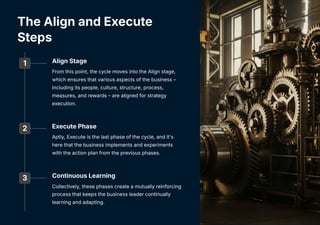
The Align and Execute
Steps
1 Align Stage
From this point, the cycle moves into the Align stage,
which ensures that various aspects of the business –
including its people, culture, structure, process,
measures, and rewards – are aligned for strategy
execution.
2 Execute Phase
Aptly, Execute is the last phase of the cycle, and it's
here that the business implements and experiments
with the action plan from the previous phases.
3 Continuous Learning
Collectively, these phases create a mutually reinforcing
process that keeps the business leader continually
learning and adapting.
Benefits of Strategic
Learning
Focus
While focus is important for strategy, the process also introduces
flexibility and creative thinking to the benefit of the organization.
Flexibility
The Strategic Learning process allows businesses to remain flexible in
the face of changing market conditions.
Creativity
The process encourages creative thinking, enabling businesses to
develop innovative solutions to challenges.

Tarek Saadi - Understanding the Strategic Learning Process

  • 1.
    Tarek Saadi - Understandingthe Strategic Learning Process For a long time, the response from management experts in relation to the central challenge facing business leaders today has focused on the need for change. While change is present in many organizations, the perspective has always been that change is treated as a one-time event and that a business only needs to move from one point to another to achieve success. Indeed, this A-to-B approach is at the core of many conventional strategies, but in a rapidly-changing and dynamic world, it's outdated.
  • 2.
    The Need forAdaptive Leadership Conventional Approach For a long time, the response from management experts in relation to the central challenge facing business leaders today has focused on the need for change. While change is present in many organizations, the perspective has always been that change is treated as a one-time event and that a business only needs to move from one point to another to achieve success. Indeed, this A-to-B approach is at the core of many conventional strategies, but in a rapidly-changing and dynamic world, it's outdated. Modern Approach Tarek Saadi, an accomplished business consultant who was certified at Colombia Business School in 2012, knows that modern business leaders must adapt to various changing dynamics within their environment. Whether that's global economic uncertainty, disruptive technologies, or high levels of complexity, entrepreneurs require a different approach from the A-to-B style. According to Professor William G. Pietersen, the challenge for the modern business leader is to 'create and lead an adaptive enterprise,' which requires continually adapting to changes in the environment.
  • 3.
    The Importance ofStrategic Learning Competitive Advantage Maintaining a competitive advantage is no longer about creating a new service or product. As Professor Pietersen explains, an organization's ability to be adaptive is critical, with this strategy becoming the platform through which business leaders can learn the practical process and tools needed to build and lead these types of businesses. Strategic Learning Process It is based on this premise that Professor Pietersen developed Strategic Learning, a process that helps leaders create and implement breakthrough strategies. The process has been deployed at various notable companies globally such as Deloitte, SAP, and The Girl Scouts of America, among others, and it is the core methodology at Columbia Business School for executive education programs. Continuous Cycle From a general view, the program has four key steps – learn, focus, align, and execute – that build on each other in a continuous cycle.
  • 4.
    The Learn andFocus Steps 1 Strategy Creation The Learn and Focus steps are the basis upon which a firm creates its strategy. 2 Comprehensive Consideration This strategy will consider many factors, including the challenges, insights and implications of various choices and how they channel into the business's key priorities. 3 Foundation for Execution These initial steps lay the groundwork for the subsequent stages of the Strategic Learning process.
  • 5.
    The Align andExecute Steps 1 Align Stage From this point, the cycle moves into the Align stage, which ensures that various aspects of the business – including its people, culture, structure, process, measures, and rewards – are aligned for strategy execution. 2 Execute Phase Aptly, Execute is the last phase of the cycle, and it's here that the business implements and experiments with the action plan from the previous phases. 3 Continuous Learning Collectively, these phases create a mutually reinforcing process that keeps the business leader continually learning and adapting.
  • 6.
    Benefits of Strategic Learning Focus Whilefocus is important for strategy, the process also introduces flexibility and creative thinking to the benefit of the organization. Flexibility The Strategic Learning process allows businesses to remain flexible in the face of changing market conditions. Creativity The process encourages creative thinking, enabling businesses to develop innovative solutions to challenges.