“Tapping into the Value on a Transport Corridor”
Nic Cloete-Hopkins, Transport Forum SIG
Emnotweni Arena, Nelspruit, 04 February 2016
1
Wits Transnet Centre of
Systems Engineering: TCSE
Partnering for Systems Solutions
Agenda
• Transport Corridors – perceptions and issues
• The Value Chain concept
• S-TEAMS what is it?
• What is Value?
• Tapping into the Value on the Transport Corridor –
Application of S-TEAMS
2
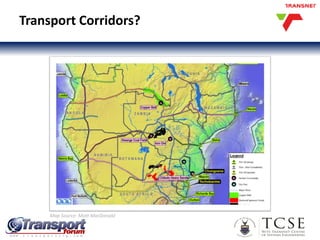
Transport Corridors?
Map Source: Mott MacDonald
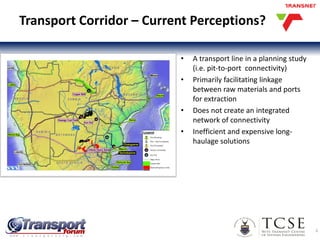
Transport Corridor – Current Perceptions?
• A transport line in a planning study
(i.e. pit-to-port connectivity)
• Primarily facilitating linkage
between raw materials and ports
for extraction
• Does not create an integrated
network of connectivity
• Inefficient and expensive long-
haulage solutions
4
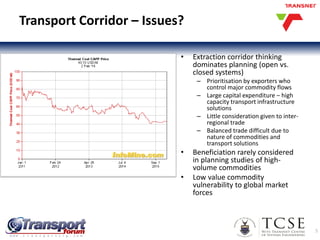
Transport Corridor – Issues?
• Extraction corridor thinking
dominates planning (open vs.
closed systems)
– Prioritisation by exporters who
control major commodity flows
– Large capital expenditure – high
capacity transport infrastructure
solutions
– Little consideration given to inter-
regional trade
– Balanced trade difficult due to
nature of commodities and
transport solutions
• Beneficiation rarely considered
in planning studies of high-
volume commodities
• Low value commodity
vulnerability to global market
forces
5
6
What is a Value Chain?
VALUE CHAIN is the sequential set of primary and support
activities that an enterprise performs to turn inputs into
value-added outputs for its external customers.
As developed by Michael E. Porter, it is a:
• connected series of organizations, resources, and
knowledge streams
• involved in the creation and delivery of value to end
customers.
Reference: VentureLine
Definition of a System – our Preference….
From Rechtin, Systems Architecting of Organizations:
Why Eagles Can’t Swim:
– “A ‘system’ is a construct or collection of different
elements that together produce results not obtainable by
the elements alone.
– The elements, or parts, can include people, hardware,
software, facilities, policies, and documents; that is, all
things required to produce system-level results.”
7
8
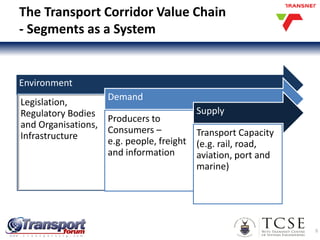
The Transport Corridor Value Chain
- Segments as a System
Environment
Legislation,
Regulatory Bodies
and Organisations,
Infrastructure
Demand
Producers to
Consumers –
e.g. people, freight
and information
Supply
Transport Capacity
(e.g. rail, road,
aviation, port and
marine)
Adopting S-TEAMS as a Mind-set
to Deliver Value to the Transport Corridor
• Systems Thinking
• Systems Engineering
• Systems Approach(es)
• Systems Methodologies
• Systems Science
–ATMES
10
What is Value?
Merriam-Webster dictionary:
• the amount of money that something is worth : the price or
cost of something
• usefulness or importance
– BUT
Value often has more than monetary meaning e.g.:
• My 10-year old car may be worth R2,000 but the value is
similar to that of a new vehicle
• The value of reliably moving freight to support the economy
has more value than the monetary contract amounts since it
impacts on jobs, infrastructure, social development,
education, etc.
Tapping into the Value on the
Transport Corridor
“Application of S-TEAMS
to elaborate on all the elements
to be considered in deliberation
of the System."
Elements for Consideration
• Systems approach
– Holistic view
– Containing system and System-of-interest
• Systems thinking
– Stakeholder viewpoints
• Systems methodologies
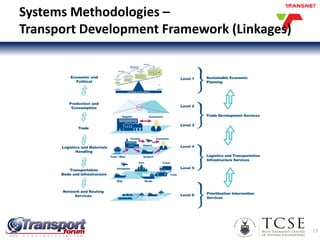
– Transport development framework (linkages, nodes and
sustainability)
• Systems engineering
– Requirements Elicitation, Capture and Management
• Systems science
– Multiple disciplines including training and education;
environment and sustainability; and multi-engineered solution
12
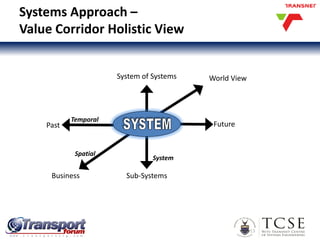
System of Systems
Sub-Systems
System
Past Future
Temporal
World View
Business
Spatial
Systems Approach –
Value Corridor Holistic View
13
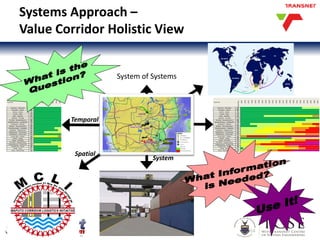
System of Systems
Sub-Systems
System
Past Future
Temporal
World View
Business
Spatial
Systems Approach –
Value Corridor Holistic View
Zesfontein - Slimesdam 59
Slimesdam - Delmas 85
Delmas - Dryden 72
Dryden - Ogies 72
Ogies - Saaiwater 52
Saaiwater - Kromklip 117
Kromklip - Bezuidenhoutsrus 85
Bezuidenhoutsrus - VanDyksdrif 78
VanDyksdrif - Blinkpan 52
Blinkpan - Broodsnyersplaas 59
Broodsnyersplaas - Gelukplaas 55
Gelukplaas - Halfgewonnen 59
Halfgewonnen - Hamelfontein 55
Hamelfontein - Ermelo Werf 72
Ermelo Werf - Panbult 26
Panbult - Iswepe 69
Iswepe - Piet Retief 47
Piet Retief - Paulpietersburg 39
Paulpietersburg - Vryheid East 33
Vryheid East - Ulundi 46
Ulundi - Nsese 51
Nsese - Richards Bay 32
Coal Line
OpsSlots
32% 33% 34% 35% 37% 38% 40% 41% 43% 44% 46% 48% 49% 51% 53% 55% 58% 60% 62% 65% 68% 70% 73%
22% 23% 24% 25% 26% 27% 28% 29% 30% 31% 32% 33% 35% 36% 37% 39% 40% 42% 44% 45% 47% 49% 51%
23% 24% 24% 25% 26% 28% 29% 30% 31% 32% 33% 35% 36% 37% 39% 41% 42% 44% 46% 48% 50% 52% 54%
20% 21% 21% 22% 23% 24% 25% 26% 27% 28% 29% 30% 32% 33% 34% 36% 37% 39% 41% 42% 44% 46% 48%
43% 45% 47% 50% 52% 58% 59% 61% 63% 65% 67% 69% 71% 73% 76% 78% 81% 84% 87% 91% 94% 97% 101%
21% 22% 23% 24% 26% 28% 29% 30% 31% 32% 32% 33% 34% 35% 36% 38% 39% 40% 42% 43% 44% 46% 47%
32% 33% 35% 36% 38% 41% 42% 43% 44% 45% 46% 48% 49% 50% 52% 53% 55% 56% 58% 60% 62% 64% 66%
36% 37% 39% 40% 42% 47% 48% 49% 50% 51% 53% 54% 55% 57% 58% 60% 62% 64% 66% 68% 70% 72% 74%
54% 56% 58% 60% 63% 70% 72% 73% 75% 77% 79% 81% 83% 85% 87% 90% 92% 95% 98% 101% 104% 108% 111%
49% 50% 52% 55% 57% 64% 65% 66% 68% 69% 71% 72% 74% 76% 78% 80% 82% 84% 87% 89% 92% 94% 97%
65% 67% 68% 70% 73% 79% 80% 81% 83% 84% 86% 87% 89% 91% 93% 95% 97% 100% 102% 105% 108% 111% 113%
69% 70% 72% 73% 76% 81% 82% 84% 85% 86% 88% 89% 91% 93% 95% 97% 99% 101% 103% 106% 109% 111% 114%
75% 76% 78% 80% 82% 88% 89% 91% 92% 94% 95% 97% 99% 100% 102% 105% 107% 109% 112% 114% 117% 120% 123%
61% 62% 64% 65% 67% 72% 73% 74% 75% 77% 78% 80% 81% 83% 85% 86% 88% 90% 93% 95% 98% 100% 103%
102% 105% 108% 111% 115% 122% 125% 127% 130% 133% 137% 140% 144% 148% 152% 157% 161% 166% 172% 178% 184% 190% 196%
40% 41% 42% 43% 45% 48% 49% 50% 51% 52% 53% 55% 56% 58% 59% 61% 63% 65% 67% 69% 72% 74% 76%
61% 63% 65% 66% 69% 73% 75% 76% 78% 80% 82% 84% 87% 89% 92% 95% 98% 101% 104% 108% 112% 115% 119%
74% 75% 78% 80% 83% 88% 90% 92% 94% 97% 99% 102% 105% 108% 111% 114% 118% 121% 126% 130% 135% 139% 144%
88% 89% 92% 95% 98% 104% 107% 109% 112% 115% 118% 121% 124% 128% 132% 136% 140% 145% 150% 155% 161% 166% 172%
65% 67% 69% 71% 73% 78% 79% 81% 83% 85% 88% 90% 93% 95% 98% 101% 105% 108% 112% 116% 120% 124% 128%
59% 60% 62% 64% 66% 70% 72% 74% 76% 78% 80% 82% 84% 87% 89% 92% 95% 98% 101% 105% 109% 112% 116%
65% 68% 72% 75% 79% 82% 86% 91% 95% 100% 105% 110% 115% 121% 127% 134% 140% 147% 156% 164% 173% 181% 190%
2015
2016
2017
2018
2019
2020
2021
2022
2023
2024
2025
2026
2027
2028
2029
2030
2031
2032
2033
2034
2035
2036
2037
Zesfontein - Slimesdam 59 25% 24% 24% 25% 27% 28% 29% 30%
Slimesdam - Delmas 85 18% 17% 17% 17% 19% 19% 20% 21%
Delmas - Dryden 72 19% 18% 17% 18% 19% 20% 21% 22%
Dryden - Ogies 72 17% 16% 15% 16% 17% 17% 18% 19%
Ogies - Saaiwater 52 34% 32% 32% 34% 36% 37% 38% 41%
Saaiwater - Kromklip 117 17% 16% 16% 17% 18% 18% 19% 20%
Kromklip - Bezuidenhoutsrus 85 26% 24% 25% 26% 27% 28% 29% 31%
Bezuidenhoutsrus - VanDyksdrif 78 29% 27% 28% 29% 30% 31% 32% 35%
VanDyksdrif - Blinkpan 52 48% 45% 47% 49% 51% 52% 54% 55%
Blinkpan - Broodsnyersplaas 59 44% 41% 44% 46% 47% 48% 50% 50%
Broodsnyersplaas - Gelukplaas 55 54% 50% 54% 56% 58% 59% 61% 64%
Gelukplaas - Halfgewonnen 59 51% 47% 51% 53% 55% 56% 58% 64%
Halfgewonnen - Hamelfontein 55 58% 54% 59% 61% 63% 64% 66% 71%
Hamelfontein - Ermelo Werf 72 48% 45% 49% 51% 52% 53% 55% 59%
Ermelo Werf - Panbult 26 81% 75% 78% 81% 84% 86% 89% 97%
Panbult - Iswepe 69 31% 29% 30% 31% 32% 33% 34% 38%
Iswepe - Piet Retief 47 48% 45% 46% 48% 50% 51% 53% 58%
Piet Retief - Paulpietersburg 39 58% 54% 55% 58% 60% 61% 63% 70%
Paulpietersburg - Vryheid East 33 69% 64% 65% 69% 71% 73% 75% 82%
Vryheid East - Ulundi 46 52% 48% 49% 51% 53% 54% 56% 61%
Ulundi - Nsese 51 47% 43% 44% 46% 48% 49% 51% 56%
Nsese - Richards Bay 32 59% 53% 43% 45% 48% 51% 53% 60%
Coal Line
OpsSlots
2007
2008
2009
2010
2011
2012
2013
2014
14
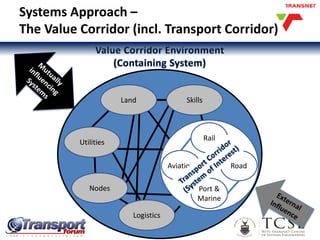
Systems Approach –
The Value Corridor (incl. Transport Corridor)
Nodes
Land
Utilities
Skills
Logistics
Rail
Aviation Road
Port &
Marine
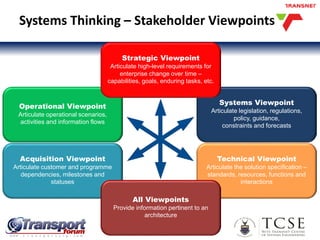
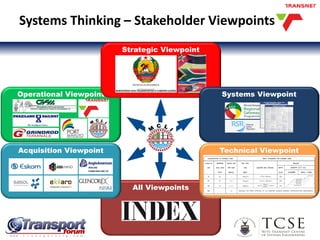
Systems Thinking – Stakeholder Viewpoints
Systems Viewpoint
Articulate legislation, regulations,
policy, guidance,
constraints and forecasts
Operational Viewpoint
Articulate operational scenarios,
activities and information flows
Acquisition Viewpoint
Articulate customer and programme
dependencies, milestones and
statuses
Technical Viewpoint
Articulate the solution specification –
standards, resources, functions and
interactions
Strategic Viewpoint
Articulate high-level requirements for
enterprise change over time –
capabilities, goals, enduring tasks, etc.
All Viewpoints
Provide information pertinent to an
architecture
Systems Thinking – Stakeholder Viewpoints
All Viewpoints
Acquisition Viewpoint Technical Viewpoint
Operational Viewpoint
Strategic Viewpoint
Systems Viewpoint
Systems Thinking – Stakeholder Viewpoints
All Viewpoints
Acquisition Viewpoint Technical Viewpoint
Operational Viewpoint
Strategic Viewpoint
Systems Viewpoint
Systems Methodologies –
Transport Development Framework (Linkages)
19
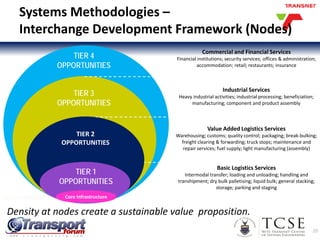
Systems Methodologies –
Interchange Development Framework (Nodes)
20
TIER 3
OPPORTUNITIES
TIER 4
OPPORTUNITIES
Value Added Logistics Services
Warehousing; customs; quality control; packaging; break-bulking;
freight clearing & forwarding; truck stops; maintenance and
repair services; fuel supply; light manufacturing (assembly)
Commercial and Financial Services
Financial institutions; security services; offices & administration;
accommodation; retail; restaurants; insurance
Basic Logistics Services
Intermodal transfer; loading and unloading; handling and
transhipment; dry bulk palletising; liquid bulk; general stacking;
storage; parking and staging
Source: Adapted from Transnet Freight Rail
TIER 2
OPPORTUNITIES
TIER 1
OPPORTUNITIES
Core Infrastructure
Industrial Services
Heavy industrial activities; industrial processing; beneficiation;
manufacturing; component and product assembly
Density at nodes create a sustainable value proposition.
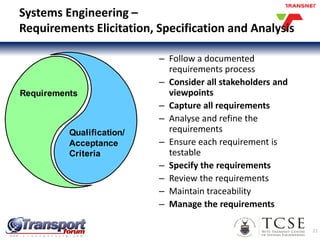
Systems Engineering –
Requirements Elicitation, Specification and Analysis
21
– Follow a documented
requirements process
– Consider all stakeholders and
viewpoints
– Capture all requirements
– Analyse and refine the
requirements
– Ensure each requirement is
testable
– Specify the requirements
– Review the requirements
– Maintain traceability
– Manage the requirements
Requirements
Qualification/
Acceptance
Criteria
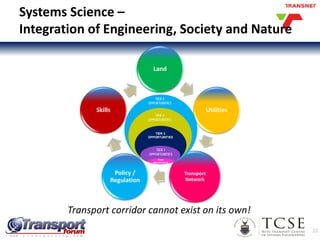
Systems Science –
Integration of Engineering, Society and Nature
22
Land
Utilities
Transport
Network
Policy /
Regulation
Skills
TIER 3
OPPORTUNITIES
TIER 4
OPPORTUNITIES
TIER 2
OPPORTUNITIES
TIER 1
OPPORTUNITIES
Core
Infrastructure
Transport corridor cannot exist on its own!
23
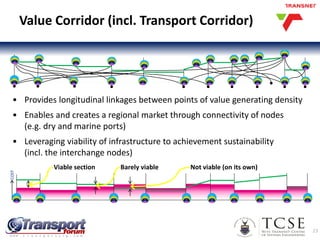
Value Corridor (incl. Transport Corridor)
• Provides longitudinal linkages between points of value generating density
• Enables and creates a regional market through connectivity of nodes
(e.g. dry and marine ports)
• Leveraging viability of infrastructure to achievement sustainability
(incl. the interchange nodes)
Core
Infrastructure
TIER 3
OPPORTUNITIES
TIER 4
OPPORTUNITIES
TIER 2
OPPORTUNITIES
TIER 1
OPPORTUNITIES
Core
Infrastructure
TIER 3
OPPORTUNITIES
TIER 4
OPPORTUNITIES
TIER 2
OPPORTUNITIES
TIER 1
OPPORTUNITIES
Core
Infrastructure
TIER 3
OPPORTUNITIES
TIER 4
OPPORTUNITIES
TIER 2
OPPORTUNITIES
TIER 1
OPPORTUNITIES
Core
Infrastructure
TIER 3
OPPORTUNITIES
TIER 4
OPPORTUNITIES
TIER 2
OPPORTUNITIES
TIER 1
OPPORTUNITIES
Core
Infrastructure
TIER 3
OPPORTUNITIES
TIER 4
OPPORTUNITIES
TIER 2
OPPORTUNITIES
TIER 1
OPPORTUNITIES
Core
Infrastructure
TIER 3
OPPORTUNITIES
TIER 4
OPPORTUNITIES
TIER 2
OPPORTUNITIES
TIER 1
OPPORTUNITIES
Core
Infrastructure
TIER 3
OPPORTUNITIES
TIER 4
OPPORTUNITIES
TIER 2
OPPORTUNITIES
TIER 1
OPPORTUNITIES
Core
Infrastructure
TIER 3
OPPORTUNITIES
TIER 4
OPPORTUNITIES
TIER 2
OPPORTUNITIES
TIER 1
OPPORTUNITIES
Core
Infrastructure
TIER 3
OPPORTUNITIES
TIER 4
OPPORTUNITIES
TIER 2
OPPORTUNITIES
TIER 1
OPPORTUNITIES
Core
Infrastructure
TIER 3
OPPORTUNITIES
TIER 4
OPPORTUNITIES
TIER 2
OPPORTUNITIES
TIER 1
OPPORTUNITIES
Core
Infrastructure
TIER 3
OPPORTUNITIES
TIER 4
OPPORTUNITIES
TIER 2
OPPORTUNITIES
TIER 1
OPPORTUNITIES
Core
Infrastructure
TIER 3
OPPORTUNITIES
TIER 4
OPPORTUNITIES
TIER 2
OPPORTUNITIES
TIER 1
OPPORTUNITIES
Core
Infrastructure
TIER 3
OPPORTUNITIES
TIER 4
OPPORTUNITIES
TIER 2
OPPORTUNITIES
TIER 1
OPPORTUNITIES
Core
Infrastructure
TIER 3
OPPORTUNITIES
TIER 4
OPPORTUNITIES
TIER 2
OPPORTUNITIES
TIER 1
OPPORTUNITIES
Core
Infrastructure
TIER 3
OPPORTUNITIES
TIER 4
OPPORTUNITIES
TIER 2
OPPORTUNITIES
TIER 1
OPPORTUNITIES
Core
Infrastructure
TIER 3
OPPORTUNITIES
TIER 4
OPPORTUNITIES
TIER 2
OPPORTUNITIES
TIER 1
OPPORTUNITIES
Core
Infrastructure
TIER 3
OPPORTUNITIES
TIER 4
OPPORTUNITIES
TIER 2
OPPORTUNITIES
TIER 1
OPPORTUNITIES
Core
Infrastructure
TIER 3
OPPORTUNITIES
TIER 4
OPPORTUNITIES
TIER 2
OPPORTUNITIES
TIER 1
OPPORTUNITIES
Core
Infrastructure
TIER 3
OPPORTUNITIES
TIER 4
OPPORTUNITIES
TIER 2
OPPORTUNITIES
TIER 1
OPPORTUNITIES
Core
Infrastructure
TIER 3
OPPORTUNITIES
TIER 4
OPPORTUNITIES
TIER 2
OPPORTUNITIES
TIER 1
OPPORTUNITIES
Core
Infrastructure
TIER 3
OPPORTUNITIES
TIER 4
OPPORTUNITIES
TIER 2
OPPORTUNITIES
TIER 1
OPPORTUNITIES
Core
Infrastructure
TIER 3
OPPORTUNITIES
TIER 4
OPPORTUNITIES
TIER 2
OPPORTUNITIES
TIER 1
OPPORTUNITIES
Core
Infrastructure
TIER 3
OPPORTUNITIES
TIER 4
OPPORTUNITIES
TIER 2
OPPORTUNITIES
TIER 1
OPPORTUNITIES
Core
Infrastructure
COST
Viable section Barely viable Not viable (on its own)
Core
Infrastructure
Core
Infrastructure
Core
Infrastructure
Core
Infrastructure
Core
Infrastructure
Core
Infrastructure
Core
Infrastructure
Core
Infrastructure
Core
Infrastructure
Core
Infrastructure
Core
Infrastructure
TIER 3
OPPORTUNITIES
TIER 4
OPPORTUNITIES
TIER 2
OPPORTUNITIES
TIER 1
OPPORTUNITIES
Core
Infrastructure
TIER 3
OPPORTUNITIES
TIER 4
OPPORTUNITIES
TIER 2
OPPORTUNITIES
TIER 1
OPPORTUNITIES
Core
Infrastructure
TIER 3
OPPORTUNITIES
TIER 4
OPPORTUNITIES
TIER 2
OPPORTUNITIES
TIER 1
OPPORTUNITIES
Core
Infrastructure
TIER 3
OPPORTUNITIES
TIER 4
OPPORTUNITIES
TIER 2
OPPORTUNITIES
TIER 1
OPPORTUNITIES
Core
Infrastructure
TIER 3
OPPORTUNITIES
TIER 4
OPPORTUNITIES
TIER 2
OPPORTUNITIES
TIER 1
OPPORTUNITIES
Core
Infrastructure
TIER 3
OPPORTUNITIES
TIER 4
OPPORTUNITIES
TIER 2
OPPORTUNITIES
TIER 1
OPPORTUNITIES
Core
Infrastructure
TIER 3
OPPORTUNITIES
TIER 4
OPPORTUNITIES
TIER 2
OPPORTUNITIES
TIER 1
OPPORTUNITIES
Core
Infrastructure
TIER 3
OPPORTUNITIES
TIER 4
OPPORTUNITIES
TIER 2
OPPORTUNITIES
TIER 1
OPPORTUNITIES
Core
Infrastructure
TIER 3
OPPORTUNITIES
TIER 4
OPPORTUNITIES
TIER 2
OPPORTUNITIES
TIER 1
OPPORTUNITIES
Core
Infrastructure
TIER 3
OPPORTUNITIES
TIER 4
OPPORTUNITIES
TIER 2
OPPORTUNITIES
TIER 1
OPPORTUNITIES
Core
Infrastructure
TIER 3
OPPORTUNITIES
TIER 4
OPPORTUNITIES
TIER 2
OPPORTUNITIES
TIER 1
OPPORTUNITIES
Core
Infrastructure
Summary: Elements for Consideration
• Understanding of systems (e.g. holistic view of the system) throughout
the enterprise ensuring we can ask the right question
• What is MY containing system and what is my (current)
SYSTEM of INTEREST
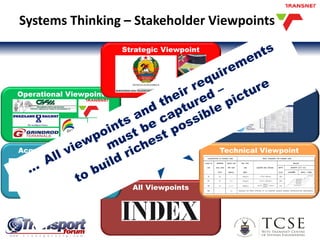
• Building richest possible picture – capturing all stakeholder viewpoints
• Value requires understanding and implementing the all elements within
the Transport and Interchange Development Framework
• Using systems engineering tools to develop integrated systems
(e.g. requirements elicitation, specification and analysis)
• Integration of Nature, People and Engineering to ensure the real Value
is achieved – not just monetary
• Skills and knowledge transfer: S-TEAMS
24
Thank you
Nic Cloete-Hopkins
Nic.Cloete-Hopkins@wits.ac.za
+27 (0)79 864 5621

Tapping into the value on a transport corridor

  • 1.
    “Tapping into theValue on a Transport Corridor” Nic Cloete-Hopkins, Transport Forum SIG Emnotweni Arena, Nelspruit, 04 February 2016 1 Wits Transnet Centre of Systems Engineering: TCSE Partnering for Systems Solutions
  • 2.
    Agenda • Transport Corridors– perceptions and issues • The Value Chain concept • S-TEAMS what is it? • What is Value? • Tapping into the Value on the Transport Corridor – Application of S-TEAMS 2
  • 3.
  • 4.
    Transport Corridor –Current Perceptions? • A transport line in a planning study (i.e. pit-to-port connectivity) • Primarily facilitating linkage between raw materials and ports for extraction • Does not create an integrated network of connectivity • Inefficient and expensive long- haulage solutions 4
  • 5.
    Transport Corridor –Issues? • Extraction corridor thinking dominates planning (open vs. closed systems) – Prioritisation by exporters who control major commodity flows – Large capital expenditure – high capacity transport infrastructure solutions – Little consideration given to inter- regional trade – Balanced trade difficult due to nature of commodities and transport solutions • Beneficiation rarely considered in planning studies of high- volume commodities • Low value commodity vulnerability to global market forces 5
  • 6.
    6 What is aValue Chain? VALUE CHAIN is the sequential set of primary and support activities that an enterprise performs to turn inputs into value-added outputs for its external customers. As developed by Michael E. Porter, it is a: • connected series of organizations, resources, and knowledge streams • involved in the creation and delivery of value to end customers. Reference: VentureLine
  • 7.
    Definition of aSystem – our Preference…. From Rechtin, Systems Architecting of Organizations: Why Eagles Can’t Swim: – “A ‘system’ is a construct or collection of different elements that together produce results not obtainable by the elements alone. – The elements, or parts, can include people, hardware, software, facilities, policies, and documents; that is, all things required to produce system-level results.” 7
  • 8.
    8 The Transport CorridorValue Chain - Segments as a System Environment Legislation, Regulatory Bodies and Organisations, Infrastructure Demand Producers to Consumers – e.g. people, freight and information Supply Transport Capacity (e.g. rail, road, aviation, port and marine)
  • 9.
    Adopting S-TEAMS asa Mind-set to Deliver Value to the Transport Corridor • Systems Thinking • Systems Engineering • Systems Approach(es) • Systems Methodologies • Systems Science –ATMES
  • 10.
    10 What is Value? Merriam-Websterdictionary: • the amount of money that something is worth : the price or cost of something • usefulness or importance – BUT Value often has more than monetary meaning e.g.: • My 10-year old car may be worth R2,000 but the value is similar to that of a new vehicle • The value of reliably moving freight to support the economy has more value than the monetary contract amounts since it impacts on jobs, infrastructure, social development, education, etc.
  • 11.
    Tapping into theValue on the Transport Corridor “Application of S-TEAMS to elaborate on all the elements to be considered in deliberation of the System."
  • 12.
    Elements for Consideration •Systems approach – Holistic view – Containing system and System-of-interest • Systems thinking – Stakeholder viewpoints • Systems methodologies – Transport development framework (linkages, nodes and sustainability) • Systems engineering – Requirements Elicitation, Capture and Management • Systems science – Multiple disciplines including training and education; environment and sustainability; and multi-engineered solution 12
  • 13.
    System of Systems Sub-Systems System PastFuture Temporal World View Business Spatial Systems Approach – Value Corridor Holistic View 13
  • 14.
    System of Systems Sub-Systems System PastFuture Temporal World View Business Spatial Systems Approach – Value Corridor Holistic View Zesfontein - Slimesdam 59 Slimesdam - Delmas 85 Delmas - Dryden 72 Dryden - Ogies 72 Ogies - Saaiwater 52 Saaiwater - Kromklip 117 Kromklip - Bezuidenhoutsrus 85 Bezuidenhoutsrus - VanDyksdrif 78 VanDyksdrif - Blinkpan 52 Blinkpan - Broodsnyersplaas 59 Broodsnyersplaas - Gelukplaas 55 Gelukplaas - Halfgewonnen 59 Halfgewonnen - Hamelfontein 55 Hamelfontein - Ermelo Werf 72 Ermelo Werf - Panbult 26 Panbult - Iswepe 69 Iswepe - Piet Retief 47 Piet Retief - Paulpietersburg 39 Paulpietersburg - Vryheid East 33 Vryheid East - Ulundi 46 Ulundi - Nsese 51 Nsese - Richards Bay 32 Coal Line OpsSlots 32% 33% 34% 35% 37% 38% 40% 41% 43% 44% 46% 48% 49% 51% 53% 55% 58% 60% 62% 65% 68% 70% 73% 22% 23% 24% 25% 26% 27% 28% 29% 30% 31% 32% 33% 35% 36% 37% 39% 40% 42% 44% 45% 47% 49% 51% 23% 24% 24% 25% 26% 28% 29% 30% 31% 32% 33% 35% 36% 37% 39% 41% 42% 44% 46% 48% 50% 52% 54% 20% 21% 21% 22% 23% 24% 25% 26% 27% 28% 29% 30% 32% 33% 34% 36% 37% 39% 41% 42% 44% 46% 48% 43% 45% 47% 50% 52% 58% 59% 61% 63% 65% 67% 69% 71% 73% 76% 78% 81% 84% 87% 91% 94% 97% 101% 21% 22% 23% 24% 26% 28% 29% 30% 31% 32% 32% 33% 34% 35% 36% 38% 39% 40% 42% 43% 44% 46% 47% 32% 33% 35% 36% 38% 41% 42% 43% 44% 45% 46% 48% 49% 50% 52% 53% 55% 56% 58% 60% 62% 64% 66% 36% 37% 39% 40% 42% 47% 48% 49% 50% 51% 53% 54% 55% 57% 58% 60% 62% 64% 66% 68% 70% 72% 74% 54% 56% 58% 60% 63% 70% 72% 73% 75% 77% 79% 81% 83% 85% 87% 90% 92% 95% 98% 101% 104% 108% 111% 49% 50% 52% 55% 57% 64% 65% 66% 68% 69% 71% 72% 74% 76% 78% 80% 82% 84% 87% 89% 92% 94% 97% 65% 67% 68% 70% 73% 79% 80% 81% 83% 84% 86% 87% 89% 91% 93% 95% 97% 100% 102% 105% 108% 111% 113% 69% 70% 72% 73% 76% 81% 82% 84% 85% 86% 88% 89% 91% 93% 95% 97% 99% 101% 103% 106% 109% 111% 114% 75% 76% 78% 80% 82% 88% 89% 91% 92% 94% 95% 97% 99% 100% 102% 105% 107% 109% 112% 114% 117% 120% 123% 61% 62% 64% 65% 67% 72% 73% 74% 75% 77% 78% 80% 81% 83% 85% 86% 88% 90% 93% 95% 98% 100% 103% 102% 105% 108% 111% 115% 122% 125% 127% 130% 133% 137% 140% 144% 148% 152% 157% 161% 166% 172% 178% 184% 190% 196% 40% 41% 42% 43% 45% 48% 49% 50% 51% 52% 53% 55% 56% 58% 59% 61% 63% 65% 67% 69% 72% 74% 76% 61% 63% 65% 66% 69% 73% 75% 76% 78% 80% 82% 84% 87% 89% 92% 95% 98% 101% 104% 108% 112% 115% 119% 74% 75% 78% 80% 83% 88% 90% 92% 94% 97% 99% 102% 105% 108% 111% 114% 118% 121% 126% 130% 135% 139% 144% 88% 89% 92% 95% 98% 104% 107% 109% 112% 115% 118% 121% 124% 128% 132% 136% 140% 145% 150% 155% 161% 166% 172% 65% 67% 69% 71% 73% 78% 79% 81% 83% 85% 88% 90% 93% 95% 98% 101% 105% 108% 112% 116% 120% 124% 128% 59% 60% 62% 64% 66% 70% 72% 74% 76% 78% 80% 82% 84% 87% 89% 92% 95% 98% 101% 105% 109% 112% 116% 65% 68% 72% 75% 79% 82% 86% 91% 95% 100% 105% 110% 115% 121% 127% 134% 140% 147% 156% 164% 173% 181% 190% 2015 2016 2017 2018 2019 2020 2021 2022 2023 2024 2025 2026 2027 2028 2029 2030 2031 2032 2033 2034 2035 2036 2037 Zesfontein - Slimesdam 59 25% 24% 24% 25% 27% 28% 29% 30% Slimesdam - Delmas 85 18% 17% 17% 17% 19% 19% 20% 21% Delmas - Dryden 72 19% 18% 17% 18% 19% 20% 21% 22% Dryden - Ogies 72 17% 16% 15% 16% 17% 17% 18% 19% Ogies - Saaiwater 52 34% 32% 32% 34% 36% 37% 38% 41% Saaiwater - Kromklip 117 17% 16% 16% 17% 18% 18% 19% 20% Kromklip - Bezuidenhoutsrus 85 26% 24% 25% 26% 27% 28% 29% 31% Bezuidenhoutsrus - VanDyksdrif 78 29% 27% 28% 29% 30% 31% 32% 35% VanDyksdrif - Blinkpan 52 48% 45% 47% 49% 51% 52% 54% 55% Blinkpan - Broodsnyersplaas 59 44% 41% 44% 46% 47% 48% 50% 50% Broodsnyersplaas - Gelukplaas 55 54% 50% 54% 56% 58% 59% 61% 64% Gelukplaas - Halfgewonnen 59 51% 47% 51% 53% 55% 56% 58% 64% Halfgewonnen - Hamelfontein 55 58% 54% 59% 61% 63% 64% 66% 71% Hamelfontein - Ermelo Werf 72 48% 45% 49% 51% 52% 53% 55% 59% Ermelo Werf - Panbult 26 81% 75% 78% 81% 84% 86% 89% 97% Panbult - Iswepe 69 31% 29% 30% 31% 32% 33% 34% 38% Iswepe - Piet Retief 47 48% 45% 46% 48% 50% 51% 53% 58% Piet Retief - Paulpietersburg 39 58% 54% 55% 58% 60% 61% 63% 70% Paulpietersburg - Vryheid East 33 69% 64% 65% 69% 71% 73% 75% 82% Vryheid East - Ulundi 46 52% 48% 49% 51% 53% 54% 56% 61% Ulundi - Nsese 51 47% 43% 44% 46% 48% 49% 51% 56% Nsese - Richards Bay 32 59% 53% 43% 45% 48% 51% 53% 60% Coal Line OpsSlots 2007 2008 2009 2010 2011 2012 2013 2014 14
  • 15.
    Systems Approach – TheValue Corridor (incl. Transport Corridor) Nodes Land Utilities Skills Logistics Rail Aviation Road Port & Marine
  • 16.
    Systems Thinking –Stakeholder Viewpoints Systems Viewpoint Articulate legislation, regulations, policy, guidance, constraints and forecasts Operational Viewpoint Articulate operational scenarios, activities and information flows Acquisition Viewpoint Articulate customer and programme dependencies, milestones and statuses Technical Viewpoint Articulate the solution specification – standards, resources, functions and interactions Strategic Viewpoint Articulate high-level requirements for enterprise change over time – capabilities, goals, enduring tasks, etc. All Viewpoints Provide information pertinent to an architecture
  • 17.
    Systems Thinking –Stakeholder Viewpoints All Viewpoints Acquisition Viewpoint Technical Viewpoint Operational Viewpoint Strategic Viewpoint Systems Viewpoint
  • 18.
    Systems Thinking –Stakeholder Viewpoints All Viewpoints Acquisition Viewpoint Technical Viewpoint Operational Viewpoint Strategic Viewpoint Systems Viewpoint
  • 19.
    Systems Methodologies – TransportDevelopment Framework (Linkages) 19
  • 20.
    Systems Methodologies – InterchangeDevelopment Framework (Nodes) 20 TIER 3 OPPORTUNITIES TIER 4 OPPORTUNITIES Value Added Logistics Services Warehousing; customs; quality control; packaging; break-bulking; freight clearing & forwarding; truck stops; maintenance and repair services; fuel supply; light manufacturing (assembly) Commercial and Financial Services Financial institutions; security services; offices & administration; accommodation; retail; restaurants; insurance Basic Logistics Services Intermodal transfer; loading and unloading; handling and transhipment; dry bulk palletising; liquid bulk; general stacking; storage; parking and staging Source: Adapted from Transnet Freight Rail TIER 2 OPPORTUNITIES TIER 1 OPPORTUNITIES Core Infrastructure Industrial Services Heavy industrial activities; industrial processing; beneficiation; manufacturing; component and product assembly Density at nodes create a sustainable value proposition.
  • 21.
    Systems Engineering – RequirementsElicitation, Specification and Analysis 21 – Follow a documented requirements process – Consider all stakeholders and viewpoints – Capture all requirements – Analyse and refine the requirements – Ensure each requirement is testable – Specify the requirements – Review the requirements – Maintain traceability – Manage the requirements Requirements Qualification/ Acceptance Criteria
  • 22.
    Systems Science – Integrationof Engineering, Society and Nature 22 Land Utilities Transport Network Policy / Regulation Skills TIER 3 OPPORTUNITIES TIER 4 OPPORTUNITIES TIER 2 OPPORTUNITIES TIER 1 OPPORTUNITIES Core Infrastructure Transport corridor cannot exist on its own!
  • 23.
    23 Value Corridor (incl.Transport Corridor) • Provides longitudinal linkages between points of value generating density • Enables and creates a regional market through connectivity of nodes (e.g. dry and marine ports) • Leveraging viability of infrastructure to achievement sustainability (incl. the interchange nodes) Core Infrastructure TIER 3 OPPORTUNITIES TIER 4 OPPORTUNITIES TIER 2 OPPORTUNITIES TIER 1 OPPORTUNITIES Core Infrastructure TIER 3 OPPORTUNITIES TIER 4 OPPORTUNITIES TIER 2 OPPORTUNITIES TIER 1 OPPORTUNITIES Core Infrastructure TIER 3 OPPORTUNITIES TIER 4 OPPORTUNITIES TIER 2 OPPORTUNITIES TIER 1 OPPORTUNITIES Core Infrastructure TIER 3 OPPORTUNITIES TIER 4 OPPORTUNITIES TIER 2 OPPORTUNITIES TIER 1 OPPORTUNITIES Core Infrastructure TIER 3 OPPORTUNITIES TIER 4 OPPORTUNITIES TIER 2 OPPORTUNITIES TIER 1 OPPORTUNITIES Core Infrastructure TIER 3 OPPORTUNITIES TIER 4 OPPORTUNITIES TIER 2 OPPORTUNITIES TIER 1 OPPORTUNITIES Core Infrastructure TIER 3 OPPORTUNITIES TIER 4 OPPORTUNITIES TIER 2 OPPORTUNITIES TIER 1 OPPORTUNITIES Core Infrastructure TIER 3 OPPORTUNITIES TIER 4 OPPORTUNITIES TIER 2 OPPORTUNITIES TIER 1 OPPORTUNITIES Core Infrastructure TIER 3 OPPORTUNITIES TIER 4 OPPORTUNITIES TIER 2 OPPORTUNITIES TIER 1 OPPORTUNITIES Core Infrastructure TIER 3 OPPORTUNITIES TIER 4 OPPORTUNITIES TIER 2 OPPORTUNITIES TIER 1 OPPORTUNITIES Core Infrastructure TIER 3 OPPORTUNITIES TIER 4 OPPORTUNITIES TIER 2 OPPORTUNITIES TIER 1 OPPORTUNITIES Core Infrastructure TIER 3 OPPORTUNITIES TIER 4 OPPORTUNITIES TIER 2 OPPORTUNITIES TIER 1 OPPORTUNITIES Core Infrastructure TIER 3 OPPORTUNITIES TIER 4 OPPORTUNITIES TIER 2 OPPORTUNITIES TIER 1 OPPORTUNITIES Core Infrastructure TIER 3 OPPORTUNITIES TIER 4 OPPORTUNITIES TIER 2 OPPORTUNITIES TIER 1 OPPORTUNITIES Core Infrastructure TIER 3 OPPORTUNITIES TIER 4 OPPORTUNITIES TIER 2 OPPORTUNITIES TIER 1 OPPORTUNITIES Core Infrastructure TIER 3 OPPORTUNITIES TIER 4 OPPORTUNITIES TIER 2 OPPORTUNITIES TIER 1 OPPORTUNITIES Core Infrastructure TIER 3 OPPORTUNITIES TIER 4 OPPORTUNITIES TIER 2 OPPORTUNITIES TIER 1 OPPORTUNITIES Core Infrastructure TIER 3 OPPORTUNITIES TIER 4 OPPORTUNITIES TIER 2 OPPORTUNITIES TIER 1 OPPORTUNITIES Core Infrastructure TIER 3 OPPORTUNITIES TIER 4 OPPORTUNITIES TIER 2 OPPORTUNITIES TIER 1 OPPORTUNITIES Core Infrastructure TIER 3 OPPORTUNITIES TIER 4 OPPORTUNITIES TIER 2 OPPORTUNITIES TIER 1 OPPORTUNITIES Core Infrastructure TIER 3 OPPORTUNITIES TIER 4 OPPORTUNITIES TIER 2 OPPORTUNITIES TIER 1 OPPORTUNITIES Core Infrastructure TIER 3 OPPORTUNITIES TIER 4 OPPORTUNITIES TIER 2 OPPORTUNITIES TIER 1 OPPORTUNITIES Core Infrastructure TIER 3 OPPORTUNITIES TIER 4 OPPORTUNITIES TIER 2 OPPORTUNITIES TIER 1 OPPORTUNITIES Core Infrastructure COST Viable section Barely viable Not viable (on its own) Core Infrastructure Core Infrastructure Core Infrastructure Core Infrastructure Core Infrastructure Core Infrastructure Core Infrastructure Core Infrastructure Core Infrastructure Core Infrastructure Core Infrastructure TIER 3 OPPORTUNITIES TIER 4 OPPORTUNITIES TIER 2 OPPORTUNITIES TIER 1 OPPORTUNITIES Core Infrastructure TIER 3 OPPORTUNITIES TIER 4 OPPORTUNITIES TIER 2 OPPORTUNITIES TIER 1 OPPORTUNITIES Core Infrastructure TIER 3 OPPORTUNITIES TIER 4 OPPORTUNITIES TIER 2 OPPORTUNITIES TIER 1 OPPORTUNITIES Core Infrastructure TIER 3 OPPORTUNITIES TIER 4 OPPORTUNITIES TIER 2 OPPORTUNITIES TIER 1 OPPORTUNITIES Core Infrastructure TIER 3 OPPORTUNITIES TIER 4 OPPORTUNITIES TIER 2 OPPORTUNITIES TIER 1 OPPORTUNITIES Core Infrastructure TIER 3 OPPORTUNITIES TIER 4 OPPORTUNITIES TIER 2 OPPORTUNITIES TIER 1 OPPORTUNITIES Core Infrastructure TIER 3 OPPORTUNITIES TIER 4 OPPORTUNITIES TIER 2 OPPORTUNITIES TIER 1 OPPORTUNITIES Core Infrastructure TIER 3 OPPORTUNITIES TIER 4 OPPORTUNITIES TIER 2 OPPORTUNITIES TIER 1 OPPORTUNITIES Core Infrastructure TIER 3 OPPORTUNITIES TIER 4 OPPORTUNITIES TIER 2 OPPORTUNITIES TIER 1 OPPORTUNITIES Core Infrastructure TIER 3 OPPORTUNITIES TIER 4 OPPORTUNITIES TIER 2 OPPORTUNITIES TIER 1 OPPORTUNITIES Core Infrastructure TIER 3 OPPORTUNITIES TIER 4 OPPORTUNITIES TIER 2 OPPORTUNITIES TIER 1 OPPORTUNITIES Core Infrastructure
  • 24.
    Summary: Elements forConsideration • Understanding of systems (e.g. holistic view of the system) throughout the enterprise ensuring we can ask the right question • What is MY containing system and what is my (current) SYSTEM of INTEREST • Building richest possible picture – capturing all stakeholder viewpoints • Value requires understanding and implementing the all elements within the Transport and Interchange Development Framework • Using systems engineering tools to develop integrated systems (e.g. requirements elicitation, specification and analysis) • Integration of Nature, People and Engineering to ensure the real Value is achieved – not just monetary • Skills and knowledge transfer: S-TEAMS 24
  • 25.