SYSTEMIC FUNCTIONAL
LINGUISTICS
-
Genre-based approach
By Franco Florencia and Sanguinetti Agostina
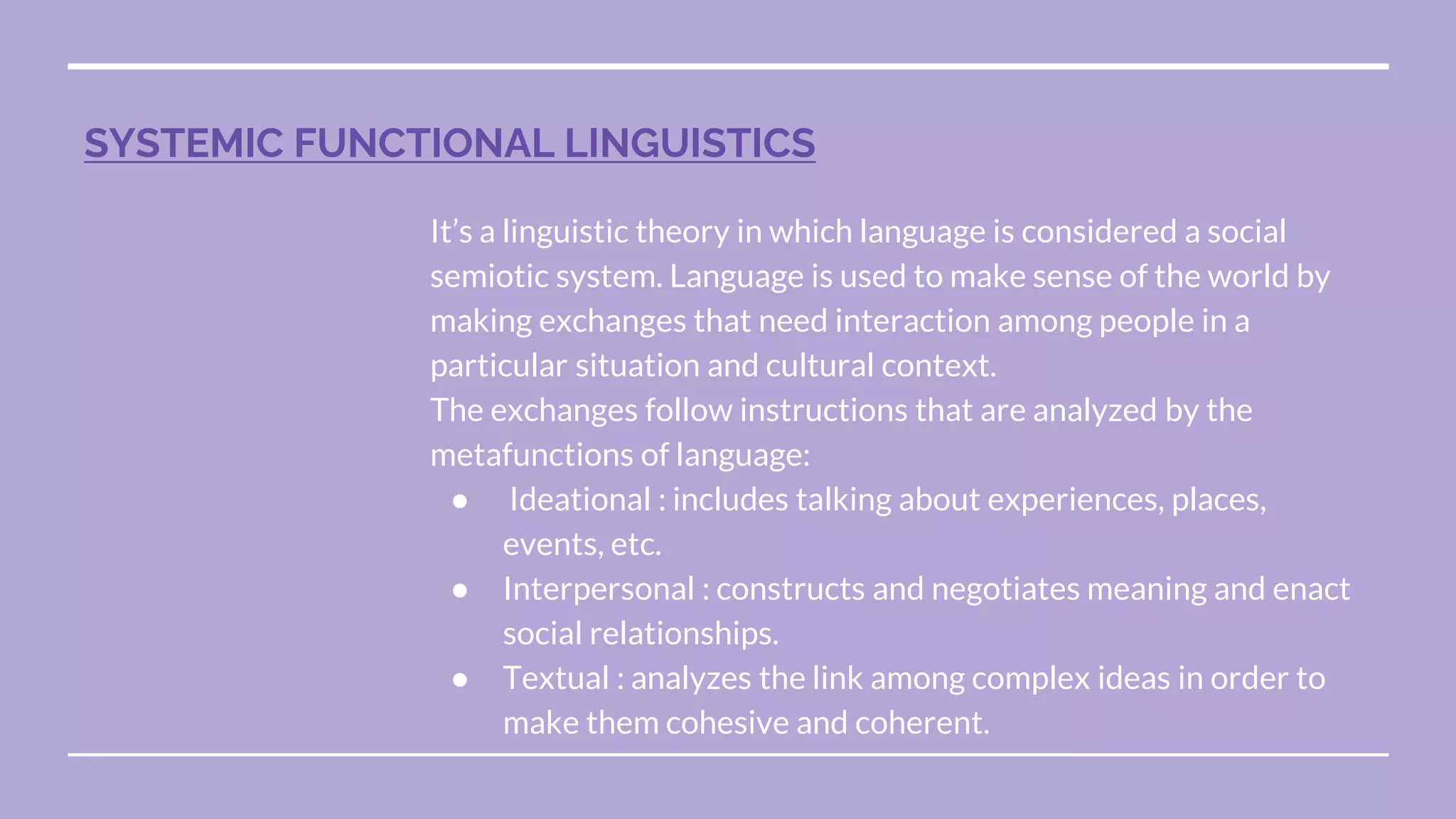
It’s a linguistic theory in which language is considered a social
semiotic system. Language is used to make sense of the world by
making exchanges that need interaction among people in a
particular situation and cultural context.
The exchanges follow instructions that are analyzed by the
metafunctions of language:
● Ideational : includes talking about experiences, places,
events, etc.
● Interpersonal : constructs and negotiates meaning and enact
social relationships.
● Textual : analyzes the link among complex ideas in order to
make them cohesive and coherent.
SYSTEMIC FUNCTIONAL LINGUISTICS
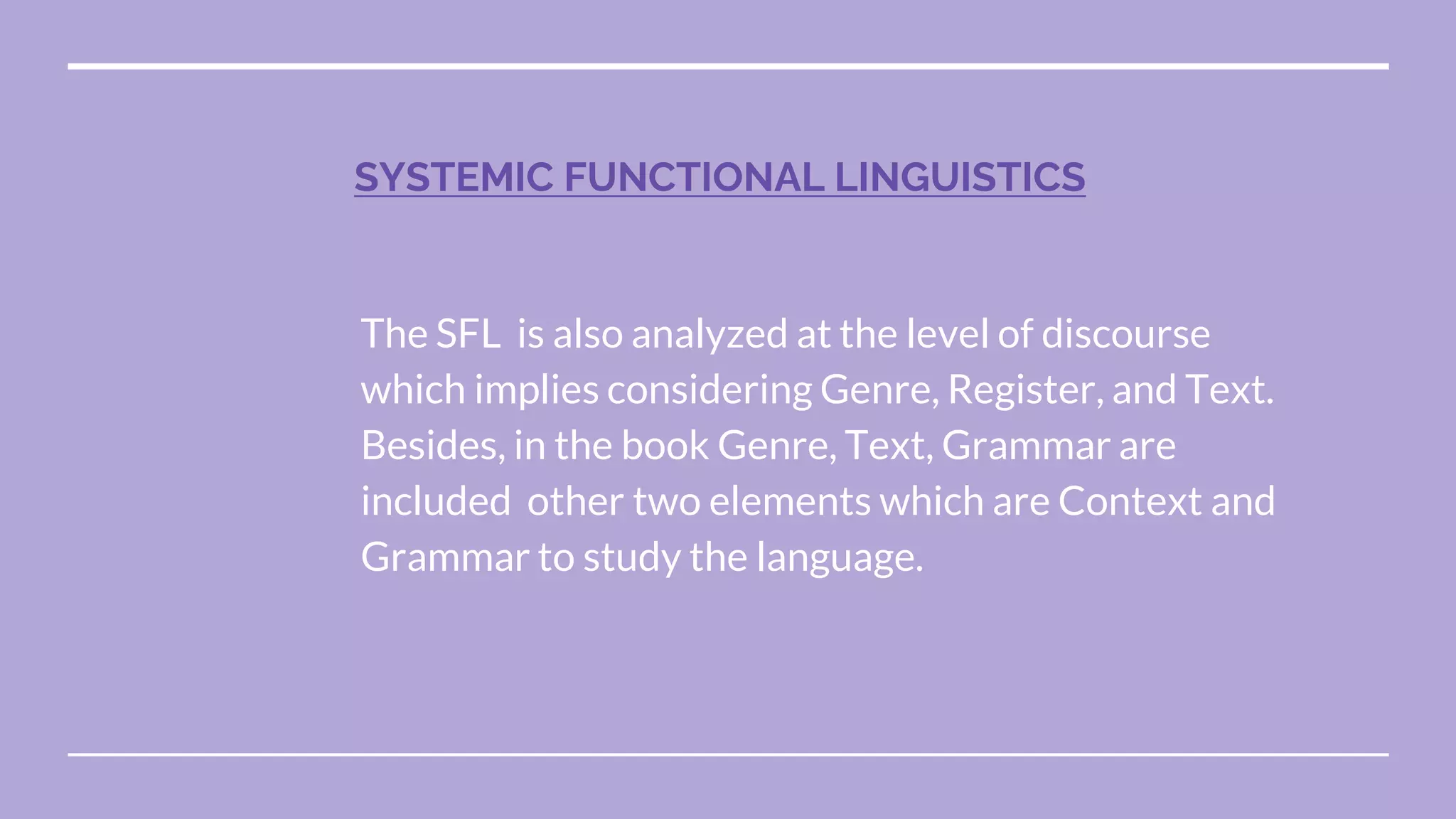
The SFL is also analyzed at the level of discourse
which implies considering Genre, Register, and Text.
Besides, in the book Genre, Text, Grammar are
included other two elements which are Context and
Grammar to study the language.
SYSTEMIC FUNCTIONAL LINGUISTICS
Language
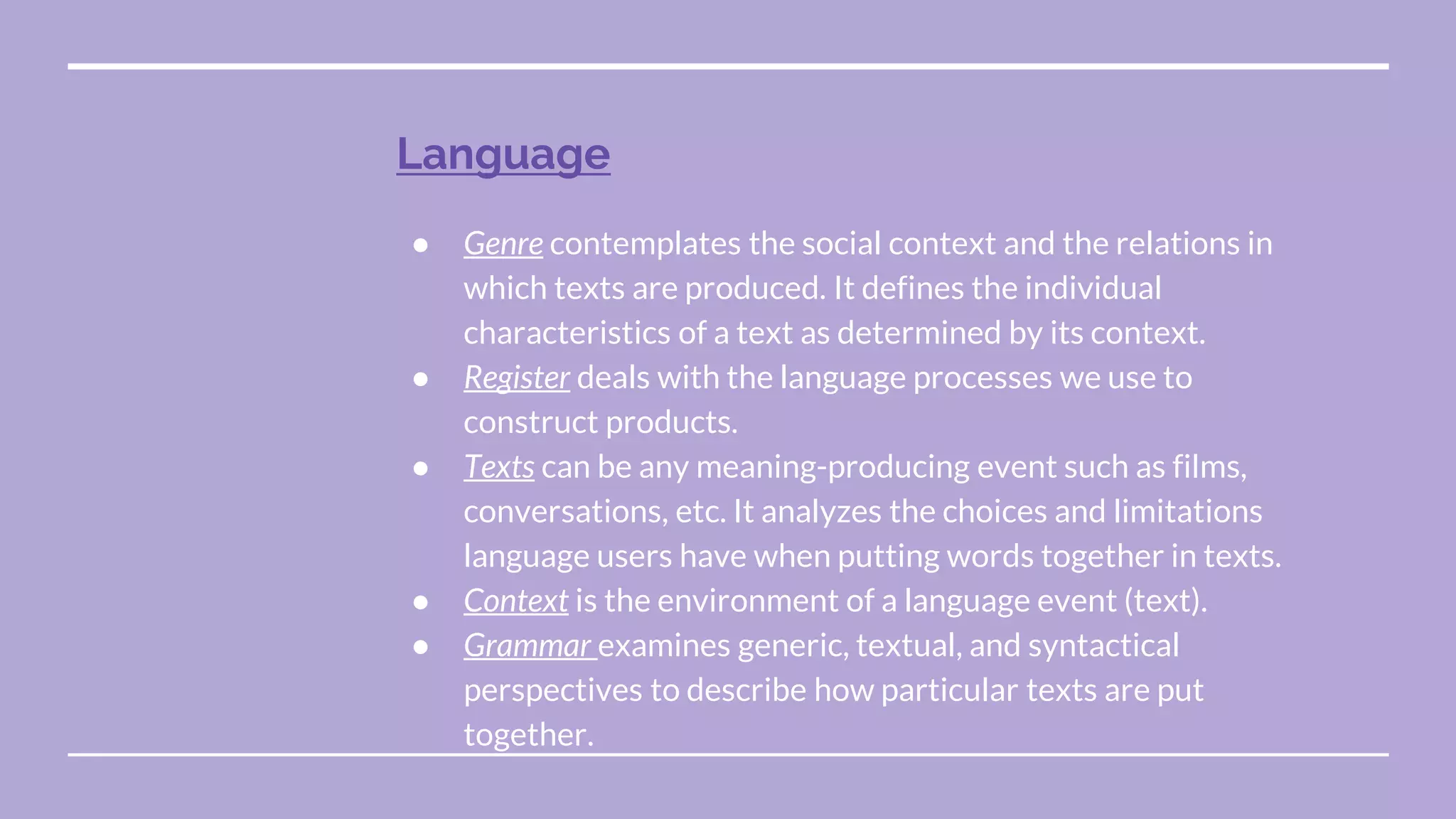
● Genre contemplates the social context and the relations in
which texts are produced. It defines the individual
characteristics of a text as determined by its context.
● Register deals with the language processes we use to
construct products.
● Texts can be any meaning-producing event such as films,
conversations, etc. It analyzes the choices and limitations
language users have when putting words together in texts.
● Context is the environment of a language event (text).
● Grammar examines generic, textual, and syntactical
perspectives to describe how particular texts are put
together.
Genre-based approach
It is based on a functional model of language:
a theoretical perspective that emphasizes the social
construction of language
● The functional approach emerged in Australia
back in the 80’s, mainly because of the influence
of M. A. K- Halliday.
Text and discourse
Text is discourse in verbal communication.
This means, text in use becomes discourse. And
discourse is formed by a sequence of utterance, that in
isolation can be ambiguous but their ambiguity
disappears within discourse.
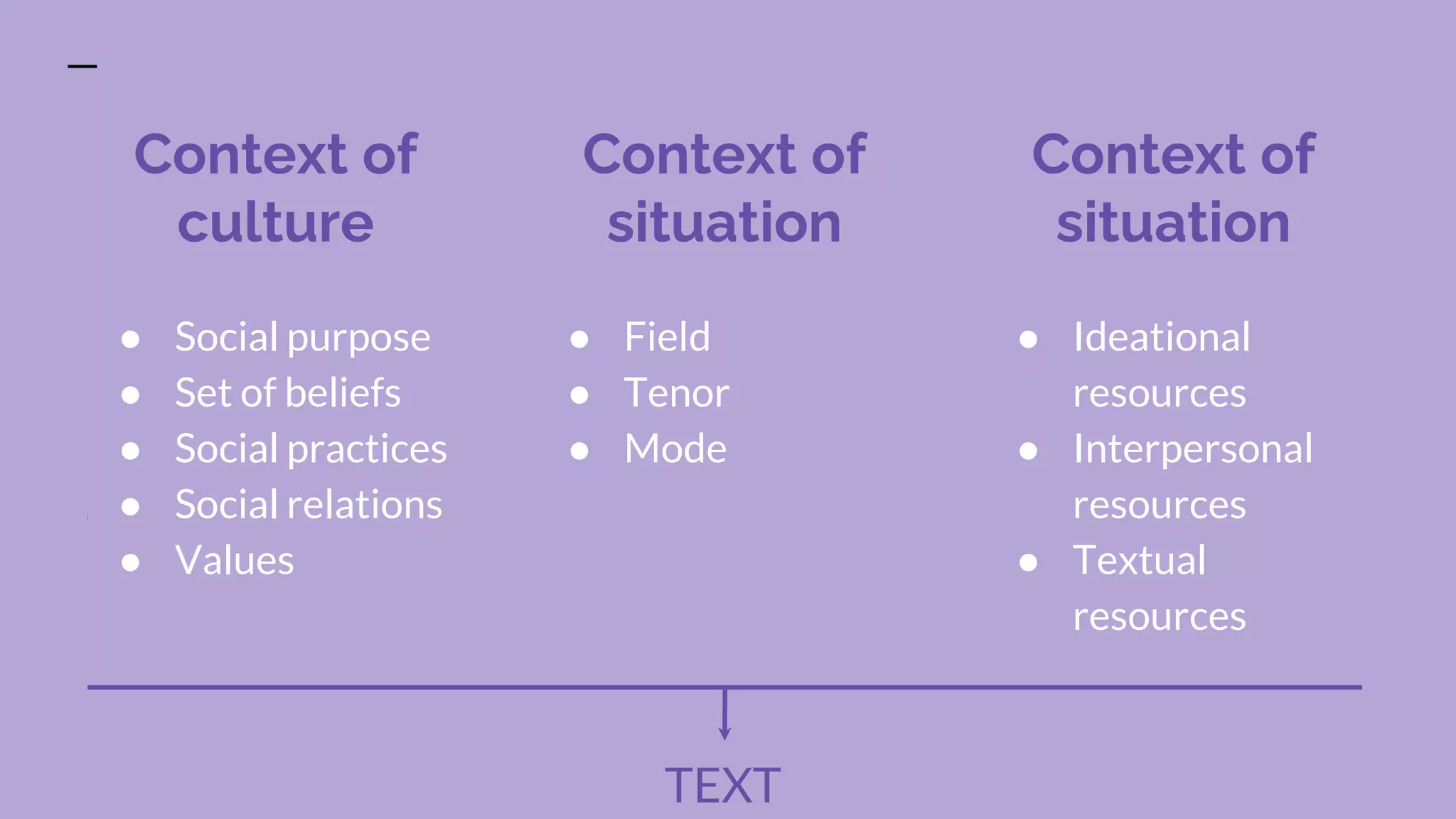
Context of
culture
● Social purpose
● Set of beliefs
● Social practices
● Social relations
● Values
Context of
situation
● Field
● Tenor
● Mode
Context of
situation
● Ideational
resources
● Interpersonal
resources
● Textual
resources
TEXT
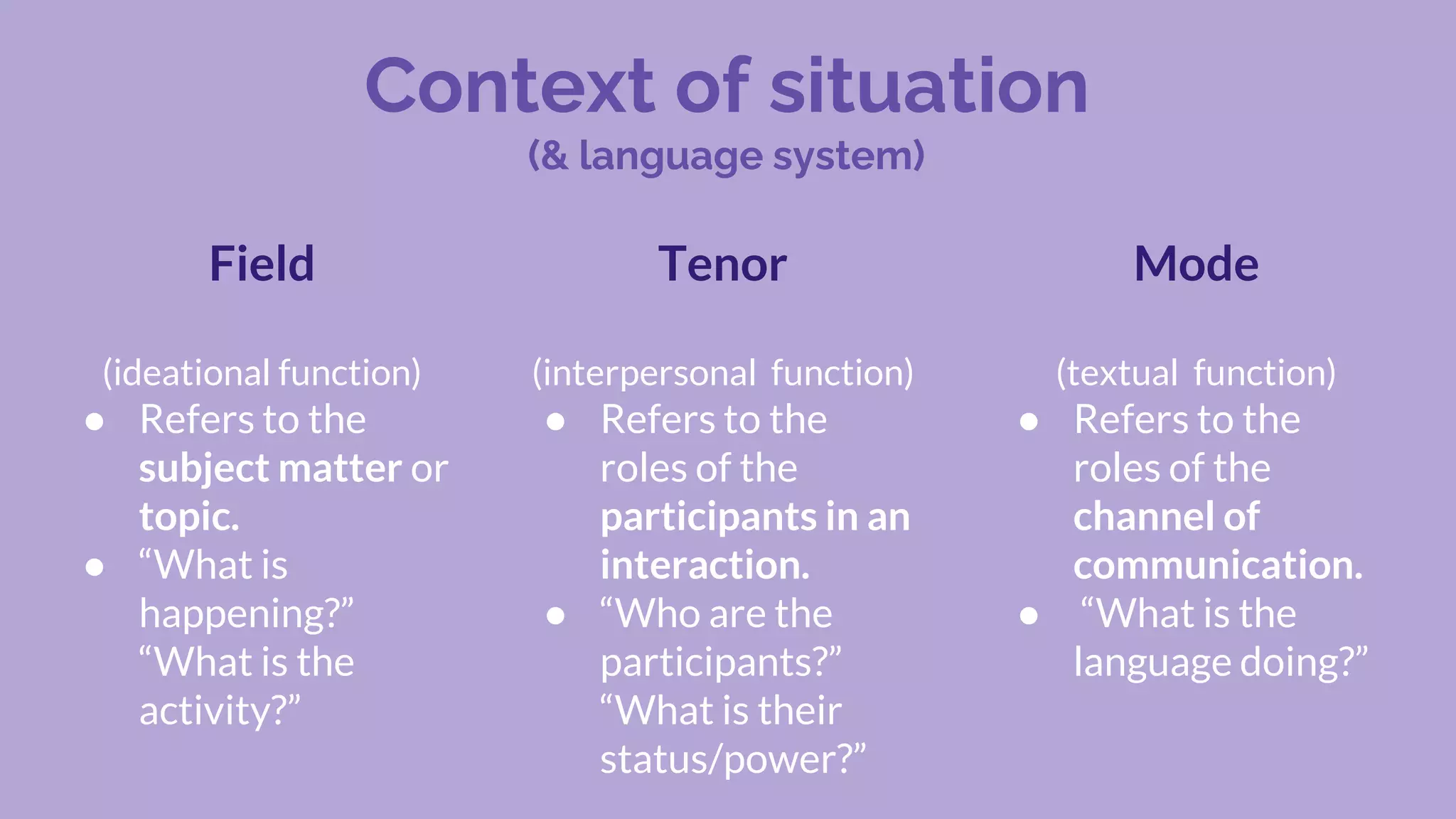
Context of situation
(& language system)
Field
(ideational function)
● Refers to the
subject matter or
topic.
● “What is
happening?”
“What is the
activity?”
Tenor
(interpersonal function)
● Refers to the
roles of the
participants in an
interaction.
● “Who are the
participants?”
“What is their
status/power?”
Mode
(textual function)
● Refers to the
roles of the
channel of
communication.
● “What is the
language doing?”
Being able to analyse the use of field, tenor, and mode
allows students to see how language works to make
meaning in various school-based texts. This is different
from traditional grammar teaching because students are
not being given rules of thumb to memorize and attempt to
use in their writing. In SFL, students are taught how
vocabulary and syntax work together to form meaning. If
students understand how language works in a specific
discipline, they will be able to make appropriate linguistic
choices to convey their thoughts completely and concisely.
Why is it useful?
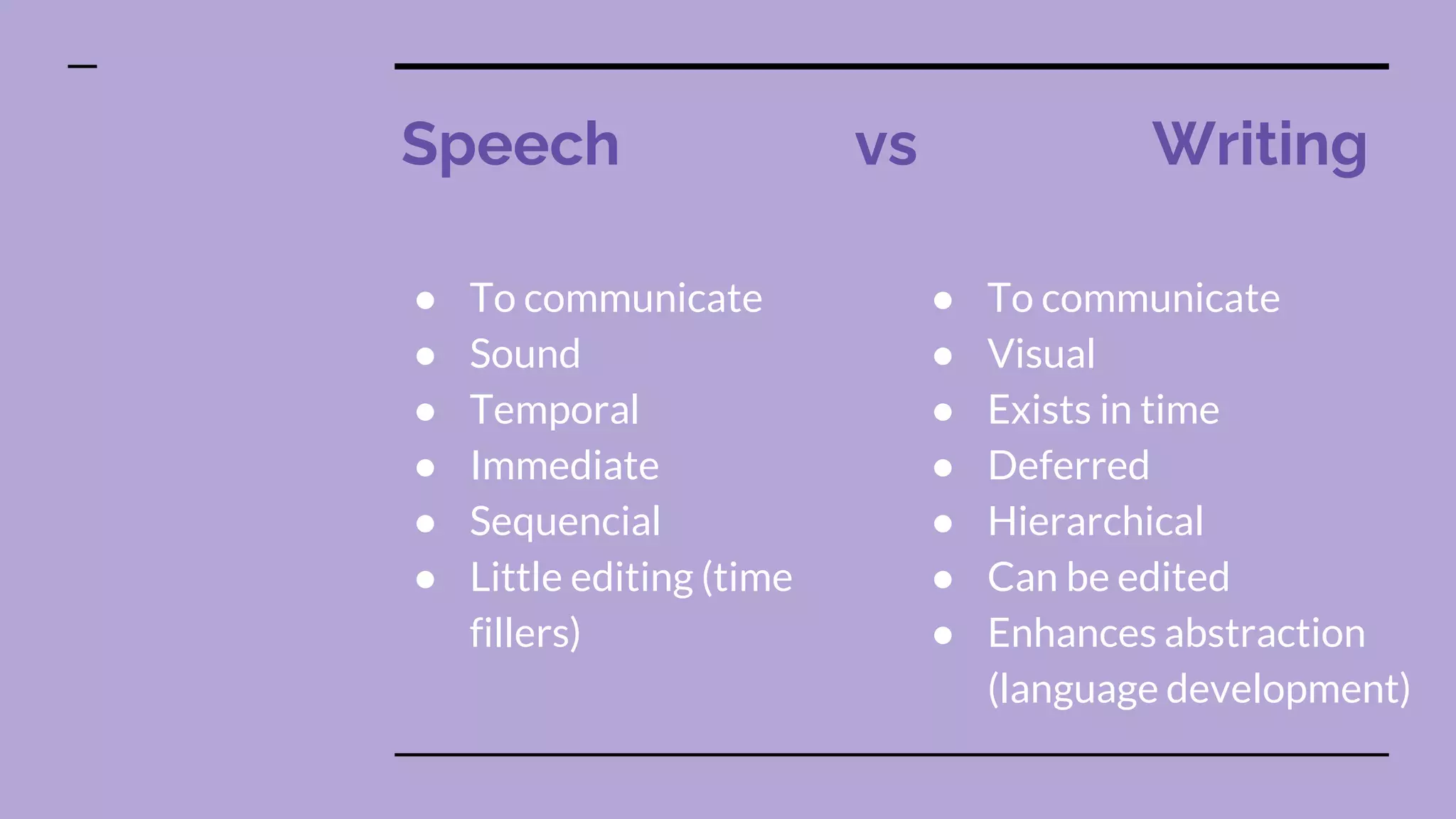
Speech vs Writing
● To communicate
● Sound
● Temporal
● Immediate
● Sequencial
● Little editing (time
fillers)
● To communicate
● Visual
● Exists in time
● Deferred
● Hierarchical
● Can be edited
● Enhances abstraction
(language development)
Why genre, text and
grammar approach?
To provide students with the ability to use the
codes of writing (the genres and the grammar)
effectively and efficiently. Without this codes
writing can be a frustrating and unproductive
process.
Bibliography
● Knapp, P. & Watkins, M. (2005). “Genre, text,
grammar: technologies for teaching and
assessing writing”; University of New South
Wales Press LTD (ED.). A genre - based model
of language. Sydney, Australia (PP, 13 - 37).

Systemic functional linguistics

  • 1.
    SYSTEMIC FUNCTIONAL LINGUISTICS - Genre-based approach ByFranco Florencia and Sanguinetti Agostina
  • 2.
    It’s a linguistictheory in which language is considered a social semiotic system. Language is used to make sense of the world by making exchanges that need interaction among people in a particular situation and cultural context. The exchanges follow instructions that are analyzed by the metafunctions of language: ● Ideational : includes talking about experiences, places, events, etc. ● Interpersonal : constructs and negotiates meaning and enact social relationships. ● Textual : analyzes the link among complex ideas in order to make them cohesive and coherent. SYSTEMIC FUNCTIONAL LINGUISTICS
  • 3.
    The SFL isalso analyzed at the level of discourse which implies considering Genre, Register, and Text. Besides, in the book Genre, Text, Grammar are included other two elements which are Context and Grammar to study the language. SYSTEMIC FUNCTIONAL LINGUISTICS
  • 4.
    Language ● Genre contemplatesthe social context and the relations in which texts are produced. It defines the individual characteristics of a text as determined by its context. ● Register deals with the language processes we use to construct products. ● Texts can be any meaning-producing event such as films, conversations, etc. It analyzes the choices and limitations language users have when putting words together in texts. ● Context is the environment of a language event (text). ● Grammar examines generic, textual, and syntactical perspectives to describe how particular texts are put together.
  • 5.
    Genre-based approach It isbased on a functional model of language: a theoretical perspective that emphasizes the social construction of language ● The functional approach emerged in Australia back in the 80’s, mainly because of the influence of M. A. K- Halliday.
  • 6.
    Text and discourse Textis discourse in verbal communication. This means, text in use becomes discourse. And discourse is formed by a sequence of utterance, that in isolation can be ambiguous but their ambiguity disappears within discourse.
  • 7.
    Context of culture ● Socialpurpose ● Set of beliefs ● Social practices ● Social relations ● Values Context of situation ● Field ● Tenor ● Mode Context of situation ● Ideational resources ● Interpersonal resources ● Textual resources TEXT
  • 8.
    Context of situation (&language system) Field (ideational function) ● Refers to the subject matter or topic. ● “What is happening?” “What is the activity?” Tenor (interpersonal function) ● Refers to the roles of the participants in an interaction. ● “Who are the participants?” “What is their status/power?” Mode (textual function) ● Refers to the roles of the channel of communication. ● “What is the language doing?”
  • 9.
    Being able toanalyse the use of field, tenor, and mode allows students to see how language works to make meaning in various school-based texts. This is different from traditional grammar teaching because students are not being given rules of thumb to memorize and attempt to use in their writing. In SFL, students are taught how vocabulary and syntax work together to form meaning. If students understand how language works in a specific discipline, they will be able to make appropriate linguistic choices to convey their thoughts completely and concisely. Why is it useful?
  • 10.
    Speech vs Writing ●To communicate ● Sound ● Temporal ● Immediate ● Sequencial ● Little editing (time fillers) ● To communicate ● Visual ● Exists in time ● Deferred ● Hierarchical ● Can be edited ● Enhances abstraction (language development)
  • 11.
    Why genre, textand grammar approach? To provide students with the ability to use the codes of writing (the genres and the grammar) effectively and efficiently. Without this codes writing can be a frustrating and unproductive process.
  • 12.
    Bibliography ● Knapp, P.& Watkins, M. (2005). “Genre, text, grammar: technologies for teaching and assessing writing”; University of New South Wales Press LTD (ED.). A genre - based model of language. Sydney, Australia (PP, 13 - 37).