Lengua y Expresión Escrita IV
I.S.F.D. Nº 41
Profesorado de Inglés.
Oral presentation- Group 8.
Students:
START!
Pair 1: Vazquez, Victoria and Peralta Noelia (Unit 1 and 2)
Pair 2: Elicegui Mercedes and Sanguinetti Agostina (Unit 17)
Pair 3: Ana Laura Germinario and Florencia Franco (18)
Pair 4: Eisenacht Vilma and Petralanda Maite ( Unit 19)
1: The origins of
language.
2: Animals and human
language.
The origins of language. (Unit 1)
Imitation of natural
sounds/cries of
emotion
King James the Fourth of Scotland
→ Hebrew.
Experiments:
Abstract concepts?
The divine source
Table of
Contents
The natural sound
source
The physical adapation
The tool-making
source
The genetic source
The divine source The natural sound
source
Egyptian pharaoh(Psamtik)
→ Phrygian language
No
evidenceRejected
Onomatopeia
Rejected
The physical
adaptation source
The social interaction
source
The social interaction source
Social context.
→ Human sounds.
→ Physical effort.
Hums, grunts,
groans,
curses.
Early people
Groups→ Social organization.
Communication.
Rejected
Similar to
apes. Social calls
No speech
No
clarification
regarding
the origins.
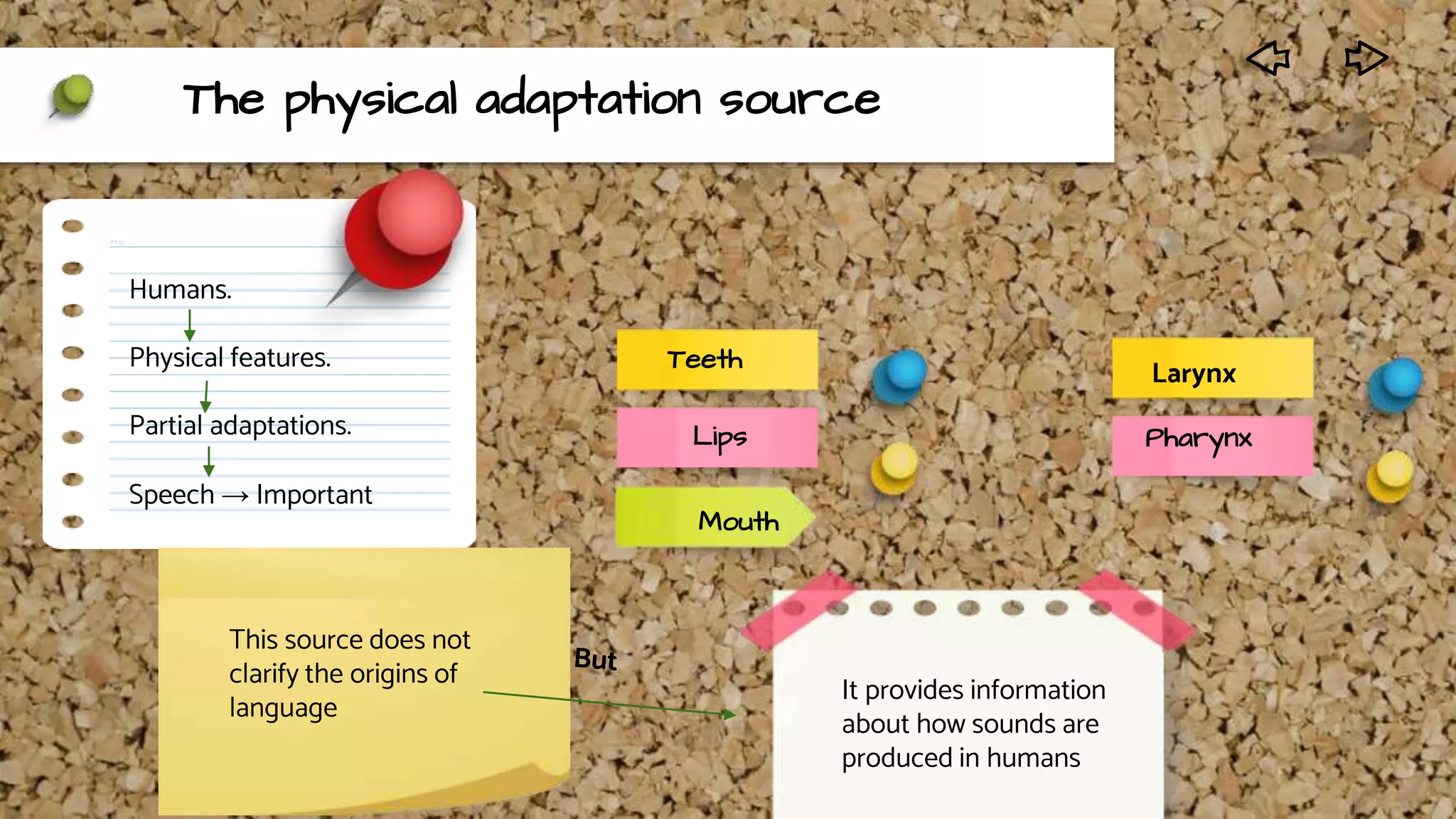
The physical adaptation source
Humans.
Physical features.
Partial adaptations.
Speech → Important
Teeth
Lips
Mouth
Larynx
Pharynx
This source does not
clarify the origins of
language
It provides information
about how sounds are
produced in humans
The tool-making source
Precursor of language → Manual gestures
Evolutionary connection between the
Language-using and tool-using human abilities
Humans→ born with a special
capacity for language → innate
Innateness hypothesis→ mutation
Tool- making produced brain development→ F1rst--> naming
an object from its noise.
2nd→ bring another noise to combine with the first one.
The genetic source
Brain
Lateralized
Structural
organization
There is not enough evidence.
A search for the “language
gene” → Only humans
possess it.
Animals and human language
Signals: communicative
or informative?
A distinction in
communication.
Properties of
human language
It is not a matter of
communication
Experimenting with
animals
Do animals understand
human language?
A conclusion
“Using language”
Unit 2
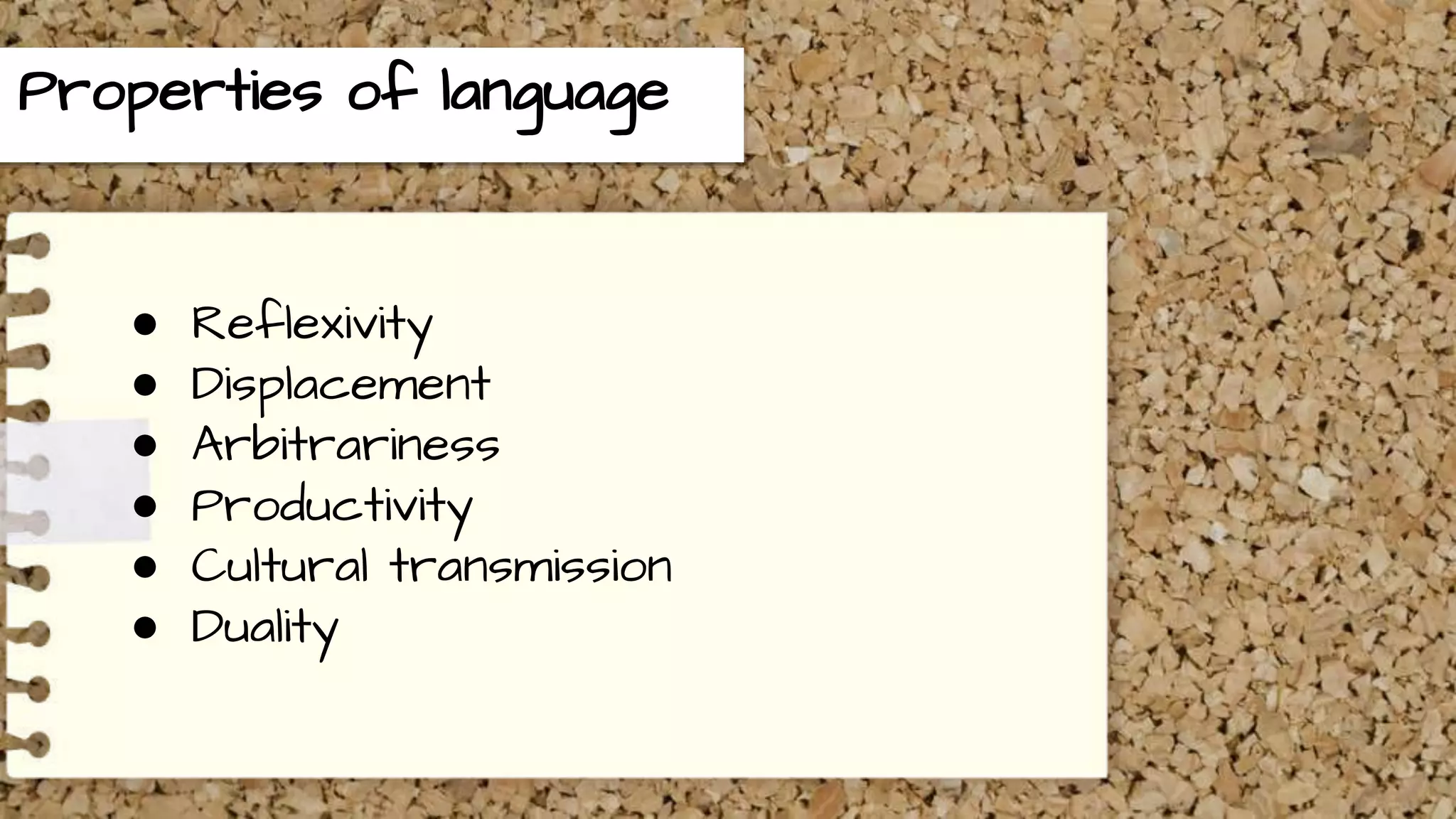
Properties of language
● Reflexivity
● Displacement
● Arbitrariness
● Productivity
● Cultural transmission
● Duality
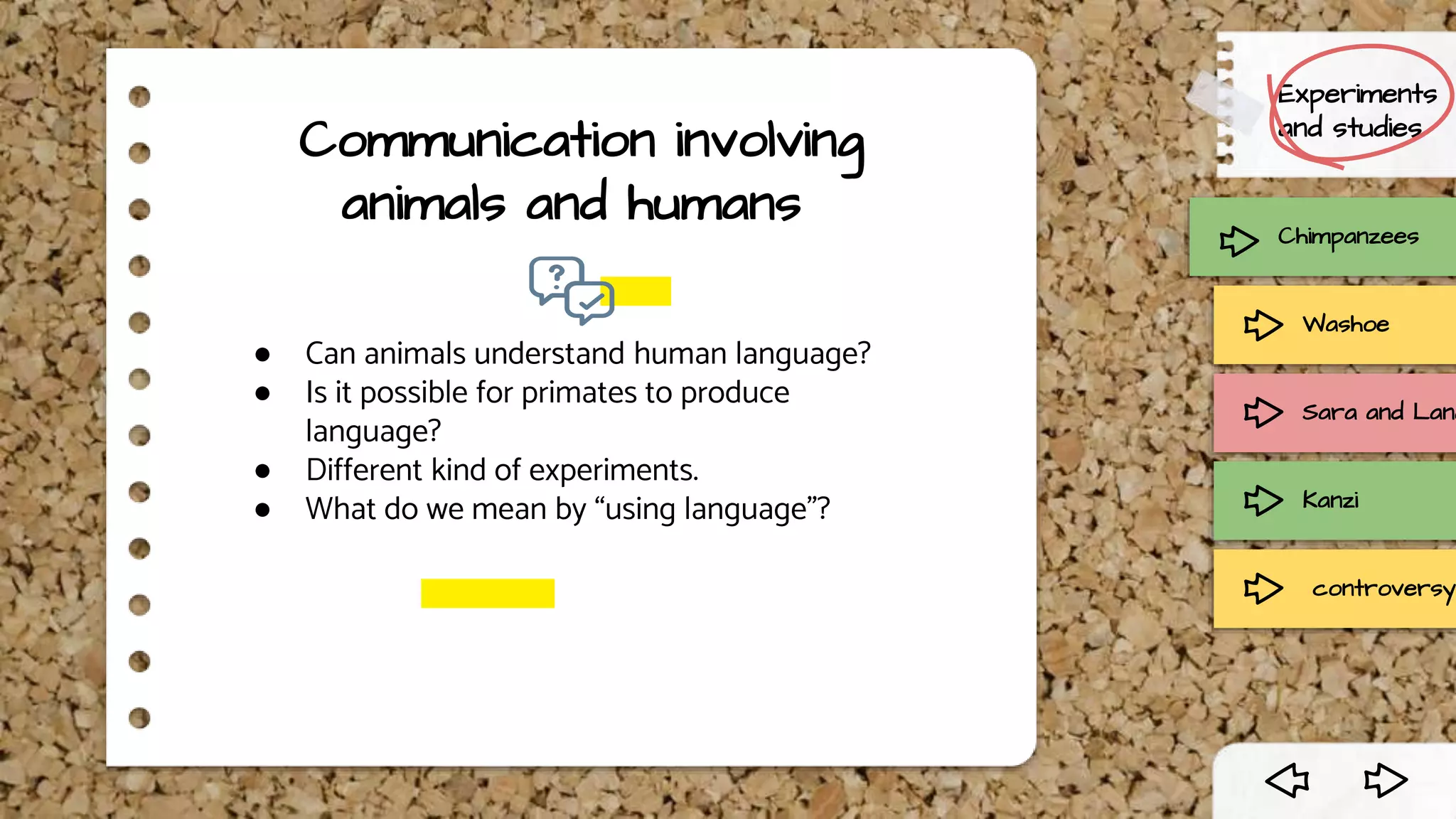
Communication involving
animals and humans
● Can animals understand human language?
● Is it possible for primates to produce
language?
● Different kind of experiments.
● What do we mean by “using language”?
Chimpanzees
Experiments
and studies
Washoe
Sara and Lana
Kanzi
controversy
A conclusion
★ All creatures communicate in
some way.
★ As human beings, our physical
features are crucial in the way
we produce spoken language.
(sounds-articulations)
★ It is possible to conclude that
primates have a similar brain
structure that allow them to use
signs to communicate.
★ Nonetheless, several processes
intervene in the use of our
language that make it unique.
Some things to consider
Thank you!
Our Team:
Victoria Vazquez
Noelia Peralta
Bibliography
Yule, G. (2010). The Study of Language. New York, USA. Cambridge University Press
Credits: This presentation template was created by slidesgo, including icons by
Flaticon and infographics & images from Freepik

Lee 4 - Group 8 - Units 1 & 2

  • 1.
    Lengua y ExpresiónEscrita IV I.S.F.D. Nº 41 Profesorado de Inglés. Oral presentation- Group 8. Students: START! Pair 1: Vazquez, Victoria and Peralta Noelia (Unit 1 and 2) Pair 2: Elicegui Mercedes and Sanguinetti Agostina (Unit 17) Pair 3: Ana Laura Germinario and Florencia Franco (18) Pair 4: Eisenacht Vilma and Petralanda Maite ( Unit 19) 1: The origins of language. 2: Animals and human language.
  • 2.
    The origins oflanguage. (Unit 1) Imitation of natural sounds/cries of emotion King James the Fourth of Scotland → Hebrew. Experiments: Abstract concepts? The divine source Table of Contents The natural sound source The physical adapation The tool-making source The genetic source The divine source The natural sound source Egyptian pharaoh(Psamtik) → Phrygian language No evidenceRejected Onomatopeia Rejected The physical adaptation source The social interaction source
  • 3.
    The social interactionsource Social context. → Human sounds. → Physical effort. Hums, grunts, groans, curses. Early people Groups→ Social organization. Communication. Rejected Similar to apes. Social calls No speech No clarification regarding the origins.
  • 4.
    The physical adaptationsource Humans. Physical features. Partial adaptations. Speech → Important Teeth Lips Mouth Larynx Pharynx This source does not clarify the origins of language It provides information about how sounds are produced in humans
  • 5.
    The tool-making source Precursorof language → Manual gestures Evolutionary connection between the Language-using and tool-using human abilities Humans→ born with a special capacity for language → innate Innateness hypothesis→ mutation Tool- making produced brain development→ F1rst--> naming an object from its noise. 2nd→ bring another noise to combine with the first one. The genetic source Brain Lateralized Structural organization There is not enough evidence. A search for the “language gene” → Only humans possess it.
  • 6.
    Animals and humanlanguage Signals: communicative or informative? A distinction in communication. Properties of human language It is not a matter of communication Experimenting with animals Do animals understand human language? A conclusion “Using language” Unit 2
  • 7.
    Properties of language ●Reflexivity ● Displacement ● Arbitrariness ● Productivity ● Cultural transmission ● Duality
  • 8.
    Communication involving animals andhumans ● Can animals understand human language? ● Is it possible for primates to produce language? ● Different kind of experiments. ● What do we mean by “using language”? Chimpanzees Experiments and studies Washoe Sara and Lana Kanzi controversy
  • 9.
    A conclusion ★ Allcreatures communicate in some way. ★ As human beings, our physical features are crucial in the way we produce spoken language. (sounds-articulations) ★ It is possible to conclude that primates have a similar brain structure that allow them to use signs to communicate. ★ Nonetheless, several processes intervene in the use of our language that make it unique. Some things to consider
  • 10.
    Thank you! Our Team: VictoriaVazquez Noelia Peralta
  • 11.
    Bibliography Yule, G. (2010).The Study of Language. New York, USA. Cambridge University Press Credits: This presentation template was created by slidesgo, including icons by Flaticon and infographics & images from Freepik