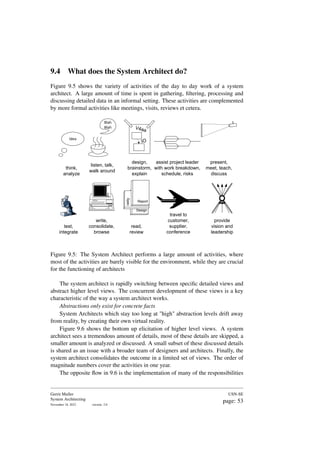
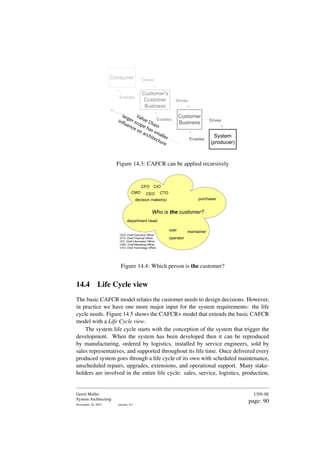
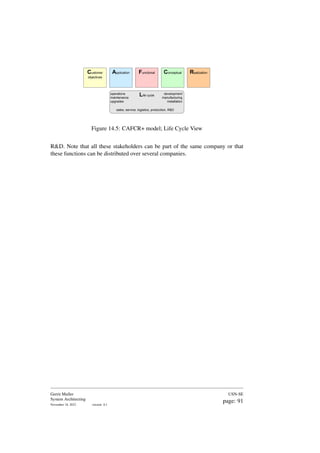
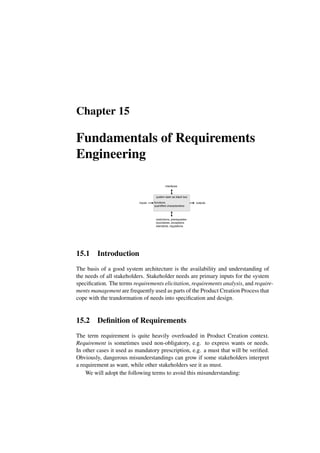
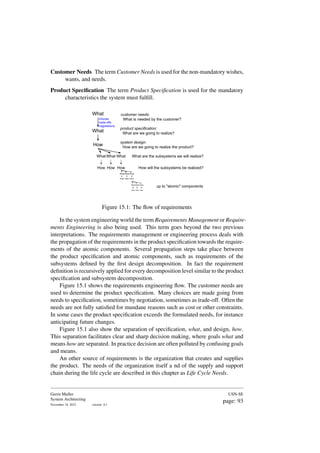
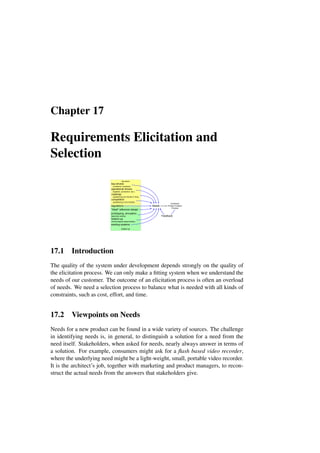
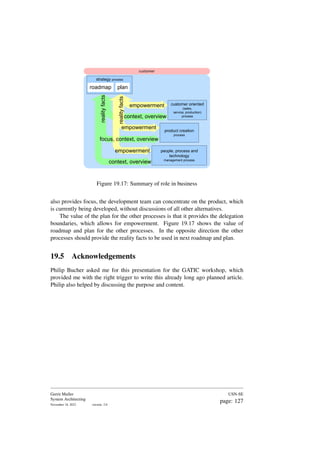
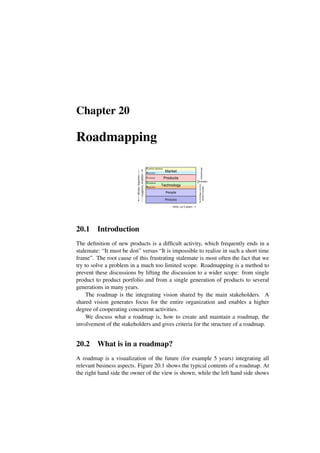
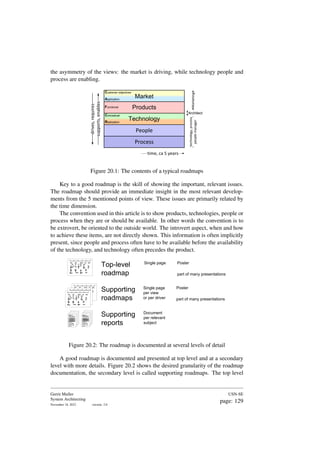
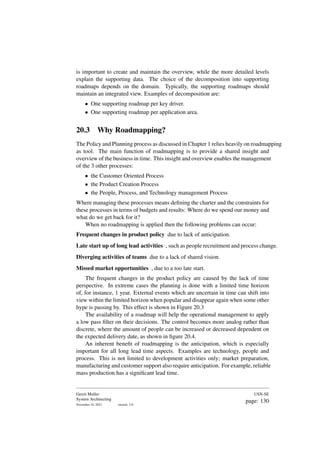
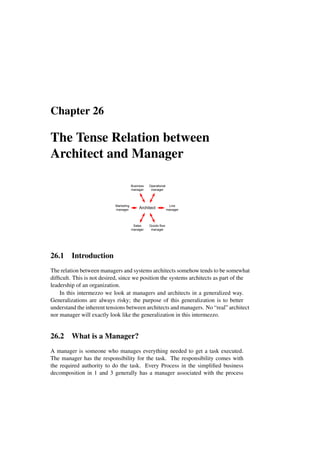
System Architecting
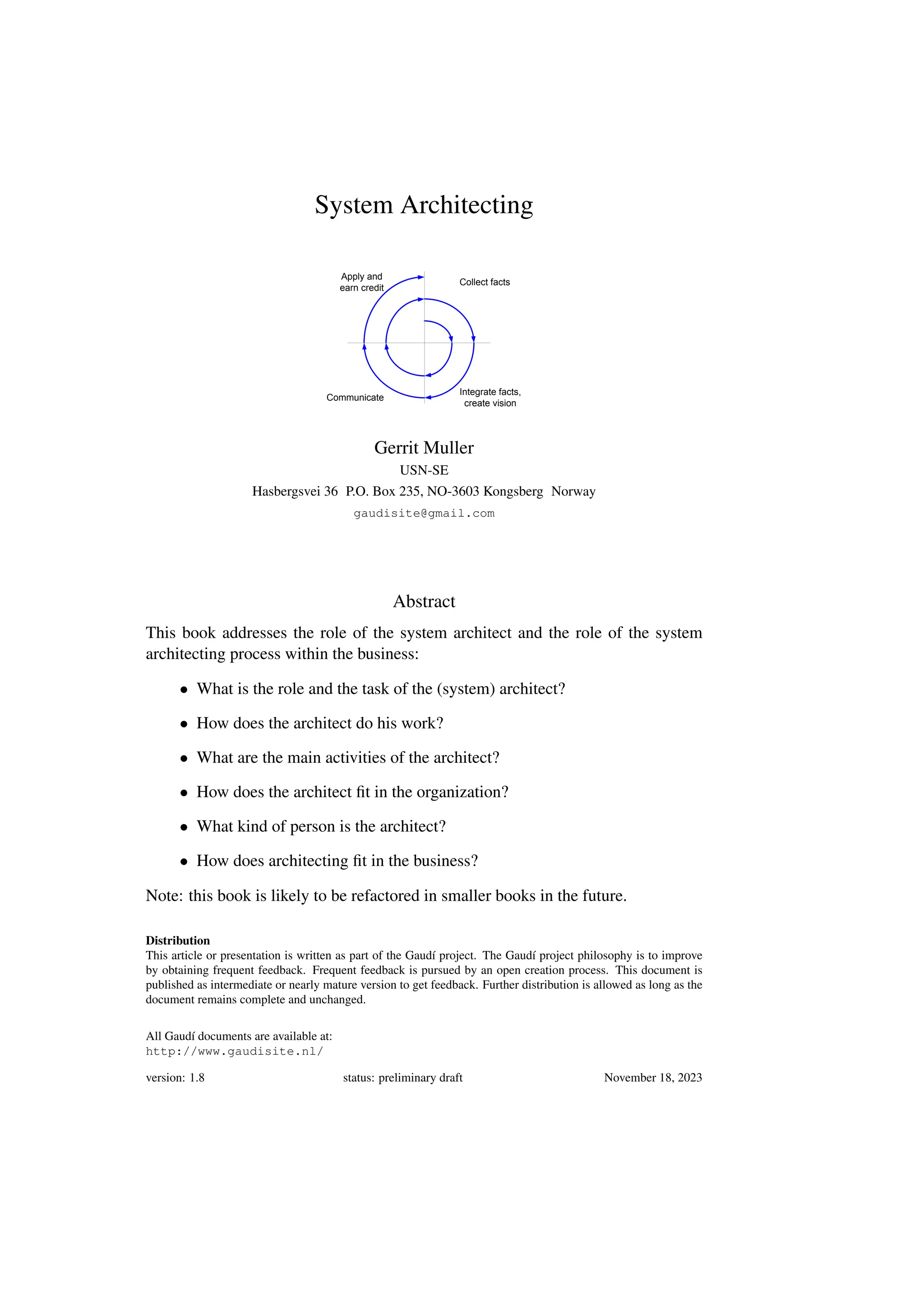
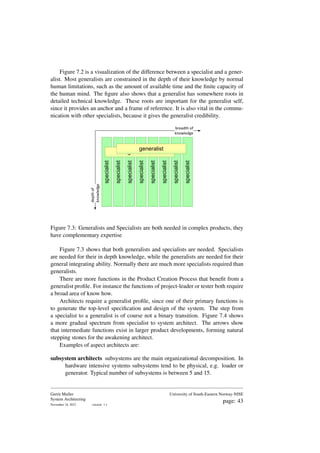
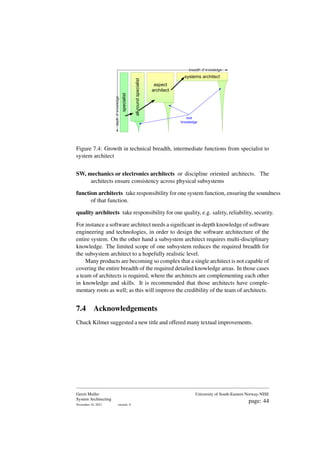
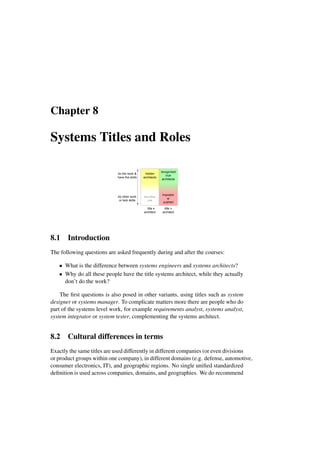
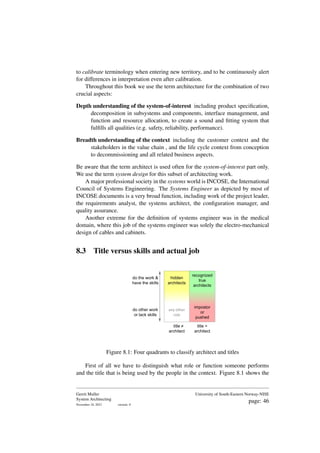
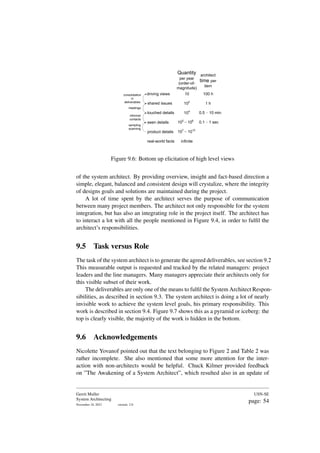
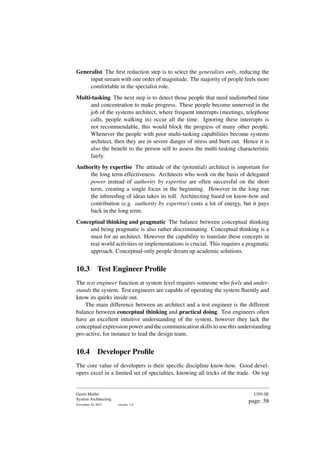
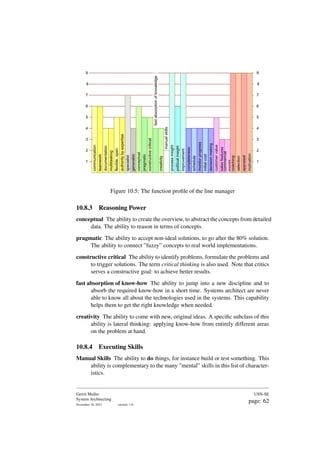
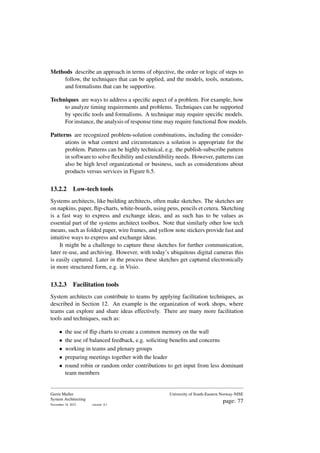
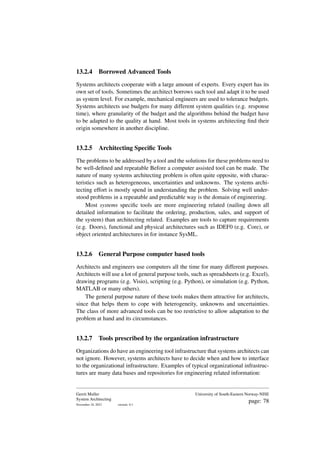
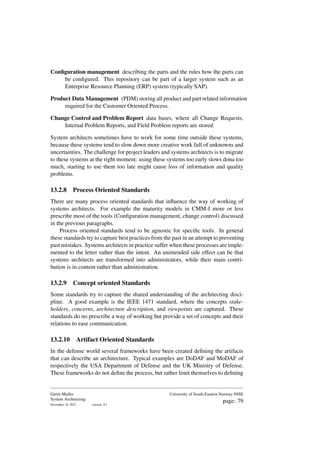
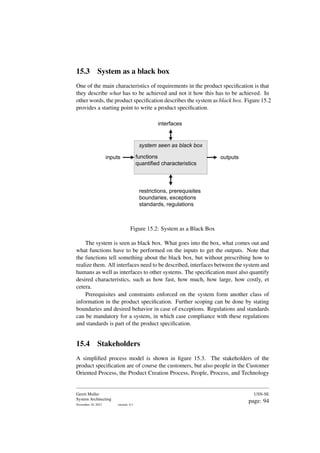
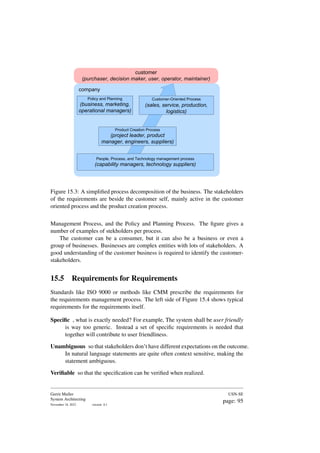
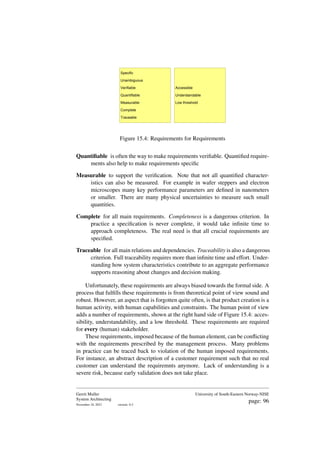
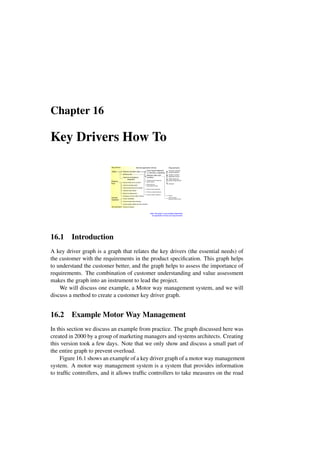
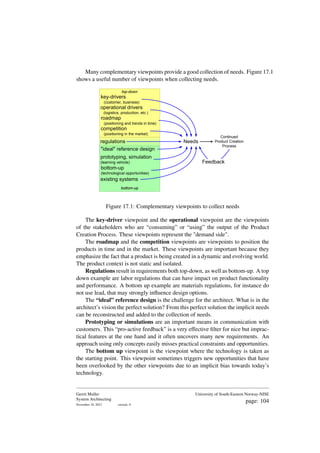
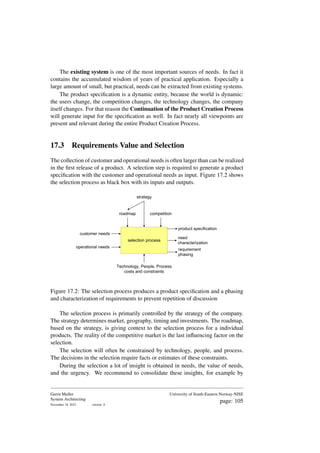
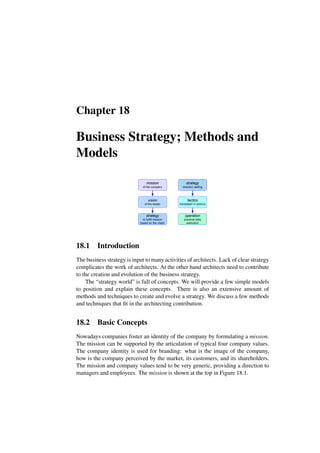
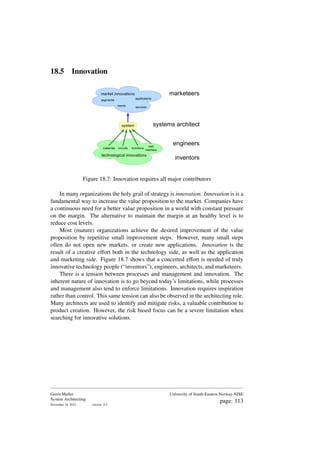
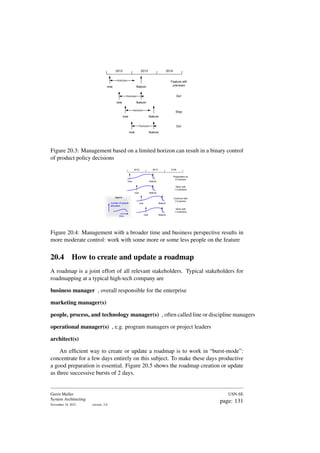
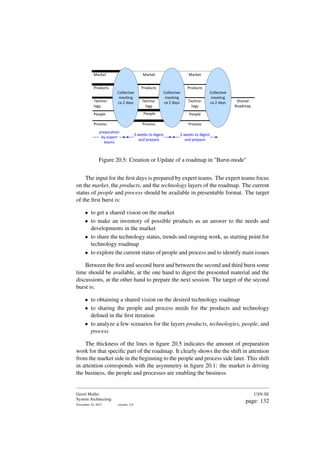
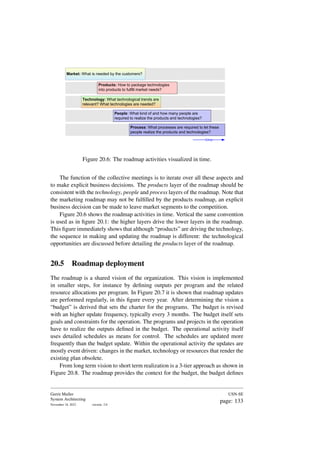
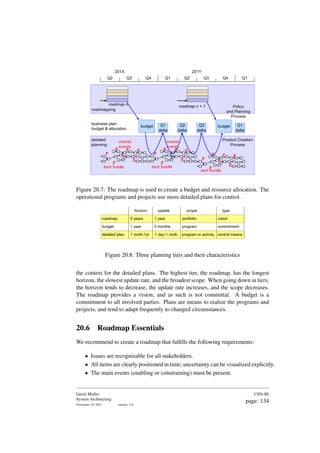
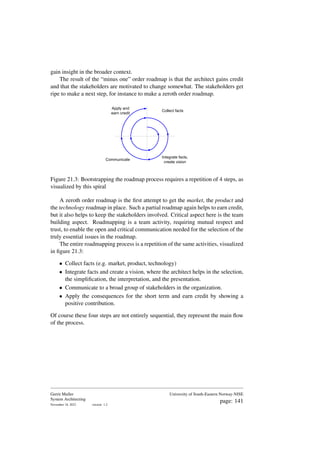
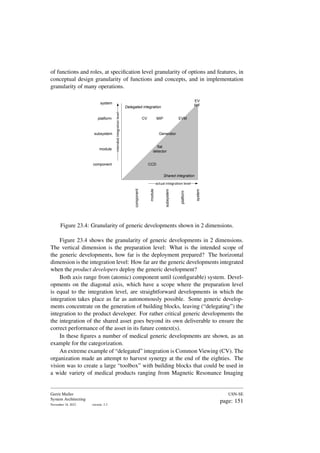
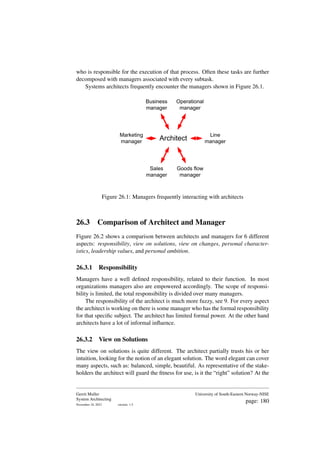
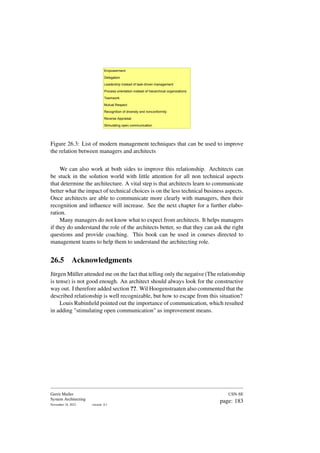
Collect facts
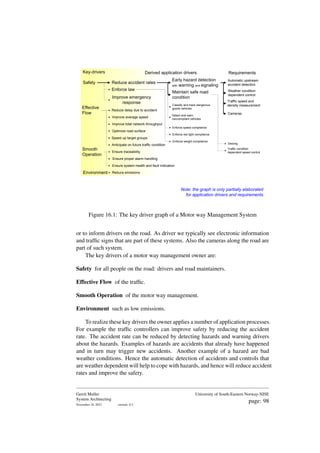
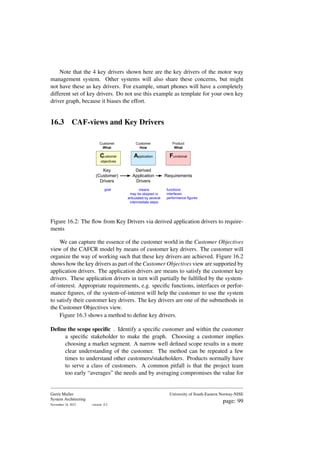
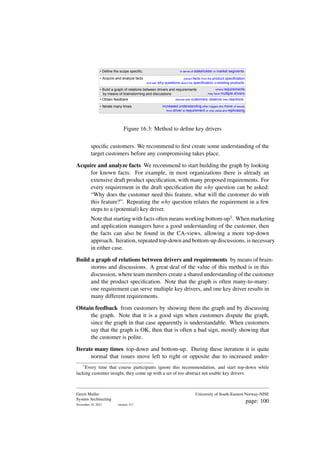
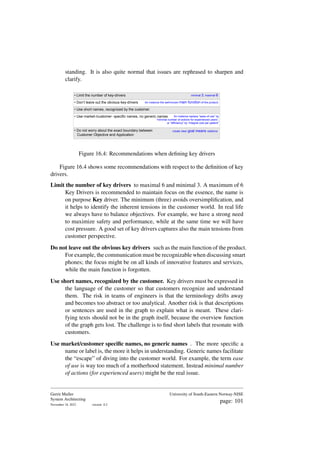
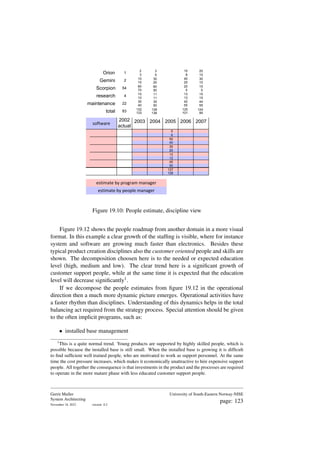
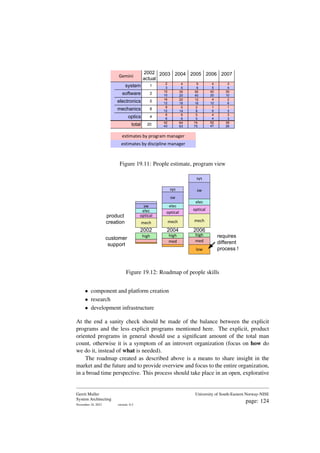
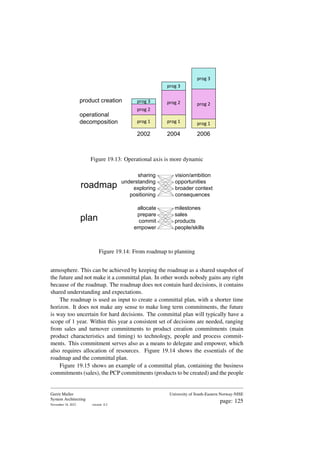
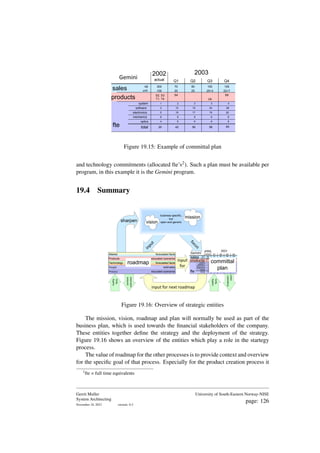
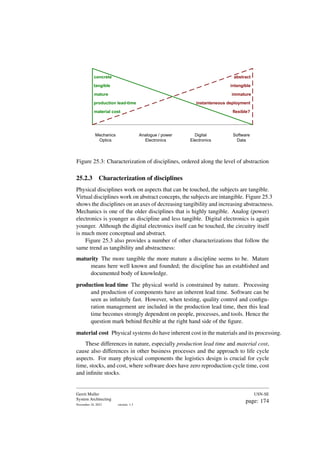
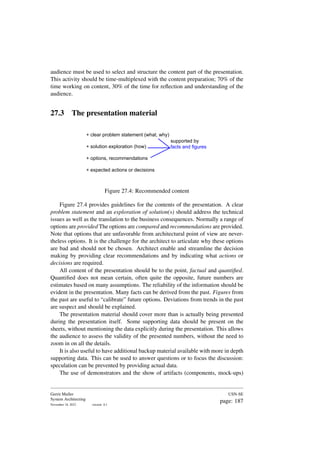
Integrate facts,
create vision
Communicate
Apply and
earn credit
Gerrit Muller
USN-SE
Hasbergsvei 36 P.O. Box 235, NO-3603 Kongsberg Norway
gaudisite@gmail.com
Abstract
This book addresses the role of the system architect and the role of the system
architecting process within the business:
• What is the role and the task of the (system) architect?
• How does the architect do his work?
• What are the main activities of the architect?
• How does the architect fit in the organization?
• What kind of person is the architect?
• How does architecting fit in the business?
Note: this book is likely to be refactored in smaller books in the future.
Distribution
This article or presentation is written as part of the Gaudí project. The Gaudí project philosophy is to improve
by obtaining frequent feedback. Frequent feedback is pursued by an open creation process. This document is
published as intermediate or nearly mature version to get feedback. Further distribution is allowed as long as the
document remains complete and unchanged.
All Gaudí documents are available at:
http://www.gaudisite.nl/
version: 1.8 status: preliminary draft November 18, 2023
Introduction
This book bundles the articles and intermezzo’s produced by the Gaudí project.
At this moment the book is in its early infancy. Most articles are updated
based on feedback from readers and students. The most up to date version of the
articles can always be found at [16]. The same information can be found here in
presentation format.
Chapters can be read as autonomous units. The sequence choosen here is more
or less top down, hopping from one viewpoint to the next. On a regular base
a sidestep ("Intermezzo") is being made, either to describe a more fundamental
notion, or to propose a more challenging point of view.
Note: this book is likely to be refactored in smaller books in the future.
System Architecture: The Silver
Bullet?
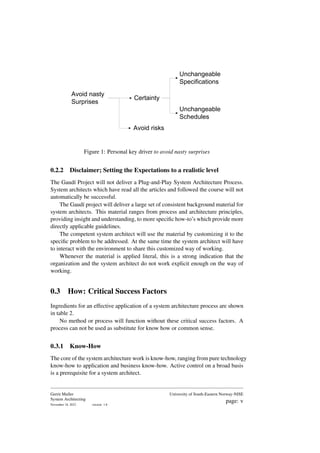
Avoid nasty
Surprises
Certainty
Unchangeable
Specifications
Unchangeable
Schedules
Avoid risks
0.1 Introduction
The expectation level with respect to processes in general and the system archi-
tecture process in particular can vary from skeptical to blind faith. The skeptics
have experienced that horrible specifications and designs can be pursued under the
grand name of Architecture. The followers with blind faith are at the opposite end
of the spectrum, their believe in processes inhibits them from seeing the limitations
and constraints from the processes applied.
The central message of this Intermezzo is:
Silver Bullets do not exist.
This Intermezzo intends to set realistic expectation levels with respect to the
System Architecture Process, and describes the ingredients for successful appli-
cation.
0.2 Why System Architecture?
System Architecting is a means to create systems efficient and effective, by supplying
overview, by guarding consistency and integrity, and by balancing. In other words
the System Architect helps the development team to find its way in a rather complex,
dynamic and uncertain world.
From psychological point of view people apply their own survival mechanisms,
when they perceive a threat. One of the most common survival mechanisms is The
Quest for Certainty, see subsection 0.2.1.
Unfortunately System Architecting will never remove all uncertainties, see
subsection 0.2.2. The application of a system architecture process can help in the
risk management, amongst others by prevention, and by minimizing impact.
Successful application of system architecture is far from trivial, section 0.3
describes how the System Architecture Process should be applied to meet the goals
of efficiency and effectively.
0.2.1 The Quest for Certainty
This section provides a caricatural view on human behavior based on a free inter-
pretation of the Maslow Hierarchy of Needs, as discussed for instance in [7]. This
exaggerated view matches with the security needs in the lower Maslow Hierarchy.
Note that less defensive behavior can be triggered by needs in the higher layers,
were words such as adventurous en explorative are being used.
The majority of people, including managers and engineers, have a need for
certainty. Their ideal is to have stable, unchangeable sets of specifications, schedules
et cetera. This (hopefully) isolates them from the nasty surprises of reality see
table 1.
• incompetent people
• human mistakes
• lack of collaboration or synergy
• misunderstanding or miscommunication
• changing markets
• fast moving competition
• unforeseen physical, chemical, mechanical properties
• mother nature (illnesses, floods)
Table 1: Nasty Surprises of Reality
Unfortunately these nasty surprises are a fact of life. Our human capability to
control these phenomena is quite limited.
Risk management can help to be more robust. However risk management
certainly does not remove these phenomena and it also does not reduce the conse-
quences to zero. Risk management balances probability, effect, and cost.
People with a need for certainty are willing to accept any method or process
which promises certainty. In other words certainty appears to be their personal key
driver. It is better to rephrase this key driver as to avoid nasty surprises, which is
closer to the internal motivation at the one hand and which gives a handle later on
to manage the expectations. Figure 1 visualizes these drivers.
Gerrit Muller
System Architecting
November 18, 2023 version: 1.8
University of South-Eastern Norway-NISE
page: iv
Avoid nasty
Surprises
Certainty
Unchangeable
Specifications
Unchangeable
Schedules
Avoid risks
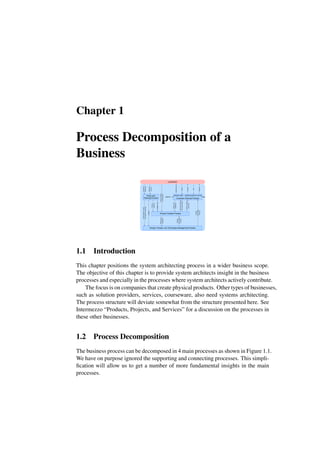
Figure 1: Personal key driver to avoid nasty surprises
0.2.2 Disclaimer; Setting the Expectations to a realistic level
The Gaudí Project will not deliver a Plug-and-Play System Architecture Process.
System architects which have read all the articles and followed the course will not
automatically be successful.
The Gaudí project will deliver a large set of consistent background material for
system architects. This material ranges from process and architecture principles,
providing insight and understanding, to more specific how-to’s which provide more
directly applicable guidelines.
The competent system architect will use the material by customizing it to the
specific problem to be addressed. At the same time the system architect will have
to interact with the environment to share this customized way of working.
Whenever the material is applied literal, this is a strong indication that the
organization and the system architect do not work explicit enough on the way of
working.
0.3 How: Critical Success Factors
Ingredients for an effective application of a system architecture process are shown
in table 2.
No method or process will function without these critical success factors. A
process can not be used as substitute for know how or common sense.
0.3.1 Know-How
The core of the system architecture work is know-how, ranging from pure technology
know-how to application and business know-how. Active control on a broad basis
is a prerequisite for a system architect.
Gerrit Muller
System Architecting
November 18, 2023 version: 1.8
University of South-Eastern Norway-NISE
page: v
• Know-How
• Common Sense
• Pragmatics
• Critical attitude
• Social skills
• Drive
• Vision
Table 2: Critical Success Factors for an effective application of a System Archi-
tecture Process
0.3.2 Common Sense
Most problems encountered during Product Creation require common sense to
solve them. Mechanistic approaches severely limit the solution space, resulting
in complex solutions. System architects are capable of "lateral" thinking, allowing
solutions in previously unexpected directions.
0.3.3 Pragmatics
The holistic approach can easily derail in a sea of seemingly conflicting require-
ments and viewpoints. The system architect needs a significant amount of pragmatism
to be selective and focused, while being holistic in the back of his mind.
0.3.4 Critical attitude
Clear diagrams, tables with facts and smooth presentations give the impression of
high quality and increase the confidence. However these same diagrams, tables and
presentations conceal the forgotten, misinterpreted, or underestimated facts. The
system architect must always be alert, for instance by asking questions as shown in
table 3.
0.3.5 Drive
A good system architect has a passion for his architecture, it has an emotional
value.
An architect which is working entirely according to the book, obediently going
through the motions, will produce a clinical architecture without drive or ownership.
Good architectures have an identity of themselves, which originate in the drive
of the architect. Such an architecture is an evolving entity, which is appreciated by
the stakeholders.
Gerrit Muller
System Architecting
November 18, 2023 version: 1.8
University of South-Eastern Norway-NISE
page: vi
• Do we address the right problem or requirement?
• Is the customer/user on-board?
• Is this design adequate?
• Consists the input data from facts, wishes or ideas?
• Do we need so many people for the implementation?
• Does this process or organization fit the problem?
Table 3: Critical Attitude: Examples of questions to be asked by the System
Architect
0.3.6 Vision
The system architect needs to have a vision to be able to provide direction. A vision
enables an evolution of existing architectures to desired architectures. Having
vision is not trivial, it requires a good understanding of needs (the problem) and
means (the solution) plus the trends (opportunities and threats) in both needs and
means.
0.4 Summary
The one sentence summary of this intermezzo is: Silver bullets do not exist. Table 4
gives a bullet-wise summary.
• Most people want to avoid nasty surprises
• Most people are looking for certainty
• Silver Bullets do not exist
• System Architecture is not a golden bullet
• Critical Success Factors: Know-How, Common Sense, Pragmatics, Critical
attitude, Drive and Vision
Table 4: Summary
0.5 Acknowledgements
Hans Gieles suggested improvements to increase the cohesion and the red line in
this Intermezzo.
Henk Obbink and Angelo Hulshout and many others pointed out that ”The
Golden Bullet” should have been ”The Silver Bullet”, which has been changed
Gerrit Muller
System Architecting
November 18, 2023 version: 1.8
University of South-Eastern Norway-NISE
page: vii
finally. Adriaan van den Brand pointed out the forgotten change of golden into
silver.
Eugene Ivanov pointed out that evolution aspects were missing. The result is
the addition of vision as critical success factor.
Steve R. Nanning indicated unclarity in the abstract and criticized the too
negative phrasing of the Quest for Certainty. Stephen Boggess added a question to
the list in Section ”Critical Attitude”. Ning Lu added more surprises and critical
success factors.
Gerrit Muller
System Architecting
November 18, 2023 version: 1.8
University of South-Eastern Norway-NISE
page: viii
Part I
Processes
Chapter 1
Process Decomposition of a
Business
customer
Customer-Oriented Process
$$
sales logisticsproduction service
presales
Product Creation Process
Policy and
Planning Process
People, Process, and Technology Management Process
Business
Drivers
Customer
Roadmap
Budget,
plan
Product
roadmap
Technology,
Process,
and
People
roadmaps
Budgets
People
Technology
Process
Needs
and
Feedback
Technical
Product
Documentation
Product-related
processes
People
Technology
Process
Information
Order
Product
$$
Support
Product
Needs
and
feedback
material
Needs
and
Feedback
1.1 Introduction
This chapter positions the system architecting process in a wider business scope.
The objective of this chapter is to provide system architects insight in the business
processes and especially in the processes where system architects actively contribute.
The focus is on companies that create physical products. Other types of businesses,
such as solution providers, services, courseware, also need systems architecting.
The process structure will deviate somewhat from the structure presented here. See
Intermezzo “Products, Projects, and Services” for a discussion on the processes in
these other businesses.
1.2 Process Decomposition
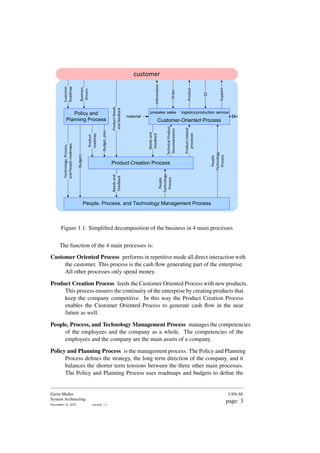
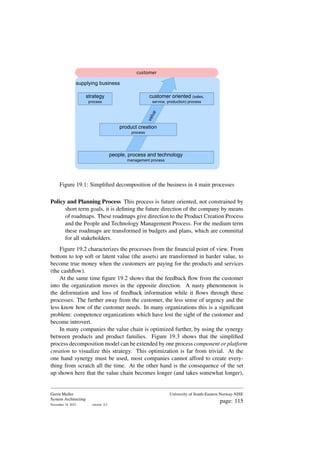
The business process can be decomposed in 4 main processes as shown in Figure 1.1.
We have on purpose ignored the supporting and connecting processes. This simpli-
fication will allow us to get a number of more fundamental insights in the main
processes.
customer
Customer-Oriented Process
$$
sales logisticsproduction service
presales
Product Creation Process
Policy and
Planning Process
People, Process, and Technology Management Process
Business
Drivers
Customer
Roadmap
Budget,
plan
Product
roadmap
Technology,
Process,
and
People
roadmaps
Budgets
People
Technology
Process
Needs
and
Feedback
Technical
Product
Documentation
Product-related
processes
People
Technology
Process
Information
Order
Product
$$
Support
Product
Needs
and
feedback
material
Needs
and
Feedback
Figure 1.1: Simplified decomposition of the business in 4 main processes
The function of the 4 main processes is:
Customer Oriented Process performs in repetitive mode all direct interaction with
the customer. This process is the cash flow generating part of the enterprise.
All other processes only spend money.
Product Creation Process feeds the Customer Oriented Process with new products.
This process ensures the continuity of the enterprise by creating products that
keep the company competitive. In this way the Product Creation Process
enables the Customer Oriented Process to generate cash flow in the near
future as well.
People, Process, and Technology Management Process manages the competencies
of the employees and the company as a whole. The competencies of the
employees and the company are the main assets of a company.
Policy and Planning Process is the management process. The Policy and Planning
Process defines the strategy, the long term direction of the company, and it
balances the shorter term tensions between the three other main processes.
The Policy and Planning Process uses roadmaps and budgets to define the
Gerrit Muller
System Architecting
November 18, 2023 version: 1.1
USN-SE
page: 3
direction for the other processes. Roadmaps give direction to the Product
Creation Process and the People, Process and Technology Management Process.
For the medium term these roadmaps are transformed in budgets and plans,
which are committal for all stakeholders.
Customer Oriented Process
$$
sales logisticsproduction service
presales
Product Creation Process
Policy and
Planning Process
People and Technology Management Process
Business
Drivers
Customer
Roadmap
Budget,
plan
Product
roadmap
Technology,
Process,
and
People
roadmaps
Budgets
People
Technology
Process
Product-related
processes
People
Technology
Process
Information
Order
Product
$$
Support
Management
Assets
Tomorrow's Cashflow
Cashflow Generation
customer
Needs
and
Feedback
Product
Needs
and
feedback
material
Technical
Product
Documentation
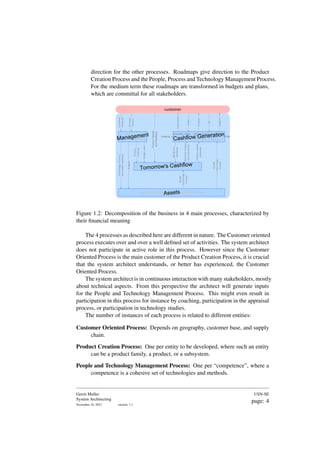
Figure 1.2: Decomposition of the business in 4 main processes, characterized by
their financial meaning
The 4 processes as described here are different in nature. The Customer oriented
process executes over and over a well defined set of activities. The system architect
does not participate in active role in this process. However since the Customer
Oriented Process is the main customer of the Product Creation Process, it is crucial
that the system architect understands, or better has experienced, the Customer
Oriented Process.
The system architect is in continuous interaction with many stakeholders, mostly
about technical aspects. From this perspective the architect will generate inputs
for the People and Technology Management Process. This might even result in
participation in this process for instance by coaching, participation in the appraisal
process, or participation in technology studies.
The number of instances of each process is related to different entities:
Customer Oriented Process: Depends on geography, customer base, and supply
chain.
Product Creation Process: One per entity to be developed, where such an entity
can be a product family, a product, or a subsystem.
People and Technology Management Process: One per “competence”, where a
competence is a cohesive set of technologies and methods.
Gerrit Muller
System Architecting
November 18, 2023 version: 1.1
USN-SE
page: 4
Policy and Planning Process: One per business. This is the pro-active integrating
process.
The evolutionary developments of product variants and new releases are seen as
individual instances of the Product Creation Process. For example the development
of a single new feature for an existing product is performed by following the entire
Product Creation Process. Of course some steps in the process will be (nearly)
empty, which does not cause any harm.
1.3 Process versus Organization
This process decomposition is not an organization, see Intermezzo “What is a
Process”. A single person can (and often will) fulfill several roles in different
processes.
System architects specifically spend most of their time in Product Creation
Process (circa. 75%), a considerable amount of time in the Policy and Planning
Process (circa 20%), and a small fraction of their time in the People, Process and
Technology Management Process.
Most engineers will spend a small amount of time in the People, Process, and
Technology Management Process, working on technologies and capabilities, while
the majority of their time is spend in the Product Creation Process.
1.4 Value Chain and Feedback
People
Technology
Process
Requirements
and
Feedback
Technical
Product
Documentation
Product
related
processes
Information
Order
Product
$$
V
a
l
u
e
F
e
e
d
b
a
c
k
Customer-Oriented
Process
$$
Product Creation Process
Policy and
Planning Process
People, Process, and Technology Management Process
Business
Drivers
Customer
Roadmap
Budget,
plan
Product
roadmap
Technology,
Process,
and
People
roadmaps
Budgets
People
Technology
Process
Support
Product
Needs
and
feedback
material
customer
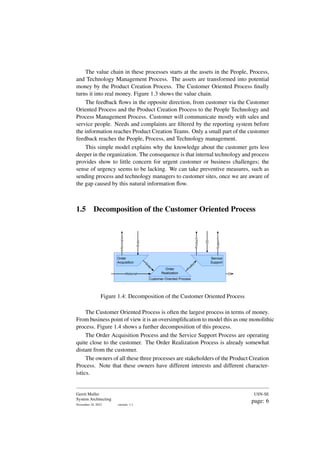
Figure 1.3: The value chain and the feedback flow in opposite direction
Gerrit Muller
System Architecting
November 18, 2023 version: 1.1
USN-SE
page: 5
The value chain in these processes starts at the assets in the People, Process,
and Technology Management Process. The assets are transformed into potential
money by the Product Creation Process. The Customer Oriented Process finally
turns it into real money. Figure 1.3 shows the value chain.
The feedback flows in the opposite direction, from customer via the Customer
Oriented Process and the Product Creation Process to the People Technology and
Process Management Process. Customer will communicate mostly with sales and
service people. Needs and complaints are filtered by the reporting system before
the information reaches Product Creation Teams. Only a small part of the customer
feedback reaches the People, Process, and Technology management.
This simple model explains why the knowledge about the customer gets less
deeper in the organization. The consequence is that internal technology and process
provides show to little concern for urgent customer or business challenges; the
sense of urgency seems to be lacking. We can take preventive measures, such as
sending process and technology managers to customer sites, once we are aware of
the gap caused by this natural information flow.
1.5 Decomposition of the Customer Oriented Process
Customer-Oriented Process
Order
Acquisition
Order
Realization
Service
Support
Material
O
r
d
e
r
P
r
o
d
u
c
t
Order
Product
Support
Information
$$
$$
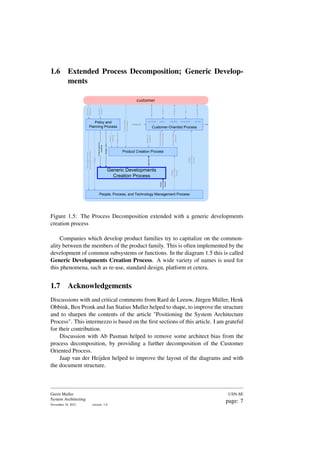
Figure 1.4: Decomposition of the Customer Oriented Process
The Customer Oriented Process is often the largest process in terms of money.
From business point of view it is an oversimplification to model this as one monolithic
process. Figure 1.4 shows a further decomposition of this process.
The Order Acquisition Process and the Service Support Process are operating
quite close to the customer. The Order Realization Process is already somewhat
distant from the customer.
The owners of all these three processes are stakeholders of the Product Creation
Process. Note that these owners have different interests and different character-
istics.
Gerrit Muller
System Architecting
November 18, 2023 version: 1.1
USN-SE
page: 6
1.6 Extended Process Decomposition; Generic Develop-
ments
customer
Customer-Oriented Process
sales logistics production service
presales
Product Creation Process
Policy and
Planning Process
People, Process, and Technology Management Process
Generic Developments
Creation Process
generics
People
Technology
Process
People
Technology
Process
People
Technology
Process
Product
Needs
and
feedback
Information
Order
Product
$$
Support
Budget,
plan
Product
roadmap
Needs
and
Feedback
Technical
Product
Documentation
Product-related
processes
Product
generics
roadmap
Budget,
plan
Business
Drivers
Customer
Roadmap
Technology,
Process,
and
People
roadmaps
Budgets
$$
material
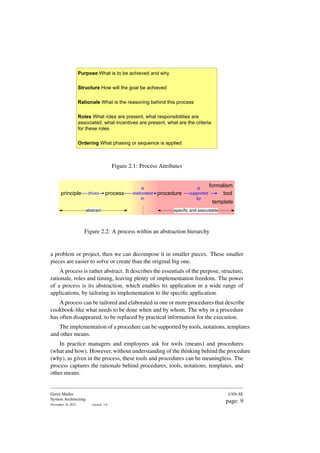
Figure 1.5: The Process Decomposition extended with a generic developments
creation process
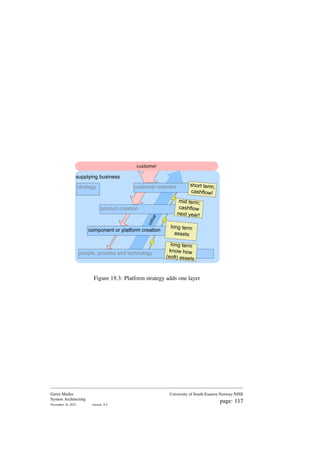
Companies which develop product families try to capitalize on the common-
ality between the members of the product family. This is often implemented by the
development of common subsystems or functions. In the diagram 1.5 this is called
Generic Developments Creation Process. A wide variety of names is used for
this phenomena, such as re-use, standard design, platform et cetera.
1.7 Acknowledgements
Discussions with and critical comments from Rard de Leeuw, Jürgen Müller, Henk
Obbink, Ben Pronk and Jan Statius Muller helped to shape, to improve the structure
and to sharpen the contents of the article "Positioning the System Architecture
Process". This intermezzo is based on the first sections of this article. I am grateful
for their contribution.
Discussion with Ab Pasman helped to remove some architect bias from the
process decomposition, by providing a further decomposition of the Customer
Oriented Process.
Jaap van der Heijden helped to improve the layout of the diagrams and with
the document structure.
Gerrit Muller
System Architecting
November 18, 2023 version: 1.0
USN-SE
page: 7
Chapter 2
What is a Process?
principle process procedure tool
formalism
template
abstract specific and executable
drives
is
elaborated
in
is
supported
by
2.1 Introduction
We rely in this part heavily on the notion of a process. This intermezzo is defining
“process” for the context of this book. We define “process”, since this word is
heavily overloaded in our daily world. We also discuss the relationship of processes
with organizations and the drive for process improvement.
2.2 What is a process
We use process as an abstracted way of working. A process can be characterized
the attributes shown in Figure 2.1
In [10] the following definition is given:
A process is an activity which takes place over time and which has a precise
aim regarding the result to be achieved. The concept of a process is hierarchical
which means that a process may consist of a partially ordered set of subprocesses.
This definition parallels the characterization above. It adds explicitly the potential
hierarchical decomposition of the process itself.
The notion of a process can be seen as one step in an abstraction hierarchy,
as shown in 2.2. The most abstract notion in this hierarchy is the “principle”. A
principle is a generic insight that can be used for many different purposes. An
example of a principle is decomposition: Whenever we have something big, e.g.
Purpose What is to be achieved and why
Structure How will the goal be achieved
Rationale What is the reasoning behind this process
Roles What roles are present, what responsibilities are
associated, what incentives are present, what are the criteria
for these roles
Ordering What phasing or sequence is applied
Figure 2.1: Process Attributes
principle process procedure tool
formalism
template
abstract specific and executable
drives
is
elaborated
in
is
supported
by
Figure 2.2: A process within an abstraction hierarchy
a problem or project, then we can decompose it in smaller pieces. These smaller
pieces are easier to solve or create than the original big one.
A process is rather abstract. It describes the essentials of the purpose, structure,
rationale, roles and timing, leaving plenty of implementation freedom. The power
of a process is its abstraction, which enables its application in a wide range of
applications, by tailoring its implementation to the specific application.
A process can be tailored and elaborated in one or more procedures that describe
cookbook-like what needs to be done when and by whom. The why in a procedure
has often disappeared, to be replaced by practical information for the execution.
The implementation of a procedure can be supported by tools, notations, templates
and other means.
In practice managers and employees ask for tools (means) and procedures
(what and how). However, without understanding of the thinking behind the procedure
(why), as given in the process, these tools and procedures can be meaningless. The
process captures the rationale behind procedures, tools, notations, templates, and
other means.
Gerrit Muller
System Architecting
November 18, 2023 version: 1.0
USN-SE
page: 9
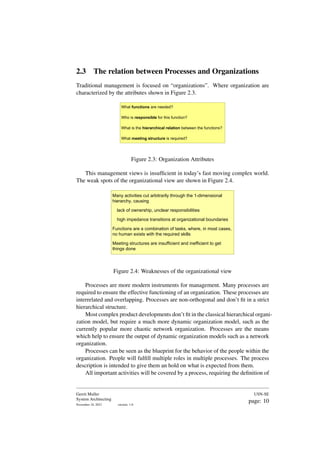
2.3 The relation between Processes and Organizations
Traditional management is focused on “organizations”. Where organization are
characterized by the attributes shown in Figure 2.3.
What functions are needed?
Who is responsible for this function?
What is the hierarchical relation between the functions?
What meeting structure is required?
Figure 2.3: Organization Attributes
This management views is insufficient in today’s fast moving complex world.
The weak spots of the organizational view are shown in Figure 2.4.
Many activities cut arbitrarily through the 1-dimensional
hierarchy, causing
lack of ownership, unclear responsibilities
high impedance transitions at organizational boundaries
Functions are a combination of tasks, where, in most cases,
no human exists with the required skills
Meeting structures are insufficient and inefficient to get
things done
Figure 2.4: Weaknesses of the organizational view
Processes are more modern instruments for management. Many processes are
required to ensure the effective functioning of an organization. These processes are
interrelated and overlapping. Processes are non-orthogonal and don’t fit in a strict
hierarchical structure.
Most complex product developments don’t fit in the classical hierarchical organi-
zation model, but require a much more dynamic organization model, such as the
currently popular more chaotic network organization. Processes are the means
which help to ensure the output of dynamic organization models such as a network
organization.
Processes can be seen as the blueprint for the behavior of the people within the
organization. People will fulfill multiple roles in multiple processes. The process
description is intended to give them an hold on what is expected from them.
All important activities will be covered by a process, requiring the definition of
Gerrit Muller
System Architecting
November 18, 2023 version: 1.0
USN-SE
page: 10
ownership, relation with other processes et cetera. The allocation of roles to people
is much more dynamic than in conventional hierarchies. More dynamic allocation
enables a better match between personal capabilities and required skills. In practice
dynamic allocation leads to more distribution of responsibilities, making it more
feasible to match capabilities and skills.
The 80/20 rule is also valid for processes: 80% of the behavior is covered
by the processes, while 20% requires independent creative behavior. An organi-
zation without processes drowns in chaos, while an organization which blindly
implements them will be killed by its own inertia, its inability to adapt to the fast
changing world.
For reasons of continuity and stability an hierarchical organization will remain.
The slowest evolving dimension is mostly used as a basis for this hierarchy. This
hierarchy functions as anchor point for people in the continuously changing process
world, but should play only a minor role in the entire operation.
The Centurion turn around operation within Philips, orchestrated by CEO Jan
Timmer in the early nineties, urged the Philips managers and employees to change
from an introvert organization point of view to an external result oriented process
point of view.
2.4 Process Improvement
Urged by competitive pressure organizations look for ways to improve their efficiency.
Many opportunities for improvement have a strong process component.
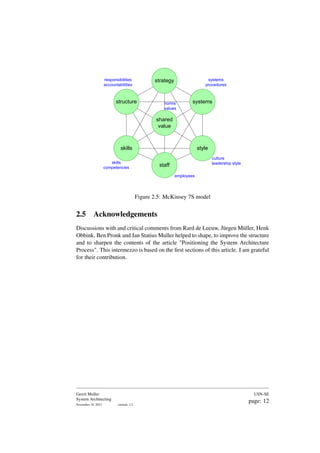
The 7S model by McKinsey gives a practical way to improve an organization
in a balanced way. The message behind this model is that at least 7 views must be
balanced when changing an organization. See Figure 2.5 for the 7 views.
The most common pitfall in improvement programs is the over-emphasis on the
process component, or worse the isolation of the process improvement. Organiza-
tions assessing their maturity level, for instance by Maturity Models [22], quite
often get too much process focus. The Process Improvement Officer1 is focused
on process issues only. Hence where the process view is introduced as an extrovert
result oriented approach, it suddenly turns into an introvert improvement program,
where business goals and drivers are unknown.
This is a quite sad situation: The opportunities for improvement are ample with
a strong process component, however due to the wrong focus a negative effect is
obtained (such as rigid procedures).
Recommendation: Process improvements should originate from the directly
involved people, for instance project leaders, engineers, architects et cetera. Invite
participation by this group in such a way that they feel the ownership.
1
The existence of this function in itself is quite dangerous, it invites the unbalanced isolated
"improvement" behavior
Gerrit Muller
System Architecting
November 18, 2023 version: 2.2
USN-SE
page: 11
strategy
shared
value
staff
systems
style
structure
skills
responsibilities
accountabilities
systems
procedures
norms
values
skills
competencies
employees
culture
leadership style
Figure 2.5: McKinsey 7S model
2.5 Acknowledgements
Discussions with and critical comments from Rard de Leeuw, Jürgen Müller, Henk
Obbink, Ben Pronk and Jan Statius Muller helped to shape, to improve the structure
and to sharpen the contents of the article "Positioning the System Architecture
Process". This intermezzo is based on the first sections of this article. I am grateful
for their contribution.
Gerrit Muller
System Architecting
November 18, 2023 version: 2.2
USN-SE
page: 12
Chapter 3
The Product Creation Process
needs
design
verification
engineering
core information
in draft
50%
most information
available in
concept
information is stable
enough to use
heavier change control
Legend:
specification
preparing or updating work
full under development
0.
feasibility
1.
definition
2.
system
design
3.
engineering
4.
integration
& test
5.
field
monitoring
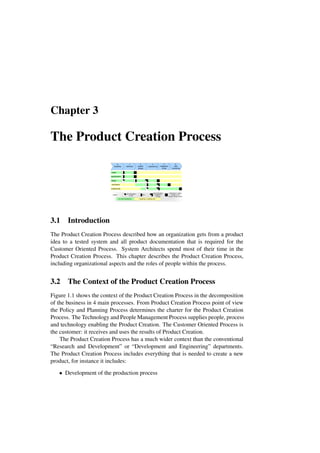
3.1 Introduction
The Product Creation Process described how an organization gets from a product
idea to a tested system and all product documentation that is required for the
Customer Oriented Process. System Architects spend most of their time in the
Product Creation Process. This chapter describes the Product Creation Process,
including organizational aspects and the roles of people within the process.
3.2 The Context of the Product Creation Process
Figure 1.1 shows the context of the Product Creation Process in the decomposition
of the business in 4 main processes. From Product Creation Process point of view
the Policy and Planning Process determines the charter for the Product Creation
Process. The Technology and People Management Process supplies people, process
and technology enabling the Product Creation. The Customer Oriented Process is
the customer: it receives and uses the results of Product Creation.
The Product Creation Process has a much wider context than the conventional
“Research and Development” or “Development and Engineering” departments.
The Product Creation Process includes everything that is needed to create a new
product, for instance it includes:
• Development of the production process
• Design of the logistics flow and structure
• Development of required services
• Market announcement
• Market introduction
In other words the Product Creation Process is a synchronized effort of nearly
all business disciplines within a company.
The term Product Creation is not only used for the development of entirely new
products, but applies also to the development of variations of existing products
or the development of upgrades or add-on products. The implementation of the
Product Creation Process can vary, depending on the product being developed; a
small add-on product will use a different organization than the development of a
large new complex product.
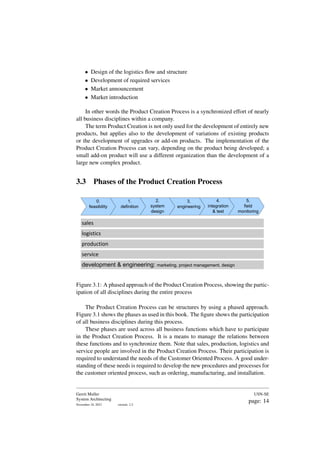
3.3 Phases of the Product Creation Process
0.
feasibility
1.
definition
2.
system
design
3.
engineering
4.
integration
& test
5.
field
monitoring
sales
logistics
production
service
development & engineering: marketing, project management, design
Figure 3.1: A phased approach of the Product Creation Process, showing the partic-
ipation of all disciplines during the entire process
The Product Creation Process can be structures by using a phased approach.
Figure 3.1 shows the phases as used in this book. The figure shows the participation
of all business disciplines during this process.
These phases are used across all business functions which have to participate
in the Product Creation Process. It is a means to manage the relations between
these functions and to synchronize them. Note that sales, production, logistics and
service people are involved in the Product Creation Process. Their participation is
required to understand the needs of the Customer Oriented Process. A good under-
standing of these needs is required to develop the new procedures and processes for
the customer oriented process, such as ordering, manufacturing, and installation.
Gerrit Muller
System Architecting
November 18, 2023 version: 2.2
USN-SE
page: 14
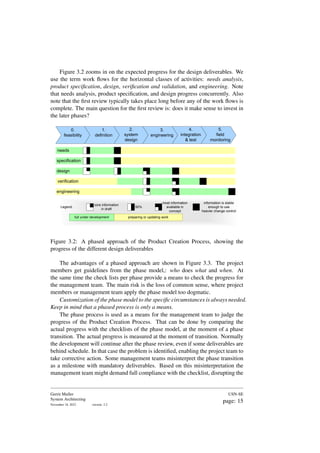
Figure 3.2 zooms in on the expected progress for the design deliverables. We
use the term work flows for the horizontal classes of activities: needs analysis,
product specification, design, verification and validation, and engineering. Note
that needs analysis, product specification, and design progress concurrently. Also
note that the first review typically takes place long before any of the work flows is
complete. The main question for the first review is: does it make sense to invest in
the later phases?
needs
design
verification
engineering
core information
in draft
50%
most information
available in
concept
information is stable
enough to use
heavier change control
Legend:
specification
preparing or updating work
full under development
0.
feasibility
1.
definition
2.
system
design
3.
engineering
4.
integration
& test
5.
field
monitoring
Figure 3.2: A phased approach of the Product Creation Process, showing the
progress of the different design deliverables
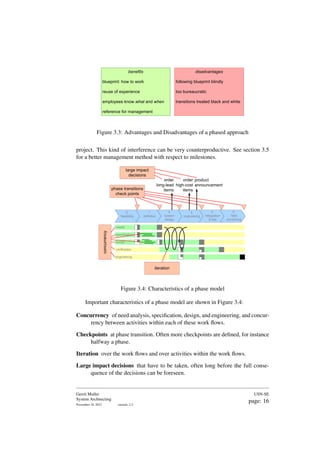
The advantages of a phased approach are shown in Figure 3.3. The project
members get guidelines from the phase model,: who does what and when. At
the same time the check lists per phase provide a means to check the progress for
the management team. The main risk is the loss of common sense, where project
members or management team apply the phase model too dogmatic.
Customization of the phase model to the specific circumstances is always needed.
Keep in mind that a phased process is only a means.
The phase process is used as a means for the management team to judge the
progress of the Product Creation Process. That can be done by comparing the
actual progress with the checklists of the phase model, at the moment of a phase
transition. The actual progress is measured at the moment of transition. Normally
the development will continue after the phase review, even if some deliverables are
behind schedule. In that case the problem is identified, enabling the project team to
take corrective action. Some management teams misinterpret the phase transition
as a milestone with mandatory deliverables. Based on this misinterpretation the
management team might demand full compliance with the checklist, disrupting the
Gerrit Muller
System Architecting
November 18, 2023 version: 2.2
USN-SE
page: 15
benefits
blueprint: how to work
reuse of experience
employees know what and when
reference for management
disadvantages
following blueprint blindly
too bureaucratic
transitions treated black and white
Figure 3.3: Advantages and Disadvantages of a phased approach
project. This kind of interference can be very counterproductive. See section 3.5
for a better management method with respect to milestones.
needs
design
verification
engineering
specification
0.
feasibility
1.
definition
2.
system
design
3.
engineering
4.
integration
& test
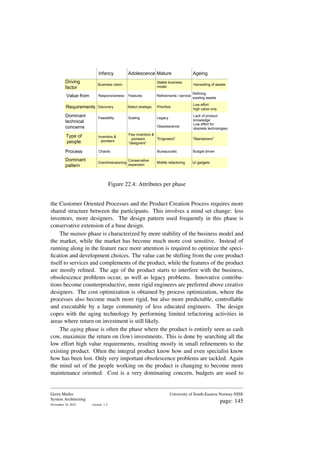
5.
field
monitoring
phase transitions
check points
concurrency
iteration
order
long-lead
items
order
high-cost
items
product
announcement
large impact
decisions
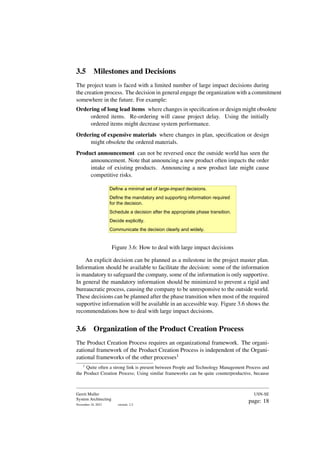
Figure 3.4: Characteristics of a phase model
Important characteristics of a phase model are shown in Figure 3.4:
Concurrency of need analysis, specification, design, and engineering, and concur-
rency between activities within each of these work flows.
Checkpoints at phase transition. Often more checkpoints are defined, for instance
halfway a phase.
Iteration over the work flows and over activities within the work flows.
Large impact decisions that have to be taken, often long before the full conse-
quence of the decisions can be foreseen.
Gerrit Muller
System Architecting
November 18, 2023 version: 2.2
USN-SE
page: 16
3.4 Evolutionary models for Product Creation
The phase model stresses and supports concurrent activities, see also [8]. A common
pitfall is a waterfall interpretation of a phased approach. Following a strict top-
down approach can be a very costly mistake, because feedback from implemen-
tation and customers is in that case too late in the process. Early and continuous
feedback both from implementation as from customer point of view is essential,
see Intermezzo 4.
requirements
specification
design
build
test and
evaluate
cycle time
2% of budget (EVO)
2 weeks (XP)
up to 2 months
alternative models
RUP (Rational Unified Process)
Open Source
SCRUM
needs
specification
system
design
subsystem
design
component
design
component realization
component
test
subsystem
test
system
test
verification
validation
V-Model Incremental or Evolutionary
Figure 3.5: V-model versus Incremental or Evolutionary development models
High market dynamics exposes one weakness of the phased approach: market
and user feedback becomes available at the end of the creation process. This is a
significant problem, because most product creations suffer from large uncertainties
in the specifications. Discovering at the end that the specifications are based on
wrong assumptions is very costly.
Figure 3.5 show the V-model and evolutionary model side by side. Evolu-
tionary methods focus on early feedback creation. EVO [6] by Gilb recommends
to use evolutionary development steps of 2% of the total development budget.
In every step some product feedback must be generated. Extreme Programming
(XP) [2] by Beck is based on fixed duration cycles of two weeks. XP requires
additional customer value in every increment.
The class of agile product creation approaches is struggling with the archi-
tecting process. The leaders of these communities dislike the “big design up-front”.
However, running in a treadmill of small increments may cause the loss of the “big
picture”. Architecting and short cycles, however, are not in conflict. The archi-
tecture also has to grow in incremental steps.
Gerrit Muller
System Architecting
November 18, 2023 version: 2.2
USN-SE
page: 17
3.5 Milestones and Decisions
The project team is faced with a limited number of large impact decisions during
the creation process. The decision in general engage the organization with a commitment
somewhere in the future. For example:
Ordering of long lead items where changes in specification or design might obsolete
ordered items. Re-ordering will cause project delay. Using the initially
ordered items might decrease system performance.
Ordering of expensive materials where changes in plan, specification or design
might obsolete the ordered materials.
Product announcement can not be reversed once the outside world has seen the
announcement. Note that announcing a new product often impacts the order
intake of existing products. Announcing a new product late might cause
competitive risks.
Define a minimal set of large-impact decisions.
Define the mandatory and supporting information required
for the decision.
Schedule a decision after the appropriate phase transition.
Decide explicitly.
Communicate the decision clearly and widely.
Figure 3.6: How to deal with large impact decisions
An explicit decision can be planned as a milestone in the project master plan.
Information should be available to facilitate the decision: some of the information
is mandatory to safeguard the company, some of the information is only supportive.
In general the mandatory information should be minimized to prevent a rigid and
bureaucratic process, causing the company to be unresponsive to the outside world.
These decisions can be planned after the phase transition when most of the required
supportive information will be available in an accessible way. Figure 3.6 shows the
recommendations how to deal with large impact decisions.
3.6 Organization of the Product Creation Process
The Product Creation Process requires an organizational framework. The organi-
zational framework of the Product Creation Process is independent of the Organi-
zational frameworks of the other processes1
1
Quite often a strong link is present between People and Technology Management Process and
the Product Creation Process; Using similar frameworks can be quite counterproductive, because
Gerrit Muller
System Architecting
November 18, 2023 version: 2.2
USN-SE
page: 18
3.6.1 Hierarchical decomposition
subsystem
single
product
product
family
entire
portfolio
developers
module
portfolio
operational
manager
family
operational
manager
(single product)
project
leader
subsystem
project
leader
operational
portfolio
architect
family
architect
product
architect
subsystem
architect
technical
portfolio
marketing
manager
family
marketing
manager
product
manager
commercial
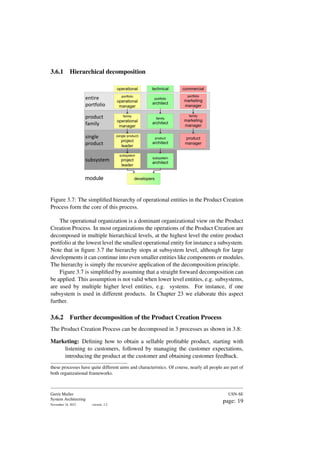
Figure 3.7: The simplified hierarchy of operational entities in the Product Creation
Process form the core of this process.
The operational organization is a dominant organizational view on the Product
Creation Process. In most organizations the operations of the Product Creation are
decomposed in multiple hierarchical levels, at the highest level the entire product
portfolio at the lowest level the smallest operational entity for instance a subsystem.
Note that in figure 3.7 the hierarchy stops at subsystem level, although for large
developments it can continue into even smaller entities like components or modules.
The hierarchy is simply the recursive application of the decomposition principle.
Figure 3.7 is simplified by assuming that a straight forward decomposition can
be applied. This assumption is not valid when lower level entities, e.g. subsystems,
are used by multiple higher level entities, e.g. systems. For instance, if one
subsystem is used in different products. In Chapter 23 we elaborate this aspect
further.
3.6.2 Further decomposition of the Product Creation Process
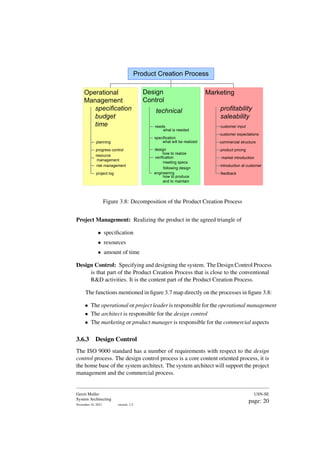
The Product Creation Process can be decomposed in 3 processes as shown in 3.8:
Marketing: Defining how to obtain a sellable profitable product, starting with
listening to customers, followed by managing the customer expectations,
introducing the product at the customer and obtaining customer feedback.
these processes have quite different aims and characteristics. Of course, nearly all people are part of
both organizational frameworks.
Gerrit Muller
System Architecting
November 18, 2023 version: 2.2
USN-SE
page: 19
Product Creation Process
Operational
Management
Design
Control
Marketing
specification
budget
time
technical profitability
saleability
needs
specification
design
engineering
what is needed
what will be realized
how to realize
how to produce
and to maintain
customer input
customer expectations
market introduction
introduction at customer
feedback
product pricing
commercial structure
planning
progress control
resource
management
risk management
project log
verification
meeting specs
following design
Figure 3.8: Decomposition of the Product Creation Process
Project Management: Realizing the product in the agreed triangle of
• specification
• resources
• amount of time
Design Control: Specifying and designing the system. The Design Control Process
is that part of the Product Creation Process that is close to the conventional
R&D activities. It is the content part of the Product Creation Process.
The functions mentioned in figure 3.7 map directly on the processes in figure 3.8:
• The operational or project leader is responsible for the operational management
• The architect is responsible for the design control
• The marketing or product manager is responsible for the commercial aspects
3.6.3 Design Control
The ISO 9000 standard has a number of requirements with respect to the design
control process. The design control process is a core content oriented process, it is
the home base of the system architect. The system architect will support the project
management and the commercial process.
Gerrit Muller
System Architecting
November 18, 2023 version: 2.2
USN-SE
page: 20
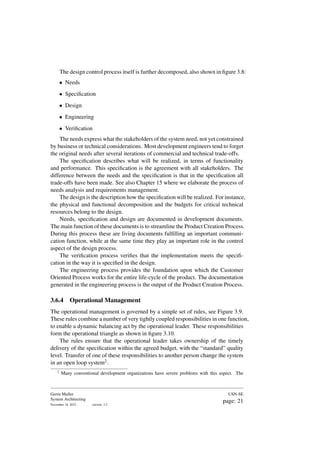
The design control process itself is further decomposed, also shown in figure 3.8:
• Needs
• Specification
• Design
• Engineering
• Verification
The needs express what the stakeholders of the system need, not yet constrained
by business or technical considerations. Most development engineers tend to forget
the original needs after several iterations of commercial and technical trade-offs.
The specification describes what will be realized, in terms of functionality
and performance. This specification is the agreement with all stakeholders. The
difference between the needs and the specification is that in the specification all
trade-offs have been made. See also Chapter 15 where we elaborate the process of
needs analysis and requirements management.
The design is the description how the specification will be realized. For instance,
the physical and functional decomposition and the budgets for critical technical
resources belong to the design.
Needs, specification and design are documented in development documents.
The main function of these documents is to streamline the Product Creation Process.
During this process these are living documents fulfilling an important communi-
cation function, while at the same time they play an important role in the control
aspect of the design process.
The verification process verifies that the implementation meets the specifi-
cation in the way it is specified in the design.
The engineering process provides the foundation upon which the Customer
Oriented Process works for the entire life-cycle of the product. The documentation
generated in the engineering process is the output of the Product Creation Process.
3.6.4 Operational Management
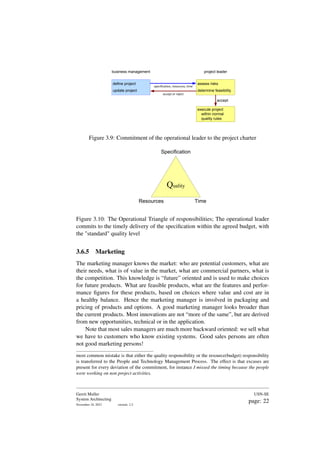
The operational management is governed by a simple set of rules, see Figure 3.9.
These rules combine a number of very tightly coupled responsibilities in one function,
to enable a dynamic balancing act by the operational leader. These responsibilities
form the operational triangle as shown in figure 3.10.
The rules ensure that the operational leader takes ownership of the timely
delivery of the specification within the agreed budget, with the “standard” quality
level. Transfer of one of these responsibilities to another person change the system
in an open loop system2.
2
Many conventional development organizations have severe problems with this aspect. The
Gerrit Muller
System Architecting
November 18, 2023 version: 2.2
USN-SE
page: 21
assess risks
determine feasibility
define project
update project
specification, resources, time
business management project leader
accept or reject
execute project
within normal
quality rules
accept
Figure 3.9: Commitment of the operational leader to the project charter
Resources Time
Specification
Quality
Figure 3.10: The Operational Triangle of responsibilities; The operational leader
commits to the timely delivery of the specification within the agreed budget, with
the "standard" quality level
3.6.5 Marketing
The marketing manager knows the market: who are potential customers, what are
their needs, what is of value in the market, what are commercial partners, what is
the competition. This knowledge is “future” oriented and is used to make choices
for future products. What are feasible products, what are the features and perfor-
mance figures for these products, based on choices where value and cost are in
a healthy balance. Hence the marketing manager is involved in packaging and
pricing of products and options. A good marketing manager looks broader than
the current products. Most innovations are not “more of the same”, but are derived
from new opportunities, technical or in the application.
Note that most sales managers are much more backward oriented: we sell what
we have to customers who know existing systems. Good sales persons are often
not good marketing persons!
most common mistake is that either the quality responsibility or the resource(budget) responsibility
is transferred to the People and Technology Management Process. The effect is that excuses are
present for every deviation of the commitment, for instance I missed the timing because the people
were working on non project activities.
Gerrit Muller
System Architecting
November 18, 2023 version: 2.2
USN-SE
page: 22
3.6.6 Product Creation Teams
Operational Leader
(project leader)
Operational Support
(project manager)
Marketing or
Product Manager
Architect
Application
Manager
Test Engineer
Service Manufacturing
Logistics
Sales
Manager Quality
Assurance
Requirements
Analyst
Subsystem
Operational
Leaders
Subsystem
Architects
Technology-
Specific
Architects
Development
support
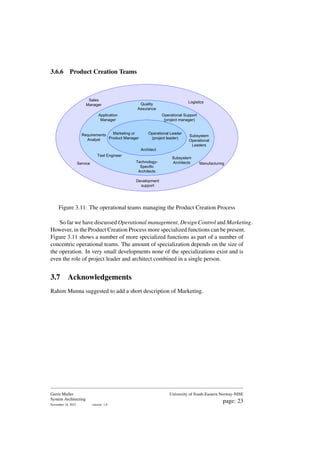
Figure 3.11: The operational teams managing the Product Creation Process
So far we have discussed Operational management, Design Control and Marketing.
However, in the Product Creation Process more specialized functions can be present.
Figure 3.11 shows a number of more specialized functions as part of a number of
concentric operational teams. The amount of specialization depends on the size of
the operation. In very small developments none of the specializations exist and is
even the role of project leader and architect combined in a single person.
3.7 Acknowledgements
Rahim Munna suggested to add a short description of Marketing.
Gerrit Muller
System Architecting
November 18, 2023 version: 1.0
University of South-Eastern Norway-NISE
page: 23
Chapter 4
The Importance of Feedback for
Architecture
deviation
of
direction
without feedback
with feedback
acceptable
deviation
level
time
sampling
interval
4.1 Introduction
Feedback is a universal principle that is applied in highly technical domains such
as control engineering, but also in social sciences. This Intermezzo discusses
feedback as part of the Systems Architecting Process and explains its importance.
4.2 Why Feedback?
4.2.1 Control
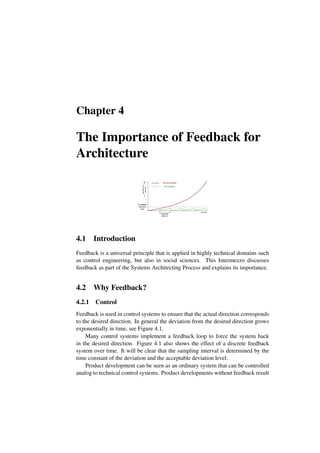
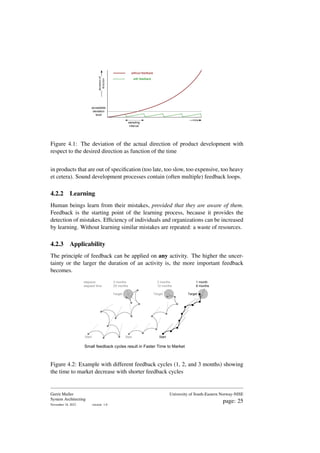
Feedback is used in control systems to ensure that the actual direction corresponds
to the desired direction. In general the deviation from the desired direction grows
exponentially in time, see Figure 4.1.
Many control systems implement a feedback loop to force the system back
in the desired direction. Figure 4.1 also shows the effect of a discrete feedback
system over time. It will be clear that the sampling interval is determined by the
time constant of the deviation and the acceptable deviation level.
Product development can be seen as an ordinary system that can be controlled
analog to technical control systems. Product developments without feedback result
deviation
of
direction
without feedback
with feedback
acceptable
deviation
level
time
sampling
interval
Figure 4.1: The deviation of the actual direction of product development with
respect to the desired direction as function of the time
in products that are out of specification (too late, too slow, too expensive, too heavy
et cetera). Sound development processes contain (often multiple) feedback loops.
4.2.2 Learning
Human beings learn from their mistakes, provided that they are aware of them.
Feedback is the starting point of the learning process, because it provides the
detection of mistakes. Efficiency of individuals and organizations can be increased
by learning. Without learning similar mistakes are repeated: a waste of resources.
4.2.3 Applicability
The principle of feedback can be applied on any activity. The higher the uncer-
tainty or the larger the duration of an activity is, the more important feedback
becomes.
3 months
25 months
2 months
12 months
1 month
8 months
Start Start Start
Target Target Target
stepsize:
elapsed time
Small feedback cycles result in Faster Time to Market
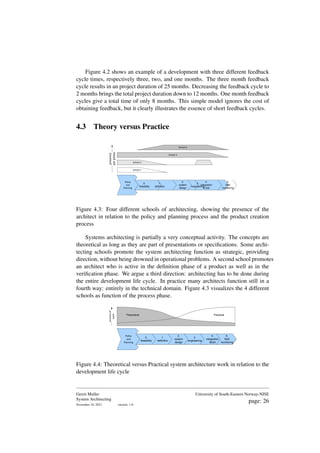
Figure 4.2: Example with different feedback cycles (1, 2, and 3 months) showing
the time to market decrease with shorter feedback cycles
Gerrit Muller
System Architecting
November 18, 2023 version: 1.0
University of South-Eastern Norway-NISE
page: 25
Figure 4.2 shows an example of a development with three different feedback
cycle times, respectively three, two, and one months. The three month feedback
cycle results in an project duration of 25 months. Decreasing the feedback cycle to
2 months brings the total project duration down to 12 months. One month feedback
cycles give a total time of only 8 months. This simple model ignores the cost of
obtaining feedback, but it clearly illustrates the essence of short feedback cycles.
4.3 Theory versus Practice
Policy
and
Planning
0.
feasibility
1.
definition
2.
system
design
3.
engineering
4.
integration
& test
5.
field
monitoring
School 1
School 2
School 3
presence
per
phase
School 4
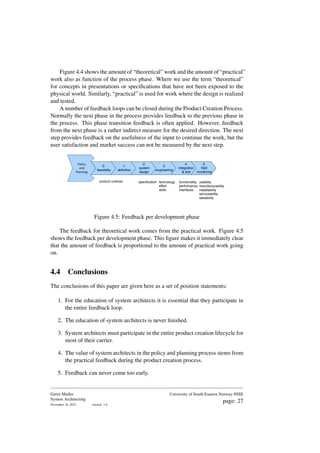
Figure 4.3: Four different schools of architecting, showing the presence of the
architect in relation to the policy and planning process and the product creation
process
Systems architecting is partially a very conceptual activity. The concepts are
theoretical as long as they are part of presentations or specifications. Some archi-
tecting schools promote the system architecting function as strategic, providing
direction, without being drowned in operational problems. A second school promotes
an architect who is active in the definition phase of a product as well as in the
verification phase. We argue a third direction: architecting has to be done during
the entire development life cycle. In practice many architects function still in a
fourth way: entirely in the technical domain. Figure 4.3 visualizes the 4 different
schools as function of the process phase.
amount
of
work
Theoretical Practical
Policy
and
Planning
0.
feasibility
1.
definition
2.
system
design
3.
engineering
4.
integration
&test
5.
field
monitoring
Figure 4.4: Theoretical versus Practical system architecture work in relation to the
development life cycle
Gerrit Muller
System Architecting
November 18, 2023 version: 1.0
University of South-Eastern Norway-NISE
page: 26
Figure 4.4 shows the amount of “theoretical” work and the amount of “practical”
work also as function of the process phase. Where we use the term “theoretical”
for concepts in presentations or specifications that have not been exposed to the
physical world. Similarly, “practical” is used for work where the design is realized
and tested.
A number of feedback loops can be closed during the Product Creation Process.
Normally the next phase in the process provides feedback to the previous phase in
the process. This phase transition feedback is often applied. However, feedback
from the next phase is a rather indirect measure for the desired direction. The next
step provides feedback on the usefulness of the input to continue the work, but the
user satisfaction and market success can not be measured by the next step.
specification technology
effort
skills
functionality
performance
interfaces
usability
manufacturability
installability
serviceability
saleability
product outlines
Policy
and
Planning
0.
feasibility
1.
definition
2.
system
design
3.
engineering
4.
integration
& test
5.
field
monitoring
Figure 4.5: Feedback per development phase
The feedback for theoretical work comes from the practical work. Figure 4.5
shows the feedback per development phase. This figure makes it immediately clear
that the amount of feedback is proportional to the amount of practical work going
on.
4.4 Conclusions
The conclusions of this paper are given here as a set of position statements:
1. For the education of system architects it is essential that they participate in
the entire feedback loop.
2. The education of system architects is never finished.
3. System architects must participate in the entire product creation lifecycle for
most of their carrier.
4. The value of system architects in the policy and planning process stems from
the practical feedback during the product creation process.
5. Feedback can never come too early.
Gerrit Muller
System Architecting
November 18, 2023 version: 1.0
University of South-Eastern Norway-NISE
page: 27
6. System architects can have fantastic dreams, feedback is required to prevent
that dreams turn into a nightmares.
Gerrit Muller
System Architecting
November 18, 2023 version: 2.3
USN-SE
page: 28
Chapter 5
The System Architecture Process
customer
Customer-Oriented Process
$$
sales logisticsproduction service
presales
Product Creation Process
People, Process, and Technology Management Process
Business
Drivers
Customer
Roadmap
Budget,
plan
Product
roadmap
Technology,
Process
and
People
roadmaps
Budgets
People
Technology
Process
Needs
and
Feedback
Technical
Product
Documentation
Product
related
processes
People
Technology
Process
Information
Order
Product
$$
Support
Product
Needs
and
feedback
C
o
n
te
x
t,
V
is
io
n
Policy and
Planning Process
R
e
a
li
ty
c
h
e
c
k
S
t
a
k
e
h
o
ld
e
r
in
t
e
r
a
c
t
io
n
Systems Architecting Process
material
5.1 Introduction
This chapter positions the systems architecting process in a wider business scope.
This positioning is intended to help understanding the process itself and the role of
the system architect (or team of system architects).
We focus on systems architecting within organizations that create and build
systems consisting of hardware and software. Although other product areas such
as solution providers, services, courseware et cetera also need system architects,
the process structure will deviate from the structure as presented here. See Inter-
mezzo 6 for an elaboration of these other architecting models.
5.2 System Architecture in the Business Context
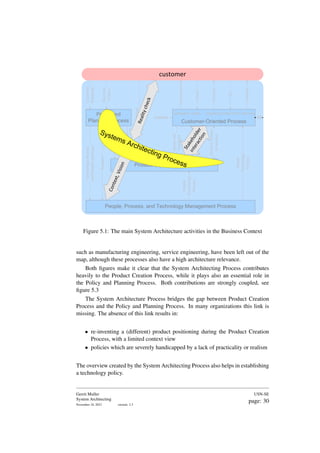
Figure 5.1 shows the main activities of the System Architecting Process as an
overlay over the business decomposition.
Processes are goal oriented, as discussed in Intermezzo 2. The process decom-
position is not orthogonal, several processes are overlapping. The System Archi-
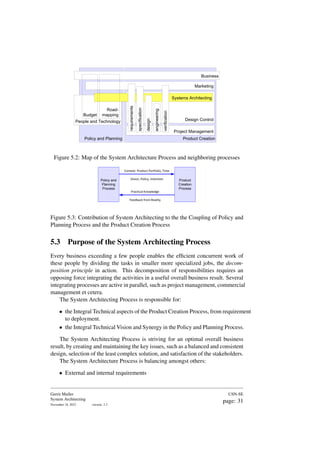
tecting Process is a clear example of such non-orthogonality. Figure 5.2 shows a
map of the System Architecture Process and neighboring processes. Many processes,
customer
Customer-Oriented Process
$$
sales logisticsproduction service
presales
Product Creation Process
People, Process, and Technology Management Process
Business
Drivers
Customer
Roadmap
Budget,
plan
Product
roadmap
Technology,
Process
and
People
roadmaps
Budgets
People
Technology
Process
Needs
and
Feedback
Technical
Product
Documentation
Product
related
processes
People
Technology
Process
Information
Order
Product
$$
Support
Product
Needs
and
feedback
C
o
n
t
e
x
t
,
V
i
s
i
o
n
Policy and
Planning Process
R
e
a
l
i
t
y
c
h
e
c
k
S
t
a
k
e
h
o
l
d
e
r
i
n
t
e
r
a
c
t
i
o
n
Systems Architecting Process
material
Figure 5.1: The main System Architecture activities in the Business Context
such as manufacturing engineering, service engineering, have been left out of the
map, although these processes also have a high architecture relevance.
Both figures make it clear that the System Architecting Process contributes
heavily to the Product Creation Process, while it plays also an essential role in
the Policy and Planning Process. Both contributions are strongly coupled, see
figure 5.3
The System Architecture Process bridges the gap between Product Creation
Process and the Policy and Planning Process. In many organizations this link is
missing. The absence of this link results in:
• re-inventing a (different) product positioning during the Product Creation
Process, with a limited context view
• policies which are severely handicapped by a lack of practicality or realism
The overview created by the System Architecting Process also helps in establishing
a technology policy.
Gerrit Muller
System Architecting
November 18, 2023 version: 2.3
USN-SE
page: 30
Policy and Planning
People and Technology
Product Creation
Marketing
Project Management
Design Control
Systems Architecting
Business
Road-
mapping
Budget
requirements
specification
design
engineering
verification
Figure 5.2: Map of the System Architecture Process and neighboring processes
Policy and
Planning
Process
Product
Creation
Process
Context: Product Portfolio, Time
Vision, Policy, Intention
Practical Knowledge
Feedback from Reality
Figure 5.3: Contribution of System Architecting to the the Coupling of Policy and
Planning Process and the Product Creation Process
5.3 Purpose of the System Architecting Process
Every business exceeding a few people enables the efficient concurrent work of
these people by dividing the tasks in smaller more specialized jobs, the decom-
position principle in action. This decomposition of responsibilities requires an
opposing force integrating the activities in a useful overall business result. Several
integrating processes are active in parallel, such as project management, commercial
management et cetera.
The System Architecting Process is responsible for:
• the Integral Technical aspects of the Product Creation Process, from requirement
to deployment.
• the Integral Technical Vision and Synergy in the Policy and Planning Process.
The System Architecting Process is striving for an optimal overall business
result, by creating and maintaining the key issues, such as a balanced and consistent
design, selection of the least complex solution, and satisfaction of the stakeholders.
The System Architecture Process is balancing amongst others:
• External and internal requirements
Gerrit Muller
System Architecting
November 18, 2023 version: 2.3
USN-SE
page: 31
• Short term needs and long term interests
• Efforts and risks from requirements to verification
• Mutual influence of detailed designs
• Value and costs
Such a balance is obtained by making trade-offs, for example performance
versus qualities versus functionality, or synergy versus specific solution
It is the purpose of the System Architecting Process to maintain the consistency
throughout the entire system, from roadmap and requirement to implementation
and verification. On top of this consistency the integrity in time must be ensured.
An enabling factor for an optimal result is simplicity of all technical aspects.
Any unnecessary complexity is a risk for the final result and lowers the overall
efficiency.
5.4 The System Architect as Process Owner
The owner of the System Architecting Process is the System Architect or the
System Architecting Team. Many other people are involved in the System Archi-
tecting Process.
The system architect or the team members spent the majority of their time,
about 80%, in the Product Creation Process. From the remaining time the majority
is spent in the Policy and Planning Process. In 5.2 it is explained that these
processes are strongly coupled. This coupling is for a large part implemented by
employing the same people in both processes. A small amount of time is spent in
People, Process, and Technology Management.
5.5 System Architecting in Product Creation Context
The Systems Architecting Process is striving for consistency and balance from
requirement to actual product.
The amount of people working in product creation can vary from a few to tens
of thousands of people. All people working on the creation of a new product have
only knowledge of a (small) subset of the information. Inconsistencies and local
optimal solutions pop up all the time, caused by lack of knowledge of the broader
context.
The Systems Architecting Process has to prevent this natural degradation of the
system quality. Systems Architecting acts pro-active by clear and sharp require-
ments, specification and system design as well as reactive by following up the
feedback from detailed design, implementation and test.
During the Product Creation Process many specification and design decisions
are taken. Quite often these decisions are taken within the scope of that moment.
Gerrit Muller
System Architecting
November 18, 2023 version: 2.3
USN-SE
page: 32
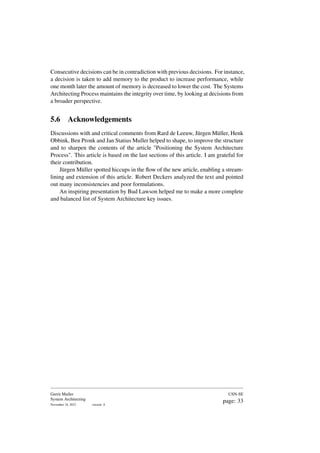
Consecutive decisions can be in contradiction with previous decisions. For instance,
a decision is taken to add memory to the product to increase performance, while
one month later the amount of memory is decreased to lower the cost. The Systems
Architecting Process maintains the integrity over time, by looking at decisions from
a broader perspective.
5.6 Acknowledgements
Discussions with and critical comments from Rard de Leeuw, Jürgen Müller, Henk
Obbink, Ben Pronk and Jan Statius Muller helped to shape, to improve the structure
and to sharpen the contents of the article "Positioning the System Architecture
Process". This article is based on the last sections of this article. I am grateful for
their contribution.
Jürgen Müller spotted hiccups in the flow of the new article, enabling a stream-
lining and extension of this article. Robert Deckers analyzed the text and pointed
out many inconsistencies and poor formulations.
An inspiring presentation by Bud Lawson helped me to make a more complete
and balanced list of System Architecture key issues.
Gerrit Muller
System Architecting
November 18, 2023 version: 0
USN-SE
page: 33
Chapter 6
Products, Projects, and Services;
similarities and differences in
architecting
logo
TBD
6.1 Introduction
We have focused on the product creation of “box” like products: products that have
a clear physical part; the product is a box that is created and the products are sold
as boxes by sales. In the twentieth century this was one of the dominating models
in industry. Another business model is project delivery: customers order a turn-key
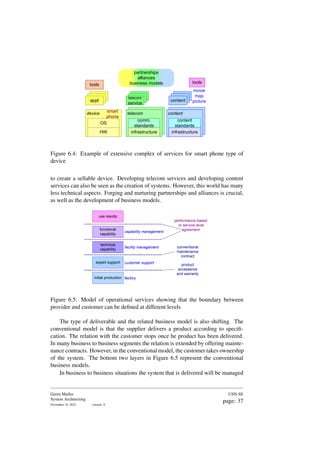
solution to be delivered by the supplier.
At the end of the century, several other types of systems and related business
models became increasingly important. An increase of interoperating systems
has opened a world of services, e.g. traffic information for navigation systems.
Services are also systems, but these systems tend to be less tangible, while these
service systems often include people, processes and organizations.
Similarly, System of Systems emerge everywhere. We have become dependent
on the interoperation of multiple systems, the system of systems.
6.2 Products and Projects
project product
unique
customer specific
catalogue
generic
"one size fits all"
tailored to customer needs
mass production
economy of scale
investment in product design
tender-contract-execution
cost ~= project hours
investment by customer
Figure 6.1: Projects versus Products
Figure 6.1 shows an axis with on the left hand extreme projects and on the right
hand extreme products. We can characterize the extremes as:
Projects are unique for a specific customer. The solution is tailored to the customer
needs. The sales starts with a tender phase, the execution phase starts when
the contract has been signed. Cost is typically proportional with the number
of project hours. In project business the customer is the investing party and
carries most of the risk.
Products are standardized as part of the sales catalogue. Products are designed to
be generic, i.e. to serve multiple customers. The standardization in extremis
assumes that “one size fits all”. At the same time standardization enables
mass production, while the increased volume of multiple customers provides
an economy of scale. Product companies typically invest themselves in new
product designs
In practice business models are less black and white. Figure 6.2 shows a
number of forces that lead to convergence between these two extremes. Project
organizations see opportunities to increase their margin by harvesting and re-using
standardized components or products. Product organizations adapt their standard
products more to specific customer needs by making their products customizable
and configurable. Customer support can adapt the product at the customer site to
customer specific needs.
Figure 6.3 shows a simplified process diagram for project business. The Customer
Oriented Process is replace by a triplet of processes:
Tender process where the specification and price are negotiated with the customer.
Gerrit Muller
System Architecting
November 18, 2023 version: 0
USN-SE
page: 35
project product
unique
customer specific
catalogue
generic
harvest and use
standardized components/products
configuration and customization
customer specific at customer site
Figure 6.2: Convergence of Projects and Products
systems architecting/
engineering
tender
project
execution
product creation
deployment
contract systems
products or
components
policy and
planning
people, process, and technology management
Figure 6.3: Simplified process diagram for project business
Execution process where the solution is created.
Deployment process where the systems are installed at the customer site and the
operation is started.
6.3 Services
Figure 6.4 shows an example of a smart phone context. The smart phone as device
contains hardware, operating system and software. The device offers an application
infrastructure for many applications that are created by many different parties. The
application creation probably will be supported by tools.
The applications on the device and telecom services facilitate content services
in the broader world. E.g. a location service based on position, map, and directory
information.
Device builders have to cooperate with the telecom world and the content world
Gerrit Muller
System Architecting
November 18, 2023 version: 0
USN-SE
page: 36
content
content
content
telecom
appl
device
OS
HW
appl
appl
tools
telecom
infrastructure
telecom
service
content
comm.
standards
content
standards
content
movie
map
picture
smart
phone
tools
partnerships
alliances
business models
infrastructure
Figure 6.4: Example of extensive complex of services for smart phone type of
device
to create a sellable device. Developing telecom services and developing content
services can also be seen as the creation of systems. However, this world has many
less technical aspects. Forging and nurturing partnerships and alliances is crucial,
as well as the development of business models.
initial production
expert support
use results
technical
capability
functional
capability
customer support
facility management conventional
maintenance
contract
product
acceptance
and warranty
capability management
performance-based
or service-level
agreement
factory
Figure 6.5: Model of operational services showing that the boundary between
provider and customer can be defined at different levels
The type of deliverable and the related business model is also shifting. The
conventional model is that the supplier delivers a product according to specifi-
cation. The relation with the customer stops once he product has been delivered.
In many business to business segments the relation is extended by offering mainte-
nance contracts. However, in the conventional model, the customer takes ownership
of the system. The bottom two layers in Figure 6.5 represent the conventional
business models.
In business to business situations the system that is delivered will be managed
Gerrit Muller
System Architecting
November 18, 2023 version: 0
USN-SE
page: 37
by a facilitation or technical department. E.g. in hospitals the radiology equipment
is supported by technical hospital staff. The actual operation of the system is done
by application experts, in the hospital example the radiology equipment is run by
dedicated clinical staff and radiologists. The radiology department provides an
imaging and diagnosis capability to the referring physicians.
The equipment manufacturer can shift their support “upwards” to offer:
Facility management a technical working and prepared system.
Capability management where the whole capability, such as diagnostic imaging,
is offered.
The consequence of this shift is that the supplier creates a recurring revenue stream.
The integral consequence for customer and supplier is that incentives are changing.
For example, when the supplier is responsible for a constant performance,
then the supplier might decide to upgrade the equipment much more regular. The
supplier also gets an incentive to minimize down time and maintenance costs.
The process structure might be adapted to facilitate the service development.
Service development, both for the content type as well as for the operational type,
require many less technical, more political, social, and economical development
activities.
6.4 System of Systems
System of Systems
autonomous
different rate of change
many heterogeneous systems
many humans in the loop
geographical distributed
consequences
emergent behavior
lack of understanding and
overview
continuous change
more political and economic
factors
Figure 6.6: System of Systems and the consequences of this approach
Today’s society depends heavily on the interoperability of many systems. We
recognize that the solution can be created by interoperability of multiple systems,
the so called System of Systems. See Figure 6.6 for the characteristics of System
of Systems and the consequences of this approach. The System of Systems can be
seen as a super system.
Examples of system of systems are:
Military capabilities , where amongst others planes, tanks, guns, officers, soldiers,
and sensors are interconnected.
Gerrit Muller
System Architecting
November 18, 2023 version: 0
USN-SE
page: 38
Health care treatment room , e.g. operating theater or catherization laboratory,
where respiratory and physiology monitors, surgical tools, clinical support
systems, nurses, surgeons, et cetera collectively perform the treatment function.
The individual systems in a System of Systems can operate autonomously.
Most often these systems have not been created with this specific super-system
in mind. The individual systems follow their own life cycles, with different rates
of change. The systems can be quite heterogeneous (large, small, expensive, low
cost, re-usable, disposable, fragile, robust, et cetera). Every system has its own
human machine interface and its own control paradigm. The geographical location
of the systems can be distributed and may change.
These characteristics have several consequences. The most dominant conse-
quence is that the super system is so complex that nobody has the understanding
and the overview of the whole. Hence nobody can predict what will happen and
we get so-called emergent behavior. The amount of systems with their different
change rates and the amount of humans create a super system that is never exactly
the same: it changes continuously. In the larger scope of the System of Systems
many non technical factors play a role, e.g. economical or political.
Gerrit Muller
System Architecting
November 18, 2023 version: 0
USN-SE
page: 39
Part II
The System Architect as a Person
Chapter 7
The Awakening of a System
Architect
root
technical
knowledge
generalist
technical
knowledge
business,
application insight
process insight
psychosocial
skills
7.1 Introduction
System architects are very rare commodity. This chapter describes the observed
general growth pattern of system architects. We hope that by analysis of the
the characteristics of existing system architects will facilitate the training of new
system architects. Reference [21] contains a good description of a system architect.
7.2 The Development of a System Architect
root
technical
knowledge
generalist
technical
knowledge
business,
application insight
process insight
psychosocial
skills
Figure 7.1: Typical Development of a System Architect
System architects need a wide range of knowledge, skills and experience to be
effective. Figure 7.1 shows a typical development of a system architect.
The system architect is rooted in technology. A thorough understanding of
a single technological subject is an essential underpinning. The next step is a
broadening of the technical scope. Section 7.3 describes the path from a mono-
disciplinary specialist to a multi-disciplinary system architect with broad techno-
logical knowledge.
When the awakening system architect has reached technological breadth, then
it will become obvious that most encountered problems have a root cause outside of
technology. The system architect starts to develop along two main parallel streams:
The business side: the market, customers, value, competition, logistics, service
aspects
The process side: who is doing what and why, necessitated by the amount of
involved stakeholders
During this phase the system architect will broaden in these two dimensions.
The system architect will view these dimensions from a technological perspective.
Again when a sufficient level of understanding is attained an awareness starts to
grow that people behave much less rationally than technical designs. The growing
awareness of the psychological and the sociological aspects is the next phase of
growth.
7.3 Generalist versus Specialist
Most developers of complex high tech products are specialists. They need an in-
depth understanding of the applicable technology to effectively guide the product
development. The decomposition of the development work is most often optimized
to create a work breakdown enabling these specialists to do their work with as much
autonomy as possible.
specialist
generalist
root
knowledge
breadth of
knowledge
depth
of
knowledge
Figure 7.2: Generalist versus Specialist; depth versus breadth
Gerrit Muller
System Architecting
November 18, 2023 version: 1.1
University of South-Eastern Norway-NISE
page: 42
Figure 7.2 is a visualization of the difference between a specialist and a gener-
alist. Most generalists are constrained in the depth of their knowledge by normal
human limitations, such as the amount of available time and the finite capacity of
the human mind. The figure also shows that a generalist has somewhere roots in
detailed technical knowledge. These roots are important for the generalist self,
since it provides an anchor and a frame of reference. It is also vital in the commu-
nication with other specialists, because it gives the generalist credibility.
specialist
specialist
specialist
specialist
specialist
specialist
specialist
specialist
generalist
generalist
breadth of
knowledge
depth
of
knowledge
Figure 7.3: Generalists and Specialists are both needed in complex products, they
have complementary expertise
Figure 7.3 shows that both generalists and specialists are needed. Specialists
are needed for their in depth knowledge, while the generalists are needed for their
general integrating ability. Normally there are much more specialists required than
generalists.
There are more functions in the Product Creation Process that benefit from a
generalist profile. For instance the functions of project-leader or tester both require
a broad area of know how.
Architects require a generalist profile, since one of their primary functions is
to generate the top-level specification and design of the system. The step from
a specialist to a generalist is of course not a binary transition. Figure 7.4 shows
a more gradual spectrum from specialist to system architect. The arrows show
that intermediate functions exist in larger product developments, forming natural
stepping stones for the awakening architect.
Examples of aspect architects are:
subsystem architects subsystems are the main organizational decomposition. In
hardware intensive systems subsystems tend to be physical, e.g. loader or
generator. Typical number of subsystems is between 5 and 15.
Gerrit Muller
System Architecting
November 18, 2023 version: 1.1
University of South-Eastern Norway-NISE
page: 43
all-round
specialist
systems architect
specialist
root
knowledge
aspect
architect
breadth of knowledge
depth
of
knowledge
Figure 7.4: Growth in technical breadth, intermediate functions from specialist to
system architect
SW, mechanics or electronics architects or discipline oriented architects. The
architects ensure consistency across physical subsystems
function architects take responsibility for one system function, ensuring the soundness
of that function.
quality architects take responsibility for one quality, e.g. safety, reliability, security.
For instance a software architect needs a significant in-depth knowledge of software
engineering and technologies, in order to design the software architecture of the
entire system. On the other hand a subsystem architect requires multi-disciplinary
knowledge. The limited scope of one subsystem reduces the required breadth for
the subsystem architect to a hopefully realistic level.
Many products are becoming so complex that a single architect is not capable of
covering the entire breadth of the required detailed knowledge areas. In those cases
a team of architects is required, where the architects are complementing each other
in knowledge and skills. It is recommended that those architects have comple-
mentary roots as well; as this will improve the credibility of the team of architects.
7.4 Acknowledgements
Chuck Kilmer suggested a new title and offered many textual improvements.
Gerrit Muller
System Architecting
November 18, 2023 version: 0
University of South-Eastern Norway-NISE
page: 44
Chapter 8
Systems Titles and Roles
recognized
true
architects
title =
architect
do the work &
have the skills
hidden
architects
do other work
or lack skills
impostor
or
pushed
title
architect
any other
role
8.1 Introduction
The following questions are asked frequently during and after the courses:
• What is the difference between systems engineers and systems architects?
• Why do all these people have the title systems architect, while they actually
don’t do the work?
The first questions is also posed in other variants, using titles such as system
designer or systems manager. To complicate matters more there are people who do
part of the systems level work, for example requirements analyst, systems analyst,
system integrator or system tester, complementing the systems architect.
8.2 Cultural differences in terms
Exactly the same titles are used differently in different companies (or even divisions
or product groups within one company), in different domains (e.g. defense, automotive,
consumer electronics, IT), and geographic regions. No single unified standardized
definition is used across companies, domains, and geographies. We do recommend
to calibrate terminology when entering new territory, and to be continuously alert
for differences in interpretation even after calibration.
Throughout this book we use the term architecture for the combination of two
crucial aspects:
Depth understanding of the system-of-interest including product specification,
decomposition in subsystems and components, interface management, and
function and resource allocation, to create a sound and fitting system that
fulfills all qualities (e.g. safety, reliability, performance).
Breadth understanding of the context including the customer context and the
stakeholders in the value chain , and the life cycle context from conception
to decommissioning and all related business aspects.
Be aware that the term architect is used often for the system-of-interest part only.
We use the term system design for this subset of architecting work.
A major professional society in the systems world is INCOSE, the International
Council of Systems Engineering. The Systems Engineer as depicted by most of
INCOSE documents is a very broad function, including work of the project leader,
the requirements analyst, the systems architect, the configuration manager, and
quality assurance.
Another extreme for the definition of systems engineer was in the medical
domain, where this job of the systems engineer was solely the electro-mechanical
design of cables and cabinets.
8.3 Title versus skills and actual job
recognized
true
architects
title =
architect
do the work &
have the skills
hidden
architects
do other work
or lack skills
impostor
or
pushed
title
architect
any other
role
Figure 8.1: Four quadrants to classify architect and titles
First of all we have to distinguish what role or function someone performs
and the title that is being used by the people in the context. Figure 8.1 shows the
Gerrit Muller
System Architecting
November 18, 2023 version: 0
University of South-Eastern Norway-NISE
page: 46
four quadrants that you get by using title as horizontal axis and competence level
as vertical axis. Note that the title axis is discrete, while the competence level is
continuous. The figure shows four quadrants:
Any other role (bottom left) for these persons that don’t do the job of an architect
and do not have the title.
Imposters or pushed persons (bottom right) are people lacking the skills or actually
not doing the work of an architect that nevertheless have the title architect.
Note that impostors are these people that actually pursued the title, for example
because of status or payment. Another category are those people that are
pushed by their management into this job, but lack the capability to do it.
People do not become true architects by declaration.
Hidden architects (top left) can be found in many organizations. These organi-
zations might use different titles or they might not be aware of the systems
discipline.
Recognized true architects (top right) are these architects that actually do the
architecting job skillfully and got he title in recognition.
8.4 Systems roles and titles
Policy
and
Planning
0.
feasibility
1.
definition
2.
system
design
3.
engineering
4.
integration
& test
5.
field
monitoring
systems architect
systems engineer
systems designer
systems tester
systems manager
Figure 8.2: System Roles mapped on the development life cycle
In this section we provide a set of roles and relate these to the development
life cycles. As explained in the previous sections these roles can be allocated in
different ways and different terms can be used than shown here. However, the
conceptual roles as shown here are quite universal.
Figure 8.2 shows the following roles:
Systems manager is the overall responsible for all systems aspects, ranging from
strategically positioning in the portfolio and the time to final operational
performance in the field. Note that such broad definition does not leave
Gerrit Muller
System Architecting
November 18, 2023 version: 0
University of South-Eastern Norway-NISE
page: 47
much room for in-depth understanding. An alternate term for this role can
be program manager.
Systems architect who combines understanding of the context with in depth under-
standing of the solution to create an appropriate system. Note that the architect
role combines some perceptive and creative modes of operation with more
analytical modes. This mixture limits how far the architect can go in the real
engineering.
Systems engineer is very close to the systems architect, but the emphasis shifts
from perceptive and creative more to engineering. With engineering we
mean the capability to finalize and document all details required for the
later processes such as logistics, manufacturing, sales, and customer support.
Note that also the systems engineer has limits and will depend on specialized
engineers (e.g. mechanical, electrical, or software) to finish the last details
of the technical product documentation.
Systems designers take the product specification as starting point and work on
(potential) solutions. System designers are “inward” focused, where system
architects connect the outward and inward perspectives.
System testers verify that the solution performs as specified. In practice system
testers need also trouble shooting capabilities to diagnose the cause of lacking
performance.
Gerrit Muller
System Architecting
November 18, 2023 version: 2.0
USN-SE
page: 48
Chapter 9
The Role and Task of the System
Architect
V4aa
IO
design,
brainstorm,
explain
Idea
think,
analyze
listen, talk,
walk around
Blah
Blah
write,
consolidate,
browse
present,
meet, teach,
discuss
read,
review
Design
Spec
Report
test,
integrate
assist project leader
with work breakdown,
schedule, risks
travel to
customer,
supplier,
conference
provide
vision and
leadership
9.1 Introduction
Architects and organizations are often struggling with the role of the system architect
(or software architect or any other kind of architect). This struggle is partially
caused by the intangible nature of the responsibilities of the architect. At the other
hand (good) architects are highly appreciated, even if their quantifiable output is
low.
This article starts with specific deliverables, then discusses the more abstract
responsibilities and, finally, discusses the day to day activities of an architect.
The role of the software architect is nicely discussed in [3].
9.2 Deliverables of the System Architect
We start at looking for the tangible output that is expected from architects. Project
leaders and program managers do expect deliverables to be finished at appro-
priate milestones. Most Product Creation Processes define the deliverables of a
System Architect to be artifacts such as documents or models. These artifacts are
symbolized by the stack in Figure 9.1.
Spec Design
Report
Report
Report
Design
Design
Spec
Spec
Figure 9.1: Deliverables of a system architect consists of artifacts forming a stack
of paper when printed
Figure 9.2 shows the main deliverables of a System Architect more specific.
Quite often the System Architect does not even produce all deliverables mentioned
here, but the architect does take the responsibility for these deliverables by coordi-
nating and integrating contributions of others. Note that some of these deliverables
are part of the Policy and Planning Process.
Customer and Life-Cycle Needs (what is needed)
System Specification (what will be realized)
Design Specification (how the system will be realized)
Verification Specification (how the system will be verified)
Verification Report (the result of the verification)
Feasibility Report (the results of a feasibility study)
Roadmap
Figure 9.2: More specific list of deliverables of a System Architect
9.3 System Architect Responsibilities
The System Architect has a limited set of primary responsibilities, as visualized in
figure 9.3. The primary responsibilities are:
Balance of system properties as well as internal design properties. The system
should be balanced: for example, the cost of subsystems should correspond
with its added value in terms of functionality and performance. Archi-
tecting is a continuous balancing act in many incomparable dimensions and
quantities.
Consistency across many organizational and design boundaries; From needs to
implementation details, from system level to detailed implementation.
Gerrit Muller
System Architecting
November 18, 2023 version: 2.0
USN-SE
page: 50
system
subsystem
Balance Consistency
module
Overview
Requirement
Spec
Design
Realization
Decomposition
Integration
modules
Function
Q
u
a
l
i
t
y
KISS
Elegance
Simple Integrity Fitting
satisfied
stakeholders
system
context
Figure 9.3: The primary responsibilities of the system architect are not tangible
and easily measurable
Decomposition, Integration Decomposition is the standard answer in dealing with
complex and big problems. Decomposing Systems in subsystems, subsystems
in modules et cetera is a major responsibility of the architect. In most
systems many decomposition dimensions are required: physical, logical,
functional, and many more, see [18]. The complementary action of decom-
position, however, is integration. The integral functioning and performance
of the system is the ultimate goal of product creation, which emphasizes
the importance of integration. In practice integration is much more difficult
than decomposition, in fact the architect must decompose in such a way that
integration is feasible.
Overview of the entire system and its context helps to make sensible specification
and design decisions. The architect should provide overview to all members
of the product creation team. Most of these members have a very limited
horizon. The architect should help them by providing proper context infor-
mation to make local design decisions.
Elegance, Simplicity are properties of a “good” architecture. The dangerous aspect
of this responsibility is the highly subjective nature of elegance and simplicity.
The appreciation of simplicity and elegance should be assessed or acknowl-
edged by others than the architect.
Integrity of the system specification and design over time. The focus of a devel-
opment team is often wandering over time, sometimes it depends on the
Gerrit Muller
System Architecting
November 18, 2023 version: 2.0
USN-SE
page: 51
hype of the week. The architect is responsible for maintaining a balanced
and focused development over time. For instance, when cost price reduction
is required then the architect should keep performance and reliability on the
agenda.
Fitting in stakeholder needs and system context, during the entire life cycle, is one
of the core responsibilities of the architect. The architect must connect depth
knowledge with breadth knowledge.
We can condense the primary responsibility of the System Architect as: to
ensure the good functioning of the System Architecting Process. In practice, this
responsibility is often shared by a team of System Architects, with one chief architect
taking the overall responsibility.
responsibility
business plan, profit
schedule, resources
market, saleability
technology
process, people
detailed designs
primary owner
business manager
project leader
marketing manager
technology manager
line manager
engineers
Figure 9.4: (Incomplete) list of secondary responsibilities of the system architect
and the related primary owner
The list of primary responsibilities as discussed above is suffering from a lack
of measurability and is rather intangible. Systems Architects also have secondary
responsibilities, where these are primarily owned by other persons. Most other
roles in product creation are much sharper defined, as shown in Figure 9.4. For
instance the business manager is responsible for the business plan and the financial
results. The project leader is responsible for the schedule and hence for completing
the project in time and within budget. The marketing manager is responsible for
addressing the relevant markets and hence for market share and salability of the
product. The technology manager is responsible for the timely availability of
technologies and related tools. The line manager is responsible for the availability
of the right people, with skills and processes to do their job. Final example are the
engineers who are responsible for the design of their component or module.
Gerrit Muller
System Architecting
November 18, 2023 version: 2.0
USN-SE
page: 52
9.4 What does the System Architect do?
Figure 9.5 shows the variety of activities of the day to day work of a system
architect. A large amount of time is spent in gathering, filtering, processing and
discussing detailed data in an informal setting. These activities are complemented
by more formal activities like meetings, visits, reviews et cetera.
V4aa
IO
design,
brainstorm,
explain
Idea
think,
analyze
listen, talk,
walk around
Blah
Blah
write,
consolidate,
browse
present,
meet, teach,
discuss
read,
review
Design
Spec
Report
test,
integrate
assist project leader
with work breakdown,
schedule, risks
travel to
customer,
supplier,
conference
provide
vision and
leadership
Figure 9.5: The System Architect performs a large amount of activities, where
most of the activities are barely visible for the environment, while they are crucial
for the functioning of architects
The system architect is rapidly switching between specific detailed views and
abstract higher level views. The concurrent development of these views is a key
characteristic of the way a system architect works.
Abstractions only exist for concrete facts
System Architects which stay too long at "high" abstraction levels drift away
from reality, by creating their own virtual reality.
Figure 9.6 shows the bottom up elicitation of higher level views. A system
architect sees a tremendous amount of details, most of these details are skipped, a
smaller amount is analyzed or discussed. A small subset of these discussed details
is shared as an issue with a broader team of designers and architects. Finally, the
system architect consolidates the outcome in a limited set of views. The order of
magnitude numbers cover the activities in one year.
The opposite flow in 9.6 is the implementation of many of the responsibilities
Gerrit Muller
System Architecting
November 18, 2023 version: 2.0
USN-SE
page: 53
driving views
shared issues
touched details
seen details
real-world facts
10
102
104
107
infinite
Quantity
per year
(order-of-
magnitude)
architect
time per
item
100 h
1 h
10 min
meetings
consolidation
in
deliverables
informal
contacts
product details
sampling
scanning
0.1
105
0.5
1 sec
106
1010
Figure 9.6: Bottom up elicitation of high level views
of the system architect. By providing overview, insight and fact-based direction a
simple, elegant, balanced and consistent design will crystalize, where the integrity
of designs goals and solutions are maintained during the project.
A lot of time spent by the architect serves the purpose of communication
between many project members. The architect not only responsible for the system
integration, but has also an integrating role in the project itself. The architect has
to interact a lot with all the people mentioned in Figure 9.4, in order to fulfil the
architect’s responsibilities.
9.5 Task versus Role
The task of the system architect is to generate the agreed deliverables, see section 9.2
This measurable output is requested and tracked by the related managers: project
leaders and the line managers. Many managers appreciate their architects only for
this visible subset of their work.
The deliverables are only one of the means to fulfil the System Architect Respon-
sibilities, as described in section 9.3. The system architect is doing a lot of nearly
invisible work to achieve the system level goals, his primary responsibility. This
work is described in section 9.4. Figure 9.7 shows this as a pyramid or iceberg: the
top is clearly visible, the majority of the work is hidden in the bottom.
9.6 Acknowledgements
Nicolette Yovanof pointed out that the text belonging to Figure 2 and Table 2 was
rather incomplete. She also mentioned that some more attention for the inter-
action with non-architects would be helpful. Chuck Kilmer provided feedback
on ”The Awakening of a System Architect”, which resulted also in an update of
Gerrit Muller
System Architecting
November 18, 2023 version: 2.0
USN-SE
page: 54
V4aa
IO
Idea
Bla Bla
Design
Spec
Report
system
subsystem
module
Requirement
Spec
Design
Realization
modules
Function
Q
u
a
li
ty
KISS
Activities
Responsibilities
Deliverables
Decreasing
Visibility
Spec Design
Report
Report
Report
Design
Design
Spec
Spec
From Manager perspective
Figure 9.7: The visible outputs versus the (nearly) invisible work at the bottom
this paper. Byeong Ho Gong suggested a better coverage of the interfacing with
customers/stakeholders. Pierre van de Laar provided textual improvements.
Gerrit Muller
System Architecting
November 18, 2023 version: 1.0
USN-SE
page: 55
Chapter 10
Function Profiles; The Sheep with
Seven Legs
communication
teamwork
documentation
multitasking
flexible,
open
authority
by
expertise
specialist
generalist
conceptual
pragmatic
constructive
critical
fast
absorption
of
knowledge
creativity
manual
skills
process
insight
political
insight
improvement
completeness
customer
value
sales
features
commercial
insight
coaching
selection
appraisal
motivation
1
2
3
4
5
6
7
8
9
1
2
3
4
5
6
7
8
9
decision
making
monitor
progress
schedule
initial
cost
10.1 Introduction
Many human resource and line managers struggle with the questions:
• What people have the potential to become good system architects?
• How to select (potential) system architects?
Employees thinking about their careers might similarly wonder if they have the
capabilities to become a good systems architect.
We list a number of characteristics of individual humans. We map the these
characteristics on different jobs, such as system architect, developer, and line manager,
indicating the relative importance of this characteristic for that job. We first discuss
the different jobs and their typical characteristics in 10.2 to 10.7. Then we elaborate
the characteristics in 10.8.
The attention for this subject is increasing. Recent research is being carried out
by Keith Frampton, see amongst others [5].
communication
teamwork
documentation
multitasking
flexible,
open
authority
by
expertise
specialist
generalist
conceptual
pragmatic
constructive
critical
fast
absorption
of
knowledge
creativity
manual
skills
process
insight
political
insight
improvement
completeness
customer
value
sales
features
commercial
insight
coaching
selection
appraisal
motivation
1
2
3
4
5
6
7
8
9
1
2
3
4
5
6
7
8
9
decision
making
monitor
progress
schedule
initial
cost
Figure 10.1: The function profile of the systems architect
10.2 Systems Architect Profile
The profile of the “ideal” system architect shows a broad spectrum of required
skills. Quite some emphasis in the skill set is on interpersonal skills, know-how,
and reasoning power.
This profile is strongly based upon an architecting style of technical leadership,
where the architect provides direction (know-how and reasoning power) as well as
moderates the integration (interpersonal skills).
The required profile is so requiring that not many people fit into it, it is a so-
called sheep with seven legs. In real life we are quite happy if we have people
available with a reasonable approximation of this profile. The combination of
complementary approximations of such ideal architect allows for the formation
of architecture teams. Such a team of architects can come close to this profile.
10.2.1 Most discriminating characteristics
In practice the following characteristics are quite discriminating when selecting
(potential) systems architects:
• Generalist
• Multi-tasking
• Authority by expertise
• Balance between conceptual and pragmatic
Gerrit Muller
System Architecting
November 18, 2023 version: 1.0
USN-SE
page: 57
Generalist The first reduction step is to select the generalists only, reducing the
input stream with one order of magnitude. The majority of people feels more
comfortable in the specialist role.
Multi-tasking The next step is to detect those people that need undisturbed time
and concentration to make progress. These people become unnerved in the
job of the systems architect, where frequent interrupts (meetings, telephone
calls, people walking in) occur all the time. Ignoring these interrupts is
not recommendable, this would block the progress of many other people.
Whenever the people with poor multi-tasking capabilities become systems
architect, then they are in severe danger of stress and burn out. Hence it is
also the benefit to the person self to assess the multi-tasking characteristic
fairly.
Authority by expertise The attitude of the (potential) architect is important for
the long term effectiveness. Architects who work on the basis of delegated
power instead of authority by expertise are often successful on the short
term, creating a single focus in the beginning. However in the long run
the inbreeding of ideas takes its toll. Architecting based on know-how and
contribution (e.g. authority by expertise) costs a lot of energy, but it pays
back in the long term.
Conceptual thinking and pragmatic The balance between conceptual thinking
and being pragmatic is also rather discriminating. Conceptual thinking is a
must for an architect. However the capability to translate these concepts in
real world activities or implementations is crucial. This requires a pragmatic
approach. Conceptual-only people dream up academic solutions.
10.3 Test Engineer Profile
The test engineer function at system level requires someone who feels and under-
stands the system. Test engineers are capable of operating the system fluently and
know its quirks inside out.
The main difference between an architect and a test engineer is the different
balance between conceptual thinking and practical doing. Test engineers often
have an excellent intuitive understanding of the system, however they lack the
conceptual expression power and the communication skills to use this understanding
pro-active, for instance to lead the design team.
10.4 Developer Profile
The core value of developers is their specific discipline know-how. Good devel-
opers excel in a limited set of specialties, knowing all tricks of the trade. On top
Gerrit Muller
System Architecting
November 18, 2023 version: 1.0
USN-SE
page: 58
communication
teamwork
documentation
multitasking
flexible,
open
authority
by
expertise
specialist
generalist
conceptual
pragmatic
constructive
critical
fast
absorption
of
knowledge
creativity
manual
skills
process
insight
political
insight
improvement
completeness
monitor
progress
customer
value
sales
features
coaching
selection
appraisal
motivation
1
2
3
4
5
6
7
8
9
1
2
3
4
5
6
7
8
9
decision
making
schedule
initial
cost
commercial
insight
Figure 10.2: The function profile of the test engineer
of this they should be able to deploy this know-how in a creative way. In today’s
large development teams a reasonable amount of interpersonal skills are required
as well as reasoning power and project management skills.
10.5 Operational Leader Profile
The operational leader, for instance a project leader, is totally focused on the result.
This requires project management skills, the core discipline for operational leaders.
The multi-tasking capability is an important prerequisite for the operational
leader too. If this capability is missing the person runs a severe risk of getting a
burn out.
Note also that the operational leader functions as kind of gatekeeper, where the
completeness is important.
10.6 Line Manager Profile
The line manager manages the intangible assets of an organization: the people,
the technology and the processes. Technology and process know-how are tightly
coupled with people, this know-how largely resides in people and is deployed by
people. Human resource management skills and process skills are the core disci-
pline for line managers, which need to be supported with sufficient specialist know-
how.
Gerrit Muller
System Architecting
November 18, 2023 version: 1.0
USN-SE
page: 59
communication
teamwork
documentation
multitasking
flexible,
open
authority
by
expertise
specialist
generalist
conceptual
pragmatic
constructive
critical
fast
absorption
of
knowledge
creativity
manual
skills
process
insight
political
insight
improvement
completeness
monitor
progress
customer
value
selection
appraisal
motivation
1
2
3
4
5
6
7
8
9
1
2
3
4
5
6
7
8
9
decision
making
commercial
insight
schedule
initial
cost
sales
features
coaching
Figure 10.3: The function profile of the developer
10.7 Commercial Manager Profile
The commercial manager needs a commercial way of observing and thinking. This
way of thinking appears to be fuzzy and not logical for technology oriented people.
From technology oriented perspective a strange mind warp is required to perform
a commercial manager function.
The commercial manager is a valuable complement to the other functions,
responsible for aspects such as salability and value proposition.
10.8 Definition of Characteristics
10.8.1 Interpersonal skills
communication The ability to communicate effectively. Communication is a two-
way activity, presenting information as well as receiving information is important.
teamwork The ability to work as member of a team, in such a way that the team
is more than the collection of individuals.
documentation The ability to create clear, accessible and maintainable documen-
tation in a reasonable amount of time.
multi-tasking The ability to work on many subjects concurrently, where (frequent)
external events determine the task switching moments.
Gerrit Muller
System Architecting
November 18, 2023 version: 1.0
USN-SE
page: 60
communication
teamwork
documentation
multitasking
flexible,
open
authority
by
expertise
specialist
generalist
conceptual
pragmatic
constructive
critical
fast
absorption
of
knowledge
creativity
manual
skills
process
insight
political
insight
improvement
completeness
monitor
progress
customer
value
selection
appraisal
motivation
1
2
3
4
5
6
7
8
9
1
2
3
4
5
6
7
8
9
decision
making
commercial
insight
schedule
initial
cost
sales
features
coaching
Figure 10.4: The function profile of the operational leader
flexible, open The attitude to respect contributions of others, the willingness to
show all personal considerations, even if these are very uncertain, the willingness
to adopt solutions of others, even in case of strong personal opinions.
Note that this overall attitude does not mean that a flexible and open person
always adopts the ideas of others (chameleon behavior). The true strength
of this characteristic is to apply it when necessary, so adopt an alternative
solution if it is better.
authority by expertise The personality which convinces people by providing data,
instead of citing formal responsibilities. Hard work is required before authority
by expertise is obtained; a good track record and trust have to be build up.
Authority is earned rather than being enforced.
10.8.2 Know-how
In terms of characteristics the know-how is qualified in 2 categories, generalist and
specialist.
Generalist The persons which are always interested in the neighboring areas, how
does it fit in the context? How does the “whole” work.
Specialist The persons which are always interested in knowing more detail.
Gerrit Muller
System Architecting
November 18, 2023 version: 1.0
USN-SE
page: 61
communication
teamwork
documentation
multitasking
flexible,
open
authority
by
expertise
specialist
generalist
conceptual
pragmatic
political
insight
improvement
completeness
monitor
progress
customer
value
sales
features
commercial
insight
coaching
selection
appraisal
motivation
1
2
3
4
5
6
7
8
9
1
2
3
4
5
6
7
8
9
decision
making
schedule
initial
cost
fast
absorption
of
knowledge
constructive
critical
manual
skills
creativity
process
insight
Figure 10.5: The function profile of the line manager
10.8.3 Reasoning Power
conceptual The ability to create the overview, to abstract the concepts from detailed
data. The ability to reason in terms of concepts.
pragmatic The ability to accept non-ideal solutions, to go after the 80% solution.
The ability to connect ”fuzzy” concepts to real world implementations.
constructive critical The ability to identify problems, formulate the problems and
to trigger solutions. The term critical thinking is also used. Note that critics
serves a constructive goal: to achieve better results.
fast absorption of know-how The ability to jump into a new discipline and to
absorb the required know-how in a short time. Systems architect are never
able to know all about the technologies used in the systems. This capability
helps them to get the right knowledge when needed.
creativity The ability to come with new, original ideas. A specific subclass of this
ability is lateral thinking: applying know-how from entirely different areas
on the problem at hand.
10.8.4 Executing Skills
Manual Skills The ability to do things, for instance build or test something. This
ability is complementary to the many ”mental” skills in this list of character-
istics.
Gerrit Muller
System Architecting
November 18, 2023 version: 1.0
USN-SE
page: 62
communication
teamwork
documentation
multitasking
flexible,
open
authority
by
expertise
specialist
generalist
conceptual
pragmatic
constructive
critical
fast
absorption
of
knowledge
political
insight
improvement
completeness
customer
value
sales
features
commercial
insight
coaching
selection
appraisal
motivation
1
2
3
4
5
6
7
8
9
1
2
3
4
5
6
7
8
9
decision
making
monitor
progress
schedule
initial
cost
manual
skills
creativity
process
insight
Figure 10.6: The function profile of the commercial manager
10.8.5 Process Skills
process insight The ability to understand specific processes, the ability to recognize
the de facto processes, the ability to asses formal and de facto processes, both
the strong points as well as the weak points.
politics insight The ability to recognize the political factors: persons, organiza-
tions, motivations, power. The ability to use this information as neutralizing
force “depoliticizing”: facts and objectives based decision making instead of
power based decision making.
improvement drive The ever present drive to improve the current situation, never
getting complacent.
10.8.6 Project Management Skills
Completeness The ability to pursue all information. This is often done by means
of spreadsheets or databases. Large collections of issues are maintained and
processed.
This ability is often complementary to, or even conflicting with, the ability to
create understanding and overview: the parts view versus the holistic view.
schedule The ability to create schedules: activities and resources with their relation-
ships, scheduled in time.
Gerrit Muller
System Architecting
November 18, 2023 version: 1.0
USN-SE
page: 63
monitor progress The ability to monitor progress, the ability to chase people, and
the ability to find and resolve the causes of delays.
initial cost The ability to create initial cost estimates and to refine these into budgets.
The ability to understand and reason in terms of initial costs. Initial costs are
the one time investments needed to develop new products and or businesses.
decision making The ability to make choices and to handle the consequences of
these choices.
10.8.7 Commercial Skills
customer value The ability to see and understand the value of a product or service
for a customer. The ability to asses the value for the customer.
sales feature The ability to recognize features needed to sell the product. The
ability to characterize the relevant characteristics of these features (“tick-
mark only”, “competitive edge”, “show-off”, et cetera).
commercial insight The ability to think in commercial terms and concepts, ranging
from “branding” to “business models”.
10.8.8 Human Resource Management Skills
coaching The ability to coach other people; help other people by reflection, by
stimulating independent thinking and acting.
selection The ability to select individuals for specific jobs. The ability to interview
people and to asses them.
appraisal The ability to asses employees and to communicate this assessment in
a fair and balanced way.
motivation The ability to make people enthusiastic, to motivate them beyond
normal performance.
10.9 Acknowledgements
Pierre America applied fine tuning of translations, spelling and capitols. Lennart
Hofland suggested an improvement for the description of the commercial manager.
Sjir van Loo suggested an increase of coaching and selection skills of the architect.
Keith Frampton pointed me to recent research about this subject.
Gerrit Muller
System Architecting
November 18, 2023 version: 0.1
University of South-Eastern Norway-NISE
page: 64
Chapter 11
Dynamic Range of Abstraction
Levels in Architecting
100
106
103
109
systems
multidisciplinary
monodisciplinary
103
109
106
stakeholders
enterprise
enterprise context
number
of
details
multi-
disciplinary
gap
context
gap
marketing
gap
11.1 Introduction
System architects need the capability to “zoom in” and “zoom out”. A tremendous
dynamic range of abstraction has to be covered from high level business and customer
objectives to detailed design decisions at engineering level. The system-of-interest
itself spans many abstraction levels. However the architect has to look beyond the
system-of-interest itself, towards the customer context, the life cycle, and to related
products.
11.2 From System-of-Interest to Context
The translation of the product specification of the system-of-interest into detailed
mono-disciplinary design decisions spans many orders of magnitude. The few
statements of performance, cost and size in the system requirements specification
ultimately result in millions of details in the technical product description: million(s)
of lines of code, connections, and parts. The technical product description is
the accumulation of mono-disciplinary formalizations. Figure 11.1 shows this
100
101
106
105
104
103
102
107
static system definition
monodisciplinary
number
of
details
system
requirements
multidisciplinary
design
Figure 11.1: Connecting System Specification to Detailed Design
dynamic range as a pyramid with the system at the top and the millions of technical
details at the bottom.
number
of
details
system
multidisciplinary
monodisciplinary
100
101
106
105
104
103
102
107
100
101
106
105
104
103
102
107
108
109
systems
multidisciplinary
monodisciplinary
system portfolio
increase
Figure 11.2: From system to Product Family or Portfolio
The current system-of-interest is most often part of a broader set of products
that evolves over time: the product family or portfolio. The aggregate amount of
details in the product family or portfolio can be several orders of magnitude larger
than the amount of details for one system. Figure 11.2 shows the increase of the
dynamic range from system to portfolio.
Architects also have to take the context of the system into account, from both
customer as well as business perspective. We can transform the portfolio pyramid
from Figure 11.2 into Figure 11.3 to show the number of details of a portfolio in
its context. The context is also shown as a pyramid, representing the fact that in
the outside world, where systems are actually used, can be viewed at many levels
of abstractions.
Gerrit Muller
System Architecting
November 18, 2023 version: 0.1
University of South-Eastern Norway-NISE
page: 66
100
106
103
109
systems
multidisciplinary design
parts, connections, lines of code
103
109
106
stakeholders
enterprise
enterprise context
number
of
details
Figure 11.3: Product Family in Context
11.3 Architecture and Architecting
100
106
103
109
systems
multidisciplinary design
parts, connections, lines of code
103
109
106
stakeholders
enterprise
enterprise context
number
of
details
Architecting:
realization and
design choices
in context
some context
details are
essential
some technical
details are
essential
Figure 11.4: Architecture: the Essence of System and Context
The challenge of developing an architecture is to capture the essence of both
the systems to be build as well as the contexts where systems are being created and
used. Figure 11.4 shows that most of an architecture covers the higher abstraction
levels. An architecture needs to abstract from most details to facilitate the capture
of the essence. Only a simplified description or model can be used at system level
to reason and facilitate communication.
However, some crucial details either from mono-disciplinary area or from the
customer or business contexts might have to be included. Quite often the devil is
in the detail. Hence known crucial details are part of an architecture description or
Gerrit Muller
System Architecting
November 18, 2023 version: 0.1
University of South-Eastern Norway-NISE
page: 67
model.
Note that architectures do have a scope:
System architecture captures the essence of a system in its context. Note that the
system context includes the product family or portfolio. However, the focus
of the system architecture is on the system itself, and as such will position
this system in the broader portfolio.
Family architecture captures the essence of the family of systems and its context.
The focus is now on the family, explaining how different products can support
specific market needs, and providing guidance to harvest synergy between
products.
Portfolio architecture is similar to family, but at an higher aggregation level.
Architecting involves all activities to create an architecture: exploring details in
system(s) and context, communication, design, specification, making decisions et
cetera. In other words architecting combines external zoom-in and zoom-out (fact
gathering and communication) with internal zoom-in and zoom-out (specification,
design, integration).
11.4 Revisiting Design and Engineering
100
101
106
105
104
103
102
107 monodisciplinary
number
of
details
system
multidisciplinary
Engineering
Capturing all information that is required for
logistics, manufacturing, legislation,
maintenance, life-cycle support
Design
from needs and requirements to design:
decomposition, interface definition, allocation,
concept selection, technology choices
anticipating engineering needs and constraints
Figure 11.5: Positioning design and engineering in the dynamic range of
abstraction levels
We can revisit the terms design and engineering based on the dynamic range
of abstraction levels, as shown in Figure 11.5.
Designing is the activity to get from needs and requirements to a design: decom-
position, interface definition, allocation, concept selection, technology choices,
etc. The design has to anticipate the engineering needs and constraints.
Gerrit Muller
System Architecting
November 18, 2023 version: 0.1
University of South-Eastern Norway-NISE
page: 68
Engineering is capturing all information that is required for the Customer Oriented
Process, such as logistics, manufacturing, legislation, maintenance, life cycle
support.
Engineering and design mostly takes place internally in the organization, with
the exception of the communication with external suppliers.
11.5 Architecting and Design in Practice
100
106
103
109
systems
multidisciplinary
monodisciplinary
103
109
106
stakeholders
enterprise
enterprise context
number
of
details
multi-
disciplinary
gap
context
gap
marketing
gap
Figure 11.6: Frequently observed gaps in practice
In practice, several problems can be observed in most organizations that can be
explained by “gaps”. Figure 11.6 shows some gaps that can be observed in many
organizations:
Multi-disciplinary gap is the gap between product specification and detailed design
decisions.
Context gap is the gap between stakeholders and product specification.
Marketing gap is the gap between the detailed outside world with billions of
individuals and our abstracted understanding in terms of stakeholders, concerns,
and needs.
Architects have a core role in closing and preventing the multi-disciplinary and the
context gaps. In practice, the marketing managers do have the irresponsibility for
the marketing gap with their knowledge of stakeholders, enterprises, and enterprise
contexts.
The multi-disciplinary gap, from specification to detailed design, is often bridged
by experience: older engineers make decisions based on their past experiences.
Gerrit Muller
System Architecting
November 18, 2023 version: 0.1
University of South-Eastern Norway-NISE
page: 69
Note that these decisions are often right. The problem is that the implicit nature
of these decisions does not facilitate communication, review, or discussion. Worse
is that this knowledge gradually disappears from the organization, making further
evolution even less transparent.
The context gap, how marketing research information relates to choices in
the product specification, requires an extrovert focus of architects. Early in their
careers many architects look inward (to design and engineering) and too little
outward (to customers and other stakeholders in the Customer Oriented Process).
Architects make major development steps when they start to address both gaps in
a balanced way.
Gerrit Muller
System Architecting
November 18, 2023 version: 0.2
USN-SE
page: 70
Chapter 12
Architecting Interaction Styles
provocation
facilitation
leading
empathic
interviewing
whiteboard simulation
judo tactics
when in an impasse: provoke
effective when used sparsely
especially recommended when new in a field:
contribute to the team, while absorbing new knowledge
provide vision and direction, make choices
risk: followers stop to give the needed feedback
take the viewpoint of the stakeholder
acknowledge the stakeholder's feelings, needs, concerns
investigate by asking questions
invite a few engineers and walk through
the system operation step by step
first listen to the stakeholder and then
explain cost and alternative opportunities
12.1 Introduction
A system architect has to use different interaction styles in different circumstances.
In some circumstances a leading style is appropriate, while in other circumstances
a facilitating style is more effective. Figure 12.1 shows the styles that are discussed
in this chapter.
12.2 Provocation
A provocative style can be used by the architect when the discussion is in an
impasse. The provocation can be based on taking an extreme viewpoint of one
of the stakeholders and confronting the other stakeholders with the consequences.
Such a provocation forces the involved stakeholders to formulate their needs more
sharp, including the consequences of following the recommendation.
A provocative style should be applied scarcely. Once team members get used
to this style then the style becomes ineffective. Most people do not like to be
provoked continuously, so they stop to respond after a few provocations.
provocation
facilitation
leading
empathic
interviewing
whiteboard simulation
judo tactics
when in an impasse: provoke
effective when used sparsely
especially recommended when new in a field:
contribute to the team, while absorbing new knowledge
provide vision and direction, make choices
risk: followers stop to give the needed feedback
take the viewpoint of the stakeholder
acknowledge the stakeholder's feelings, needs, concerns
investigate by asking questions
invite a few engineers and walk through
the system operation step by step
first listen to the stakeholder and then
explain cost and alternative opportunities
Figure 12.1: Interaction styles for architects
12.3 Facilitation
The facilitation style is a style where the architect serves the team by facilitating
meetings and workshops. Facilitating a meeting means:
• preparing the meeting or workshop together with the owner of the meeting:
determining the goal, participants, place, agenda, means.
• facilitating the meeting itself: timekeeping, managing the flips, writing action
point and conclusions.
• finalizing the meeting: writing a report and presentation of the results, chasing
follow-up actions.
The facilitation style is especially useful for architects entering a new domain.
The architect provides visible value for the team, while as a spin off the architect
learns a lot about the new domain.
12.4 Leading
A leading style is a style where the architect is highly visible. The architect
provides vision and direction to the team. The leading architect can be recognized
by looking at the followers: if they really follow the architect then the architect is
effective as leader.
The risk of this style is that the team starts to trust the architect decisions too
much. Most of the team members have much more know how about the design
issues than the architect. The architect will often make decisions based on limited
know how that should be corrected by the specialists with more know how. The
Gerrit Muller
System Architecting
November 18, 2023 version: 0.2
USN-SE
page: 72
leading style sometimes inhibits the specialists to oppose the architect. The leading
architect must be aware of this effect. Sometimes even invitations to oppose and
provocations do not help to loosen up the followers.
12.5 Empathic
The empathic style is based on taking the viewpoint of the stakeholder under
discussion. This goes much further than the objective rational view. The feelings
and emotions of this stakeholder must be taken into account as well. The under-
standing of the state of mind is communicated back to the stakeholder. The result
of this way of interacting is that the architect gets a much better insight in the stake-
holder, while at the same time the stakeholder has the feeling to be taken seriously.
12.6 Interviewing
Architects pose lots of questions, questions are one of the most important instru-
ments of the architect. The interviewing style makes excessive use of questions.
The architect uses a priori knowledge to formulate open questions. These open
questions must lead to an understanding of the stakeholder concerns.
The difficult part of this style is to use a priori know how in a limited and
constructive way. The danger of a priori know how is that it limits observation and
that suggestive questions are formulated instead of open questions.
12.7 White-board simulation
The white-board simulation style is used in meetings where a few specialists are
present. The architect guides the specialists through a use case, where every
specialist explains the system behavior from the specialist viewpoint. For example,
the use case can be to push a next channel button on the user interface. In this
example the user interface signal will trigger an avalanche of events in the system,
going through many layers and propagating to many subsystems.
This guided simulation often reveals a lot of unknown system behavior, strange
dependencies, inefficient sequences and many more engineering surprises. The
normal reactions of the participants is that after a few steps they want to redesign
the system. The architect should suppress this urge, by parking improvements at
the side. The main purpose of this style is to build a shared understanding of the
current design.
Gerrit Muller
System Architecting
November 18, 2023 version: 0.2
USN-SE
page: 73
12.8 Judo tactics
The basis of judo tactics is that the architect starts to listen to the stakeholder,
especially when the architect feels an urge to contradict the stakeholder. After
listening to the stakeholder, and acknowledging the validity of the needs, the architect
explains the costs and trade-offs. In many cases the stakeholders have a healthy
feeling for value and cost and look for a reasonable balance. Quite often the result
is a decision that the architect wanted to make right at the beginning. However,
this style works only if the architect really listens, and is willing to take a different
direction if needed. It might be that the architect discovers that the value for the
stakeholder is much larger than originally assumed!
In many cases ill communication and bad listening skills block reasonable
decisions. The judo style, where the architect starts to listen, avoids this trap.
Gerrit Muller
System Architecting
November 18, 2023 version: 0.1
University of South-Eastern Norway-NISE
page: 74
Chapter 13
The Tool Box of the System
Architect
100
106
103
109
103
109
106
number
of
details
systems
multi-disciplinary
design
parts, connections,
lines of code
stakeholders
enterprise
enterprise context
tools to manage
large amounts
of information
human
overview
e.g.
Doors
Core
13.1 Introduction
The subject of tools for systems architecting creates numerous debates. We will
use a broad interpretation of the word tool, including intellectual tools, low-tech
tools (such as pen and paper), but we will also discuss computer assisted tools.
One of the key questions is when to apply what tool. An essential capability for
systems architects is to pick an appropriate tool, and, if needed, to adapt it to the
situation at hand.
We discussed in Sections 4 and 8 that the role of the systems architect depends
on the organizational context. Similarly, there are organizations that force a set
of tools on systems architects based on the perceived role and way of working of
system architects.
We base our discussion of tools on the deliverables, responsibilities and activ-
ities as described in Sections 9 and 11 (Figures 11.4 and 11.6). Key contribution
of systems architects in these sections is the simplification of complicated systems
into understandable essentials. Main challenges in achieving this contribution are
the heterogeneity of the system and its context, and the uncertainties and unknowns
in the system and its context. The goal is to make systems specification and design
decisions communicable, and to facilitate debate and reasoning about decisions.
Many organizations move in practice too fast to extensive use of computer
assisted tools. As consequence the architects and stakeholders move away from
overview and understanding essentials to more detailed concerns (that also have
be to be addressed!). The purpose of this section is to help understand the impact
of tool selection, and especially to bring balance in the application of intellectual
tools versus computer assisted tools.
13.2 Overview of Systems Architecting Tools
noncomputer tools
human-experience-based
methods
techniques
patterns
low tech tools
paper
pen
yellow note stickers
computer-based tools
borrowed advanced tools
general-purpose tools
spreadsheet
drawing
scripting
simulation
architecting specific tools
organization infrastructure
configuration management
product data management
change control
standards
artifact oriented
frameworks
notations
formalisms
process oriented
ISO 9000, CMM-I
DoDAF
SysML
concept oriented
IEEE 1471
Excel
Visio
Python
facilitation
workshops
Figure 13.1: Classification of Architecting Tools
Figure 13.1 shows an overview and a classification of systems architecting
tools. The left side shows the tools that are independent of computers and related
software programs. The right hand side shows tools that depend on computers and
specific software. The bottom part of the figure shows some of the standards that
impact the selection and application of tools.
13.2.1 Human Experience Based tools
Experience is crucial for systems architects. Systems architects meet new approaches
during their entire career, and they build a rich frame of reference by seeing many
systems in many circumstances. Reflection on the way of working transforms
events into valuable experience: approaches are transformed into methods and
techniques, and problems and solutions are transformed into patterns.
Gerrit Muller
System Architecting
November 18, 2023 version: 0.1
University of South-Eastern Norway-NISE
page: 76
Methods describe an approach in terms of objective, the order or logic of steps to
follow, the techniques that can be applied, and the models, tools, notations,
and formalisms that can be supportive.
Techniques are ways to address a specific aspect of a problem. For example, how
to analyze timing requirements and problems. Techniques can be supported
by specific tools and formalisms. A technique may require specific models.
For instance, the analysis of response time may require functional flow models.
Patterns are recognized problem-solution combinations, including the consider-
ations in what context and circumstances a solution is appropriate for the
problem. Patterns can be highly technical, e.g. the publish-subscribe pattern
in software to solve flexibility and extendibility needs. However, patterns can
also be high level organizational or business, such as considerations about
products versus services in Figure 6.5.
13.2.2 Low-tech tools
Systems architects, like building architects, often make sketches. The sketches are
on napkins, paper, flip-charts, white-boards, using pens, pencils et cetera. Sketching
is a fast way to express and exchange ideas, and as such has to be values as
essential part of the systems architect toolbox. Note that similarly other low tech
means, such as folded paper, wire frames, and yellow note stickers provide fast and
intuitive ways to express and exchange ideas.
It might be a challenge to capture these sketches for further communication,
later re-use, and archiving. However, with today’s ubiquitous digital cameras this
is easily captured. Later in the process these sketches get captured electronically
in more structured form, e.g. in Visio.
13.2.3 Facilitation tools
System architects can contribute to teams by applying facilitation techniques, as
described in Section 12. An example is the organization of work shops, where
teams can explore and share ideas effectively. There are many more facilitation
tools and techniques, such as:
• the use of flip charts to create a common memory on the wall
• the use of balanced feedback, e.g. soliciting benefits and concerns
• working in teams and plenary groups
• preparing meetings together with the leader
• round robin or random order contributions to get input from less dominant
team members
Gerrit Muller
System Architecting
November 18, 2023 version: 0.1
University of South-Eastern Norway-NISE
page: 77
13.2.4 Borrowed Advanced Tools
Systems architects cooperate with a large amount of experts. Every expert has its
own set of tools. Sometimes the architect borrows such tool and adapt it to be used
as system level. For example, mechanical engineers are used to tolerance budgets.
Systems architects use budgets for many different system qualities (e.g. response
time), where granularity of the budget and the algorithms behind the budget have
to be adapted to the quality at hand. Most tools in systems architecting find their
origin somewhere in another discipline.
13.2.5 Architecting Specific Tools
The problems to be addressed by a tool and the solutions for these problems need to
be well-defined and repeatable Before a computer assisted tool can be made. The
nature of many systems architecting problem is often quite opposite, with charac-
teristics such as heterogeneous, uncertainties and unknowns. The systems archi-
tecting effort is mostly spend in understanding the problem. Solving well under-
stood problems in a repeatable and predictable way is the domain of engineering.
Most systems specific tools are more engineering related (nailing down all
detailed information to facilitate the ordering, production, sales, and support of
the system) than architecting related. Examples are tools to capture requirements
(e.g. Doors), functional and physical architectures such as IDEF0 (e.g. Core), or
object oriented architectures in for instance SysML.
13.2.6 General Purpose computer based tools
Architects and engineers use computers all the time for many different purposes.
Architects will use a lot of general purpose tools, such as spreadsheets (e.g. Excel),
drawing programs (e.g. Visio), scripting (e.g. Python), or simulation (e.g. Python,
MATLAB or many others).
The general purpose nature of these tools makes them attractive for architects,
since that helps them to cope with heterogeneity, unknowns and uncertainties.
The class of more advanced tools can be too restrictive to allow adaptation to the
problem at hand and its circumstances.
13.2.7 Tools prescribed by the organization infrastructure
Organizations do have an engineering tool infrastructure that systems architects can
not ignore. However, systems architects have to decide when and how to interface
to the organizational infrastructure. Examples of typical organizational infrastruc-
tures are many data bases and repositories for engineering related information:
Gerrit Muller
System Architecting
November 18, 2023 version: 0.1
University of South-Eastern Norway-NISE
page: 78
Configuration management describing the parts and the rules how the parts can
be configured. This repository can be part of a larger system such as an
Enterprise Resource Planning (ERP) system (typically SAP).
Product Data Management (PDM) storing all product and part related information
required for the Customer Oriented Process.
Change Control and Problem Report data bases, where all Change Requests,
Internal Problem Reports, and Field Problem reports are stored.
System architects sometimes have to work for some time outside these systems,
because these systems tend to slow down more creative work full of unknowns and
uncertainties. The challenge for project leaders and systems architects is to migrate
to these systems at the right moment: using these systems too early slows dona too
much, starting to use them too late might cause loss of information and quality
problems.
13.2.8 Process Oriented Standards
There are many process oriented standards that influence the way of working of
systems architects. For example the maturity models in CMM-I more or less
prescribe most of the tools (Configuration management, change control) discussed
in the previous paragraphs.
Process oriented standards tend to be agnostic for specific tools. In general
these standards try to capture best practices from the past in an attempt to preventing
past mistakes. Systems architects in practice suffer when these processes are imple-
mented to the letter rather than the intent. An unintended side effect can be that
systems architects are transformed into administrators, while their main contri-
bution is in content rather than administration.
13.2.9 Concept oriented Standards
Some standards try to capture the shared understanding of the architecting disci-
pline. A good example is the IEEE 1471 standard, where the concepts stake-
holders, concerns, architecture description, and viewpoints are captured. These
standards do no prescribe a way of working but provide a set of concepts and their
relations to ease communication.
13.2.10 Artifact Oriented Standards
In the defense world several frameworks have been created defining the artifacts
that can describe an architecture. Typical examples are DoDAF and MoDAF of
respectively the USA Department of Defense and the UK Ministry of Defense.
These frameworks do not define the process, but rather limit themselves to defining
Gerrit Muller
System Architecting
November 18, 2023 version: 0.1
University of South-Eastern Norway-NISE
page: 79
the artifacts that may describe the architecture. These standards tend to see the
artifacts as electronics artifacts with a significant degree of formalization to facil-
itate computer assistance.
Part of the Systems Engineering community has transformed UML from the
software engineering world into a more systems oriented modeling language SysML.
SysML is a set of formalisms to create artifacts that can be used for computer
assisted tools.
13.3 Human versus Computer Assisted Tools
One of the main challenges is to decide when and for what to use computer assisted
tools, as stated in the introduction. Figure 13.2 shows a so-called four quadrant
analysis of intellectual (human) tools and computer assisted tools. The four quadrants
are obtained by adding a second dimension: strength and weakness.
tools
humans
strength
weakness
strength
weakness
limited capacity
erroneous behavior
incomplete
biased
tool dominates
focus on details
no understanding
fragmentation
focus on overview
identify essentials
understand relationships
insight, intuition
synthesis
"infinite" storage capacity
"infinite" processing capacity
complete
neutral
no errors
Figure 13.2: 4 Quadrant analysis of computerized and human tools
Strengths of humans , based on their intellect, are:
• to be able to focus on overview
• to be able to identify the essentials
• to understand relationships
• to have insight and intuition
• to be able to synthesize (to combine heterogeneous information into a
meaningful picture)
Strengths of computers , based on current technological level, are:
• near-infinite storage capacity
Gerrit Muller
System Architecting
November 18, 2023 version: 0.1
University of South-Eastern Norway-NISE
page: 80
• near-infinite processing capacity
• the ability to be complete by storing all information
• to be neutral, without emotions, opinions, or (political) interests
• to be perfect in execution, making no errors
Weaknesses of humans , inherent to their social and psychological background,
are
• storage and processing capacity is limited.
• showing behavior that is erroneous
• memory is imperfect, information is often incomplete
• biased, for emotional, social or political reasons
Weaknesses of computers , inherent to their mechanistic technical nature, are:
• the tool dominates, because there is no “reasonable” flexibility
• the information is in full detail, moving the focus on details
• computers do not have any understanding (garbage in, garbage out)
• the data tends to be fragmented, only stored relations are present.
100
106
103
109
103
109
106
number
of
details
systems
multi-disciplinary
design
parts, connections,
lines of code
stakeholders
enterprise
enterprise context
tools to manage
large amounts
of information
human
overview
e.g.
Doors
Core
Figure 13.3: Tools Support Processing of Large Amounts of Details
The idea behind the four quadrants is that the weaknesses of humans can be
compensated by the strengths of computers and vice versa. If we map these charac-
teristics on the pyramids of Figure 11.4 then we see that human intellect is required
at the higher abstraction levels where we strive for understanding between hetero-
geneous stakeholders. Computer assisted tools bring most of their value where
large amounts of data have to be managed and processed. Most computer assisted
tools address a limited set of concerns, such that the problem is well defined and
the solutions can be applied repeatable and predictable. Many computer assisted
tools are mono-discipline oriented, since disciplines capture repeatable knowledge.
Gerrit Muller
System Architecting
November 18, 2023 version: 0.1
University of South-Eastern Norway-NISE
page: 81
13.4 Flow: from Data to Overview and Understanding
design
suppliers
standards
regulations
partners
customers
collect
formalize repository
generate/
instantiate
select &
simplify
interpret &
present
analyse
less detail
more detail
intermediate
data
results and
explanation
expanded data
by automation support
raw data
Figure 13.4: From Data to Understandable Information
We have seen in the previous Subsection that computer based tools create most
of their value when large amounts of data have to be managed and processed. Other
discussions that pop up when computer assistance is used is the degree of formal-
ization and the use of automated outputs. Figure 13.4 shows the flow from input
data up to the moment that the results are being used by a heterogeneous group of
stakeholders. The figure shows the following functions:
Collect data from many inputs, e.g. the design, suppliers, standards, regulations,
partners, and customers. The output of this function is a collection of raw
data: data that still has to be processed to make it useful.
Formalize to be able to enter the data into computer based tools. The nature of
the formalization is to look for appropriate abstractions to capture this data.
The consequence of the abstraction is that the amount of detail can decrease
slightly, for instance because repeated data is captured more structurally.
Repositories are used to store the formalized data so that this data can be used for
many different purposes. For example an information model can be stored
as entity relation ship model plus a data dictionary to capture all formatting
details. This information model data can be used to generate data structures
and code, it can be used to generate test cases for compliance testing, and
the data can be used for analysis.
Generation and Instantiation can be applied on prescriptive data in the repos-
itory to generate or instantiate components, stubs or test harnesses.
Analysis techniques are applied on the data to determine characteristics of the
design. For example, the form, shape and material characteristics of compo-
nents can be used to calculate the center of gravity of components and of the
Gerrit Muller
System Architecting
November 18, 2023 version: 0.1
University of South-Eastern Norway-NISE
page: 82
aggregate of multiple components. Another example is that configurations
can be analyzed for feasibility and performance.
Selection and Simplification is a function that is applied by humans (architects or
designers) to make the results ripe for communication and discussion. The
output of automated analysis techniques is often rather detailed and highly
formal, while the essential aspects are hidden in a huge amount of other
details.
Interpretation and Presentation are the last steps in making the information acces-
sible and understandable for the broader group of stakeholders. In interpre-
tation the meaning of the the outputs is added: is a center of gravity deviation
of 10mm a problem or is it quite good? The presentation is the format of the
output, what visualization will engage the stakeholders, how to ensure that
the information relates to the mental model of the diverse stakeholders?
A common mistake made by engineers is that they show their own intermediate
data to stakeholders that use a different mental framework themselves. The conse-
quence is that the communication is quite incomplete and the risk is significant that
stakeholders will disconnect or will not give any reaction even when necessary.
Systems architects have to make the last steps of selection, simplification, inter-
pretation and presentation. Note also that these steps bring their own risks: every
simplification is only valid within its limits, so architects are also responsible to
monitor the validity of discussions and decisions in light of the used simplifica-
tions.
design
suppliers
standards
regulations
partners
customers
sample
model
select &
simplify
interpret &
present
analyze
less detail
more detail
intermediate
data
results and
explanation
raw data
guess &
estimate
Figure 13.5: Data Flow Early in Creation Process
Early in the development projects architects are using a slightly simplified flow
to facilitate system specification and design, as shown in Figure 13.5. This figure
shows that early in the process many estimates and guesses are used, and that less
formalization is used. Remember that formalization and computer based tools are
especially relevant when large amounts of data have to be processed and managed.
More simple models can be used by architects as long as the amount of information
is small.
Gerrit Muller
System Architecting
November 18, 2023 version: 0.1
University of South-Eastern Norway-NISE
page: 83
100
101
106
105
104
103
102
107
mono-
disciplinary
multi-
disciplinary
system
number
of
details
collect
formalize repository
generate/
instantiate
select &
simplify
interpret &
present
generated/
instantiated
analyze
Figure 13.6: Data Flow Mapped on Pyramid
Figure 13.6 maps the data flow on the pyramid with the abstraction levels. This
mapping shows again the relation between the amount of information and the kind
of tools to be used: repositories, generator tools and analysis tools are typically
computer assisted, while the intellectual challenges of selection, simplification,
interpretation, and presentation are human activities.
100
101
106
105
104
103
102
107
mono-
disciplinary
multi-
disciplinary
system
number
of
details
more formal, more rigorous
less formal,
communication-
oriented
generated/
instantiated
machine
readable
well defined
repeatable
reusable
heterogeneous
uncertainties, unknowns
variable backgrounds, concerns
SysML
DOORS
IDEF0
108
109
Figure 13.7: Formality Levels in Pyramid
Figure 13.7 summarizes these areas of application in the pyramid. The bottom
parts of the pyramid with large amount of details can be characterized as more
formal and requiring more rigor. Formalization requires well defined problems,
data, and operations that are repeatable. The data is machine readable to allow
automated tools. The use of repositories facilitates re-use over systems and compo-
nents.
Gerrit Muller
System Architecting
November 18, 2023 version: 0.1
University of South-Eastern Norway-NISE
page: 84
The upper part of the pyramid is characterized by the combination of quite
heterogeneous data with uncertainties and unknowns used ba heterogeneous group
of stakeholders with variable backgrounds and concerns. This upper part is less
formal and oriented towards communication, discussion and decision making.
Gerrit Muller
System Architecting
November 18, 2023 version: 0.1
University of South-Eastern Norway-NISE
page: 85
Part III
Market, Requirements,
Roadmapping
Chapter 14
Short introduction to basic
“CAFCR” model
Customer
What
Customer
How
Product
What
Product
How
What does Customer need
in Product and Why?
drives, justifies, needs
enables, supports
Customer
objectives
Application Functional Conceptual Realization
14.1 Introduction
A simple reference model is used to enable the understanding of the inside of a
system in relation to its context.
An early tutorial[20] of this model used the concatenation of the first letters
of the views in this model to form the acronym “CAFCR” (Customer Objectives,
Application, Functional, Conceptual, Realization). This acronym is used so often
within the company, that changing the acronym has become impossible. We keep
the name constant, despite the fact that better names for some of the views have
been proposed. The weakest name of the views is Functional, because this view
also contains the so-called non functional requirements. A better name for this
view is the Black-Box view, expressing the fact that the system is described from
outside, without assumptions about the internals.
The model has been used effectively in a wide variety of applications, ranging
from motor way management systems to component models for audio/video streaming.
The model is not a silver bullet and should be applied only if it helps the design
team.
14.2 The CAFCR model
A useful top level decomposition of an architecture is provided by the so-called
“CAFCR” model, as shown in figure 19.4. The Customer Objectives view and
the Application view provide the why from the customer. The Functional view
describes the what of the product, which includes (despite the name) also the non-
functional requirements. The how of the product is described in the Conceptual
and Realization view, where the conceptual view is changing less in time than the
fast changing realization (Moore’s law!).
Customer
What
Customer
How
Product
What
Product
How
What does Customer need
in Product and Why?
drives, justifies, needs
enables, supports
Customer
objectives
Application Functional Conceptual Realization
Figure 14.1: The “CAFCR” model
The job of the architect is to integrate these views in a consistent and balanced
way. Architects do this job by frequent viewpoint hopping: looking at the problem
from many different viewpoints, sampling the problem and solution space in order
to build up an understanding of the business. Top-down (objective driven, based
on intention and context understanding) in combination with bottom-up (constraint
aware, identifying opportunities, know how based), see figure 19.5.
In other words the views must be used concurrently, not top down like the
waterfall model. However at the end a consistent story-line must be available,
where the justification and the needs are expressed at the customer side, while the
technical solution side enables and support the customer side.
The model will be used to provide a next level of reference models and submethods.
Although the 5 views are presented here as sharp disjunct views, many subse-
quent models and methods don’t fit entirely in one single view. This in itself not a
problem, the model is a means to build up understanding, it is not a goal in itself.
14.3 Who is the customer?
The term customer is easily used, but it is far from trivial to determine the customer.
The position in the value chain shows that multiple customers are involved. In
Gerrit Muller
System Architecting
November 18, 2023 version: 0.4
University of South-Eastern Norway-NISE
page: 88
Customer
objectives
Application Functional Conceptual Realization
intention
constraint
awareness
objective
driven
context
understanding
oppor-
tunities
knowledge
based
Customer
What
Customer
How
Product
What
Product
How
What does Customer need
in Product and Why?
Figure 14.2: Five viewpoints for an architecture. The task of the architect is
to integrate all these viewpoints, in order to get a valuable, usable and feasible
product.
figure 19.6 the multiple customers are addressed by applying the CAFCR model
recursively.
The customer is a gross generalization. Marketing managers make a classi-
fication of customers by means of a market segmentation. It is recommended to
start building up insight by making specific choices for the customer, for example
by selecting specific market segments. Making early assumptions about synergy
between market segments can handicap the build-up of customer understanding
These kind of assumptions tend to pollute the model and inhibits clear and sharp
reasoning.
many stakeholders are involved for any given customer. Multiple stakeholders
are involved even when the customer is a consumer, such as parents, other family,
and friends. Figure 14.4 shows an example of the people involved in a small
company. Note that most of these people have different interests with respect to
the system.
Market segments are also still tremendous abstractions. Architect have to stay
aware all the time of the distance between the abstract models they are using and
the reality, with all unique infinitely complex individuals.
Gerrit Muller
System Architecting
November 18, 2023 version: 0.4
University of South-Eastern Norway-NISE
page: 89
System
(producer)
Customer
Business Drives
Enables
Customer's
Customer
Business
Drives
Enables
Consumer Drives
Enables
Value Chain
larger scope has smaller
influence on architecture
Figure 14.3: CAFCR can be applied recursively
decision maker(s) purchaser
maintainer
operator
user
CEO
CFO
CTO
CIO
department head
Who is the customer?
CMO
CEO: Chief Executive Officer
CFO: Chief Financial Officer
CIO: Chief Information Officer
CMO: Chief Marketing Officer
CTO: Chief Technology Officer
Figure 14.4: Which person is the customer?
14.4 Life Cycle view
The basic CAFCR model relates the customer needs to design decisions. However,
in practice we have one more major input for the system requirements: the life
cycle needs. Figure 14.5 shows the CAFCR+ model that extends the basic CAFCR
model with a Life Cycle view.
The system life cycle starts with the conception of the system that trigger the
development. When the system has been developed then it can be reproduced
by manufacturing, ordered by logistics, installed by service engineers, sold by
sales representatives, and supported throughout its life time. Once delivered every
produced system goes through a life cycle of its own with scheduled maintenance,
unscheduled repairs, upgrades, extensions, and operational support. Many stake-
holders are involved in the entire life cycle: sales, service, logistics, production,
Gerrit Muller
System Architecting
November 18, 2023 version: 0.1
USN-SE
page: 90
Customer
objectives
Application Functional Conceptual Realization
Life cycle
operations
maintenance
upgrades
development
manufacturing
installation
sales, service, logistics, production, R&D
Figure 14.5: CAFCR+ model; Life Cycle View
R&D. Note that all these stakeholders can be part of the same company or that
these functions can be distributed over several companies.
Gerrit Muller
System Architecting
November 18, 2023 version: 0.1
USN-SE
page: 91
Chapter 15
Fundamentals of Requirements
Engineering
system seen as black box
inputs outputs
functions
quantified characteristics
restrictions, prerequisites
boundaries, exceptions
standards, regulations
interfaces
15.1 Introduction
The basis of a good system architecture is the availability and understanding of
the needs of all stakeholders. Stakeholder needs are primary inputs for the system
specification. The terms requirements elicitation, requirements analysis, and require-
ments management are frequently used as parts of the Product Creation Process that
cope with the trandormation of needs into specification and design.
15.2 Definition of Requirements
The term requirement is quite heavily overloaded in Product Creation context.
Requirement is sometimes used non-obligatory, e.g. to express wants or needs.
In other cases it used as mandatory prescription, e.g. a must that will be verified.
Obviously, dangerous misunderstandings can grow if some stakeholders interpret
a requirement as want, while other stakeholders see it as must.
We will adopt the following terms to avoid this misunderstanding:
Customer Needs The term Customer Needs is used for the non-mandatory wishes,
wants, and needs.
Product Specification The term Product Specification is used for the mandatory
characteristics the system must fulfill.
What
What
How
customer needs:
What is needed by the customer?
product specification:
What are we going to realize?
system design:
How are we going to realize the product?
What
How
What
How
What
How
What are the subsystems we will realize?
How will the subsystems be realized?
What
How
What
How
What
How
What
How
What
How
What
How
up to "atomic" components
choices
trade-offs
negotiations
Figure 15.1: The flow of requirements
In the system engineering world the term Requirements Management or Require-
ments Engineering is also being used. This term goes beyond the two previous
interpretations. The requirements management or engineering process deals with
the propagation of the requirements in the product specification towards the require-
ments of the atomic components. Several propagation steps take place between
the product specification and atomic components, such as requirements of the
subsystems defined by the first design decomposition. In fact the requirement
definition is recursively applied for every decomposition level similar to the product
specification and subsystem decomposition.
Figure 15.1 shows the requirements engineering flow. The customer needs are
used to determine the product specification. Many choices are made going from
needs to specification, sometimes by negotiation, sometimes as trade-off. Often the
needs are not fully satisfied for mundane reasons such as cost or other constraints.
In some cases the product specification exceeds the formulated needs, for instance
anticipating future changes.
Figure 15.1 also show the separation of specification, what, and design, how.
This separation facilitates clear and sharp decision making, where goals what and
means how are separated. In practice decision are often polluted by confusing goals
and means.
An other source of requirements is the organization that creates and supplies
the product. The needs of the organization itself a nd of the supply and support
chain during the life cycle are described in this chapter as Life Cycle Needs.
Gerrit Muller
System Architecting
November 18, 2023 version: 0.1
USN-SE
page: 93
15.3 System as a black box
One of the main characteristics of requirements in the product specification is that
they describe what has to be achieved and not it how this has to be achieved. In
other words, the product specification describes the system as black box. Figure 15.2
provides a starting point to write a product specification.
system seen as black box
inputs outputs
functions
quantified characteristics
restrictions, prerequisites
boundaries, exceptions
standards, regulations
interfaces
Figure 15.2: System as a Black Box
The system is seen as black box. What goes into the box, what comes out and
what functions have to be performed on the inputs to get the outputs. Note that
the functions tell something about the black box, but without prescribing how to
realize them. All interfaces need to be described, interfaces between the system and
humans as well as interfaces to other systems. The specification must also quantify
desired characteristics, such as how fast, how much, how large, how costly, et
cetera.
Prerequisites and constraints enforced on the system form another class of
information in the product specification. Further scoping can be done by stating
boundaries and desired behavior in case of exceptions. Regulations and standards
can be mandatory for a system, in which case compliance with these regulations
and standards is part of the product specification.
15.4 Stakeholders
A simplified process model is shown in figure 15.3. The stakeholders of the
product specification are of course the customers, but also people in the Customer
Oriented Process, the Product Creation Process, People, Process, and Technology
Gerrit Muller
System Architecting
November 18, 2023 version: 0.1
USN-SE
page: 94
Policy and Planning
(business, marketing,
operational managers)
customer
(purchaser, decision maker, user, operator, maintainer)
company
Product Creation Process
(project leader, product
manager, engineers, suppliers)
Customer-Oriented Process
(sales, service, production,
logistics)
People, Process, and Technology management process
(capability managers, technology suppliers)
Figure 15.3: A simplified process decomposition of the business. The stakeholders
of the requirements are beside the customer self, mainly active in the customer
oriented process and the product creation process.
Management Process, and the Policy and Planning Process. The figure gives a
number of examples of stekholders per process.
The customer can be a consumer, but it can also be a business or even a
group of businesses. Businesses are complex entities with lots of stakeholders. A
good understanding of the customer business is required to identify the customer-
stakeholders.
15.5 Requirements for Requirements
Standards like ISO 9000 or methods like CMM prescribe the requirements for
the requirements management process. The left side of Figure 15.4 shows typical
requirements for the requirements itself.
Specific , what is exactly needed? For example, The system shall be user friendly
is way too generic. Instead a set of specific requirements is needed that
together will contribute to user friendliness.
Unambiguous so that stakeholders don’t have different expectations on the outcome.
In natural language statements are quite often context sensitive, making the
statement ambiguous.
Verifiable so that the specification can be verified when realized.
Gerrit Muller
System Architecting
November 18, 2023 version: 0.1
USN-SE
page: 95
Specific
Unambiguous
Verifiable
Quantifiable
Measurable
Complete
Traceable
Accessible
Understandable
Low threshold
Figure 15.4: Requirements for Requirements
Quantifiable is often the way to make requirements verifiable. Quantified require-
ments also help to make requirements specific
Measurable to support the verification. Note that not all quantified character-
istics can also be measured. For example in wafer steppers and electron
microscopes many key performance parameters are defined in nanometers
or smaller. There are many physical uncertainties to measure such small
quantities.
Complete for all main requirements. Completeness is a dangerous criterion. In
practice a specification is never complete, it would take infinite time to
approach completeness. The real need is that all crucial requirements are
specified.
Traceable for all main relations and dependencies. Traceability is also a dangerous
criterion. Full traceability requires more than infinite time and effort. Under-
standing how system characteristics contribute to an aggregate performance
supports reasoning about changes and decision making.
Unfortunately, these requirements are always biased towards the formal side. A
process that fulfills these requirements is from theoretical point of view sound and
robust. However, an aspect that is forgotten quite often, is that product creation is a
human activity, with human capabilities and constraints. The human point of view
adds a number of requirements, shown at the right hand side of Figure 15.4: acces-
sibility, understandability, and a low threshold. These requirements are required
for every (human) stakeholder.
These requirements, imposed because of the human element, can be conflicting
with the requirements prescribed by the management process. Many problems
in practice can be traced back to violation of the human imposed requirements.
For instance, an abstract description of a customer requirement such that no real
customer can understand the requiremnts anymore. Lack of understanding is a
severe risk, because early validation does not take place.
Gerrit Muller
System Architecting
November 18, 2023 version: 0.2
University of South-Eastern Norway-NISE
page: 96
Chapter 16
Key Drivers How To
Safety
Effective
Flow
Smooth
Operation
Environment
Reduce accident rates
Enforce law
Improve emergency
response
Reduce delay due to accident
Improve average speed
Improve total network throughput
Optimize road surface
Speed up target groups
Anticipate on future traffic condition
Ensure traceability
Ensure proper alarm handling
Ensure system health and fault indication
Reduce emissions
Early hazard detection
with warning and signaling
Maintain safe road
condition
Classify and track dangerous
goods vehicles
Detect and warn
noncompliant vehicles
Enforce speed compliance
Enforce red light compliance
Enforce weight compliance
Key-drivers Derived application drivers Requirements
Automatic upstream
accident detection
Weather condition
dependent control
Deicing
Traffic condition
dependent speed control
Traffic speed and
density measurement
Note: the graph is only partially elaborated
for application drivers and requirements
Cameras
16.1 Introduction
A key driver graph is a graph that relates the key drivers (the essential needs) of
the customer with the requirements in the product specification. This graph helps
to understand the customer better, and the graph helps to assess the importance of
requirements. The combination of customer understanding and value assessment
makes the graph into an instrument to lead the project.
We will discuss one example, a Motor way management system, and we will
discuss a method to create a customer key driver graph.
16.2 Example Motor Way Management
In this section we discuss an example from practice. The graph discussed here was
created in 2000 by a group of marketing managers and systems architects. Creating
this version took a few days. Note that we only show and discuss a small part of
the entire graph to prevent overload.
Figure 16.1 shows an example of a key driver graph of a motor way management
system. A motor way management system is a system that provides information
to traffic controllers, and it allows traffic controllers to take measures on the road
Safety
Effective
Flow
Smooth
Operation
Environment
Reduce accident rates
Enforce law
Improve emergency
response
Reduce delay due to accident
Improve average speed
Improve total network throughput
Optimize road surface
Speed up target groups
Anticipate on future traffic condition
Ensure traceability
Ensure proper alarm handling
Ensure system health and fault indication
Reduce emissions
Early hazard detection
with warning and signaling
Maintain safe road
condition
Classify and track dangerous
goods vehicles
Detect and warn
noncompliant vehicles
Enforce speed compliance
Enforce red light compliance
Enforce weight compliance
Key-drivers Derived application drivers Requirements
Automatic upstream
accident detection
Weather condition
dependent control
Deicing
Traffic condition
dependent speed control
Traffic speed and
density measurement
Note: the graph is only partially elaborated
for application drivers and requirements
Cameras
Figure 16.1: The key driver graph of a Motor way Management System
or to inform drivers on the road. As driver we typically see electronic information
and traffic signs that are part of these systems. Also the cameras along the road are
part of such system.
The key drivers of a motor way management owner are:
Safety for all people on the road: drivers and road maintainers.
Effective Flow of the traffic.
Smooth Operation of the motor way management.
Environment such as low emissions.
To realize these key drivers the owner applies a number of application processes.
For example the traffic controllers can improve safety by reducing the accident
rate. The accident rate can be reduced by detecting hazards and warning drivers
about the hazards. Examples of hazards are accidents that already have happened
and in turn may trigger new accidents. Another example of a hazard are bad
weather conditions. Hence the automatic detection of accidents and controls that
are weather dependent will help to cope with hazards, and hence will reduce accident
rates and improve the safety.
Gerrit Muller
System Architecting
November 18, 2023 version: 0.2
University of South-Eastern Norway-NISE
page: 98
Note that the 4 key drivers shown here are the key drivers of the motor way
management system. Other systems will also share these concerns, but might
not have these as key drivers. For example, smart phones will have a completely
different set of key drivers. Do not use this example as template for your own key
driver graph, because it biases the effort.
16.3 CAF-views and Key Drivers
Key
(Customer)
Drivers
Derived
Application
Drivers
Requirements
Customer
What
Customer
How
Product
What
Customer
objectives
Application Functional
goal means
may be skipped or
articulated by several
intermediate steps
functions
interfaces
performance figures
Figure 16.2: The flow from Key Drivers via derived application drivers to require-
ments
We can capture the essence of the customer world in the Customer Objectives
view of the CAFCR model by means of customer key drivers. The customer will
organize the way of working such that these key drivers are achieved. Figure 16.2
shows how the key drivers as part of the Customer Objectives view are supported by
application drivers. The application drivers are means to satisfy the customer key
drivers. These application drivers in turn will partially be fulfilled by the system-
of-interest. Appropriate requirements, e.g. specific functions, interfaces or perfor-
mance figures, of the system-of-interest will help the customer to use the system
to satisfy their customer key drivers. The key drivers are one of the submethods in
the Customer Objectives view.
Figure 16.3 shows a method to define key drivers.
Define the scope specific . Identify a specific customer and within the customer
a specific stakeholder to make the graph. Choosing a customer implies
choosing a market segment. A narrow well defined scope results in a more
clear understanding of the customer. The method can be repeated a few
times to understand other customers/stakeholders. Products normally have
to serve a class of customers. A common pitfall is that the project team
too early “averages” the needs and by averaging compromises the value for
Gerrit Muller
System Architecting
November 18, 2023 version: 0.2
University of South-Eastern Norway-NISE
page: 99
• Build a graph of relations between drivers and requirements
by means of brainstorming and discussions
• Define the scope specific. in terms of stakeholder or market segments
• Acquire and analyze facts extract facts from the product specification
and ask why questions about the specification of existing products.
• Iterate many times increased understanding often triggers the move of issues
from driver to requirement or vice versa and rephrasing
where requirements
may have multiple drivers
• Obtain feedback discuss with customers, observe their reactions
Figure 16.3: Method to define key drivers
specific customers. We recommend to first create some understanding of the
target customers before any compromising takes place.
Acquire and analyze facts We recommend to start building the graph by looking
for known facts. For example, in most organizations there is already an
extensive draft product specification, with many proposed requirements. For
every requirement in the draft specification the why question can be asked:
“Why does the customer need this feature, what will the customer do with
this feature?”. Repeating the why question relates the requirement in a few
steps to a (potential) key driver.
Note that starting with facts often means working bottom-up1. When marketing
and application managers have a good understanding of the customer, then
the facts can also be found in the CA-views, allowing a more top-down
approach. Iteration, repeated top-down and bottom-up discussions, is necessary
in either case.
Build a graph of relations between drivers and requirements by means of brain-
storms and discussions. A great deal of the value of this method is in this
discussion, where team members create a shared understanding of the customer
and the product specification. Note that the graph is often many-to-many:
one requirement can serve multiple key drivers, and one key driver results in
many different requirements.
Obtain feedback from customers by showing them the graph and by discussing
the graph. Note that it is a good sign when customers dispute the graph,
since the graph in that case apparently is understandable. When customers
say that the graph is OK, then that is often a bad sign, mostly showing that
the customer is polite.
Iterate many times top-down and bottom-up. During these iteration it is quite
normal that issues move left to right or opposite due to increased under-
1
Every time that course participants ignore this recommendation, and start top-down while
lacking customer insight, they come up with a set of too abstract not usable key drivers.
Gerrit Muller
System Architecting
November 18, 2023 version: 0.2
University of South-Eastern Norway-NISE
page: 100
standing. It is also quite normal that issues are rephrased to sharpen and
clarify.
• Use short names, recognized by the customer.
• Limit the number of key-drivers minimal 3, maximal 6
for instance the well-known main function of the product
• Don’t leave out the obvious key-drivers
for instance replace “ease of use” by
“minimal number of actions for experienced users”,
or “efficiency” by “integral cost per patient”
• Use market-/customer- specific names, no generic names
• Do not worry about the exact boundary between
Customer Objective and Application
create clear goal means relations
Figure 16.4: Recommendations when defining key drivers
Figure 16.4 shows some recommendations with respect to the definition of key
drivers.
Limit the number of key drivers to maximal 6 and minimal 3. A maximum of 6
Key Drivers is recommended to maintain focus on the essence, the name is
on purpose Key driver. The minimum (three) avoids oversimplification, and
it helps to identify the inherent tensions in the customer world. In real life
we always have to balance objectives. For example, we have a strong need
to maximize safety and performance, while at the same time we will have
cost pressure. A good set of key drivers captures also the main tensions from
customer perspective.
Do not leave out the obvious key drivers such as the main function of the product.
For example, the communication must be recognizable when discussing smart
phones; the focus might be on all kinds of innovative features and services,
while the main function is forgotten.
Use short names, recognized by the customer. Key drivers must be expressed in
the language of the customer so that customers recognize and understand
them. The risk in teams of engineers is that the terminology drifts away
and becomes too abstract or too analytical. Another risk is that descriptions
or sentences are used in the graph to explain what is meant. These clari-
fying texts should not be in the graph itself, because the overview function
of the graph gets lost. The challenge is to find short labels that resonate with
customers.
Use market/customer specific names, no generic names . The more specific a
name or label is, the more it helps in understanding. Generic names facilitate
the “escape” of diving into the customer world. For example, the term ease
of use is way too much of a motherhood statement. Instead minimal number
of actions (for experienced users) might be the real issue.
Gerrit Muller
System Architecting
November 18, 2023 version: 0.2
University of South-Eastern Norway-NISE
page: 101
Allocation to Customer Objectives or Application View Do not worry about the
exact boundary between Customer Objective and Application The purpose
of the graph is to get a clear separation of goals and means, where goals and
means are recursive: an application driver is a means to achieve the customer
key driver, and at the same time it is a goal for the functions of the system
of interest. Sometimes we need five steps to relate customer key drivers to
requirements, sometimes the relation is obvious and is directly linked. The
CAFCR model is a means to think about the architecture, it is not a goal to
fit everything right in the different views!
Gerrit Muller
System Architecting
November 18, 2023 version: 0
University of South-Eastern Norway-NISE
page: 102
Chapter 17
Requirements Elicitation and
Selection
bottom-up
top-down
key-drivers
(customer, business)
roadmap
(positioning and trends in time)
competition
(positioning in the market)
"ideal" reference design
prototyping, simulation
(learning vehicle)
bottom-up
(technological opportunities)
existing systems
operational drivers
(logistics, production, etc.)
Needs
Continued
Product Creation
Process
Feedback
regulations
17.1 Introduction
The quality of the system under development depends strongly on the quality of
the elicitation process. We can only make a fitting system when we understand the
needs of our customer. The outcome of an elicitation process is often an overload
of needs. We need a selection process to balance what is needed with all kinds of
constraints, such as cost, effort, and time.
17.2 Viewpoints on Needs
Needs for a new product can be found in a wide variety of sources. The challenge
in identifying needs is, in general, to distinguish a solution for a need from the
need itself. Stakeholders, when asked for needs, nearly always answer in terms of
a solution. For example, consumers might ask for a flash based video recorder,
where the underlying need might be a light-weight, small, portable video recorder.
It is the architect’s job, together with marketing and product managers, to recon-
struct the actual needs from the answers that stakeholders give.
Many complementary viewpoints provide a good collection of needs. Figure 17.1
shows a useful number of viewpoints when collecting needs.
bottom-up
top-down
key-drivers
(customer, business)
roadmap
(positioning and trends in time)
competition
(positioning in the market)
"ideal" reference design
prototyping, simulation
(learning vehicle)
bottom-up
(technological opportunities)
existing systems
operational drivers
(logistics, production, etc.)
Needs
Continued
Product Creation
Process
Feedback
regulations
Figure 17.1: Complementary viewpoints to collect needs
The key-driver viewpoint and the operational viewpoint are the viewpoints
of the stakeholders who are “consuming” or “using” the output of the Product
Creation Process. These viewpoints represent the "demand side".
The roadmap and the competition viewpoints are viewpoints to position the
products in time and in the market. These viewpoints are important because they
emphasize the fact that a product is being created in a dynamic and evolving world.
The product context is not static and isolated.
Regulations result in requirements both top-down, as well as bottom-up. A top
down example are labor regulations that can have impact on product functionality
and performance. A bottom up example are materials regulations, for instance do
not use lead, that may strongly influence design options.
The “ideal” reference design is the challenge for the architect. What is in the
architect’s vision the perfect solution? From this perfect solution the implicit needs
can be reconstructed and added to the collection of needs.
Prototyping or simulations are an important means in communication with
customers. This “pro-active feedback” is a very effective filter for nice but imprac-
tical features at the one hand and it often uncovers many new requirements. An
approach using only concepts easily misses practical constraints and opportunities.
The bottom up viewpoint is the viewpoint where the technology is taken as
the starting point. This viewpoint sometimes triggers new opportunities that have
been overlooked by the other viewpoints due to an implicit bias towards today’s
technology.
Gerrit Muller
System Architecting
November 18, 2023 version: 0
University of South-Eastern Norway-NISE
page: 104
The existing system is one of the most important sources of needs. In fact it
contains the accumulated wisdom of years of practical application. Especially a
large amount of small, but practical, needs can be extracted from existing systems.
The product specification is a dynamic entity, because the world is dynamic:
the users change, the competition changes, the technology changes, the company
itself changes. For that reason the Continuation of the Product Creation Process
will generate input for the specification as well. In fact nearly all viewpoints are
present and relevant during the entire Product Creation Process.
17.3 Requirements Value and Selection
The collection of customer and operational needs is often larger than can be realized
in the first release of a product. A selection step is required to generate a product
specification with the customer and operational needs as input. Figure 17.2 shows
the selection process as black box with its inputs and outputs.
customer needs
operational needs
roadmap
strategy
competition
selection process
product specification
need
characterization
requirement
phasing
Technology, People, Process
costs and constraints
Figure 17.2: The selection process produces a product specification and a phasing
and characterization of requirements to prevent repetition of discussion
The selection process is primarily controlled by the strategy of the company.
The strategy determines market, geography, timing and investments. The roadmap,
based on the strategy, is giving context to the selection process for a individual
products. The reality of the competitive market is the last influencing factor on the
selection.
The selection will often be constrained by technology, people, and process.
The decisions in the selection require facts or estimates of these constraints.
During the selection a lot of insight is obtained in needs, the value of needs,
and the urgency. We recommend to consolidate these insights, for example by
Gerrit Muller
System Architecting
November 18, 2023 version: 0
University of South-Eastern Norway-NISE
page: 105
documenting the characterization of needs. The timing insights can be documented
in a phased plan for requirements.
important urgent
effort
value
do
don't discuss
discuss
do
don't discuss
discuss
Figure 17.3: Simple methods for a first selection
The amount of needs can be so large that it is beneficial to quickly filter out
the“obvious” requirements. For some needs it is immediately obvious that they
have to be fulfilled anyway, while other needs can be delayed without any problem.
Figure 17.3 shows a number of qualitative characterizations of needs, visualized in
a two-dimensional matrix. For every quadrant in the matrix a conclusion is given,
a need must be included in the specification, a need has to be discarded or the need
must be discussed further.
This simple qualitative approach can, for instance, be done with the following
criteria:
• importance versus urgency
• customer value versus effort
In the final selection step a more detailed analysis step is preferable, because
this improves the understanding of the needs and results in a less changes during
the development.
A possible way to do this more detailed analysis is to “quantify” the character-
istics for every requirement for the most business relevant aspects, see for examples
Figure 24.10.
These quantifications can be given for the immediate future, but also for the
somewhat remote future. In that way insight is obtained in the trend, while this
information is also very useful for a discussion on the timing of the different
requirements. In [4] a much more elaborated method for requirement evaluation
and selection is described.
The output of the requirement characterization and the proposed phasing can
be used as input for the next update cycle of the roadmap.
Gerrit Muller
System Architecting
November 18, 2023 version: 0
University of South-Eastern Norway-NISE
page: 106
• Value for the customer
• (dis)satisfaction level for the customer
• Selling value (How much is the customer willing to pay?)
• Level of differentiation w.r.t. the competition
• Impact on the market share
• Impact on the profit margin
Use relative scale, e.g. 1..5 1=low value, 5 -high value
Ask several knowledgeable people to score
Discussion provides insight (don't fall in spreadsheet trap)
Figure 17.4: Quantifiable Aspects for Requirements Selection
Gerrit Muller
System Architecting
November 18, 2023 version: 0
University of South-Eastern Norway-NISE
page: 107
Chapter 18
Business Strategy; Methods and
Models
mission
of the company
vision
of the leader
strategy
to fulfill mission
based on the vision
strategy
direction setting
tactics
translation in actions
operation
practical daily
execution
18.1 Introduction
The business strategy is input to many activities of architects. Lack of clear strategy
complicates the work of architects. At the other hand architects need to contribute
to the creation and evolution of the business strategy.
The “strategy world” is full of concepts. We will provide a few simple models
to position and explain these concepts. There is also an extensive amount of
methods and techniques to create and evolve a strategy. We discuss a few methods
and techniques that fit in the architecting contribution.
18.2 Basic Concepts
Nowadays companies foster an identity of the company by formulating a mission.
The mission can be supported by the articulation of typical four company values.
The company identity is used for branding: what is the image of the company,
how is the company perceived by the market, its customers, and its shareholders.
The mission and company values tend to be very generic, providing a direction to
managers and employees. The mission is shown at the top in Figure 18.1.
mission
of the company
vision
of the leader
strategy
to fulfill mission
based on the vision
strategy
direction setting
tactics
translation in actions
operation
practical daily
execution
Figure 18.1: Some Basic Concepts
The leaders in the company formulate a vision: what value can the company
bring to the world, what role can the company play. The vision tends to be more
market domain specific and will evolve over time.
A true vision is a powerful instrument, uniting the company employees by a
shared vision. Unfortunately, too many visions are the result of a mechanistic
process. The creation of a vision depends on leaders with the ability to combine
a huge amount of context data in a sensible picture. A poor vision might result in
ghost hunting or lack of cohesion in the organization.
The mission and vision set the scope for the strategy: where does the company
want to go and why. At the right side of Figure 18.1 a often used layering is shown
of strategy, tactics, and operation.
The tactics is an elaboration of the strategy, how can the strategy best be
achieved. For example, do we start with top-of-the-line systems, followed by cost
reduced systems, or vice versa.
The operations focus on the execution: get things done. Typically the opera-
tions has a fast hear beat, where resources and activities are managed continuously
and deviations or problems are resolved as soon as possible.
Systems architects will often get the mission and company values as given.
They will work using mission and values as guiding principles. Architects might
be involved in the creation and evolution of the vision. System Architects should
be involved in the strategy creation and evolution. They are typically involved in
the tactics. A significant amount of the architect’s time is spend in the operational
aspects of product creation.
Figure 18.2 shows the “BAPO” framework developed at Philips Research by
Henk Obbink. The Business needs drive the Architecture. Ideally, the Process and
Organization should be designed to facilitate the creation of the Architecture. In
practice often the opposite is happening: the Organization structure is superim-
posed on the Architecture. In other words, we compromise the Architecture to fit
in the existing Organization. The room for Organization changes triggered by the
Architecture is limited since Organization changes tend to be slow. The conse-
Gerrit Muller
System Architecting
November 18, 2023 version: 0
University of South-Eastern Norway-NISE
page: 109
From: COPA tutorial; Philips SW conference 2001.
B
Business
O
Organization
P
Process
A
Architecture
Figure 18.2: BAPO framework
quence for architecting is that Process and Organization are part of the playing
field. Process and Organization should not be seen as fixed entities.
18.3 Methods for Strategy Support
build upon
Strengths
select
Opportunities
cope with
Weaknesses
mitigate
Threats
Figure 18.3: SWOT analysis
One of the methods that is frequently used when creating or evolving a strategy
is a SWOT-analysis, see Figure 18.3, where the letters stand for:
Strengths of the own organization, including technology and market position,
where the organization can build on.
Weaknesses of the own organization, where the organization has to cope with
these weaknesses. Note that acknowledgment of a weakness and relying on
outside support is a legitimate way to cope with weaknesses.
Opportunities in the world where the organization can benefit of their current
strengths. Opportunities have to be identified, assessed, and finally a subset
has to be selected to pursue.
Threats in the world, e.g. from changing markets or regulations, or from upcoming
competition. Threats have to be identified and assessed, and, when serious,
counter measures need to be formulated.
The SWOT analysis results in a “big picture” of the current situation that can be
used as starting point for the formulation for a strategy.
One of the strategic choices is what a company will do itself and when it will
rely on suppliers. There is spectrum of possibilities, from create and make it self,
Gerrit Muller
System Architecting
November 18, 2023 version: 0
University of South-Eastern Norway-NISE
page: 110
Core
Key
Base
make outsource buy refer customer
to 3rd party
Own value
IP
Critical for final
performance
Commodity
Technology life
cycle
Partnering
Total Product
Figure 18.4: Core, Key or Base technology
via outsourcing, to buy. Figure 18.4 shows a technology classification model to
reason about these choices. The decision how to obtain the needed technology
should be based on where the company intents to add value. The technology classi-
fication model uses core, key, and base technology:
Core technology is technology where the company is adding value. In order to
be able to add value, this technology should be developed by the company
itself.
Key technology is technology which is critical for the final system performance. If
the system performance can not be reached by means of third party technology
than the company must develop it themselves. Otherwise outsourcing or
buying is attractive, in order to focus as much as possible on core technology
added value. However when outsourcing or buying an intimate partnership
is recommended to ensure the proper performance level.
Base technology is technology which is available on the market and where the
development is driven by other systems or applications. Care should be taken
that these external developments can be followed. Own developments here
are de-focusing the attention from the company’s core technology.
18.4 Examples of strategic choices
Figure 18.5 shows a list of business models. Every business model has specific
characteristics in terms of capital use, return on investment, recurring revenues,
variability over time, and margin. At the other hand will the business model have
Gerrit Muller
System Architecting
November 18, 2023 version: 0
University of South-Eastern Norway-NISE
page: 111
Pay for product
Pay for accessories (cell phone, MP3 cases, skins, etc.)
Pay per use (per printed page, per accessed image)
Pay for service (imaging, printing)
Pay for capability (diagnosis, booklet)
Pay as part of subscription (telecom)
Pay for content (music, movies, eBooks)
Pay for consumables (ink, toner)
Advertizing company pays (Google)
Insurance pays (health care)
Figure 18.5: Examples of Business Models
significant impact on the product specification, design choices, organization, staff,
and processes.
technology provider
component provider
device supplier
system supplier
solution provider
service provider
capability provider
accessory supplier
tool
supplier
competence
provider
infrastructure
provider
content
provider
content
publisher
content
creator
consumer
Figure 18.6: Where in the Value Chain?
The position in the value chain is also a strategic choice. Figure 18.6 shows an
example of value chain. Companies that stay at the same position in the value chain
must protect their margin by excellence in that position. The risk is that “lower”
positions in the value chain get commoditized, meaning that the margin gets small
or negative. Many organizations address this margin problem by trying to rise in
the value chain or by expansion in the value chain.
The choice of the business model and the position in the value chain are primarily
business decisions. However, these decisions do have such large impact on the
architecting that architects should be involved in the decision making. The conse-
quence for the architects is that they have to participate in a largely financial and
economical discussion about the business.
Gerrit Muller
System Architecting
November 18, 2023 version: 0
University of South-Eastern Norway-NISE
page: 112
18.5 Innovation
technological innovations
circuits
materials functions
user
interface
system
needs services
applications
market innovations
segments
marketeers
systems architect
inventors
engineers
Figure 18.7: Innovation requires all major contributors
In many organizations the holy grail of strategy is innovation. Innovation is is a
fundamental way to increase the value proposition to the market. Companies have
a continuous need for a better value proposition in a world with constant pressure
on the margin. The alternative to maintain the margin at an healthy level is to
reduce cost levels.
Most (mature) organizations achieve the desired improvement of the value
proposition by repetitive small improvement steps. However, many small steps
often do not open new markets, or create new applications. Innovation is the
result of a creative effort both in the technology side, as well as the application
and marketing side. Figure 18.7 shows that a concerted effort is needed of truly
innovative technology people (“inventors”), engineers, architects, and marketeers.
There is a tension between processes and management and innovation. The
inherent nature of innovation is to go beyond today’s limitations, while processes
and management also tend to enforce limitations. Innovation requires inspiration
rather than control. This same tension can also be observed in the architecting role.
Many architects are used to identify and mitigate risks, a valuable contribution to
product creation. However, the risk based focus can be a severe limitation when
searching for innovative solutions.
Gerrit Muller
System Architecting
November 18, 2023 version: 0.2
University of South-Eastern Norway-NISE
page: 113
Chapter 19
The role of roadmapping in the
strategy process
context
overview
empower-
ment
i
n
p
u
t
focus
Process
People
Market
Products
Technology
forecasted facts
educated scenarios
forecasted facts
estimates
educated scenarios
roadmap
vision
business specific,
but
open and generic
mission
Gemini Q1 Q2 Q3 Q4
system
electronics
mechanics
optics
total
2 4 5 4
10 30 50 40
16 20 12 4
8 5 2 1
6 6 5 4
42 64 74 52
2002
actual
20
1
2
5
8
4
software
k$
unit
products
300
100
S2, S3
T1, T4
S4
V6
S6
70
20
90
25
100
25+3
105
22+7
2003
sales
fte
input
for
input for next roadmap
sharpen
committal
plan
reality
facts
reality
facts
19.1 Process decomposition of a business
The business process for an organization which creates and builds systems consisting
of hardware and software is decomposed in 4 main processes as shown in figure 19.1.
The decomposition in 4 main processes leaves out all connecting supporting
and other processes. The function of the 4 main processes is:
Customer Oriented Process This process performs in repetitive mode all direct
interaction with the customer. This primary process is the cashflow gener-
ating part of the enterprise. All other processes only spend money.
Product Creation Process This Process feeds the Customer Oriented Process with
new products. This process ensures the continuity of the enterprise by creating
products which enables the primary process to generate cashflow tomorrow
as well.
People and Technology Management Process Here the main assets of the company
are managed: the know how and skills residing in people.
strategy
process
customer
supplying business
v
a
l
u
e
product creation
process
customer oriented (sales,
service, production) process
people, process and technology
management process
Figure 19.1: Simplified decomposition of the business in 4 main processes
Policy and Planning Process This process is future oriented, not constrained by
short term goals, it is defining the future direction of the company by means
of roadmaps. These roadmaps give direction to the Product Creation Process
and the People and Technology Management Process. For the medium term
these roadmaps are transformed in budgets and plans, which are committal
for all stakeholders.
Figure 19.2 characterizes the processes from the financial point of view. From
bottom to top soft or latent value (the assets) are transformed in harder value, to
become true money when the customers are paying for the products and services
(the cashflow).
At the same time figure 19.2 shows that the feedback flow from the customer
into the organization moves in the opposite direction. A nasty phenomenon is
the deformation and loss of feedback information while it flows through these
processes. The further away from the customer, the less sense of urgency and the
less know how of the customer needs. In many organizations this is a significant
problem: competence organizations which have lost the sight of the customer and
become introvert.
In many companies the value chain is optimized further, by using the synergy
between products and product families. Figure 19.3 shows that the simplified
process decomposition model can be extended by one process component or platform
creation to visualize this strategy. This optimization is far from trivial. At the
one hand synergy must be used, most companies cannot afford to create every-
thing from scratch all the time. At the other hand is the consequence of the set
up shown here that the value chain becomes longer (and takes somewhat longer),
Gerrit Muller
System Architecting
November 18, 2023 version: 0.2
University of South-Eastern Norway-NISE
page: 115
strategy
process
supplying business
v
a
l
u
e
people, process and technology
long term
know how
(soft) assets
f
e
e
d
b
a
c
k
product creation
customer oriented
customer
short term;
cashflow!
mid term;
cashflow
next year!
Figure 19.2: Tension between processes
while the feedback deformation and loss increases even further! A more elaborated
discussion on these aspects can be found in [13].
Gerrit Muller
System Architecting
November 18, 2023 version: 0.2
University of South-Eastern Norway-NISE
page: 116
strategy
supplying business
v
a
l
u
e
customer oriented
people, process and technology
short term;
cashflow!
long term
know how
(soft) assets
customer
product creation
mid term;
cashflow
next year!
component or platform creation
long term
assets
Figure 19.3: Platform strategy adds one layer
Gerrit Muller
System Architecting
November 18, 2023 version: 0.2
University of South-Eastern Norway-NISE
page: 117
19.2 Framework for architecting and roadmapping
Customer
What
Customer
How
Product
What
Product
How
What does Customer need
in Product and Why?
drives, justifies, needs
enables, supports
Customer
objectives
Application Functional Conceptual Realization
Figure 19.4: CAFCR framework for architecting
Figure 19.4 shows the ”CAFCR” framework for system architecting, see [18].
The customer objectives view and the application view provide the why from the
customer. The functional view describes the what of the product, which includes
(despite the name) also the non functional requirements. The how of the product
is described in the conceptual and realization view, where the conceptual view is
changing less in time than the fast changing realization (Moore’s law!).
The job of the architect is to integrate these views in a consistent and balanced
way. Architects do this job by frequent viewpoint hopping, looking at the problem
from many different viewpoints, sampling the problem and solution space in order
to build up an understanding of the business. Top down (objective driven, based
on intention and context understanding) in combination with bottom up (constraint
aware, identifying opportunities, know how based), see figure 19.5.
In other words the views must be used concurrently, not top down like the
waterfall model. However at the end a consistent story must be available, where the
justification and the needs are expressed in the customer side, while the technical
solution side enables and support the customer side.
The term customer is easily used, but it is far from trivial to determine the
customer. The position in the value chain shows that multiple customers are involved.
In figure 19.6 the multiple customers are addressed by applying the CAFCR model
recursively.
The customer is a gross generalization. Marketing managers make a classifi-
cation of customers by means of a market segmentation. Nevertheless stay aware of
the level of abstraction used when discussing the customer/market/market segment.
The viewpoints of the ”CAFCR” framework are useful for setting up a roadmap
as well. However on top of these views also business, people and process views
are needed in a roadmap, see figure 20.1 and [15].
Gerrit Muller
System Architecting
November 18, 2023 version: 0.2
University of South-Eastern Norway-NISE
page: 118
Customer
objectives
Application Functional Conceptual Realization
intention
constraint
awareness
objective
driven
context
understanding
oppor-
tunities
knowledge
based
Customer
What
Customer
How
Product
What
Product
How
What does Customer need
in Product and Why?
Figure 19.5: Five viewpoints for an architecture. The task of the architect is
to integrate all these viewpoints, in order to get a valuable, usable and feasible
product.
System
(producer)
Customer
Business Drives
Enables
Customer's
Customer
Business
Drives
Enables
Consumer Drives
Enables
Value Chain
larger scope has smaller
influence on architecture
Figure 19.6: CAFCR can be applied recursively
Gerrit Muller
System Architecting
November 18, 2023 version: 0.2
University of South-Eastern Norway-NISE
page: 119
People
Process
Conceptual
Realization
Functional
Customer objectives
Application
time, ca 5 years
Market
Products
Technology
drives,
requires
supports,
enables
Marketing
technology,
process
people
manager
Architect
Figure 19.7: Structure of a roadmap
Gerrit Muller
System Architecting
November 18, 2023 version: 0.2
University of South-Eastern Norway-NISE
page: 120
19.3 From vision to roadmap to plan and further
The identity or the main focus of a company is often expressed in a mission
statement, supported by a vision on the market, the domain and its own position
in market and domain. The nature of both mission and vision is highly generic,
although business specific. Mission and vision is a compact articulation of the
company and its strategy.
Process
People
Market
Products
Technology
forecasted facts
educated scenarios
forecasted facts
estimates
educated scenarios
roadmap
vision
business specific,
but
open and generic
mission
Figure 19.8: From generic mission to factual roadmap
The roadmap builds on vision and mission and makes the strategy much more
specific in time as well as in contents. Figure 19.8 shows the generic mission and
vision statement as overarching entities for the roadmap. As indicated within the
roadmap segments its content is much more specific, containing (forecasted) facts,
(educated) scenarios and estimates.
An integrated roadmap is made in steps:
1. Explore market, product and technology segments; what is happening in
the outside world, what is needed, where are opportunities in market and/or
technology.
2. Estimate people and process needs for the identified product and technology
needs. These estimates should be made without constraints. The question is
what is needed, rather than what is possible.
3. Determine a balanced, economic attractive and skills wise feasible content
for product, technology, people and process. Here trade-offs have to be made
Gerrit Muller
System Architecting
November 18, 2023 version: 0.2
University of South-Eastern Norway-NISE
page: 121
and creative marketing as well as technological skills are required to define
an effective product roadmap, which is at the same time realistic with respect
to the people and processes.
system 2003 2004 2005 2006 2007
Orion
Gemini
Scorpion
research
maintenance
total
estimate by people manager
estimate by program manager
2 3 5 10 20
3 5 6 8 10
10 30 50 40 30
10 20 40 20 10
80 60 30 20 15
70 50 20 5 5
10 11 12 13 15
10 11 12 13 15
30 35 40 42 44
40 50 50 55 55
132 139 137 125 124
133 136 128 101 95
2002
actual
83
1
2
54
4
22
electronics 2003 2004 2005 2006 2007
Orion
Gemini
Scorpion
research
maintenance
total
estimate by people manager
estimate by program manager
2 3 5 10 20
3 5 6 8 10
10 30 50 40 30
10 20 40 20 10
80 60 30 20 15
70 50 20 5 5
10 11 12 13 15
10 11 12 13 15
30 35 40 42 44
40 50 50 55 55
132 139 137 125 124
133 136 128 101 95
2002
actual
83
1
2
54
4
22
Conceptual
Realization
Functional
Customer objectives
Application
Market
Products
Technology
homework
feedback
People
Process
after iteration
software 2003 2004 2005 2006 2007
Orion
Gemini
Scorpion
research
maintenance
total
estimate by people manager
estimate by program manager
2 3 5 10 20
3 5 6 8 10
10 30 50 40 30
10 20 40 20 10
80 60 30 20 15
70 50 20 5 5
10 11 12 13 15
10 11 12 13 15
30 35 40 42 44
40 50 50 55 55
132 139 137 125 124
133 136 128 101 95
2002
actual
83
1
2
54
4
22
Figure 19.9: From Market, Product, Technology to People, Process
Figure 19.9 shows how to make the last few steps. The estimations for the
amount of people are made from 2 viewpoints: the people and technology manager
(the supplier of resources) and the operational manager (responsible for the timely
and reliable result of the product creation process and hence the ”consumer” of
these resources).
The people and technology manager will make estimates which are discipline
specific, decomposed towards the programs, see figure 19.10
The operational manager (or program manager) will make an estimate which
is program specific. A program is a cohesive set of products, where the program
manager is responsible for the timely development and quality of all products
within the program. This estimate will be decomposed into disciplines, see figure 19.11.
Every activity is estimated twice via this approach. In both figure 19.10 and
figure 19.11 the corresponding second estimate is shown as well, in other words the
results are merged. This merge immediately shows differences in interpretation of
the input or differences in opinion. These differences should be discussed, so either
the inputs are reiterated, resulting in a shared estimate, or the difference in opinion
is analyzed and a shared estimate must be the result (although the compromise may
be marked as highly uncertain)
After this ”harmonization” of the estimates the real difficult work starts, of
tweaking the product program, the required features and being more creative in the
solutions in order to come to a feasible roadmap. This step will change the product
and technology segments, with corresponding changes in people and process.
Gerrit Muller
System Architecting
November 18, 2023 version: 0.2
University of South-Eastern Norway-NISE
page: 122
software 2003 2004 2005 2006 2007
Orion
Gemini
Scorpion
research
maintenance
total
estimate by people manager
estimate by program manager
2 3
5
10 20
3 5
6
8 10
10 30
50
40 30
10 20
40
20 10
80 60
30
20 15
70 50
20
5 5
10 11
12
13 15
10 11
12
13 15
30 35
40
42 44
40 50
50
55 55
132 139
137
125 124
133 136
128
101 95
2002
actual
83
1
2
54
4
22
Figure 19.10: People estimate, discipline view
Figure 19.12 shows the people roadmap from another domain in a more visual
format. In this example a clear growth of the staffing is visible, where for instance
system and software are growing much faster than electronics. Besides these
typical product creation disciplines also the customer oriented people and skills are
shown. The decomposition choosen here is to the needed or expected education
level (high, medium and low). The clear trend here is a significant growth of
customer support people, while at the same time it is expected that the education
level will decrease significantly1.
If we decompose the people estimates from figure 19.12 in the operational
direction then a much more dynamic picture emerges. Operational activities have
a faster rhythm than disciplines. Understanding of this dynamics helps in the total
balancing act required from the strategy process. Special attention should be given
to the often implicit programs, such as:
• installed base management
1
This is a quite normal trend. Young products are supported by highly skilled people, which is
possible because the installed base is still small. When the installed base is growing it is difficult
to find sufficient well trained people, who are motivated to work as support personnel. At the same
time the cost pressure increases, which makes it economically unattractive to hire expensive support
people. All together the consequence is that investments in the product and the processes are required
to operate in the more mature phase with less educated customer support people.
Gerrit Muller
System Architecting
November 18, 2023 version: 0.2
University of South-Eastern Norway-NISE
page: 123
Gemini 2003 2004 2005 2006 2007
system
electronics
mechanics
optics
total
estimates by discipline manager
estimates by program manager
2 4 5 4 3
3 5 6 5 4
10 30 50 40 30
10 20 40 20 10
16 20 12 4 2
12 18 16 12 6
8 5 2 1 1
12 14 8 6 3
6 6 5 4 3
6 6 5 4 3
42 64 74 52 39
43 63 75 47 26
2002
actual
20
1
2
5
8
4
software
Figure 19.11: People estimate, program view
mech
elec
sw
optical
high
mech
elec
sw
optical
high
med
mech
elec
sw
optical
high
med
low
product
creation
customer
support
requires
different
process !
sys
sys
2002 2004 2006
Figure 19.12: Roadmap of people skills
• component and platform creation
• research
• development infrastructure
At the end a sanity check should be made of the balance between the explicit
programs and the less explicit programs mentioned here. The explicit, product
oriented programs in general should use a significant amount of the total man
count, otherwise it is a symptom of an introvert organization (focus on how do
we do it, instead of what is needed).
The roadmap created as described above is a means to share insight in the
market and the future and to provide overview and focus to the entire organization,
in a broad time perspective. This process should take place in an open, explorative
Gerrit Muller
System Architecting
November 18, 2023 version: 0.2
University of South-Eastern Norway-NISE
page: 124
prog 1
prog 3
prog 2
prog 1
prog 3
prog 2
prog 1
prog 3
prog 2
product creation
operational
decomposition
2002 2004 2006
Figure 19.13: Operational axis is more dynamic
sharing
understanding
exploring
positioning
vision/ambition
opportunities
broader context
consequences
allocate
prepare
commit
empower
milestones
sales
products
people/skills
roadmap
plan
Figure 19.14: From roadmap to planning
atmosphere. This can be achieved by keeping the roadmap as a shared snapshot of
the future and not make it a committal plan. In other words nobody gains any right
because of the roadmap. The roadmap does not contain hard decisions, it contains
shared understanding and expectations.
The roadmap is used as input to create a committal plan, with a shorter time
horizon. It does not make any sense to make long term commitments, the future
is way too uncertain for hard decisions. The committal plan will typically have a
scope of 1 year. Within this year a consistent set of decisions are needed, ranging
from sales and turnover commitments to product creation commitments (main
product characteristics and timing) to technology, people and process commit-
ments. This commitment serves also as a means to delegate and empower, which
also requires allocation of resources. Figure 19.14 shows the essentials of the
roadmap and the committal plan.
Figure 19.15 shows an example of a committal plan, containing the business
commitments (sales), the PCP commitments (products to be created) and the people
Gerrit Muller
System Architecting
November 18, 2023 version: 0.2
University of South-Eastern Norway-NISE
page: 125
Gemini Q1 Q2 Q3 Q4
system
electronics
mechanics
optics
total
2 3 3 4
10 18 24 28
16 17 19 20
8 8 6 6
6 6 6 6
42 50 58 64
2002
actual
20
1
2
5
8
4
software
k$
unit
products
300
100
S2, S3
T1, T4
S4
V6
S6
70
20
90
25
100
25+3
105
22+7
2003
sales
fte
Figure 19.15: Example of committal plan
and technology commitments (allocated fte’s2). Such a plan must be available per
program, in this example it is the Gemini program.
19.4 Summary
context
overview
empower-
ment
i
n
p
u
t
focus
Process
People
Market
Products
Technology
forecasted facts
educated scenarios
forecasted facts
estimates
educated scenarios
roadmap
vision
business specific,
but
open and generic
mission
Gemini Q1 Q2 Q3 Q4
system
electronics
mechanics
optics
total
2 4 5 4
10 30 50 40
16 20 12 4
8 5 2 1
6 6 5 4
42 64 74 52
2002
actual
20
1
2
5
8
4
software
k$
unit
products
300
100
S2, S3
T1, T4
S4
V6
S6
70
20
90
25
100
25+3
105
22+7
2003
sales
fte
input
for
input for next roadmap
sharpen
committal
plan
reality
facts
reality
facts
Figure 19.16: Overview of strategic entities
The mission, vision, roadmap and plan will normally be used as part of the
business plan, which is used towards the financial stakeholders of the company.
These entities together define the strategy and the deployment of the strategy.
Figure 19.16 shows an overview of the entities which play a role in the startegy
process.
The value of roadmap for the other processes is to provide context and overview
for the specific goal of that process. Especially for the product creation process it
2
fte = full time equivalents
Gerrit Muller
System Architecting
November 18, 2023 version: 0.2
University of South-Eastern Norway-NISE
page: 126
strategy process
customer
product creation
process
customer oriented
(sales,
service, production)
process
people, process and
technology
management process
roadmap plan
reality
facts
reality
facts
empowerment
empowerment
empowerment
context, overview
focus, context, overview
context, overview
Figure 19.17: Summary of role in business
also provides focus, the development team can concentrate on the product, which
is currently being developed, without discussions of all other alternatives.
The value of the plan for the other processes is that it provides the delegation
boundaries, which allows for empowerment. Figure 19.17 shows the value of
roadmap and plan for the other processes. In the opposite direction the other
processes should provide the reality facts to be used in next roadmap and plan.
19.5 Acknowledgements
Philip Bucher asked me for this presentation for the GATIC workshop, which
provided me with the right trigger to write this already long ago planned article.
Philip also helped by discussing the purpose and content.
Gerrit Muller
System Architecting
November 18, 2023 version: 2.0
USN-SE
page: 127
Chapter 20
Roadmapping
People
Process
Conceptual
Realization
Functional
Customer objectives
Application
time, ca 5 years
Market
Products
Technology
drives,
requires
supports,
enables
Marketing
technology,
process
people
manager
Architect
20.1 Introduction
The definition of new products is a difficult activity, which frequently ends in a
stalemate: “It must be don” versus “It is impossible to realize in such a short time
frame”. The root cause of this frustrating stalemate is most often the fact that we
try to solve a problem in a much too limited scope. Roadmapping is a method to
prevent these discussions by lifting the discussion to a wider scope: from single
product to product portfolio and from a single generation of products to several
generations in many years.
The roadmap is the integrating vision shared by the main stakeholders. A
shared vision generates focus for the entire organization and enables a higher
degree of cooperating concurrent activities.
We discuss what a roadmap is, how to create and maintain a roadmap, the
involvement of the stakeholders and gives criteria for the structure of a roadmap.
20.2 What is in a roadmap?
A roadmap is a visualization of the future (for example 5 years) integrating all
relevant business aspects. Figure 20.1 shows the typical contents of a roadmap. At
the right hand side the owner of the view is shown, while the left hand side shows
the asymmetry of the views: the market is driving, while technology people and
process are enabling.
People
Process
Conceptual
Realization
Functional
Customer objectives
Application
time, ca 5 years
Market
Products
Technology
drives,
requires
supports,
enables
Marketing
technology,
process
people
manager
Architect
Figure 20.1: The contents of a typical roadmaps
Key to a good roadmap is the skill of showing the important, relevant issues.
The roadmap should provide an immediate insight in the most relevant develop-
ments from the 5 mentioned points of view. These issues are primarily related by
the time dimension.
The convention used in this article is to show products, technologies, people or
process when they are or should be available. In other words the convention is to
be extrovert, be oriented to the outside world. The introvert aspect, when and how
to achieve these items, are not directly shown. This information is often implicitly
present, since people and process often have to be available before the availability
of the technology, and technology often precedes the product.
Single page
Top-level
roadmap
Poster
part of many presentations
Supporting
roadmaps
Single page
per view
or per driver
Supporting
reports
Document
per relevant
subject
Poster
part of many presentations
Figure 20.2: The roadmap is documented at several levels of detail
A good roadmap is documented and presented at top level and at a secondary
level with more details. Figure 20.2 shows the desired granularity of the roadmap
documentation, the secondary level is called supporting roadmaps. The top level
Gerrit Muller
System Architecting
November 18, 2023 version: 2.0
USN-SE
page: 129
is important to create and maintain the overview, while the more detailed levels
explain the supporting data. The choice of the decomposition into supporting
roadmaps depends on the domain. Typically, the supporting roadmaps should
maintain an integrated view. Examples of decomposition are:
• One supporting roadmap per key driver.
• One supporting roadmap per application area.
20.3 Why Roadmapping?
The Policy and Planning process as discussed in Chapter 1 relies heavily on roadmapping
as tool. The main function of roadmapping is to provide a shared insight and
overview of the business in time. This insight and overview enables the management
of the 3 other processes:
• the Customer Oriented Process
• the Product Creation Process
• the People, Process, and Technology management Process
Where managing these processes means defining the charter and the constraints for
these processes in terms of budgets and results: Where do we spend our money and
what do we get back for it?
When no roadmapping is applied then the following problems can occur:
Frequent changes in product policy due to lack of anticipation.
Late start up of long lead activities , such as people recruitment and process change.
Diverging activities of teams due to a lack of shared vision.
Missed market opportunities , due to a too late start.
The frequent changes in the product policy are caused by the lack of time
perspective. In extreme cases the planning is done with a limited time horizon
of, for instance, 1 year. External events which are uncertain in time can shift into
view within the limited horizon when popular and disappear again when some other
hype is passing by. This effect is shown in Figure 20.3
The availability of a roadmap will help the operational management to apply
a low pass filter on their decisions. The control becomes more analog rather than
discrete, where the amount of people can be increased or decreased dependent on
the expected delivery date, as shown in figure 20.4.
An inherent benefit of roadmapping is the anticipation, which is especially
important for all long lead time aspects. Examples are technology, people and
process. This is not limited to development activities only; market preparation,
manufacturing and customer support also require anticipation. For example, reliable
mass production has a significant lead time.
Gerrit Muller
System Architecting
November 18, 2023 version: 2.0
USN-SE
page: 130
2012 2013 2014
now
horizon
now
now
feature
feature
feature
horizon
horizon
now feature
horizon
Feature still
unknown
Do!
Stop
Do!
Figure 20.3: Management based on a limited horizon can result in a binary control
of product policy decisions
2012 2013 2104
now
now
now
feature
feature
feature
now feature
Work with
1.5 persons
Continue with
0.5 person
Work with
1.5 persons
Preparation by
0.5 person
number of people
allocated
time
legend
Figure 20.4: Management with a broader time and business perspective results in
more moderate control: work with some more or some less people on the feature
20.4 How to create and update a roadmap
A roadmap is a joint effort of all relevant stakeholders. Typical stakeholders for
roadmapping at a typical high-tech company are
business manager , overall responsible for the enterprise
marketing manager(s)
people, process, and technology manager(s) , often called line or discipline managers
operational manager(s) , e.g. program managers or project leaders
architect(s)
An efficient way to create or update a roadmap is to work in “burst-mode”:
concentrate for a few days entirely on this subject. To make these days productive
a good preparation is essential. Figure 20.5 shows the roadmap creation or update
as three successive bursts of 2 days.
Gerrit Muller
System Architecting
November 18, 2023 version: 2.0
USN-SE
page: 131
Market
Products
Market
Products
Techno-
logy
People
Process
Shared
Roadmap
Techno-
logy
People
Process Process
People
Market
Products
Techno-
logy
2 weeks to digest
and prepare
2 weeks to digest
and prepare
preparation
by expert
teams
Collective
meeting
ca 2 days
Collective
meeting
ca 2 days
Collective
meeting
ca 2 days
Figure 20.5: Creation or Update of a roadmap in "Burst-mode"
The input for the first days is prepared by expert teams. The expert teams focus
on the market, the products, and the technology layers of the roadmap. The current
status of people and process should be available in presentable format. The target
of the first burst is:
• to get a shared vision on the market
• to make an inventory of possible products as an answer to the needs and
developments in the market
• to share the technology status, trends and ongoing work, as starting point for
technology roadmap
• to explore the current status of people and process and to identify main issues
Between the first and second burst and between the second and third burst some
time should be available, at the one hand to digest the presented material and the
discussions, at the other hand to prepare the next session. The target of the second
burst is:
• to obtaining a shared vision on the desired technology roadmap
• to sharing the people and process needs for the products and technology
defined in the first iteration
• to analyze a few scenarios for the layers products, technologies, people, and
process
The thickness of the lines in figure 20.5 indicates the amount of preparation
work for that specific part of the roadmap. It clearly shows the the shift in attention
from the market side in the beginning to the people and process side later. This shift
in attention corresponds with the asymmetry in figure 20.1: the market is driving
the business, the people and processes are enabling the business.
Gerrit Muller
System Architecting
November 18, 2023 version: 2.0
USN-SE
page: 132
time
Market: What is needed by the customers?
People: What kind of and how many people are
required to realize the products and technologies?
Process: What processes are required to let these
people realize the products and technologies?
Technology: What technological trends are
relevant? What technologies are needed?
Products: How to package technologies
into products to fulfill market needs?
Figure 20.6: The roadmap activities visualized in time.
The function of the collective meetings is to iterate over all these aspects and
to make explicit business decisions. The products layer of the roadmap should be
consistent with the technology, people and process layers of the roadmap. Note that
the marketing roadmap may not be fulfilled by the products roadmap, an explicit
business decision can be made to leave market segments to the competition.
Figure 20.6 shows the roadmap activities in time. Vertical the same convention
is used as in figure 20.1: the higher layers drive the lower layers in the roadmap.
This figure immediately shows that although “products” are driving the technology,
the sequence in making and updating the roadmap is different: the technological
opportunities are discussed before detailing the products layer of the roadmap.
20.5 Roadmap deployment
The roadmap is a shared vision of the organization. This vision is implemented
in smaller steps, for instance by defining outputs per program and the related
resource allocations per program. In Figure 20.7 it is shown that roadmap updates
are performed regularly, in this figure every year. After determining the vision a
“budget” is derived that sets the charter for the programs. The budget is revised
with an higher update frequency, typically every 3 months. The budget itself sets
goals and constraints for the operation. The programs and projects in the operation
have to realize the outputs defined in the budget. The operational activity itself
uses detailed schedules as means for control. The schedules are updated more
frequently than the budget update. Within the operational activity the updates are
mostly event driven: changes in the market, technology or resources that render the
existing plan obsolete.
From long term vision to short term realization is a 3-tier approach as shown in
Figure 20.8. The roadmap provides the context for the budget, the budget defines
Gerrit Muller
System Architecting
November 18, 2023 version: 2.0
USN-SE
page: 133
Q1
delta
Q1
Q2 Q3 Q4 Q1 Q2 Q3 Q4
Q2
delta
Q3
delta
Q1
delta
201X 201Y
business plan:
budget & allocation
detailed
planning
roadmapping
Policy
and Planning
Process
Product Creation
Process
market
events
tech hurdle tech hurdle
tech hurdle
roadmap n roadmap n + 1
budget budget
market
events
Figure 20.7: The roadmap is used to create a budget and resource allocation. The
operational programs and projects use more detailed plans for control.
roadmap
detailed plan
budget
5 years
1 year
1 mnth-1yr
horizon update
1 year
3 months
1 day-1 mnth
scope type
portfolio
program
program or activity
vision
commitment
control means
Figure 20.8: Three planning tiers and their characteristics
the context for the detailed plans. The highest tier, the roadmap, has the longest
horizon, the slowest update rate, and the broadest scope. When going down in tiers,
the horizon tends to decrease, the update rate increases, and the scope decreases.
The roadmap provides a vision, and as such is not committal. A budget is a
commitment to all involved parties. Plans are means to realize the programs and
projects, and tend to adapt frequently to changed circumstances.
20.6 Roadmap Essentials
We recommend to create a roadmap that fulfills the following requirements:
• Issues are recognizable for all stakeholders.
• All items are clearly positioned in time; uncertainty can be visualized explicitly.
• The main events (enabling or constraining) must be present.
Gerrit Muller
System Architecting
November 18, 2023 version: 2.0
USN-SE
page: 134
• The amount of information has to be limited to maintain the overview.
20.6.1 Selection of most important or relevant issues
The art of making a roadmap is the selection of the most relevant issues. It is quite
easy to generate an extensive roadmap, visualizing all marketing and technological
information. However, such superset roadmap is only the first step in making the
roadmap. The superset of information will create an overload of information that
inhibits the overview we strive for.
20.6.2 Key drivers as a means to structure the roadmap
In [14] key drivers are explained as an effective method to elicit and understand
requirements. Key drivers can also be very helpful in the creation and update of
the roadmap. At the marketing side the trend in these key drivers must be visible
in the roadmap. Showing key driver trends also helps to structure the roadmap.
The supporting roadmaps can clarify how the key driver trends will be supported
For instance, a technology roadmap per key driver is a very explicit way to visualize
the relationship between the market in terms of key drivers, the products with the
expected performance levels, and enabling technologies.
20.6.3 Nothing is certain, ambiguity is normal
A roadmap is a means to share insight and understanding in a broader time and
business perspective. Both dimensions are full of uncertainties and mostly outside
the control of the stakeholders. It can not be repeated often enough that a roadmap
is only a vision (or dream?).
The only certainty about a roadmap is that reality will differ from the vision
presented in the roadmap.
As a consequence the investment in making the roadmap more accurate and
more complete should be limited. Nobody can predict the future, we will have to
live with rather ambiguous visions and expectations of the future.
20.6.4 Use facts whenever possible
The disclaimer that ambiguity is normal can be used as an excuse to deliver sloppy
work Unfortunately, a sloppy roadmap will backfire to the creators. It is recom-
mended to base a roadmap on facts whenever possible Examples of sources of
facts are:
• Market analysis reports (number of customers, market size, competition,
trends)
• Installed base (change requests, problem reports, historical data)
Gerrit Muller
System Architecting
November 18, 2023 version: 2.0
USN-SE
page: 135
• Manufacturing (statistical process control)
• Suppliers (roadmaps, historical data)
• Internal reports (technology studies, simulations)
Use of multiple data sources enable cross-verification of the sanity of assump-
tions For instance, predictions of the market size in units or in money should fit
with the amount of potential customers and the amount of money these customers
are capable (and willing) to spend.
20.6.5 Do not panic in case of impossibilities
It is quite normal that the roadmap layers appear to be totally inconsistent For
instance, a frequent occurring effect is that the budget estimate in response to the
market requirements is 3 times the available budget1. Retrospective analysis of
past roadmaps shows that the realized amount of work for the given budget is often
twice the estimate made for the roadmap. In other words, due to a number of effects
the roadmap estimates tend to have a pessimistic bias. The overestimation can be
caused by:
• Quantization effects of small activities (the amount of time is rounded to
person weeks/months/years).
• Uncertainty is translated into margins at every level (module, subsystem,
system).
• Counting activities twice (e.g., in technology development and in product
development).
• Quantization effects of persons/roles (full time project leader, architect, product
manager, et cetera per product).
• Lack of pragmatism, a more extensive technical realization than required for
the market needs.
• Too many bells and whistles without business or customer value.
Initial technical proposals might be more extensive than required for market
needs, as mentioned in the lack of pragmatism. Technical ambition is good during
the roadmap process, as long as it does not pre-empt a healthy decisions. The
roadmapping discussions should help to balance the amount of technology antici-
pation with needs and practical constraints.
20.7 Acknowledgements
The insight that a roadmap should cover all 5 views form market to process came
to me via Hans Brouwhuis. Roadmapping as a business tool gained momentum
1
This factor 3 is an empirical number which of course depends on the company and its culture
Gerrit Muller
System Architecting
November 18, 2023 version: 2.0
USN-SE
page: 136
within Philips during the quality actions inspired by Jan Timmer.
The critical and constructive remarks by Jürgen Müller helped to shape this
article.
Gerrit Muller
System Architecting
November 18, 2023 version: 0
University of South-Eastern Norway-NISE
page: 137
Chapter 21
Change Management;
Introducing Systems Architecting
Aspects
-1st
order
roadmap
facts as
perceived by
the
stakeholders
0th
order
roadmap
serious
attempt to
obtain a
consistent
vision
1st
order
roadmap
first full-blown
roadmap;
supporting
reports are
still limited
2nd
order
roadmap
full-blown
roadmap;
improved
fundament
eye-opener for many
stakeholders, first overview of
business and time context
shared understanding of product
positioning and required
technology investments
time
quality
of
information
explicit forecast of people
and process needs
2 to 4 years
21.1 Introduction
Many organizations do not have explicit roles for systems work or do not use
explicit processes, methods or techniques for systems architecting. There are also
many organizations that are unaware of any systems aspects. The introduction of
any systems aspect in an organization is far from trivial. Introducing something
new induces a negative reaction, not only for systems related aspects. The field
of Change Management addresses the question how to introduce changes into an
organization.
Some heuristics from Change Management are:
• People do not want to be changed. They are quite often willing to change.
• Changing the way of working or changing the culture costs many years.
• It is recommended to work at multiple tracks at the same time: amongst
others managerial, operational, strategic, etc.
• Changes are better accepted when the initiators earn credit by showing usable
results.
21.2 Earning Credit, Work on Urgent Issues
An effective way to introduce changes, such as new systems architecting methods,
or introducing the role of a systems architect, is to earn credit by actively contributing
to the organizational results. Earning credit works fastest when urgent problems
are resolved. For example, systems architects typically can contribute in trouble
shooting during systems integration. The systems integration phase is always
hectic with lots of time and resource pressure, where mon-disciplinary engineers
point to other disciplines as the source of problems. The integral overview and
the systems thinking capabilities of system architects make them into ideal trouble
shooters. Unfortunately, systems architects not always fancy this “foot in the mud”
work.
An approach that nearly always fails is the “evangelism” approach, where
systems architects try to convince the stakeholders of the value of new methods
or roles by promoting the (theoretical) benefits. Most stakeholders are wary about
unproven claims, especially if the messenger does not have shown any ability yet.
earn credit
contribute to
urgent issues
apply new
systems aspect
achieve
results
show results
and systems
aspect
consolidate
systems aspect
the results illustrate
how the systems aspect
contributes
the credit is used to introduce
a more fundamental change
Figure 21.1: Earn Credit and Work by Example
Spending credit is going faster and easier then earning credit. We recommend
to keep on earning credit, by working on actual (urgent) issues, when introducing
systems aspects. Every time that some small change is introduced, architects have
used some of their earned credit. Note that forcing changes costs a huge amount of
credit, architects can rarely afford that.
Figure 21.1 shows how to introduce changes, earning credit, followed by creating
an example, and finally by consolidating the change, using the credit earned initially.
This flow shows that the introduction of the change is done by showing an example
rather than preaching the change. An example is more easy understood than a
theoretical explanation, while the success of the application helps to sell the idea.
Gerrit Muller
System Architecting
November 18, 2023 version: 0
University of South-Eastern Norway-NISE
page: 139
21.3 Example: Bootstrapping the Roadmapping Process
Many companies and business units have no ongoing roadmapping activity or only
a limited roadmapping activity, for instance a products roadmap only. The intro-
duction of a roadmapping process, as described in Section 20, is a daunting task for
a system architect. Roadmapping is an improvements at strategic level with mostly
a long term impact. System architects need to be sufficiently known and respected
in an organization to introduce roadmapping; it requires a significant amount of
credit to introduce such long term improvement.
Introduction of a roadmapping process can be viewed as part of a change
management process. Based on the Change Management heuristics we recommend
to introduce roadmapping in a number of smaller steps. The motto here is: Think
big, act small.
-1st
order
roadmap
facts as
perceived by
the
stakeholders
0th
order
roadmap
serious
attempt to
obtain a
consistent
vision
1st
order
roadmap
first full-blown
roadmap;
supporting
reports are
still limited
2nd
order
roadmap
full-blown
roadmap;
improved
fundament
eye-opener for many
stakeholders, first overview of
business and time context
shared understanding of product
positioning and required
technology investments
time
quality
of
information
explicit forecast of people
and process needs
2 to 4 years
Figure 21.2: Bootstrapping the Roadmap Process
Figure 21.2 shows the bootstrapping of a roadmap process, typically taking 2
to 4 years. The benefits of starting with roadmapping become available during the
first iteration. The mature roadmap, achieved in 2 to 4 years, will bring the full
benefits of organizational efficacy and efficiency.
A good start is to capture the existing visions, plans, budgets, et cetera, and to
integrate this information into a “minus one” order roadmap. In most cases posing
such questions forces the stakeholders to reflect on the current status. In many cases
the stakeholders discover that their outlook is rather unbalanced (for instance, the
first half year is covered in minute detail, the latter period is fuzzy) or the outlook
appears to be totally inconsistent (for instance, marketing has an entirely different
expectation than development). Hopefully, the stakeholders get an overview and
Gerrit Muller
System Architecting
November 18, 2023 version: 0
University of South-Eastern Norway-NISE
page: 140
gain insight in the broader context.
The result of the “minus one” order roadmap is that the architect gains credit
and that the stakeholders are motivated to change somewhat. The stakeholders get
ripe to make a next step, for instance to make a zeroth order roadmap.
Collect facts
Integrate facts,
create vision
Communicate
Apply and
earn credit
Figure 21.3: Bootstrapping the roadmap process requires a repetition of 4 steps, as
visualized by this spiral
A zeroth order roadmap is the first attempt to get the market, the product and
the technology roadmap in place. Such a partial roadmap again helps to earn credit,
but it also helps to keep the stakeholders involved. Critical aspect here is the team
building aspect. Roadmapping is a team activity, requiring mutual respect and
trust, to enable the open and critical communication needed for the selection of the
truly essential issues in the roadmap.
The entire roadmapping process is a repetition of the same activities, visualized
in figure 21.3:
• Collect facts (e.g. market, product, technology)
• Integrate facts and create a vision, where the architect helps in the selection,
the simplification, the interpretation, and the presentation.
• Communicate to a broad group of stakeholders in the organization.
• Apply the consequences for the short term and earn credit by showing a
positive contribution.
Of course these four steps are not entirely sequential, they represent the main flow
of the process.
Gerrit Muller
System Architecting
November 18, 2023 version: 1.2
University of South-Eastern Norway-NISE
page: 141
Chapter 22
Market Product Life Cycle
Consequences for Architecting
Infancy Mature Aging
sales
volume
Adolescence
time
22.1 Introduction
A class of products serving a specific market evolves over time. This evolution is
reflected in the sales volume of these products. The systems architecting approach
depends where products are in this evolution.
Infancy Adolescence Maturity Aging
sales
volume
time
decline
taking
shape
growth
stable
Figure 22.1: Compared with ideal bathtub curve
The life cycle of a product market combination can be visualized by showing
the sales volume as a function of the time. In literature the form of the curve of the
sales volume as function of the time is described as bathtub, see figure 22.1. It is
customary to recognize four phases in this curve:
• The life cycle starts with very small sales in the infancy phase, where the
product finds its shape.
• A fast increasing sales volume in the adolescent phase.
• A more or less stable sales volume in the mature phase.
• A decreasing sales volume in the aging phase.
The curve and its phases represent the theoretical evolution. In the next paragraphs
we will discuss observations in practice and an explanation, and we will show that
the class of products and the market themselves also evolve on a macro scale.
22.2 Observed Life Cycle Curve in Practice
Infancy Adolescence Maturity Aging
sales
volume
time
ideal "bathtub" curve
observed
curve
product unable
to make transition
Figure 22.2: Market product life cycle phases
Henk Obbink (Philips Research) observed dips in the sales volume, as shown
in figure 22.2. The transition from one phase to the next does not seem to happen
smoothly. In some cases the sales drops further and the product does not make the
transition at all.
The hypothesis for the dips in the curve is that characteristics of all stake-
holders are different for the different life cycle phases. If the way of working of
an organization is not adopted to these changes, then a mismatch with the changed
circumstances results in decreasing sales. Figure 22.2 also indicates that, if no
adaptation to the change takes place, that the sales might even drop to zero. Zero
Gerrit Muller
System Architecting
November 18, 2023 version: 1.2
University of South-Eastern Norway-NISE
page: 143
Infancy Maturity Aging
MRI scanner
functional
MRI
X-ray systems
VCR
DVD+RW DVD
digital
TV
flat TV TV
sales
volume
Adolescence
time
Figure 22.3: Examples of product classes on the curve
sales effectively is killing the business, while still plenty of market opportunity is
present.
Figure 22.3 annotates the life cycle graph with a number of products and their
positioning in the life cycle. As can be seen products can move backwards in
the phases (i.e. become “younger”) by the addition of innovative features. For
instance MRS scanners moved backwards when functional imaging was added, an
innovative way to visualize the activity of specific tissues. Similarly, conventional
televisions rejuvenated multiple times by adding digital processing, flat screens,
and digital interfaces.
22.3 Life Cycle Model
Figure 22.4 shows typical attributes of the life cycle phases.
The infancy phase is characterized by uncertainty about the customer needs,
and therefore the product requirements. Essential is that the creator/producer is
responsive to the customer needs, which will provide insight in needs and require-
ments. The way of working in this phase reflects the inherent uncertainty, the
chaotic development, and the innovative and pioneering mind set. Product cost is
still less of an issue, the risk related to the uncertainty is the dominant concern.
The design copes with the uncertainty by over-dimensioning those aspects which
are perceived to be the most uncertain.
The adolescent phase is characterized by strong (exponential) growth of the
sales volume, concurrent with an increase in performance, features and product
variants. The challenge is to cope with this strong growth in many dimensions.
With respect to the requirements a strategic selection is needed, to serve the growing
customer base, without drowning in an exploding complexity. The technical and
process challenge is to scale up in all dimensions at the same time. Up-scaling
Gerrit Muller
System Architecting
November 18, 2023 version: 1.2
University of South-Eastern Norway-NISE
page: 144
Infancy Adolescence Mature Ageing
Discovery
Feasibility
Business vision
Features
Scaling Legacy
Obsolescence
Stable business
model
Refinements / service
Responsiveness
Harvesting of assets
Refining
existing assets
Low effort for
obsolete technologies
Select strategic Prioritize
Low effort
high value only
Lack of product
knowledge
Inventors &
pioneers
Few inventors &
pioneers
"designers"
"Engineers" "Maintainers"
Chaotic Bureaucratic Budget driven
Overdimensioning
Conservative
expansion
UI gadgets
Midlife refactoring
Value from
Requirements
Dominant
technical
concerns
Type of
people
Process
Dominant
pattern
Driving
factor
Figure 22.4: Attributes per phase
the Customer Oriented Processes and the Product Creation Process requires more
shared structure between the participants. This involves a mind set change: less
inventors, more designers. The design pattern used frequently in this phase is
conservative extension of a base design.
The mature phase is characterized by more stability of the business model and
the market, while the market has become much more cost sensitive. Instead of
running along in the feature race more attention is required to optimize the speci-
fication and development choices. The value can be shifting from the core product
itself to services and complements of the product, while the features of the product
are mostly refined. The age of the product starts to interfere with the business,
obsolescence problems occur, as well as legacy problems. Innovative contribu-
tions become counterproductive, more rigid engineers are preferred above creative
designers. The cost optimization is obtained by process optimization, where the
processes also become much more rigid, but also more predictable, controllable
and executable by a large community of less educated engineers. The design
copes with the aging technology by performing limited refactoring activities in
areas where return on investment is still likely.
The aging phase is often the phase where the product is entirely seen as cash
cow, maximize the return on (low) investments. This is done by searching all the
low effort high value requirements, resulting mostly in small refinements to the
existing product. Often the integral product know how and even specialist know
how has been lost. Only very important obsolescence problems are tackled. Again
the mind set of the people working on the product is changing to become more
maintenance oriented. Cost is a very dominating concern, budgets are used to
Gerrit Muller
System Architecting
November 18, 2023 version: 1.2
University of South-Eastern Norway-NISE
page: 145
control the cost. Many changes are cosmetic or superficial, taking place in the
most visible parts of the product: the user interface and the outer packaging.
22.4 Acknowledgements
Henk Obbink observed the discontinuity of market success at the phase transitions.
The analysis of this phenomenon was carried out by Jürgen Müller, Henk Obbink
and Gerrit Muller.
Pierre America improved the layout of the diagrams.
Gerrit Muller
System Architecting
November 18, 2023 version: 1.2
University of South-Eastern Norway-NISE
page: 146
Part IV
Product Families, Generics and
Software
Chapter 23
Product Families and Generic
Aspects
sales logistics production service
presales
information
order
product
$$
support
Needs
and
feedback
Technical
product
Documentation
Customer
roadmap
Business
drivers
product
roadmap
Technology,
Process
and
People
roadmaps
people
Technology
Process
Budgets
budget,
plan
Product
related
processes
people
Technology
Process
people
Technology
Process
product,
generics
roadmap
budget,
plan
generics
V
a
lu
e
F
e
e
d
b
a
c
k
Customer-Oriented Process
$$
sales logistics production service
presales
Product Creation Process
Policy and
Planning Process
People, Process, and Technology Management Process
Shared Assets Creation Process
customer
Product
Needs
and
feedback
material
Needs
&
feedback
Needs
&
feedback
23.1 Introduction
Platform
Common components
Standard design
Framework
Family architecture
Generic aspects, functions, or features
Reuse
Products (in project environment)
Figure 23.1: Different names for development strategies that strive to harvest
synergy
Harvesting synergy between products or projects is being done under many
different names, such as shown in Figure 23.1. We use generic developments or
harvesting synergy as label for this phenomena. The reader may substitute the
name that is used in their organization.
Many trends (increased variability, increased number of features, increased
interoperability and connectivity, decreased time to market, globalization of devel-
opment, globalization of markets) in the world force organizations into these strategies
where synergy is harvested. Harvesting synergy is, however, also a complicating
factor both organizational and technical. We strive to give insight in both needs
and complications of harvesting synergy, in the hope that awareness of the compli-
cations will help to establish an effective synergy harvesting strategy.
23.2 Why generic developments?
Many people advocate generic developments, claiming a wide range of advantages,
such as listed in Figure 23.2.
Reduced time to market
Reduced cost per function
Improved quality
Improved reliability
Improved predictability
Easier diversity management
Increases uniformity
Employees only have to understand one base system
Larger purchasing power
Means to consolidate knowledge
Increase added value
Enables parallel developments of multiple products
“Free” feature propagation
building on shared components
build every function only once
maturing realization
modularity
less learning
economy of scale
not reinventing existing functionality
product-to-product or project-to-project
Figure 23.2: Advantages which are often claimed for generic developments
Effective implementation of generic development has proven to be quite difficult.
Many attempts to achieve these claims by generic developments have resulted in
the opposite of these claims and goals, such as increased time to market, quality
and reliability problems et cetera. We need a better rationale to do generic devel-
opments, in order to design an effective Shared Assets Creation Process.
Figure 23.3 shows drivers for Generic Developments and the derived require-
ments for the Shared Assets Creation Process. The first driver (Customer value is
extrovert: does the product have value for the customer and is the customer willing
to buy the product? The second driver Internal Benefits is introvert, it is the normal
economic constraint for a company.
Gerrit Muller
System Architecting
November 18, 2023 version: 2.3
USN-SE
page: 149
Customer value
Internal benefits
application adaptability
availability variations
new features originating
from different products
timely availability
reliability
increase economy
of scale
asset creation
availability of accumulated
feature set
design for
configurability
shared architectural
framework
quality increase
maturity
predictability
availability integrated
base product
Extrovert driver
Introvert driver
Figure 23.3: Drivers of Generic Developments
Today high tech companies are know how and skill constrained, in a market
that is extremely fast changing and rather turbulent. Cost considerations are an
economic constraint that has to be balanced with the capability to create valuable
and sellable products.
The derivation of the requirements for the product development shows that
these requirements are not a goal in itself, but are a means to facilitate an higher
level goal. For instance, a shared architecture framework is required to enable
features developed for one product to be used in other products too. This propa-
gation of features makes sense if it creates value for a customer. So the verification
of the shared architecture framework requirement has to involve the propagation a
new feature from one product to the next, using limited effort and lead time.
We emphasize the derivation from drivers to requirements because many generic
developments fulfil the requirements, such as availability accumulated feature set.
designed for configurability, shared architectural framework, and maturity or imple-
mentation, without bringing the assumed customer or sales value. For example,
many generic developments result in large monolithic solutions, without flexi-
bility and long development times. Developers of such framework have been
providing replies as: ”You can not have this easy shortcut, because our architectural
framework does not support it, changing the framework will cost us 100 man-years
in 3 years elapsed time”.
23.3 Granularity Of Generic Developments
Granularity is one of the key design choices for systems architects: what is an
appropriate decomposition level for modularity? Granularity decisions have to be
made at all levels for different purposes. For example, in the application granularity
Gerrit Muller
System Architecting
November 18, 2023 version: 2.3
USN-SE
page: 150
of functions and roles, at specification level granularity of options and features, in
conceptual design granularity of functions and concepts, and in implementation
granularity of many operations.
actual integration level
system
component
intended
integration
level
subsystem
platform
module
EVM
MIP
CV
Generator
CCD
flat
detector
system
component
subsystem
platform
module
Delegated integration
Shared integration
EV
R/F
Figure 23.4: Granularity of generic developments shown in 2 dimensions.
Figure 23.4 shows the granularity of generic developments in 2 dimensions.
The vertical dimension is the preparation level: What is the intended scope of
the generic developments, how far is the deployment prepared? The horizontal
dimension is the integration level: How far are the generic developments integrated
when the product developers deploy the generic development?
Both axis range from (atomic) component until (configurable) system. Devel-
opments on the diagonal axis, which have a scope where the preparation level
is equal to the integration level, are straightforward developments in which the
integration takes place as far as autonomously possible. Some generic develop-
ments concentrate on the generation of building blocks, leaving (“delegating”) the
integration to the product developer. For rather critical generic developments the
the integration of the shared asset goes beyond its own deliverable to ensure the
correct performance of the asset in its future context(s).
In these figures a number of medical generic developments are shown, as an
example for the categorization.
An extreme example of “delegated” integration is Common Viewing (CV). The
organization made an attempt to harvest synergy at the end of the eighties. The
vision was to create a large “toolbox” with building blocks that could be used in
a wide variety of medical products ranging from Magnetic Resonance Imaging
Gerrit Muller
System Architecting
November 18, 2023 version: 2.3
USN-SE
page: 151
(MRI) scanners to X-ray systems. A powerful set of (mostly SW) components
was created, using Object Oriented technology and supporting a high degree of
configurability
The CV toolbox proved difficult to sell to product developers, amongst others
due to the low integration level. The perception of the product developers was
that they still had to do the majority of difficult work: the integration. The vision
of a marketing manager changed the direction of CV into creating a completely
integrated product: EasyVision Radiography Fluoroscopy (EV RF). This medical
workstation for the URF (Universal Radiography Fluoroscopy) market was highly
successful, serving as an intelligent print server. The communication and print
function were highly configurable to make the product adaptable to its environment.
The EasyVision RF was used as a basis for a whole series of medical worksta-
tions and servers. The shared functionality is developed as generic development
at platform level. This platform is nowadays called EasyVision Modules (EVM).
Despite its name it has still a significant integration level, with its upside (product
developers are not bothered with the lower level integration) and its downside
(predefined functionality and behavior).
The old CV vision is revived and a second generation of EVM is being created,
covering the EVM platform functionality with finer granularity: a module level
of integration. The whole evolution as described here from CV as toolbox to
more fine grained EVM modules took about 15 years. During all these years
the balance between genericity (degree of sharing) and customer value has been
changing without ever achieving the combination of a high degree of sharing and
a high customer value at the same time.
23.4 Modified Process Decomposition
In 3 we discussed a simplified process description of companies. This decom-
position assumes that product creation processes for multiple products are more
or less independent. When generic developments are factored out for strategic
reasons then an additional process is added: the Shared Assets Creation Process.
Figure 23.5 shows the (still simplified) modified process decomposition
Figure 23.6 shows these processes from the financial point of view. From
financial point of view the purpose of this additional process is the generation of
strategic assets. These assets are used by the Product Creation Process to ensure
the cash flow for the near future by staying competitive.
The consequence of this additional process is an lengthening of the value chain
and consequently a longer feedback chain as well. This is shown in figure 23.7.
The increased length of the feedback chain is a significant threat for generic devel-
opments. The distance between designers and developers of shared assets and
the stakeholders in the outside world is large. These developers easily lose focus
Gerrit Muller
System Architecting
November 18, 2023 version: 2.3
USN-SE
page: 152
customer
Customer-Oriented Process
Product Creation Process
Policy and
Planning Process
People, Process, and Technology Management Process
Shared Assets Creation Process
generic
assets
People
Technology
Process
People
Technology
Process
People
Technology
Process
Info
Order
Product
$$
Support
Budget,
plan
Product
roadmap
Needs
&
Feedback
Technical
Product
Doc.
Product-
related
processes
Generic
assets
roadmap
Budget,
plan
Business
Drivers
Customer
Roadmap
Technology,
Process,
and
People
roadmaps
Budgets
$$
Product
needs
and
feedback
material
Needs
&
Feedback
Needs
&
Feedback
Figure 23.5: Modified process decomposition
on customer value and may focus on the technology instead. Successful sharing
requires a strong relation between customer value and technology.
23.5 Modified Operational Organization of Product Creation
The operational organization of the Product Creation Process is described in 3.
This organization is a straightforward hierarchy, where the limited amount of relations
(conflicts) between products or subsystems are managed at the closest hierarchical
management level.
Introduction of generic developments complicates the operational structure signif-
icantly1. Figure 23.8 shows the operational organization of the Product Creation
Process, with the necessary additions to support generic developments.
The conventional Product Creation Process is based on a relative straight-
forward hierarchy, where the control flow and delivery flow are opposite, where
both flows follow the hierarchy. The introduction of generic developments breaks
this simple structure: a generic development team delivers to multiple product
developments, where the control is taking place from an encompassing operational
level, to enable operational balancing of products and generic developments. In
other words the principal of the project leader is not the customer anymore, but an
intermediate manager.
1
The complication can be avoided by working sequentially. However in today’s dynamic market
sequential work results in unacceptable lead times. Concurrent engineering is a fact of life. Organi-
zations are looking for opportunities to reduce the lead time more.
Gerrit Muller
System Architecting
November 18, 2023 version: 2.3
USN-SE
page: 153
customer
sales logistics production service
presales
generics
People
Technology
Process
People
Technology
Process
People
Technology
Process
Information
Order
Product
$$
Support
Budget,
plan
Product
roadmap
Needs
and
Feedback
Technical
Product
Documentation
Product
related
processes
Product
generics
roadmap
Budget,
plan
Business
Drivers
Customer
Roadmap
Technology,
Process
and
People
roadmaps
Budgets
$$
Management
Tomorrow's Cashflow
Strategic Asset
Generation
Assets
Cashflow generation
Product
Needs
and
feedback
material
Figure 23.6: Financial viewpoint of processes
Every operational entity needs the 3 complementing processes in the product
creation process: operational management, design control and commercial. For
each of these processes a role is required of someone responsible for that process:
the operational manager, the architect and the commercial manager. Together these
3 people form the core team of the operation. Introduction of generic developments
also requires the introduction of these roles for the shared assets, such as platform
or components.
For the architect role this means that a platform architect is needed, who is
closely working together with the platform project leader and the platform manager.
At the other hand the platform architect needs many architectural contacts with
the product family architect, acting as the architectural principal, with the product
architect, acting as customers, and with the component architects, acting as suppliers.
The separation of the roles of the platform architect and the product family
architect is not obvious. For example in [9] 3 operational entities with related
processes and roles are identified. Application Family Engineering (AFE), Component
System Engineering (CSE), and Application System Engineering (ASE) map respec-
tively on Product Family, Component, and Product as shown in Figure 23.8. We
will either have a gap or a double role, when mapping 4 operational entities on
3 processes. In practice the result is that one of the roles is missing, or played
implicit. For instance quite often the application family engineer starts to play
platform architect, forgetting the original task application family engineering. We
have observed that architects either tend to play the platform architect role or the
product family role. Architects combining both roles naturally are scarce.
Gerrit Muller
System Architecting
November 18, 2023 version: 2.3
USN-SE
page: 154
sales logistics production service
presales
information
order
product
$$
support
Needs
and
feedback
Technical
product
Documentation
Customer
roadmap
Business
drivers
product
roadmap
Technology,
Process
and
People
roadmaps
people
Technology
Process
Budgets
budget,
plan
Product
related
processes
people
Technology
Process
people
Technology
Process
product,
generics
roadmap
budget,
plan
generics
V
a
l
u
e
F
e
e
d
b
a
c
k
Customer-Oriented Process
$$
sales logistics production service
presales
Product Creation Process
Policy and
Planning Process
People, Process, and Technology Management Process
Shared Assets Creation Process
customer
Product
Needs
and
feedback
material
Needs
&
feedback
Needs
&
feedback
Figure 23.7: Feedback and Value flow
23.6 Models for Generic Developments
Many different models for the development of shared assets are in use. An important
differentiating characteristic is the driving force, often directly related to the de
facto organization structure. The main flavors of driving forces are shown in
figure 23.9.
23.6.1 Lead Customer
The lead customer as driving force guarantees a direct feedback path from an actual
customer. Due to the importance of feedback this is a very significant advantage.
The main disadvantages of this approach are that the outcome of such a devel-
opment often needs a lot of work to make it reusable as a generic product. The
focus is on the key functions and performance parameters of the lead customer,
while all other functions and performance parameters are secondary in the beginning.
Also the requirements of this lead customer can be rather customer specific, with a
low value for other customers.
23.6.2 Carrier Product
The combination of a generic development with one of the product developments
also shortens the feedback cycle, although the feedback is not as direct as with
the lead customer. Combination with a normal product development will result in
a better coverage of performance parameters and functionality. Disadvantage can
Gerrit Muller
System Architecting
November 18, 2023 version: 2.3
USN-SE
page: 155
subsystem
developers
entire
portfolio
product
family
single
product
sub-
system
module
project
leader
platform
component
project
leader
component
developers
platform
architect
component
architect
platform
manager
component
manager
platform
component
portfolio
operational
manager
family
operational
manager
single product
project
leader
subsystem
project
leader
operational
portfolio
architect
family
architect
product
architect
subsystem
architect
technical
portfolio
marketing
manager
family
marketing
manager
product
manager
commercial
Figure 23.8: Operational Organization of the Product Creation Process, modified
to enable generic developments
lead customer
carrier product
platform
technology push
good
direct feedback
too specific?
generic?
no feedback
bad
advanced
demanding
innovate for specific customer
refactor to extract generics
innovate for specific product
refactor to extract generics
innovate in generic platform
integrate in products
innovate in research laboratory
transfer to product development
Figure 23.9: Models for SW reuse
be that the operational team takes full ownership for the product (which is good!),
while giving the generic development second priority, which from family point of
view is unwanted.
In larger product families the different charters of the product teams create a
political tension. Especially in immature or power oriented cultures this can lead
to horrible counterproductive political games.
Lead customer driven product development, where the product is at the same
time the carrier for the platform combines the benefits of the lead customer and
the carrier product approach. In our experience this is the most effective approach
of generic developments. A prerequisite for success is an open and result driven
culture to preempt any political games.
Gerrit Muller
System Architecting
November 18, 2023 version: 2.3
USN-SE
page: 156
23.6.3 Platform
Generic developments are often decoupled from the product developments in maturing
product families, by creating an autonomous Shared Asset Creation Process. In
products where integration plays a major role (nearly all products) the shared assets
are pre-integrated into a platform or base product. Such platform or base product
follows its own release process before it can be used by product developments.
feature 1
feature 2
Platform integration
test
R
e
l
e
a
s
e
Product integration
product feature 1
product feature 2
test
R
e
l
e
a
s
e
Figure 23.10: The introduction of a new feature as part of a platform causes an
additional latency in the introduction to the market.
The benefit of this approach is separation of concerns and decoupling of products
and platforms in smaller manageable units. These benefits are also the main weakness
of such a model: as a consequence the feedback loop is stretched to a dangerous
duration. At the same time the duration from feature/technology to market increases,
see figure 23.10.
23.6.4 Alternative Generic Development Scenarios
A number alternative re-use strategies have been applied with more or less success:
Spin-out as an independent company is especially tried for key and base technologies.
However, many spin-out companies have been re-absorbed by their parent
companies. Examples are multimedia processors from TriMedia (parent
Philips Semiconductors, later NXP) and cell phone operating system Symbian
(parent Nokia)
Reuse after use works quite good in practice, especially for good clean designs.
Opportunistic copy where implementations are taken that are available. The results
are quite mixed. Short term benefits are quick results and hence short feedback
cycles. Longer term a problem can be that an architectural mess has been
growing that turns into a legacy.
Gerrit Muller
System Architecting
November 18, 2023 version: 2.3
USN-SE
page: 157
Open source where key and base technologies are shared and developed much
more publicly.
Inner-source , where a company stimulates sharing takes place within a company
modeled after an open source approach.
volutionary refactoring where the architecture and its components are actively
re-factored to keep them fit for the future and for potentially increased scope
of application
23.7 Common Pitfalls
We learn from out mistakes. Unfortunately, many mistakes have been made in the
area of generic developments. We compiled the list of pitfalls shown in Figure 23.11
from mistakes in generic developments in the past. Some of the attempts to harvest
synergy were partially successful, but issues from the list limited the degree of
success.
Technical
• Too generic
• Innovation stops
(stable interfaces)
• Vulnerability
Process/People/Organization
• Forced cooperation
• Time platform feature to market
• Unrealistic expectations
• Distance platform developer to customer
• No marketing ownership
• Bureaucratic process (no flexibility)
• New employees, knowledge dilution
• Underestimation of platform support
• Overstretching of product scope
• Nonmanagement, organizational scope increase
• Underestimation of integration
• Component/platform determines business policy
• Subcritical investment
Figure 23.11: Sources of failure in generic developments
Most of the problems have a root cause in people, process, or organizational
issues. The list with technical problems is relatively small:
Too generic platform or components that can do everything, but nothing really
good: “the Swiss army knife”
Innovation stops , because existing interfaces are declared to be stable. Existing
structure and interfaces can block innovation.
Vulnerability , because all products use one and the same core. If the shared core
has a problem anywhere then all products are hit simultaneously. Diversity
Gerrit Muller
System Architecting
November 18, 2023 version: 2.3
USN-SE
page: 158
is a characteristic that enhances resilience. In nature, species often survive
disasters, such as diseases, due to the diversity in the population.
Forced cooperation by upper management, de-motivating employees, and creating
social and political tensions in the organization.
Time platform feature to market because of stacked release procedures.
Unrealistic expectations by upper management, often as a consequence of the
claims from architects and engineers o the benefits of harvesting synergy.
When less is delivered than promised, then a negative spiral sets in of cost
reduction and hence even more decreasing outcome.
Distance platform developer to customer , see Figure 23.7.
No marketing ownership , but engineering push only. Marketing support is crucial,
since marketing is one of the key players when making decisions about
investments. Lack of marketing ownership results in a continuous fight for
funding, with starvation in the end.
Bureaucratic process , and loss of flexibility. The increased scope of the operation
(common components or platform plus derived products) often requires a
more formal organization than the individual products used to have. The
formalization easily turns into bureaucratism, slowing down the entire organi-
zation.
Knowledge dilution caused by the hiring of new employees. Often an increase in
resources is needed early during the creation of shared assets. If these new
resources are inexperienced, then the knowledge is diluted, resulting in less
quality of the created assets.
Underestimation of shared asset support required when the shared assets are used
by products. Product designers need support when specifying and designing
new products based on these assets, and they need support for trouble shooting
during integration and introduction in the field. When components are used
in new circumstances (e.g. new products), then always unexpected problems
pop-up.
Overstretching of product scope beyond the natural level of synergy. Harvesting
synergy is a balancing act, between maximum value creation for specific
customers and minimizing diversity in the realization. When the minimization
of diversity dominates over value creation, then customers are not served
well, resulting in a loss of business. Organizations easily lose their customer
focus, when creating a synergy drive.
Gerrit Muller
System Architecting
November 18, 2023 version: 2.3
USN-SE
page: 159
Non-management of organizational scope increase that is inherent when multiple
products share assets. The scope increase requires organization, process and
staffing adaptations.
Underestimation of integration of shared assets in other products. Systems integration
is often ill understood and hence underestimated, see ??. When existing
products have to migrate to the use of shared assets, then this requires that
these products adapt their architecture too.
Component/platform determines business policy which is effectively an inversion
of the need driven approach. This inversion relates to the distance between
shared asset development and customers. What happens is that what can be
done dominates over what needs to be done. The shared asset developers get
de facto power, since all products depend on their delivery.
Subcritical investment , caused by a cost reduction focus. Shared asset devel-
opment primarily should bring market and customer value, while keeping
the cost limited by harvesting synergy. As soon as cost reduction dominates
over value creation, then all products and shared assets can get too little
investment, causing delays and quality problems.
23.8 Acknowledgments
During the first CTT course system architecture, from november 22 until november
26 1999, a lively discussion about generic developments took place, which created
a lot of input for this article. I am grateful to the following people, who attended
this course: Dieter Hammer, Wil Hoogenstraaten, Juergen Mueller, Hans Gieles,
Huib Eggenhuisen, Maurice Penners, Pierre America, Peter Jaspers, Joost Versteijlen,
Peter Beelen, Jarl Blijd, Marcel Dijkema, Werner Roelandt, Paul Janson, Ashish
Parasrampuria, Mahesh Bandakka, Jodie Ledeboer
I thank Pierre America for working on consistency in spelling and the use of
capitols. Ad van den Langenberg pointed out a number of spelling errors.
Gerrit Muller
System Architecting
November 18, 2023 version: 2.1
University of South-Eastern Norway-NISE
page: 160
Chapter 24
Product Familiy Business
Analysis And Definition
Customer
architecture
Application
architecture
Functional
architecture
Conceptual
architecture
Realization
architecture
1st prototype
1st product
b
u
s
in
e
s
s
a
n
a
ly
s
is
fe
a
tu
re
e
x
p
lo
ra
ti
o
n
1st family definition
sc
op
in
g
ab
str
ac
tio
n,
co
ns
oli
da
tio
n
learning
more
learning
knowledge
learning
curve
sp
ec
ifi
ca
tio
n
an
d
de
si
gn
time
24.1 Introduction
The creation and evolution of a product family is based on a business analysis.
Such a business analysis is used for the definition of the family: which products
are member of the family, what distribution of features, which performance range.
Several methods can be used to make the step from business analysis to product
family definition, see for instance Figure 24.1.
Roadmapping
Reference Architecture
Requirements Capturing
Feature Space Exploration
Value Engineering
Scope Determination
Figure 24.1: Methods for Family Analysis
24.2 Roadmapping
About once per year it is recommended to work for a number of weeks on roadmaps.
These roadmaps serve as a shared vision of the next 5 years, see [15]. Roadmapping
is done at the level of a product portfolio or product family. The value of roadmapping
is that it brings understanding over 5 views: market, product, technology, process
and people. This understanding has the time perspective as the main dimension.
The roadmaps provide a time and product portfolio context for the definition
of a product family. A number of the activities in roadmapping and product family
definition are quite similar; both require an market analysis, a good understanding
of commercial opportunities and insight in the technology.
Roadmapping is focused on insight, understanding and shared vision, without
any commitment. The definition of a product family results in a more specific
detailed output, which is at least partially committal. In other words. Roadmapping
is transforming a strategy into tactics, while Product Family definition transforms
the tactics into operational activities.
24.3 Reference Architecture
Customer Architecture:
• Key drivers
• Customer Business Models
• Market Model (competition,
complementors)
Functional Architecture:
· Commercial Decomposition:
· Features, Functions,
Options
Price Performance
Dimensioning
Application Architecture:
• Applicational drivers
• Application Domain Model:
• entities + relations
• behavior
• Stakeholders
Customer
objectives
Application Functional Conceptual Realization
Figure 24.2: Product Family Reference Architecture, zooming in on the views
determined by the business analysis and family definition process
A reference architecture covers 5 viewpoints on a product family, see figure 24.2.
The business, application and functional architectures are the main subjects of
interest during the business analysis and family definition process.
Gerrit Muller
System Architecting
November 18, 2023 version: 2.1
University of South-Eastern Norway-NISE
page: 162
24.3.1 Business Architecture
The business architecture models the world of the customer. Again a number of
complementary views are required.
The key drivers of the customer are identified, see [14]. A limited, but specific
set of key drivers is a powerful guide in the entire creation process.
The business model of the customer is determined, see typical questions addressed
by a business model in Figure 24.3
Who appreciates what?
Who pays when for what?
Who takes decisions?
Figure 24.3: Questions addresses in the business model
The business of the customer is served by many different suppliers. Some of
these suppliers are competing with your own business, while others are comple-
mentary. This information is compiled into a market model.
Example Set top boxes are supplied to different kinds of customers, varying
from consumers to content providers. In case of the content providers different
business models are practiced, ranging from pay-per-view to entirely paid by the
advertisers.
The set top box is only a small part of the value chain. Many complementers
are active in this entire chain, which starts at the content generation and ends at
the television screen of the consumer. Philips is quite active in all complementing
products at the consumer side, such as television and video storage, while it is
active in parts of the value chain proceeding the set top box.
The competition exists from comparable set top box manufacturers, but also
new devices such as game computers (Playstation 2) enter this market.
24.3.2 Application Architecture
The application architecture models the way the user works or enjoys your products
in a broader context.
The key drivers of the business architecture are transformed into application
drivers, which describe what the user needs to fulfill the key drivers of the business.
These application drivers provide insight. The direct relation with the key drivers
and the functional requirements provide traceability and a means to focus the
requirement process.
Application domain models support the other processes by providing a shared
reference. A model describing the entities and their relations ”sets the stage”; it
Gerrit Muller
System Architecting
November 18, 2023 version: 2.1
University of South-Eastern Norway-NISE
page: 163
defines the relevant entities such as persons, tools, deliverables, consumables et
cetera. A dynamic view on the application is given in the behavior model. Both
models at this level should focus on the main issues, detailed definitions endanger
the overview and understanding.
Figure 24.2 explicitly mentions stakeholders as part of the application archi-
tecture. Of course stakeholders will show up as an entity. The (human) stake-
holders play such an dominant role in the application that it is useful to make a
separate overview of the stakeholders and their roles.
Example: An X-ray diagnostic system requires predefined diagnostic proce-
dures to be used easily. These procedures are based on rather specific domain
knowledge, such as demographic data, pathology and anatomical data. The essen-
tials of the way of working should be described in the application drivers.
The application model would describe all relevant entities, such as patient,
patient table, monitors, UI devices, tube, detector, ECG monitor, film, examination
room, technician, nurse, patient et cetera including their relationship.
Note that understanding is the aim of this exercise, not completeness. Those
entities and relations should be shown which are relevant for the shared (by commercial
and technical people) understanding of the application.
The behavior model would describe the dynamics of the application. It could
for instance describe the patient flow, and the information flow.
The application stakeholder view focuses on the human players, which are in
this case: referring physician, receptionist, radiologist, patient, technician, nurse,
technical support staff of the hospital, et cetera.
24.3.3 Functional Architecture
The functional architecture is the commercial view on the system, describing the
commercial flexibility of the products. The functional architecture is the basis of
the sales catalog.
The commercial decomposition defines in terms of functions, features and
options the capabilities of the products and their structure from commercial point
of view. The product manager decides which items to package in sellable products.
The price performance ranges are also defined in the functional architecture.
24.4 ”YoYo-View” over time
To define a product family technical, business and application know how are a
prerequisite. Figure 24.4 shows that this know how is often the result of previous
experience with single products 1. The curve indicates the architectural focus as
1
recruitment of experienced people is also an effective way to obtain the know how. In fact the
same learning curve is followed, but external.
Gerrit Muller
System Architecting
November 18, 2023 version: 2.1
University of South-Eastern Norway-NISE
page: 164
Customer
architecture
Application
architecture
Functional
architecture
Conceptual
architecture
Realization
architecture
1st prototype
1st product
b
u
s
i
n
e
s
s
a
n
a
l
y
s
i
s
f
e
a
t
u
r
e
e
x
p
l
o
r
a
t
i
o
n
1st family definition
s
c
o
p
in
g
a
b
s
tr
a
c
ti
o
n
,
c
o
n
s
o
li
d
a
ti
o
n
learning
more
learning
knowledge
learning
curve
s
p
e
c
if
ic
a
t
io
n
a
n
d
d
e
s
ig
n
time
Figure 24.4: The analysis and definition of a family requires a number of iterations
over the views in the reference architecture
a function of time. This focus is iterating over the CAFCR views. The diagram
simplifies this learning curve to a single prototype and product, in reality more
generations are required for the build up of the know how.
When enough knowhow is present in the group of people, this know how
is made explicit in the form of a reference architecture. The ”problem” is now
analyzed by making a business analysis, feature space exploration and valuation
of the features. As shown in figure 24.4 this activity ranges over the business,
application and functional architectures.
The next step is to go back to a more fundamental question: What is an effective
scope for the product family? A broad scope is attractive for customers when
they benefit from a rich offering of product members and options. From business
perspective a broad scope is desirable to increase economy of scale effects and to
harvest synergy by sharing development efforts. However, at the same time a broad
scope increases dependencies between markets and products, increases organiza-
tional complexity, and increases internal communication and process needs. Over-
stretching the product scope has been a major cause of product family failures.
Once the organization has sufficient know and the scope is clear, then the actual
product family specification and design can take place in a more or less top down
fashion2.
2
Although iterative (evolutionary, agile) development approaches are highly recommended.
Gerrit Muller
System Architecting
November 18, 2023 version: 2.1
University of South-Eastern Norway-NISE
page: 165
24.5 Relation with the Technical Architecture
generic components
product-specific components
architecture
guidelines
Customer
objectives
Application Functional Conceptual Realization
Figure 24.5: Technical Architecture for a Product Family
The family definition will have to iterate with the technical and implemen-
tation architecture. Figure 24.5 shows an example of the contents of a technical
architecture in case of a Component Based Product Family.
Rather fundamental decisions which have to be taken for the technical archi-
tecture is where to address the requirements, in:
• Product Specific Components,
• Generic Components, or in
• Architecture Guidelines.
Ideally the technical structure closely resembles the functional structure, by a
natural mapping of functions and features on components.
24.6 Requirements Capturing
Collection and analysis of requirements is indispensable. Many methods exists to
do this. In [14] the requirements capturing is described for products. However the
methods described in this article are also applicable for Product Families.
Product Family Definition requires special attention for commonality and variation
analysis and for product positioning. In section 24.7 some more detailed method is
described to address these issues.
Also special attention should be paid to the life cycle requirements, these
requirements often originate at internal stakeholders, such as sales, manufacturing,
Gerrit Muller
System Architecting
November 18, 2023 version: 2.1
University of South-Eastern Norway-NISE
page: 166
Installation
Configuration
Customization
Life-cycle management (amongst others upgrading)
Configuration Management
Licensing strategy
Figure 24.6: Subjects requiring special attention for Product Families
service et cetera. Figure 24.6 shows a list of subjects which require special attention
in case of product families.
24.7 Feature Space Exploration and Value Engineering
1. Make an inventory of features
2. Map features on market segments
3. Determine products
4. Map features on products
5. Determine valuation criteria
6. Valuate features per product
Figure 24.7: From Feature Exploration to Valuation per Product
Analysis of commonality and variation of features over products helps to define
the product family in first instance and to make a family design in second instance.
This analysis starts with an exploration of the feature space, and results in a valued
set of features per product. Figure 24.7 shows which steps are taken in this process.
See also [14] which describes how to obtain requirements.
market
segments
features
Figure 24.8: Market Feature Map
Gerrit Muller
System Architecting
November 18, 2023 version: 2.1
University of South-Eastern Norway-NISE
page: 167
The features can be mapped on market segments, resulting in a matrix, see
figure 24.8. The feature axis can be ordered, for instance by following the key
driver, application driver derivation.
Again iteration is the magic word. Iterate a few times from Market segment
to Features and vice versa. If key drivers are used as structure for the feature axis,
then these key drivers should be included in the iteration. Market segments can
have different key drivers!
products
features
Figure 24.9: Product Feature Map
The Market segmentation can be transformed in products, once sufficient insight
is obtained in the market segments and the features involved. This results in a
Product Feature Map, see figure 24.9.
• Value for the customer
• (dis)satisfaction level for the customer
• Selling value (How much is the customer willing to pay?)
• Level of differentiation w.r.t. the competition
• Impact on the market share
• Impact on the profit margin
Use relative scale, e.g. 1..5 1=low value, 5 -high value
Ask several knowledgeable people to score
Discussion provides insight (don't fall in spreadsheet trap)
Figure 24.10: Example of Valuation Criteria
Valuation criteria are needed to determine the value of features. Figure 24.10
shows an example of Valuation Criteria.
Figure 24.11 shows the result of the entire process. Here all the features have
been valuated, the corresponding values are substituted in the matrix.
This matrix is the starting point for the selection process, see section 24.4,
which finally has to answer:
Which Feature will be realized When for Which product?
A much more elaborated method for feature space exploration, valuation and
scoping can be found in [4].
Gerrit Muller
System Architecting
November 18, 2023 version: 2.1
University of South-Eastern Norway-NISE
page: 168
1
4
2
5
3
2
4
4
1
3
5
2
4
3
2
4
4
1
4
4
2
5
3
2
5
4
4
products
features
P1800 P1900 P2200
feeder
buffer
hf feeder
sunpower
satisfaction
customer
sales
price
market
share
satisfaction
customer
sales
price
market
share
satisfaction
customer
sales
price
market
share
Figure 24.11: Product Feature Map with substituted Numbers
24.8 Scope Determination
A fundamental question in Product Family approach is the scope of the family
Which part of the Market do we want to serve?
A clear shared answer on this question is the key to an efficient continuation of
the Family Creation Process. Some more nuance can be added to the question by
including the time dimension (When?).
Note that figure 24.4 also simplifies the scoping to a single iteration. In reality
some iteration with the technical and implementation architecture takes place.
Commercial Product Family
Technical Product
Family 1
Technical Product
Family 2
Figure 24.12: Commercial and Technical Viewpoint on Product Families
The scope determination is primarily a commercial scoping. Later in the process,
as part of the Family Design, also technical scope determination is needed. Figure 24.12
shows that a commercial Product Family can be realized by two technical product
Families.
Example High end products (”Up-market Televisions”) will emphasize a richness
of features, irrespective of for instance memory and processor constraints, while
the mid range products (”Mainstream Televisions”) have a severe cost constraint,
which translates in memory and processor constraints. From commercial point of
view it should appear as one continuous family. From technical point of view the
requirements could be conflicting too much, while two technical families with a
different optimization focus, match perfectly with the commercial requirements.
Gerrit Muller
System Architecting
November 18, 2023 version: 2.1
University of South-Eastern Norway-NISE
page: 169
24.9 Acknowledgements
Frank van der Linden wrote a position paper on this subject to trigger the discussion
for the ”Family Engineering Handbook”. After Frank left Philips Research to join
Philips Medical Systems I inherited the job to write this section of the handbook. I
thank Frank for writing the original position paper which served as a starting point
of this article.
Discussions with Jürgen Müller helped to sharpen the contents of this article.
Discussions in the composable architecture meeting, attended by Pierre America,
William van der Sterren, Jan Gerben Wijnstra and Jürgen Müller helped to make
the article more complete and consistent. Ad van den Langenberg pointed out a
number of spelling errors.
James Sirota pointed out that the explanation of the Yoyo-figure was very
limited. He also suggested to add a warning about opportunistic re-use.
Gerrit Muller
System Architecting
November 18, 2023 version: 1.3
USN-SE
page: 170
Chapter 25
The Role of Software in Systems
sensor
optical
device
mechanical
device
Control
Feedback
human user
application SW
control SW
digital electronics
analog or power electronics
mechanical
device
sensor
optical
device
local
automation
or safety
legend
25.1 Introduction
The relation between the software and system disciplines is difficult in many organi-
zations. The poor relation between the disciplines results in gaps in the design and
later in quality problems in the final systems. As a consequence software is in
many organizations perceived as a problem and a bottleneck in product creation.
Part of the explanation is traditionally physical disciplines, e.g. mechanical,
optical, or electrical engineering, dominated system design. Historically the engineers
from these physical disciplines were confronted most with the application domain.
These engineers have evolved into domain engineers.
In the modern world software has a significant impact on many system qualities,
as we will show in this chapter. More and more customer value depends on
software. Unfortunately, many software engineers have not yet build up sufficient
knowledge of the physical aspects of their systems or of the application domain.
At the same time the engineers from the physical disciplines, who dominate the
system design, do not yet understand the jargon and the concepts from the “virtual”
disciplines (software, digital electronics engineering).
25.2 Why is Software a Bottleneck in Product Development?
25.2.1 Growth of software effort
Software is a relative young discipline. The amount of software in systems is
growing exponentially. The contribution of different disciplines to the system,
measured in effort is shifting continuously. Figure 25.1 shows the growth of effort
to make software and the related relative decrease of the other disciplines.
100%
time
relative
effort
SW
electronics
mechanics
physics/chemistry, etc.
1970 2000
Figure 25.1: The relative contribution of software effort as function of time
25.2.2 Roles of the disciplines in a system
The different disciplines do have an asymmetric relation when we look at the
control in systems. Figure 25.2 shows a typical control hierarchy in a system.
At the bottom we see the physical disciplines who realize physical devices and
sensors. We prefer to keep these physical components independent from each
other seen from control perspective. Safety provisions are the major exception
to this rule.
The physical devices need actuation that is delivered by some analog (power)
electronics, e.g. amplifiers. Note that there might be all kinds of conversions in
between in the more complex reality, e.g. pressure in a hydraulic system, light
in an optics system. Again we prefer to keep the analog electronics mutually
independent. The analog electronics is controlled by digital electronics. The
control stack continues with control software that sits on top of the digital hardware.
Finally, application software determines what the control software should do. Hopefully,
the human user is the person who is really in control.
Gerrit Muller
System Architecting
November 18, 2023 version: 1.3
USN-SE
page: 172
sensor
optical
device
mechanical
device
Control
Feedback
human user
application SW
control SW
digital electronics
analog or power electronics
mechanical
device
sensor
optical
device
local
automation
or safety
legend
Figure 25.2: The Control Hierarchy of a system along the Technology dimension
Note that in all layers there are several reasons to have short cuts from sensors
to control:
Safety is always kept as simple and direct as possible, since any complexity intro-
duces new safety risks. A good safety design carefully allocates safety
functions to the different layers to achieve the desired safety while achieving
the desired control flexibility.
Automation can be done on lower layers if this simplifies the overall design.
Automation provides value when the higher level work flows are well under-
stood and well defined.
Performance is a special case of automation, where the short cut facilitates better
performance, for example fast response times.
The software technology is in most modern systems the integrating technology,
as shown by the control hierarchy. In the next section we will dive somewhat
deeper in the relation between system qualities and software technology. In modern
systems software technology determines to a high degree most system qualities.
The inherent system qualities are often determined by the physical design, but the
actually achieved quality is often determined by the way the software is constructed.
For example, we can dimension a system with quite powerful motors to ensure high
performance, but if the software does not fully utilize the motors, then the system
performance is lower than can be expected from the physical design. Similarly
for reliability that inherently is determined by the physical design. However, the
software control may negatively impact reliability. For example, in a system with
pumps, the software used a sequence where one of the pumps regularly ran dry.
The consequence was that this pump failed often.
Gerrit Muller
System Architecting
November 18, 2023 version: 1.3
USN-SE
page: 173
Software
Data
Digital
Electronics
Analogue / power
Electronics
Mechanics
Optics
abstract
concrete
intangible
tangible
immature
mature
material cost
production lead-time
flexible?
instanteneous deployment
Figure 25.3: Characterization of disciplines, ordered along the level of abstraction
25.2.3 Characterization of disciplines
Physical disciplines work on aspects that can be touched, the subjects are tangible.
Virtual disciplines work on abstract concepts, the subjects are intangible. Figure 25.3
shows the disciplines on an axes of decreasing tangibility and increasing abstractness.
Mechanics is one of the older disciplines that is highly tangible. Analog (power)
electronics is younger as discipline and less tangible. Digital electronics is again
younger. Although the digital electronics itself can be touched, the circuitry itself
is much more conceptual and abstract.
Figure 25.3 also provides a number of other characterizations that follow the
same trend as tangibility and abstractness:
maturity The more tangible the more mature a discipline seems to be. Mature
means here well known and founded; the discipline has an established and
documented body of knowledge.
production lead time The physical world is constrained by nature. Processing
and production of components have an inherent lead time. Software can be
seen as infinitely fast. However, when testing, quality control and configu-
ration management are included in the production lead time, then this lead
time becomes strongly dependent on people, processes, and tools. Hence the
question mark behind flexible at the right hand side of the figure.
material cost Physical systems do have inherent cost in the materials and its processing.
These differences in nature, especially production lead time and material cost,
cause also differences in other business processes and the approach to life cycle
aspects. For many physical components the logistics design is crucial for cycle
time, stocks, and cost, where software does have zero reproduction cycle time, cost
and infinite stocks.
Gerrit Muller
System Architecting
November 18, 2023 version: 1.3
USN-SE
page: 174
25.3 System or Software Issues?
Systems can be specified in terms of their functionality and qualities. Most qualities
of a system are strongly influenced or even determined by the software design.
Figure 25.4 based on [19] shows a checklist for qualities. In this figure all qualities
that have a strong or weak relation with the software design are highlighted.
usability
attractiveness
responsiveness
image quality
wearability
storability
transportability
usable
safety
security
reliability
robustness
integrity
availability
dependable
throughput or
productivity
effective
serviceability
configurability
installability
serviceable
liability
testability
traceability
standards compliance
liable
ecological footprint
contamination
noise
disposability
ecological
reproducibility
predictability
consistent
efficient
resource utilization
cost of ownership
cost price
power consumption
consumption rate
(water, air,
chemicals,
etc.)
size, weight
accuracy
down-to-earth
attributes
manufacturability
logistics flexibility
lead-time
logistics friendly
evolvability
portability
upgradability
extendibility
maintainability
future proof
interoperable
connectivity
3rd
party extendible
weak SW relation
strong SW relation
legend
Figure 25.4: Quality Checklist annotated with the relation with software
During System Design the system is decomposed in subsystems and implemen-
tation technologies. The combination of subsystems and technologies together has
to realize the qualities. During this step the contribution or the role of a subsystem
and implementing technology is determined.
Figure 25.5 shows the System level design aspects that are strongly related to
software. Figure 25.6 shows a list of mechanisms used by SW engineers. These
mechanisms facilitate the system level design aspects mentioned in Figure 25.5.
Both Quality Attributes and Design Aspects are System Level issues, however
most of these issues are predominantly influenced by the software. The System
Architect should: define the system level what, co-design the system level how
and be involved with the single technology or subsystem how.
Due to the strong Software impact the software architect should: understand/review
the system level what, co-design the system level how and design the software
how.
This requires significant domain know-how of the Software Architect, see [11].
Figures 25.5 and 25.6 contain too many design aspects and software mecha-
nisms to discuss as part of this book. The main purpose of these lists is to show the
variety of technology issues to be addressed by the software architect.
Many of the design aspects have a many to many relation to the software
mechanisms. For example, the design strategies for performance, safety, and security
Gerrit Muller
System Architecting
November 18, 2023 version: 1.3
USN-SE
page: 175
Customer
objectives
Application Functional Conceptual Realization
design philosophy per quality attribute
granularity, scoping, containment, cohesion, coupling
interfaces, allocation, budgets
information model (entities, relations, operations)
identification, naming
static characteristics, dynamic behavior
system-level infrastructure
software development process, environment, repository, and tools
life cycle, configuration management, upgrades, obsolescence
feedback tools, for instance monitoring, statistics, and analysis
persistence
licensing, SW-keys
setup sequence, initialization, start-up, shutdown
technology choices
make, outsource, buy, or interoperability decisions
performance, safety, security, ...
e.g., distributed or
centralized control
HAL_message_acknowledge_status versus ACK
Figure 25.5: System design aspects that are strongly SW related
relate to nearly all software mechanisms. Vice versa most software mechanisms
penetrate throughout most software and relate back to most of the design aspects.
The software part of systems is complex in itself. The software is a construct
made by many people, stacking construct on construct. The risk is that software
architects spend all their time internally in the software, while they also have to
relate the software choices to the context, the system.
25.4 Acknowledgments
Jürgen Müller helped to sort out the attributes, aspects, mechanisms et cetera,
which helps to position the Software Discipline in the System Development.
Gerrit Muller
System Architecting
November 18, 2023 version: 1.3
USN-SE
page: 176
Customer
objectives
Application Functional Conceptual Realization
error handling, exception handling, logging
processes, tasks, threads
configuration management; packages, components, files, objects, modules, interfaces
automated testing: special methods, harness, suites
signaling, messaging, callback scheduling, notification, active data, watchdogs, timeouts
locking, semaphores, transactions, checkpoints, deadlock detection, rollback
identification, naming, data model, registry, configuration database, inheritance, scoping
resource management, allocation, fragmentation prevention, garbage collection
persistence, caching, versioning, prefetching, lazy evaluation
licensing, SW-keys
bootstrap, discovery, negotiation, introspection
call graphs, message tracing, object tracing, etc.
distribution, allocation, transparency; component, client/server, multitier model
Figure 25.6: List of Software Mechanisms that are frequently applied to solve the
system level design aspects
Gerrit Muller
System Architecting
November 18, 2023 version: 1.3
USN-SE
page: 177
Part V
Management and Architects
Chapter 26
The Tense Relation between
Architect and Manager
Business
manager
Operational
manager
Architect
Line
manager
Goods flow
manager
Marketing
manager
Sales
manager
26.1 Introduction
The relation between managers and systems architects somehow tends to be somewhat
difficult. This is not desired, since we position the systems architects as part of the
leadership of an organization.
In this intermezzo we look at managers and architects in a generalized way.
Generalizations are always risky; the purpose of this generalization is to better
understand the inherent tensions between architects and managers. No “real” architect
nor manager will exactly look like the generalization in this intermezzo.
26.2 What is a Manager?
A manager is someone who manages everything needed to get a task executed.
The manager has the responsibility for the task. The responsibility comes with
the required authority to do the task. Every Process in the simplified business
decomposition in 1 and 3 generally has a manager associated with the process
who is responsible for the execution of that process. Often these tasks are further
decomposed with managers associated with every subtask.
Systems architects frequently encounter the managers shown in Figure 26.1.
Business
manager
Operational
manager
Architect
Line
manager
Goods flow
manager
Marketing
manager
Sales
manager
Figure 26.1: Managers frequently interacting with architects
26.3 Comparison of Architect and Manager
Figure 26.2 shows a comparison between architects and managers for 6 different
aspects: responsibility, view on solutions, view on changes, personal character-
istics, leadership values, and personal ambition.
26.3.1 Responsibility
Managers have a well defined responsibility, related to their function. In most
organizations managers also are empowered accordingly. The scope of responsi-
bility is limited, the total responsibility is divided over many managers.
The responsibility of the architect is much more fuzzy, see 9. For every aspect
the architect is working on there is some manager who has the formal responsibility
for that specific subject. The architect has limited formal power. At the other hand
architects have a lot of informal influence.
26.3.2 View on Solutions
The view on solutions is quite different. The architect partially trusts his or her
intuition, looking for the notion of an elegant solution. The word elegant can cover
many aspects, such as: balanced, simple, beautiful. As representative of the stake-
holders the architect will guard the fitness for use, is it the “right” solution? At the
Gerrit Muller
System Architecting
November 18, 2023 version: 1.5
University of South-Eastern Norway-NISE
page: 180
scope
formal weight
wide
low
architect manager
limited
high
responsibilities
design
application
elegant
perfect fit
architect manager
if it works it is OK
no complaints
view on
solutions
future proof important task dependent
personal
characteristics
highest
hierarchical level
best solutions
viewpoint
attitude
changes needed:
+ stakeholders
+ time
+ problem analysis
fact of life
architect
manager
changes introduce:
problems
uncertainties
new changes
avoid changes
view on
changes
leadership values
based on
KPI's
title creates
expectations
task driven
based on
knowledge
vision
personal ambition
conformance
demanding
control minded
independent
critical
curious
architect
manager
-
-
-
Figure 26.2: Comparison of caricature of architect and manager
same time the architect will place the solution in a time perspective, is the solution
“future proof”?
Most managers stay close to their task and responsibility. A solution that
matches the specification is by definition good. If there are no complaints, then
there is no problem.
26.3.3 View on Changes
Architects (ought to) spend a significant part of their time in the turbulent outside
world, inhabited with demanding customers in changing markets with aggressive
inventive competitors, and innovative suppliers. At the same time architects are
active in the company across many internal boundaries, enabling architects to
detect, analyze and to help solving many internal problems. Architects are contin-
uously confronted with situations where change is required. The internal and the
external world are highly dynamic, causing need for change everywhere. Archi-
tects see changes as a fact of life.
Managers tend to take an opposite view on the need for change caused by
the limited scope and the heavy weight of the responsibility of their task results.
Managers have experienced that changes always introduce problems, involve uncer-
tainties, and trigger more changes. The resulting behavior is to avoid changes/footnote
Keep aware that we discuss caricatures of architects and managers. In practice
there are many (bad) architects behaving very conservative..
Gerrit Muller
System Architecting
November 18, 2023 version: 1.5
University of South-Eastern Norway-NISE
page: 181
26.3.4 Personal Characteristics
Managers are control minded, managers like to be in control of the task being
performed; that is exactly their job. Managers demand conformance as a means to
be in control. The people working at a task have to conform to the way the manager
wants to perform the task.
Architects have an entirely different personality. Architects need independence
and curiosity to be able to act as representative of the stakeholders. At the same
time architects need to be critical, is this the best way to do address the task?
26.3.5 Leadership Values
Many organizations still think in hierarchical terms. Hence the manager is seen as
the person who sets the direction. However, it is questionable if managers do have
the appropriate knowledge and vision to determine the direction.
Architects have a broad perspective and know how, while (good) architects also
have vision. This is a natural combination to provide true leadership.
Some architects are handicapped by an introvert personality making it difficult
to “sell” the vision and to take the leaders position. It will be clear that team-work
of manager and architect will work wonders in such a case.
26.3.6 Personal Ambition
The personal ambition of managers and architects are opposite as well. Many
managers are driven by normal career incentives: higher position, power, status
and more money. Architects seem to be driven by the case at hand, they want to
achieve the “best” solution.
This difference in ambition makes the architect difficult to control, because
architects are rather insensitive for the normal incentives, such as promotions and
salary raises.
26.4 How to improve the relationship
The starting point for any solution is the recognition of the problem. This inter-
mezzo is primarily provided to create awareness of the problem that there is tension
between architects and managers. No silver bullets are given here as solution.
A quite promising direction to address this problem is modern management
techniques, see Figure 26.3 for a list of suggestions.
The architect plays a vital role in bootstrapping these management techniques.
In many techniques the architect plays the role of catalyst due to the combination of
personal characteristics such as independence and know how. If the architect hides
in technological solutions, then the architect does not trigger the required change.
Gerrit Muller
System Architecting
November 18, 2023 version: 1.5
University of South-Eastern Norway-NISE
page: 182
Empowerment
Delegation
Leadership instead of task-driven management
Process orientation instead of hierarchical organizations
Teamwork
Mutual Respect
Recognition of diversity and nonconformity
Reverse Appraisal
Stimulating open communication
Figure 26.3: List of modern management techniques that can be used to improve
the relation between managers and architects
We can also work at both sides to improve this relationship. Architects can
be stuck in the solution world with little attention for all non technical aspects
that determine the architecture. A vital step is that architects learn to communicate
better what the impact of technical choices is on the less technical business aspects.
Once architects are able to communicate more clearly with managers, then their
recognition and influence will increase. See the next chapter for a further elabo-
ration.
Many managers do not know what to expect from architects. It helps managers
if they do understand the role of the architects better, so that they can ask the right
questions and provide coaching. This book can be used in courses directed to
management teams to help them to understand the architecting role.
26.5 Acknowledgments
Jürgen Müller attended me on the fact that telling only the negative (The relationship
is tense) is not good enough. An architect should always look for the constructive
way out. I therefore added section ??. Wil Hoogenstraaten also commented that the
described relationship is well recognizable, but how to escape from this situation?
Louis Rubinfield pointed out the importance of communication, which resulted
in adding "stimulating open communication" as improvement means.
Gerrit Muller
System Architecting
November 18, 2023 version: 0.1
USN-SE
page: 183
Chapter 27
How to present architecture
issues to higher management
Market drivers Options Typical performance
Bill of material Schedule
Power budget
fte's profit-investment
Operating principle worst-case
performance
Power details
cost
ttm
wow
DRM
integration
multiple suppliers
nifty features
fashionable design
Hollywood pact
standards
MPEG4
MP3
color display
ePen
GPS sensor
GSM
UTMS
BT
802.11b
A B A
B
load
transfer/sec
infra
sensor
display
power
total
A B
7
6
20
3
36
8
8
17
4
37
302304 310 318 326
A
302304 308 322 326
B
330
infra
sensor
display
power
total
A B
7
6
20
3
36
8
8
17
4
37
infra
control
display
appl
total
A B
2
6
6
3
17
8
4
8
3
23
salesprice
cost/p
units
sales
costs
investment
profit
A B
10M
3M
2M
5M
10
3
1M
10M
4M
3M
3M
10
4
1M
A
B
load
transfer/sec
infra
sensor
display
power
total
A B
7
6
20
3
36
8
8
17
4
37
infra
sensor
display
power
total
A B
7
6
20
3
36
8
8
17
4
37
infra
sensor
display
power
total
A B
7
6
20
3
36
8
8
17
4
37
backup material
recommendation
recommendation:
select A
follow up:
allocate Jan, Piet, Klaas
per 1/11
go/nogo 1/1/03
mention the red information only
27.1 Introduction
The architect bridges the technology world with the other business related worlds,
by understanding these other worlds and by having ample know-how of technologies.
Management teams are responsible for the overall business performance, which in
the end is expressed in financial results.
Many architects and management teams are captured in a vicious circle:
• architects complain about management decisions and lack of know-how of
managers
• managers complain about lack of input data and invisible architects
One way to break this vicious circle is to improve the managerial communi-
cation skills of architects. We address a frequently needed skill: presenting an
architecture issue to a management team.
The architect should contribute to the managerial decision process by commu-
nicating technology options and consequences of technological decisions. Figure 27.1
shows a number of the relevant, somewhat overlapping, viewpoints. The figure
indicates what links architects should communicate to management teams.
management
technology
market organizational
!
issues
logistics
financial
Figure 27.1: Architectural issues related to managerial viewpoints
common characteristics
+ action-oriented
+ solution rather than problem
+ impatient, busy
+ want facts not beliefs
+ operate in a political context
+ bottom-line oriented:
profit, return on investment,
market share, etc.
highly variable characteristics
? technology knowledge
from extensive to shallow
? style from power play to
inspirational leadership
Figure 27.2: Characteristics of managers in higher management teams
Architects must have a good understanding of their target audience. Figure 27.2
characterizes the managers in management teams. Their main job is to run a
healthy business, which explains many of these characterizations: action oriented,
solution rather than problem, impatient, busy, bottom-line oriented: profit, return
on investment, market share, et cetera, and want facts not believes. These managers
operate with many people all with their own personal interests. This means that
managers operate in a political context (something which architects like to ignore).
Some characteristics of management teams depend on the company culture.
For example, the amount of technology know-how can vary from extensive to
shallow. Or, for example, the management style can vary from power play to inspi-
rational leadership.
Gerrit Muller
System Architecting
November 18, 2023 version: 0.1
USN-SE
page: 185
27.2 Preparation
Presentations to higher management teams must always be prepared with multiple
people: a small preparation team. The combined insights of the preparation team
enlarge the coverage of important issues, both technical as well as business. the
combined understanding of the target audience is also quite valuable. Figure 27.3
shows how to prepare the content of the presentation as well as how to prepare for
the audience.
content
+ gather facts
+ perform analysis
+ identify goal and message
+ make presentation
+ polish presentation form
understand audience
+ gather audience background
+ analysis audience interests
+ identify expected responses
+ simulate audience,
exercise presentation
mutual interaction
Always prepare with small team!
70%
of effort
30%
of effort
Figure 27.3: How to prepare
The content of the presentation must be clear, address the main issues, and
convey the message, see also 27.3. The message must have substance for managers,
which means that it should be fact based. The first steps are gathering facts and
performing analysis. Based on these facts the goal and message of the presen-
tation must be articulated. All this information must be combined in a presen-
tation. When the presentation content is satisfactory the form must be polished
(templates, colors, readability, et cetera). Although this has been described as a
sequential process, the normal incremental spiral approach should be followed,
going through these steps in 2-3 passes.
The members of management teams operate normally in a highly political
context, mutually as well as with people in their context. This politics interferes
significantly with the decision making. The political situation should be mapped by
the preparation team, the political forces must be identified and understood. This
is done by analyzing the audience, their background and their interests. The prepa-
ration team can gain a lot of insight by discussing the expected responses of the
management team. At some moment the preparation team can simulate (role-play)
the management team in a proof-run of the presentation. The understanding of the
Gerrit Muller
System Architecting
November 18, 2023 version: 0.1
USN-SE
page: 186
audience must be used to select and structure the content part of the presentation.
This activity should be time-multiplexed with the content preparation; 70% of the
time working on content, 30% of the time for reflection and understanding of the
audience.
27.3 The presentation material
+ clear problem statement (what, why)
+ solution exploration (how)
+ options, recommendations
+ expected actions or decisions
supported by
facts and figures
Figure 27.4: Recommended content
Figure 27.4 provides guidelines for the contents of the presentation. A clear
problem statement and an exploration of solution(s) should address the technical
issues as well as the translation to the business consequences. Normally a range of
options are provided The options are compared and recommendations are provided.
Note that options that are unfavorable from architectural point of view are never-
theless options. It is the challenge for the architect to articulate why these options
are bad and should not be chosen. Architect enable and streamline the decision
making by providing clear recommendations and by indicating what actions or
decisions are required.
All content of the presentation should be to the point, factual and quantified.
Quantified does not mean certain, often quite the opposite, future numbers are
estimates based on many assumptions. The reliability of the information should be
evident in the presentation. Many facts can be derived from the past. Figures from
the past are useful to “calibrate” future options. Deviations from trends in the past
are suspect and should be explained.
The presentation material should cover more than is actually being presented
during the presentation itself. Some supporting data should be present on the
sheets, without mentioning the data explicitly during the presentation. This allows
the audience to assess the validity of the presented numbers, without the need to
zoom in on all the details.
It is also useful to have additional backup material available with more in depth
supporting data. This can be used to answer questions or to focus the discussion:
speculation can be prevented by providing actual data.
The use of demonstrators and the show of artifacts (components, mock-ups)
Gerrit Muller
System Architecting
November 18, 2023 version: 0.1
USN-SE
page: 187
Market drivers Options Typical performance
Bill of material Schedule
Power budget
fte's profit-investment
Operating principle worst-case
performance
Power details
cost
ttm
wow
DRM
integration
multiple suppliers
nifty features
fashionable design
Hollywood pact
standards
MPEG4
MP3
color display
ePen
GPS sensor
GSM
UTMS
BT
802.11b
A B A
B
load
transfer/sec
infra
sensor
display
power
total
A B
7
6
20
3
36
8
8
17
4
37
302304 310 318 326
A
302304 308 322 326
B
330
infra
sensor
display
power
total
A B
7
6
20
3
36
8
8
17
4
37
infra
control
display
appl
total
A B
2
6
6
3
17
8
4
8
3
23
salesprice
cost/p
units
sales
costs
investment
profit
A B
10M
3M
2M
5M
10
3
1M
10M
4M
3M
3M
10
4
1M
A
B
load
transfer/sec
infra
sensor
display
power
total
A B
7
6
20
3
36
8
8
17
4
37
infra
sensor
display
power
total
A B
7
6
20
3
36
8
8
17
4
37
infra
sensor
display
power
total
A B
7
6
20
3
36
8
8
17
4
37
backup material
recommendation
recommendation:
select A
follow up:
allocate Jan, Piet, Klaas
per 1/11
go/nogo 1/1/03
mention the red information only
Figure 27.5: Mentioned info, shown info and backup info
makes the presentation more lively. The demonstrations should be short and attractive
(from customer point of view), while illustrating the value and technological possi-
bilities and issues.
presentation material
+ professional
+ moderate use of
color and animations
+ readable
+ use demos and show artifacts but stay yourself,
stay authentic
presenter's appearance
+ well dressed
+ self confident but open
poor form can easily distract from purpose and content
Figure 27.6: Form is important
Architects prefer to focus on the content, form is supportive to transfer the
content. However architects should be aware that managers can be distracted by
the form of a presentation, potentially spoiling the entire meeting by small issues.
Figure 27.6 gives a number of recommendations with respect to the form of the
presentation and the appearance of the presenter.
The presentation material (slides, demonstrators, video, drawings, et cetera)
Gerrit Muller
System Architecting
November 18, 2023 version: 0.1
USN-SE
page: 188
has to look professional. Slides will use color and other presentation features.
However, moderation in the use of colors, animations and other presentation features
is recommended; an overload of these colors and features does not look profes-
sional and will distract the audience from the actual content. Information on the
slides has to be readable: use large enough fonts and use sufficient contrast with
the background. Pay special attention to quality and readability, when copy-pasting
information from other sources. Sometimes it is better to recreate a high quality
table or graph than to save effort by copy-pasting an unreadable table or graph.
The appearance of the presenter can also make or break the presentation. The
presenter should give sufficient attention to clothes and overall appearance. Don’t
exaggerate this, you should stay yourself and still be authentic. Other people
immediately sense it when the appearance is too exaggerated, which is also damaging
for your image.
27.4 The Presentation
do not do
- preach beliefs + quantify, show figures
and facts
- underestimate technology
knowledge of managers
+ create faith in your knowledge
- tell them what they did wrong + focus on objectives
- oversell + manage expectations
Figure 27.7: Don’t force your opinion, understand the audience
Figures 27.7 and 27.8 show in the don’t column a number of pitfalls for an
architect when presenting to higher management teams. The preferred interaction
pattern is given in the do column.
The pitfalls in Figure 27.7, preaching believes, underestimating know-how of
managers, and telling managers what they did wrong, are caused by insufficient
understanding of the target audience. In these cases the opinion of the architect
is too dominant, opinions work counterproductive. Overselling creates a problem
for the future: expectations are created that can not be met. The consequence of
overselling is loss of credibility and potentially lack of support in tougher times.
Architects must manage the expectations of the audience.
When presenting the architect tries to achieve multiple objectives:
• Create awareness of the problem and potential solutions by quantification
and by showing figures and facts.
Gerrit Muller
System Architecting
November 18, 2023 version: 0.1
USN-SE
page: 189
• Show architecting competence in these areas, with the message being: “you,
the manager, can delegate the technical responsibility to me”. This creates
faith in the architect’s know-how.
• Facilitate decision making by translating the problem and solution(s) in business
consequences, with the focus on objectives.
This means that sufficient technological content need to be shown, at least to create
faith in the architect’s competence. Underestimation of the managerial know-
how is arrogant, but mostly very dangerous. Some managers have a significant
historic know-how, which enable them to assess strengths and weaknesses quickly.
Providing sufficient depth to this type of manager is rewarding. The less informed
manager does not need to fully understand the technical part, but at least should
get the feeling that he or she understands the issues.
do not do
- let one of the managers hijack
the meeting
+ maintain the lead
- build up tensions by withholding
facts or solutions
+ be to the point and direct
- be lost or panic at unexpected
inputs or alternatives
+ acknowledge input, indicate
consequences (facts based)
Figure 27.8: How to cope with managerial dominance
The impatience and action orientation of managers makes them very dominant,
with the risk that they take over the meeting or presentation. Figure 27.8 shows a
number of these risks and the possible counter measures:
Managers hijacking the meeting can be prevented by maintaining the lead as
presenter.
Build up tensions by withholding facts or solutions, but be to the point and direct.
For example, it can be wise to start with a summary of the main facts and
conclusions, so that the audience know where the presentation is heading.
Be lost or panic at unexpected inputs or alternatives. Most managers are fast and
have a broad perspective that helps them to come with unforeseen options.
Acknowledge inputs and indicate the consequences of alternatives as far as
you can see them (fact based!).
An example of an unexpected input might be to outsource a proposed development
to a low-cost country. The outsourcing of developments of core components might
require lots of communication and traveling, creating costs. Such consequence has
to be put on the table, but refrain from concluding that it is (im)possible.
Gerrit Muller
System Architecting
November 18, 2023 version: 0.1
USN-SE
page: 190
27.5 Exercise
The SARCH course [12] on System Architecting contains an exercise, where the
participants can apply then lessons learned by giving a presentation to a (simulated)
management team. The presenter gives his presentation for the participants and the
teacher, who play the role of this higher management team.
+ Bring a clear architecture message to
+ a Management team at least 2 hierarchical levels higher
+ with 10 minutes for presentation including discussion
(no limitation on number of slides)
* architecture message =
technology options in relation with market/product
* address the concerns of the management stakeholders:
translation required from technology issues into
business consequences (months, fte's, turnover, profit, investments)
Figure 27.9: Exercise presentation to higher management
Figure 27.9 shows the description of this exercise. The group of participants
is divided in 4 teams of about 4 people, preferably from the same domain. These
teams have somewhat less than 2 hours for the preparation of the presentation. The
exercise is explained to them several days before and the teams are also formed
days before. This enables the team to determine a subject and message in a background
process, during lunch and in the breaks. Determining the subject and message
requires quite some elapsed time. It is highly recommended to take a subject from
real-life: ”What you always wanted to tell topmanagement”.
prepare in team of 4 1 2
1 2
present and
discuss feedback
3 4
3 4
13:30 17:00
14:00 15:00 16:00
Figure 27.10: Schedule of the presentation exercise
Figure 27.10 shows the schedule of the exercise. Every presentation is 10
minutes sharp, including the interaction with the management team. Directly after
Gerrit Muller
System Architecting
November 18, 2023 version: 0.1
USN-SE
page: 191
the presentation feedback is given by the participants as well as by the teacher. This
feedback should follow the normal feedback guidelines: mentioning the strong
points, before discussing the options for improvement. The teacher must ensure
that sufficient feedback is given, the material in this exercise can be used as guideline.
The limited preparation time implies that the result will also be limited. The
form will be limited (handwritten flipovers) and most of the historical data will be
made up.
The teacher should stimulate the complete group to really participate in the role
play, it can also be a lot of fun.
Gerrit Muller
System Architecting
November 18, 2023 version: 1.3
USN-SE
page: 192
Chapter 28
Simplistic Financial
Computations for System
Architects.
sales volume
in units
$
income
expenses
break even
point
profit
expected
sales volume
fixed
costs
variable
28.1 Introduction
Many system architects shy away from the financial considerations of the product
creation. In this document a very much simplified set of models is offered to help
the architect in exploring the financial aspects as well. This will help the architect
to make a ”sharper” design, by understanding earlier the financial aspects.
The architect should always be aware of the many simplifications in the models
presented here. Interaction with real financial experts, such as controllers, will
help to understand shortcomings of these models and the finesses of the highly
virtualized financial world.
In Section 28.2 a very basic cost and margin model is described. Section 28.3
refines the model at the cost side and the income side. In Section 28.4 the time
dimension is added to the model. Section 28.5 provides a number of criteria for
making finacial decisions.
28.2 Cost and Margin
The simplest financial model looks only at the selling price (what does the customer
pay), the cost price (how much does the manufacturing of the product actually
cost). The difference of the selling price and the cost price is the margin. Figure 28.1
shows these simple relations. The figure also adds some annotations, to make the
notions more useful:
• the cost price can be further decomposed in material, labor and other costs
• the margin (”profit per product”) must cover all other company expenses,
such as research and development costs, before a real profit is generated
• most products are sold as one of the elements of a value chain. In this figure
a retailer is added to show that the street price, as paid by the consumer, is
different from the price paid by the retailer[1].
The annotation of the other costs, into transportation, insurance, and royalties per
product, show that the model can be refined more and more. The model without
such a refinement happens to be rather useful already.
material
labour
miscellaneous
margin
cost
price
sales
price
Cost per product,
excluding fixed costs
Margin per product.
The margin over the sales volume,
must cover the fixed costs, and generate profit
transportation, insurance,
royalties per product, ...
purchase price of components may cover
development cost of supplier
retailer margin
and costs
street
price
Figure 28.1: The relation between sales price, cost price and margin per product
The translation of margin into profit can be done by plotting income and expenses
in one figure, as shown in Figure 28.2, as function of the sales volume. The slope
of the expenses line is proportional with the costs per product. The slope of the
income line is proportional with the sales price. The vertical offset of the expenses
line are the fixed organizational costs, such as research, development, and overhead
costs. The figure shows immediately that the sales volume must exceed the break
even point to make a profit. The profit is the vertical distance between expenses
and income for a given sales volume. The figure is very useful to obtain insight in
Gerrit Muller
System Architecting
November 18, 2023 version: 1.3
USN-SE
page: 194
the robustness of the profit: variations in the sales volume are horizontal shifts in
the figure. If the sales volume is far away from the break even point than the profit
is not so sensitive for the the volume.
sales volume
in units
$
income
expenses
break even
point
profit
expected
sales volume
fixed
costs
variable
Figure 28.2: Profit as function of sales volume
28.3 Refining investments and income
The investments as mentioned before may be much more than the research and
development costs only, depending strongly on the business domain. Figure 28.3
shows a decomposition of the investments. The R&D investments are often calcu-
lated in a simple way, by using a standard rate for development personnel that
includes overhead costs such as housing, infrastructure, management and so on.
The investment in R&D is then easily calculated as the product of the amount of
effort in hours times the rate (=standardized cost per hour). The danger of this
type of simplification is that overhead costs become invisible and are not managed
explicitly anymore.
Not all development costs need to be financed as investments. For outsourced
developments an explicit decision has to be made about the financing model:
• the supplier takes a risk by making the investments, but also benefits from
Gerrit Muller
System Architecting
November 18, 2023 version: 1.3
USN-SE
page: 195
research and development
NRE: outsourcing, royalties
marketing, sales
training sales&service
financing
including:
staff, training, tools, housing
materials, prototypes
overhead
certification
strategic choice:
NRE or per product
business dependent:
pharmaceutics industry
sales cost >> R&D cost
often a standard staffing rate is used
that covers most costs above:
R&D investment = Effort * rate
Figure 28.3: Investments, more than R&D
larger sales volumes
• the company pays the investment, the so called Non Recurring Engineering
(NRE) costs. In this case the supplier takes less risks, but will also benefit
less from larger sales volumes.
If the supplier does the investment than the development costs of the component
are part of the purchasing price and become part of the material price. For the NRE
case the component development costs are a straightforward investment.
Other investments to be made are needed to prepare the company to scale all
customer oriented processes to the expected sales volume, ranging from manufac-
turing and customer support to sales staff. In some business segments the marketing
costs of introducing new products is very significant. For example, the pharmaceu-
tical industry spends 4 times as much money on marketing than on R&D. The
financial costs of making investments, such as interest on the capital being used,
must also be taken into account.
We have started by simplifying the income side to the sales price of the products.
The model can be refined by taking other sources of income into account, as shown
in Figure 28.4. The options and accessories are sold as separate entities, generating
a significant revenue for many products. For many products the base products are
sold with a loss. This loss is later compensated by the profit on options and acces-
sories.
Gerrit Muller
System Architecting
November 18, 2023 version: 1.3
USN-SE
page: 196
products
options,
accessories
other recurring
income
services
sales priceoption * volumeoption
sales priceproduct * volume product
incomeservice
options
services
content, portal
updates
maintenance
license fees
pay per movie
Figure 28.4: Income, more than product sales only
Many companies strive for a business model where a recurring stream of revenues
is created, for instance by providing services (access to updates or content), or by
selling consumables (ink for prink jet printers, lamps for beamers, et cetera).
One step further is to tap the income of other players of the value chain.
Example is the license income for MPEG4 usage by service and content providers.
The chip or box supplier may generate additional income by partnering with the
downstream value chain players.
28.4 Adding the time dimension
All financial parameters are a function of time: income, expenses, cash-flow, profit,
et cetera. The financial future can be estimated over time, for example in table form
as shown in Figure 28.5. This table shows the investments, sales volume, variable
costs, income, and profit (loss) per quarter. At the bottom the accumulated profit is
shown.
The cost price and sales price per unit are assumed to be constant in this
example, respectively 20k$ and 50k$. The formulas for variable costs, income
and profit are very simple:
variable costs = sales volume ∗ cost price
income = sales volume ∗ sales price
profit = income − (investments + variable costs)
Gerrit Muller
System Architecting
November 18, 2023 version: 1.3
USN-SE
page: 197
Y1 Q1
100k$
-
-
-
(100k$)
(100k$)
investments
sales volume (units)
material & labour costs
income
quarter profit (loss)
cumulative profit
Y2 Q3
20k$
30
600k$
1500k$
880k$
1480k$
Y2 Q2
60k$
30
600k$
1500k$
840k$
600k$
Y2 Q1
100k$
20
400k$
1000k$
500k$
(240k$)
Y1 Q4
100k$
10
200k$
500k$
200k$
(740k$)
Y1 Q3
500k$
2
40k$
100k$
(440k$)
(940k$)
Y1 Q2
400k$
-
-
-
(400k$)
(500k$)
cost price / unit = 20k$
sales price / unit = 50k$
variable cost = sales volume * cost price / unit
income = sales volume * sales price / unit
quarter profit = income - (investments + variable costs)
Figure 28.5: The Time Dimension
Figure 28.6 shows the cumulative profit from Figure 28.5 as a graph. This
graph is often called a ”hockey” stick: it starts with going down, making a loss,
but when the sales increase it goes up, and the company starts to make a profit.
Relevant questions for such a graph are:
• when is profit expected?
• how much loss can be permitted in the beginning?
• what will the sustainable profit be in later phases?
These questions can also be refined by performing a simple sensitivity analysis.
Figure 28.7 shows an example of such an analysis. Two variations of the original
plan are shown:
• a development delay of 3 months
• an intermediate more expensive product in the beginning, followed by a more
cost optimized product later
The delay of 3 months in development causes a much later profitability. The
investment level continues for a longer time, while the income is delayed. Unfortu-
nately development delays occur quite often, so this delayed profitability is rather
common. Reality is sometimes worse, due to loss of market share and sales price
erosion. This example brings two messages:
• a go decision is based on the combination of the profit expectation and the
risk assessment
• development delays are financially very bad
The scenario starting with a more expensive product is based on an initial
product cost price of 30k$. The 20k$ cost price level is reached after 1 year.
The benefit of an early product availability is that market share is build up. In
Gerrit Muller
System Architecting
November 18, 2023 version: 1.3
USN-SE
page: 198
profit
loss
time
(1M$)
(0.5M$)
0.5M$
1M$
Y1
Q1
Y1
Q2
Y1
Q3
Y1
Q4
Y2
Q1
Y2
Q3
Figure 28.6: The “Hockey” Stick
this example the final market share in the first example is assumed to be 30 units,
while in the latter scenario 35 units is used. The benefits of this scenario are mostly
risk related. The loss in the beginning is somewhat less and the time to profit is
somewhat better, but the most important gain is be in the market early and to reduce
the risk in that way. An important side effect of being early in the market is that
early market feedback is obtained that will be used in the follow on products.
In reality, a company does not develop a single product or system. After
developing an initial product, it will develop successors and may be expand into a
product family. Figure reffig:SFCmultipleDevelopments shows how the cumulative
profits are stacked, creating an integral hockey stick for the succession of products.
In this graph the sales of the first product is reduced, while the sales of the second
product is starting. This gradual ramp-up and down is repated for the next products.
The sales volume for the later products is increasing gradually.
28.5 Financial yardsticks
How to assess the outcome of the presented simple financial models? What are
good scenarios from financial point of view? The expectation to be profitable is not
sufficient to start a new product development. One of the problems in answering
these questions is that the financial criteria appear to be rather dynamic themselves.
A management fashion influences the emphasis in these criteria. Figure 28.9 shows
a number of metrics that have been fashionable in the last decade.
The list is not complete, but it shows the many financial considerations that
play a role in decision making.
Gerrit Muller
System Architecting
November 18, 2023 version: 1.3
USN-SE
page: 199
delay of 3 months
early more expensive
product + follow-on
original model
profit
loss
time
(1M$)
(0.5M$)
0.5M$
1M$
Y1
Q1
Y1
Q2
Y1
Q3
Y1
Q4
Y2
Q1
Y2
Q3
Y2
Q2
Figure 28.7: What if ...?
Return On Investments is a metric from the point of view of the shareholder or
the investor. The decision these stakeholders make is: what investment is the
most attractive.
Return On Net Assets (RONA) is basically the same as ROI, but it looks at all
the capital involved, not only the investments. It is a more integral metric
than ROI.
turnover / fte is a metric that measures the efficiency of the human capital. Optimization
of this metric results in a maximum added value per employee. It helps
companies to focus on the core activities, by outsourcing the non-core activ-
ities.
market ranking (share, growth) has been used heavily by the former CEO of
General Electric, Jack Welch. Only business units in rank 1, 2 or 3 were
allowed. Too small business units were expanded aggressively if sufficient
potential was available. Otherwise the business units were closed or sold.
The growth figure is related to the shareholder value: only growing companies
create more shareholder value.
R&D investment / sales is a metric at company macro level. For high-tech companies
10% is commonly used. Low investments carry the risk of insufficient product
innovation. Higher investments may not be affordable.
cashflow is a metric of the actual liquid assets that are available. The profit of a
company is defined by the growth of all assets of a company. In fast growing
Gerrit Muller
System Architecting
November 18, 2023 version: 1.3
USN-SE
page: 200
-2
-1
0
1
2
3
4
5
6
7
8
9
1 2 3 4 5 6 7 8 9 10 11 12 13 14
cumulative 1
cumulative 2
cumulative 3
cumulative 4
cumulative total
M€
quarter
Figure 28.8: Stacking Multiple Developments
companies a lot of working capital can be unavailable in stocks or other non
salable assets. Fast growing, profit making, companies can go bankrupt by a
negative cash-flow. The crisis of Philips in 1992 was caused by this effect:
years of profit combined with a negative cash-flow.
28.6 Acknowledgements
William van der Sterren provided feedback and references. Hans Barella, former
CEO of Philips medical Systems, always stressed the importance of Figure 28.2,
and especially the importance of a robust profit. Ad van den Langenberg pointed
out a number of spelling errors.
Gerrit Muller
System Architecting
November 18, 2023 version: 0.1
University of South-Eastern Norway-NISE
page: 201
Return On Investments (ROI)
Net Present Value
Return On Net Assets (RONA)
turnover / fte
market ranking (share, growth)
R&D investment / sales
cash-flow
leasing reduces assets, improves RONA
outsourcing reduces headcount, improves this ratio
"only numbers 1, 2 and 3 will be profitable"
in high tech segments 10% or more
fast growing companies combine profits with negative cash-flow,
risk of bankruptcy
Figure 28.9: Fashionable financial yardsticks
Gerrit Muller
System Architecting
November 18, 2023 version: 0.1
University of South-Eastern Norway-NISE
page: 202
Chapter 29
How to appraise or assess an
architect?
John Brown
(product
architect)
Jim Green
(family architect)
Yo Nerd
(SW engineer)
Joe Go
(project leader)
D. Blackhat
(product
architect)
potential
Ju Nior
(product
architect)
Se Nior
(chief designer)
The Boss
(business
manager)
value
for
the
company
1 ask for ranking
2 ask for justification
(why ...?)
3 clarify criterions
4 iterate ranking and
justification
very high
low
29.1 Introduction
The responsibilities of system architects are ill defined. Either the responsibilities
overlap significantly with other players in the Product Creation Process, or the
responsibilities are very abstract and vague (not specific and measurable), see [17].
- difficult to define yardstick
- difficult to measure
- difficult to compare
- difficult to certify
- difficult to translate in (financial) consequences
abstract (vague) responsibilities
lot of overlap of responsibilities
How to assess an architect?
Figure 29.1: The function of an architect is difficult to evaluate
Figure 29.1 provides the problem statement: How to asses the architect, when it
is difficult to define a yardstick, measurements, comparisons, or certifications due
to the ill defined responsibilities. The financial remuneration, which is normally
based on measurements and comparisons also becomes very difficult.
Section 29.2 formulates the success criterions for architects. These criterions
are used in section 29.3 to describe an assessment method.
29.2 When is the architect successful?
In [17] the deliverables, responsibilities and activities of the system architect are
discussed. Figure 29.2 summarizes this article. The deliverables of the architect
are abstract paperwork or electronic information, no tangible modules or systems.
The primary responsibilities are not easily measured: how sound (balanced, well
decomposed, consistent, et cetera) is the system specification and design? The
architect is spending most of his time on activities which do not result in one of
the deliverables and most of the activities do not directly contribute to the primary
responsibilities. However all of these activities are indispensable for the role of the
architect and together ensure the architecture quality.
V4aa
IO
Idea
Bla Bla
system
subsystem
module
Requirement
Spec
Design
Realization
modules
Function
Q
u
a
li
ty
KISS
many very detailed
Activities
necessary but invisible
Responsibilities
abstract and qualitative
Deliverables
paperwork only
Spec Design
Report
Report
Report
Design
Design
Spec
Spec
Report
Report
Report
r
e
p
o
r
t
s
p
e
c
d
e
s
i
g
n
balance consistency
decomposition
integration
overview simplicity integrity
thinking, talking, discussing, scheduling, presenting, measuring, writing, reviewing, visiting customers
analyzing, listening, brainstorming, supporting, teaching, testing, reading, visiting trade-shows
simulating, communicating, troubleshooting, selling, integrating, browsing, consolidating, visiting suppliers
Figure 29.2: Tangible deliverables based upon many invisible activities
Figure 29.3 shows the architecting function and the criterions for successful
architecting. Architecting is the transformation of problem and solution know how
and often an already existing architecture into a new architecture. This process
takes place in the context of many stakeholders, with their expectations, needs,
concerns and constraints. The architecting is done by the product creation team
(project leader, engineers, product manager and the system architect), although the
architect should take the lead in this process.
The architect has played his role successful if the 2 criterions which are shown
are fulfilled:
• the resulting architecture satisfies the stakeholders
• the architect has enabled the product creation team by leading the archi-
tecting process.
Gerrit Muller
System Architecting
November 18, 2023 version: 0.1
University of South-Eastern Norway-NISE
page: 204
preceeding architecture
Architecting
architecture
Stakeholders
expectations, needs,
concerns, constraints
PCP team
architect, project leader,
engineers,
product manager
problem know how
solution know how
legenda
business context
technology
context
human context
result
satisfies
t
e
a
m
i
s
e
n
a
b
l
e
d
Figure 29.3: Criterions for successful architecting
29.3 How to assess the architect?
The criterions discussed in section 29.2 must be explored in order to facilitate
the assessment of the architect. Most appraisal systems are based on formalized
yardsticks, such as the (generic) function appraisal system, the (specific) job description
and the (also specific) personal career development plan.
formalized expectations actual architect performance
function appraisal system,
f.i. from Hay Management Consultants
impact
scope of control
freedom of thinking
job description
deliverables
timing
career development plan
skills
know how
architecture fitness
sales turnover
business success
market continuity
internal stakeholder satisfaction
contribution
deliverables
timing
skills
know how
Figure 29.4: Yardsticks for architect assessment
Figure 29.4 shows the formal yardsticks at the left hand side. The main issues
addressed in the yardsticks are also mentioned.
The function appraisal systems, such as defined by Hay Management, are based
on parameters as scope of control, impact and freedom of thinking. The Hay
management system is calibrated over multiple companies, domains and functions,
by the active participation of the Hay Management company.
The experience is that the architect function does not easily fit in this method.
ASML has defined all their functions in this system, with a multiple ladder approach
and were able to fit the system engineer function in an acceptable way in this
model. Other companies are struggling more with the architect function, due to
Gerrit Muller
System Architecting
November 18, 2023 version: 0.1
University of South-Eastern Norway-NISE
page: 205
the problems described in section 29.1.
The reference for the individual appraisal is the specific job description, which
defines the deliverables and the timing. Deliverables are a poor performance indicator,
lots of paper is a sign of a bad architect! However a small amount of paper is not
yet a sign of a good architect. Instead of measuring the deliverables the architecture
fitness can be assessed, which in turn is a measure for the architecting contribution
of the architect.
Complementary is the personal career development plan, which defines the
desired skills and know how. The measurement of skills and know how can be
done by assessing the internal stakeholder satisfaction.
The right hand side of figure 29.4 shows the actual architect performance, in
terms of architecture fitness and internal stakeholder satisfaction. The architecture
fitness is characterized by parameters such as sales turnover, business success and
market continuity. The internal stakeholder satisfaction is characterized by the
opinion of the stakeholders of the architects role in terms of contribution, deliver-
ables, timing, skills and know how.
architect
engineer
operational manager
manufacturing, logistics, service
group leader
product manager project leader
colleague architect
Figure 29.5: 360 degree assessment
An informal 360 degree approach can be used to ”measure” the internal stake-
holder satisfaction with respect to the architect. A subset (3 to 6) of internal stake-
holders is interviewed, where the performance of the architect is discussed in terms
of contribution, deliverables, timing, skills and know how, see figure 29.5.
The stakeholders to be interviewed should have had sufficient interaction with
the architect and should have complementary, somewhat overlapping viewpoints.
By asking specific, but open questions, the role of the architect can be articulated.
Assessment is a relative act, in order to provide meaning to the input data,
the data needs to be calibrated. This calibration can be done by comparing the
architect being assessed with colleagues. It is useful to ask for a ranking with
multiple colleagues, both architects and non architects. The ranking question asked
to the interviewees has mostly a trigger function: by forcing a one dimensional
comparison the performance in different dimensions has to be combined in a single
Gerrit Muller
System Architecting
November 18, 2023 version: 0.1
University of South-Eastern Norway-NISE
page: 206
John Brown
(product
architect)
Jim Green
(family architect)
Yo Nerd
(SW engineer)
Joe Go
(project leader)
D. Blackhat
(product
architect)
potential
Ju Nior
(product
architect)
Se Nior
(chief designer)
The Boss
(business
manager)
value
for
the
company
1 ask for ranking
2 ask for justification
(why ...?)
3 clarify criterions
4 iterate ranking and
justification
very high
low
Figure 29.6: Ranking as trigger for discussions
assessment figure.
The relative position and the distance between ranked people will generate new
questions: ”Why do you think that Yo Nerd has a greater value than Se Nior?".
Also the differences in ranking between interviewees gives a lot of insight in the
(often implicit) criterions which are used by the interviewees, for instance: ”Ju
Nior is highly valued by the engineer for his excellent technical solutions, while
the product manager criticizes him for not listening to the customer”.
Gerrit Muller
System Architecting
November 18, 2023 version: 0.1
University of South-Eastern Norway-NISE
page: 207
Bibliography
[1] Mark Abraham. Define and price for your market starting at end market
values! http://www.sticky-marketing.net/articles/
pricing-for-channels.htm, 2001.
[2] Kent Beck. Extreme Programming Explained: Embrace Change. Addison-
Wesley, Reading, MA, 2000.
[3] Dana Bredemeyer and Ruth Malan. Role of the software architect. http:
//www.bredemeyer.com/pdf_files/role.pdf, 1999.
[4] Jean-Marc DeBaud and Klaus Schmid. A systematic approach to derive the
scope of software product lines. In 21st international Conference on Software
Engineering: Preparing for the Software Century, pages 34–47. ICSE, 1999.
[5] K. Frampton, J. M. Carroll, and J. A. Thom. What capabilities do IT architects
say they need? In 10th United Kingdom Academy for Information Systems
(UKAIS) Proceedings, 2005.
[6] Thomas Gilb. Competitive Engineering: A Handbook For Systems
Engineering, Requirements Engineering, and Software Engineering Using
Planguage. Elsevier Butterworth-Heinemann, London, 2005.
[7] W. Huitt. Maslow’s hierarchy of needs. Educational Psychology Interactive.
Valdosta, GA: Valdosta State University., 2004.
[8] Ivar Jacobson, Grady Booch, and James Rumbaugh. The Unified Software
Development Process. Addison-Wesley, Reading, MA, 1999.
[9] Ivar Jacobson, Martin Griss, and Patrik Jonsson. Software Reuse; Archi-
tecture, Process and Organization for Business Success. ACM Press, New
York, 1997.
[10] Klaus Kronlöf, editor. Method Integration; Concepts and Case Studies. John
Wiley, Chichester, England, 1993. A useful introduction is given in Chapter
1, The Concept of Method Integration.
[11] Philip Kruchten. The software architect- and the software architecture team.
In Software Architecture; TC2 First Working IFIP Conference on Software
Architecture (WICSA1), pages 565–583. IFIP, 1999. This article describes
required skills for architect and architecture team; traps and pitfalls; Person-
ality profile based on Myers-Briggs Type Indicator.
[12] Gerrit Muller. CTT course SARCH. http://www.gaudisite.nl/
SARCHcoursePaper.pdf, 1999.
[13] Gerrit Muller. Product families and generic aspects. http://www.
gaudisite.nl/GenericDevelopmentsPaper.pdf, 1999.
[14] Gerrit Muller. Requirements capturing by the system architect. http://
www.gaudisite.nl/RequirementsPaper.pdf, 1999.
[15] Gerrit Muller. Roadmapping. http://www.gaudisite.nl/
RoadmappingPaper.pdf, 1999.
[16] Gerrit Muller. The system architecture homepage. http://www.
gaudisite.nl/index.html, 1999.
[17] Gerrit Muller. The role and task of the system architect. http://www.
gaudisite.nl/RoleSystemArchitectPaper.pdf, 2000.
[18] Gerrit Muller. Architectural reasoning explained. http://www.
gaudisite.nl/ArchitecturalReasoningBook.pdf, 2002.
[19] Gerrit Muller. CAFCR: A multi-view method for embedded systems archi-
tecting: Balancing genericity and specificity. http://www.gaudisite.
nl/ThesisBook.pdf, 2004.
[20] Henk Obbink, Jürgen Müller, Pierre America, and Rob van Ommering.
COPA: A component-oriented platform architecting method for
families of software-intensive electronic products. http://www.
hitech-projects.com/SAE/COPA/COPA_Tutorial.pdf, 2000.
[21] Eberhardt Rechtin and Mark W. Maier. The Art of Systems Architecting. CRC
Press, Boca Raton, Florida, 1997.
[22] Carnegie Mellon Software Engineering Institute SEI. Software engineering
management practices. http://www.sei.cmu.edu/managing/
managing.html, 2000.
History
Gerrit Muller
System Architecting
November 18, 2023 version: 0.1
University of South-Eastern Norway-NISE
page: 209
Version: 1.8, date: July 28, 2010 changed by: Gerrit Muller
• added ToolBoxSystemArchitect, ChangeManagementIntoducingSystems
Version: 1.7, date: July 10, 2010 changed by: Gerrit Muller
• added BusinessStrategyMethodsModels
Version: 1.6, date: July 7, 2010 changed by: Gerrit Muller
• added Dynamic Range of Abstraction Levels in Architecting
Version: 1.5, date: June 30, 2010 changed by: Gerrit Muller
• refactored chapter requirements into: CAFCR introduction, Fundamentals of Requirements Engineering, Key Driver How to, Requirements
Elicitation and Selection.
Version: 1.4, date: June 26, 2010 changed by: Gerrit Muller
• added chapter “Product, Projects, and Services”
• added chapter “Systems Titles and Roles”
Version: 1.3, date: June 3, 2004 changed by: Gerrit Muller
• added chapter ’“Simplistic Financial Computations”
Version: 1.2, date: May 28, 2004 changed by: Gerrit Muller
• divided the book in Parts
• removed the chapter about Medical Imaging
Version: 1.1, date: March 29, 2004 changed by: Gerrit Muller
• added “Architecting Styles”
Version: 1.0, date: June 12, 2003 changed by: Gerrit Muller
• added "How to appraise or assess an architect?"
• added refactoring notice to the abstract and introduction
Version: 0.9, date: January 21, 2003 changed by: Gerrit Muller
• minor changes
Version: 0.8, date: November 1, 2002 changed by: Gerrit Muller
• Added chapter ”How to present architecture issues to higher management”
Version: 0.7, date: October 3, 2002 changed by: Gerrit Muller
• Added chapter ”The role of roadmapping in the strategy process”
• added chapter ”Market Product lifecycle consequences for architecting”
• changed order of chapters ”Roadmapping” and ”Requirements”
Version: 0.6, date: August 5, 2002 changed by: Gerrit Muller
• Changed title to ”System Architecting”
Version: 0.5, date: June 22, 2001 changed by: Gerrit Muller
• corrected part of missing or wrong references and citations
Version: 0.4, date: February 6, 2001 changed by: Gerrit Muller
• Added chapter ”Function Profiles; The sheep with 7 legs”
Version: 0.3, date: November 1, 2000 changed by: Gerrit Muller
• Added chapter ”Role and Task of the System Architect”
• Added chapter ”Role of Software in Complex Systems”
Version: 0.2, date: March 29, 2000 changed by: Gerrit Muller
• Added chapter ”Product Families Business Analysis and Family Definition”
Version: 0.1, date: March 24, 2000 changed by: Gerrit Muller
• Added Preface; System Architecture: The Golden Bullet?
Version: 0, date: March 21, 2000 changed by: Gerrit Muller
• Created very preliminary bookstructure from available Gaudí articles and intermezzo’s, no changelog yet
Gerrit Muller
System Architecting
November 18, 2023 version: 0.1
University of South-Eastern Norway-NISE
page: 210

SystemArchitectureBook pdfffffffffffffffffffffffffff

  • 1.
    System Architecting Collect facts Integratefacts, create vision Communicate Apply and earn credit Gerrit Muller USN-SE Hasbergsvei 36 P.O. Box 235, NO-3603 Kongsberg Norway gaudisite@gmail.com Abstract This book addresses the role of the system architect and the role of the system architecting process within the business: • What is the role and the task of the (system) architect? • How does the architect do his work? • What are the main activities of the architect? • How does the architect fit in the organization? • What kind of person is the architect? • How does architecting fit in the business? Note: this book is likely to be refactored in smaller books in the future. Distribution This article or presentation is written as part of the Gaudí project. The Gaudí project philosophy is to improve by obtaining frequent feedback. Frequent feedback is pursued by an open creation process. This document is published as intermediate or nearly mature version to get feedback. Further distribution is allowed as long as the document remains complete and unchanged. All Gaudí documents are available at: http://www.gaudisite.nl/ version: 1.8 status: preliminary draft November 18, 2023
  • 2.
    Introduction This book bundlesthe articles and intermezzo’s produced by the Gaudí project. At this moment the book is in its early infancy. Most articles are updated based on feedback from readers and students. The most up to date version of the articles can always be found at [16]. The same information can be found here in presentation format. Chapters can be read as autonomous units. The sequence choosen here is more or less top down, hopping from one viewpoint to the next. On a regular base a sidestep ("Intermezzo") is being made, either to describe a more fundamental notion, or to propose a more challenging point of view. Note: this book is likely to be refactored in smaller books in the future.
  • 3.
    System Architecture: TheSilver Bullet? Avoid nasty Surprises Certainty Unchangeable Specifications Unchangeable Schedules Avoid risks 0.1 Introduction The expectation level with respect to processes in general and the system archi- tecture process in particular can vary from skeptical to blind faith. The skeptics have experienced that horrible specifications and designs can be pursued under the grand name of Architecture. The followers with blind faith are at the opposite end of the spectrum, their believe in processes inhibits them from seeing the limitations and constraints from the processes applied. The central message of this Intermezzo is: Silver Bullets do not exist. This Intermezzo intends to set realistic expectation levels with respect to the System Architecture Process, and describes the ingredients for successful appli- cation. 0.2 Why System Architecture? System Architecting is a means to create systems efficient and effective, by supplying overview, by guarding consistency and integrity, and by balancing. In other words the System Architect helps the development team to find its way in a rather complex, dynamic and uncertain world. From psychological point of view people apply their own survival mechanisms, when they perceive a threat. One of the most common survival mechanisms is The Quest for Certainty, see subsection 0.2.1.
  • 4.
    Unfortunately System Architectingwill never remove all uncertainties, see subsection 0.2.2. The application of a system architecture process can help in the risk management, amongst others by prevention, and by minimizing impact. Successful application of system architecture is far from trivial, section 0.3 describes how the System Architecture Process should be applied to meet the goals of efficiency and effectively. 0.2.1 The Quest for Certainty This section provides a caricatural view on human behavior based on a free inter- pretation of the Maslow Hierarchy of Needs, as discussed for instance in [7]. This exaggerated view matches with the security needs in the lower Maslow Hierarchy. Note that less defensive behavior can be triggered by needs in the higher layers, were words such as adventurous en explorative are being used. The majority of people, including managers and engineers, have a need for certainty. Their ideal is to have stable, unchangeable sets of specifications, schedules et cetera. This (hopefully) isolates them from the nasty surprises of reality see table 1. • incompetent people • human mistakes • lack of collaboration or synergy • misunderstanding or miscommunication • changing markets • fast moving competition • unforeseen physical, chemical, mechanical properties • mother nature (illnesses, floods) Table 1: Nasty Surprises of Reality Unfortunately these nasty surprises are a fact of life. Our human capability to control these phenomena is quite limited. Risk management can help to be more robust. However risk management certainly does not remove these phenomena and it also does not reduce the conse- quences to zero. Risk management balances probability, effect, and cost. People with a need for certainty are willing to accept any method or process which promises certainty. In other words certainty appears to be their personal key driver. It is better to rephrase this key driver as to avoid nasty surprises, which is closer to the internal motivation at the one hand and which gives a handle later on to manage the expectations. Figure 1 visualizes these drivers. Gerrit Muller System Architecting November 18, 2023 version: 1.8 University of South-Eastern Norway-NISE page: iv
  • 5.
    Avoid nasty Surprises Certainty Unchangeable Specifications Unchangeable Schedules Avoid risks Figure1: Personal key driver to avoid nasty surprises 0.2.2 Disclaimer; Setting the Expectations to a realistic level The Gaudí Project will not deliver a Plug-and-Play System Architecture Process. System architects which have read all the articles and followed the course will not automatically be successful. The Gaudí project will deliver a large set of consistent background material for system architects. This material ranges from process and architecture principles, providing insight and understanding, to more specific how-to’s which provide more directly applicable guidelines. The competent system architect will use the material by customizing it to the specific problem to be addressed. At the same time the system architect will have to interact with the environment to share this customized way of working. Whenever the material is applied literal, this is a strong indication that the organization and the system architect do not work explicit enough on the way of working. 0.3 How: Critical Success Factors Ingredients for an effective application of a system architecture process are shown in table 2. No method or process will function without these critical success factors. A process can not be used as substitute for know how or common sense. 0.3.1 Know-How The core of the system architecture work is know-how, ranging from pure technology know-how to application and business know-how. Active control on a broad basis is a prerequisite for a system architect. Gerrit Muller System Architecting November 18, 2023 version: 1.8 University of South-Eastern Norway-NISE page: v
  • 6.
    • Know-How • CommonSense • Pragmatics • Critical attitude • Social skills • Drive • Vision Table 2: Critical Success Factors for an effective application of a System Archi- tecture Process 0.3.2 Common Sense Most problems encountered during Product Creation require common sense to solve them. Mechanistic approaches severely limit the solution space, resulting in complex solutions. System architects are capable of "lateral" thinking, allowing solutions in previously unexpected directions. 0.3.3 Pragmatics The holistic approach can easily derail in a sea of seemingly conflicting require- ments and viewpoints. The system architect needs a significant amount of pragmatism to be selective and focused, while being holistic in the back of his mind. 0.3.4 Critical attitude Clear diagrams, tables with facts and smooth presentations give the impression of high quality and increase the confidence. However these same diagrams, tables and presentations conceal the forgotten, misinterpreted, or underestimated facts. The system architect must always be alert, for instance by asking questions as shown in table 3. 0.3.5 Drive A good system architect has a passion for his architecture, it has an emotional value. An architect which is working entirely according to the book, obediently going through the motions, will produce a clinical architecture without drive or ownership. Good architectures have an identity of themselves, which originate in the drive of the architect. Such an architecture is an evolving entity, which is appreciated by the stakeholders. Gerrit Muller System Architecting November 18, 2023 version: 1.8 University of South-Eastern Norway-NISE page: vi
  • 7.
    • Do weaddress the right problem or requirement? • Is the customer/user on-board? • Is this design adequate? • Consists the input data from facts, wishes or ideas? • Do we need so many people for the implementation? • Does this process or organization fit the problem? Table 3: Critical Attitude: Examples of questions to be asked by the System Architect 0.3.6 Vision The system architect needs to have a vision to be able to provide direction. A vision enables an evolution of existing architectures to desired architectures. Having vision is not trivial, it requires a good understanding of needs (the problem) and means (the solution) plus the trends (opportunities and threats) in both needs and means. 0.4 Summary The one sentence summary of this intermezzo is: Silver bullets do not exist. Table 4 gives a bullet-wise summary. • Most people want to avoid nasty surprises • Most people are looking for certainty • Silver Bullets do not exist • System Architecture is not a golden bullet • Critical Success Factors: Know-How, Common Sense, Pragmatics, Critical attitude, Drive and Vision Table 4: Summary 0.5 Acknowledgements Hans Gieles suggested improvements to increase the cohesion and the red line in this Intermezzo. Henk Obbink and Angelo Hulshout and many others pointed out that ”The Golden Bullet” should have been ”The Silver Bullet”, which has been changed Gerrit Muller System Architecting November 18, 2023 version: 1.8 University of South-Eastern Norway-NISE page: vii
  • 8.
    finally. Adriaan vanden Brand pointed out the forgotten change of golden into silver. Eugene Ivanov pointed out that evolution aspects were missing. The result is the addition of vision as critical success factor. Steve R. Nanning indicated unclarity in the abstract and criticized the too negative phrasing of the Quest for Certainty. Stephen Boggess added a question to the list in Section ”Critical Attitude”. Ning Lu added more surprises and critical success factors. Gerrit Muller System Architecting November 18, 2023 version: 1.8 University of South-Eastern Norway-NISE page: viii
  • 9.
  • 10.
    Chapter 1 Process Decompositionof a Business customer Customer-Oriented Process $$ sales logisticsproduction service presales Product Creation Process Policy and Planning Process People, Process, and Technology Management Process Business Drivers Customer Roadmap Budget, plan Product roadmap Technology, Process, and People roadmaps Budgets People Technology Process Needs and Feedback Technical Product Documentation Product-related processes People Technology Process Information Order Product $$ Support Product Needs and feedback material Needs and Feedback 1.1 Introduction This chapter positions the system architecting process in a wider business scope. The objective of this chapter is to provide system architects insight in the business processes and especially in the processes where system architects actively contribute. The focus is on companies that create physical products. Other types of businesses, such as solution providers, services, courseware, also need systems architecting. The process structure will deviate somewhat from the structure presented here. See Intermezzo “Products, Projects, and Services” for a discussion on the processes in these other businesses. 1.2 Process Decomposition The business process can be decomposed in 4 main processes as shown in Figure 1.1. We have on purpose ignored the supporting and connecting processes. This simpli- fication will allow us to get a number of more fundamental insights in the main processes.
  • 11.
    customer Customer-Oriented Process $$ sales logisticsproductionservice presales Product Creation Process Policy and Planning Process People, Process, and Technology Management Process Business Drivers Customer Roadmap Budget, plan Product roadmap Technology, Process, and People roadmaps Budgets People Technology Process Needs and Feedback Technical Product Documentation Product-related processes People Technology Process Information Order Product $$ Support Product Needs and feedback material Needs and Feedback Figure 1.1: Simplified decomposition of the business in 4 main processes The function of the 4 main processes is: Customer Oriented Process performs in repetitive mode all direct interaction with the customer. This process is the cash flow generating part of the enterprise. All other processes only spend money. Product Creation Process feeds the Customer Oriented Process with new products. This process ensures the continuity of the enterprise by creating products that keep the company competitive. In this way the Product Creation Process enables the Customer Oriented Process to generate cash flow in the near future as well. People, Process, and Technology Management Process manages the competencies of the employees and the company as a whole. The competencies of the employees and the company are the main assets of a company. Policy and Planning Process is the management process. The Policy and Planning Process defines the strategy, the long term direction of the company, and it balances the shorter term tensions between the three other main processes. The Policy and Planning Process uses roadmaps and budgets to define the Gerrit Muller System Architecting November 18, 2023 version: 1.1 USN-SE page: 3
  • 12.
    direction for theother processes. Roadmaps give direction to the Product Creation Process and the People, Process and Technology Management Process. For the medium term these roadmaps are transformed in budgets and plans, which are committal for all stakeholders. Customer Oriented Process $$ sales logisticsproduction service presales Product Creation Process Policy and Planning Process People and Technology Management Process Business Drivers Customer Roadmap Budget, plan Product roadmap Technology, Process, and People roadmaps Budgets People Technology Process Product-related processes People Technology Process Information Order Product $$ Support Management Assets Tomorrow's Cashflow Cashflow Generation customer Needs and Feedback Product Needs and feedback material Technical Product Documentation Figure 1.2: Decomposition of the business in 4 main processes, characterized by their financial meaning The 4 processes as described here are different in nature. The Customer oriented process executes over and over a well defined set of activities. The system architect does not participate in active role in this process. However since the Customer Oriented Process is the main customer of the Product Creation Process, it is crucial that the system architect understands, or better has experienced, the Customer Oriented Process. The system architect is in continuous interaction with many stakeholders, mostly about technical aspects. From this perspective the architect will generate inputs for the People and Technology Management Process. This might even result in participation in this process for instance by coaching, participation in the appraisal process, or participation in technology studies. The number of instances of each process is related to different entities: Customer Oriented Process: Depends on geography, customer base, and supply chain. Product Creation Process: One per entity to be developed, where such an entity can be a product family, a product, or a subsystem. People and Technology Management Process: One per “competence”, where a competence is a cohesive set of technologies and methods. Gerrit Muller System Architecting November 18, 2023 version: 1.1 USN-SE page: 4
  • 13.
    Policy and PlanningProcess: One per business. This is the pro-active integrating process. The evolutionary developments of product variants and new releases are seen as individual instances of the Product Creation Process. For example the development of a single new feature for an existing product is performed by following the entire Product Creation Process. Of course some steps in the process will be (nearly) empty, which does not cause any harm. 1.3 Process versus Organization This process decomposition is not an organization, see Intermezzo “What is a Process”. A single person can (and often will) fulfill several roles in different processes. System architects specifically spend most of their time in Product Creation Process (circa. 75%), a considerable amount of time in the Policy and Planning Process (circa 20%), and a small fraction of their time in the People, Process and Technology Management Process. Most engineers will spend a small amount of time in the People, Process, and Technology Management Process, working on technologies and capabilities, while the majority of their time is spend in the Product Creation Process. 1.4 Value Chain and Feedback People Technology Process Requirements and Feedback Technical Product Documentation Product related processes Information Order Product $$ V a l u e F e e d b a c k Customer-Oriented Process $$ Product Creation Process Policy and Planning Process People, Process, and Technology Management Process Business Drivers Customer Roadmap Budget, plan Product roadmap Technology, Process, and People roadmaps Budgets People Technology Process Support Product Needs and feedback material customer Figure 1.3: The value chain and the feedback flow in opposite direction Gerrit Muller System Architecting November 18, 2023 version: 1.1 USN-SE page: 5
  • 14.
    The value chainin these processes starts at the assets in the People, Process, and Technology Management Process. The assets are transformed into potential money by the Product Creation Process. The Customer Oriented Process finally turns it into real money. Figure 1.3 shows the value chain. The feedback flows in the opposite direction, from customer via the Customer Oriented Process and the Product Creation Process to the People Technology and Process Management Process. Customer will communicate mostly with sales and service people. Needs and complaints are filtered by the reporting system before the information reaches Product Creation Teams. Only a small part of the customer feedback reaches the People, Process, and Technology management. This simple model explains why the knowledge about the customer gets less deeper in the organization. The consequence is that internal technology and process provides show to little concern for urgent customer or business challenges; the sense of urgency seems to be lacking. We can take preventive measures, such as sending process and technology managers to customer sites, once we are aware of the gap caused by this natural information flow. 1.5 Decomposition of the Customer Oriented Process Customer-Oriented Process Order Acquisition Order Realization Service Support Material O r d e r P r o d u c t Order Product Support Information $$ $$ Figure 1.4: Decomposition of the Customer Oriented Process The Customer Oriented Process is often the largest process in terms of money. From business point of view it is an oversimplification to model this as one monolithic process. Figure 1.4 shows a further decomposition of this process. The Order Acquisition Process and the Service Support Process are operating quite close to the customer. The Order Realization Process is already somewhat distant from the customer. The owners of all these three processes are stakeholders of the Product Creation Process. Note that these owners have different interests and different character- istics. Gerrit Muller System Architecting November 18, 2023 version: 1.1 USN-SE page: 6
  • 15.
    1.6 Extended ProcessDecomposition; Generic Develop- ments customer Customer-Oriented Process sales logistics production service presales Product Creation Process Policy and Planning Process People, Process, and Technology Management Process Generic Developments Creation Process generics People Technology Process People Technology Process People Technology Process Product Needs and feedback Information Order Product $$ Support Budget, plan Product roadmap Needs and Feedback Technical Product Documentation Product-related processes Product generics roadmap Budget, plan Business Drivers Customer Roadmap Technology, Process, and People roadmaps Budgets $$ material Figure 1.5: The Process Decomposition extended with a generic developments creation process Companies which develop product families try to capitalize on the common- ality between the members of the product family. This is often implemented by the development of common subsystems or functions. In the diagram 1.5 this is called Generic Developments Creation Process. A wide variety of names is used for this phenomena, such as re-use, standard design, platform et cetera. 1.7 Acknowledgements Discussions with and critical comments from Rard de Leeuw, Jürgen Müller, Henk Obbink, Ben Pronk and Jan Statius Muller helped to shape, to improve the structure and to sharpen the contents of the article "Positioning the System Architecture Process". This intermezzo is based on the first sections of this article. I am grateful for their contribution. Discussion with Ab Pasman helped to remove some architect bias from the process decomposition, by providing a further decomposition of the Customer Oriented Process. Jaap van der Heijden helped to improve the layout of the diagrams and with the document structure. Gerrit Muller System Architecting November 18, 2023 version: 1.0 USN-SE page: 7
  • 16.
    Chapter 2 What isa Process? principle process procedure tool formalism template abstract specific and executable drives is elaborated in is supported by 2.1 Introduction We rely in this part heavily on the notion of a process. This intermezzo is defining “process” for the context of this book. We define “process”, since this word is heavily overloaded in our daily world. We also discuss the relationship of processes with organizations and the drive for process improvement. 2.2 What is a process We use process as an abstracted way of working. A process can be characterized the attributes shown in Figure 2.1 In [10] the following definition is given: A process is an activity which takes place over time and which has a precise aim regarding the result to be achieved. The concept of a process is hierarchical which means that a process may consist of a partially ordered set of subprocesses. This definition parallels the characterization above. It adds explicitly the potential hierarchical decomposition of the process itself. The notion of a process can be seen as one step in an abstraction hierarchy, as shown in 2.2. The most abstract notion in this hierarchy is the “principle”. A principle is a generic insight that can be used for many different purposes. An example of a principle is decomposition: Whenever we have something big, e.g.
  • 17.
    Purpose What isto be achieved and why Structure How will the goal be achieved Rationale What is the reasoning behind this process Roles What roles are present, what responsibilities are associated, what incentives are present, what are the criteria for these roles Ordering What phasing or sequence is applied Figure 2.1: Process Attributes principle process procedure tool formalism template abstract specific and executable drives is elaborated in is supported by Figure 2.2: A process within an abstraction hierarchy a problem or project, then we can decompose it in smaller pieces. These smaller pieces are easier to solve or create than the original big one. A process is rather abstract. It describes the essentials of the purpose, structure, rationale, roles and timing, leaving plenty of implementation freedom. The power of a process is its abstraction, which enables its application in a wide range of applications, by tailoring its implementation to the specific application. A process can be tailored and elaborated in one or more procedures that describe cookbook-like what needs to be done when and by whom. The why in a procedure has often disappeared, to be replaced by practical information for the execution. The implementation of a procedure can be supported by tools, notations, templates and other means. In practice managers and employees ask for tools (means) and procedures (what and how). However, without understanding of the thinking behind the procedure (why), as given in the process, these tools and procedures can be meaningless. The process captures the rationale behind procedures, tools, notations, templates, and other means. Gerrit Muller System Architecting November 18, 2023 version: 1.0 USN-SE page: 9
  • 18.
    2.3 The relationbetween Processes and Organizations Traditional management is focused on “organizations”. Where organization are characterized by the attributes shown in Figure 2.3. What functions are needed? Who is responsible for this function? What is the hierarchical relation between the functions? What meeting structure is required? Figure 2.3: Organization Attributes This management views is insufficient in today’s fast moving complex world. The weak spots of the organizational view are shown in Figure 2.4. Many activities cut arbitrarily through the 1-dimensional hierarchy, causing lack of ownership, unclear responsibilities high impedance transitions at organizational boundaries Functions are a combination of tasks, where, in most cases, no human exists with the required skills Meeting structures are insufficient and inefficient to get things done Figure 2.4: Weaknesses of the organizational view Processes are more modern instruments for management. Many processes are required to ensure the effective functioning of an organization. These processes are interrelated and overlapping. Processes are non-orthogonal and don’t fit in a strict hierarchical structure. Most complex product developments don’t fit in the classical hierarchical organi- zation model, but require a much more dynamic organization model, such as the currently popular more chaotic network organization. Processes are the means which help to ensure the output of dynamic organization models such as a network organization. Processes can be seen as the blueprint for the behavior of the people within the organization. People will fulfill multiple roles in multiple processes. The process description is intended to give them an hold on what is expected from them. All important activities will be covered by a process, requiring the definition of Gerrit Muller System Architecting November 18, 2023 version: 1.0 USN-SE page: 10
  • 19.
    ownership, relation withother processes et cetera. The allocation of roles to people is much more dynamic than in conventional hierarchies. More dynamic allocation enables a better match between personal capabilities and required skills. In practice dynamic allocation leads to more distribution of responsibilities, making it more feasible to match capabilities and skills. The 80/20 rule is also valid for processes: 80% of the behavior is covered by the processes, while 20% requires independent creative behavior. An organi- zation without processes drowns in chaos, while an organization which blindly implements them will be killed by its own inertia, its inability to adapt to the fast changing world. For reasons of continuity and stability an hierarchical organization will remain. The slowest evolving dimension is mostly used as a basis for this hierarchy. This hierarchy functions as anchor point for people in the continuously changing process world, but should play only a minor role in the entire operation. The Centurion turn around operation within Philips, orchestrated by CEO Jan Timmer in the early nineties, urged the Philips managers and employees to change from an introvert organization point of view to an external result oriented process point of view. 2.4 Process Improvement Urged by competitive pressure organizations look for ways to improve their efficiency. Many opportunities for improvement have a strong process component. The 7S model by McKinsey gives a practical way to improve an organization in a balanced way. The message behind this model is that at least 7 views must be balanced when changing an organization. See Figure 2.5 for the 7 views. The most common pitfall in improvement programs is the over-emphasis on the process component, or worse the isolation of the process improvement. Organiza- tions assessing their maturity level, for instance by Maturity Models [22], quite often get too much process focus. The Process Improvement Officer1 is focused on process issues only. Hence where the process view is introduced as an extrovert result oriented approach, it suddenly turns into an introvert improvement program, where business goals and drivers are unknown. This is a quite sad situation: The opportunities for improvement are ample with a strong process component, however due to the wrong focus a negative effect is obtained (such as rigid procedures). Recommendation: Process improvements should originate from the directly involved people, for instance project leaders, engineers, architects et cetera. Invite participation by this group in such a way that they feel the ownership. 1 The existence of this function in itself is quite dangerous, it invites the unbalanced isolated "improvement" behavior Gerrit Muller System Architecting November 18, 2023 version: 2.2 USN-SE page: 11
  • 20.
    strategy shared value staff systems style structure skills responsibilities accountabilities systems procedures norms values skills competencies employees culture leadership style Figure 2.5:McKinsey 7S model 2.5 Acknowledgements Discussions with and critical comments from Rard de Leeuw, Jürgen Müller, Henk Obbink, Ben Pronk and Jan Statius Muller helped to shape, to improve the structure and to sharpen the contents of the article "Positioning the System Architecture Process". This intermezzo is based on the first sections of this article. I am grateful for their contribution. Gerrit Muller System Architecting November 18, 2023 version: 2.2 USN-SE page: 12
  • 21.
    Chapter 3 The ProductCreation Process needs design verification engineering core information in draft 50% most information available in concept information is stable enough to use heavier change control Legend: specification preparing or updating work full under development 0. feasibility 1. definition 2. system design 3. engineering 4. integration & test 5. field monitoring 3.1 Introduction The Product Creation Process described how an organization gets from a product idea to a tested system and all product documentation that is required for the Customer Oriented Process. System Architects spend most of their time in the Product Creation Process. This chapter describes the Product Creation Process, including organizational aspects and the roles of people within the process. 3.2 The Context of the Product Creation Process Figure 1.1 shows the context of the Product Creation Process in the decomposition of the business in 4 main processes. From Product Creation Process point of view the Policy and Planning Process determines the charter for the Product Creation Process. The Technology and People Management Process supplies people, process and technology enabling the Product Creation. The Customer Oriented Process is the customer: it receives and uses the results of Product Creation. The Product Creation Process has a much wider context than the conventional “Research and Development” or “Development and Engineering” departments. The Product Creation Process includes everything that is needed to create a new product, for instance it includes: • Development of the production process
  • 22.
    • Design ofthe logistics flow and structure • Development of required services • Market announcement • Market introduction In other words the Product Creation Process is a synchronized effort of nearly all business disciplines within a company. The term Product Creation is not only used for the development of entirely new products, but applies also to the development of variations of existing products or the development of upgrades or add-on products. The implementation of the Product Creation Process can vary, depending on the product being developed; a small add-on product will use a different organization than the development of a large new complex product. 3.3 Phases of the Product Creation Process 0. feasibility 1. definition 2. system design 3. engineering 4. integration & test 5. field monitoring sales logistics production service development & engineering: marketing, project management, design Figure 3.1: A phased approach of the Product Creation Process, showing the partic- ipation of all disciplines during the entire process The Product Creation Process can be structures by using a phased approach. Figure 3.1 shows the phases as used in this book. The figure shows the participation of all business disciplines during this process. These phases are used across all business functions which have to participate in the Product Creation Process. It is a means to manage the relations between these functions and to synchronize them. Note that sales, production, logistics and service people are involved in the Product Creation Process. Their participation is required to understand the needs of the Customer Oriented Process. A good under- standing of these needs is required to develop the new procedures and processes for the customer oriented process, such as ordering, manufacturing, and installation. Gerrit Muller System Architecting November 18, 2023 version: 2.2 USN-SE page: 14
  • 23.
    Figure 3.2 zoomsin on the expected progress for the design deliverables. We use the term work flows for the horizontal classes of activities: needs analysis, product specification, design, verification and validation, and engineering. Note that needs analysis, product specification, and design progress concurrently. Also note that the first review typically takes place long before any of the work flows is complete. The main question for the first review is: does it make sense to invest in the later phases? needs design verification engineering core information in draft 50% most information available in concept information is stable enough to use heavier change control Legend: specification preparing or updating work full under development 0. feasibility 1. definition 2. system design 3. engineering 4. integration & test 5. field monitoring Figure 3.2: A phased approach of the Product Creation Process, showing the progress of the different design deliverables The advantages of a phased approach are shown in Figure 3.3. The project members get guidelines from the phase model,: who does what and when. At the same time the check lists per phase provide a means to check the progress for the management team. The main risk is the loss of common sense, where project members or management team apply the phase model too dogmatic. Customization of the phase model to the specific circumstances is always needed. Keep in mind that a phased process is only a means. The phase process is used as a means for the management team to judge the progress of the Product Creation Process. That can be done by comparing the actual progress with the checklists of the phase model, at the moment of a phase transition. The actual progress is measured at the moment of transition. Normally the development will continue after the phase review, even if some deliverables are behind schedule. In that case the problem is identified, enabling the project team to take corrective action. Some management teams misinterpret the phase transition as a milestone with mandatory deliverables. Based on this misinterpretation the management team might demand full compliance with the checklist, disrupting the Gerrit Muller System Architecting November 18, 2023 version: 2.2 USN-SE page: 15
  • 24.
    benefits blueprint: how towork reuse of experience employees know what and when reference for management disadvantages following blueprint blindly too bureaucratic transitions treated black and white Figure 3.3: Advantages and Disadvantages of a phased approach project. This kind of interference can be very counterproductive. See section 3.5 for a better management method with respect to milestones. needs design verification engineering specification 0. feasibility 1. definition 2. system design 3. engineering 4. integration & test 5. field monitoring phase transitions check points concurrency iteration order long-lead items order high-cost items product announcement large impact decisions Figure 3.4: Characteristics of a phase model Important characteristics of a phase model are shown in Figure 3.4: Concurrency of need analysis, specification, design, and engineering, and concur- rency between activities within each of these work flows. Checkpoints at phase transition. Often more checkpoints are defined, for instance halfway a phase. Iteration over the work flows and over activities within the work flows. Large impact decisions that have to be taken, often long before the full conse- quence of the decisions can be foreseen. Gerrit Muller System Architecting November 18, 2023 version: 2.2 USN-SE page: 16
  • 25.
    3.4 Evolutionary modelsfor Product Creation The phase model stresses and supports concurrent activities, see also [8]. A common pitfall is a waterfall interpretation of a phased approach. Following a strict top- down approach can be a very costly mistake, because feedback from implemen- tation and customers is in that case too late in the process. Early and continuous feedback both from implementation as from customer point of view is essential, see Intermezzo 4. requirements specification design build test and evaluate cycle time 2% of budget (EVO) 2 weeks (XP) up to 2 months alternative models RUP (Rational Unified Process) Open Source SCRUM needs specification system design subsystem design component design component realization component test subsystem test system test verification validation V-Model Incremental or Evolutionary Figure 3.5: V-model versus Incremental or Evolutionary development models High market dynamics exposes one weakness of the phased approach: market and user feedback becomes available at the end of the creation process. This is a significant problem, because most product creations suffer from large uncertainties in the specifications. Discovering at the end that the specifications are based on wrong assumptions is very costly. Figure 3.5 show the V-model and evolutionary model side by side. Evolu- tionary methods focus on early feedback creation. EVO [6] by Gilb recommends to use evolutionary development steps of 2% of the total development budget. In every step some product feedback must be generated. Extreme Programming (XP) [2] by Beck is based on fixed duration cycles of two weeks. XP requires additional customer value in every increment. The class of agile product creation approaches is struggling with the archi- tecting process. The leaders of these communities dislike the “big design up-front”. However, running in a treadmill of small increments may cause the loss of the “big picture”. Architecting and short cycles, however, are not in conflict. The archi- tecture also has to grow in incremental steps. Gerrit Muller System Architecting November 18, 2023 version: 2.2 USN-SE page: 17
  • 26.
    3.5 Milestones andDecisions The project team is faced with a limited number of large impact decisions during the creation process. The decision in general engage the organization with a commitment somewhere in the future. For example: Ordering of long lead items where changes in specification or design might obsolete ordered items. Re-ordering will cause project delay. Using the initially ordered items might decrease system performance. Ordering of expensive materials where changes in plan, specification or design might obsolete the ordered materials. Product announcement can not be reversed once the outside world has seen the announcement. Note that announcing a new product often impacts the order intake of existing products. Announcing a new product late might cause competitive risks. Define a minimal set of large-impact decisions. Define the mandatory and supporting information required for the decision. Schedule a decision after the appropriate phase transition. Decide explicitly. Communicate the decision clearly and widely. Figure 3.6: How to deal with large impact decisions An explicit decision can be planned as a milestone in the project master plan. Information should be available to facilitate the decision: some of the information is mandatory to safeguard the company, some of the information is only supportive. In general the mandatory information should be minimized to prevent a rigid and bureaucratic process, causing the company to be unresponsive to the outside world. These decisions can be planned after the phase transition when most of the required supportive information will be available in an accessible way. Figure 3.6 shows the recommendations how to deal with large impact decisions. 3.6 Organization of the Product Creation Process The Product Creation Process requires an organizational framework. The organi- zational framework of the Product Creation Process is independent of the Organi- zational frameworks of the other processes1 1 Quite often a strong link is present between People and Technology Management Process and the Product Creation Process; Using similar frameworks can be quite counterproductive, because Gerrit Muller System Architecting November 18, 2023 version: 2.2 USN-SE page: 18
  • 27.
    3.6.1 Hierarchical decomposition subsystem single product product family entire portfolio developers module portfolio operational manager family operational manager (singleproduct) project leader subsystem project leader operational portfolio architect family architect product architect subsystem architect technical portfolio marketing manager family marketing manager product manager commercial Figure 3.7: The simplified hierarchy of operational entities in the Product Creation Process form the core of this process. The operational organization is a dominant organizational view on the Product Creation Process. In most organizations the operations of the Product Creation are decomposed in multiple hierarchical levels, at the highest level the entire product portfolio at the lowest level the smallest operational entity for instance a subsystem. Note that in figure 3.7 the hierarchy stops at subsystem level, although for large developments it can continue into even smaller entities like components or modules. The hierarchy is simply the recursive application of the decomposition principle. Figure 3.7 is simplified by assuming that a straight forward decomposition can be applied. This assumption is not valid when lower level entities, e.g. subsystems, are used by multiple higher level entities, e.g. systems. For instance, if one subsystem is used in different products. In Chapter 23 we elaborate this aspect further. 3.6.2 Further decomposition of the Product Creation Process The Product Creation Process can be decomposed in 3 processes as shown in 3.8: Marketing: Defining how to obtain a sellable profitable product, starting with listening to customers, followed by managing the customer expectations, introducing the product at the customer and obtaining customer feedback. these processes have quite different aims and characteristics. Of course, nearly all people are part of both organizational frameworks. Gerrit Muller System Architecting November 18, 2023 version: 2.2 USN-SE page: 19
  • 28.
    Product Creation Process Operational Management Design Control Marketing specification budget time technicalprofitability saleability needs specification design engineering what is needed what will be realized how to realize how to produce and to maintain customer input customer expectations market introduction introduction at customer feedback product pricing commercial structure planning progress control resource management risk management project log verification meeting specs following design Figure 3.8: Decomposition of the Product Creation Process Project Management: Realizing the product in the agreed triangle of • specification • resources • amount of time Design Control: Specifying and designing the system. The Design Control Process is that part of the Product Creation Process that is close to the conventional R&D activities. It is the content part of the Product Creation Process. The functions mentioned in figure 3.7 map directly on the processes in figure 3.8: • The operational or project leader is responsible for the operational management • The architect is responsible for the design control • The marketing or product manager is responsible for the commercial aspects 3.6.3 Design Control The ISO 9000 standard has a number of requirements with respect to the design control process. The design control process is a core content oriented process, it is the home base of the system architect. The system architect will support the project management and the commercial process. Gerrit Muller System Architecting November 18, 2023 version: 2.2 USN-SE page: 20
  • 29.
    The design controlprocess itself is further decomposed, also shown in figure 3.8: • Needs • Specification • Design • Engineering • Verification The needs express what the stakeholders of the system need, not yet constrained by business or technical considerations. Most development engineers tend to forget the original needs after several iterations of commercial and technical trade-offs. The specification describes what will be realized, in terms of functionality and performance. This specification is the agreement with all stakeholders. The difference between the needs and the specification is that in the specification all trade-offs have been made. See also Chapter 15 where we elaborate the process of needs analysis and requirements management. The design is the description how the specification will be realized. For instance, the physical and functional decomposition and the budgets for critical technical resources belong to the design. Needs, specification and design are documented in development documents. The main function of these documents is to streamline the Product Creation Process. During this process these are living documents fulfilling an important communi- cation function, while at the same time they play an important role in the control aspect of the design process. The verification process verifies that the implementation meets the specifi- cation in the way it is specified in the design. The engineering process provides the foundation upon which the Customer Oriented Process works for the entire life-cycle of the product. The documentation generated in the engineering process is the output of the Product Creation Process. 3.6.4 Operational Management The operational management is governed by a simple set of rules, see Figure 3.9. These rules combine a number of very tightly coupled responsibilities in one function, to enable a dynamic balancing act by the operational leader. These responsibilities form the operational triangle as shown in figure 3.10. The rules ensure that the operational leader takes ownership of the timely delivery of the specification within the agreed budget, with the “standard” quality level. Transfer of one of these responsibilities to another person change the system in an open loop system2. 2 Many conventional development organizations have severe problems with this aspect. The Gerrit Muller System Architecting November 18, 2023 version: 2.2 USN-SE page: 21
  • 30.
    assess risks determine feasibility defineproject update project specification, resources, time business management project leader accept or reject execute project within normal quality rules accept Figure 3.9: Commitment of the operational leader to the project charter Resources Time Specification Quality Figure 3.10: The Operational Triangle of responsibilities; The operational leader commits to the timely delivery of the specification within the agreed budget, with the "standard" quality level 3.6.5 Marketing The marketing manager knows the market: who are potential customers, what are their needs, what is of value in the market, what are commercial partners, what is the competition. This knowledge is “future” oriented and is used to make choices for future products. What are feasible products, what are the features and perfor- mance figures for these products, based on choices where value and cost are in a healthy balance. Hence the marketing manager is involved in packaging and pricing of products and options. A good marketing manager looks broader than the current products. Most innovations are not “more of the same”, but are derived from new opportunities, technical or in the application. Note that most sales managers are much more backward oriented: we sell what we have to customers who know existing systems. Good sales persons are often not good marketing persons! most common mistake is that either the quality responsibility or the resource(budget) responsibility is transferred to the People and Technology Management Process. The effect is that excuses are present for every deviation of the commitment, for instance I missed the timing because the people were working on non project activities. Gerrit Muller System Architecting November 18, 2023 version: 2.2 USN-SE page: 22
  • 31.
    3.6.6 Product CreationTeams Operational Leader (project leader) Operational Support (project manager) Marketing or Product Manager Architect Application Manager Test Engineer Service Manufacturing Logistics Sales Manager Quality Assurance Requirements Analyst Subsystem Operational Leaders Subsystem Architects Technology- Specific Architects Development support Figure 3.11: The operational teams managing the Product Creation Process So far we have discussed Operational management, Design Control and Marketing. However, in the Product Creation Process more specialized functions can be present. Figure 3.11 shows a number of more specialized functions as part of a number of concentric operational teams. The amount of specialization depends on the size of the operation. In very small developments none of the specializations exist and is even the role of project leader and architect combined in a single person. 3.7 Acknowledgements Rahim Munna suggested to add a short description of Marketing. Gerrit Muller System Architecting November 18, 2023 version: 1.0 University of South-Eastern Norway-NISE page: 23
  • 32.
    Chapter 4 The Importanceof Feedback for Architecture deviation of direction without feedback with feedback acceptable deviation level time sampling interval 4.1 Introduction Feedback is a universal principle that is applied in highly technical domains such as control engineering, but also in social sciences. This Intermezzo discusses feedback as part of the Systems Architecting Process and explains its importance. 4.2 Why Feedback? 4.2.1 Control Feedback is used in control systems to ensure that the actual direction corresponds to the desired direction. In general the deviation from the desired direction grows exponentially in time, see Figure 4.1. Many control systems implement a feedback loop to force the system back in the desired direction. Figure 4.1 also shows the effect of a discrete feedback system over time. It will be clear that the sampling interval is determined by the time constant of the deviation and the acceptable deviation level. Product development can be seen as an ordinary system that can be controlled analog to technical control systems. Product developments without feedback result
  • 33.
    deviation of direction without feedback with feedback acceptable deviation level time sampling interval Figure4.1: The deviation of the actual direction of product development with respect to the desired direction as function of the time in products that are out of specification (too late, too slow, too expensive, too heavy et cetera). Sound development processes contain (often multiple) feedback loops. 4.2.2 Learning Human beings learn from their mistakes, provided that they are aware of them. Feedback is the starting point of the learning process, because it provides the detection of mistakes. Efficiency of individuals and organizations can be increased by learning. Without learning similar mistakes are repeated: a waste of resources. 4.2.3 Applicability The principle of feedback can be applied on any activity. The higher the uncer- tainty or the larger the duration of an activity is, the more important feedback becomes. 3 months 25 months 2 months 12 months 1 month 8 months Start Start Start Target Target Target stepsize: elapsed time Small feedback cycles result in Faster Time to Market Figure 4.2: Example with different feedback cycles (1, 2, and 3 months) showing the time to market decrease with shorter feedback cycles Gerrit Muller System Architecting November 18, 2023 version: 1.0 University of South-Eastern Norway-NISE page: 25
  • 34.
    Figure 4.2 showsan example of a development with three different feedback cycle times, respectively three, two, and one months. The three month feedback cycle results in an project duration of 25 months. Decreasing the feedback cycle to 2 months brings the total project duration down to 12 months. One month feedback cycles give a total time of only 8 months. This simple model ignores the cost of obtaining feedback, but it clearly illustrates the essence of short feedback cycles. 4.3 Theory versus Practice Policy and Planning 0. feasibility 1. definition 2. system design 3. engineering 4. integration & test 5. field monitoring School 1 School 2 School 3 presence per phase School 4 Figure 4.3: Four different schools of architecting, showing the presence of the architect in relation to the policy and planning process and the product creation process Systems architecting is partially a very conceptual activity. The concepts are theoretical as long as they are part of presentations or specifications. Some archi- tecting schools promote the system architecting function as strategic, providing direction, without being drowned in operational problems. A second school promotes an architect who is active in the definition phase of a product as well as in the verification phase. We argue a third direction: architecting has to be done during the entire development life cycle. In practice many architects function still in a fourth way: entirely in the technical domain. Figure 4.3 visualizes the 4 different schools as function of the process phase. amount of work Theoretical Practical Policy and Planning 0. feasibility 1. definition 2. system design 3. engineering 4. integration &test 5. field monitoring Figure 4.4: Theoretical versus Practical system architecture work in relation to the development life cycle Gerrit Muller System Architecting November 18, 2023 version: 1.0 University of South-Eastern Norway-NISE page: 26
  • 35.
    Figure 4.4 showsthe amount of “theoretical” work and the amount of “practical” work also as function of the process phase. Where we use the term “theoretical” for concepts in presentations or specifications that have not been exposed to the physical world. Similarly, “practical” is used for work where the design is realized and tested. A number of feedback loops can be closed during the Product Creation Process. Normally the next phase in the process provides feedback to the previous phase in the process. This phase transition feedback is often applied. However, feedback from the next phase is a rather indirect measure for the desired direction. The next step provides feedback on the usefulness of the input to continue the work, but the user satisfaction and market success can not be measured by the next step. specification technology effort skills functionality performance interfaces usability manufacturability installability serviceability saleability product outlines Policy and Planning 0. feasibility 1. definition 2. system design 3. engineering 4. integration & test 5. field monitoring Figure 4.5: Feedback per development phase The feedback for theoretical work comes from the practical work. Figure 4.5 shows the feedback per development phase. This figure makes it immediately clear that the amount of feedback is proportional to the amount of practical work going on. 4.4 Conclusions The conclusions of this paper are given here as a set of position statements: 1. For the education of system architects it is essential that they participate in the entire feedback loop. 2. The education of system architects is never finished. 3. System architects must participate in the entire product creation lifecycle for most of their carrier. 4. The value of system architects in the policy and planning process stems from the practical feedback during the product creation process. 5. Feedback can never come too early. Gerrit Muller System Architecting November 18, 2023 version: 1.0 University of South-Eastern Norway-NISE page: 27
  • 36.
    6. System architectscan have fantastic dreams, feedback is required to prevent that dreams turn into a nightmares. Gerrit Muller System Architecting November 18, 2023 version: 2.3 USN-SE page: 28
  • 37.
    Chapter 5 The SystemArchitecture Process customer Customer-Oriented Process $$ sales logisticsproduction service presales Product Creation Process People, Process, and Technology Management Process Business Drivers Customer Roadmap Budget, plan Product roadmap Technology, Process and People roadmaps Budgets People Technology Process Needs and Feedback Technical Product Documentation Product related processes People Technology Process Information Order Product $$ Support Product Needs and feedback C o n te x t, V is io n Policy and Planning Process R e a li ty c h e c k S t a k e h o ld e r in t e r a c t io n Systems Architecting Process material 5.1 Introduction This chapter positions the systems architecting process in a wider business scope. This positioning is intended to help understanding the process itself and the role of the system architect (or team of system architects). We focus on systems architecting within organizations that create and build systems consisting of hardware and software. Although other product areas such as solution providers, services, courseware et cetera also need system architects, the process structure will deviate from the structure as presented here. See Inter- mezzo 6 for an elaboration of these other architecting models. 5.2 System Architecture in the Business Context Figure 5.1 shows the main activities of the System Architecting Process as an overlay over the business decomposition. Processes are goal oriented, as discussed in Intermezzo 2. The process decom- position is not orthogonal, several processes are overlapping. The System Archi- tecting Process is a clear example of such non-orthogonality. Figure 5.2 shows a map of the System Architecture Process and neighboring processes. Many processes,
  • 38.
    customer Customer-Oriented Process $$ sales logisticsproductionservice presales Product Creation Process People, Process, and Technology Management Process Business Drivers Customer Roadmap Budget, plan Product roadmap Technology, Process and People roadmaps Budgets People Technology Process Needs and Feedback Technical Product Documentation Product related processes People Technology Process Information Order Product $$ Support Product Needs and feedback C o n t e x t , V i s i o n Policy and Planning Process R e a l i t y c h e c k S t a k e h o l d e r i n t e r a c t i o n Systems Architecting Process material Figure 5.1: The main System Architecture activities in the Business Context such as manufacturing engineering, service engineering, have been left out of the map, although these processes also have a high architecture relevance. Both figures make it clear that the System Architecting Process contributes heavily to the Product Creation Process, while it plays also an essential role in the Policy and Planning Process. Both contributions are strongly coupled, see figure 5.3 The System Architecture Process bridges the gap between Product Creation Process and the Policy and Planning Process. In many organizations this link is missing. The absence of this link results in: • re-inventing a (different) product positioning during the Product Creation Process, with a limited context view • policies which are severely handicapped by a lack of practicality or realism The overview created by the System Architecting Process also helps in establishing a technology policy. Gerrit Muller System Architecting November 18, 2023 version: 2.3 USN-SE page: 30
  • 39.
    Policy and Planning Peopleand Technology Product Creation Marketing Project Management Design Control Systems Architecting Business Road- mapping Budget requirements specification design engineering verification Figure 5.2: Map of the System Architecture Process and neighboring processes Policy and Planning Process Product Creation Process Context: Product Portfolio, Time Vision, Policy, Intention Practical Knowledge Feedback from Reality Figure 5.3: Contribution of System Architecting to the the Coupling of Policy and Planning Process and the Product Creation Process 5.3 Purpose of the System Architecting Process Every business exceeding a few people enables the efficient concurrent work of these people by dividing the tasks in smaller more specialized jobs, the decom- position principle in action. This decomposition of responsibilities requires an opposing force integrating the activities in a useful overall business result. Several integrating processes are active in parallel, such as project management, commercial management et cetera. The System Architecting Process is responsible for: • the Integral Technical aspects of the Product Creation Process, from requirement to deployment. • the Integral Technical Vision and Synergy in the Policy and Planning Process. The System Architecting Process is striving for an optimal overall business result, by creating and maintaining the key issues, such as a balanced and consistent design, selection of the least complex solution, and satisfaction of the stakeholders. The System Architecture Process is balancing amongst others: • External and internal requirements Gerrit Muller System Architecting November 18, 2023 version: 2.3 USN-SE page: 31
  • 40.
    • Short termneeds and long term interests • Efforts and risks from requirements to verification • Mutual influence of detailed designs • Value and costs Such a balance is obtained by making trade-offs, for example performance versus qualities versus functionality, or synergy versus specific solution It is the purpose of the System Architecting Process to maintain the consistency throughout the entire system, from roadmap and requirement to implementation and verification. On top of this consistency the integrity in time must be ensured. An enabling factor for an optimal result is simplicity of all technical aspects. Any unnecessary complexity is a risk for the final result and lowers the overall efficiency. 5.4 The System Architect as Process Owner The owner of the System Architecting Process is the System Architect or the System Architecting Team. Many other people are involved in the System Archi- tecting Process. The system architect or the team members spent the majority of their time, about 80%, in the Product Creation Process. From the remaining time the majority is spent in the Policy and Planning Process. In 5.2 it is explained that these processes are strongly coupled. This coupling is for a large part implemented by employing the same people in both processes. A small amount of time is spent in People, Process, and Technology Management. 5.5 System Architecting in Product Creation Context The Systems Architecting Process is striving for consistency and balance from requirement to actual product. The amount of people working in product creation can vary from a few to tens of thousands of people. All people working on the creation of a new product have only knowledge of a (small) subset of the information. Inconsistencies and local optimal solutions pop up all the time, caused by lack of knowledge of the broader context. The Systems Architecting Process has to prevent this natural degradation of the system quality. Systems Architecting acts pro-active by clear and sharp require- ments, specification and system design as well as reactive by following up the feedback from detailed design, implementation and test. During the Product Creation Process many specification and design decisions are taken. Quite often these decisions are taken within the scope of that moment. Gerrit Muller System Architecting November 18, 2023 version: 2.3 USN-SE page: 32
  • 41.
    Consecutive decisions canbe in contradiction with previous decisions. For instance, a decision is taken to add memory to the product to increase performance, while one month later the amount of memory is decreased to lower the cost. The Systems Architecting Process maintains the integrity over time, by looking at decisions from a broader perspective. 5.6 Acknowledgements Discussions with and critical comments from Rard de Leeuw, Jürgen Müller, Henk Obbink, Ben Pronk and Jan Statius Muller helped to shape, to improve the structure and to sharpen the contents of the article "Positioning the System Architecture Process". This article is based on the last sections of this article. I am grateful for their contribution. Jürgen Müller spotted hiccups in the flow of the new article, enabling a stream- lining and extension of this article. Robert Deckers analyzed the text and pointed out many inconsistencies and poor formulations. An inspiring presentation by Bud Lawson helped me to make a more complete and balanced list of System Architecture key issues. Gerrit Muller System Architecting November 18, 2023 version: 0 USN-SE page: 33
  • 42.
    Chapter 6 Products, Projects,and Services; similarities and differences in architecting logo TBD 6.1 Introduction We have focused on the product creation of “box” like products: products that have a clear physical part; the product is a box that is created and the products are sold as boxes by sales. In the twentieth century this was one of the dominating models in industry. Another business model is project delivery: customers order a turn-key solution to be delivered by the supplier. At the end of the century, several other types of systems and related business models became increasingly important. An increase of interoperating systems has opened a world of services, e.g. traffic information for navigation systems. Services are also systems, but these systems tend to be less tangible, while these service systems often include people, processes and organizations. Similarly, System of Systems emerge everywhere. We have become dependent on the interoperation of multiple systems, the system of systems.
  • 43.
    6.2 Products andProjects project product unique customer specific catalogue generic "one size fits all" tailored to customer needs mass production economy of scale investment in product design tender-contract-execution cost ~= project hours investment by customer Figure 6.1: Projects versus Products Figure 6.1 shows an axis with on the left hand extreme projects and on the right hand extreme products. We can characterize the extremes as: Projects are unique for a specific customer. The solution is tailored to the customer needs. The sales starts with a tender phase, the execution phase starts when the contract has been signed. Cost is typically proportional with the number of project hours. In project business the customer is the investing party and carries most of the risk. Products are standardized as part of the sales catalogue. Products are designed to be generic, i.e. to serve multiple customers. The standardization in extremis assumes that “one size fits all”. At the same time standardization enables mass production, while the increased volume of multiple customers provides an economy of scale. Product companies typically invest themselves in new product designs In practice business models are less black and white. Figure 6.2 shows a number of forces that lead to convergence between these two extremes. Project organizations see opportunities to increase their margin by harvesting and re-using standardized components or products. Product organizations adapt their standard products more to specific customer needs by making their products customizable and configurable. Customer support can adapt the product at the customer site to customer specific needs. Figure 6.3 shows a simplified process diagram for project business. The Customer Oriented Process is replace by a triplet of processes: Tender process where the specification and price are negotiated with the customer. Gerrit Muller System Architecting November 18, 2023 version: 0 USN-SE page: 35
  • 44.
    project product unique customer specific catalogue generic harvestand use standardized components/products configuration and customization customer specific at customer site Figure 6.2: Convergence of Projects and Products systems architecting/ engineering tender project execution product creation deployment contract systems products or components policy and planning people, process, and technology management Figure 6.3: Simplified process diagram for project business Execution process where the solution is created. Deployment process where the systems are installed at the customer site and the operation is started. 6.3 Services Figure 6.4 shows an example of a smart phone context. The smart phone as device contains hardware, operating system and software. The device offers an application infrastructure for many applications that are created by many different parties. The application creation probably will be supported by tools. The applications on the device and telecom services facilitate content services in the broader world. E.g. a location service based on position, map, and directory information. Device builders have to cooperate with the telecom world and the content world Gerrit Muller System Architecting November 18, 2023 version: 0 USN-SE page: 36
  • 45.
    content content content telecom appl device OS HW appl appl tools telecom infrastructure telecom service content comm. standards content standards content movie map picture smart phone tools partnerships alliances business models infrastructure Figure 6.4:Example of extensive complex of services for smart phone type of device to create a sellable device. Developing telecom services and developing content services can also be seen as the creation of systems. However, this world has many less technical aspects. Forging and nurturing partnerships and alliances is crucial, as well as the development of business models. initial production expert support use results technical capability functional capability customer support facility management conventional maintenance contract product acceptance and warranty capability management performance-based or service-level agreement factory Figure 6.5: Model of operational services showing that the boundary between provider and customer can be defined at different levels The type of deliverable and the related business model is also shifting. The conventional model is that the supplier delivers a product according to specifi- cation. The relation with the customer stops once he product has been delivered. In many business to business segments the relation is extended by offering mainte- nance contracts. However, in the conventional model, the customer takes ownership of the system. The bottom two layers in Figure 6.5 represent the conventional business models. In business to business situations the system that is delivered will be managed Gerrit Muller System Architecting November 18, 2023 version: 0 USN-SE page: 37
  • 46.
    by a facilitationor technical department. E.g. in hospitals the radiology equipment is supported by technical hospital staff. The actual operation of the system is done by application experts, in the hospital example the radiology equipment is run by dedicated clinical staff and radiologists. The radiology department provides an imaging and diagnosis capability to the referring physicians. The equipment manufacturer can shift their support “upwards” to offer: Facility management a technical working and prepared system. Capability management where the whole capability, such as diagnostic imaging, is offered. The consequence of this shift is that the supplier creates a recurring revenue stream. The integral consequence for customer and supplier is that incentives are changing. For example, when the supplier is responsible for a constant performance, then the supplier might decide to upgrade the equipment much more regular. The supplier also gets an incentive to minimize down time and maintenance costs. The process structure might be adapted to facilitate the service development. Service development, both for the content type as well as for the operational type, require many less technical, more political, social, and economical development activities. 6.4 System of Systems System of Systems autonomous different rate of change many heterogeneous systems many humans in the loop geographical distributed consequences emergent behavior lack of understanding and overview continuous change more political and economic factors Figure 6.6: System of Systems and the consequences of this approach Today’s society depends heavily on the interoperability of many systems. We recognize that the solution can be created by interoperability of multiple systems, the so called System of Systems. See Figure 6.6 for the characteristics of System of Systems and the consequences of this approach. The System of Systems can be seen as a super system. Examples of system of systems are: Military capabilities , where amongst others planes, tanks, guns, officers, soldiers, and sensors are interconnected. Gerrit Muller System Architecting November 18, 2023 version: 0 USN-SE page: 38
  • 47.
    Health care treatmentroom , e.g. operating theater or catherization laboratory, where respiratory and physiology monitors, surgical tools, clinical support systems, nurses, surgeons, et cetera collectively perform the treatment function. The individual systems in a System of Systems can operate autonomously. Most often these systems have not been created with this specific super-system in mind. The individual systems follow their own life cycles, with different rates of change. The systems can be quite heterogeneous (large, small, expensive, low cost, re-usable, disposable, fragile, robust, et cetera). Every system has its own human machine interface and its own control paradigm. The geographical location of the systems can be distributed and may change. These characteristics have several consequences. The most dominant conse- quence is that the super system is so complex that nobody has the understanding and the overview of the whole. Hence nobody can predict what will happen and we get so-called emergent behavior. The amount of systems with their different change rates and the amount of humans create a super system that is never exactly the same: it changes continuously. In the larger scope of the System of Systems many non technical factors play a role, e.g. economical or political. Gerrit Muller System Architecting November 18, 2023 version: 0 USN-SE page: 39
  • 48.
    Part II The SystemArchitect as a Person
  • 49.
    Chapter 7 The Awakeningof a System Architect root technical knowledge generalist technical knowledge business, application insight process insight psychosocial skills 7.1 Introduction System architects are very rare commodity. This chapter describes the observed general growth pattern of system architects. We hope that by analysis of the the characteristics of existing system architects will facilitate the training of new system architects. Reference [21] contains a good description of a system architect. 7.2 The Development of a System Architect root technical knowledge generalist technical knowledge business, application insight process insight psychosocial skills Figure 7.1: Typical Development of a System Architect System architects need a wide range of knowledge, skills and experience to be effective. Figure 7.1 shows a typical development of a system architect. The system architect is rooted in technology. A thorough understanding of a single technological subject is an essential underpinning. The next step is a
  • 50.
    broadening of thetechnical scope. Section 7.3 describes the path from a mono- disciplinary specialist to a multi-disciplinary system architect with broad techno- logical knowledge. When the awakening system architect has reached technological breadth, then it will become obvious that most encountered problems have a root cause outside of technology. The system architect starts to develop along two main parallel streams: The business side: the market, customers, value, competition, logistics, service aspects The process side: who is doing what and why, necessitated by the amount of involved stakeholders During this phase the system architect will broaden in these two dimensions. The system architect will view these dimensions from a technological perspective. Again when a sufficient level of understanding is attained an awareness starts to grow that people behave much less rationally than technical designs. The growing awareness of the psychological and the sociological aspects is the next phase of growth. 7.3 Generalist versus Specialist Most developers of complex high tech products are specialists. They need an in- depth understanding of the applicable technology to effectively guide the product development. The decomposition of the development work is most often optimized to create a work breakdown enabling these specialists to do their work with as much autonomy as possible. specialist generalist root knowledge breadth of knowledge depth of knowledge Figure 7.2: Generalist versus Specialist; depth versus breadth Gerrit Muller System Architecting November 18, 2023 version: 1.1 University of South-Eastern Norway-NISE page: 42
  • 51.
    Figure 7.2 isa visualization of the difference between a specialist and a gener- alist. Most generalists are constrained in the depth of their knowledge by normal human limitations, such as the amount of available time and the finite capacity of the human mind. The figure also shows that a generalist has somewhere roots in detailed technical knowledge. These roots are important for the generalist self, since it provides an anchor and a frame of reference. It is also vital in the commu- nication with other specialists, because it gives the generalist credibility. specialist specialist specialist specialist specialist specialist specialist specialist generalist generalist breadth of knowledge depth of knowledge Figure 7.3: Generalists and Specialists are both needed in complex products, they have complementary expertise Figure 7.3 shows that both generalists and specialists are needed. Specialists are needed for their in depth knowledge, while the generalists are needed for their general integrating ability. Normally there are much more specialists required than generalists. There are more functions in the Product Creation Process that benefit from a generalist profile. For instance the functions of project-leader or tester both require a broad area of know how. Architects require a generalist profile, since one of their primary functions is to generate the top-level specification and design of the system. The step from a specialist to a generalist is of course not a binary transition. Figure 7.4 shows a more gradual spectrum from specialist to system architect. The arrows show that intermediate functions exist in larger product developments, forming natural stepping stones for the awakening architect. Examples of aspect architects are: subsystem architects subsystems are the main organizational decomposition. In hardware intensive systems subsystems tend to be physical, e.g. loader or generator. Typical number of subsystems is between 5 and 15. Gerrit Muller System Architecting November 18, 2023 version: 1.1 University of South-Eastern Norway-NISE page: 43
  • 52.
    all-round specialist systems architect specialist root knowledge aspect architect breadth ofknowledge depth of knowledge Figure 7.4: Growth in technical breadth, intermediate functions from specialist to system architect SW, mechanics or electronics architects or discipline oriented architects. The architects ensure consistency across physical subsystems function architects take responsibility for one system function, ensuring the soundness of that function. quality architects take responsibility for one quality, e.g. safety, reliability, security. For instance a software architect needs a significant in-depth knowledge of software engineering and technologies, in order to design the software architecture of the entire system. On the other hand a subsystem architect requires multi-disciplinary knowledge. The limited scope of one subsystem reduces the required breadth for the subsystem architect to a hopefully realistic level. Many products are becoming so complex that a single architect is not capable of covering the entire breadth of the required detailed knowledge areas. In those cases a team of architects is required, where the architects are complementing each other in knowledge and skills. It is recommended that those architects have comple- mentary roots as well; as this will improve the credibility of the team of architects. 7.4 Acknowledgements Chuck Kilmer suggested a new title and offered many textual improvements. Gerrit Muller System Architecting November 18, 2023 version: 0 University of South-Eastern Norway-NISE page: 44
  • 53.
    Chapter 8 Systems Titlesand Roles recognized true architects title = architect do the work & have the skills hidden architects do other work or lack skills impostor or pushed title architect any other role 8.1 Introduction The following questions are asked frequently during and after the courses: • What is the difference between systems engineers and systems architects? • Why do all these people have the title systems architect, while they actually don’t do the work? The first questions is also posed in other variants, using titles such as system designer or systems manager. To complicate matters more there are people who do part of the systems level work, for example requirements analyst, systems analyst, system integrator or system tester, complementing the systems architect. 8.2 Cultural differences in terms Exactly the same titles are used differently in different companies (or even divisions or product groups within one company), in different domains (e.g. defense, automotive, consumer electronics, IT), and geographic regions. No single unified standardized definition is used across companies, domains, and geographies. We do recommend
  • 54.
    to calibrate terminologywhen entering new territory, and to be continuously alert for differences in interpretation even after calibration. Throughout this book we use the term architecture for the combination of two crucial aspects: Depth understanding of the system-of-interest including product specification, decomposition in subsystems and components, interface management, and function and resource allocation, to create a sound and fitting system that fulfills all qualities (e.g. safety, reliability, performance). Breadth understanding of the context including the customer context and the stakeholders in the value chain , and the life cycle context from conception to decommissioning and all related business aspects. Be aware that the term architect is used often for the system-of-interest part only. We use the term system design for this subset of architecting work. A major professional society in the systems world is INCOSE, the International Council of Systems Engineering. The Systems Engineer as depicted by most of INCOSE documents is a very broad function, including work of the project leader, the requirements analyst, the systems architect, the configuration manager, and quality assurance. Another extreme for the definition of systems engineer was in the medical domain, where this job of the systems engineer was solely the electro-mechanical design of cables and cabinets. 8.3 Title versus skills and actual job recognized true architects title = architect do the work & have the skills hidden architects do other work or lack skills impostor or pushed title architect any other role Figure 8.1: Four quadrants to classify architect and titles First of all we have to distinguish what role or function someone performs and the title that is being used by the people in the context. Figure 8.1 shows the Gerrit Muller System Architecting November 18, 2023 version: 0 University of South-Eastern Norway-NISE page: 46
  • 55.
    four quadrants thatyou get by using title as horizontal axis and competence level as vertical axis. Note that the title axis is discrete, while the competence level is continuous. The figure shows four quadrants: Any other role (bottom left) for these persons that don’t do the job of an architect and do not have the title. Imposters or pushed persons (bottom right) are people lacking the skills or actually not doing the work of an architect that nevertheless have the title architect. Note that impostors are these people that actually pursued the title, for example because of status or payment. Another category are those people that are pushed by their management into this job, but lack the capability to do it. People do not become true architects by declaration. Hidden architects (top left) can be found in many organizations. These organi- zations might use different titles or they might not be aware of the systems discipline. Recognized true architects (top right) are these architects that actually do the architecting job skillfully and got he title in recognition. 8.4 Systems roles and titles Policy and Planning 0. feasibility 1. definition 2. system design 3. engineering 4. integration & test 5. field monitoring systems architect systems engineer systems designer systems tester systems manager Figure 8.2: System Roles mapped on the development life cycle In this section we provide a set of roles and relate these to the development life cycles. As explained in the previous sections these roles can be allocated in different ways and different terms can be used than shown here. However, the conceptual roles as shown here are quite universal. Figure 8.2 shows the following roles: Systems manager is the overall responsible for all systems aspects, ranging from strategically positioning in the portfolio and the time to final operational performance in the field. Note that such broad definition does not leave Gerrit Muller System Architecting November 18, 2023 version: 0 University of South-Eastern Norway-NISE page: 47
  • 56.
    much room forin-depth understanding. An alternate term for this role can be program manager. Systems architect who combines understanding of the context with in depth under- standing of the solution to create an appropriate system. Note that the architect role combines some perceptive and creative modes of operation with more analytical modes. This mixture limits how far the architect can go in the real engineering. Systems engineer is very close to the systems architect, but the emphasis shifts from perceptive and creative more to engineering. With engineering we mean the capability to finalize and document all details required for the later processes such as logistics, manufacturing, sales, and customer support. Note that also the systems engineer has limits and will depend on specialized engineers (e.g. mechanical, electrical, or software) to finish the last details of the technical product documentation. Systems designers take the product specification as starting point and work on (potential) solutions. System designers are “inward” focused, where system architects connect the outward and inward perspectives. System testers verify that the solution performs as specified. In practice system testers need also trouble shooting capabilities to diagnose the cause of lacking performance. Gerrit Muller System Architecting November 18, 2023 version: 2.0 USN-SE page: 48
  • 57.
    Chapter 9 The Roleand Task of the System Architect V4aa IO design, brainstorm, explain Idea think, analyze listen, talk, walk around Blah Blah write, consolidate, browse present, meet, teach, discuss read, review Design Spec Report test, integrate assist project leader with work breakdown, schedule, risks travel to customer, supplier, conference provide vision and leadership 9.1 Introduction Architects and organizations are often struggling with the role of the system architect (or software architect or any other kind of architect). This struggle is partially caused by the intangible nature of the responsibilities of the architect. At the other hand (good) architects are highly appreciated, even if their quantifiable output is low. This article starts with specific deliverables, then discusses the more abstract responsibilities and, finally, discusses the day to day activities of an architect. The role of the software architect is nicely discussed in [3]. 9.2 Deliverables of the System Architect We start at looking for the tangible output that is expected from architects. Project leaders and program managers do expect deliverables to be finished at appro- priate milestones. Most Product Creation Processes define the deliverables of a System Architect to be artifacts such as documents or models. These artifacts are symbolized by the stack in Figure 9.1.
  • 58.
    Spec Design Report Report Report Design Design Spec Spec Figure 9.1:Deliverables of a system architect consists of artifacts forming a stack of paper when printed Figure 9.2 shows the main deliverables of a System Architect more specific. Quite often the System Architect does not even produce all deliverables mentioned here, but the architect does take the responsibility for these deliverables by coordi- nating and integrating contributions of others. Note that some of these deliverables are part of the Policy and Planning Process. Customer and Life-Cycle Needs (what is needed) System Specification (what will be realized) Design Specification (how the system will be realized) Verification Specification (how the system will be verified) Verification Report (the result of the verification) Feasibility Report (the results of a feasibility study) Roadmap Figure 9.2: More specific list of deliverables of a System Architect 9.3 System Architect Responsibilities The System Architect has a limited set of primary responsibilities, as visualized in figure 9.3. The primary responsibilities are: Balance of system properties as well as internal design properties. The system should be balanced: for example, the cost of subsystems should correspond with its added value in terms of functionality and performance. Archi- tecting is a continuous balancing act in many incomparable dimensions and quantities. Consistency across many organizational and design boundaries; From needs to implementation details, from system level to detailed implementation. Gerrit Muller System Architecting November 18, 2023 version: 2.0 USN-SE page: 50
  • 59.
    system subsystem Balance Consistency module Overview Requirement Spec Design Realization Decomposition Integration modules Function Q u a l i t y KISS Elegance Simple IntegrityFitting satisfied stakeholders system context Figure 9.3: The primary responsibilities of the system architect are not tangible and easily measurable Decomposition, Integration Decomposition is the standard answer in dealing with complex and big problems. Decomposing Systems in subsystems, subsystems in modules et cetera is a major responsibility of the architect. In most systems many decomposition dimensions are required: physical, logical, functional, and many more, see [18]. The complementary action of decom- position, however, is integration. The integral functioning and performance of the system is the ultimate goal of product creation, which emphasizes the importance of integration. In practice integration is much more difficult than decomposition, in fact the architect must decompose in such a way that integration is feasible. Overview of the entire system and its context helps to make sensible specification and design decisions. The architect should provide overview to all members of the product creation team. Most of these members have a very limited horizon. The architect should help them by providing proper context infor- mation to make local design decisions. Elegance, Simplicity are properties of a “good” architecture. The dangerous aspect of this responsibility is the highly subjective nature of elegance and simplicity. The appreciation of simplicity and elegance should be assessed or acknowl- edged by others than the architect. Integrity of the system specification and design over time. The focus of a devel- opment team is often wandering over time, sometimes it depends on the Gerrit Muller System Architecting November 18, 2023 version: 2.0 USN-SE page: 51
  • 60.
    hype of theweek. The architect is responsible for maintaining a balanced and focused development over time. For instance, when cost price reduction is required then the architect should keep performance and reliability on the agenda. Fitting in stakeholder needs and system context, during the entire life cycle, is one of the core responsibilities of the architect. The architect must connect depth knowledge with breadth knowledge. We can condense the primary responsibility of the System Architect as: to ensure the good functioning of the System Architecting Process. In practice, this responsibility is often shared by a team of System Architects, with one chief architect taking the overall responsibility. responsibility business plan, profit schedule, resources market, saleability technology process, people detailed designs primary owner business manager project leader marketing manager technology manager line manager engineers Figure 9.4: (Incomplete) list of secondary responsibilities of the system architect and the related primary owner The list of primary responsibilities as discussed above is suffering from a lack of measurability and is rather intangible. Systems Architects also have secondary responsibilities, where these are primarily owned by other persons. Most other roles in product creation are much sharper defined, as shown in Figure 9.4. For instance the business manager is responsible for the business plan and the financial results. The project leader is responsible for the schedule and hence for completing the project in time and within budget. The marketing manager is responsible for addressing the relevant markets and hence for market share and salability of the product. The technology manager is responsible for the timely availability of technologies and related tools. The line manager is responsible for the availability of the right people, with skills and processes to do their job. Final example are the engineers who are responsible for the design of their component or module. Gerrit Muller System Architecting November 18, 2023 version: 2.0 USN-SE page: 52
  • 61.
    9.4 What doesthe System Architect do? Figure 9.5 shows the variety of activities of the day to day work of a system architect. A large amount of time is spent in gathering, filtering, processing and discussing detailed data in an informal setting. These activities are complemented by more formal activities like meetings, visits, reviews et cetera. V4aa IO design, brainstorm, explain Idea think, analyze listen, talk, walk around Blah Blah write, consolidate, browse present, meet, teach, discuss read, review Design Spec Report test, integrate assist project leader with work breakdown, schedule, risks travel to customer, supplier, conference provide vision and leadership Figure 9.5: The System Architect performs a large amount of activities, where most of the activities are barely visible for the environment, while they are crucial for the functioning of architects The system architect is rapidly switching between specific detailed views and abstract higher level views. The concurrent development of these views is a key characteristic of the way a system architect works. Abstractions only exist for concrete facts System Architects which stay too long at "high" abstraction levels drift away from reality, by creating their own virtual reality. Figure 9.6 shows the bottom up elicitation of higher level views. A system architect sees a tremendous amount of details, most of these details are skipped, a smaller amount is analyzed or discussed. A small subset of these discussed details is shared as an issue with a broader team of designers and architects. Finally, the system architect consolidates the outcome in a limited set of views. The order of magnitude numbers cover the activities in one year. The opposite flow in 9.6 is the implementation of many of the responsibilities Gerrit Muller System Architecting November 18, 2023 version: 2.0 USN-SE page: 53
  • 62.
    driving views shared issues toucheddetails seen details real-world facts 10 102 104 107 infinite Quantity per year (order-of- magnitude) architect time per item 100 h 1 h 10 min meetings consolidation in deliverables informal contacts product details sampling scanning 0.1 105 0.5 1 sec 106 1010 Figure 9.6: Bottom up elicitation of high level views of the system architect. By providing overview, insight and fact-based direction a simple, elegant, balanced and consistent design will crystalize, where the integrity of designs goals and solutions are maintained during the project. A lot of time spent by the architect serves the purpose of communication between many project members. The architect not only responsible for the system integration, but has also an integrating role in the project itself. The architect has to interact a lot with all the people mentioned in Figure 9.4, in order to fulfil the architect’s responsibilities. 9.5 Task versus Role The task of the system architect is to generate the agreed deliverables, see section 9.2 This measurable output is requested and tracked by the related managers: project leaders and the line managers. Many managers appreciate their architects only for this visible subset of their work. The deliverables are only one of the means to fulfil the System Architect Respon- sibilities, as described in section 9.3. The system architect is doing a lot of nearly invisible work to achieve the system level goals, his primary responsibility. This work is described in section 9.4. Figure 9.7 shows this as a pyramid or iceberg: the top is clearly visible, the majority of the work is hidden in the bottom. 9.6 Acknowledgements Nicolette Yovanof pointed out that the text belonging to Figure 2 and Table 2 was rather incomplete. She also mentioned that some more attention for the inter- action with non-architects would be helpful. Chuck Kilmer provided feedback on ”The Awakening of a System Architect”, which resulted also in an update of Gerrit Muller System Architecting November 18, 2023 version: 2.0 USN-SE page: 54
  • 63.
    V4aa IO Idea Bla Bla Design Spec Report system subsystem module Requirement Spec Design Realization modules Function Q u a li ty KISS Activities Responsibilities Deliverables Decreasing Visibility Spec Design Report Report Report Design Design Spec Spec FromManager perspective Figure 9.7: The visible outputs versus the (nearly) invisible work at the bottom this paper. Byeong Ho Gong suggested a better coverage of the interfacing with customers/stakeholders. Pierre van de Laar provided textual improvements. Gerrit Muller System Architecting November 18, 2023 version: 1.0 USN-SE page: 55
  • 64.
    Chapter 10 Function Profiles;The Sheep with Seven Legs communication teamwork documentation multitasking flexible, open authority by expertise specialist generalist conceptual pragmatic constructive critical fast absorption of knowledge creativity manual skills process insight political insight improvement completeness customer value sales features commercial insight coaching selection appraisal motivation 1 2 3 4 5 6 7 8 9 1 2 3 4 5 6 7 8 9 decision making monitor progress schedule initial cost 10.1 Introduction Many human resource and line managers struggle with the questions: • What people have the potential to become good system architects? • How to select (potential) system architects? Employees thinking about their careers might similarly wonder if they have the capabilities to become a good systems architect. We list a number of characteristics of individual humans. We map the these characteristics on different jobs, such as system architect, developer, and line manager, indicating the relative importance of this characteristic for that job. We first discuss the different jobs and their typical characteristics in 10.2 to 10.7. Then we elaborate the characteristics in 10.8. The attention for this subject is increasing. Recent research is being carried out by Keith Frampton, see amongst others [5].
  • 65.
    communication teamwork documentation multitasking flexible, open authority by expertise specialist generalist conceptual pragmatic constructive critical fast absorption of knowledge creativity manual skills process insight political insight improvement completeness customer value sales features commercial insight coaching selection appraisal motivation 1 2 3 4 5 6 7 8 9 1 2 3 4 5 6 7 8 9 decision making monitor progress schedule initial cost Figure 10.1: Thefunction profile of the systems architect 10.2 Systems Architect Profile The profile of the “ideal” system architect shows a broad spectrum of required skills. Quite some emphasis in the skill set is on interpersonal skills, know-how, and reasoning power. This profile is strongly based upon an architecting style of technical leadership, where the architect provides direction (know-how and reasoning power) as well as moderates the integration (interpersonal skills). The required profile is so requiring that not many people fit into it, it is a so- called sheep with seven legs. In real life we are quite happy if we have people available with a reasonable approximation of this profile. The combination of complementary approximations of such ideal architect allows for the formation of architecture teams. Such a team of architects can come close to this profile. 10.2.1 Most discriminating characteristics In practice the following characteristics are quite discriminating when selecting (potential) systems architects: • Generalist • Multi-tasking • Authority by expertise • Balance between conceptual and pragmatic Gerrit Muller System Architecting November 18, 2023 version: 1.0 USN-SE page: 57
  • 66.
    Generalist The firstreduction step is to select the generalists only, reducing the input stream with one order of magnitude. The majority of people feels more comfortable in the specialist role. Multi-tasking The next step is to detect those people that need undisturbed time and concentration to make progress. These people become unnerved in the job of the systems architect, where frequent interrupts (meetings, telephone calls, people walking in) occur all the time. Ignoring these interrupts is not recommendable, this would block the progress of many other people. Whenever the people with poor multi-tasking capabilities become systems architect, then they are in severe danger of stress and burn out. Hence it is also the benefit to the person self to assess the multi-tasking characteristic fairly. Authority by expertise The attitude of the (potential) architect is important for the long term effectiveness. Architects who work on the basis of delegated power instead of authority by expertise are often successful on the short term, creating a single focus in the beginning. However in the long run the inbreeding of ideas takes its toll. Architecting based on know-how and contribution (e.g. authority by expertise) costs a lot of energy, but it pays back in the long term. Conceptual thinking and pragmatic The balance between conceptual thinking and being pragmatic is also rather discriminating. Conceptual thinking is a must for an architect. However the capability to translate these concepts in real world activities or implementations is crucial. This requires a pragmatic approach. Conceptual-only people dream up academic solutions. 10.3 Test Engineer Profile The test engineer function at system level requires someone who feels and under- stands the system. Test engineers are capable of operating the system fluently and know its quirks inside out. The main difference between an architect and a test engineer is the different balance between conceptual thinking and practical doing. Test engineers often have an excellent intuitive understanding of the system, however they lack the conceptual expression power and the communication skills to use this understanding pro-active, for instance to lead the design team. 10.4 Developer Profile The core value of developers is their specific discipline know-how. Good devel- opers excel in a limited set of specialties, knowing all tricks of the trade. On top Gerrit Muller System Architecting November 18, 2023 version: 1.0 USN-SE page: 58
  • 67.
    communication teamwork documentation multitasking flexible, open authority by expertise specialist generalist conceptual pragmatic constructive critical fast absorption of knowledge creativity manual skills process insight political insight improvement completeness monitor progress customer value sales features coaching selection appraisal motivation 1 2 3 4 5 6 7 8 9 1 2 3 4 5 6 7 8 9 decision making schedule initial cost commercial insight Figure 10.2: Thefunction profile of the test engineer of this they should be able to deploy this know-how in a creative way. In today’s large development teams a reasonable amount of interpersonal skills are required as well as reasoning power and project management skills. 10.5 Operational Leader Profile The operational leader, for instance a project leader, is totally focused on the result. This requires project management skills, the core discipline for operational leaders. The multi-tasking capability is an important prerequisite for the operational leader too. If this capability is missing the person runs a severe risk of getting a burn out. Note also that the operational leader functions as kind of gatekeeper, where the completeness is important. 10.6 Line Manager Profile The line manager manages the intangible assets of an organization: the people, the technology and the processes. Technology and process know-how are tightly coupled with people, this know-how largely resides in people and is deployed by people. Human resource management skills and process skills are the core disci- pline for line managers, which need to be supported with sufficient specialist know- how. Gerrit Muller System Architecting November 18, 2023 version: 1.0 USN-SE page: 59
  • 68.
    communication teamwork documentation multitasking flexible, open authority by expertise specialist generalist conceptual pragmatic constructive critical fast absorption of knowledge creativity manual skills process insight political insight improvement completeness monitor progress customer value selection appraisal motivation 1 2 3 4 5 6 7 8 9 1 2 3 4 5 6 7 8 9 decision making commercial insight schedule initial cost sales features coaching Figure 10.3: Thefunction profile of the developer 10.7 Commercial Manager Profile The commercial manager needs a commercial way of observing and thinking. This way of thinking appears to be fuzzy and not logical for technology oriented people. From technology oriented perspective a strange mind warp is required to perform a commercial manager function. The commercial manager is a valuable complement to the other functions, responsible for aspects such as salability and value proposition. 10.8 Definition of Characteristics 10.8.1 Interpersonal skills communication The ability to communicate effectively. Communication is a two- way activity, presenting information as well as receiving information is important. teamwork The ability to work as member of a team, in such a way that the team is more than the collection of individuals. documentation The ability to create clear, accessible and maintainable documen- tation in a reasonable amount of time. multi-tasking The ability to work on many subjects concurrently, where (frequent) external events determine the task switching moments. Gerrit Muller System Architecting November 18, 2023 version: 1.0 USN-SE page: 60
  • 69.
    communication teamwork documentation multitasking flexible, open authority by expertise specialist generalist conceptual pragmatic constructive critical fast absorption of knowledge creativity manual skills process insight political insight improvement completeness monitor progress customer value selection appraisal motivation 1 2 3 4 5 6 7 8 9 1 2 3 4 5 6 7 8 9 decision making commercial insight schedule initial cost sales features coaching Figure 10.4: Thefunction profile of the operational leader flexible, open The attitude to respect contributions of others, the willingness to show all personal considerations, even if these are very uncertain, the willingness to adopt solutions of others, even in case of strong personal opinions. Note that this overall attitude does not mean that a flexible and open person always adopts the ideas of others (chameleon behavior). The true strength of this characteristic is to apply it when necessary, so adopt an alternative solution if it is better. authority by expertise The personality which convinces people by providing data, instead of citing formal responsibilities. Hard work is required before authority by expertise is obtained; a good track record and trust have to be build up. Authority is earned rather than being enforced. 10.8.2 Know-how In terms of characteristics the know-how is qualified in 2 categories, generalist and specialist. Generalist The persons which are always interested in the neighboring areas, how does it fit in the context? How does the “whole” work. Specialist The persons which are always interested in knowing more detail. Gerrit Muller System Architecting November 18, 2023 version: 1.0 USN-SE page: 61
  • 70.
    communication teamwork documentation multitasking flexible, open authority by expertise specialist generalist conceptual pragmatic political insight improvement completeness monitor progress customer value sales features commercial insight coaching selection appraisal motivation 1 2 3 4 5 6 7 8 9 1 2 3 4 5 6 7 8 9 decision making schedule initial cost fast absorption of knowledge constructive critical manual skills creativity process insight Figure 10.5: Thefunction profile of the line manager 10.8.3 Reasoning Power conceptual The ability to create the overview, to abstract the concepts from detailed data. The ability to reason in terms of concepts. pragmatic The ability to accept non-ideal solutions, to go after the 80% solution. The ability to connect ”fuzzy” concepts to real world implementations. constructive critical The ability to identify problems, formulate the problems and to trigger solutions. The term critical thinking is also used. Note that critics serves a constructive goal: to achieve better results. fast absorption of know-how The ability to jump into a new discipline and to absorb the required know-how in a short time. Systems architect are never able to know all about the technologies used in the systems. This capability helps them to get the right knowledge when needed. creativity The ability to come with new, original ideas. A specific subclass of this ability is lateral thinking: applying know-how from entirely different areas on the problem at hand. 10.8.4 Executing Skills Manual Skills The ability to do things, for instance build or test something. This ability is complementary to the many ”mental” skills in this list of character- istics. Gerrit Muller System Architecting November 18, 2023 version: 1.0 USN-SE page: 62
  • 71.
    communication teamwork documentation multitasking flexible, open authority by expertise specialist generalist conceptual pragmatic constructive critical fast absorption of knowledge political insight improvement completeness customer value sales features commercial insight coaching selection appraisal motivation 1 2 3 4 5 6 7 8 9 1 2 3 4 5 6 7 8 9 decision making monitor progress schedule initial cost manual skills creativity process insight Figure 10.6: Thefunction profile of the commercial manager 10.8.5 Process Skills process insight The ability to understand specific processes, the ability to recognize the de facto processes, the ability to asses formal and de facto processes, both the strong points as well as the weak points. politics insight The ability to recognize the political factors: persons, organiza- tions, motivations, power. The ability to use this information as neutralizing force “depoliticizing”: facts and objectives based decision making instead of power based decision making. improvement drive The ever present drive to improve the current situation, never getting complacent. 10.8.6 Project Management Skills Completeness The ability to pursue all information. This is often done by means of spreadsheets or databases. Large collections of issues are maintained and processed. This ability is often complementary to, or even conflicting with, the ability to create understanding and overview: the parts view versus the holistic view. schedule The ability to create schedules: activities and resources with their relation- ships, scheduled in time. Gerrit Muller System Architecting November 18, 2023 version: 1.0 USN-SE page: 63
  • 72.
    monitor progress Theability to monitor progress, the ability to chase people, and the ability to find and resolve the causes of delays. initial cost The ability to create initial cost estimates and to refine these into budgets. The ability to understand and reason in terms of initial costs. Initial costs are the one time investments needed to develop new products and or businesses. decision making The ability to make choices and to handle the consequences of these choices. 10.8.7 Commercial Skills customer value The ability to see and understand the value of a product or service for a customer. The ability to asses the value for the customer. sales feature The ability to recognize features needed to sell the product. The ability to characterize the relevant characteristics of these features (“tick- mark only”, “competitive edge”, “show-off”, et cetera). commercial insight The ability to think in commercial terms and concepts, ranging from “branding” to “business models”. 10.8.8 Human Resource Management Skills coaching The ability to coach other people; help other people by reflection, by stimulating independent thinking and acting. selection The ability to select individuals for specific jobs. The ability to interview people and to asses them. appraisal The ability to asses employees and to communicate this assessment in a fair and balanced way. motivation The ability to make people enthusiastic, to motivate them beyond normal performance. 10.9 Acknowledgements Pierre America applied fine tuning of translations, spelling and capitols. Lennart Hofland suggested an improvement for the description of the commercial manager. Sjir van Loo suggested an increase of coaching and selection skills of the architect. Keith Frampton pointed me to recent research about this subject. Gerrit Muller System Architecting November 18, 2023 version: 0.1 University of South-Eastern Norway-NISE page: 64
  • 73.
    Chapter 11 Dynamic Rangeof Abstraction Levels in Architecting 100 106 103 109 systems multidisciplinary monodisciplinary 103 109 106 stakeholders enterprise enterprise context number of details multi- disciplinary gap context gap marketing gap 11.1 Introduction System architects need the capability to “zoom in” and “zoom out”. A tremendous dynamic range of abstraction has to be covered from high level business and customer objectives to detailed design decisions at engineering level. The system-of-interest itself spans many abstraction levels. However the architect has to look beyond the system-of-interest itself, towards the customer context, the life cycle, and to related products. 11.2 From System-of-Interest to Context The translation of the product specification of the system-of-interest into detailed mono-disciplinary design decisions spans many orders of magnitude. The few statements of performance, cost and size in the system requirements specification ultimately result in millions of details in the technical product description: million(s) of lines of code, connections, and parts. The technical product description is the accumulation of mono-disciplinary formalizations. Figure 11.1 shows this
  • 74.
    100 101 106 105 104 103 102 107 static system definition monodisciplinary number of details system requirements multidisciplinary design Figure11.1: Connecting System Specification to Detailed Design dynamic range as a pyramid with the system at the top and the millions of technical details at the bottom. number of details system multidisciplinary monodisciplinary 100 101 106 105 104 103 102 107 100 101 106 105 104 103 102 107 108 109 systems multidisciplinary monodisciplinary system portfolio increase Figure 11.2: From system to Product Family or Portfolio The current system-of-interest is most often part of a broader set of products that evolves over time: the product family or portfolio. The aggregate amount of details in the product family or portfolio can be several orders of magnitude larger than the amount of details for one system. Figure 11.2 shows the increase of the dynamic range from system to portfolio. Architects also have to take the context of the system into account, from both customer as well as business perspective. We can transform the portfolio pyramid from Figure 11.2 into Figure 11.3 to show the number of details of a portfolio in its context. The context is also shown as a pyramid, representing the fact that in the outside world, where systems are actually used, can be viewed at many levels of abstractions. Gerrit Muller System Architecting November 18, 2023 version: 0.1 University of South-Eastern Norway-NISE page: 66
  • 75.
    100 106 103 109 systems multidisciplinary design parts, connections,lines of code 103 109 106 stakeholders enterprise enterprise context number of details Figure 11.3: Product Family in Context 11.3 Architecture and Architecting 100 106 103 109 systems multidisciplinary design parts, connections, lines of code 103 109 106 stakeholders enterprise enterprise context number of details Architecting: realization and design choices in context some context details are essential some technical details are essential Figure 11.4: Architecture: the Essence of System and Context The challenge of developing an architecture is to capture the essence of both the systems to be build as well as the contexts where systems are being created and used. Figure 11.4 shows that most of an architecture covers the higher abstraction levels. An architecture needs to abstract from most details to facilitate the capture of the essence. Only a simplified description or model can be used at system level to reason and facilitate communication. However, some crucial details either from mono-disciplinary area or from the customer or business contexts might have to be included. Quite often the devil is in the detail. Hence known crucial details are part of an architecture description or Gerrit Muller System Architecting November 18, 2023 version: 0.1 University of South-Eastern Norway-NISE page: 67
  • 76.
    model. Note that architecturesdo have a scope: System architecture captures the essence of a system in its context. Note that the system context includes the product family or portfolio. However, the focus of the system architecture is on the system itself, and as such will position this system in the broader portfolio. Family architecture captures the essence of the family of systems and its context. The focus is now on the family, explaining how different products can support specific market needs, and providing guidance to harvest synergy between products. Portfolio architecture is similar to family, but at an higher aggregation level. Architecting involves all activities to create an architecture: exploring details in system(s) and context, communication, design, specification, making decisions et cetera. In other words architecting combines external zoom-in and zoom-out (fact gathering and communication) with internal zoom-in and zoom-out (specification, design, integration). 11.4 Revisiting Design and Engineering 100 101 106 105 104 103 102 107 monodisciplinary number of details system multidisciplinary Engineering Capturing all information that is required for logistics, manufacturing, legislation, maintenance, life-cycle support Design from needs and requirements to design: decomposition, interface definition, allocation, concept selection, technology choices anticipating engineering needs and constraints Figure 11.5: Positioning design and engineering in the dynamic range of abstraction levels We can revisit the terms design and engineering based on the dynamic range of abstraction levels, as shown in Figure 11.5. Designing is the activity to get from needs and requirements to a design: decom- position, interface definition, allocation, concept selection, technology choices, etc. The design has to anticipate the engineering needs and constraints. Gerrit Muller System Architecting November 18, 2023 version: 0.1 University of South-Eastern Norway-NISE page: 68
  • 77.
    Engineering is capturingall information that is required for the Customer Oriented Process, such as logistics, manufacturing, legislation, maintenance, life cycle support. Engineering and design mostly takes place internally in the organization, with the exception of the communication with external suppliers. 11.5 Architecting and Design in Practice 100 106 103 109 systems multidisciplinary monodisciplinary 103 109 106 stakeholders enterprise enterprise context number of details multi- disciplinary gap context gap marketing gap Figure 11.6: Frequently observed gaps in practice In practice, several problems can be observed in most organizations that can be explained by “gaps”. Figure 11.6 shows some gaps that can be observed in many organizations: Multi-disciplinary gap is the gap between product specification and detailed design decisions. Context gap is the gap between stakeholders and product specification. Marketing gap is the gap between the detailed outside world with billions of individuals and our abstracted understanding in terms of stakeholders, concerns, and needs. Architects have a core role in closing and preventing the multi-disciplinary and the context gaps. In practice, the marketing managers do have the irresponsibility for the marketing gap with their knowledge of stakeholders, enterprises, and enterprise contexts. The multi-disciplinary gap, from specification to detailed design, is often bridged by experience: older engineers make decisions based on their past experiences. Gerrit Muller System Architecting November 18, 2023 version: 0.1 University of South-Eastern Norway-NISE page: 69
  • 78.
    Note that thesedecisions are often right. The problem is that the implicit nature of these decisions does not facilitate communication, review, or discussion. Worse is that this knowledge gradually disappears from the organization, making further evolution even less transparent. The context gap, how marketing research information relates to choices in the product specification, requires an extrovert focus of architects. Early in their careers many architects look inward (to design and engineering) and too little outward (to customers and other stakeholders in the Customer Oriented Process). Architects make major development steps when they start to address both gaps in a balanced way. Gerrit Muller System Architecting November 18, 2023 version: 0.2 USN-SE page: 70
  • 79.
    Chapter 12 Architecting InteractionStyles provocation facilitation leading empathic interviewing whiteboard simulation judo tactics when in an impasse: provoke effective when used sparsely especially recommended when new in a field: contribute to the team, while absorbing new knowledge provide vision and direction, make choices risk: followers stop to give the needed feedback take the viewpoint of the stakeholder acknowledge the stakeholder's feelings, needs, concerns investigate by asking questions invite a few engineers and walk through the system operation step by step first listen to the stakeholder and then explain cost and alternative opportunities 12.1 Introduction A system architect has to use different interaction styles in different circumstances. In some circumstances a leading style is appropriate, while in other circumstances a facilitating style is more effective. Figure 12.1 shows the styles that are discussed in this chapter. 12.2 Provocation A provocative style can be used by the architect when the discussion is in an impasse. The provocation can be based on taking an extreme viewpoint of one of the stakeholders and confronting the other stakeholders with the consequences. Such a provocation forces the involved stakeholders to formulate their needs more sharp, including the consequences of following the recommendation. A provocative style should be applied scarcely. Once team members get used to this style then the style becomes ineffective. Most people do not like to be provoked continuously, so they stop to respond after a few provocations.
  • 80.
    provocation facilitation leading empathic interviewing whiteboard simulation judo tactics whenin an impasse: provoke effective when used sparsely especially recommended when new in a field: contribute to the team, while absorbing new knowledge provide vision and direction, make choices risk: followers stop to give the needed feedback take the viewpoint of the stakeholder acknowledge the stakeholder's feelings, needs, concerns investigate by asking questions invite a few engineers and walk through the system operation step by step first listen to the stakeholder and then explain cost and alternative opportunities Figure 12.1: Interaction styles for architects 12.3 Facilitation The facilitation style is a style where the architect serves the team by facilitating meetings and workshops. Facilitating a meeting means: • preparing the meeting or workshop together with the owner of the meeting: determining the goal, participants, place, agenda, means. • facilitating the meeting itself: timekeeping, managing the flips, writing action point and conclusions. • finalizing the meeting: writing a report and presentation of the results, chasing follow-up actions. The facilitation style is especially useful for architects entering a new domain. The architect provides visible value for the team, while as a spin off the architect learns a lot about the new domain. 12.4 Leading A leading style is a style where the architect is highly visible. The architect provides vision and direction to the team. The leading architect can be recognized by looking at the followers: if they really follow the architect then the architect is effective as leader. The risk of this style is that the team starts to trust the architect decisions too much. Most of the team members have much more know how about the design issues than the architect. The architect will often make decisions based on limited know how that should be corrected by the specialists with more know how. The Gerrit Muller System Architecting November 18, 2023 version: 0.2 USN-SE page: 72
  • 81.
    leading style sometimesinhibits the specialists to oppose the architect. The leading architect must be aware of this effect. Sometimes even invitations to oppose and provocations do not help to loosen up the followers. 12.5 Empathic The empathic style is based on taking the viewpoint of the stakeholder under discussion. This goes much further than the objective rational view. The feelings and emotions of this stakeholder must be taken into account as well. The under- standing of the state of mind is communicated back to the stakeholder. The result of this way of interacting is that the architect gets a much better insight in the stake- holder, while at the same time the stakeholder has the feeling to be taken seriously. 12.6 Interviewing Architects pose lots of questions, questions are one of the most important instru- ments of the architect. The interviewing style makes excessive use of questions. The architect uses a priori knowledge to formulate open questions. These open questions must lead to an understanding of the stakeholder concerns. The difficult part of this style is to use a priori know how in a limited and constructive way. The danger of a priori know how is that it limits observation and that suggestive questions are formulated instead of open questions. 12.7 White-board simulation The white-board simulation style is used in meetings where a few specialists are present. The architect guides the specialists through a use case, where every specialist explains the system behavior from the specialist viewpoint. For example, the use case can be to push a next channel button on the user interface. In this example the user interface signal will trigger an avalanche of events in the system, going through many layers and propagating to many subsystems. This guided simulation often reveals a lot of unknown system behavior, strange dependencies, inefficient sequences and many more engineering surprises. The normal reactions of the participants is that after a few steps they want to redesign the system. The architect should suppress this urge, by parking improvements at the side. The main purpose of this style is to build a shared understanding of the current design. Gerrit Muller System Architecting November 18, 2023 version: 0.2 USN-SE page: 73
  • 82.
    12.8 Judo tactics Thebasis of judo tactics is that the architect starts to listen to the stakeholder, especially when the architect feels an urge to contradict the stakeholder. After listening to the stakeholder, and acknowledging the validity of the needs, the architect explains the costs and trade-offs. In many cases the stakeholders have a healthy feeling for value and cost and look for a reasonable balance. Quite often the result is a decision that the architect wanted to make right at the beginning. However, this style works only if the architect really listens, and is willing to take a different direction if needed. It might be that the architect discovers that the value for the stakeholder is much larger than originally assumed! In many cases ill communication and bad listening skills block reasonable decisions. The judo style, where the architect starts to listen, avoids this trap. Gerrit Muller System Architecting November 18, 2023 version: 0.1 University of South-Eastern Norway-NISE page: 74
  • 83.
    Chapter 13 The ToolBox of the System Architect 100 106 103 109 103 109 106 number of details systems multi-disciplinary design parts, connections, lines of code stakeholders enterprise enterprise context tools to manage large amounts of information human overview e.g. Doors Core 13.1 Introduction The subject of tools for systems architecting creates numerous debates. We will use a broad interpretation of the word tool, including intellectual tools, low-tech tools (such as pen and paper), but we will also discuss computer assisted tools. One of the key questions is when to apply what tool. An essential capability for systems architects is to pick an appropriate tool, and, if needed, to adapt it to the situation at hand. We discussed in Sections 4 and 8 that the role of the systems architect depends on the organizational context. Similarly, there are organizations that force a set of tools on systems architects based on the perceived role and way of working of system architects. We base our discussion of tools on the deliverables, responsibilities and activ- ities as described in Sections 9 and 11 (Figures 11.4 and 11.6). Key contribution of systems architects in these sections is the simplification of complicated systems into understandable essentials. Main challenges in achieving this contribution are the heterogeneity of the system and its context, and the uncertainties and unknowns in the system and its context. The goal is to make systems specification and design decisions communicable, and to facilitate debate and reasoning about decisions.
  • 84.
    Many organizations movein practice too fast to extensive use of computer assisted tools. As consequence the architects and stakeholders move away from overview and understanding essentials to more detailed concerns (that also have be to be addressed!). The purpose of this section is to help understand the impact of tool selection, and especially to bring balance in the application of intellectual tools versus computer assisted tools. 13.2 Overview of Systems Architecting Tools noncomputer tools human-experience-based methods techniques patterns low tech tools paper pen yellow note stickers computer-based tools borrowed advanced tools general-purpose tools spreadsheet drawing scripting simulation architecting specific tools organization infrastructure configuration management product data management change control standards artifact oriented frameworks notations formalisms process oriented ISO 9000, CMM-I DoDAF SysML concept oriented IEEE 1471 Excel Visio Python facilitation workshops Figure 13.1: Classification of Architecting Tools Figure 13.1 shows an overview and a classification of systems architecting tools. The left side shows the tools that are independent of computers and related software programs. The right hand side shows tools that depend on computers and specific software. The bottom part of the figure shows some of the standards that impact the selection and application of tools. 13.2.1 Human Experience Based tools Experience is crucial for systems architects. Systems architects meet new approaches during their entire career, and they build a rich frame of reference by seeing many systems in many circumstances. Reflection on the way of working transforms events into valuable experience: approaches are transformed into methods and techniques, and problems and solutions are transformed into patterns. Gerrit Muller System Architecting November 18, 2023 version: 0.1 University of South-Eastern Norway-NISE page: 76
  • 85.
    Methods describe anapproach in terms of objective, the order or logic of steps to follow, the techniques that can be applied, and the models, tools, notations, and formalisms that can be supportive. Techniques are ways to address a specific aspect of a problem. For example, how to analyze timing requirements and problems. Techniques can be supported by specific tools and formalisms. A technique may require specific models. For instance, the analysis of response time may require functional flow models. Patterns are recognized problem-solution combinations, including the consider- ations in what context and circumstances a solution is appropriate for the problem. Patterns can be highly technical, e.g. the publish-subscribe pattern in software to solve flexibility and extendibility needs. However, patterns can also be high level organizational or business, such as considerations about products versus services in Figure 6.5. 13.2.2 Low-tech tools Systems architects, like building architects, often make sketches. The sketches are on napkins, paper, flip-charts, white-boards, using pens, pencils et cetera. Sketching is a fast way to express and exchange ideas, and as such has to be values as essential part of the systems architect toolbox. Note that similarly other low tech means, such as folded paper, wire frames, and yellow note stickers provide fast and intuitive ways to express and exchange ideas. It might be a challenge to capture these sketches for further communication, later re-use, and archiving. However, with today’s ubiquitous digital cameras this is easily captured. Later in the process these sketches get captured electronically in more structured form, e.g. in Visio. 13.2.3 Facilitation tools System architects can contribute to teams by applying facilitation techniques, as described in Section 12. An example is the organization of work shops, where teams can explore and share ideas effectively. There are many more facilitation tools and techniques, such as: • the use of flip charts to create a common memory on the wall • the use of balanced feedback, e.g. soliciting benefits and concerns • working in teams and plenary groups • preparing meetings together with the leader • round robin or random order contributions to get input from less dominant team members Gerrit Muller System Architecting November 18, 2023 version: 0.1 University of South-Eastern Norway-NISE page: 77
  • 86.
    13.2.4 Borrowed AdvancedTools Systems architects cooperate with a large amount of experts. Every expert has its own set of tools. Sometimes the architect borrows such tool and adapt it to be used as system level. For example, mechanical engineers are used to tolerance budgets. Systems architects use budgets for many different system qualities (e.g. response time), where granularity of the budget and the algorithms behind the budget have to be adapted to the quality at hand. Most tools in systems architecting find their origin somewhere in another discipline. 13.2.5 Architecting Specific Tools The problems to be addressed by a tool and the solutions for these problems need to be well-defined and repeatable Before a computer assisted tool can be made. The nature of many systems architecting problem is often quite opposite, with charac- teristics such as heterogeneous, uncertainties and unknowns. The systems archi- tecting effort is mostly spend in understanding the problem. Solving well under- stood problems in a repeatable and predictable way is the domain of engineering. Most systems specific tools are more engineering related (nailing down all detailed information to facilitate the ordering, production, sales, and support of the system) than architecting related. Examples are tools to capture requirements (e.g. Doors), functional and physical architectures such as IDEF0 (e.g. Core), or object oriented architectures in for instance SysML. 13.2.6 General Purpose computer based tools Architects and engineers use computers all the time for many different purposes. Architects will use a lot of general purpose tools, such as spreadsheets (e.g. Excel), drawing programs (e.g. Visio), scripting (e.g. Python), or simulation (e.g. Python, MATLAB or many others). The general purpose nature of these tools makes them attractive for architects, since that helps them to cope with heterogeneity, unknowns and uncertainties. The class of more advanced tools can be too restrictive to allow adaptation to the problem at hand and its circumstances. 13.2.7 Tools prescribed by the organization infrastructure Organizations do have an engineering tool infrastructure that systems architects can not ignore. However, systems architects have to decide when and how to interface to the organizational infrastructure. Examples of typical organizational infrastruc- tures are many data bases and repositories for engineering related information: Gerrit Muller System Architecting November 18, 2023 version: 0.1 University of South-Eastern Norway-NISE page: 78
  • 87.
    Configuration management describingthe parts and the rules how the parts can be configured. This repository can be part of a larger system such as an Enterprise Resource Planning (ERP) system (typically SAP). Product Data Management (PDM) storing all product and part related information required for the Customer Oriented Process. Change Control and Problem Report data bases, where all Change Requests, Internal Problem Reports, and Field Problem reports are stored. System architects sometimes have to work for some time outside these systems, because these systems tend to slow down more creative work full of unknowns and uncertainties. The challenge for project leaders and systems architects is to migrate to these systems at the right moment: using these systems too early slows dona too much, starting to use them too late might cause loss of information and quality problems. 13.2.8 Process Oriented Standards There are many process oriented standards that influence the way of working of systems architects. For example the maturity models in CMM-I more or less prescribe most of the tools (Configuration management, change control) discussed in the previous paragraphs. Process oriented standards tend to be agnostic for specific tools. In general these standards try to capture best practices from the past in an attempt to preventing past mistakes. Systems architects in practice suffer when these processes are imple- mented to the letter rather than the intent. An unintended side effect can be that systems architects are transformed into administrators, while their main contri- bution is in content rather than administration. 13.2.9 Concept oriented Standards Some standards try to capture the shared understanding of the architecting disci- pline. A good example is the IEEE 1471 standard, where the concepts stake- holders, concerns, architecture description, and viewpoints are captured. These standards do no prescribe a way of working but provide a set of concepts and their relations to ease communication. 13.2.10 Artifact Oriented Standards In the defense world several frameworks have been created defining the artifacts that can describe an architecture. Typical examples are DoDAF and MoDAF of respectively the USA Department of Defense and the UK Ministry of Defense. These frameworks do not define the process, but rather limit themselves to defining Gerrit Muller System Architecting November 18, 2023 version: 0.1 University of South-Eastern Norway-NISE page: 79
  • 88.
    the artifacts thatmay describe the architecture. These standards tend to see the artifacts as electronics artifacts with a significant degree of formalization to facil- itate computer assistance. Part of the Systems Engineering community has transformed UML from the software engineering world into a more systems oriented modeling language SysML. SysML is a set of formalisms to create artifacts that can be used for computer assisted tools. 13.3 Human versus Computer Assisted Tools One of the main challenges is to decide when and for what to use computer assisted tools, as stated in the introduction. Figure 13.2 shows a so-called four quadrant analysis of intellectual (human) tools and computer assisted tools. The four quadrants are obtained by adding a second dimension: strength and weakness. tools humans strength weakness strength weakness limited capacity erroneous behavior incomplete biased tool dominates focus on details no understanding fragmentation focus on overview identify essentials understand relationships insight, intuition synthesis "infinite" storage capacity "infinite" processing capacity complete neutral no errors Figure 13.2: 4 Quadrant analysis of computerized and human tools Strengths of humans , based on their intellect, are: • to be able to focus on overview • to be able to identify the essentials • to understand relationships • to have insight and intuition • to be able to synthesize (to combine heterogeneous information into a meaningful picture) Strengths of computers , based on current technological level, are: • near-infinite storage capacity Gerrit Muller System Architecting November 18, 2023 version: 0.1 University of South-Eastern Norway-NISE page: 80
  • 89.
    • near-infinite processingcapacity • the ability to be complete by storing all information • to be neutral, without emotions, opinions, or (political) interests • to be perfect in execution, making no errors Weaknesses of humans , inherent to their social and psychological background, are • storage and processing capacity is limited. • showing behavior that is erroneous • memory is imperfect, information is often incomplete • biased, for emotional, social or political reasons Weaknesses of computers , inherent to their mechanistic technical nature, are: • the tool dominates, because there is no “reasonable” flexibility • the information is in full detail, moving the focus on details • computers do not have any understanding (garbage in, garbage out) • the data tends to be fragmented, only stored relations are present. 100 106 103 109 103 109 106 number of details systems multi-disciplinary design parts, connections, lines of code stakeholders enterprise enterprise context tools to manage large amounts of information human overview e.g. Doors Core Figure 13.3: Tools Support Processing of Large Amounts of Details The idea behind the four quadrants is that the weaknesses of humans can be compensated by the strengths of computers and vice versa. If we map these charac- teristics on the pyramids of Figure 11.4 then we see that human intellect is required at the higher abstraction levels where we strive for understanding between hetero- geneous stakeholders. Computer assisted tools bring most of their value where large amounts of data have to be managed and processed. Most computer assisted tools address a limited set of concerns, such that the problem is well defined and the solutions can be applied repeatable and predictable. Many computer assisted tools are mono-discipline oriented, since disciplines capture repeatable knowledge. Gerrit Muller System Architecting November 18, 2023 version: 0.1 University of South-Eastern Norway-NISE page: 81
  • 90.
    13.4 Flow: fromData to Overview and Understanding design suppliers standards regulations partners customers collect formalize repository generate/ instantiate select & simplify interpret & present analyse less detail more detail intermediate data results and explanation expanded data by automation support raw data Figure 13.4: From Data to Understandable Information We have seen in the previous Subsection that computer based tools create most of their value when large amounts of data have to be managed and processed. Other discussions that pop up when computer assistance is used is the degree of formal- ization and the use of automated outputs. Figure 13.4 shows the flow from input data up to the moment that the results are being used by a heterogeneous group of stakeholders. The figure shows the following functions: Collect data from many inputs, e.g. the design, suppliers, standards, regulations, partners, and customers. The output of this function is a collection of raw data: data that still has to be processed to make it useful. Formalize to be able to enter the data into computer based tools. The nature of the formalization is to look for appropriate abstractions to capture this data. The consequence of the abstraction is that the amount of detail can decrease slightly, for instance because repeated data is captured more structurally. Repositories are used to store the formalized data so that this data can be used for many different purposes. For example an information model can be stored as entity relation ship model plus a data dictionary to capture all formatting details. This information model data can be used to generate data structures and code, it can be used to generate test cases for compliance testing, and the data can be used for analysis. Generation and Instantiation can be applied on prescriptive data in the repos- itory to generate or instantiate components, stubs or test harnesses. Analysis techniques are applied on the data to determine characteristics of the design. For example, the form, shape and material characteristics of compo- nents can be used to calculate the center of gravity of components and of the Gerrit Muller System Architecting November 18, 2023 version: 0.1 University of South-Eastern Norway-NISE page: 82
  • 91.
    aggregate of multiplecomponents. Another example is that configurations can be analyzed for feasibility and performance. Selection and Simplification is a function that is applied by humans (architects or designers) to make the results ripe for communication and discussion. The output of automated analysis techniques is often rather detailed and highly formal, while the essential aspects are hidden in a huge amount of other details. Interpretation and Presentation are the last steps in making the information acces- sible and understandable for the broader group of stakeholders. In interpre- tation the meaning of the the outputs is added: is a center of gravity deviation of 10mm a problem or is it quite good? The presentation is the format of the output, what visualization will engage the stakeholders, how to ensure that the information relates to the mental model of the diverse stakeholders? A common mistake made by engineers is that they show their own intermediate data to stakeholders that use a different mental framework themselves. The conse- quence is that the communication is quite incomplete and the risk is significant that stakeholders will disconnect or will not give any reaction even when necessary. Systems architects have to make the last steps of selection, simplification, inter- pretation and presentation. Note also that these steps bring their own risks: every simplification is only valid within its limits, so architects are also responsible to monitor the validity of discussions and decisions in light of the used simplifica- tions. design suppliers standards regulations partners customers sample model select & simplify interpret & present analyze less detail more detail intermediate data results and explanation raw data guess & estimate Figure 13.5: Data Flow Early in Creation Process Early in the development projects architects are using a slightly simplified flow to facilitate system specification and design, as shown in Figure 13.5. This figure shows that early in the process many estimates and guesses are used, and that less formalization is used. Remember that formalization and computer based tools are especially relevant when large amounts of data have to be processed and managed. More simple models can be used by architects as long as the amount of information is small. Gerrit Muller System Architecting November 18, 2023 version: 0.1 University of South-Eastern Norway-NISE page: 83
  • 92.
    100 101 106 105 104 103 102 107 mono- disciplinary multi- disciplinary system number of details collect formalize repository generate/ instantiate select & simplify interpret& present generated/ instantiated analyze Figure 13.6: Data Flow Mapped on Pyramid Figure 13.6 maps the data flow on the pyramid with the abstraction levels. This mapping shows again the relation between the amount of information and the kind of tools to be used: repositories, generator tools and analysis tools are typically computer assisted, while the intellectual challenges of selection, simplification, interpretation, and presentation are human activities. 100 101 106 105 104 103 102 107 mono- disciplinary multi- disciplinary system number of details more formal, more rigorous less formal, communication- oriented generated/ instantiated machine readable well defined repeatable reusable heterogeneous uncertainties, unknowns variable backgrounds, concerns SysML DOORS IDEF0 108 109 Figure 13.7: Formality Levels in Pyramid Figure 13.7 summarizes these areas of application in the pyramid. The bottom parts of the pyramid with large amount of details can be characterized as more formal and requiring more rigor. Formalization requires well defined problems, data, and operations that are repeatable. The data is machine readable to allow automated tools. The use of repositories facilitates re-use over systems and compo- nents. Gerrit Muller System Architecting November 18, 2023 version: 0.1 University of South-Eastern Norway-NISE page: 84
  • 93.
    The upper partof the pyramid is characterized by the combination of quite heterogeneous data with uncertainties and unknowns used ba heterogeneous group of stakeholders with variable backgrounds and concerns. This upper part is less formal and oriented towards communication, discussion and decision making. Gerrit Muller System Architecting November 18, 2023 version: 0.1 University of South-Eastern Norway-NISE page: 85
  • 94.
  • 95.
    Chapter 14 Short introductionto basic “CAFCR” model Customer What Customer How Product What Product How What does Customer need in Product and Why? drives, justifies, needs enables, supports Customer objectives Application Functional Conceptual Realization 14.1 Introduction A simple reference model is used to enable the understanding of the inside of a system in relation to its context. An early tutorial[20] of this model used the concatenation of the first letters of the views in this model to form the acronym “CAFCR” (Customer Objectives, Application, Functional, Conceptual, Realization). This acronym is used so often within the company, that changing the acronym has become impossible. We keep the name constant, despite the fact that better names for some of the views have been proposed. The weakest name of the views is Functional, because this view also contains the so-called non functional requirements. A better name for this view is the Black-Box view, expressing the fact that the system is described from outside, without assumptions about the internals. The model has been used effectively in a wide variety of applications, ranging from motor way management systems to component models for audio/video streaming. The model is not a silver bullet and should be applied only if it helps the design team.
  • 96.
    14.2 The CAFCRmodel A useful top level decomposition of an architecture is provided by the so-called “CAFCR” model, as shown in figure 19.4. The Customer Objectives view and the Application view provide the why from the customer. The Functional view describes the what of the product, which includes (despite the name) also the non- functional requirements. The how of the product is described in the Conceptual and Realization view, where the conceptual view is changing less in time than the fast changing realization (Moore’s law!). Customer What Customer How Product What Product How What does Customer need in Product and Why? drives, justifies, needs enables, supports Customer objectives Application Functional Conceptual Realization Figure 14.1: The “CAFCR” model The job of the architect is to integrate these views in a consistent and balanced way. Architects do this job by frequent viewpoint hopping: looking at the problem from many different viewpoints, sampling the problem and solution space in order to build up an understanding of the business. Top-down (objective driven, based on intention and context understanding) in combination with bottom-up (constraint aware, identifying opportunities, know how based), see figure 19.5. In other words the views must be used concurrently, not top down like the waterfall model. However at the end a consistent story-line must be available, where the justification and the needs are expressed at the customer side, while the technical solution side enables and support the customer side. The model will be used to provide a next level of reference models and submethods. Although the 5 views are presented here as sharp disjunct views, many subse- quent models and methods don’t fit entirely in one single view. This in itself not a problem, the model is a means to build up understanding, it is not a goal in itself. 14.3 Who is the customer? The term customer is easily used, but it is far from trivial to determine the customer. The position in the value chain shows that multiple customers are involved. In Gerrit Muller System Architecting November 18, 2023 version: 0.4 University of South-Eastern Norway-NISE page: 88
  • 97.
    Customer objectives Application Functional ConceptualRealization intention constraint awareness objective driven context understanding oppor- tunities knowledge based Customer What Customer How Product What Product How What does Customer need in Product and Why? Figure 14.2: Five viewpoints for an architecture. The task of the architect is to integrate all these viewpoints, in order to get a valuable, usable and feasible product. figure 19.6 the multiple customers are addressed by applying the CAFCR model recursively. The customer is a gross generalization. Marketing managers make a classi- fication of customers by means of a market segmentation. It is recommended to start building up insight by making specific choices for the customer, for example by selecting specific market segments. Making early assumptions about synergy between market segments can handicap the build-up of customer understanding These kind of assumptions tend to pollute the model and inhibits clear and sharp reasoning. many stakeholders are involved for any given customer. Multiple stakeholders are involved even when the customer is a consumer, such as parents, other family, and friends. Figure 14.4 shows an example of the people involved in a small company. Note that most of these people have different interests with respect to the system. Market segments are also still tremendous abstractions. Architect have to stay aware all the time of the distance between the abstract models they are using and the reality, with all unique infinitely complex individuals. Gerrit Muller System Architecting November 18, 2023 version: 0.4 University of South-Eastern Norway-NISE page: 89
  • 98.
    System (producer) Customer Business Drives Enables Customer's Customer Business Drives Enables Consumer Drives Enables ValueChain larger scope has smaller influence on architecture Figure 14.3: CAFCR can be applied recursively decision maker(s) purchaser maintainer operator user CEO CFO CTO CIO department head Who is the customer? CMO CEO: Chief Executive Officer CFO: Chief Financial Officer CIO: Chief Information Officer CMO: Chief Marketing Officer CTO: Chief Technology Officer Figure 14.4: Which person is the customer? 14.4 Life Cycle view The basic CAFCR model relates the customer needs to design decisions. However, in practice we have one more major input for the system requirements: the life cycle needs. Figure 14.5 shows the CAFCR+ model that extends the basic CAFCR model with a Life Cycle view. The system life cycle starts with the conception of the system that trigger the development. When the system has been developed then it can be reproduced by manufacturing, ordered by logistics, installed by service engineers, sold by sales representatives, and supported throughout its life time. Once delivered every produced system goes through a life cycle of its own with scheduled maintenance, unscheduled repairs, upgrades, extensions, and operational support. Many stake- holders are involved in the entire life cycle: sales, service, logistics, production, Gerrit Muller System Architecting November 18, 2023 version: 0.1 USN-SE page: 90
  • 99.
    Customer objectives Application Functional ConceptualRealization Life cycle operations maintenance upgrades development manufacturing installation sales, service, logistics, production, R&D Figure 14.5: CAFCR+ model; Life Cycle View R&D. Note that all these stakeholders can be part of the same company or that these functions can be distributed over several companies. Gerrit Muller System Architecting November 18, 2023 version: 0.1 USN-SE page: 91
  • 100.
    Chapter 15 Fundamentals ofRequirements Engineering system seen as black box inputs outputs functions quantified characteristics restrictions, prerequisites boundaries, exceptions standards, regulations interfaces 15.1 Introduction The basis of a good system architecture is the availability and understanding of the needs of all stakeholders. Stakeholder needs are primary inputs for the system specification. The terms requirements elicitation, requirements analysis, and require- ments management are frequently used as parts of the Product Creation Process that cope with the trandormation of needs into specification and design. 15.2 Definition of Requirements The term requirement is quite heavily overloaded in Product Creation context. Requirement is sometimes used non-obligatory, e.g. to express wants or needs. In other cases it used as mandatory prescription, e.g. a must that will be verified. Obviously, dangerous misunderstandings can grow if some stakeholders interpret a requirement as want, while other stakeholders see it as must. We will adopt the following terms to avoid this misunderstanding:
  • 101.
    Customer Needs Theterm Customer Needs is used for the non-mandatory wishes, wants, and needs. Product Specification The term Product Specification is used for the mandatory characteristics the system must fulfill. What What How customer needs: What is needed by the customer? product specification: What are we going to realize? system design: How are we going to realize the product? What How What How What How What are the subsystems we will realize? How will the subsystems be realized? What How What How What How What How What How What How up to "atomic" components choices trade-offs negotiations Figure 15.1: The flow of requirements In the system engineering world the term Requirements Management or Require- ments Engineering is also being used. This term goes beyond the two previous interpretations. The requirements management or engineering process deals with the propagation of the requirements in the product specification towards the require- ments of the atomic components. Several propagation steps take place between the product specification and atomic components, such as requirements of the subsystems defined by the first design decomposition. In fact the requirement definition is recursively applied for every decomposition level similar to the product specification and subsystem decomposition. Figure 15.1 shows the requirements engineering flow. The customer needs are used to determine the product specification. Many choices are made going from needs to specification, sometimes by negotiation, sometimes as trade-off. Often the needs are not fully satisfied for mundane reasons such as cost or other constraints. In some cases the product specification exceeds the formulated needs, for instance anticipating future changes. Figure 15.1 also show the separation of specification, what, and design, how. This separation facilitates clear and sharp decision making, where goals what and means how are separated. In practice decision are often polluted by confusing goals and means. An other source of requirements is the organization that creates and supplies the product. The needs of the organization itself a nd of the supply and support chain during the life cycle are described in this chapter as Life Cycle Needs. Gerrit Muller System Architecting November 18, 2023 version: 0.1 USN-SE page: 93
  • 102.
    15.3 System asa black box One of the main characteristics of requirements in the product specification is that they describe what has to be achieved and not it how this has to be achieved. In other words, the product specification describes the system as black box. Figure 15.2 provides a starting point to write a product specification. system seen as black box inputs outputs functions quantified characteristics restrictions, prerequisites boundaries, exceptions standards, regulations interfaces Figure 15.2: System as a Black Box The system is seen as black box. What goes into the box, what comes out and what functions have to be performed on the inputs to get the outputs. Note that the functions tell something about the black box, but without prescribing how to realize them. All interfaces need to be described, interfaces between the system and humans as well as interfaces to other systems. The specification must also quantify desired characteristics, such as how fast, how much, how large, how costly, et cetera. Prerequisites and constraints enforced on the system form another class of information in the product specification. Further scoping can be done by stating boundaries and desired behavior in case of exceptions. Regulations and standards can be mandatory for a system, in which case compliance with these regulations and standards is part of the product specification. 15.4 Stakeholders A simplified process model is shown in figure 15.3. The stakeholders of the product specification are of course the customers, but also people in the Customer Oriented Process, the Product Creation Process, People, Process, and Technology Gerrit Muller System Architecting November 18, 2023 version: 0.1 USN-SE page: 94
  • 103.
    Policy and Planning (business,marketing, operational managers) customer (purchaser, decision maker, user, operator, maintainer) company Product Creation Process (project leader, product manager, engineers, suppliers) Customer-Oriented Process (sales, service, production, logistics) People, Process, and Technology management process (capability managers, technology suppliers) Figure 15.3: A simplified process decomposition of the business. The stakeholders of the requirements are beside the customer self, mainly active in the customer oriented process and the product creation process. Management Process, and the Policy and Planning Process. The figure gives a number of examples of stekholders per process. The customer can be a consumer, but it can also be a business or even a group of businesses. Businesses are complex entities with lots of stakeholders. A good understanding of the customer business is required to identify the customer- stakeholders. 15.5 Requirements for Requirements Standards like ISO 9000 or methods like CMM prescribe the requirements for the requirements management process. The left side of Figure 15.4 shows typical requirements for the requirements itself. Specific , what is exactly needed? For example, The system shall be user friendly is way too generic. Instead a set of specific requirements is needed that together will contribute to user friendliness. Unambiguous so that stakeholders don’t have different expectations on the outcome. In natural language statements are quite often context sensitive, making the statement ambiguous. Verifiable so that the specification can be verified when realized. Gerrit Muller System Architecting November 18, 2023 version: 0.1 USN-SE page: 95
  • 104.
    Specific Unambiguous Verifiable Quantifiable Measurable Complete Traceable Accessible Understandable Low threshold Figure 15.4:Requirements for Requirements Quantifiable is often the way to make requirements verifiable. Quantified require- ments also help to make requirements specific Measurable to support the verification. Note that not all quantified character- istics can also be measured. For example in wafer steppers and electron microscopes many key performance parameters are defined in nanometers or smaller. There are many physical uncertainties to measure such small quantities. Complete for all main requirements. Completeness is a dangerous criterion. In practice a specification is never complete, it would take infinite time to approach completeness. The real need is that all crucial requirements are specified. Traceable for all main relations and dependencies. Traceability is also a dangerous criterion. Full traceability requires more than infinite time and effort. Under- standing how system characteristics contribute to an aggregate performance supports reasoning about changes and decision making. Unfortunately, these requirements are always biased towards the formal side. A process that fulfills these requirements is from theoretical point of view sound and robust. However, an aspect that is forgotten quite often, is that product creation is a human activity, with human capabilities and constraints. The human point of view adds a number of requirements, shown at the right hand side of Figure 15.4: acces- sibility, understandability, and a low threshold. These requirements are required for every (human) stakeholder. These requirements, imposed because of the human element, can be conflicting with the requirements prescribed by the management process. Many problems in practice can be traced back to violation of the human imposed requirements. For instance, an abstract description of a customer requirement such that no real customer can understand the requiremnts anymore. Lack of understanding is a severe risk, because early validation does not take place. Gerrit Muller System Architecting November 18, 2023 version: 0.2 University of South-Eastern Norway-NISE page: 96
  • 105.
    Chapter 16 Key DriversHow To Safety Effective Flow Smooth Operation Environment Reduce accident rates Enforce law Improve emergency response Reduce delay due to accident Improve average speed Improve total network throughput Optimize road surface Speed up target groups Anticipate on future traffic condition Ensure traceability Ensure proper alarm handling Ensure system health and fault indication Reduce emissions Early hazard detection with warning and signaling Maintain safe road condition Classify and track dangerous goods vehicles Detect and warn noncompliant vehicles Enforce speed compliance Enforce red light compliance Enforce weight compliance Key-drivers Derived application drivers Requirements Automatic upstream accident detection Weather condition dependent control Deicing Traffic condition dependent speed control Traffic speed and density measurement Note: the graph is only partially elaborated for application drivers and requirements Cameras 16.1 Introduction A key driver graph is a graph that relates the key drivers (the essential needs) of the customer with the requirements in the product specification. This graph helps to understand the customer better, and the graph helps to assess the importance of requirements. The combination of customer understanding and value assessment makes the graph into an instrument to lead the project. We will discuss one example, a Motor way management system, and we will discuss a method to create a customer key driver graph. 16.2 Example Motor Way Management In this section we discuss an example from practice. The graph discussed here was created in 2000 by a group of marketing managers and systems architects. Creating this version took a few days. Note that we only show and discuss a small part of the entire graph to prevent overload. Figure 16.1 shows an example of a key driver graph of a motor way management system. A motor way management system is a system that provides information to traffic controllers, and it allows traffic controllers to take measures on the road
  • 106.
    Safety Effective Flow Smooth Operation Environment Reduce accident rates Enforcelaw Improve emergency response Reduce delay due to accident Improve average speed Improve total network throughput Optimize road surface Speed up target groups Anticipate on future traffic condition Ensure traceability Ensure proper alarm handling Ensure system health and fault indication Reduce emissions Early hazard detection with warning and signaling Maintain safe road condition Classify and track dangerous goods vehicles Detect and warn noncompliant vehicles Enforce speed compliance Enforce red light compliance Enforce weight compliance Key-drivers Derived application drivers Requirements Automatic upstream accident detection Weather condition dependent control Deicing Traffic condition dependent speed control Traffic speed and density measurement Note: the graph is only partially elaborated for application drivers and requirements Cameras Figure 16.1: The key driver graph of a Motor way Management System or to inform drivers on the road. As driver we typically see electronic information and traffic signs that are part of these systems. Also the cameras along the road are part of such system. The key drivers of a motor way management owner are: Safety for all people on the road: drivers and road maintainers. Effective Flow of the traffic. Smooth Operation of the motor way management. Environment such as low emissions. To realize these key drivers the owner applies a number of application processes. For example the traffic controllers can improve safety by reducing the accident rate. The accident rate can be reduced by detecting hazards and warning drivers about the hazards. Examples of hazards are accidents that already have happened and in turn may trigger new accidents. Another example of a hazard are bad weather conditions. Hence the automatic detection of accidents and controls that are weather dependent will help to cope with hazards, and hence will reduce accident rates and improve the safety. Gerrit Muller System Architecting November 18, 2023 version: 0.2 University of South-Eastern Norway-NISE page: 98
  • 107.
    Note that the4 key drivers shown here are the key drivers of the motor way management system. Other systems will also share these concerns, but might not have these as key drivers. For example, smart phones will have a completely different set of key drivers. Do not use this example as template for your own key driver graph, because it biases the effort. 16.3 CAF-views and Key Drivers Key (Customer) Drivers Derived Application Drivers Requirements Customer What Customer How Product What Customer objectives Application Functional goal means may be skipped or articulated by several intermediate steps functions interfaces performance figures Figure 16.2: The flow from Key Drivers via derived application drivers to require- ments We can capture the essence of the customer world in the Customer Objectives view of the CAFCR model by means of customer key drivers. The customer will organize the way of working such that these key drivers are achieved. Figure 16.2 shows how the key drivers as part of the Customer Objectives view are supported by application drivers. The application drivers are means to satisfy the customer key drivers. These application drivers in turn will partially be fulfilled by the system- of-interest. Appropriate requirements, e.g. specific functions, interfaces or perfor- mance figures, of the system-of-interest will help the customer to use the system to satisfy their customer key drivers. The key drivers are one of the submethods in the Customer Objectives view. Figure 16.3 shows a method to define key drivers. Define the scope specific . Identify a specific customer and within the customer a specific stakeholder to make the graph. Choosing a customer implies choosing a market segment. A narrow well defined scope results in a more clear understanding of the customer. The method can be repeated a few times to understand other customers/stakeholders. Products normally have to serve a class of customers. A common pitfall is that the project team too early “averages” the needs and by averaging compromises the value for Gerrit Muller System Architecting November 18, 2023 version: 0.2 University of South-Eastern Norway-NISE page: 99
  • 108.
    • Build agraph of relations between drivers and requirements by means of brainstorming and discussions • Define the scope specific. in terms of stakeholder or market segments • Acquire and analyze facts extract facts from the product specification and ask why questions about the specification of existing products. • Iterate many times increased understanding often triggers the move of issues from driver to requirement or vice versa and rephrasing where requirements may have multiple drivers • Obtain feedback discuss with customers, observe their reactions Figure 16.3: Method to define key drivers specific customers. We recommend to first create some understanding of the target customers before any compromising takes place. Acquire and analyze facts We recommend to start building the graph by looking for known facts. For example, in most organizations there is already an extensive draft product specification, with many proposed requirements. For every requirement in the draft specification the why question can be asked: “Why does the customer need this feature, what will the customer do with this feature?”. Repeating the why question relates the requirement in a few steps to a (potential) key driver. Note that starting with facts often means working bottom-up1. When marketing and application managers have a good understanding of the customer, then the facts can also be found in the CA-views, allowing a more top-down approach. Iteration, repeated top-down and bottom-up discussions, is necessary in either case. Build a graph of relations between drivers and requirements by means of brain- storms and discussions. A great deal of the value of this method is in this discussion, where team members create a shared understanding of the customer and the product specification. Note that the graph is often many-to-many: one requirement can serve multiple key drivers, and one key driver results in many different requirements. Obtain feedback from customers by showing them the graph and by discussing the graph. Note that it is a good sign when customers dispute the graph, since the graph in that case apparently is understandable. When customers say that the graph is OK, then that is often a bad sign, mostly showing that the customer is polite. Iterate many times top-down and bottom-up. During these iteration it is quite normal that issues move left to right or opposite due to increased under- 1 Every time that course participants ignore this recommendation, and start top-down while lacking customer insight, they come up with a set of too abstract not usable key drivers. Gerrit Muller System Architecting November 18, 2023 version: 0.2 University of South-Eastern Norway-NISE page: 100
  • 109.
    standing. It isalso quite normal that issues are rephrased to sharpen and clarify. • Use short names, recognized by the customer. • Limit the number of key-drivers minimal 3, maximal 6 for instance the well-known main function of the product • Don’t leave out the obvious key-drivers for instance replace “ease of use” by “minimal number of actions for experienced users”, or “efficiency” by “integral cost per patient” • Use market-/customer- specific names, no generic names • Do not worry about the exact boundary between Customer Objective and Application create clear goal means relations Figure 16.4: Recommendations when defining key drivers Figure 16.4 shows some recommendations with respect to the definition of key drivers. Limit the number of key drivers to maximal 6 and minimal 3. A maximum of 6 Key Drivers is recommended to maintain focus on the essence, the name is on purpose Key driver. The minimum (three) avoids oversimplification, and it helps to identify the inherent tensions in the customer world. In real life we always have to balance objectives. For example, we have a strong need to maximize safety and performance, while at the same time we will have cost pressure. A good set of key drivers captures also the main tensions from customer perspective. Do not leave out the obvious key drivers such as the main function of the product. For example, the communication must be recognizable when discussing smart phones; the focus might be on all kinds of innovative features and services, while the main function is forgotten. Use short names, recognized by the customer. Key drivers must be expressed in the language of the customer so that customers recognize and understand them. The risk in teams of engineers is that the terminology drifts away and becomes too abstract or too analytical. Another risk is that descriptions or sentences are used in the graph to explain what is meant. These clari- fying texts should not be in the graph itself, because the overview function of the graph gets lost. The challenge is to find short labels that resonate with customers. Use market/customer specific names, no generic names . The more specific a name or label is, the more it helps in understanding. Generic names facilitate the “escape” of diving into the customer world. For example, the term ease of use is way too much of a motherhood statement. Instead minimal number of actions (for experienced users) might be the real issue. Gerrit Muller System Architecting November 18, 2023 version: 0.2 University of South-Eastern Norway-NISE page: 101
  • 110.
    Allocation to CustomerObjectives or Application View Do not worry about the exact boundary between Customer Objective and Application The purpose of the graph is to get a clear separation of goals and means, where goals and means are recursive: an application driver is a means to achieve the customer key driver, and at the same time it is a goal for the functions of the system of interest. Sometimes we need five steps to relate customer key drivers to requirements, sometimes the relation is obvious and is directly linked. The CAFCR model is a means to think about the architecture, it is not a goal to fit everything right in the different views! Gerrit Muller System Architecting November 18, 2023 version: 0 University of South-Eastern Norway-NISE page: 102
  • 111.
    Chapter 17 Requirements Elicitationand Selection bottom-up top-down key-drivers (customer, business) roadmap (positioning and trends in time) competition (positioning in the market) "ideal" reference design prototyping, simulation (learning vehicle) bottom-up (technological opportunities) existing systems operational drivers (logistics, production, etc.) Needs Continued Product Creation Process Feedback regulations 17.1 Introduction The quality of the system under development depends strongly on the quality of the elicitation process. We can only make a fitting system when we understand the needs of our customer. The outcome of an elicitation process is often an overload of needs. We need a selection process to balance what is needed with all kinds of constraints, such as cost, effort, and time. 17.2 Viewpoints on Needs Needs for a new product can be found in a wide variety of sources. The challenge in identifying needs is, in general, to distinguish a solution for a need from the need itself. Stakeholders, when asked for needs, nearly always answer in terms of a solution. For example, consumers might ask for a flash based video recorder, where the underlying need might be a light-weight, small, portable video recorder. It is the architect’s job, together with marketing and product managers, to recon- struct the actual needs from the answers that stakeholders give.
  • 112.
    Many complementary viewpointsprovide a good collection of needs. Figure 17.1 shows a useful number of viewpoints when collecting needs. bottom-up top-down key-drivers (customer, business) roadmap (positioning and trends in time) competition (positioning in the market) "ideal" reference design prototyping, simulation (learning vehicle) bottom-up (technological opportunities) existing systems operational drivers (logistics, production, etc.) Needs Continued Product Creation Process Feedback regulations Figure 17.1: Complementary viewpoints to collect needs The key-driver viewpoint and the operational viewpoint are the viewpoints of the stakeholders who are “consuming” or “using” the output of the Product Creation Process. These viewpoints represent the "demand side". The roadmap and the competition viewpoints are viewpoints to position the products in time and in the market. These viewpoints are important because they emphasize the fact that a product is being created in a dynamic and evolving world. The product context is not static and isolated. Regulations result in requirements both top-down, as well as bottom-up. A top down example are labor regulations that can have impact on product functionality and performance. A bottom up example are materials regulations, for instance do not use lead, that may strongly influence design options. The “ideal” reference design is the challenge for the architect. What is in the architect’s vision the perfect solution? From this perfect solution the implicit needs can be reconstructed and added to the collection of needs. Prototyping or simulations are an important means in communication with customers. This “pro-active feedback” is a very effective filter for nice but imprac- tical features at the one hand and it often uncovers many new requirements. An approach using only concepts easily misses practical constraints and opportunities. The bottom up viewpoint is the viewpoint where the technology is taken as the starting point. This viewpoint sometimes triggers new opportunities that have been overlooked by the other viewpoints due to an implicit bias towards today’s technology. Gerrit Muller System Architecting November 18, 2023 version: 0 University of South-Eastern Norway-NISE page: 104
  • 113.
    The existing systemis one of the most important sources of needs. In fact it contains the accumulated wisdom of years of practical application. Especially a large amount of small, but practical, needs can be extracted from existing systems. The product specification is a dynamic entity, because the world is dynamic: the users change, the competition changes, the technology changes, the company itself changes. For that reason the Continuation of the Product Creation Process will generate input for the specification as well. In fact nearly all viewpoints are present and relevant during the entire Product Creation Process. 17.3 Requirements Value and Selection The collection of customer and operational needs is often larger than can be realized in the first release of a product. A selection step is required to generate a product specification with the customer and operational needs as input. Figure 17.2 shows the selection process as black box with its inputs and outputs. customer needs operational needs roadmap strategy competition selection process product specification need characterization requirement phasing Technology, People, Process costs and constraints Figure 17.2: The selection process produces a product specification and a phasing and characterization of requirements to prevent repetition of discussion The selection process is primarily controlled by the strategy of the company. The strategy determines market, geography, timing and investments. The roadmap, based on the strategy, is giving context to the selection process for a individual products. The reality of the competitive market is the last influencing factor on the selection. The selection will often be constrained by technology, people, and process. The decisions in the selection require facts or estimates of these constraints. During the selection a lot of insight is obtained in needs, the value of needs, and the urgency. We recommend to consolidate these insights, for example by Gerrit Muller System Architecting November 18, 2023 version: 0 University of South-Eastern Norway-NISE page: 105
  • 114.
    documenting the characterizationof needs. The timing insights can be documented in a phased plan for requirements. important urgent effort value do don't discuss discuss do don't discuss discuss Figure 17.3: Simple methods for a first selection The amount of needs can be so large that it is beneficial to quickly filter out the“obvious” requirements. For some needs it is immediately obvious that they have to be fulfilled anyway, while other needs can be delayed without any problem. Figure 17.3 shows a number of qualitative characterizations of needs, visualized in a two-dimensional matrix. For every quadrant in the matrix a conclusion is given, a need must be included in the specification, a need has to be discarded or the need must be discussed further. This simple qualitative approach can, for instance, be done with the following criteria: • importance versus urgency • customer value versus effort In the final selection step a more detailed analysis step is preferable, because this improves the understanding of the needs and results in a less changes during the development. A possible way to do this more detailed analysis is to “quantify” the character- istics for every requirement for the most business relevant aspects, see for examples Figure 24.10. These quantifications can be given for the immediate future, but also for the somewhat remote future. In that way insight is obtained in the trend, while this information is also very useful for a discussion on the timing of the different requirements. In [4] a much more elaborated method for requirement evaluation and selection is described. The output of the requirement characterization and the proposed phasing can be used as input for the next update cycle of the roadmap. Gerrit Muller System Architecting November 18, 2023 version: 0 University of South-Eastern Norway-NISE page: 106
  • 115.
    • Value forthe customer • (dis)satisfaction level for the customer • Selling value (How much is the customer willing to pay?) • Level of differentiation w.r.t. the competition • Impact on the market share • Impact on the profit margin Use relative scale, e.g. 1..5 1=low value, 5 -high value Ask several knowledgeable people to score Discussion provides insight (don't fall in spreadsheet trap) Figure 17.4: Quantifiable Aspects for Requirements Selection Gerrit Muller System Architecting November 18, 2023 version: 0 University of South-Eastern Norway-NISE page: 107
  • 116.
    Chapter 18 Business Strategy;Methods and Models mission of the company vision of the leader strategy to fulfill mission based on the vision strategy direction setting tactics translation in actions operation practical daily execution 18.1 Introduction The business strategy is input to many activities of architects. Lack of clear strategy complicates the work of architects. At the other hand architects need to contribute to the creation and evolution of the business strategy. The “strategy world” is full of concepts. We will provide a few simple models to position and explain these concepts. There is also an extensive amount of methods and techniques to create and evolve a strategy. We discuss a few methods and techniques that fit in the architecting contribution. 18.2 Basic Concepts Nowadays companies foster an identity of the company by formulating a mission. The mission can be supported by the articulation of typical four company values. The company identity is used for branding: what is the image of the company, how is the company perceived by the market, its customers, and its shareholders. The mission and company values tend to be very generic, providing a direction to managers and employees. The mission is shown at the top in Figure 18.1.
  • 117.
    mission of the company vision ofthe leader strategy to fulfill mission based on the vision strategy direction setting tactics translation in actions operation practical daily execution Figure 18.1: Some Basic Concepts The leaders in the company formulate a vision: what value can the company bring to the world, what role can the company play. The vision tends to be more market domain specific and will evolve over time. A true vision is a powerful instrument, uniting the company employees by a shared vision. Unfortunately, too many visions are the result of a mechanistic process. The creation of a vision depends on leaders with the ability to combine a huge amount of context data in a sensible picture. A poor vision might result in ghost hunting or lack of cohesion in the organization. The mission and vision set the scope for the strategy: where does the company want to go and why. At the right side of Figure 18.1 a often used layering is shown of strategy, tactics, and operation. The tactics is an elaboration of the strategy, how can the strategy best be achieved. For example, do we start with top-of-the-line systems, followed by cost reduced systems, or vice versa. The operations focus on the execution: get things done. Typically the opera- tions has a fast hear beat, where resources and activities are managed continuously and deviations or problems are resolved as soon as possible. Systems architects will often get the mission and company values as given. They will work using mission and values as guiding principles. Architects might be involved in the creation and evolution of the vision. System Architects should be involved in the strategy creation and evolution. They are typically involved in the tactics. A significant amount of the architect’s time is spend in the operational aspects of product creation. Figure 18.2 shows the “BAPO” framework developed at Philips Research by Henk Obbink. The Business needs drive the Architecture. Ideally, the Process and Organization should be designed to facilitate the creation of the Architecture. In practice often the opposite is happening: the Organization structure is superim- posed on the Architecture. In other words, we compromise the Architecture to fit in the existing Organization. The room for Organization changes triggered by the Architecture is limited since Organization changes tend to be slow. The conse- Gerrit Muller System Architecting November 18, 2023 version: 0 University of South-Eastern Norway-NISE page: 109
  • 118.
    From: COPA tutorial;Philips SW conference 2001. B Business O Organization P Process A Architecture Figure 18.2: BAPO framework quence for architecting is that Process and Organization are part of the playing field. Process and Organization should not be seen as fixed entities. 18.3 Methods for Strategy Support build upon Strengths select Opportunities cope with Weaknesses mitigate Threats Figure 18.3: SWOT analysis One of the methods that is frequently used when creating or evolving a strategy is a SWOT-analysis, see Figure 18.3, where the letters stand for: Strengths of the own organization, including technology and market position, where the organization can build on. Weaknesses of the own organization, where the organization has to cope with these weaknesses. Note that acknowledgment of a weakness and relying on outside support is a legitimate way to cope with weaknesses. Opportunities in the world where the organization can benefit of their current strengths. Opportunities have to be identified, assessed, and finally a subset has to be selected to pursue. Threats in the world, e.g. from changing markets or regulations, or from upcoming competition. Threats have to be identified and assessed, and, when serious, counter measures need to be formulated. The SWOT analysis results in a “big picture” of the current situation that can be used as starting point for the formulation for a strategy. One of the strategic choices is what a company will do itself and when it will rely on suppliers. There is spectrum of possibilities, from create and make it self, Gerrit Muller System Architecting November 18, 2023 version: 0 University of South-Eastern Norway-NISE page: 110
  • 119.
    Core Key Base make outsource buyrefer customer to 3rd party Own value IP Critical for final performance Commodity Technology life cycle Partnering Total Product Figure 18.4: Core, Key or Base technology via outsourcing, to buy. Figure 18.4 shows a technology classification model to reason about these choices. The decision how to obtain the needed technology should be based on where the company intents to add value. The technology classi- fication model uses core, key, and base technology: Core technology is technology where the company is adding value. In order to be able to add value, this technology should be developed by the company itself. Key technology is technology which is critical for the final system performance. If the system performance can not be reached by means of third party technology than the company must develop it themselves. Otherwise outsourcing or buying is attractive, in order to focus as much as possible on core technology added value. However when outsourcing or buying an intimate partnership is recommended to ensure the proper performance level. Base technology is technology which is available on the market and where the development is driven by other systems or applications. Care should be taken that these external developments can be followed. Own developments here are de-focusing the attention from the company’s core technology. 18.4 Examples of strategic choices Figure 18.5 shows a list of business models. Every business model has specific characteristics in terms of capital use, return on investment, recurring revenues, variability over time, and margin. At the other hand will the business model have Gerrit Muller System Architecting November 18, 2023 version: 0 University of South-Eastern Norway-NISE page: 111
  • 120.
    Pay for product Payfor accessories (cell phone, MP3 cases, skins, etc.) Pay per use (per printed page, per accessed image) Pay for service (imaging, printing) Pay for capability (diagnosis, booklet) Pay as part of subscription (telecom) Pay for content (music, movies, eBooks) Pay for consumables (ink, toner) Advertizing company pays (Google) Insurance pays (health care) Figure 18.5: Examples of Business Models significant impact on the product specification, design choices, organization, staff, and processes. technology provider component provider device supplier system supplier solution provider service provider capability provider accessory supplier tool supplier competence provider infrastructure provider content provider content publisher content creator consumer Figure 18.6: Where in the Value Chain? The position in the value chain is also a strategic choice. Figure 18.6 shows an example of value chain. Companies that stay at the same position in the value chain must protect their margin by excellence in that position. The risk is that “lower” positions in the value chain get commoditized, meaning that the margin gets small or negative. Many organizations address this margin problem by trying to rise in the value chain or by expansion in the value chain. The choice of the business model and the position in the value chain are primarily business decisions. However, these decisions do have such large impact on the architecting that architects should be involved in the decision making. The conse- quence for the architects is that they have to participate in a largely financial and economical discussion about the business. Gerrit Muller System Architecting November 18, 2023 version: 0 University of South-Eastern Norway-NISE page: 112
  • 121.
    18.5 Innovation technological innovations circuits materialsfunctions user interface system needs services applications market innovations segments marketeers systems architect inventors engineers Figure 18.7: Innovation requires all major contributors In many organizations the holy grail of strategy is innovation. Innovation is is a fundamental way to increase the value proposition to the market. Companies have a continuous need for a better value proposition in a world with constant pressure on the margin. The alternative to maintain the margin at an healthy level is to reduce cost levels. Most (mature) organizations achieve the desired improvement of the value proposition by repetitive small improvement steps. However, many small steps often do not open new markets, or create new applications. Innovation is the result of a creative effort both in the technology side, as well as the application and marketing side. Figure 18.7 shows that a concerted effort is needed of truly innovative technology people (“inventors”), engineers, architects, and marketeers. There is a tension between processes and management and innovation. The inherent nature of innovation is to go beyond today’s limitations, while processes and management also tend to enforce limitations. Innovation requires inspiration rather than control. This same tension can also be observed in the architecting role. Many architects are used to identify and mitigate risks, a valuable contribution to product creation. However, the risk based focus can be a severe limitation when searching for innovative solutions. Gerrit Muller System Architecting November 18, 2023 version: 0.2 University of South-Eastern Norway-NISE page: 113
  • 122.
    Chapter 19 The roleof roadmapping in the strategy process context overview empower- ment i n p u t focus Process People Market Products Technology forecasted facts educated scenarios forecasted facts estimates educated scenarios roadmap vision business specific, but open and generic mission Gemini Q1 Q2 Q3 Q4 system electronics mechanics optics total 2 4 5 4 10 30 50 40 16 20 12 4 8 5 2 1 6 6 5 4 42 64 74 52 2002 actual 20 1 2 5 8 4 software k$ unit products 300 100 S2, S3 T1, T4 S4 V6 S6 70 20 90 25 100 25+3 105 22+7 2003 sales fte input for input for next roadmap sharpen committal plan reality facts reality facts 19.1 Process decomposition of a business The business process for an organization which creates and builds systems consisting of hardware and software is decomposed in 4 main processes as shown in figure 19.1. The decomposition in 4 main processes leaves out all connecting supporting and other processes. The function of the 4 main processes is: Customer Oriented Process This process performs in repetitive mode all direct interaction with the customer. This primary process is the cashflow gener- ating part of the enterprise. All other processes only spend money. Product Creation Process This Process feeds the Customer Oriented Process with new products. This process ensures the continuity of the enterprise by creating products which enables the primary process to generate cashflow tomorrow as well. People and Technology Management Process Here the main assets of the company are managed: the know how and skills residing in people.
  • 123.
    strategy process customer supplying business v a l u e product creation process customeroriented (sales, service, production) process people, process and technology management process Figure 19.1: Simplified decomposition of the business in 4 main processes Policy and Planning Process This process is future oriented, not constrained by short term goals, it is defining the future direction of the company by means of roadmaps. These roadmaps give direction to the Product Creation Process and the People and Technology Management Process. For the medium term these roadmaps are transformed in budgets and plans, which are committal for all stakeholders. Figure 19.2 characterizes the processes from the financial point of view. From bottom to top soft or latent value (the assets) are transformed in harder value, to become true money when the customers are paying for the products and services (the cashflow). At the same time figure 19.2 shows that the feedback flow from the customer into the organization moves in the opposite direction. A nasty phenomenon is the deformation and loss of feedback information while it flows through these processes. The further away from the customer, the less sense of urgency and the less know how of the customer needs. In many organizations this is a significant problem: competence organizations which have lost the sight of the customer and become introvert. In many companies the value chain is optimized further, by using the synergy between products and product families. Figure 19.3 shows that the simplified process decomposition model can be extended by one process component or platform creation to visualize this strategy. This optimization is far from trivial. At the one hand synergy must be used, most companies cannot afford to create every- thing from scratch all the time. At the other hand is the consequence of the set up shown here that the value chain becomes longer (and takes somewhat longer), Gerrit Muller System Architecting November 18, 2023 version: 0.2 University of South-Eastern Norway-NISE page: 115
  • 124.
    strategy process supplying business v a l u e people, processand technology long term know how (soft) assets f e e d b a c k product creation customer oriented customer short term; cashflow! mid term; cashflow next year! Figure 19.2: Tension between processes while the feedback deformation and loss increases even further! A more elaborated discussion on these aspects can be found in [13]. Gerrit Muller System Architecting November 18, 2023 version: 0.2 University of South-Eastern Norway-NISE page: 116
  • 125.
    strategy supplying business v a l u e customer oriented people,process and technology short term; cashflow! long term know how (soft) assets customer product creation mid term; cashflow next year! component or platform creation long term assets Figure 19.3: Platform strategy adds one layer Gerrit Muller System Architecting November 18, 2023 version: 0.2 University of South-Eastern Norway-NISE page: 117
  • 126.
    19.2 Framework forarchitecting and roadmapping Customer What Customer How Product What Product How What does Customer need in Product and Why? drives, justifies, needs enables, supports Customer objectives Application Functional Conceptual Realization Figure 19.4: CAFCR framework for architecting Figure 19.4 shows the ”CAFCR” framework for system architecting, see [18]. The customer objectives view and the application view provide the why from the customer. The functional view describes the what of the product, which includes (despite the name) also the non functional requirements. The how of the product is described in the conceptual and realization view, where the conceptual view is changing less in time than the fast changing realization (Moore’s law!). The job of the architect is to integrate these views in a consistent and balanced way. Architects do this job by frequent viewpoint hopping, looking at the problem from many different viewpoints, sampling the problem and solution space in order to build up an understanding of the business. Top down (objective driven, based on intention and context understanding) in combination with bottom up (constraint aware, identifying opportunities, know how based), see figure 19.5. In other words the views must be used concurrently, not top down like the waterfall model. However at the end a consistent story must be available, where the justification and the needs are expressed in the customer side, while the technical solution side enables and support the customer side. The term customer is easily used, but it is far from trivial to determine the customer. The position in the value chain shows that multiple customers are involved. In figure 19.6 the multiple customers are addressed by applying the CAFCR model recursively. The customer is a gross generalization. Marketing managers make a classifi- cation of customers by means of a market segmentation. Nevertheless stay aware of the level of abstraction used when discussing the customer/market/market segment. The viewpoints of the ”CAFCR” framework are useful for setting up a roadmap as well. However on top of these views also business, people and process views are needed in a roadmap, see figure 20.1 and [15]. Gerrit Muller System Architecting November 18, 2023 version: 0.2 University of South-Eastern Norway-NISE page: 118
  • 127.
    Customer objectives Application Functional ConceptualRealization intention constraint awareness objective driven context understanding oppor- tunities knowledge based Customer What Customer How Product What Product How What does Customer need in Product and Why? Figure 19.5: Five viewpoints for an architecture. The task of the architect is to integrate all these viewpoints, in order to get a valuable, usable and feasible product. System (producer) Customer Business Drives Enables Customer's Customer Business Drives Enables Consumer Drives Enables Value Chain larger scope has smaller influence on architecture Figure 19.6: CAFCR can be applied recursively Gerrit Muller System Architecting November 18, 2023 version: 0.2 University of South-Eastern Norway-NISE page: 119
  • 128.
    People Process Conceptual Realization Functional Customer objectives Application time, ca5 years Market Products Technology drives, requires supports, enables Marketing technology, process people manager Architect Figure 19.7: Structure of a roadmap Gerrit Muller System Architecting November 18, 2023 version: 0.2 University of South-Eastern Norway-NISE page: 120
  • 129.
    19.3 From visionto roadmap to plan and further The identity or the main focus of a company is often expressed in a mission statement, supported by a vision on the market, the domain and its own position in market and domain. The nature of both mission and vision is highly generic, although business specific. Mission and vision is a compact articulation of the company and its strategy. Process People Market Products Technology forecasted facts educated scenarios forecasted facts estimates educated scenarios roadmap vision business specific, but open and generic mission Figure 19.8: From generic mission to factual roadmap The roadmap builds on vision and mission and makes the strategy much more specific in time as well as in contents. Figure 19.8 shows the generic mission and vision statement as overarching entities for the roadmap. As indicated within the roadmap segments its content is much more specific, containing (forecasted) facts, (educated) scenarios and estimates. An integrated roadmap is made in steps: 1. Explore market, product and technology segments; what is happening in the outside world, what is needed, where are opportunities in market and/or technology. 2. Estimate people and process needs for the identified product and technology needs. These estimates should be made without constraints. The question is what is needed, rather than what is possible. 3. Determine a balanced, economic attractive and skills wise feasible content for product, technology, people and process. Here trade-offs have to be made Gerrit Muller System Architecting November 18, 2023 version: 0.2 University of South-Eastern Norway-NISE page: 121
  • 130.
    and creative marketingas well as technological skills are required to define an effective product roadmap, which is at the same time realistic with respect to the people and processes. system 2003 2004 2005 2006 2007 Orion Gemini Scorpion research maintenance total estimate by people manager estimate by program manager 2 3 5 10 20 3 5 6 8 10 10 30 50 40 30 10 20 40 20 10 80 60 30 20 15 70 50 20 5 5 10 11 12 13 15 10 11 12 13 15 30 35 40 42 44 40 50 50 55 55 132 139 137 125 124 133 136 128 101 95 2002 actual 83 1 2 54 4 22 electronics 2003 2004 2005 2006 2007 Orion Gemini Scorpion research maintenance total estimate by people manager estimate by program manager 2 3 5 10 20 3 5 6 8 10 10 30 50 40 30 10 20 40 20 10 80 60 30 20 15 70 50 20 5 5 10 11 12 13 15 10 11 12 13 15 30 35 40 42 44 40 50 50 55 55 132 139 137 125 124 133 136 128 101 95 2002 actual 83 1 2 54 4 22 Conceptual Realization Functional Customer objectives Application Market Products Technology homework feedback People Process after iteration software 2003 2004 2005 2006 2007 Orion Gemini Scorpion research maintenance total estimate by people manager estimate by program manager 2 3 5 10 20 3 5 6 8 10 10 30 50 40 30 10 20 40 20 10 80 60 30 20 15 70 50 20 5 5 10 11 12 13 15 10 11 12 13 15 30 35 40 42 44 40 50 50 55 55 132 139 137 125 124 133 136 128 101 95 2002 actual 83 1 2 54 4 22 Figure 19.9: From Market, Product, Technology to People, Process Figure 19.9 shows how to make the last few steps. The estimations for the amount of people are made from 2 viewpoints: the people and technology manager (the supplier of resources) and the operational manager (responsible for the timely and reliable result of the product creation process and hence the ”consumer” of these resources). The people and technology manager will make estimates which are discipline specific, decomposed towards the programs, see figure 19.10 The operational manager (or program manager) will make an estimate which is program specific. A program is a cohesive set of products, where the program manager is responsible for the timely development and quality of all products within the program. This estimate will be decomposed into disciplines, see figure 19.11. Every activity is estimated twice via this approach. In both figure 19.10 and figure 19.11 the corresponding second estimate is shown as well, in other words the results are merged. This merge immediately shows differences in interpretation of the input or differences in opinion. These differences should be discussed, so either the inputs are reiterated, resulting in a shared estimate, or the difference in opinion is analyzed and a shared estimate must be the result (although the compromise may be marked as highly uncertain) After this ”harmonization” of the estimates the real difficult work starts, of tweaking the product program, the required features and being more creative in the solutions in order to come to a feasible roadmap. This step will change the product and technology segments, with corresponding changes in people and process. Gerrit Muller System Architecting November 18, 2023 version: 0.2 University of South-Eastern Norway-NISE page: 122
  • 131.
    software 2003 20042005 2006 2007 Orion Gemini Scorpion research maintenance total estimate by people manager estimate by program manager 2 3 5 10 20 3 5 6 8 10 10 30 50 40 30 10 20 40 20 10 80 60 30 20 15 70 50 20 5 5 10 11 12 13 15 10 11 12 13 15 30 35 40 42 44 40 50 50 55 55 132 139 137 125 124 133 136 128 101 95 2002 actual 83 1 2 54 4 22 Figure 19.10: People estimate, discipline view Figure 19.12 shows the people roadmap from another domain in a more visual format. In this example a clear growth of the staffing is visible, where for instance system and software are growing much faster than electronics. Besides these typical product creation disciplines also the customer oriented people and skills are shown. The decomposition choosen here is to the needed or expected education level (high, medium and low). The clear trend here is a significant growth of customer support people, while at the same time it is expected that the education level will decrease significantly1. If we decompose the people estimates from figure 19.12 in the operational direction then a much more dynamic picture emerges. Operational activities have a faster rhythm than disciplines. Understanding of this dynamics helps in the total balancing act required from the strategy process. Special attention should be given to the often implicit programs, such as: • installed base management 1 This is a quite normal trend. Young products are supported by highly skilled people, which is possible because the installed base is still small. When the installed base is growing it is difficult to find sufficient well trained people, who are motivated to work as support personnel. At the same time the cost pressure increases, which makes it economically unattractive to hire expensive support people. All together the consequence is that investments in the product and the processes are required to operate in the more mature phase with less educated customer support people. Gerrit Muller System Architecting November 18, 2023 version: 0.2 University of South-Eastern Norway-NISE page: 123
  • 132.
    Gemini 2003 20042005 2006 2007 system electronics mechanics optics total estimates by discipline manager estimates by program manager 2 4 5 4 3 3 5 6 5 4 10 30 50 40 30 10 20 40 20 10 16 20 12 4 2 12 18 16 12 6 8 5 2 1 1 12 14 8 6 3 6 6 5 4 3 6 6 5 4 3 42 64 74 52 39 43 63 75 47 26 2002 actual 20 1 2 5 8 4 software Figure 19.11: People estimate, program view mech elec sw optical high mech elec sw optical high med mech elec sw optical high med low product creation customer support requires different process ! sys sys 2002 2004 2006 Figure 19.12: Roadmap of people skills • component and platform creation • research • development infrastructure At the end a sanity check should be made of the balance between the explicit programs and the less explicit programs mentioned here. The explicit, product oriented programs in general should use a significant amount of the total man count, otherwise it is a symptom of an introvert organization (focus on how do we do it, instead of what is needed). The roadmap created as described above is a means to share insight in the market and the future and to provide overview and focus to the entire organization, in a broad time perspective. This process should take place in an open, explorative Gerrit Muller System Architecting November 18, 2023 version: 0.2 University of South-Eastern Norway-NISE page: 124
  • 133.
    prog 1 prog 3 prog2 prog 1 prog 3 prog 2 prog 1 prog 3 prog 2 product creation operational decomposition 2002 2004 2006 Figure 19.13: Operational axis is more dynamic sharing understanding exploring positioning vision/ambition opportunities broader context consequences allocate prepare commit empower milestones sales products people/skills roadmap plan Figure 19.14: From roadmap to planning atmosphere. This can be achieved by keeping the roadmap as a shared snapshot of the future and not make it a committal plan. In other words nobody gains any right because of the roadmap. The roadmap does not contain hard decisions, it contains shared understanding and expectations. The roadmap is used as input to create a committal plan, with a shorter time horizon. It does not make any sense to make long term commitments, the future is way too uncertain for hard decisions. The committal plan will typically have a scope of 1 year. Within this year a consistent set of decisions are needed, ranging from sales and turnover commitments to product creation commitments (main product characteristics and timing) to technology, people and process commit- ments. This commitment serves also as a means to delegate and empower, which also requires allocation of resources. Figure 19.14 shows the essentials of the roadmap and the committal plan. Figure 19.15 shows an example of a committal plan, containing the business commitments (sales), the PCP commitments (products to be created) and the people Gerrit Muller System Architecting November 18, 2023 version: 0.2 University of South-Eastern Norway-NISE page: 125
  • 134.
    Gemini Q1 Q2Q3 Q4 system electronics mechanics optics total 2 3 3 4 10 18 24 28 16 17 19 20 8 8 6 6 6 6 6 6 42 50 58 64 2002 actual 20 1 2 5 8 4 software k$ unit products 300 100 S2, S3 T1, T4 S4 V6 S6 70 20 90 25 100 25+3 105 22+7 2003 sales fte Figure 19.15: Example of committal plan and technology commitments (allocated fte’s2). Such a plan must be available per program, in this example it is the Gemini program. 19.4 Summary context overview empower- ment i n p u t focus Process People Market Products Technology forecasted facts educated scenarios forecasted facts estimates educated scenarios roadmap vision business specific, but open and generic mission Gemini Q1 Q2 Q3 Q4 system electronics mechanics optics total 2 4 5 4 10 30 50 40 16 20 12 4 8 5 2 1 6 6 5 4 42 64 74 52 2002 actual 20 1 2 5 8 4 software k$ unit products 300 100 S2, S3 T1, T4 S4 V6 S6 70 20 90 25 100 25+3 105 22+7 2003 sales fte input for input for next roadmap sharpen committal plan reality facts reality facts Figure 19.16: Overview of strategic entities The mission, vision, roadmap and plan will normally be used as part of the business plan, which is used towards the financial stakeholders of the company. These entities together define the strategy and the deployment of the strategy. Figure 19.16 shows an overview of the entities which play a role in the startegy process. The value of roadmap for the other processes is to provide context and overview for the specific goal of that process. Especially for the product creation process it 2 fte = full time equivalents Gerrit Muller System Architecting November 18, 2023 version: 0.2 University of South-Eastern Norway-NISE page: 126
  • 135.
    strategy process customer product creation process customeroriented (sales, service, production) process people, process and technology management process roadmap plan reality facts reality facts empowerment empowerment empowerment context, overview focus, context, overview context, overview Figure 19.17: Summary of role in business also provides focus, the development team can concentrate on the product, which is currently being developed, without discussions of all other alternatives. The value of the plan for the other processes is that it provides the delegation boundaries, which allows for empowerment. Figure 19.17 shows the value of roadmap and plan for the other processes. In the opposite direction the other processes should provide the reality facts to be used in next roadmap and plan. 19.5 Acknowledgements Philip Bucher asked me for this presentation for the GATIC workshop, which provided me with the right trigger to write this already long ago planned article. Philip also helped by discussing the purpose and content. Gerrit Muller System Architecting November 18, 2023 version: 2.0 USN-SE page: 127
  • 136.
    Chapter 20 Roadmapping People Process Conceptual Realization Functional Customer objectives Application time,ca 5 years Market Products Technology drives, requires supports, enables Marketing technology, process people manager Architect 20.1 Introduction The definition of new products is a difficult activity, which frequently ends in a stalemate: “It must be don” versus “It is impossible to realize in such a short time frame”. The root cause of this frustrating stalemate is most often the fact that we try to solve a problem in a much too limited scope. Roadmapping is a method to prevent these discussions by lifting the discussion to a wider scope: from single product to product portfolio and from a single generation of products to several generations in many years. The roadmap is the integrating vision shared by the main stakeholders. A shared vision generates focus for the entire organization and enables a higher degree of cooperating concurrent activities. We discuss what a roadmap is, how to create and maintain a roadmap, the involvement of the stakeholders and gives criteria for the structure of a roadmap. 20.2 What is in a roadmap? A roadmap is a visualization of the future (for example 5 years) integrating all relevant business aspects. Figure 20.1 shows the typical contents of a roadmap. At the right hand side the owner of the view is shown, while the left hand side shows
  • 137.
    the asymmetry ofthe views: the market is driving, while technology people and process are enabling. People Process Conceptual Realization Functional Customer objectives Application time, ca 5 years Market Products Technology drives, requires supports, enables Marketing technology, process people manager Architect Figure 20.1: The contents of a typical roadmaps Key to a good roadmap is the skill of showing the important, relevant issues. The roadmap should provide an immediate insight in the most relevant develop- ments from the 5 mentioned points of view. These issues are primarily related by the time dimension. The convention used in this article is to show products, technologies, people or process when they are or should be available. In other words the convention is to be extrovert, be oriented to the outside world. The introvert aspect, when and how to achieve these items, are not directly shown. This information is often implicitly present, since people and process often have to be available before the availability of the technology, and technology often precedes the product. Single page Top-level roadmap Poster part of many presentations Supporting roadmaps Single page per view or per driver Supporting reports Document per relevant subject Poster part of many presentations Figure 20.2: The roadmap is documented at several levels of detail A good roadmap is documented and presented at top level and at a secondary level with more details. Figure 20.2 shows the desired granularity of the roadmap documentation, the secondary level is called supporting roadmaps. The top level Gerrit Muller System Architecting November 18, 2023 version: 2.0 USN-SE page: 129
  • 138.
    is important tocreate and maintain the overview, while the more detailed levels explain the supporting data. The choice of the decomposition into supporting roadmaps depends on the domain. Typically, the supporting roadmaps should maintain an integrated view. Examples of decomposition are: • One supporting roadmap per key driver. • One supporting roadmap per application area. 20.3 Why Roadmapping? The Policy and Planning process as discussed in Chapter 1 relies heavily on roadmapping as tool. The main function of roadmapping is to provide a shared insight and overview of the business in time. This insight and overview enables the management of the 3 other processes: • the Customer Oriented Process • the Product Creation Process • the People, Process, and Technology management Process Where managing these processes means defining the charter and the constraints for these processes in terms of budgets and results: Where do we spend our money and what do we get back for it? When no roadmapping is applied then the following problems can occur: Frequent changes in product policy due to lack of anticipation. Late start up of long lead activities , such as people recruitment and process change. Diverging activities of teams due to a lack of shared vision. Missed market opportunities , due to a too late start. The frequent changes in the product policy are caused by the lack of time perspective. In extreme cases the planning is done with a limited time horizon of, for instance, 1 year. External events which are uncertain in time can shift into view within the limited horizon when popular and disappear again when some other hype is passing by. This effect is shown in Figure 20.3 The availability of a roadmap will help the operational management to apply a low pass filter on their decisions. The control becomes more analog rather than discrete, where the amount of people can be increased or decreased dependent on the expected delivery date, as shown in figure 20.4. An inherent benefit of roadmapping is the anticipation, which is especially important for all long lead time aspects. Examples are technology, people and process. This is not limited to development activities only; market preparation, manufacturing and customer support also require anticipation. For example, reliable mass production has a significant lead time. Gerrit Muller System Architecting November 18, 2023 version: 2.0 USN-SE page: 130
  • 139.
    2012 2013 2014 now horizon now now feature feature feature horizon horizon nowfeature horizon Feature still unknown Do! Stop Do! Figure 20.3: Management based on a limited horizon can result in a binary control of product policy decisions 2012 2013 2104 now now now feature feature feature now feature Work with 1.5 persons Continue with 0.5 person Work with 1.5 persons Preparation by 0.5 person number of people allocated time legend Figure 20.4: Management with a broader time and business perspective results in more moderate control: work with some more or some less people on the feature 20.4 How to create and update a roadmap A roadmap is a joint effort of all relevant stakeholders. Typical stakeholders for roadmapping at a typical high-tech company are business manager , overall responsible for the enterprise marketing manager(s) people, process, and technology manager(s) , often called line or discipline managers operational manager(s) , e.g. program managers or project leaders architect(s) An efficient way to create or update a roadmap is to work in “burst-mode”: concentrate for a few days entirely on this subject. To make these days productive a good preparation is essential. Figure 20.5 shows the roadmap creation or update as three successive bursts of 2 days. Gerrit Muller System Architecting November 18, 2023 version: 2.0 USN-SE page: 131
  • 140.
    Market Products Market Products Techno- logy People Process Shared Roadmap Techno- logy People Process Process People Market Products Techno- logy 2 weeksto digest and prepare 2 weeks to digest and prepare preparation by expert teams Collective meeting ca 2 days Collective meeting ca 2 days Collective meeting ca 2 days Figure 20.5: Creation or Update of a roadmap in "Burst-mode" The input for the first days is prepared by expert teams. The expert teams focus on the market, the products, and the technology layers of the roadmap. The current status of people and process should be available in presentable format. The target of the first burst is: • to get a shared vision on the market • to make an inventory of possible products as an answer to the needs and developments in the market • to share the technology status, trends and ongoing work, as starting point for technology roadmap • to explore the current status of people and process and to identify main issues Between the first and second burst and between the second and third burst some time should be available, at the one hand to digest the presented material and the discussions, at the other hand to prepare the next session. The target of the second burst is: • to obtaining a shared vision on the desired technology roadmap • to sharing the people and process needs for the products and technology defined in the first iteration • to analyze a few scenarios for the layers products, technologies, people, and process The thickness of the lines in figure 20.5 indicates the amount of preparation work for that specific part of the roadmap. It clearly shows the the shift in attention from the market side in the beginning to the people and process side later. This shift in attention corresponds with the asymmetry in figure 20.1: the market is driving the business, the people and processes are enabling the business. Gerrit Muller System Architecting November 18, 2023 version: 2.0 USN-SE page: 132
  • 141.
    time Market: What isneeded by the customers? People: What kind of and how many people are required to realize the products and technologies? Process: What processes are required to let these people realize the products and technologies? Technology: What technological trends are relevant? What technologies are needed? Products: How to package technologies into products to fulfill market needs? Figure 20.6: The roadmap activities visualized in time. The function of the collective meetings is to iterate over all these aspects and to make explicit business decisions. The products layer of the roadmap should be consistent with the technology, people and process layers of the roadmap. Note that the marketing roadmap may not be fulfilled by the products roadmap, an explicit business decision can be made to leave market segments to the competition. Figure 20.6 shows the roadmap activities in time. Vertical the same convention is used as in figure 20.1: the higher layers drive the lower layers in the roadmap. This figure immediately shows that although “products” are driving the technology, the sequence in making and updating the roadmap is different: the technological opportunities are discussed before detailing the products layer of the roadmap. 20.5 Roadmap deployment The roadmap is a shared vision of the organization. This vision is implemented in smaller steps, for instance by defining outputs per program and the related resource allocations per program. In Figure 20.7 it is shown that roadmap updates are performed regularly, in this figure every year. After determining the vision a “budget” is derived that sets the charter for the programs. The budget is revised with an higher update frequency, typically every 3 months. The budget itself sets goals and constraints for the operation. The programs and projects in the operation have to realize the outputs defined in the budget. The operational activity itself uses detailed schedules as means for control. The schedules are updated more frequently than the budget update. Within the operational activity the updates are mostly event driven: changes in the market, technology or resources that render the existing plan obsolete. From long term vision to short term realization is a 3-tier approach as shown in Figure 20.8. The roadmap provides the context for the budget, the budget defines Gerrit Muller System Architecting November 18, 2023 version: 2.0 USN-SE page: 133
  • 142.
    Q1 delta Q1 Q2 Q3 Q4Q1 Q2 Q3 Q4 Q2 delta Q3 delta Q1 delta 201X 201Y business plan: budget & allocation detailed planning roadmapping Policy and Planning Process Product Creation Process market events tech hurdle tech hurdle tech hurdle roadmap n roadmap n + 1 budget budget market events Figure 20.7: The roadmap is used to create a budget and resource allocation. The operational programs and projects use more detailed plans for control. roadmap detailed plan budget 5 years 1 year 1 mnth-1yr horizon update 1 year 3 months 1 day-1 mnth scope type portfolio program program or activity vision commitment control means Figure 20.8: Three planning tiers and their characteristics the context for the detailed plans. The highest tier, the roadmap, has the longest horizon, the slowest update rate, and the broadest scope. When going down in tiers, the horizon tends to decrease, the update rate increases, and the scope decreases. The roadmap provides a vision, and as such is not committal. A budget is a commitment to all involved parties. Plans are means to realize the programs and projects, and tend to adapt frequently to changed circumstances. 20.6 Roadmap Essentials We recommend to create a roadmap that fulfills the following requirements: • Issues are recognizable for all stakeholders. • All items are clearly positioned in time; uncertainty can be visualized explicitly. • The main events (enabling or constraining) must be present. Gerrit Muller System Architecting November 18, 2023 version: 2.0 USN-SE page: 134
  • 143.
    • The amountof information has to be limited to maintain the overview. 20.6.1 Selection of most important or relevant issues The art of making a roadmap is the selection of the most relevant issues. It is quite easy to generate an extensive roadmap, visualizing all marketing and technological information. However, such superset roadmap is only the first step in making the roadmap. The superset of information will create an overload of information that inhibits the overview we strive for. 20.6.2 Key drivers as a means to structure the roadmap In [14] key drivers are explained as an effective method to elicit and understand requirements. Key drivers can also be very helpful in the creation and update of the roadmap. At the marketing side the trend in these key drivers must be visible in the roadmap. Showing key driver trends also helps to structure the roadmap. The supporting roadmaps can clarify how the key driver trends will be supported For instance, a technology roadmap per key driver is a very explicit way to visualize the relationship between the market in terms of key drivers, the products with the expected performance levels, and enabling technologies. 20.6.3 Nothing is certain, ambiguity is normal A roadmap is a means to share insight and understanding in a broader time and business perspective. Both dimensions are full of uncertainties and mostly outside the control of the stakeholders. It can not be repeated often enough that a roadmap is only a vision (or dream?). The only certainty about a roadmap is that reality will differ from the vision presented in the roadmap. As a consequence the investment in making the roadmap more accurate and more complete should be limited. Nobody can predict the future, we will have to live with rather ambiguous visions and expectations of the future. 20.6.4 Use facts whenever possible The disclaimer that ambiguity is normal can be used as an excuse to deliver sloppy work Unfortunately, a sloppy roadmap will backfire to the creators. It is recom- mended to base a roadmap on facts whenever possible Examples of sources of facts are: • Market analysis reports (number of customers, market size, competition, trends) • Installed base (change requests, problem reports, historical data) Gerrit Muller System Architecting November 18, 2023 version: 2.0 USN-SE page: 135
  • 144.
    • Manufacturing (statisticalprocess control) • Suppliers (roadmaps, historical data) • Internal reports (technology studies, simulations) Use of multiple data sources enable cross-verification of the sanity of assump- tions For instance, predictions of the market size in units or in money should fit with the amount of potential customers and the amount of money these customers are capable (and willing) to spend. 20.6.5 Do not panic in case of impossibilities It is quite normal that the roadmap layers appear to be totally inconsistent For instance, a frequent occurring effect is that the budget estimate in response to the market requirements is 3 times the available budget1. Retrospective analysis of past roadmaps shows that the realized amount of work for the given budget is often twice the estimate made for the roadmap. In other words, due to a number of effects the roadmap estimates tend to have a pessimistic bias. The overestimation can be caused by: • Quantization effects of small activities (the amount of time is rounded to person weeks/months/years). • Uncertainty is translated into margins at every level (module, subsystem, system). • Counting activities twice (e.g., in technology development and in product development). • Quantization effects of persons/roles (full time project leader, architect, product manager, et cetera per product). • Lack of pragmatism, a more extensive technical realization than required for the market needs. • Too many bells and whistles without business or customer value. Initial technical proposals might be more extensive than required for market needs, as mentioned in the lack of pragmatism. Technical ambition is good during the roadmap process, as long as it does not pre-empt a healthy decisions. The roadmapping discussions should help to balance the amount of technology antici- pation with needs and practical constraints. 20.7 Acknowledgements The insight that a roadmap should cover all 5 views form market to process came to me via Hans Brouwhuis. Roadmapping as a business tool gained momentum 1 This factor 3 is an empirical number which of course depends on the company and its culture Gerrit Muller System Architecting November 18, 2023 version: 2.0 USN-SE page: 136
  • 145.
    within Philips duringthe quality actions inspired by Jan Timmer. The critical and constructive remarks by Jürgen Müller helped to shape this article. Gerrit Muller System Architecting November 18, 2023 version: 0 University of South-Eastern Norway-NISE page: 137
  • 146.
    Chapter 21 Change Management; IntroducingSystems Architecting Aspects -1st order roadmap facts as perceived by the stakeholders 0th order roadmap serious attempt to obtain a consistent vision 1st order roadmap first full-blown roadmap; supporting reports are still limited 2nd order roadmap full-blown roadmap; improved fundament eye-opener for many stakeholders, first overview of business and time context shared understanding of product positioning and required technology investments time quality of information explicit forecast of people and process needs 2 to 4 years 21.1 Introduction Many organizations do not have explicit roles for systems work or do not use explicit processes, methods or techniques for systems architecting. There are also many organizations that are unaware of any systems aspects. The introduction of any systems aspect in an organization is far from trivial. Introducing something new induces a negative reaction, not only for systems related aspects. The field of Change Management addresses the question how to introduce changes into an organization. Some heuristics from Change Management are: • People do not want to be changed. They are quite often willing to change. • Changing the way of working or changing the culture costs many years. • It is recommended to work at multiple tracks at the same time: amongst others managerial, operational, strategic, etc.
  • 147.
    • Changes arebetter accepted when the initiators earn credit by showing usable results. 21.2 Earning Credit, Work on Urgent Issues An effective way to introduce changes, such as new systems architecting methods, or introducing the role of a systems architect, is to earn credit by actively contributing to the organizational results. Earning credit works fastest when urgent problems are resolved. For example, systems architects typically can contribute in trouble shooting during systems integration. The systems integration phase is always hectic with lots of time and resource pressure, where mon-disciplinary engineers point to other disciplines as the source of problems. The integral overview and the systems thinking capabilities of system architects make them into ideal trouble shooters. Unfortunately, systems architects not always fancy this “foot in the mud” work. An approach that nearly always fails is the “evangelism” approach, where systems architects try to convince the stakeholders of the value of new methods or roles by promoting the (theoretical) benefits. Most stakeholders are wary about unproven claims, especially if the messenger does not have shown any ability yet. earn credit contribute to urgent issues apply new systems aspect achieve results show results and systems aspect consolidate systems aspect the results illustrate how the systems aspect contributes the credit is used to introduce a more fundamental change Figure 21.1: Earn Credit and Work by Example Spending credit is going faster and easier then earning credit. We recommend to keep on earning credit, by working on actual (urgent) issues, when introducing systems aspects. Every time that some small change is introduced, architects have used some of their earned credit. Note that forcing changes costs a huge amount of credit, architects can rarely afford that. Figure 21.1 shows how to introduce changes, earning credit, followed by creating an example, and finally by consolidating the change, using the credit earned initially. This flow shows that the introduction of the change is done by showing an example rather than preaching the change. An example is more easy understood than a theoretical explanation, while the success of the application helps to sell the idea. Gerrit Muller System Architecting November 18, 2023 version: 0 University of South-Eastern Norway-NISE page: 139
  • 148.
    21.3 Example: Bootstrappingthe Roadmapping Process Many companies and business units have no ongoing roadmapping activity or only a limited roadmapping activity, for instance a products roadmap only. The intro- duction of a roadmapping process, as described in Section 20, is a daunting task for a system architect. Roadmapping is an improvements at strategic level with mostly a long term impact. System architects need to be sufficiently known and respected in an organization to introduce roadmapping; it requires a significant amount of credit to introduce such long term improvement. Introduction of a roadmapping process can be viewed as part of a change management process. Based on the Change Management heuristics we recommend to introduce roadmapping in a number of smaller steps. The motto here is: Think big, act small. -1st order roadmap facts as perceived by the stakeholders 0th order roadmap serious attempt to obtain a consistent vision 1st order roadmap first full-blown roadmap; supporting reports are still limited 2nd order roadmap full-blown roadmap; improved fundament eye-opener for many stakeholders, first overview of business and time context shared understanding of product positioning and required technology investments time quality of information explicit forecast of people and process needs 2 to 4 years Figure 21.2: Bootstrapping the Roadmap Process Figure 21.2 shows the bootstrapping of a roadmap process, typically taking 2 to 4 years. The benefits of starting with roadmapping become available during the first iteration. The mature roadmap, achieved in 2 to 4 years, will bring the full benefits of organizational efficacy and efficiency. A good start is to capture the existing visions, plans, budgets, et cetera, and to integrate this information into a “minus one” order roadmap. In most cases posing such questions forces the stakeholders to reflect on the current status. In many cases the stakeholders discover that their outlook is rather unbalanced (for instance, the first half year is covered in minute detail, the latter period is fuzzy) or the outlook appears to be totally inconsistent (for instance, marketing has an entirely different expectation than development). Hopefully, the stakeholders get an overview and Gerrit Muller System Architecting November 18, 2023 version: 0 University of South-Eastern Norway-NISE page: 140
  • 149.
    gain insight inthe broader context. The result of the “minus one” order roadmap is that the architect gains credit and that the stakeholders are motivated to change somewhat. The stakeholders get ripe to make a next step, for instance to make a zeroth order roadmap. Collect facts Integrate facts, create vision Communicate Apply and earn credit Figure 21.3: Bootstrapping the roadmap process requires a repetition of 4 steps, as visualized by this spiral A zeroth order roadmap is the first attempt to get the market, the product and the technology roadmap in place. Such a partial roadmap again helps to earn credit, but it also helps to keep the stakeholders involved. Critical aspect here is the team building aspect. Roadmapping is a team activity, requiring mutual respect and trust, to enable the open and critical communication needed for the selection of the truly essential issues in the roadmap. The entire roadmapping process is a repetition of the same activities, visualized in figure 21.3: • Collect facts (e.g. market, product, technology) • Integrate facts and create a vision, where the architect helps in the selection, the simplification, the interpretation, and the presentation. • Communicate to a broad group of stakeholders in the organization. • Apply the consequences for the short term and earn credit by showing a positive contribution. Of course these four steps are not entirely sequential, they represent the main flow of the process. Gerrit Muller System Architecting November 18, 2023 version: 1.2 University of South-Eastern Norway-NISE page: 141
  • 150.
    Chapter 22 Market ProductLife Cycle Consequences for Architecting Infancy Mature Aging sales volume Adolescence time 22.1 Introduction A class of products serving a specific market evolves over time. This evolution is reflected in the sales volume of these products. The systems architecting approach depends where products are in this evolution. Infancy Adolescence Maturity Aging sales volume time decline taking shape growth stable Figure 22.1: Compared with ideal bathtub curve
  • 151.
    The life cycleof a product market combination can be visualized by showing the sales volume as a function of the time. In literature the form of the curve of the sales volume as function of the time is described as bathtub, see figure 22.1. It is customary to recognize four phases in this curve: • The life cycle starts with very small sales in the infancy phase, where the product finds its shape. • A fast increasing sales volume in the adolescent phase. • A more or less stable sales volume in the mature phase. • A decreasing sales volume in the aging phase. The curve and its phases represent the theoretical evolution. In the next paragraphs we will discuss observations in practice and an explanation, and we will show that the class of products and the market themselves also evolve on a macro scale. 22.2 Observed Life Cycle Curve in Practice Infancy Adolescence Maturity Aging sales volume time ideal "bathtub" curve observed curve product unable to make transition Figure 22.2: Market product life cycle phases Henk Obbink (Philips Research) observed dips in the sales volume, as shown in figure 22.2. The transition from one phase to the next does not seem to happen smoothly. In some cases the sales drops further and the product does not make the transition at all. The hypothesis for the dips in the curve is that characteristics of all stake- holders are different for the different life cycle phases. If the way of working of an organization is not adopted to these changes, then a mismatch with the changed circumstances results in decreasing sales. Figure 22.2 also indicates that, if no adaptation to the change takes place, that the sales might even drop to zero. Zero Gerrit Muller System Architecting November 18, 2023 version: 1.2 University of South-Eastern Norway-NISE page: 143
  • 152.
    Infancy Maturity Aging MRIscanner functional MRI X-ray systems VCR DVD+RW DVD digital TV flat TV TV sales volume Adolescence time Figure 22.3: Examples of product classes on the curve sales effectively is killing the business, while still plenty of market opportunity is present. Figure 22.3 annotates the life cycle graph with a number of products and their positioning in the life cycle. As can be seen products can move backwards in the phases (i.e. become “younger”) by the addition of innovative features. For instance MRS scanners moved backwards when functional imaging was added, an innovative way to visualize the activity of specific tissues. Similarly, conventional televisions rejuvenated multiple times by adding digital processing, flat screens, and digital interfaces. 22.3 Life Cycle Model Figure 22.4 shows typical attributes of the life cycle phases. The infancy phase is characterized by uncertainty about the customer needs, and therefore the product requirements. Essential is that the creator/producer is responsive to the customer needs, which will provide insight in needs and require- ments. The way of working in this phase reflects the inherent uncertainty, the chaotic development, and the innovative and pioneering mind set. Product cost is still less of an issue, the risk related to the uncertainty is the dominant concern. The design copes with the uncertainty by over-dimensioning those aspects which are perceived to be the most uncertain. The adolescent phase is characterized by strong (exponential) growth of the sales volume, concurrent with an increase in performance, features and product variants. The challenge is to cope with this strong growth in many dimensions. With respect to the requirements a strategic selection is needed, to serve the growing customer base, without drowning in an exploding complexity. The technical and process challenge is to scale up in all dimensions at the same time. Up-scaling Gerrit Muller System Architecting November 18, 2023 version: 1.2 University of South-Eastern Norway-NISE page: 144
  • 153.
    Infancy Adolescence MatureAgeing Discovery Feasibility Business vision Features Scaling Legacy Obsolescence Stable business model Refinements / service Responsiveness Harvesting of assets Refining existing assets Low effort for obsolete technologies Select strategic Prioritize Low effort high value only Lack of product knowledge Inventors & pioneers Few inventors & pioneers "designers" "Engineers" "Maintainers" Chaotic Bureaucratic Budget driven Overdimensioning Conservative expansion UI gadgets Midlife refactoring Value from Requirements Dominant technical concerns Type of people Process Dominant pattern Driving factor Figure 22.4: Attributes per phase the Customer Oriented Processes and the Product Creation Process requires more shared structure between the participants. This involves a mind set change: less inventors, more designers. The design pattern used frequently in this phase is conservative extension of a base design. The mature phase is characterized by more stability of the business model and the market, while the market has become much more cost sensitive. Instead of running along in the feature race more attention is required to optimize the speci- fication and development choices. The value can be shifting from the core product itself to services and complements of the product, while the features of the product are mostly refined. The age of the product starts to interfere with the business, obsolescence problems occur, as well as legacy problems. Innovative contribu- tions become counterproductive, more rigid engineers are preferred above creative designers. The cost optimization is obtained by process optimization, where the processes also become much more rigid, but also more predictable, controllable and executable by a large community of less educated engineers. The design copes with the aging technology by performing limited refactoring activities in areas where return on investment is still likely. The aging phase is often the phase where the product is entirely seen as cash cow, maximize the return on (low) investments. This is done by searching all the low effort high value requirements, resulting mostly in small refinements to the existing product. Often the integral product know how and even specialist know how has been lost. Only very important obsolescence problems are tackled. Again the mind set of the people working on the product is changing to become more maintenance oriented. Cost is a very dominating concern, budgets are used to Gerrit Muller System Architecting November 18, 2023 version: 1.2 University of South-Eastern Norway-NISE page: 145
  • 154.
    control the cost.Many changes are cosmetic or superficial, taking place in the most visible parts of the product: the user interface and the outer packaging. 22.4 Acknowledgements Henk Obbink observed the discontinuity of market success at the phase transitions. The analysis of this phenomenon was carried out by Jürgen Müller, Henk Obbink and Gerrit Muller. Pierre America improved the layout of the diagrams. Gerrit Muller System Architecting November 18, 2023 version: 1.2 University of South-Eastern Norway-NISE page: 146
  • 155.
    Part IV Product Families,Generics and Software
  • 156.
    Chapter 23 Product Familiesand Generic Aspects sales logistics production service presales information order product $$ support Needs and feedback Technical product Documentation Customer roadmap Business drivers product roadmap Technology, Process and People roadmaps people Technology Process Budgets budget, plan Product related processes people Technology Process people Technology Process product, generics roadmap budget, plan generics V a lu e F e e d b a c k Customer-Oriented Process $$ sales logistics production service presales Product Creation Process Policy and Planning Process People, Process, and Technology Management Process Shared Assets Creation Process customer Product Needs and feedback material Needs & feedback Needs & feedback 23.1 Introduction Platform Common components Standard design Framework Family architecture Generic aspects, functions, or features Reuse Products (in project environment) Figure 23.1: Different names for development strategies that strive to harvest synergy Harvesting synergy between products or projects is being done under many different names, such as shown in Figure 23.1. We use generic developments or
  • 157.
    harvesting synergy aslabel for this phenomena. The reader may substitute the name that is used in their organization. Many trends (increased variability, increased number of features, increased interoperability and connectivity, decreased time to market, globalization of devel- opment, globalization of markets) in the world force organizations into these strategies where synergy is harvested. Harvesting synergy is, however, also a complicating factor both organizational and technical. We strive to give insight in both needs and complications of harvesting synergy, in the hope that awareness of the compli- cations will help to establish an effective synergy harvesting strategy. 23.2 Why generic developments? Many people advocate generic developments, claiming a wide range of advantages, such as listed in Figure 23.2. Reduced time to market Reduced cost per function Improved quality Improved reliability Improved predictability Easier diversity management Increases uniformity Employees only have to understand one base system Larger purchasing power Means to consolidate knowledge Increase added value Enables parallel developments of multiple products “Free” feature propagation building on shared components build every function only once maturing realization modularity less learning economy of scale not reinventing existing functionality product-to-product or project-to-project Figure 23.2: Advantages which are often claimed for generic developments Effective implementation of generic development has proven to be quite difficult. Many attempts to achieve these claims by generic developments have resulted in the opposite of these claims and goals, such as increased time to market, quality and reliability problems et cetera. We need a better rationale to do generic devel- opments, in order to design an effective Shared Assets Creation Process. Figure 23.3 shows drivers for Generic Developments and the derived require- ments for the Shared Assets Creation Process. The first driver (Customer value is extrovert: does the product have value for the customer and is the customer willing to buy the product? The second driver Internal Benefits is introvert, it is the normal economic constraint for a company. Gerrit Muller System Architecting November 18, 2023 version: 2.3 USN-SE page: 149
  • 158.
    Customer value Internal benefits applicationadaptability availability variations new features originating from different products timely availability reliability increase economy of scale asset creation availability of accumulated feature set design for configurability shared architectural framework quality increase maturity predictability availability integrated base product Extrovert driver Introvert driver Figure 23.3: Drivers of Generic Developments Today high tech companies are know how and skill constrained, in a market that is extremely fast changing and rather turbulent. Cost considerations are an economic constraint that has to be balanced with the capability to create valuable and sellable products. The derivation of the requirements for the product development shows that these requirements are not a goal in itself, but are a means to facilitate an higher level goal. For instance, a shared architecture framework is required to enable features developed for one product to be used in other products too. This propa- gation of features makes sense if it creates value for a customer. So the verification of the shared architecture framework requirement has to involve the propagation a new feature from one product to the next, using limited effort and lead time. We emphasize the derivation from drivers to requirements because many generic developments fulfil the requirements, such as availability accumulated feature set. designed for configurability, shared architectural framework, and maturity or imple- mentation, without bringing the assumed customer or sales value. For example, many generic developments result in large monolithic solutions, without flexi- bility and long development times. Developers of such framework have been providing replies as: ”You can not have this easy shortcut, because our architectural framework does not support it, changing the framework will cost us 100 man-years in 3 years elapsed time”. 23.3 Granularity Of Generic Developments Granularity is one of the key design choices for systems architects: what is an appropriate decomposition level for modularity? Granularity decisions have to be made at all levels for different purposes. For example, in the application granularity Gerrit Muller System Architecting November 18, 2023 version: 2.3 USN-SE page: 150
  • 159.
    of functions androles, at specification level granularity of options and features, in conceptual design granularity of functions and concepts, and in implementation granularity of many operations. actual integration level system component intended integration level subsystem platform module EVM MIP CV Generator CCD flat detector system component subsystem platform module Delegated integration Shared integration EV R/F Figure 23.4: Granularity of generic developments shown in 2 dimensions. Figure 23.4 shows the granularity of generic developments in 2 dimensions. The vertical dimension is the preparation level: What is the intended scope of the generic developments, how far is the deployment prepared? The horizontal dimension is the integration level: How far are the generic developments integrated when the product developers deploy the generic development? Both axis range from (atomic) component until (configurable) system. Devel- opments on the diagonal axis, which have a scope where the preparation level is equal to the integration level, are straightforward developments in which the integration takes place as far as autonomously possible. Some generic develop- ments concentrate on the generation of building blocks, leaving (“delegating”) the integration to the product developer. For rather critical generic developments the the integration of the shared asset goes beyond its own deliverable to ensure the correct performance of the asset in its future context(s). In these figures a number of medical generic developments are shown, as an example for the categorization. An extreme example of “delegated” integration is Common Viewing (CV). The organization made an attempt to harvest synergy at the end of the eighties. The vision was to create a large “toolbox” with building blocks that could be used in a wide variety of medical products ranging from Magnetic Resonance Imaging Gerrit Muller System Architecting November 18, 2023 version: 2.3 USN-SE page: 151
  • 160.
    (MRI) scanners toX-ray systems. A powerful set of (mostly SW) components was created, using Object Oriented technology and supporting a high degree of configurability The CV toolbox proved difficult to sell to product developers, amongst others due to the low integration level. The perception of the product developers was that they still had to do the majority of difficult work: the integration. The vision of a marketing manager changed the direction of CV into creating a completely integrated product: EasyVision Radiography Fluoroscopy (EV RF). This medical workstation for the URF (Universal Radiography Fluoroscopy) market was highly successful, serving as an intelligent print server. The communication and print function were highly configurable to make the product adaptable to its environment. The EasyVision RF was used as a basis for a whole series of medical worksta- tions and servers. The shared functionality is developed as generic development at platform level. This platform is nowadays called EasyVision Modules (EVM). Despite its name it has still a significant integration level, with its upside (product developers are not bothered with the lower level integration) and its downside (predefined functionality and behavior). The old CV vision is revived and a second generation of EVM is being created, covering the EVM platform functionality with finer granularity: a module level of integration. The whole evolution as described here from CV as toolbox to more fine grained EVM modules took about 15 years. During all these years the balance between genericity (degree of sharing) and customer value has been changing without ever achieving the combination of a high degree of sharing and a high customer value at the same time. 23.4 Modified Process Decomposition In 3 we discussed a simplified process description of companies. This decom- position assumes that product creation processes for multiple products are more or less independent. When generic developments are factored out for strategic reasons then an additional process is added: the Shared Assets Creation Process. Figure 23.5 shows the (still simplified) modified process decomposition Figure 23.6 shows these processes from the financial point of view. From financial point of view the purpose of this additional process is the generation of strategic assets. These assets are used by the Product Creation Process to ensure the cash flow for the near future by staying competitive. The consequence of this additional process is an lengthening of the value chain and consequently a longer feedback chain as well. This is shown in figure 23.7. The increased length of the feedback chain is a significant threat for generic devel- opments. The distance between designers and developers of shared assets and the stakeholders in the outside world is large. These developers easily lose focus Gerrit Muller System Architecting November 18, 2023 version: 2.3 USN-SE page: 152
  • 161.
    customer Customer-Oriented Process Product CreationProcess Policy and Planning Process People, Process, and Technology Management Process Shared Assets Creation Process generic assets People Technology Process People Technology Process People Technology Process Info Order Product $$ Support Budget, plan Product roadmap Needs & Feedback Technical Product Doc. Product- related processes Generic assets roadmap Budget, plan Business Drivers Customer Roadmap Technology, Process, and People roadmaps Budgets $$ Product needs and feedback material Needs & Feedback Needs & Feedback Figure 23.5: Modified process decomposition on customer value and may focus on the technology instead. Successful sharing requires a strong relation between customer value and technology. 23.5 Modified Operational Organization of Product Creation The operational organization of the Product Creation Process is described in 3. This organization is a straightforward hierarchy, where the limited amount of relations (conflicts) between products or subsystems are managed at the closest hierarchical management level. Introduction of generic developments complicates the operational structure signif- icantly1. Figure 23.8 shows the operational organization of the Product Creation Process, with the necessary additions to support generic developments. The conventional Product Creation Process is based on a relative straight- forward hierarchy, where the control flow and delivery flow are opposite, where both flows follow the hierarchy. The introduction of generic developments breaks this simple structure: a generic development team delivers to multiple product developments, where the control is taking place from an encompassing operational level, to enable operational balancing of products and generic developments. In other words the principal of the project leader is not the customer anymore, but an intermediate manager. 1 The complication can be avoided by working sequentially. However in today’s dynamic market sequential work results in unacceptable lead times. Concurrent engineering is a fact of life. Organi- zations are looking for opportunities to reduce the lead time more. Gerrit Muller System Architecting November 18, 2023 version: 2.3 USN-SE page: 153
  • 162.
    customer sales logistics productionservice presales generics People Technology Process People Technology Process People Technology Process Information Order Product $$ Support Budget, plan Product roadmap Needs and Feedback Technical Product Documentation Product related processes Product generics roadmap Budget, plan Business Drivers Customer Roadmap Technology, Process and People roadmaps Budgets $$ Management Tomorrow's Cashflow Strategic Asset Generation Assets Cashflow generation Product Needs and feedback material Figure 23.6: Financial viewpoint of processes Every operational entity needs the 3 complementing processes in the product creation process: operational management, design control and commercial. For each of these processes a role is required of someone responsible for that process: the operational manager, the architect and the commercial manager. Together these 3 people form the core team of the operation. Introduction of generic developments also requires the introduction of these roles for the shared assets, such as platform or components. For the architect role this means that a platform architect is needed, who is closely working together with the platform project leader and the platform manager. At the other hand the platform architect needs many architectural contacts with the product family architect, acting as the architectural principal, with the product architect, acting as customers, and with the component architects, acting as suppliers. The separation of the roles of the platform architect and the product family architect is not obvious. For example in [9] 3 operational entities with related processes and roles are identified. Application Family Engineering (AFE), Component System Engineering (CSE), and Application System Engineering (ASE) map respec- tively on Product Family, Component, and Product as shown in Figure 23.8. We will either have a gap or a double role, when mapping 4 operational entities on 3 processes. In practice the result is that one of the roles is missing, or played implicit. For instance quite often the application family engineer starts to play platform architect, forgetting the original task application family engineering. We have observed that architects either tend to play the platform architect role or the product family role. Architects combining both roles naturally are scarce. Gerrit Muller System Architecting November 18, 2023 version: 2.3 USN-SE page: 154
  • 163.
    sales logistics productionservice presales information order product $$ support Needs and feedback Technical product Documentation Customer roadmap Business drivers product roadmap Technology, Process and People roadmaps people Technology Process Budgets budget, plan Product related processes people Technology Process people Technology Process product, generics roadmap budget, plan generics V a l u e F e e d b a c k Customer-Oriented Process $$ sales logistics production service presales Product Creation Process Policy and Planning Process People, Process, and Technology Management Process Shared Assets Creation Process customer Product Needs and feedback material Needs & feedback Needs & feedback Figure 23.7: Feedback and Value flow 23.6 Models for Generic Developments Many different models for the development of shared assets are in use. An important differentiating characteristic is the driving force, often directly related to the de facto organization structure. The main flavors of driving forces are shown in figure 23.9. 23.6.1 Lead Customer The lead customer as driving force guarantees a direct feedback path from an actual customer. Due to the importance of feedback this is a very significant advantage. The main disadvantages of this approach are that the outcome of such a devel- opment often needs a lot of work to make it reusable as a generic product. The focus is on the key functions and performance parameters of the lead customer, while all other functions and performance parameters are secondary in the beginning. Also the requirements of this lead customer can be rather customer specific, with a low value for other customers. 23.6.2 Carrier Product The combination of a generic development with one of the product developments also shortens the feedback cycle, although the feedback is not as direct as with the lead customer. Combination with a normal product development will result in a better coverage of performance parameters and functionality. Disadvantage can Gerrit Muller System Architecting November 18, 2023 version: 2.3 USN-SE page: 155
  • 164.
    subsystem developers entire portfolio product family single product sub- system module project leader platform component project leader component developers platform architect component architect platform manager component manager platform component portfolio operational manager family operational manager single product project leader subsystem project leader operational portfolio architect family architect product architect subsystem architect technical portfolio marketing manager family marketing manager product manager commercial Figure 23.8:Operational Organization of the Product Creation Process, modified to enable generic developments lead customer carrier product platform technology push good direct feedback too specific? generic? no feedback bad advanced demanding innovate for specific customer refactor to extract generics innovate for specific product refactor to extract generics innovate in generic platform integrate in products innovate in research laboratory transfer to product development Figure 23.9: Models for SW reuse be that the operational team takes full ownership for the product (which is good!), while giving the generic development second priority, which from family point of view is unwanted. In larger product families the different charters of the product teams create a political tension. Especially in immature or power oriented cultures this can lead to horrible counterproductive political games. Lead customer driven product development, where the product is at the same time the carrier for the platform combines the benefits of the lead customer and the carrier product approach. In our experience this is the most effective approach of generic developments. A prerequisite for success is an open and result driven culture to preempt any political games. Gerrit Muller System Architecting November 18, 2023 version: 2.3 USN-SE page: 156
  • 165.
    23.6.3 Platform Generic developmentsare often decoupled from the product developments in maturing product families, by creating an autonomous Shared Asset Creation Process. In products where integration plays a major role (nearly all products) the shared assets are pre-integrated into a platform or base product. Such platform or base product follows its own release process before it can be used by product developments. feature 1 feature 2 Platform integration test R e l e a s e Product integration product feature 1 product feature 2 test R e l e a s e Figure 23.10: The introduction of a new feature as part of a platform causes an additional latency in the introduction to the market. The benefit of this approach is separation of concerns and decoupling of products and platforms in smaller manageable units. These benefits are also the main weakness of such a model: as a consequence the feedback loop is stretched to a dangerous duration. At the same time the duration from feature/technology to market increases, see figure 23.10. 23.6.4 Alternative Generic Development Scenarios A number alternative re-use strategies have been applied with more or less success: Spin-out as an independent company is especially tried for key and base technologies. However, many spin-out companies have been re-absorbed by their parent companies. Examples are multimedia processors from TriMedia (parent Philips Semiconductors, later NXP) and cell phone operating system Symbian (parent Nokia) Reuse after use works quite good in practice, especially for good clean designs. Opportunistic copy where implementations are taken that are available. The results are quite mixed. Short term benefits are quick results and hence short feedback cycles. Longer term a problem can be that an architectural mess has been growing that turns into a legacy. Gerrit Muller System Architecting November 18, 2023 version: 2.3 USN-SE page: 157
  • 166.
    Open source wherekey and base technologies are shared and developed much more publicly. Inner-source , where a company stimulates sharing takes place within a company modeled after an open source approach. volutionary refactoring where the architecture and its components are actively re-factored to keep them fit for the future and for potentially increased scope of application 23.7 Common Pitfalls We learn from out mistakes. Unfortunately, many mistakes have been made in the area of generic developments. We compiled the list of pitfalls shown in Figure 23.11 from mistakes in generic developments in the past. Some of the attempts to harvest synergy were partially successful, but issues from the list limited the degree of success. Technical • Too generic • Innovation stops (stable interfaces) • Vulnerability Process/People/Organization • Forced cooperation • Time platform feature to market • Unrealistic expectations • Distance platform developer to customer • No marketing ownership • Bureaucratic process (no flexibility) • New employees, knowledge dilution • Underestimation of platform support • Overstretching of product scope • Nonmanagement, organizational scope increase • Underestimation of integration • Component/platform determines business policy • Subcritical investment Figure 23.11: Sources of failure in generic developments Most of the problems have a root cause in people, process, or organizational issues. The list with technical problems is relatively small: Too generic platform or components that can do everything, but nothing really good: “the Swiss army knife” Innovation stops , because existing interfaces are declared to be stable. Existing structure and interfaces can block innovation. Vulnerability , because all products use one and the same core. If the shared core has a problem anywhere then all products are hit simultaneously. Diversity Gerrit Muller System Architecting November 18, 2023 version: 2.3 USN-SE page: 158
  • 167.
    is a characteristicthat enhances resilience. In nature, species often survive disasters, such as diseases, due to the diversity in the population. Forced cooperation by upper management, de-motivating employees, and creating social and political tensions in the organization. Time platform feature to market because of stacked release procedures. Unrealistic expectations by upper management, often as a consequence of the claims from architects and engineers o the benefits of harvesting synergy. When less is delivered than promised, then a negative spiral sets in of cost reduction and hence even more decreasing outcome. Distance platform developer to customer , see Figure 23.7. No marketing ownership , but engineering push only. Marketing support is crucial, since marketing is one of the key players when making decisions about investments. Lack of marketing ownership results in a continuous fight for funding, with starvation in the end. Bureaucratic process , and loss of flexibility. The increased scope of the operation (common components or platform plus derived products) often requires a more formal organization than the individual products used to have. The formalization easily turns into bureaucratism, slowing down the entire organi- zation. Knowledge dilution caused by the hiring of new employees. Often an increase in resources is needed early during the creation of shared assets. If these new resources are inexperienced, then the knowledge is diluted, resulting in less quality of the created assets. Underestimation of shared asset support required when the shared assets are used by products. Product designers need support when specifying and designing new products based on these assets, and they need support for trouble shooting during integration and introduction in the field. When components are used in new circumstances (e.g. new products), then always unexpected problems pop-up. Overstretching of product scope beyond the natural level of synergy. Harvesting synergy is a balancing act, between maximum value creation for specific customers and minimizing diversity in the realization. When the minimization of diversity dominates over value creation, then customers are not served well, resulting in a loss of business. Organizations easily lose their customer focus, when creating a synergy drive. Gerrit Muller System Architecting November 18, 2023 version: 2.3 USN-SE page: 159
  • 168.
    Non-management of organizationalscope increase that is inherent when multiple products share assets. The scope increase requires organization, process and staffing adaptations. Underestimation of integration of shared assets in other products. Systems integration is often ill understood and hence underestimated, see ??. When existing products have to migrate to the use of shared assets, then this requires that these products adapt their architecture too. Component/platform determines business policy which is effectively an inversion of the need driven approach. This inversion relates to the distance between shared asset development and customers. What happens is that what can be done dominates over what needs to be done. The shared asset developers get de facto power, since all products depend on their delivery. Subcritical investment , caused by a cost reduction focus. Shared asset devel- opment primarily should bring market and customer value, while keeping the cost limited by harvesting synergy. As soon as cost reduction dominates over value creation, then all products and shared assets can get too little investment, causing delays and quality problems. 23.8 Acknowledgments During the first CTT course system architecture, from november 22 until november 26 1999, a lively discussion about generic developments took place, which created a lot of input for this article. I am grateful to the following people, who attended this course: Dieter Hammer, Wil Hoogenstraaten, Juergen Mueller, Hans Gieles, Huib Eggenhuisen, Maurice Penners, Pierre America, Peter Jaspers, Joost Versteijlen, Peter Beelen, Jarl Blijd, Marcel Dijkema, Werner Roelandt, Paul Janson, Ashish Parasrampuria, Mahesh Bandakka, Jodie Ledeboer I thank Pierre America for working on consistency in spelling and the use of capitols. Ad van den Langenberg pointed out a number of spelling errors. Gerrit Muller System Architecting November 18, 2023 version: 2.1 University of South-Eastern Norway-NISE page: 160
  • 169.
    Chapter 24 Product FamiliyBusiness Analysis And Definition Customer architecture Application architecture Functional architecture Conceptual architecture Realization architecture 1st prototype 1st product b u s in e s s a n a ly s is fe a tu re e x p lo ra ti o n 1st family definition sc op in g ab str ac tio n, co ns oli da tio n learning more learning knowledge learning curve sp ec ifi ca tio n an d de si gn time 24.1 Introduction The creation and evolution of a product family is based on a business analysis. Such a business analysis is used for the definition of the family: which products are member of the family, what distribution of features, which performance range. Several methods can be used to make the step from business analysis to product family definition, see for instance Figure 24.1. Roadmapping Reference Architecture Requirements Capturing Feature Space Exploration Value Engineering Scope Determination Figure 24.1: Methods for Family Analysis
  • 170.
    24.2 Roadmapping About onceper year it is recommended to work for a number of weeks on roadmaps. These roadmaps serve as a shared vision of the next 5 years, see [15]. Roadmapping is done at the level of a product portfolio or product family. The value of roadmapping is that it brings understanding over 5 views: market, product, technology, process and people. This understanding has the time perspective as the main dimension. The roadmaps provide a time and product portfolio context for the definition of a product family. A number of the activities in roadmapping and product family definition are quite similar; both require an market analysis, a good understanding of commercial opportunities and insight in the technology. Roadmapping is focused on insight, understanding and shared vision, without any commitment. The definition of a product family results in a more specific detailed output, which is at least partially committal. In other words. Roadmapping is transforming a strategy into tactics, while Product Family definition transforms the tactics into operational activities. 24.3 Reference Architecture Customer Architecture: • Key drivers • Customer Business Models • Market Model (competition, complementors) Functional Architecture: · Commercial Decomposition: · Features, Functions, Options Price Performance Dimensioning Application Architecture: • Applicational drivers • Application Domain Model: • entities + relations • behavior • Stakeholders Customer objectives Application Functional Conceptual Realization Figure 24.2: Product Family Reference Architecture, zooming in on the views determined by the business analysis and family definition process A reference architecture covers 5 viewpoints on a product family, see figure 24.2. The business, application and functional architectures are the main subjects of interest during the business analysis and family definition process. Gerrit Muller System Architecting November 18, 2023 version: 2.1 University of South-Eastern Norway-NISE page: 162
  • 171.
    24.3.1 Business Architecture Thebusiness architecture models the world of the customer. Again a number of complementary views are required. The key drivers of the customer are identified, see [14]. A limited, but specific set of key drivers is a powerful guide in the entire creation process. The business model of the customer is determined, see typical questions addressed by a business model in Figure 24.3 Who appreciates what? Who pays when for what? Who takes decisions? Figure 24.3: Questions addresses in the business model The business of the customer is served by many different suppliers. Some of these suppliers are competing with your own business, while others are comple- mentary. This information is compiled into a market model. Example Set top boxes are supplied to different kinds of customers, varying from consumers to content providers. In case of the content providers different business models are practiced, ranging from pay-per-view to entirely paid by the advertisers. The set top box is only a small part of the value chain. Many complementers are active in this entire chain, which starts at the content generation and ends at the television screen of the consumer. Philips is quite active in all complementing products at the consumer side, such as television and video storage, while it is active in parts of the value chain proceeding the set top box. The competition exists from comparable set top box manufacturers, but also new devices such as game computers (Playstation 2) enter this market. 24.3.2 Application Architecture The application architecture models the way the user works or enjoys your products in a broader context. The key drivers of the business architecture are transformed into application drivers, which describe what the user needs to fulfill the key drivers of the business. These application drivers provide insight. The direct relation with the key drivers and the functional requirements provide traceability and a means to focus the requirement process. Application domain models support the other processes by providing a shared reference. A model describing the entities and their relations ”sets the stage”; it Gerrit Muller System Architecting November 18, 2023 version: 2.1 University of South-Eastern Norway-NISE page: 163
  • 172.
    defines the relevantentities such as persons, tools, deliverables, consumables et cetera. A dynamic view on the application is given in the behavior model. Both models at this level should focus on the main issues, detailed definitions endanger the overview and understanding. Figure 24.2 explicitly mentions stakeholders as part of the application archi- tecture. Of course stakeholders will show up as an entity. The (human) stake- holders play such an dominant role in the application that it is useful to make a separate overview of the stakeholders and their roles. Example: An X-ray diagnostic system requires predefined diagnostic proce- dures to be used easily. These procedures are based on rather specific domain knowledge, such as demographic data, pathology and anatomical data. The essen- tials of the way of working should be described in the application drivers. The application model would describe all relevant entities, such as patient, patient table, monitors, UI devices, tube, detector, ECG monitor, film, examination room, technician, nurse, patient et cetera including their relationship. Note that understanding is the aim of this exercise, not completeness. Those entities and relations should be shown which are relevant for the shared (by commercial and technical people) understanding of the application. The behavior model would describe the dynamics of the application. It could for instance describe the patient flow, and the information flow. The application stakeholder view focuses on the human players, which are in this case: referring physician, receptionist, radiologist, patient, technician, nurse, technical support staff of the hospital, et cetera. 24.3.3 Functional Architecture The functional architecture is the commercial view on the system, describing the commercial flexibility of the products. The functional architecture is the basis of the sales catalog. The commercial decomposition defines in terms of functions, features and options the capabilities of the products and their structure from commercial point of view. The product manager decides which items to package in sellable products. The price performance ranges are also defined in the functional architecture. 24.4 ”YoYo-View” over time To define a product family technical, business and application know how are a prerequisite. Figure 24.4 shows that this know how is often the result of previous experience with single products 1. The curve indicates the architectural focus as 1 recruitment of experienced people is also an effective way to obtain the know how. In fact the same learning curve is followed, but external. Gerrit Muller System Architecting November 18, 2023 version: 2.1 University of South-Eastern Norway-NISE page: 164
  • 173.
    Customer architecture Application architecture Functional architecture Conceptual architecture Realization architecture 1st prototype 1st product b u s i n e s s a n a l y s i s f e a t u r e e x p l o r a t i o n 1stfamily definition s c o p in g a b s tr a c ti o n , c o n s o li d a ti o n learning more learning knowledge learning curve s p e c if ic a t io n a n d d e s ig n time Figure 24.4: The analysis and definition of a family requires a number of iterations over the views in the reference architecture a function of time. This focus is iterating over the CAFCR views. The diagram simplifies this learning curve to a single prototype and product, in reality more generations are required for the build up of the know how. When enough knowhow is present in the group of people, this know how is made explicit in the form of a reference architecture. The ”problem” is now analyzed by making a business analysis, feature space exploration and valuation of the features. As shown in figure 24.4 this activity ranges over the business, application and functional architectures. The next step is to go back to a more fundamental question: What is an effective scope for the product family? A broad scope is attractive for customers when they benefit from a rich offering of product members and options. From business perspective a broad scope is desirable to increase economy of scale effects and to harvest synergy by sharing development efforts. However, at the same time a broad scope increases dependencies between markets and products, increases organiza- tional complexity, and increases internal communication and process needs. Over- stretching the product scope has been a major cause of product family failures. Once the organization has sufficient know and the scope is clear, then the actual product family specification and design can take place in a more or less top down fashion2. 2 Although iterative (evolutionary, agile) development approaches are highly recommended. Gerrit Muller System Architecting November 18, 2023 version: 2.1 University of South-Eastern Norway-NISE page: 165
  • 174.
    24.5 Relation withthe Technical Architecture generic components product-specific components architecture guidelines Customer objectives Application Functional Conceptual Realization Figure 24.5: Technical Architecture for a Product Family The family definition will have to iterate with the technical and implemen- tation architecture. Figure 24.5 shows an example of the contents of a technical architecture in case of a Component Based Product Family. Rather fundamental decisions which have to be taken for the technical archi- tecture is where to address the requirements, in: • Product Specific Components, • Generic Components, or in • Architecture Guidelines. Ideally the technical structure closely resembles the functional structure, by a natural mapping of functions and features on components. 24.6 Requirements Capturing Collection and analysis of requirements is indispensable. Many methods exists to do this. In [14] the requirements capturing is described for products. However the methods described in this article are also applicable for Product Families. Product Family Definition requires special attention for commonality and variation analysis and for product positioning. In section 24.7 some more detailed method is described to address these issues. Also special attention should be paid to the life cycle requirements, these requirements often originate at internal stakeholders, such as sales, manufacturing, Gerrit Muller System Architecting November 18, 2023 version: 2.1 University of South-Eastern Norway-NISE page: 166
  • 175.
    Installation Configuration Customization Life-cycle management (amongstothers upgrading) Configuration Management Licensing strategy Figure 24.6: Subjects requiring special attention for Product Families service et cetera. Figure 24.6 shows a list of subjects which require special attention in case of product families. 24.7 Feature Space Exploration and Value Engineering 1. Make an inventory of features 2. Map features on market segments 3. Determine products 4. Map features on products 5. Determine valuation criteria 6. Valuate features per product Figure 24.7: From Feature Exploration to Valuation per Product Analysis of commonality and variation of features over products helps to define the product family in first instance and to make a family design in second instance. This analysis starts with an exploration of the feature space, and results in a valued set of features per product. Figure 24.7 shows which steps are taken in this process. See also [14] which describes how to obtain requirements. market segments features Figure 24.8: Market Feature Map Gerrit Muller System Architecting November 18, 2023 version: 2.1 University of South-Eastern Norway-NISE page: 167
  • 176.
    The features canbe mapped on market segments, resulting in a matrix, see figure 24.8. The feature axis can be ordered, for instance by following the key driver, application driver derivation. Again iteration is the magic word. Iterate a few times from Market segment to Features and vice versa. If key drivers are used as structure for the feature axis, then these key drivers should be included in the iteration. Market segments can have different key drivers! products features Figure 24.9: Product Feature Map The Market segmentation can be transformed in products, once sufficient insight is obtained in the market segments and the features involved. This results in a Product Feature Map, see figure 24.9. • Value for the customer • (dis)satisfaction level for the customer • Selling value (How much is the customer willing to pay?) • Level of differentiation w.r.t. the competition • Impact on the market share • Impact on the profit margin Use relative scale, e.g. 1..5 1=low value, 5 -high value Ask several knowledgeable people to score Discussion provides insight (don't fall in spreadsheet trap) Figure 24.10: Example of Valuation Criteria Valuation criteria are needed to determine the value of features. Figure 24.10 shows an example of Valuation Criteria. Figure 24.11 shows the result of the entire process. Here all the features have been valuated, the corresponding values are substituted in the matrix. This matrix is the starting point for the selection process, see section 24.4, which finally has to answer: Which Feature will be realized When for Which product? A much more elaborated method for feature space exploration, valuation and scoping can be found in [4]. Gerrit Muller System Architecting November 18, 2023 version: 2.1 University of South-Eastern Norway-NISE page: 168
  • 177.
    1 4 2 5 3 2 4 4 1 3 5 2 4 3 2 4 4 1 4 4 2 5 3 2 5 4 4 products features P1800 P1900 P2200 feeder buffer hffeeder sunpower satisfaction customer sales price market share satisfaction customer sales price market share satisfaction customer sales price market share Figure 24.11: Product Feature Map with substituted Numbers 24.8 Scope Determination A fundamental question in Product Family approach is the scope of the family Which part of the Market do we want to serve? A clear shared answer on this question is the key to an efficient continuation of the Family Creation Process. Some more nuance can be added to the question by including the time dimension (When?). Note that figure 24.4 also simplifies the scoping to a single iteration. In reality some iteration with the technical and implementation architecture takes place. Commercial Product Family Technical Product Family 1 Technical Product Family 2 Figure 24.12: Commercial and Technical Viewpoint on Product Families The scope determination is primarily a commercial scoping. Later in the process, as part of the Family Design, also technical scope determination is needed. Figure 24.12 shows that a commercial Product Family can be realized by two technical product Families. Example High end products (”Up-market Televisions”) will emphasize a richness of features, irrespective of for instance memory and processor constraints, while the mid range products (”Mainstream Televisions”) have a severe cost constraint, which translates in memory and processor constraints. From commercial point of view it should appear as one continuous family. From technical point of view the requirements could be conflicting too much, while two technical families with a different optimization focus, match perfectly with the commercial requirements. Gerrit Muller System Architecting November 18, 2023 version: 2.1 University of South-Eastern Norway-NISE page: 169
  • 178.
    24.9 Acknowledgements Frank vander Linden wrote a position paper on this subject to trigger the discussion for the ”Family Engineering Handbook”. After Frank left Philips Research to join Philips Medical Systems I inherited the job to write this section of the handbook. I thank Frank for writing the original position paper which served as a starting point of this article. Discussions with Jürgen Müller helped to sharpen the contents of this article. Discussions in the composable architecture meeting, attended by Pierre America, William van der Sterren, Jan Gerben Wijnstra and Jürgen Müller helped to make the article more complete and consistent. Ad van den Langenberg pointed out a number of spelling errors. James Sirota pointed out that the explanation of the Yoyo-figure was very limited. He also suggested to add a warning about opportunistic re-use. Gerrit Muller System Architecting November 18, 2023 version: 1.3 USN-SE page: 170
  • 179.
    Chapter 25 The Roleof Software in Systems sensor optical device mechanical device Control Feedback human user application SW control SW digital electronics analog or power electronics mechanical device sensor optical device local automation or safety legend 25.1 Introduction The relation between the software and system disciplines is difficult in many organi- zations. The poor relation between the disciplines results in gaps in the design and later in quality problems in the final systems. As a consequence software is in many organizations perceived as a problem and a bottleneck in product creation. Part of the explanation is traditionally physical disciplines, e.g. mechanical, optical, or electrical engineering, dominated system design. Historically the engineers from these physical disciplines were confronted most with the application domain. These engineers have evolved into domain engineers. In the modern world software has a significant impact on many system qualities, as we will show in this chapter. More and more customer value depends on software. Unfortunately, many software engineers have not yet build up sufficient knowledge of the physical aspects of their systems or of the application domain. At the same time the engineers from the physical disciplines, who dominate the system design, do not yet understand the jargon and the concepts from the “virtual” disciplines (software, digital electronics engineering).
  • 180.
    25.2 Why isSoftware a Bottleneck in Product Development? 25.2.1 Growth of software effort Software is a relative young discipline. The amount of software in systems is growing exponentially. The contribution of different disciplines to the system, measured in effort is shifting continuously. Figure 25.1 shows the growth of effort to make software and the related relative decrease of the other disciplines. 100% time relative effort SW electronics mechanics physics/chemistry, etc. 1970 2000 Figure 25.1: The relative contribution of software effort as function of time 25.2.2 Roles of the disciplines in a system The different disciplines do have an asymmetric relation when we look at the control in systems. Figure 25.2 shows a typical control hierarchy in a system. At the bottom we see the physical disciplines who realize physical devices and sensors. We prefer to keep these physical components independent from each other seen from control perspective. Safety provisions are the major exception to this rule. The physical devices need actuation that is delivered by some analog (power) electronics, e.g. amplifiers. Note that there might be all kinds of conversions in between in the more complex reality, e.g. pressure in a hydraulic system, light in an optics system. Again we prefer to keep the analog electronics mutually independent. The analog electronics is controlled by digital electronics. The control stack continues with control software that sits on top of the digital hardware. Finally, application software determines what the control software should do. Hopefully, the human user is the person who is really in control. Gerrit Muller System Architecting November 18, 2023 version: 1.3 USN-SE page: 172
  • 181.
    sensor optical device mechanical device Control Feedback human user application SW controlSW digital electronics analog or power electronics mechanical device sensor optical device local automation or safety legend Figure 25.2: The Control Hierarchy of a system along the Technology dimension Note that in all layers there are several reasons to have short cuts from sensors to control: Safety is always kept as simple and direct as possible, since any complexity intro- duces new safety risks. A good safety design carefully allocates safety functions to the different layers to achieve the desired safety while achieving the desired control flexibility. Automation can be done on lower layers if this simplifies the overall design. Automation provides value when the higher level work flows are well under- stood and well defined. Performance is a special case of automation, where the short cut facilitates better performance, for example fast response times. The software technology is in most modern systems the integrating technology, as shown by the control hierarchy. In the next section we will dive somewhat deeper in the relation between system qualities and software technology. In modern systems software technology determines to a high degree most system qualities. The inherent system qualities are often determined by the physical design, but the actually achieved quality is often determined by the way the software is constructed. For example, we can dimension a system with quite powerful motors to ensure high performance, but if the software does not fully utilize the motors, then the system performance is lower than can be expected from the physical design. Similarly for reliability that inherently is determined by the physical design. However, the software control may negatively impact reliability. For example, in a system with pumps, the software used a sequence where one of the pumps regularly ran dry. The consequence was that this pump failed often. Gerrit Muller System Architecting November 18, 2023 version: 1.3 USN-SE page: 173
  • 182.
    Software Data Digital Electronics Analogue / power Electronics Mechanics Optics abstract concrete intangible tangible immature mature materialcost production lead-time flexible? instanteneous deployment Figure 25.3: Characterization of disciplines, ordered along the level of abstraction 25.2.3 Characterization of disciplines Physical disciplines work on aspects that can be touched, the subjects are tangible. Virtual disciplines work on abstract concepts, the subjects are intangible. Figure 25.3 shows the disciplines on an axes of decreasing tangibility and increasing abstractness. Mechanics is one of the older disciplines that is highly tangible. Analog (power) electronics is younger as discipline and less tangible. Digital electronics is again younger. Although the digital electronics itself can be touched, the circuitry itself is much more conceptual and abstract. Figure 25.3 also provides a number of other characterizations that follow the same trend as tangibility and abstractness: maturity The more tangible the more mature a discipline seems to be. Mature means here well known and founded; the discipline has an established and documented body of knowledge. production lead time The physical world is constrained by nature. Processing and production of components have an inherent lead time. Software can be seen as infinitely fast. However, when testing, quality control and configu- ration management are included in the production lead time, then this lead time becomes strongly dependent on people, processes, and tools. Hence the question mark behind flexible at the right hand side of the figure. material cost Physical systems do have inherent cost in the materials and its processing. These differences in nature, especially production lead time and material cost, cause also differences in other business processes and the approach to life cycle aspects. For many physical components the logistics design is crucial for cycle time, stocks, and cost, where software does have zero reproduction cycle time, cost and infinite stocks. Gerrit Muller System Architecting November 18, 2023 version: 1.3 USN-SE page: 174
  • 183.
    25.3 System orSoftware Issues? Systems can be specified in terms of their functionality and qualities. Most qualities of a system are strongly influenced or even determined by the software design. Figure 25.4 based on [19] shows a checklist for qualities. In this figure all qualities that have a strong or weak relation with the software design are highlighted. usability attractiveness responsiveness image quality wearability storability transportability usable safety security reliability robustness integrity availability dependable throughput or productivity effective serviceability configurability installability serviceable liability testability traceability standards compliance liable ecological footprint contamination noise disposability ecological reproducibility predictability consistent efficient resource utilization cost of ownership cost price power consumption consumption rate (water, air, chemicals, etc.) size, weight accuracy down-to-earth attributes manufacturability logistics flexibility lead-time logistics friendly evolvability portability upgradability extendibility maintainability future proof interoperable connectivity 3rd party extendible weak SW relation strong SW relation legend Figure 25.4: Quality Checklist annotated with the relation with software During System Design the system is decomposed in subsystems and implemen- tation technologies. The combination of subsystems and technologies together has to realize the qualities. During this step the contribution or the role of a subsystem and implementing technology is determined. Figure 25.5 shows the System level design aspects that are strongly related to software. Figure 25.6 shows a list of mechanisms used by SW engineers. These mechanisms facilitate the system level design aspects mentioned in Figure 25.5. Both Quality Attributes and Design Aspects are System Level issues, however most of these issues are predominantly influenced by the software. The System Architect should: define the system level what, co-design the system level how and be involved with the single technology or subsystem how. Due to the strong Software impact the software architect should: understand/review the system level what, co-design the system level how and design the software how. This requires significant domain know-how of the Software Architect, see [11]. Figures 25.5 and 25.6 contain too many design aspects and software mecha- nisms to discuss as part of this book. The main purpose of these lists is to show the variety of technology issues to be addressed by the software architect. Many of the design aspects have a many to many relation to the software mechanisms. For example, the design strategies for performance, safety, and security Gerrit Muller System Architecting November 18, 2023 version: 1.3 USN-SE page: 175
  • 184.
    Customer objectives Application Functional ConceptualRealization design philosophy per quality attribute granularity, scoping, containment, cohesion, coupling interfaces, allocation, budgets information model (entities, relations, operations) identification, naming static characteristics, dynamic behavior system-level infrastructure software development process, environment, repository, and tools life cycle, configuration management, upgrades, obsolescence feedback tools, for instance monitoring, statistics, and analysis persistence licensing, SW-keys setup sequence, initialization, start-up, shutdown technology choices make, outsource, buy, or interoperability decisions performance, safety, security, ... e.g., distributed or centralized control HAL_message_acknowledge_status versus ACK Figure 25.5: System design aspects that are strongly SW related relate to nearly all software mechanisms. Vice versa most software mechanisms penetrate throughout most software and relate back to most of the design aspects. The software part of systems is complex in itself. The software is a construct made by many people, stacking construct on construct. The risk is that software architects spend all their time internally in the software, while they also have to relate the software choices to the context, the system. 25.4 Acknowledgments Jürgen Müller helped to sort out the attributes, aspects, mechanisms et cetera, which helps to position the Software Discipline in the System Development. Gerrit Muller System Architecting November 18, 2023 version: 1.3 USN-SE page: 176
  • 185.
    Customer objectives Application Functional ConceptualRealization error handling, exception handling, logging processes, tasks, threads configuration management; packages, components, files, objects, modules, interfaces automated testing: special methods, harness, suites signaling, messaging, callback scheduling, notification, active data, watchdogs, timeouts locking, semaphores, transactions, checkpoints, deadlock detection, rollback identification, naming, data model, registry, configuration database, inheritance, scoping resource management, allocation, fragmentation prevention, garbage collection persistence, caching, versioning, prefetching, lazy evaluation licensing, SW-keys bootstrap, discovery, negotiation, introspection call graphs, message tracing, object tracing, etc. distribution, allocation, transparency; component, client/server, multitier model Figure 25.6: List of Software Mechanisms that are frequently applied to solve the system level design aspects Gerrit Muller System Architecting November 18, 2023 version: 1.3 USN-SE page: 177
  • 186.
  • 187.
    Chapter 26 The TenseRelation between Architect and Manager Business manager Operational manager Architect Line manager Goods flow manager Marketing manager Sales manager 26.1 Introduction The relation between managers and systems architects somehow tends to be somewhat difficult. This is not desired, since we position the systems architects as part of the leadership of an organization. In this intermezzo we look at managers and architects in a generalized way. Generalizations are always risky; the purpose of this generalization is to better understand the inherent tensions between architects and managers. No “real” architect nor manager will exactly look like the generalization in this intermezzo. 26.2 What is a Manager? A manager is someone who manages everything needed to get a task executed. The manager has the responsibility for the task. The responsibility comes with the required authority to do the task. Every Process in the simplified business decomposition in 1 and 3 generally has a manager associated with the process
  • 188.
    who is responsiblefor the execution of that process. Often these tasks are further decomposed with managers associated with every subtask. Systems architects frequently encounter the managers shown in Figure 26.1. Business manager Operational manager Architect Line manager Goods flow manager Marketing manager Sales manager Figure 26.1: Managers frequently interacting with architects 26.3 Comparison of Architect and Manager Figure 26.2 shows a comparison between architects and managers for 6 different aspects: responsibility, view on solutions, view on changes, personal character- istics, leadership values, and personal ambition. 26.3.1 Responsibility Managers have a well defined responsibility, related to their function. In most organizations managers also are empowered accordingly. The scope of responsi- bility is limited, the total responsibility is divided over many managers. The responsibility of the architect is much more fuzzy, see 9. For every aspect the architect is working on there is some manager who has the formal responsibility for that specific subject. The architect has limited formal power. At the other hand architects have a lot of informal influence. 26.3.2 View on Solutions The view on solutions is quite different. The architect partially trusts his or her intuition, looking for the notion of an elegant solution. The word elegant can cover many aspects, such as: balanced, simple, beautiful. As representative of the stake- holders the architect will guard the fitness for use, is it the “right” solution? At the Gerrit Muller System Architecting November 18, 2023 version: 1.5 University of South-Eastern Norway-NISE page: 180
  • 189.
    scope formal weight wide low architect manager limited high responsibilities design application elegant perfectfit architect manager if it works it is OK no complaints view on solutions future proof important task dependent personal characteristics highest hierarchical level best solutions viewpoint attitude changes needed: + stakeholders + time + problem analysis fact of life architect manager changes introduce: problems uncertainties new changes avoid changes view on changes leadership values based on KPI's title creates expectations task driven based on knowledge vision personal ambition conformance demanding control minded independent critical curious architect manager - - - Figure 26.2: Comparison of caricature of architect and manager same time the architect will place the solution in a time perspective, is the solution “future proof”? Most managers stay close to their task and responsibility. A solution that matches the specification is by definition good. If there are no complaints, then there is no problem. 26.3.3 View on Changes Architects (ought to) spend a significant part of their time in the turbulent outside world, inhabited with demanding customers in changing markets with aggressive inventive competitors, and innovative suppliers. At the same time architects are active in the company across many internal boundaries, enabling architects to detect, analyze and to help solving many internal problems. Architects are contin- uously confronted with situations where change is required. The internal and the external world are highly dynamic, causing need for change everywhere. Archi- tects see changes as a fact of life. Managers tend to take an opposite view on the need for change caused by the limited scope and the heavy weight of the responsibility of their task results. Managers have experienced that changes always introduce problems, involve uncer- tainties, and trigger more changes. The resulting behavior is to avoid changes/footnote Keep aware that we discuss caricatures of architects and managers. In practice there are many (bad) architects behaving very conservative.. Gerrit Muller System Architecting November 18, 2023 version: 1.5 University of South-Eastern Norway-NISE page: 181
  • 190.
    26.3.4 Personal Characteristics Managersare control minded, managers like to be in control of the task being performed; that is exactly their job. Managers demand conformance as a means to be in control. The people working at a task have to conform to the way the manager wants to perform the task. Architects have an entirely different personality. Architects need independence and curiosity to be able to act as representative of the stakeholders. At the same time architects need to be critical, is this the best way to do address the task? 26.3.5 Leadership Values Many organizations still think in hierarchical terms. Hence the manager is seen as the person who sets the direction. However, it is questionable if managers do have the appropriate knowledge and vision to determine the direction. Architects have a broad perspective and know how, while (good) architects also have vision. This is a natural combination to provide true leadership. Some architects are handicapped by an introvert personality making it difficult to “sell” the vision and to take the leaders position. It will be clear that team-work of manager and architect will work wonders in such a case. 26.3.6 Personal Ambition The personal ambition of managers and architects are opposite as well. Many managers are driven by normal career incentives: higher position, power, status and more money. Architects seem to be driven by the case at hand, they want to achieve the “best” solution. This difference in ambition makes the architect difficult to control, because architects are rather insensitive for the normal incentives, such as promotions and salary raises. 26.4 How to improve the relationship The starting point for any solution is the recognition of the problem. This inter- mezzo is primarily provided to create awareness of the problem that there is tension between architects and managers. No silver bullets are given here as solution. A quite promising direction to address this problem is modern management techniques, see Figure 26.3 for a list of suggestions. The architect plays a vital role in bootstrapping these management techniques. In many techniques the architect plays the role of catalyst due to the combination of personal characteristics such as independence and know how. If the architect hides in technological solutions, then the architect does not trigger the required change. Gerrit Muller System Architecting November 18, 2023 version: 1.5 University of South-Eastern Norway-NISE page: 182
  • 191.
    Empowerment Delegation Leadership instead oftask-driven management Process orientation instead of hierarchical organizations Teamwork Mutual Respect Recognition of diversity and nonconformity Reverse Appraisal Stimulating open communication Figure 26.3: List of modern management techniques that can be used to improve the relation between managers and architects We can also work at both sides to improve this relationship. Architects can be stuck in the solution world with little attention for all non technical aspects that determine the architecture. A vital step is that architects learn to communicate better what the impact of technical choices is on the less technical business aspects. Once architects are able to communicate more clearly with managers, then their recognition and influence will increase. See the next chapter for a further elabo- ration. Many managers do not know what to expect from architects. It helps managers if they do understand the role of the architects better, so that they can ask the right questions and provide coaching. This book can be used in courses directed to management teams to help them to understand the architecting role. 26.5 Acknowledgments Jürgen Müller attended me on the fact that telling only the negative (The relationship is tense) is not good enough. An architect should always look for the constructive way out. I therefore added section ??. Wil Hoogenstraaten also commented that the described relationship is well recognizable, but how to escape from this situation? Louis Rubinfield pointed out the importance of communication, which resulted in adding "stimulating open communication" as improvement means. Gerrit Muller System Architecting November 18, 2023 version: 0.1 USN-SE page: 183
  • 192.
    Chapter 27 How topresent architecture issues to higher management Market drivers Options Typical performance Bill of material Schedule Power budget fte's profit-investment Operating principle worst-case performance Power details cost ttm wow DRM integration multiple suppliers nifty features fashionable design Hollywood pact standards MPEG4 MP3 color display ePen GPS sensor GSM UTMS BT 802.11b A B A B load transfer/sec infra sensor display power total A B 7 6 20 3 36 8 8 17 4 37 302304 310 318 326 A 302304 308 322 326 B 330 infra sensor display power total A B 7 6 20 3 36 8 8 17 4 37 infra control display appl total A B 2 6 6 3 17 8 4 8 3 23 salesprice cost/p units sales costs investment profit A B 10M 3M 2M 5M 10 3 1M 10M 4M 3M 3M 10 4 1M A B load transfer/sec infra sensor display power total A B 7 6 20 3 36 8 8 17 4 37 infra sensor display power total A B 7 6 20 3 36 8 8 17 4 37 infra sensor display power total A B 7 6 20 3 36 8 8 17 4 37 backup material recommendation recommendation: select A follow up: allocate Jan, Piet, Klaas per 1/11 go/nogo 1/1/03 mention the red information only 27.1 Introduction The architect bridges the technology world with the other business related worlds, by understanding these other worlds and by having ample know-how of technologies. Management teams are responsible for the overall business performance, which in the end is expressed in financial results. Many architects and management teams are captured in a vicious circle: • architects complain about management decisions and lack of know-how of managers • managers complain about lack of input data and invisible architects One way to break this vicious circle is to improve the managerial communi- cation skills of architects. We address a frequently needed skill: presenting an architecture issue to a management team. The architect should contribute to the managerial decision process by commu- nicating technology options and consequences of technological decisions. Figure 27.1 shows a number of the relevant, somewhat overlapping, viewpoints. The figure indicates what links architects should communicate to management teams.
  • 193.
    management technology market organizational ! issues logistics financial Figure 27.1:Architectural issues related to managerial viewpoints common characteristics + action-oriented + solution rather than problem + impatient, busy + want facts not beliefs + operate in a political context + bottom-line oriented: profit, return on investment, market share, etc. highly variable characteristics ? technology knowledge from extensive to shallow ? style from power play to inspirational leadership Figure 27.2: Characteristics of managers in higher management teams Architects must have a good understanding of their target audience. Figure 27.2 characterizes the managers in management teams. Their main job is to run a healthy business, which explains many of these characterizations: action oriented, solution rather than problem, impatient, busy, bottom-line oriented: profit, return on investment, market share, et cetera, and want facts not believes. These managers operate with many people all with their own personal interests. This means that managers operate in a political context (something which architects like to ignore). Some characteristics of management teams depend on the company culture. For example, the amount of technology know-how can vary from extensive to shallow. Or, for example, the management style can vary from power play to inspi- rational leadership. Gerrit Muller System Architecting November 18, 2023 version: 0.1 USN-SE page: 185
  • 194.
    27.2 Preparation Presentations tohigher management teams must always be prepared with multiple people: a small preparation team. The combined insights of the preparation team enlarge the coverage of important issues, both technical as well as business. the combined understanding of the target audience is also quite valuable. Figure 27.3 shows how to prepare the content of the presentation as well as how to prepare for the audience. content + gather facts + perform analysis + identify goal and message + make presentation + polish presentation form understand audience + gather audience background + analysis audience interests + identify expected responses + simulate audience, exercise presentation mutual interaction Always prepare with small team! 70% of effort 30% of effort Figure 27.3: How to prepare The content of the presentation must be clear, address the main issues, and convey the message, see also 27.3. The message must have substance for managers, which means that it should be fact based. The first steps are gathering facts and performing analysis. Based on these facts the goal and message of the presen- tation must be articulated. All this information must be combined in a presen- tation. When the presentation content is satisfactory the form must be polished (templates, colors, readability, et cetera). Although this has been described as a sequential process, the normal incremental spiral approach should be followed, going through these steps in 2-3 passes. The members of management teams operate normally in a highly political context, mutually as well as with people in their context. This politics interferes significantly with the decision making. The political situation should be mapped by the preparation team, the political forces must be identified and understood. This is done by analyzing the audience, their background and their interests. The prepa- ration team can gain a lot of insight by discussing the expected responses of the management team. At some moment the preparation team can simulate (role-play) the management team in a proof-run of the presentation. The understanding of the Gerrit Muller System Architecting November 18, 2023 version: 0.1 USN-SE page: 186
  • 195.
    audience must beused to select and structure the content part of the presentation. This activity should be time-multiplexed with the content preparation; 70% of the time working on content, 30% of the time for reflection and understanding of the audience. 27.3 The presentation material + clear problem statement (what, why) + solution exploration (how) + options, recommendations + expected actions or decisions supported by facts and figures Figure 27.4: Recommended content Figure 27.4 provides guidelines for the contents of the presentation. A clear problem statement and an exploration of solution(s) should address the technical issues as well as the translation to the business consequences. Normally a range of options are provided The options are compared and recommendations are provided. Note that options that are unfavorable from architectural point of view are never- theless options. It is the challenge for the architect to articulate why these options are bad and should not be chosen. Architect enable and streamline the decision making by providing clear recommendations and by indicating what actions or decisions are required. All content of the presentation should be to the point, factual and quantified. Quantified does not mean certain, often quite the opposite, future numbers are estimates based on many assumptions. The reliability of the information should be evident in the presentation. Many facts can be derived from the past. Figures from the past are useful to “calibrate” future options. Deviations from trends in the past are suspect and should be explained. The presentation material should cover more than is actually being presented during the presentation itself. Some supporting data should be present on the sheets, without mentioning the data explicitly during the presentation. This allows the audience to assess the validity of the presented numbers, without the need to zoom in on all the details. It is also useful to have additional backup material available with more in depth supporting data. This can be used to answer questions or to focus the discussion: speculation can be prevented by providing actual data. The use of demonstrators and the show of artifacts (components, mock-ups) Gerrit Muller System Architecting November 18, 2023 version: 0.1 USN-SE page: 187
  • 196.
    Market drivers OptionsTypical performance Bill of material Schedule Power budget fte's profit-investment Operating principle worst-case performance Power details cost ttm wow DRM integration multiple suppliers nifty features fashionable design Hollywood pact standards MPEG4 MP3 color display ePen GPS sensor GSM UTMS BT 802.11b A B A B load transfer/sec infra sensor display power total A B 7 6 20 3 36 8 8 17 4 37 302304 310 318 326 A 302304 308 322 326 B 330 infra sensor display power total A B 7 6 20 3 36 8 8 17 4 37 infra control display appl total A B 2 6 6 3 17 8 4 8 3 23 salesprice cost/p units sales costs investment profit A B 10M 3M 2M 5M 10 3 1M 10M 4M 3M 3M 10 4 1M A B load transfer/sec infra sensor display power total A B 7 6 20 3 36 8 8 17 4 37 infra sensor display power total A B 7 6 20 3 36 8 8 17 4 37 infra sensor display power total A B 7 6 20 3 36 8 8 17 4 37 backup material recommendation recommendation: select A follow up: allocate Jan, Piet, Klaas per 1/11 go/nogo 1/1/03 mention the red information only Figure 27.5: Mentioned info, shown info and backup info makes the presentation more lively. The demonstrations should be short and attractive (from customer point of view), while illustrating the value and technological possi- bilities and issues. presentation material + professional + moderate use of color and animations + readable + use demos and show artifacts but stay yourself, stay authentic presenter's appearance + well dressed + self confident but open poor form can easily distract from purpose and content Figure 27.6: Form is important Architects prefer to focus on the content, form is supportive to transfer the content. However architects should be aware that managers can be distracted by the form of a presentation, potentially spoiling the entire meeting by small issues. Figure 27.6 gives a number of recommendations with respect to the form of the presentation and the appearance of the presenter. The presentation material (slides, demonstrators, video, drawings, et cetera) Gerrit Muller System Architecting November 18, 2023 version: 0.1 USN-SE page: 188
  • 197.
    has to lookprofessional. Slides will use color and other presentation features. However, moderation in the use of colors, animations and other presentation features is recommended; an overload of these colors and features does not look profes- sional and will distract the audience from the actual content. Information on the slides has to be readable: use large enough fonts and use sufficient contrast with the background. Pay special attention to quality and readability, when copy-pasting information from other sources. Sometimes it is better to recreate a high quality table or graph than to save effort by copy-pasting an unreadable table or graph. The appearance of the presenter can also make or break the presentation. The presenter should give sufficient attention to clothes and overall appearance. Don’t exaggerate this, you should stay yourself and still be authentic. Other people immediately sense it when the appearance is too exaggerated, which is also damaging for your image. 27.4 The Presentation do not do - preach beliefs + quantify, show figures and facts - underestimate technology knowledge of managers + create faith in your knowledge - tell them what they did wrong + focus on objectives - oversell + manage expectations Figure 27.7: Don’t force your opinion, understand the audience Figures 27.7 and 27.8 show in the don’t column a number of pitfalls for an architect when presenting to higher management teams. The preferred interaction pattern is given in the do column. The pitfalls in Figure 27.7, preaching believes, underestimating know-how of managers, and telling managers what they did wrong, are caused by insufficient understanding of the target audience. In these cases the opinion of the architect is too dominant, opinions work counterproductive. Overselling creates a problem for the future: expectations are created that can not be met. The consequence of overselling is loss of credibility and potentially lack of support in tougher times. Architects must manage the expectations of the audience. When presenting the architect tries to achieve multiple objectives: • Create awareness of the problem and potential solutions by quantification and by showing figures and facts. Gerrit Muller System Architecting November 18, 2023 version: 0.1 USN-SE page: 189
  • 198.
    • Show architectingcompetence in these areas, with the message being: “you, the manager, can delegate the technical responsibility to me”. This creates faith in the architect’s know-how. • Facilitate decision making by translating the problem and solution(s) in business consequences, with the focus on objectives. This means that sufficient technological content need to be shown, at least to create faith in the architect’s competence. Underestimation of the managerial know- how is arrogant, but mostly very dangerous. Some managers have a significant historic know-how, which enable them to assess strengths and weaknesses quickly. Providing sufficient depth to this type of manager is rewarding. The less informed manager does not need to fully understand the technical part, but at least should get the feeling that he or she understands the issues. do not do - let one of the managers hijack the meeting + maintain the lead - build up tensions by withholding facts or solutions + be to the point and direct - be lost or panic at unexpected inputs or alternatives + acknowledge input, indicate consequences (facts based) Figure 27.8: How to cope with managerial dominance The impatience and action orientation of managers makes them very dominant, with the risk that they take over the meeting or presentation. Figure 27.8 shows a number of these risks and the possible counter measures: Managers hijacking the meeting can be prevented by maintaining the lead as presenter. Build up tensions by withholding facts or solutions, but be to the point and direct. For example, it can be wise to start with a summary of the main facts and conclusions, so that the audience know where the presentation is heading. Be lost or panic at unexpected inputs or alternatives. Most managers are fast and have a broad perspective that helps them to come with unforeseen options. Acknowledge inputs and indicate the consequences of alternatives as far as you can see them (fact based!). An example of an unexpected input might be to outsource a proposed development to a low-cost country. The outsourcing of developments of core components might require lots of communication and traveling, creating costs. Such consequence has to be put on the table, but refrain from concluding that it is (im)possible. Gerrit Muller System Architecting November 18, 2023 version: 0.1 USN-SE page: 190
  • 199.
    27.5 Exercise The SARCHcourse [12] on System Architecting contains an exercise, where the participants can apply then lessons learned by giving a presentation to a (simulated) management team. The presenter gives his presentation for the participants and the teacher, who play the role of this higher management team. + Bring a clear architecture message to + a Management team at least 2 hierarchical levels higher + with 10 minutes for presentation including discussion (no limitation on number of slides) * architecture message = technology options in relation with market/product * address the concerns of the management stakeholders: translation required from technology issues into business consequences (months, fte's, turnover, profit, investments) Figure 27.9: Exercise presentation to higher management Figure 27.9 shows the description of this exercise. The group of participants is divided in 4 teams of about 4 people, preferably from the same domain. These teams have somewhat less than 2 hours for the preparation of the presentation. The exercise is explained to them several days before and the teams are also formed days before. This enables the team to determine a subject and message in a background process, during lunch and in the breaks. Determining the subject and message requires quite some elapsed time. It is highly recommended to take a subject from real-life: ”What you always wanted to tell topmanagement”. prepare in team of 4 1 2 1 2 present and discuss feedback 3 4 3 4 13:30 17:00 14:00 15:00 16:00 Figure 27.10: Schedule of the presentation exercise Figure 27.10 shows the schedule of the exercise. Every presentation is 10 minutes sharp, including the interaction with the management team. Directly after Gerrit Muller System Architecting November 18, 2023 version: 0.1 USN-SE page: 191
  • 200.
    the presentation feedbackis given by the participants as well as by the teacher. This feedback should follow the normal feedback guidelines: mentioning the strong points, before discussing the options for improvement. The teacher must ensure that sufficient feedback is given, the material in this exercise can be used as guideline. The limited preparation time implies that the result will also be limited. The form will be limited (handwritten flipovers) and most of the historical data will be made up. The teacher should stimulate the complete group to really participate in the role play, it can also be a lot of fun. Gerrit Muller System Architecting November 18, 2023 version: 1.3 USN-SE page: 192
  • 201.
    Chapter 28 Simplistic Financial Computationsfor System Architects. sales volume in units $ income expenses break even point profit expected sales volume fixed costs variable 28.1 Introduction Many system architects shy away from the financial considerations of the product creation. In this document a very much simplified set of models is offered to help the architect in exploring the financial aspects as well. This will help the architect to make a ”sharper” design, by understanding earlier the financial aspects. The architect should always be aware of the many simplifications in the models presented here. Interaction with real financial experts, such as controllers, will help to understand shortcomings of these models and the finesses of the highly virtualized financial world. In Section 28.2 a very basic cost and margin model is described. Section 28.3 refines the model at the cost side and the income side. In Section 28.4 the time dimension is added to the model. Section 28.5 provides a number of criteria for making finacial decisions.
  • 202.
    28.2 Cost andMargin The simplest financial model looks only at the selling price (what does the customer pay), the cost price (how much does the manufacturing of the product actually cost). The difference of the selling price and the cost price is the margin. Figure 28.1 shows these simple relations. The figure also adds some annotations, to make the notions more useful: • the cost price can be further decomposed in material, labor and other costs • the margin (”profit per product”) must cover all other company expenses, such as research and development costs, before a real profit is generated • most products are sold as one of the elements of a value chain. In this figure a retailer is added to show that the street price, as paid by the consumer, is different from the price paid by the retailer[1]. The annotation of the other costs, into transportation, insurance, and royalties per product, show that the model can be refined more and more. The model without such a refinement happens to be rather useful already. material labour miscellaneous margin cost price sales price Cost per product, excluding fixed costs Margin per product. The margin over the sales volume, must cover the fixed costs, and generate profit transportation, insurance, royalties per product, ... purchase price of components may cover development cost of supplier retailer margin and costs street price Figure 28.1: The relation between sales price, cost price and margin per product The translation of margin into profit can be done by plotting income and expenses in one figure, as shown in Figure 28.2, as function of the sales volume. The slope of the expenses line is proportional with the costs per product. The slope of the income line is proportional with the sales price. The vertical offset of the expenses line are the fixed organizational costs, such as research, development, and overhead costs. The figure shows immediately that the sales volume must exceed the break even point to make a profit. The profit is the vertical distance between expenses and income for a given sales volume. The figure is very useful to obtain insight in Gerrit Muller System Architecting November 18, 2023 version: 1.3 USN-SE page: 194
  • 203.
    the robustness ofthe profit: variations in the sales volume are horizontal shifts in the figure. If the sales volume is far away from the break even point than the profit is not so sensitive for the the volume. sales volume in units $ income expenses break even point profit expected sales volume fixed costs variable Figure 28.2: Profit as function of sales volume 28.3 Refining investments and income The investments as mentioned before may be much more than the research and development costs only, depending strongly on the business domain. Figure 28.3 shows a decomposition of the investments. The R&D investments are often calcu- lated in a simple way, by using a standard rate for development personnel that includes overhead costs such as housing, infrastructure, management and so on. The investment in R&D is then easily calculated as the product of the amount of effort in hours times the rate (=standardized cost per hour). The danger of this type of simplification is that overhead costs become invisible and are not managed explicitly anymore. Not all development costs need to be financed as investments. For outsourced developments an explicit decision has to be made about the financing model: • the supplier takes a risk by making the investments, but also benefits from Gerrit Muller System Architecting November 18, 2023 version: 1.3 USN-SE page: 195
  • 204.
    research and development NRE:outsourcing, royalties marketing, sales training sales&service financing including: staff, training, tools, housing materials, prototypes overhead certification strategic choice: NRE or per product business dependent: pharmaceutics industry sales cost >> R&D cost often a standard staffing rate is used that covers most costs above: R&D investment = Effort * rate Figure 28.3: Investments, more than R&D larger sales volumes • the company pays the investment, the so called Non Recurring Engineering (NRE) costs. In this case the supplier takes less risks, but will also benefit less from larger sales volumes. If the supplier does the investment than the development costs of the component are part of the purchasing price and become part of the material price. For the NRE case the component development costs are a straightforward investment. Other investments to be made are needed to prepare the company to scale all customer oriented processes to the expected sales volume, ranging from manufac- turing and customer support to sales staff. In some business segments the marketing costs of introducing new products is very significant. For example, the pharmaceu- tical industry spends 4 times as much money on marketing than on R&D. The financial costs of making investments, such as interest on the capital being used, must also be taken into account. We have started by simplifying the income side to the sales price of the products. The model can be refined by taking other sources of income into account, as shown in Figure 28.4. The options and accessories are sold as separate entities, generating a significant revenue for many products. For many products the base products are sold with a loss. This loss is later compensated by the profit on options and acces- sories. Gerrit Muller System Architecting November 18, 2023 version: 1.3 USN-SE page: 196
  • 205.
    products options, accessories other recurring income services sales priceoption* volumeoption sales priceproduct * volume product incomeservice options services content, portal updates maintenance license fees pay per movie Figure 28.4: Income, more than product sales only Many companies strive for a business model where a recurring stream of revenues is created, for instance by providing services (access to updates or content), or by selling consumables (ink for prink jet printers, lamps for beamers, et cetera). One step further is to tap the income of other players of the value chain. Example is the license income for MPEG4 usage by service and content providers. The chip or box supplier may generate additional income by partnering with the downstream value chain players. 28.4 Adding the time dimension All financial parameters are a function of time: income, expenses, cash-flow, profit, et cetera. The financial future can be estimated over time, for example in table form as shown in Figure 28.5. This table shows the investments, sales volume, variable costs, income, and profit (loss) per quarter. At the bottom the accumulated profit is shown. The cost price and sales price per unit are assumed to be constant in this example, respectively 20k$ and 50k$. The formulas for variable costs, income and profit are very simple: variable costs = sales volume ∗ cost price income = sales volume ∗ sales price profit = income − (investments + variable costs) Gerrit Muller System Architecting November 18, 2023 version: 1.3 USN-SE page: 197
  • 206.
    Y1 Q1 100k$ - - - (100k$) (100k$) investments sales volume(units) material & labour costs income quarter profit (loss) cumulative profit Y2 Q3 20k$ 30 600k$ 1500k$ 880k$ 1480k$ Y2 Q2 60k$ 30 600k$ 1500k$ 840k$ 600k$ Y2 Q1 100k$ 20 400k$ 1000k$ 500k$ (240k$) Y1 Q4 100k$ 10 200k$ 500k$ 200k$ (740k$) Y1 Q3 500k$ 2 40k$ 100k$ (440k$) (940k$) Y1 Q2 400k$ - - - (400k$) (500k$) cost price / unit = 20k$ sales price / unit = 50k$ variable cost = sales volume * cost price / unit income = sales volume * sales price / unit quarter profit = income - (investments + variable costs) Figure 28.5: The Time Dimension Figure 28.6 shows the cumulative profit from Figure 28.5 as a graph. This graph is often called a ”hockey” stick: it starts with going down, making a loss, but when the sales increase it goes up, and the company starts to make a profit. Relevant questions for such a graph are: • when is profit expected? • how much loss can be permitted in the beginning? • what will the sustainable profit be in later phases? These questions can also be refined by performing a simple sensitivity analysis. Figure 28.7 shows an example of such an analysis. Two variations of the original plan are shown: • a development delay of 3 months • an intermediate more expensive product in the beginning, followed by a more cost optimized product later The delay of 3 months in development causes a much later profitability. The investment level continues for a longer time, while the income is delayed. Unfortu- nately development delays occur quite often, so this delayed profitability is rather common. Reality is sometimes worse, due to loss of market share and sales price erosion. This example brings two messages: • a go decision is based on the combination of the profit expectation and the risk assessment • development delays are financially very bad The scenario starting with a more expensive product is based on an initial product cost price of 30k$. The 20k$ cost price level is reached after 1 year. The benefit of an early product availability is that market share is build up. In Gerrit Muller System Architecting November 18, 2023 version: 1.3 USN-SE page: 198
  • 207.
    profit loss time (1M$) (0.5M$) 0.5M$ 1M$ Y1 Q1 Y1 Q2 Y1 Q3 Y1 Q4 Y2 Q1 Y2 Q3 Figure 28.6: The“Hockey” Stick this example the final market share in the first example is assumed to be 30 units, while in the latter scenario 35 units is used. The benefits of this scenario are mostly risk related. The loss in the beginning is somewhat less and the time to profit is somewhat better, but the most important gain is be in the market early and to reduce the risk in that way. An important side effect of being early in the market is that early market feedback is obtained that will be used in the follow on products. In reality, a company does not develop a single product or system. After developing an initial product, it will develop successors and may be expand into a product family. Figure reffig:SFCmultipleDevelopments shows how the cumulative profits are stacked, creating an integral hockey stick for the succession of products. In this graph the sales of the first product is reduced, while the sales of the second product is starting. This gradual ramp-up and down is repated for the next products. The sales volume for the later products is increasing gradually. 28.5 Financial yardsticks How to assess the outcome of the presented simple financial models? What are good scenarios from financial point of view? The expectation to be profitable is not sufficient to start a new product development. One of the problems in answering these questions is that the financial criteria appear to be rather dynamic themselves. A management fashion influences the emphasis in these criteria. Figure 28.9 shows a number of metrics that have been fashionable in the last decade. The list is not complete, but it shows the many financial considerations that play a role in decision making. Gerrit Muller System Architecting November 18, 2023 version: 1.3 USN-SE page: 199
  • 208.
    delay of 3months early more expensive product + follow-on original model profit loss time (1M$) (0.5M$) 0.5M$ 1M$ Y1 Q1 Y1 Q2 Y1 Q3 Y1 Q4 Y2 Q1 Y2 Q3 Y2 Q2 Figure 28.7: What if ...? Return On Investments is a metric from the point of view of the shareholder or the investor. The decision these stakeholders make is: what investment is the most attractive. Return On Net Assets (RONA) is basically the same as ROI, but it looks at all the capital involved, not only the investments. It is a more integral metric than ROI. turnover / fte is a metric that measures the efficiency of the human capital. Optimization of this metric results in a maximum added value per employee. It helps companies to focus on the core activities, by outsourcing the non-core activ- ities. market ranking (share, growth) has been used heavily by the former CEO of General Electric, Jack Welch. Only business units in rank 1, 2 or 3 were allowed. Too small business units were expanded aggressively if sufficient potential was available. Otherwise the business units were closed or sold. The growth figure is related to the shareholder value: only growing companies create more shareholder value. R&D investment / sales is a metric at company macro level. For high-tech companies 10% is commonly used. Low investments carry the risk of insufficient product innovation. Higher investments may not be affordable. cashflow is a metric of the actual liquid assets that are available. The profit of a company is defined by the growth of all assets of a company. In fast growing Gerrit Muller System Architecting November 18, 2023 version: 1.3 USN-SE page: 200
  • 209.
    -2 -1 0 1 2 3 4 5 6 7 8 9 1 2 34 5 6 7 8 9 10 11 12 13 14 cumulative 1 cumulative 2 cumulative 3 cumulative 4 cumulative total M€ quarter Figure 28.8: Stacking Multiple Developments companies a lot of working capital can be unavailable in stocks or other non salable assets. Fast growing, profit making, companies can go bankrupt by a negative cash-flow. The crisis of Philips in 1992 was caused by this effect: years of profit combined with a negative cash-flow. 28.6 Acknowledgements William van der Sterren provided feedback and references. Hans Barella, former CEO of Philips medical Systems, always stressed the importance of Figure 28.2, and especially the importance of a robust profit. Ad van den Langenberg pointed out a number of spelling errors. Gerrit Muller System Architecting November 18, 2023 version: 0.1 University of South-Eastern Norway-NISE page: 201
  • 210.
    Return On Investments(ROI) Net Present Value Return On Net Assets (RONA) turnover / fte market ranking (share, growth) R&D investment / sales cash-flow leasing reduces assets, improves RONA outsourcing reduces headcount, improves this ratio "only numbers 1, 2 and 3 will be profitable" in high tech segments 10% or more fast growing companies combine profits with negative cash-flow, risk of bankruptcy Figure 28.9: Fashionable financial yardsticks Gerrit Muller System Architecting November 18, 2023 version: 0.1 University of South-Eastern Norway-NISE page: 202
  • 211.
    Chapter 29 How toappraise or assess an architect? John Brown (product architect) Jim Green (family architect) Yo Nerd (SW engineer) Joe Go (project leader) D. Blackhat (product architect) potential Ju Nior (product architect) Se Nior (chief designer) The Boss (business manager) value for the company 1 ask for ranking 2 ask for justification (why ...?) 3 clarify criterions 4 iterate ranking and justification very high low 29.1 Introduction The responsibilities of system architects are ill defined. Either the responsibilities overlap significantly with other players in the Product Creation Process, or the responsibilities are very abstract and vague (not specific and measurable), see [17]. - difficult to define yardstick - difficult to measure - difficult to compare - difficult to certify - difficult to translate in (financial) consequences abstract (vague) responsibilities lot of overlap of responsibilities How to assess an architect? Figure 29.1: The function of an architect is difficult to evaluate Figure 29.1 provides the problem statement: How to asses the architect, when it is difficult to define a yardstick, measurements, comparisons, or certifications due
  • 212.
    to the illdefined responsibilities. The financial remuneration, which is normally based on measurements and comparisons also becomes very difficult. Section 29.2 formulates the success criterions for architects. These criterions are used in section 29.3 to describe an assessment method. 29.2 When is the architect successful? In [17] the deliverables, responsibilities and activities of the system architect are discussed. Figure 29.2 summarizes this article. The deliverables of the architect are abstract paperwork or electronic information, no tangible modules or systems. The primary responsibilities are not easily measured: how sound (balanced, well decomposed, consistent, et cetera) is the system specification and design? The architect is spending most of his time on activities which do not result in one of the deliverables and most of the activities do not directly contribute to the primary responsibilities. However all of these activities are indispensable for the role of the architect and together ensure the architecture quality. V4aa IO Idea Bla Bla system subsystem module Requirement Spec Design Realization modules Function Q u a li ty KISS many very detailed Activities necessary but invisible Responsibilities abstract and qualitative Deliverables paperwork only Spec Design Report Report Report Design Design Spec Spec Report Report Report r e p o r t s p e c d e s i g n balance consistency decomposition integration overview simplicity integrity thinking, talking, discussing, scheduling, presenting, measuring, writing, reviewing, visiting customers analyzing, listening, brainstorming, supporting, teaching, testing, reading, visiting trade-shows simulating, communicating, troubleshooting, selling, integrating, browsing, consolidating, visiting suppliers Figure 29.2: Tangible deliverables based upon many invisible activities Figure 29.3 shows the architecting function and the criterions for successful architecting. Architecting is the transformation of problem and solution know how and often an already existing architecture into a new architecture. This process takes place in the context of many stakeholders, with their expectations, needs, concerns and constraints. The architecting is done by the product creation team (project leader, engineers, product manager and the system architect), although the architect should take the lead in this process. The architect has played his role successful if the 2 criterions which are shown are fulfilled: • the resulting architecture satisfies the stakeholders • the architect has enabled the product creation team by leading the archi- tecting process. Gerrit Muller System Architecting November 18, 2023 version: 0.1 University of South-Eastern Norway-NISE page: 204
  • 213.
    preceeding architecture Architecting architecture Stakeholders expectations, needs, concerns,constraints PCP team architect, project leader, engineers, product manager problem know how solution know how legenda business context technology context human context result satisfies t e a m i s e n a b l e d Figure 29.3: Criterions for successful architecting 29.3 How to assess the architect? The criterions discussed in section 29.2 must be explored in order to facilitate the assessment of the architect. Most appraisal systems are based on formalized yardsticks, such as the (generic) function appraisal system, the (specific) job description and the (also specific) personal career development plan. formalized expectations actual architect performance function appraisal system, f.i. from Hay Management Consultants impact scope of control freedom of thinking job description deliverables timing career development plan skills know how architecture fitness sales turnover business success market continuity internal stakeholder satisfaction contribution deliverables timing skills know how Figure 29.4: Yardsticks for architect assessment Figure 29.4 shows the formal yardsticks at the left hand side. The main issues addressed in the yardsticks are also mentioned. The function appraisal systems, such as defined by Hay Management, are based on parameters as scope of control, impact and freedom of thinking. The Hay management system is calibrated over multiple companies, domains and functions, by the active participation of the Hay Management company. The experience is that the architect function does not easily fit in this method. ASML has defined all their functions in this system, with a multiple ladder approach and were able to fit the system engineer function in an acceptable way in this model. Other companies are struggling more with the architect function, due to Gerrit Muller System Architecting November 18, 2023 version: 0.1 University of South-Eastern Norway-NISE page: 205
  • 214.
    the problems describedin section 29.1. The reference for the individual appraisal is the specific job description, which defines the deliverables and the timing. Deliverables are a poor performance indicator, lots of paper is a sign of a bad architect! However a small amount of paper is not yet a sign of a good architect. Instead of measuring the deliverables the architecture fitness can be assessed, which in turn is a measure for the architecting contribution of the architect. Complementary is the personal career development plan, which defines the desired skills and know how. The measurement of skills and know how can be done by assessing the internal stakeholder satisfaction. The right hand side of figure 29.4 shows the actual architect performance, in terms of architecture fitness and internal stakeholder satisfaction. The architecture fitness is characterized by parameters such as sales turnover, business success and market continuity. The internal stakeholder satisfaction is characterized by the opinion of the stakeholders of the architects role in terms of contribution, deliver- ables, timing, skills and know how. architect engineer operational manager manufacturing, logistics, service group leader product manager project leader colleague architect Figure 29.5: 360 degree assessment An informal 360 degree approach can be used to ”measure” the internal stake- holder satisfaction with respect to the architect. A subset (3 to 6) of internal stake- holders is interviewed, where the performance of the architect is discussed in terms of contribution, deliverables, timing, skills and know how, see figure 29.5. The stakeholders to be interviewed should have had sufficient interaction with the architect and should have complementary, somewhat overlapping viewpoints. By asking specific, but open questions, the role of the architect can be articulated. Assessment is a relative act, in order to provide meaning to the input data, the data needs to be calibrated. This calibration can be done by comparing the architect being assessed with colleagues. It is useful to ask for a ranking with multiple colleagues, both architects and non architects. The ranking question asked to the interviewees has mostly a trigger function: by forcing a one dimensional comparison the performance in different dimensions has to be combined in a single Gerrit Muller System Architecting November 18, 2023 version: 0.1 University of South-Eastern Norway-NISE page: 206
  • 215.
    John Brown (product architect) Jim Green (familyarchitect) Yo Nerd (SW engineer) Joe Go (project leader) D. Blackhat (product architect) potential Ju Nior (product architect) Se Nior (chief designer) The Boss (business manager) value for the company 1 ask for ranking 2 ask for justification (why ...?) 3 clarify criterions 4 iterate ranking and justification very high low Figure 29.6: Ranking as trigger for discussions assessment figure. The relative position and the distance between ranked people will generate new questions: ”Why do you think that Yo Nerd has a greater value than Se Nior?". Also the differences in ranking between interviewees gives a lot of insight in the (often implicit) criterions which are used by the interviewees, for instance: ”Ju Nior is highly valued by the engineer for his excellent technical solutions, while the product manager criticizes him for not listening to the customer”. Gerrit Muller System Architecting November 18, 2023 version: 0.1 University of South-Eastern Norway-NISE page: 207
  • 216.
    Bibliography [1] Mark Abraham.Define and price for your market starting at end market values! http://www.sticky-marketing.net/articles/ pricing-for-channels.htm, 2001. [2] Kent Beck. Extreme Programming Explained: Embrace Change. Addison- Wesley, Reading, MA, 2000. [3] Dana Bredemeyer and Ruth Malan. Role of the software architect. http: //www.bredemeyer.com/pdf_files/role.pdf, 1999. [4] Jean-Marc DeBaud and Klaus Schmid. A systematic approach to derive the scope of software product lines. In 21st international Conference on Software Engineering: Preparing for the Software Century, pages 34–47. ICSE, 1999. [5] K. Frampton, J. M. Carroll, and J. A. Thom. What capabilities do IT architects say they need? In 10th United Kingdom Academy for Information Systems (UKAIS) Proceedings, 2005. [6] Thomas Gilb. Competitive Engineering: A Handbook For Systems Engineering, Requirements Engineering, and Software Engineering Using Planguage. Elsevier Butterworth-Heinemann, London, 2005. [7] W. Huitt. Maslow’s hierarchy of needs. Educational Psychology Interactive. Valdosta, GA: Valdosta State University., 2004. [8] Ivar Jacobson, Grady Booch, and James Rumbaugh. The Unified Software Development Process. Addison-Wesley, Reading, MA, 1999. [9] Ivar Jacobson, Martin Griss, and Patrik Jonsson. Software Reuse; Archi- tecture, Process and Organization for Business Success. ACM Press, New York, 1997. [10] Klaus Kronlöf, editor. Method Integration; Concepts and Case Studies. John Wiley, Chichester, England, 1993. A useful introduction is given in Chapter 1, The Concept of Method Integration.
  • 217.
    [11] Philip Kruchten.The software architect- and the software architecture team. In Software Architecture; TC2 First Working IFIP Conference on Software Architecture (WICSA1), pages 565–583. IFIP, 1999. This article describes required skills for architect and architecture team; traps and pitfalls; Person- ality profile based on Myers-Briggs Type Indicator. [12] Gerrit Muller. CTT course SARCH. http://www.gaudisite.nl/ SARCHcoursePaper.pdf, 1999. [13] Gerrit Muller. Product families and generic aspects. http://www. gaudisite.nl/GenericDevelopmentsPaper.pdf, 1999. [14] Gerrit Muller. Requirements capturing by the system architect. http:// www.gaudisite.nl/RequirementsPaper.pdf, 1999. [15] Gerrit Muller. Roadmapping. http://www.gaudisite.nl/ RoadmappingPaper.pdf, 1999. [16] Gerrit Muller. The system architecture homepage. http://www. gaudisite.nl/index.html, 1999. [17] Gerrit Muller. The role and task of the system architect. http://www. gaudisite.nl/RoleSystemArchitectPaper.pdf, 2000. [18] Gerrit Muller. Architectural reasoning explained. http://www. gaudisite.nl/ArchitecturalReasoningBook.pdf, 2002. [19] Gerrit Muller. CAFCR: A multi-view method for embedded systems archi- tecting: Balancing genericity and specificity. http://www.gaudisite. nl/ThesisBook.pdf, 2004. [20] Henk Obbink, Jürgen Müller, Pierre America, and Rob van Ommering. COPA: A component-oriented platform architecting method for families of software-intensive electronic products. http://www. hitech-projects.com/SAE/COPA/COPA_Tutorial.pdf, 2000. [21] Eberhardt Rechtin and Mark W. Maier. The Art of Systems Architecting. CRC Press, Boca Raton, Florida, 1997. [22] Carnegie Mellon Software Engineering Institute SEI. Software engineering management practices. http://www.sei.cmu.edu/managing/ managing.html, 2000. History Gerrit Muller System Architecting November 18, 2023 version: 0.1 University of South-Eastern Norway-NISE page: 209
  • 218.
    Version: 1.8, date:July 28, 2010 changed by: Gerrit Muller • added ToolBoxSystemArchitect, ChangeManagementIntoducingSystems Version: 1.7, date: July 10, 2010 changed by: Gerrit Muller • added BusinessStrategyMethodsModels Version: 1.6, date: July 7, 2010 changed by: Gerrit Muller • added Dynamic Range of Abstraction Levels in Architecting Version: 1.5, date: June 30, 2010 changed by: Gerrit Muller • refactored chapter requirements into: CAFCR introduction, Fundamentals of Requirements Engineering, Key Driver How to, Requirements Elicitation and Selection. Version: 1.4, date: June 26, 2010 changed by: Gerrit Muller • added chapter “Product, Projects, and Services” • added chapter “Systems Titles and Roles” Version: 1.3, date: June 3, 2004 changed by: Gerrit Muller • added chapter ’“Simplistic Financial Computations” Version: 1.2, date: May 28, 2004 changed by: Gerrit Muller • divided the book in Parts • removed the chapter about Medical Imaging Version: 1.1, date: March 29, 2004 changed by: Gerrit Muller • added “Architecting Styles” Version: 1.0, date: June 12, 2003 changed by: Gerrit Muller • added "How to appraise or assess an architect?" • added refactoring notice to the abstract and introduction Version: 0.9, date: January 21, 2003 changed by: Gerrit Muller • minor changes Version: 0.8, date: November 1, 2002 changed by: Gerrit Muller • Added chapter ”How to present architecture issues to higher management” Version: 0.7, date: October 3, 2002 changed by: Gerrit Muller • Added chapter ”The role of roadmapping in the strategy process” • added chapter ”Market Product lifecycle consequences for architecting” • changed order of chapters ”Roadmapping” and ”Requirements” Version: 0.6, date: August 5, 2002 changed by: Gerrit Muller • Changed title to ”System Architecting” Version: 0.5, date: June 22, 2001 changed by: Gerrit Muller • corrected part of missing or wrong references and citations Version: 0.4, date: February 6, 2001 changed by: Gerrit Muller • Added chapter ”Function Profiles; The sheep with 7 legs” Version: 0.3, date: November 1, 2000 changed by: Gerrit Muller • Added chapter ”Role and Task of the System Architect” • Added chapter ”Role of Software in Complex Systems” Version: 0.2, date: March 29, 2000 changed by: Gerrit Muller • Added chapter ”Product Families Business Analysis and Family Definition” Version: 0.1, date: March 24, 2000 changed by: Gerrit Muller • Added Preface; System Architecture: The Golden Bullet? Version: 0, date: March 21, 2000 changed by: Gerrit Muller • Created very preliminary bookstructure from available Gaudí articles and intermezzo’s, no changelog yet Gerrit Muller System Architecting November 18, 2023 version: 0.1 University of South-Eastern Norway-NISE page: 210