LANE 334 -EA: Syntax
                                                     2011 – Term 2


  Syntax & Syntactic Analysis                              1

        By:                http://SBANJAR.kau.edu.sa/
Dr. Shadia Y. Banjar       http://wwwdrshadiabanjar.blogspot.com
Dr. Shadia Yousef Banjar                                             1
1.1


 • In linguistics, syntax is the rules of a language that
   show how the words of that language are to be
   arranged to make a sentence of that language.
 So…
 So
 • It is the study of how words are combined
   together to form sentences.


 Dr. Shadia Yousef Banjar                               2
Syntactic analysis may be defined as:
1- determining the relevant components
of a sentence
2- describing these parts grammatically.
•The component parts of a sentence are
called constituents.


Dr. Shadia Yousef Banjar               3
‘SYNTACTIC ANALYSIS’ involves two related
tasks:
(a) breaking down the sentence into its
constituents
(b) labeling each constituent, stating what type
(form)of constituent it is, and what
grammatical function it has.


Dr. Shadia Yousef Banjar                           4
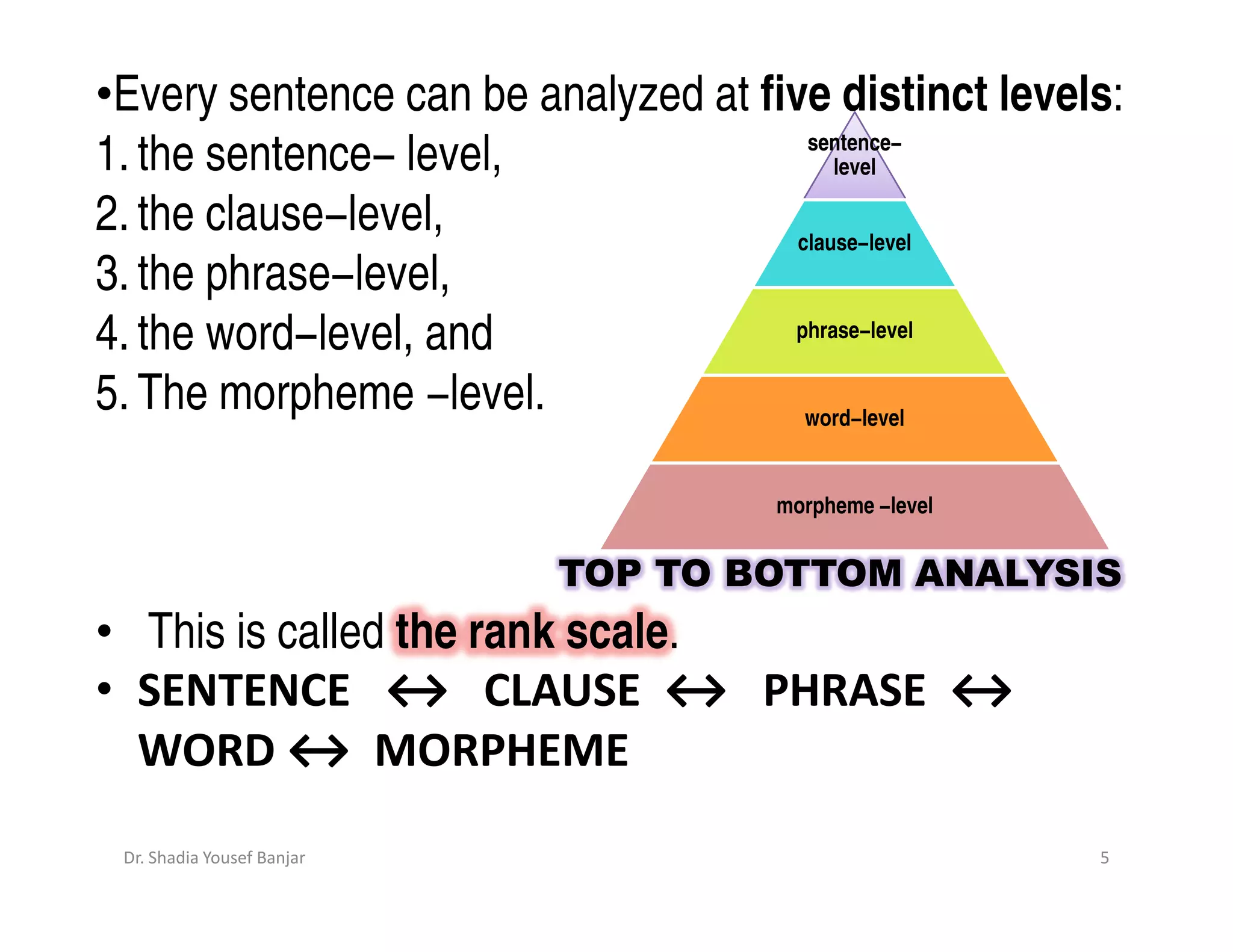
•Every sentence can be analyzed at five distinct levels:
                                       sentence−
1. the sentence− level,                   level

2. the clause−level,                  clause−level
3. the phrase−level,
4. the word−level, and               phrase−level


5. The morpheme −level.                word−level


                                     morpheme −level


                            TOP TO BOTTOM ANALYSIS
• This is called the rank scale.
• SENTENCE ↔ CLAUSE ↔ PHRASE ↔
  WORD ↔ MORPHEME
 Dr. Shadia Yousef Banjar                              5
1.2                         Representing Sentence Structure
We can represent the categorical constituent structure of the sentence
  in terms of brackets/ labeled brackets / tree diagram.

• Analyzing the following sentence:
“The snake killed the rat and swallowed it”
(1a) First level: Sentence level
[ The snake killed the rat and swallowed it]
(1b) Second level: Clause level
[ [The snake killed the rat] and [swallowed it]]
(1c) Third level: Phrase level
[ [[The snake] [killed [the rat ]]] and [[swallowed [it]]]]
(1d)Forth level: Word level
[[[[ The] [snake]] [[killed ] [[the][ rat ]]]] [and] [[[swallowed ] [[it]]]]]
   Dr. Shadia Yousef Banjar                                            6
II. Labeled Bracketing
(1a)
[ s1The snake killed the rat and swallowed it ]
(1b)
[ s1 [s2 The snake killed the rat ] and [ s3 (it )swallowed it ]]
(1c)
[s1 [s2 [ NP The snake ] [ VP killed [ NP the rat ]]] and [[s3
    [NP(it )] [VP swallowed [NP it ]]]]
(1d)
[s1 [s2 [ NP[               Det   The] [ N snake]]
                                     [VP[ V killed ] [ NP[ Det
    the][N rat ]]]] [ coord and] [s [NP [Det (it )] [VP [V
                                                3


    swallowed ] [NP [Det it]]]]]
 Dr. Shadia Yousef Banjar                                           7
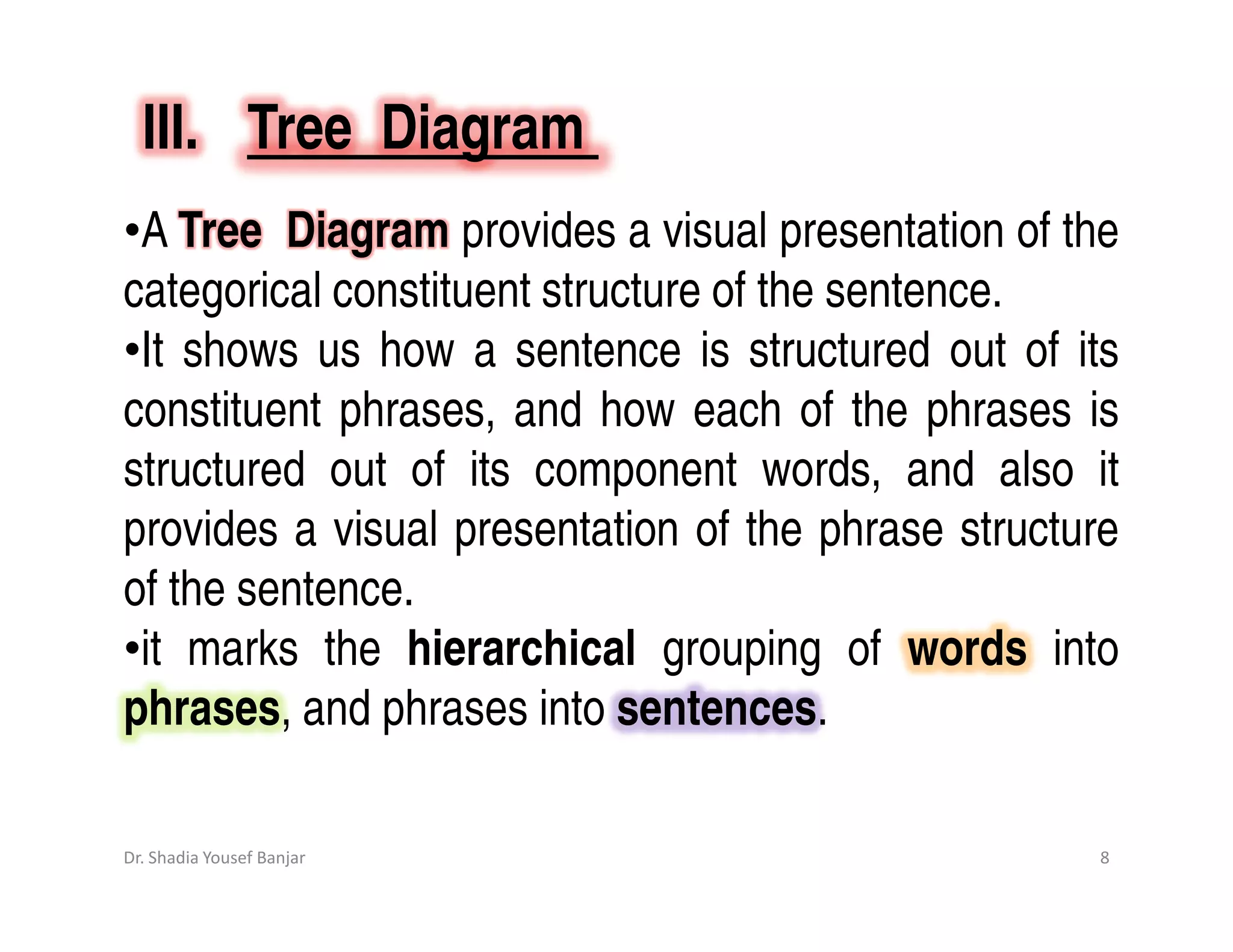
III. Tree Diagram
•A Tree Diagram provides a visual presentation of the
categorical constituent structure of the sentence.
•It shows us how a sentence is structured out of its
constituent phrases, and how each of the phrases is
structured out of its component words, and also it
provides a visual presentation of the phrase structure
of the sentence.
•it marks the hierarchical grouping of words into
phrases, and phrases into sentences.

Dr. Shadia Yousef Banjar                            8
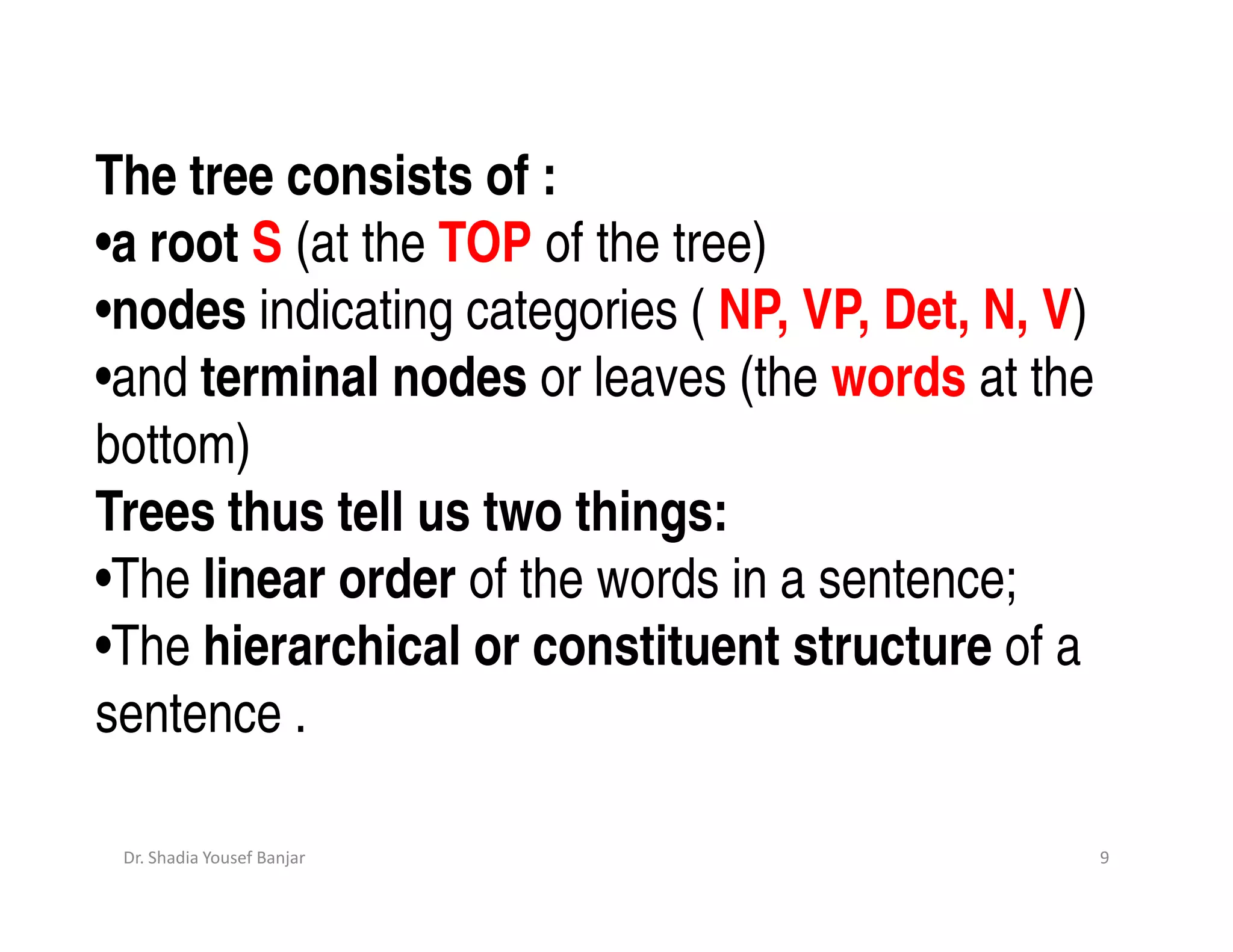
The tree consists of :
•a root S (at the TOP of the tree)
•nodes indicating categories ( NP, VP, Det, N, V)
•and terminal nodes or leaves (the words at the
bottom)
Trees thus tell us two things:
•The linear order of the words in a sentence;
•The hierarchical or constituent structure of a
sentence .

 Dr. Shadia Yousef Banjar                           9
Dr. Shadia Yousef Banjar   10
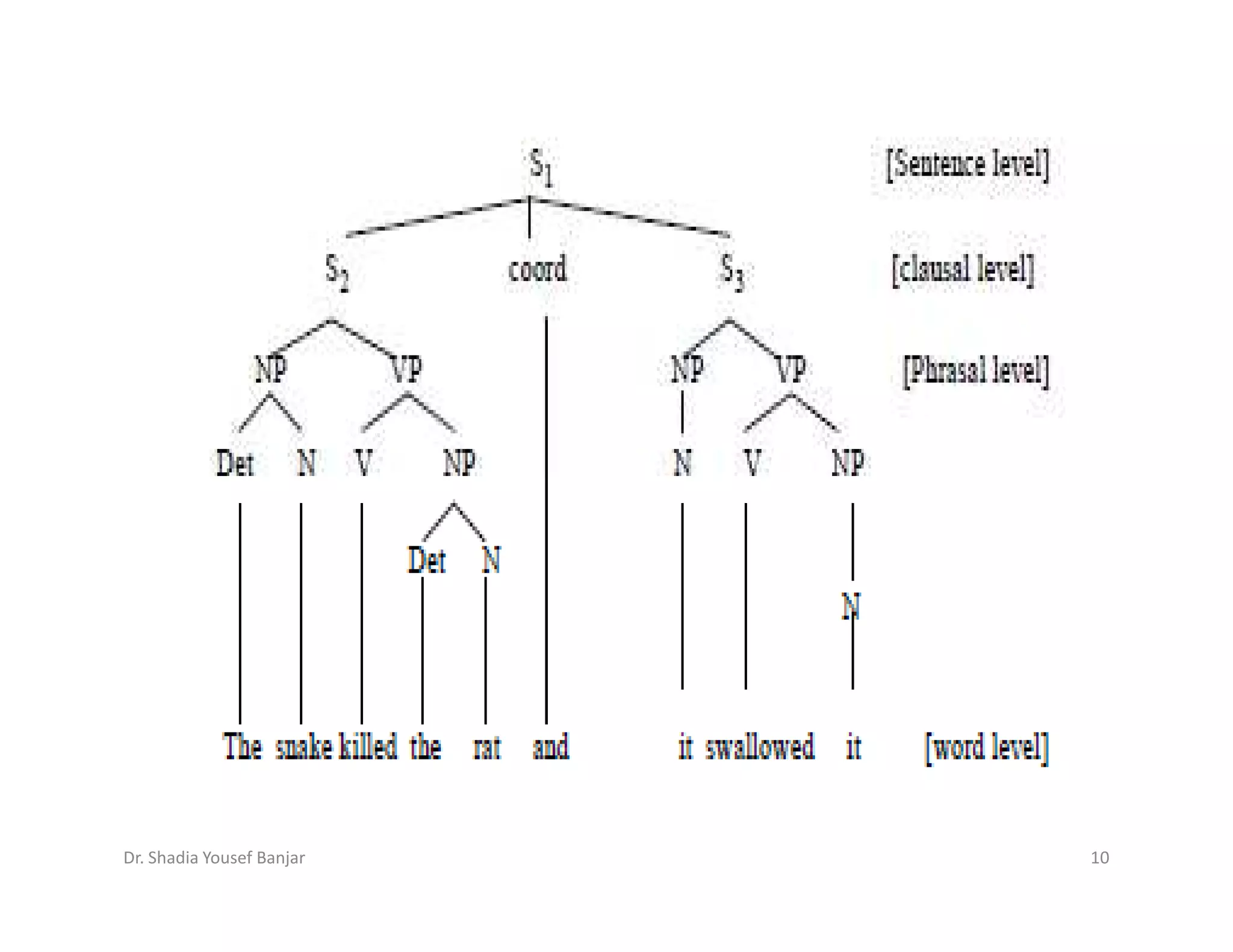
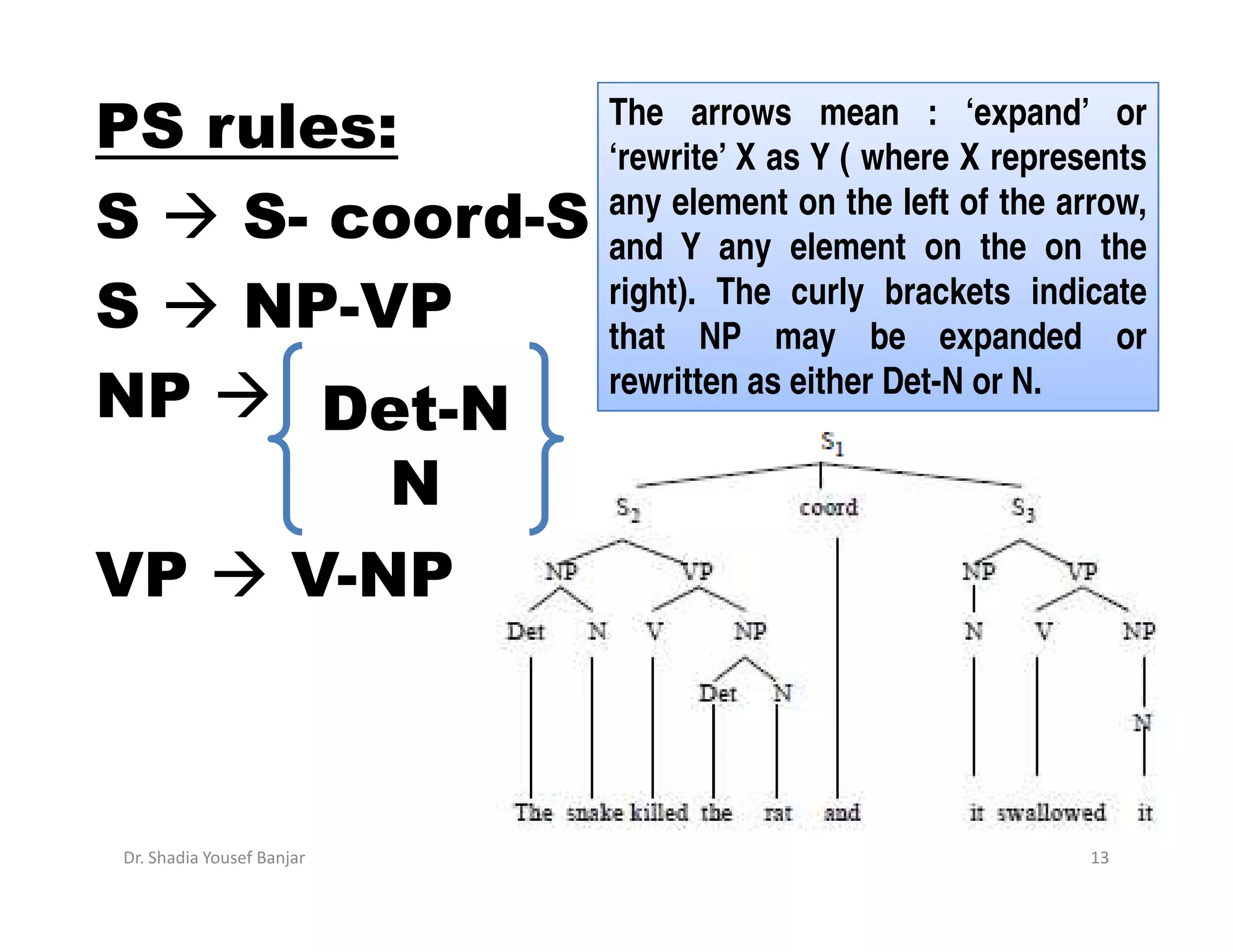
In the above diagram:
•the node S1 ( the whole sentence)
•S1 has three branches,
• It expanded as two nodes labeled S2 and S3
coordinated by and. S2 is expanded in two branches
as NP - VP.
•S3 is expanded as NP – VP.
• VP is expanded in two branches as V- NP.
•NP is expanded in two branches as Det- N.
•Det, N, and V are terminal nodes attached to words
(i.e. lexical items)
•Whereas NP, VP, S are non-terminal nodes.
  Dr. Shadia Yousef Banjar                            11
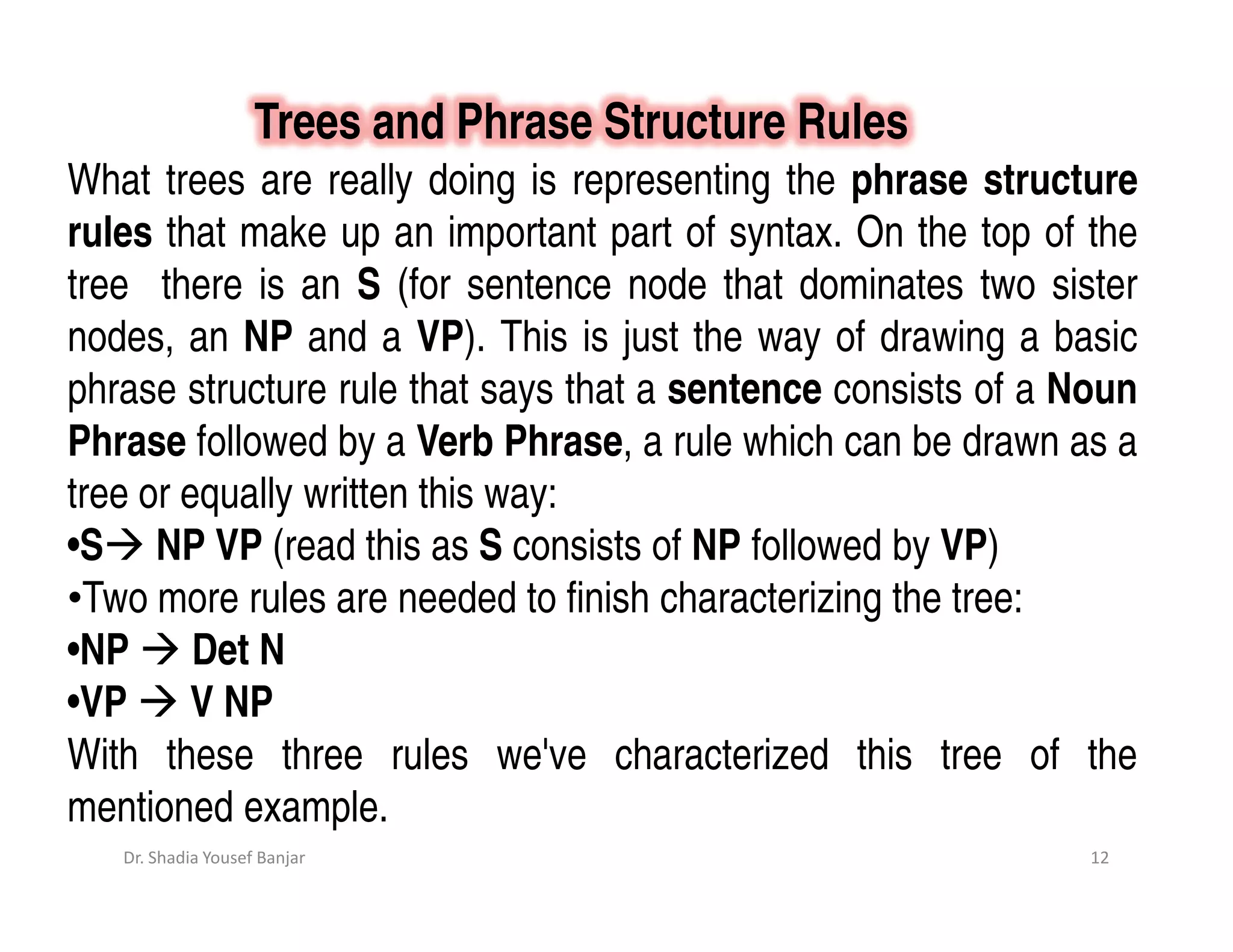
Trees and Phrase Structure Rules
What trees are really doing is representing the phrase structure
rules that make up an important part of syntax. On the top of the
tree there is an S (for sentence node that dominates two sister
nodes, an NP and a VP). This is just the way of drawing a basic
phrase structure rule that says that a sentence consists of a Noun
Phrase followed by a Verb Phrase, a rule which can be drawn as a
tree or equally written this way:
•S NP VP (read this as S consists of NP followed by VP)
•Two more rules are needed to finish characterizing the tree:
•NP Det N
•VP V NP
With these three rules we've characterized this tree of the
mentioned example.
   Dr. Shadia Yousef Banjar                                    12
The arrows mean : ‘expand’ or
PS rules:                  ‘rewrite’ X as Y ( where X represents
                           any element on the left of the arrow,
S   S- coord-S             and Y any element on the on the
                           right). The curly brackets indicate
S   NP-VP                  that NP may be expanded or
                           rewritten as either Det-N or N.
NP     Det-N
         N
VP    V-NP


Dr. Shadia Yousef Banjar                                    13
Representing Constituency in Phrase-markers
              (Tree Diagrams)
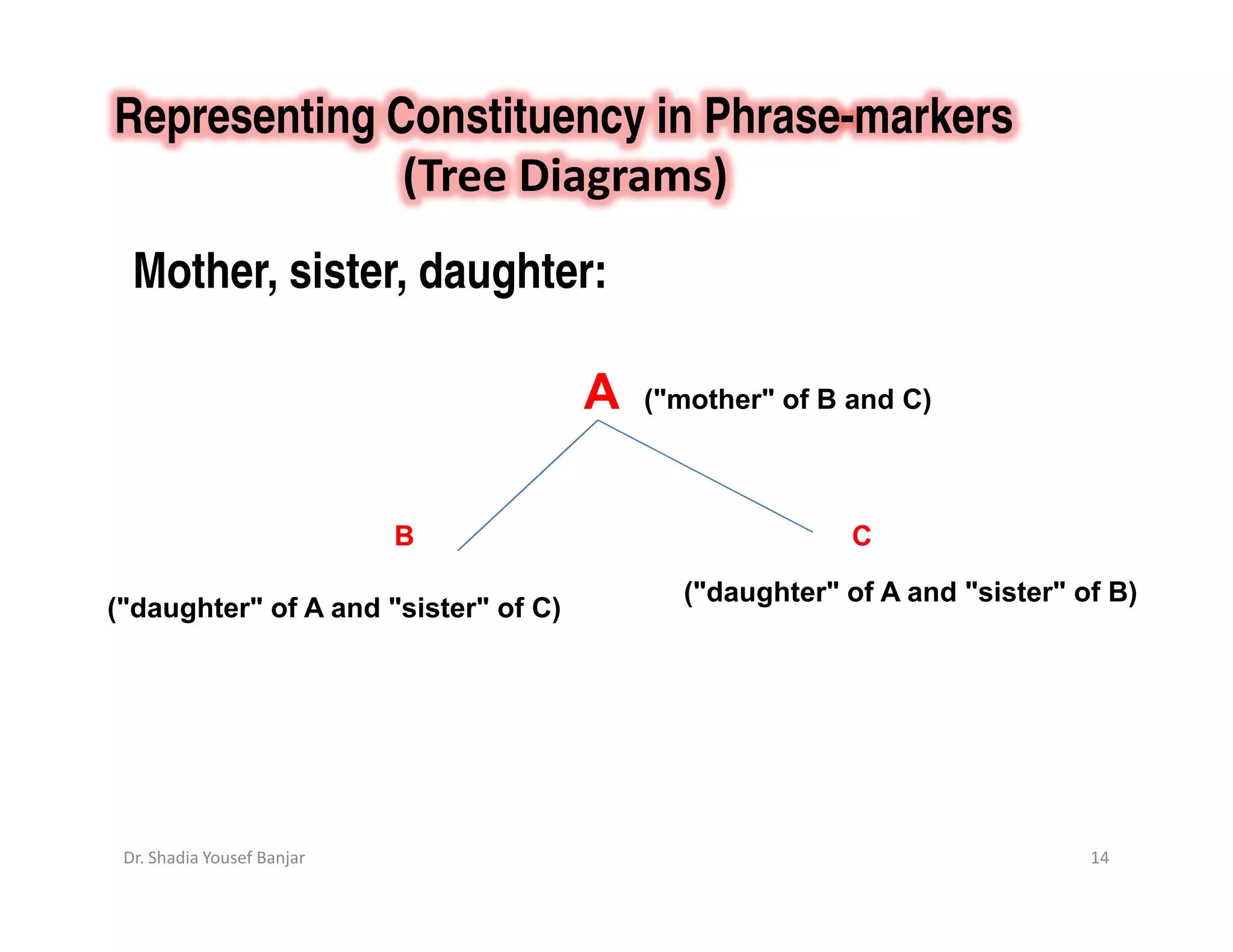
  Mother, sister, daughter:

                                      A   ("mother" of B and C)


                            B                            C

                                            ("daughter" of A and "sister" of B)
("daughter" of A and "sister" of C)


 Dr. Shadia Yousef Banjar                                                  14
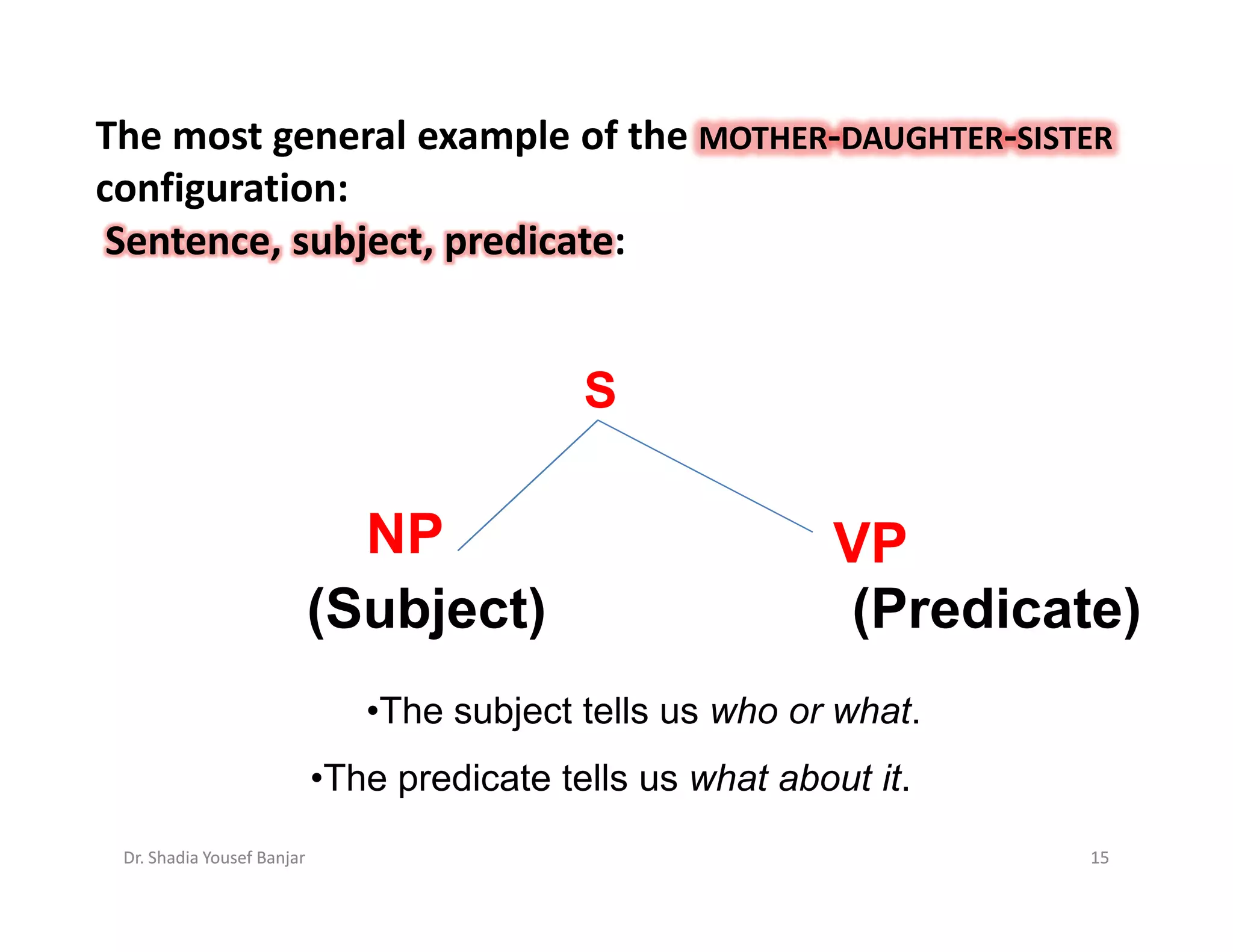
The most general example of the MOTHER-DAUGHTER-SISTER
configuration:
 Sentence, subject, predicate:


                                             S

                              NP                             VP
                            (Subject)                         (Predicate)
                               •The subject tells us who or what.
                            •The predicate tells us what about it.
 Dr. Shadia Yousef Banjar                                              15
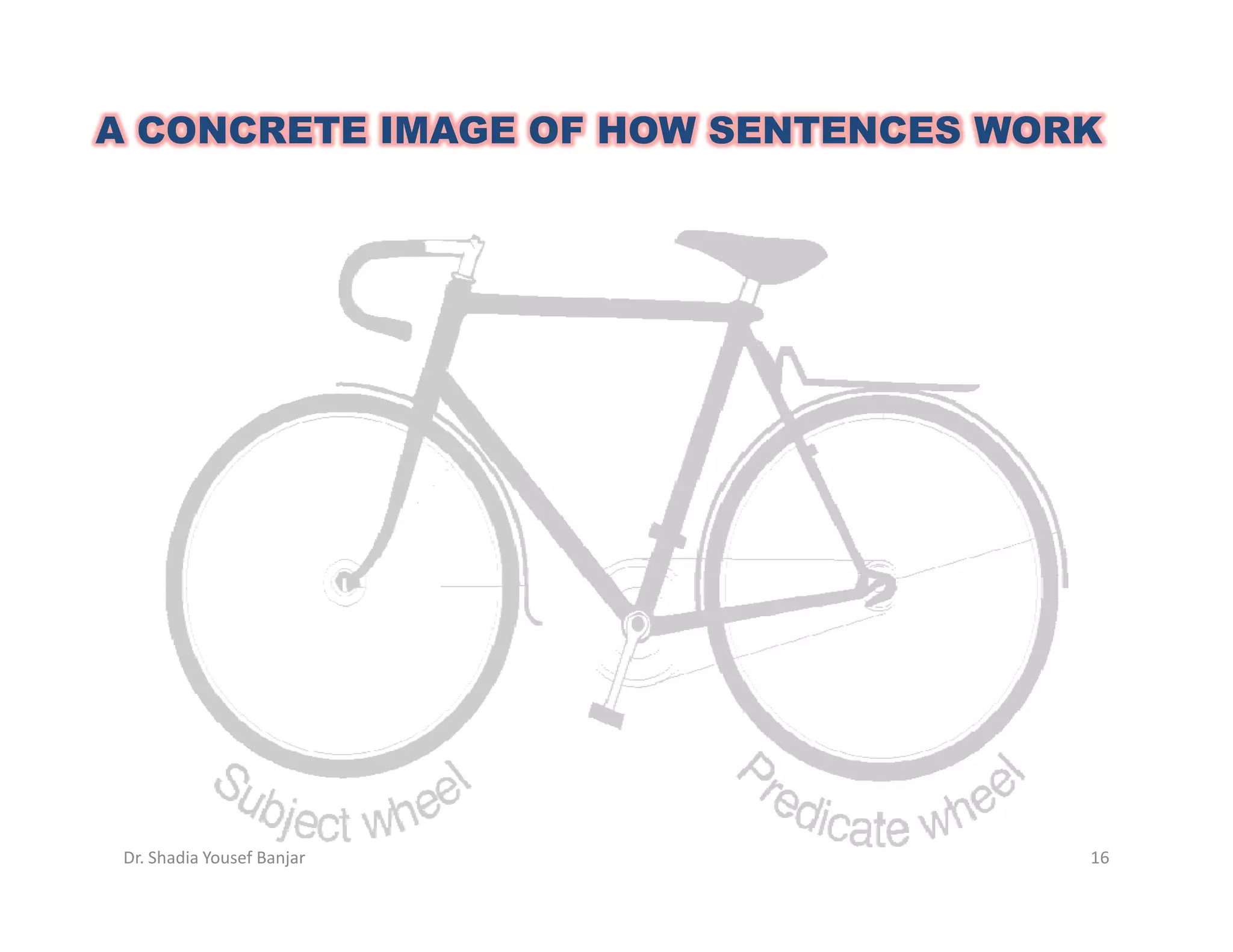
A CONCRETE IMAGE OF HOW SENTENCES WORK


 Dr. Shadia Yousef Banjar            16
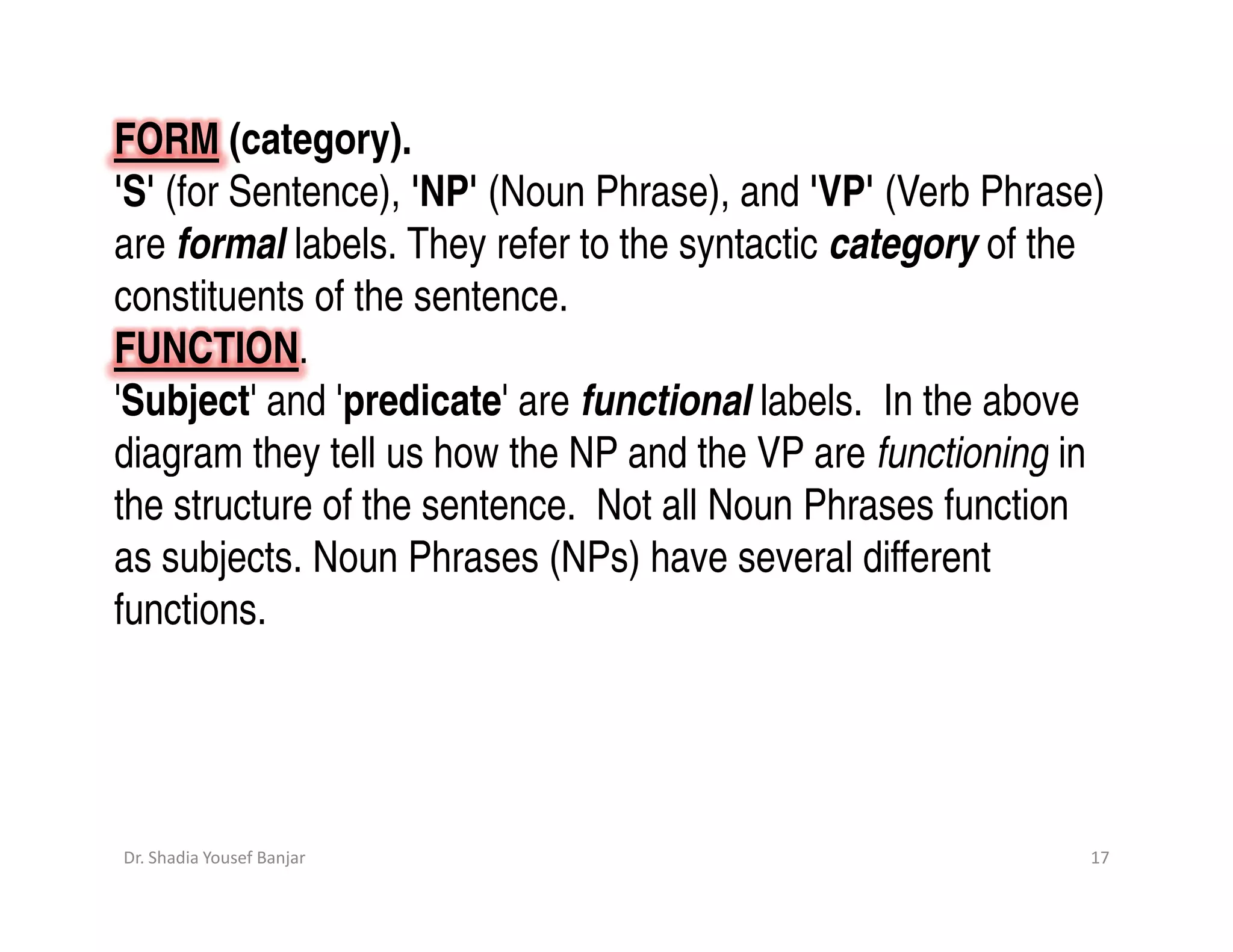
FORM (category).
'S' (for Sentence), 'NP' (Noun Phrase), and 'VP' (Verb Phrase)
are formal labels. They refer to the syntactic category of the
constituents of the sentence.
FUNCTION.
'Subject' and 'predicate' are functional labels. In the above
diagram they tell us how the NP and the VP are functioning in
the structure of the sentence. Not all Noun Phrases function
as subjects. Noun Phrases (NPs) have several different
functions.


Dr. Shadia Yousef Banjar                                     17
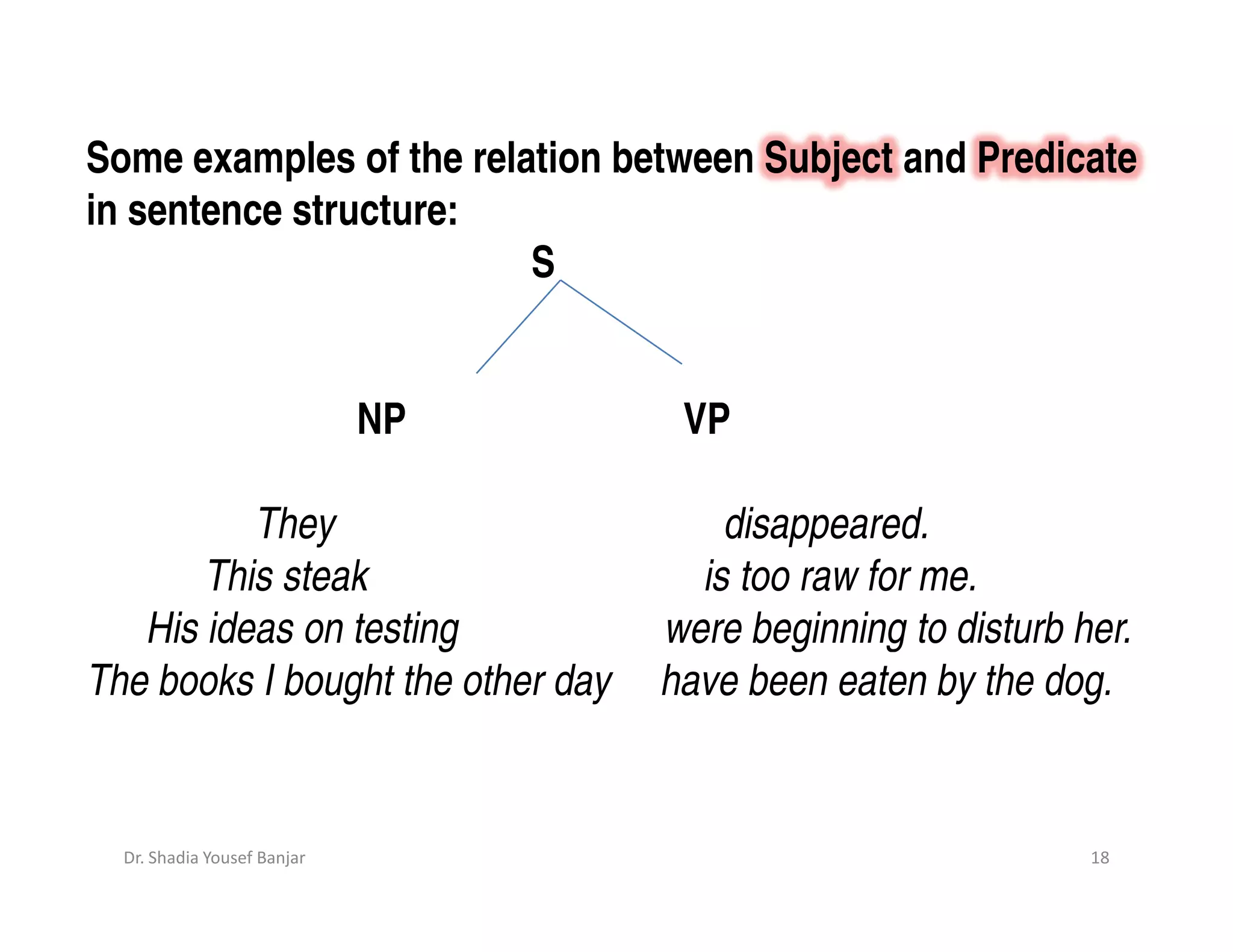
Some examples of the relation between Subject and Predicate
in sentence structure:
                         S


                             NP     VP

          They                         disappeared.
       This steak                    is too raw for me.
   His ideas on testing            were beginning to disturb her.
The books I bought the other day   have been eaten by the dog.


  Dr. Shadia Yousef Banjar                                    18
Dr. Shadia Yousef Banjar   19

Syntax & syntactic analysis,lec.1, dr. shadia.ppt [compatibility mode]

  • 1.
    LANE 334 -EA:Syntax 2011 – Term 2 Syntax & Syntactic Analysis 1 By: http://SBANJAR.kau.edu.sa/ Dr. Shadia Y. Banjar http://wwwdrshadiabanjar.blogspot.com Dr. Shadia Yousef Banjar 1
  • 2.
    1.1 • Inlinguistics, syntax is the rules of a language that show how the words of that language are to be arranged to make a sentence of that language. So… So • It is the study of how words are combined together to form sentences. Dr. Shadia Yousef Banjar 2
  • 3.
    Syntactic analysis maybe defined as: 1- determining the relevant components of a sentence 2- describing these parts grammatically. •The component parts of a sentence are called constituents. Dr. Shadia Yousef Banjar 3
  • 4.
    ‘SYNTACTIC ANALYSIS’ involvestwo related tasks: (a) breaking down the sentence into its constituents (b) labeling each constituent, stating what type (form)of constituent it is, and what grammatical function it has. Dr. Shadia Yousef Banjar 4
  • 5.
    •Every sentence canbe analyzed at five distinct levels: sentence− 1. the sentence− level, level 2. the clause−level, clause−level 3. the phrase−level, 4. the word−level, and phrase−level 5. The morpheme −level. word−level morpheme −level TOP TO BOTTOM ANALYSIS • This is called the rank scale. • SENTENCE ↔ CLAUSE ↔ PHRASE ↔ WORD ↔ MORPHEME Dr. Shadia Yousef Banjar 5
  • 6.
    1.2 Representing Sentence Structure We can represent the categorical constituent structure of the sentence in terms of brackets/ labeled brackets / tree diagram. • Analyzing the following sentence: “The snake killed the rat and swallowed it” (1a) First level: Sentence level [ The snake killed the rat and swallowed it] (1b) Second level: Clause level [ [The snake killed the rat] and [swallowed it]] (1c) Third level: Phrase level [ [[The snake] [killed [the rat ]]] and [[swallowed [it]]]] (1d)Forth level: Word level [[[[ The] [snake]] [[killed ] [[the][ rat ]]]] [and] [[[swallowed ] [[it]]]]] Dr. Shadia Yousef Banjar 6
  • 7.
    II. Labeled Bracketing (1a) [s1The snake killed the rat and swallowed it ] (1b) [ s1 [s2 The snake killed the rat ] and [ s3 (it )swallowed it ]] (1c) [s1 [s2 [ NP The snake ] [ VP killed [ NP the rat ]]] and [[s3 [NP(it )] [VP swallowed [NP it ]]]] (1d) [s1 [s2 [ NP[ Det The] [ N snake]] [VP[ V killed ] [ NP[ Det the][N rat ]]]] [ coord and] [s [NP [Det (it )] [VP [V 3 swallowed ] [NP [Det it]]]]] Dr. Shadia Yousef Banjar 7
  • 8.
    III. Tree Diagram •ATree Diagram provides a visual presentation of the categorical constituent structure of the sentence. •It shows us how a sentence is structured out of its constituent phrases, and how each of the phrases is structured out of its component words, and also it provides a visual presentation of the phrase structure of the sentence. •it marks the hierarchical grouping of words into phrases, and phrases into sentences. Dr. Shadia Yousef Banjar 8
  • 9.
    The tree consistsof : •a root S (at the TOP of the tree) •nodes indicating categories ( NP, VP, Det, N, V) •and terminal nodes or leaves (the words at the bottom) Trees thus tell us two things: •The linear order of the words in a sentence; •The hierarchical or constituent structure of a sentence . Dr. Shadia Yousef Banjar 9
  • 10.
  • 11.
    In the abovediagram: •the node S1 ( the whole sentence) •S1 has three branches, • It expanded as two nodes labeled S2 and S3 coordinated by and. S2 is expanded in two branches as NP - VP. •S3 is expanded as NP – VP. • VP is expanded in two branches as V- NP. •NP is expanded in two branches as Det- N. •Det, N, and V are terminal nodes attached to words (i.e. lexical items) •Whereas NP, VP, S are non-terminal nodes. Dr. Shadia Yousef Banjar 11
  • 12.
    Trees and PhraseStructure Rules What trees are really doing is representing the phrase structure rules that make up an important part of syntax. On the top of the tree there is an S (for sentence node that dominates two sister nodes, an NP and a VP). This is just the way of drawing a basic phrase structure rule that says that a sentence consists of a Noun Phrase followed by a Verb Phrase, a rule which can be drawn as a tree or equally written this way: •S NP VP (read this as S consists of NP followed by VP) •Two more rules are needed to finish characterizing the tree: •NP Det N •VP V NP With these three rules we've characterized this tree of the mentioned example. Dr. Shadia Yousef Banjar 12
  • 13.
    The arrows mean: ‘expand’ or PS rules: ‘rewrite’ X as Y ( where X represents any element on the left of the arrow, S S- coord-S and Y any element on the on the right). The curly brackets indicate S NP-VP that NP may be expanded or rewritten as either Det-N or N. NP Det-N N VP V-NP Dr. Shadia Yousef Banjar 13
  • 14.
    Representing Constituency inPhrase-markers (Tree Diagrams) Mother, sister, daughter: A ("mother" of B and C) B C ("daughter" of A and "sister" of B) ("daughter" of A and "sister" of C) Dr. Shadia Yousef Banjar 14
  • 15.
    The most generalexample of the MOTHER-DAUGHTER-SISTER configuration: Sentence, subject, predicate: S NP VP (Subject) (Predicate) •The subject tells us who or what. •The predicate tells us what about it. Dr. Shadia Yousef Banjar 15
  • 16.
    A CONCRETE IMAGEOF HOW SENTENCES WORK Dr. Shadia Yousef Banjar 16
  • 17.
    FORM (category). 'S' (forSentence), 'NP' (Noun Phrase), and 'VP' (Verb Phrase) are formal labels. They refer to the syntactic category of the constituents of the sentence. FUNCTION. 'Subject' and 'predicate' are functional labels. In the above diagram they tell us how the NP and the VP are functioning in the structure of the sentence. Not all Noun Phrases function as subjects. Noun Phrases (NPs) have several different functions. Dr. Shadia Yousef Banjar 17
  • 18.
    Some examples ofthe relation between Subject and Predicate in sentence structure: S NP VP They disappeared. This steak is too raw for me. His ideas on testing were beginning to disturb her. The books I bought the other day have been eaten by the dog. Dr. Shadia Yousef Banjar 18
  • 19.