

Performances
considerations
with PHP 7
Hi
 Julien PAULI
 SensioLabs tech team (Blackfire - PHP)
 Programming with PHP since early 2000s
 Today working with PHP and hacking it from inside (C)
 PHP Internals programmer/contributor
 PHP 5.5 & 5.6 Release Manager
 @julienpauli
 Tech life at http://jpauli.tech
 jpauli@php.net
What we'll cover together
 PHP 7 new compiler
 Compiler optimizations
 PHP 7 new executor optimizers and OPCache passes
 PHP 7 new references mechanism
 PHP 7 new Hashtables (PHP arrays)
 PHP 7 new strings management
Having SF and PHP work together
The PHP language
 Born in 1995
 Fully written using the C language
 Today
 870,000 C lines of code
 dozens of contributors around the world
PHP VERSIONS SURVEY
PHP code compilation
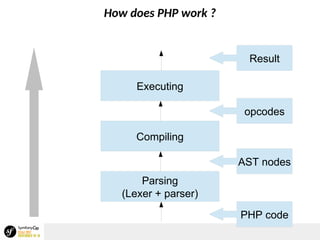
How does PHP work ?
Parsing
(Lexer + parser)
Compiling
Executing
opcodes
PHP code
AST nodes
Result
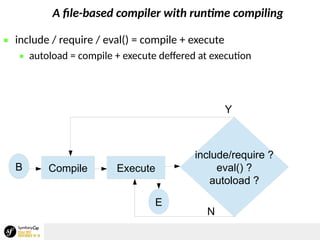
A file-based compiler with runtime compiling
 include / require / eval() = compile + execute
 autoload = compile + execute deffered at execution
Compile Execute
include/require ?
eval() ?
autoload ?
B
N
Y
E
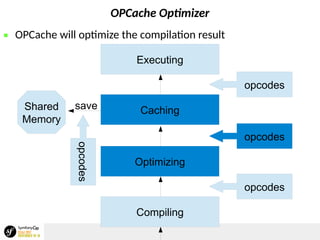
OPCache Optimizer
 OPCache will optimize the compilation result
opcodes
Optimizing
opcodes
Shared
Memory
opcodes
Caching
Compiling
save
Executing
opcodes
PHP 7 compiler
PHP 7 new compiler
 PHP 7 compiler is based on an AST
 It plays with OPCache to optimize the runtime
 Every hash of every litteral string is calculated at compile time
 Resolves every static/litteral expression
 Optimizes some function calls when result is known at compile
time
 Compiling a PHP file is a huge heavy process
Classes impact
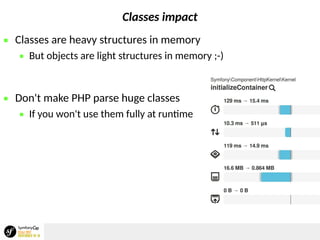
 Classes are heavy structures in memory
 But objects are light structures in memory ;-)
 Don't make PHP parse huge classes
 If you won't use them fully at runtime
PHP 7 compiler optimizations
 If the compile node can be resolved at compile-time , it will be
 Static expressions, static arrays initialization
 PHP constants
 Some functions compile to special ZendVM OPCodes or are
directly resolved by the compiler if possible
 strlen(), is_{type}(), {type}val() casts, defined(), chr(), ord(),
cuf()&cufa(), get_class(), get_called_class(), gettype(), count(),
in_array(), array_slice(), func_num_args(), func_get_args()
 Some are parts of OPCache optimizer :
 function_exists(), is_callable(), extension_loaded(), constant(),
dirname(), defined(), strlen()
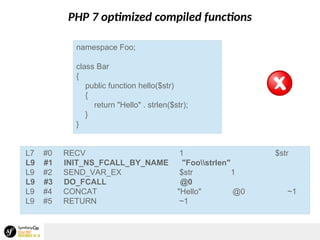
PHP 7 optimized compiled functions
namespace Foo;
class Bar
{
public function hello($str)
{
return "Hello" . strlen($str);
}
}
L7 #0 RECV 1 $str
L9 #1 INIT_NS_FCALL_BY_NAME "Foostrlen"
L9 #2 SEND_VAR_EX $str 1
L9 #3 DO_FCALL @0
L9 #4 CONCAT "Hello" @0 ~1
L9 #5 RETURN ~1
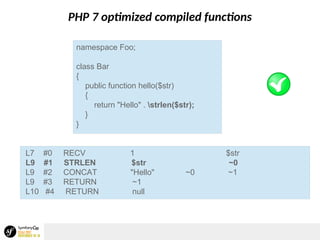
PHP 7 optimized compiled functions
namespace Foo;
class Bar
{
public function hello($str)
{
return "Hello" . strlen($str);
}
}
L7 #0 RECV 1 $str
L9 #1 STRLEN $str ~0
L9 #2 CONCAT "Hello" ~0 ~1
L9 #3 RETURN ~1
L10 #4 RETURN null
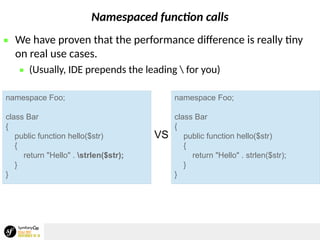
Namespaced function calls
 We have proven that the performance difference is really tiny
on real use cases.
 (Usually, IDE prepends the leading  for you)
namespace Foo;
class Bar
{
public function hello($str)
{
return "Hello" . strlen($str);
}
}
namespace Foo;
class Bar
{
public function hello($str)
{
return "Hello" . strlen($str);
}
}
VS
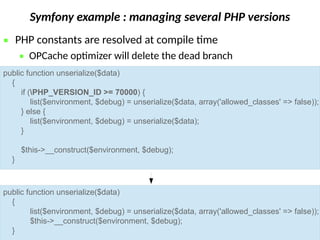
Symfony example : managing several PHP versions
 PHP constants are resolved at compile time
 OPCache optimizer will delete the dead branch
public function unserialize($data)
{
if (PHP_VERSION_ID >= 70000) {
list($environment, $debug) = unserialize($data, array('allowed_classes' => false));
} else {
list($environment, $debug) = unserialize($data);
}
$this->__construct($environment, $debug);
}
public function unserialize($data)
{
list($environment, $debug) = unserialize($data, array('allowed_classes' => false));
$this->__construct($environment, $debug);
}
PHP 7 compiler optim example, static arrays
 Arrays containg keys/vals that are static/litteral
 Such arrays are fully resolved at compile time
 They involve no runtime work at all
const FOO = ['bar', 'baz', 'foo', 34, [42, 'bar'=>'baz']];
PHP 7 references
PHP 7 new references mechanism
 In PHP 7, the deep copy is postponed until COW breakage
 If no COW breakage, then no copy happens at all
function foo($arg) { $arg = 'bar'; } /* full copy of the variable */
$a = 'foo';
$b = &$a;
foo($a);
$a = ['foo', 42, ['bar' , new stdclass], 'baz'];
$b = &$a;
if (count($a) == 8) { /* no zval copy here */
}
PHP 7 new hashtables
PHP 7 hashtables
 It has been fully rewritten, and reworked
 Nothing to say from PHP userland POV
 Except perhaps for the packed array case
Packed arrays
 If your keys are integer only (no string key)
 If your keys are constantly increasing
 No matter if they don't follow each other with +1
 Then you'll benefit from packed arrays optimization
 Packed arrays will reduce memory size compared to "normal"
array
 Reduction of (table_size - 2) * 4 bytes
 ~ 4Kb for a 1000 entry table
 May be noticeable for BIG arrays
Packed arrays example
const N = 1024 * 1023;
for ($i=0; $i<N; $i++) {
$tab[] = random_bytes(3);
}
echo memory_get_usage();
const N = 1024 * 1023;
for ($i=0; $i<N; $i++) {
$tab[] = random_bytes(3);
}
$tab['foo'] = 'bar';
echo memory_get_usage();
const N = 1024 * 1023;
for ($i=0; $i<N; $i++) {
$tab[] = random_bytes(3);
}
unset($tab[1000]);
$tab[1000] = 1000;
echo memory_get_usage();
~67Mb
~71Mb
~71Mb
Packed arrays conditions (recalled)
 Do NOT use string keys
 Always use increasing integer-based keys
 Contiguous or not is not important
 If using the compiler, keep keys into the interval [0-table-size] ,
table-size being rounded to the upper power of two
 For example, if you need lists , then you'll benefit from this
optimisation
HashTables in PHP 7 : go further
 http://jpauli.github.io/2016/04/08/hashtables.html
Strings
$a = "bar";
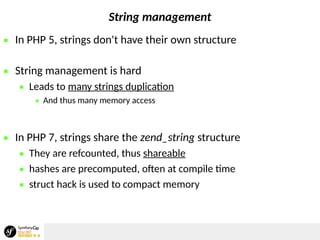
String management
 In PHP 5, strings don't have their own structure
 String management is hard
 Leads to many strings duplication
 And thus many memory access
 In PHP 7, strings share the zend_string structure
 They are refcounted, thus shareable
 hashes are precomputed, often at compile time
 struct hack is used to compact memory
Strings in PHP
char * str
...
zval
gc_infos
int len
refcount is_ref zend_string *
...
zval
...
hash
gc_infos
char str[1]size_t len
...
zend_string
PHP 5 PHP 7
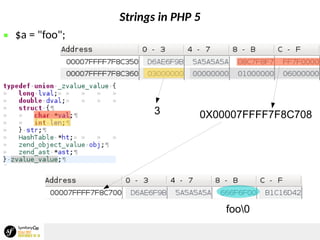
Strings in PHP 5
 $a = "foo";
3 0X00007FFFF7F8C708
foo0
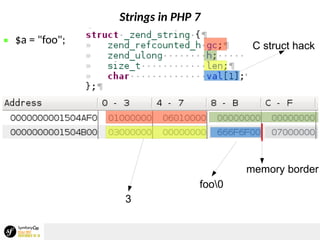
Strings in PHP 7
 $a = "foo";
foo0
C struct hack
3
memory border
Strings tip
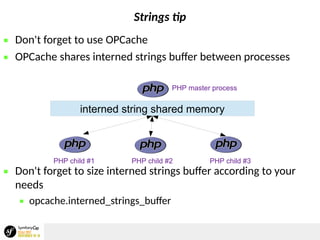
 Don't forget to use OPCache
 OPCache shares interned strings buffer between processes
 Don't forget to size interned strings buffer according to your
needs
 opcache.interned_strings_buffer
interned string shared memory
PHP master process
PHP child #1 PHP child #2 PHP child #3
Encapsed strings
Encapsed string optimisation
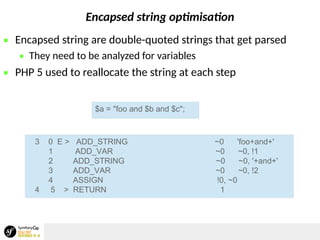
 Encapsed string are double-quoted strings that get parsed
 They need to be analyzed for variables
 PHP 5 used to reallocate the string at each step
$a = "foo and $b and $c";
3 0 E > ADD_STRING ~0 'foo+and+'
1 ADD_VAR ~0 ~0, !1
2 ADD_STRING ~0 ~0, '+and+'
3 ADD_VAR ~0 ~0, !2
4 ASSIGN !0, ~0
4 5 > RETURN 1
Encapsed string in PHP 5
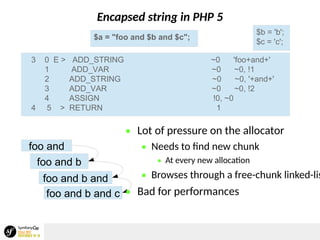
$a = "foo and $b and $c";
3 0 E > ADD_STRING ~0 'foo+and+'
1 ADD_VAR ~0 ~0, !1
2 ADD_STRING ~0 ~0, '+and+'
3 ADD_VAR ~0 ~0, !2
4 ASSIGN !0, ~0
4 5 > RETURN 1
foo and
foo and b
foo and b and
foo and b and c
 Lot of pressure on the allocator
 Needs to find new chunk
 At every new allocation
 Browses through a free-chunk linked-lis
 Bad for performances
$b = 'b';
$c = 'c';
Encapsed string optimisation in PHP 7
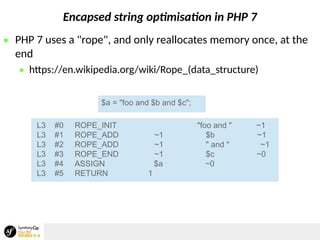
 PHP 7 uses a "rope", and only reallocates memory once, at the
end
 https://en.wikipedia.org/wiki/Rope_(data_structure)
$a = "foo and $b and $c";
L3 #0 ROPE_INIT "foo and " ~1
L3 #1 ROPE_ADD ~1 $b ~1
L3 #2 ROPE_ADD ~1 " and " ~1
L3 #3 ROPE_END ~1 $c ~0
L3 #4 ASSIGN $a ~0
L3 #5 RETURN 1
Encapsed strings in PHP 7
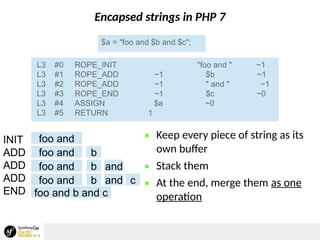
$a = "foo and $b and $c";
L3 #0 ROPE_INIT "foo and " ~1
L3 #1 ROPE_ADD ~1 $b ~1
L3 #2 ROPE_ADD ~1 " and " ~1
L3 #3 ROPE_END ~1 $c ~0
L3 #4 ASSIGN $a ~0
L3 #5 RETURN 1
foo and
foo and b
foo and b and
foo and b and c
foo and b and c
INIT
ADD
ADD
ADD
END
 Keep every piece of string as its
own buffer
 Stack them
 At the end, merge them as one
operation
So ?
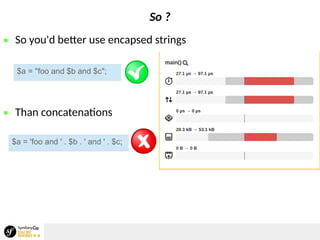
 So you'd better use encapsed strings
 Than concatenations
$a = "foo and $b and $c";
$a = 'foo and ' . $b . ' and ' . $c;
Some other unclassified optimizations
switch-case with special cases
 A switch-case statement with only strings as cases, will now use
a jump table instead of testing each case individually in the VM
 Same for only-integers keys, starting from at least 5 cases.
switch ($a) {
case 'bar':
echo 'bar';
break;
case 'foo':
echo 'foo';
break;
}
if ($a == 'bar') {
echo 'bar';
} elseif ($a == 'foo') {
echo 'foo';
}
in_array($a, ['bar', 'foo']);PHP >=7.2
PHP < 7.2
This is O(1) in huge majority of cases
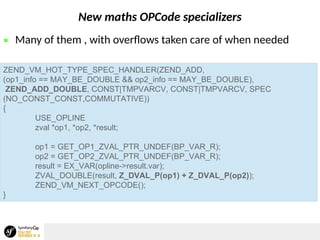
New maths OPCode specializers
 Many of them , with overflows taken care of when needed
ZEND_VM_HOT_TYPE_SPEC_HANDLER(ZEND_ADD,
(op1_info == MAY_BE_DOUBLE && op2_info == MAY_BE_DOUBLE),
ZEND_ADD_DOUBLE, CONST|TMPVARCV, CONST|TMPVARCV, SPEC
(NO_CONST_CONST,COMMUTATIVE))
{
USE_OPLINE
zval *op1, *op2, *result;
op1 = GET_OP1_ZVAL_PTR_UNDEF(BP_VAR_R);
op2 = GET_OP2_ZVAL_PTR_UNDEF(BP_VAR_R);
result = EX_VAR(opline->result.var);
ZVAL_DOUBLE(result, Z_DVAL_P(op1) + Z_DVAL_P(op2));
ZEND_VM_NEXT_OPCODE();
}
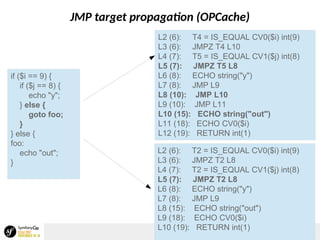
JMP target propagation (OPCache)
if ($i == 9) {
if ($j == 8) {
echo "y";
} else {
goto foo;
}
} else {
foo:
echo "out";
}
L2 (6): T2 = IS_EQUAL CV0($i) int(9)
L3 (6): JMPZ T2 L8
L4 (7): T2 = IS_EQUAL CV1($j) int(8)
L5 (7): JMPZ T2 L8
L6 (8): ECHO string("y")
L7 (8): JMP L9
L8 (15): ECHO string("out")
L9 (18): ECHO CV0($i)
L10 (19): RETURN int(1)
L2 (6): T4 = IS_EQUAL CV0($i) int(9)
L3 (6): JMPZ T4 L10
L4 (7): T5 = IS_EQUAL CV1($j) int(8)
L5 (7): JMPZ T5 L8
L6 (8): ECHO string("y")
L7 (8): JMP L9
L8 (10): JMP L10
L9 (10): JMP L11
L10 (15): ECHO string("out")
L11 (18): ECHO CV0($i)
L12 (19): RETURN int(1)
Future ?
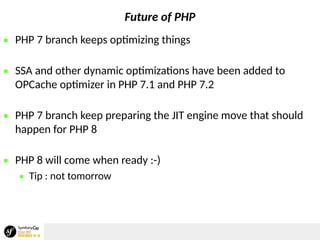
Future of PHP
 PHP 7 branch keeps optimizing things
 SSA and other dynamic optimizations have been added to
OPCache optimizer in PHP 7.1 and PHP 7.2
 PHP 7 branch keep preparing the JIT engine move that should
happen for PHP 8
 PHP 8 will come when ready :-)
 Tip : not tomorrow
Thank you for listening

SymfonyCon 2017 php7 performances

  • 1.
  • 2.
    Hi  Julien PAULI SensioLabs tech team (Blackfire - PHP)  Programming with PHP since early 2000s  Today working with PHP and hacking it from inside (C)  PHP Internals programmer/contributor  PHP 5.5 & 5.6 Release Manager  @julienpauli  Tech life at http://jpauli.tech  jpauli@php.net
  • 3.
    What we'll covertogether  PHP 7 new compiler  Compiler optimizations  PHP 7 new executor optimizers and OPCache passes  PHP 7 new references mechanism  PHP 7 new Hashtables (PHP arrays)  PHP 7 new strings management
  • 4.
    Having SF andPHP work together
  • 5.
    The PHP language Born in 1995  Fully written using the C language  Today  870,000 C lines of code  dozens of contributors around the world
  • 6.
  • 7.
  • 8.
    How does PHPwork ? Parsing (Lexer + parser) Compiling Executing opcodes PHP code AST nodes Result
  • 9.
    A file-based compilerwith runtime compiling  include / require / eval() = compile + execute  autoload = compile + execute deffered at execution Compile Execute include/require ? eval() ? autoload ? B N Y E
  • 10.
    OPCache Optimizer  OPCachewill optimize the compilation result opcodes Optimizing opcodes Shared Memory opcodes Caching Compiling save Executing opcodes
  • 11.
  • 12.
    PHP 7 newcompiler  PHP 7 compiler is based on an AST  It plays with OPCache to optimize the runtime  Every hash of every litteral string is calculated at compile time  Resolves every static/litteral expression  Optimizes some function calls when result is known at compile time  Compiling a PHP file is a huge heavy process
  • 13.
    Classes impact  Classesare heavy structures in memory  But objects are light structures in memory ;-)  Don't make PHP parse huge classes  If you won't use them fully at runtime
  • 14.
    PHP 7 compileroptimizations  If the compile node can be resolved at compile-time , it will be  Static expressions, static arrays initialization  PHP constants  Some functions compile to special ZendVM OPCodes or are directly resolved by the compiler if possible  strlen(), is_{type}(), {type}val() casts, defined(), chr(), ord(), cuf()&cufa(), get_class(), get_called_class(), gettype(), count(), in_array(), array_slice(), func_num_args(), func_get_args()  Some are parts of OPCache optimizer :  function_exists(), is_callable(), extension_loaded(), constant(), dirname(), defined(), strlen()
  • 15.
    PHP 7 optimizedcompiled functions namespace Foo; class Bar { public function hello($str) { return "Hello" . strlen($str); } } L7 #0 RECV 1 $str L9 #1 INIT_NS_FCALL_BY_NAME "Foostrlen" L9 #2 SEND_VAR_EX $str 1 L9 #3 DO_FCALL @0 L9 #4 CONCAT "Hello" @0 ~1 L9 #5 RETURN ~1
  • 16.
    PHP 7 optimizedcompiled functions namespace Foo; class Bar { public function hello($str) { return "Hello" . strlen($str); } } L7 #0 RECV 1 $str L9 #1 STRLEN $str ~0 L9 #2 CONCAT "Hello" ~0 ~1 L9 #3 RETURN ~1 L10 #4 RETURN null
  • 17.
    Namespaced function calls We have proven that the performance difference is really tiny on real use cases.  (Usually, IDE prepends the leading for you) namespace Foo; class Bar { public function hello($str) { return "Hello" . strlen($str); } } namespace Foo; class Bar { public function hello($str) { return "Hello" . strlen($str); } } VS
  • 18.
    Symfony example :managing several PHP versions  PHP constants are resolved at compile time  OPCache optimizer will delete the dead branch public function unserialize($data) { if (PHP_VERSION_ID >= 70000) { list($environment, $debug) = unserialize($data, array('allowed_classes' => false)); } else { list($environment, $debug) = unserialize($data); } $this->__construct($environment, $debug); } public function unserialize($data) { list($environment, $debug) = unserialize($data, array('allowed_classes' => false)); $this->__construct($environment, $debug); }
  • 19.
    PHP 7 compileroptim example, static arrays  Arrays containg keys/vals that are static/litteral  Such arrays are fully resolved at compile time  They involve no runtime work at all const FOO = ['bar', 'baz', 'foo', 34, [42, 'bar'=>'baz']];
  • 20.
  • 21.
    PHP 7 newreferences mechanism  In PHP 7, the deep copy is postponed until COW breakage  If no COW breakage, then no copy happens at all function foo($arg) { $arg = 'bar'; } /* full copy of the variable */ $a = 'foo'; $b = &$a; foo($a); $a = ['foo', 42, ['bar' , new stdclass], 'baz']; $b = &$a; if (count($a) == 8) { /* no zval copy here */ }
  • 22.
    PHP 7 newhashtables
  • 23.
    PHP 7 hashtables It has been fully rewritten, and reworked  Nothing to say from PHP userland POV  Except perhaps for the packed array case
  • 24.
    Packed arrays  Ifyour keys are integer only (no string key)  If your keys are constantly increasing  No matter if they don't follow each other with +1  Then you'll benefit from packed arrays optimization  Packed arrays will reduce memory size compared to "normal" array  Reduction of (table_size - 2) * 4 bytes  ~ 4Kb for a 1000 entry table  May be noticeable for BIG arrays
  • 25.
    Packed arrays example constN = 1024 * 1023; for ($i=0; $i<N; $i++) { $tab[] = random_bytes(3); } echo memory_get_usage(); const N = 1024 * 1023; for ($i=0; $i<N; $i++) { $tab[] = random_bytes(3); } $tab['foo'] = 'bar'; echo memory_get_usage(); const N = 1024 * 1023; for ($i=0; $i<N; $i++) { $tab[] = random_bytes(3); } unset($tab[1000]); $tab[1000] = 1000; echo memory_get_usage(); ~67Mb ~71Mb ~71Mb
  • 26.
    Packed arrays conditions(recalled)  Do NOT use string keys  Always use increasing integer-based keys  Contiguous or not is not important  If using the compiler, keep keys into the interval [0-table-size] , table-size being rounded to the upper power of two  For example, if you need lists , then you'll benefit from this optimisation
  • 27.
    HashTables in PHP7 : go further  http://jpauli.github.io/2016/04/08/hashtables.html
  • 28.
  • 29.
    String management  InPHP 5, strings don't have their own structure  String management is hard  Leads to many strings duplication  And thus many memory access  In PHP 7, strings share the zend_string structure  They are refcounted, thus shareable  hashes are precomputed, often at compile time  struct hack is used to compact memory
  • 30.
    Strings in PHP char* str ... zval gc_infos int len refcount is_ref zend_string * ... zval ... hash gc_infos char str[1]size_t len ... zend_string PHP 5 PHP 7
  • 31.
    Strings in PHP5  $a = "foo"; 3 0X00007FFFF7F8C708 foo0
  • 32.
    Strings in PHP7  $a = "foo"; foo0 C struct hack 3 memory border
  • 33.
    Strings tip  Don'tforget to use OPCache  OPCache shares interned strings buffer between processes  Don't forget to size interned strings buffer according to your needs  opcache.interned_strings_buffer interned string shared memory PHP master process PHP child #1 PHP child #2 PHP child #3
  • 34.
  • 35.
    Encapsed string optimisation Encapsed string are double-quoted strings that get parsed  They need to be analyzed for variables  PHP 5 used to reallocate the string at each step $a = "foo and $b and $c"; 3 0 E > ADD_STRING ~0 'foo+and+' 1 ADD_VAR ~0 ~0, !1 2 ADD_STRING ~0 ~0, '+and+' 3 ADD_VAR ~0 ~0, !2 4 ASSIGN !0, ~0 4 5 > RETURN 1
  • 36.
    Encapsed string inPHP 5 $a = "foo and $b and $c"; 3 0 E > ADD_STRING ~0 'foo+and+' 1 ADD_VAR ~0 ~0, !1 2 ADD_STRING ~0 ~0, '+and+' 3 ADD_VAR ~0 ~0, !2 4 ASSIGN !0, ~0 4 5 > RETURN 1 foo and foo and b foo and b and foo and b and c  Lot of pressure on the allocator  Needs to find new chunk  At every new allocation  Browses through a free-chunk linked-lis  Bad for performances $b = 'b'; $c = 'c';
  • 37.
    Encapsed string optimisationin PHP 7  PHP 7 uses a "rope", and only reallocates memory once, at the end  https://en.wikipedia.org/wiki/Rope_(data_structure) $a = "foo and $b and $c"; L3 #0 ROPE_INIT "foo and " ~1 L3 #1 ROPE_ADD ~1 $b ~1 L3 #2 ROPE_ADD ~1 " and " ~1 L3 #3 ROPE_END ~1 $c ~0 L3 #4 ASSIGN $a ~0 L3 #5 RETURN 1
  • 38.
    Encapsed strings inPHP 7 $a = "foo and $b and $c"; L3 #0 ROPE_INIT "foo and " ~1 L3 #1 ROPE_ADD ~1 $b ~1 L3 #2 ROPE_ADD ~1 " and " ~1 L3 #3 ROPE_END ~1 $c ~0 L3 #4 ASSIGN $a ~0 L3 #5 RETURN 1 foo and foo and b foo and b and foo and b and c foo and b and c INIT ADD ADD ADD END  Keep every piece of string as its own buffer  Stack them  At the end, merge them as one operation
  • 39.
    So ?  Soyou'd better use encapsed strings  Than concatenations $a = "foo and $b and $c"; $a = 'foo and ' . $b . ' and ' . $c;
  • 40.
  • 41.
    switch-case with specialcases  A switch-case statement with only strings as cases, will now use a jump table instead of testing each case individually in the VM  Same for only-integers keys, starting from at least 5 cases. switch ($a) { case 'bar': echo 'bar'; break; case 'foo': echo 'foo'; break; } if ($a == 'bar') { echo 'bar'; } elseif ($a == 'foo') { echo 'foo'; } in_array($a, ['bar', 'foo']);PHP >=7.2 PHP < 7.2 This is O(1) in huge majority of cases
  • 42.
    New maths OPCodespecializers  Many of them , with overflows taken care of when needed ZEND_VM_HOT_TYPE_SPEC_HANDLER(ZEND_ADD, (op1_info == MAY_BE_DOUBLE && op2_info == MAY_BE_DOUBLE), ZEND_ADD_DOUBLE, CONST|TMPVARCV, CONST|TMPVARCV, SPEC (NO_CONST_CONST,COMMUTATIVE)) { USE_OPLINE zval *op1, *op2, *result; op1 = GET_OP1_ZVAL_PTR_UNDEF(BP_VAR_R); op2 = GET_OP2_ZVAL_PTR_UNDEF(BP_VAR_R); result = EX_VAR(opline->result.var); ZVAL_DOUBLE(result, Z_DVAL_P(op1) + Z_DVAL_P(op2)); ZEND_VM_NEXT_OPCODE(); }
  • 43.
    JMP target propagation(OPCache) if ($i == 9) { if ($j == 8) { echo "y"; } else { goto foo; } } else { foo: echo "out"; } L2 (6): T2 = IS_EQUAL CV0($i) int(9) L3 (6): JMPZ T2 L8 L4 (7): T2 = IS_EQUAL CV1($j) int(8) L5 (7): JMPZ T2 L8 L6 (8): ECHO string("y") L7 (8): JMP L9 L8 (15): ECHO string("out") L9 (18): ECHO CV0($i) L10 (19): RETURN int(1) L2 (6): T4 = IS_EQUAL CV0($i) int(9) L3 (6): JMPZ T4 L10 L4 (7): T5 = IS_EQUAL CV1($j) int(8) L5 (7): JMPZ T5 L8 L6 (8): ECHO string("y") L7 (8): JMP L9 L8 (10): JMP L10 L9 (10): JMP L11 L10 (15): ECHO string("out") L11 (18): ECHO CV0($i) L12 (19): RETURN int(1)
  • 44.
  • 45.
    Future of PHP PHP 7 branch keeps optimizing things  SSA and other dynamic optimizations have been added to OPCache optimizer in PHP 7.1 and PHP 7.2  PHP 7 branch keep preparing the JIT engine move that should happen for PHP 8  PHP 8 will come when ready :-)  Tip : not tomorrow
  • 46.
    Thank you forlistening