John Coggeshall
@coogle
http://www.coggeshall.org/
A PEEK AT PHP 7.0
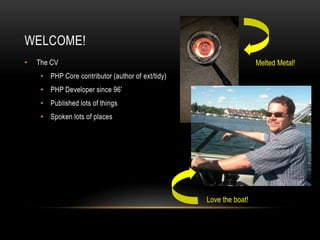
WELCOME!
• The CV
• PHP Core contributor (author of ext/tidy)
• PHP Developer since 96’
• Published lots of things
• Spoken lots of places
Melted Metal!
Love the boat!
ALL THE THINGS : PHP 7
• PHP 7 is the next major iteration of the PHP language
• Awesome new language features
• More sanity / consistency
• More speed!
• But wait, what happened to PHP 6?
• PHP 6 is dead.
• The short version: PHP 6’s big push was going to be Unicode support, but there
wasn’t enough developers to get that done so the tree stagnated and died.
• When will PHP 7 be released?
• Best guess: GA Fall, 2015
Warning
Everything I say here could be wrong.
… It’s probably not
… A lot of it is already implemented
… I probably got the date wrong
… There aren’t RFCs for everything
… At least I didn’t write a book on PHP 6
ERROR HANDLING
THE DEATH OF E_STRICT
• E_STRICT was our way of telling developers they were doing it wrong ™
• In PHP 7, E_STRICT is gone, and anything that was E_STRICT has been upgraded to
one of the following:
• Nothing (we just removed the E_STRICT error because it was dumb)
• Make it an E_DEPRECATED error (probably should have ran with this from the
beginning)
• Promote it to an E_NOTICE or E_WARNING (we’re serious about not letting you do
these things, knock it off)
Oh, Yeah! Hell, No.
28 4
https://wiki.php.net/rfc/reclassify_e_strict
CALL TO MEMBER FUNCTION OF
…ARG!!
• A really common error in PHP 5+ is “Call to member function blah() of non object”
• Basically, you tried to call a method on something that wasn’t an object (typically
NULL)
• $foo->bar->baz();
• In PHP 5, this is a fatal error and your application blows up
• In PHP 7 this has been changed to an E_RECOVERABLE_ERROR making it something
you can, you know, recover from in your application
Oh, Yeah! Hell, No.
32 0
https://wiki.php.net/rfc/catchable-call-to-member-of-
non-object
ENGINE EXCEPTIONS
• PHP 7 introduces the concept of using Exceptions for engine-level error handling to
replace E_ERROR, etc.
• Many / Most common error conditions will be converted to exceptions
• Future error conditions will, if possible, be implemented as exceptions
• Also introduced a revamped Exception object model
• BaseException
• EngineException
• ParseException
• Exception
• …
• Note: Existing catch code will not catch these new exceptions (clever)
Oh, Yeah! Hell, No.
60 2
Oh, Yeah! Hell, No.
39 19
https://wiki.php.net/rfc/engine_exceptions_for_php7
OBJECTS ‘N STUFF
WAIT.. THIS WAS BROKEN??
• In current versions of PHP, some internal classes could fail in the constructor and return a
object that, for all intensive purposes, was broken.
• In PHP 7, all internal classes throw exceptions in their constructors to prevent broken
instances
<?php
// Reflection function is not meant to accept an array (E_WARNING)
$reflection = new ReflectionFunction([]);
// Blows up
var_dump($reflection->getParameters());
Oh, Yeah! Hell, No.
32 1
https://wiki.php.net/rfc/internal_constructor_behaviour
SPEAKING OF CONSTRUCTORS..
• Also in PHP 7, the PHP 4 (circa 2000 – 15 years old) style of object constructors having
the same name as the class are one step closer to dying to the relief of all serious
developers.
• Methods named the same thing as the class (i.e. Filter::filter()) are just methods now
• Constructors are called __construct()
• In PHP 7 if it looks like you are using this horrible behavior it will now yell at you with an
E_DEPRECIATED
Oh, Yeah! Hell, No.
50 4
https://wiki.php.net/rfc/remove_php4_constructors
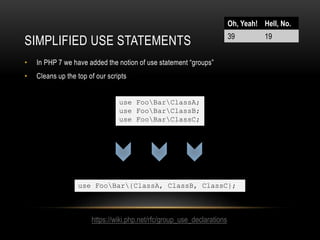
SIMPLIFIED USE STATEMENTS
• In PHP 7 we have added the notion of use statement “groups”
• Cleans up the top of our scripts
use FooBarClassA;
use FooBarClassB;
use FooBarClassC;
use FooBar{ClassA, ClassB, ClassC};
https://wiki.php.net/rfc/group_use_declarations
Oh, Yeah! Hell, No.
39 19
LANGUAGE FEATURES
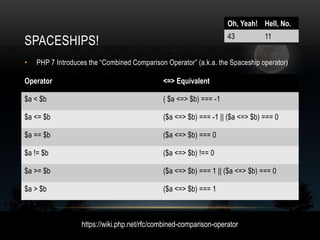
SPACESHIPS!
https://wiki.php.net/rfc/combined-comparison-operator
• PHP 7 Introduces the “Combined Comparison Operator” (a.k.a. the Spaceship operator)
Operator <=> Equivalent
$a < $b ( $a <=> $b) === -1
$a <= $b ($a <=> $b) === -1 || ($a <=> $b) === 0
$a == $b ($a <=> $b) === 0
$a != $b ($a <=> $b) !== 0
$a >= $b ($a <=> $b) === 1 || ($a <=> $b) === 0
$a > $b ($a <=> $b) === 1
Oh, Yeah! Hell, No.
43 11
?? OPERATOR
• No, that wasn’t a placeholder in my slides
• The ?? Operator, or Null Coalesce Operator which allows us to set default values for
variables when the variable doesn’t exist.
• Cleaner than trying to use ?: or other approaches
https://wiki.php.net/rfc/isset_ternary
Oh, Yeah! Hell, No.
31 3
<?php
// Useful for when you want to set default values for variables
$user = $_GET[‘user’] ?? ‘nobody’;
RETURN TYPES
• My personal war over the years has included this one
• Return type-hints will finally be part of PHP in PHP 7
• Doesn’t support “nullable” types (yet)
<?php
// Useful for when you want to set default values for variables
function returnsArray(): array {
return [‘happy’, ‘days’];
}
Oh, Yeah! Hell, No.
47 3
https://wiki.php.net/rfc/return_types
UNIFORM VARIABLE SYNTAX
• PHP has some… complicated|odd|dumb|insane variable syntax possibilities
• $foo->$bar[‘baz’]()
• There are a lot of inconsistencies in the way we resolve variables when they get a little
crazy
• In PHP 7, we are introducing a uniform syntax and fixing all of those issues
https://wiki.php.net/rfc/uniform_variable_syntax
Oh, Yeah! Hell, No.
30 1
<?php
$foo()[‘bar’](); // Call closure in array from return value
[$obj1, $obj2][0]->prop; // Access $obj1->prop
returnString(){0}; // Return first character
$foo::$bar::$baz; // Stacked static calls
$foo->bar()::baz(); // Stacked mixed calls
$foo()(); // Stacked function calls
$foo->bar()(); // Stacked method calls
WE STILL HAD THAT?
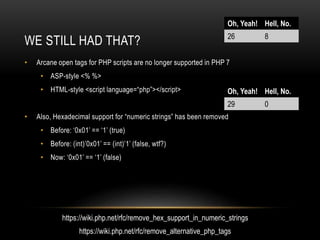
• Arcane open tags for PHP scripts are no longer supported in PHP 7
• ASP-style <% %>
• HTML-style <script language=“php”></script>
• Also, Hexadecimal support for “numeric strings” has been removed
• Before: ‘0x01’ == ‘1’ (true)
• Before: (int)’0x01’ == (int)’1’ (false, wtf?)
• Now: ‘0x01’ == ‘1’ (false)
Oh, Yeah! Hell, No.
26 8
Oh, Yeah! Hell, No.
29 0
https://wiki.php.net/rfc/remove_hex_support_in_numeric_strings
https://wiki.php.net/rfc/remove_alternative_php_tags
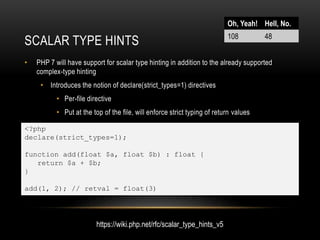
SCALAR TYPE HINTS
• PHP 7 will have support for scalar type hinting in addition to the already supported
complex-type hinting
• Introduces the notion of declare(strict_types=1) directives
• Per-file directive
• Put at the top of the file, will enforce strict typing of return values
• Caller file counts, not source file
Oh, Yeah! Hell, No.
108 48
https://wiki.php.net/rfc/scalar_type_hints_v5
<?php
declare(strict_types=1);
function add(float $a, float $b) : float {
return $a + $b;
}
add(1, 2); // retval = float(3)
NEW LIST() BEHAVIOR
• The list() statement(?) is a odd thing in PHP used to extract array values into variables
• list($a, $b, $c) = [1, 2, 3]; // $a = 1, $b = 2, $c = 3
• In PHP 7 there are a couple of changes to the behavior
• list() now assigns variables left-to-right instead of right-to left
• list() no longer supports extracting values from strings
<?php
$a = []
list($a[], $a[], $a[]) = [1, 2 ,3];
// OLD: $a = [3, 2, 1];
// NEW: $a = [1, 2, 3];
https://wiki.php.net/rfc/abstract_syntax_tree
https://wiki.php.net/rfc/fix_list_behavior_inconsistency
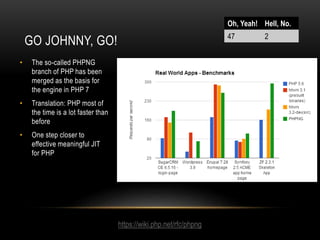
GO JOHNNY, GO!
• The so-called PHPNG
branch of PHP has been
merged as the basis for
the engine in PHP 7
• Translation: PHP most of
the time is a lot faster than
before
• One step closer to
effective meaningful JIT
for PHP
Oh, Yeah! Hell, No.
47 2
https://wiki.php.net/rfc/phpng
KEEP UP TO DATE WITH THE LATEST
• PHP 7 like all things is going to be a moving target until it is done
• There is a VirtualBox of PHP 7 to toy around with maintained by Rasmus Lerdorf
• https://github.com/rlerdorf/php7dev
• The PHP RFC Wiki is also a great source of more details on everything we’ve discussed
and the things currently being considered
• https://wiki.php.net/rfc
John Coggeshall
@coogle
http://www.coggeshall.org/
THANK YOU / QUESTIONS?

Peek at PHP 7

  • 1.
  • 2.
    WELCOME! • The CV •PHP Core contributor (author of ext/tidy) • PHP Developer since 96’ • Published lots of things • Spoken lots of places Melted Metal! Love the boat!
  • 3.
    ALL THE THINGS: PHP 7 • PHP 7 is the next major iteration of the PHP language • Awesome new language features • More sanity / consistency • More speed! • But wait, what happened to PHP 6? • PHP 6 is dead. • The short version: PHP 6’s big push was going to be Unicode support, but there wasn’t enough developers to get that done so the tree stagnated and died. • When will PHP 7 be released? • Best guess: GA Fall, 2015
  • 4.
    Warning Everything I sayhere could be wrong. … It’s probably not … A lot of it is already implemented … I probably got the date wrong … There aren’t RFCs for everything … At least I didn’t write a book on PHP 6
  • 5.
  • 6.
    THE DEATH OFE_STRICT • E_STRICT was our way of telling developers they were doing it wrong ™ • In PHP 7, E_STRICT is gone, and anything that was E_STRICT has been upgraded to one of the following: • Nothing (we just removed the E_STRICT error because it was dumb) • Make it an E_DEPRECATED error (probably should have ran with this from the beginning) • Promote it to an E_NOTICE or E_WARNING (we’re serious about not letting you do these things, knock it off) Oh, Yeah! Hell, No. 28 4 https://wiki.php.net/rfc/reclassify_e_strict
  • 7.
    CALL TO MEMBERFUNCTION OF …ARG!! • A really common error in PHP 5+ is “Call to member function blah() of non object” • Basically, you tried to call a method on something that wasn’t an object (typically NULL) • $foo->bar->baz(); • In PHP 5, this is a fatal error and your application blows up • In PHP 7 this has been changed to an E_RECOVERABLE_ERROR making it something you can, you know, recover from in your application Oh, Yeah! Hell, No. 32 0 https://wiki.php.net/rfc/catchable-call-to-member-of- non-object
  • 8.
    ENGINE EXCEPTIONS • PHP7 introduces the concept of using Exceptions for engine-level error handling to replace E_ERROR, etc. • Many / Most common error conditions will be converted to exceptions • Future error conditions will, if possible, be implemented as exceptions • Also introduced a revamped Exception object model • BaseException • EngineException • ParseException • Exception • … • Note: Existing catch code will not catch these new exceptions (clever) Oh, Yeah! Hell, No. 60 2 Oh, Yeah! Hell, No. 39 19 https://wiki.php.net/rfc/engine_exceptions_for_php7
  • 9.
  • 10.
    WAIT.. THIS WASBROKEN?? • In current versions of PHP, some internal classes could fail in the constructor and return a object that, for all intensive purposes, was broken. • In PHP 7, all internal classes throw exceptions in their constructors to prevent broken instances <?php // Reflection function is not meant to accept an array (E_WARNING) $reflection = new ReflectionFunction([]); // Blows up var_dump($reflection->getParameters()); Oh, Yeah! Hell, No. 32 1 https://wiki.php.net/rfc/internal_constructor_behaviour
  • 11.
    SPEAKING OF CONSTRUCTORS.. •Also in PHP 7, the PHP 4 (circa 2000 – 15 years old) style of object constructors having the same name as the class are one step closer to dying to the relief of all serious developers. • Methods named the same thing as the class (i.e. Filter::filter()) are just methods now • Constructors are called __construct() • In PHP 7 if it looks like you are using this horrible behavior it will now yell at you with an E_DEPRECIATED Oh, Yeah! Hell, No. 50 4 https://wiki.php.net/rfc/remove_php4_constructors
  • 12.
    SIMPLIFIED USE STATEMENTS •In PHP 7 we have added the notion of use statement “groups” • Cleans up the top of our scripts use FooBarClassA; use FooBarClassB; use FooBarClassC; use FooBar{ClassA, ClassB, ClassC}; https://wiki.php.net/rfc/group_use_declarations Oh, Yeah! Hell, No. 39 19
  • 13.
  • 14.
    SPACESHIPS! https://wiki.php.net/rfc/combined-comparison-operator • PHP 7Introduces the “Combined Comparison Operator” (a.k.a. the Spaceship operator) Operator <=> Equivalent $a < $b ( $a <=> $b) === -1 $a <= $b ($a <=> $b) === -1 || ($a <=> $b) === 0 $a == $b ($a <=> $b) === 0 $a != $b ($a <=> $b) !== 0 $a >= $b ($a <=> $b) === 1 || ($a <=> $b) === 0 $a > $b ($a <=> $b) === 1 Oh, Yeah! Hell, No. 43 11
  • 15.
    ?? OPERATOR • No,that wasn’t a placeholder in my slides • The ?? Operator, or Null Coalesce Operator which allows us to set default values for variables when the variable doesn’t exist. • Cleaner than trying to use ?: or other approaches https://wiki.php.net/rfc/isset_ternary Oh, Yeah! Hell, No. 31 3 <?php // Useful for when you want to set default values for variables $user = $_GET[‘user’] ?? ‘nobody’;
  • 16.
    RETURN TYPES • Mypersonal war over the years has included this one • Return type-hints will finally be part of PHP in PHP 7 • Doesn’t support “nullable” types (yet) <?php // Useful for when you want to set default values for variables function returnsArray(): array { return [‘happy’, ‘days’]; } Oh, Yeah! Hell, No. 47 3 https://wiki.php.net/rfc/return_types
  • 17.
    UNIFORM VARIABLE SYNTAX •PHP has some… complicated|odd|dumb|insane variable syntax possibilities • $foo->$bar[‘baz’]() • There are a lot of inconsistencies in the way we resolve variables when they get a little crazy • In PHP 7, we are introducing a uniform syntax and fixing all of those issues https://wiki.php.net/rfc/uniform_variable_syntax Oh, Yeah! Hell, No. 30 1 <?php $foo()[‘bar’](); // Call closure in array from return value [$obj1, $obj2][0]->prop; // Access $obj1->prop returnString(){0}; // Return first character $foo::$bar::$baz; // Stacked static calls $foo->bar()::baz(); // Stacked mixed calls $foo()(); // Stacked function calls $foo->bar()(); // Stacked method calls
  • 18.
    WE STILL HADTHAT? • Arcane open tags for PHP scripts are no longer supported in PHP 7 • ASP-style <% %> • HTML-style <script language=“php”></script> • Also, Hexadecimal support for “numeric strings” has been removed • Before: ‘0x01’ == ‘1’ (true) • Before: (int)’0x01’ == (int)’1’ (false, wtf?) • Now: ‘0x01’ == ‘1’ (false) Oh, Yeah! Hell, No. 26 8 Oh, Yeah! Hell, No. 29 0 https://wiki.php.net/rfc/remove_hex_support_in_numeric_strings https://wiki.php.net/rfc/remove_alternative_php_tags
  • 19.
    SCALAR TYPE HINTS •PHP 7 will have support for scalar type hinting in addition to the already supported complex-type hinting • Introduces the notion of declare(strict_types=1) directives • Per-file directive • Put at the top of the file, will enforce strict typing of return values • Caller file counts, not source file Oh, Yeah! Hell, No. 108 48 https://wiki.php.net/rfc/scalar_type_hints_v5 <?php declare(strict_types=1); function add(float $a, float $b) : float { return $a + $b; } add(1, 2); // retval = float(3)
  • 20.
    NEW LIST() BEHAVIOR •The list() statement(?) is a odd thing in PHP used to extract array values into variables • list($a, $b, $c) = [1, 2, 3]; // $a = 1, $b = 2, $c = 3 • In PHP 7 there are a couple of changes to the behavior • list() now assigns variables left-to-right instead of right-to left • list() no longer supports extracting values from strings <?php $a = [] list($a[], $a[], $a[]) = [1, 2 ,3]; // OLD: $a = [3, 2, 1]; // NEW: $a = [1, 2, 3]; https://wiki.php.net/rfc/abstract_syntax_tree https://wiki.php.net/rfc/fix_list_behavior_inconsistency
  • 21.
    GO JOHNNY, GO! •The so-called PHPNG branch of PHP has been merged as the basis for the engine in PHP 7 • Translation: PHP most of the time is a lot faster than before • One step closer to effective meaningful JIT for PHP Oh, Yeah! Hell, No. 47 2 https://wiki.php.net/rfc/phpng
  • 22.
    KEEP UP TODATE WITH THE LATEST • PHP 7 like all things is going to be a moving target until it is done • There is a VirtualBox of PHP 7 to toy around with maintained by Rasmus Lerdorf • https://github.com/rlerdorf/php7dev • The PHP RFC Wiki is also a great source of more details on everything we’ve discussed and the things currently being considered • https://wiki.php.net/rfc
  • 23.