MODULE -3
Manoj Bk
Lavanya
Lathiesh
Switchgears
– A switchgear is a generic term which includes
all the switching devices associated with
power system protection. It also includes all
devices associated with control, metering and
regulating of electrical power systems.
Assembly of such devices in a logical manner
forms switchgear. In other words systems
used for switching, controlling and protecting
the electrical power circuits and different
types of electrical equipment are known as
switchgear. This is very basic definition of
switchgear
Why we need Electrical Switchgears
– Switchgear protection plays a vital role in modern power system network, right from generation through
transmission to distribution end. The current interruption devices are called circuit breaker. The circuit breakers
can be operated manually as when required and it can also be operated autometically during over current and
short circuit or any other faults in the system by sensing the abnormality of system parameters. These power
system parametrs can be current, voltage, frequency, phase angle etc. The circuit breaker senses the faulty
condition of system through protection relays and these relays are again actuated by faulty signal normally
comes from current transformer or voltage transformer.
– The switchgear has to perform the function of carrying, making and breaking the normal load current like a
switch and it has to perform the function of clearing the fault in the power system. In addition to that, it also has
the provision of metering and regulating the various parameters of electrical power systems. Thus the switchgear
includes circuit breakers, current transformers, voltage transformers, protection relays, measuring instruments,
electrical switches, electrical fuses, miniature circuit breaker, lightning arresters or surge arresters, electrical
isolators and other associated pieces of equipment.
Structural Diagram
Dimensional Diagram
Types of Switchgears
– Medium Voltage switchgears
– Low voltage switchgears
– GIS or Gas insulated switchgears
Medium Voltage switchgears
– From 3 KV to 36 KV switchgear system is categorized as medium voltage switchgear or MV switchgear. These
switchgears are of many types. They may metal enclosed indoor type switchgear, metal enclosed outdoor type
switchgear, outdoor type switchgear without metal enclosure, etc. The interruption medium of this switchgear
may be insulating oil, SF6 gas or vacuum. The main requirement of power network is to interrupt current during
faulty condition irrespective of what type of CB is used in the MV switchgear system. Although it may be capable
of functioning in other conditions also.
Medium voltage switchgear, should be capable of,
– Normal ON/OFF switching operation.
– Short circuit current interruption.
– Switching of capacitive currents.
– Switching of inductive currents.
– Some special application
USAGE as Railway Traction
– Another application of medium voltage switchgear is single phase railway
track system. The main function of the circuit breaker associated with
railway traction system is to interrupt short circuit, on the overhead
catenary system which occurs frequently and it is transient. Hence, a
circuit breaker used for this purpose should have, short breaking time for
small contact gap, short arcing time, quick breaking, and VCB is the best
possible solution. Arcing energy is much higher in the single-phase CB than
3 phase CB. It is still much lower in a vacuum circuit breaker than that in a
conventional circuit breaker. The number of short circuits occurs in the
overhead catenary system is much higher than those occurring on
electrical transmission system. Medium voltage switchgear with vacuum
circuit breaker is most suitable for traction application. We can conclude
that, in the medium voltage system where the tripping rate is very high,
MV Vacuum Switchgear is the most suitable solution.
Low voltage switchgears
– Generally electrical switchgear rated upto
1KV is termed as low voltage switchgear.
The term LV Switchgear includes low voltage
circuit breakers, switches, off load electrical
isolators, HRC fuses, earth leakage circuit
breaker, miniature circuit breakers (MCB) and
molded case circuit breakers (MCCB) etc i.e.
all the accessories required to protect the LV
system. The most common use of LV
switchgear is in LV distribution board. This
system has the following parts
Features
– Simplicity
– Efficient performance
– High normal current rating up
to 600 A
– High fault withstanding
capacity upto 63 kA
GIS or Gas insulated
switchgears
– It is very much required to establish an electrical
substation at load center. Since, establishing a
substation at load center is quite economical and
profitable in many aspects. As it reduces length of
feeders and due to short length feeders, the quality of
voltage regulation improves. But the main obstruction
of establishing a substation at load center is space.
Generally main load center of any place is situated at
very congested place where, sufficient land for
establishing conventional electrical substation is very
hardly available.
Usage
– Electrical bus bars.
– Electrical isolators or disconnectors.
– Circuit breakers.
– Current transformers.
– Voltage transformers.
– Earth switches.
– Surge arrestors or lightning arresters.
FUSES
– Fuse –protective device in a circuit against damage
from an excessive current flowing in it. Protects by
melting the fuse- element by excessive current and
thus disconnecting the circuit
– They are cheap
– Fuse elements may be lead for small current and
tinned copper for large currents.
up to 3 amp of current lead fuse wires are used unto
15 amp of current alloy of lead and tin is used and above
15 amperes tinned copper wires are used
ADVANTAGES OF REWIRABLE FUSE DISADVANTAGES OF REWIRABLE
FUSE
Cheapest form of operation Unreliable operation
Requires minimum time to replace Lack of discrimination
Requires no maintenance Small time lag
Has Current limiting effect Misuse
Affords current limiting effect under
short circuit conditions due to cut off
Low rupturing capacity
Characteristics of Fuse
Materials
1. Low melting point
2. Low ohmic losses ( Loss of electric energy when a current flows through a
resistance due to conversion into heat Also known as ohmic loss).
3. High conductivity
4. Lower rate of deterioration
Different types of fuses:
1. Re-wirable or kit-kat fuses: these fuses are simple in construction, cheap and available up to a current rating of 200A.
They are erratic in operation and their performance deteriorates with time.
2. Plug fuse: The fuse carries is provided with a glass window for visual inspection of the fuse wire
3. Cartridge fuse: Fuse wire usually an alloy of lead is enclosed in a strong fibre casing. The fuse element is fastened to
copper caps at the ends of the casing. They are available up-to a voltage rating of 25kV. They are used for protection in
lighting installations and power lines.
4. Miniature Cartridge fuses : These are the miniature version of the higher rating cartridge fuses, which are extensively
used in automobiles, TV sets, and other electronic equipment's.
5. Transformer fuse blocks: these porcelain housed fuses are placed on secondary of the distribution transformers for
protection against short circuits and overloads
6. Expulsion fuses: these consists of fuse wire placed in hollow tube of fibre lined with asbestos. These are suited only for
out door use for example, protection of high voltage circuits
7. Semi-enclosed re-wirable fuses: these have limited use because of low breaking capacity
8. Time delay fuse: these are specially designed to withstand a current overload for a limited time and final application in
motor circuits
Electrical Switchgear Protection
Devices
– The switch is used to manually open and close the electrical circuit
in our home and electrical fuse is used to protect our household
electrical circuit from over current and short circuit faults.
In same way every electrical circuit including high voltage electrical
power system needs switching and protective devices. But in high
voltage and extra high voltage system, this switching and protective
scheme becomes complicated one for high fault current
interruption in safe and secure way. In addition to that from
commercial point of view every electrical power system needs
measuring, controlling and regulating arrangement. Collectively the
whole system is called switchgear and protection of power system.
The electrical switchgear has been developing in various forms
Switchgear protection plays a vital role in modern power
system network, right from generation through transmission to
distribution end. The current interruption devices are called
circuit breaker. The circuit breakers can be operated manually
as when required and it can also be operated automatically
during over current and short circuit or any other faults in the
system by sensing the abnormality of system parameters.
These power system parameters can be current, voltage,
frequency, phase angle etc. The circuit breaker senses the
faulty condition of system through protection relays and these
relays are again actuated by faulty signal normally comes from
current transformer or voltage transformer.
The switchgear has to perform the function of carrying, making
and breaking the normal load current like a switch and it has to
perform the function of clearing the fault in the power system.
In addition to that, it also has the provision of metering and
regulating the various parameters of electrical power systems.
Thus the switchgear includes circuit breakers, current
transformers, voltage transformers, protection relays,
measuring instruments, electrical switches, electrical fuses,
miniature circuit breaker, lightning arresters or surge arresters,
electrical isolators and other associated pieces of equipment
EARTH
LEAKAGE
CIRCUIT
BREAKER
Lavanya
EARTH LEAKAGE CIRCUIT
BREAKER
– AN EARTH LEAKAGE CIRCIUT BREAKER (ELCB) IS A SAFETY DEVICE USED IN
ELECTRICAL INSTALLATIONS WITH HIGH EARTH IMPEDANCE TO PREVENT
SHOCK . IT DETECTS SMALL STRAY VOLTAGES ON THE METAL ENCLOSURES
OF ELECTRICAL EQUIPEMENT ,AND INTERRUPTS THE CIRCUIT IF A
DANGEROUS VOLTAGE IS DETECTED .
– IT IS USED FOR THE PROTECTION AGAINST ELECTRICAL LEAKAGE IN THE
CIRCUIT
– WHEN SOMEBODY GETS AN ELECTRICAL SHOCK OR RESIDUAL CURRENT
OF THE CIRCUIT EXCEEDS THE FIXED VALUE ,ELCB CUTS OFF THE POWER
WITHIN THE TIME OF 0.1S AUTOMATICALLY PROTECTING THE PERSONAL
SAFETY AND PREVENTING THE EQUIPEMENT FROM THE FAULT
– ELCB ALSO PROTECT THE CIRCUIT AGAINST OVER LOAD AND SHORT
CIRCUIT .
USE OF ELCB
– THE MAIN PURPOSE OF EARTH LEAKAGE PROTECTORS IS TO PREVENT INJURY
TO HUMANS AND ANIMALS DUE TO ELECTRIC SHOCK .
IT IS A CURRENT OPERATED DEVICE DESIGNED TO OPERATE
WHEN A LEAKAGE CURRENT SUCCEEDS A PRE DETERMINED
VALUE IT ESSENTIALLY CONSISTS OF AN OPERATING COIL AND A
TRIP MECHANISM ,WHICH OPERATES CONTACTS CONTROLLING
THE SUPPLY TO THE CIRCUIT CONCERENED .
ADVANTAGES
THEY ARE LESS SENSITIVE TO FAULT CONDITIONS ,THEREFORE
HAVE LESS NUISANCE STRIPS .
THEY CAN BE ARRANGED TO PROTECT AGAINST CABLE
DAMAGE ONLY
AND NOT STRIP ON FAULTS IN DOWN LINE INSTALLATIONS .
DISADVANTAGES
THEY DO NOT DETECT FAULTS THAT DON’T PASS CURRENT
THROUGH THE CPC TO THE EARTH ROD .
THEY DO NOT ALLOW A SINGLE BUILDINGF SYSTEM TO BE
EASILY SPLIT INTO MULTIPLE SECTIONS WITH INDEPENDENT
FAULT PROTECTION ,BECAUSE EARTHINGS SYSTEM ARE
USUALLY BONDED TO PIPE WORK
ELCB’S INTRODUCE ADDITIONAL RESISTANCE AND ADDITIONAL
POINT OF FAILURE INTO EARTHING SYSTEMS .
MINIATURE CIRCUIT
BREAKER
• A MINIATURE CIRCUIT BREAKER IS AN
AUTOMATICALLY OPERATED ELECTRICAL
SWITCH DESIGNED TO PROTECT AND
ELECTRICAL CIRCUIT FROM DAMAGE CAUSED
BY OVERLOAD OR SHORT CIRCIUT .
• ITS BASIC FUNCTION IS TO DETECT A FAULT
CONDITION AND INTERRUPT CURRENT FLOW
• IT COMES UNDER LOW VOLTAGE CIRCUIT
BREAKER .
CONSTRUCTION
– MCB IS MEANT FOR TWO TYPE OF OVER CURRENT SITUATION
OVERLOAD AND SHORT CIRCUIT
– IT CONSISTS OF MAGNET AND THERMAL TRIP UNIT
– BOTH UNITS AT INDEPENDENTLY AND MECHANICALLY WITH
BREAKERS TRIP MECHANISM TO OPEN BREAKERS CONTACT
– MAGNETIC TRIP UNIT (SHORT CIRCUIT PROTECTION ) .THE
MAGNETIC TRIP UNIT PROTECTS AGAINST A SHORT CIRCUIT THE
MAGNETIC TRIP UNIT IS COMPRISED OF AN ELECTROMAGNET
AND ARMATURE
– THERMAL TRIP UNIT (OVERLOADED PROTECTION )
THE THERMAL TRIP UNIT PROTECT AGAINST CONTINIOUS
OVERLOAD .THE THERMAL UNIT IS COMPRISED OF BIMETAL
ELEMENT LOCATED BEHIND THE CIRCUIT BREAKER TRIP BAR AND ,IS
PART OF THE BREAKERS CURRENT CARRYING PATH
HOW MCB WORKS
– THERE ARE TWO AGREEMENTS OF OPERATION OF
MINIATURE CIRCUIT BREAKER
– ONE DUE TO THERMAL EFFECT AND OTHER DUE TO
ELECTROMAGNETIC EFFECT OF OVER CURRENT
– THE THERMAL OPERATION OF MINIATURE CIRCUIT
BREAKER IS ACHIEVED WITH THE BIMETALLIC STRIP
WHENEVER CONTINIOUS OVER CURRENT FLOWS
THROUGH MCB ,THE BIMETALLIC STRIP IS HEATED
AND DEFLECTS BY BENDING.
USES
– A MINIATURE CIRCUIT BREAKER IS USED IN NEW CONSTRUCTION INSTEAD
OF THE OLDER TYPES OF FUSES .CIRCUIT BREAKERS ARE SMALL DEVISES
USED TO CONTROL AND PROTECT ELECTRICAL PANEL AND THE OTHER
DEVISES FROM OVER FLOWING OF ELECTRIC POWER
– HOME ELECTRICAL PANELS : MCB ARE MUCH SAFER THAN THE TYPICAL
FUSES BECAUSE THEY CAN BE RESET MANUALLY AND BECAUSE THEY
HANDLE MUCH LARGER AMOUNTS OF POWER ,HENCE THEY ARE USED IN
HOME APPLIANCE
– GROUND FAULT TRIP MECHANISM : IN SOME CASES ,YOU CAN USE A
MINIATURE CIRCUIT BREAKER WITH GROUND FAULT , OR ARC FAULT
MECHANISMS, BECAUSE THE BREAKERS CONSISTS OF A SYSTEM THAT
OPENS THE CONTACTS IF A LINE TO GROUND FAULTS OCCURS
– LIGHTS :USING MINIATURE CIRCUIT BREAKERS IN THE LIGHTING SYSTEM OF
THE HOUSE ,BECAUSE THEY CAN DEAL WITH THE AMOUNT OF POWER
NEEDED TO LIGHT A HOUSE ESPECIALLY IF USING SPECIFIC TYPES OF LAMPS
SUCH AS FLUROSCENT LIGHTS
MCCB AND
ACB
Lathiesh Naidu
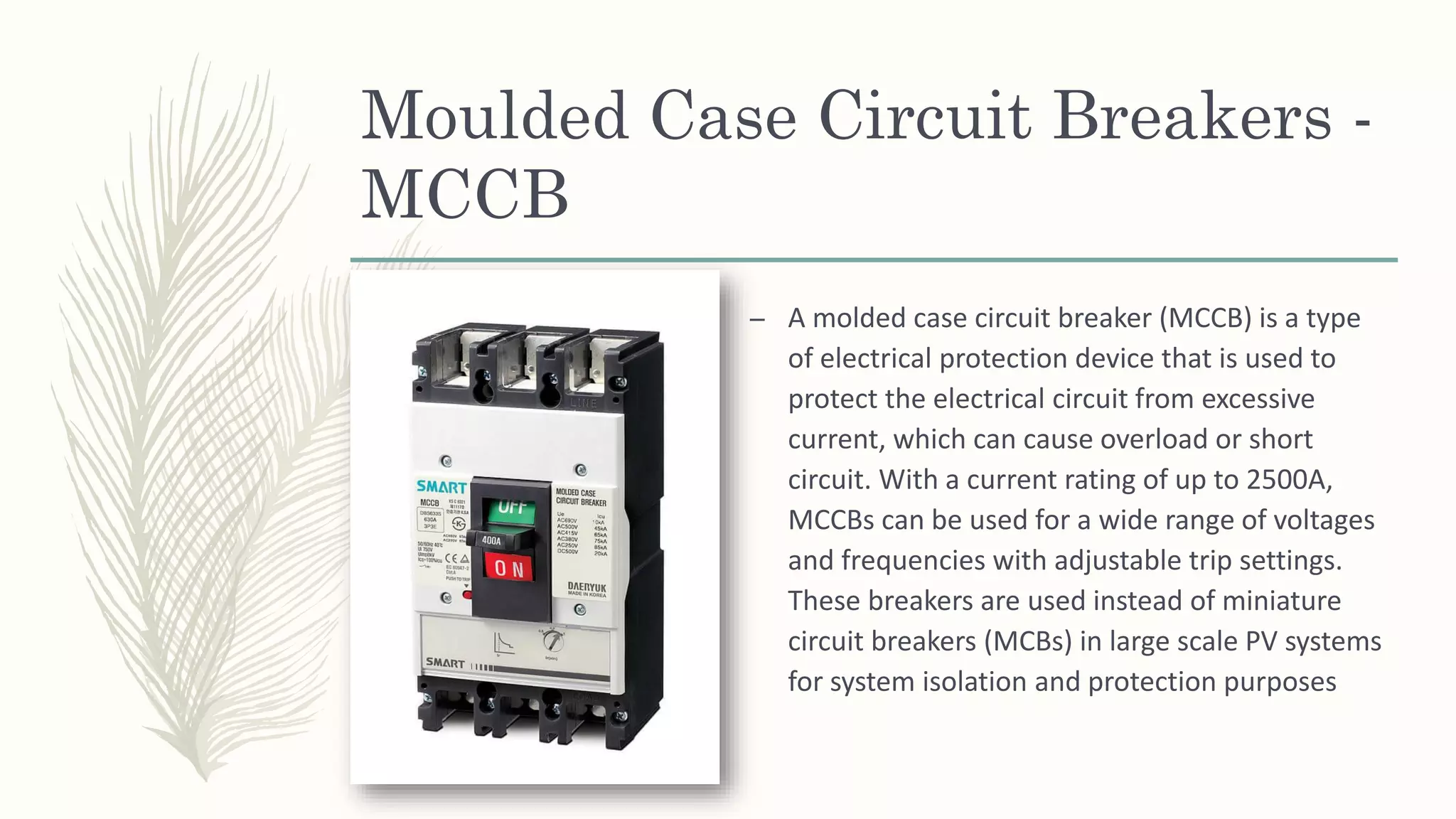
Moulded Case Circuit Breakers -
MCCB
– A molded case circuit breaker (MCCB) is a type
of electrical protection device that is used to
protect the electrical circuit from excessive
current, which can cause overload or short
circuit. With a current rating of up to 2500A,
MCCBs can be used for a wide range of voltages
and frequencies with adjustable trip settings.
These breakers are used instead of miniature
circuit breakers (MCBs) in large scale PV systems
for system isolation and protection purposes
How The MCCB operates?
– The MCCB uses a temperature sensitive device
(the thermal element) with a current sensitive
electromagnetic device (the magnetic element)
to provide the trip mechanism for protection
and isolation purposes. This enables the MCCB
to provide:
– Overload Protection,
– Electrical Fault Protection against short circuit
currents, and
– Electrical Switch for disconnection
Overload Protection
– Overload protection is provided by the MCCB via the temperature sensitive
component. This component is essentially a bimetallic contact: a contact which
consists of two metals that expand at different rates when exposed to high
temperature. During the normal operating conditions, the bimetallic contact will
allow the electric current to flow through the MCCB. When the current exceeds the
trip value, the bimetallic contact will start to heat and bend away due to the
different thermal rate of heat expansion within the contact. Eventually, the contact
will bend to the point of physically pushing the trip bar and unlatching the contacts,
causing the circuit to be interrupted.
– The thermal protection of the MCCB will typically have a time delay to allow a short
duration of overcurrent which is commonly seen in some device operations, such as
inrush currents seen when starting motors. This time delay allows the circuit to
continue to operate in these circumstances without tripping the MCCB.
Sizing of MCCB
– MCCBs in an electrical circuit should be sized according to the circuit’s expected
operating current and possible fault currents. The three main criteria while
selecting MCCBs are:
– The rated working voltage (Ue) of the MCCB should be similar to the system
voltage.
– The trip value of the MCCB should be adjusted according to the current drawn
by the load.
– The breaking capacity of the MCCB must be higher than the theoretical possible
fault currents.
Graph of Protection Curve
AIR CIRCUIT BREAKERS -
ACB
– Use to provide Overcurrent and short-circuit
protection
– Operate in air atmospheric pressure
– Electric circuits over 800Amps to 10Kamps
– Usually used in low voltage applications below
450V
– Faster breaker operation and quenched the
arc for short time when the system fault
Working of air circuit Breaker
– Air circuit breakers operate with their contacts in free air. Their method of arc
quenching control is entirely different from that of oil circuit-breakers. They
are always used for a low-voltage interruption and now tends to replace high-
voltage oil breakers. The below-shown figure illustrates the principle of air
breaker circuit operation
– Air Circuit breakers generally have two pairs of contacts. The main pair of
contacts (1) carries the current at normal load and these contacts are made of
copper metal. The second pair is the arcing contact (2) and is made of carbon.
When the circuit breaker is being opened, the main contacts open first. When
the main contacts opened the arcing contacts are still in touch with each
other. As the current gets a parallel low resistive path through the arcing
contact. During the opening of the main contacts, there will not be any arcing
in the main contact. The arcing is only initiated when finally the arcing
contacts are separated. Each of the arc contacts is fitted with an arc runner
which helps. The arc discharge to move upward due to both thermal and
electromagnetic effects as shown in the figure. As the arc is driven upward it
enters in the arc chute, consisting of splatters.
Working of air circuit Breaker
– Figure (a) shows the development of the arc from the time it
leaves the main contacts until it is within the arc chute. When
the current next ceases at a current zero, the ionized air in the
path of where the arc had been being in parallel with the open
contacts and acts as a shunt resistance across both the contacts
and the self-capacitance C, shown in below figure with red as a
high resistance R.
– When the oscillation starts between C and L as described for the
idealized circuit breaker shown in Figure below, this resistance
damps the oscillation heavily. Certainly, it is usually so heavy that
the damping is critical, the oscillation cannot then take place at
all, and the restricting voltage, instead of appearing as a high-
frequency oscillation, rises dead-beat to its eventual value of
peak generator voltage. This is shown below the lower
waveform.
Types of Air Circuit Breakers
– Plain Break type Air Break Circuit Breaker
Plain brake air circuit breakers are the simplest form of
air breakers. The main points of contacts are made in
the shape of two horns. The arc of these circuit
breakers extends from one tip to the other.
– Magnetic Blowout Type Air Break Circuit Breaker
Magnetic blowout air circuit breakers are used in
voltage capacity up to 11KV. The extension of the arc
can get by magnetic field provided by the current in
blowout coils
Types of Air Circuit Breakers
- Magnetic Blowout Type Air Break
Circuit Breaker
Magnetic blowout air circuit
breakers are used in voltage
capacity up to 11KV. The extension
of the arc can get by magnetic field
provided by the current in blowout
coil
Principal - Air Chute Air Break
Circuit Breake
– In air chute air break circuit breaker, the main
contacts are usually made up of copper and
conduct current in closed positions. Air chute
air break circuit breakers have low contact
resistance and they are silver plated. The arcing
contacts are solid, resistant to heat, and are
made up of copper alloy.
Features of Air Circuit Breakers
MERITS
– Air Circuit Breakers are used for controlling the power station
auxiliaries and industrial plants. They offer protection to
industrial plants, electrical machines like the transformers,
capacitors, and generators.
– They are mainly used for the protection of plants, where
there are possibilities of fire or explosion hazards.
– The air brake principle of the air breaker circuit arc is used
in DC circuits and AC circuit up to 12KV.
– The air circuit breakers have high resistance power that helps
in increasing the resistance of the arc by splitting, cooling,
and lengthening.
– An air circuit breaker is also used in the Electricity sharing
system and NGD about 15kV
DEMERITS
– A drawback of the arc chute principle is its
inefficiency at low currents where the
electromagnetic fields are weak.
– The chute itself is not necessarily less efficient in
its lengthening and de-ionizing action than at high
currents, but the arc movement into the chute
tends to become slower, and high-speed
interruption is not necessarily obtained
RCCB-Residual Current Circuit
Breaker
– A Residual Current Circuit Breaker (RCCB)
is an important safety measure when it
comes to protection of electrical circuits.
It is a current sensing device, which can
automatically measure and disconnect
the circuit whenever a fault occurs in the
connected circuit or the current exceeds
the rated sensitivity.
Features of RCCB
MERITS DEMERITS
Provides protection against earth fault as well as any
leakage current
RCCB does not guarantee to operate if none standard waveforms
are generated by loads. It’s mainly because RCCB is designed to
operate on normal supply waveforms.
Automatically disconnects the circuit when the rated
sensitivity is exceeded. Offers possibility of dual
termination both for cable and connections
There might be some unwanted tripping of RCCB. It’s mainly
because whenever there are sudden changes in electrical load,
there can be small current flow to earth especially in old
appliance.
Offers protection against voltage fluctuation as it
includes a filtering device that guards against
transient voltage levels
RCCB does not protect from current overload. It has been
designed to protect only when the live current and neutral
current are different. However, a current overload cannot be
detected.
Difference between MCB ,
MCCB and ACB
MCB MCCB ACB
It stands for Miniature Circuit Breaker. It stands for Molded Case Circuit Breaker. ACB stands for Air Circuit Breaker
Rated current not more than 125 Ampere. Rated Current up to 1600A Rated Current upto 4000A.
Its interrupting current rating is under 10KA Their interrupting current ranges from
around 10KA -85KA
Interrupting current is between 800Amps
and 10Kamps
Judging from their power capacities, MCB is
mainly used for low Breaking capacity
requirement mainly domestic
MCCB is mainly used for both low and
high Breaking capacity requirements
mainly industrial.
They are always used for a low-voltage
interruption and now tends to replace
high-voltage oil breakers.
Its trip characteristics are normally not Its trip current may be fixed as well as Modern circuit breakers(MCCB,ACB)
Difference between MCB ,
MCCB and ACB
MCB MCCB ACB
Difference between MCB ,
MCCB and ACB
RCCB ELCB
It stands for Residual Current Circuit Breaker. It stands for Electric Leakage Circuit Breaker.
It is a new name and refers to current operated devices. ELCB refers to voltage operated earth leakage device.
It ensures 100% detection of leakage current & is available to sense
the AC as well as DC leakage current.
It is not preferable as it can only detect current that flow
back through the main earth wire.
RCCB has no connection with the earth wire and that’s why it can
trip when both current (phase and neutral) are different and it
withstands up to both currents are same.
ELCB is working based on Earth leakage current. These
devices measured the voltage on the earth conductor; if
this voltage was not zero this indicated a current leakage to
Difference between MCB ,
MCCB and ACB
RCCB ELCB
PROTECTIVE
DEVICES
Lathiesh
Manoj BK
PROTECTIVE DEVICES
– Protective relay work as a sensing device, it senses the fault, then known its position
and finally, it gives the tripping command to the circuit breaker. The circuit breaker
after taking the command from the protective relay, disconnect the faulted element.
– By clearing the fault fast with the help of fast-acting protective relay and associated
circuit breaker, the damage to the apparatus is reduced, and the resultant hazards
like fire, the risk of the life are reduced, by removing the particularly faulted section.
– But the continuity of supply is maintained, though remaining healthy section, by
clearing the fault fast, fault arising time is reduced, and therefore the system can be
restored to the normal state sooner. Hence the transient state stability limit of the
system is greatly improved, permanent damage to the equipment is avoided, and
the possibility of developing most simple fault such as single phase-to-ground into
most severe fault such as double phase-to-ground fault is reduced
The fault can only be reduced if the
protective relay is reliable,
maintainable and sensitive enough to
distinguish between normal and
abnormal condition. The relay must
come into action whenever there is a
fault and must not operate if there is
no fault. Some relays are used for the
protection of the power system. Some
of them are primary relay meaning
that they are the first line of defence.
Such relays sense the fault and send a
signal to the proper circuit breaker to
trip and clear the fault.

Switchgears and protection devices

  • 1.
  • 2.
    Switchgears – A switchgearis a generic term which includes all the switching devices associated with power system protection. It also includes all devices associated with control, metering and regulating of electrical power systems. Assembly of such devices in a logical manner forms switchgear. In other words systems used for switching, controlling and protecting the electrical power circuits and different types of electrical equipment are known as switchgear. This is very basic definition of switchgear
  • 4.
    Why we needElectrical Switchgears – Switchgear protection plays a vital role in modern power system network, right from generation through transmission to distribution end. The current interruption devices are called circuit breaker. The circuit breakers can be operated manually as when required and it can also be operated autometically during over current and short circuit or any other faults in the system by sensing the abnormality of system parameters. These power system parametrs can be current, voltage, frequency, phase angle etc. The circuit breaker senses the faulty condition of system through protection relays and these relays are again actuated by faulty signal normally comes from current transformer or voltage transformer. – The switchgear has to perform the function of carrying, making and breaking the normal load current like a switch and it has to perform the function of clearing the fault in the power system. In addition to that, it also has the provision of metering and regulating the various parameters of electrical power systems. Thus the switchgear includes circuit breakers, current transformers, voltage transformers, protection relays, measuring instruments, electrical switches, electrical fuses, miniature circuit breaker, lightning arresters or surge arresters, electrical isolators and other associated pieces of equipment.
  • 5.
  • 6.
  • 7.
    Types of Switchgears –Medium Voltage switchgears – Low voltage switchgears – GIS or Gas insulated switchgears
  • 8.
    Medium Voltage switchgears –From 3 KV to 36 KV switchgear system is categorized as medium voltage switchgear or MV switchgear. These switchgears are of many types. They may metal enclosed indoor type switchgear, metal enclosed outdoor type switchgear, outdoor type switchgear without metal enclosure, etc. The interruption medium of this switchgear may be insulating oil, SF6 gas or vacuum. The main requirement of power network is to interrupt current during faulty condition irrespective of what type of CB is used in the MV switchgear system. Although it may be capable of functioning in other conditions also. Medium voltage switchgear, should be capable of, – Normal ON/OFF switching operation. – Short circuit current interruption. – Switching of capacitive currents. – Switching of inductive currents. – Some special application
  • 9.
    USAGE as RailwayTraction – Another application of medium voltage switchgear is single phase railway track system. The main function of the circuit breaker associated with railway traction system is to interrupt short circuit, on the overhead catenary system which occurs frequently and it is transient. Hence, a circuit breaker used for this purpose should have, short breaking time for small contact gap, short arcing time, quick breaking, and VCB is the best possible solution. Arcing energy is much higher in the single-phase CB than 3 phase CB. It is still much lower in a vacuum circuit breaker than that in a conventional circuit breaker. The number of short circuits occurs in the overhead catenary system is much higher than those occurring on electrical transmission system. Medium voltage switchgear with vacuum circuit breaker is most suitable for traction application. We can conclude that, in the medium voltage system where the tripping rate is very high, MV Vacuum Switchgear is the most suitable solution.
  • 10.
    Low voltage switchgears –Generally electrical switchgear rated upto 1KV is termed as low voltage switchgear. The term LV Switchgear includes low voltage circuit breakers, switches, off load electrical isolators, HRC fuses, earth leakage circuit breaker, miniature circuit breakers (MCB) and molded case circuit breakers (MCCB) etc i.e. all the accessories required to protect the LV system. The most common use of LV switchgear is in LV distribution board. This system has the following parts
  • 11.
    Features – Simplicity – Efficientperformance – High normal current rating up to 600 A – High fault withstanding capacity upto 63 kA
  • 12.
    GIS or Gasinsulated switchgears – It is very much required to establish an electrical substation at load center. Since, establishing a substation at load center is quite economical and profitable in many aspects. As it reduces length of feeders and due to short length feeders, the quality of voltage regulation improves. But the main obstruction of establishing a substation at load center is space. Generally main load center of any place is situated at very congested place where, sufficient land for establishing conventional electrical substation is very hardly available.
  • 13.
    Usage – Electrical busbars. – Electrical isolators or disconnectors. – Circuit breakers. – Current transformers. – Voltage transformers. – Earth switches. – Surge arrestors or lightning arresters.
  • 14.
    FUSES – Fuse –protectivedevice in a circuit against damage from an excessive current flowing in it. Protects by melting the fuse- element by excessive current and thus disconnecting the circuit – They are cheap – Fuse elements may be lead for small current and tinned copper for large currents. up to 3 amp of current lead fuse wires are used unto 15 amp of current alloy of lead and tin is used and above 15 amperes tinned copper wires are used
  • 15.
    ADVANTAGES OF REWIRABLEFUSE DISADVANTAGES OF REWIRABLE FUSE Cheapest form of operation Unreliable operation Requires minimum time to replace Lack of discrimination Requires no maintenance Small time lag Has Current limiting effect Misuse Affords current limiting effect under short circuit conditions due to cut off Low rupturing capacity
  • 16.
    Characteristics of Fuse Materials 1.Low melting point 2. Low ohmic losses ( Loss of electric energy when a current flows through a resistance due to conversion into heat Also known as ohmic loss). 3. High conductivity 4. Lower rate of deterioration
  • 17.
    Different types offuses: 1. Re-wirable or kit-kat fuses: these fuses are simple in construction, cheap and available up to a current rating of 200A. They are erratic in operation and their performance deteriorates with time. 2. Plug fuse: The fuse carries is provided with a glass window for visual inspection of the fuse wire 3. Cartridge fuse: Fuse wire usually an alloy of lead is enclosed in a strong fibre casing. The fuse element is fastened to copper caps at the ends of the casing. They are available up-to a voltage rating of 25kV. They are used for protection in lighting installations and power lines. 4. Miniature Cartridge fuses : These are the miniature version of the higher rating cartridge fuses, which are extensively used in automobiles, TV sets, and other electronic equipment's. 5. Transformer fuse blocks: these porcelain housed fuses are placed on secondary of the distribution transformers for protection against short circuits and overloads 6. Expulsion fuses: these consists of fuse wire placed in hollow tube of fibre lined with asbestos. These are suited only for out door use for example, protection of high voltage circuits 7. Semi-enclosed re-wirable fuses: these have limited use because of low breaking capacity 8. Time delay fuse: these are specially designed to withstand a current overload for a limited time and final application in motor circuits
  • 18.
    Electrical Switchgear Protection Devices –The switch is used to manually open and close the electrical circuit in our home and electrical fuse is used to protect our household electrical circuit from over current and short circuit faults. In same way every electrical circuit including high voltage electrical power system needs switching and protective devices. But in high voltage and extra high voltage system, this switching and protective scheme becomes complicated one for high fault current interruption in safe and secure way. In addition to that from commercial point of view every electrical power system needs measuring, controlling and regulating arrangement. Collectively the whole system is called switchgear and protection of power system. The electrical switchgear has been developing in various forms
  • 19.
    Switchgear protection playsa vital role in modern power system network, right from generation through transmission to distribution end. The current interruption devices are called circuit breaker. The circuit breakers can be operated manually as when required and it can also be operated automatically during over current and short circuit or any other faults in the system by sensing the abnormality of system parameters. These power system parameters can be current, voltage, frequency, phase angle etc. The circuit breaker senses the faulty condition of system through protection relays and these relays are again actuated by faulty signal normally comes from current transformer or voltage transformer. The switchgear has to perform the function of carrying, making and breaking the normal load current like a switch and it has to perform the function of clearing the fault in the power system. In addition to that, it also has the provision of metering and regulating the various parameters of electrical power systems. Thus the switchgear includes circuit breakers, current transformers, voltage transformers, protection relays, measuring instruments, electrical switches, electrical fuses, miniature circuit breaker, lightning arresters or surge arresters, electrical isolators and other associated pieces of equipment
  • 20.
  • 21.
    EARTH LEAKAGE CIRCUIT BREAKER –AN EARTH LEAKAGE CIRCIUT BREAKER (ELCB) IS A SAFETY DEVICE USED IN ELECTRICAL INSTALLATIONS WITH HIGH EARTH IMPEDANCE TO PREVENT SHOCK . IT DETECTS SMALL STRAY VOLTAGES ON THE METAL ENCLOSURES OF ELECTRICAL EQUIPEMENT ,AND INTERRUPTS THE CIRCUIT IF A DANGEROUS VOLTAGE IS DETECTED . – IT IS USED FOR THE PROTECTION AGAINST ELECTRICAL LEAKAGE IN THE CIRCUIT – WHEN SOMEBODY GETS AN ELECTRICAL SHOCK OR RESIDUAL CURRENT OF THE CIRCUIT EXCEEDS THE FIXED VALUE ,ELCB CUTS OFF THE POWER WITHIN THE TIME OF 0.1S AUTOMATICALLY PROTECTING THE PERSONAL SAFETY AND PREVENTING THE EQUIPEMENT FROM THE FAULT – ELCB ALSO PROTECT THE CIRCUIT AGAINST OVER LOAD AND SHORT CIRCUIT .
  • 22.
    USE OF ELCB –THE MAIN PURPOSE OF EARTH LEAKAGE PROTECTORS IS TO PREVENT INJURY TO HUMANS AND ANIMALS DUE TO ELECTRIC SHOCK .
  • 23.
    IT IS ACURRENT OPERATED DEVICE DESIGNED TO OPERATE WHEN A LEAKAGE CURRENT SUCCEEDS A PRE DETERMINED VALUE IT ESSENTIALLY CONSISTS OF AN OPERATING COIL AND A TRIP MECHANISM ,WHICH OPERATES CONTACTS CONTROLLING THE SUPPLY TO THE CIRCUIT CONCERENED . ADVANTAGES THEY ARE LESS SENSITIVE TO FAULT CONDITIONS ,THEREFORE HAVE LESS NUISANCE STRIPS . THEY CAN BE ARRANGED TO PROTECT AGAINST CABLE DAMAGE ONLY AND NOT STRIP ON FAULTS IN DOWN LINE INSTALLATIONS . DISADVANTAGES THEY DO NOT DETECT FAULTS THAT DON’T PASS CURRENT THROUGH THE CPC TO THE EARTH ROD . THEY DO NOT ALLOW A SINGLE BUILDINGF SYSTEM TO BE EASILY SPLIT INTO MULTIPLE SECTIONS WITH INDEPENDENT FAULT PROTECTION ,BECAUSE EARTHINGS SYSTEM ARE USUALLY BONDED TO PIPE WORK ELCB’S INTRODUCE ADDITIONAL RESISTANCE AND ADDITIONAL POINT OF FAILURE INTO EARTHING SYSTEMS .
  • 24.
    MINIATURE CIRCUIT BREAKER • AMINIATURE CIRCUIT BREAKER IS AN AUTOMATICALLY OPERATED ELECTRICAL SWITCH DESIGNED TO PROTECT AND ELECTRICAL CIRCUIT FROM DAMAGE CAUSED BY OVERLOAD OR SHORT CIRCIUT . • ITS BASIC FUNCTION IS TO DETECT A FAULT CONDITION AND INTERRUPT CURRENT FLOW • IT COMES UNDER LOW VOLTAGE CIRCUIT BREAKER .
  • 25.
    CONSTRUCTION – MCB ISMEANT FOR TWO TYPE OF OVER CURRENT SITUATION OVERLOAD AND SHORT CIRCUIT – IT CONSISTS OF MAGNET AND THERMAL TRIP UNIT – BOTH UNITS AT INDEPENDENTLY AND MECHANICALLY WITH BREAKERS TRIP MECHANISM TO OPEN BREAKERS CONTACT – MAGNETIC TRIP UNIT (SHORT CIRCUIT PROTECTION ) .THE MAGNETIC TRIP UNIT PROTECTS AGAINST A SHORT CIRCUIT THE MAGNETIC TRIP UNIT IS COMPRISED OF AN ELECTROMAGNET AND ARMATURE – THERMAL TRIP UNIT (OVERLOADED PROTECTION ) THE THERMAL TRIP UNIT PROTECT AGAINST CONTINIOUS OVERLOAD .THE THERMAL UNIT IS COMPRISED OF BIMETAL ELEMENT LOCATED BEHIND THE CIRCUIT BREAKER TRIP BAR AND ,IS PART OF THE BREAKERS CURRENT CARRYING PATH
  • 26.
    HOW MCB WORKS –THERE ARE TWO AGREEMENTS OF OPERATION OF MINIATURE CIRCUIT BREAKER – ONE DUE TO THERMAL EFFECT AND OTHER DUE TO ELECTROMAGNETIC EFFECT OF OVER CURRENT – THE THERMAL OPERATION OF MINIATURE CIRCUIT BREAKER IS ACHIEVED WITH THE BIMETALLIC STRIP WHENEVER CONTINIOUS OVER CURRENT FLOWS THROUGH MCB ,THE BIMETALLIC STRIP IS HEATED AND DEFLECTS BY BENDING.
  • 27.
    USES – A MINIATURECIRCUIT BREAKER IS USED IN NEW CONSTRUCTION INSTEAD OF THE OLDER TYPES OF FUSES .CIRCUIT BREAKERS ARE SMALL DEVISES USED TO CONTROL AND PROTECT ELECTRICAL PANEL AND THE OTHER DEVISES FROM OVER FLOWING OF ELECTRIC POWER – HOME ELECTRICAL PANELS : MCB ARE MUCH SAFER THAN THE TYPICAL FUSES BECAUSE THEY CAN BE RESET MANUALLY AND BECAUSE THEY HANDLE MUCH LARGER AMOUNTS OF POWER ,HENCE THEY ARE USED IN HOME APPLIANCE – GROUND FAULT TRIP MECHANISM : IN SOME CASES ,YOU CAN USE A MINIATURE CIRCUIT BREAKER WITH GROUND FAULT , OR ARC FAULT MECHANISMS, BECAUSE THE BREAKERS CONSISTS OF A SYSTEM THAT OPENS THE CONTACTS IF A LINE TO GROUND FAULTS OCCURS – LIGHTS :USING MINIATURE CIRCUIT BREAKERS IN THE LIGHTING SYSTEM OF THE HOUSE ,BECAUSE THEY CAN DEAL WITH THE AMOUNT OF POWER NEEDED TO LIGHT A HOUSE ESPECIALLY IF USING SPECIFIC TYPES OF LAMPS SUCH AS FLUROSCENT LIGHTS
  • 28.
  • 29.
    Moulded Case CircuitBreakers - MCCB – A molded case circuit breaker (MCCB) is a type of electrical protection device that is used to protect the electrical circuit from excessive current, which can cause overload or short circuit. With a current rating of up to 2500A, MCCBs can be used for a wide range of voltages and frequencies with adjustable trip settings. These breakers are used instead of miniature circuit breakers (MCBs) in large scale PV systems for system isolation and protection purposes
  • 30.
    How The MCCBoperates? – The MCCB uses a temperature sensitive device (the thermal element) with a current sensitive electromagnetic device (the magnetic element) to provide the trip mechanism for protection and isolation purposes. This enables the MCCB to provide: – Overload Protection, – Electrical Fault Protection against short circuit currents, and – Electrical Switch for disconnection
  • 31.
    Overload Protection – Overloadprotection is provided by the MCCB via the temperature sensitive component. This component is essentially a bimetallic contact: a contact which consists of two metals that expand at different rates when exposed to high temperature. During the normal operating conditions, the bimetallic contact will allow the electric current to flow through the MCCB. When the current exceeds the trip value, the bimetallic contact will start to heat and bend away due to the different thermal rate of heat expansion within the contact. Eventually, the contact will bend to the point of physically pushing the trip bar and unlatching the contacts, causing the circuit to be interrupted. – The thermal protection of the MCCB will typically have a time delay to allow a short duration of overcurrent which is commonly seen in some device operations, such as inrush currents seen when starting motors. This time delay allows the circuit to continue to operate in these circumstances without tripping the MCCB.
  • 32.
    Sizing of MCCB –MCCBs in an electrical circuit should be sized according to the circuit’s expected operating current and possible fault currents. The three main criteria while selecting MCCBs are: – The rated working voltage (Ue) of the MCCB should be similar to the system voltage. – The trip value of the MCCB should be adjusted according to the current drawn by the load. – The breaking capacity of the MCCB must be higher than the theoretical possible fault currents.
  • 33.
  • 34.
    AIR CIRCUIT BREAKERS- ACB – Use to provide Overcurrent and short-circuit protection – Operate in air atmospheric pressure – Electric circuits over 800Amps to 10Kamps – Usually used in low voltage applications below 450V – Faster breaker operation and quenched the arc for short time when the system fault
  • 35.
    Working of aircircuit Breaker – Air circuit breakers operate with their contacts in free air. Their method of arc quenching control is entirely different from that of oil circuit-breakers. They are always used for a low-voltage interruption and now tends to replace high- voltage oil breakers. The below-shown figure illustrates the principle of air breaker circuit operation – Air Circuit breakers generally have two pairs of contacts. The main pair of contacts (1) carries the current at normal load and these contacts are made of copper metal. The second pair is the arcing contact (2) and is made of carbon. When the circuit breaker is being opened, the main contacts open first. When the main contacts opened the arcing contacts are still in touch with each other. As the current gets a parallel low resistive path through the arcing contact. During the opening of the main contacts, there will not be any arcing in the main contact. The arcing is only initiated when finally the arcing contacts are separated. Each of the arc contacts is fitted with an arc runner which helps. The arc discharge to move upward due to both thermal and electromagnetic effects as shown in the figure. As the arc is driven upward it enters in the arc chute, consisting of splatters.
  • 36.
    Working of aircircuit Breaker – Figure (a) shows the development of the arc from the time it leaves the main contacts until it is within the arc chute. When the current next ceases at a current zero, the ionized air in the path of where the arc had been being in parallel with the open contacts and acts as a shunt resistance across both the contacts and the self-capacitance C, shown in below figure with red as a high resistance R. – When the oscillation starts between C and L as described for the idealized circuit breaker shown in Figure below, this resistance damps the oscillation heavily. Certainly, it is usually so heavy that the damping is critical, the oscillation cannot then take place at all, and the restricting voltage, instead of appearing as a high- frequency oscillation, rises dead-beat to its eventual value of peak generator voltage. This is shown below the lower waveform.
  • 37.
    Types of AirCircuit Breakers – Plain Break type Air Break Circuit Breaker Plain brake air circuit breakers are the simplest form of air breakers. The main points of contacts are made in the shape of two horns. The arc of these circuit breakers extends from one tip to the other. – Magnetic Blowout Type Air Break Circuit Breaker Magnetic blowout air circuit breakers are used in voltage capacity up to 11KV. The extension of the arc can get by magnetic field provided by the current in blowout coils
  • 38.
    Types of AirCircuit Breakers - Magnetic Blowout Type Air Break Circuit Breaker Magnetic blowout air circuit breakers are used in voltage capacity up to 11KV. The extension of the arc can get by magnetic field provided by the current in blowout coil
  • 39.
    Principal - AirChute Air Break Circuit Breake – In air chute air break circuit breaker, the main contacts are usually made up of copper and conduct current in closed positions. Air chute air break circuit breakers have low contact resistance and they are silver plated. The arcing contacts are solid, resistant to heat, and are made up of copper alloy.
  • 40.
    Features of AirCircuit Breakers MERITS – Air Circuit Breakers are used for controlling the power station auxiliaries and industrial plants. They offer protection to industrial plants, electrical machines like the transformers, capacitors, and generators. – They are mainly used for the protection of plants, where there are possibilities of fire or explosion hazards. – The air brake principle of the air breaker circuit arc is used in DC circuits and AC circuit up to 12KV. – The air circuit breakers have high resistance power that helps in increasing the resistance of the arc by splitting, cooling, and lengthening. – An air circuit breaker is also used in the Electricity sharing system and NGD about 15kV DEMERITS – A drawback of the arc chute principle is its inefficiency at low currents where the electromagnetic fields are weak. – The chute itself is not necessarily less efficient in its lengthening and de-ionizing action than at high currents, but the arc movement into the chute tends to become slower, and high-speed interruption is not necessarily obtained
  • 41.
    RCCB-Residual Current Circuit Breaker –A Residual Current Circuit Breaker (RCCB) is an important safety measure when it comes to protection of electrical circuits. It is a current sensing device, which can automatically measure and disconnect the circuit whenever a fault occurs in the connected circuit or the current exceeds the rated sensitivity.
  • 42.
    Features of RCCB MERITSDEMERITS Provides protection against earth fault as well as any leakage current RCCB does not guarantee to operate if none standard waveforms are generated by loads. It’s mainly because RCCB is designed to operate on normal supply waveforms. Automatically disconnects the circuit when the rated sensitivity is exceeded. Offers possibility of dual termination both for cable and connections There might be some unwanted tripping of RCCB. It’s mainly because whenever there are sudden changes in electrical load, there can be small current flow to earth especially in old appliance. Offers protection against voltage fluctuation as it includes a filtering device that guards against transient voltage levels RCCB does not protect from current overload. It has been designed to protect only when the live current and neutral current are different. However, a current overload cannot be detected.
  • 43.
    Difference between MCB, MCCB and ACB MCB MCCB ACB It stands for Miniature Circuit Breaker. It stands for Molded Case Circuit Breaker. ACB stands for Air Circuit Breaker Rated current not more than 125 Ampere. Rated Current up to 1600A Rated Current upto 4000A. Its interrupting current rating is under 10KA Their interrupting current ranges from around 10KA -85KA Interrupting current is between 800Amps and 10Kamps Judging from their power capacities, MCB is mainly used for low Breaking capacity requirement mainly domestic MCCB is mainly used for both low and high Breaking capacity requirements mainly industrial. They are always used for a low-voltage interruption and now tends to replace high-voltage oil breakers. Its trip characteristics are normally not Its trip current may be fixed as well as Modern circuit breakers(MCCB,ACB)
  • 44.
    Difference between MCB, MCCB and ACB MCB MCCB ACB
  • 45.
    Difference between MCB, MCCB and ACB RCCB ELCB It stands for Residual Current Circuit Breaker. It stands for Electric Leakage Circuit Breaker. It is a new name and refers to current operated devices. ELCB refers to voltage operated earth leakage device. It ensures 100% detection of leakage current & is available to sense the AC as well as DC leakage current. It is not preferable as it can only detect current that flow back through the main earth wire. RCCB has no connection with the earth wire and that’s why it can trip when both current (phase and neutral) are different and it withstands up to both currents are same. ELCB is working based on Earth leakage current. These devices measured the voltage on the earth conductor; if this voltage was not zero this indicated a current leakage to
  • 46.
    Difference between MCB, MCCB and ACB RCCB ELCB
  • 47.
  • 48.
    PROTECTIVE DEVICES – Protectiverelay work as a sensing device, it senses the fault, then known its position and finally, it gives the tripping command to the circuit breaker. The circuit breaker after taking the command from the protective relay, disconnect the faulted element. – By clearing the fault fast with the help of fast-acting protective relay and associated circuit breaker, the damage to the apparatus is reduced, and the resultant hazards like fire, the risk of the life are reduced, by removing the particularly faulted section. – But the continuity of supply is maintained, though remaining healthy section, by clearing the fault fast, fault arising time is reduced, and therefore the system can be restored to the normal state sooner. Hence the transient state stability limit of the system is greatly improved, permanent damage to the equipment is avoided, and the possibility of developing most simple fault such as single phase-to-ground into most severe fault such as double phase-to-ground fault is reduced
  • 49.
    The fault canonly be reduced if the protective relay is reliable, maintainable and sensitive enough to distinguish between normal and abnormal condition. The relay must come into action whenever there is a fault and must not operate if there is no fault. Some relays are used for the protection of the power system. Some of them are primary relay meaning that they are the first line of defence. Such relays sense the fault and send a signal to the proper circuit breaker to trip and clear the fault.