Tech2
O
Technical Article
110 EverythingAboutWater | JULY2013 www.eawater.com
Ozone has been used
in swimming pools and
spas in European countries since the
early 1950s and in the United States
since about 1975. In India, the use
of ozone has grown rapidly over the
last decade. Numerous private, public
and commercial pools have switched
to ozone technology as people have
become more concerned about
chlorine and chlorinated byproducts.
Chlorine is a good sanitizer and
oxidizer, but these processes create unpleasant and unhealthy by-products.
When chlorine oxidizes organic contaminants (body wastes, soaps,
cosmetics, etc) carcinogenic chlorinated organics (THMs) are produced in
abundance. Chlorination of nitrogenous body wastes result in chloramines
which cause an unpleasant smell and are the source of stinging eyes, ear
and skin irritation. Despite these studies, most swimming pool managers are
probably unaware that they are exposing their patrons toTHMs.This problem
is not widely known and for the most part is ignored by the media.
Ozone prevents the formation of scum line forming and filter clogging
chlorinated organics, eye & skin irritating and hair and swimsuit discoloring
chloramines. Upon completion of these significant oxidation tasks, ozone
reverts to oxygen, leaving no by-products behind. To date, ozonation is the
best water treatment solution available, yielding the most modern, safest and
most environmentally friendly sanitation of pools and SPAs. However, not all
ozone generation techniques will achieve the above benefits in a swimming
pool. www.otsil.net
As oftodaypool owners/ consultants/ builders are being misled byflybynight
ozone operators and marketers of UV ozone systems. They do not mention
that it is UV ozone and offer no technical specifications of the equipment.
Corona Discharge
vs. Ultraviolet
Generation.
By Shreyas B.
Ozone Generation for
SWIMMING POOL
DISINFECTION
Ozone Generation
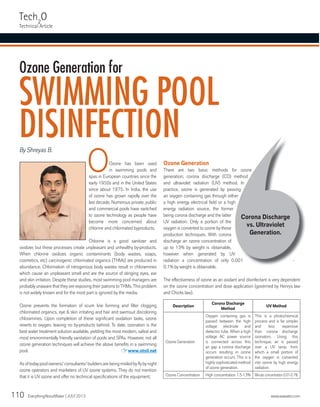
There are two basic methods for ozone
generation; corona discharge (CD) method
and ultraviolet radiation (UV) method. In
practice, ozone is generated by passing
an oxygen containing gas through either
a high energy electrical field or a high
energy radiation source, the former
being corona discharge and the latter
UV radiation. Only a portion of the
oxygen is converted to ozone by these
production techniques. With corona
discharge an ozone concentration of
up to 13% by weight is obtainable,
however when generated by UV
radiation a concentration of only 0.001 -
0.1% by weight is obtainable.
The effectiveness of ozone as an oxidant and disinfectant is very dependent
on the ozone concentration and dose application (governed by Henrys law
and Chicks law).
Description
Corona Discharge
Method
UV Method
Ozone Generation
Oxygen containing gas is
passed between the high
voltage electrode and
dielectric tube. When a high
voltage AC power source
is connected across this
air gap a corona discharge
occurs resulting in ozone
generation occurs. This is a
highly sophisticated method
of ozone generation.
This is a photochemical
process and is far simpler
and less expensive
than corona discharge
ozonators. Using this
technique, air is passed
over a UV lamp, from
which a small portion of
the oxygen is converted
into ozone by high energy
radiation.
Ozone Concentration High concentration 1.5-13% Minute concentration 0.01-0.1%
O
Tech2
O
Technical Article
www.eawater.com EverythingAboutWater | JULY2013 111
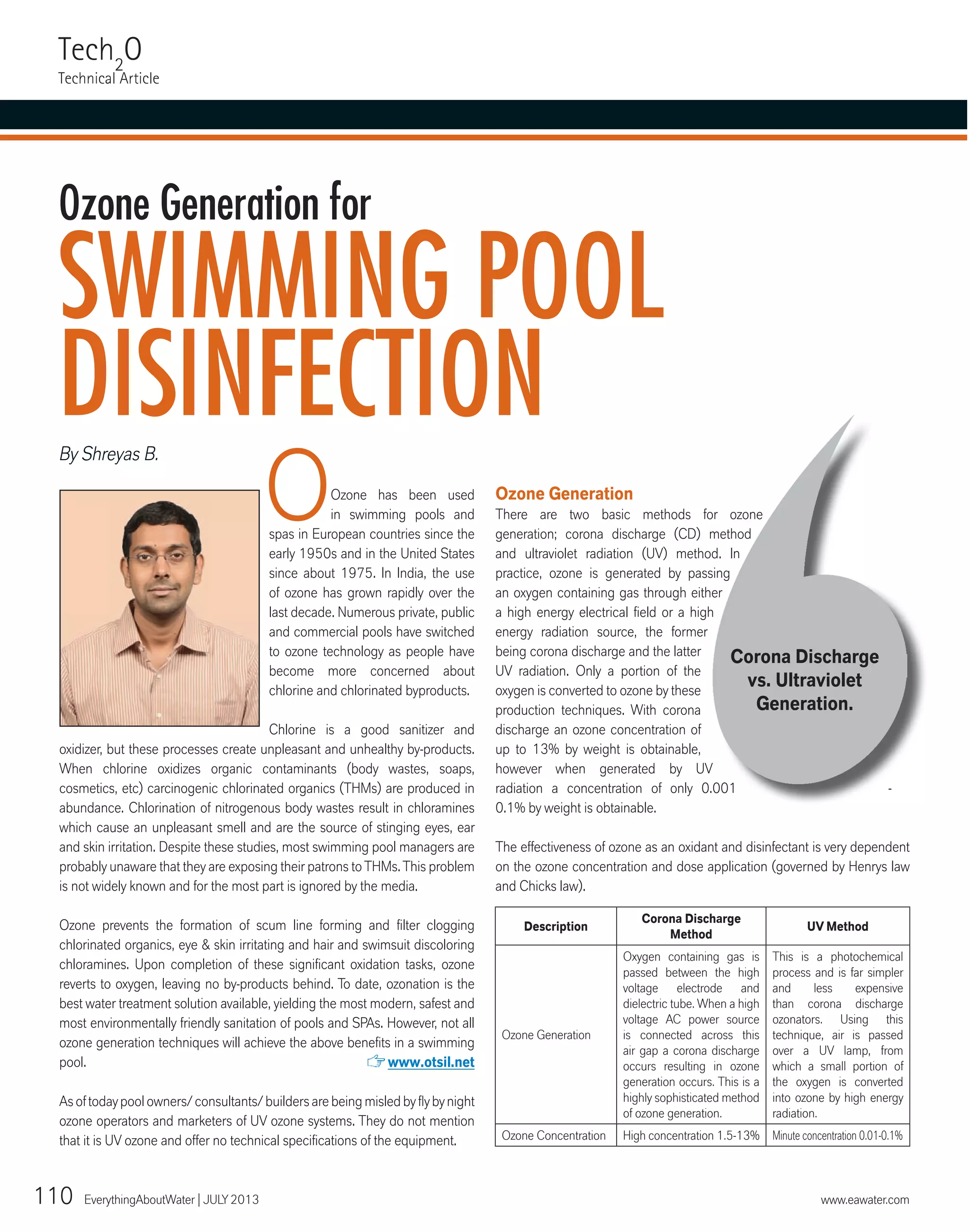
Ozone Effectiveness
as Disinfectant
High
Ineffective due to very low
ozone concentrations
Ozone Effectiveness
as Oxidant
High Very low
Solubility of ozone in
water at produced
concentrations (30
degrees temperature)
5-10% w/w
0.003% w/w. Low
concentrations not suitable
for high ozone mass
transfer in water.
Practical Uses
Water and waste water
disinfection and oxidation,
pulp and paper, air
treatment, medical, process
requirements.
Recommended for air
treatment only.
Table 1: Corona Discharge Method and UV Method - A General Comparison
As expected, the solubility of ozone increases with an increase in ozone
concentration in the gas stream. According to Henry’s Law, the efficiency
of absorbing a specific gas into an aqueous phase is based on the partial
pressure of that particular gas in the total gas flow. Therefore, the higher the
concentration of ozone in the generator gas stream, the more complete will
be the transfer of ozone into the water. For UV generated systems, the ozone
solubility is nearly nil. Hence, for ozone treatment of swimming pools, CD
generated ozone will provide a water quality that is not achievable with UV
generated ozone.
From a scientific and regulatory perspective water disinfection is routinely
characterized on the basis of contact time as ascertained by Chicks law.
Contact time and its kinetics are simply a measure of the inactivation
expressed as a function of concentration of the disinfectant and time
(as C*t, C is residual concentration, and t, time). As expressed earlier, the
concentration of ozone through UV generation method is 1/20 that of CD
generation method. In addition to this, most UV lamps used for disinfection
purposes operate in the 254 nm range. The ozone produced in the process
gets decomposed by UV radiation to form hydroxyl radicals. The half-life of
hydroxyl free radicals is on the order of microseconds and have very little time
to complete disinfection action which typically require longer contact times.
As a result hydroxyl radicals have oxidizing properties, but no disinfection
property. On the other hand, corona discharge method of ozone generation
produces a mixofmolecularozone which has excellent disinfection properties
due to longer half life and hydroxyl radicals with shorter half life with excelled
oxidizing property as well.
Hence, UV generated ozone systems are not recommended for swimming
pool applications where disinfection is of primary importance (in India).
UV generated ozone systems are primarily used for air applications like
deodorization and disinfection where traces of ozone is sufficient. Any
application that requires more than trace quantities and concentrations of
ozone will necessarily opt for corona discharge method of generation.
UV generated ozone systems are quite popular in America because of the
inherent high quality of water that typically require lower disinfection doses. In
addition to this, trace quantities of ozone generated through the UV method
do not act as a primary disinfectant, rather helps polish the water (odor and
color) and disassociate Bromide salt to Hypo bromous acid and liberating
bromine gas which act as the primary disinfectant. (In the US bromine gas is
more popular than chlorine and less harmful).
The Future
Once pool owners switch to ozone, they realize that they no longer have to put
up with red eye, rashes and the health consequences of chlorinated pools.
Without a doubt, ozone starting to gain a foothold in water treatment and
for swimming pools. Most major pool operators across the world use ozone
technology. Every single International games pool is ozonized. As these
technology leaders continue to push for alternatives to chlorine, acceptance
of this technology will be more and more favorable. But designing the ozone
dosage, the ozone concentration and the method of dissolution will decide
the efficiency of ozone in swimming pools. With proper design, swimming
pool owners and users can enjoy all the benefits of ozone while saving on
water and chemicals.
About the Author
Shreyas B. is an alumnus of BITS, Pilani and IIMA. He had joined Ozone
Technologies and Systems India Pvt. Limited Chennai in the year 2009. He has
received intensive training under some eminent ozone specialist and from Xylem
Water Solutions Inc. He is now a Director of the company.
Ozone Technologies & Systems (India) Pvt. Ltd. more popularly known
as OTSIL was formed in May 1994. Over the last 15 years OTSIL had been
promoting the use of ozone. Starting off with simple applications such as water
treatment, OTSILhas expanded its application reach to more complicated process
such as ozonoloysis and pulp and paper bleaching. Today OTSILis known for its
expertise in many ozone applications and have more than 600 installations all over
the country.To the prospective ozone users in India, OTSILprovides a vast range of
equipments, starting from small 3 gram unit to the Jumbo sized 200 Kg per hour.
To know more about the author, you can write to us. Your feedback is welcome
and should be sent at: mayur@eawater.com. Published letters in each issue will
get a one-year complimentary subscription of EverythingAboutWater Magazine.
India’s First
Water E-Magazine
www.eawater.com

SWIMMING POOL DISINFECTION

  • 1.
    Tech2 O Technical Article 110 EverythingAboutWater| JULY2013 www.eawater.com Ozone has been used in swimming pools and spas in European countries since the early 1950s and in the United States since about 1975. In India, the use of ozone has grown rapidly over the last decade. Numerous private, public and commercial pools have switched to ozone technology as people have become more concerned about chlorine and chlorinated byproducts. Chlorine is a good sanitizer and oxidizer, but these processes create unpleasant and unhealthy by-products. When chlorine oxidizes organic contaminants (body wastes, soaps, cosmetics, etc) carcinogenic chlorinated organics (THMs) are produced in abundance. Chlorination of nitrogenous body wastes result in chloramines which cause an unpleasant smell and are the source of stinging eyes, ear and skin irritation. Despite these studies, most swimming pool managers are probably unaware that they are exposing their patrons toTHMs.This problem is not widely known and for the most part is ignored by the media. Ozone prevents the formation of scum line forming and filter clogging chlorinated organics, eye & skin irritating and hair and swimsuit discoloring chloramines. Upon completion of these significant oxidation tasks, ozone reverts to oxygen, leaving no by-products behind. To date, ozonation is the best water treatment solution available, yielding the most modern, safest and most environmentally friendly sanitation of pools and SPAs. However, not all ozone generation techniques will achieve the above benefits in a swimming pool. www.otsil.net As oftodaypool owners/ consultants/ builders are being misled byflybynight ozone operators and marketers of UV ozone systems. They do not mention that it is UV ozone and offer no technical specifications of the equipment. Corona Discharge vs. Ultraviolet Generation. By Shreyas B. Ozone Generation for SWIMMING POOL DISINFECTION Ozone Generation There are two basic methods for ozone generation; corona discharge (CD) method and ultraviolet radiation (UV) method. In practice, ozone is generated by passing an oxygen containing gas through either a high energy electrical field or a high energy radiation source, the former being corona discharge and the latter UV radiation. Only a portion of the oxygen is converted to ozone by these production techniques. With corona discharge an ozone concentration of up to 13% by weight is obtainable, however when generated by UV radiation a concentration of only 0.001 - 0.1% by weight is obtainable. The effectiveness of ozone as an oxidant and disinfectant is very dependent on the ozone concentration and dose application (governed by Henrys law and Chicks law). Description Corona Discharge Method UV Method Ozone Generation Oxygen containing gas is passed between the high voltage electrode and dielectric tube. When a high voltage AC power source is connected across this air gap a corona discharge occurs resulting in ozone generation occurs. This is a highly sophisticated method of ozone generation. This is a photochemical process and is far simpler and less expensive than corona discharge ozonators. Using this technique, air is passed over a UV lamp, from which a small portion of the oxygen is converted into ozone by high energy radiation. Ozone Concentration High concentration 1.5-13% Minute concentration 0.01-0.1% O
  • 2.
    Tech2 O Technical Article www.eawater.com EverythingAboutWater| JULY2013 111 Ozone Effectiveness as Disinfectant High Ineffective due to very low ozone concentrations Ozone Effectiveness as Oxidant High Very low Solubility of ozone in water at produced concentrations (30 degrees temperature) 5-10% w/w 0.003% w/w. Low concentrations not suitable for high ozone mass transfer in water. Practical Uses Water and waste water disinfection and oxidation, pulp and paper, air treatment, medical, process requirements. Recommended for air treatment only. Table 1: Corona Discharge Method and UV Method - A General Comparison As expected, the solubility of ozone increases with an increase in ozone concentration in the gas stream. According to Henry’s Law, the efficiency of absorbing a specific gas into an aqueous phase is based on the partial pressure of that particular gas in the total gas flow. Therefore, the higher the concentration of ozone in the generator gas stream, the more complete will be the transfer of ozone into the water. For UV generated systems, the ozone solubility is nearly nil. Hence, for ozone treatment of swimming pools, CD generated ozone will provide a water quality that is not achievable with UV generated ozone. From a scientific and regulatory perspective water disinfection is routinely characterized on the basis of contact time as ascertained by Chicks law. Contact time and its kinetics are simply a measure of the inactivation expressed as a function of concentration of the disinfectant and time (as C*t, C is residual concentration, and t, time). As expressed earlier, the concentration of ozone through UV generation method is 1/20 that of CD generation method. In addition to this, most UV lamps used for disinfection purposes operate in the 254 nm range. The ozone produced in the process gets decomposed by UV radiation to form hydroxyl radicals. The half-life of hydroxyl free radicals is on the order of microseconds and have very little time to complete disinfection action which typically require longer contact times. As a result hydroxyl radicals have oxidizing properties, but no disinfection property. On the other hand, corona discharge method of ozone generation produces a mixofmolecularozone which has excellent disinfection properties due to longer half life and hydroxyl radicals with shorter half life with excelled oxidizing property as well. Hence, UV generated ozone systems are not recommended for swimming pool applications where disinfection is of primary importance (in India). UV generated ozone systems are primarily used for air applications like deodorization and disinfection where traces of ozone is sufficient. Any application that requires more than trace quantities and concentrations of ozone will necessarily opt for corona discharge method of generation. UV generated ozone systems are quite popular in America because of the inherent high quality of water that typically require lower disinfection doses. In addition to this, trace quantities of ozone generated through the UV method do not act as a primary disinfectant, rather helps polish the water (odor and color) and disassociate Bromide salt to Hypo bromous acid and liberating bromine gas which act as the primary disinfectant. (In the US bromine gas is more popular than chlorine and less harmful). The Future Once pool owners switch to ozone, they realize that they no longer have to put up with red eye, rashes and the health consequences of chlorinated pools. Without a doubt, ozone starting to gain a foothold in water treatment and for swimming pools. Most major pool operators across the world use ozone technology. Every single International games pool is ozonized. As these technology leaders continue to push for alternatives to chlorine, acceptance of this technology will be more and more favorable. But designing the ozone dosage, the ozone concentration and the method of dissolution will decide the efficiency of ozone in swimming pools. With proper design, swimming pool owners and users can enjoy all the benefits of ozone while saving on water and chemicals. About the Author Shreyas B. is an alumnus of BITS, Pilani and IIMA. He had joined Ozone Technologies and Systems India Pvt. Limited Chennai in the year 2009. He has received intensive training under some eminent ozone specialist and from Xylem Water Solutions Inc. He is now a Director of the company. Ozone Technologies & Systems (India) Pvt. Ltd. more popularly known as OTSIL was formed in May 1994. Over the last 15 years OTSIL had been promoting the use of ozone. Starting off with simple applications such as water treatment, OTSILhas expanded its application reach to more complicated process such as ozonoloysis and pulp and paper bleaching. Today OTSILis known for its expertise in many ozone applications and have more than 600 installations all over the country.To the prospective ozone users in India, OTSILprovides a vast range of equipments, starting from small 3 gram unit to the Jumbo sized 200 Kg per hour. To know more about the author, you can write to us. Your feedback is welcome and should be sent at: mayur@eawater.com. Published letters in each issue will get a one-year complimentary subscription of EverythingAboutWater Magazine. India’s First Water E-Magazine www.eawater.com