Array List
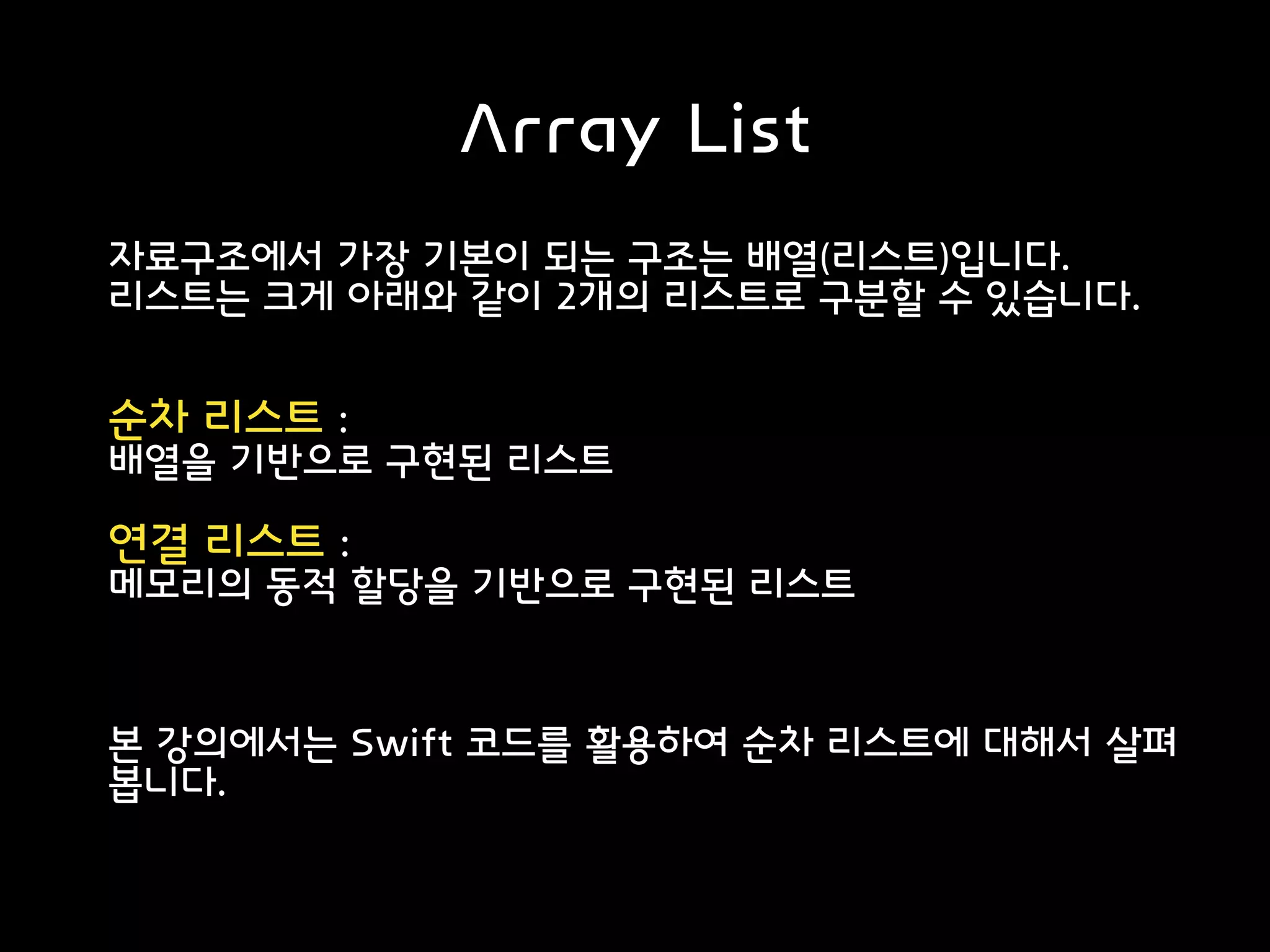
자료구조에서 가장기본이 되는 구조는 배열(리스트)입니다.
리스트는 크게 아래와 같이 2개의 리스트로 구분할 수 있습니다.
순차 리스트 :
배열을 기반으로 구현된 리스트
연결 리스트 :
메모리의 동적 할당을 기반으로 구현된 리스트
본 강의에서는 Swift 코드를 활용하여 순차 리스트에 대해서 살펴
봅니다.
Features
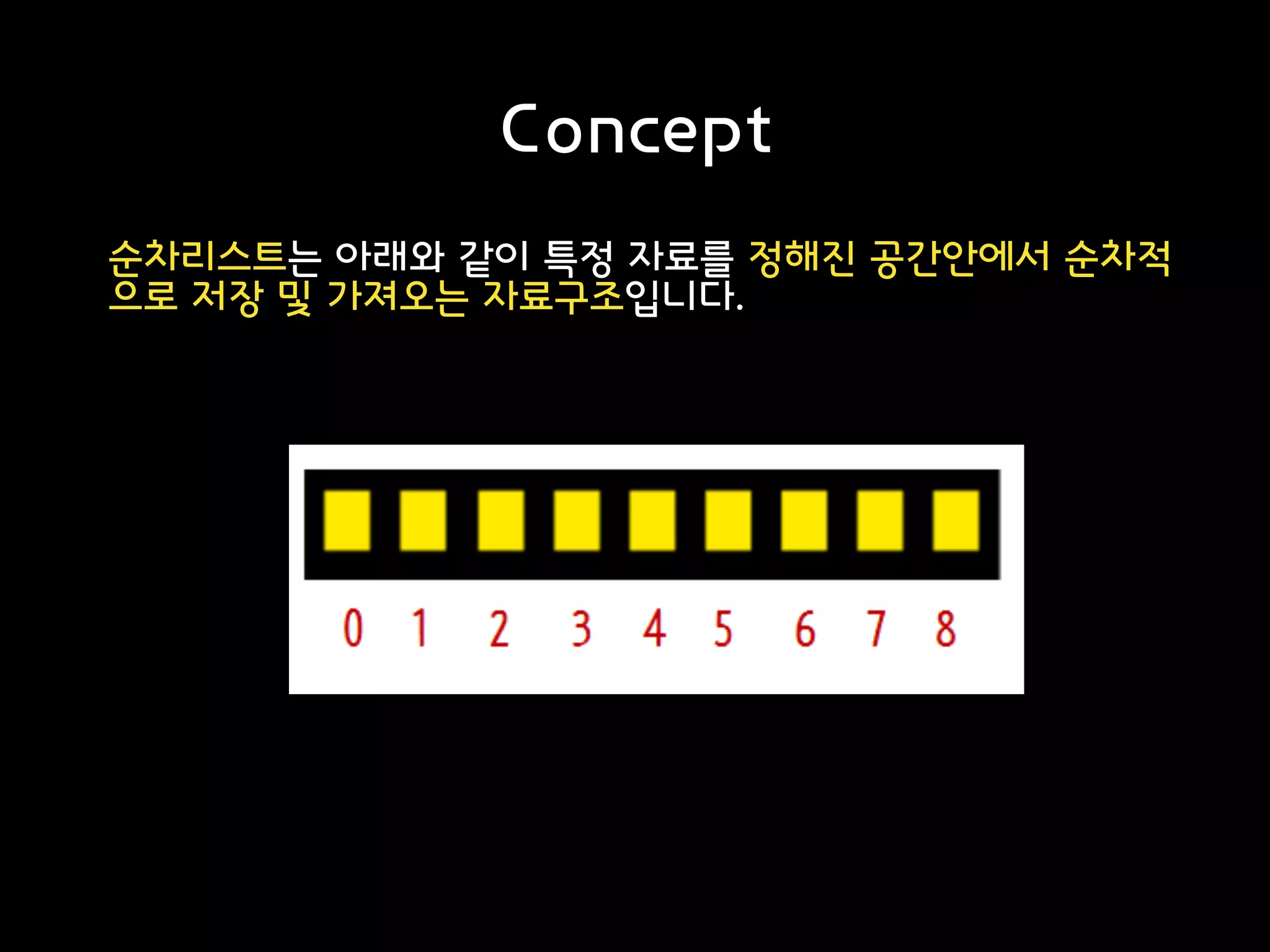
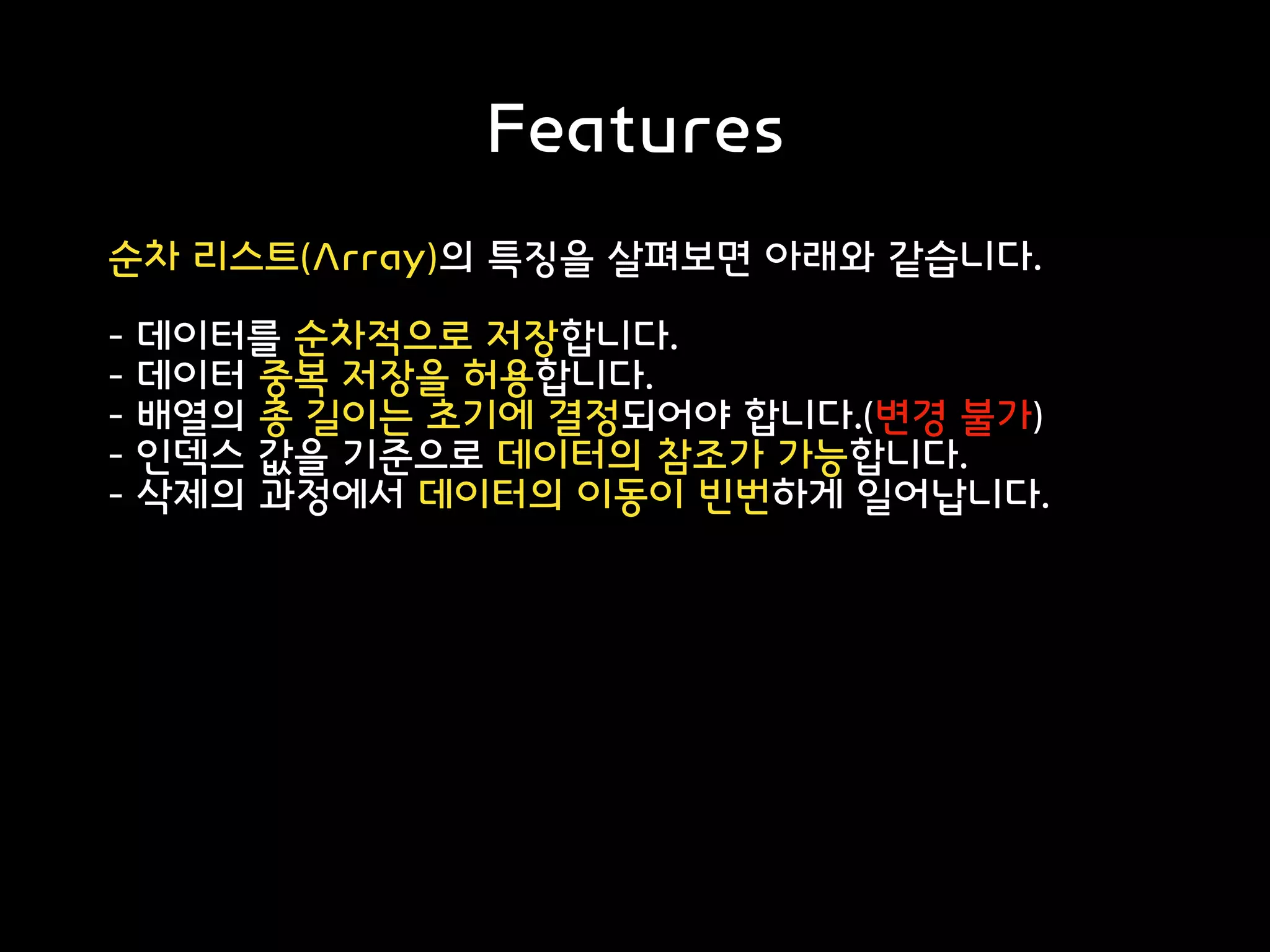
순차 리스트(Array)의 특징을살펴보면 아래와 같습니다.
- 데이터를 순차적으로 저장합니다.
- 데이터 중복 저장을 허용합니다.
- 배열의 총 길이는 초기에 결정되어야 합니다.(변경 불가)
- 인덱스 값을 기준으로 데이터의 참조가 가능합니다.
- 삭제의 과정에서 데이터의 이동이 빈번하게 일어납니다.
6.
Implementation
Swift를 활용하여 Array를 구현해보겠습니다.
우선 필요한 메소드는 아래와 같습니다.
- init() : 배열의 크기를 설정하는 초기화 함수
- insert() : 데이터 입력
- remove() : 특정 인덱스의 데이터 삭제
- removeAll() : 모든 데이터 삭제
- get() : 특정 인덱스의 데이터 값을 반환
- count() : 현재 배열의 크기를 반환
7.
Implementation
가장 데이터의 기본이되는 Node 클래스 입니다.
해당 Node 클래스는 모든 데이터 형식을 받을 수 있도록
Generic 형태로 구현이 되어 있습니다.
class Node<T> {
fileprivate var data:T
init(_ data: T) {
self.data = data
}
}
8.
Implementation
class ArrayList<T> {
privatevar size:Int
private var list:[Node<T>]
init(size:Int) {
self.list = [Node<T>]()
self.size = size
}
func insert(item:T) {
if self.list.count < size {
self.list.append(Node<T>(item))
}
}
func remove(at:Int) {
if self.list.count <= 0 { return }
if self.list.count <= at { return }
self.list.remove(at: at)
}
func removeAll() {
self.list.removeAll()
}
func get(index:Int) -> T {
return self.list[index].data
}
func count() -> Int {
size = list.count
return size
}
}
9.
Implementation
아래와 같이 사용이가능합니다.
let list:ArrayList<Int> = ArrayList(size: 5)
list.insert(item: 1)
list.insert(item: 2)
list.insert(item: 3)
list.insert(item: 4)
list.insert(item: 5)
// 최대 리스트 크기가 5로 설정하였으므로 추가 불가
list.insert(item: 6)
// 현재 리스트 카운트 : 5
print(list.count())
for i in 0..<list.count() {
print(list.get(index: i))
// 1
// 2
// 3
// 4
// 5
}
10.
Implementation
// 4번째 요소삭제
list.remove(at: 3)
// 현재 리스트 카운트 : 4
print(list.count())
for i in 0..<list.count() {
print(list.get(index: i))
// 1
// 2
// 3
// 5
}
list.removeAll()
// 현재 리스트 카운트 : 0
print(list.count())


![Implementation
class ArrayList<T> {
private var size:Int
private var list:[Node<T>]
init(size:Int) {
self.list = [Node<T>]()
self.size = size
}
func insert(item:T) {
if self.list.count < size {
self.list.append(Node<T>(item))
}
}
func remove(at:Int) {
if self.list.count <= 0 { return }
if self.list.count <= at { return }
self.list.remove(at: at)
}
func removeAll() {
self.list.removeAll()
}
func get(index:Int) -> T {
return self.list[index].data
}
func count() -> Int {
size = list.count
return size
}
}](https://image.slidesharecdn.com/swiftdatastructure-array-200525090841/75/Swift-Data-Structure-Array-8-2048.jpg)


![References
[1] [Swift 자료구조 ch01] 자료구조 살펴보기 : https://
kor45cw.tistory.com/238
[2] Swift로 자료구조, 알고리즘 공부하기 (3) - Array List : https://
kor45cw.tistory.com/3
[3] Swift의 Array 완전 정복 – 01. 생성과 조작 : https://
soooprmx.com/archives/7045
[4] (Swift 기초) 자료구조(Collection) - 배열(Array) (2) : https://
m.blog.naver.com/PostView.nhn?
blogId=el_vin&logNo=221019918085&categoryNo=10&proxy
Referer=&proxyReferer=https:%2F%2Fwww.google.com%2F
[5] [Swift4] 컬렉션 타입 ::: Array / Dictionary / 메소드 /
Optional / nil : https://yereol.tistory.com/9](https://image.slidesharecdn.com/swiftdatastructure-array-200525090841/75/Swift-Data-Structure-Array-11-2048.jpg)
![References
[6] Swift Language 배열 : https://sodocumentation.net/ko/
swift/topic/284/배열
[7] Swift Collection Types : https://
www.hohyeonmoon.com/blog/swift-collection-types/
[8] 10장 Swift 기초 8, 묶음(collection) 자료 구조, 배열(array) :
https://www.youtube.com/watch?v=UgMHDoFpN9M
[9] Swift의 Sequence와 Collection에 대해 알아야 하는것들 :
https://academy.realm.io/kr/posts/try-swift-soroush-
khanlou-sequence-collection/
[10] 자료구조: Linked List 대 ArrayList : http://
www.nextree.co.kr/p6506/](https://image.slidesharecdn.com/swiftdatastructure-array-200525090841/75/Swift-Data-Structure-Array-12-2048.jpg)


![[Swift] Data Structure - Stack](https://cdn.slidesharecdn.com/ss_thumbnails/swiftdatastructure-stack-200527030150-thumbnail.jpg?width=640&height=640&fit=bounds)
![[Swift] Data Structure - Linked List](https://cdn.slidesharecdn.com/ss_thumbnails/swiftdatastructure-linkedlist-200526085027-thumbnail.jpg?width=640&height=640&fit=bounds)
![[Algorithm] Counting Sort](https://cdn.slidesharecdn.com/ss_thumbnails/algorithmcountingsort-200609093544-thumbnail.jpg?width=640&height=640&fit=bounds)
![[Commit Again] 1주차 STL study](https://cdn.slidesharecdn.com/ss_thumbnails/stlstudy-141020155958-conversion-gate01-thumbnail.jpg?width=640&height=640&fit=bounds)
![[Swift] Data Structure - Heap](https://cdn.slidesharecdn.com/ss_thumbnails/swiftdatastructure-heap-200529005142-thumbnail.jpg?width=640&height=640&fit=bounds)

![[Algorithm] Selection Sort](https://cdn.slidesharecdn.com/ss_thumbnails/algorithmselectionsort-200608093047-thumbnail.jpg?width=640&height=640&fit=bounds)
![[Algorithm] Binary Search](https://cdn.slidesharecdn.com/ss_thumbnails/algorithmbinarysearch-200608093042-thumbnail.jpg?width=640&height=640&fit=bounds)


![[Algorithm] Insertion Sort](https://cdn.slidesharecdn.com/ss_thumbnails/algorithminsertionsort-200608093045-thumbnail.jpg?width=640&height=640&fit=bounds)
![[Algorithm] Radix Sort](https://cdn.slidesharecdn.com/ss_thumbnails/algorithmradixsort-200609093548-thumbnail.jpg?width=640&height=640&fit=bounds)

![[Algorithm] Quick Sort](https://cdn.slidesharecdn.com/ss_thumbnails/algorithmquicksort-200609093546-thumbnail.jpg?width=640&height=640&fit=bounds)


![[Swift] Tuple](https://cdn.slidesharecdn.com/ss_thumbnails/tuple-200513092237-thumbnail.jpg?width=640&height=640&fit=bounds)


![[SOPT] 데이터 구조 및 알고리즘 스터디 - #01 : 개요, 점근적 복잡도, 배열, 연결리스트](https://cdn.slidesharecdn.com/ss_thumbnails/1-150824001021-lva1-app6892-thumbnail.jpg?width=640&height=640&fit=bounds)


![[Swift] Data Structure - Dequeue](https://cdn.slidesharecdn.com/ss_thumbnails/swiftdatastructure-dequeue-200527055025-thumbnail.jpg?width=640&height=640&fit=bounds)


![[Swift] Data Structure Introduction](https://cdn.slidesharecdn.com/ss_thumbnails/swiftdatastructureintroduction-200525090844-thumbnail.jpg?width=640&height=640&fit=bounds)


![[Algorithm] Merge Sort](https://cdn.slidesharecdn.com/ss_thumbnails/algorithmmergesort-200608093046-thumbnail.jpg?width=640&height=640&fit=bounds)
![[Algorithm] Heap Sort](https://cdn.slidesharecdn.com/ss_thumbnails/algorithmheapsort-200609093546-thumbnail.jpg?width=640&height=640&fit=bounds)
![[Algorithm] Bubble Sort](https://cdn.slidesharecdn.com/ss_thumbnails/algorithmbubblesort-200608093044-thumbnail.jpg?width=640&height=640&fit=bounds)
![[Swift] Data Structure - Graph](https://cdn.slidesharecdn.com/ss_thumbnails/swiftdatastructure-graph-200530024232-thumbnail.jpg?width=640&height=640&fit=bounds)
![[Algorithm] Recursive(재귀)](https://cdn.slidesharecdn.com/ss_thumbnails/algorithmrecursive-200604135139-thumbnail.jpg?width=640&height=640&fit=bounds)
![[Swift] Data Structure - Tree](https://cdn.slidesharecdn.com/ss_thumbnails/swiftdatastructure-tree-200530024258-thumbnail.jpg?width=640&height=640&fit=bounds)

![[Algorithm] Big O Notation](https://cdn.slidesharecdn.com/ss_thumbnails/algorithmbigonotation-200610075543-thumbnail.jpg?width=640&height=640&fit=bounds)
![[Swift] Data Structure - Queue](https://cdn.slidesharecdn.com/ss_thumbnails/swiftdatastructure-queue-200527030149-thumbnail.jpg?width=640&height=640&fit=bounds)
![[Swift] Data Structure - Binary Search Tree](https://cdn.slidesharecdn.com/ss_thumbnails/swiftdatastructure-binarysearchtree-200603091904-thumbnail.jpg?width=640&height=640&fit=bounds)
![[Algorithm] Shell Sort](https://cdn.slidesharecdn.com/ss_thumbnails/algorithmshellsort-200609093548-thumbnail.jpg?width=640&height=640&fit=bounds)
![[Swift] Data Structure - Binary Tree](https://cdn.slidesharecdn.com/ss_thumbnails/swiftdatastructure-binarytree-200601093754-thumbnail.jpg?width=640&height=640&fit=bounds)
![[Swift] Data Structure - Graph(DFS)](https://cdn.slidesharecdn.com/ss_thumbnails/swiftdatastructure-graphdfs-200603005720-thumbnail.jpg?width=640&height=640&fit=bounds)
![[Swift] Data Structure - Graph(BFS)](https://cdn.slidesharecdn.com/ss_thumbnails/swiftdatastructure-graphbfs-200603005912-thumbnail.jpg?width=640&height=640&fit=bounds)
![[Swift] Data Structure - AVL](https://cdn.slidesharecdn.com/ss_thumbnails/swiftdatastructure-avl-200604134853-thumbnail.jpg?width=640&height=640&fit=bounds)
![[Algorithm] Sorting Comparison](https://cdn.slidesharecdn.com/ss_thumbnails/algorithmsortingcomparison-200610075544-thumbnail.jpg?width=640&height=640&fit=bounds)
![[Swift] Template Method](https://cdn.slidesharecdn.com/ss_thumbnails/swifttemplatemethod-200521092932-thumbnail.jpg?width=640&height=640&fit=bounds)
![[Swift] State](https://cdn.slidesharecdn.com/ss_thumbnails/swiftstate-200521092932-thumbnail.jpg?width=640&height=640&fit=bounds)
![[Swift] Visitor](https://cdn.slidesharecdn.com/ss_thumbnails/swiftvisitor-200521092933-thumbnail.jpg?width=640&height=640&fit=bounds)