Creative Financing, Energy,  and Design Options for the Residential Market David Lantz Owner Shelterwood  [email_address] www.prairiegreenhomes.com
Welcome This seminar is intended for homeowners, lenders, appraisers, and realtors We will outline the many financing options available to help stimulate the existing  housing market Creative financing options will help everyone incorporate energy and design upgrades into older, well located homes
Agenda Energy Improvement Mortgages: Case Studies  Financing options FHA 203(k) loan program VA energy mortgage program FHA energy mortgage program Freddie Mac energy mortgage program Fannie Mae energy mortgage program RESNET energy rating Estimating energy savings
Energy Improvement Mortgage (EIM): What We Stand to Gain Lower cost of ownership for homeowners Pollution reduction for the environment Better home resale value Bigger and more secure loans for banks Construction work for local contractors
Energy Improvement Mortgages Case Studies
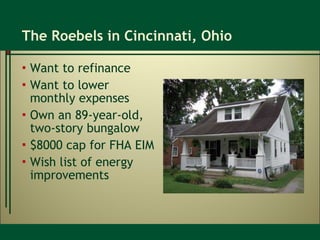
The Roebels in Cincinnati, Ohio Want to refinance Want to lower monthly expenses Own an 89-year-old, two-story bungalow $8000 cap for FHA EIM Wish list of energy improvements
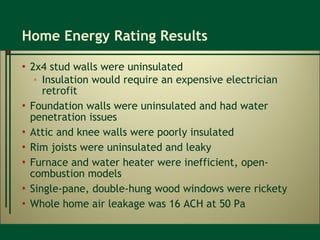
Home Energy Rating Results 2x4 stud walls were uninsulated Insulation would require an expensive electrician retrofit Foundation walls were uninsulated and had water penetration issues Attic and knee walls were poorly insulated Rim joists were uninsulated and leaky Furnace and water heater were inefficient, open-combustion models Single-pane, double-hung wood windows were rickety Whole home air leakage was 16 ACH at 50 Pa
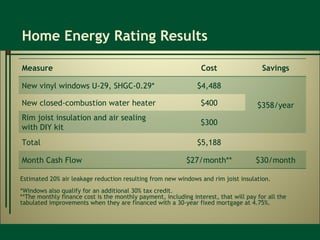
Home Energy Rating Results Estimated 20% air leakage reduction resulting from new windows and rim joist insulation. *Windows also qualify for an additional 30% tax credit. **The monthly finance cost is the monthly payment, including interest, that will pay for all the tabulated improvements when they are financed with a 30-year fixed mortgage at 4.75%. Measure Cost Savings New vinyl windows U-29, SHGC-0.29* $4,488 $358/year New closed-combustion water heater  $400 Rim joist insulation and air sealing  with DIY kit $300 Total $5,188 Month Cash Flow $27/month** $30/month
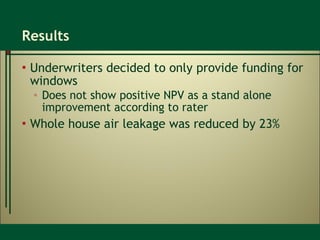
Results Underwriters decided to only provide funding for windows Does not show positive NPV as a stand alone improvement according to rater Whole house air leakage was reduced by 23%
Lessons Learned All members of the EIM team need to work together and have faith in the goal of EIMs Realtors understanding Lenders cooperation Homeowners patience and persistence Flexible terms from energy contractors
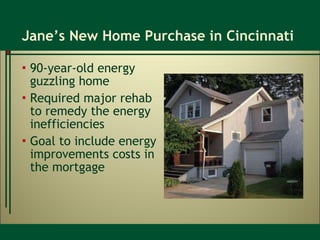
Jane’s New Home Purchase in Cincinnati 90-year-old energy guzzling home Required major rehab to remedy the energy inefficiencies Goal to include energy improvements costs in the mortgage
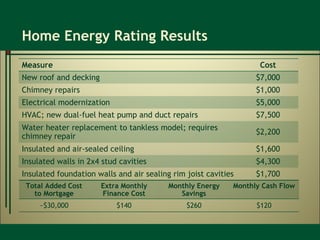
Home Energy Rating Results Measure Cost New roof and decking $7,000 Chimney repairs $1,000 Electrical modernization $5,000 HVAC; new dual-fuel heat pump and duct repairs $7,500 Water heater replacement to tankless model; requires chimney repair $2,200 Insulated and air-sealed ceiling $1,600 Insulated walls in 2x4 stud cavities $4,300 Insulated foundation walls and air sealing rim joist cavities $1,700 Total Added Cost to Mortgage Extra Monthly Finance Cost Monthly Energy Savings Monthly Cash Flow ~$30,000 $140 $260 $120
Finance Options and Challenges FHA EIM  Limit is $8,000 so $22,000 will need to be financed elsewhere 203(k) mortgage  Allows up to $35,000 but requires a larger down payment Solution EIM loan in conjunction with the 203(k) Line item certain improvements with EIM which requires no down payment Cosmetic and structural improvements done with 203(k) Purchase price of $140,000 plus $30,000 improvements equals a mortgage of $170,000  Neighborhood comps sell for $160,000 but have higher  energy costs
Not an Ideal Outcome Due to comp values, she only secured $20,000 worth of financing not the $30,000 required New roof Chimney repairs Electrical work New HVAC system 203(k) secured $13,000  EIM secured $7,000 She didn’t achieve the “Energy Efficient” upgrade to her home
Getting the Ideal Outcome If Jane had done the complete renovation her mortgage would have been $170,000 Her home would have a greater intrinsic value than her neighborhood’s inefficient homes Her neighbor’s would have smaller mortgage payments, but higher energy bills
The Energy Efficient Mortgage: A Solution to the Mortgage Problem The Energy Efficient Mortgage (EEM) is a loan for efficient homes that don’t need improvements The bank regards utility savings as an extra income source for prospective home buyers  EEM is insured and less risky for banks What if Jane’s home were automatically prequalified for an EEM?  What if potential buyers were automatically offered more-flexible financing in the form of an EEM?
Energy Financing Programs Can Drive the Home Renovation Economy If the industry can successfully build upon the three solutions described here Bigger loan caps for needed improvements Stackability with other loan programs More rewards for homes that prove themselves efficient We will see the emergence of an extreme energy makeover movement
Financing Options
FHA Section 203(k)  Loan Program Turning “Fixer-Uppers” into Dream Homes
What Is a 203(k) Loan? Allows a borrower to purchase or refinance a home including additional money for repairs  or renovations Rehabilitate a foreclosed property Update a property Fix a required repair Add a room addition Amount financed is based on the projected value of the property after rehabilitation
203(k) Mortgage Background Established by congress in 1978 Allows banks to develop new business while mitigating risks Provides government-backed mortgage insurance Assists in the revitalization and stabilization of neighborhoods negatively impacted by the current foreclosure crisis
Two Types of 203(k) Loans Standard Extensive structural work Repair costs exceed $35,000 Loan maximum is 110% of the “as-improved” value Streamlined Places fewer demands on borrower Maximum of $35,000 in repair costs Use of FHA-designated consultant not required
203(k) Mortgage Details Loan down payment can be as low as 3% Property must be used as a principle residence by an individual or family $5,000 is minimum amount financed  for renovation Six months of mortgage payments can be included in the financing
Examples of Repairs Allowed Kitchen or bathroom remodel Replacing roof, gutters, and downspouts Adding a family room, bedroom, or bathroom Replacing flooring, tiling, or carpeting Completing basement, attic, or adding second story Expanding or building a garage Renovating a deteriorating property Repairing structural damage Repairing termite damage Upgrading plumbing, heating, air conditioning, or electrical wiring Eliminating health and safety hazards (eg, lead paint) Making the home accessible to the disabled Installing a well or a septic system Adding a porch, deck, or patio Adding or repairing siding or repainting Installing energy efficient windows or doors
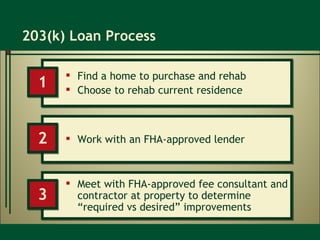
203(k) Loan Process Find a home to purchase and rehab Choose to rehab current residence 1 Work with an FHA-approved lender 2 Meet with FHA-approved fee consultant and contractor at property to determine “required vs desired” improvements 3
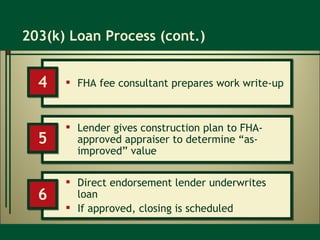
203(k) Loan Process (cont.) FHA fee consultant prepares work write-up 4 Lender gives construction plan to FHA-approved appraiser to determine “as-improved” value 5 Direct endorsement lender underwrites loan If approved, closing is scheduled 6
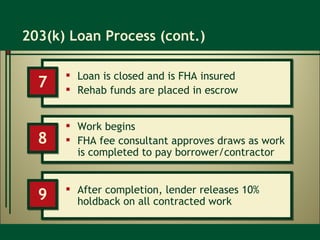
203(k) Loan Process (cont.) Loan is closed and is FHA insured Rehab funds are placed in escrow 7 Work begins FHA fee consultant approves draws as work is completed to pay borrower/contractor 8 After completion, lender releases 10% holdback on all contracted work 9
Energy Mortgages The Key to Unlocking Residential Energy Efficiency
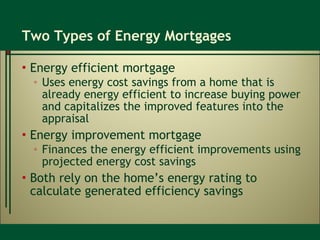
Two Types of Energy Mortgages Energy efficient mortgage Uses energy cost savings from a home that is already energy efficient to increase buying power and capitalizes the improved features into the appraisal Energy improvement mortgage Finances the energy efficient improvements using projected energy cost savings Both rely on the home’s energy rating to calculate generated efficiency savings
VA Energy Mortgage Program
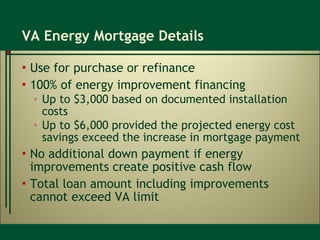
VA Energy Mortgage Details Use for purchase or refinance 100% of energy improvement financing Up to $3,000 based on documented installation costs Up to $6,000 provided the projected energy cost savings exceed the increase in mortgage payment No additional down payment if energy improvements create positive cash flow Total loan amount including improvements cannot exceed VA limit
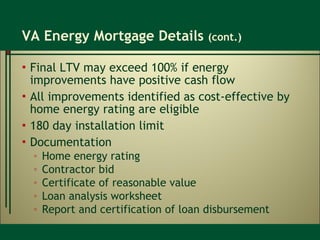
VA Energy Mortgage Details  (cont.) Final LTV may exceed 100% if energy improvements have positive cash flow All improvements identified as cost-effective by home energy rating are eligible 180 day installation limit Documentation Home energy rating Contractor bid Certificate of reasonable value Loan analysis worksheet Report and certification of loan disbursement
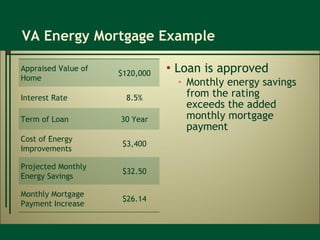
VA Energy Mortgage Example Loan is approved  Monthly energy savings from the rating exceeds the added monthly mortgage payment Appraised Value of Home $120,000 Interest Rate 8.5% Term of Loan 30 Year Cost of Energy Improvements $3,400 Projected Monthly Energy Savings $32.50 Monthly Mortgage Payment Increase $26.14
FHA Energy Mortgage Program
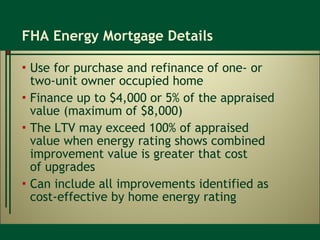
FHA Energy Mortgage Details Use for purchase and refinance of one- or  two-unit owner occupied home Finance up to $4,000 or 5% of the appraised value (maximum of $8,000) The LTV may exceed 100% of appraised  value when energy rating shows combined improvement value is greater that cost  of upgrades Can include all improvements identified as  cost-effective by home energy rating
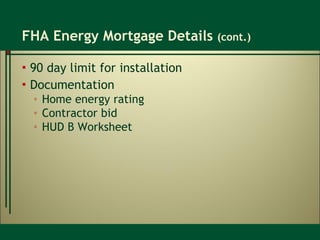
FHA Energy Mortgage Details  (cont.) 90 day limit for installation Documentation Home energy rating Contractor bid HUD B Worksheet
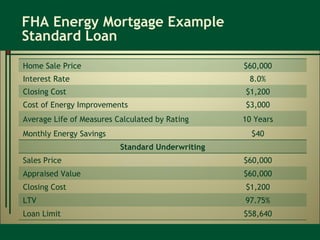
FHA Energy Mortgage Example Standard Loan Home Sale Price $60,000 Interest Rate 8.0% Closing Cost $1,200 Cost of Energy Improvements $3,000 Average Life of Measures Calculated by Rating 10 Years Monthly Energy Savings $40 Standard Underwriting Sales Price $60,000 Appraised Value $60,000 Closing Cost $1,200 LTV 97.75% Loan Limit $58,640
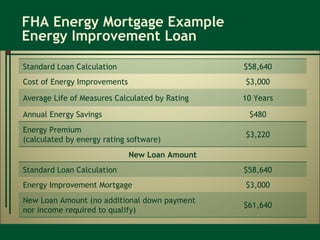
FHA Energy Mortgage Example Energy Improvement Loan Energy Premium Calculation is essentially the Present Value of energy savings over the useful life of those improvements minus the cost of the life of the improvements. Standard Loan Calculation $58,640 Cost of Energy Improvements $3,000 Average Life of Measures Calculated by Rating 10 Years Annual Energy Savings $480 Energy Premium  (calculated by energy rating software) $3,220 New Loan Amount Standard Loan Calculation $58,640 Energy Improvement Mortgage $3,000 New Loan Amount (no additional down payment nor income required to qualify) $61,640
Freddie Mac Energy Mortgage
Freddie Mac Energy Mortgage Details Use for purchase and refinance of one to four owner occupied units No limit to amount financed for energy improvements if supported by value Requires a down payment related to the LTV of the loan including energy improvements Principle, interest, insurance, and taxes (PITI) of loan increases dollar-for-dollar to reflect energy savings projected by energy rating Value of energy rating improvements added to appraised value
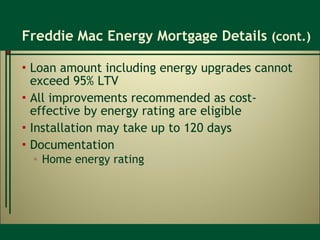
Freddie Mac Energy Mortgage Details  (cont.) Loan amount including energy upgrades cannot exceed 95% LTV All improvements recommended as cost-effective by energy rating are eligible Installation may take up to 120 days Documentation Home energy rating
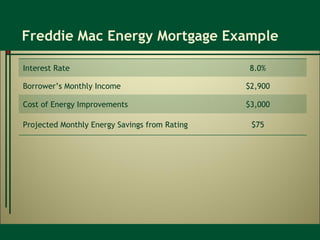
Freddie Mac Energy Mortgage Example Interest Rate 8.0% Borrower’s Monthly Income $2,900 Cost of Energy Improvements $3,000 Projected Monthly Energy Savings from Rating $75
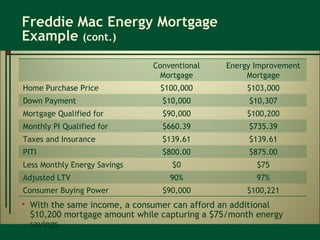
Freddie Mac Energy Mortgage  Example  (cont.) With the same income, a consumer can afford an additional $10,200 mortgage amount while capturing a $75/month energy savings  Conventional Mortgage Energy Improvement Mortgage Home Purchase Price $100,000 $103,000 Down Payment $10,000 $10,307 Mortgage Qualified for $90,000 $100,200 Monthly PI Qualified for $660.39 $735.39 Taxes and Insurance $139.61 $139.61 PITI $800.00 $875.00 Less Monthly Energy Savings $0 $75 Adjusted LTV 90% 97% Consumer Buying Power $90,000 $100,221
Fannie Mae  Energy Mortgage
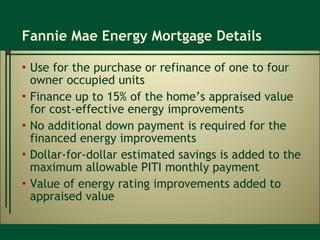
Fannie Mae Energy Mortgage Details Use for the purchase or refinance of one to four owner occupied units Finance up to 15% of the home’s appraised value for cost-effective energy improvements No additional down payment is required for the financed energy improvements Dollar-for-dollar estimated savings is added to the maximum allowable PITI monthly payment Value of energy rating improvements added to appraised value
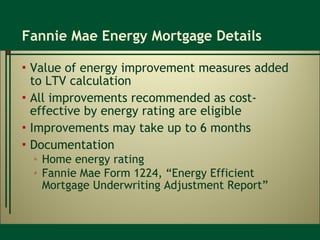
Fannie Mae Energy Mortgage Details Value of energy improvement measures added to LTV calculation All improvements recommended as cost-effective by energy rating are eligible Improvements may take up to 6 months Documentation Home energy rating Fannie Mae Form 1224, “Energy Efficient Mortgage Underwriting Adjustment Report”
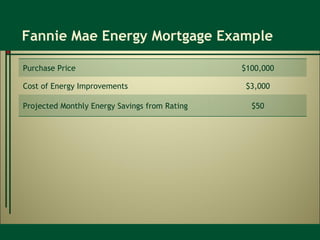
Fannie Mae Energy Mortgage Example Purchase Price $100,000 Cost of Energy Improvements $3,000 Projected Monthly Energy Savings from Rating $50
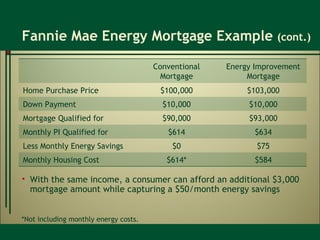
Fannie Mae Energy Mortgage Example  (cont.) With the same income, a consumer can afford an additional $3,000 mortgage amount while capturing a $50/month energy savings  *Not including monthly energy costs. Conventional Mortgage Energy Improvement Mortgage Home Purchase Price $100,000 $103,000 Down Payment $10,000 $10,000 Mortgage Qualified for $90,000 $93,000 Monthly PI Qualified for $614 $634 Less Monthly Energy Savings $0 $75 Monthly Housing Cost $614* $584
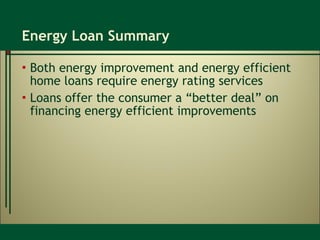
Energy Loan Summary Both energy improvement and energy efficient home loans require energy rating services Loans offer the consumer a “better deal” on financing energy efficient improvements
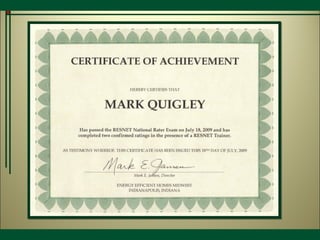
RESNET Residential Energy Services Network Mark Quigley RESNET Certified Energy Rater Energy Consultant Shelterwood
 
Energy Efficiency: “The First Fuel” Why the “First Fuel”? Least cost carbon mitigation option Only near-term resource option Available everywhere in large amounts Best economic strategy How can we mine the “First Fuel”? Energy policies that overcome barriers Climate policies that use EE effectively Better delivery infrastructure: Financing
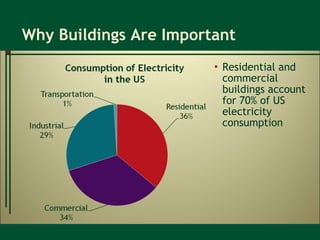
Why Buildings Are Important Residential and commercial buildings account for 70% of US electricity consumption
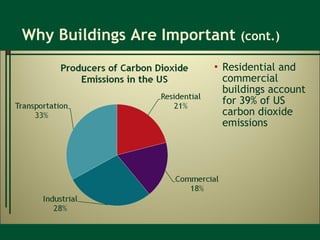
Why Buildings Are Important  (cont.) Residential and commercial buildings account for 39% of US carbon dioxide emissions
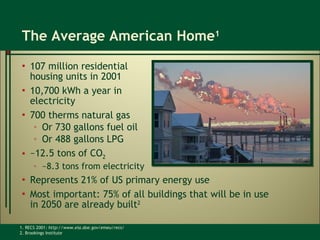
The Average American Home 1 107 million residential housing units in 2001  10,700 kWh a year in electricity 700 therms natural gas Or 730 gallons fuel oil Or 488 gallons LPG ~12.5 tons of CO 2 ~8.3 tons from electricity Represents 21% of US primary energy use Most important: 75% of all buildings that will be in use  in 2050 are already built 2 1. RECS 2001 : http://www.eia.doe.gov/emeu/recs/ 2. Brookings Institute
Steps That Need to Be Taken Adopt policies that overcome market barriers that prevent maximizing the full economic potential of energy efficiency  Adopt climate policies that exploit  energy efficiency Provide affordable and accessible financing
What Is RESNET? An industry-based, not-for-profit membership corporation Membership composed of program administrators, raters, and allied industries Governed by a board of 21 elected by membership A national standards making body for building energy efficiency rating and certification systems in the USA Consensus based standard development and amendment process Transparent review and adoption process Formal public review and comment process
Building Energy-Efficiency in US RESNET Ratings (2007) 139,907 homes rated as 15% over standard energy performance  13.4% of new homes 23,702 homes were certified as complying with federal tax credit  50% more efficient than code 2.3% of new homes
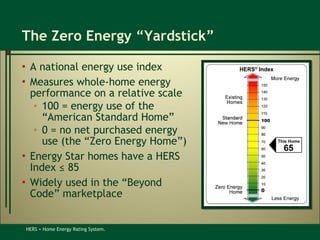
The Zero Energy “Yardstick” A national energy use index  Measures whole-home energy performance on a relative scale  100 = energy use of the “American Standard Home” 0 = no net purchased energy use (the “Zero Energy Home”) Energy Star homes have a HERS Index ≤ 85 Widely used in the “Beyond Code” marketplace HERS = Home Energy Rating System.
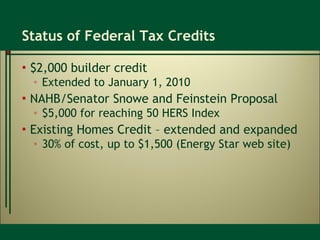
Status of Federal Tax Credits $2,000 builder credit Extended to January 1, 2010 NAHB/Senator Snowe and Feinstein Proposal $5,000 for reaching 50 HERS Index Existing Homes Credit – extended and expanded 30% of cost, up to $1,500 (Energy Star web site)
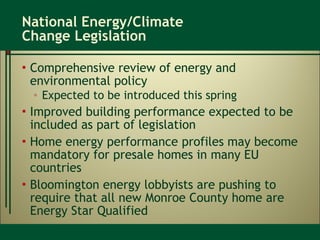
National Energy/Climate  Change Legislation Comprehensive review of energy and environmental policy Expected to be introduced this spring Improved building performance expected to be included as part of legislation Home energy performance profiles may become mandatory for presale homes in many EU countries Bloomington energy lobbyists are pushing to require that all new Monroe County home are Energy Star Qualified
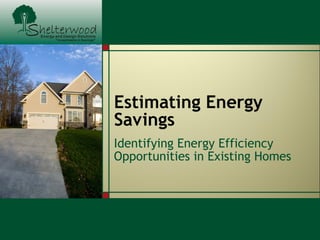
Estimating Energy Savings Identifying Energy Efficiency Opportunities in Existing Homes
Estimating Energy Savings Rater performs home inspection to gather data about a current energy characteristics Rater enters data into REM/Rate™ software to calculate energy rating score REM/Rate™ software is used by most  RESNET raters Accurate at determining energy usage in new  and existing homes
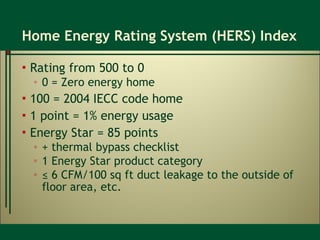
Home Energy Rating System (HERS) Index Rating from 500 to 0 0 = Zero energy home 100 = 2004 IECC code home 1 point = 1% energy usage Energy Star = 85 points + thermal bypass checklist 1 Energy Star product category ≤  6 CFM/100 sq ft duct leakage to the outside of floor area, etc.
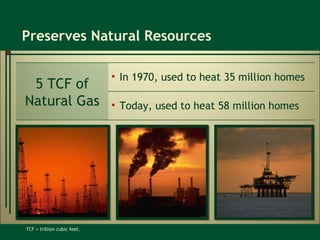
Preserves Natural Resources TCF = trillion cubic feet. 5 TCF of Natural Gas In 1970, used to heat 35 million homes Today, used to heat 58 million homes
Tools of the Trade
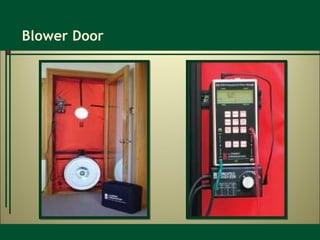
Blower Door
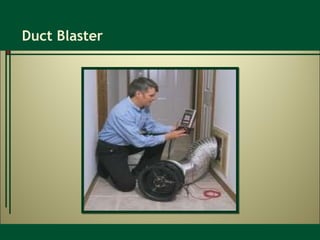
Duct Blaster
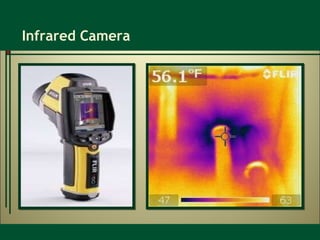
Infrared Camera
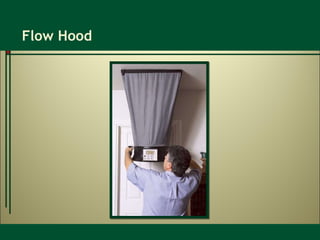
Flow Hood
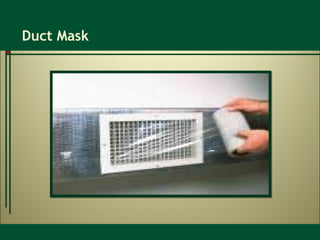
Duct Mask
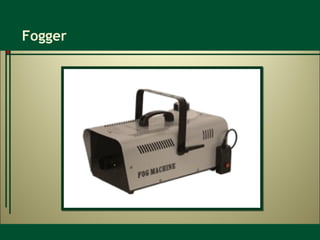
Fogger
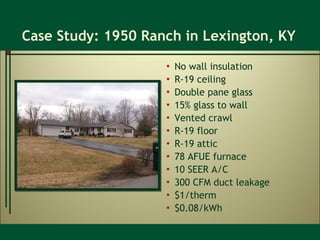
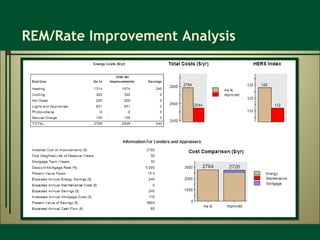
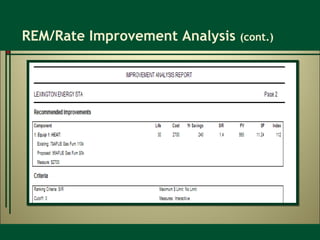
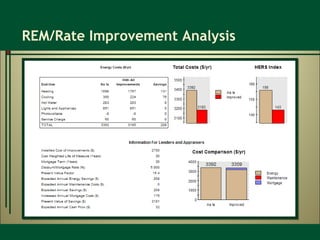
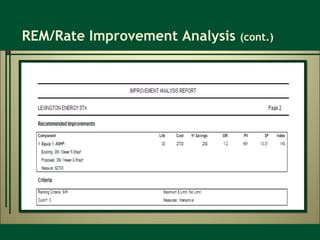
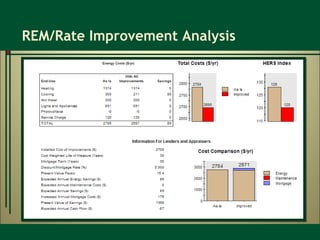
Case Study: 1950 Ranch in Lexington, KY No wall insulation R-19 ceiling Double pane glass 15% glass to wall Vented crawl R-19 floor R-19 attic 78 AFUE furnace 10 SEER A/C 300 CFM duct leakage $1/therm $0.08/kWh
List of Measures to Consider Air infiltration Wall insulation Closed crawl perimeter insulated Duct leakage Furnace replacement Heat pump replacement Ceiling insulation Air conditioner replacement Lighting
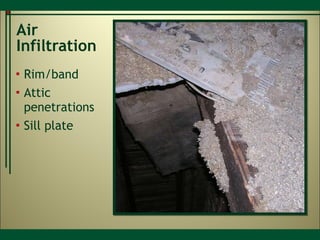
Air Infiltration Rim/band Attic penetrations Sill plate
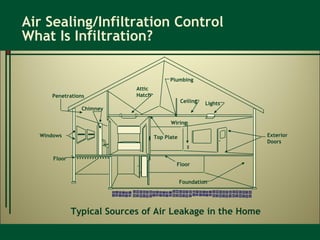
Air Sealing/Infiltration Control What Is Infiltration? Windows Attic Hatch Plumbing Ceiling Lights Wiring Floor Foundation Floor Chimney Exterior Doors Typical Sources of Air Leakage in the Home Penetrations Top Plate
Air Infiltrations Can we get the house too tight? Ventilate ASHRAE 62.2  Some say ASHRAE 62.2 over ventilates Maintain relative humidity 30-50%
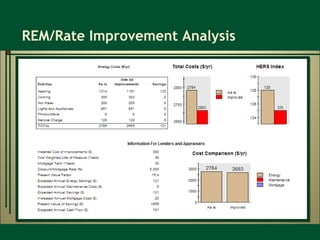
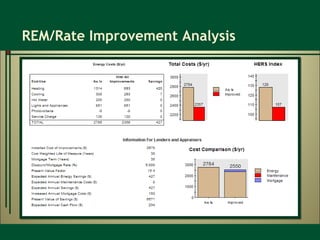
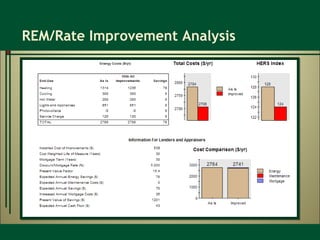
REM/Rate Improvement Analysis
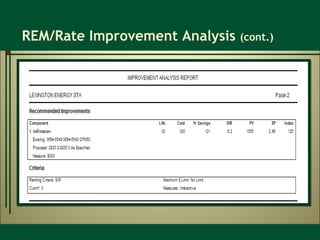
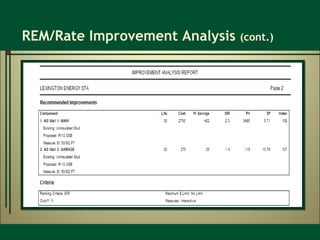
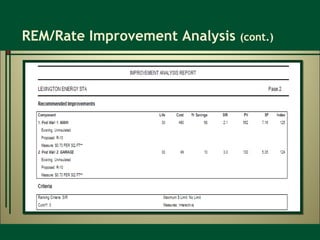
REM/Rate Improvement Analysis  (cont.)
Wall Insulation Dense pack Cellulose Foam
REM/Rate Improvement Analysis
REM/Rate Improvement Analysis  (cont.)
Crawl Space Moisture Problems
Symptom:  Light Mold Spotting in Crawl Space
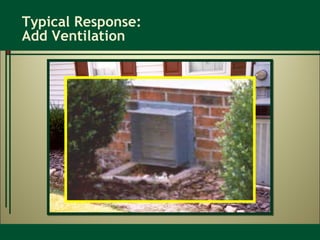
Typical Response:  Add Ventilation
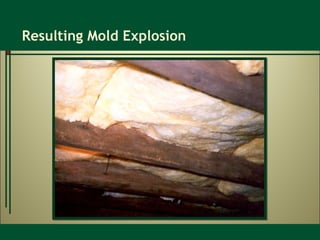
Resulting Mold Explosion
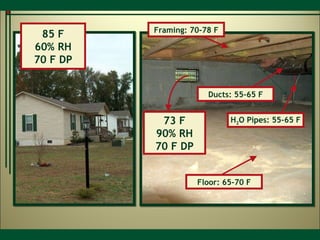
85 F 60% RH 70 F DP 73 F 90% RH 70 F DP Framing: 70-78 F Ducts: 55-65 F H 2 O Pipes: 55-65 F Floor: 65-70 F
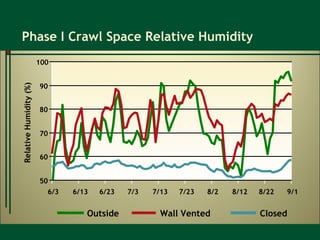
Phase I Crawl Space Relative Humidity 50 60 70 80 90 100 6/3 6/13 6/23 7/3 7/13 7/23 8/2 8/12 8/22 9/1 Relative Humidity (%) Wall Vented Closed Outside
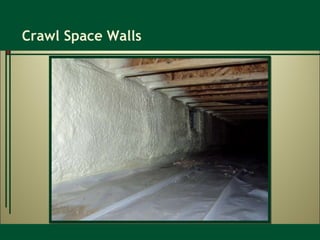
Crawl Space Walls
REM/Rate Improvement Analysis
REM/Rate Improvement Analysis  (cont.)
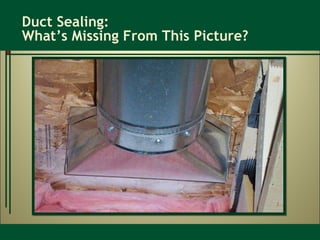
Duct Sealing: What’s Missing From This Picture?
Mechanical Systems
Furnace Replacement Replace 78 AFUE with 95 AFUE 30% up to $1500 tax credit Downsize with improvements
REM/Rate Improvement Analysis
REM/Rate Improvement Analysis  (cont.)
Heat Pump Scenario 10 SEER 6.8 HSPF Replace with 14 SEER 8.5 HSPF
REM/Rate Improvement Analysis
REM/Rate Improvement Analysis  (cont.)
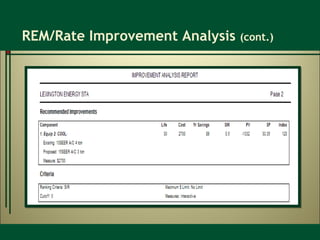
Air Conditioner Replacement 10 SEER to 14 SEER Downsize
REM/Rate Improvement Analysis
REM/Rate Improvement Analysis  (cont.)
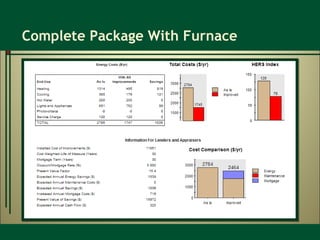
Complete Package With Furnace
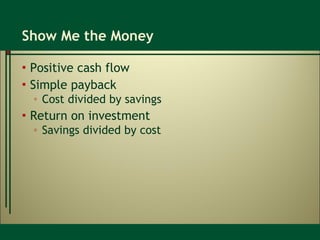
Show Me the Money Positive cash flow Simple payback Cost divided by savings Return on investment Savings divided by cost
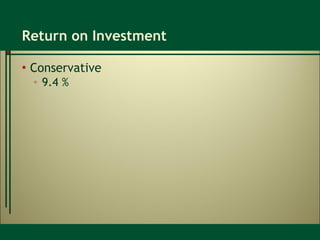
Return on Investment Conservative 9.4 %
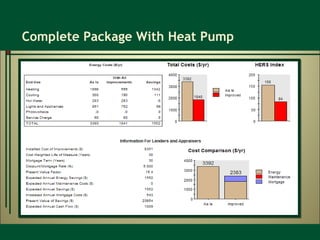
Complete Package With Heat Pump
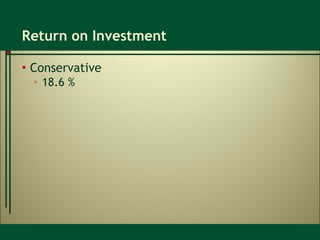
Return on Investment Conservative 18.6 %
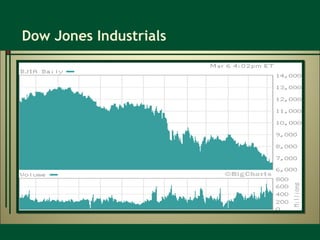
Dow Jones Industrials
Resources Cut Your Energy Bills Now-150 Smart Ways to Save Money and Make Your Home More Comfortable and Green   Bruce Harley, The Taunton Press $12.95 Insulate and Weatherize Bruce Harley, The Taunton Press $19.95 Read This Before You Buy, Build, or Renovate BuildingScience.com, Information http://tinyurl.com/5nhbzl
Thank You
Questions www.prairiegreenhomes.com David Lantz Owner Office: 812-333-2991 Cell: 812-325-6931 [email_address] Mark Quigley Energy   Consultant Office: 812-333-2991 Cell: 812-325-5299 [email_address]

Sw creative financing 2 25

  • 1.
    Creative Financing, Energy, and Design Options for the Residential Market David Lantz Owner Shelterwood [email_address] www.prairiegreenhomes.com
  • 2.
    Welcome This seminaris intended for homeowners, lenders, appraisers, and realtors We will outline the many financing options available to help stimulate the existing housing market Creative financing options will help everyone incorporate energy and design upgrades into older, well located homes
  • 3.
    Agenda Energy ImprovementMortgages: Case Studies Financing options FHA 203(k) loan program VA energy mortgage program FHA energy mortgage program Freddie Mac energy mortgage program Fannie Mae energy mortgage program RESNET energy rating Estimating energy savings
  • 4.
    Energy Improvement Mortgage(EIM): What We Stand to Gain Lower cost of ownership for homeowners Pollution reduction for the environment Better home resale value Bigger and more secure loans for banks Construction work for local contractors
  • 5.
  • 6.
    The Roebels inCincinnati, Ohio Want to refinance Want to lower monthly expenses Own an 89-year-old, two-story bungalow $8000 cap for FHA EIM Wish list of energy improvements
  • 7.
    Home Energy RatingResults 2x4 stud walls were uninsulated Insulation would require an expensive electrician retrofit Foundation walls were uninsulated and had water penetration issues Attic and knee walls were poorly insulated Rim joists were uninsulated and leaky Furnace and water heater were inefficient, open-combustion models Single-pane, double-hung wood windows were rickety Whole home air leakage was 16 ACH at 50 Pa
  • 8.
    Home Energy RatingResults Estimated 20% air leakage reduction resulting from new windows and rim joist insulation. *Windows also qualify for an additional 30% tax credit. **The monthly finance cost is the monthly payment, including interest, that will pay for all the tabulated improvements when they are financed with a 30-year fixed mortgage at 4.75%. Measure Cost Savings New vinyl windows U-29, SHGC-0.29* $4,488 $358/year New closed-combustion water heater $400 Rim joist insulation and air sealing with DIY kit $300 Total $5,188 Month Cash Flow $27/month** $30/month
  • 9.
    Results Underwriters decidedto only provide funding for windows Does not show positive NPV as a stand alone improvement according to rater Whole house air leakage was reduced by 23%
  • 10.
    Lessons Learned Allmembers of the EIM team need to work together and have faith in the goal of EIMs Realtors understanding Lenders cooperation Homeowners patience and persistence Flexible terms from energy contractors
  • 11.
    Jane’s New HomePurchase in Cincinnati 90-year-old energy guzzling home Required major rehab to remedy the energy inefficiencies Goal to include energy improvements costs in the mortgage
  • 12.
    Home Energy RatingResults Measure Cost New roof and decking $7,000 Chimney repairs $1,000 Electrical modernization $5,000 HVAC; new dual-fuel heat pump and duct repairs $7,500 Water heater replacement to tankless model; requires chimney repair $2,200 Insulated and air-sealed ceiling $1,600 Insulated walls in 2x4 stud cavities $4,300 Insulated foundation walls and air sealing rim joist cavities $1,700 Total Added Cost to Mortgage Extra Monthly Finance Cost Monthly Energy Savings Monthly Cash Flow ~$30,000 $140 $260 $120
  • 13.
    Finance Options andChallenges FHA EIM Limit is $8,000 so $22,000 will need to be financed elsewhere 203(k) mortgage Allows up to $35,000 but requires a larger down payment Solution EIM loan in conjunction with the 203(k) Line item certain improvements with EIM which requires no down payment Cosmetic and structural improvements done with 203(k) Purchase price of $140,000 plus $30,000 improvements equals a mortgage of $170,000 Neighborhood comps sell for $160,000 but have higher energy costs
  • 14.
    Not an IdealOutcome Due to comp values, she only secured $20,000 worth of financing not the $30,000 required New roof Chimney repairs Electrical work New HVAC system 203(k) secured $13,000 EIM secured $7,000 She didn’t achieve the “Energy Efficient” upgrade to her home
  • 15.
    Getting the IdealOutcome If Jane had done the complete renovation her mortgage would have been $170,000 Her home would have a greater intrinsic value than her neighborhood’s inefficient homes Her neighbor’s would have smaller mortgage payments, but higher energy bills
  • 16.
    The Energy EfficientMortgage: A Solution to the Mortgage Problem The Energy Efficient Mortgage (EEM) is a loan for efficient homes that don’t need improvements The bank regards utility savings as an extra income source for prospective home buyers EEM is insured and less risky for banks What if Jane’s home were automatically prequalified for an EEM? What if potential buyers were automatically offered more-flexible financing in the form of an EEM?
  • 17.
    Energy Financing ProgramsCan Drive the Home Renovation Economy If the industry can successfully build upon the three solutions described here Bigger loan caps for needed improvements Stackability with other loan programs More rewards for homes that prove themselves efficient We will see the emergence of an extreme energy makeover movement
  • 18.
  • 19.
    FHA Section 203(k) Loan Program Turning “Fixer-Uppers” into Dream Homes
  • 20.
    What Is a203(k) Loan? Allows a borrower to purchase or refinance a home including additional money for repairs or renovations Rehabilitate a foreclosed property Update a property Fix a required repair Add a room addition Amount financed is based on the projected value of the property after rehabilitation
  • 21.
    203(k) Mortgage BackgroundEstablished by congress in 1978 Allows banks to develop new business while mitigating risks Provides government-backed mortgage insurance Assists in the revitalization and stabilization of neighborhoods negatively impacted by the current foreclosure crisis
  • 22.
    Two Types of203(k) Loans Standard Extensive structural work Repair costs exceed $35,000 Loan maximum is 110% of the “as-improved” value Streamlined Places fewer demands on borrower Maximum of $35,000 in repair costs Use of FHA-designated consultant not required
  • 23.
    203(k) Mortgage DetailsLoan down payment can be as low as 3% Property must be used as a principle residence by an individual or family $5,000 is minimum amount financed for renovation Six months of mortgage payments can be included in the financing
  • 24.
    Examples of RepairsAllowed Kitchen or bathroom remodel Replacing roof, gutters, and downspouts Adding a family room, bedroom, or bathroom Replacing flooring, tiling, or carpeting Completing basement, attic, or adding second story Expanding or building a garage Renovating a deteriorating property Repairing structural damage Repairing termite damage Upgrading plumbing, heating, air conditioning, or electrical wiring Eliminating health and safety hazards (eg, lead paint) Making the home accessible to the disabled Installing a well or a septic system Adding a porch, deck, or patio Adding or repairing siding or repainting Installing energy efficient windows or doors
  • 25.
    203(k) Loan ProcessFind a home to purchase and rehab Choose to rehab current residence 1 Work with an FHA-approved lender 2 Meet with FHA-approved fee consultant and contractor at property to determine “required vs desired” improvements 3
  • 26.
    203(k) Loan Process(cont.) FHA fee consultant prepares work write-up 4 Lender gives construction plan to FHA-approved appraiser to determine “as-improved” value 5 Direct endorsement lender underwrites loan If approved, closing is scheduled 6
  • 27.
    203(k) Loan Process(cont.) Loan is closed and is FHA insured Rehab funds are placed in escrow 7 Work begins FHA fee consultant approves draws as work is completed to pay borrower/contractor 8 After completion, lender releases 10% holdback on all contracted work 9
  • 28.
    Energy Mortgages TheKey to Unlocking Residential Energy Efficiency
  • 29.
    Two Types ofEnergy Mortgages Energy efficient mortgage Uses energy cost savings from a home that is already energy efficient to increase buying power and capitalizes the improved features into the appraisal Energy improvement mortgage Finances the energy efficient improvements using projected energy cost savings Both rely on the home’s energy rating to calculate generated efficiency savings
  • 30.
  • 31.
    VA Energy MortgageDetails Use for purchase or refinance 100% of energy improvement financing Up to $3,000 based on documented installation costs Up to $6,000 provided the projected energy cost savings exceed the increase in mortgage payment No additional down payment if energy improvements create positive cash flow Total loan amount including improvements cannot exceed VA limit
  • 32.
    VA Energy MortgageDetails (cont.) Final LTV may exceed 100% if energy improvements have positive cash flow All improvements identified as cost-effective by home energy rating are eligible 180 day installation limit Documentation Home energy rating Contractor bid Certificate of reasonable value Loan analysis worksheet Report and certification of loan disbursement
  • 33.
    VA Energy MortgageExample Loan is approved Monthly energy savings from the rating exceeds the added monthly mortgage payment Appraised Value of Home $120,000 Interest Rate 8.5% Term of Loan 30 Year Cost of Energy Improvements $3,400 Projected Monthly Energy Savings $32.50 Monthly Mortgage Payment Increase $26.14
  • 34.
  • 35.
    FHA Energy MortgageDetails Use for purchase and refinance of one- or two-unit owner occupied home Finance up to $4,000 or 5% of the appraised value (maximum of $8,000) The LTV may exceed 100% of appraised value when energy rating shows combined improvement value is greater that cost of upgrades Can include all improvements identified as cost-effective by home energy rating
  • 36.
    FHA Energy MortgageDetails (cont.) 90 day limit for installation Documentation Home energy rating Contractor bid HUD B Worksheet
  • 37.
    FHA Energy MortgageExample Standard Loan Home Sale Price $60,000 Interest Rate 8.0% Closing Cost $1,200 Cost of Energy Improvements $3,000 Average Life of Measures Calculated by Rating 10 Years Monthly Energy Savings $40 Standard Underwriting Sales Price $60,000 Appraised Value $60,000 Closing Cost $1,200 LTV 97.75% Loan Limit $58,640
  • 38.
    FHA Energy MortgageExample Energy Improvement Loan Energy Premium Calculation is essentially the Present Value of energy savings over the useful life of those improvements minus the cost of the life of the improvements. Standard Loan Calculation $58,640 Cost of Energy Improvements $3,000 Average Life of Measures Calculated by Rating 10 Years Annual Energy Savings $480 Energy Premium (calculated by energy rating software) $3,220 New Loan Amount Standard Loan Calculation $58,640 Energy Improvement Mortgage $3,000 New Loan Amount (no additional down payment nor income required to qualify) $61,640
  • 39.
  • 40.
    Freddie Mac EnergyMortgage Details Use for purchase and refinance of one to four owner occupied units No limit to amount financed for energy improvements if supported by value Requires a down payment related to the LTV of the loan including energy improvements Principle, interest, insurance, and taxes (PITI) of loan increases dollar-for-dollar to reflect energy savings projected by energy rating Value of energy rating improvements added to appraised value
  • 41.
    Freddie Mac EnergyMortgage Details (cont.) Loan amount including energy upgrades cannot exceed 95% LTV All improvements recommended as cost-effective by energy rating are eligible Installation may take up to 120 days Documentation Home energy rating
  • 42.
    Freddie Mac EnergyMortgage Example Interest Rate 8.0% Borrower’s Monthly Income $2,900 Cost of Energy Improvements $3,000 Projected Monthly Energy Savings from Rating $75
  • 43.
    Freddie Mac EnergyMortgage Example (cont.) With the same income, a consumer can afford an additional $10,200 mortgage amount while capturing a $75/month energy savings Conventional Mortgage Energy Improvement Mortgage Home Purchase Price $100,000 $103,000 Down Payment $10,000 $10,307 Mortgage Qualified for $90,000 $100,200 Monthly PI Qualified for $660.39 $735.39 Taxes and Insurance $139.61 $139.61 PITI $800.00 $875.00 Less Monthly Energy Savings $0 $75 Adjusted LTV 90% 97% Consumer Buying Power $90,000 $100,221
  • 44.
    Fannie Mae Energy Mortgage
  • 45.
    Fannie Mae EnergyMortgage Details Use for the purchase or refinance of one to four owner occupied units Finance up to 15% of the home’s appraised value for cost-effective energy improvements No additional down payment is required for the financed energy improvements Dollar-for-dollar estimated savings is added to the maximum allowable PITI monthly payment Value of energy rating improvements added to appraised value
  • 46.
    Fannie Mae EnergyMortgage Details Value of energy improvement measures added to LTV calculation All improvements recommended as cost-effective by energy rating are eligible Improvements may take up to 6 months Documentation Home energy rating Fannie Mae Form 1224, “Energy Efficient Mortgage Underwriting Adjustment Report”
  • 47.
    Fannie Mae EnergyMortgage Example Purchase Price $100,000 Cost of Energy Improvements $3,000 Projected Monthly Energy Savings from Rating $50
  • 48.
    Fannie Mae EnergyMortgage Example (cont.) With the same income, a consumer can afford an additional $3,000 mortgage amount while capturing a $50/month energy savings *Not including monthly energy costs. Conventional Mortgage Energy Improvement Mortgage Home Purchase Price $100,000 $103,000 Down Payment $10,000 $10,000 Mortgage Qualified for $90,000 $93,000 Monthly PI Qualified for $614 $634 Less Monthly Energy Savings $0 $75 Monthly Housing Cost $614* $584
  • 49.
    Energy Loan SummaryBoth energy improvement and energy efficient home loans require energy rating services Loans offer the consumer a “better deal” on financing energy efficient improvements
  • 50.
    RESNET Residential EnergyServices Network Mark Quigley RESNET Certified Energy Rater Energy Consultant Shelterwood
  • 51.
  • 52.
    Energy Efficiency: “TheFirst Fuel” Why the “First Fuel”? Least cost carbon mitigation option Only near-term resource option Available everywhere in large amounts Best economic strategy How can we mine the “First Fuel”? Energy policies that overcome barriers Climate policies that use EE effectively Better delivery infrastructure: Financing
  • 53.
    Why Buildings AreImportant Residential and commercial buildings account for 70% of US electricity consumption
  • 54.
    Why Buildings AreImportant (cont.) Residential and commercial buildings account for 39% of US carbon dioxide emissions
  • 55.
    The Average AmericanHome 1 107 million residential housing units in 2001 10,700 kWh a year in electricity 700 therms natural gas Or 730 gallons fuel oil Or 488 gallons LPG ~12.5 tons of CO 2 ~8.3 tons from electricity Represents 21% of US primary energy use Most important: 75% of all buildings that will be in use in 2050 are already built 2 1. RECS 2001 : http://www.eia.doe.gov/emeu/recs/ 2. Brookings Institute
  • 56.
    Steps That Needto Be Taken Adopt policies that overcome market barriers that prevent maximizing the full economic potential of energy efficiency Adopt climate policies that exploit energy efficiency Provide affordable and accessible financing
  • 57.
    What Is RESNET?An industry-based, not-for-profit membership corporation Membership composed of program administrators, raters, and allied industries Governed by a board of 21 elected by membership A national standards making body for building energy efficiency rating and certification systems in the USA Consensus based standard development and amendment process Transparent review and adoption process Formal public review and comment process
  • 58.
    Building Energy-Efficiency inUS RESNET Ratings (2007) 139,907 homes rated as 15% over standard energy performance 13.4% of new homes 23,702 homes were certified as complying with federal tax credit 50% more efficient than code 2.3% of new homes
  • 59.
    The Zero Energy“Yardstick” A national energy use index Measures whole-home energy performance on a relative scale 100 = energy use of the “American Standard Home” 0 = no net purchased energy use (the “Zero Energy Home”) Energy Star homes have a HERS Index ≤ 85 Widely used in the “Beyond Code” marketplace HERS = Home Energy Rating System.
  • 60.
    Status of FederalTax Credits $2,000 builder credit Extended to January 1, 2010 NAHB/Senator Snowe and Feinstein Proposal $5,000 for reaching 50 HERS Index Existing Homes Credit – extended and expanded 30% of cost, up to $1,500 (Energy Star web site)
  • 61.
    National Energy/Climate Change Legislation Comprehensive review of energy and environmental policy Expected to be introduced this spring Improved building performance expected to be included as part of legislation Home energy performance profiles may become mandatory for presale homes in many EU countries Bloomington energy lobbyists are pushing to require that all new Monroe County home are Energy Star Qualified
  • 62.
    Estimating Energy SavingsIdentifying Energy Efficiency Opportunities in Existing Homes
  • 63.
    Estimating Energy SavingsRater performs home inspection to gather data about a current energy characteristics Rater enters data into REM/Rate™ software to calculate energy rating score REM/Rate™ software is used by most RESNET raters Accurate at determining energy usage in new and existing homes
  • 64.
    Home Energy RatingSystem (HERS) Index Rating from 500 to 0 0 = Zero energy home 100 = 2004 IECC code home 1 point = 1% energy usage Energy Star = 85 points + thermal bypass checklist 1 Energy Star product category ≤ 6 CFM/100 sq ft duct leakage to the outside of floor area, etc.
  • 65.
    Preserves Natural ResourcesTCF = trillion cubic feet. 5 TCF of Natural Gas In 1970, used to heat 35 million homes Today, used to heat 58 million homes
  • 66.
  • 67.
  • 68.
  • 69.
  • 70.
  • 71.
  • 72.
  • 73.
    Case Study: 1950Ranch in Lexington, KY No wall insulation R-19 ceiling Double pane glass 15% glass to wall Vented crawl R-19 floor R-19 attic 78 AFUE furnace 10 SEER A/C 300 CFM duct leakage $1/therm $0.08/kWh
  • 74.
    List of Measuresto Consider Air infiltration Wall insulation Closed crawl perimeter insulated Duct leakage Furnace replacement Heat pump replacement Ceiling insulation Air conditioner replacement Lighting
  • 75.
    Air Infiltration Rim/bandAttic penetrations Sill plate
  • 76.
    Air Sealing/Infiltration ControlWhat Is Infiltration? Windows Attic Hatch Plumbing Ceiling Lights Wiring Floor Foundation Floor Chimney Exterior Doors Typical Sources of Air Leakage in the Home Penetrations Top Plate
  • 77.
    Air Infiltrations Canwe get the house too tight? Ventilate ASHRAE 62.2 Some say ASHRAE 62.2 over ventilates Maintain relative humidity 30-50%
  • 78.
  • 79.
  • 80.
    Wall Insulation Densepack Cellulose Foam
  • 81.
  • 82.
  • 83.
  • 84.
    Symptom: LightMold Spotting in Crawl Space
  • 85.
    Typical Response: Add Ventilation
  • 86.
  • 87.
    85 F 60%RH 70 F DP 73 F 90% RH 70 F DP Framing: 70-78 F Ducts: 55-65 F H 2 O Pipes: 55-65 F Floor: 65-70 F
  • 88.
    Phase I CrawlSpace Relative Humidity 50 60 70 80 90 100 6/3 6/13 6/23 7/3 7/13 7/23 8/2 8/12 8/22 9/1 Relative Humidity (%) Wall Vented Closed Outside
  • 89.
  • 90.
  • 91.
  • 92.
    Duct Sealing: What’sMissing From This Picture?
  • 93.
  • 94.
    Furnace Replacement Replace78 AFUE with 95 AFUE 30% up to $1500 tax credit Downsize with improvements
  • 95.
  • 96.
  • 97.
    Heat Pump Scenario10 SEER 6.8 HSPF Replace with 14 SEER 8.5 HSPF
  • 98.
  • 99.
  • 100.
    Air Conditioner Replacement10 SEER to 14 SEER Downsize
  • 101.
  • 102.
  • 103.
  • 104.
    Show Me theMoney Positive cash flow Simple payback Cost divided by savings Return on investment Savings divided by cost
  • 105.
    Return on InvestmentConservative 9.4 %
  • 106.
  • 107.
    Return on InvestmentConservative 18.6 %
  • 108.
  • 109.
    Resources Cut YourEnergy Bills Now-150 Smart Ways to Save Money and Make Your Home More Comfortable and Green Bruce Harley, The Taunton Press $12.95 Insulate and Weatherize Bruce Harley, The Taunton Press $19.95 Read This Before You Buy, Build, or Renovate BuildingScience.com, Information http://tinyurl.com/5nhbzl
  • 110.
  • 111.
    Questions www.prairiegreenhomes.com DavidLantz Owner Office: 812-333-2991 Cell: 812-325-6931 [email_address] Mark Quigley Energy Consultant Office: 812-333-2991 Cell: 812-325-5299 [email_address]

Editor's Notes

  • #2 www.shelterwoodllc.com Creative Financing, Energy, and Design Options for the Residential Market
  • #3 www.shelterwoodllc.com Creative Financing, Energy, and Design Options for the Residential Market
  • #53 www.shelterwoodllc.com Creative Financing, Energy, and Design Options for the Residential Market
  • #54 www.shelterwoodllc.com Creative Financing, Energy, and Design Options for the Residential Market
  • #55 www.shelterwoodllc.com Creative Financing, Energy, and Design Options for the Residential Market
  • #56 www.shelterwoodllc.com Creative Financing, Energy, and Design Options for the Residential Market
  • #57 www.shelterwoodllc.com Creative Financing, Energy, and Design Options for the Residential Market
  • #58 www.shelterwoodllc.com Creative Financing, Energy, and Design Options for the Residential Market
  • #59 www.shelterwoodllc.com Creative Financing, Energy, and Design Options for the Residential Market
  • #60 www.shelterwoodllc.com Creative Financing, Energy, and Design Options for the Residential Market
  • #61 www.shelterwoodllc.com Creative Financing, Energy, and Design Options for the Residential Market
  • #62 www.shelterwoodllc.com Creative Financing, Energy, and Design Options for the Residential Market
  • #63 www.shelterwoodllc.com Creative Financing, Energy, and Design Options for the Residential Market
  • #64 www.shelterwoodllc.com Creative Financing, Energy, and Design Options for the Residential Market
  • #65 www.shelterwoodllc.com Creative Financing, Energy, and Design Options for the Residential Market
  • #66 www.shelterwoodllc.com Creative Financing, Energy, and Design Options for the Residential Market
  • #68 www.shelterwoodllc.com Creative Financing, Energy, and Design Options for the Residential Market
  • #69 www.shelterwoodllc.com Creative Financing, Energy, and Design Options for the Residential Market
  • #70 www.shelterwoodllc.com Creative Financing, Energy, and Design Options for the Residential Market
  • #71 www.shelterwoodllc.com Creative Financing, Energy, and Design Options for the Residential Market
  • #72 www.shelterwoodllc.com Creative Financing, Energy, and Design Options for the Residential Market
  • #73 www.shelterwoodllc.com Creative Financing, Energy, and Design Options for the Residential Market
  • #74 www.shelterwoodllc.com Creative Financing, Energy, and Design Options for the Residential Market
  • #75 www.shelterwoodllc.com Creative Financing, Energy, and Design Options for the Residential Market
  • #76 www.shelterwoodllc.com Creative Financing, Energy, and Design Options for the Residential Market
  • #77 Convective losses due to infiltration into and out of the building envelope can be reduced but complying with the provisions in the IECC that require penetrations in the building envelope between conditioned and unconditioned spaces and the great outdoors to be sealed. There are several points in the building envelope that are sources of air infiltration and that should be sealed to prevent heat loss and gain through infiltration. www.shelterwoodllc.com Creative Financing, Energy, and Design Options for the Residential Market
  • #78 www.shelterwoodllc.com Creative Financing, Energy, and Design Options for the Residential Market
  • #79 www.shelterwoodllc.com Creative Financing, Energy, and Design Options for the Residential Market
  • #80 www.shelterwoodllc.com Creative Financing, Energy, and Design Options for the Residential Market
  • #81 www.shelterwoodllc.com Creative Financing, Energy, and Design Options for the Residential Market
  • #82 www.shelterwoodllc.com Creative Financing, Energy, and Design Options for the Residential Market
  • #83 www.shelterwoodllc.com Creative Financing, Energy, and Design Options for the Residential Market
  • #84 www.shelterwoodllc.com Creative Financing, Energy, and Design Options for the Residential Market
  • #85 Many problems start small. My house is a 65-year-old home that had a vented crawl with no ground vapor retarder until 2003. One of the draws for me to buy this house was its lack of any major moisture problem under the house. Were there problems? Sure: plumbing leak under bathroom, old termite damage due to water problems at attached porch, surface mold on framing, poor storage due to high RH. www.shelterwoodllc.com Creative Financing, Energy, and Design Options for the Residential Market
  • #86 www.shelterwoodllc.com Creative Financing, Energy, and Design Options for the Residential Market
  • #87 www.shelterwoodllc.com Creative Financing, Energy, and Design Options for the Residential Market
  • #88 Typical summer conditions in Princeville are actually more humid than the example noted above. Daily average dew points range from 70 F to 75 F throughout the summer months. www.shelterwoodllc.com Creative Financing, Energy, and Design Options for the Residential Market
  • #89 www.shelterwoodllc.com Creative Financing, Energy, and Design Options for the Residential Market
  • #90 www.shelterwoodllc.com Creative Financing, Energy, and Design Options for the Residential Market
  • #91 www.shelterwoodllc.com Creative Financing, Energy, and Design Options for the Residential Market
  • #92 www.shelterwoodllc.com Creative Financing, Energy, and Design Options for the Residential Market
  • #93 There is no duct sealant on the connection from the duct to the boot. www.shelterwoodllc.com Creative Financing, Energy, and Design Options for the Residential Market
  • #94 www.shelterwoodllc.com Creative Financing, Energy, and Design Options for the Residential Market
  • #95 www.shelterwoodllc.com Creative Financing, Energy, and Design Options for the Residential Market
  • #96 www.shelterwoodllc.com Creative Financing, Energy, and Design Options for the Residential Market
  • #97 www.shelterwoodllc.com Creative Financing, Energy, and Design Options for the Residential Market
  • #98 www.shelterwoodllc.com Creative Financing, Energy, and Design Options for the Residential Market
  • #99 www.shelterwoodllc.com Creative Financing, Energy, and Design Options for the Residential Market
  • #100 www.shelterwoodllc.com Creative Financing, Energy, and Design Options for the Residential Market
  • #101 www.shelterwoodllc.com Creative Financing, Energy, and Design Options for the Residential Market
  • #102 www.shelterwoodllc.com Creative Financing, Energy, and Design Options for the Residential Market
  • #103 www.shelterwoodllc.com Creative Financing, Energy, and Design Options for the Residential Market
  • #104 www.shelterwoodllc.com Creative Financing, Energy, and Design Options for the Residential Market
  • #105 www.shelterwoodllc.com Creative Financing, Energy, and Design Options for the Residential Market
  • #106 www.shelterwoodllc.com Creative Financing, Energy, and Design Options for the Residential Market
  • #107 www.shelterwoodllc.com Creative Financing, Energy, and Design Options for the Residential Market
  • #108 www.shelterwoodllc.com Creative Financing, Energy, and Design Options for the Residential Market
  • #109 www.shelterwoodllc.com Creative Financing, Energy, and Design Options for the Residential Market
  • #110 www.shelterwoodllc.com Creative Financing, Energy, and Design Options for the Residential Market
  • #111 www.shelterwoodllc.com Creative Financing, Energy, and Design Options for the Residential Market
  • #112 www.shelterwoodllc.com Creative Financing, Energy, and Design Options for the Residential Market