Questionnaire
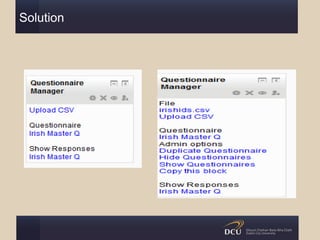
Manager block
Surveys made easy
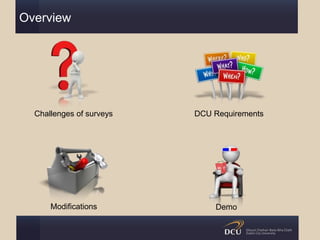
Overview
Modifications
DCU RequirementsChallenges of surveys
Demo
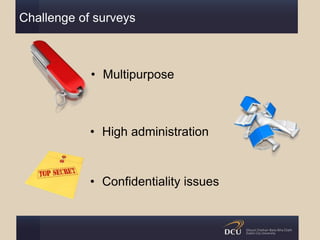
• Multipurpose
Challenge of surveys
• Confidentiality issues
• High administration
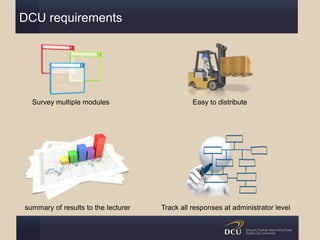
DCU requirements
Survey multiple modules
summary of results to the lecturer Track all responses at administrator level
Easy to distribute
Solution
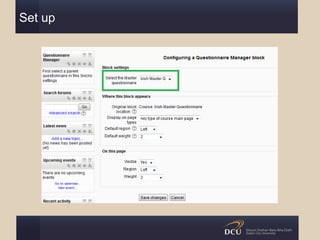
Set up
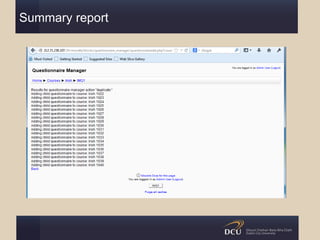
Summary report
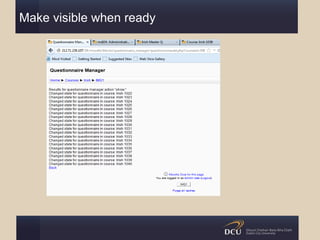
Make visible when ready
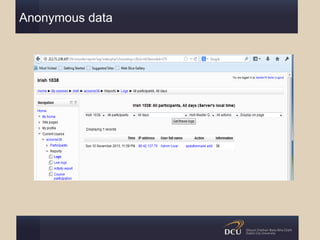
Anonymous data
Conclusions
• Easy to implement
• Easy to administer
• Satisfies all parties
• Next steps

Surveys made easy

Editor's Notes

  • #2 Do you have a colour scheme or powerpoint template that you would like to use? – this is the latest DCU template from Comms & marketingWhat is on the screen?Object 1Object 2Object 3:Do the objects all appear at the same time, if not what sequence do they appear in and does one object overlap the other. When one object is visible do you want the others to shrink in sizeDo you want text to appear with each objectDo the objects "click" to reveal more information? Do they divert to another slide and take the learner in a different direction, if so do you want the learner to be able to navigate backwards when they are finishedWhen the object has been "visited" do you want this to be recognised by the user i.e. it to fade into the background or specify X% of the slide is completeMain menuPlease specify if the title of this slide is to appearAdditional featuresDo you want any specific resources embed in this slide i.e. a word document or pdf? If so please provide the documentsLet's let one of the master practitioners explain…
  • #5 Provide summary of results to the lecturerTrack all responses at administrator level
  • #8 web based so its accessible from everywhere with the internet
  • #9 This is the second phase of the ADDIE model. The purpose of this phase is to plan what the course will look like and to produce an instructional design document, similar to a roadmap or blueprint for the training course.At this stage, the training specialist knows the pre-existing knowledge of the trainees and the objectives of the training. What they now need to do, is design a training program to get the trainees from where they are now to where the client wants them to be. The design phase must be systematic and specific. Systematic in that it should be a logical, orderly approach to identify, develop and evaluate a planned strategy, designed to enable trainees to attain the desired learning goals. Specific – in that each element of the design should be considered in detail.It is during this phase that the training specialist will decide how the content should be organised, how the achievement of the learning objectives should be measured, what types of exercises and/or activities will be of most benefit in assisting the trainees in achieving the learning objectives, create the structure for the course content.There are three parts to the design phase – design the assessment, choose a course format and create the instructional strategy.