Jack Williams, Isaac Kenyon, Minh Ngoc Nguyen
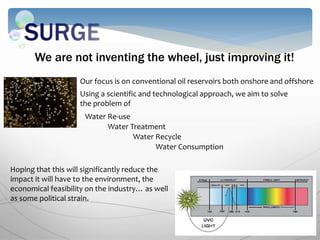
We are not inventing the wheel, just improving it!
Our focus is on conventional oil reservoirs both onshore and offshore
Using a scientific and technological approach, we aim to solve
the problem of
Water Re-use
Water Treatment
Water Consumption
Water Recycle
Hoping that this will significantly reduce the
impact it will have to the environment, the
economical feasibility on the industry… as well
as some political strain.
Micro-Bubbles
Using standard atmospheric air and not CO2, this process will create hydro
bubbles that will be oscillated using an ultra sound system without causing
concern to the environment. These oscillating nano-metric sized bubbles will be
incorporated into the water that will increase the pressure and the sweep
efficiency of removing oil from the reservoir sand and is effectively much like a
cleaning process. This will also reduce the amount of water.
This works in two ways:
1. They will pop when they are down in the reservoir, thus
increasing the pressure and force oil up to the surface through
controlled boreholes.
2. They don’t pop but do expand due to oscillation which produces
a strong rolling force on oil stuck to the bottom solid surface
following the path of least resistance (which is inevitably the
boreholes).
Zimmerman, W., Tesar, V., Butler, S. and Bandulasena, H. (2008). Microbubble Generation. Recent Patents on Engineering,
2(1), pp.1-8.
Kinematic Filtration
This is a process that will occur after the water has been separated from the oil
using an Api process that is already in place and put into a controlled elevated
very wide storage tank. The pressure from the tank will produce a flow of
water down a high gradient piped slope, essentially carrying water from A to
B. Using gravity a natural parameter as the water flows through the system
without the use of expensive energy consumption.
Within the high gradient pipe there 9
cylindrical filters combining;
1. Sand that removes debris
2. Carbon which filters out colour and taste
3. A cup that removes pathogens
Water will eventually pass into the next section of the
process
Information taken form Purite
LED Treatment
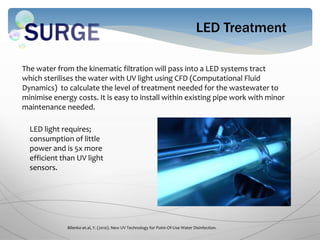
The water from the kinematic filtration will pass into a LED systems tract
which sterilises the water with UV light using CFD (Computational Fluid
Dynamics) to calculate the level of treatment needed for the wastewater to
minimise energy costs. It is easy to install within existing pipe work with minor
maintenance needed.
Bilenko et.al, Y. (2010). New UV Technology for Point-Of-Use Water Disinfection.
LED light requires;
consumption of little
power and is 5x more
efficient than UV light
sensors.
System Overview

SURGE_BP_PRESENTATION

  • 1.
    Jack Williams, IsaacKenyon, Minh Ngoc Nguyen
  • 2.
    We are notinventing the wheel, just improving it! Our focus is on conventional oil reservoirs both onshore and offshore Using a scientific and technological approach, we aim to solve the problem of Water Re-use Water Treatment Water Consumption Water Recycle Hoping that this will significantly reduce the impact it will have to the environment, the economical feasibility on the industry… as well as some political strain.
  • 3.
    Micro-Bubbles Using standard atmosphericair and not CO2, this process will create hydro bubbles that will be oscillated using an ultra sound system without causing concern to the environment. These oscillating nano-metric sized bubbles will be incorporated into the water that will increase the pressure and the sweep efficiency of removing oil from the reservoir sand and is effectively much like a cleaning process. This will also reduce the amount of water. This works in two ways: 1. They will pop when they are down in the reservoir, thus increasing the pressure and force oil up to the surface through controlled boreholes. 2. They don’t pop but do expand due to oscillation which produces a strong rolling force on oil stuck to the bottom solid surface following the path of least resistance (which is inevitably the boreholes). Zimmerman, W., Tesar, V., Butler, S. and Bandulasena, H. (2008). Microbubble Generation. Recent Patents on Engineering, 2(1), pp.1-8.
  • 4.
    Kinematic Filtration This isa process that will occur after the water has been separated from the oil using an Api process that is already in place and put into a controlled elevated very wide storage tank. The pressure from the tank will produce a flow of water down a high gradient piped slope, essentially carrying water from A to B. Using gravity a natural parameter as the water flows through the system without the use of expensive energy consumption. Within the high gradient pipe there 9 cylindrical filters combining; 1. Sand that removes debris 2. Carbon which filters out colour and taste 3. A cup that removes pathogens Water will eventually pass into the next section of the process Information taken form Purite
  • 5.
    LED Treatment The waterfrom the kinematic filtration will pass into a LED systems tract which sterilises the water with UV light using CFD (Computational Fluid Dynamics) to calculate the level of treatment needed for the wastewater to minimise energy costs. It is easy to install within existing pipe work with minor maintenance needed. Bilenko et.al, Y. (2010). New UV Technology for Point-Of-Use Water Disinfection. LED light requires; consumption of little power and is 5x more efficient than UV light sensors.
  • 6.