


Introduction:


 Desalination is nothing but removal of salt content
  present in the sea water and making palatable.
 But how do we achieve this
 My solution is “ Solar powered Desalination by
  Membrane Distillation”.
 Why desalination:
 Desalination of sea and brackish water has
  become a necessity in many arid and semiarid
  regions. Due to the fast growing population and a
  correspondingly high water demand in these
  regions the few water sources often get
  brackish or contaminated.
 The use of fossil energies for desalination leads to an
  environmental load.
DESCRIPTION OF THE MEMBRANE DISTILLATION (MD)-
PROCESS :

 It is possible to concentrate aqueous solutions of non-
  volatile dissolved substances by microporous
  membranes impermeable for water but permeable
  for water vapour

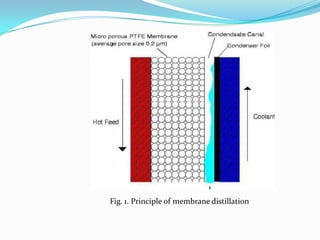
 Driving force for this "membrane distillation" is a
  vapour pressure difference on both sides of the
  membrane due to a corresponding temperature
  gradient across the membrane.
Fig. 1. Principle of membrane distillation
 The distillation is performed at ambient pressure
  and at a maximum temperature of 80°C (175°"F)
 The system is employing spiral wound
  desalination modules. Inside the distillation
  modules a thin microporous hydrophobic
  PTFE-membrane is used with pore diameters
  between 0.051 and 0.2 m.
 This material shows the surprising property of
  allowing easy passage of water vapour, but of
  completely blocking the flow of liquid water.
 In the process one surface (hot side) of the flat sheet
  membrane is in contact with the process solution while the
  opposite surface (cold side) is in contact with distillate.

 Thus the diffusion gap between evaporating and
  condensing surfaces is reduced to the thickness of the
  membrane that is only about 30 mm. With an actual
  pore fraction of 80% high specific evaporation rates are
  possible.

 The recovery of the heat of condensation is done by
  utilizing the heat of condensation to preheat the feed
  water.
DESIGN OF THE DESALINATION
MODULE
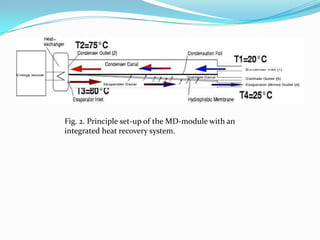
 Cold feed water (temperature T l) enters the module
  and is progressively heated by the hot condenser
  sheet, so that it emerges from flow channel 1
  (heat recovery channel) on a significantly higher
  temperature level (temperature T2).
 Before the feed water reenters the module into flow
  channel 2, the temperature has to be elevated from
  T2 to T3 using an external heat source. The
  distillation takes place from flow channel 2 across
  the membrane into flow channel 3. The feed water is
  gradually loosing heat and is getting concentrated.
Fig. 2. Principle set-up of the MD-module with an
integrated heat recovery system.
 The temperature difference between flow channel 2 and
  3 is the driving force for the process and is
  maintained along the whole channel length
 The concentrate emerges therefore with a higher
  temperature than the incoming feed. The distillate is
  collected in flow channel 3 and emerges from the
  module almost at ambient temperature (between Tl and
  T4).
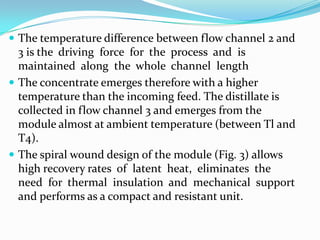
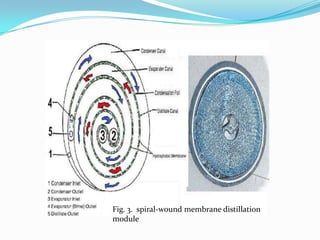
 The spiral wound design of the module (Fig. 3) allows
  high recovery rates of latent heat, eliminates the
  need for thermal insulation and mechanical support
  and performs as a compact and resistant unit.
Fig. 3. spiral-wound membrane distillation
module
Optimization of process :
The whole module construction has been optimized
  interms of :
      Distillate output
      Pressure losses
      Material stability
      Manufacturing technique
APPLICATIONS OF MEMBRANE DISTILLATION :
        Production Of Boiler Feed Water
        Production Of Ultrapure Water For Use In
    Medical, Pharmaceutical Or ElectronicIndustry
        Generation Of Pure Water For Rinsing In Surface
    Treatment Technology
        Recycling Of Process Solutions By Concentration
        Treatment Of Contaminated Fluids (Poisonous,
    Radioactive)
        The industrial applicability for the treatment of
    process solutions has been proven in a plant for nickel
    electroplating in Dresden/Germany.
SYSTEM ADVANTAGES :
 Efficient and compact spiral-wound membrane distillation
  modules

 Recovery of the heat of condensation is integrated in the module
  design

 Chemical pretreatment of feed water is not required -

 Low system pressure

 Insensitive to dry-running and fouling -

 Neglectible scaling due to process temperatures below 80°C
  (176°F).
WHICH COUNTRIES
USE THIS METHOD :
             The membrane distillation is
AUSTRALIA    being optimized for the
U.S.A        production of boiler feed
GERMANY      water, the recycling of
             electrolytes and for the
             production of distilled water
             for rinsing.
Conclusion :
 Small simple desalination plants operating independent
  from the electric grid are either not available or not
  economic at all.
 The process of membrane distillation allows the effective
  use of low temperature heat sources like solar energy or
  waste energy from engines for small to medium scale
  desalination.
 In order to achieve an effective membrane distillation
  process spiral wound modules have been developed and
  optimized during a 6-year R&D program.
 The modules are designed as compact units with
  integrated recovery of the heat of condensation,
  allowing a highly efficient use of low temperature heat
  sources.
REFERENCES:
 E. Delyannis. V. Belessiotis Solar desalination, is it
  effective? Desalination and WaterReuse Vol. 414
 J. Manwell, J. McGowan, Recent renewable energy
  driven desalination system research and development in
  North America Desalination, 94 (I 994) p. 229-241
 K. Schneider, T. van Gassel, Membrandestillation Chem.-
  lng.-Tech. 66 (1984) Nr. 7, 514-521
 N. Kjellander, Design and fold test of a membrane
  distillation system for seawater desalination
  Desalination, 61 (1987) p. 237- 243
solar distillation
solar distillation

solar distillation

  • 2.
    Introduction:  Desalination isnothing but removal of salt content present in the sea water and making palatable.  But how do we achieve this  My solution is “ Solar powered Desalination by Membrane Distillation”.
  • 3.
     Why desalination: Desalination of sea and brackish water has become a necessity in many arid and semiarid regions. Due to the fast growing population and a correspondingly high water demand in these regions the few water sources often get brackish or contaminated.  The use of fossil energies for desalination leads to an environmental load.
  • 4.
    DESCRIPTION OF THEMEMBRANE DISTILLATION (MD)- PROCESS :  It is possible to concentrate aqueous solutions of non- volatile dissolved substances by microporous membranes impermeable for water but permeable for water vapour  Driving force for this "membrane distillation" is a vapour pressure difference on both sides of the membrane due to a corresponding temperature gradient across the membrane.
  • 5.
    Fig. 1. Principleof membrane distillation
  • 6.
     The distillationis performed at ambient pressure and at a maximum temperature of 80°C (175°"F)  The system is employing spiral wound desalination modules. Inside the distillation modules a thin microporous hydrophobic PTFE-membrane is used with pore diameters between 0.051 and 0.2 m.  This material shows the surprising property of allowing easy passage of water vapour, but of completely blocking the flow of liquid water.
  • 7.
     In theprocess one surface (hot side) of the flat sheet membrane is in contact with the process solution while the opposite surface (cold side) is in contact with distillate.  Thus the diffusion gap between evaporating and condensing surfaces is reduced to the thickness of the membrane that is only about 30 mm. With an actual pore fraction of 80% high specific evaporation rates are possible.  The recovery of the heat of condensation is done by utilizing the heat of condensation to preheat the feed water.
  • 8.
    DESIGN OF THEDESALINATION MODULE  Cold feed water (temperature T l) enters the module and is progressively heated by the hot condenser sheet, so that it emerges from flow channel 1 (heat recovery channel) on a significantly higher temperature level (temperature T2).  Before the feed water reenters the module into flow channel 2, the temperature has to be elevated from T2 to T3 using an external heat source. The distillation takes place from flow channel 2 across the membrane into flow channel 3. The feed water is gradually loosing heat and is getting concentrated.
  • 9.
    Fig. 2. Principleset-up of the MD-module with an integrated heat recovery system.
  • 10.
     The temperaturedifference between flow channel 2 and 3 is the driving force for the process and is maintained along the whole channel length  The concentrate emerges therefore with a higher temperature than the incoming feed. The distillate is collected in flow channel 3 and emerges from the module almost at ambient temperature (between Tl and T4).  The spiral wound design of the module (Fig. 3) allows high recovery rates of latent heat, eliminates the need for thermal insulation and mechanical support and performs as a compact and resistant unit.
  • 11.
    Fig. 3. spiral-woundmembrane distillation module
  • 12.
    Optimization of process: The whole module construction has been optimized interms of :  Distillate output  Pressure losses  Material stability  Manufacturing technique
  • 13.
    APPLICATIONS OF MEMBRANEDISTILLATION :  Production Of Boiler Feed Water  Production Of Ultrapure Water For Use In Medical, Pharmaceutical Or ElectronicIndustry  Generation Of Pure Water For Rinsing In Surface Treatment Technology  Recycling Of Process Solutions By Concentration  Treatment Of Contaminated Fluids (Poisonous, Radioactive)  The industrial applicability for the treatment of process solutions has been proven in a plant for nickel electroplating in Dresden/Germany.
  • 14.
    SYSTEM ADVANTAGES : Efficient and compact spiral-wound membrane distillation modules  Recovery of the heat of condensation is integrated in the module design  Chemical pretreatment of feed water is not required -  Low system pressure  Insensitive to dry-running and fouling -  Neglectible scaling due to process temperatures below 80°C (176°F).
  • 15.
    WHICH COUNTRIES USE THISMETHOD :  The membrane distillation is AUSTRALIA being optimized for the U.S.A production of boiler feed GERMANY water, the recycling of electrolytes and for the production of distilled water for rinsing.
  • 16.
    Conclusion :  Smallsimple desalination plants operating independent from the electric grid are either not available or not economic at all.  The process of membrane distillation allows the effective use of low temperature heat sources like solar energy or waste energy from engines for small to medium scale desalination.  In order to achieve an effective membrane distillation process spiral wound modules have been developed and optimized during a 6-year R&D program.  The modules are designed as compact units with integrated recovery of the heat of condensation, allowing a highly efficient use of low temperature heat sources.
  • 17.
    REFERENCES:  E. Delyannis.V. Belessiotis Solar desalination, is it effective? Desalination and WaterReuse Vol. 414  J. Manwell, J. McGowan, Recent renewable energy driven desalination system research and development in North America Desalination, 94 (I 994) p. 229-241  K. Schneider, T. van Gassel, Membrandestillation Chem.- lng.-Tech. 66 (1984) Nr. 7, 514-521  N. Kjellander, Design and fold test of a membrane distillation system for seawater desalination Desalination, 61 (1987) p. 237- 243