REDUCING SURGE PRICES FOR
CAB HAILING SERVICE
Presented by
Muktanidhi Dhotrad, Rohit Khurana, Sandeep Girada
Under the Guidance of
Dr. Yunan Liu
Yining Huang
Apr 2019
Financial Mathematics
Problem
Statement
Financial Mathematics
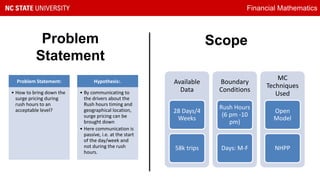
Problem Statement:
• How to bring down the
surge pricing during
rush hours to an
acceptable level?
Hypothesis:.
• By communicating to
the drivers about the
Rush hours timing and
geographical location,
surge pricing can be
brought down
• Here communication is
passive, i.e. at the start
of the day/week and
not during the rush
hours.
Available
Data
28 Days/4
Weeks
58k trips
Boundary
Conditions
Rush Hours
(6 pm -10
pm)
Days: M-F
MC
Techniques
Used
Open
Model
NHPP
Scope
Data Exploration, Cleaning
& Aggregation
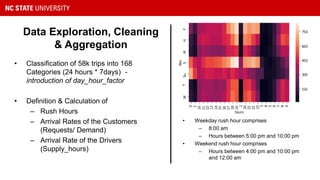
• Classification of 58k trips into 168
Categories (24 hours * 7days) -
introduction of day_hour_factor
• Definition & Calculation of
– Rush Hours
– Arrival Rates of the Customers
(Requests/ Demand)
– Arrival Rate of the Drivers
(Supply_hours)
• Weekday rush hour comprises
– 8:00 am
– Hours between 5:00 pm and 10:00 pm
• Weekend rush hour comprises
– Hours between 4:00 pm and 10:00 pm
and 12:00 am
Key Patterns
0
1
2
3
4
5
Rider Cancelled Trips Rest of the Trips
Average ETA
73%
27%
Surge Multiplier
(=1) >1
AA BB CC DD
CC 15.14% 6.12% 73.01% 5.74%
𝜆𝑑
𝜆𝑟
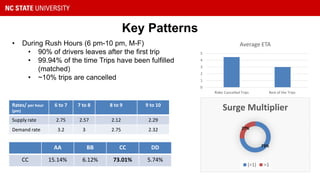
• During Rush Hours (6 pm-10 pm, M-F)
• 90% of drivers leaves after the first trip
• 99.94% of the time Trips have been fulfilled
(matched)
• ~10% trips are cancelled
Rates/ per hour
(pm)
6 to 7 7 to 8 8 to 9 9 to 10
Supply rate 2.75 2.57 2.12 2.29
Demand rate 3.2 3 2.75 2.32
Definitions
Financial Mathematics
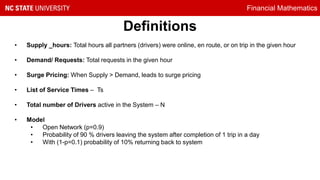
• Supply _hours: Total hours all partners (drivers) were online, en route, or on trip in the given hour
• Demand/ Requests: Total requests in the given hour
• Surge Pricing: When Supply > Demand, leads to surge pricing
• List of Service Times – Ts
• Total number of Drivers active in the System – N
• Model
• Open Network (p=0.9)
• Probability of 90 % drivers leaving the system after completion of 1 trip in a day
• With (1-p=0.1) probability of 10% returning back to system
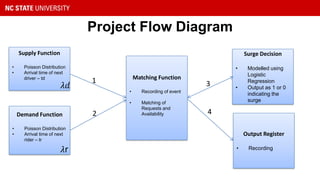
Project Flow Diagram
Supply Function
• Poisson Distribution
• Arrival time of next
driver – td
Demand Function
• Poisson Distribution
• Arrival time of next
rider – tr
𝜆𝑑
𝜆r
Matching Function
• Recording of event
• Matching of
Requests and
Availability
Surge Decision
• Modelled using
Logistic
Regression
• Output as 1 or 0
indicating the
surge
Output Register
• Recording
1
2
3
4
Financial Mathematics
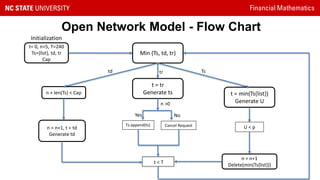
Open Network Model - Flow Chart
t= 0, n=5, T=240
Ts={list}, td, tr
Cap
Initialization
Min (Ts, td, tr)
t = tr
Generate ts
Ts.append(ts) Cancel Request
t < T
n + len(Ts) < Cap
n = n+1, t = td
Generate td
t = min(Ts{list})
Generate U
U < p
n = n+1
Delete(min(Ts{list}))
Tstrtd
n >0
Yes No
Financial Mathematics
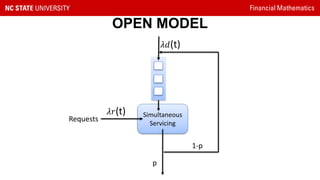
OPEN MODEL
Requests
Simultaneous
Servicing
1-p
p
𝜆𝑑(t)
𝜆𝑟(t)
Financial Mathematics
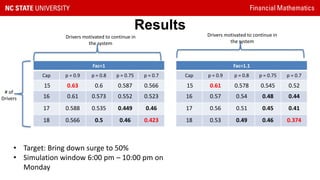
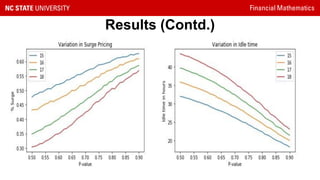
Results
Fac=1
Cap p = 0.9 p = 0.8 p = 0.75 p = 0.7
15 0.63 0.6 0.587 0.566
16 0.61 0.573 0.552 0.523
17 0.588 0.535 0.449 0.46
18 0.566 0.5 0.46 0.423
• Target: Bring down surge to 50%
• Simulation window 6:00 pm – 10:00 pm on
Monday
# of
Drivers
Drivers motivated to continue in
the system
Fac=1.1
Cap p = 0.9 p = 0.8 p = 0.75 p = 0.7
15 0.61 0.578 0.545 0.52
16 0.57 0.54 0.48 0.44
17 0.56 0.51 0.45 0.41
18 0.53 0.49 0.46 0.374
Drivers motivated to continue in
the system
Financial Mathematics
Results (Contd.)
Recommendations
• Passively communicating drivers about the rush hours
and location brings down the count of surge pricing.
• Model uses lot of assumption, that needs to be validated.
• Psychological behavior of the partner/ drive does play a role and that
requires attention.
• Possibility of breach of Demand & Supply Equilibrium to be studied.
Future Enhancements
THANK YOU
&
Questions Please

Surge pricing mc_presentation

  • 1.
    REDUCING SURGE PRICESFOR CAB HAILING SERVICE Presented by Muktanidhi Dhotrad, Rohit Khurana, Sandeep Girada Under the Guidance of Dr. Yunan Liu Yining Huang Apr 2019 Financial Mathematics
  • 2.
    Problem Statement Financial Mathematics Problem Statement: •How to bring down the surge pricing during rush hours to an acceptable level? Hypothesis:. • By communicating to the drivers about the Rush hours timing and geographical location, surge pricing can be brought down • Here communication is passive, i.e. at the start of the day/week and not during the rush hours. Available Data 28 Days/4 Weeks 58k trips Boundary Conditions Rush Hours (6 pm -10 pm) Days: M-F MC Techniques Used Open Model NHPP Scope
  • 3.
    Data Exploration, Cleaning &Aggregation • Classification of 58k trips into 168 Categories (24 hours * 7days) - introduction of day_hour_factor • Definition & Calculation of – Rush Hours – Arrival Rates of the Customers (Requests/ Demand) – Arrival Rate of the Drivers (Supply_hours) • Weekday rush hour comprises – 8:00 am – Hours between 5:00 pm and 10:00 pm • Weekend rush hour comprises – Hours between 4:00 pm and 10:00 pm and 12:00 am
  • 4.
    Key Patterns 0 1 2 3 4 5 Rider CancelledTrips Rest of the Trips Average ETA 73% 27% Surge Multiplier (=1) >1 AA BB CC DD CC 15.14% 6.12% 73.01% 5.74% 𝜆𝑑 𝜆𝑟 • During Rush Hours (6 pm-10 pm, M-F) • 90% of drivers leaves after the first trip • 99.94% of the time Trips have been fulfilled (matched) • ~10% trips are cancelled Rates/ per hour (pm) 6 to 7 7 to 8 8 to 9 9 to 10 Supply rate 2.75 2.57 2.12 2.29 Demand rate 3.2 3 2.75 2.32
  • 5.
    Definitions Financial Mathematics • Supply_hours: Total hours all partners (drivers) were online, en route, or on trip in the given hour • Demand/ Requests: Total requests in the given hour • Surge Pricing: When Supply > Demand, leads to surge pricing • List of Service Times – Ts • Total number of Drivers active in the System – N • Model • Open Network (p=0.9) • Probability of 90 % drivers leaving the system after completion of 1 trip in a day • With (1-p=0.1) probability of 10% returning back to system
  • 6.
    Project Flow Diagram SupplyFunction • Poisson Distribution • Arrival time of next driver – td Demand Function • Poisson Distribution • Arrival time of next rider – tr 𝜆𝑑 𝜆r Matching Function • Recording of event • Matching of Requests and Availability Surge Decision • Modelled using Logistic Regression • Output as 1 or 0 indicating the surge Output Register • Recording 1 2 3 4
  • 7.
    Financial Mathematics Open NetworkModel - Flow Chart t= 0, n=5, T=240 Ts={list}, td, tr Cap Initialization Min (Ts, td, tr) t = tr Generate ts Ts.append(ts) Cancel Request t < T n + len(Ts) < Cap n = n+1, t = td Generate td t = min(Ts{list}) Generate U U < p n = n+1 Delete(min(Ts{list})) Tstrtd n >0 Yes No
  • 8.
  • 9.
    Financial Mathematics Results Fac=1 Cap p= 0.9 p = 0.8 p = 0.75 p = 0.7 15 0.63 0.6 0.587 0.566 16 0.61 0.573 0.552 0.523 17 0.588 0.535 0.449 0.46 18 0.566 0.5 0.46 0.423 • Target: Bring down surge to 50% • Simulation window 6:00 pm – 10:00 pm on Monday # of Drivers Drivers motivated to continue in the system Fac=1.1 Cap p = 0.9 p = 0.8 p = 0.75 p = 0.7 15 0.61 0.578 0.545 0.52 16 0.57 0.54 0.48 0.44 17 0.56 0.51 0.45 0.41 18 0.53 0.49 0.46 0.374 Drivers motivated to continue in the system
  • 10.
  • 11.
    Recommendations • Passively communicatingdrivers about the rush hours and location brings down the count of surge pricing.
  • 12.
    • Model useslot of assumption, that needs to be validated. • Psychological behavior of the partner/ drive does play a role and that requires attention. • Possibility of breach of Demand & Supply Equilibrium to be studied. Future Enhancements
  • 13.