S1
Electronic Supplementary Information
Surface Amorphized in-situ RuO-NiFeOOH/Au Islands for
Electrocatalytic Oxygen Evolution Reaction
Karthick Kannimuthu,1 Pawan Kumar,1 Pooja Gakhad,2 Hadi Shaker Shiran,1 Xiyang Wang,3 Ali
Shayesteh Zeraati,1 Sangeetha Kumaravel,4 Shariful Kibria Nabil,1 Rajangam Vinodh,1 Md
Abdullah Al Bari,1 Maria Molina,1 George Shimizu,1 Yimin A. Wu,3 Pulickel M. Ajayan,5
Abhishek Kumar Singh,2 Soumyabrata Roy,5,6 and Md Golam Kibria1*
1Department of Chemical and Petroleum Engineering, University of Calgary, 2500 University
Drive, NW Calgary, Alberta, Canada T2N 1N4.
2Materials Research Centre, Indian Institute of Science, Bangalore 560 012, India
3Department of Mechanical and Mechatronics Engineering, Waterloo Institute for
Nanotechnology, Materials Interface Foundry, University of Waterloo, Waterloo, Ontario N2L
3G1, Canada
4Department of Chemistry, Kalasalingam Academy of Research and Education, Srivilliputhur
626126, India.
5Department of Materials Science and Nanoengineering, Rice University, 6100 Main St., Houston,
TX 77030, USA.
6Department of Sustainable Energy Engineering, Indian Institute of Technology Kanpur, Kanpur,
Uttar Pradesh 208016, India
E-mail: md.kibria@ucalgary.ca
Supplementary Information (SI) for Journal of Materials Chemistry A.
This journal is © The Royal Society of Chemistry 2025
S2
1. Experimental details
1.1 Reagents and Materials………………………………………………………………... Page S3
1.2 Synthesis of Ru-NiFeP/Au by an electrodeposition method ………..............................Page S3
1.3 Physical characterization…………………………………………….............................Page S3
1.4 Electrochemical OER Studies……………………………………….............................Page S4
2. Figures
Figure S1. XRD pattern of NF, Au/NF, and RuFeP/NF catalysts ….………….………….….… Page S5
Figure S2. Grazing incident wide X-ray scattering of Au-Ni………………….……...…………… Page S6
Figure S3. SEM images and corresponding EDS spectra of Au-Ni………………….……… Page S7
Figure S4. SEM images and mapping studies of Ru5-NiFeP/Au..………………….……….. Page S8
Figure S5. SEM images and mapping studies of Ru5-NiFeP/Au….………………….……… Page S8
Figure S6. SEM images and mapping studies of Ru15-NiFeP/Au.…………………….………. Page S9
Figure S7. HR-TEM and SAED analysis of Au-Ni………………….….…………….………. Page S9
Figure S8. HR-TEM, SAED and FFT analysis of Ru15-NiFeP/Au ………….….……….……. Page S10
Figure S9. XPS spectra of Au-Ni……………………………………………………………….. Page S11
Figure S10. XPS spectra of Ru5-NiFeP/Au ……………………………………………………… Page S12
Figure S11. XPS spectra of Ru15-NiFeP/Au …………………………………………………. ..Page S13
Figure S12. Soft X-ray absorption Ni L, P K, and O K edge spectra…………………….………….Page S14
Figure S13. Hard X-ray absorption Ni K-edge XANES spectra…………………….………….Page S15
Figure S14. LSV and Tafel slope curves of RuO2/NF in 1 M KOH……………….………….Page S17
Figure S15. Cdl studies of Au-Ni, NiFeP/Au, and Ru15-NiFeP/Au electrodes………….………….Page S18
Figure S16. Cycling stability study of Ru15-NiFeP/Au……………………………....……… Page S20
Figure S17. Post OER SEM images of Ru15-NiFeP/Au…………………………....……… Page S21
Figure S18. Post OER HR-TEM images of Ru15-NiFeP/Au…………………………....……… Page S22
Figure S19. Post OER XPS spectra of Ru15-NiFeP/Au…………………………....……… Page S23
Figure S20. CV studies of Ni, NiFeP/Au, and Ru15-NiFeP/Au…………………………....……… Page S24
Figure S21. In-situ SERS studies of bare Ni………………………………………………………..Page S25
Figure S22. In-situ SERS fitted results of Ru15-NiFeP/Au…………………………………………Page S26
Figure S23. Tauc plots of FeP and RuFeP/FTO materials…………………………………………Page S26
Figure S24. DFT structure of O intermediate on type-1 NiFe-OOH….……………………. Page S29
Figure S25. DFT structure of O intermediate on type-2 NiFe-OOH ….……………………. Page S30
Figure S26. DFT structure of O intermediate on type-1 Ru-O/NiFe-OOH Raman……..........Page S31
Figure S27. DFT structure of O intermediate on type-2 Ru-O/NiFe-OOH Raman……..........Page S32
Figure S28. OER pathways in type-1 and type-2 NiFe-OOH ……………………………...…Page S33
Figure S29. OER free energy profile in type-1 and type-2 NiFe-OOH …………………...…Page S33
Figure S30. In-Situ SERS cell set up for the OER study…………………………………...…Page S34
Tables
Table S1. EXAFS fitting for the coordination of Ru15-NiFeP/Au ...….………………... Page S16
Table S2. OER comparison table with the literature reports ……….……….………………... Page S19
Table S3. Bader charge analysis for type-1 NiFe-OOH ……….……….………………... Page S35
Table S4. Bader charge analysis for type-2 NiFe-OOH ……….……….………………... Page S35
Table S5. Bader charge analysis for type-1 RuO/NiFe-OOH ….……….………………... Page S35
Table S6. Bader charge analysis for type-2 RuO/NiFe-OOH ….……….………………... Page S36
Table S7. Gibbs free energy profile for type-1 NiFe-OOH ……….……….………………... Page S36
S3
Table S8. Gibbs free energy profile for type-2 NiFe-OOH ……….……….………………... Page S36
Table S9. Gibbs free energy profile for type-1 RuO/NiFe-OOH ….……….………………... Page S37
Table S10. Gibbs free energy profile for type-2 RuO/NiFe-OOH ….……….…………….... Page S37
1. Experimental details
1.1 Reagent and materials
Ruthenium trichloride (RuCl3.xH2O) (99.98 %), Au chloride solution (HAuCl4·3H2O, ≥99.9%
trace metals basis), Nickel foam (NF), Iron nitrate (Fe(NO3)3.9H2O (≥98%), Sodium
hypophosphite (NaH2PO2.H2O) (≥99%), PMDA (97%), KOH (≥85%), and HPLC grade water
were used throughout the experiments.
1.2. Synthesis of Ru-NiFeP/Au by an electrodeposition method
For the synthesis of Au-NF, galvanic replacement technique was employed. NF was initially
washed with 3M HCl to exclude the surface oxides. After that, NF piece was added to 50 mL of
34 mg/L of gold (III) chloride at pH~4 buffer and 0.5M NaCl and kept for stirring for 30 min. The
prepared Au/NF were used as working electrodes, Ag/AgCl used as a reference and carbon cloth
as a counter electrode. To the 5, 10, 15, 20, 25 mmol of RuCl3.xH2O, 10 mmol Fe(NO3)3.9H2O,
and 100 mmol NaH2PO2.H2O electrolytes, constant potential of -1.3 V is applied for 300 s. The
formed product is named Ru5-NiFeP/Au-NF. Here, NF itself acted as a Ni source. After the
deposition, electrodes were washed with DI water several times and dried at room temperature.
1.3. Physical characterization
The crystallinity of the samples was determined using X-ray diffraction (XRD) recorded on a
Bruker D8 Discover instrument using Cu-Kα radiation (40 kV, λ = 0.15418 nm) equipped with a
LynxEYE 1-dimensional detector. The scan rate of 0.02° is within the 2θ range of 10–90°. The
morphology was analyzed by scanning electron microscopy (SEM-EDS) (Phenom proX Desktop).
JEOL JEM-ARM200CF S/TEM operating at an acceleration voltage of 200 KeVwas used to
acquire high resolution – transmission electron microscopy (HR-TEM) images. X-ray
photoelectron spectroscopy (XPS) on an Axis-Ultra, Kratos Analytical instrument and a
monochromatic Al-Kα source (photon energy ≈1486.7 eV, source voltage-15 kV, current-10 mA,
power-50 W, Rowland circle monochromator) under ultrahigh vacuum (∼10−9 Torr). The binding
S4
energies of all elements were corrected with respect to adventitious carbon peak at 284.6 eV. The
in-situ Raman spectroscopy was used to investigate changes in the vibrational modes of the
electrodes using a Thermo Scientific DXR2 Raman microscope equipped with a 532 nm laser. The
crystalline nature of the materials were also studied by synchrotron-based wide-angle X-ray
scattering (WAXS) measurement. The WAXS analysis was carried out at 04ID-1 BXDS-WLE,
low energy wiggler beamline of Canadian light source (CLS). The energy range for this beamline
was 7-22 keV, with a maximum photon flux of 1 x 10¹² to 5 x 10¹² photons/s in focus on the sample
at 250 mA ring current. The electronic nature of the samples were studied using synchrotron-based
soft X-ray absorption spectroscopy (sXAS) and the beamline operating energy range was 3.5–1500
eV, monochromator VLS-PGM, deviation angle 140-176.3º, spectral resolution- 104 (E/ΔE)
@100eV, 10 µm slit width and spot size 2x 0.2 mm2. Local chemical environment and co-
ordination nature was studied by Hard X-ray Microanalysis (HXMA) beamline of CLS. The
energy range for the beamline was 5-40 KeV with a superconducting Wiggler source and photon
flux of 1012@12 keV. The spot size was 0.8 x 1.5 mm while the spectral resolution was 1x10⁻⁴.
1.4.Electrochemical OER Studies
Electrocatalytic OER studies were executed in a three-electrode cell in 1M KOH electrolyte.
Carbon paper as a counter electrode, Ag/AgCl as a reference electrode and RuNiFeP/Au electrodes
acted as working electrodes. Freshly prepared KOH (50 mL) was used to study OER
measurements. After 5 CV scans at 100 mV s-1 for activation, LSV was carried out at a scan rate
of 5 mV s-1. The LSV curves were 50% iR-corrected from the Rs values read from the EIS studies.
The in-situ EIS studies were tested at different applied potential biases with an AC amplitude of
0.005 V in the frequencies range of 100 kHz to 0.1 kHz. Electrochemical active surface area
(ECSA) was derived from the Cdl method in a non-faradaic region (0-0.1 V vs Ag/AgCl) and
calculated from ja-jc vs . The stability of the electrodes was measured via the galvanostatic
method at a constant current density of 100 mA cm-2 for 30 h in OER. TOF for OER was calculated
using the following formula,
TOF = jS/4nF
Where, j – current density, S – geometrical surface area, n – active molar sites (from ICP-MS) and
F – Faraday constant. The mass activity was calculated using,
Mass activity = Current density (j)/loading (mg). The specific activity of the
electrodes was measured by normalizing the current with the calculated ECSA values.
S5
Figure S1. (a) XRD pattern of NF, Au/NF, and RuFeP/NF catalysts. (b) Enlarged view of the
XRD pattern demonstrating the peak shifts in RuFeP catalysts.
S6
Figure S2. (a) Synchrotron based grazing incident wide X-ray scattering (GI-WAXS) 2D scan
image and (b) corresponding Q values respectively showing the metallic peaks of Ni and Au.
respectively.
S7
Figure S3. (a) Au-NF SEM image, (b-c) EDS elemental mapping results of Au and AuNi
composite respectively, (d) corresponding EDS spectra.
S8
Figure S4. SEM images of Ru5-NiFeP/Au, (a) SEM image showing islands of RuFeP, and (b-h)
elemental mapping for mix composite, Au, Ru, Ni, Fe, P, and O respectively.
Figure S5. SEM images of Ru10-NiFeP/Au, (a) SEM image showing islands of RuFeP, and (b-h)
elemental mapping for mix composite, Au, Ru, Fe, P, and O respectively.
S9
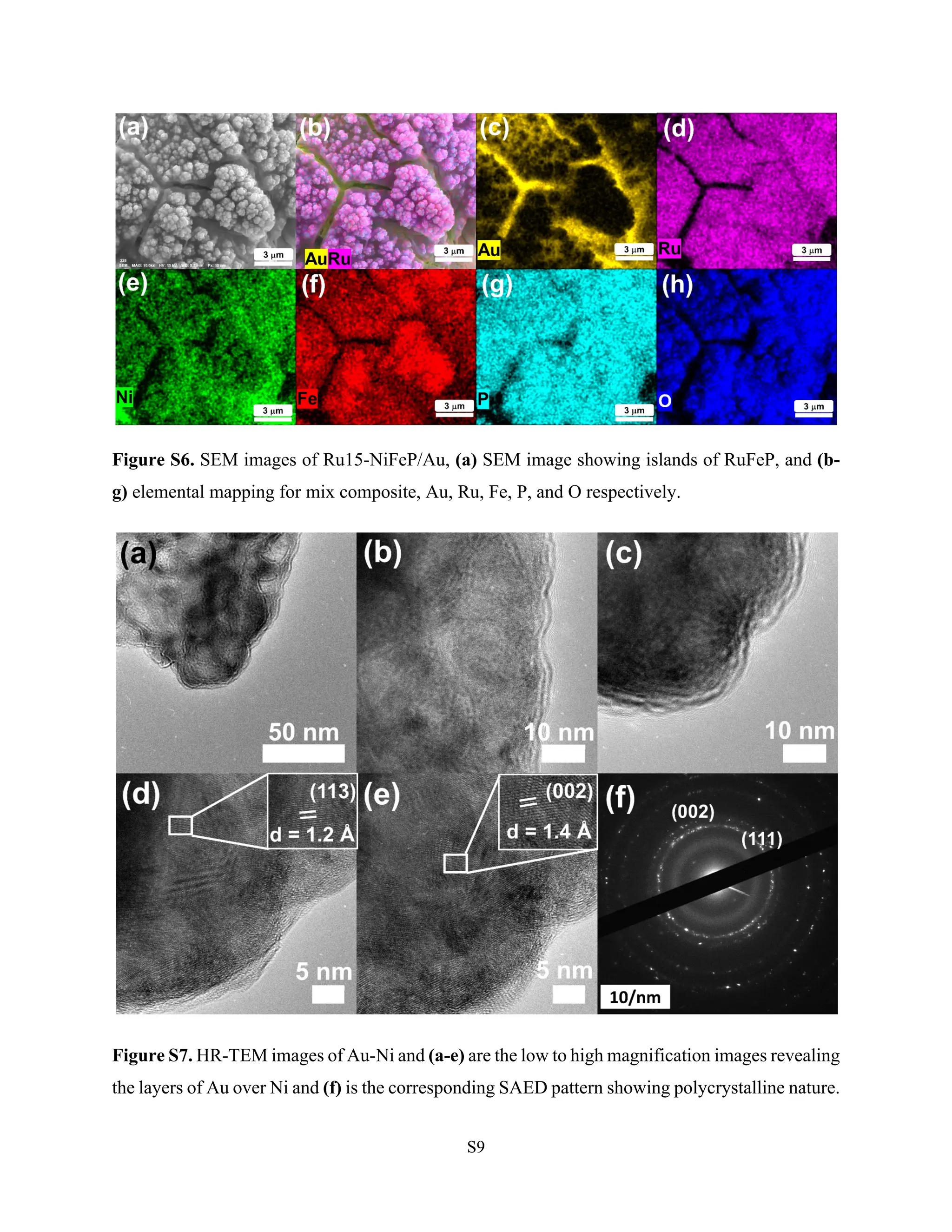
Figure S6. SEM images of Ru15-NiFeP/Au, (a) SEM image showing islands of RuFeP, and (b-
g) elemental mapping for mix composite, Au, Ru, Fe, P, and O respectively.
Figure S7. HR-TEM images of Au-Ni and (a-e) are the low to high magnification images revealing
the layers of Au over Ni and (f) is the corresponding SAED pattern showing polycrystalline nature.
S10
Figure S8. HR-TEM images of Ru15-NiFeP/Au-NF (a-d) low to high magnification images
showing the island structures and (e-f) corresponding SAED pattern displaying amorphous nature
and FFT pattern showing polycrystalline nature of Au-Ni.
S11
Figure S9. (a) XPS survey scan and HR-XPS spectra of Ru15-NiFeP/Au-NF in (a) Au 4f and (b)
Ni 2p regions respectively.
S12
Figure S10. (a) XPS survey scan and (b-h) high resolution XPS spectra of Ru5-Au 4f, Ni 2p, Ru
3p, Fe 2p, P 2p, and C1s, Ru3d, and O1s respectively.
S13
Figure S11. (a) XPS survey scan and (b-h) high resolution XPS spectra of Ru15-NiFeP/Au,
consisting of Au 4f, Ni 2p, Ru 3p, Fe 2p, P 2p, and C1s, Ru3d, and O1s respectively.
S14
Figure S12. Synchrotron based soft X-ray absorption spectra of Ru15-NiFeP@Au islands. (a-c)
EEMS scanning profiles of Ni, L, and O respectively.
S15
8300 8310 8320 8330 8340 8350 8360
-0.2
0.0
0.2
0.4
0.6
0.8
1.0
1.2 NiO
NF
Ru15-NiFeP/Au
Energy (eV)
Normalized
Absorption
(a.u.)
Figure S13. Synchrotron based hard X-ray absorption spectra of Ni-K edge XANES spectra.
S16
Table S1. EXAFS fitting results of Ru15-NiFeP/Au
Atom Bond Bond length CN E 2 (10-3) R-factor
Fe-O 1.90 (0.02)
4.4
(0.6) 9.2 (0.9) 9.4 (0.7)
Fe
Fe-P 2.34 (0.05)
4.5
(0.4) 3.9 (0.5) 8.8 (0.9)
0.008
Ru-O 1.92 (0.08)
1.3
(0.3) 6.5 (0.7) 5.7 (0.3)
Ru-O/P 2.03 (0.06)
4.6
(0.5) 3.8 (0.5) 3.6 (0.5)
Ru
Ru-Fe 2.59 (0.05)
6.9
(0.8) 0.9 (0.3) 3.7 (0.3)
0.008
S17
Figure S14. (a) LSV studies of RuO2/NF and (b) Tafel slope in 1 M KOH electrolyte.
S18
Figure S15. (a-d) Double layer capacitance (Cdl) results of Ni, Au-Ni, NiFeP/Au, and Ru5-
NiFeP/Au electrodes in non-Faradaic region and (e) Plot of j vs  displaying the Cdl of each
catalyst.
S19
Table S2. Comparison of OER results of Ru15-NiFeP/Au with the literature reports
S. No Catalyst Electrolyte Overpotential (mV) /
mA cm-2
References
1 3DG−Au-Ni3S2 1 M KOH 370 mV @ 91 mA cm-2 1
2 Au/NiCo2O4 1 M KOH 360 mV @ 10 mA cm-2 2
3 Ni/Au/Cysteine 0.1 M KOH 310 mV @ 10 mA cm-2 3
4 Fe0.14Co0.86-P/CC 1 M KOH 270 mV @ 10 mA cm-2 4
5 Co2P/FeP-FeP4 1 M KOH 230 mV @ 10 mA cm-2 5
6 CoP/FeP/CeOx 1 M KOH 285 mV @ 10 mA cm-2 6
7 CoP/FeP/CP 1 M KOH 260 mV @ 10 mA cm-2 7
8 CoP/FeP 1 M KOH 280 mV @ 10 mA cm-2 8
9 RuP/NPC 1 M KOH 310 mV @ 10 mA cm-2 9
10 NiFeP@NiP@NF 1 M KOH 227 mV @ 10 mA cm-2 10
11 Co-NiP@NC 1 M KOH 280 mV @ 10 mA cm-2 11
12 Ni2P/C-500 0.1 M KOH 260 mV @ 10 mA cm-2 12
13 Ni(PO3)2 1 M KOH 342 mV @ 10 mA cm-2 13
14 Ni2P/FeP4/CoP 1 M KOH 274 mV @ 10 mA cm-2 14
15 NiFeP/Zn 1 M NaOH 262 mV @ 10 mA cm-2 15
16 NiFeP-rGO 1 M KOH 250 mV @ 10 mA cm-2 16
17 NiFeP-MOF 1 M KOH 274 mV @ 10 mA cm-2 17
18 CrNiFeP/NC 1 M KOH 249 mV @ 10 mA cm-2 18
19 Ru15-NiFeP/Au 1 M KOH 223 mV @ 10 mA cm-2 This work
S20
Figure S16. LSV before and after the OER cycling study for 500 cycles at 200 mV/sec scan rate
for Ru15-NiFeP/Au electrode in 1M KOH.
S21
Figure S17. Post OER SEM images of Ru15-NiFeP/Au. (a and b) are the RuNiFeP islands similar
to before OER studies and (c-h) are the color mapping results of Ni, Au, Ru, P, O and K
respectively and here K arises from the electrolyte KOH used.
S22
Figure S18. Post OER HR-TEM images of Ru15-NiFeP/Au. (a-c) High magnified images
showing the islands of Ru15-NiFeP similar to that of before OER. (d) High magnification image
and the inset shows the lattice fringes and (f) corresponding SAED pattern.
S23
Figure S19. Post OER HR-XPS spectra of Ru15-NiFeP/Au-NF in (a-e) High resolution spectra
of Au 4f, Ni 2p, Fe 2p, C1s, Ru3d, and P 2p respectively.
S24
Figure S20. iR uncorrected CV from 1.3 to 1.6 V vs RHE chosen for studying electrode/electrolyte
interface by in-situ EIS studies.
S25
Figure S21. (a) In-situ SERS studies of bare NF and (b) Fitted peak area for NiOOH and the
corresponding intensities.
S26
Figure S22. In-situ SERS studies of Ru15-NiFeP/Au showing the fitted peak area and intensities
of FeOOH.
Figure S23. (a) Tauc plot of FeP and (b) Tauc plot of RuFeP demonstrating the role of Ru in the
reduction of band gap.
S27
2.Density Functional Theory (DFT) study
2.1. Computational Methodology
To gain atomistic insights into the oxygen evolution reaction mechanism on RuO over
NiFeOOH system, first-principles calculations were performed using density functional theory as
implemented in Vienna ab-initio simulation (VASP 6.2.0) package.19 The electron exchange and
correlations were approximated using Perdew-Burke-Ernzerhof (PBE) generalized gradient
approximation (GGA).20 The electron-ion interactions were described by all electron projector
augmented wave (PAW) pseudopotentials.21 The dispersion energy corrections were incorporated
using DFT+D3 approach of Grimme et al.22 A supercell of size 2*2*1 was constructed to explore
the maximum surface sites with non-equivalent chemical environment. The periodic images were
separated by a vacuum of 20 Å along z direction to prevent spurious interactions. The Brillouin
zone was sampled using 2*4*1 Monkhorst-Pack k-grid, for all structures. The optimization of all
structures was performed using a conjugate gradient scheme until the convergence criteria for
energies and the forces reached 10−5 eV and 0.01 eV Å-1, respectively. The strong correlation
effects of d-electrons for Fe and Ni were accounted using DFT+U method with Ueff= 2.5 eV, 4.8
eV and 4.0 eV for Fe, Ni and Ru, respectively. Bader charge scheme, as implemented in
Henkelman code,23 was utilized to study the degree of charge distribution.
Ideally, OER is a 4e– transfer process, consisting of four intermediate steps.24 The mechanism of
oxygen reduction reaction is as follows:
* + H2O → *OH + H+ + e- (1)
*OH → *O + H+ + e- (2)
*O + H2O → *OOH + H+ + e- (3)
*OOH → * + O2 + H+ + e- (4)
where * represent the catalytic surface.
The overpotential of OER process depends on the adsorption of intermediates on the catalytic
surface. Hence, *OOH, *OH and *O intermediates are first adsorbed on NiFe-OOH at type-1 and
S28
type-2 surface sites and, on the type-1 and type-2 RuO/NiFe-OOH at Ru, Then, the adsorption
energy of intermediates involved are calculated using the following equations:
ΔEads(OH) = E(*OH) − [E* + E(H2O) − 0.5E(H2)] (1)
ΔEads(O) = E(*O) − [E* + E(H2O) − E(H2)] (2)
ΔEads(OOH) = E(*OOH) − [E* + 2E(H2O) − 1.5E(H2)] (3)
ΔEads(OH), ΔEads(O) and ΔEads(OOH) are the adsorption energies of *OH, *O and *OOH
intermediates, respectively. E(*OH), E(*O) and E(*OOH) are the total energy of the system
(surface + intermediate), E* is the energy of the surface, E(H2O) and E(H2) are the energy of the
reference molecules. To further analyze the thermodynamics of the reaction, the calculated
adsorption energies were used to obtain the Gibbs free energies using the following equation24:
ΔG = ΔEads + ΔZPE − TΔS + ΔGU (4)
The Gibbs free energy for OER reaction is given as [6]:
ΔG = ΔEads + ΔZPE − TΔS - eU (5)
Here, ΔZPE is the difference in zero-point energies of the species, and e represents number of
electrons transferred. Only vibrational energy contribution was considered during the calculation
of entropies (Table S5-S8). The zero-point energy calculations were performed using vaspkit.25
ΔGU represents the free energy correction due to electrode potentials. The temperature was taken
to be 298.18 K.
Gibbs free energy for all the steps (Eq 1-4) are ΔG1, ΔG2, ΔG3 and ΔG4 , respectively. The
potential limiting step is given as,
ΔGPLS = max {ΔG1, ΔG2, ΔG3, ΔG4} (6)
The limiting potential,
UL = -
∆𝐺𝑃𝐿𝑆
𝑒
S29
The theoretical overpotential is given as
ηOER = UL -1.23 V (7)
where 1.23V is the theoretical potential for water splitting.
Figure S24. DFT study demonstrating the structure of O intermediate on type-1 NiFe-OOH.
S30
Figure S25. DFT study demonstrating the structure of O intermediate on type-2 NiFe-OOH.
S31
Figure S26. DFT study demonstrating the structure of O intermediate on type-1 Ru-O/NiFe-
OOH.
S32
Figure S27. DFT study demonstrating the structure of O intermediate on type-2 Ru-O/NiFe-
OOH.
S33
Figure S28. OER pathways in, (a) type-1 NiFe-OOH (b) type-2 NiFe-OOH.
Figure S29. (a-b) OER Free energy diagram of (a) type-1 NiFe-OOH (b) type-2 NiFe-OOH.
S34
Figure S30. Custom made in-situ SERS cell setup with Ru15-NiFeP/Au working electrode,
Carbon cloth counter electrode and Ag/AgCl reference electrode respectively.
S35
Bader Charge Analysis
Table S3. Bader charge analysis for type-1 NiFe-OOH configuration
S.No. Type-1
NiFe-OOH
O *O *O *H Ni1 Ni2 Fe
1. * + OH -0.44 -0.58 - 0.63 1.30 1.28 1.42
2. * + O -0.44 -0.07 - - 1.29 1.27 1.45
3. * + OOH -0.61 -0.02 -0.47 0.69 1.33 1.32 1.47
Table S4. Bader charge analysis for type-2 NiFe-OOH configuration
S.No. Type-2
NiFe-OOH
O *O *O *H Ni Fe1 Fe2
1. * + OH -0.49 -0.54 - 0.61 1.34 1.45 1.45
2. * + O -0.42 -0.12 - - 1.25 1.45 1.44
3. * + OOH -0.64 -0.03 -0.45 0.65 1.34 1.47 1.47
Table S5. Bader charge analysis for type-1 RuO/NiFe-OOH
S.No. Type-2
RuO/NiFe-OOH
O O1 O2 O3 *O *O *H Ru Ni
1. Surface (*) -0.54 -0.90 -0.88 -0.88 - - - 1.50 1.21
2. * + OH -0.58 -0.87 -0.88 -0.87 -0.98 - 0.57 1.61 1.30
3. * + O -0.33 -0.92 -0.86 -0.86 -0.28 - - 1.51 1.18
4. * + OOH -0.58 -0.87 -0.88 -0.87 -0.36 -0.56 0.58 1.61 1.30
S36
Table S6. Bader charge analysis for type-2 RuO/NiFe-OOH
S.No. Type-1
RuO/NiFe-OOH
O O1 O2 O3 *O *O *H Ru Fe
1. Surface (*) -0.61 -0.87 -0.91 -0.91 - - - 1.52 1.32
2. * + OH -0.63 -0.89 -0.93 - -0.98 - 0.64 1.61 1.43
3. * + O -0.54 -0.93 -0.93 - -0.54 - - 1.82 1.43
4. * + OOH -0.61 -0.88 -0.90 - -0.36 -0.60 0.64 1.62 1.40
Gibbs Free Energy calculations
Table S7. Gibbs free energy for type-1 NiFe-OOH at U= 0V, 1.23 V and 1.94 V
Type1 NiFeOOH Adsorption
Energy(eV)
∆(Z-∆TS) ∆G(U=0 V) ∆G(U=1.23 V) ∆G(U=1.94
V)
OH 2.09 -0.42 1.94 0.71 0.0039
O 3.65 -0.31 3.34 0.88 -0.537
OOH 4.71 -0.44 4.28 0.59 -1.54
Table S8. Gibbs free energy for type-2 NiFe-OOH at U= 0V, 1.23 V and 1.82 V
Type2 NiFeOOH Adsorption
Energy(eV)
∆(Z-∆TS) ∆G(U=0 V) ∆G(U=1.23 V) ∆G(U=1.82
V)
OH 1.86 -0.10 1.76 0.53 -0.058
O 3.89 -0.31 3.58 1.12 -0.064
OOH 4.54 -0.49 4.05 0.36 -1.41
S37
Table S9. Gibbs free energy for type-1 RuO/NiFe-OOH at U= 0V, 1.23 V and 1.58 V
Type1
RuO/NiFeOOH
Adsorption
Energy(eV)
∆(Z-∆TS) ∆G(U=0 V) ∆G(U=1.23 V) ∆G(U=1.58
V)
OH 1.02 -0.11 0.91 -0.32 -0.67
O 2.32 -0.29 2.03 -0.43 -1.13
OOH 4.07 -0.45 3.61 -0.08 -1.13
Table S10. Gibbs free energy for type-2 RuO/NiFe-OOH at U= 0V, 1.23 V and 1.70 V
Type2
RuO/NiFeOOH
Adsorption
Energy(eV)
∆(Z-∆TS) ∆G(U=0 V) ∆G(U=1.23 V) ∆G(U=1.70
V)
OH 0.85 -0.11 0.77 -0.46 -0.93
O 2.13 -0.29 1.83 -0.62 -1.57
OOH 3.64 -0.42 3.22 -0.47 -1.88
References
1 H. C. Tsai, B. Vedhanarayanan and T. W. Lin, ACS Appl. Energy Mater., 2019, 2, 3708–
3716.
2 X. Liu, J. Liu, Y. Li, Y. Li and X. Sun, ChemCatChem, 2014, 6, 2501–2506.
3 P. K. Bhartiya, M. Srivastava and D. Mishra, Int. J. Hydrogen Energy, 2022, 47, 42160–
42170.
4 H. Yu, L. Qi, Y. Hu, Y. Qu, P. Yan, T. T. Isimjan and X. Yang, J. Colloid Interface Sci.,
2021, 600, 811–819.
5 X. Wu, T. Dhanasekaran, W. Han, Y. Gao, Y. Li, D. Zhao, G. Wang and J. Zhao, ACS
Appl. Energy Mater., 2025, 3, 158–170.
6 X. Z. Song, T. Zhang, Y. H. Zhao, J. C. Ni, Y. Pan, Z. Tan and X. F. Wang, Inorg. Chem.,
2023, 62, 8347–8356.
S38
7 L. Zeng, L. An, Z. Zhang, J. Zheng, W. Chen, C. Liu, Y. Zheng, D. Dang and Z. Q. Liu,
Chem. Eng. J., , DOI:10.1016/j.cej.2024.152084.
8 Y. Zhang, Z. Li, S. He, Y. Qiao, A. Yuan, J. Wu and H. Zhou, J. Colloid Interface Sci.,
2025, 679, 20–29.
9 Q. Qin, H. Jang, L. Chen, G. Nam, X. Liu and J. Cho, Adv. Energy Mater., 2018, 8, 1–12.
10 F. Diao, W. Huang, G. Ctistis, H. Wackerbarth, Y. Yang, P. Si, J. Zhang, X. Xiao and C.
Engelbrekt, ACS Appl. Mater. Interfaces, 2021, 13, 23702–23713.
11 T. Xie, B. Wang, S. Yang, Q. Xu, X. Cheng, C. Zhou and J. Hu, J. Alloys Compd., 2022,
921, 166111.
12 D. Huo, F. Song, J. Hu, J. Yuan, L. Niu and A. jun Wang, Int. J. Hydrogen Energy, 2021,
46, 8519–8530.
13 A. Gupta, C. A. Allison, A. Kumar, R. Srivastava, M. Sim, J. Horinek, W. Lin, F. M. de
Souza, S. R. Mishra, F. Perez, R. K. Gupta and T. Dawsey, J. Energy Storage, 2024, 75,
1–13.
14 G. L. Li, Y. Y. Miao, F. Deng, S. Wang, R. X. Wang, W. H. Lu and R. L. Chen, J. Colloid
Interface Sci., 2024, 667, 543–552.
15 J. O. Silva, S. Cartagena and J. A. Calderón, Electrochim. Acta, ,
DOI:10.1016/j.electacta.2023.142299.
16 J. Chang, Z. Hu, D. Wu, F. Xu, C. Chen, K. Jiang and Z. Gao, J. Colloid Interface Sci.,
2023, 638, 801–812.
17 S. Qiu, S. Hao, Y. Xing, J. Huang, X. Wang, M. Ding, G. Zhao, B. Zhang and Y. Zhang,
Int. J. Hydrogen Energy, 2022, 47, 30472–30483.
18 C. Tian, M. Zhang, W. Yan, Y. Qing, L. Li, Y. Wu, J. Li and T. Yang, Int. J. Hydrogen
Energy, 2023, 48, 30653–30663.
19 G. Kresse and J. Furthmüller, Comput. Mater. Sci., 1996, 6, 15–50.
20 J. P. Perdew, K. Burke and M. Ernzerhof, Phys. Rev. Lett., 1996, 77, 3865–3868.
21 D. Joubert, Phys. Rev. B - Condens. Matter Mater. Phys., 1999, 59, 1758–1775.
22 S. Grimme, J. Antony, S. Ehrlich and H. Krieg, J. Chem. Phys., , DOI:10.1063/1.3382344.
23 W. Tang, E. Sanville and G. Henkelman, J. Phys. Condens. Matter, , DOI:10.1088/0953-
8984/21/8/084204.
24 J. K. Nørskov, J. Rossmeisl, A. Logadottir, L. Lindqvist, J. R. Kitchin, T. Bligaard and H.
Jónsson, J. Phys. Chem. B, 2004, 108, 17886–17892.
25 V. Wang, N. Xu, J. C. Liu, G. Tang and W. T. Geng, Comput. Phys. Commun., 2021, 267,
S39
108033.

Surface Amorphized in-situ RuO-NiFeOOH/Au Islands for Electrocatalytic Oxygen Evolution Reaction

  • 1.
    S1 Electronic Supplementary Information SurfaceAmorphized in-situ RuO-NiFeOOH/Au Islands for Electrocatalytic Oxygen Evolution Reaction Karthick Kannimuthu,1 Pawan Kumar,1 Pooja Gakhad,2 Hadi Shaker Shiran,1 Xiyang Wang,3 Ali Shayesteh Zeraati,1 Sangeetha Kumaravel,4 Shariful Kibria Nabil,1 Rajangam Vinodh,1 Md Abdullah Al Bari,1 Maria Molina,1 George Shimizu,1 Yimin A. Wu,3 Pulickel M. Ajayan,5 Abhishek Kumar Singh,2 Soumyabrata Roy,5,6 and Md Golam Kibria1* 1Department of Chemical and Petroleum Engineering, University of Calgary, 2500 University Drive, NW Calgary, Alberta, Canada T2N 1N4. 2Materials Research Centre, Indian Institute of Science, Bangalore 560 012, India 3Department of Mechanical and Mechatronics Engineering, Waterloo Institute for Nanotechnology, Materials Interface Foundry, University of Waterloo, Waterloo, Ontario N2L 3G1, Canada 4Department of Chemistry, Kalasalingam Academy of Research and Education, Srivilliputhur 626126, India. 5Department of Materials Science and Nanoengineering, Rice University, 6100 Main St., Houston, TX 77030, USA. 6Department of Sustainable Energy Engineering, Indian Institute of Technology Kanpur, Kanpur, Uttar Pradesh 208016, India E-mail: md.kibria@ucalgary.ca Supplementary Information (SI) for Journal of Materials Chemistry A. This journal is © The Royal Society of Chemistry 2025
  • 2.
    S2 1. Experimental details 1.1Reagents and Materials………………………………………………………………... Page S3 1.2 Synthesis of Ru-NiFeP/Au by an electrodeposition method ………..............................Page S3 1.3 Physical characterization…………………………………………….............................Page S3 1.4 Electrochemical OER Studies……………………………………….............................Page S4 2. Figures Figure S1. XRD pattern of NF, Au/NF, and RuFeP/NF catalysts ….………….………….….… Page S5 Figure S2. Grazing incident wide X-ray scattering of Au-Ni………………….……...…………… Page S6 Figure S3. SEM images and corresponding EDS spectra of Au-Ni………………….……… Page S7 Figure S4. SEM images and mapping studies of Ru5-NiFeP/Au..………………….……….. Page S8 Figure S5. SEM images and mapping studies of Ru5-NiFeP/Au….………………….……… Page S8 Figure S6. SEM images and mapping studies of Ru15-NiFeP/Au.…………………….………. Page S9 Figure S7. HR-TEM and SAED analysis of Au-Ni………………….….…………….………. Page S9 Figure S8. HR-TEM, SAED and FFT analysis of Ru15-NiFeP/Au ………….….……….……. Page S10 Figure S9. XPS spectra of Au-Ni……………………………………………………………….. Page S11 Figure S10. XPS spectra of Ru5-NiFeP/Au ……………………………………………………… Page S12 Figure S11. XPS spectra of Ru15-NiFeP/Au …………………………………………………. ..Page S13 Figure S12. Soft X-ray absorption Ni L, P K, and O K edge spectra…………………….………….Page S14 Figure S13. Hard X-ray absorption Ni K-edge XANES spectra…………………….………….Page S15 Figure S14. LSV and Tafel slope curves of RuO2/NF in 1 M KOH……………….………….Page S17 Figure S15. Cdl studies of Au-Ni, NiFeP/Au, and Ru15-NiFeP/Au electrodes………….………….Page S18 Figure S16. Cycling stability study of Ru15-NiFeP/Au……………………………....……… Page S20 Figure S17. Post OER SEM images of Ru15-NiFeP/Au…………………………....……… Page S21 Figure S18. Post OER HR-TEM images of Ru15-NiFeP/Au…………………………....……… Page S22 Figure S19. Post OER XPS spectra of Ru15-NiFeP/Au…………………………....……… Page S23 Figure S20. CV studies of Ni, NiFeP/Au, and Ru15-NiFeP/Au…………………………....……… Page S24 Figure S21. In-situ SERS studies of bare Ni………………………………………………………..Page S25 Figure S22. In-situ SERS fitted results of Ru15-NiFeP/Au…………………………………………Page S26 Figure S23. Tauc plots of FeP and RuFeP/FTO materials…………………………………………Page S26 Figure S24. DFT structure of O intermediate on type-1 NiFe-OOH….……………………. Page S29 Figure S25. DFT structure of O intermediate on type-2 NiFe-OOH ….……………………. Page S30 Figure S26. DFT structure of O intermediate on type-1 Ru-O/NiFe-OOH Raman……..........Page S31 Figure S27. DFT structure of O intermediate on type-2 Ru-O/NiFe-OOH Raman……..........Page S32 Figure S28. OER pathways in type-1 and type-2 NiFe-OOH ……………………………...…Page S33 Figure S29. OER free energy profile in type-1 and type-2 NiFe-OOH …………………...…Page S33 Figure S30. In-Situ SERS cell set up for the OER study…………………………………...…Page S34 Tables Table S1. EXAFS fitting for the coordination of Ru15-NiFeP/Au ...….………………... Page S16 Table S2. OER comparison table with the literature reports ……….……….………………... Page S19 Table S3. Bader charge analysis for type-1 NiFe-OOH ……….……….………………... Page S35 Table S4. Bader charge analysis for type-2 NiFe-OOH ……….……….………………... Page S35 Table S5. Bader charge analysis for type-1 RuO/NiFe-OOH ….……….………………... Page S35 Table S6. Bader charge analysis for type-2 RuO/NiFe-OOH ….……….………………... Page S36 Table S7. Gibbs free energy profile for type-1 NiFe-OOH ……….……….………………... Page S36
  • 3.
    S3 Table S8. Gibbsfree energy profile for type-2 NiFe-OOH ……….……….………………... Page S36 Table S9. Gibbs free energy profile for type-1 RuO/NiFe-OOH ….……….………………... Page S37 Table S10. Gibbs free energy profile for type-2 RuO/NiFe-OOH ….……….…………….... Page S37 1. Experimental details 1.1 Reagent and materials Ruthenium trichloride (RuCl3.xH2O) (99.98 %), Au chloride solution (HAuCl4·3H2O, ≥99.9% trace metals basis), Nickel foam (NF), Iron nitrate (Fe(NO3)3.9H2O (≥98%), Sodium hypophosphite (NaH2PO2.H2O) (≥99%), PMDA (97%), KOH (≥85%), and HPLC grade water were used throughout the experiments. 1.2. Synthesis of Ru-NiFeP/Au by an electrodeposition method For the synthesis of Au-NF, galvanic replacement technique was employed. NF was initially washed with 3M HCl to exclude the surface oxides. After that, NF piece was added to 50 mL of 34 mg/L of gold (III) chloride at pH~4 buffer and 0.5M NaCl and kept for stirring for 30 min. The prepared Au/NF were used as working electrodes, Ag/AgCl used as a reference and carbon cloth as a counter electrode. To the 5, 10, 15, 20, 25 mmol of RuCl3.xH2O, 10 mmol Fe(NO3)3.9H2O, and 100 mmol NaH2PO2.H2O electrolytes, constant potential of -1.3 V is applied for 300 s. The formed product is named Ru5-NiFeP/Au-NF. Here, NF itself acted as a Ni source. After the deposition, electrodes were washed with DI water several times and dried at room temperature. 1.3. Physical characterization The crystallinity of the samples was determined using X-ray diffraction (XRD) recorded on a Bruker D8 Discover instrument using Cu-Kα radiation (40 kV, λ = 0.15418 nm) equipped with a LynxEYE 1-dimensional detector. The scan rate of 0.02° is within the 2θ range of 10–90°. The morphology was analyzed by scanning electron microscopy (SEM-EDS) (Phenom proX Desktop). JEOL JEM-ARM200CF S/TEM operating at an acceleration voltage of 200 KeVwas used to acquire high resolution – transmission electron microscopy (HR-TEM) images. X-ray photoelectron spectroscopy (XPS) on an Axis-Ultra, Kratos Analytical instrument and a monochromatic Al-Kα source (photon energy ≈1486.7 eV, source voltage-15 kV, current-10 mA, power-50 W, Rowland circle monochromator) under ultrahigh vacuum (∼10−9 Torr). The binding
  • 4.
    S4 energies of allelements were corrected with respect to adventitious carbon peak at 284.6 eV. The in-situ Raman spectroscopy was used to investigate changes in the vibrational modes of the electrodes using a Thermo Scientific DXR2 Raman microscope equipped with a 532 nm laser. The crystalline nature of the materials were also studied by synchrotron-based wide-angle X-ray scattering (WAXS) measurement. The WAXS analysis was carried out at 04ID-1 BXDS-WLE, low energy wiggler beamline of Canadian light source (CLS). The energy range for this beamline was 7-22 keV, with a maximum photon flux of 1 x 10¹² to 5 x 10¹² photons/s in focus on the sample at 250 mA ring current. The electronic nature of the samples were studied using synchrotron-based soft X-ray absorption spectroscopy (sXAS) and the beamline operating energy range was 3.5–1500 eV, monochromator VLS-PGM, deviation angle 140-176.3º, spectral resolution- 104 (E/ΔE) @100eV, 10 µm slit width and spot size 2x 0.2 mm2. Local chemical environment and co- ordination nature was studied by Hard X-ray Microanalysis (HXMA) beamline of CLS. The energy range for the beamline was 5-40 KeV with a superconducting Wiggler source and photon flux of 1012@12 keV. The spot size was 0.8 x 1.5 mm while the spectral resolution was 1x10⁻⁴. 1.4.Electrochemical OER Studies Electrocatalytic OER studies were executed in a three-electrode cell in 1M KOH electrolyte. Carbon paper as a counter electrode, Ag/AgCl as a reference electrode and RuNiFeP/Au electrodes acted as working electrodes. Freshly prepared KOH (50 mL) was used to study OER measurements. After 5 CV scans at 100 mV s-1 for activation, LSV was carried out at a scan rate of 5 mV s-1. The LSV curves were 50% iR-corrected from the Rs values read from the EIS studies. The in-situ EIS studies were tested at different applied potential biases with an AC amplitude of 0.005 V in the frequencies range of 100 kHz to 0.1 kHz. Electrochemical active surface area (ECSA) was derived from the Cdl method in a non-faradaic region (0-0.1 V vs Ag/AgCl) and calculated from ja-jc vs . The stability of the electrodes was measured via the galvanostatic method at a constant current density of 100 mA cm-2 for 30 h in OER. TOF for OER was calculated using the following formula, TOF = jS/4nF Where, j – current density, S – geometrical surface area, n – active molar sites (from ICP-MS) and F – Faraday constant. The mass activity was calculated using, Mass activity = Current density (j)/loading (mg). The specific activity of the electrodes was measured by normalizing the current with the calculated ECSA values.
  • 5.
    S5 Figure S1. (a)XRD pattern of NF, Au/NF, and RuFeP/NF catalysts. (b) Enlarged view of the XRD pattern demonstrating the peak shifts in RuFeP catalysts.
  • 6.
    S6 Figure S2. (a)Synchrotron based grazing incident wide X-ray scattering (GI-WAXS) 2D scan image and (b) corresponding Q values respectively showing the metallic peaks of Ni and Au. respectively.
  • 7.
    S7 Figure S3. (a)Au-NF SEM image, (b-c) EDS elemental mapping results of Au and AuNi composite respectively, (d) corresponding EDS spectra.
  • 8.
    S8 Figure S4. SEMimages of Ru5-NiFeP/Au, (a) SEM image showing islands of RuFeP, and (b-h) elemental mapping for mix composite, Au, Ru, Ni, Fe, P, and O respectively. Figure S5. SEM images of Ru10-NiFeP/Au, (a) SEM image showing islands of RuFeP, and (b-h) elemental mapping for mix composite, Au, Ru, Fe, P, and O respectively.
  • 9.
    S9 Figure S6. SEMimages of Ru15-NiFeP/Au, (a) SEM image showing islands of RuFeP, and (b- g) elemental mapping for mix composite, Au, Ru, Fe, P, and O respectively. Figure S7. HR-TEM images of Au-Ni and (a-e) are the low to high magnification images revealing the layers of Au over Ni and (f) is the corresponding SAED pattern showing polycrystalline nature.
  • 10.
    S10 Figure S8. HR-TEMimages of Ru15-NiFeP/Au-NF (a-d) low to high magnification images showing the island structures and (e-f) corresponding SAED pattern displaying amorphous nature and FFT pattern showing polycrystalline nature of Au-Ni.
  • 11.
    S11 Figure S9. (a)XPS survey scan and HR-XPS spectra of Ru15-NiFeP/Au-NF in (a) Au 4f and (b) Ni 2p regions respectively.
  • 12.
    S12 Figure S10. (a)XPS survey scan and (b-h) high resolution XPS spectra of Ru5-Au 4f, Ni 2p, Ru 3p, Fe 2p, P 2p, and C1s, Ru3d, and O1s respectively.
  • 13.
    S13 Figure S11. (a)XPS survey scan and (b-h) high resolution XPS spectra of Ru15-NiFeP/Au, consisting of Au 4f, Ni 2p, Ru 3p, Fe 2p, P 2p, and C1s, Ru3d, and O1s respectively.
  • 14.
    S14 Figure S12. Synchrotronbased soft X-ray absorption spectra of Ru15-NiFeP@Au islands. (a-c) EEMS scanning profiles of Ni, L, and O respectively.
  • 15.
    S15 8300 8310 83208330 8340 8350 8360 -0.2 0.0 0.2 0.4 0.6 0.8 1.0 1.2 NiO NF Ru15-NiFeP/Au Energy (eV) Normalized Absorption (a.u.) Figure S13. Synchrotron based hard X-ray absorption spectra of Ni-K edge XANES spectra.
  • 16.
    S16 Table S1. EXAFSfitting results of Ru15-NiFeP/Au Atom Bond Bond length CN E 2 (10-3) R-factor Fe-O 1.90 (0.02) 4.4 (0.6) 9.2 (0.9) 9.4 (0.7) Fe Fe-P 2.34 (0.05) 4.5 (0.4) 3.9 (0.5) 8.8 (0.9) 0.008 Ru-O 1.92 (0.08) 1.3 (0.3) 6.5 (0.7) 5.7 (0.3) Ru-O/P 2.03 (0.06) 4.6 (0.5) 3.8 (0.5) 3.6 (0.5) Ru Ru-Fe 2.59 (0.05) 6.9 (0.8) 0.9 (0.3) 3.7 (0.3) 0.008
  • 17.
    S17 Figure S14. (a)LSV studies of RuO2/NF and (b) Tafel slope in 1 M KOH electrolyte.
  • 18.
    S18 Figure S15. (a-d)Double layer capacitance (Cdl) results of Ni, Au-Ni, NiFeP/Au, and Ru5- NiFeP/Au electrodes in non-Faradaic region and (e) Plot of j vs  displaying the Cdl of each catalyst.
  • 19.
    S19 Table S2. Comparisonof OER results of Ru15-NiFeP/Au with the literature reports S. No Catalyst Electrolyte Overpotential (mV) / mA cm-2 References 1 3DG−Au-Ni3S2 1 M KOH 370 mV @ 91 mA cm-2 1 2 Au/NiCo2O4 1 M KOH 360 mV @ 10 mA cm-2 2 3 Ni/Au/Cysteine 0.1 M KOH 310 mV @ 10 mA cm-2 3 4 Fe0.14Co0.86-P/CC 1 M KOH 270 mV @ 10 mA cm-2 4 5 Co2P/FeP-FeP4 1 M KOH 230 mV @ 10 mA cm-2 5 6 CoP/FeP/CeOx 1 M KOH 285 mV @ 10 mA cm-2 6 7 CoP/FeP/CP 1 M KOH 260 mV @ 10 mA cm-2 7 8 CoP/FeP 1 M KOH 280 mV @ 10 mA cm-2 8 9 RuP/NPC 1 M KOH 310 mV @ 10 mA cm-2 9 10 NiFeP@NiP@NF 1 M KOH 227 mV @ 10 mA cm-2 10 11 Co-NiP@NC 1 M KOH 280 mV @ 10 mA cm-2 11 12 Ni2P/C-500 0.1 M KOH 260 mV @ 10 mA cm-2 12 13 Ni(PO3)2 1 M KOH 342 mV @ 10 mA cm-2 13 14 Ni2P/FeP4/CoP 1 M KOH 274 mV @ 10 mA cm-2 14 15 NiFeP/Zn 1 M NaOH 262 mV @ 10 mA cm-2 15 16 NiFeP-rGO 1 M KOH 250 mV @ 10 mA cm-2 16 17 NiFeP-MOF 1 M KOH 274 mV @ 10 mA cm-2 17 18 CrNiFeP/NC 1 M KOH 249 mV @ 10 mA cm-2 18 19 Ru15-NiFeP/Au 1 M KOH 223 mV @ 10 mA cm-2 This work
  • 20.
    S20 Figure S16. LSVbefore and after the OER cycling study for 500 cycles at 200 mV/sec scan rate for Ru15-NiFeP/Au electrode in 1M KOH.
  • 21.
    S21 Figure S17. PostOER SEM images of Ru15-NiFeP/Au. (a and b) are the RuNiFeP islands similar to before OER studies and (c-h) are the color mapping results of Ni, Au, Ru, P, O and K respectively and here K arises from the electrolyte KOH used.
  • 22.
    S22 Figure S18. PostOER HR-TEM images of Ru15-NiFeP/Au. (a-c) High magnified images showing the islands of Ru15-NiFeP similar to that of before OER. (d) High magnification image and the inset shows the lattice fringes and (f) corresponding SAED pattern.
  • 23.
    S23 Figure S19. PostOER HR-XPS spectra of Ru15-NiFeP/Au-NF in (a-e) High resolution spectra of Au 4f, Ni 2p, Fe 2p, C1s, Ru3d, and P 2p respectively.
  • 24.
    S24 Figure S20. iRuncorrected CV from 1.3 to 1.6 V vs RHE chosen for studying electrode/electrolyte interface by in-situ EIS studies.
  • 25.
    S25 Figure S21. (a)In-situ SERS studies of bare NF and (b) Fitted peak area for NiOOH and the corresponding intensities.
  • 26.
    S26 Figure S22. In-situSERS studies of Ru15-NiFeP/Au showing the fitted peak area and intensities of FeOOH. Figure S23. (a) Tauc plot of FeP and (b) Tauc plot of RuFeP demonstrating the role of Ru in the reduction of band gap.
  • 27.
    S27 2.Density Functional Theory(DFT) study 2.1. Computational Methodology To gain atomistic insights into the oxygen evolution reaction mechanism on RuO over NiFeOOH system, first-principles calculations were performed using density functional theory as implemented in Vienna ab-initio simulation (VASP 6.2.0) package.19 The electron exchange and correlations were approximated using Perdew-Burke-Ernzerhof (PBE) generalized gradient approximation (GGA).20 The electron-ion interactions were described by all electron projector augmented wave (PAW) pseudopotentials.21 The dispersion energy corrections were incorporated using DFT+D3 approach of Grimme et al.22 A supercell of size 2*2*1 was constructed to explore the maximum surface sites with non-equivalent chemical environment. The periodic images were separated by a vacuum of 20 Å along z direction to prevent spurious interactions. The Brillouin zone was sampled using 2*4*1 Monkhorst-Pack k-grid, for all structures. The optimization of all structures was performed using a conjugate gradient scheme until the convergence criteria for energies and the forces reached 10−5 eV and 0.01 eV Å-1, respectively. The strong correlation effects of d-electrons for Fe and Ni were accounted using DFT+U method with Ueff= 2.5 eV, 4.8 eV and 4.0 eV for Fe, Ni and Ru, respectively. Bader charge scheme, as implemented in Henkelman code,23 was utilized to study the degree of charge distribution. Ideally, OER is a 4e– transfer process, consisting of four intermediate steps.24 The mechanism of oxygen reduction reaction is as follows: * + H2O → *OH + H+ + e- (1) *OH → *O + H+ + e- (2) *O + H2O → *OOH + H+ + e- (3) *OOH → * + O2 + H+ + e- (4) where * represent the catalytic surface. The overpotential of OER process depends on the adsorption of intermediates on the catalytic surface. Hence, *OOH, *OH and *O intermediates are first adsorbed on NiFe-OOH at type-1 and
  • 28.
    S28 type-2 surface sitesand, on the type-1 and type-2 RuO/NiFe-OOH at Ru, Then, the adsorption energy of intermediates involved are calculated using the following equations: ΔEads(OH) = E(*OH) − [E* + E(H2O) − 0.5E(H2)] (1) ΔEads(O) = E(*O) − [E* + E(H2O) − E(H2)] (2) ΔEads(OOH) = E(*OOH) − [E* + 2E(H2O) − 1.5E(H2)] (3) ΔEads(OH), ΔEads(O) and ΔEads(OOH) are the adsorption energies of *OH, *O and *OOH intermediates, respectively. E(*OH), E(*O) and E(*OOH) are the total energy of the system (surface + intermediate), E* is the energy of the surface, E(H2O) and E(H2) are the energy of the reference molecules. To further analyze the thermodynamics of the reaction, the calculated adsorption energies were used to obtain the Gibbs free energies using the following equation24: ΔG = ΔEads + ΔZPE − TΔS + ΔGU (4) The Gibbs free energy for OER reaction is given as [6]: ΔG = ΔEads + ΔZPE − TΔS - eU (5) Here, ΔZPE is the difference in zero-point energies of the species, and e represents number of electrons transferred. Only vibrational energy contribution was considered during the calculation of entropies (Table S5-S8). The zero-point energy calculations were performed using vaspkit.25 ΔGU represents the free energy correction due to electrode potentials. The temperature was taken to be 298.18 K. Gibbs free energy for all the steps (Eq 1-4) are ΔG1, ΔG2, ΔG3 and ΔG4 , respectively. The potential limiting step is given as, ΔGPLS = max {ΔG1, ΔG2, ΔG3, ΔG4} (6) The limiting potential, UL = - ∆𝐺𝑃𝐿𝑆 𝑒
  • 29.
    S29 The theoretical overpotentialis given as ηOER = UL -1.23 V (7) where 1.23V is the theoretical potential for water splitting. Figure S24. DFT study demonstrating the structure of O intermediate on type-1 NiFe-OOH.
  • 30.
    S30 Figure S25. DFTstudy demonstrating the structure of O intermediate on type-2 NiFe-OOH.
  • 31.
    S31 Figure S26. DFTstudy demonstrating the structure of O intermediate on type-1 Ru-O/NiFe- OOH.
  • 32.
    S32 Figure S27. DFTstudy demonstrating the structure of O intermediate on type-2 Ru-O/NiFe- OOH.
  • 33.
    S33 Figure S28. OERpathways in, (a) type-1 NiFe-OOH (b) type-2 NiFe-OOH. Figure S29. (a-b) OER Free energy diagram of (a) type-1 NiFe-OOH (b) type-2 NiFe-OOH.
  • 34.
    S34 Figure S30. Custommade in-situ SERS cell setup with Ru15-NiFeP/Au working electrode, Carbon cloth counter electrode and Ag/AgCl reference electrode respectively.
  • 35.
    S35 Bader Charge Analysis TableS3. Bader charge analysis for type-1 NiFe-OOH configuration S.No. Type-1 NiFe-OOH O *O *O *H Ni1 Ni2 Fe 1. * + OH -0.44 -0.58 - 0.63 1.30 1.28 1.42 2. * + O -0.44 -0.07 - - 1.29 1.27 1.45 3. * + OOH -0.61 -0.02 -0.47 0.69 1.33 1.32 1.47 Table S4. Bader charge analysis for type-2 NiFe-OOH configuration S.No. Type-2 NiFe-OOH O *O *O *H Ni Fe1 Fe2 1. * + OH -0.49 -0.54 - 0.61 1.34 1.45 1.45 2. * + O -0.42 -0.12 - - 1.25 1.45 1.44 3. * + OOH -0.64 -0.03 -0.45 0.65 1.34 1.47 1.47 Table S5. Bader charge analysis for type-1 RuO/NiFe-OOH S.No. Type-2 RuO/NiFe-OOH O O1 O2 O3 *O *O *H Ru Ni 1. Surface (*) -0.54 -0.90 -0.88 -0.88 - - - 1.50 1.21 2. * + OH -0.58 -0.87 -0.88 -0.87 -0.98 - 0.57 1.61 1.30 3. * + O -0.33 -0.92 -0.86 -0.86 -0.28 - - 1.51 1.18 4. * + OOH -0.58 -0.87 -0.88 -0.87 -0.36 -0.56 0.58 1.61 1.30
  • 36.
    S36 Table S6. Badercharge analysis for type-2 RuO/NiFe-OOH S.No. Type-1 RuO/NiFe-OOH O O1 O2 O3 *O *O *H Ru Fe 1. Surface (*) -0.61 -0.87 -0.91 -0.91 - - - 1.52 1.32 2. * + OH -0.63 -0.89 -0.93 - -0.98 - 0.64 1.61 1.43 3. * + O -0.54 -0.93 -0.93 - -0.54 - - 1.82 1.43 4. * + OOH -0.61 -0.88 -0.90 - -0.36 -0.60 0.64 1.62 1.40 Gibbs Free Energy calculations Table S7. Gibbs free energy for type-1 NiFe-OOH at U= 0V, 1.23 V and 1.94 V Type1 NiFeOOH Adsorption Energy(eV) ∆(Z-∆TS) ∆G(U=0 V) ∆G(U=1.23 V) ∆G(U=1.94 V) OH 2.09 -0.42 1.94 0.71 0.0039 O 3.65 -0.31 3.34 0.88 -0.537 OOH 4.71 -0.44 4.28 0.59 -1.54 Table S8. Gibbs free energy for type-2 NiFe-OOH at U= 0V, 1.23 V and 1.82 V Type2 NiFeOOH Adsorption Energy(eV) ∆(Z-∆TS) ∆G(U=0 V) ∆G(U=1.23 V) ∆G(U=1.82 V) OH 1.86 -0.10 1.76 0.53 -0.058 O 3.89 -0.31 3.58 1.12 -0.064 OOH 4.54 -0.49 4.05 0.36 -1.41
  • 37.
    S37 Table S9. Gibbsfree energy for type-1 RuO/NiFe-OOH at U= 0V, 1.23 V and 1.58 V Type1 RuO/NiFeOOH Adsorption Energy(eV) ∆(Z-∆TS) ∆G(U=0 V) ∆G(U=1.23 V) ∆G(U=1.58 V) OH 1.02 -0.11 0.91 -0.32 -0.67 O 2.32 -0.29 2.03 -0.43 -1.13 OOH 4.07 -0.45 3.61 -0.08 -1.13 Table S10. Gibbs free energy for type-2 RuO/NiFe-OOH at U= 0V, 1.23 V and 1.70 V Type2 RuO/NiFeOOH Adsorption Energy(eV) ∆(Z-∆TS) ∆G(U=0 V) ∆G(U=1.23 V) ∆G(U=1.70 V) OH 0.85 -0.11 0.77 -0.46 -0.93 O 2.13 -0.29 1.83 -0.62 -1.57 OOH 3.64 -0.42 3.22 -0.47 -1.88 References 1 H. C. Tsai, B. Vedhanarayanan and T. W. Lin, ACS Appl. Energy Mater., 2019, 2, 3708– 3716. 2 X. Liu, J. Liu, Y. Li, Y. Li and X. Sun, ChemCatChem, 2014, 6, 2501–2506. 3 P. K. Bhartiya, M. Srivastava and D. Mishra, Int. J. Hydrogen Energy, 2022, 47, 42160– 42170. 4 H. Yu, L. Qi, Y. Hu, Y. Qu, P. Yan, T. T. Isimjan and X. Yang, J. Colloid Interface Sci., 2021, 600, 811–819. 5 X. Wu, T. Dhanasekaran, W. Han, Y. Gao, Y. Li, D. Zhao, G. Wang and J. Zhao, ACS Appl. Energy Mater., 2025, 3, 158–170. 6 X. Z. Song, T. Zhang, Y. H. Zhao, J. C. Ni, Y. Pan, Z. Tan and X. F. Wang, Inorg. Chem., 2023, 62, 8347–8356.
  • 38.
    S38 7 L. Zeng,L. An, Z. Zhang, J. Zheng, W. Chen, C. Liu, Y. Zheng, D. Dang and Z. Q. Liu, Chem. Eng. J., , DOI:10.1016/j.cej.2024.152084. 8 Y. Zhang, Z. Li, S. He, Y. Qiao, A. Yuan, J. Wu and H. Zhou, J. Colloid Interface Sci., 2025, 679, 20–29. 9 Q. Qin, H. Jang, L. Chen, G. Nam, X. Liu and J. Cho, Adv. Energy Mater., 2018, 8, 1–12. 10 F. Diao, W. Huang, G. Ctistis, H. Wackerbarth, Y. Yang, P. Si, J. Zhang, X. Xiao and C. Engelbrekt, ACS Appl. Mater. Interfaces, 2021, 13, 23702–23713. 11 T. Xie, B. Wang, S. Yang, Q. Xu, X. Cheng, C. Zhou and J. Hu, J. Alloys Compd., 2022, 921, 166111. 12 D. Huo, F. Song, J. Hu, J. Yuan, L. Niu and A. jun Wang, Int. J. Hydrogen Energy, 2021, 46, 8519–8530. 13 A. Gupta, C. A. Allison, A. Kumar, R. Srivastava, M. Sim, J. Horinek, W. Lin, F. M. de Souza, S. R. Mishra, F. Perez, R. K. Gupta and T. Dawsey, J. Energy Storage, 2024, 75, 1–13. 14 G. L. Li, Y. Y. Miao, F. Deng, S. Wang, R. X. Wang, W. H. Lu and R. L. Chen, J. Colloid Interface Sci., 2024, 667, 543–552. 15 J. O. Silva, S. Cartagena and J. A. Calderón, Electrochim. Acta, , DOI:10.1016/j.electacta.2023.142299. 16 J. Chang, Z. Hu, D. Wu, F. Xu, C. Chen, K. Jiang and Z. Gao, J. Colloid Interface Sci., 2023, 638, 801–812. 17 S. Qiu, S. Hao, Y. Xing, J. Huang, X. Wang, M. Ding, G. Zhao, B. Zhang and Y. Zhang, Int. J. Hydrogen Energy, 2022, 47, 30472–30483. 18 C. Tian, M. Zhang, W. Yan, Y. Qing, L. Li, Y. Wu, J. Li and T. Yang, Int. J. Hydrogen Energy, 2023, 48, 30653–30663. 19 G. Kresse and J. Furthmüller, Comput. Mater. Sci., 1996, 6, 15–50. 20 J. P. Perdew, K. Burke and M. Ernzerhof, Phys. Rev. Lett., 1996, 77, 3865–3868. 21 D. Joubert, Phys. Rev. B - Condens. Matter Mater. Phys., 1999, 59, 1758–1775. 22 S. Grimme, J. Antony, S. Ehrlich and H. Krieg, J. Chem. Phys., , DOI:10.1063/1.3382344. 23 W. Tang, E. Sanville and G. Henkelman, J. Phys. Condens. Matter, , DOI:10.1088/0953- 8984/21/8/084204. 24 J. K. Nørskov, J. Rossmeisl, A. Logadottir, L. Lindqvist, J. R. Kitchin, T. Bligaard and H. Jónsson, J. Phys. Chem. B, 2004, 108, 17886–17892. 25 V. Wang, N. Xu, J. C. Liu, G. Tang and W. T. Geng, Comput. Phys. Commun., 2021, 267,
  • 39.