Objectives
■Understanding the definitionsof supply chain management
■Defining key issues in SCM and how to approach these issues
■Defining basic activities in SCM (purchasing,
inventory, warehousing, distribution, forecast,….)
5.
Resources
■Sunil Chopra andPeter Meindl (2010)- Supply chain management:
strategy, planning and operation, Global edition
■Joel D. Wisner, G. Keong Leong, Keah-choon Tan (5th
edition 2018)
- Principles of supply chain management
6.
Course Structure
■Chapter 1:Overview of supply chain management
■Chapter 2: Purchasing management
■Chapter 3: Demand forecasting
■Chapter 4: Inventory management
■Chapter 5: Distribution and warehouse management
■Chapter 6: Integration
7.
CHAPTER 1 :OVERVIEW OF SUPPLY CHAIN
MANAGEMENT
You should be able to:
■ Describe a supply chain and define supply chain management.
■ Describe the objectives and elements of supply chain management.
■ Describe basic supply chain management activities.
■ Describe a brief history of supply chain management.
■ Describe the supply chain classification
■ Describe the supply chain strategies.
What is aSupply Chain?
A supply chain consists of the flow of products and services from:
– Raw materials manufacturers
– Component and intermediate manufacturers
– Final product manufacturers
– Wholesalers and distributors and
– Retailers
Connected by transportation and storage activities, and
Integrated through information, planning, and integration activities
(Wisner et al, 2018)
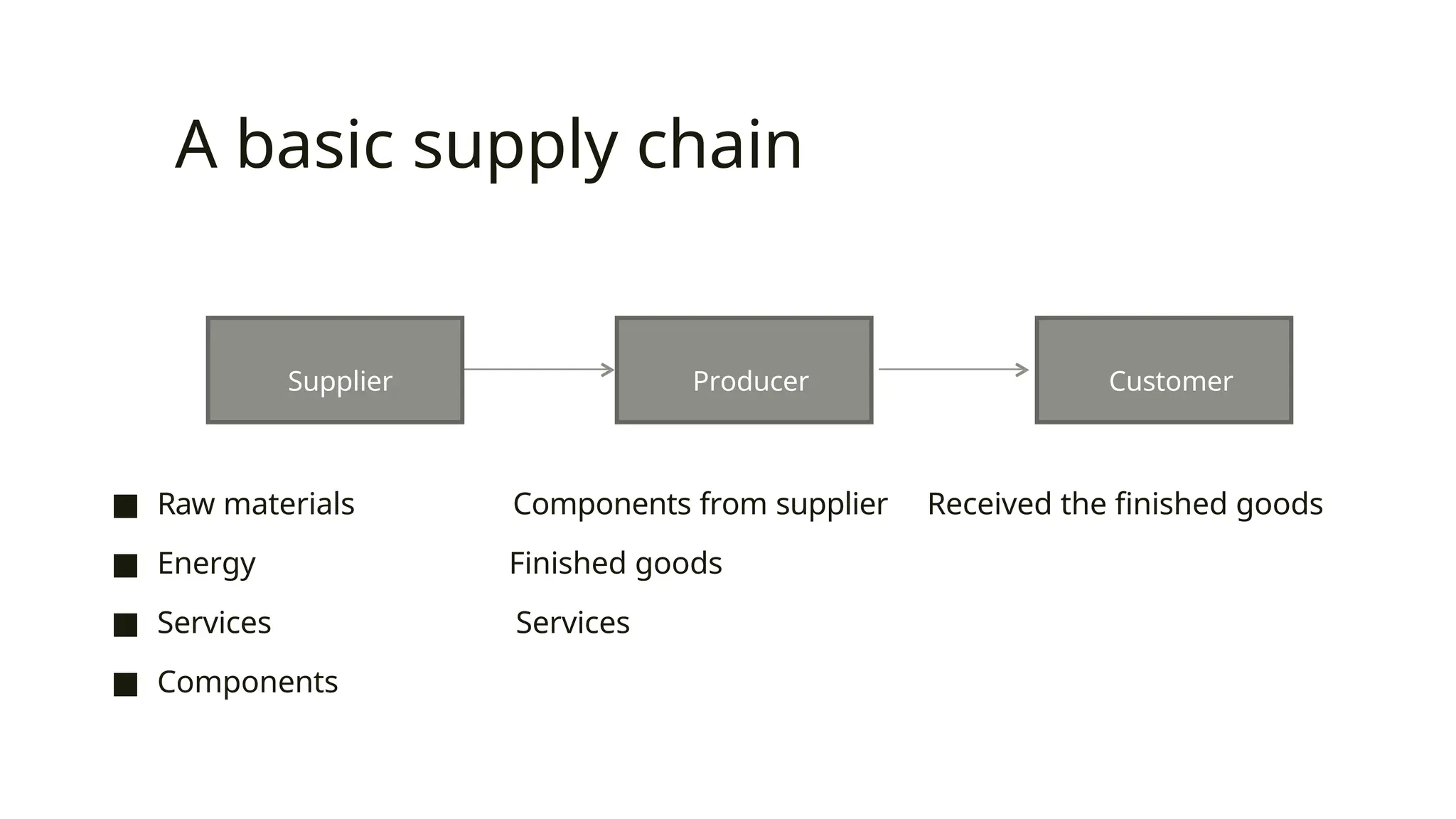
A basic supplychain
■ Raw materials Components from supplier Received the finished goods
■ Energy Finished goods
■ Services Services
■ Components
Customer
Supplier Producer
■ “ Asupply chain consists all parties involved, directly or indirectly,
in fulfilling a customer request. The supply chain includes not only
the manufactures and suppliers, but also transporters, warehouses,
retailers, and even customers themselves” (Chopra & Meindl,
2010)
■ A supply chain involves the constant flow of information,
What is SupplyChain Management?
The planning and management of all activities involved in sourcing and
procurement, conversion, and all logistics management activities … also
includes coordination with channel partners, which can be suppliers,
intermediaries, third party service providers, and customers.
Council of Supply Chain Management Professionals
The design and management of seamless, value-added processes across
organizational boundaries to meet the real needs of the end customer.
Institute for Supply Management
The design, planning, execution, control and monitoring of supply chain
activities with the objective of creating net value, building a competitive
infrastructure, leveraging worldwide logistics, synchronizing supply with
demand, and measuring performance globally.
Association for Operations Management
12
19.
What is SupplyChain Management?
(continued)
■ Successful supply chain management requires high levels of
trust, cooperation, collaboration, and honest, accurate
communications
– All participants in the supply chain benefit.
– Boundaries are dynamic and extend from “the firm’s suppliers’
suppliers to its customers’ customers (i.e., second tier suppliers and
customers).”
– Supply chains also include reverse logistics activities to
handle returned products, warranty repairs, and recycling.
Objective of supplychain management
■ Maximize the supply chain profitability
■ Reducing overall costs (inventory cost, purchasing cost,…) and
meeting the needs of customers
■ Sharing information between all partners in supply chain
Importance of SupplyChain Management
Firms with large system inventories gain the most from successful SCM
– Lower purchasing & carrying costs
– Better product quality
– Higher customer service levels
– Increased sales and profits
Importance of SupplyChain Management
(continued)
Firms using Supply Chain Management:
1. Start with key suppliers
2. Move on to other suppliers, customers, and logistics services
3. Integrate second tier suppliers and customers (second
tier refers to the customer’s customers and the supplier’s
suppliers)
16
Origins of SupplyChain Management
1950s-1960s
U.S. manufacturers focused on mass production techniques as their
principal cost reduction and productivity improvement strategies
1960s-1970s
Introduction of new computer technologies lead to development of
Materials Requirements Planning (MRP) and Manufacturing
Resource Planning (MRPII) to coordinate inventory management and
improve internal communication
Origins of SupplyChain Management
(continued)
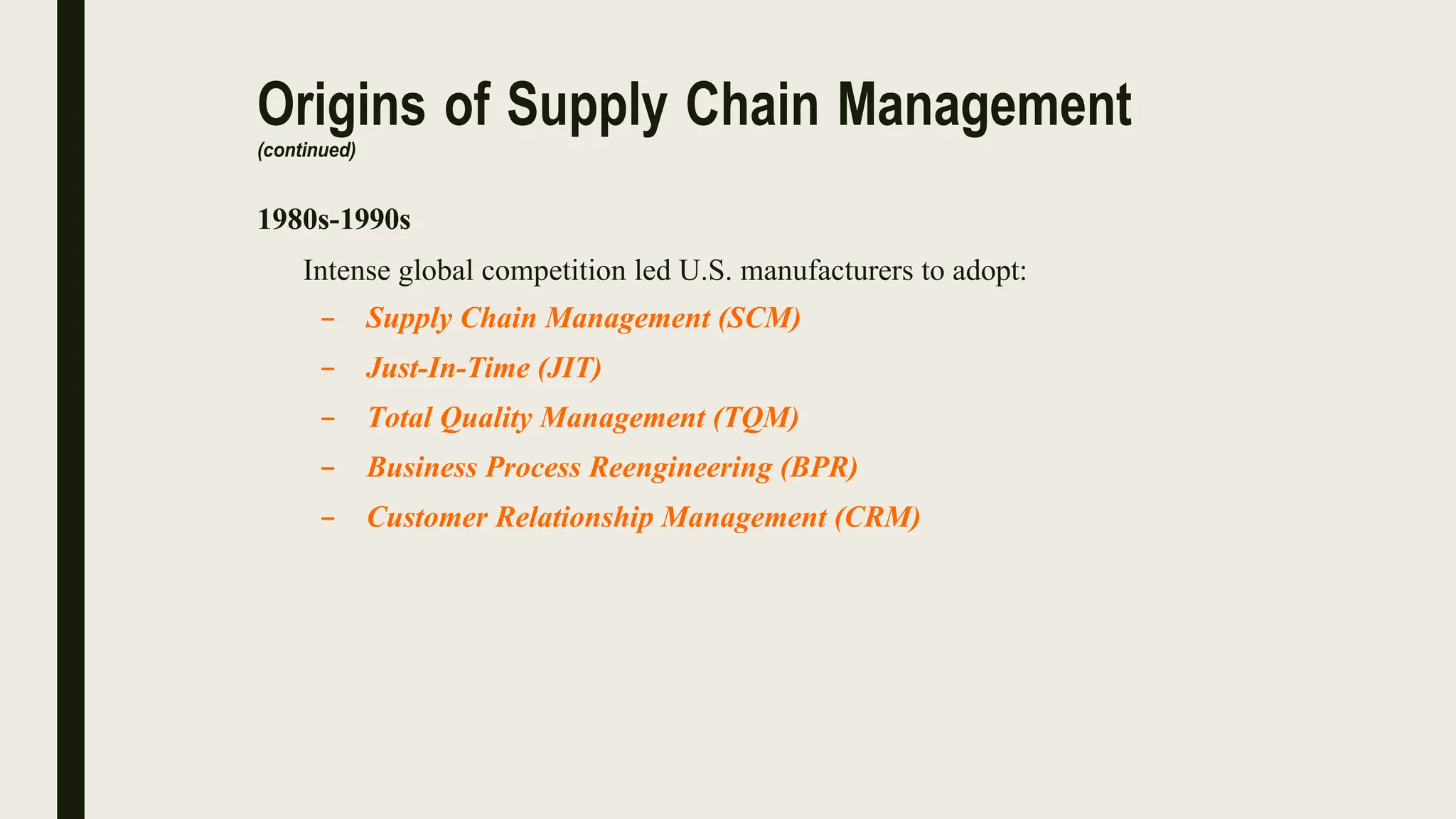
1980s-1990s
Intense global competition led U.S. manufacturers to adopt:
– Supply Chain Management (SCM)
– Just-In-Time (JIT)
– Total Quality Management (TQM)
– Business Process Reengineering (BPR)
– Customer Relationship Management (CRM)
Characteristics Logistics Supplychain management
Activities Transportation, warehousing,
forecast, delivery, customer service,
information,…
Logistics, supplier, manufacturing,
collaboration, integration, customer,…
Scope Internal Internal + external
Objective Reducing logistics cost, improving
customer service
Reducing total cost, and increasing
collaboration and integration.
Influence Short time Long time
20
32.
Origins of SupplyChain Management (continued)
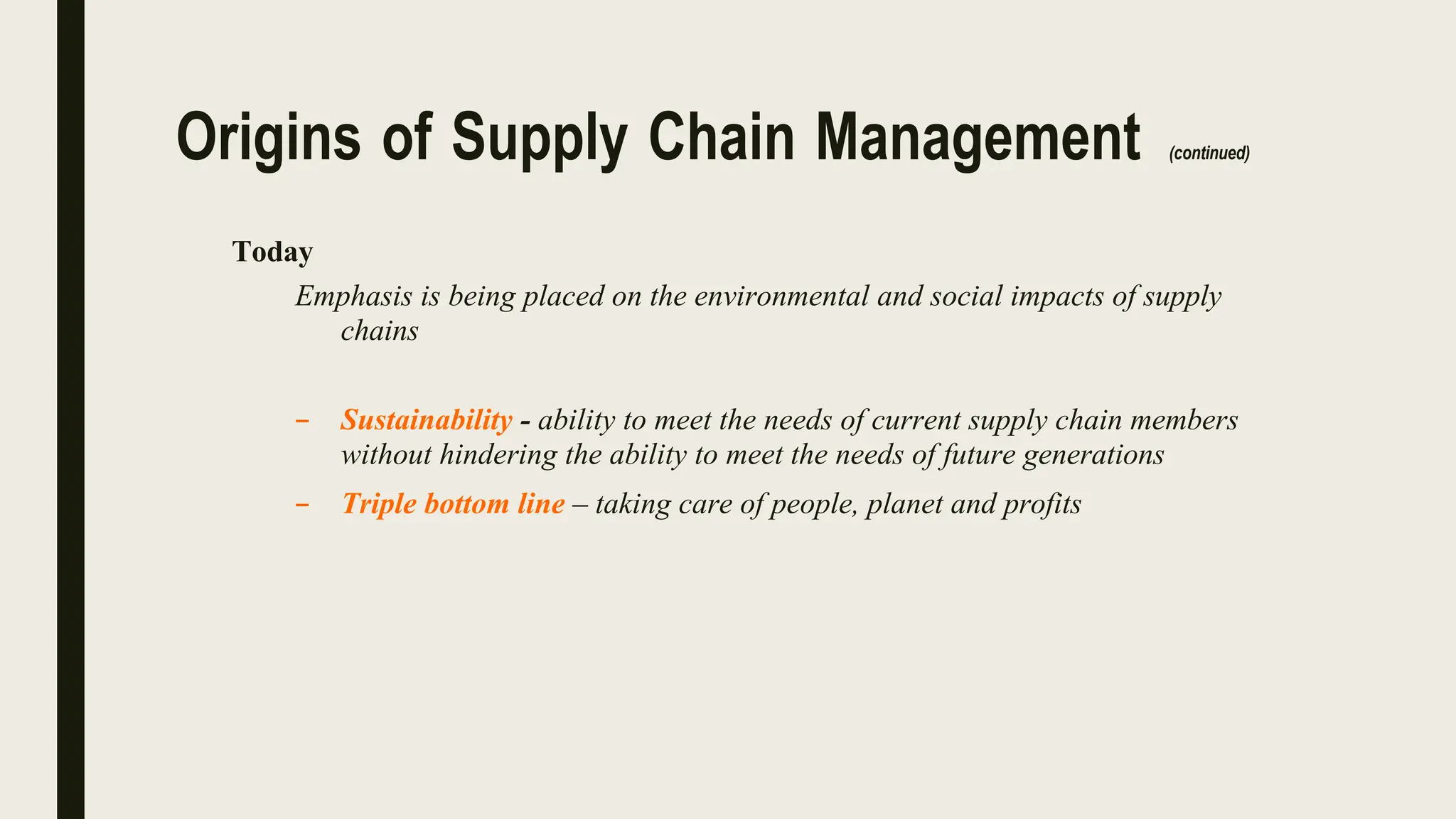
Today
Emphasis is being placed on the environmental and social impacts of supply
chains
– Sustainability - ability to meet the needs of current supply chain members
without hindering the ability to meet the needs of future generations
– Triple bottom line – taking care of people, planet and profits
Supply chain classification
■Collaboratesupply chains
FOCUS Relationship Development ( close
working relationship for mutual gain)
VALUE
PROPOSITION
● Share information
● Strategic partnerships
● Joint product development
● Long-term stability
● Mutual trust
23
36.
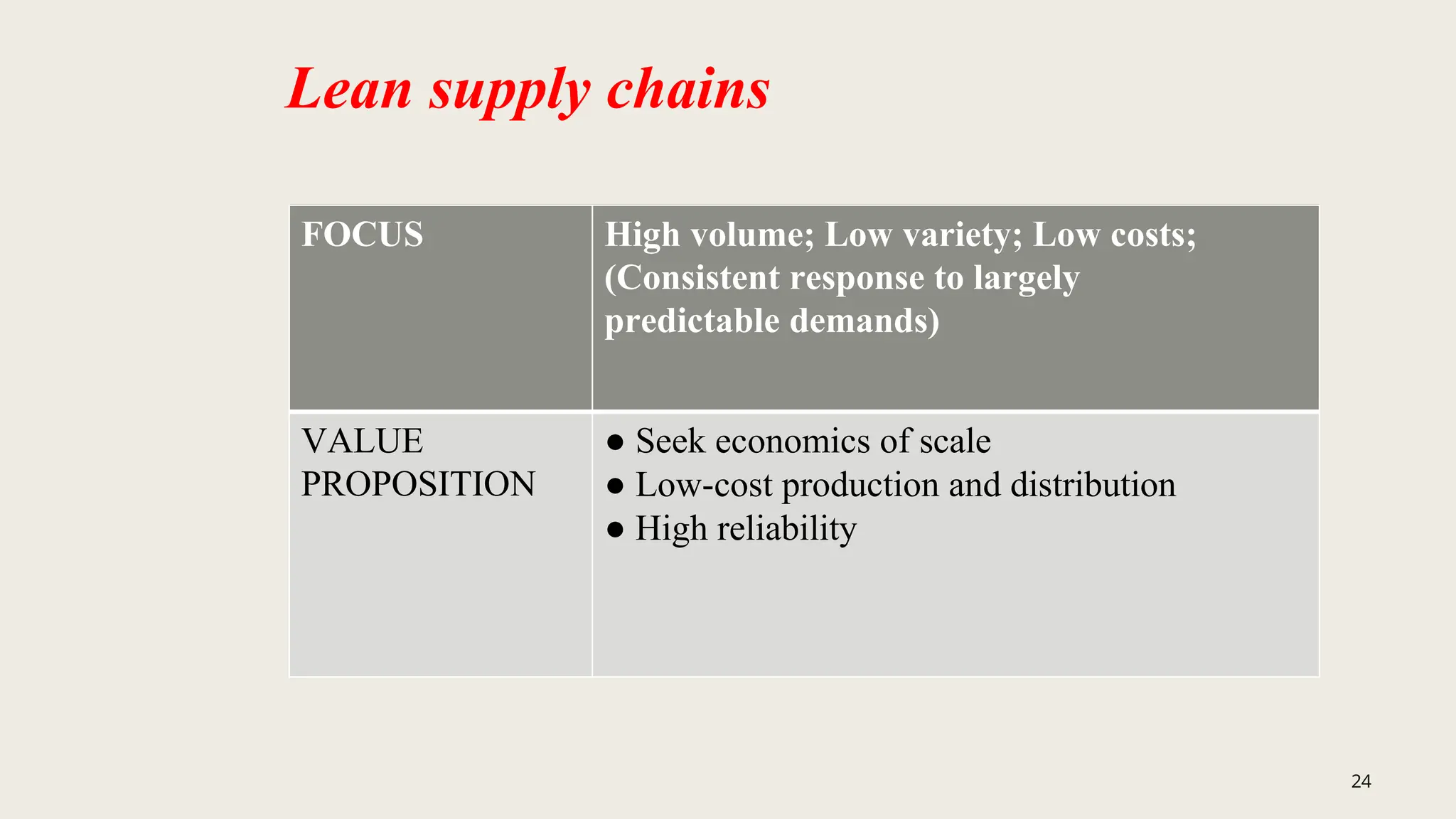
Lean supply chains
FOCUSHigh volume; Low variety; Low costs;
(Consistent response to largely
predictable demands)
VALUE
PROPOSITION
● Seek economics of scale
● Low-cost production and distribution
● High reliability
24
37.
Agile supply chains
FOCUSManage enterprises for responsiveness;
quick reactions; (rapid response to
unpredictable demand and supply
conditions)
VALUE
PROPOSITION
● Fast decision-making
● Fast delivery; flexible scheduling;
● Rapid response in unpredictable conditions
● Available capacity
25
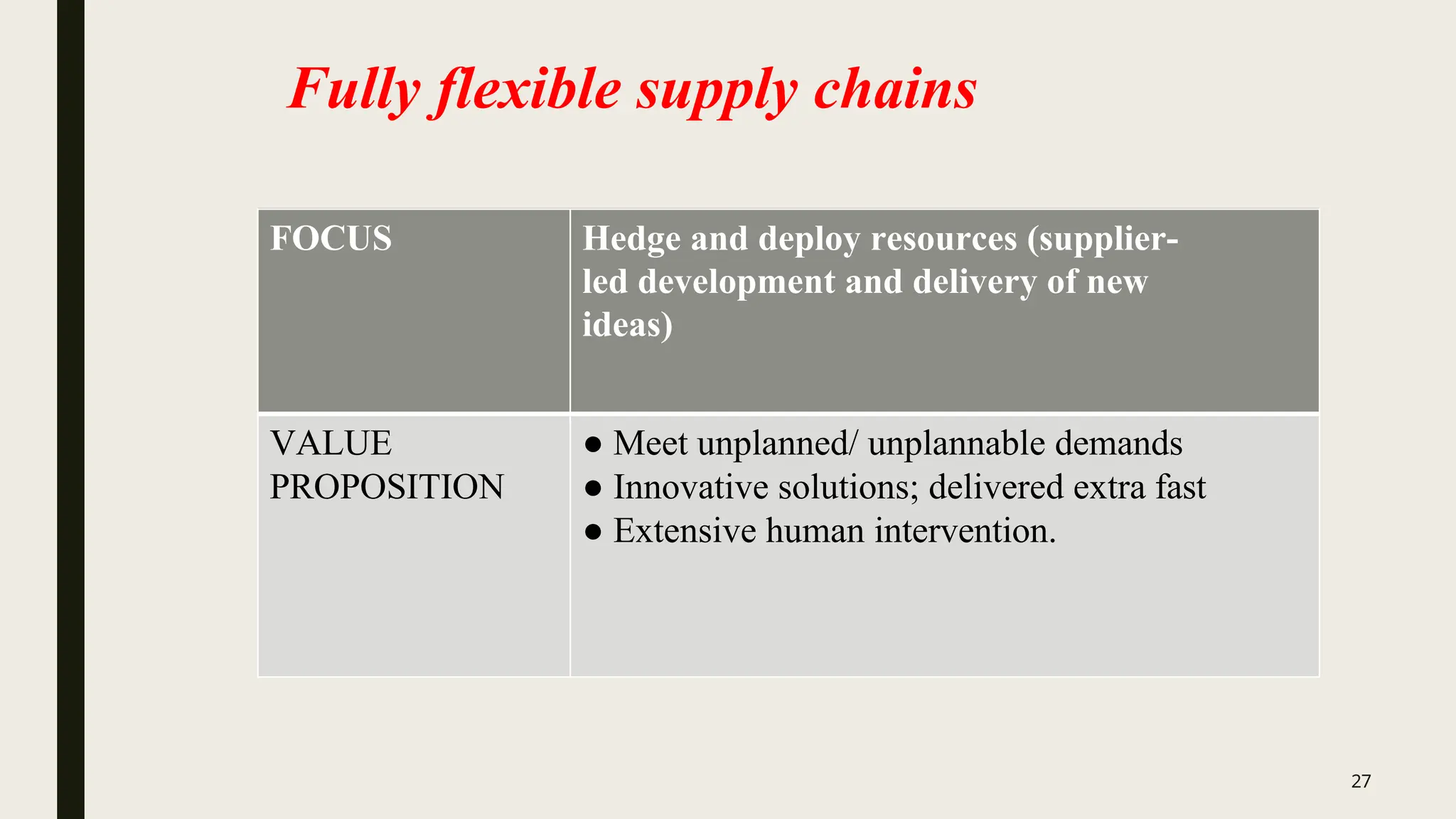
Fully flexible supplychains
FOCUS Hedge and deploy resources (supplier-
led development and delivery of new
ideas)
VALUE
PROPOSITION
● Meet unplanned/ unplannable demands
● Innovative solutions; delivered extra fast
● Extensive human intervention.
27
40.
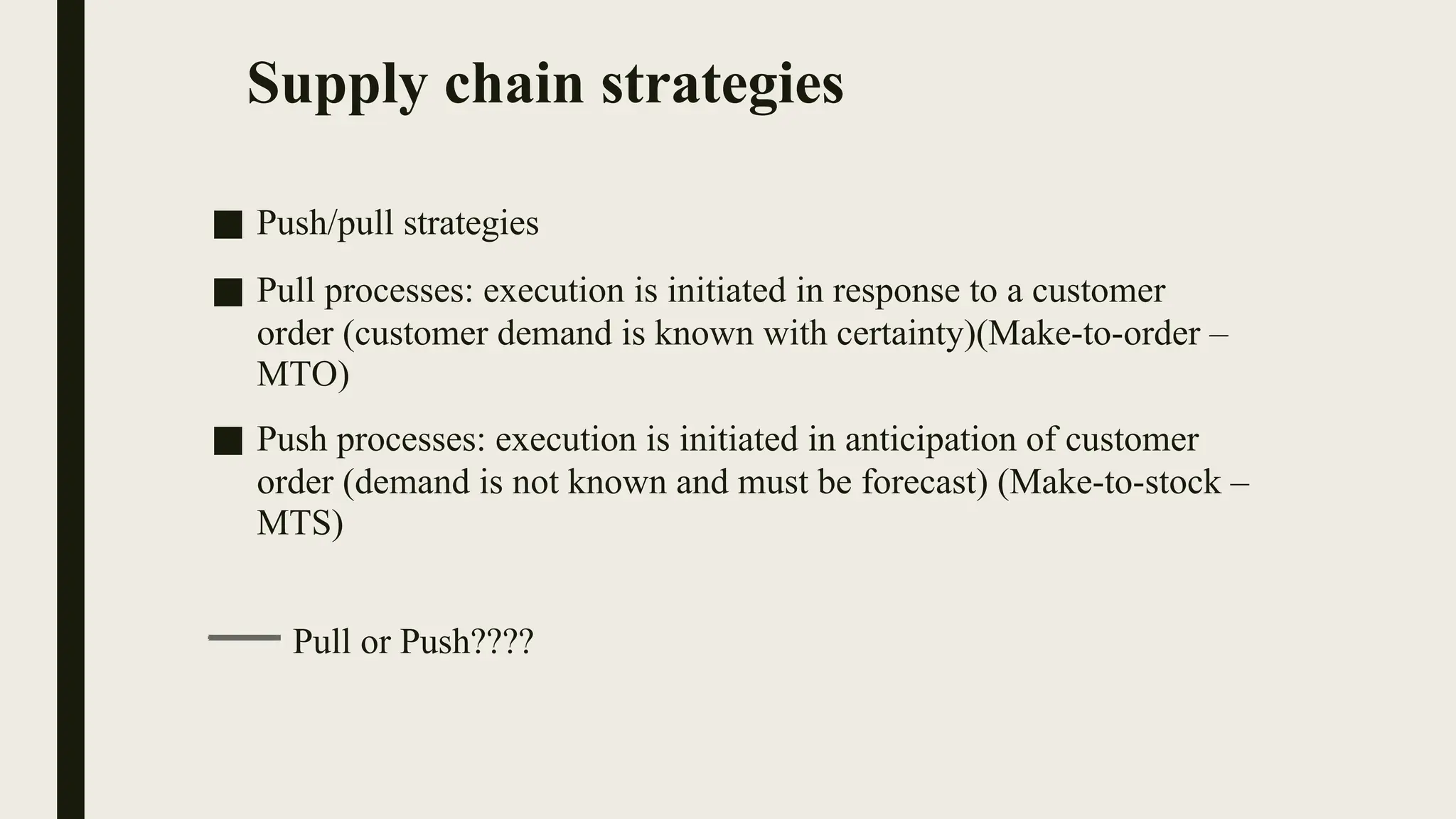
Supply chain strategies
■Push/pull strategies
■ Pull processes: execution is initiated in response to a customer
order (customer demand is known with certainty)(Make-to-order –
MTO)
■ Push processes: execution is initiated in anticipation of customer
order (demand is not known and must be forecast) (Make-to-stock –
MTS)
Pull or Push????
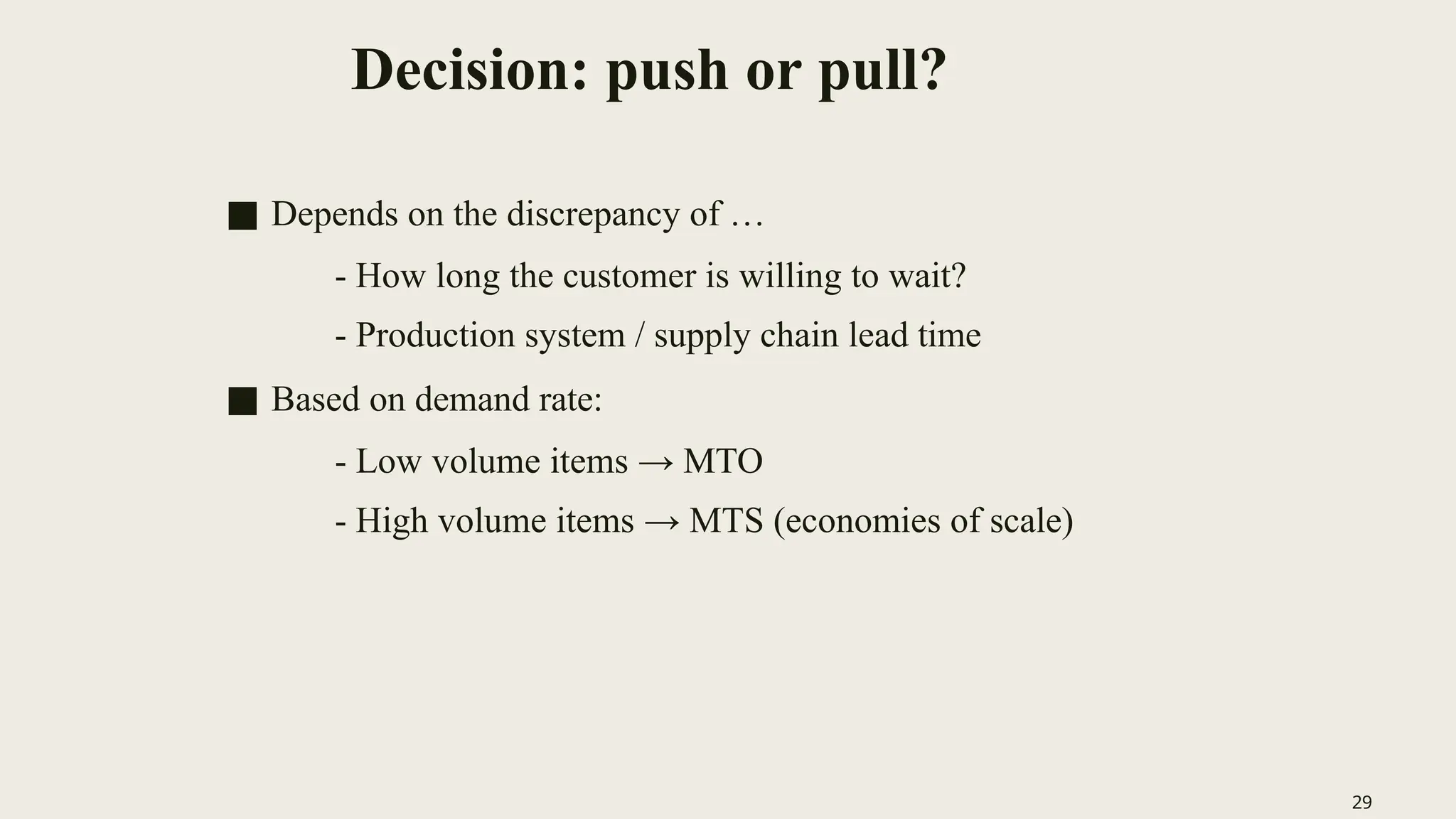
Decision: push orpull?
■ Depends on the discrepancy of …
- How long the customer is willing to wait?
- Production system / supply chain lead time
■ Based on demand rate:
- Low volume items → MTO
- High volume items → MTS (economies of scale)
29
43.
Postponement
■ Ability ofa SC to delay the differentiation or customization until closer
to the time the product is sold
30
44.
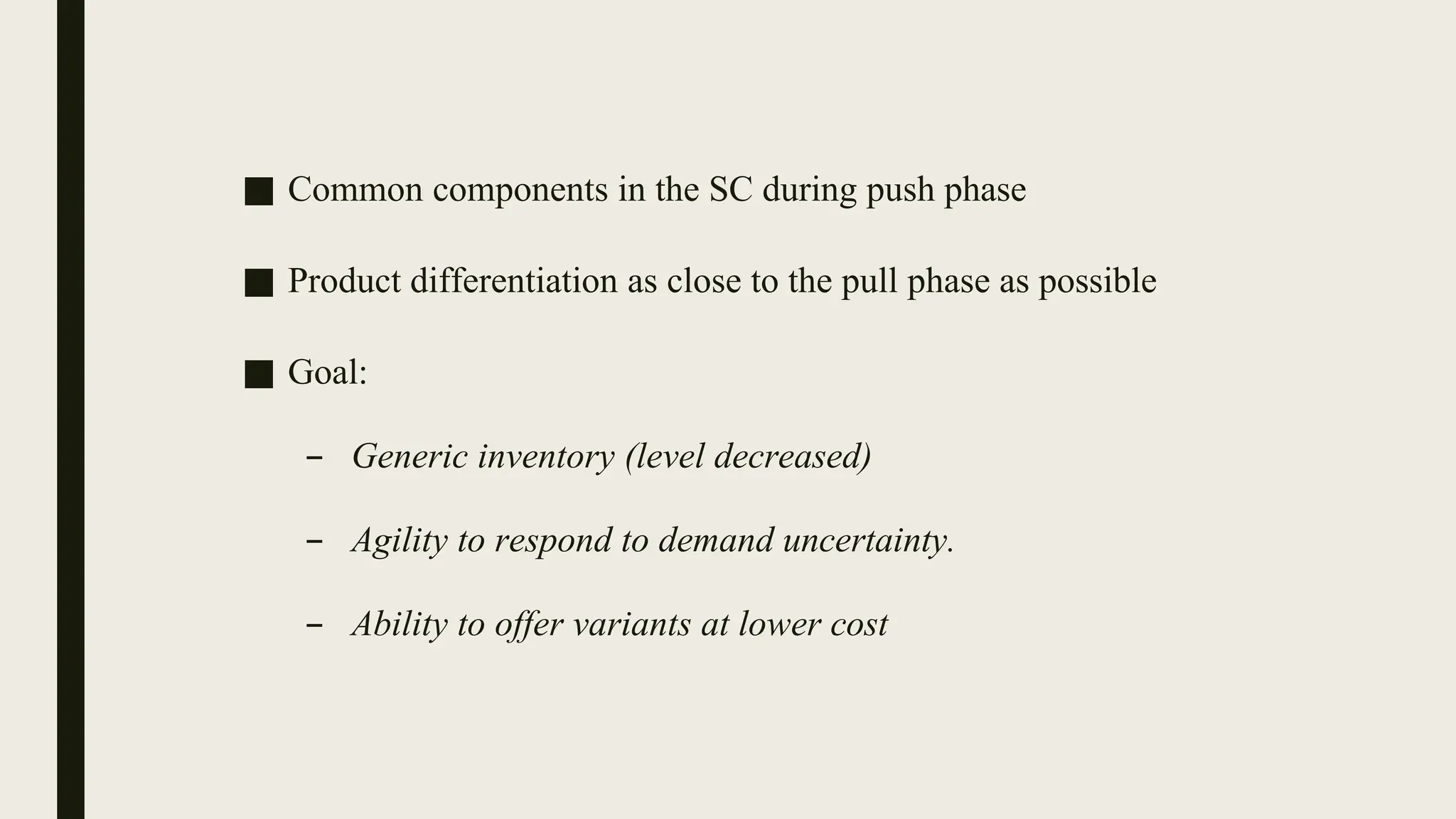
■ Common componentsin the SC during push phase
■ Product differentiation as close to the pull phase as possible
■ Goal:
– Generic inventory (level decreased)
– Agility to respond to demand uncertainty.
– Ability to offer variants at lower cost
Current Trends inSupply Chain Management
- Supply Chain Analytics - examining raw supply chain data and reaching
conclusions or making predictions with the information
- Most companies are trying to improve their supply chain
sustainability performance
CHAPTER 2: PURCHASING
MANAGEMENT
Youshould be able to:
■ Describe the role of purchasing and its strategic impact on
an organization’s competitive advantage.
■ Describe the traditional purchasing process, e-procurement,
public procurement, and green purchasing.
■ Analyze and evaluate sourcing decisions and the factors impacting
supplier selection, including outsourcing, make-or-buy, and break-
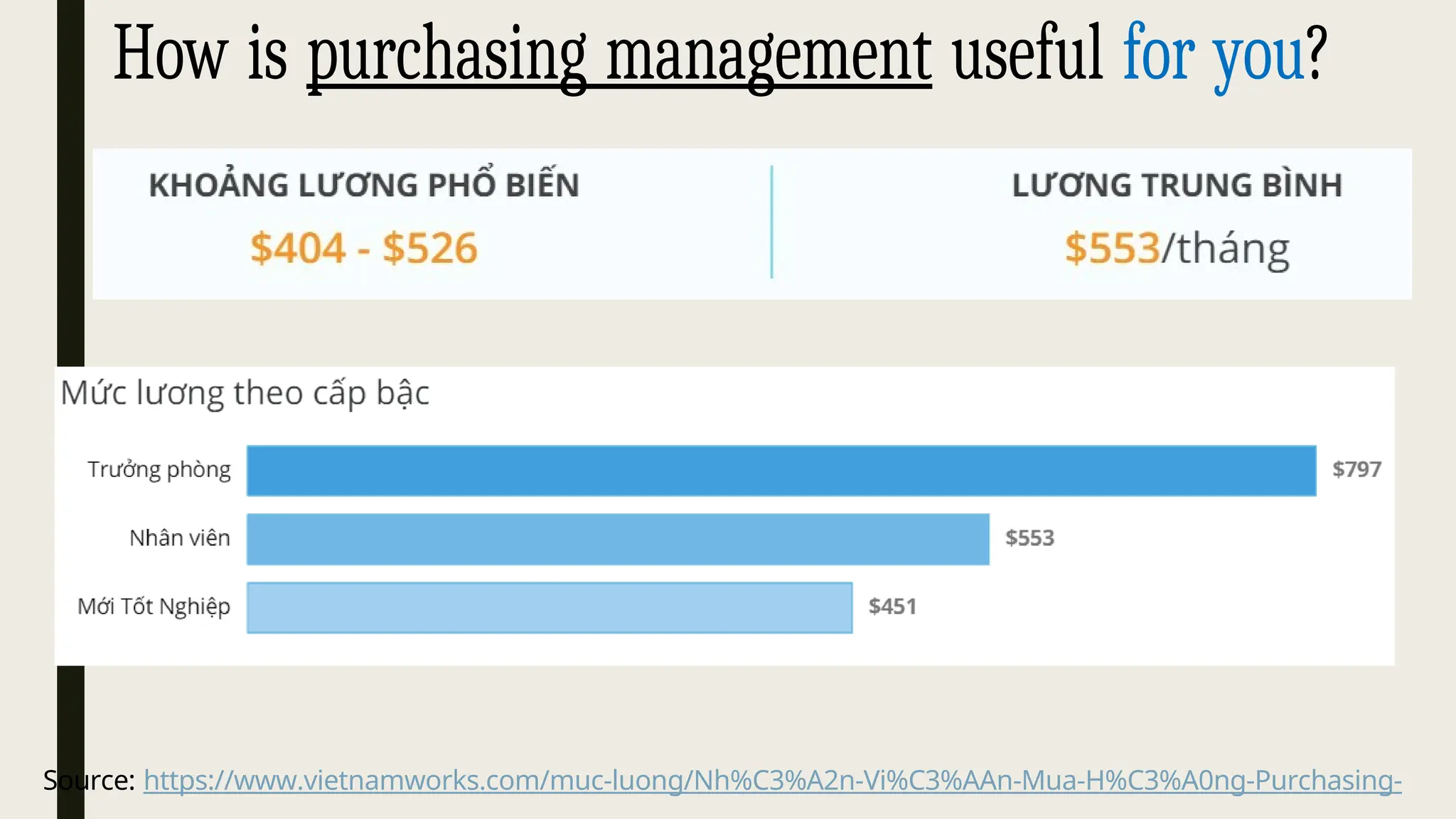
How is purchasingmanagement useful for you?
Not only for your everyday life.
But also for you to get a job
Purchasing executive
Purchasing planning executive
Sourcing executive/officier
Chuyên viên mua hàng
Chuyên viên thu mua
Chuyên viên quản lý tài sản
Definition of purchasing
■Purchasingis understood as all activities to obtain goods, key
operating equipment, materials, services, maintenance, repair and
operation (MRO)
■Purchasing is a key business function that is responsible for
acquisition of required materials, services and equipment
■Purchasing is a process made up of all activities associated with
identifying needs, locating and selecting suppliers, negotiating
terms, and following up to ensure supplier performance
59.
Different decisions amongterminologies
Sourcing Purchasing
1. Which products and
services, if any, should be
outsourced in whole or
part?
2. Which of these should
be supplied form
offshore?
1. Which supplier(s) should
be selected to make the
outsourced products
and services?
2. How should suppliers
and associated
contracts be managed
60.
3. How shouldthe supply
base be optimized?
on an ongoing basis?
61.
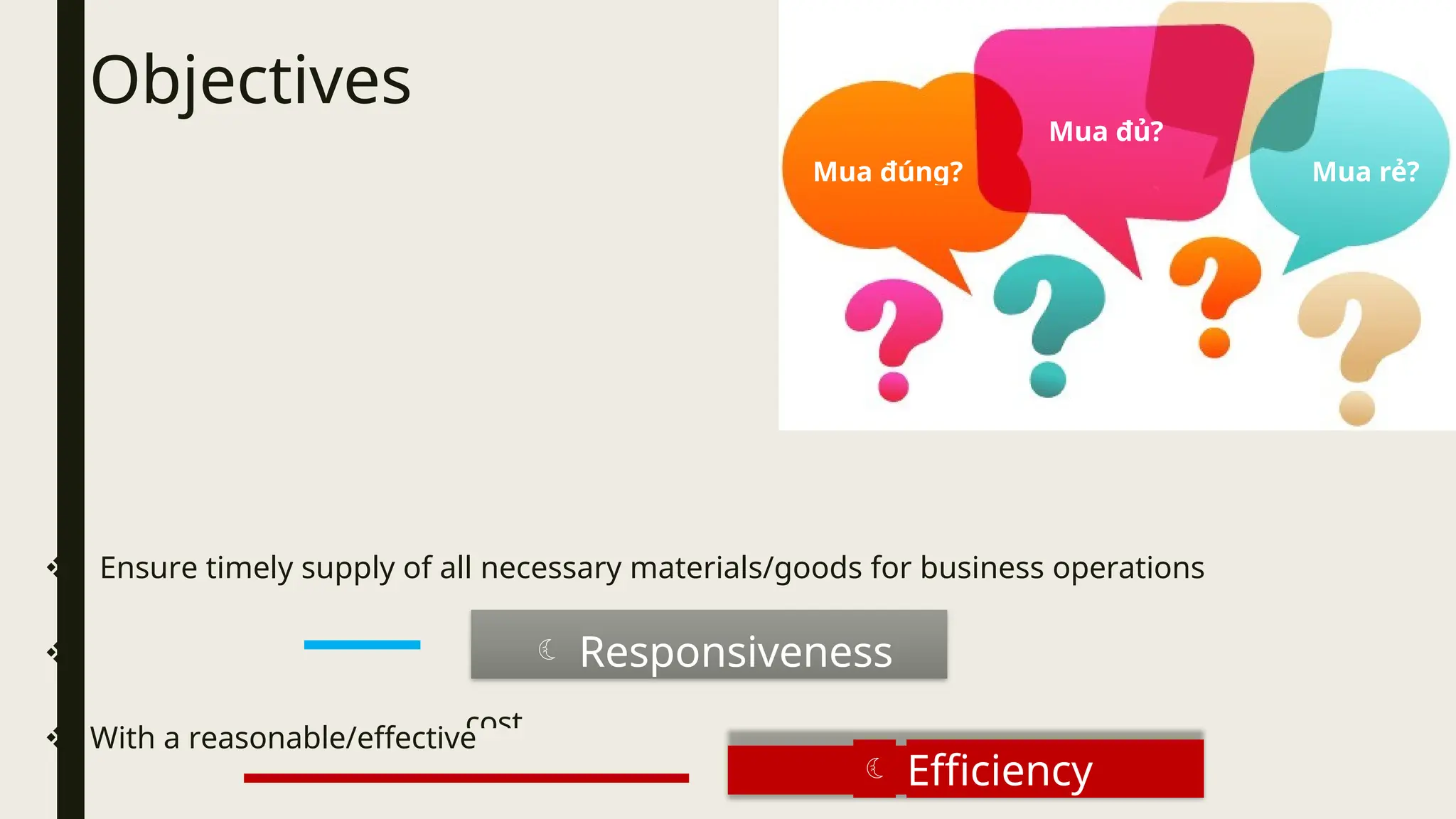
Objectives
Ensure timelysupply of all necessary materials/goods for business operations
With a reasonable/effective
Mua rẻ?
Mua đúng?
Mua đủ?
Efficiency
Responsiveness
cost
62.
Objectives
i. Ensure continuousand stable material flow
ii. Buy with the lowest total cost and reasonable terms attached
iii. Improve the quality of the final product, in order to best meet customer expectations
iv. Finding and selecting good suppliers, maintaining business relationships with them
63.
The Role ofSupply Management in an Organization
The primary goals of purchasing are:
– Ensure uninterrupted flows of raw materials at the lowest total cost,
– Improve quality of the finished goods produced, and
– Maximize customer satisfaction.
Purchasing contributes to these objectives by:
– Actively seeking better materials and reliable suppliers,
– Working closely with and exploiting the expertise of strategic suppliers to
improve quality and materials
– Involving suppliers and purchasing personnel in new product design
and development efforts.
64.
The Role ofSupply Management in an Organization
(Continued)
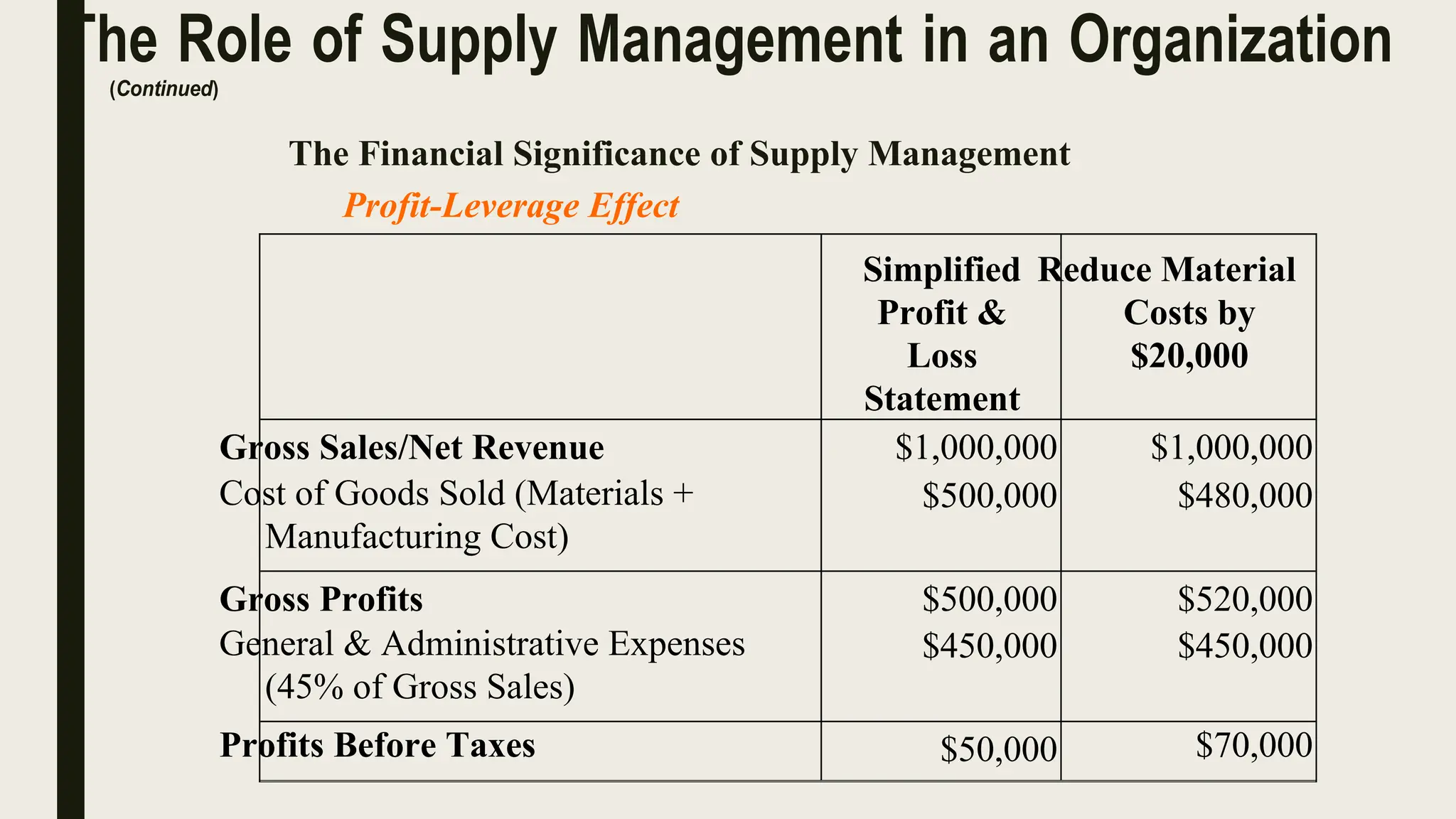
The Financial Significance of Supply Management
Profit-Leverage Effect
Simplified
Profit &
Loss
Statement
Reduce Material
Costs by
$20,000
Gross Sales/Net Revenue $1,000,000 $1,000,000
Cost of Goods Sold (Materials +
Manufacturing Cost)
$500,000 $480,000
Gross Profits $500,000 $520,000
General & Administrative Expenses
(45% of Gross Sales)
$450,000 $450,000
Profits Before Taxes $50,000 $70,000
65.
6
0
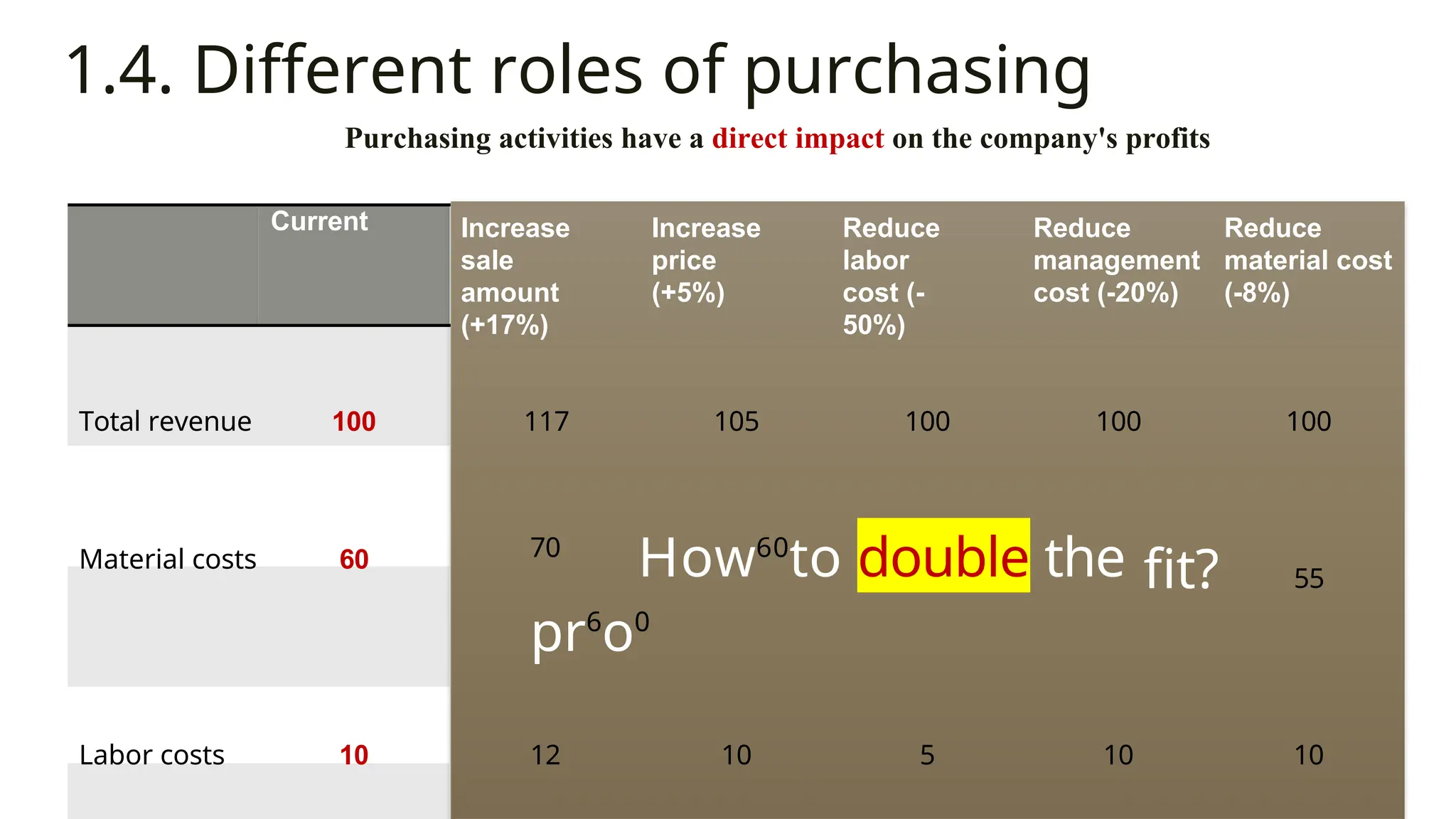
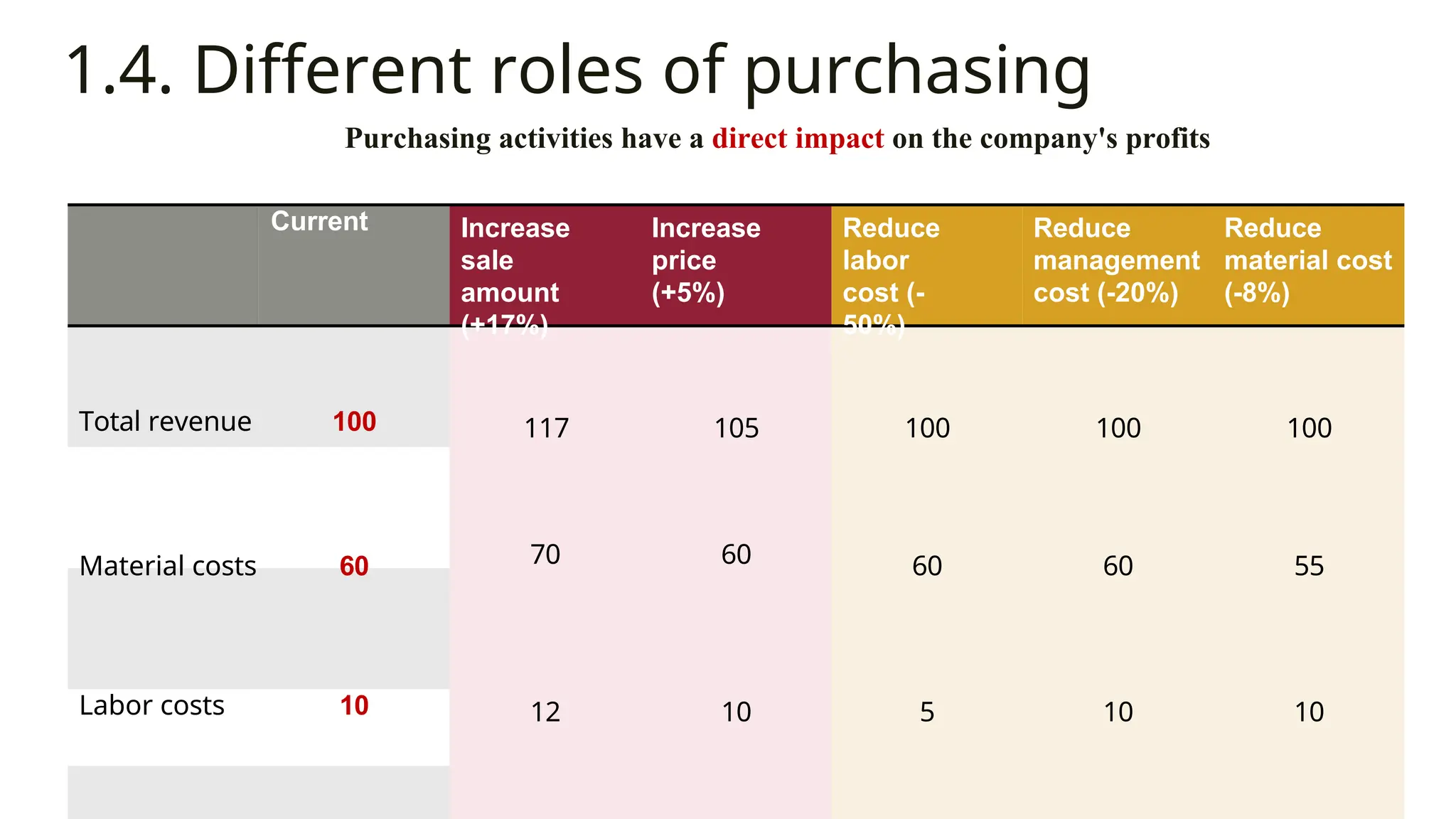
1.4. Different rolesof purchasing
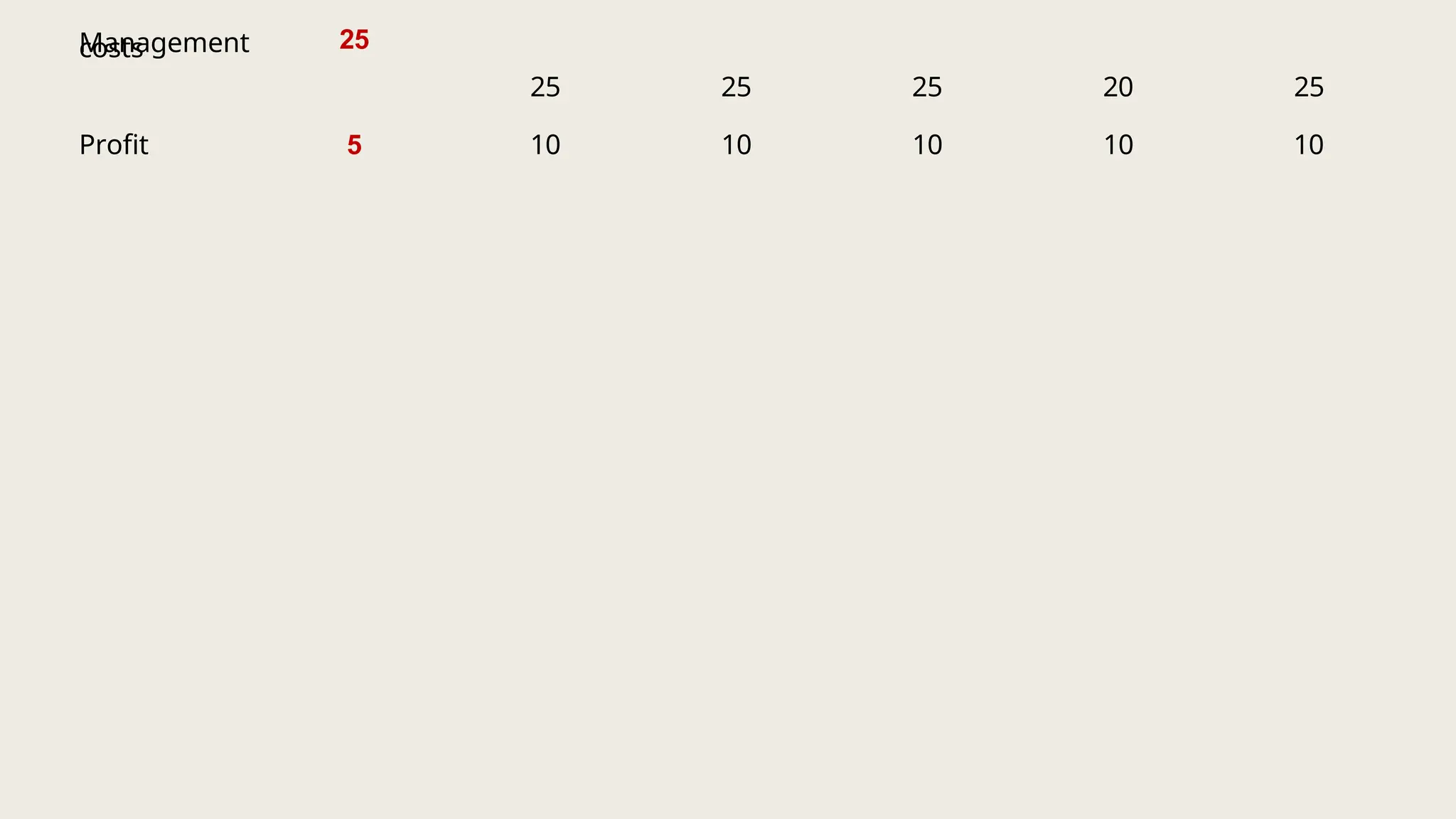
Purchasing activities have a direct impact on the company's profits
Current Increase
sale
amount
(+17%)
Increase
price
(+5%)
Reduce
labor
cost (-
50%)
Reduce
management
cost (-20%)
Reduce
material cost
(-8%)
Total revenue 100 117 105 100 100 100
Material costs 60 70
How60
to double the
pr6
o0
fit? 55
Labor costs 10 12 10 5 10 10
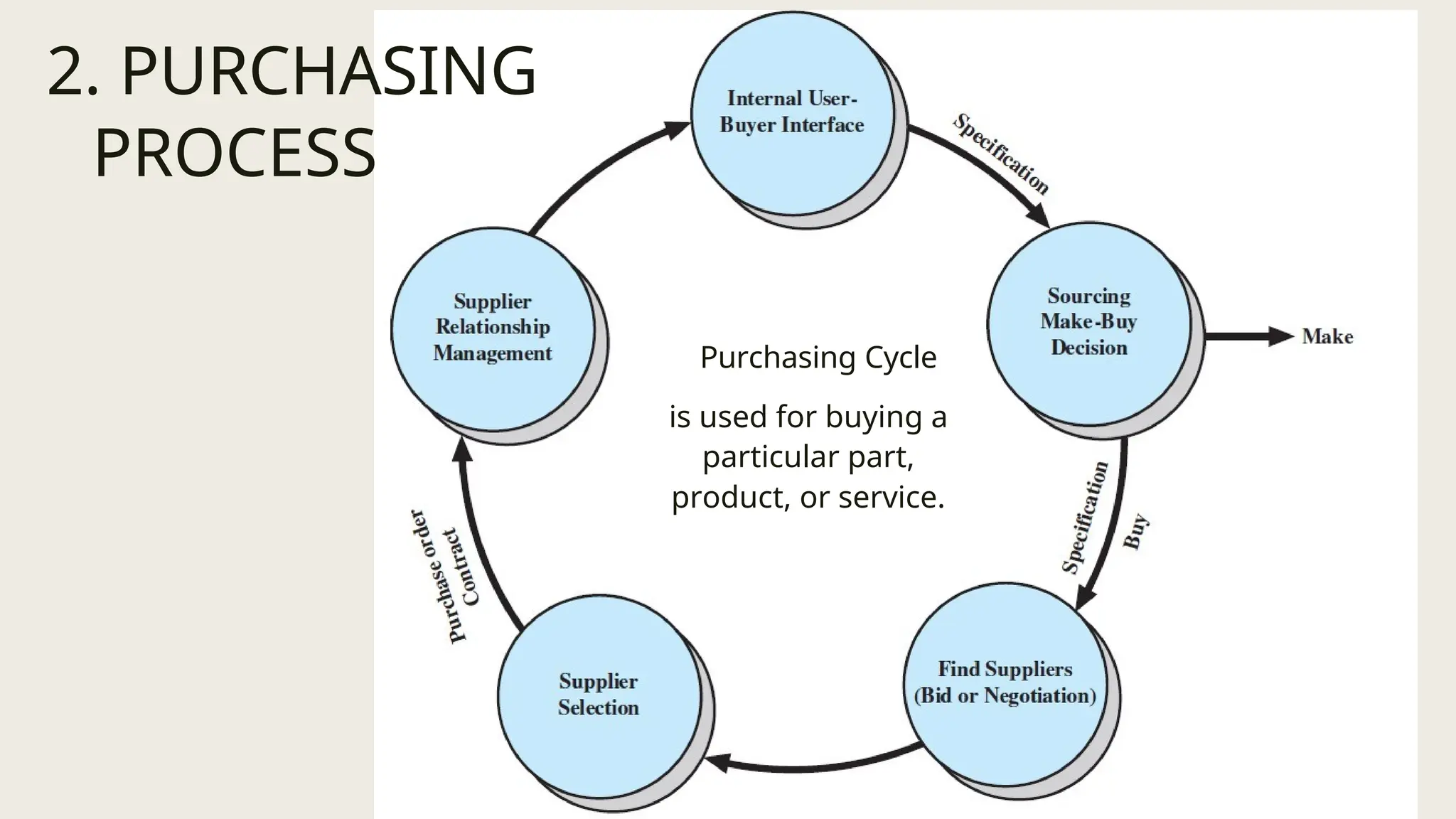
2. PURCHASING PROCESS
i.Traditional/manual/paper-based process
ii. E-procurement
iii. Global purchasing
iv. Green purchasing/sourcing
Types of product
Purchasing situation
Requirements and practices of
enterprises
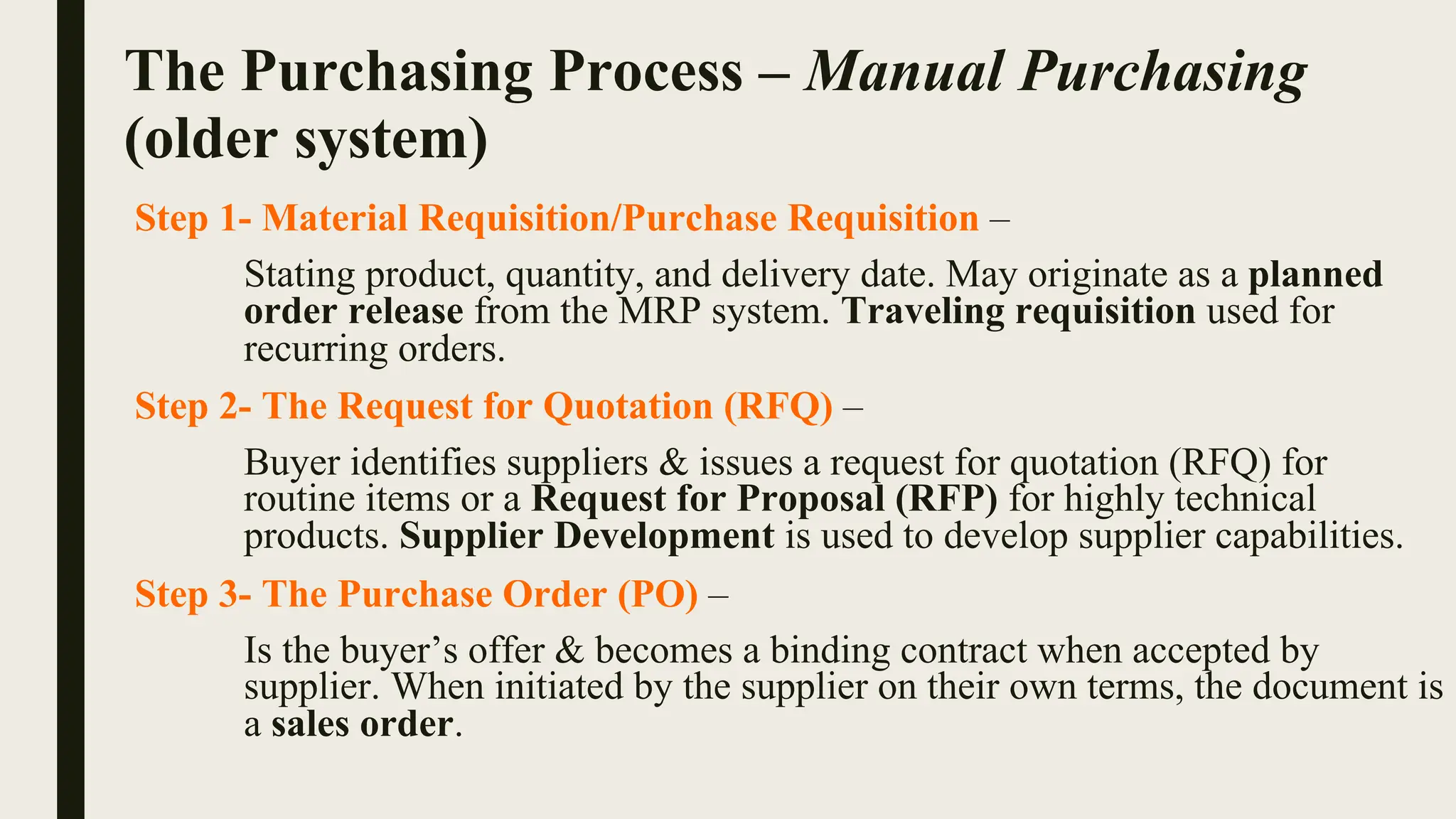
The Purchasing Process– Manual Purchasing
(older system)
Step 1- Material Requisition/Purchase Requisition –
Stating product, quantity, and delivery date. May originate as a planned
order release from the MRP system. Traveling requisition used for
recurring orders.
Step 2- The Request for Quotation (RFQ) –
Buyer identifies suppliers & issues a request for quotation (RFQ) for
routine items or a Request for Proposal (RFP) for highly technical
products. Supplier Development is used to develop supplier capabilities.
Step 3- The Purchase Order (PO) –
Is the buyer’s offer & becomes a binding contract when accepted by
supplier. When initiated by the supplier on their own terms, the document is
a sales order.
73.
+
Yes
Materials
Materials
Materials +
+
Materials
Materials
Materials
Ship
Materials
Ship
Materials
No
Issue PO
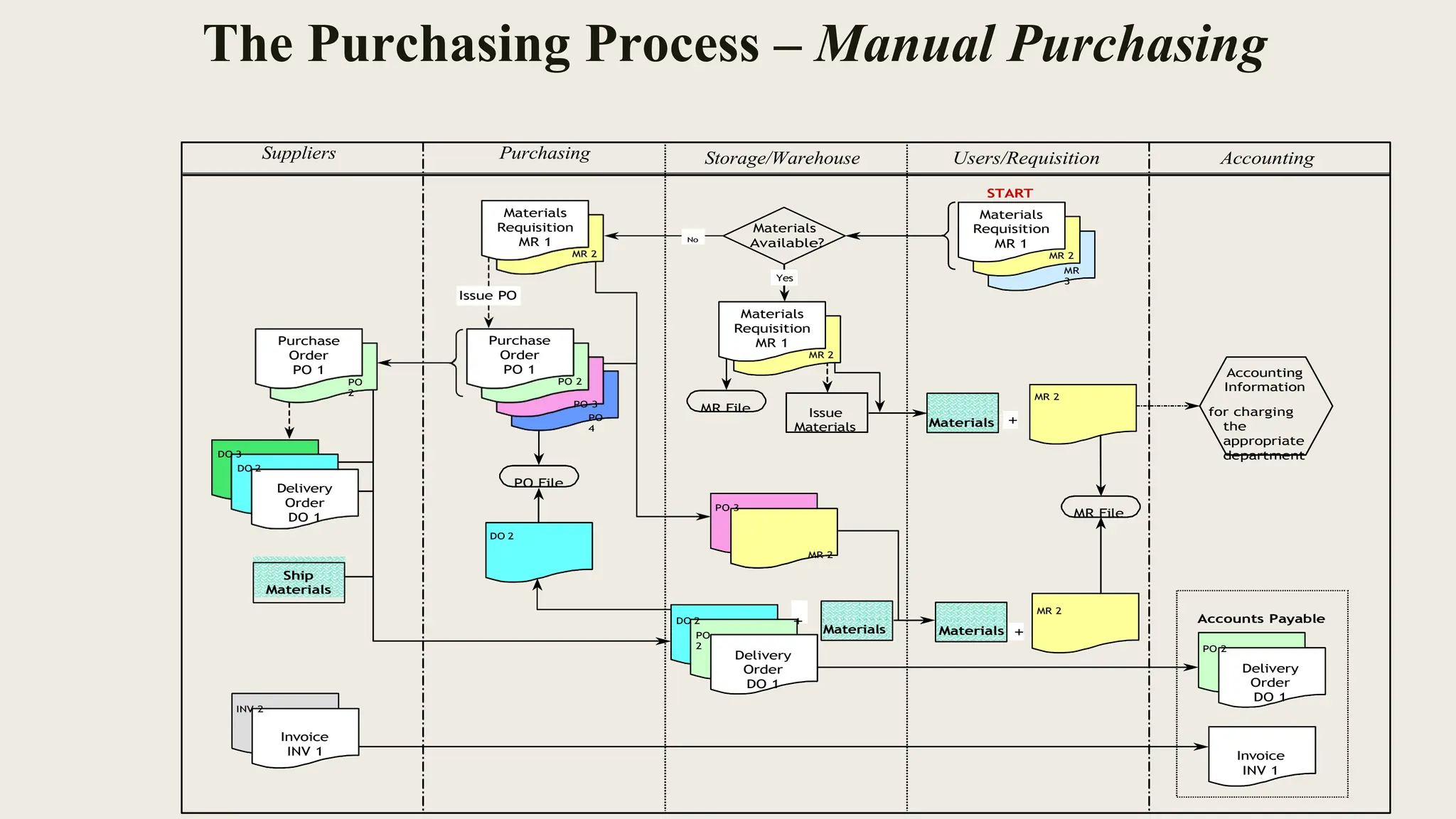
ThePurchasing Process – Manual Purchasing
Suppliers Purchasing Storage/Warehouse Users/Requisition Accounting
Purchase
Order
PO 1
PO
2
Materials
Requisition
MR 1
MR 2
Issue PO
Purchase
Order
PO 1
PO 2
Materials
No
Available?
Yes
Materials
Requisition
MR 1
MR 2
START
Materials
Requisition
MR 1
MR 2
MR
3
MR 2
Accounting
Information
DO 3
DO 2
Delivery
Order
DO 1
PO File
DO 2
PO 3
PO
4
MR File
PO 3
Issue
Materials
MR 2
+
MR File
for charging
the
appropriate
department
INV 2
DO 2
PO
2
+
Delivery
Order
DO 1
Materials
MR 2
+
Accounts Payable
PO 2
Delivery
Order
DO 1
Invoice
INV 1 Invoice
INV 1
Ship
Materials
Materials
Materials
74.
PR – PurchasingRequisition
Material requisition
Clearly state:
1. Information about products/materials requested to
purchase: product code, abbreviation or full name
of the product, product type, product color (if
needed),...
2. Quantity (state the unit)
3. Delivery time required
4. Purchase requisition date (will be used for
tracking and retrieving purchase information
loops from this date)
5. Approval signature or relevant departments (Law,
Technical, ...)
Purchase Requisition (PR)
4
1 2
1 3
5
75.
Price/Recommended supplier: canbe stated or
not
Note: Traveling-requisition: used for
materials or goods purchased frequently or in
the past
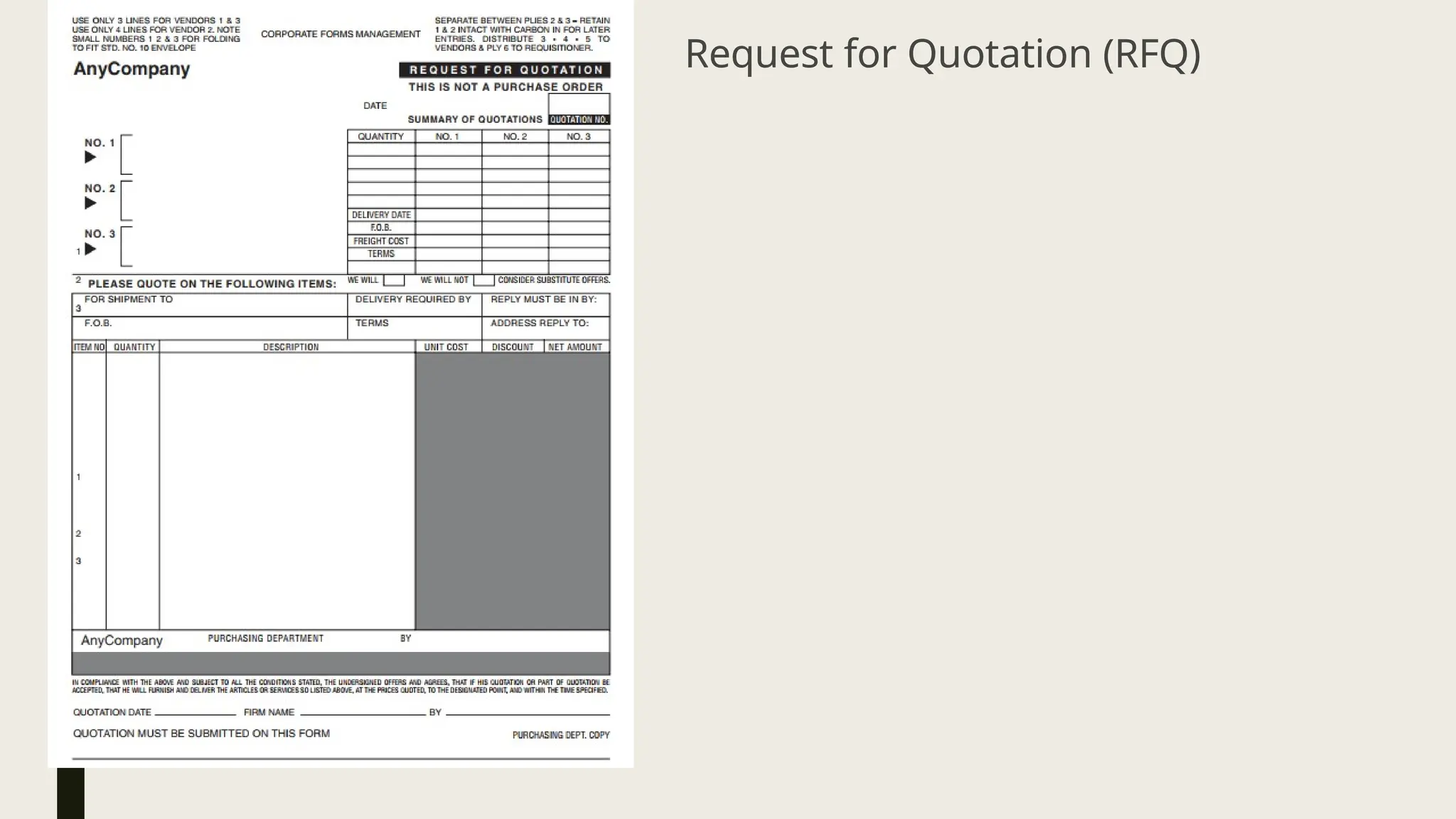
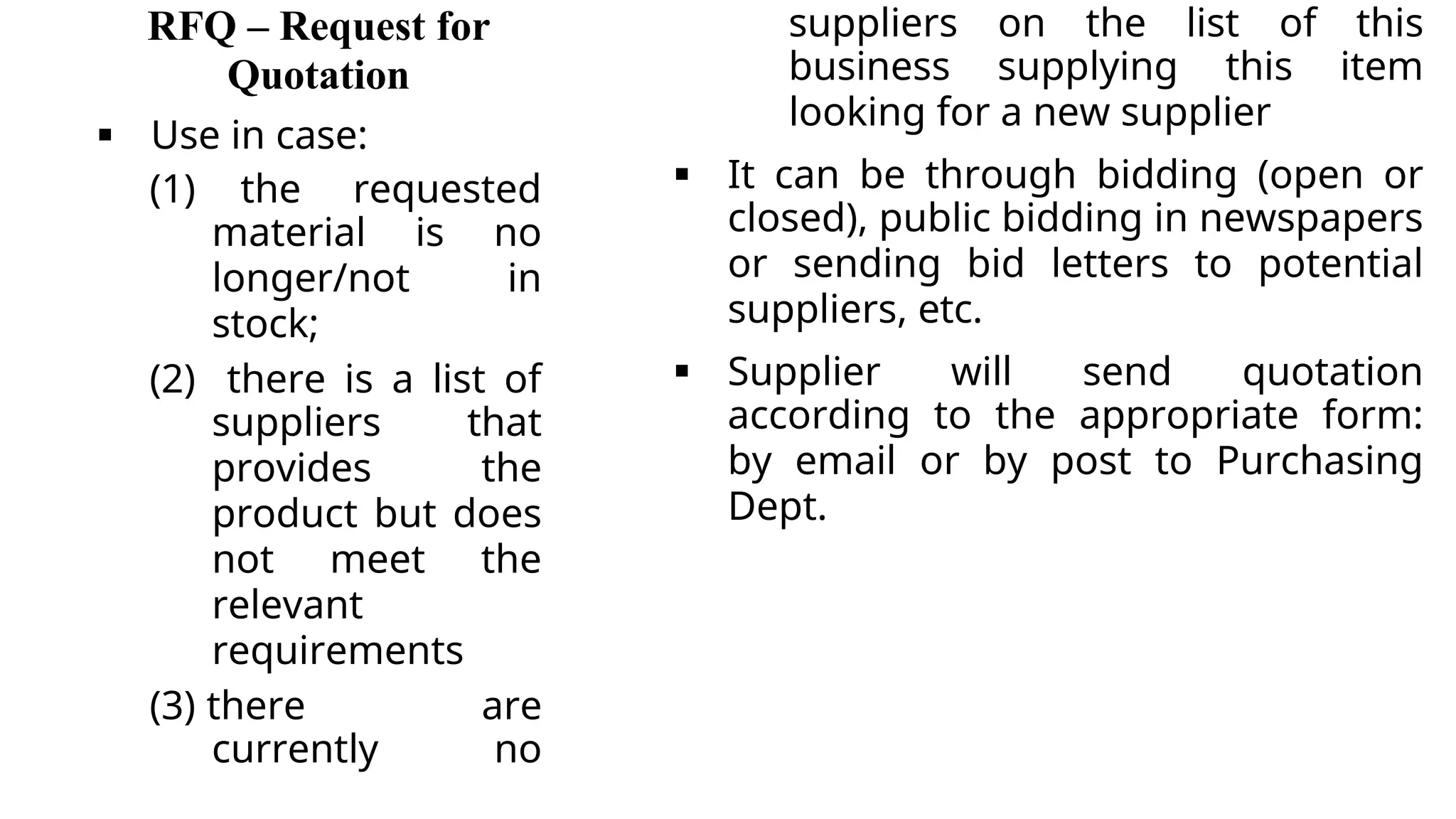
RFQ – Requestfor
Quotation
Use in case:
(1) the requested
material is no
longer/not in
stock;
(2) there is a list of
suppliers that
provides the
product but does
not meet the
relevant
requirements
(3) there are
currently no
suppliers on the list of this
business supplying this item
looking for a new supplier
It can be through bidding (open or
closed), public bidding in newspapers
or sending bid letters to potential
suppliers, etc.
Supplier will send quotation
according to the appropriate form:
by email or by post to Purchasing
Dept.
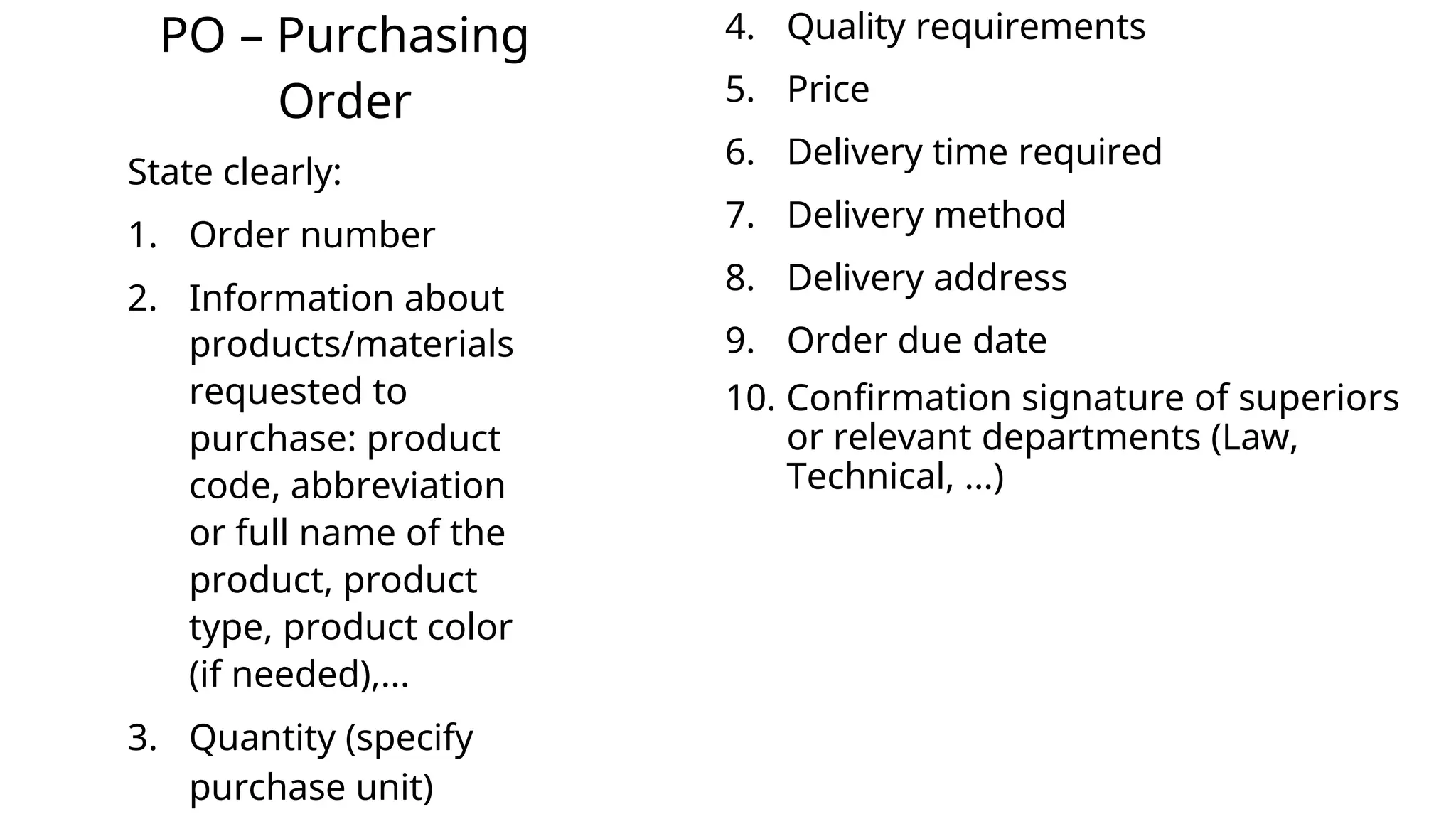
PO – Purchasing
Order
Stateclearly:
1. Order number
2. Information about
products/materials
requested to
purchase: product
code, abbreviation
or full name of the
product, product
type, product color
(if needed),...
3. Quantity (specify
purchase unit)
4. Quality requirements
5. Price
6. Delivery time required
7. Delivery method
8. Delivery address
9. Order due date
10. Confirmation signature of superiors
or relevant departments (Law,
Technical, ...)
The Purchasing Process– e-Procurement
Electronic purchasing (E-procurement) is an integrated purchasing
process that uses information technology application tools, computers, the
internet, etc. to perform transactions between companies/enterprises and
other customers. supplier.
An electronic purchasing system covers the processes involved in
purchasing activities, from identifying needs in the organization, to supplier
selection, to payment execution, to contract management, and to supplier
management.
83.
The Purchasing Process– e-Procurement
E-procurement usually includes purchasing processes between companies
(buyers) and suppliers (sellers), commonly used in industrial purchasing.
SRM
E-commerce usually involves the buying process between consumers/retail
customers (buyers) and companies/businesses (sellers), often used in
commercial purchases.
CRM
Differences between E-procurement and E-
commerce
84.
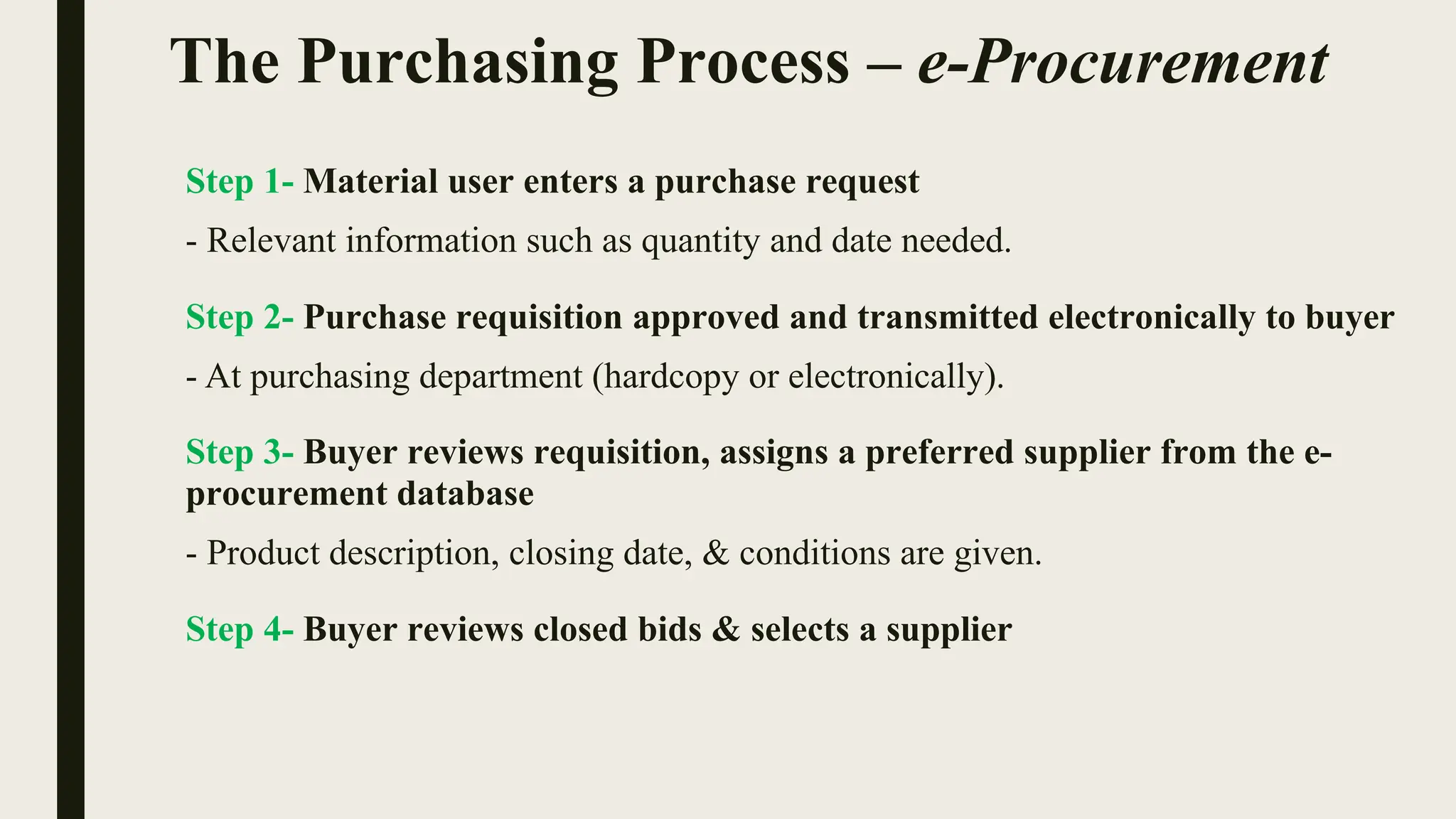
The Purchasing Process– e-Procurement
Step 1- Material user enters a purchase request
- Relevant information such as quantity and date needed.
Step 2- Purchase requisition approved and transmitted electronically to buyer
- At purchasing department (hardcopy or electronically).
Step 3- Buyer reviews requisition, assigns a preferred supplier from the e-
procurement database
- Product description, closing date, & conditions are given.
Step 4- Buyer reviews closed bids & selects a supplier
The Purchasing Process– e-Procurement
(Continued)
Advantages of the e-Procurement System
– Time savings
– Cost savings
– Accuracy
– Real time use
– Mobility
– Trackability
– Management benefits
– Supplier benefits
88.
Global Sourcing
Import Broker– Sales agent who performs transactions for a fee
(They do not take title to the goods)
Import Merchant – Buys and takes title to the goods and resells them
to a buyer
Tariff – An official list showing the duties, taxes, or customs imposed
by the host country on imports or exports
Non-tariff barriers – import quotas, licensing agreements, embargoes,
laws and other regulations imposed on imports and exports
89.
Global Sourcing (continued)
Reasonsfor Global Sourcing –
Opportunity to improve quality, cost, and delivery performance
Potential Challenges –
Requires additional skills and knowledge to deal with
international suppliers, logistics, communication, political
environment, and other issues
90.
Global Sourcing (Continued)
Issuesfor Global Purchasers
■United Nations’ Contracts for the International Sale of Goods
(CISG)
– Terms of acceptance cannot be modified
■Incoterms (commonly used term referring to the
International Commercial Terms - uniform rules that
simplify international transactions of goods with respect to
shipping costs, risks, and responsibilities of buyer, seller and
shipper
91.
Global Sourcing (Continued)
Countertrade– goods and/or services of domestic firms are
exchanged for goods and/or services of equal value or in
combination with currency from foreign firms
Countertrade can include:
■ Barter - complete exchange of goods or services of
equal value without the exchange of currency
■ Offset - exchange agreement for industrial goods
or services as a condition of military-related export
92.
Global Sourcing (Continued)
Countertradecan include:
■Direct Offset - involves coproduction, or a joint venture and
exchange of related goods or services
■Indirect Offset - involves exchange of goods or
services unrelated to the initial purchase.
■Counterpurchase - the original exporter agrees to sell goods
or services to a foreign importer and simultaneously agrees to
buy specific goods or services from the foreign importer
93.
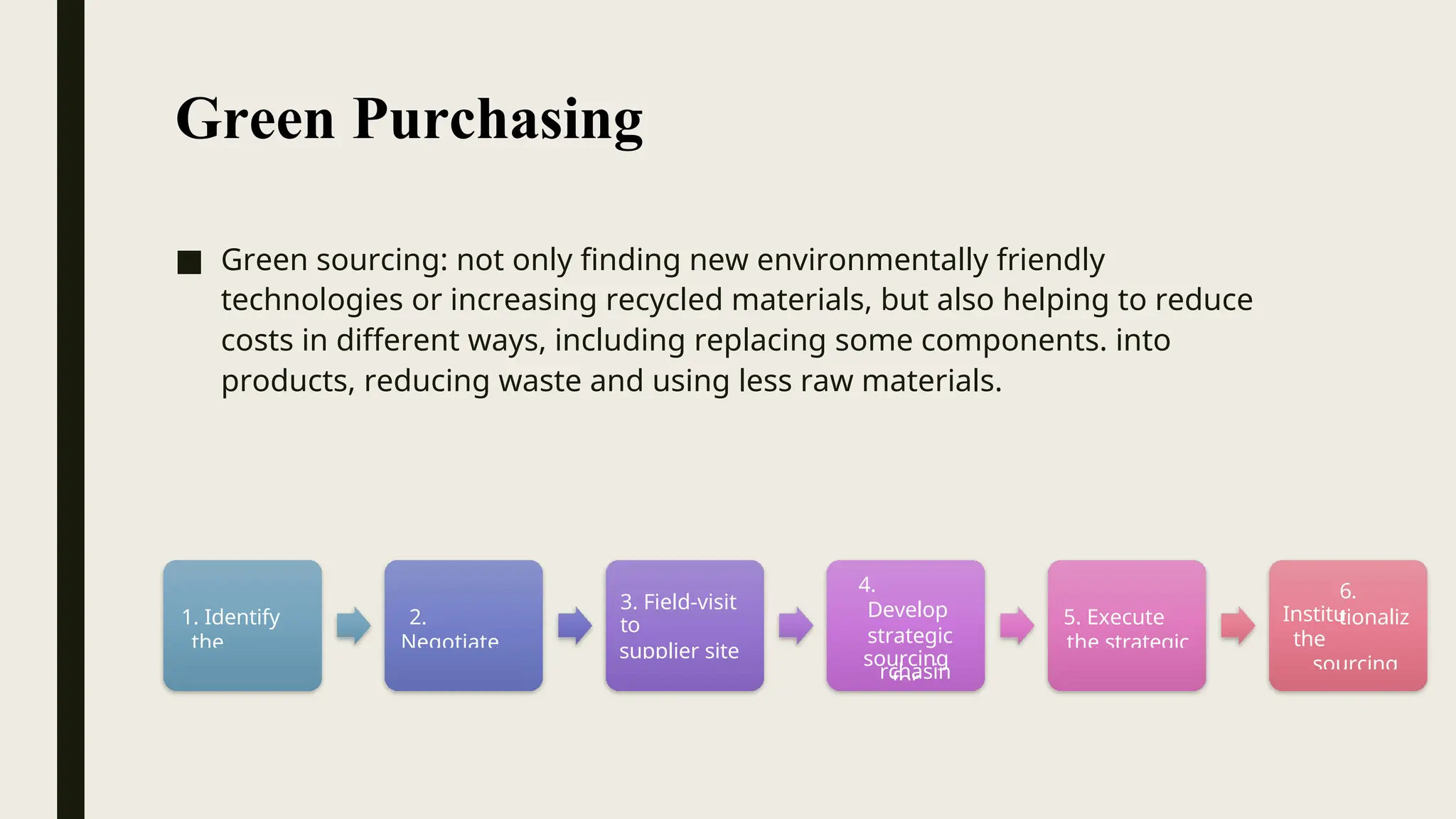
Green Purchasing
■ Greensourcing: not only finding new environmentally friendly
technologies or increasing recycled materials, but also helping to reduce
costs in different ways, including replacing some components. into
products, reducing waste and using less raw materials.
the
sourcing
rchasin
tionaliz
6.
Institu
5. Execute
the strategic
4.
Develop
strategic
sourcing
for
3. Field-visit
to
supplier site
2.
Negotiate
1. Identify
the
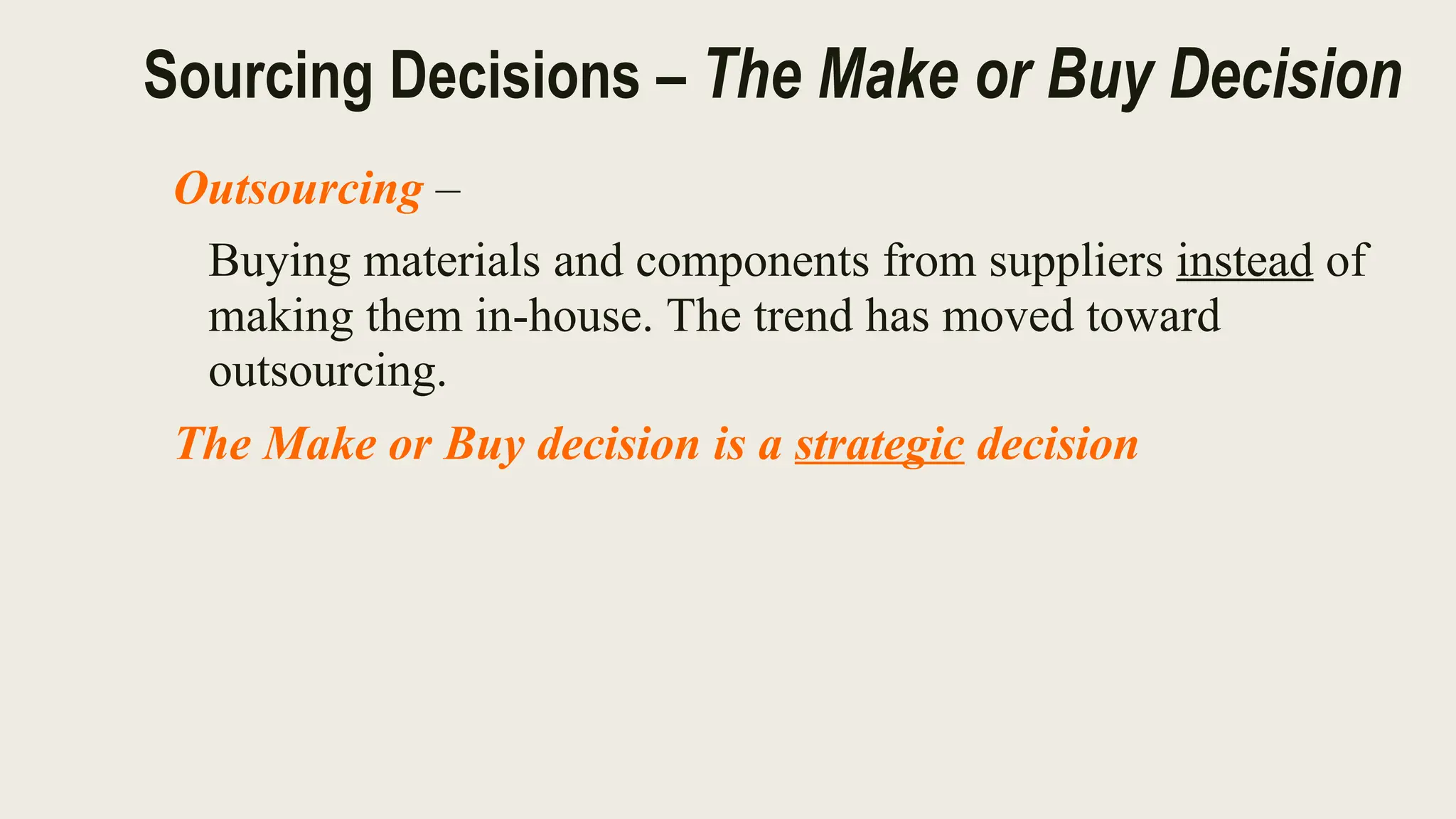
Sourcing Decisions –The Make or Buy Decision
Outsourcing –
Buying materials and components from suppliers instead of
making them in-house. The trend has moved toward
outsourcing.
The Make or Buy decision is a strategic decision
98.
Sourcing Decisions –The Make or Buy Decision
(Continued)
Reasons for Buying or Outsourcing
– Cost advantage – Especially for components that are
non- vital to the organization’s operations, suppliers may
have economies of scale
– Insufficient capacity – A firm may be at or near capacity
and subcontracting from a supplier may make better
sense
– Lack of expertise – Firm may not have the necessary
technology and expertise
– Quality – Suppliers have better technology, process,
skilled labor, and the advantage of economy of scale
99.
Sourcing Decisions –The Make or Buy Decision
(Continued)
Reasons for Making
– Protect proprietary technology
– No competent supplier
– Better quality control
– Use existing idle capacity
– Control of lead-time, transportation, and
warehousing costs
– Lower cost
100.
Make-or-Buy Break-Even Analysis
Phântích điểm tới hạn
A business has to decide whether to manufacture it in-house or buy it out to get
the parts it needs. Demand for the year is 15,000 units.
o If outsource, the cost for the order is 500$, the purchase price is 7$/SP;
o If insource, the investment in machinery and equipment is $25,000 and the
cost of components is $5/product
Cost Insourcing Outsourcing
Fixed costs $25,000 $500
Variable costs $5/SP $7/SP
Annual Demand: 15,000 SP
Assumptions
(1) All costsinvolved can be classified under either fixed or variable
cost,
(2) Fixed cost remains the same within the range of analysis,
(3) A linear variable cost relationship exists,
(4) Fixed cost of the make option is higher because of initial
capital investment in equipment
(5) Variable cost of the buy option is higher because of supplier
Sourcing Decisions –The Make or Buy Decision
(Continued)
The Make-or-Buy Break-Even Analysis
105.
Meaning of Break-evenPoint
■ If the Demand < Break-even Point Buy
■ If the Demand > Break-even Point Make
106.
Roles of SupplyBase
Supply Base - list of suppliers a firm uses to acquire its materials, services,
supplies, and equipment
– Emphasis on long-term strategic supplier alliances, consolidating
volume into one or a few suppliers, resulting in a smaller supply base
Preferred suppliers provide:
– Product and process technology & expertise to support buyer’s operations
– Information on latest trends in materials, processes, designs, and
the supply market
– Capacity for meeting unexpected demand
– Cost savings due to economies of scale
107.
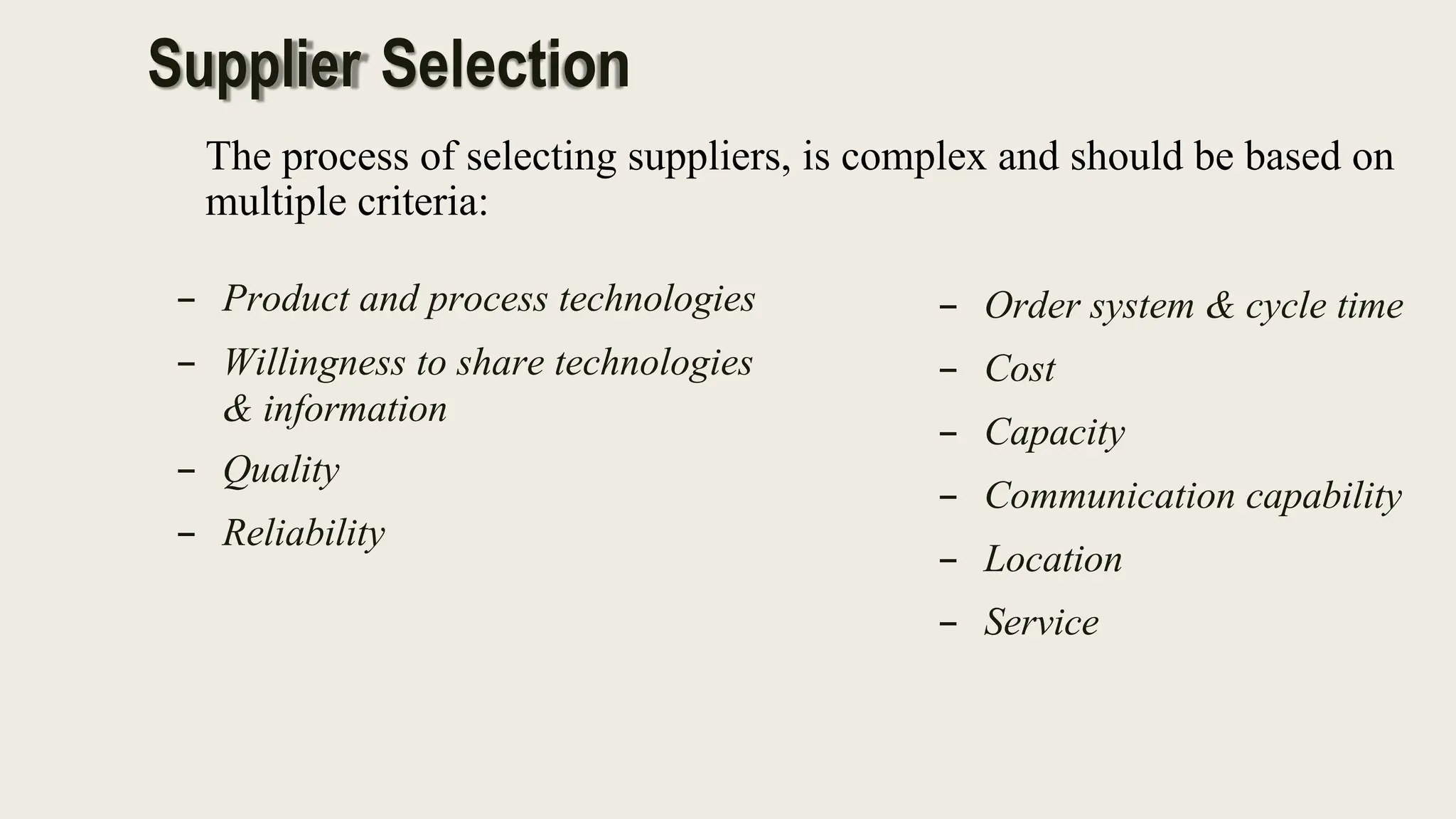
The process ofselecting suppliers, is complex and should be based on
multiple criteria:
– Product and process technologies
– Willingness to share technologies
& information
– Quality
– Reliability
– Order system & cycle time
– Cost
– Capacity
– Communication capability
– Location
– Service
Supplier Selection
108.
Example:
ATV, InC. assemblefive different models of all-terrain vehicles (ATVs) from
various ready-made components to serve the Las Vegas, Nevada, market. The
company uses the same engine for all its ATVs. The purchasing manager,
Ms.Jane Kim, needs to choose a supplier for engines for the coming year. Due
to the size of the warehouse and other administrative restrictions, she must
order the engines in lot size of 1,000 each. The unique characteristics of the
standardized engine require special tooling to be used during the
manufacturing process. ATV agrees to reimburse the supplier for the tooling.
This is a critical purchase, since late delivery of engines would disrupt
production and cause 50 percent lost sales and 50 percent back orders of the
ATVs. Jane has obtained quotes from two reliable suppliers but needs to know
which supplier is more cost-effective. She has the following information:
109.
Requirement 12,000 units
Weight22 pounds
Order processing cost $125 per order
Inventory carrying cost 20 % per year
Cost of working capital 10% per year
Profit margin 18%
Price of finished ATV $ 4,500
Back-order cost $ 15 per unit backordered
The following freight rates from her carrier:
Truckload (TL>= 40,000 Lbs) = $0.8 per ton-mile
Less-than-truckload (LTL) = $1.2 per ton-mile
Note: per ton-mile = 2,000 Lbs per mile; number of days per year = 365
110.
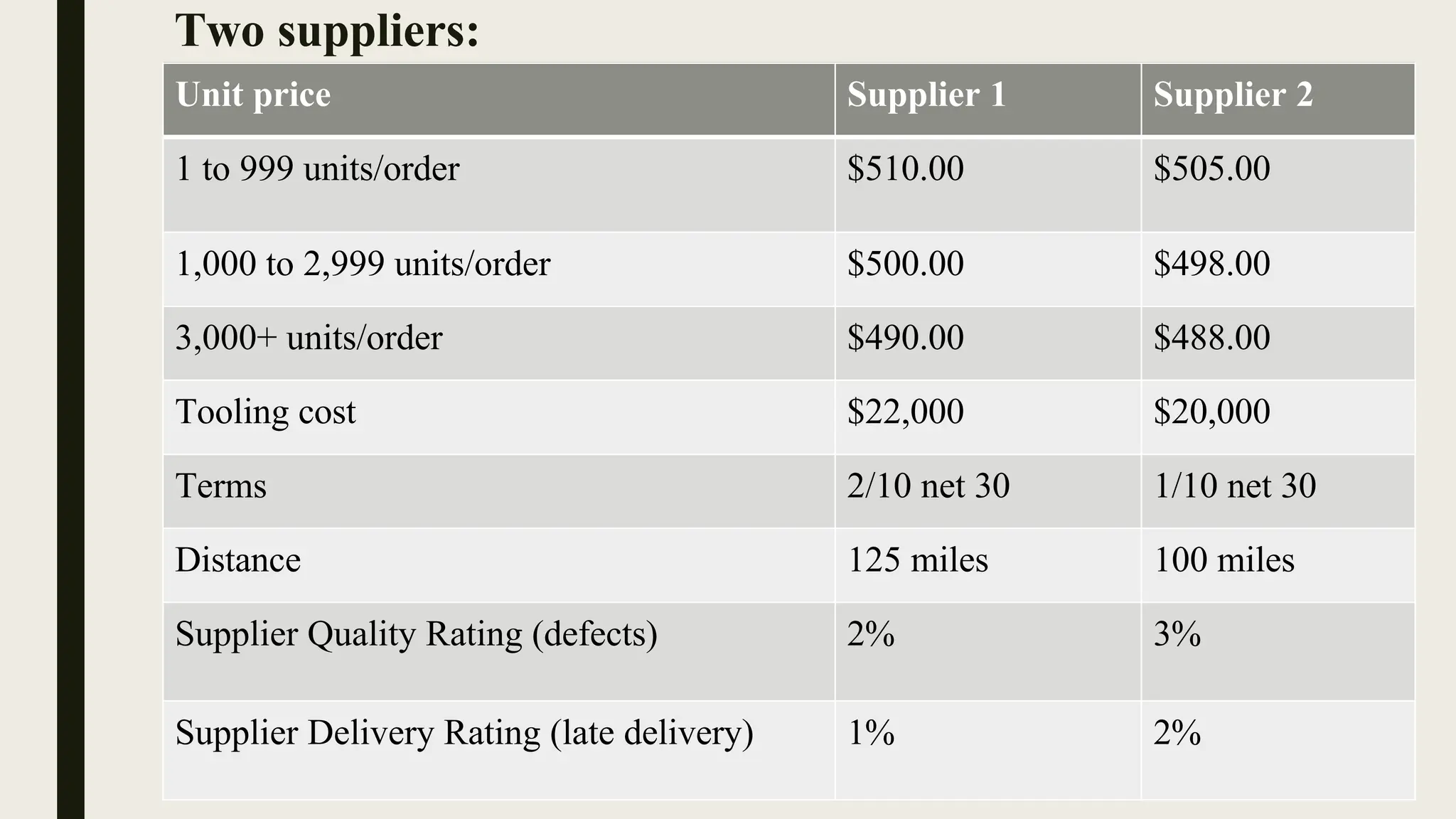
Two suppliers:
Unit priceSupplier 1 Supplier 2
1 to 999 units/order $510.00 $505.00
1,000 to 2,999 units/order $500.00 $498.00
3,000+ units/order $490.00 $488.00
Tooling cost $22,000 $20,000
Terms 2/10 net 30 1/10 net 30
Distance 125 miles 100 miles
Supplier Quality Rating (defects) 2% 3%
Supplier Delivery Rating (late delivery) 1% 2%
111.
How Many Suppliersto Use
Single sourcing - a risky proposition. Current trends favor a few sources.
Reasons Favoring a Single
Supplier
To establish a
good relationship
Less quality variability
Lower cost
Transportation economies
Proprietary product or
process purchases
Volume too small to split
Reasons Favoring Two
or More Suppliers
Need capacity
Spread risk of supply
interruption
Create competition
Information
Dealing with special kinds
of business
112.
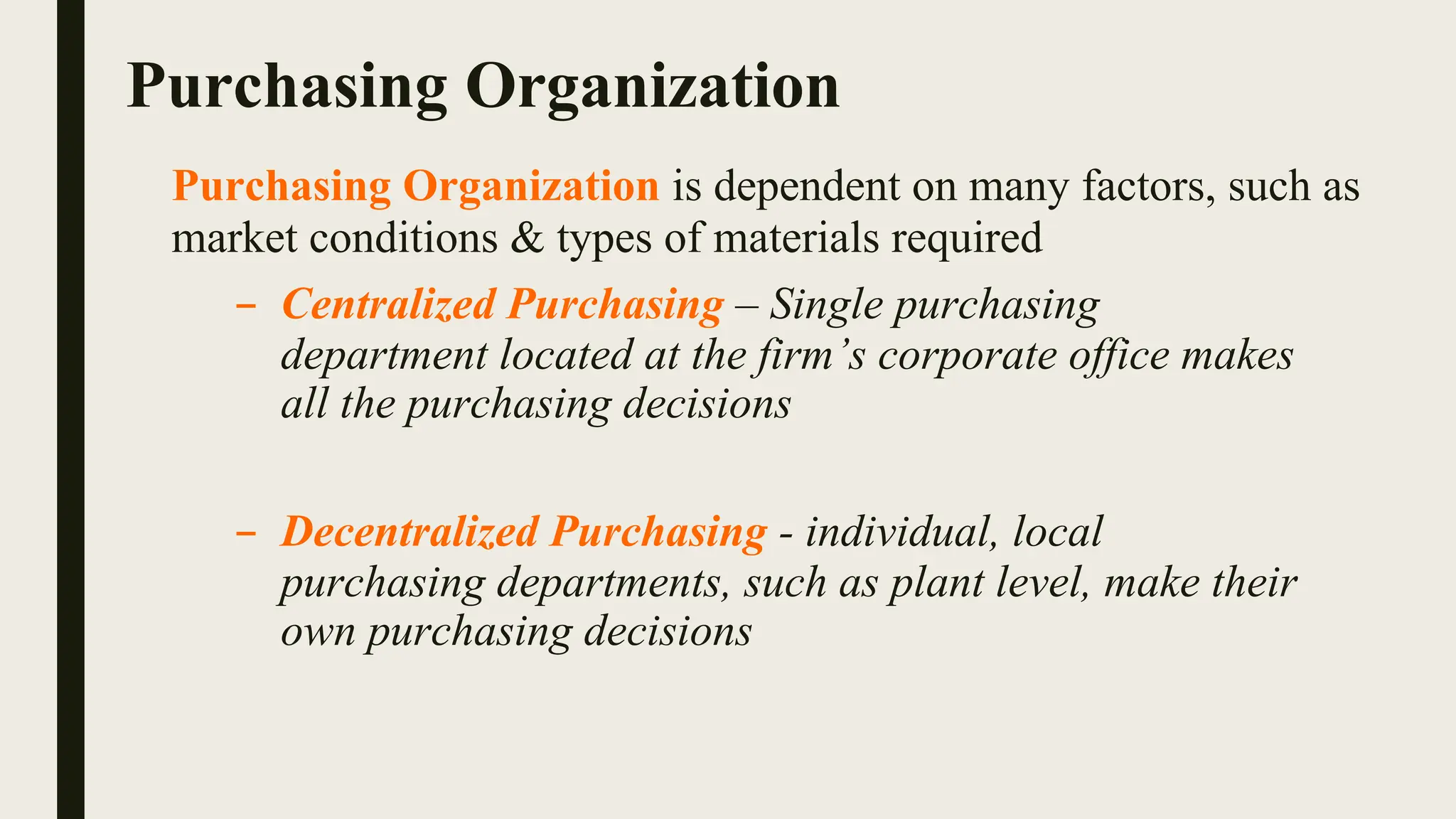
Purchasing Organization
Purchasing Organizationis dependent on many factors, such as
market conditions & types of materials required
– Centralized Purchasing – Single purchasing
department located at the firm’s corporate office makes
all the purchasing decisions
– Decentralized Purchasing - individual, local
purchasing departments, such as plant level, make their
own purchasing decisions
113.
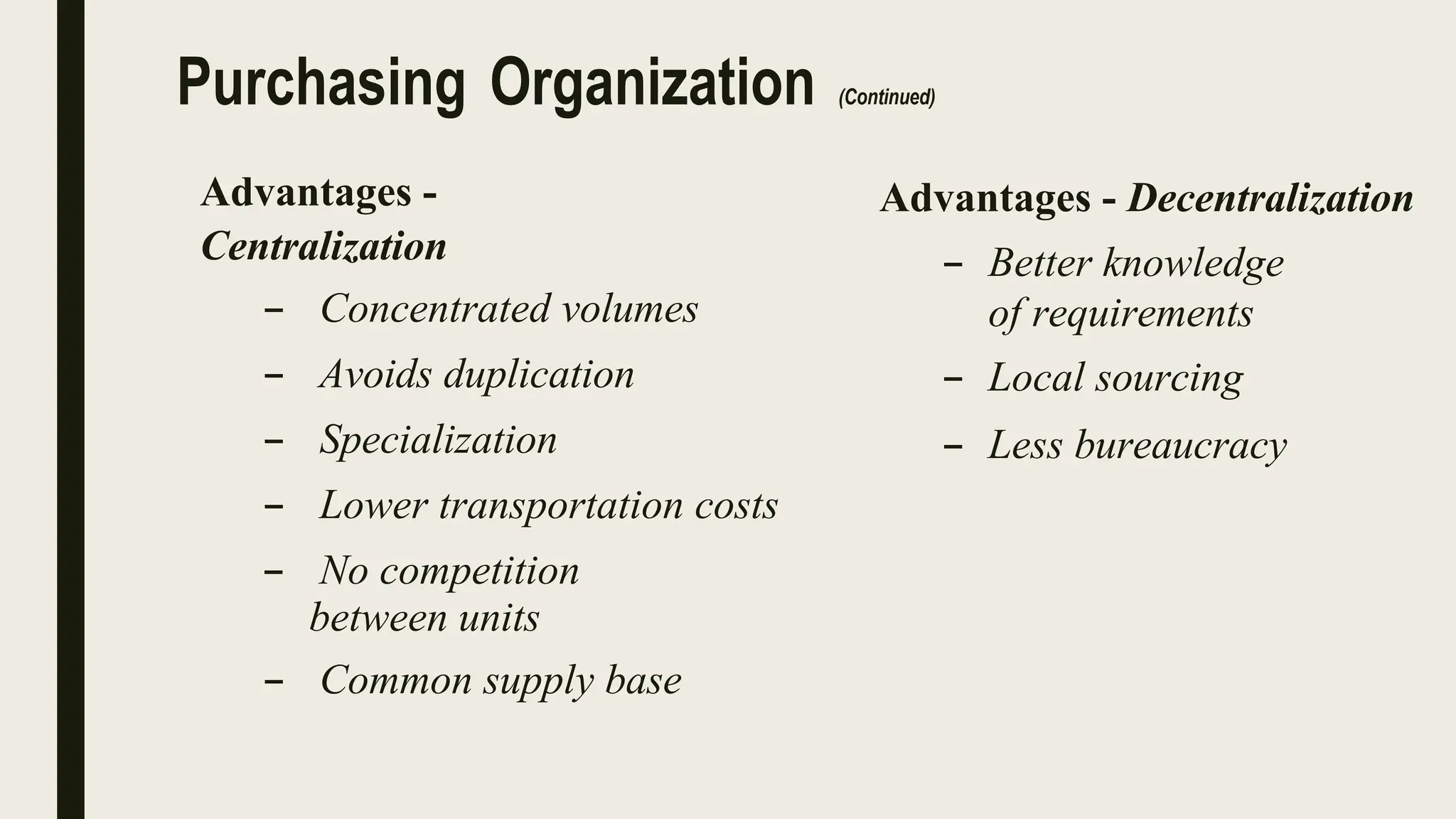
Purchasing Organization (Continued)
Advantages-
Centralization
– Concentrated volumes
– Avoids duplication
– Specialization
– Lower transportation costs
– No competition
between units
– Common supply base
Advantages - Decentralization
– Better knowledge
of requirements
– Local sourcing
– Less bureaucracy
114.
Purchasing Organization (Continued)
Ahybrid purchasing organization
Decentralized-centralized (large multiunit org)-
decentralized corporate and centralized at business unit
Centralized-decentralized (large organization
w/centralized control) centralized large national
contracts at corporate level and decentralized items
specific to business unit