INTRODUCTION TO SUPPLY CHAIN
MANAGEMENT
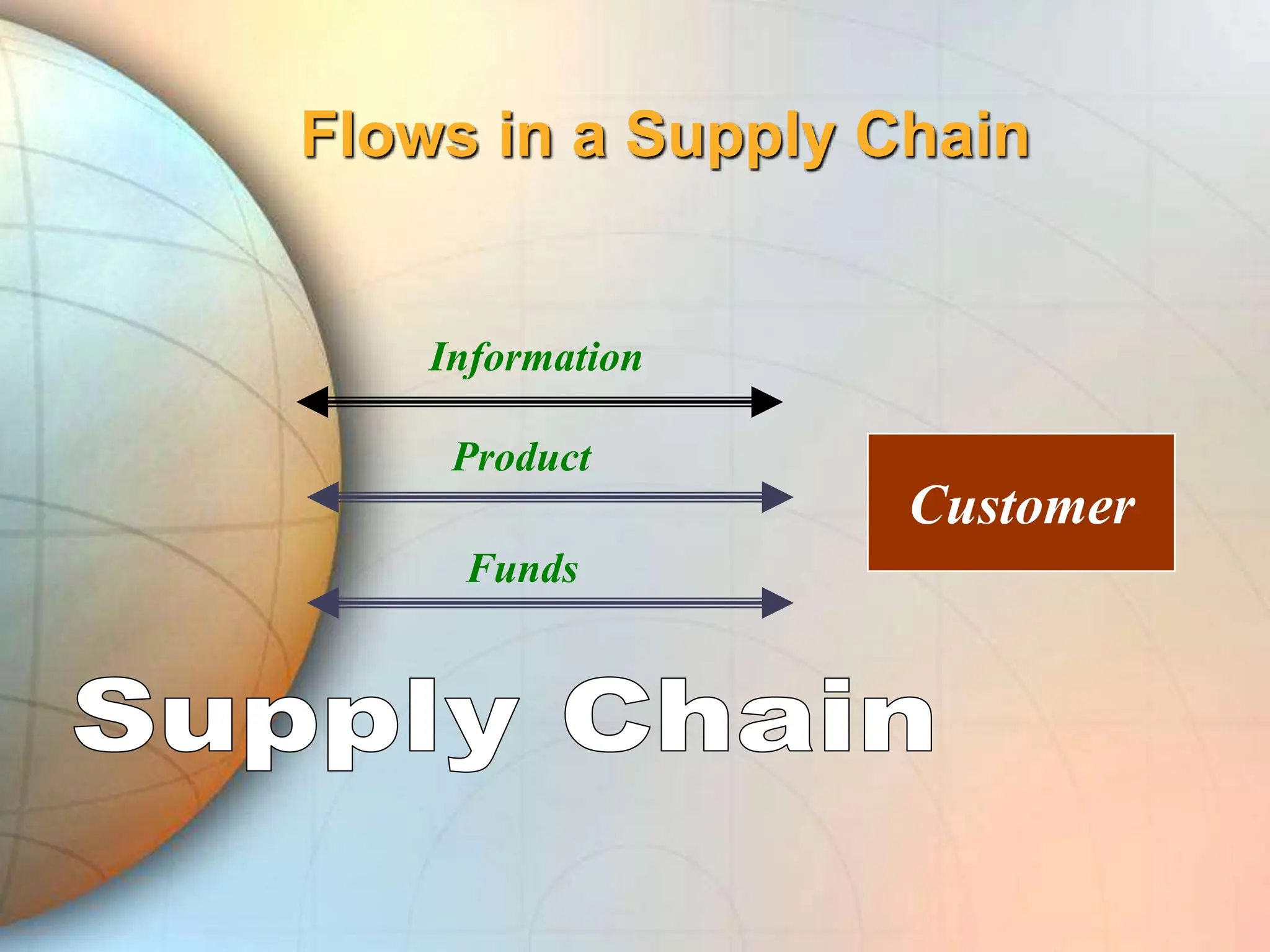
Flows in a Supply Chain
Customer
Information
Product
Funds
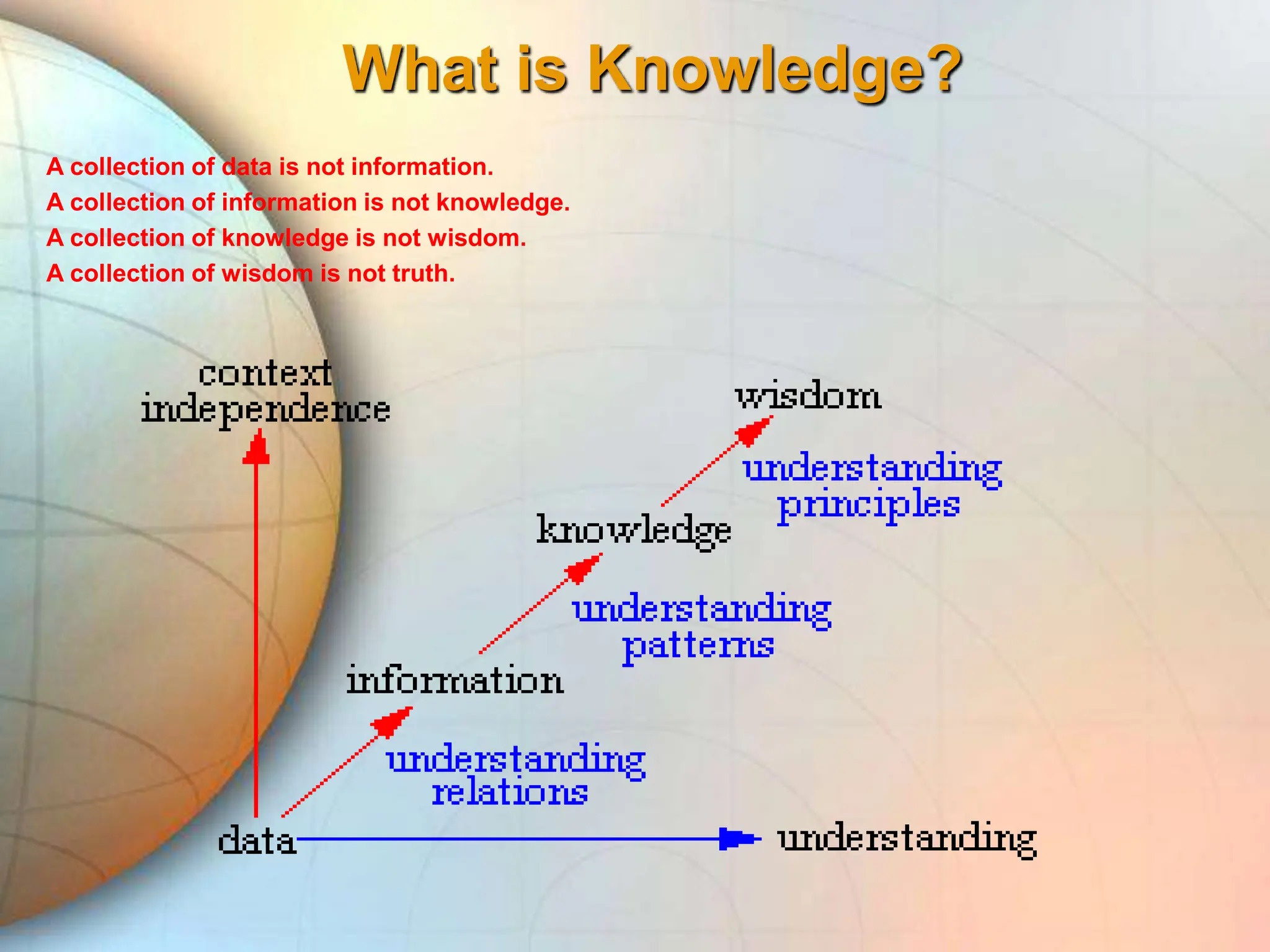
What is Knowledge?
A collection of data is not information.
A collection of information is not knowledge.
A collection of knowledge is not wisdom.
A collection of wisdom is not truth.
In the first half of the twentieth
century industry replaced agriculture, in
the second half of the twentieth century –
“service” has replaced “manufacturing” -
and right now, the knowledge industry is
beginning to replace the others.
−−George Kotzmetzk
Chapter Outline
* Introduction
* What is Supply Chain Management?
* Why is Supply Chain Management important?
* The origins of Supply Chain Management
* Important Elements of Supply Chain Management:
- Purchasing
- Operations
- Distribution
- Integration
* Strategies for Supply Chain Management
* Future Trends in Supply Chain Management
* The Beer Game
What is a Supply Chain?
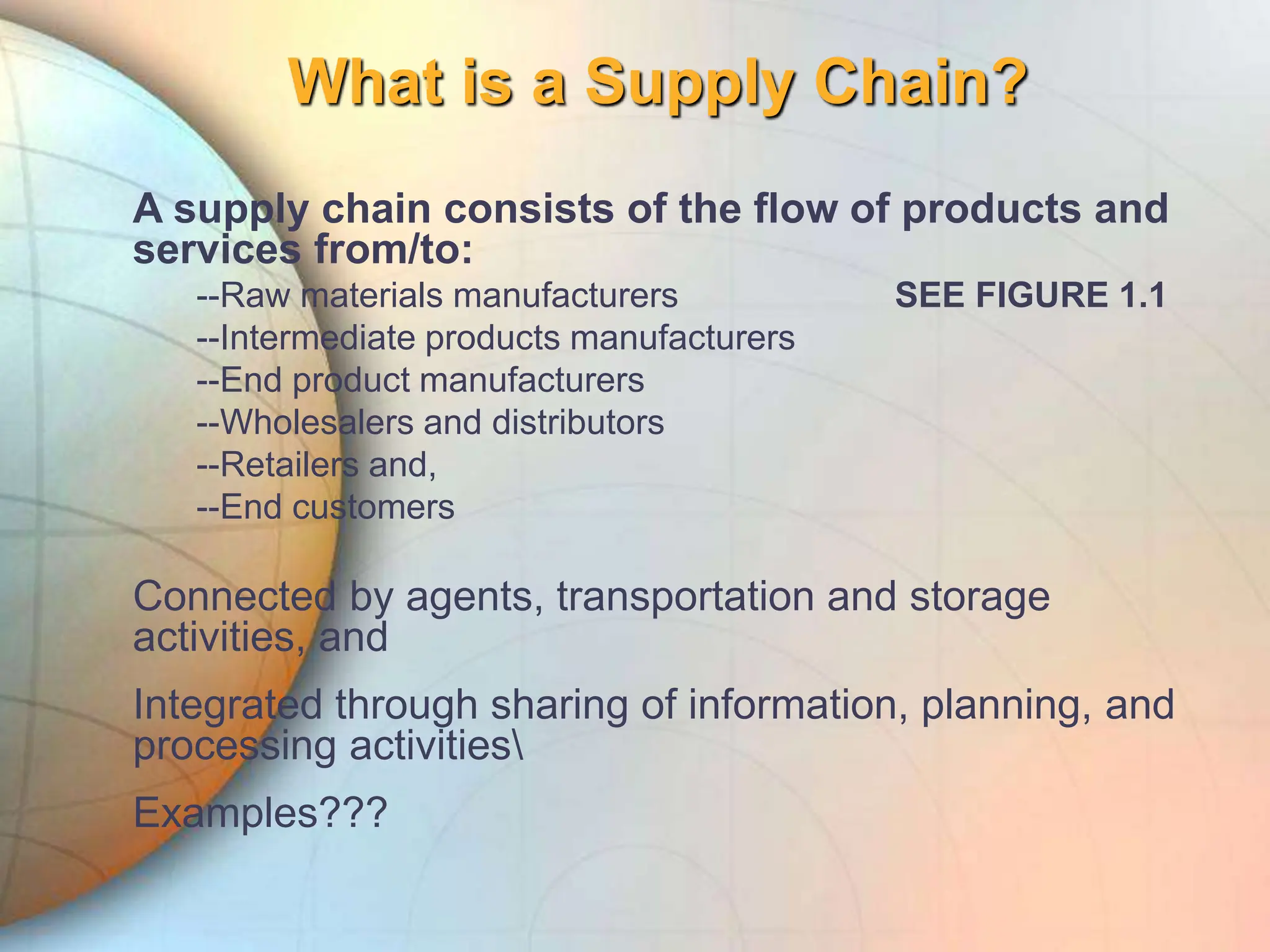
A supply chain consists of the flow of products and
services from/to:
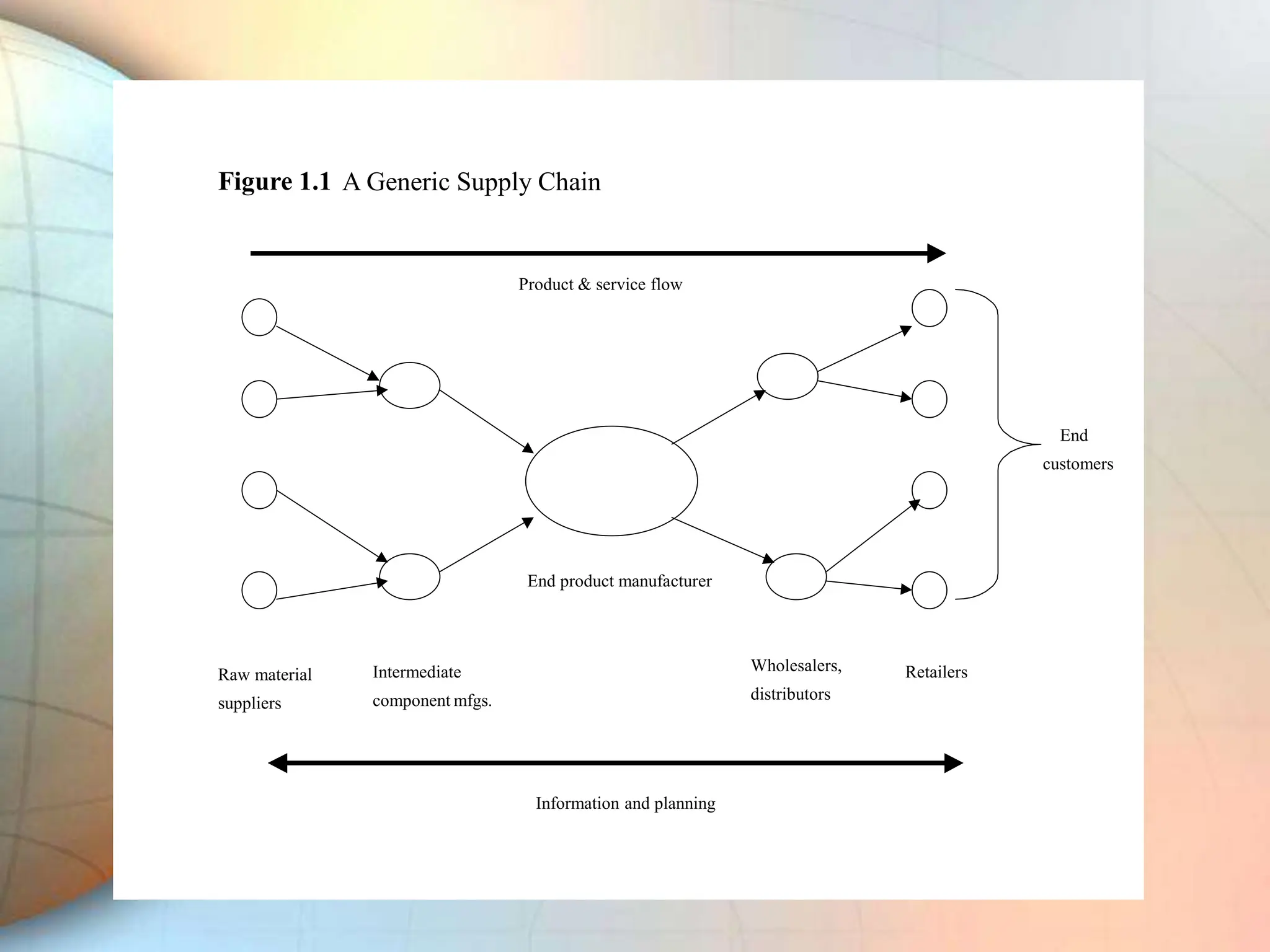
--Raw materials manufacturers SEE FIGURE 1.1
--Intermediate products manufacturers
--End product manufacturers
--Wholesalers and distributors
--Retailers and,
--End customers
Connected by agents, transportation and storage
activities, and
Integrated through sharing of information, planning, and
processing activities
Examples???
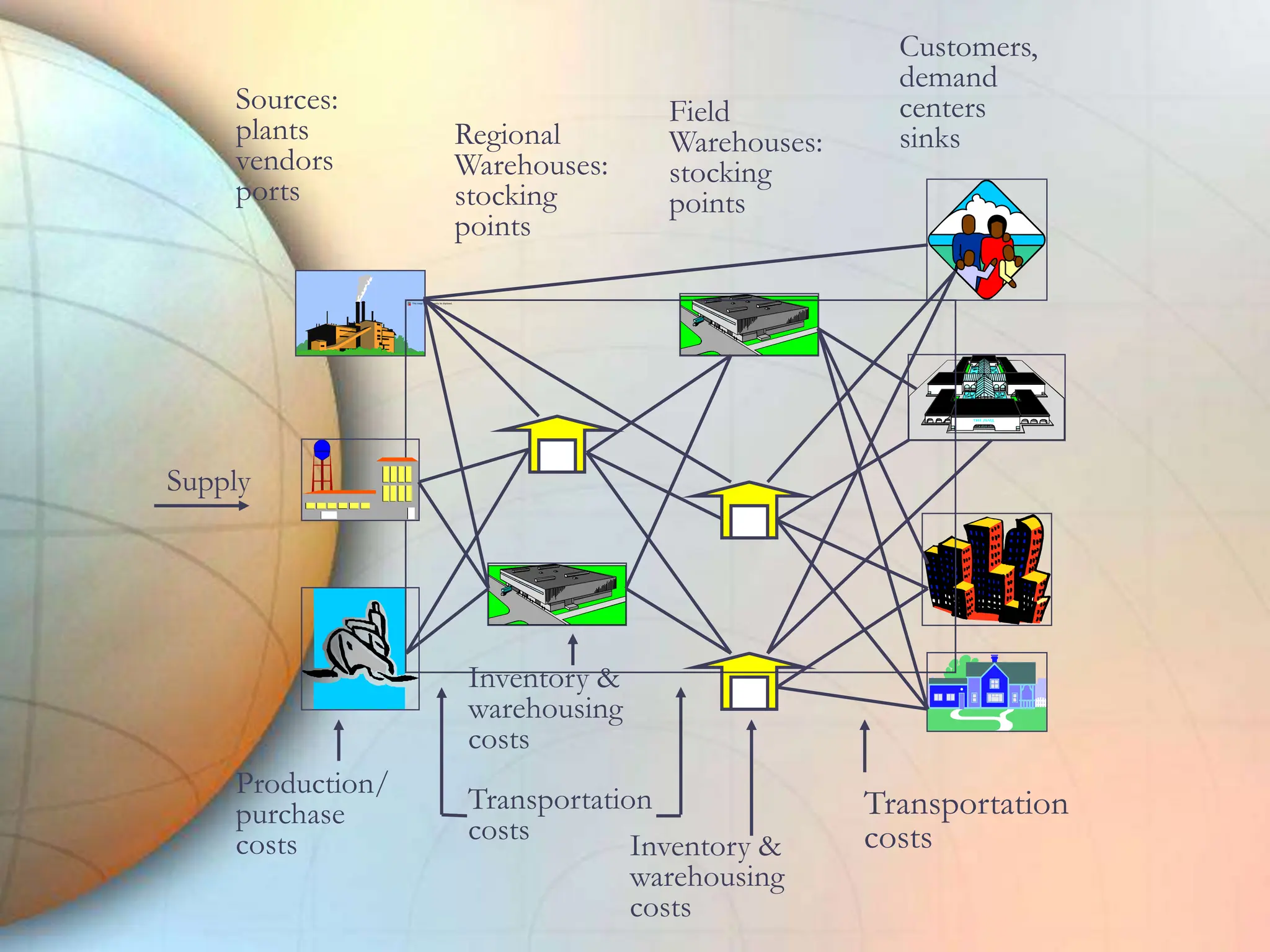
Supply
Sources:
plants
vendors
ports
Regional
Warehouses:
stocking
points
Field
Warehouses:
stocking
points
Customers,
demand
centers
sinks
Production/
purchase
costs
Inventory &
warehousing
costs
Transportation
costs
Inventory &
warehousing
costs
Transportation
costs
Figure 1.1 A Generic Supply Chain
End product manufacturer
Wholesalers,
distributors
Intermediate
component mfgs.
Raw material
suppliers
Retailers
End
customers
Product & service flow
Information and planning
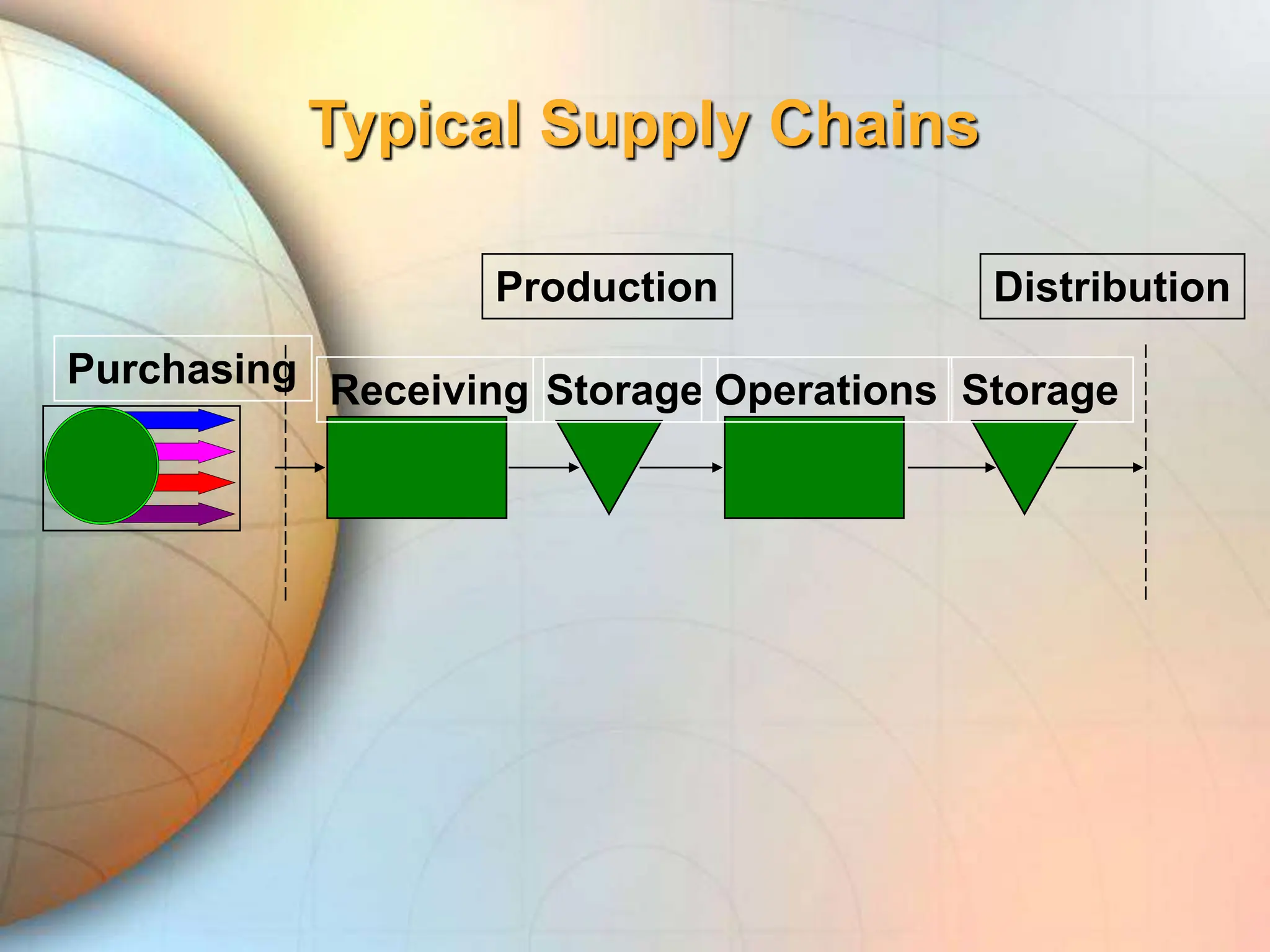
Typical Supply Chains
Purchasing
Receiving Storage Operations Storage
Production Distribution
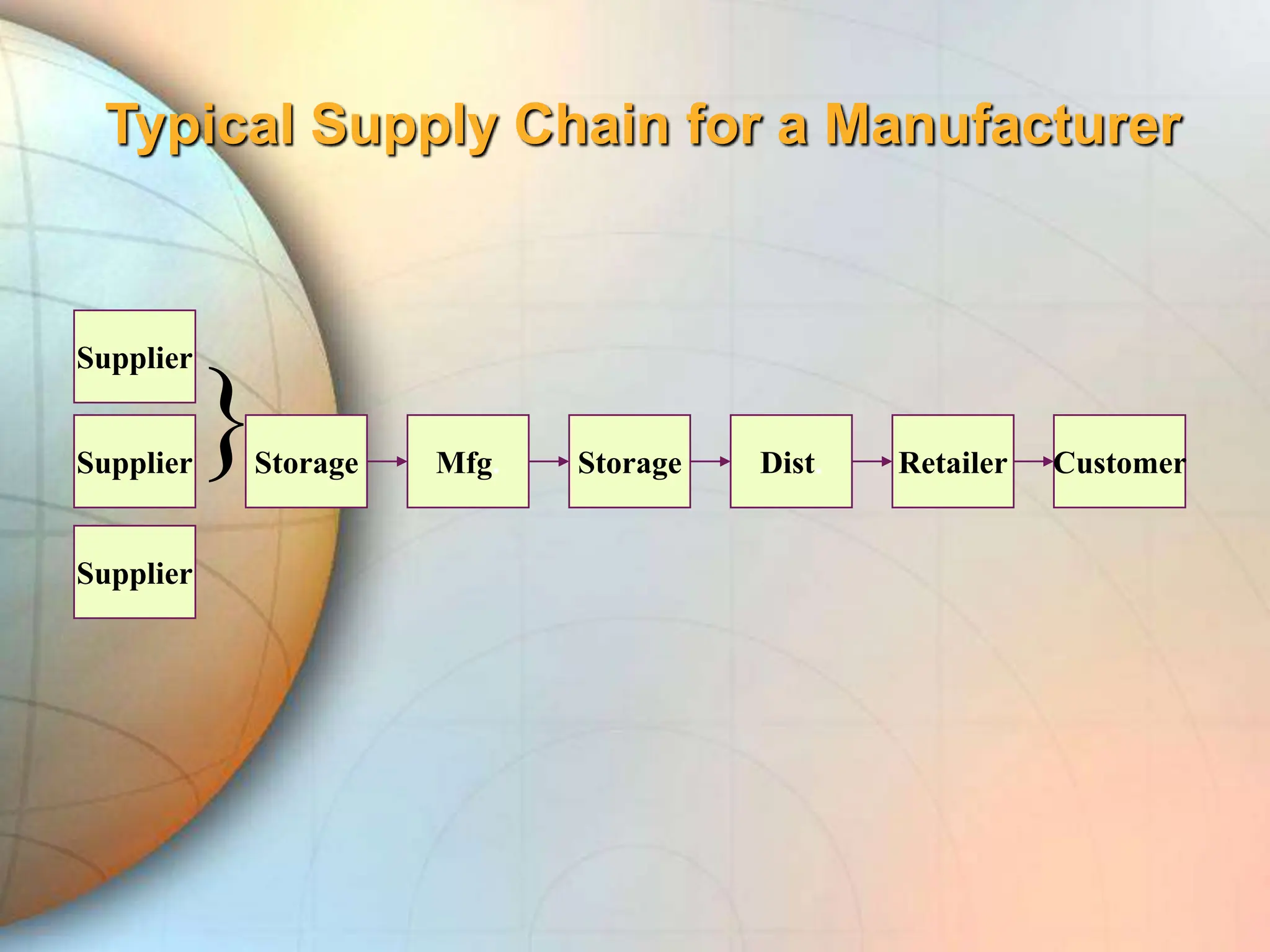
Typical Supply Chain for a Manufacturer
Supplier
Supplier
Supplier
Storage
} Mfg. Storage Dist. Retailer Customer
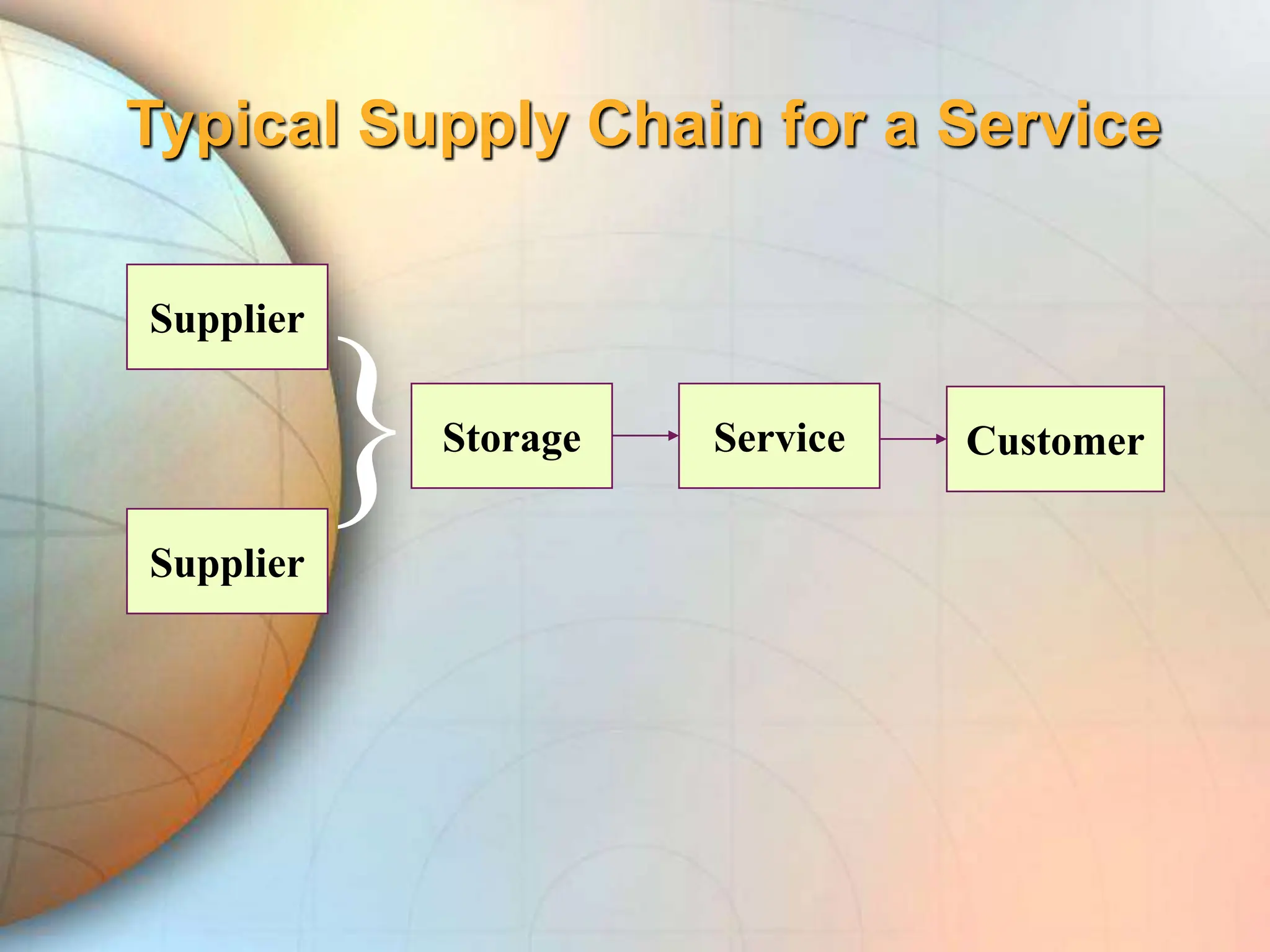
Supplier
Supplier
}Storage Service Customer
Typical Supply Chain for a Service
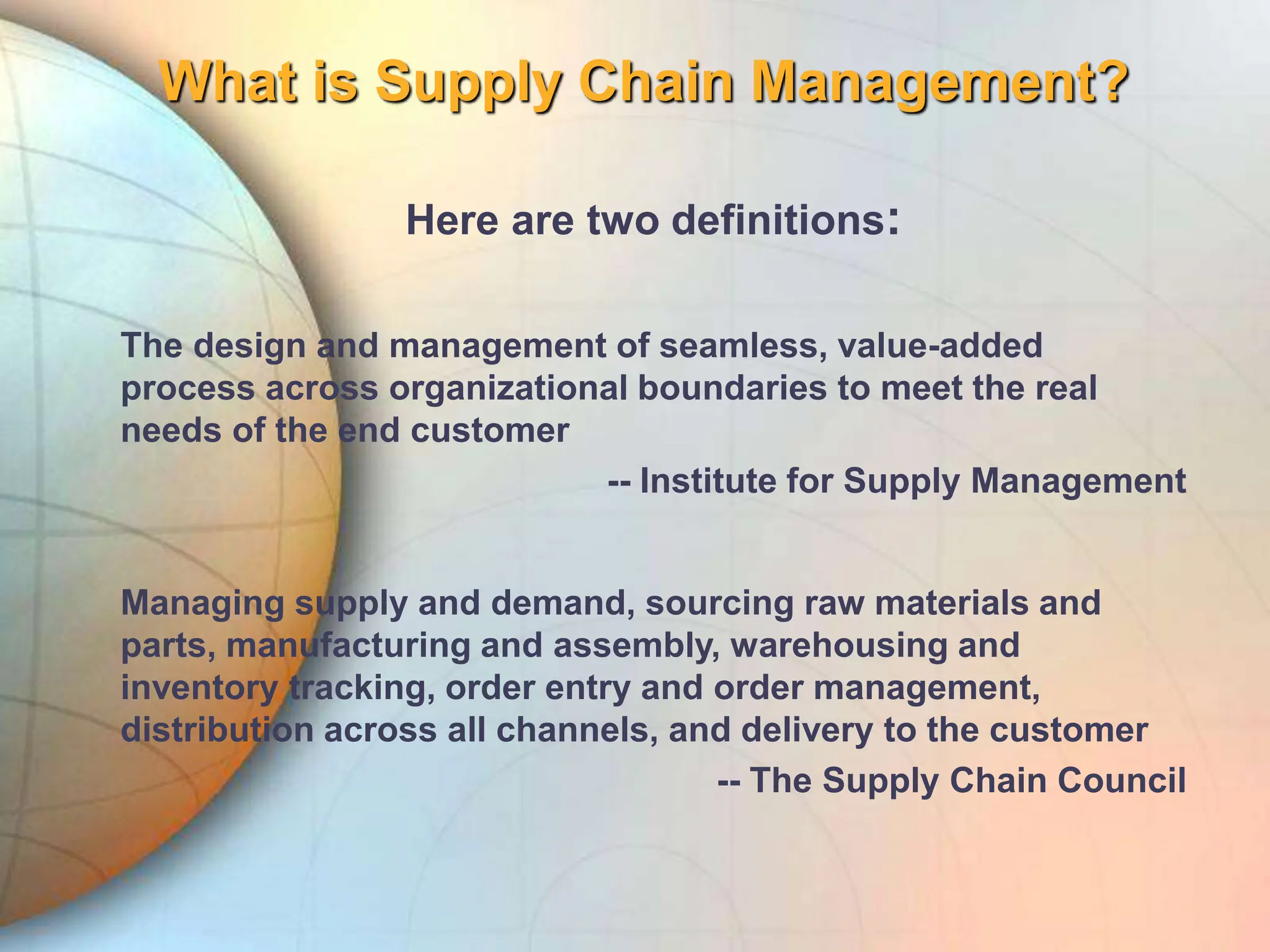
What is Supply Chain Management?
Here are two definitions:
The design and management of seamless, value-added
process across organizational boundaries to meet the real
needs of the end customer
-- Institute for Supply Management
Managing supply and demand, sourcing raw materials and
parts, manufacturing and assembly, warehousing and
inventory tracking, order entry and order management,
distribution across all channels, and delivery to the customer
-- The Supply Chain Council
What Is the Goal of Supply Chain
Management?.
 Supply chain management is concerned with
the efficient integration of suppliers, factories,
warehouses and stores so that merchandise is
produced and distributed:
– In the right quantities
– To the right locations
– At the right time
 In order to
– Minimize total system cost
– Satisfy customer service requirements
Importance of Supply Chain
Management
* Firms have discovered value-enhancing and long
term benefits
* Who benefits most? Firms with:
- Large inventories
- Large number of suppliers
- Complex products
- Customers with large purchasing budgets
* Benefits
- Lower purchasing/inventory costs, higher
quality/customer service
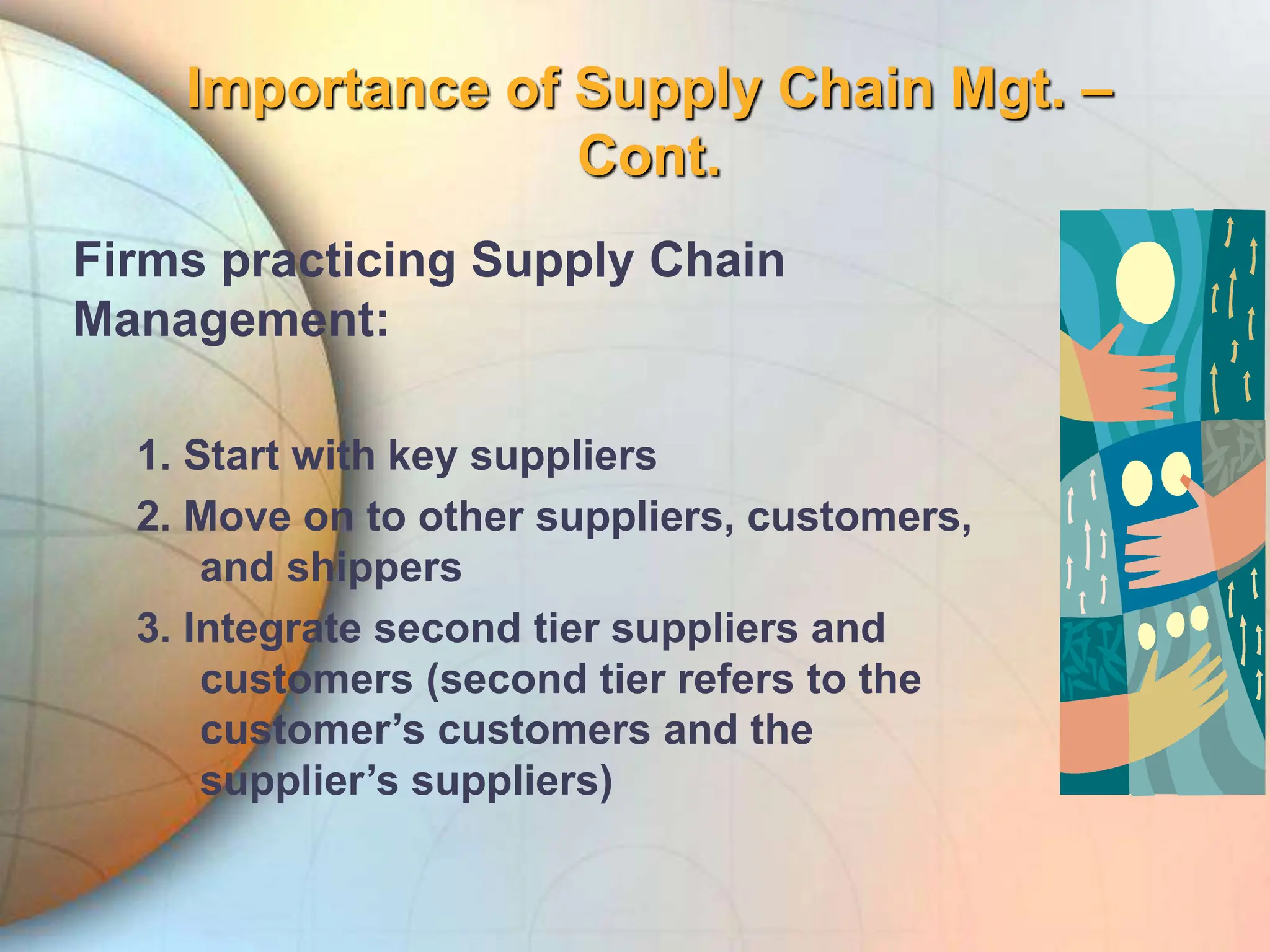
Importance of Supply Chain Mgt. –
Cont.
Firms practicing Supply Chain
Management:
1. Start with key suppliers
2. Move on to other suppliers, customers,
and shippers
3. Integrate second tier suppliers and
customers (second tier refers to the
customer’s customers and the
supplier’s suppliers)
Importance of Supply Chain Mgt. –
Cont.
* Cost savings and better coordination of resources
are reasons to employ Supply Chain Management
-- Bullwhip Effect- the magnification of safety stocks and
costs based on separate forecasts and uncoordinated
planning and sharing of information along the supply chain
(Ex. 1.1)
* Reducing the bullwhip effect occurs through:
-- Process integration- Interdependent activities can lead to
improved quality, reduced cycle time, better production
methods, better forecasts, less safety stock, etc.
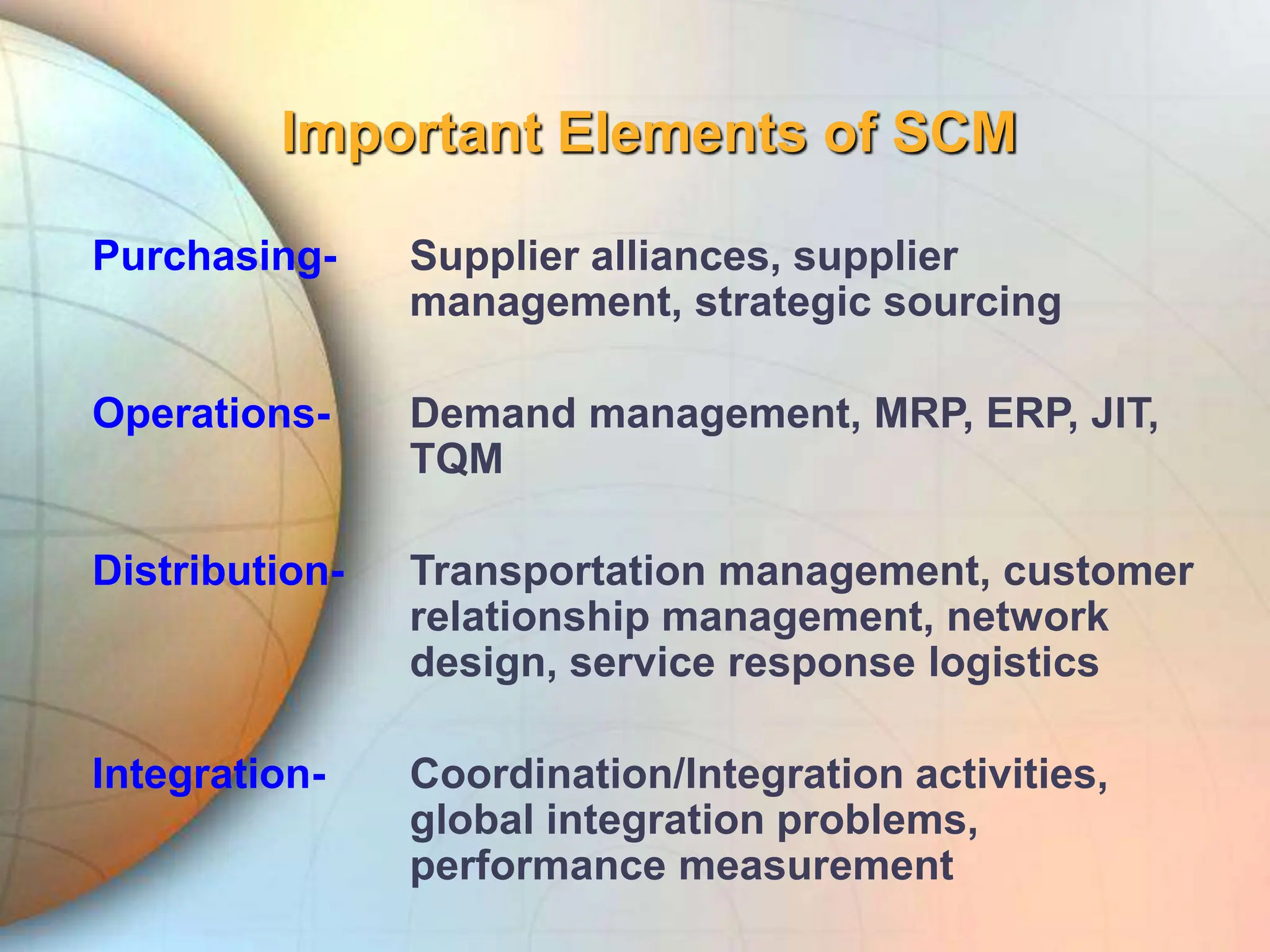
Important Elements of SCM
Purchasing- Supplier alliances, supplier
management, strategic sourcing
Operations- Demand management, MRP, ERP, JIT,
TQM
Distribution- Transportation management, customer
relationship management, network
design, service response logistics
Integration- Coordination/Integration activities,
global integration problems,
performance measurement
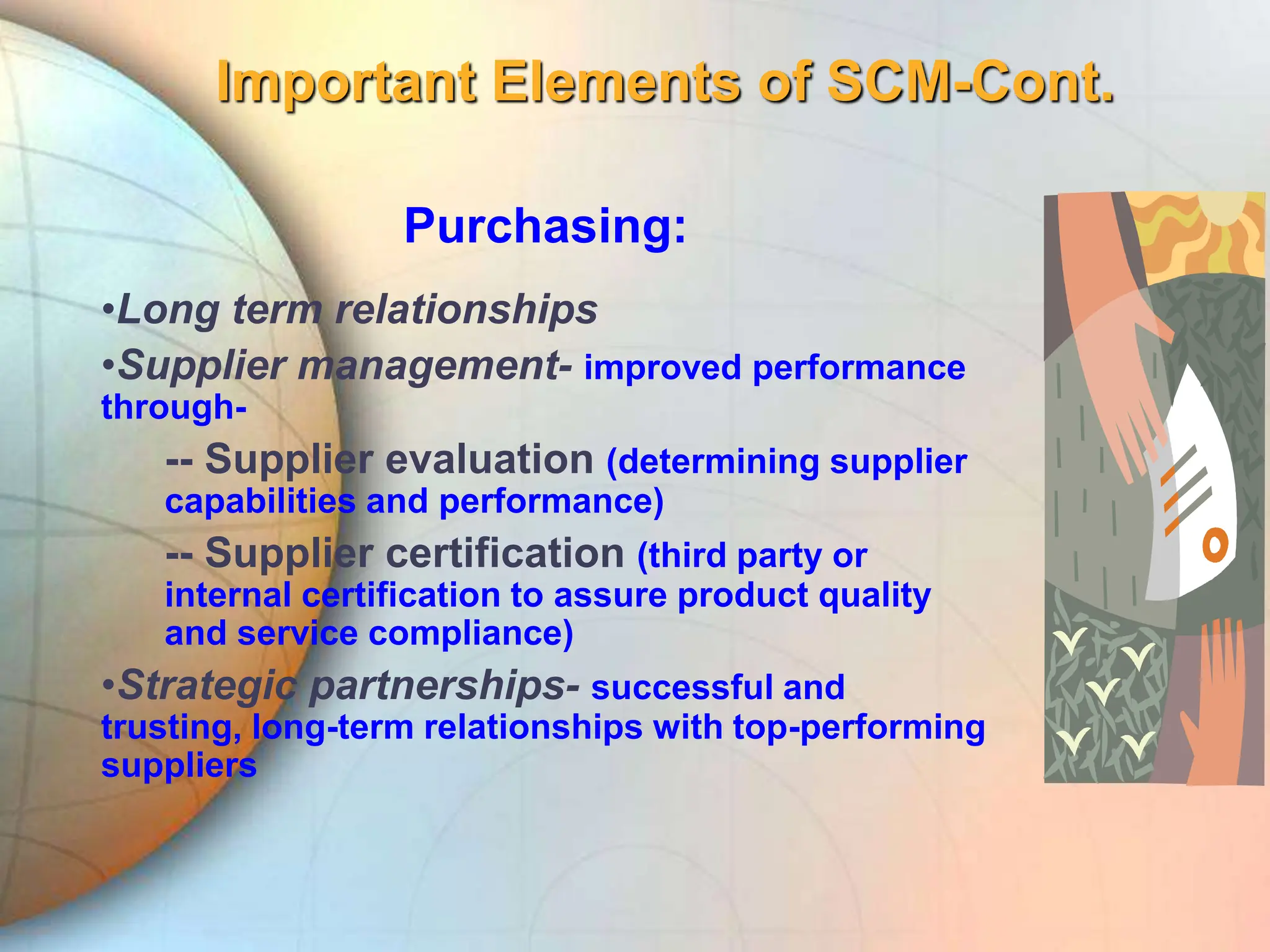
Important Elements of SCM-Cont.
Purchasing:
•Long term relationships
•Supplier management- improved performance
through-
-- Supplier evaluation (determining supplier
capabilities and performance)
-- Supplier certification (third party or
internal certification to assure product quality
and service compliance)
•Strategic partnerships- successful and
trusting, long-term relationships with top-performing
suppliers
Important Elements of Supply Chain
Management-Cont.
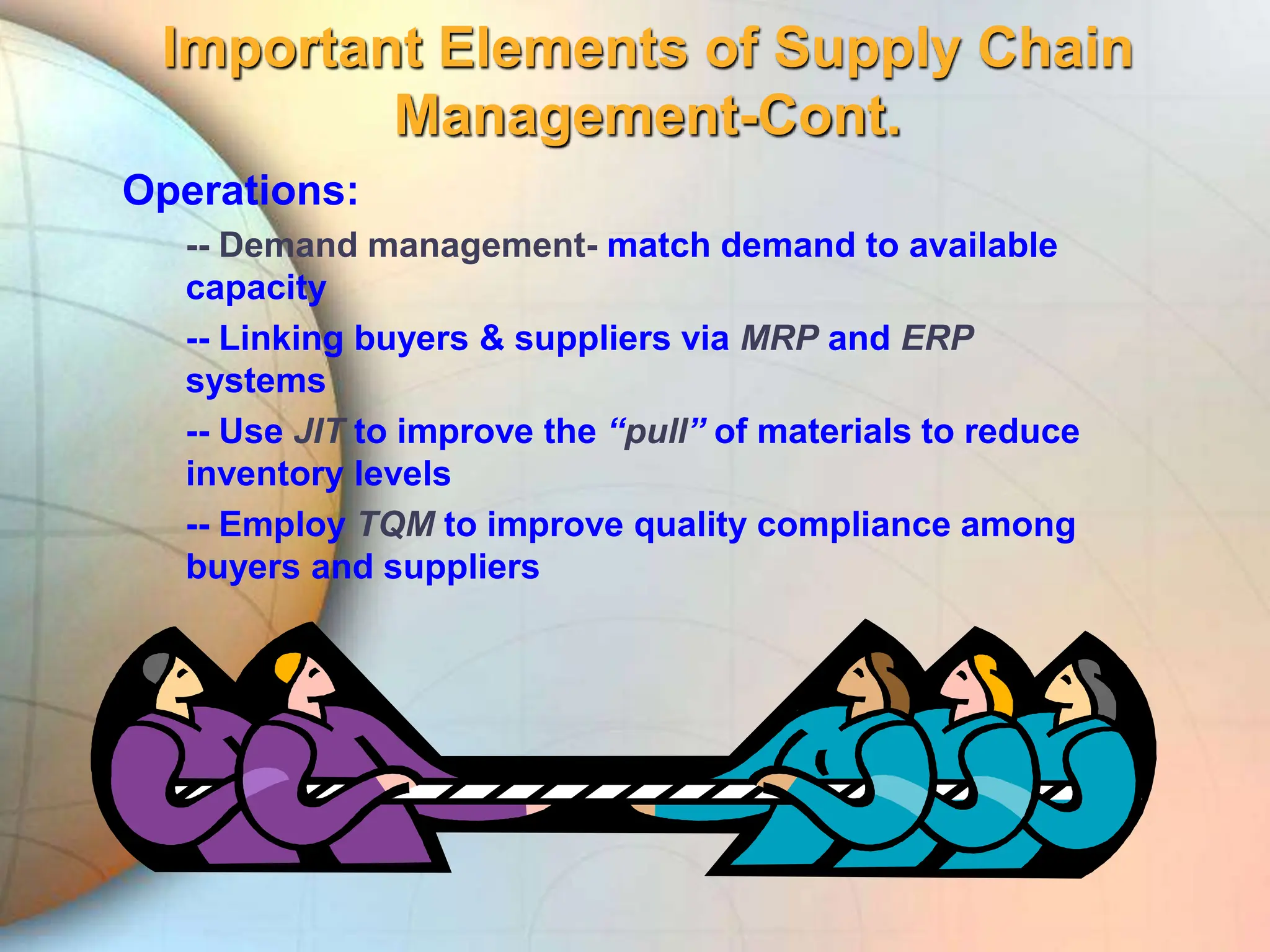
Operations:
-- Demand management- match demand to available
capacity
-- Linking buyers & suppliers via MRP and ERP
systems
-- Use JIT to improve the “pull” of materials to reduce
inventory levels
-- Employ TQM to improve quality compliance among
buyers and suppliers
Important Elements of Supply Chain
Management-Cont.
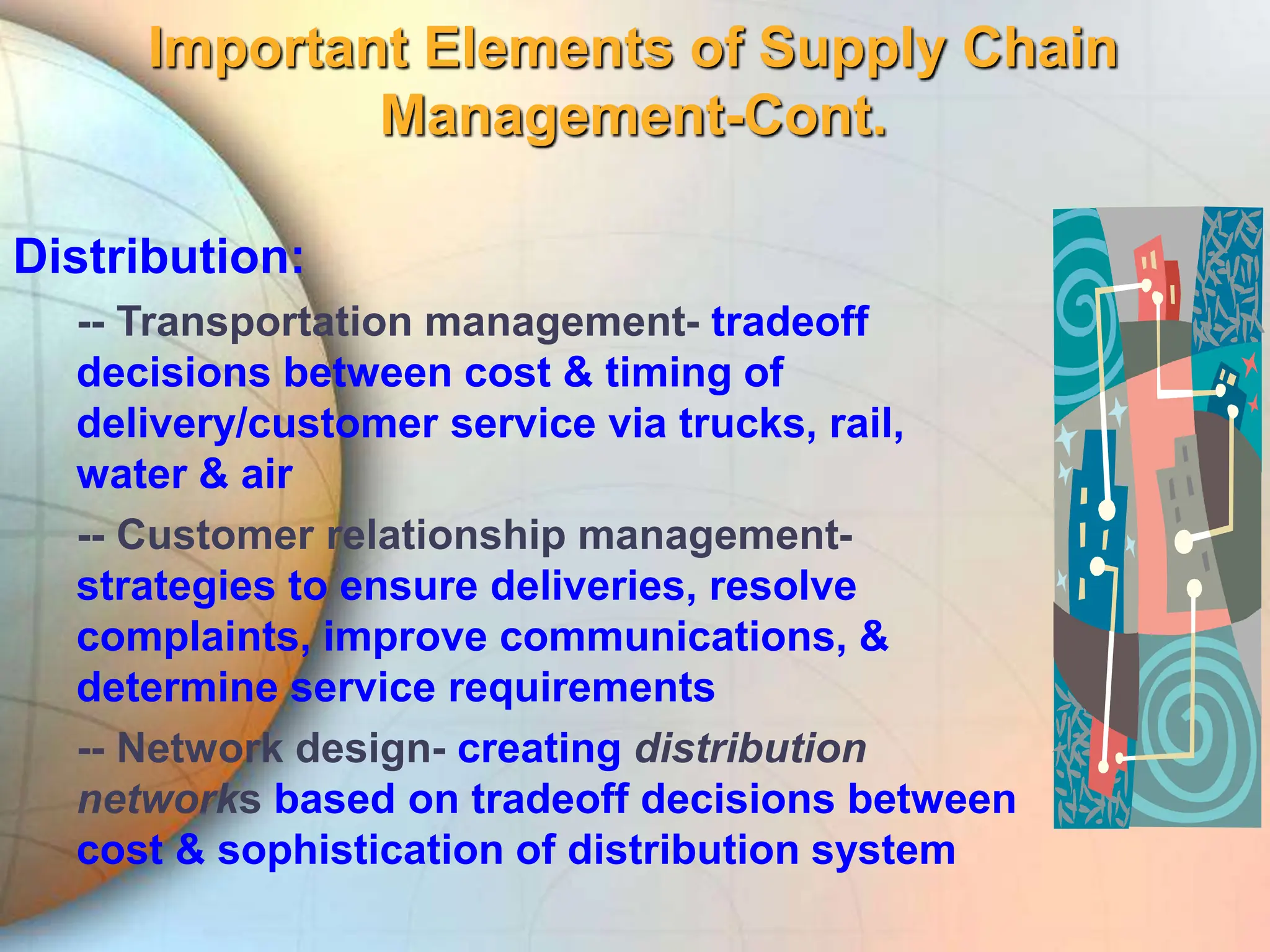
Distribution:
-- Transportation management- tradeoff
decisions between cost & timing of
delivery/customer service via trucks, rail,
water & air
-- Customer relationship management-
strategies to ensure deliveries, resolve
complaints, improve communications, &
determine service requirements
-- Network design- creating distribution
networks based on tradeoff decisions between
cost & sophistication of distribution system
Important Elements of Supply Chain
Management-Cont.
Integration:
-- Supply Chain Integration- when supply chain
participants work for common goals. Requires intrafirm
functional integration. Based on efforts to change
attitudes & adversarial relationships
-- Global Supply Chains- advantages that accrue from
sourcing from larger global market e.g., lower cost &
higher quality suppliers. May involve operating exposure,
which is risk found in foreign settings
-- Supply Chain Performance Measurement- Crucial for
firms to know if procedures are working
Strategies for SCM
All of the advanced strategies, techniques,
and approaches for Supply Chain
Management focus on:
Global Optimization
Managing Uncertainty
Optimization
* What is it?
* Why is it important?
* What tools and approaches help?
Tools and Strategies for
Optimization
• Decision Support Systems
• Inventory Control
• Network Design
• Design for Logistics
• Cross Docking
Global Optimization
 What is it?
 Why is it different/better than local optimization?
 What are conflicting supply chain objectives?
 What tools and approaches help with global
optimization?
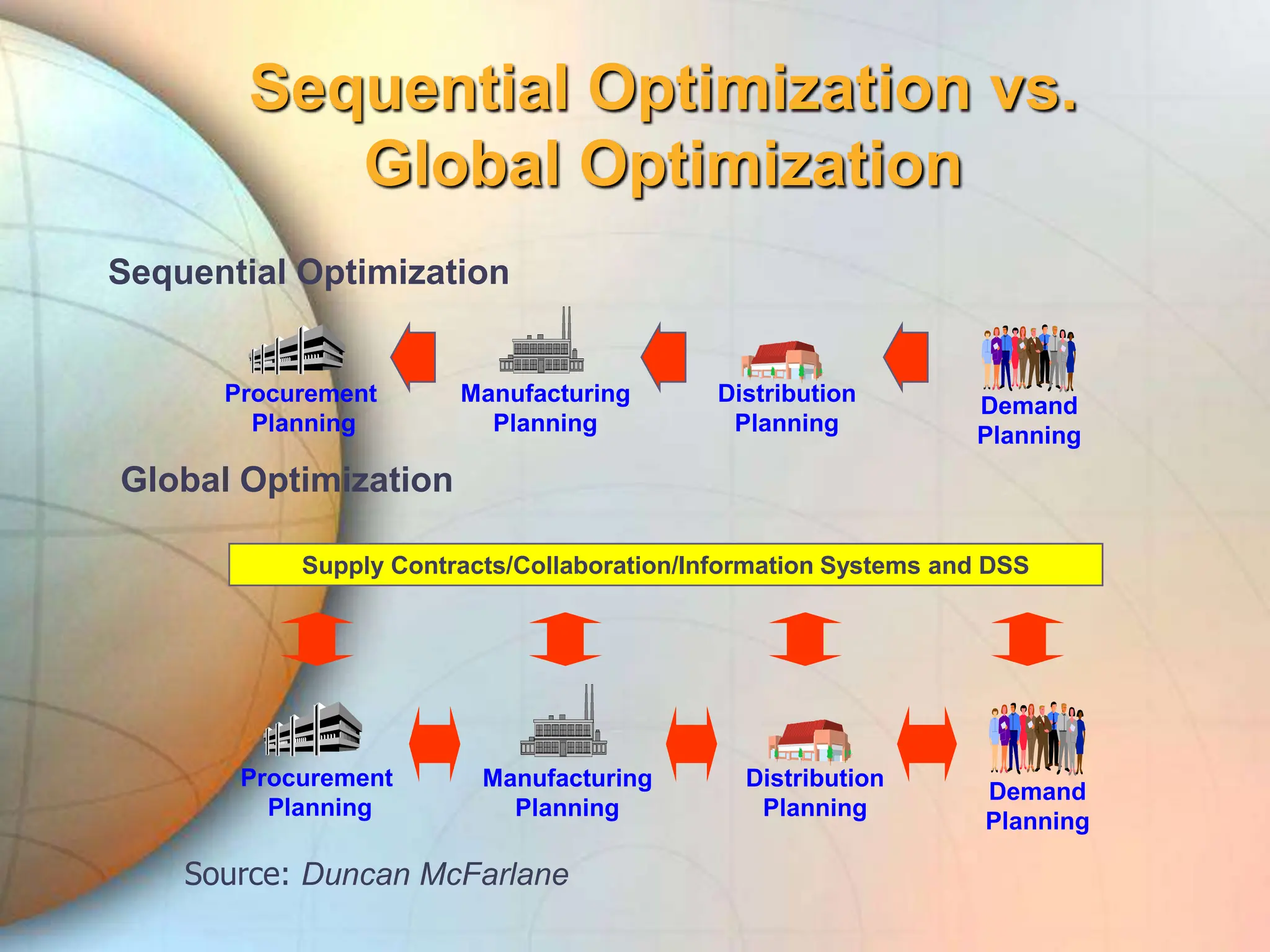
Procurement
Planning
Manufacturing
Planning
Distribution
Planning
Demand
Planning
Sequential Optimization
Supply Contracts/Collaboration/Information Systems and DSS
Procurement
Planning
Manufacturing
Planning
Distribution
Planning
Demand
Planning
Global Optimization
Sequential Optimization vs.
Global Optimization
Source: Duncan McFarlane
Why is Global Optimization Hard?
–The supply chain is complex
–Different facilities have conflicting objectives
–The supply chain is a dynamic system
–The power structure changes
–The system varies over time
Uncertainty
• What is variation?
• What is randomness?
• What tools and approaches help us to
deal with these issues?
Can’t Forecasting Help?
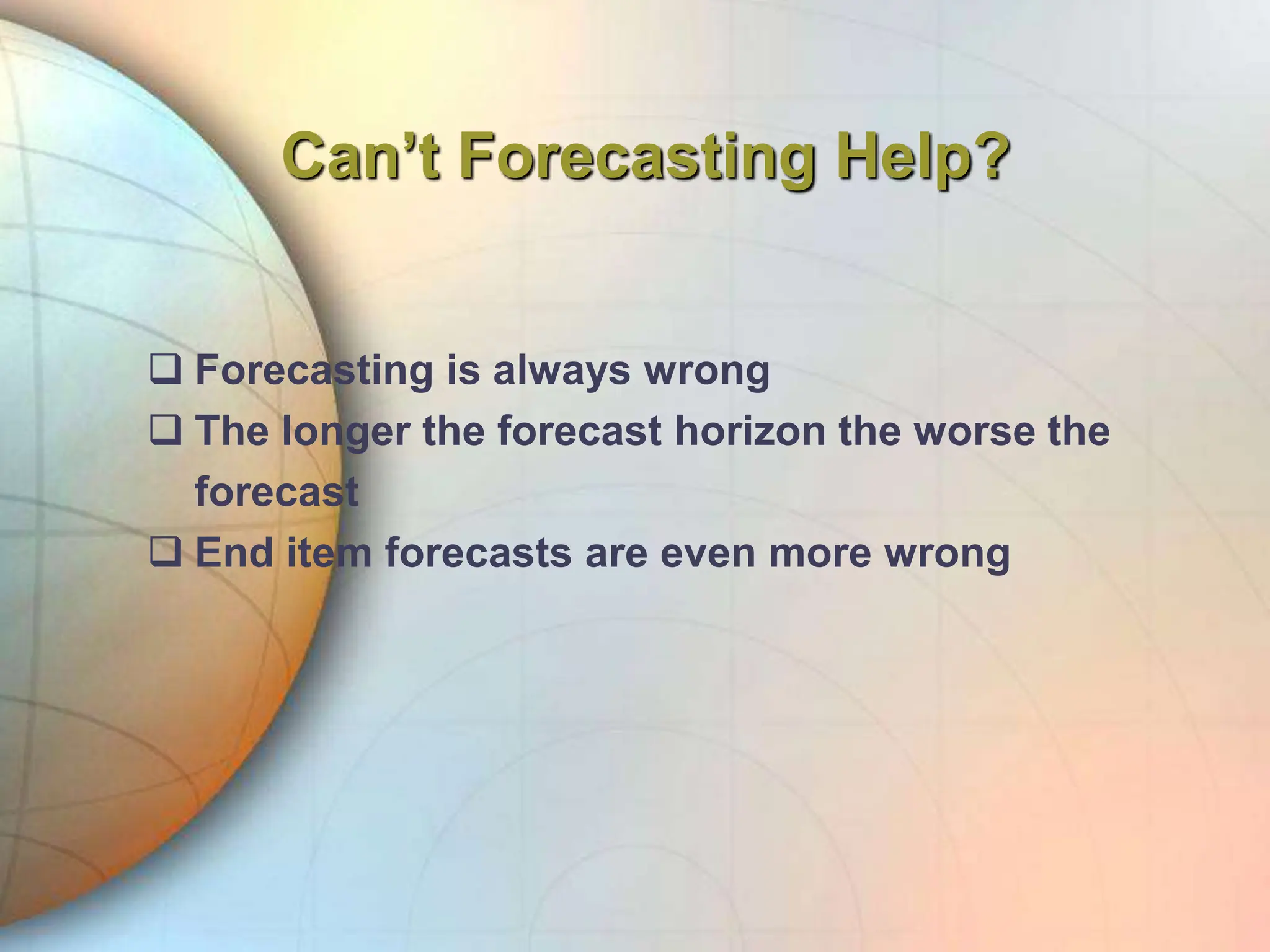
 Forecasting is always wrong
 The longer the forecast horizon the worse the
forecast
 End item forecasts are even more wrong
Why Is Uncertainty Hard to Deal With?
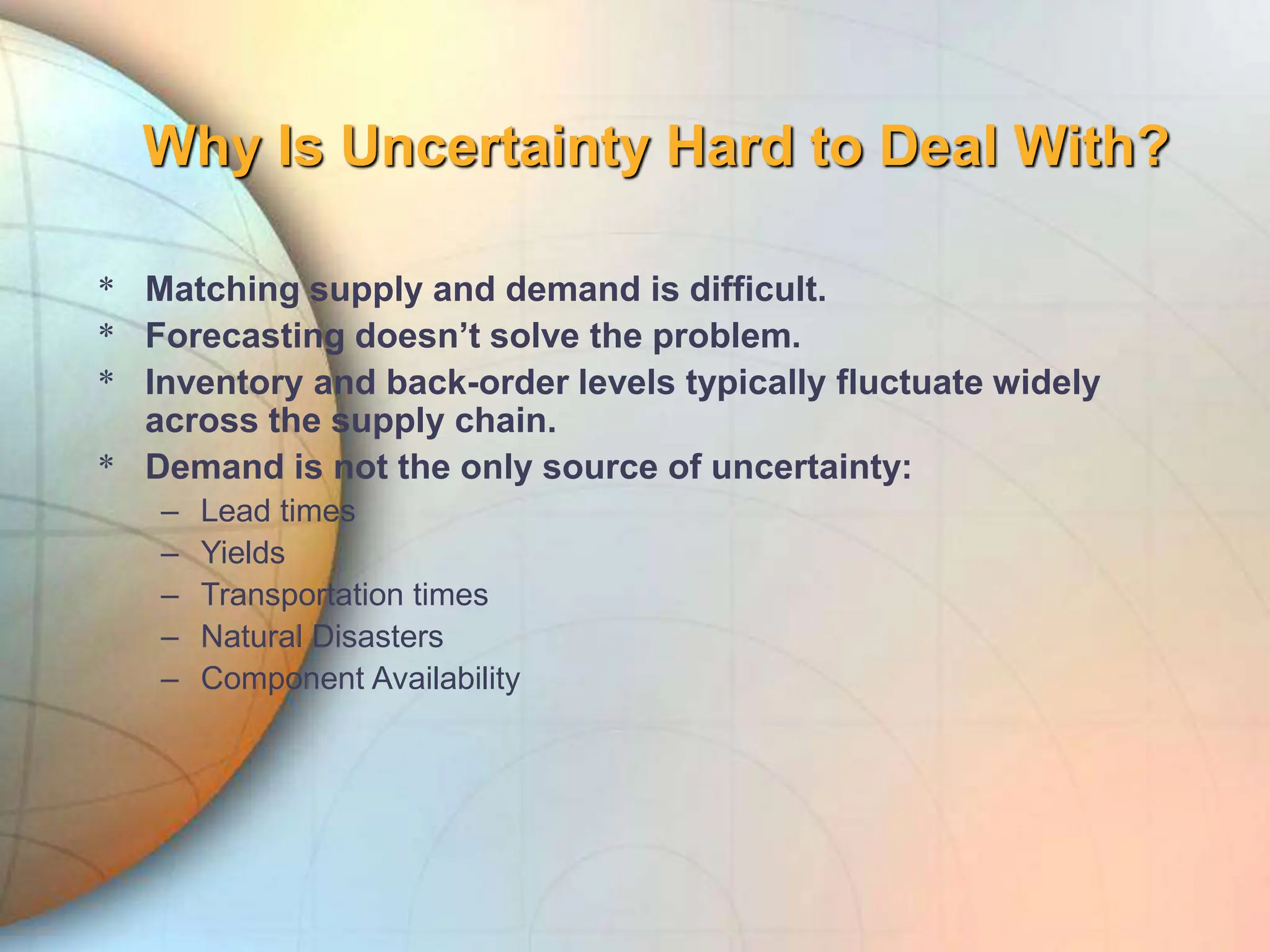
* Matching supply and demand is difficult.
* Forecasting doesn’t solve the problem.
* Inventory and back-order levels typically fluctuate widely
across the supply chain.
* Demand is not the only source of uncertainty:
– Lead times
– Yields
– Transportation times
– Natural Disasters
– Component Availability
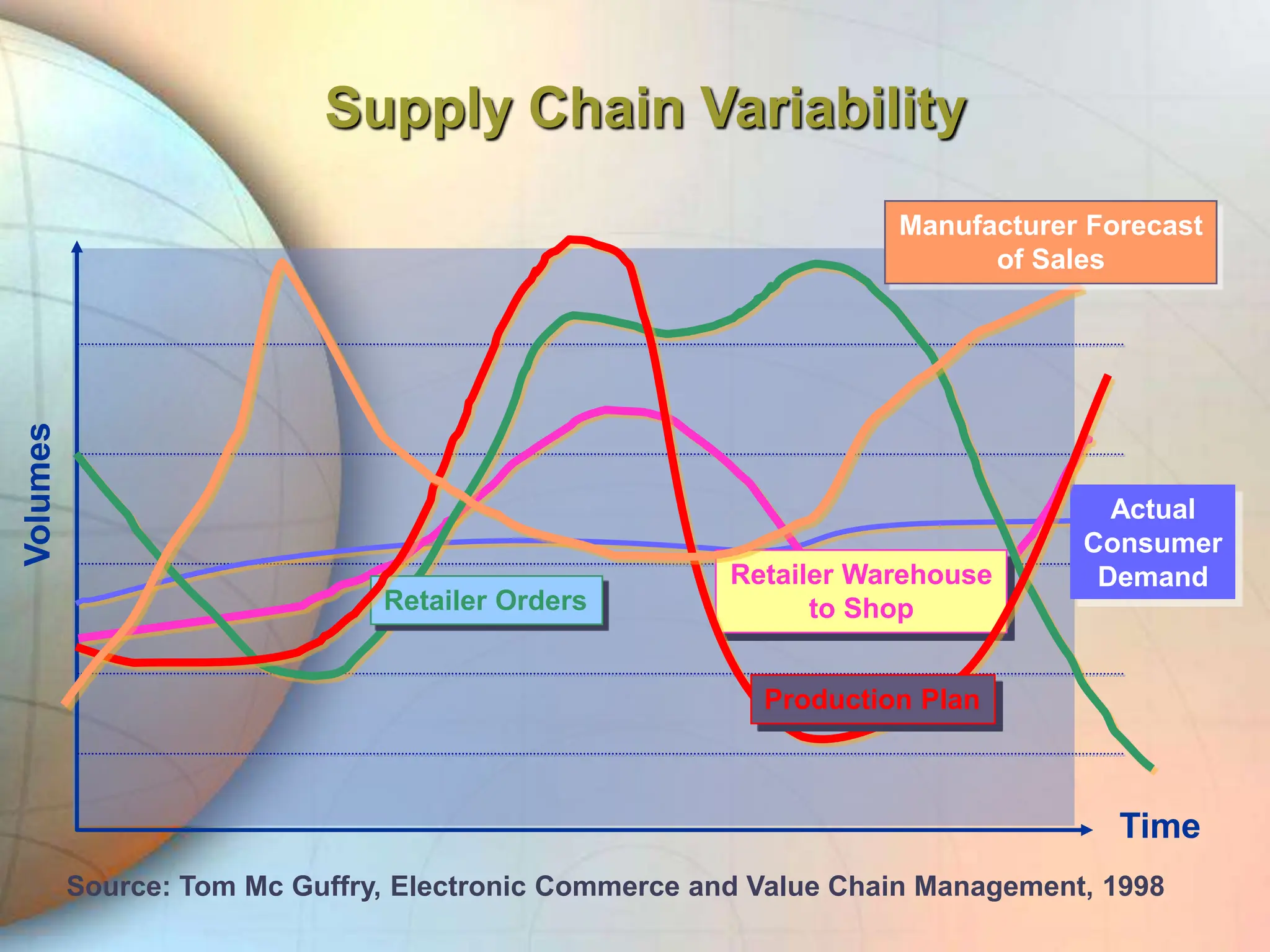
Supply Chain Variability
Volumes
Time
Source: Tom Mc Guffry, Electronic Commerce and Value Chain Management, 1998
Actual
Consumer
Demand
Retailer Warehouse
to Shop
Retailer Orders
Production Plan
Manufacturer Forecast
of Sales
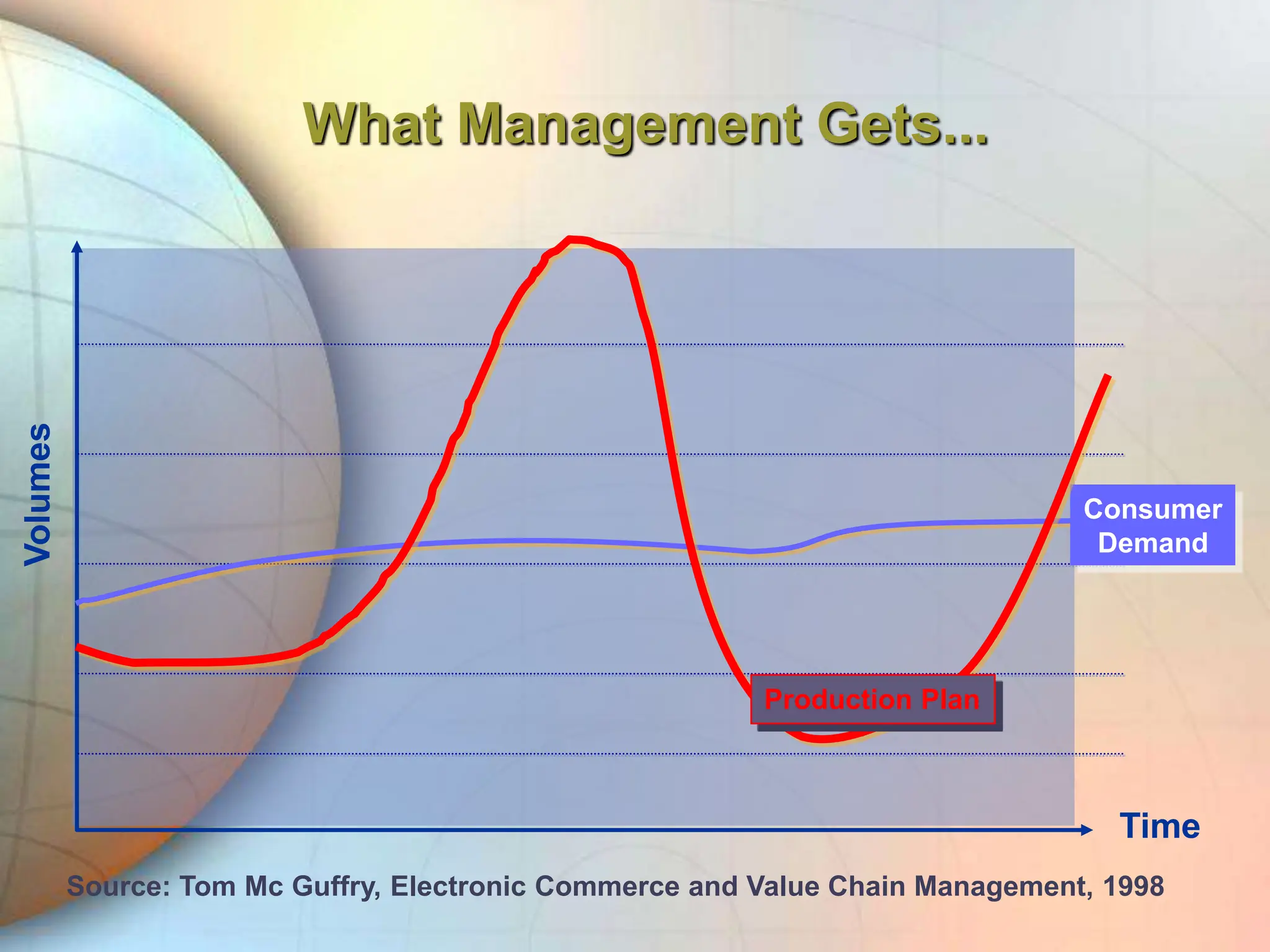
What Management Gets...
Volumes
Time
Source: Tom Mc Guffry, Electronic Commerce and Value Chain Management, 1998
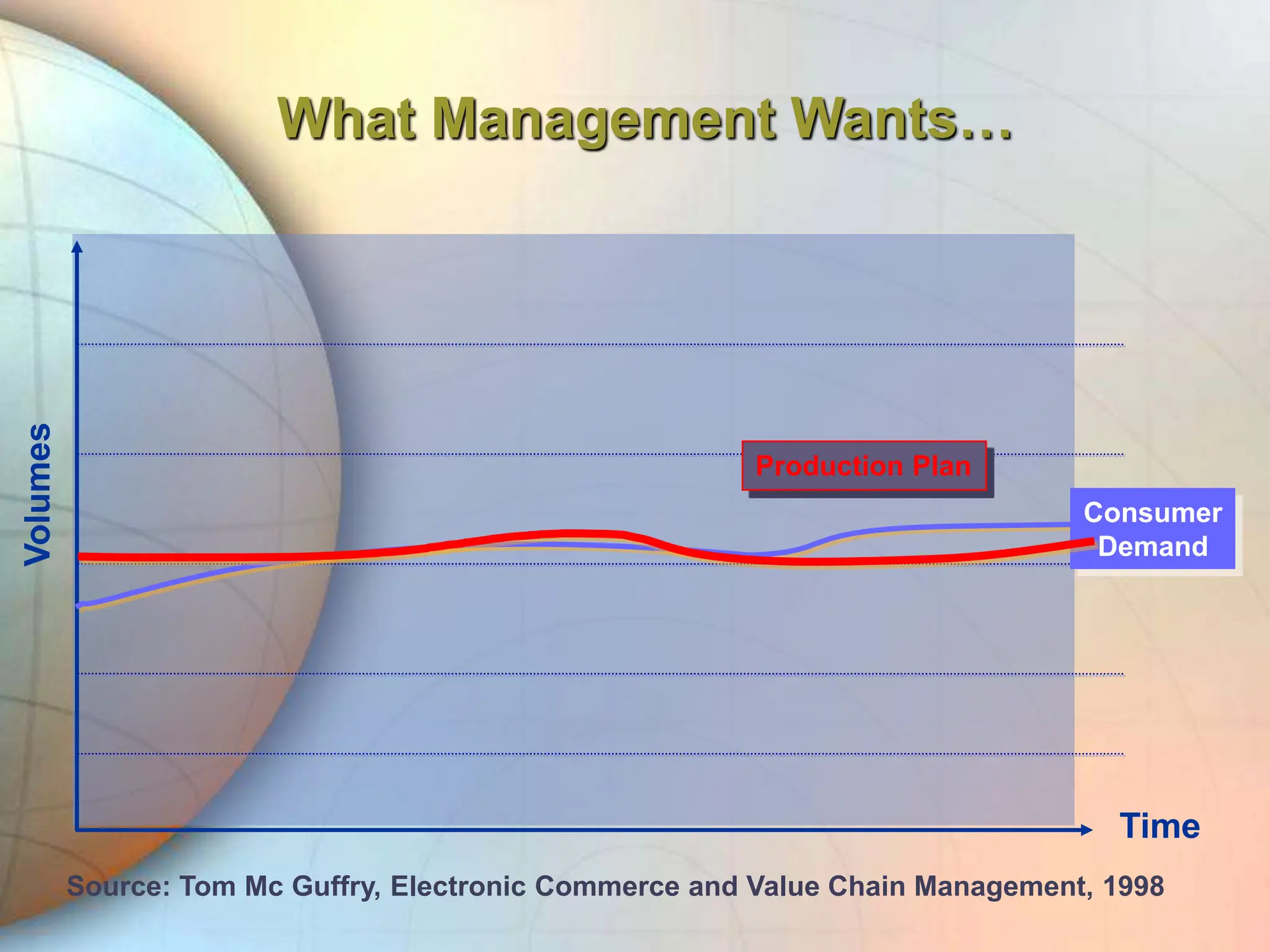
Consumer
Demand
Production Plan
What Management Wants…
Volumes
Time
Source: Tom Mc Guffry, Electronic Commerce and Value Chain Management, 1998
Consumer
Demand
Production Plan
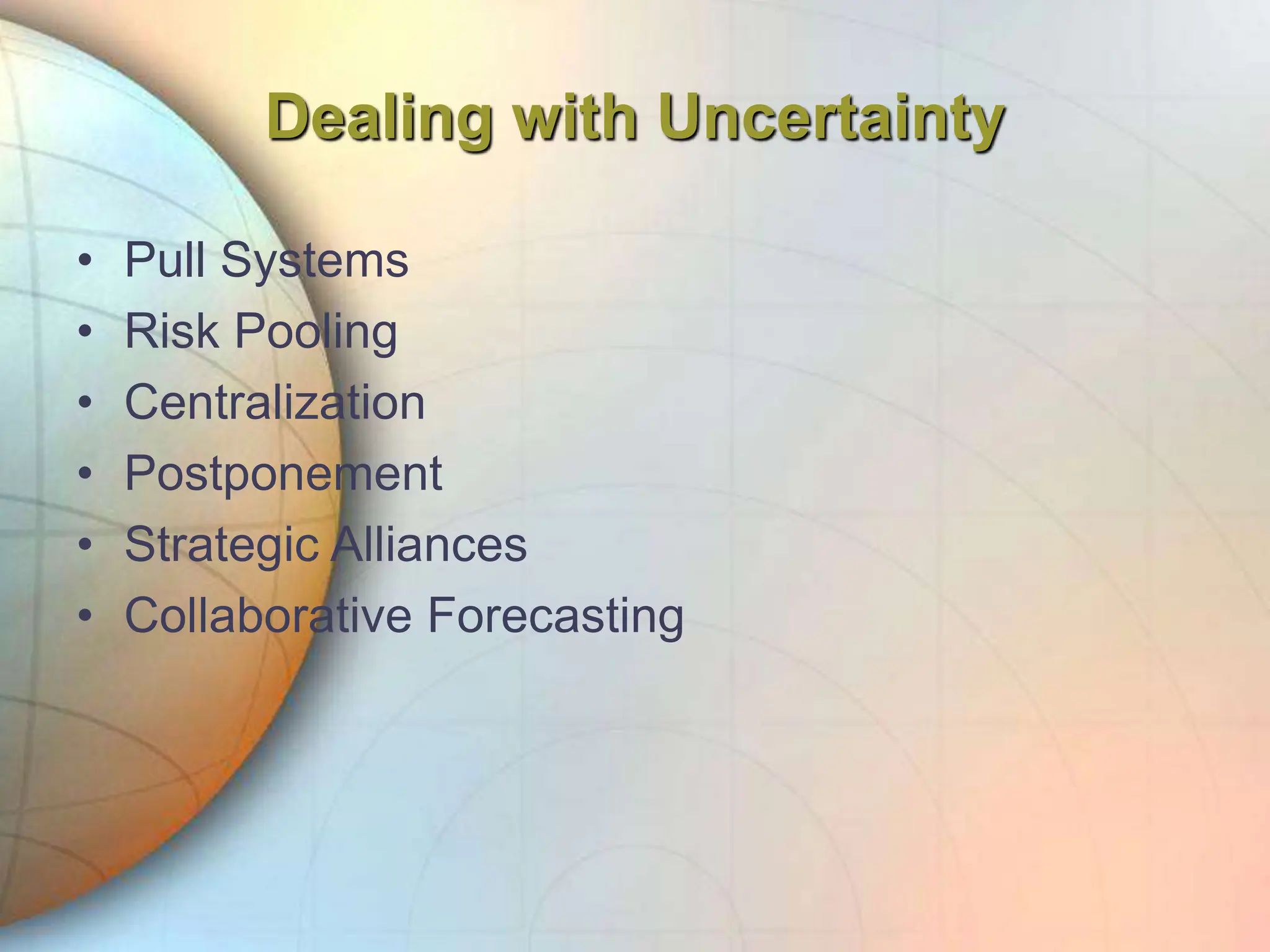
Dealing with Uncertainty
• Pull Systems
• Risk Pooling
• Centralization
• Postponement
• Strategic Alliances
• Collaborative Forecasting
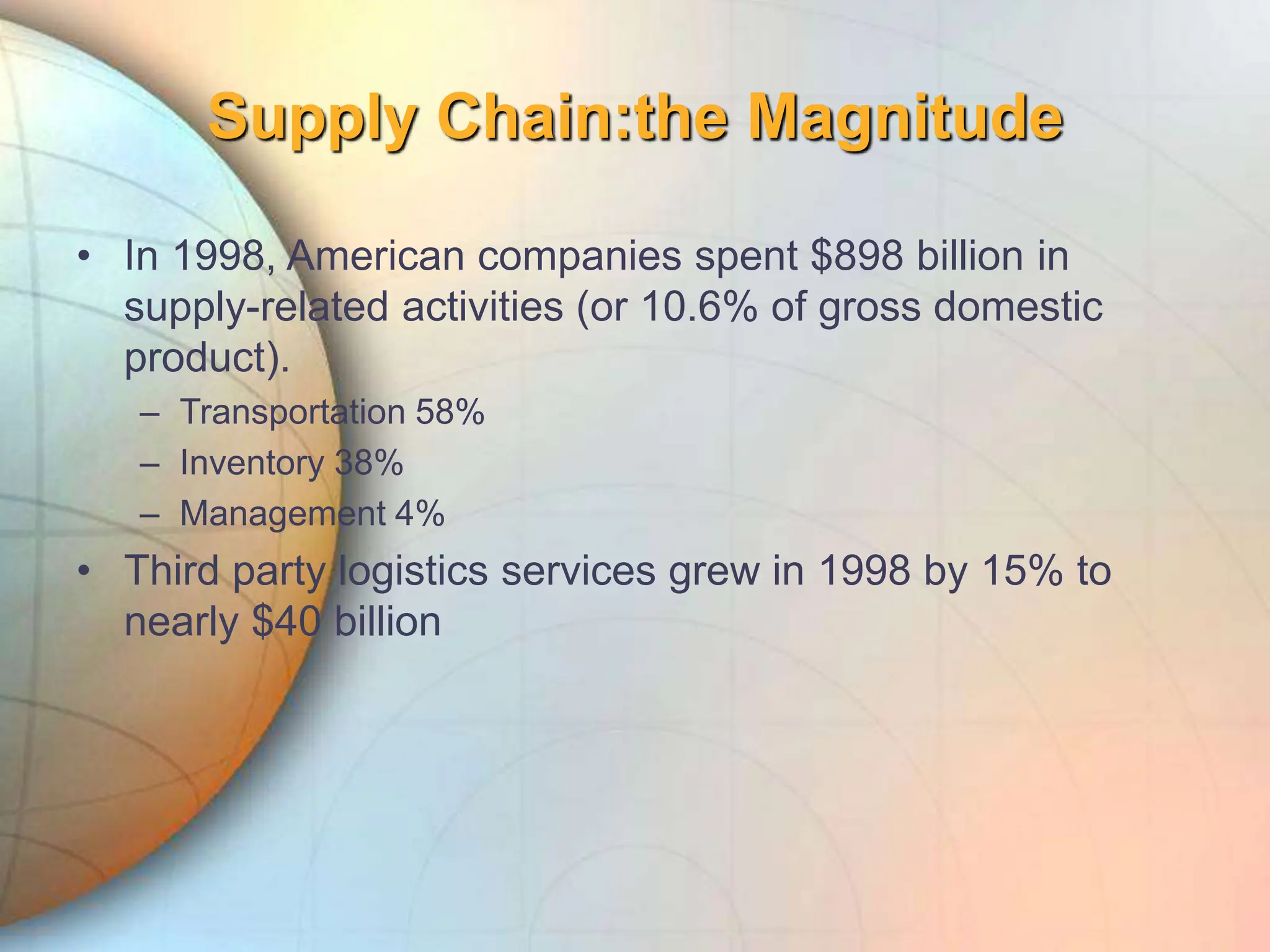
Supply Chain:the Magnitude
• In 1998, American companies spent $898 billion in
supply-related activities (or 10.6% of gross domestic
product).
– Transportation 58%
– Inventory 38%
– Management 4%
• Third party logistics services grew in 1998 by 15% to
nearly $40 billion
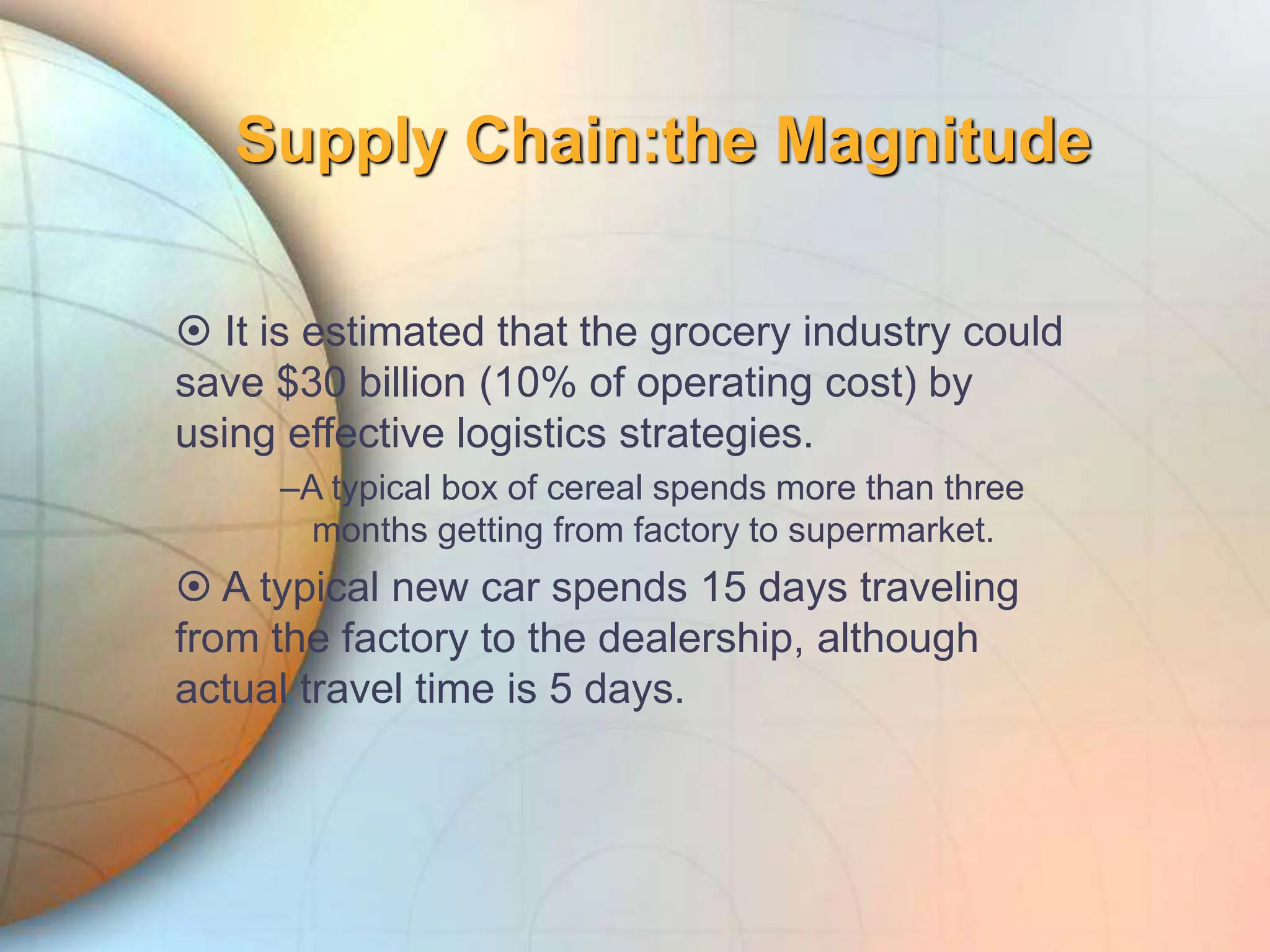
Supply Chain:the Magnitude
 It is estimated that the grocery industry could
save $30 billion (10% of operating cost) by
using effective logistics strategies.
–A typical box of cereal spends more than three
months getting from factory to supermarket.
 A typical new car spends 15 days traveling
from the factory to the dealership, although
actual travel time is 5 days.
Supply Chain: The Magnitude
 Compaq computer estimates it lost $500 million to $1 billion
in sales in 1995 because its laptops and desktops
were not available when and where customers were
ready to buy them.
 Boeing aircraft, one of America's leading capital goods
producers, was forced to announce write downs of
$2.6 billion in October 1997, due to “Raw material
shortages, internal and supplier parts shortages…”.
Supply Chain: The Potential
Procter & Gamble estimates that it saved retail
customers $65 million through logistics gains over the
past 18 months.
“According to P&G, the essence of its approach lies in
manufacturers and suppliers working closely together …. jointly
creating business plans to eliminate the source of wasteful
practices across the entire supply chain”.
(Journal of business strategy, Oct./Nov. 1997)
Supply Chain:the Potential
• In 10 years, Wal-Mart transformed itself by changing its
logistics system. It has the highest sales per
square foot, inventory turnover and operating
profit of any discount retailer.
• Dell Computer has outperformed the competition in
terms of shareholder value growth over the eight
years period, 1988-1996, by over 3,000% (see
Anderson and Lee, 1999) using
–Direct business model
–Build-to-order strategy.
What’s New?
• Global competition
• Shorter product life cycle
• New, low-cost distribution channels
• More powerful well-informed
customers
• Internet and E-Business strategies
H&B Wood Bats Process
ERP5
Overview—Supply System at Hillerich & Bradsby
Technology/Logistics
LO2
American President Line

Introduction of SCM and related basic concepts

  • 1.
    INTRODUCTION TO SUPPLYCHAIN MANAGEMENT
  • 2.
    Flows in aSupply Chain Customer Information Product Funds
  • 3.
    What is Knowledge? Acollection of data is not information. A collection of information is not knowledge. A collection of knowledge is not wisdom. A collection of wisdom is not truth.
  • 4.
    In the firsthalf of the twentieth century industry replaced agriculture, in the second half of the twentieth century – “service” has replaced “manufacturing” - and right now, the knowledge industry is beginning to replace the others. −−George Kotzmetzk
  • 5.
    Chapter Outline * Introduction *What is Supply Chain Management? * Why is Supply Chain Management important? * The origins of Supply Chain Management * Important Elements of Supply Chain Management: - Purchasing - Operations - Distribution - Integration * Strategies for Supply Chain Management * Future Trends in Supply Chain Management * The Beer Game
  • 6.
    What is aSupply Chain? A supply chain consists of the flow of products and services from/to: --Raw materials manufacturers SEE FIGURE 1.1 --Intermediate products manufacturers --End product manufacturers --Wholesalers and distributors --Retailers and, --End customers Connected by agents, transportation and storage activities, and Integrated through sharing of information, planning, and processing activities Examples???
  • 7.
  • 8.
    Figure 1.1 AGeneric Supply Chain End product manufacturer Wholesalers, distributors Intermediate component mfgs. Raw material suppliers Retailers End customers Product & service flow Information and planning
  • 9.
    Typical Supply Chains Purchasing ReceivingStorage Operations Storage Production Distribution
  • 10.
    Typical Supply Chainfor a Manufacturer Supplier Supplier Supplier Storage } Mfg. Storage Dist. Retailer Customer
  • 11.
  • 12.
    What is SupplyChain Management? Here are two definitions: The design and management of seamless, value-added process across organizational boundaries to meet the real needs of the end customer -- Institute for Supply Management Managing supply and demand, sourcing raw materials and parts, manufacturing and assembly, warehousing and inventory tracking, order entry and order management, distribution across all channels, and delivery to the customer -- The Supply Chain Council
  • 13.
    What Is theGoal of Supply Chain Management?.  Supply chain management is concerned with the efficient integration of suppliers, factories, warehouses and stores so that merchandise is produced and distributed: – In the right quantities – To the right locations – At the right time  In order to – Minimize total system cost – Satisfy customer service requirements
  • 14.
    Importance of SupplyChain Management * Firms have discovered value-enhancing and long term benefits * Who benefits most? Firms with: - Large inventories - Large number of suppliers - Complex products - Customers with large purchasing budgets * Benefits - Lower purchasing/inventory costs, higher quality/customer service
  • 15.
    Importance of SupplyChain Mgt. – Cont. Firms practicing Supply Chain Management: 1. Start with key suppliers 2. Move on to other suppliers, customers, and shippers 3. Integrate second tier suppliers and customers (second tier refers to the customer’s customers and the supplier’s suppliers)
  • 16.
    Importance of SupplyChain Mgt. – Cont. * Cost savings and better coordination of resources are reasons to employ Supply Chain Management -- Bullwhip Effect- the magnification of safety stocks and costs based on separate forecasts and uncoordinated planning and sharing of information along the supply chain (Ex. 1.1) * Reducing the bullwhip effect occurs through: -- Process integration- Interdependent activities can lead to improved quality, reduced cycle time, better production methods, better forecasts, less safety stock, etc.
  • 17.
    Important Elements ofSCM Purchasing- Supplier alliances, supplier management, strategic sourcing Operations- Demand management, MRP, ERP, JIT, TQM Distribution- Transportation management, customer relationship management, network design, service response logistics Integration- Coordination/Integration activities, global integration problems, performance measurement
  • 18.
    Important Elements ofSCM-Cont. Purchasing: •Long term relationships •Supplier management- improved performance through- -- Supplier evaluation (determining supplier capabilities and performance) -- Supplier certification (third party or internal certification to assure product quality and service compliance) •Strategic partnerships- successful and trusting, long-term relationships with top-performing suppliers
  • 19.
    Important Elements ofSupply Chain Management-Cont. Operations: -- Demand management- match demand to available capacity -- Linking buyers & suppliers via MRP and ERP systems -- Use JIT to improve the “pull” of materials to reduce inventory levels -- Employ TQM to improve quality compliance among buyers and suppliers
  • 20.
    Important Elements ofSupply Chain Management-Cont. Distribution: -- Transportation management- tradeoff decisions between cost & timing of delivery/customer service via trucks, rail, water & air -- Customer relationship management- strategies to ensure deliveries, resolve complaints, improve communications, & determine service requirements -- Network design- creating distribution networks based on tradeoff decisions between cost & sophistication of distribution system
  • 21.
    Important Elements ofSupply Chain Management-Cont. Integration: -- Supply Chain Integration- when supply chain participants work for common goals. Requires intrafirm functional integration. Based on efforts to change attitudes & adversarial relationships -- Global Supply Chains- advantages that accrue from sourcing from larger global market e.g., lower cost & higher quality suppliers. May involve operating exposure, which is risk found in foreign settings -- Supply Chain Performance Measurement- Crucial for firms to know if procedures are working
  • 22.
    Strategies for SCM Allof the advanced strategies, techniques, and approaches for Supply Chain Management focus on: Global Optimization Managing Uncertainty
  • 23.
    Optimization * What isit? * Why is it important? * What tools and approaches help?
  • 24.
    Tools and Strategiesfor Optimization • Decision Support Systems • Inventory Control • Network Design • Design for Logistics • Cross Docking
  • 25.
    Global Optimization  Whatis it?  Why is it different/better than local optimization?  What are conflicting supply chain objectives?  What tools and approaches help with global optimization?
  • 26.
    Procurement Planning Manufacturing Planning Distribution Planning Demand Planning Sequential Optimization Supply Contracts/Collaboration/InformationSystems and DSS Procurement Planning Manufacturing Planning Distribution Planning Demand Planning Global Optimization Sequential Optimization vs. Global Optimization Source: Duncan McFarlane
  • 27.
    Why is GlobalOptimization Hard? –The supply chain is complex –Different facilities have conflicting objectives –The supply chain is a dynamic system –The power structure changes –The system varies over time
  • 28.
    Uncertainty • What isvariation? • What is randomness? • What tools and approaches help us to deal with these issues?
  • 29.
    Can’t Forecasting Help? Forecasting is always wrong  The longer the forecast horizon the worse the forecast  End item forecasts are even more wrong
  • 30.
    Why Is UncertaintyHard to Deal With? * Matching supply and demand is difficult. * Forecasting doesn’t solve the problem. * Inventory and back-order levels typically fluctuate widely across the supply chain. * Demand is not the only source of uncertainty: – Lead times – Yields – Transportation times – Natural Disasters – Component Availability
  • 31.
    Supply Chain Variability Volumes Time Source:Tom Mc Guffry, Electronic Commerce and Value Chain Management, 1998 Actual Consumer Demand Retailer Warehouse to Shop Retailer Orders Production Plan Manufacturer Forecast of Sales
  • 32.
    What Management Gets... Volumes Time Source:Tom Mc Guffry, Electronic Commerce and Value Chain Management, 1998 Consumer Demand Production Plan
  • 33.
    What Management Wants… Volumes Time Source:Tom Mc Guffry, Electronic Commerce and Value Chain Management, 1998 Consumer Demand Production Plan
  • 34.
    Dealing with Uncertainty •Pull Systems • Risk Pooling • Centralization • Postponement • Strategic Alliances • Collaborative Forecasting
  • 35.
    Supply Chain:the Magnitude •In 1998, American companies spent $898 billion in supply-related activities (or 10.6% of gross domestic product). – Transportation 58% – Inventory 38% – Management 4% • Third party logistics services grew in 1998 by 15% to nearly $40 billion
  • 36.
    Supply Chain:the Magnitude It is estimated that the grocery industry could save $30 billion (10% of operating cost) by using effective logistics strategies. –A typical box of cereal spends more than three months getting from factory to supermarket.  A typical new car spends 15 days traveling from the factory to the dealership, although actual travel time is 5 days.
  • 37.
    Supply Chain: TheMagnitude  Compaq computer estimates it lost $500 million to $1 billion in sales in 1995 because its laptops and desktops were not available when and where customers were ready to buy them.  Boeing aircraft, one of America's leading capital goods producers, was forced to announce write downs of $2.6 billion in October 1997, due to “Raw material shortages, internal and supplier parts shortages…”.
  • 38.
    Supply Chain: ThePotential Procter & Gamble estimates that it saved retail customers $65 million through logistics gains over the past 18 months. “According to P&G, the essence of its approach lies in manufacturers and suppliers working closely together …. jointly creating business plans to eliminate the source of wasteful practices across the entire supply chain”. (Journal of business strategy, Oct./Nov. 1997)
  • 39.
    Supply Chain:the Potential •In 10 years, Wal-Mart transformed itself by changing its logistics system. It has the highest sales per square foot, inventory turnover and operating profit of any discount retailer. • Dell Computer has outperformed the competition in terms of shareholder value growth over the eight years period, 1988-1996, by over 3,000% (see Anderson and Lee, 1999) using –Direct business model –Build-to-order strategy.
  • 40.
    What’s New? • Globalcompetition • Shorter product life cycle • New, low-cost distribution channels • More powerful well-informed customers • Internet and E-Business strategies
  • 41.
    H&B Wood BatsProcess ERP5 Overview—Supply System at Hillerich & Bradsby
  • 42.