SUPERVISED LEARNING:
DECISION TREE
Tujuan Pembelajaran
• Mahasiswa dapat memahami perbedaan konsep pembelajaran
tersupervisi (supervised learning) dan pembelajaran tidak tersupervisi
(unsupervised learning).
• Mahasiswa dapat memahami konsep pembelajaran (learning)
tersupervisi, khususnya menggunakan metode Decision Tree (DT)
Topik Pembahasan
Pengantar
Supervised vs Unsupervised Learning
Decision Tree
Pembentukan Tree dalam Decision Tree
Latihan
Pengantar
• Learning: Kemampuan AI untuk belajar dari pengetahuan (fakta, data,
informasi) yang telah terjadi sebelumnya untuk menyelesaikan suatu
permasalahan baru.
Pengantar
Algoritma pembelajaran mesin mampu menginterpretasikan dan
mengolah data terdahulu untuk menyelesaikan permasalahan baru
Supervised vs Unsupervised Learning
Kita “melatih model”,
lalu dengan pengetahuan
tersebut, si model dapat
memprediksikan data
yang baru atau belum
diketahui
SUPERVISED LEARNING
Supervised vs Unsupervised Learning
Model / algoritma
berusaha untuk
menemukan
pengetahuan (pola,
informasi, dll) dari
sekumpulan data
UNSUPERVISED LEARNING
Supervised vs Unsupervised Learning
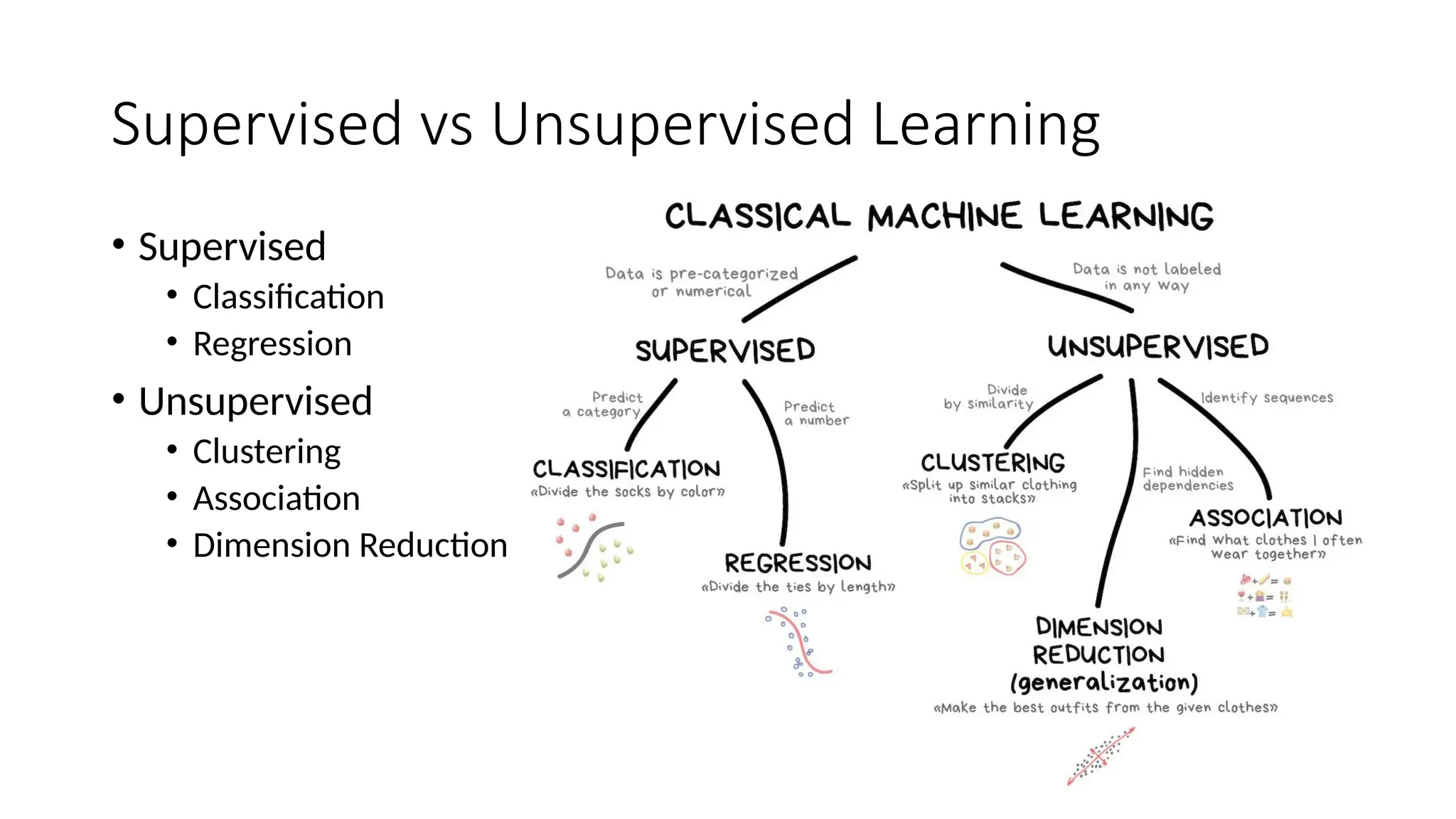
• Supervised
• Classification
• Regression
• Unsupervised
• Clustering
• Association
• Dimension Reduction
Classification vs Regression
• Klasifikasi berusaha memprediksi label atau kelas yang bersifat diskret / kategorikal
 Regresi berusaha memprediksi label atau kelas yang bersifat kontinu / numerik
Algoritma Klasifikasi
• Logistic Regression.
• Naïve Bayes.
• Stochastic Gradient Descent.
• K-Nearest Neighbours.
• Decision Tree.
• Random Forest.
• Support Vector Machine.
ALGORITMA DECISION TREE
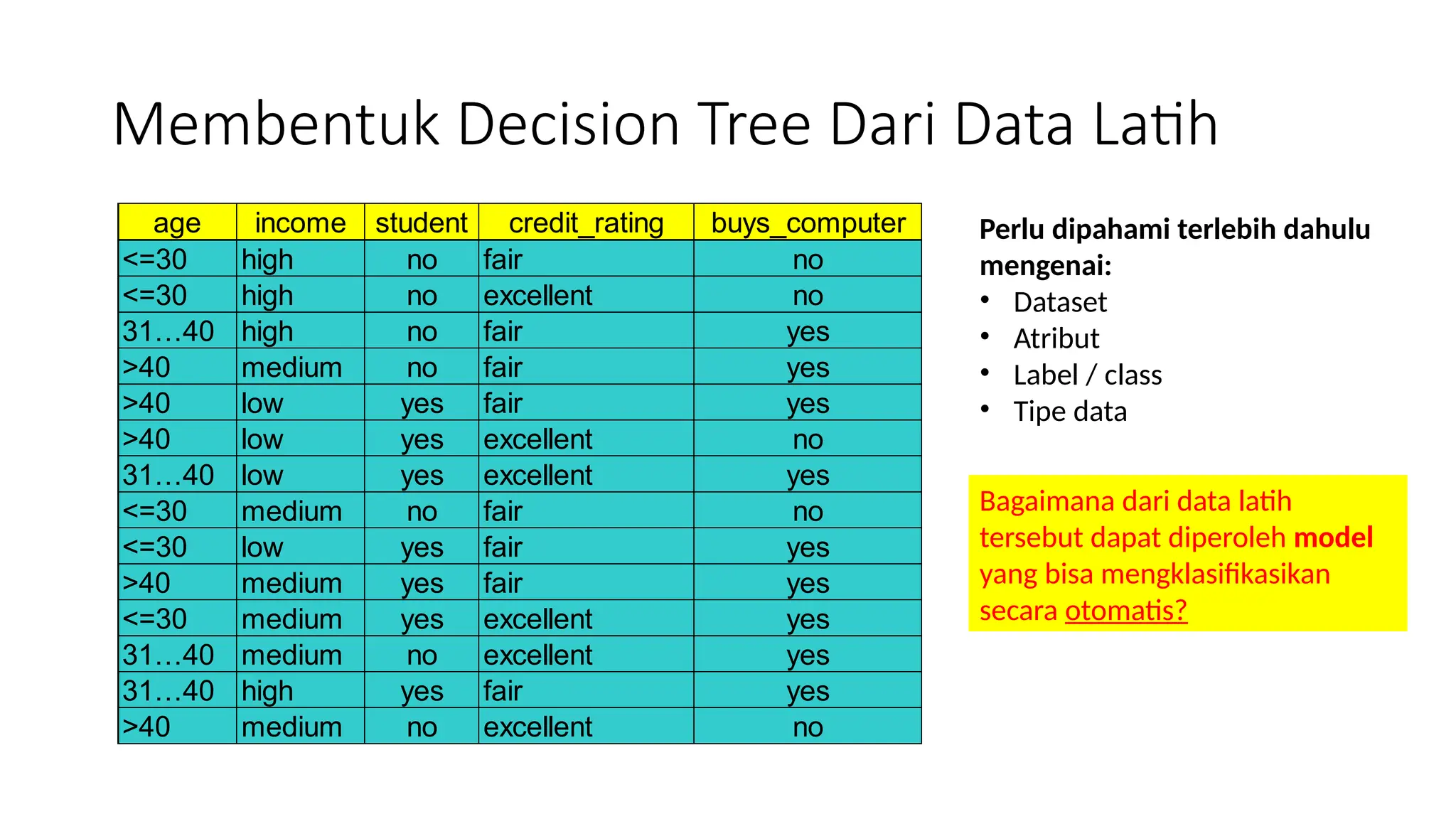
Membentuk Decision Tree Dari Data Latih
age income student credit_rating buys_computer
<=30 high no fair no
<=30 high no excellent no
31…40 high no fair yes
>40 medium no fair yes
>40 low yes fair yes
>40 low yes excellent no
31…40 low yes excellent yes
<=30 medium no fair no
<=30 low yes fair yes
>40 medium yes fair yes
<=30 medium yes excellent yes
31…40 medium no excellent yes
31…40 high yes fair yes
>40 medium no excellent no
Perlu dipahami terlebih dahulu
mengenai:
• Dataset
• Atribut
• Label / class
• Tipe data
Bagaimana dari data latih
tersebut dapat diperoleh model
yang bisa mengklasifikasikan
secara otomatis?
Membangun Decision Tree Dari Data Latih
age income student credit_rating buys_computer
<=30 high no fair no
<=30 high no excellent no
31…40 high no fair yes
>40 medium no fair yes
>40 low yes fair yes
>40 low yes excellent no
31…40 low yes excellent yes
<=30 medium no fair no
<=30 low yes fair yes
>40 medium yes fair yes
<=30 medium yes excellent yes
31…40 medium no excellent yes
31…40 high yes fair yes
>40 medium no excellent no
age?
student? credit rating?
<=30 >40
no yes yes
yes
31..40
no
fair
excellent
yes
no
Model Decision Tree
Rule:
IF ((age<=30) and (student) ) OR (age=31..40) OR
((age>40) and (credit_rating=fair))
THEN
BELI_PC=YES
Membangun Decision Tree Dari Data Latih
age income student credit_rating buys_computer
<=30 high no fair no
<=30 high no excellent no
31…40 high no fair yes
>40 medium no fair yes
>40 low yes fair yes
>40 low yes excellent no
31…40 low yes excellent yes
<=30 medium no fair no
<=30 low yes fair yes
>40 medium yes fair yes
<=30 medium yes excellent yes
31…40 medium no excellent yes
31…40 high yes fair yes
>40 medium no excellent no
age?
student? credit rating?
<=30 >40
no yes yes
yes
31..40
no
fair
excellent
yes
no
Model Decision Tree
Bagaimana memilih atribut mana
yang menjadi root? Disajikan terlebih
dahulu, dst
Memilih Atribut Terbaik
age income student credit_rating buys_computer
<=30 high no fair no
<=30 high no excellent no
31…40 high no fair yes
>40 medium no fair yes
>40 low yes fair yes
>40 low yes excellent no
31…40 low yes excellent yes
<=30 medium no fair no
<=30 low yes fair yes
>40 medium yes fair yes
<=30 medium yes excellent yes
31…40 medium no excellent yes
31…40 high yes fair yes
>40 medium no excellent no
Yes
No
student?
yes no
Atribut “student” kurang cocok
sebagai pemisah, karena tidak
dapat memisahkan label dengan
baik
Kita coba atribut “student”
Memilih Atribut Terbaik
age income student credit_rating buys_computer
<=30 high no fair no
<=30 high no excellent no
31…40 high no fair yes
>40 medium no fair yes
>40 low yes fair yes
>40 low yes excellent no
31…40 low yes excellent yes
<=30 medium no fair no
<=30 low yes fair yes
>40 medium yes fair yes
<=30 medium yes excellent yes
31…40 medium no excellent yes
31…40 high yes fair yes
>40 medium no excellent no
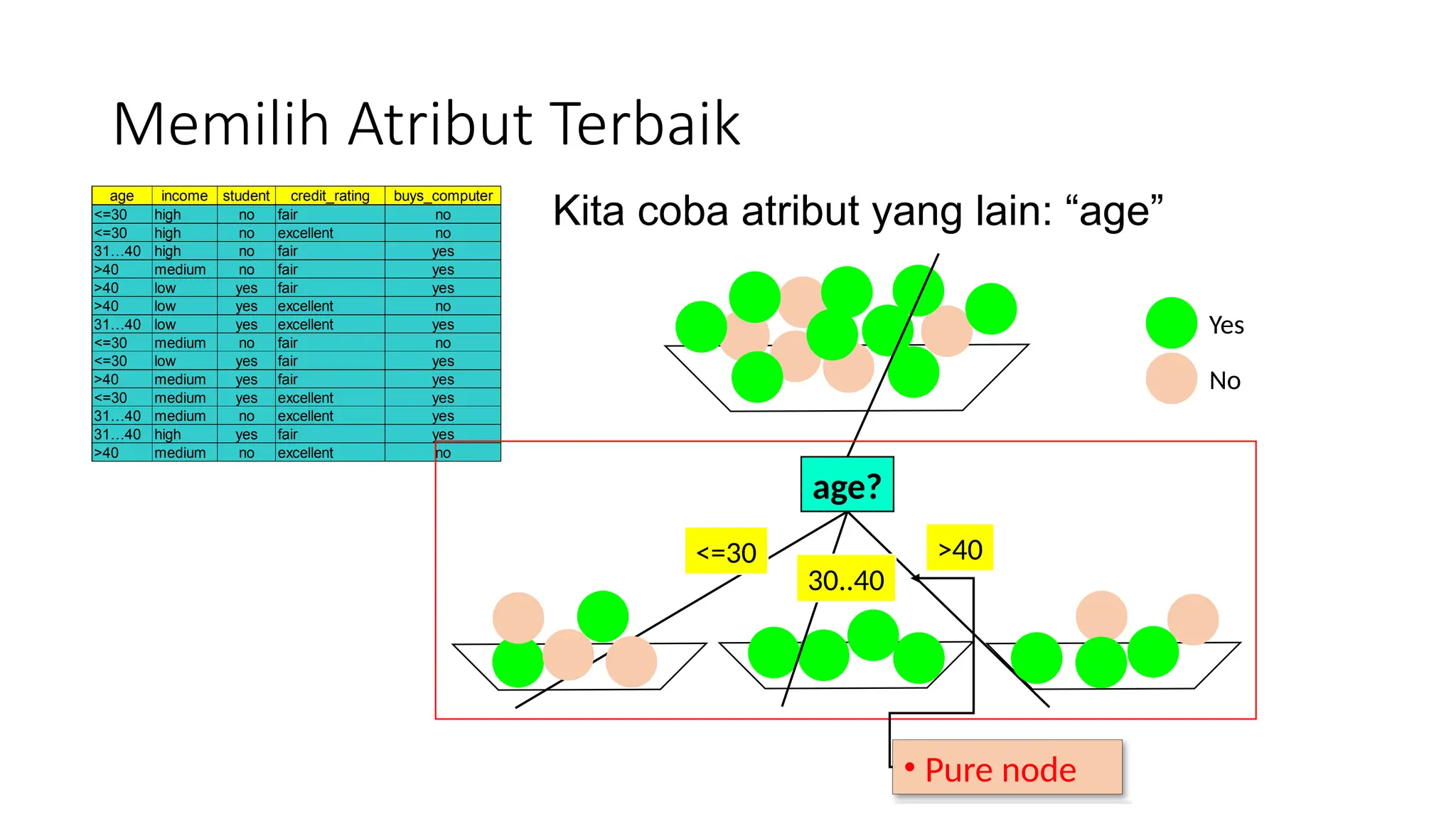
Kita coba atribut yang lain: “age”
age?
Yes
No
<=30 >40
30..40
Atribut “age” cocok sebagai pemisah,
karena dapat memisahkan label dengan
baik
Memilih Atribut Terbaik
age income student credit_rating buys_computer
<=30 high no fair no
<=30 high no excellent no
31…40 high no fair yes
>40 medium no fair yes
>40 low yes fair yes
>40 low yes excellent no
31…40 low yes excellent yes
<=30 medium no fair no
<=30 low yes fair yes
>40 medium yes fair yes
<=30 medium yes excellent yes
31…40 medium no excellent yes
31…40 high yes fair yes
>40 medium no excellent no
age?
Yes
No
<=30 >40
Kita coba atribut yang lain: “age”
30..40
• More Predictiveness
• Less Impurity
• Lower Entropy
Memilih Atribut Terbaik
age income student credit_rating buys_computer
<=30 high no fair no
<=30 high no excellent no
31…40 high no fair yes
>40 medium no fair yes
>40 low yes fair yes
>40 low yes excellent no
31…40 low yes excellent yes
<=30 medium no fair no
<=30 low yes fair yes
>40 medium yes fair yes
<=30 medium yes excellent yes
31…40 medium no excellent yes
31…40 high yes fair yes
>40 medium no excellent no
age?
Yes
No
<=30 >40
Kita coba atribut yang lain: “age”
30..40
• Pure node
Entropy
• Ukuran kemurnian,
keberagaman, randomness
atau uncertainty
• Nilai entropy semakin kecil,
distribusi semakin homogen,
node semakin murni (pure)
1 yes
7 no
Entropy rendah
3 yes
5 no
Entropy tinggi
0 yes
8 no
Entropy = 0
4 yes
4 no
Entropy = 1
)
(
log
)
( 2
1
i
m
i
i p
p
D
Info 



*Info(D) = Entropy (D)
Perhitungan Entropy
age income student credit_rating buys_computer
<=30 high no fair no
<=30 high no excellent no
31…40 high no fair yes
>40 medium no fair yes
>40 low yes fair yes
>40 low yes excellent no
31…40 low yes excellent yes
<=30 medium no fair no
<=30 low yes fair yes
>40 medium yes fair yes
<=30 medium yes excellent yes
31…40 medium no excellent yes
31…40 high yes fair yes
>40 medium no excellent no
940
.
0
)
14
5
(
log
14
5
)
14
9
(
log
14
9
)
5
,
9
(
)
( 2
2 



I
D
Info
Hitung entropy dari class / label “buys_computer”
(entropy data)
1
• buys_computer = “yes”  9 data
• buys_computer = “no”  5 data
• Total  14 data
)
(
log
)
( 2
1
i
m
i
i p
p
D
Info 


 )
(
|
|
|
|
)
(
1
j
v
j
j
A D
I
D
D
D
Info 


Perhitungan Entropy
age income student credit_rating buys_computer
<=30 high no fair no
<=30 high no excellent no
31…40 high no fair yes
>40 medium no fair yes
>40 low yes fair yes
>40 low yes excellent no
31…40 low yes excellent yes
<=30 medium no fair no
<=30 low yes fair yes
>40 medium yes fair yes
<=30 medium yes excellent yes
31…40 medium no excellent yes
31…40 high yes fair yes
>40 medium no excellent no
Hitung entropy dari setiap atribut
694
,
0
)
2
,
3
(
14
5
)
0
,
4
(
14
4
)
3
,
2
(
14
5
)
( 


 I
I
I
D
Infoage
2
Atribut “age”
age “yes” “no” I(yes,no)
<=30 2 3 0,971
31..40 4 0 0
>40 3 2 0,971
)
(
log
)
( 2
1
i
m
i
i p
p
D
Info 


 )
(
|
|
|
|
)
(
1
j
v
j
j
A D
I
D
D
D
Info 


971
,
0
)
5
3
(
log
5
3
)
3
2
(
log
5
2
)
3
,
2
(
)
3
,
2
( 2
2 



I
Info
Perhitungan Entropy
age income student credit_rating buys_computer
<=30 high no fair no
<=30 high no excellent no
31…40 high no fair yes
>40 medium no fair yes
>40 low yes fair yes
>40 low yes excellent no
31…40 low yes excellent yes
<=30 medium no fair no
<=30 low yes fair yes
>40 medium yes fair yes
<=30 medium yes excellent yes
31…40 medium no excellent yes
31…40 high yes fair yes
>40 medium no excellent no
Hitung entropy dari setiap atribut
911
,
0
)
2
,
2
(
14
4
)
2
,
4
(
14
6
)
1
,
3
(
14
4
)
( 


 I
I
I
D
Infoincome
3
Atribut “income”
income “yes” “no” I(yes,no)
low 3 1 0,811
medium 4 2 0,918
high 2 2 1
)
(
log
)
( 2
1
i
m
i
i p
p
D
Info 


 )
(
|
|
|
|
)
(
1
j
v
j
j
A D
I
D
D
D
Info 


Perhitungan Entropy
age income student credit_rating buys_computer
<=30 high no fair no
<=30 high no excellent no
31…40 high no fair yes
>40 medium no fair yes
>40 low yes fair yes
>40 low yes excellent no
31…40 low yes excellent yes
<=30 medium no fair no
<=30 low yes fair yes
>40 medium yes fair yes
<=30 medium yes excellent yes
31…40 medium no excellent yes
31…40 high yes fair yes
>40 medium no excellent no
Hitung entropy dari setiap atribut
788
,
0
)
4
,
3
(
14
7
)
1
,
6
(
14
7
)
( 

 I
I
D
Infostudent
4
Atribut “student”
student “yes” “no” I(yes,no)
yes 6 1 0,592
no 3 4 0,985
)
(
log
)
( 2
1
i
m
i
i p
p
D
Info 


 )
(
|
|
|
|
)
(
1
j
v
j
j
A D
I
D
D
D
Info 


Perhitungan Entropy
age income student credit_rating buys_computer
<=30 high no fair no
<=30 high no excellent no
31…40 high no fair yes
>40 medium no fair yes
>40 low yes fair yes
>40 low yes excellent no
31…40 low yes excellent yes
<=30 medium no fair no
<=30 low yes fair yes
>40 medium yes fair yes
<=30 medium yes excellent yes
31…40 medium no excellent yes
31…40 high yes fair yes
>40 medium no excellent no
Hitung entropy dari setiap atribut
892
,
0
)
3
,
3
(
14
6
)
2
,
6
(
14
8
)
(
_ 

 I
I
D
Info rating
credit
5
Atribut “credit_rating”
credit_rating “yes” “no” I(yes,no)
fair 6 2 0,811
excellent 3 3 1
)
(
log
)
( 2
1
i
m
i
i p
p
D
Info 


 )
(
|
|
|
|
)
(
1
j
v
j
j
A D
I
D
D
D
Info 


Information Gain
• Information gain (sering disebut “gain” saja)
merupakan informasi / nilai peningkatan
derajat kepastian dari suatu atribut setelah
dipecah (split)
• Gain(A) menggambarkan seberapa besar
entropy berkurang akibat atribut A.
Semakin besar, semakin bagus. student?
yes no
E = 0,940
E = 0,592 E = 0,985
Entropi sebelum dipecah
Entropi setelah dipecah
(D)
Info
Info(D)
Gain(A) A


Hitung Information Gain Setiap Atribut
• Gain (age) = 0,940 – 0,694 = 0,246
• Gain (income) = 0,940 – 0,911 = 0,029
• Gain (student) = 0,940 – 0,788 = 0,152
• Gain (credit_rating) = 0,940 – 0,892 = 0,048
(D)
Info
Info(D)
Gain(A) A


Atribut “age” memiliki nilai
information gain yang
tertinggi, sehingga dipilih
sebagai node awal (root)
Atribut Entropi Atribut
buys_computer 0,904
age 0,694
income 0,911
student 0,788
credit_rating 0,892
Membentuk Decision Tree
• Setelah atribut “age”, atribut
apa selanjutnya?
• Diproses untuk setiap cabang
selama masih ada > 1 kelas
age?
? ?
<=30 >40
yes
31..40
age income student credit_rating buys_computer
<=30 high no fair no
<=30 high no excellent no
31…40 high no fair yes
>40 medium no fair yes
>40 low yes fair yes
>40 low yes excellent no
31…40 low yes excellent yes
<=30 medium no fair no
<=30 low yes fair yes
>40 medium yes fair yes
<=30 medium yes excellent yes
31…40 medium no excellent yes
31…40 high yes fair yes
>40 medium no excellent no
Tidak perlu diproses, karena
hanya 1 kemungkinan kelas
Membentuk Decision Tree
age income student credit_rating buys_computer
<=30 high no fair no
<=30 high no excellent no
<=30 medium no fair no
<=30 low yes fair yes
<=30 medium yes excellent yes
Selanjutnya... proses data age<=30
Hitung Gain atribut:
• Gain(Age): tidak perlu dihitung lagi
• Gain(income)
• Gain(student)
• Gain(credit_rating)
97
.
0
)
5
3
(
log
5
3
)
5
2
(
log
5
2
)
3
,
2
(
)
( 2
2 



I
D
Info
0
)
0
,
2
(
5
2
)
3
,
0
(
5
3
)
( 

 I
I
D
Infostudent Gain (student) = Info(D) – Infostudent(D) = 0.97 – 0 = 0.97
95
.
0
)
1
,
1
(
5
2
)
2
,
1
(
5
3
)
(
_ 

 I
I
D
Info rating
credit Gain (credit_rating) = Info(D) – Infocredit_rating(D) = 0.97 – 0.95 = 0.02
4
.
0
)
0
,
1
(
5
1
)
1
,
1
(
5
2
)
2
,
0
(
5
2
)
( 


 I
I
I
D
Infoincome Gain (income) = Info(D) – Infoincome(D) = 0.97 – 0.4 = 0.57
Membentuk Decision Tree
age?
student? ?
<=30 >40
yes
31..40
yes
no
no yes
LANJUTKAN…
Cara lain dalam membentuk Decision Tree
• Menggunakan Gini Index (GI) atau Impurity
• Langkah:
• Menghitung Gini Index (GI) untuk setiap atribut
• Menentukan root berdasarkan nilai GI. Root adalah
atribut dengan nilai GI terkecil.
• Ulangi langkah 1 dan 2 untuk level berikutnya pada tree
hingga nilai GI = 0.
Kapan Menggunakan Decision Tree?
• Data dalam bentuk atribut-nilai. Kondisi ideal adalah jika isi nilai
jumlahnya sedikit. Misalnya: “panas”, “sedang”, “dingin”.
• Output diskrit.
• Training data dapat tidak lengkap
Kelebihan dan Kekurangan Decision Tree
• Kelebihan:
• Mudah diimplementasikan
• Hipotesis yang dihasilkan mudah dipahami
• Efisien
• Kekurangan:
• Overfitting: terlalu mengikuti training data
• Terlalu banyak cabang, merefleksikan anomali akibat noise atau outlier.
• Akurasi rendah untuk data baru
• Proses pembangunan pohon keputusan pada data numerik menjadi lebih rumit
dan memungkinkan terdapat informasi yang hilang
• Pohon keputusan dapat tumbuh menjadi sangat kompleks pada data yang rumit.
Pengembangan Decision Tree
• Mengatasi overfitting
• Pre-pruning: Hentikan pembuatan tree di awal. Tidak mensplit node jika
goodness measure dibawah threshold.
• Post-pruning: Buang cabang setelah tree jadi
• Pengembangan Metode:
• C4.5, C5.0
• Conditional Decision Tree
• Gradient-boosted Trees
• Random Forest
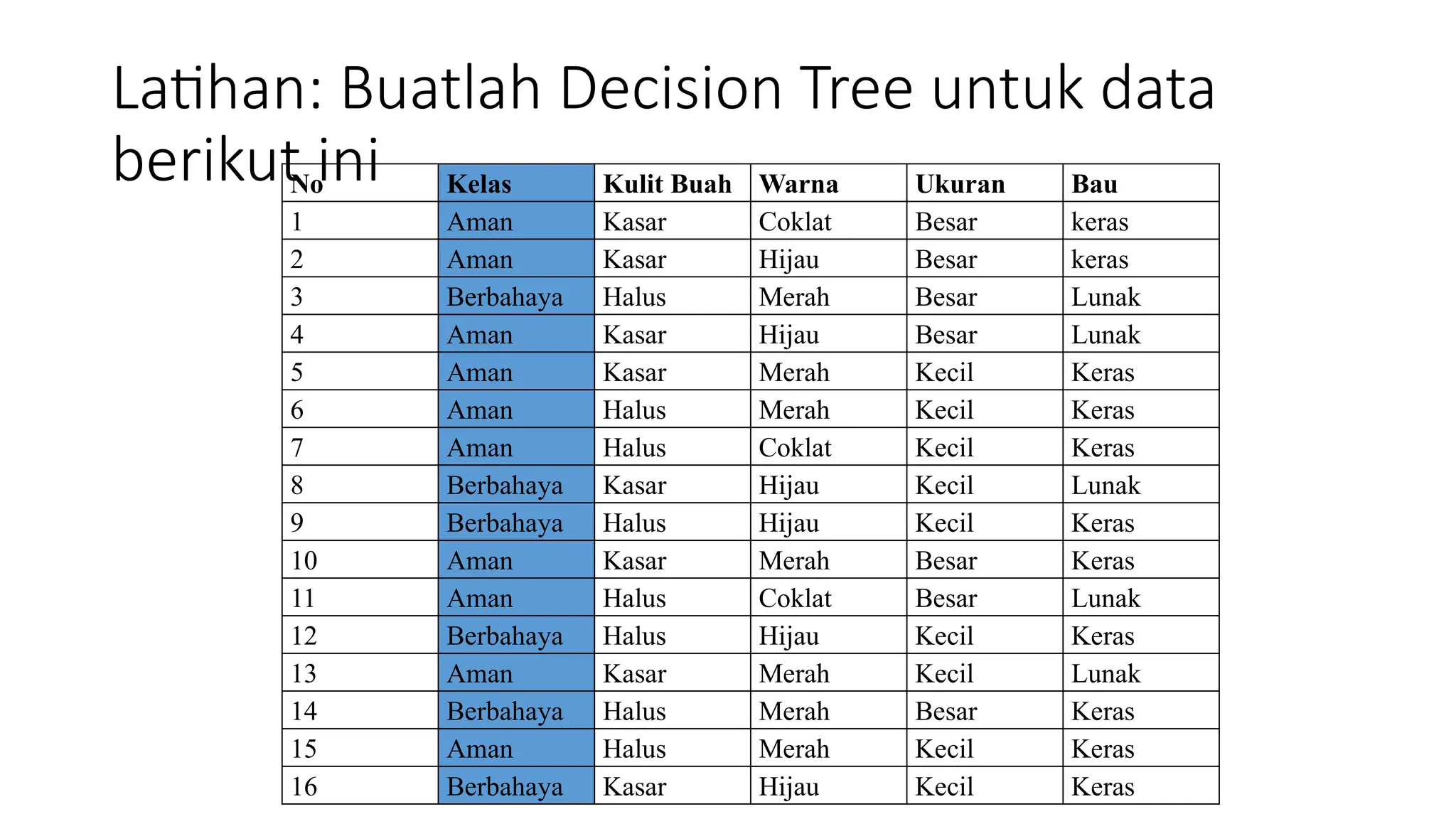
Latihan: Buatlah Decision Tree untuk data
berikut ini
No Kelas Kulit Buah Warna Ukuran Bau
1 Aman Kasar Coklat Besar keras
2 Aman Kasar Hijau Besar keras
3 Berbahaya Halus Merah Besar Lunak
4 Aman Kasar Hijau Besar Lunak
5 Aman Kasar Merah Kecil Keras
6 Aman Halus Merah Kecil Keras
7 Aman Halus Coklat Kecil Keras
8 Berbahaya Kasar Hijau Kecil Lunak
9 Berbahaya Halus Hijau Kecil Keras
10 Aman Kasar Merah Besar Keras
11 Aman Halus Coklat Besar Lunak
12 Berbahaya Halus Hijau Kecil Keras
13 Aman Kasar Merah Kecil Lunak
14 Berbahaya Halus Merah Besar Keras
15 Aman Halus Merah Kecil Keras
16 Berbahaya Kasar Hijau Kecil Keras
REFERENSI
• Russel, S., & Norvig, P. (2003). Artificial Intelligence A Modern
Approach . New Jersey : Pearson Education, Inc.
• Slide Jiawei Han http://www.cs.uiuc.edu/~hanj/bk2/
• Course “Machine Learning with Python” dari CognitiveClass.Ai
• Slide Materi Pelatihan Digital Talent Academy – Kominfo.
• https://towardsdatascience.com/supervised-vs-unsupervised-learning
-in-2-minutes-72dad148f242

Supervised Learning (Decision Tree).pptx

  • 1.
  • 2.
    Tujuan Pembelajaran • Mahasiswadapat memahami perbedaan konsep pembelajaran tersupervisi (supervised learning) dan pembelajaran tidak tersupervisi (unsupervised learning). • Mahasiswa dapat memahami konsep pembelajaran (learning) tersupervisi, khususnya menggunakan metode Decision Tree (DT)
  • 3.
    Topik Pembahasan Pengantar Supervised vsUnsupervised Learning Decision Tree Pembentukan Tree dalam Decision Tree Latihan
  • 4.
    Pengantar • Learning: KemampuanAI untuk belajar dari pengetahuan (fakta, data, informasi) yang telah terjadi sebelumnya untuk menyelesaikan suatu permasalahan baru.
  • 5.
    Pengantar Algoritma pembelajaran mesinmampu menginterpretasikan dan mengolah data terdahulu untuk menyelesaikan permasalahan baru
  • 6.
    Supervised vs UnsupervisedLearning Kita “melatih model”, lalu dengan pengetahuan tersebut, si model dapat memprediksikan data yang baru atau belum diketahui SUPERVISED LEARNING
  • 7.
    Supervised vs UnsupervisedLearning Model / algoritma berusaha untuk menemukan pengetahuan (pola, informasi, dll) dari sekumpulan data UNSUPERVISED LEARNING
  • 8.
    Supervised vs UnsupervisedLearning • Supervised • Classification • Regression • Unsupervised • Clustering • Association • Dimension Reduction
  • 9.
    Classification vs Regression •Klasifikasi berusaha memprediksi label atau kelas yang bersifat diskret / kategorikal  Regresi berusaha memprediksi label atau kelas yang bersifat kontinu / numerik
  • 10.
    Algoritma Klasifikasi • LogisticRegression. • Naïve Bayes. • Stochastic Gradient Descent. • K-Nearest Neighbours. • Decision Tree. • Random Forest. • Support Vector Machine.
  • 11.
  • 12.
    Membentuk Decision TreeDari Data Latih age income student credit_rating buys_computer <=30 high no fair no <=30 high no excellent no 31…40 high no fair yes >40 medium no fair yes >40 low yes fair yes >40 low yes excellent no 31…40 low yes excellent yes <=30 medium no fair no <=30 low yes fair yes >40 medium yes fair yes <=30 medium yes excellent yes 31…40 medium no excellent yes 31…40 high yes fair yes >40 medium no excellent no Perlu dipahami terlebih dahulu mengenai: • Dataset • Atribut • Label / class • Tipe data Bagaimana dari data latih tersebut dapat diperoleh model yang bisa mengklasifikasikan secara otomatis?
  • 13.
    Membangun Decision TreeDari Data Latih age income student credit_rating buys_computer <=30 high no fair no <=30 high no excellent no 31…40 high no fair yes >40 medium no fair yes >40 low yes fair yes >40 low yes excellent no 31…40 low yes excellent yes <=30 medium no fair no <=30 low yes fair yes >40 medium yes fair yes <=30 medium yes excellent yes 31…40 medium no excellent yes 31…40 high yes fair yes >40 medium no excellent no age? student? credit rating? <=30 >40 no yes yes yes 31..40 no fair excellent yes no Model Decision Tree Rule: IF ((age<=30) and (student) ) OR (age=31..40) OR ((age>40) and (credit_rating=fair)) THEN BELI_PC=YES
  • 14.
    Membangun Decision TreeDari Data Latih age income student credit_rating buys_computer <=30 high no fair no <=30 high no excellent no 31…40 high no fair yes >40 medium no fair yes >40 low yes fair yes >40 low yes excellent no 31…40 low yes excellent yes <=30 medium no fair no <=30 low yes fair yes >40 medium yes fair yes <=30 medium yes excellent yes 31…40 medium no excellent yes 31…40 high yes fair yes >40 medium no excellent no age? student? credit rating? <=30 >40 no yes yes yes 31..40 no fair excellent yes no Model Decision Tree Bagaimana memilih atribut mana yang menjadi root? Disajikan terlebih dahulu, dst
  • 15.
    Memilih Atribut Terbaik ageincome student credit_rating buys_computer <=30 high no fair no <=30 high no excellent no 31…40 high no fair yes >40 medium no fair yes >40 low yes fair yes >40 low yes excellent no 31…40 low yes excellent yes <=30 medium no fair no <=30 low yes fair yes >40 medium yes fair yes <=30 medium yes excellent yes 31…40 medium no excellent yes 31…40 high yes fair yes >40 medium no excellent no Yes No student? yes no Atribut “student” kurang cocok sebagai pemisah, karena tidak dapat memisahkan label dengan baik Kita coba atribut “student”
  • 16.
    Memilih Atribut Terbaik ageincome student credit_rating buys_computer <=30 high no fair no <=30 high no excellent no 31…40 high no fair yes >40 medium no fair yes >40 low yes fair yes >40 low yes excellent no 31…40 low yes excellent yes <=30 medium no fair no <=30 low yes fair yes >40 medium yes fair yes <=30 medium yes excellent yes 31…40 medium no excellent yes 31…40 high yes fair yes >40 medium no excellent no Kita coba atribut yang lain: “age” age? Yes No <=30 >40 30..40 Atribut “age” cocok sebagai pemisah, karena dapat memisahkan label dengan baik
  • 17.
    Memilih Atribut Terbaik ageincome student credit_rating buys_computer <=30 high no fair no <=30 high no excellent no 31…40 high no fair yes >40 medium no fair yes >40 low yes fair yes >40 low yes excellent no 31…40 low yes excellent yes <=30 medium no fair no <=30 low yes fair yes >40 medium yes fair yes <=30 medium yes excellent yes 31…40 medium no excellent yes 31…40 high yes fair yes >40 medium no excellent no age? Yes No <=30 >40 Kita coba atribut yang lain: “age” 30..40 • More Predictiveness • Less Impurity • Lower Entropy
  • 18.
    Memilih Atribut Terbaik ageincome student credit_rating buys_computer <=30 high no fair no <=30 high no excellent no 31…40 high no fair yes >40 medium no fair yes >40 low yes fair yes >40 low yes excellent no 31…40 low yes excellent yes <=30 medium no fair no <=30 low yes fair yes >40 medium yes fair yes <=30 medium yes excellent yes 31…40 medium no excellent yes 31…40 high yes fair yes >40 medium no excellent no age? Yes No <=30 >40 Kita coba atribut yang lain: “age” 30..40 • Pure node
  • 19.
    Entropy • Ukuran kemurnian, keberagaman,randomness atau uncertainty • Nilai entropy semakin kecil, distribusi semakin homogen, node semakin murni (pure) 1 yes 7 no Entropy rendah 3 yes 5 no Entropy tinggi 0 yes 8 no Entropy = 0 4 yes 4 no Entropy = 1 ) ( log ) ( 2 1 i m i i p p D Info     *Info(D) = Entropy (D)
  • 20.
    Perhitungan Entropy age incomestudent credit_rating buys_computer <=30 high no fair no <=30 high no excellent no 31…40 high no fair yes >40 medium no fair yes >40 low yes fair yes >40 low yes excellent no 31…40 low yes excellent yes <=30 medium no fair no <=30 low yes fair yes >40 medium yes fair yes <=30 medium yes excellent yes 31…40 medium no excellent yes 31…40 high yes fair yes >40 medium no excellent no 940 . 0 ) 14 5 ( log 14 5 ) 14 9 ( log 14 9 ) 5 , 9 ( ) ( 2 2     I D Info Hitung entropy dari class / label “buys_computer” (entropy data) 1 • buys_computer = “yes”  9 data • buys_computer = “no”  5 data • Total  14 data ) ( log ) ( 2 1 i m i i p p D Info     ) ( | | | | ) ( 1 j v j j A D I D D D Info   
  • 21.
    Perhitungan Entropy age incomestudent credit_rating buys_computer <=30 high no fair no <=30 high no excellent no 31…40 high no fair yes >40 medium no fair yes >40 low yes fair yes >40 low yes excellent no 31…40 low yes excellent yes <=30 medium no fair no <=30 low yes fair yes >40 medium yes fair yes <=30 medium yes excellent yes 31…40 medium no excellent yes 31…40 high yes fair yes >40 medium no excellent no Hitung entropy dari setiap atribut 694 , 0 ) 2 , 3 ( 14 5 ) 0 , 4 ( 14 4 ) 3 , 2 ( 14 5 ) (     I I I D Infoage 2 Atribut “age” age “yes” “no” I(yes,no) <=30 2 3 0,971 31..40 4 0 0 >40 3 2 0,971 ) ( log ) ( 2 1 i m i i p p D Info     ) ( | | | | ) ( 1 j v j j A D I D D D Info    971 , 0 ) 5 3 ( log 5 3 ) 3 2 ( log 5 2 ) 3 , 2 ( ) 3 , 2 ( 2 2     I Info
  • 22.
    Perhitungan Entropy age incomestudent credit_rating buys_computer <=30 high no fair no <=30 high no excellent no 31…40 high no fair yes >40 medium no fair yes >40 low yes fair yes >40 low yes excellent no 31…40 low yes excellent yes <=30 medium no fair no <=30 low yes fair yes >40 medium yes fair yes <=30 medium yes excellent yes 31…40 medium no excellent yes 31…40 high yes fair yes >40 medium no excellent no Hitung entropy dari setiap atribut 911 , 0 ) 2 , 2 ( 14 4 ) 2 , 4 ( 14 6 ) 1 , 3 ( 14 4 ) (     I I I D Infoincome 3 Atribut “income” income “yes” “no” I(yes,no) low 3 1 0,811 medium 4 2 0,918 high 2 2 1 ) ( log ) ( 2 1 i m i i p p D Info     ) ( | | | | ) ( 1 j v j j A D I D D D Info   
  • 23.
    Perhitungan Entropy age incomestudent credit_rating buys_computer <=30 high no fair no <=30 high no excellent no 31…40 high no fair yes >40 medium no fair yes >40 low yes fair yes >40 low yes excellent no 31…40 low yes excellent yes <=30 medium no fair no <=30 low yes fair yes >40 medium yes fair yes <=30 medium yes excellent yes 31…40 medium no excellent yes 31…40 high yes fair yes >40 medium no excellent no Hitung entropy dari setiap atribut 788 , 0 ) 4 , 3 ( 14 7 ) 1 , 6 ( 14 7 ) (    I I D Infostudent 4 Atribut “student” student “yes” “no” I(yes,no) yes 6 1 0,592 no 3 4 0,985 ) ( log ) ( 2 1 i m i i p p D Info     ) ( | | | | ) ( 1 j v j j A D I D D D Info   
  • 24.
    Perhitungan Entropy age incomestudent credit_rating buys_computer <=30 high no fair no <=30 high no excellent no 31…40 high no fair yes >40 medium no fair yes >40 low yes fair yes >40 low yes excellent no 31…40 low yes excellent yes <=30 medium no fair no <=30 low yes fair yes >40 medium yes fair yes <=30 medium yes excellent yes 31…40 medium no excellent yes 31…40 high yes fair yes >40 medium no excellent no Hitung entropy dari setiap atribut 892 , 0 ) 3 , 3 ( 14 6 ) 2 , 6 ( 14 8 ) ( _    I I D Info rating credit 5 Atribut “credit_rating” credit_rating “yes” “no” I(yes,no) fair 6 2 0,811 excellent 3 3 1 ) ( log ) ( 2 1 i m i i p p D Info     ) ( | | | | ) ( 1 j v j j A D I D D D Info   
  • 25.
    Information Gain • Informationgain (sering disebut “gain” saja) merupakan informasi / nilai peningkatan derajat kepastian dari suatu atribut setelah dipecah (split) • Gain(A) menggambarkan seberapa besar entropy berkurang akibat atribut A. Semakin besar, semakin bagus. student? yes no E = 0,940 E = 0,592 E = 0,985 Entropi sebelum dipecah Entropi setelah dipecah (D) Info Info(D) Gain(A) A  
  • 26.
    Hitung Information GainSetiap Atribut • Gain (age) = 0,940 – 0,694 = 0,246 • Gain (income) = 0,940 – 0,911 = 0,029 • Gain (student) = 0,940 – 0,788 = 0,152 • Gain (credit_rating) = 0,940 – 0,892 = 0,048 (D) Info Info(D) Gain(A) A   Atribut “age” memiliki nilai information gain yang tertinggi, sehingga dipilih sebagai node awal (root) Atribut Entropi Atribut buys_computer 0,904 age 0,694 income 0,911 student 0,788 credit_rating 0,892
  • 27.
    Membentuk Decision Tree •Setelah atribut “age”, atribut apa selanjutnya? • Diproses untuk setiap cabang selama masih ada > 1 kelas age? ? ? <=30 >40 yes 31..40 age income student credit_rating buys_computer <=30 high no fair no <=30 high no excellent no 31…40 high no fair yes >40 medium no fair yes >40 low yes fair yes >40 low yes excellent no 31…40 low yes excellent yes <=30 medium no fair no <=30 low yes fair yes >40 medium yes fair yes <=30 medium yes excellent yes 31…40 medium no excellent yes 31…40 high yes fair yes >40 medium no excellent no Tidak perlu diproses, karena hanya 1 kemungkinan kelas
  • 28.
    Membentuk Decision Tree ageincome student credit_rating buys_computer <=30 high no fair no <=30 high no excellent no <=30 medium no fair no <=30 low yes fair yes <=30 medium yes excellent yes Selanjutnya... proses data age<=30 Hitung Gain atribut: • Gain(Age): tidak perlu dihitung lagi • Gain(income) • Gain(student) • Gain(credit_rating) 97 . 0 ) 5 3 ( log 5 3 ) 5 2 ( log 5 2 ) 3 , 2 ( ) ( 2 2     I D Info 0 ) 0 , 2 ( 5 2 ) 3 , 0 ( 5 3 ) (    I I D Infostudent Gain (student) = Info(D) – Infostudent(D) = 0.97 – 0 = 0.97 95 . 0 ) 1 , 1 ( 5 2 ) 2 , 1 ( 5 3 ) ( _    I I D Info rating credit Gain (credit_rating) = Info(D) – Infocredit_rating(D) = 0.97 – 0.95 = 0.02 4 . 0 ) 0 , 1 ( 5 1 ) 1 , 1 ( 5 2 ) 2 , 0 ( 5 2 ) (     I I I D Infoincome Gain (income) = Info(D) – Infoincome(D) = 0.97 – 0.4 = 0.57
  • 29.
    Membentuk Decision Tree age? student?? <=30 >40 yes 31..40 yes no no yes LANJUTKAN…
  • 30.
    Cara lain dalammembentuk Decision Tree • Menggunakan Gini Index (GI) atau Impurity • Langkah: • Menghitung Gini Index (GI) untuk setiap atribut • Menentukan root berdasarkan nilai GI. Root adalah atribut dengan nilai GI terkecil. • Ulangi langkah 1 dan 2 untuk level berikutnya pada tree hingga nilai GI = 0.
  • 31.
    Kapan Menggunakan DecisionTree? • Data dalam bentuk atribut-nilai. Kondisi ideal adalah jika isi nilai jumlahnya sedikit. Misalnya: “panas”, “sedang”, “dingin”. • Output diskrit. • Training data dapat tidak lengkap
  • 32.
    Kelebihan dan KekuranganDecision Tree • Kelebihan: • Mudah diimplementasikan • Hipotesis yang dihasilkan mudah dipahami • Efisien • Kekurangan: • Overfitting: terlalu mengikuti training data • Terlalu banyak cabang, merefleksikan anomali akibat noise atau outlier. • Akurasi rendah untuk data baru • Proses pembangunan pohon keputusan pada data numerik menjadi lebih rumit dan memungkinkan terdapat informasi yang hilang • Pohon keputusan dapat tumbuh menjadi sangat kompleks pada data yang rumit.
  • 33.
    Pengembangan Decision Tree •Mengatasi overfitting • Pre-pruning: Hentikan pembuatan tree di awal. Tidak mensplit node jika goodness measure dibawah threshold. • Post-pruning: Buang cabang setelah tree jadi • Pengembangan Metode: • C4.5, C5.0 • Conditional Decision Tree • Gradient-boosted Trees • Random Forest
  • 34.
    Latihan: Buatlah DecisionTree untuk data berikut ini No Kelas Kulit Buah Warna Ukuran Bau 1 Aman Kasar Coklat Besar keras 2 Aman Kasar Hijau Besar keras 3 Berbahaya Halus Merah Besar Lunak 4 Aman Kasar Hijau Besar Lunak 5 Aman Kasar Merah Kecil Keras 6 Aman Halus Merah Kecil Keras 7 Aman Halus Coklat Kecil Keras 8 Berbahaya Kasar Hijau Kecil Lunak 9 Berbahaya Halus Hijau Kecil Keras 10 Aman Kasar Merah Besar Keras 11 Aman Halus Coklat Besar Lunak 12 Berbahaya Halus Hijau Kecil Keras 13 Aman Kasar Merah Kecil Lunak 14 Berbahaya Halus Merah Besar Keras 15 Aman Halus Merah Kecil Keras 16 Berbahaya Kasar Hijau Kecil Keras
  • 35.
    REFERENSI • Russel, S.,& Norvig, P. (2003). Artificial Intelligence A Modern Approach . New Jersey : Pearson Education, Inc. • Slide Jiawei Han http://www.cs.uiuc.edu/~hanj/bk2/ • Course “Machine Learning with Python” dari CognitiveClass.Ai • Slide Materi Pelatihan Digital Talent Academy – Kominfo. • https://towardsdatascience.com/supervised-vs-unsupervised-learning -in-2-minutes-72dad148f242

Editor's Notes

  • #6 https://towardsdatascience.com/supervised-vs-unsupervised-learning-in-2-minutes-72dad148f242
  • #7 https://towardsdatascience.com/supervised-vs-unsupervised-learning-in-2-minutes-72dad148f242
  • #8 https://github.com/iammiori/data_analysis_python/issues/1
  • #9 http://cognitiveclass.ai