Notice of Annual Meeting of Stockholders
To Be Held Wednesday, June 15, 2005
The Annual Meeting of Stockholders of SUPERVALU INC. will be held on Wednesday, June 15,
2005, at 10:30 a.m., local time, at the Minneapolis Convention Center, 1301 Second Avenue South,
Minneapolis, Minnesota 55403 for the following purposes:
1) To elect three directors;
2) To ratify the appointment of KPMG LLP as independent registered public accountants;
3) To vote on amendments to the SUPERVALU INC. 2002 Stock Plan;
4) To consider and vote on a stockholder proposal as described in the attached proxy statement;
and
5) To transact such other business as may properly come before the meeting.
Record Date
The Board of Directors has fixed the close of business on April 18, 2005, as the record date for the
purpose of determining stockholders who are entitled to notice of and to vote at the meeting. Holders of
SUPERVALU common stock and preferred stock are entitled to one vote for each share held of record
on the record date.
IMPORTANT: We hope you will be able to attend the meeting in person and you are cordially
invited to attend. If you expect to attend the meeting, please check the appropriate box on the proxy
card when you return your proxy or follow the instructions on your proxy card to vote and confirm your
attendance by telephone or Internet.
PLEASE NOTE THAT YOU WILL NEED AN ADMISSION TICKET OR PROOF
THAT YOU OWN SUPERVALU STOCK TO BE ADMITTED TO THE MEETING
Record stockholder: If your shares are registered directly in your name,
an admission ticket is printed on the enclosed proxy card.
Shares held in street name by a broker or a bank: If your shares are held for your account
in the name of a broker, bank or other nominee, please bring a current brokerage
statement, letter from your stockbroker or other proof of stock ownership.
If you need special assistance because of a disability, please contact John P. Breedlove,
Corporate Secretary, at P.O. Box 990, Minneapolis, Minnesota 55440, telephone (952) 828-4154.
BY ORDER OF THE BOARD OF DIRECTORS
John P. Breedlove
Corporate Secretary
May 12, 2005
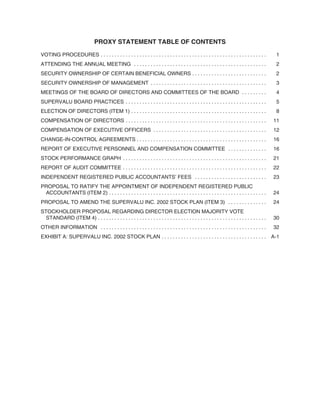
PROXY STATEMENT TABLE OF CONTENTS
VOTING PROCEDURES . . . . . . . . . . . . . . . . . . . . . . . . . . . . . . . . . . . . . . . . . . . . . . . . . . . . . . . . . . . . 1
ATTENDING THE ANNUAL MEETING . . . . . . . . . . . . . . . . . . . . . . . . . . . . . . . . . . . . . . . . . . . . . . . . 2
SECURITY OWNERSHIP OF CERTAIN BENEFICIAL OWNERS . . . . . . . . . . . . . . . . . . . . . . . . . . . 2
SECURITY OWNERSHIP OF MANAGEMENT . . . . . . . . . . . . . . . . . . . . . . . . . . . . . . . . . . . . . . . . . . 3
MEETINGS OF THE BOARD OF DIRECTORS AND COMMITTEES OF THE BOARD . . . . . . . . . 4
SUPERVALU BOARD PRACTICES . . . . . . . . . . . . . . . . . . . . . . . . . . . . . . . . . . . . . . . . . . . . . . . . . . . 5
ELECTION OF DIRECTORS (ITEM 1) . . . . . . . . . . . . . . . . . . . . . . . . . . . . . . . . . . . . . . . . . . . . . . . . . 8
COMPENSATION OF DIRECTORS . . . . . . . . . . . . . . . . . . . . . . . . . . . . . . . . . . . . . . . . . . . . . . . . . . . 11
COMPENSATION OF EXECUTIVE OFFICERS . . . . . . . . . . . . . . . . . . . . . . . . . . . . . . . . . . . . . . . . . 12
CHANGE-IN-CONTROL AGREEMENTS . . . . . . . . . . . . . . . . . . . . . . . . . . . . . . . . . . . . . . . . . . . . . . . 16
REPORT OF EXECUTIVE PERSONNEL AND COMPENSATION COMMITTEE . . . . . . . . . . . . . . 16
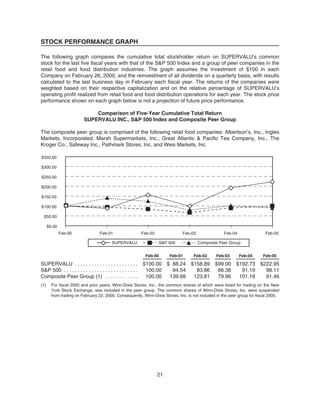
STOCK PERFORMANCE GRAPH . . . . . . . . . . . . . . . . . . . . . . . . . . . . . . . . . . . . . . . . . . . . . . . . . . . . 21
REPORT OF AUDIT COMMITTEE . . . . . . . . . . . . . . . . . . . . . . . . . . . . . . . . . . . . . . . . . . . . . . . . . . . . 22
INDEPENDENT REGISTERED PUBLIC ACCOUNTANTS’ FEES . . . . . . . . . . . . . . . . . . . . . . . . . . 23
PROPOSAL TO RATIFY THE APPOINTMENT OF INDEPENDENT REGISTERED PUBLIC
ACCOUNTANTS (ITEM 2) . . . . . . . . . . . . . . . . . . . . . . . . . . . . . . . . . . . . . . . . . . . . . . . . . . . . . . . . . 24
PROPOSAL TO AMEND THE SUPERVALU INC. 2002 STOCK PLAN (ITEM 3) . . . . . . . . . . . . . . 24
STOCKHOLDER PROPOSAL REGARDING DIRECTOR ELECTION MAJORITY VOTE
STANDARD (ITEM 4) . . . . . . . . . . . . . . . . . . . . . . . . . . . . . . . . . . . . . . . . . . . . . . . . . . . . . . . . . . . . . 30
OTHER INFORMATION . . . . . . . . . . . . . . . . . . . . . . . . . . . . . . . . . . . . . . . . . . . . . . . . . . . . . . . . . . . . 32
EXHIBIT A: SUPERVALU INC. 2002 STOCK PLAN . . . . . . . . . . . . . . . . . . . . . . . . . . . . . . . . . . . . . . A-1
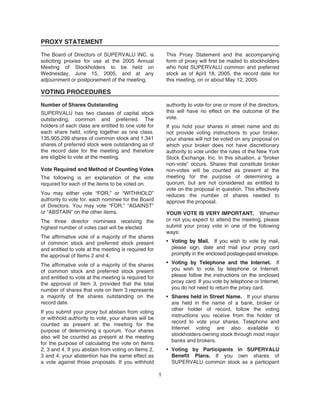
PROXY STATEMENT
The Board of Directors of SUPERVALU INC. is
soliciting proxies for use at the 2005 Annual
Meeting of Stockholders to be held on
Wednesday, June 15, 2005, and at any
adjournment or postponement of the meeting.
This Proxy Statement and the accompanying
form of proxy will first be mailed to stockholders
who hold SUPERVALU common and preferred
stock as of April 18, 2005, the record date for
this meeting, on or about May 12, 2005.
VOTING PROCEDURES
Number of Shares Outstanding
SUPERVALU has two classes of capital stock
outstanding, common and preferred. The
holders of each class are entitled to one vote for
each share held, voting together as one class.
135,905,299 shares of common stock and 1,341
shares of preferred stock were outstanding as of
the record date for the meeting and therefore
are eligible to vote at the meeting.
Vote Required and Method of Counting Votes
The following is an explanation of the vote
required for each of the items to be voted on.
You may either vote “FOR,” or “WITHHOLD”
authority to vote for, each nominee for the Board
of Directors. You may vote “FOR,” “AGAINST”
or “ABSTAIN” on the other items.
The three director nominees receiving the
highest number of votes cast will be elected.
The affirmative vote of a majority of the shares
of common stock and preferred stock present
and entitled to vote at the meeting is required for
the approval of Items 2 and 4.
The affirmative vote of a majority of the shares
of common stock and preferred stock present
and entitled to vote at the meeting is required for
the approval of Item 3, provided that the total
number of shares that vote on Item 3 represents
a majority of the shares outstanding on the
record date.
If you submit your proxy but abstain from voting
or withhold authority to vote, your shares will be
counted as present at the meeting for the
purpose of determining a quorum. Your shares
also will be counted as present at the meeting
for the purpose of calculating the vote on Items
2, 3 and 4. If you abstain from voting on Items 2,
3 and 4, your abstention has the same effect as
a vote against those proposals. If you withhold
authority to vote for one or more of the directors,
this will have no effect on the outcome of the
vote.
If you hold your shares in street name and do
not provide voting instructions to your broker,
your shares will not be voted on any proposal on
which your broker does not have discretionary
authority to vote under the rules of the New York
Stock Exchange, Inc. In this situation, a “broker
non-vote” occurs. Shares that constitute broker
non-votes will be counted as present at the
meeting for the purpose of determining a
quorum, but are not considered as entitled to
vote on the proposal in question. This effectively
reduces the number of shares needed to
approve the proposal.
YOUR VOTE IS VERY IMPORTANT. Whether
or not you expect to attend the meeting, please
submit your proxy vote in one of the following
ways:
• Voting by Mail. If you wish to vote by mail,
please sign, date and mail your proxy card
promptly in the enclosed postage-paid envelope.
• Voting by Telephone and the Internet. If
you wish to vote by telephone or Internet,
please follow the instructions on the enclosed
proxy card. If you vote by telephone or Internet,
you do not need to return the proxy card.
• Shares held in Street Name. If your shares
are held in the name of a bank, broker or
other holder of record, follow the voting
instructions you receive from the holder of
record to vote your shares. Telephone and
Internet voting are also available to
stockholders owning stock through most major
banks and brokers.
• Voting by Participants in SUPERVALU
Benefit Plans. If you own shares of
SUPERVALU common stock as a participant
1
in one or more of our employee benefit plans,
you will receive a single proxy card that
covers both the shares credited to your plan
account(s) and shares you own that are
registered in the same name. If any of your
plan accounts are not in the same name as
your shares of record, you will receive
separate proxy cards for your record and plan
holdings. Proxies submitted by plan
participants will serve as voting instructions to
the trustee(s) for the plans whether provided
by mail, telephone or Internet.
• Revoking Your Proxy. You may revoke
your proxy at any time before your shares are
voted by sending a written statement to the
Corporate Secretary, or by submitting another
proxy with a later date. You may also revoke
your proxy by voting in person at the meeting.
It is important that all stockholders vote. If you
submit a proxy by mail, telephone or Internet
without indicating how you want to vote, your
shares will be voted as recommended by the
Board of Directors.
ATTENDING THE ANNUAL MEETING
If you plan to attend the Annual Meeting, you
will not be admitted without an admission
ticket or proof that you own SUPERVALU
stock.
• Record Stockholders. If you are a record
stockholder (i.e., a person who owns shares
registered directly in his or her name with
SUPERVALU’s transfer agent) and plan to
attend the meeting, please indicate this when
voting, either by marking the attendance box
on the proxy card or responding affirmatively
when prompted during telephone or Internet
voting. An admission ticket for record
stockholders is printed on the proxy card
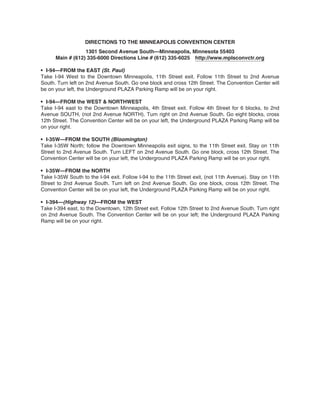
together with directions to the meeting. The
admission ticket must be brought to the
meeting.
• Owners of Shares Held in Street Name.
Beneficial owners of SUPERVALU common
stock held in street name by a broker, bank or
other nominee will need proof of ownership to
be admitted to the meeting. A recent
brokerage statement or letter from the broker,
bank or other nominee are examples of proof
of ownership. If your shares are held in street
name and you want to vote in person at the
meeting, you must obtain a written proxy from
the broker, bank or other nominee holding
your shares.
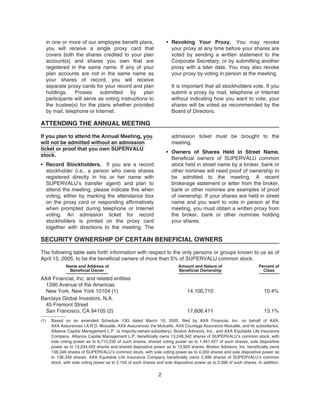
SECURITY OWNERSHIP OF CERTAIN BENEFICIAL OWNERS
The following table sets forth information with respect to the only persons or groups known to us as of
April 15, 2005, to be the beneficial owners of more than 5% of SUPERVALU common stock.
Name and Address of
Beneficial Owner
Amount and Nature of
Beneficial Ownership
Percent of
Class
AXA Financial, Inc. and related entities
1290 Avenue of the Americas
New York, New York 10104 (1) 14,100,710 10.4%
Barclays Global Investors, N.A.
45 Fremont Street
San Francisco, CA 94105 (2) 17,606,411 13.1%
(1) Based on an amended Schedule 13G dated March 10, 2005, filed by AXA Financial, Inc. on behalf of AXA,
AXA Assurances I.A.R.D. Mutuelle, AXA Assurances Vie Mutuelle, AXA Courtage Assurance Mutuelle, and its subsidiaries,
Alliance Capital Management L.P. (a majority-owned subsidiary), Boston Advisors, Inc., and AXA Equitable Life Insurance
Company. Alliance Capital Management L.P. beneficially owns 13,248,342 shares of SUPERVALU’s common stock, with
sole voting power as to 6,715,232 of such shares, shared voting power as to 1,461,427 of such shares, sole dispositive
power as to 13,234,422 shares and shared dispositive power as to 13,920 shares. Boston Advisors, Inc. beneficially owns
136,349 shares of SUPERVALU’s common stock, with sole voting power as to 4,350 shares and sole dispositive power as
to 136,349 shares. AXA Equitable Life Insurance Company beneficially owns 2,396 shares of SUPERVALU’s common
stock, with sole voting power as to 2,150 of such shares and sole dispositive power as to 2,396 of such shares. In addition,
2
AXA Konzern AG (Germany) and AXA Rosenberg Investment Management LLC, two entities of AXA, beneficially own
shares of SUPERVALU’s common stock for investment purposes only. AXA Konzern AG (Germany) owns 30,600 common
shares with sole voting and dispositive power as to all such shares. AXA Rosenberg Investment Management LLC owns
683,023 common shares with sole voting power as to 407,600 of such shares and sole dispositive power as to all of such
shares. AXA, AXA Assurances I.A.R.D. Mutuelle, AXA Assurances Vie Mutuelle, and AXA Courtage Assurance Mutuelle
disclaim beneficial ownership of 14,100,710 shares.
(2) Based on a Schedule 13G dated February 14, 2005, filed by Barclays Global Investors, N.A. on behalf of itself, Barclays
Global Fund Advisors, Barclays Global Investors, LTD., Barclays Bank PLC, Barclays Capital Securities, Limited, Palomino
Limited, and other Barclays entities, reporting beneficial ownership of 17,606,411 shares of SUPERVALU’s common stock
held in trust accounts for the economic benefit of the beneficiaries of these accounts. Of these shares, Barclays Global
Investors, N.A. has sole voting power as to 12,224,217 shares and sole dispositive power as to 14,149,657 shares,
Barclays Global Fund Advisors has sole voting power as to 642,384 shares and sole dispositive power as to 764,108
shares, Barclays Global Investors, Ltd. has sole voting power as to 2,461,847 shares and sole dispositive power as to
2,470,747 shares, Barclays Bank PLC has sole voting and dispositive power as to 177,884 shares, Barclays Capital
Securities, Limited has sole voting and dispositive power as to 3,515 shares, and Palomino Limited has sole voting and
dispositive power as to 40,500 shares. Other Barclays’ entities named in the filing report no voting or dispositive power as
to the common stock of SUPERVALU.
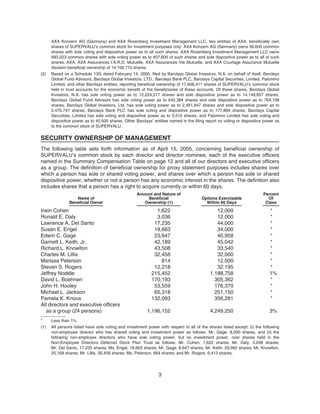
SECURITY OWNERSHIP OF MANAGEMENT
The following table sets forth information as of April 15, 2005, concerning beneficial ownership of
SUPERVALU’s common stock by each director and director nominee, each of the executive officers
named in the Summary Compensation Table on page 12 and all of our directors and executive officers
as a group. The definition of beneficial ownership for proxy statement purposes includes shares over
which a person has sole or shared voting power, and shares over which a person has sole or shared
dispositive power, whether or not a person has any economic interest in the shares. The definition also
includes shares that a person has a right to acquire currently or within 60 days.
Name of
Beneficial Owner
Amount and Nature of
Beneficial
Ownership (1)
Options Exercisable
Within 60 Days
Percent
Of
Class
Irwin Cohen 1,622 12,000 *
Ronald E. Daly 3,036 12,000 *
Lawrence A. Del Santo 17,235 44,000 *
Susan E. Engel 18,663 34,000 *
Edwin C. Gage 23,647 40,958 *
Garnett L. Keith, Jr. 42,189 45,042 *
Richard L. Knowlton 43,508 33,540 *
Charles M. Lillis 32,458 32,000 *
Marissa Peterson 814 12,000 *
Steven S. Rogers 12,218 32,195 *
Jeffrey Noddle 215,452 1,188,758 1%
David L. Boehnen 170,193 305,362 *
John H. Hooley 53,559 176,370 *
Michael L. Jackson 65,318 251,150 *
Pamela K. Knous 132,093 356,281 *
All directors and executive officers
as a group (24 persons) 1,196,152 4,249,250 3%
* Less than 1%
(1) All persons listed have sole voting and investment power with respect to all of the shares listed except: (i) the following
non-employee director who has shared voting and investment power as follows: Mr. Gage, 8,000 shares, and (ii) the
following non-employee directors who have sole voting power, but no investment power, over shares held in the
Non-Employee Directors Deferred Stock Plan Trust as follows: Mr. Cohen, 1,622 shares; Mr. Daly, 3,036 shares;
Mr. Del Santo, 17,235 shares; Ms. Engel, 18,663 shares; Mr. Gage, 8,647 shares; Mr. Keith, 29,992 shares; Mr. Knowlton,
25,168 shares; Mr. Lillis, 30,458 shares; Ms. Peterson, 664 shares; and Mr. Rogers, 6,413 shares.
3
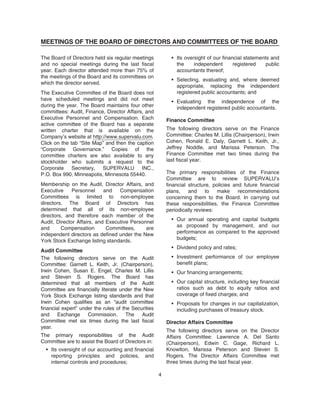
MEETINGS OF THE BOARD OF DIRECTORS AND COMMITTEES OF THE BOARD
The Board of Directors held six regular meetings
and no special meetings during the last fiscal
year. Each director attended more than 75% of
the meetings of the Board and its committees on
which the director served.
The Executive Committee of the Board does not
have scheduled meetings and did not meet
during the year. The Board maintains four other
committees: Audit, Finance, Director Affairs, and
Executive Personnel and Compensation. Each
active committee of the Board has a separate
written charter that is available on the
Company’s website at http://www.supervalu.com.
Click on the tab “Site Map” and then the caption
“Corporate Governance.” Copies of the
committee charters are also available to any
stockholder who submits a request to the
Corporate Secretary, SUPERVALU INC.,
P.O. Box 990, Minneapolis, Minnesota 55440.
Membership on the Audit, Director Affairs, and
Executive Personnel and Compensation
Committees is limited to non-employee
directors. The Board of Directors has
determined that all of its non-employee
directors, and therefore each member of the
Audit, Director Affairs, and Executive Personnel
and Compensation Committees, are
independent directors as defined under the New
York Stock Exchange listing standards.
Audit Committee
The following directors serve on the Audit
Committee: Garnett L. Keith, Jr. (Chairperson),
Irwin Cohen, Susan E. Engel, Charles M. Lillis
and Steven S. Rogers. The Board has
determined that all members of the Audit
Committee are financially literate under the New
York Stock Exchange listing standards and that
Irwin Cohen qualifies as an “audit committee
financial expert” under the rules of the Securities
and Exchange Commission. The Audit
Committee met six times during the last fiscal
year.
The primary responsibilities of the Audit
Committee are to assist the Board of Directors in:
• Its oversight of our accounting and financial
reporting principles and policies, and
internal controls and procedures;
• Its oversight of our financial statements and
the independent registered public
accountants thereof;
• Selecting, evaluating and, where deemed
appropriate, replacing the independent
registered public accountants; and
• Evaluating the independence of the
independent registered public accountants.
Finance Committee
The following directors serve on the Finance
Committee: Charles M. Lillis (Chairperson), Irwin
Cohen, Ronald E. Daly, Garnett L. Keith, Jr.,
Jeffrey Noddle, and Marissa Peterson. The
Finance Committee met two times during the
last fiscal year.
The primary responsibilities of the Finance
Committee are to review SUPERVALU’s
financial structure, policies and future financial
plans, and to make recommendations
concerning them to the Board. In carrying out
these responsibilities, the Finance Committee
periodically reviews:
• Our annual operating and capital budgets
as proposed by management, and our
performance as compared to the approved
budgets;
• Dividend policy and rates;
• Investment performance of our employee
benefit plans;
• Our financing arrangements;
• Our capital structure, including key financial
ratios such as debt to equity ratios and
coverage of fixed charges; and
• Proposals for changes in our capitalization,
including purchases of treasury stock.
Director Affairs Committee
The following directors serve on the Director
Affairs Committee: Lawrence A. Del Santo
(Chairperson), Edwin C. Gage, Richard L.
Knowlton, Marissa Peterson and Steven S.
Rogers. The Director Affairs Committee met
three times during the last fiscal year.
4
The mission of the Director Affairs Committee is
to recommend a framework to assist the Board
in fulfilling its corporate governance
responsibilities. In carrying out its mission, the
Director Affairs Committee establishes and
regularly reviews the Board’s policies and
procedures, which provide:
• Criteria for the size and composition of the
Board;
• Procedures for the conduct of Board
meetings, including executive sessions of
the Board;
• Policies on director retirement and
resignation; and
• Criteria regarding personal qualifications
needed for Board membership.
In addition, the Director Affairs Committee has
the responsibility to:
• Consider and recommend nominations for
Board membership and the composition of
Board Committees;
• Evaluate Board practices at SUPERVALU
and other well-managed companies and
recommend appropriate changes to the
Board (see “SUPERVALU Board Practices”
below);
• Consider governance issues raised by
stockholders and recommend appropriate
responses to the Board; and
• Consider appropriate compensation for
directors.
Executive Personnel and Compensation
Committee
The following directors serve on the Executive
Personnel and Compensation Committee: Edwin
C. Gage (Chairperson), Ronald E. Daly,
Lawrence A. Del Santo, Susan E. Engel, and
Richard L. Knowlton. The Committee met five
times during the last fiscal year.
The primary functions of the Executive
Personnel and Compensation Committee are to:
• Determine the process to evaluate the
performance of the Chief Executive Officer;
• Review and recommend to the Board the
compensation of the Chief Executive Officer;
• Review and recommend to the Board major
changes in executive compensation
programs, executive stock options and
retirement plans for officers;
• Consider and make recommendations to
the Board concerning the annual election of
corporate officers and the succession plan
for the Chief Executive Officer;
• Approve annual salaries and bonuses of
corporate officers and other executives at
specified levels;
• Review and approve participants and
performance targets under our annual and
long-term incentive compensation plans; and
• Approve stock option grants and awards
under our stock option plans, bonus and
other incentive plans.
SUPERVALU BOARD PRACTICES
In order to help our stockholders better
understand SUPERVALU’s Board practices, we
are including the following description of current
practices. The Director Affairs Committee
periodically reviews these practices.
Evaluation of Board Performance
In order to continue to evaluate and improve the
effectiveness of the Board, the Board, under the
guidance of the Director Affairs Committee,
annually evaluates the Board’s performance as
a whole. The evaluation process includes a
survey of the individual views of all directors, a
summary of which is then shared with the Board.
Each active Board Committee also evaluates its
own performance on a yearly basis.
Size of the Board
Although the size of the Board may vary from
time to time, the Board believes the size should
preferably be not less than ten or more than
fourteen members. The Board believes that the
5
size of the Board should accommodate the
objectives of effective discussion and decision-
making and adequate staffing of Board
committees.
Director Independence
The Board believes that a substantial majority of
its members should be independent, non-
employee directors. It is the Board’s policy that
no more than three members of the Board will
be employees of SUPERVALU. These
management members will include the Chief
Executive Officer and up to two additional
persons whose duties and responsibilities
identify them as key managers of SUPERVALU.
The Board currently has eleven members. One
member is an employee of SUPERVALU:
Mr. Noddle, Chairman, Chief Executive Officer
and President. The Board has determined that
all of its non-employee directors meet the
requirements for independence under New York
Stock Exchange listing standards.
Director Retirement
It is Board policy that non-employee directors
retire at the annual meeting following the date
they attain the age of seventy-two, and that non-
employee directors elected after February 27,
1994, will serve a maximum term of fifteen years.
Mr. Knowlton is seventy-two and therefore is
retiring at the Annual Meeting. Directors who
change the occupation they held when initially
elected to the Board are expected to offer to
resign from the Board. At that time, the Director
Affairs Committee will review the continuation of
Board membership under these new
circumstances and make a recommendation to
the full Board.
The Board also has adopted a policy that
requires employee directors, other than the
Chief Executive Officer, to retire from the Board
at the time of a change in their status as an
officer of SUPERVALU. A former Chief
Executive Officer may continue to serve on the
Board until the third anniversary after his or her
separation from SUPERVALU. However, if a
former Chief Executive Officer leaves
SUPERVALU to accept another position, the
Chief Executive Officer is expected to retire as a
director effective simultaneously with his or her
separation from SUPERVALU.
Selection of Directors
The Director Affairs Committee is the standing
committee responsible for determining the slate
of director nominees for election by
stockholders. The Director Affairs Committee
considers and evaluates potential Board
candidates based on the criteria set forth below,
and makes its recommendation to the full Board.
The criteria applied to director candidates stress
independence, integrity, experience and sound
judgment in areas relevant to SUPERVALU’s
business, financial acumen, interpersonal skills,
a proven record of accomplishment, a
willingness to commit sufficient time to the
Board, and the ability to challenge and stimulate
management. The Director Affairs Committee
will use the same process and criteria for
evaluating all nominees, regardless of whether
the nominee is submitted by a stockholder or by
some other source.
The Director Affairs Committee is not currently
utilizing the services of an executive recruiting
firm to assist in the identification or evaluation of
director candidates. However, the committee
has used such firms in the past and may engage
a firm to provide such services in the future, as it
deems necessary or appropriate.
Directors and management are encouraged to
submit the name of any candidate they believe
to be qualified to serve on the Board, together
with background information on the candidate, to
the Chairperson of the Director Affairs
Committee. In accordance with procedures set
forth in our bylaws, stockholders may propose,
and the Director Affairs Committee will consider,
nominees for election to the Board of Directors
by giving timely written notice to the Corporate
Secretary, which must be received at our
principal executive offices no later than the close
of business on February 15, 2006, and no earlier
than January 16, 2006. Any such notice must
include the name of the nominee, a brief
biographical sketch and resume, contact
information and such other background
materials on such nominee as the Director
Affairs Committee may request.
Board Meetings
The full Board meets at least six times each
year. Board meetings normally do not exceed
6
one day in length. The Board also schedules a
longer multi-day off-site strategic planning
meeting every two years and additional one-day
strategic planning update meetings every other
year.
Executive Sessions of Outside Directors;
Presiding Director
Non-employee directors generally meet together
as a group, without the Chief Executive Officer
or any other employee directors in attendance,
during three scheduled executive sessions each
year. The Chairperson of the Director Affairs
Committee will preside during any executive
session of the Board; however, the Chairperson
of the Executive Personnel and Compensation
Committee will preside during any executive
session held for the purpose of conducting the
Chief Executive Officer’s performance review.
Attendance at Stockholder Meetings
The Board does not have a formal policy
regarding director attendance at the Annual
Meeting of Stockholders. However, all directors
are strongly encouraged to attend the meeting.
All directors attended the 2004 Annual Meeting
of Stockholders.
Stock Ownership Guidelines
Non-employee directors are encouraged to
acquire and own SUPERVALU common stock
with a fair market value of five times a director’s
annual retainer, within five years after the
director is first elected.
Governance Principles
The Board maintains a formal statement of
Governance Principles that sets forth the
corporate governance practices for the
Company. The Governance Principles are
available on the Company’s website at
http://www.supervalu.com. Click on the tab “Site
Map” and then the caption “Corporate
Governance.” Copies of the Governance
Principles are also available to any stockholder
who submits a request to the Corporate
Secretary at SUPERVALU INC., P.O. Box 990,
Minneapolis, Minnesota 55440.
7
ELECTION OF DIRECTORS (ITEM 1)
The Board is divided into three classes, with the number of directors to be divided as equally as
possible among the three classes. Directors are elected for staggered terms of three years. If a
vacancy exists or occurs during the year, the vacant directorship may be filled by the vote of the
remaining directors until the next annual meeting, at which time the stockholders elect a director to fill
the balance of the unexpired term or the term established by the Board. There are currently eleven
members of the Board. One director, Richard L. Knowlton, will be retiring at the Annual Meeting in
accordance with Board policies (see “Director Retirement” on page 6).
Edwin C. Gage, Garnett L. Keith, Jr. and Marissa Peterson are nominated for three-year terms expiring
in 2008. The Board of Directors is informed that each nominee is willing to serve as a director;
however, if any nominee is unable to serve or for good cause will not serve, the proxy may be voted for
another person as the persons named on the proxies decide. If all of the nominees are elected,
following the Annual Meeting there will be ten members of the Board with four directors with terms
expiring in 2006, three directors with terms expiring in 2007 and three directors with terms expiring in
2008.
The following sets forth information, as of April 15, 2005, concerning the three nominees, the seven
directors whose terms of office will continue after the Annual Meeting and the director who is retiring at
the Annual Meeting.
NOMINEES FOR ELECTION AS DIRECTORS AT THE ANNUAL MEETING
FOR THREE-YEAR TERMS EXPIRING IN 2008
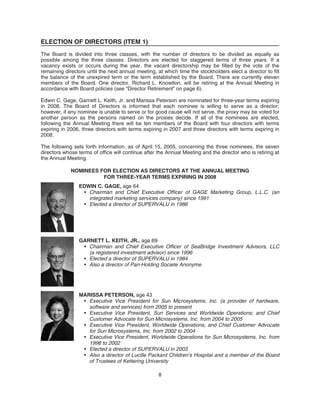
EDWIN C. GAGE, age 64
• Chairman and Chief Executive Officer of GAGE Marketing Group, L.L.C. (an
integrated marketing services company) since 1991
• Elected a director of SUPERVALU in 1986
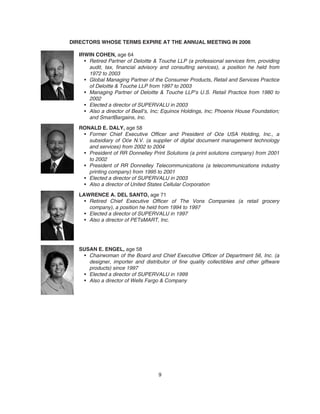
GARNETT L. KEITH, JR., age 69
• Chairman and Chief Executive Officer of SeaBridge Investment Advisors, LLC
(a registered investment advisor) since 1996
• Elected a director of SUPERVALU in 1984
• Also a director of Pan-Holding Societe Anonyme
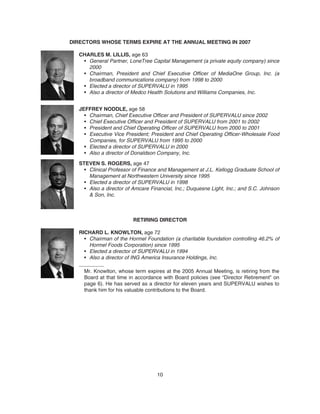
MARISSA PETERSON, age 43
• Executive Vice President for Sun Microsystems, Inc. (a provider of hardware,
software and services) from 2005 to present
• Executive Vice President, Sun Services and Worldwide Operations; and Chief
Customer Advocate for Sun Microsystems, Inc. from 2004 to 2005
• Executive Vice President, Worldwide Operations; and Chief Customer Advocate
for Sun Microsystems, Inc. from 2002 to 2004
• Executive Vice President, Worldwide Operations for Sun Microsystems, Inc. from
1998 to 2002
• Elected a director of SUPERVALU in 2003
• Also a director of Lucille Packard Children’s Hospital and a member of the Board
of Trustees of Kettering University
8
DIRECTORS WHOSE TERMS EXPIRE AT THE ANNUAL MEETING IN 2006
IRWIN COHEN, age 64
• Retired Partner of Deloitte & Touche LLP (a professional services firm, providing
audit, tax, financial advisory and consulting services), a position he held from
1972 to 2003
• Global Managing Partner of the Consumer Products, Retail and Services Practice
of Deloitte & Touche LLP from 1997 to 2003
• Managing Partner of Deloitte & Touche LLP’s U.S. Retail Practice from 1980 to
2002
• Elected a director of SUPERVALU in 2003
• Also a director of Beall’s, Inc; Equinox Holdings, Inc; Phoenix House Foundation;
and SmartBargains, Inc.
RONALD E. DALY, age 58
• Former Chief Executive Officer and President of Oc´e USA Holding, Inc., a
subsidiary of Oc´e N.V. (a supplier of digital document management technology
and services) from 2002 to 2004
• President of RR Donnelley Print Solutions (a print solutions company) from 2001
to 2002
• President of RR Donnelley Telecommunications (a telecommunications industry
printing company) from 1995 to 2001
• Elected a director of SUPERVALU in 2003
• Also a director of United States Cellular Corporation
LAWRENCE A. DEL SANTO, age 71
• Retired Chief Executive Officer of The Vons Companies (a retail grocery
company), a position he held from 1994 to 1997
• Elected a director of SUPERVALU in 1997
• Also a director of PETsMART, Inc.
SUSAN E. ENGEL, age 58
• Chairwoman of the Board and Chief Executive Officer of Department 56, Inc. (a
designer, importer and distributor of fine quality collectibles and other giftware
products) since 1997
• Elected a director of SUPERVALU in 1999
• Also a director of Wells Fargo & Company
9
DIRECTORS WHOSE TERMS EXPIRE AT THE ANNUAL MEETING IN 2007
CHARLES M. LILLIS, age 63
• General Partner, LoneTree Capital Management (a private equity company) since
2000
• Chairman, President and Chief Executive Officer of MediaOne Group, Inc. (a
broadband communications company) from 1998 to 2000
• Elected a director of SUPERVALU in 1995
• Also a director of Medco Health Solutions and Williams Companies, Inc.
JEFFREY NODDLE, age 58
• Chairman, Chief Executive Officer and President of SUPERVALU since 2002
• Chief Executive Officer and President of SUPERVALU from 2001 to 2002
• President and Chief Operating Officer of SUPERVALU from 2000 to 2001
• Executive Vice President; President and Chief Operating Officer-Wholesale Food
Companies, for SUPERVALU from 1995 to 2000
• Elected a director of SUPERVALU in 2000
• Also a director of Donaldson Company, Inc.
STEVEN S. ROGERS, age 47
• Clinical Professor of Finance and Management at J.L. Kellogg Graduate School of
Management at Northwestern University since 1995
• Elected a director of SUPERVALU in 1998
• Also a director of Amcare Financial, Inc.; Duquesne Light, Inc.; and S.C. Johnson
& Son, Inc.
RETIRING DIRECTOR
RICHARD L. KNOWLTON, age 72
• Chairman of the Hormel Foundation (a charitable foundation controlling 46.2% of
Hormel Foods Corporation) since 1995
• Elected a director of SUPERVALU in 1994
• Also a director of ING America Insurance Holdings, Inc.
Mr. Knowlton, whose term expires at the 2005 Annual Meeting, is retiring from the
Board at that time in accordance with Board policies (see “Director Retirement” on
page 6). He has served as a director for eleven years and SUPERVALU wishes to
thank him for his valuable contributions to the Board.
10
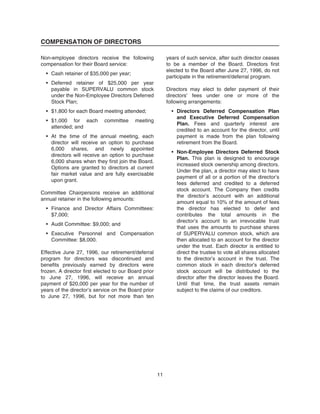
COMPENSATION OF DIRECTORS
Non-employee directors receive the following
compensation for their Board service:
• Cash retainer of $35,000 per year;
• Deferred retainer of $25,000 per year
payable in SUPERVALU common stock
under the Non-Employee Directors Deferred
Stock Plan;
• $1,800 for each Board meeting attended;
• $1,000 for each committee meeting
attended; and
• At the time of the annual meeting, each
director will receive an option to purchase
6,000 shares, and newly appointed
directors will receive an option to purchase
6,000 shares when they first join the Board.
Options are granted to directors at current
fair market value and are fully exercisable
upon grant.
Committee Chairpersons receive an additional
annual retainer in the following amounts:
• Finance and Director Affairs Committees:
$7,000;
• Audit Committee: $9,000; and
• Executive Personnel and Compensation
Committee: $8,000.
Effective June 27, 1996, our retirement/deferral
program for directors was discontinued and
benefits previously earned by directors were
frozen. A director first elected to our Board prior
to June 27, 1996, will receive an annual
payment of $20,000 per year for the number of
years of the director’s service on the Board prior
to June 27, 1996, but for not more than ten
years of such service, after such director ceases
to be a member of the Board. Directors first
elected to the Board after June 27, 1996, do not
participate in the retirement/deferral program.
Directors may elect to defer payment of their
directors’ fees under one or more of the
following arrangements:
• Directors Deferred Compensation Plan
and Executive Deferred Compensation
Plan. Fees and quarterly interest are
credited to an account for the director, until
payment is made from the plan following
retirement from the Board.
• Non-Employee Directors Deferred Stock
Plan. This plan is designed to encourage
increased stock ownership among directors.
Under the plan, a director may elect to have
payment of all or a portion of the director’s
fees deferred and credited to a deferred
stock account. The Company then credits
the director’s account with an additional
amount equal to 10% of the amount of fees
the director has elected to defer and
contributes the total amounts in the
director’s account to an irrevocable trust
that uses the amounts to purchase shares
of SUPERVALU common stock, which are
then allocated to an account for the director
under the trust. Each director is entitled to
direct the trustee to vote all shares allocated
to the director’s account in the trust. The
common stock in each director’s deferred
stock account will be distributed to the
director after the director leaves the Board.
Until that time, the trust assets remain
subject to the claims of our creditors.
11
COMPENSATION OF EXECUTIVE OFFICERS
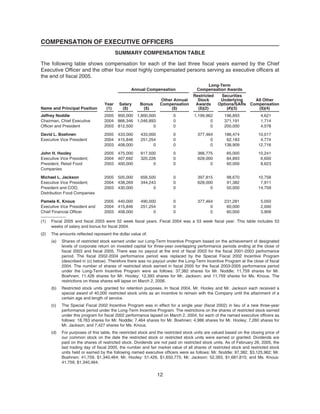
SUMMARY COMPENSATION TABLE
The following table shows compensation for each of the last three fiscal years earned by the Chief
Executive Officer and the other four most highly compensated persons serving as executive officers at
the end of fiscal 2005.
Name and Principal Position
Year
(1)
Annual Compensation
Long-Term
Compensation Awards
All Other
Compensation
($)(4)
Salary
($)
Bonus
($)
Other Annual
Compensation
($)
Restricted
Stock
Awards
($)(2)
Securities
Underlying
Options/SARs
(#)(3)
Jeffrey Noddle
Chairman, Chief Executive
Officer and President
2005
2004
2003
900,000
866,346
812,500
1,800,000
1,046,893
0
0
0
0
1,199,962
0
0
196,893
371,191
200,000
4,621
1,714
4,578
David L. Boehnen
Executive Vice President
2005
2004
2003
433,000
415,846
408,000
433,000
251,254
0
0
0
0
377,464
0
0
186,474
62,183
138,909
10,017
4,774
12,716
John H. Hooley
Executive Vice President;
President, Retail Food
Companies
2005
2004
2003
475,000
407,692
400,000
617,500
320,226
0
0
0
0
366,775
628,000
0
65,000
84,893
60,000
10,241
6,600
8,623
Michael L. Jackson
Executive Vice President;
President and COO,
Distribution Food Companies
2005
2004
2003
505,000
438,269
430,000
656,500
344,243
0
0
0
0
397,815
628,000
0
98,670
91,382
50,000
10,758
7,911
14,709
Pamela K. Knous
Executive Vice President and
Chief Financial Officer
2005
2004
2003
440,000
415,846
408,000
490,000
251,254
0
0
0
0
377,464
0
0
231,281
60,000
60,000
5,050
2,000
3,909
(1) Fiscal 2005 and fiscal 2003 were 52 week fiscal years. Fiscal 2004 was a 53 week fiscal year. This table includes 53
weeks of salary and bonus for fiscal 2004.
(2) The amounts reflected represent the dollar value of:
(a) Shares of restricted stock earned under our Long-Term Incentive Program based on the achievement of designated
levels of corporate return on invested capital for three-year overlapping performance periods ending at the close of
fiscal 2003 and fiscal 2005. There was no payout at the end of fiscal 2003 for the fiscal 2001-2003 performance
period. The fiscal 2002-2004 performance period was replaced by the Special Fiscal 2002 Incentive Program
(described in (c) below). Therefore there was no payout under the Long-Term Incentive Program at the close of fiscal
2004. The number of shares of restricted stock earned in fiscal 2005 for the fiscal 2003-2005 performance period
under the Long-Term Incentive Program were as follows: 37,382 shares for Mr. Noddle; 11,759 shares for Mr.
Boehnen; 11,426 shares for Mr. Hooley; 12,393 shares for Mr. Jackson; and 11,759 shares for Ms. Knous. The
restrictions on these shares will lapse on March 2, 2006.
(b) Restricted stock units granted for retention purposes. In fiscal 2004, Mr. Hooley and Mr. Jackson each received a
special award of 40,000 restricted stock units as an incentive to remain with the Company until the attainment of a
certain age and length of service.
(c) The Special Fiscal 2002 Incentive Program was in effect for a single year (fiscal 2002) in lieu of a new three-year
performance period under the Long-Term Incentive Program. The restrictions on the shares of restricted stock earned
under this program for fiscal 2002 performance lapsed on March 2, 2004, for each of the named executive officers as
follows: 18,763 shares for Mr. Noddle; 7,464 shares for Mr. Boehnen; 4,986 shares for Mr. Hooley; 7,260 shares for
Mr. Jackson; and 7,427 shares for Ms. Knous.
(d) For purposes of this table, the restricted stock and the restricted stock units are valued based on the closing price of
our common stock on the date the restricted stock or restricted stock units were earned or granted. Dividends are
paid on the shares of restricted stock. Dividends are not paid on restricted stock units. As of February 26, 2005, the
last trading day of fiscal 2005, the number and fair market value of all shares of restricted stock and restricted stock
units held or earned by the following named executive officers were as follows: Mr. Noddle: 97,382, $3,125,962; Mr.
Boehnen: 41,759, $1,340,464; Mr. Hooley: 51,426, $1,650,775; Mr. Jackson: 52,393, $1,681,815; and Ms. Knous:
41,759, $1,340,464.
12
(3) The total number of shares subject to option awards includes those subject to restoration options (as more fully described
below in note (1) to the table entitled “Option Grants in Last Fiscal Year”) received by the named executive officers as
follows: Mr. Noddle, 71,191 shares in fiscal 2004 and 6,143 shares in fiscal 2002; Mr. Boehnen, 126,474 shares in fiscal
2005, 2,183 shares in fiscal 2004, and 88,909 shares in fiscal 2003; Mr. Hooley, 19,893 shares in fiscal 2004; Mr. Jackson,
33,670 shares in fiscal 2005 and 26,382 shares in fiscal 2004; and Ms. Knous, 166,280 shares in fiscal 2005. No stock
appreciation rights were granted in fiscal 2005, 2004 or 2003.
(4) For fiscal 2005, the amount of All Other Compensation reflects contributions made by us during the fiscal year under the
Qualified Pre-Tax Savings and Profit Sharing 401(k) Plan, and additional contributions made by us to an unfunded non-
qualified deferred compensation plan because of limitations on the annual compensation that can be taken into account
under the 401(k) Plan. The amounts of contributions to the 401(k) Plan and the unfunded plan for fiscal 2005 were as
follows: $4,621 and $0 for Mr. Noddle; $4,621 and $5,396 for Mr. Boehnen; $5,050 and $5,192 for Mr. Hooley; $4,621 and
$5,957 for Mr. Jackson; $5,050 and $0 for Ms. Knous.
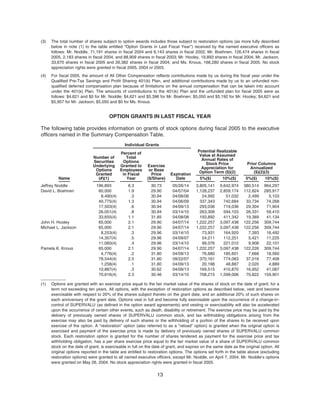
OPTION GRANTS IN LAST FISCAL YEAR
The following table provides information on grants of stock options during fiscal 2005 to the executive
officers named in the Summary Compensation Table.
Name
Individual Grants
Number of
Securities
Underlying
Options
Granted
(#)(1)
Percent of
Total
Options
Granted to
Employees
in Fiscal
Year
Exercise
or Base
Price
($/Share)
Expiration
Date
Potential Realizable
Value at Assumed
Annual Rates of
Stock Price
Appreciation for
Option Term ($)(2)
Prior Columns
Annualized
($)(2)(3)
5%($) 10%($) 5%($) 10%($)
Jeffrey Noddle 196,893 6.3 30.73 05/26/14 3,805,141 9,642,974 380,514 964,297
David L. Boehnen 60,000
8,490(4)
40,775(4)
17,503(4)
26,051(4)
33,655(4)
1.9
.3
1.3
.6
.8
1.1
29.90
30.94
30.94
30.94
30.94
31.85
04/07/04
04/08/06
04/06/09
04/09/13
03/14/10
04/08/08
1,128,237
24,992
337,343
293,036
263,306
193,892
2,859,174
51,032
742,684
719,036
594,103
411,342
112,824
2,499
33,734
29,304
26,331
19,389
285,917
5,103
74,268
71,904
59,410
41,134
John H. Hooley 65,000 2.1 29.90 04/07/14 1,222,257 3,097,438 122,256 309,744
Michael L. Jackson 65,000
8,253(4)
14,357(4)
11,060(4)
2.1
.3
.5
.4
29.90
29.96
29.96
29.96
04/07/14
03/14/10
04/09/07
03/14/10
1,222,257
73,931
54,211
99,076
3,097,438
164,920
112,251
221,012
122,256
7,393
5,421
9,908
309,744
16,492
11,225
22,101
Pamela K. Knous 65,000
4,776(4)
78,544(4)
1,258(4)
10,887(4)
70,816(4)
2.1
.2
2.5
.1
.3
2.3
29.90
31.80
31.80
31.80
30.62
30.46
04/07/14
04/09/13
09/22/07
04/09/13
04/09/13
03/14/10
1,222,257
76,680
370,161
20,198
169,515
708,215
3,097,438
185,601
774,083
48,887
410,870
1,599,006
122,226
7,668
37,016
2,020
16,952
70,822
309,744
18,560
77,408
4,889
41,087
159,901
(1) Options are granted with an exercise price equal to the fair market value of the shares of stock on the date of grant, for a
term not exceeding ten years. All options, with the exception of restoration options as described below, vest and become
exercisable with respect to 20% of the shares subject thereto on the grant date, and an additional 20% of such shares on
each anniversary of the grant date. Options vest in full and become fully exercisable upon the occurrence of a change-in-
control of SUPERVALU (as defined in the option award agreements) and vesting or exercisability will also be accelerated
upon the occurrence of certain other events, such as death, disability or retirement. The exercise price may be paid by the
delivery of previously owned shares of SUPERVALU common stock, and tax withholding obligations arising from the
exercise may also be paid by delivery of such shares or the withholding of a portion of the shares to be received upon
exercise of the option. A “restoration” option (also referred to as a “reload” option) is granted when the original option is
exercised and payment of the exercise price is made by delivery of previously owned shares of SUPERVALU common
stock. Each restoration option is granted for the number of shares tendered as payment for the exercise price and tax
withholding obligation, has a per share exercise price equal to the fair market value of a share of SUPERVALU common
stock on the date of grant, is exercisable in full on the date of grant, and expires on the same date as the original option. All
original options reported in the table are entitled to restoration options. The options set forth in the table above (excluding
restoration options) were granted to all named executive officers, except Mr. Noddle, on April 7, 2004. Mr. Noddle’s options
were granted on May 26, 2004. No stock appreciation rights were granted in fiscal 2005.
13
(2) The amounts indicated represent the potential realizable value to the optionholder if SUPERVALU common stock were to
appreciate at the indicated annual rate and the options were held for their full term before being exercised. These amounts
are the result of calculations at the 5% and 10% rates set by the Securities and Exchange Commission and therefore are
not intended to forecast possible future appreciation, if any, in our stock price. Total potential realizable value for all of the
named officers who received stock option grants is $11,284,703 and $27,829,290 at the 5% and 10% stock price growth
assumptions, respectively. Assuming 5% and 10% stock price growth over a period of ten years commencing April 1, 2004,
the increase in total stockholder value from stock price appreciation alone for all shares outstanding on that date would be
$2,576,536,408 and $6,529,449,130, respectively.
(3) Computed by dividing potential realizable value at the assumed annual rates of stock price appreciation by the term of the
option. Options granted in fiscal 2005 have a ten-year term. Restoration options (described above) have a term equal to the
remaining term of the original option.
(4) Grant of a restoration option.
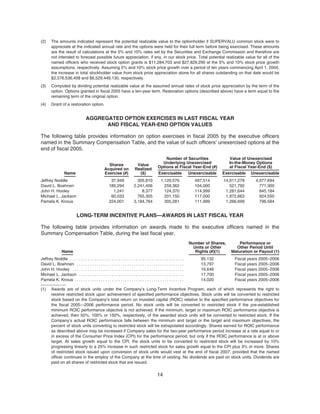
AGGREGATED OPTION EXERCISES IN LAST FISCAL YEAR
AND FISCAL YEAR-END OPTION VALUES
The following table provides information on option exercises in fiscal 2005 by the executive officers
named in the Summary Compensation Table, and the value of such officers’ unexercised options at the
end of fiscal 2005.
Name
Shares
Acquired on
Exercise (#)
Value
Realized
($)
Number of Securities
Underlying Unexercised
Options at Fiscal Year-End (#)
Value of Unexercised
In-the-Money Options
at Fiscal Year-End ($)
Exercisable Unexercisable Exercisable Unexercisable
Jeffrey Noddle 37,949 305,810 1,120,570 497,514 14,011,279 4,077,694
David L. Boehnen 185,294 2,241,406 259,362 104,000 521,792 771,300
John H. Hooley 1,241 8,377 124,370 114,999 1,281,644 845,184
Michael L. Jackson 60,033 765,305 201,150 117,000 1,972,663 924,550
Pamela K. Knous 224,001 3,184,764 305,281 111,999 1,266,699 796,584
LONG-TERM INCENTIVE PLANS—AWARDS IN LAST FISCAL YEAR
The following table provides information on awards made to the executive officers named in the
Summary Compensation Table, during the last fiscal year.
Name
Number of Shares,
Units or Other
Rights (#)(1)
Performance or
Other Period Until
Maturation or Payout (1)
Jeffrey Noddle . . . . . . . . . . . . . . . . . . . . . . . . . . . . . . . . . . . . . . . . . . . . . . . . . . . . 95,132 Fiscal years 2005–2006
David L. Boehnen . . . . . . . . . . . . . . . . . . . . . . . . . . . . . . . . . . . . . . . . . . . . . . . . . 13,797 Fiscal years 2005–2006
John H. Hooley . . . . . . . . . . . . . . . . . . . . . . . . . . . . . . . . . . . . . . . . . . . . . . . . . . . 16,648 Fiscal years 2005–2006
Michael L. Jackson . . . . . . . . . . . . . . . . . . . . . . . . . . . . . . . . . . . . . . . . . . . . . . . . 17,700 Fiscal years 2005–2006
Pamela K. Knous . . . . . . . . . . . . . . . . . . . . . . . . . . . . . . . . . . . . . . . . . . . . . . . . . . 14,020 Fiscal years 2005–2006
(1) Awards are of stock units under the Company’s Long-Term Incentive Program, each of which represents the right to
receive restricted stock upon achievement of specified performance objectives. Stock units will be converted to restricted
stock based on the Company’s total return on invested capital (ROIC) relative to the specified performance objectives for
the fiscal 2005—2006 performance period. No stock units will be converted to restricted stock if the pre-established
minimum ROIC performance objective is not achieved. If the minimum, target or maximum ROIC performance objective is
achieved, then 50%, 100% or 150%, respectively, of the awarded stock units will be converted to restricted stock. If the
Company’s actual ROIC performance falls between the minimum and target or the target and maximum objectives, the
percent of stock units converting to restricted stock will be extrapolated accordingly. Shares earned for ROIC performance
as described above may be increased if Company sales for the two-year performance period increase at a rate equal to or
in excess of the Consumer Price Index (CPI) for the performance period, but only if the ROIC performance is at or above
target. At sales growth equal to the CPI, the stock units to be converted to restricted stock will be increased by 10%
progressing linearly to a 25% increase in such restricted stock for sales growth equal to the CPI plus 3% or more. Shares
of restricted stock issued upon conversion of stock units would vest at the end of fiscal 2007, provided that the named
officer continues in the employ of the Company at the time of vesting. No dividends are paid on stock units. Dividends are
paid on all shares of restricted stock that are issued.
14
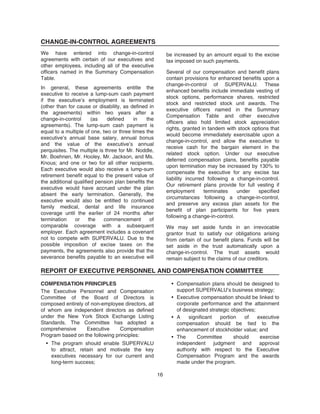
PENSION PLANS AND RETIREMENT BENEFITS
The following table shows the estimated maximum annual benefits that would be paid to an employee
upon retirement at age 65 under the combination of the SUPERVALU Retirement Plan, the Non-
Qualified Supplemental Executive Retirement Plan (or, if applicable, the Excess Benefit Plan)
maintained for certain highly compensated employees, and the “Retirement Benefit Plan Account” of
the Company’s Non-Qualified Deferred Compensation Plans. The table does not reflect the $170,000
per year limitation on annual benefits payable from the plans imposed by Section 415 of the Internal
Revenue Code, nor the $210,000 per year limitation on compensation included in final annual average
pay imposed by Section 401(a)(17) of the Internal Revenue Code. Our Non-Qualified Supplemental
Executive Retirement Plan and Excess Benefit Plan allow payment of additional benefits so that
retiring employees may receive, in the aggregate, at least the benefits they would have been entitled to
receive if the Internal Revenue Code did not impose maximum limitations. Final annual average
compensation under the plans is the average of the annual compensation for the five consecutive
complete fiscal years prior to retirement that produce the highest average compensation. Annual
compensation consists of salary and bonus (but not long-term compensation) as set forth in the
Summary Compensation Table.
Years of Service
Final Annual Average Compensation 15 20 25 30
$ 500,000 . . . . . . . . . . . . . . . . . . . . . . . . . . . . . . . . . . . . . . . . . 109,500 146,000 182,500 219,000
800,000 . . . . . . . . . . . . . . . . . . . . . . . . . . . . . . . . . . . . . . . . . 181,500 242,000 302,500 363,000
1,100,000 . . . . . . . . . . . . . . . . . . . . . . . . . . . . . . . . . . . . . . . . . 253,500 338,000 422,500 507,000
1,400,000 . . . . . . . . . . . . . . . . . . . . . . . . . . . . . . . . . . . . . . . . . 325,500 434,000 542,500 651,000
1,700,000 . . . . . . . . . . . . . . . . . . . . . . . . . . . . . . . . . . . . . . . . . 397,500 530,000 662,500 795,000
2,000,000 . . . . . . . . . . . . . . . . . . . . . . . . . . . . . . . . . . . . . . . . . 469,500 626,000 782,500 939,000
The above estimates of annual benefits payable on normal retirement are computed using the straight-
life annuity method and are based on certain assumptions, including (a) that the employee remains
employed until the normal retirement age of 65 (although retirement is permitted at age 62 without any
benefit reduction because of age); and (b) that the present retirement plans remain in force until the
retirement date. Benefits payable under these plans will not be reduced or offset by the participant’s
Social Security benefit. Our Non-Qualified Deferred Compensation Plans, the Non-Qualified
Supplemental Executive Retirement Plan and the Excess Benefit Plan allow terminated and retired
participants to receive their benefits in periodic installments or as a lump sum.
As to each of the executive officers named in the Summary Compensation Table, the final annual
average pay and credited years of service under the plans as of February 26, 2005, were as follows:
Mr. Noddle: $1,350,638, 28.8 years; Mr. Boehnen: $651,911, 13.8 years; Mr. Hooley: $536,965, 30.2
years; Mr. Jackson: $633,836, 26.1 years; and Ms. Knous: $634,341, 7.4 years.
The Company provides post-retirement death benefits for certain designated retired executive officers,
which would include the executive officers named in the Summary Compensation Table if they retire
under the Company’s retirement plan. The death benefit is fixed at an amount approximately equal to,
on an after-tax basis, an eligible executive’s final base salary. The benefits are funded through life
insurance policies owned by the Company.
15
CHANGE-IN-CONTROL AGREEMENTS
We have entered into change-in-control
agreements with certain of our executives and
other employees, including all of the executive
officers named in the Summary Compensation
Table.
In general, these agreements entitle the
executive to receive a lump-sum cash payment
if the executive’s employment is terminated
(other than for cause or disability, as defined in
the agreements) within two years after a
change-in-control (as defined in the
agreements). The lump-sum cash payment is
equal to a multiple of one, two or three times the
executive’s annual base salary, annual bonus
and the value of the executive’s annual
perquisites. The multiple is three for Mr. Noddle,
Mr. Boehnen, Mr. Hooley, Mr. Jackson, and Ms.
Knous; and one or two for all other recipients.
Each executive would also receive a lump-sum
retirement benefit equal to the present value of
the additional qualified pension plan benefits the
executive would have accrued under the plan
absent the early termination. Generally, the
executive would also be entitled to continued
family medical, dental and life insurance
coverage until the earlier of 24 months after
termination or the commencement of
comparable coverage with a subsequent
employer. Each agreement includes a covenant
not to compete with SUPERVALU. Due to the
possible imposition of excise taxes on the
payments, the agreements also provide that the
severance benefits payable to an executive will
be increased by an amount equal to the excise
tax imposed on such payments.
Several of our compensation and benefit plans
contain provisions for enhanced benefits upon a
change-in-control of SUPERVALU. These
enhanced benefits include immediate vesting of
stock options, performance shares, restricted
stock and restricted stock unit awards. The
executive officers named in the Summary
Compensation Table and other executive
officers also hold limited stock appreciation
rights, granted in tandem with stock options that
would become immediately exercisable upon a
change-in-control, and allow the executive to
receive cash for the bargain element in the
related stock option. Under our executive
deferred compensation plans, benefits payable
upon termination may be increased by 130% to
compensate the executive for any excise tax
liability incurred following a change-in-control.
Our retirement plans provide for full vesting if
employment terminates under specified
circumstances following a change-in-control,
and preserve any excess plan assets for the
benefit of plan participants for five years
following a change-in-control.
We may set aside funds in an irrevocable
grantor trust to satisfy our obligations arising
from certain of our benefit plans. Funds will be
set aside in the trust automatically upon a
change-in-control. The trust assets would
remain subject to the claims of our creditors.
REPORT OF EXECUTIVE PERSONNEL AND COMPENSATION COMMITTEE
COMPENSATION PRINCIPLES
The Executive Personnel and Compensation
Committee of the Board of Directors is
composed entirely of non-employee directors, all
of whom are independent directors as defined
under the New York Stock Exchange Listing
Standards. The Committee has adopted a
comprehensive Executive Compensation
Program based on the following principles:
• The program should enable SUPERVALU
to attract, retain and motivate the key
executives necessary for our current and
long-term success;
• Compensation plans should be designed to
support SUPERVALU’s business strategy;
• Executive compensation should be linked to
corporate performance and the attainment
of designated strategic objectives;
• A significant portion of executive
compensation should be tied to the
enhancement of stockholder value; and
• The Committee should exercise
independent judgment and approval
authority with respect to the Executive
Compensation Program and the awards
made under the program.
16
COMPENSATION METHODOLOGY
The structure of the Executive Compensation
Program is based on a market comparison of
compensation for equivalent positions in
industries from which SUPERVALU draws
executive talent, as well as a position evaluation
system designed to achieve internal equity
based on job responsibility. The market
comparison is made using information on
equivalent positions from twenty retail and
distribution companies, which on average
approximate SUPERVALU in terms of size.
Compensation comparison to this peer group
and the grocery companies within this peer
group are the basis for designing our current
compensation structure, which has a mix of fixed
to variable compensation and short-term to long-
term incentive potential approximating the mix
within the compensation peer group.
Comparisons are performed to ensure that the
dollar values of the various plan components as
well as total compensation are comparable to
those of the compensation peer group. In
addition to a review of compensation plan
design and compensation levels, the Committee
also reviews SUPERVALU’s performance on a
number of key financial measures relative to the
compensation peer group.
The variable compensation components of the
program are designed so that executives’ total
compensation will be above the median of the
compensation peer group when SUPERVALU’s
performance is superior, and below the median
of the compensation peer group when
performance is below industry norms. This
fluctuation in compensation value is increased
by the substantial use of SUPERVALU common
stock in the program, as described under the
caption “Long-Term Incentive Compensation”
below, so that total compensation will
significantly increase or decrease in direct
correlation to SUPERVALU’s stock price.
The following summary explains the major
components of the Executive Compensation
Program.
ANNUAL COMPENSATION
Base Salaries. The base salary levels for
executive officers are determined based on
three objectives:
• Internal equity based on job responsibility;
• Individual performance and experience; and
• Competitive salary levels with industries
from which SUPERVALU draws executive
talent.
Our salary structure is based on the median
salary levels of companies in similar industries
and similar in size to SUPERVALU. Actual
salaries may be set above or below this median
depending on individual job performance and
experience.
Increases in base salaries for executives below
the CEO level are proposed by the CEO based
on performance evaluations, which include both
progress on achievement of financial results and
a qualitative assessment of performance. The
Committee reviews and approves all salary
increases for executive officers.
Annual Bonuses. All of our executive officers
are eligible to receive an annual cash bonus.
The Annual Bonus Plan is designed to motivate
executives to meet or exceed corporate financial
goals that support our business plans.
Specifically, the plan is primarily designed to
stimulate and reward growth in SUPERVALU
earnings. The Committee assigns target bonus
levels to each executive, which are competitive
with our compensation peer group. Among
executive officers, these range from 25% of
annual base salary to 100% of annual base
salary for the CEO. For fiscal 2005 the bonus
award potential for executive officers was based
on corporate net profit growth performance,
which could be further increased if revenue
growth equaled or exceeded inflation as
measured by the increase in the Consumer
Price Index. Bonus payments increase as net
profit growth meets and exceeds the annual
growth rate targeted by the Board. The
Company exceeded the net profit goal for fiscal
2005; however, the revenue growth factor was
not achieved. For fiscal 2005 the maximum
bonus was limited to twice the target bonus
level. Bonuses for the CEO and four other
named executive officers are paid from a special
plan structured so that the payment will be tax-
deductible as “qualified performance-based
compensation” under Internal Revenue Code
Section 162(m). The bonuses paid to these
individuals for fiscal 2005 are shown in the
Summary Compensation Table.
17
LONG-TERM INCENTIVE COMPENSATION
SUPERVALU maintains a Long-Term Incentive
Plan and stock option plans. Together, these
plans tie a significant portion of executives’ total
compensation to long-term results. The long-
term incentive potential is intended to be
competitive with programs offered by our
compensation peer group. The Board of
Directors, upon the recommendation of the
Committee, is proposing that stockholders
approve amendments to the 2002 Stock Plan at
the 2005 Annual Meeting, so that additional
shares of common stock will be available for
future grants of stock options and other stock-
based awards.
Long-Term Incentive Program. The Long-
Term Incentive Program is a component of the
Long-Term Incentive Plan and provides for
performance periods as follows: fiscal 2003-
2005 (completed), fiscal 2004-2006, and fiscal
2005-2006. The Committee selects program
participants, approves awards and interprets
and administers this program. Program
participants are the CEO, Executive Vice
Presidents, Senior Vice Presidents and other
designated officers or executives. The
performance measure under this program is
overall corporate return on invested capital
(“ROIC”) relative to pre-established objectives. If
the designated ROIC objective is attained, the
performance awards under the program may be
increased if overall corporate revenue growth is
above program targets. Commencing with fiscal
2005 the three-year overlapping performance
period design was replaced with a two-year end-
to-end design, and fiscal 2005-2006 is the first
performance period under this new design.
Awards of stock units for the fiscal 2005-2006
performance period for the Company’s five most
highly compensated executive officers are
shown on page 14 under the caption “Long-
Term Incentive Plans—Awards in Last Fiscal
Year.”
Any payouts under this program are in the form
of restricted stock with a one-year restriction on
a recipient’s ability to sell the stock.
For the fiscal 2003-2005 performance period
SUPERVALU exceeded its ROIC performance
objective, which produced the payouts shown in
the Summary Compensation Table.
ROIC Stock Incentive Program. Officers
below the level of Senior Vice President, and
certain Profit Center Presidents participate in an
incentive program known as the Return On
Invested Capital (ROIC) Stock Incentive
Program. Amounts earned and paid out under
this program are based entirely on fiscal year
ROIC performance against pre-established
objectives. Earned payouts are made in
restricted stock at the end of the fiscal year, with
the restrictions on such stock lapsing two years
following the close of the fiscal year for which
the stock was earned. For fiscal 2005, 9,387
shares of restricted stock were awarded to
executive officers under this program.
Stock Option Plans. The Committee believes
that linking a portion of executive compensation
and income potential to SUPERVALU’s stock
price appreciation is the most effective way of
aligning executive and stockholder interests.
Two key programs together cause executives to
view themselves as owners of a meaningful
equity stake in the business over the long term.
They are:
• The executive stock option program; and
• Stock ownership and retention guidelines
for executive officers.
Stock Option Grants. The Committee makes
grants of stock options to key employees under
established grant guidelines intended to be
competitive with our compensation peer group.
The Committee also considers subjective factors
in determining grant size; grants are not
automatically tied to a formula or the employee’s
position in SUPERVALU. Corporate, profit
center or individual performance will impact the
size of an employee’s grant. In addition, current
ownership of stock is a consideration in the size
of option grants for officers and Profit Center
Presidents. Based on the stock grant guidelines
and the subjective factors described above,
grant recommendations are developed by
management, reviewed by the CEO and
presented to the Committee for final approval.
In fiscal 2005 the Committee granted options to
certain key employees, including Mr. Noddle, as
described below in the section on CEO
18
compensation. All stock options were granted
with an exercise price equal to the market price
of our common stock on the date of grant. In
order to encourage option exercises and share
ownership, we also permit executives to
exercise options using shares of our common
stock to pay the exercise price. Upon such
exercise, we grant the executive a restoration
stock option (commonly referred to as a reload
option) for the number of shares surrendered.
Restoration options are exercisable at the then
current market price and extend for the
remainder of the original option’s term. Effective
for stock option grants made after April 1, 2005
and thereafter, restoration options have been
discontinued. In addition, the exercise term for
options granted after April 1, 2005 and thereafter
has been reduced to seven years from the
previous ten-year term. Option grants, including
restoration options, for executive officers are
shown in the Summary Compensation Table.
STOCK OWNERSHIP AND RETENTION
GUIDELINES
The Committee has established stock ownership
and retention guidelines for executive officers so
that they face the same downside risk and
upside potential as stockholders experience.
Executives are expected to show significant
progress toward reaching these ownership
goals. The goal for the CEO is ownership of
150,000 shares, excluding vested and
unexercised stock options, which is between five
and six times his annual base salary. Mr.
Noddle’s current stock ownership, excluding
vested and unexercised stock options, exceeds
his ownership guideline. Prior to achieving their
ownership goal, executives are expected to
retain 100% of the net after-tax profit shares
received from an option exercise or the vesting
of restricted stock. After they meet their
ownership goal, they are expected to retain 50%
of the net after-tax profit shares received from
option exercises or the vesting of restricted
stock. This 50% retention requirement does not
apply to executives who are 55 or older who
have met their ownership goal.
CHAIRMAN OF THE BOARD AND CHIEF
EXECUTIVE OFFICER COMPENSATION
The Chairperson of the Committee, together with
the Chairperson of the Director Affairs
Committee, conducts an annual performance
evaluation of the CEO based on written input
from all Board members. The following factors
are considered in this performance evaluation:
financial results, strategic planning, leadership,
customer service, succession planning, human
resource management/diversity, communications,
external relations and Board interface.
As a result of this evaluation, Mr. Noddle
received an increase in base salary for fiscal
2005 from $850,000 to $900,000. There had
been no increase in Mr. Noddle’s salary for fiscal
2004. On May 26, 2004, Mr. Noodle also
received a stock option grant for 196,893 shares
and an award of 95,132 stock units under
SUPERVALU’s Long-Term Incentive Program,
as described above and on page 14 under the
caption “Long-Term Incentive Plans-Awards in
Last Fiscal Year.” In determining these
compensation elements, the Committee took
into consideration the compensation peer group
data and the recommendations made by an
outside consultant retained by the Committee as
to the appropriate total compensation level and
the split of long-term incentive opportunity
between stock options and other performance-
based plans. The stock units will only be paid
out if SUPERVALU achieves the specified
performance objectives for the fiscal 2005-2006
performance period. In April 2005, Mr. Noddle
received 37,382 shares of restricted stock
pursuant to 24,921 stock units granted under the
Long-Term Incentive Program in fiscal 2002, the
maximum payout for exceeding the return on
invested capital performance goals established
for the fiscal 2003-2005 performance period, as
described in Note 2(a) of the Summary
Compensation Table. He also received an
annual cash bonus of $1,800,000 for fiscal 2005
under SUPERVALU’s Annual Bonus Plan
described above, as a result of SUPERVALU
exceeding its corporate net profit performance
goals for that year.
19
POLICY REGARDING SECTION 162(m)
Section 162(m) of the Internal Revenue Code
imposes limits on tax deductions to employers
for executive compensation in excess of
$1,000,000 paid to any of the five most highly
compensated executive officers named in the
Summary Compensation Table unless certain
conditions are met. The Committee makes every
reasonable effort to preserve this tax deduction
consistent with the principles of the Executive
Compensation Program.
CONCLUSION
The Committee believes that the retention and
motivation of high-caliber executive management
is fundamentally important to SUPERVALU’s
performance. The Committee plays an active role
in ensuring that our compensation plans
implement our key compensation principles.
Independent compensation consultants have
assisted the Committee in designing these plans,
assessing the effectiveness of the overall
program and keeping overall compensation
competitive with that of relevant peer companies.
Total compensation is intended to be above
industry averages when performance is superior,
and below industry averages when performance
is below expected levels or SUPERVALU’s stock
fails to appreciate. The Committee believes that
the Executive Compensation Program has been
a substantial contributor toward motivating
executives to focus on the creation of stockholder
value.
Respectfully submitted,
Edwin C. Gage, Chairperson
Ronald E. Daly
Lawrence A. Del Santo
Susan E. Engel
Richard L. Knowlton
20
STOCK PERFORMANCE GRAPH
The following graph compares the cumulative total stockholder return on SUPERVALU’s common
stock for the last five fiscal years with that of the S&P 500 Index and a group of peer companies in the
retail food and food distribution industries. The graph assumes the investment of $100 in each
Company on February 26, 2000, and the reinvestment of all dividends on a quarterly basis, with results
calculated to the last business day in February each fiscal year. The returns of the companies were
weighted based on their respective capitalization and on the relative percentage of SUPERVALU’s
operating profit realized from retail food and food distribution operations for each year. The stock price
performance shown on each graph below is not a projection of future price performance.
Comparison of Five-Year Cumulative Total Return
SUPERVALU INC., S&P 500 Index and Composite Peer Group
The composite peer group is comprised of the following retail food companies: Albertson’s, Inc., Ingles
Markets, Incorporated, Marsh Supermarkets, Inc., Great Atlantic & Pacific Tea Company, Inc., The
Kroger Co., Safeway Inc., Pathmark Stores, Inc. and Weis Markets, Inc.
Feb-00 Feb-01 Feb-02 Feb-03 Feb-04 Feb-05
SUPERVALU . . . . . . . . . . . . . . . . . . . . . . . $100.00 $ 88.24 $158.89 $99.00 $192.73 $222.95
S&P 500 . . . . . . . . . . . . . . . . . . . . . . . . . . . 100.00 94.54 83.86 66.38 91.19 98.11
Composite Peer Group (1) . . . . . . . . . . . . 100.00 139.68 123.81 79.96 101.18 91.46
(1) For fiscal 2005 and prior years, Winn-Dixie Stores, Inc., the common shares of which were listed for trading on the New
York Stock Exchange, was included in the peer group. The common shares of Winn-Dixie Stores, Inc. were suspended
from trading on February 22, 2005. Consequently, Winn-Dixie Stores, Inc. is not included in the peer group for fiscal 2005.
21
REPORT OF AUDIT COMMITTEE
The Audit Committee of the Board of Directors is
composed of the following non-employee
directors: Garnett L. Keith (Chairperson), Irwin
Cohen, Susan E. Engel, Charles M. Lillis and
Steven S. Rogers. All of the members of the
Audit Committee are independent directors as
defined under the New York Stock Exchange
listing standards. In addition, the Board has
determined that all members of the Audit
Committee are financially literate under the New
York Stock Exchange listing standards and that
Irwin Cohen qualifies as an “audit committee
financial expert” under the rules of the Securities
and Exchange Commission.
The Audit Committee operates under a written
charter adopted by the Board of Directors, which
is evaluated annually. The charter of the Audit
Committee is available on the Company’s
website at http://www.supervalu.com. Click on
the tab “Site Map” and then the caption
“Corporate Governance.” The Audit Committee
selects, evaluates and, where deemed
appropriate, replaces SUPERVALU’s
independent registered public accountants. The
Audit Committee also pre-approves all audit
services, engagement fees and terms, and all
permitted non-audit engagements, except for
certain de minimus amounts.
Management is responsible for SUPERVALU’s
internal controls and the financial reporting
process. SUPERVALU’s independent registered
public accountants are responsible for performing
an independent audit of SUPERVALU’s
consolidated financial statements in accordance
with auditing standards generally accepted in the
United States of America and issuing a report on
SUPERVALU’s consolidated financial statements.
The Audit Committee’s responsibility is to monitor
and oversee these processes.
In this context, the Audit Committee has reviewed
SUPERVALU’s audited financial statements for
fiscal 2005 and has met and held discussions
with management and KPMG LLP, the
independent registered public accountants.
Management represented to the Audit Committee
that SUPERVALU’s consolidated financial
statements for fiscal 2005 were prepared in
accordance with accounting principles generally
accepted in the United States of America, and the
Audit Committee discussed the consolidated
financial statements with KPMG. The Audit
Committee also discussed with KPMG matters
required to be discussed by Statement on
Auditing Standards No. 61 (Communications with
Audit Committees).
KPMG also provided to the Audit Committee the
written disclosure required by Independence
Standards Board Standard No. 1 (Independence
Discussions with Audit Committees), and the
Audit Committee discussed with KPMG the
accounting firm’s independence.
Based upon the Audit Committee’s discussion
with management and KPMG, and the Audit
Committee’s review of the representation of
management and the report of KPMG to the Audit
Committee, the Audit Committee recommended
to the Board of Directors that the audited
consolidated financial statements be included in
SUPERVALU’s Annual Report on Form 10-K for
the fiscal year ended February 26, 2005, filed
with the Securities and Exchange Commission.
The Committee also considered whether non-
audit services provided by the independent
registered public accountants during fiscal 2005
were compatible with maintaining their
independence and concluded that such non-
audit services did not affect their independence.
Respectfully submitted,
Garnett L. Keith, Chairperson
Irwin Cohen
Susan E. Engel
Charles M. Lillis
Steven S. Rogers
22
INDEPENDENT REGISTERED PUBLIC ACCOUNTANTS’ FEES
The Audit Committee has a formal policy
concerning the approval of audit and non-audit
services to be provided by the Company’s
independent registered public accountants. A
copy of this policy can be found in the Audit
Committee’s charter which is available on the
Company’s website at http://www.supervalu.com.
Click on the tab “Site Map” and then the caption
“Corporate Governance.” The policy requires
that the Audit Committee pre-approve all audit
services, engagement fees and terms, and all
permitted non-audit engagements, subject to the
de minimus exceptions permitted pursuant to the
Securities Exchange Act of 1934. The
Chairperson of the Audit Committee is
authorized to grant such pre-approvals in the
event there is a need for such approvals prior to
the next full Audit Committee meeting, provided
all such pre-approvals are then reported to the
full Audit Committee at its next scheduled
meeting.
During fiscal 2005 and 2004, KPMG LLP
provided various audit, audit-related and non-
audit services to the Company. The Audit
Committee pre-approved all audit services, audit-
related services and all other services provided
by KPMG LLP in fiscal 2005. The following table
presents fees for professional services charged
by KPMG to the Company by type and amount
for fiscal 2005 and fiscal 2004.
2005 2004
($ in thousands)
Audit fees . . . . . . . . . . . . . . . . . . . . . $2,294 $ 996
Audit-related fees (1) . . . . . . . . . . . . 518 377
Total audit and audit
related fees . . . . . . . . . . . . . . 2,812 1,373
Tax fees (2) . . . . . . . . . . . . . . . . . . . 150 76
All other fees . . . . . . . . . . . . . . . . . . — —
Total fees . . . . . . . . . . . . . . . . . $2,962 $1,449
(1) Audit-related fees consist principally of fees for audits
of financial statements of certain employee benefit
plans and audits of the financial statements of certain
subsidiaries.
(2) Tax fees consist of fees for tax consultation services.
23
PROPOSAL TO RATIFY THE APPOINTMENT OF INDEPENDENT REGISTERED
PUBLIC ACCOUNTANTS (ITEM 2)
The Audit Committee of our Board of Directors
has appointed KPMG LLP as our independent
registered public accountants for the year
ending February 25, 2006. Stockholder
ratification of the appointment of KPMG LLP as
our independent registered public accountants is
not required by our bylaws or otherwise.
However, the Board of Directors is submitting
the appointment of KPMG LLP to the
stockholders for ratification as a matter of good
corporate practice. If the stockholders fail to
ratify the appointment, the Audit Committee will
reconsider whether or not to retain that firm.
Even if the appointment is ratified, the Audit
Committee, which is solely responsible for
appointing and terminating our independent
registered public accountants, may in its
discretion, direct the appointment of different
independent registered public accountants at
any time during the year if it determines that
such a change would be in the best interests of
the Company and its stockholders.
A representative of KPMG LLP will be present at
the Annual Meeting with the opportunity to make
a statement and to respond to questions.
The Board of Directors recommends a vote
“FOR” the proposal to ratify the appointment
of KPMG LLP as independent registered
public accountants.
PROPOSAL TO AMEND THE SUPERVALU INC. 2002 STOCK PLAN (ITEM 3)
BACKGROUND. At the 2002 Annual Meeting,
the stockholders approved the SUPERVALU
INC. 2002 Stock Plan (the “Plan”). The Plan
authorizes the grant of stock options, stock
appreciation rights, restricted stock, restricted
stock units, performance awards and other
stock-based awards to eligible participants in the
Plan up to a maximum of 4,000,000 shares of
our common stock as further described under
the caption “Maximum Number of Shares”
below.
Since the approval of the Plan, awards have
been made thereunder, as well as under other
equity compensation plans maintained by the
Company. (See the table on page 26 under the
caption “Equity Compensation Plan Information”
for more information on grants made under the
Plan as well as awards made under other equity
compensation plans of the Company.)
As of April 15, 2005, approximately 976,400
shares were available for future grants under the
Plan and approximately 8,600 shares were
available for issuance under the Company’s
other equity compensation plans. The Company
expects that the amount of shares available for
future grants under the Plan will be insufficient to
cover awards anticipated to be made under the
Plan prior to the next Annual Meeting of
Stockholders, as well as awards made
thereafter.
PROPOSED AMENDMENTS. The Board of
Directors recommends that the stockholders
approve amendments to the Plan as follows:
• to increase the shares available for
awards under the Plan from 4,000,000
to 13,000,000 shares, with 7,500,000 of
such shares being reserved solely for
issuance pursuant to stock option
awards, as set forth in Section 4(a) of
the Plan;
• to establish a maximum term of seven
years for newly granted stock option
awards under the Plan, except for
restoration options granted with respect
to previously granted options, as set
forth in Section 6(a)(ii) of the Plan; and
• to eliminate the Company’s ability to
grant restoration options in connection
with newly granted stock option awards
under the Plan, as set forth in Section
6(a)(iv) of the Plan.
SUMMARY OF THE PLAN. A copy of the Plan
is attached as Exhibit A to this Proxy Statement.
The language added or altered by the proposed
amendments is bolded and underlined. This
discussion is only a summary. You should refer
to the Plan for more complete information.
24
Purpose. The purpose of the Plan is to aid the
Company in attracting and retaining key
management personnel and non-employee
directors capable of assuring the future success
of the Company and our affiliates, to offer these
individuals incentives to put forth maximum
efforts for the success of the Company’s
business, and to afford these individuals an
opportunity to acquire a proprietary interest in
the Company.
Maximum Number of Shares. Currently, up
to 4,000,000 shares of our common stock may
be issued for awards under the Plan (subject to
certain adjustments). The Company proposes to
amend the Plan to increase the shares available
from 4,000,000 to 13,000,000 shares, with
7,500,000 of such shares being reserved solely
for issuance pursuant to stock option awards. If
any shares to which an award relates are
forfeited, or if an award is otherwise terminated,
then the number of shares with respect to such
award, to the extent of any such forfeiture or
termination, will again be available for grant
under the Plan.
The closing price of SUPERVALU common
stock on April 15, 2005, as reported on the New
York Stock Exchange, was $33.66.
Administration. The Plan is administered by
the Executive Personnel and Compensation
Committee (the “Committee”). The Committee
has the authority to select the individuals to
whom awards are granted, to determine the
types of awards and the number of shares of
common stock covered by awards, and to set
the terms and conditions of awards. The
Committee also has the authority to establish
rules for the administration of the Plan, and its
determinations and interpretations are binding.
The Committee has the authority to accelerate
the vesting, exercisability or lapse of restrictions
with respect to awards granted under the Plan
and to determine whether shares or other
amounts that may be payable under the
Plan may be deferred. The Committee may
delegate its authority to one or more directors or
officers, except that the Committee may not
delegate its authority (a) with respect to granting
awards to any directors or officers who are
subject to Section 16 of the Securities Exchange
Act of 1934, (b) in any manner that would cause
the Plan not to comply with the requirements of
Section 162(m) of the Internal Revenue Code, or
(c) in any manner that would not comply with
Section 157 of the Delaware General
Corporation Law.
Eligible Participants. Any employee, officer,
director, consultant or independent contractor
providing services to SUPERVALU or our
affiliates who is selected by the Committee is
eligible to receive awards under the Plan. As of
April 15, 2005, there were approximately 1,000
persons who were eligible to receive awards
under the Plan.
Types Of Awards. The Plan permits the grant
of a variety of different types of awards:
Stock options, including incentive stock options
(“ISOs”) meeting the requirements of Section
422 of the Internal Revenue Code (the “Code”),
and stock options that are not ISOs
(“Nonqualified Stock Options”); stock
appreciation rights (“SARs”); restricted stock and
restricted stock units; performance awards
payable in cash or stock, or a combination of
cash and stock, upon attainment of specified
objectives or goals; and other awards valued in
whole or in part by reference to or based on
SUPERVALU’s common stock.
Awards may be granted for any amount of cash
consideration or for no cash consideration so
long as legal requirements are met. The Plan
requires that options and SARs have an
exercise price per share or grant price of not
less than 100% of the fair market value of our
common stock on the date of grant.
25
New Plan Benefits
2002 STOCK PLAN
The following table sets forth the number of shares of SUPERVALU common stock covered by options
or other awards granted under the Plan during the 2005 fiscal year. No incentive awards made under
the 2002 Stock Plan prior to the date of the Annual Meeting, June 15, 2005, have been made subject
to stockholder approval. The number and type of awards that will be granted in the future under the
Plan to officers, employees and non-employee directors are not determinable as the Committee will
make such determinations in its discretion.
Name and Position
Options
Granted
Restricted
Stock
Granted
Jeffrey Noddle
Chairman, Chief Executive
Officer and President
196,893 0
David L. Boehnen
Executive Vice President
186,474 0
John H. Hooley
Executive Vice President;
President, Retail Food Companies
65,000 0
Michael L. Jackson
Executive Vice President; President and COO,
Distribution Food Companies
98,670 0
Pamela K. Knous
Executive Vice President and
Chief Financial Officer
231,281 0
Executive Officer Group 1,103,375 35,266
Non-Executive Director Group 78,966 0
Nominees for Election as Director 0 0
Each associate of the above-mentioned directors, executive officers or nominees 0 0
Each other person who received or is to receive five percent of such options, warrants or rights 0 0
Non-Executive Officer Employee Group 75,922 0
Stock Options. Options may be exercised by
payment of the exercise price, either in cash or,
at the discretion of the Committee, by using
shares of our common stock or other
consideration having a fair market value equal to
the exercise price.
The Committee may also grant restoration
options with terms and conditions established by
the Committee. Restoration options (commonly
referred to as “reload” options) may be granted
when a participant pays the exercise price of the
option by using previously owned shares of
common stock. The restoration option is granted
for a number of shares not exceeding the
number of shares surrendered in payment of the
option exercise price plus the number of shares,
if any, surrendered or withheld in payment of tax
obligations of the participant in connection with
the exercise of the option. Restoration options
have an exercise price equal to the fair market
value of our common stock on the date of grant
of the restoration option. The Committee has
determined not to grant restoration options
in connection with stock options granted
after April 1, 2005, and the Company
proposes to amend the Plan to reflect the
Committee’s determination.
The exercise term for options granted is
established by the Committee at the date of
grant. The Committee has determined to
26
establish a maximum exercise term of seven
years with respect to stock options granted
after April 1, 2005, except for restoration
options granted pursuant to the exercise of
previously granted options, and the
Company proposes to amend the Plan to
reflect such determination.
Stock Appreciation Rights. The holder of an
SAR is entitled to receive the excess of the fair
market value of a specified number of shares
(calculated as of the exercise date or, if the
Committee so determines, as of any time during
a specified period before or after the exercise
date) over the grant price of the SAR.
Restricted Stock and Restricted Stock
Units. Shares of restricted stock and restricted
stock units may be awarded subject to such
restrictions and other terms and conditions as the
Committee may impose. Holders of restricted
stock may have all of the rights of our
stockholders (including the right to vote the
shares subject to the restricted stock award and
to receive any dividends with respect to the
stock), or these rights may be restricted. Holders
of restricted stock units will have the right, subject
to any restrictions imposed by the Committee, to
receive shares of restricted stock (or a cash
payment equal to the fair market value of the
shares) at some future date. Restricted stock
may not be transferred by the holder until the
restrictions established by the Committee lapse.
Upon termination of the holder’s employment
during the restriction period, restricted stock and
restricted stock units are forfeited, unless the
Committee determines otherwise.
Performance Awards. Performance awards
will provide their holders the right to receive
payments, in whole or in part, upon the
achievement of goals established by the
Committee during performance periods
established by the Committee. A performance
award granted under the Plan may be
denominated or payable in cash, shares of
common stock or restricted stock, other
securities, other awards or other property.
Other Stock Based Awards. The Committee
also is authorized to grant other types of awards
that are denominated or payable in or otherwise
relate to our common stock. The Plan provides
that the Committee will establish the terms and
conditions of such awards.
Transferability. In general, no award and no
right under any award granted under the Plan will
be transferable by its recipient otherwise than by
will or by the laws of descent and distribution.
Withholding Obligations. Under the Plan, the
Committee may permit participants receiving or
exercising awards to surrender previously
owned shares of our common stock to satisfy
federal, state or local withholding tax obligations.
Adjustments. The Committee may make
adjustments to awards under the Plan in order to
prevent dilution or enlargement of the benefits or
potential benefits intended to be made available
if any corporate transaction or event affects the
shares of common stock so that an adjustment
is appropriate.
Term. The Plan will terminate on April 9, 2012,
and no awards may be made after that date.
However, any award granted before April 9,
2012 may extend beyond that date.
Amendments. The Board of Directors may
amend or terminate the Plan at any time,
provided that stockholder approval must be
obtained if the amendment (a) would violate the
rules or regulations of the New York Stock
Exchange or any other securities exchange or
the National Association of Securities Dealers,
Inc. that are applicable to SUPERVALU; (b)
would cause us to be unable, under the Code, to
grant ISOs under the Plan; (c) would amend the
exercise price of any option or SAR previously
granted, except for any adjustment made to
prevent dilution or enlargement of benefits in the
event of a corporate transaction or similar event
affecting the shares of common stock, as
described above under “Adjustments;” or (d)
would allow the exercise price of any option or
the grant price of any SAR to be less than 100%
of the fair market value of our common stock on
the date such option or SAR is granted.
FEDERAL INCOME TAX CONSEQUENCES.
The following is a summary of the principal U.S.
federal income tax consequences generally
applicable to awards under the Plan.
27
Options and SARs. The grant of an option or
SAR is not expected to result in any taxable
income for the recipient. The holder of an ISO
generally will have no taxable income upon
exercising the ISO (except that an alternative
minimum tax may result and SUPERVALU will
not be entitled to a tax deduction when an ISO is
exercised). When a participant exercises a
Nonqualified Stock Option, the optionholder
must recognize ordinary income equal to the
excess of the fair market value of the shares
acquired over the exercise price, and we will be
entitled to a tax deduction for the same amount.
Upon exercising a SAR, the amount of any cash
received and the fair market value on the
exercise date of any common stock received are
taxable to the recipient as ordinary income and
deductible by SUPERVALU. The tax
consequence to an optionholder upon a
disposition of shares acquired through the
exercise of an option will depend on how long
the shares have been held and upon whether
the shares were acquired by exercising an ISO
or by exercising a Nonqualified Stock Option or
SAR. Generally, there will be no tax
consequences to SUPERVALU in connection
with the disposition of shares acquired under an
option. However, we may be entitled to a tax
deduction in the case of a disposition of shares
acquired under an ISO before the applicable
ISO holding periods set forth in the Code have
been satisfied.
Other Awards. For other awards granted
under the Plan that are payable in cash or
shares of common stock and that are either
transferable or not subject to substantial risk of
forfeiture, the holder of the award must
recognize ordinary income equal to the excess of
(a) the cash or the fair market value of the shares
of common stock received (determined as of the
date of such receipt) over (b) the amount (if any)
paid for such shares of common stock by the
holder, and we will be entitled at that time to a tax
deduction for the same amount, if and to the
extent that amount satisfies general rules
concerning deductibility of compensation. With
respect to an award that is payable in shares of
common stock that are restricted as to
transferability and subject to substantial risk of
forfeiture, unless a special election is made
pursuant to the Code, the holder of the award
must recognize ordinary income equal to the
excess of (x) the fair market value of the shares
of common stock received (determined as of the
first time the shares become transferable or not
subject to substantial risk of forfeiture, whichever
occurs earlier) over (y) the amount (if any) paid
for such shares of common stock by the holder,
and we will be entitled at that time to a tax
deduction for the same amount if and to the
extent that amount is deductible.
Special Rules. Special rules may apply in the
case of individuals subject to Section 16(b) of
the Exchange Act. In particular, unless a special
election is made pursuant to the Code, shares
received pursuant to the exercise of a stock
option or SAR may be treated as restricted as to
transferability and subject to a substantial risk of
forfeiture for a period of up to six months after
the date of exercise. Accordingly, the amount of
any ordinary income recognized, and the
amount of our tax deduction, are determined as
of the end of such period.
28
Equity Compensation Plan Information.
The following table sets forth information as of February 26, 2005, about the Company’s common stock
that may be issued under all of its equity compensation plans:
Plan Category
(a) (b) (c)
Number of securities to be
issued upon exercise of
outstanding options,
warrants and rights
Weighted-average
exercise price of
outstanding options,
warrants and rights
Number of securities
remaining available for
future issuance under
equity compensation plans
(excluding securities
reflected in column (a))
Equity compensation plans
approved by security
holders (1) . . . . . . . . . . . . . . . . 6,437,305 $22.67(2) 2,866,904(3)
Equity compensation plans not
approved by security
holders (4)(5) . . . . . . . . . . . . . . 5,286,227 $24.15 1,198,043(6)
Total . . . . . . . . . . . . . . . . . . . . . . . 11,723,532 $23.35(2) 4,064,947(3)(6)
1) Includes the Company’s 1989 Stock Appreciation Rights Plan, 1983 Employee Stock Option Plan, 1993 Stock Plan, 2002
Stock Plan, SUPERVALU/Richfood Stock Incentive Plan and 2002 Long-Term Incentive Plan.
2) Excludes 200,000 restricted stock units included in column (a) which do not have an exercise price. Such units vest and
are payable in shares after the expiration of the time periods set forth in their restricted stock unit agreements.
3) In addition to grants of options, warrants or rights, includes the following shares available for issuance in the form of
restricted stock, performance awards and other types of stock-based awards: 2002 Stock Plan, 2,125,537 shares;
SUPERVALU/Richfood Stock Incentive Plan, 3,436 shares; and 2002 Long-Term Incentive Plan, 738,021 shares.
4) Includes the Company’s 1997 Stock Plan and Restricted Stock Plan.
5) Does not include outstanding options for 32,342 shares of common stock at a weighted average exercise price of $27.00
per share that were assumed in connection with the merger of Richfood Holdings, Inc. into the Company effective August
31, 1999, under the Richfood Holdings, Inc. Non-Employee Directors’ Stock Option Plan. No further awards will be made
under this plan.
6) Includes 1,114,543 shares under the 1997 Stock Option Plan available for issuance in the form of restricted stock,
performance awards and other types of stock-based awards in addition to the granting of options, warrants or stock
appreciation rights and 83,500 shares under the Restricted Stock Plan available for issuance as restricted stock.
1997 Stock Plan. The Board of Directors adopted the 1997 Stock Plan on April 9, 1997, to provide
for the granting of non-qualified stock options, restoration options, stock appreciation rights, restricted
stock, restricted stock units and performance awards to key employees of the Company or any of its
subsidiaries. A total of 10,800,000 shares are authorized and may be issued as awards under the plan.
The Board amended this plan August 18, 1998, March 14, 2000, and April 10, 2002, and it will
terminate on April 9, 2007.
All employees, consultants or independent contractors providing services to the Company, other than
officers or directors of the Company or any of its affiliates who are subject to Section 16 of the
Securities Exchange Act of 1934, are eligible to participate in the plan. The Board administers the plan
and has discretion to set the terms of all awards made under the plan, except as otherwise expressly
provided in the plan. Options granted under the plan may not have an exercise price less than 100
percent of the fair market value of the Company’s common stock on the date of the grant. Stock
appreciation rights may not be granted at a price less than 100 percent of the fair market value of the
common stock on the date of the grant. Unless the Board otherwise specifies, restricted stock and
restricted stock units will be forfeited and reacquired by the Company if an employee is terminated.
Performance awards granted under the plan may be payable in cash, shares, restricted stock, other
securities, other awards under the plan or other property when the participant achieves performance
goals set by the Board.
29
Restricted Stock Plan. The Board of Directors adopted the Restricted Stock Plan on April 10, 1991,
to provide for the granting of restricted stock to key management employees of the Company or any of
its subsidiaries who are not subject to the provisions of Section 16 of the Securities Exchange Act of
1934 at the time of an award. The Board amended this plan on February 24, 2001, to increase the total
shares available for issuance to 300,000. This plan has no expiration date. The chief executive officer
administers this plan and may determine who is eligible to participate in the plan, the number of shares
to be covered by each award and the terms and conditions of any award or agreement under the plan
(including the forfeiture, transfer or other restrictions relating to such award).
The Board of Directors recommends a vote “FOR” the proposal to amend the 2002 Stock Plan.
STOCKHOLDER PROPOSAL REGARDING DIRECTOR ELECTION MAJORITY
VOTE STANDARD (ITEM 4)
The United Brotherhood of Carpenters Pension
Fund, 101 Constitution Avenue, N.W.,
Washington, D.C. 20001, which is the beneficial
owner of approximately 2,200 shares of
SUPERVALU common stock, has given notice
that it intends to introduce a resolution at the
Annual Meeting that relates to the director
election majority vote standard. SUPERVALU’s
Board of Directors unanimously opposes the
proposed resolution for the reasons set forth
below. The text of the resolution and the
supporting statement of the United Brotherhood
of Carpenters Pension Fund are printed below
verbatim from its submission.
Director Election Majority Vote Standard
Proposal
Resolved: That the shareholders of Supervalu
Inc. (“Company”) hereby request that the Board
of Directors initiate the appropriate process to
amend the Company’s governance documents
(certificate of incorporation or bylaws) to provide
that director nominees shall be elected by the
affirmative vote of the majority of votes cast at
an annual meeting of shareholders.
Supporting Statement: Our Company is
incorporated in Delaware. Among other issues,
Delaware corporate law addresses the issue of
the level of voting support necessary for a
specific action, such as the election of corporate
directors. Delaware law provides that a
company’s certificate of incorporation or bylaws
may specify the number of votes that shall be
necessary for the transaction of any business,
including the election of directors. (DGCL,
Title 8, Chapter 1, Subchapter VII, Section 216).
Further, the law provides that if the level of
voting support necessary for a specific action is
not specified in the certificate of incorporation or
bylaws of the corporation, directors “shall be
elected by a plurality of the votes of the shares
present in person or represented by proxy at the
meeting and entitled to vote on the election of
directors.”
Our Company presently uses the plurality vote
standard for the election of directors. We feel
that it is appropriate and timely for the Board to
initiate a change in the Company’s director
election vote standard. Specifically, this
shareholder proposal urges that the Board of
Directors initiate a change to the director
election vote standard to provide that in director
elections a majority vote standard will be used in
lieu of the Company’s current plurality vote
standard. Specifically, the new standard should
provide that nominees for the board of directors
must receive a majority of the vote cast in order
to be elected or re-elected to the Board.
Under the Company’s current plurality vote
standard, a director nominee in a director
election can be elected or re-elected with as little
as a single affirmative vote, even while a
substantial majority of the votes cast are
“withheld” from that director nominee. So even if
99.99% of the shares “withhold” authority to vote
for a candidate or all the candidates, a 0.01%
“for” vote results in the candidate’s election or
re-election to the board. The proposed majority
vote standard would require that a director
receive a majority of the vote cast in order to be
elected to the Board.
30
It is our contention that the proposed majority
vote standard for corporate board elections is a
fair standard that will strengthen the Company’s
governance and the Board. Our proposal is not
intended to limit the judgment of the Board in
crafting the requested governance change. For
instance, the Board should address the status of
incumbent directors who fail to receive a
majority vote when standing for re-election
under a majority vote standard or whether a
plurality director election standard is appropriate
in contested elections.
We urge your support of this important director
election reform.
BOARD OF DIRECTORS’ RECOMMENDATION
The Board of Directors recommends a vote
AGAINST the foregoing proposal for the
following reasons:
Our Company is incorporated under the laws of
the State of Delaware and is therefore governed
by the Delaware General Corporation Law.
Because the Company has not specified a
different voting requirement in its certificate of
incorporation or bylaws, the plurality standard
established by the Delaware General
Corporation Law governs the election of the
Company’s directors. This statutory standard
provides for the election of directors based on
the highest number of votes cast by the
Company’s stockholders, and is the same
standard that governs many other public
companies that are incorporated in Delaware.
The Board of Directors believes that the plurality
standard is fair and impartial and serves the best
interests of the Company’s stockholders.
Our Board of Directors is comprised of highly
qualified directors from diverse backgrounds, all
of whom (other than our Chief Executive Officer)
are “independent” within the meaning of various
criteria applied by federal regulatory agencies
and investor rating companies, as well as
standards adopted by the New York Stock
Exchange. Each of these directors was elected
by a plurality vote. Director nominees are
evaluated and recommended for election by the
Director Affairs Committee based on various
criteria, including their independence, integrity,
experience, and sound judgment in areas
relevant to the Company’s business, financial
acumen, interpersonal skills, a proven record of
accomplishment, a willingness to commit
sufficient time to the Board, and the ability to
challenge and stimulate management. In
addition, stockholders themselves may
recommend candidates for election, as
described in “Board Practices—Selection of
Directors,” and the Director Affairs Committee
will apply the same criteria in evaluating such
nominees.
The proposal infers that the members of our
Company’s Board of Directors are being elected
by minimal affirmative votes and that a change
is therefore required. That clearly is not the case
for our Company. During each of the past five
years, at least 85% of the number of shares of
the Company’s common stock entitled to vote at
the Company’s Annual Meeting of Stockholders
has been represented in person or by proxy at
each meeting. Every director nominee during
such period received the affirmative vote of
more than 90% percent of the shares entitled to
vote and present in person or by proxy at such
meetings. Further, during such time period, no
more than 10% percent of the shares entitled to
vote and present in person or by proxy at any
annual meeting were withheld for the election of
any one director nominee. Consequently,
changing from the Company’s plurality voting
requirement to the voting requirement that has
been proposed would not have had an effect on
the outcome of our election process during the
past five years. Given our stockholders’ history
of electing highly qualified, independent
directors under the current plurality system, we
believe that a change in the voting requirement
is not necessary to improve our corporate
governance processes.
The Company’s current plurality voting
requirement for the election of directors is also
fair and impartial in that it applies equally to any
candidate who is nominated for election to the
Board of Directors. Those nominees who receive
the most votes cast for the number of directors to
be elected will be elected to the Board of
Directors, whether the candidate is nominated by
the Board of Directors or a stockholder. For
example, a stockholder nominee could be elected
under the current standards if the number of
31
votes cast for that nominee exceeds the number
of votes cast for one or more other nominees,
including persons nominated by the Board. If the
proposal were adopted, a stockholder nominee
that received more votes during an election than
an incumbent director nominee might,
nonetheless, fail to win election to the Board
unless such stockholder nominee received a
majority of the votes cast.
Finally, the proposal does not address what
would happen if one or more candidates who
are incumbent directors fail to receive a majority
of the votes cast. Consistent with the provisions
of the Delaware General Corporation Law, the
Company’s bylaws provide that directors shall
hold office from the date of their election until
their successors have been elected and
qualified. An incumbent director who did not
receive a majority of the votes cast would
nonetheless remain in office until such person’s
successor was elected and qualified, absent
resignation or removal from the Board of
Directors. In the case of resignation or removal,
the Board has the right pursuant to the
Company’s bylaws to fill the vacancy, or the
position might remain vacant. None of these
alternatives would necessarily reflect the views
of stockholders who have chosen to exercise
their right to vote for the directors of their choice
at an annual meeting, and could result in a less
democratic process for the election of the
Company’s directors.
For these reasons, the Board of Directors of
SUPERVALU believes that this stockholder
proposal would not improve SUPERVALU’s
corporate governance and is not in the best
interests of SUPERVALU’s stockholders.
Therefore, the Board of Directors
unanimously recommends a vote
“AGAINST” this proposal.
OTHER INFORMATION
SUPERVALU Mailing Address
The mailing address of our principal executive
offices is: SUPERVALU INC., P.O. Box 990,
Minneapolis, Minnesota 55440.
Stockholder Proposals for the 2006 Annual
Meeting
In accordance with rules of the Securities and
Exchange Commission, all proposals of
stockholders that are requested to be included in
SUPERVALU’s Proxy Statement for the 2006
Annual Meeting of Stockholders must be
received by the Corporate Secretary on or
before January 12, 2006.
In accordance with our bylaws and rules of the
Securities and Exchange Commission, any other
stockholder proposals to be presented at the
2006 Annual Meeting must be given in writing to
the Corporate Secretary and received at our
principal executive offices no later than the close
of business on February 15, 2006, nor earlier
than January 16, 2006. The proposal must
contain specific information required by our
bylaws, a copy of which is available on the
Company’s website at http://www.supervalu.com.
Click on the tab “Site Map” and then the caption
“Corporate Governance.” Copies of the bylaws
are also available by writing to the Corporate
Secretary at the mailing address above.
Communications with the Board of Directors
Stockholders that desire to communicate with
the non-management members of the Board of
Directors or any individual non-management
member may do so by sending a letter
addressed to the director or directors in care of
the Corporate Secretary at the mailing address
above. All such correspondence will be
forwarded to the non-management director or
directors.
Code of Ethics
SUPERVALU has adopted a Code of Ethics that
applies to its principal executive officer, principal
financial officer, principal accounting officer or
controller, or persons performing similar
functions, and all other employees and non-
employee directors. The Code of Ethics is
available on the Company’s website at
http://www.supervalu.com. Click on the tab “Site
Map” and then the caption “Corporate
Governance.” Copies of the Code of Ethics are
also available to any stockholder who submits a
request to the Corporate Secretary at the mailing
address above.
32
Expenses of Solicitation
This solicitation of proxies is being made by
SUPERVALU and we will pay the costs of such
solicitation. We arrange with brokerage houses,
custodians, nominees and other fiduciaries to
send proxy materials to their principals, and we
reimburse them for their expenses in this regard.
In addition to solicitation by mail, proxies may be
solicited by our employees, by telephone or
personally. No additional compensation will be
paid for such employee solicitation. We also
have retained Innisfree M&A Incorporated to
assist in the solicitation of proxies for an
estimated fee of $10,000 plus out-of-pocket
expenses.
Section 16(a) Beneficial Ownership
Reporting Compliance
The rules of the Securities and Exchange
Commission require our directors, executive
officers and holders of more than 10% of our
common stock to file reports of stock ownership
and changes in ownership with the Commission.
Based on the Section 16 reports filed by our
directors and executive officers and written
representations of our directors and executive
officers, we believe there were no late or
inaccurate filings for fiscal 2005.
Householding
Only one copy of each of our Annual Report to
Stockholders and this Proxy Statement have
been sent to multiple stockholders who share the
same address and last name, unless we have
received contrary instructions from one or more of
those stockholders. This procedure is referred to
as “householding.” We have been notified that
certain intermediaries (brokers or banks) also will
household proxy materials. We will deliver
promptly, upon oral or written request, separate
copies of the Annual Report and Proxy Statement
to any stockholder at the same address. If you
wish to receive separate copies of one or both of
these documents, or if you do not wish to
participate in householding in the future, you may
write to SUPERVALU INC., P.O. Box 990,
Minneapolis, Minnesota 55440, Attention:
Corporate Secretary, or call (952) 828-4154. You
may contact your broker or bank to make a
similar request. Stockholders sharing an address
who now receive multiple copies of our Annual
Report and Proxy Statement may request
delivery of a single copy of each document by
writing or calling us at the above address or by
contacting their broker or bank (provided the
broker or bank has determined to household
proxy materials).
Electronic Access to Annual Report and
Proxy Statement
Our Notice of Annual Meeting, Proxy Statement,
and Annual Report are available on the
Company’s website at http://www.supervalu.com.
Click on the tab “Site Map” and then the caption
“Annual Report and Proxy Statement.” Instead of
receiving paper copies of the Annual Report and
Proxy Statement in the mail, you may elect to
access these documents on the Internet. Opting
to receive your proxy materials online saves us
the cost of producing and mailing bulky
documents to your home or business.
Stockholders of Record: To consent to
electronic access to these documents in the
future, go to http://www.econsent.com/svu and
follow the prompts. If you vote by Internet,
simply follow the prompts that will link you to
http://www.econsent.com/svu.
If you vote by telephone or mail, you can enroll for
access only through http://www.econsent.com/svu.
Owners of Shares Held in Street
Name: Check the information provided to you
in the proxy materials mailed to you by your
bank or broker.
33
Exhibit A
SUPERVALU INC.
2002 STOCK PLAN
Section 1. Purpose.
The purpose of the Plan is to promote the interests of the Company and its stockholders by
aiding the Company in attracting and retaining key management personnel for the Company and its
Affiliates as well as non-employee directors for the Company, capable of assuring the future success of
the Company and its Affiliates; to offer such individuals incentives to put forth maximum efforts for the
success of the Company’s business; and, to afford such individuals an opportunity to acquire a
proprietary interest in the Company.
Section 2. Definitions.
As used in the Plan, the following terms shall have the meanings set forth below:
(a) “Affiliate” shall mean (i) any entity that, directly or indirectly through one or more
intermediaries, is controlled by the Company and (ii) any entity in which the Company has a significant
equity interest, in each case as determined by the Committee.
(b) “Award” shall mean any Option, Stock Appreciation Right, Restricted Stock, Restricted
Stock Unit, Performance Award, or Other Stock-Based Award granted under the Plan.
(c) “Award Agreement” shall mean any written agreement, contract or other instrument or
document evidencing any Award granted under the Plan. Each Award Agreement shall be subject to
the applicable terms and conditions of the Plan and any other terms and conditions (not inconsistent
with the Plan) determined by the Committee.
(d) “Code” shall mean the Internal Revenue Code of 1986, as amended from time to time,
and any regulations promulgated thereunder.
(e) “Committee” shall mean a committee of the Board of Directors of the Company designated
by such Board to administer the Plan. The Committee shall be comprised of not less than such number of
directors as shall be required to permit Awards granted under the Plan to qualify under Rule 16b-3, and
each member of the Committee shall be a “Non-Employee Director” within the meaning of Rule 16b-3
and an “outside director” within the meaning of Section 162(m) of the Code. The Company expects to
have the Plan administered in accordance with the requirements for the award of “qualified performance-
based compensation” within the meaning of Section 162(m) of the Code.
(f) “Company” shall mean SUPERVALU INC., a Delaware corporation, and any successor
corporation.
(g) “Eligible Person” shall mean any employee, officer, consultant or independent contractor
providing services to the Company or any Affiliate, who the Committee determines to be an Eligible
Person, or any director of the Company who is not an employee of the Company or an Affiliate.
(h) “Fair Market Value” shall mean, with respect to any property (including, without limitation,
any Shares or other securities), the fair market value of such property determined by such methods or
procedures as shall be established from time to time by the Committee. Notwithstanding the foregoing,
unless otherwise determined by the Committee, the Fair Market Value of Shares on a given date for
A-1
purposes of the Plan shall be the average of the opening and closing sale price of the Shares as
reported on the New York Stock Exchange on such date or, if such Exchange is not open for trading on
such date, on the day closest to such date when such Exchange is open for trading.
(i) “Incentive Stock Option” shall mean an option to purchase Shares that is granted under
Section 6(a) of the Plan and intended to meet the requirements of Section 422 of the Code or any
successor provision.
(j) “Non-Qualified Stock Option” shall mean an option to purchase Shares that is granted
under Section 6(a) of the Plan and is not intended to be an Incentive Stock Option.
(k) “Option” shall mean an option to purchase Shares that is granted under Section 6(a) of
the Plan as an Incentive Stock Option or a Non-Qualified Stock Option, and shall include Restoration
Options.
(l) “Other Stock-Based Award” shall mean any right granted under Section 6(e) of the Plan.
(m) “Participant” shall mean an Eligible Person that is granted an Award under the Plan.
(n) “Performance Award” shall mean any right granted under Section 6(d) of the Plan.
(o) “Person” shall mean any individual, corporation, partnership, association or trust.
(p) “Plan” shall mean this SUPERVALU INC. 2002 Stock Plan, as amended from time to time.
(q) “Restoration Option” shall mean any Option granted under Section 6(a)(iv) of the Plan.
(r) “Restricted Stock” shall mean any Share granted under Section 6(c) of the Plan.
(s) “Restricted Stock Unit” shall mean any unit granted under Section 6(c) of the Plan
evidencing the right to receive a Share (or a cash payment equal to the Fair Market Value of a Share)
at some future date.
(t) “Rule 16b-3” shall mean Rule 16b-3 promulgated by the Securities and Exchange
Commission under the Securities Exchange Act of 1934, as amended, or any successor rule or
regulation.
(u) “Share” shall mean a share of the common stock of the Company, par value $1.00 per
share, or such other security or property as may become subject to an Award pursuant to an
adjustment made under Section 4(c) of the Plan.
(v) “Stock Appreciation Right” shall mean any right granted under Section 6(b) of the Plan.
Section 3. Administration.
(a) Power and Authority of the Committee. The Plan shall be administered by the
Committee. Subject to the express provisions of the Plan and applicable law, the Committee shall have
full power and authority to: (i) designate Eligible Persons and Participants; (ii) determine the type or
types of Awards to be granted to each Participant under the Plan; (iii) determine the number of Shares
to be covered by (or with respect to which payments, rights or other matters are to be calculated in
connection with) each Award; (iv) determine the terms and conditions of any Award or Award
Agreement; (v) amend the terms and conditions of any Award or Award Agreement and accelerate the
vesting or exercisability of Options, or the lapse of restrictions relating to Restricted Stock, Restricted
A-2
Stock Units or other Awards; provided however, that no such amendment shall amend the exercise
price of any Option or Stock Appreciation Rights previously granted, except for any adjustment made
under Section 4(c) of the Plan, without the approval of the Company’s stockholders; (vi) determine
whether, to what extent and under what circumstances Awards may be exercised in cash, Shares,
other securities, other Awards or other property, or canceled, forfeited or suspended; (vii) determine
whether, to what extent and under what circumstances cash, Shares, other securities, other Awards,
other property and other amounts payable with respect to an Award under the Plan shall be deferred
either automatically or at the election of the holder thereof or the Committee; (viii) interpret and
administer the Plan and any instrument or agreement, including an Award Agreement, relating to the
Plan; (ix) establish, amend, suspend or waive such rules and regulations and appoint such agents as it
shall deem appropriate for the proper administration of the Plan; and (x) make any other determination
and take any other action that the Committee deems necessary or desirable for the administration of
the Plan. Unless otherwise expressly provided in the Plan, all designations, determinations,
interpretations and other decisions under or with respect to the Plan or any Award shall be within the
sole discretion of the Committee, may be made at any time and shall be final, conclusive and binding
upon any Eligible Person or Participant, any holder or beneficiary of any Award and any employee of
the Company or any Affiliate.
(b) Delegation. The Committee may delegate its powers and duties under the Plan to one
or more directors or officers of the Company, or to a committee of directors or officers, subject to such
terms, conditions and limitations as the Committee may establish in its sole discretion; provided,
however, that the Committee shall not delegate its powers and duties under the Plan (i) with regard to
officers or directors of the Company or any Affiliate who are subject to Section 16 of the Securities
Exchange Act of 1934, (ii) in such a manner as would cause the Plan not to comply with the
requirements of Section 162(m) of the Code or (iii) in such a manner as would contravene Section 157
of the Delaware General Corporation Law.
(c) Power and Authority of the Board of Directors. Notwithstanding anything to the contrary
contained herein, the Board of Directors may, at any time and from time to time, without any further
action of the Committee, exercise the powers and duties of the Committee under the Plan.
Section 4. Shares Available for Awards.
(a) Shares Available. Subject to adjustment as provided in Section 4(c), the
aggregate number of Shares that may be issued under all Awards under the Plan shall be
13,000,000, of which 7,500,000 shares shall be reserved solely for the grant of Awards
designated as stock options. Shares to be issued under the Plan may be either Shares reacquired
and held in the treasury or authorized but unissued Shares. If any Shares covered by an Award or to
which an Award relates are not purchased or are forfeited, or if an Award otherwise terminates or is
settled without delivery of any Shares, then the number of Shares counted against the aggregate
number of Shares available under the Plan with respect to such Award, to the extent of any such
forfeiture, termination or settlement, shall again be available for granting Awards under the Plan. Any
shares tendered in payment of the exercise price of an Option granted under the Plan or an option
granted under any other stock plan of the Company shall be credited to the number of Shares available
for grant under the Plan.
(b) Accounting for Awards. For purposes of this Section 4, if an Award entitles the holder
thereof to receive or purchase Shares, the number of Shares covered by such Award or to which such
Award relates shall be counted on the date of grant of such Award against the aggregate number of
Shares available for granting Awards under the Plan.
(c) Adjustments. In the event that the Committee shall determine that any dividend or other
distribution (whether in the form of cash, Shares, other securities or other property), recapitalization,
A-3
stock split, reverse stock split, reorganization, merger, consolidation, split-up, spin-off, combination,
repurchase or exchange of Shares or other securities of the Company, issuance of warrants or other
rights to purchase Shares or other securities of the Company or other similar corporate transaction or
event affects the Shares such that an adjustment is determined by the Committee to be appropriate in
order to prevent dilution or enlargement of the benefits or potential benefits intended to be made
available under the Plan, then the Committee shall, in such manner as it may deem equitable, adjust
any or all of (i) the number and type of Shares (or other securities or other property) which thereafter
may be made the subject of Awards, (ii) the number and type of Shares (or other securities or other
property) subject to outstanding Awards and (iii) the purchase or exercise price with respect to any
Award; provided, however, that the number of Shares covered by any Award or to which such Award
relates shall always be a whole number.
(d) Award Limitations Under the Plan. No Eligible Person, who is an employee of the
Company at the time of grant, may be granted any Option, Stock Appreciation Right or Other Stock-
Based Award (the value of which is based solely on an increase in the value of the Shares after the
date of grant) for more than 500,000 Shares (subject to adjustment as provided for in Section 4(c)),
taking into account all such awards granted by the Company pursuant to any of its stock compensation
plans, in any calendar year period beginning with the period commencing January 1, 2002. The
foregoing annual limitation specifically includes the grant of any Awards representing “qualified
performance-based compensation” within the meaning of Section 162(m) of the Code.
Section 5. Eligibility.
Any Eligible Person, including any Eligible Person who is an officer or director of the
Company or any Affiliate, shall be eligible to be designated a Participant. In determining which Eligible
Persons shall receive an Award and the terms of any Award, the Committee may take into account the
nature of the services rendered by the respective Eligible Persons, their present and potential
contributions to the success of the Company or such other factors as the Committee, in its discretion,
shall deem relevant. Notwithstanding the foregoing, an Incentive Stock Option may only be granted to
full-time or part-time employees (which term as used herein includes, without limitation, officers and
directors who are also employees) and an Incentive Stock Option shall not be granted to an employee
of an Affiliate unless such Affiliate is also a “subsidiary corporation” of the Company within the meaning
of Section 424(f) of the Code or any successor provision.
Section 6. Awards.
(a) Options. The Committee is hereby authorized to grant Options to Participants with the
following terms and conditions and with such additional terms and conditions not inconsistent with the
provisions of the Plan as the Committee shall determine:
(i) Exercise Price. The purchase price per Share purchasable under an Option shall be
determined by the Committee; provided, however, that such purchase price shall not be less than
100% of the Fair Market Value of a Share on the date of grant of such Option and shall not be adjusted
thereafter except as provided for in Section 4(c) of the Plan.
(ii) Option Term. The term of each Option shall be fixed by the Committee, but shall not
exceed seven years for Options granted after April 1, 2005, except for Restoration Options
granted with respect to previously granted Options pursuant to clause (iv) below.
(iii) Time and Method of Exercise. The Committee shall determine the time or times at
which an Option may be exercised in whole or in part and the method or methods by which, and the
form or forms (including, without limitation, cash, Shares, promissory notes, other securities, other
A-4
Awards or other property, or any combination thereof, having a Fair Market Value on the exercise date
equal to the relevant exercise price) in which, payment of the exercise price with respect thereto may
be made or deemed to have been made.
(iv) Restoration Options. The Committee may grant Restoration Options, separately or
together with another Option, pursuant to which, subject to the terms and conditions established by the
Committee and any applicable requirements of law, the Participant would be granted a new Option
when the payment of the exercise price of the option to which such Restoration Option relates is made
by the delivery of Shares pursuant to the relevant provisions of the plan or agreement relating to such
option, which new Option would be an Option to purchase the number of Shares not exceeding the
sum of (A) the number of Shares so provided as consideration upon the exercise of the previously
granted option to which such Restoration Option relates, (B) the number of Shares, if any, tendered or
withheld as payment of the amount required to be withheld under applicable tax laws in connection
with the exercise of the option to which such Restoration Option relates, and (C) the number of
previously owned Shares, if any, tendered as payment for additional tax obligations of the Participant in
connection with the exercise of the option to which such Restoration Option relates pursuant to the
relevant provisions of the plan or agreement relating to such option. Restoration Options may be
granted with respect to options previously granted under the Plan or any other stock option plan of the
Company, and may be granted in connection with any option granted under the Plan or any other stock
option plan of the Company at the time of such grant. Such Restoration Options shall have a per share
exercise price equal to the Fair Market Value of one Share as of the date of grant of the new Option.
Any Restoration Option shall be subject to availability of sufficient Shares for grant under the Plan.
Shares surrendered as part or all of the exercise price of the Option to which it relates that have been
owned by the optionee less than six months will not be counted for purposes of determining the
number of Shares that may be purchased pursuant to a Restoration Option. Notwithstanding the
foregoing, no Restoration Option shall be granted in connection with Options granted under the
Plan or any other stock option plan of the Company after April 1, 2005.
(b) Stock Appreciation Rights. The Committee is hereby authorized to grant Stock
Appreciation Rights to Participants subject to the terms of the Plan and any applicable Award
Agreement. A Stock Appreciation Right granted under the Plan shall confer on the holder thereof a
right to receive upon exercise thereof the excess of (i) the Fair Market Value of one Share on the date
of exercise (or, if the Committee shall so determine, at any time during a specified period before or
after the date of exercise) over (ii) the grant price of the Stock Appreciation Right as specified by the
Committee, which price shall not be less than 100% of the Fair Market Value of one Share on the date
of grant of the Stock Appreciation Right. Subject to the terms of the Plan and any applicable Award
Agreement, the grant price, term, methods of exercise, dates of exercise, methods of settlement and
any other terms and conditions of any Stock Appreciation Right shall be as determined by the
Committee. The Committee may impose such conditions or restrictions on the exercise of any Stock
Appreciation Right as it may deem appropriate.
(c) Restricted Stock and Restricted Stock Units. The Committee is hereby authorized to
grant Awards of Restricted Stock and Restricted Stock Units to Participants with the following terms
and conditions and with such additional terms and conditions not inconsistent with the provisions of the
Plan as the Committee shall determine:
(i) Restrictions. Shares of Restricted Stock and Restricted Stock Units shall be subject to
such restrictions as the Committee may impose (including, without limitation, any limitation on the right
to vote a Share of Restricted Stock or the right to receive any dividend or other right or property with
respect thereto), which restrictions may lapse separately or in combination at such time or times, in
such installments or otherwise as the Committee may deem appropriate.
(ii) Stock Certificates. Any Restricted Stock granted under the Plan shall, at the option of
the Company, be evidenced by book entry Shares held in the Participant’s name on the records of the
A-5
Company’s transfer agent or by issuance of a stock certificate or certificates, which certificate or
certificates shall be held by the Company. Such book entry Shares or certificate or certificates shall be
registered in the name of the Participant and shall bear an appropriate legend referring to the terms,
conditions and restrictions applicable to such Restricted Stock. In the case of Restricted Stock Units,
no Shares shall be issued at the time such Awards are granted.
(iii) Forfeiture; Delivery of Shares. Except as otherwise determined by the Committee,
upon termination of employment (as determined under criteria established by the Committee) during
the applicable restriction period, all Shares of Restricted Stock and all Restricted Stock Units at such
time subject to restriction shall be forfeited and reacquired by the Company; provided, however, that
the Committee may, when it finds that a waiver would be in the best interest of the Company, waive in
whole or in part any or all remaining restrictions with respect to Shares of Restricted Stock or
Restricted Stock Units. Any Share representing Restricted Stock that is no longer subject to restrictions
shall be delivered to the holder thereof promptly after the applicable restrictions lapse or are waived.
Upon the lapse or waiver of restrictions and the restricted period relating to Restricted Stock Units
evidencing the right to receive Shares, such Shares shall be issued and delivered to the holders of the
Restricted Stock Units.
(d) Performance Awards. The Committee is hereby authorized to grant Performance
Awards to Participants subject to the terms of the Plan and any applicable Award Agreement. A
Performance Award granted under the Plan (i) may be denominated or payable in cash, Shares
(including, without limitation, Restricted Stock), other securities, other Awards or other property and
(ii) shall confer on the holder thereof the right to receive payments, in whole or in part, upon the
achievement of such performance goals during such performance periods as the Committee shall
establish. Subject to the terms of the Plan and any applicable Award Agreement, the performance
goals to be achieved during any performance period, the length of any performance period, the amount
of any Performance Award granted, the amount of any payment or transfer to be made pursuant to any
Performance Award and any other terms and conditions of any Performance Award shall be
determined by the Committee.
(e) Other Stock-Based Awards. The Committee is hereby authorized to grant to
Participants such other Awards that are denominated or payable in, valued in whole or in part by
reference to, or otherwise based on or related to, Shares (including, without limitation, securities
convertible into Shares), as are deemed by the Committee to be consistent with the purpose of the
Plan; provided, however, that such grants must comply with applicable law. Subject to the terms of the
Plan and any applicable Award Agreement, the Committee shall determine the terms and conditions of
such Awards. Shares or other securities delivered pursuant to a purchase right granted under this
Section 6(e) shall be purchased for such consideration, which may be paid by such method or methods
and in such form or forms (including without limitation, cash, Shares, promissory notes, other
securities, other Awards or other property or any combination thereof) as the Committee shall
determine, the value of which consideration, as established by the Committee, shall not be less than
100% of the Fair Market Value of such Shares or other securities as of the date such purchase right is
granted.
(f) General.
(i) Consideration for Awards. Awards may be granted for no cash consideration or for other
consideration as may be determined by the Committee or required by applicable law.
(ii) Awards May Be Granted Separately or Together. Awards may, in the discretion of the
Committee, be granted either alone or in addition to, in tandem with or in substitution for any other
Award or any award granted under any plan of the Company or any Affiliate other than the Plan.
A-6
Awards granted in addition to or in tandem with other Awards or in addition to or in tandem with awards
granted under any such other plan of the Company or any Affiliate may be granted either at the same
time as or at a different time from the grant of such other Awards or awards.
(iii) Forms of Payment under Awards. Subject to the terms of the Plan and of any
applicable Award Agreement, payments or transfers to be made by the Company or an Affiliate upon
the grant, exercise or payment of an Award may be made in such form or forms as the Committee
shall determine (including, without limitation, cash, Shares, promissory notes, other securities, other
Awards or other property or any combination thereof), and may be made in a single payment or
transfer, in installments or on a deferred basis, in each case in accordance with rules and procedures
established by the Committee. Such rules and procedures may include, without limitation, provisions
for the payment or crediting of reasonable interest on installment or deferred payments.
(iv) Limits on Transfer of Awards. No Award and no right under any such Award shall be
transferable by a Participant other than by will or by the laws of descent and distribution; provided,
however, that, if so determined by the Committee, a Participant may, in the manner established by the
Committee, transfer Non-Qualified Stock Options or designate a beneficiary or beneficiaries to exercise
the rights of the Participant and receive any property distributable with respect to any Award upon the
death of the Participant. Each Award or right under any such Award shall be exercisable during the
Participant’s lifetime only by the Participant (except as otherwise provided in an Award Agreement or
amendment thereto relating to a Non-Qualified Stock Option pursuant to terms determined by the
Committee) or, if permissible under applicable law, by the Participant’s guardian or legal
representative. No Award or right under any such Award may be pledged, alienated, attached or
otherwise encumbered, and any purported pledge, alienation, attachment or encumbrance thereof
shall be void and unenforceable against the Company or any Affiliate.
(v) Term of Awards. Except as provided in Section 6(a)(ii), the term of each Award shall
be for such period as may be determined by the Committee.
(vi) Restrictions; Securities Exchange Listing. All Shares or other securities delivered
under the Plan pursuant to any Award or the exercise thereof shall be subject to such stop transfer
orders or other restrictions as the Committee may deem advisable under the Plan or the rules,
regulations and other requirements of the Securities and Exchange Commission and any applicable
federal or state securities laws, and the Committee may cause a legend or legends to be placed on the
certificates for such shares or other securities to reflect such restrictions. If the Shares or other
securities are traded on a securities exchange, the Company shall not be required to deliver any
Shares or other securities covered by an Award unless and until such Shares or other securities have
been admitted for trading on such securities exchange.
Section 7. Amendment and Termination; Adjustments.
(a) Amendments to the Plan. The Board of Directors of the Company may amend, alter,
suspend, discontinue or terminate the Plan; provided, however, that, notwithstanding any other
provision of the Plan or any Award Agreement, without the approval of the stockholders of the
Company, no such amendment, alteration, suspension, discontinuation or termination shall be made
that, absent such approval:
(i) would violate the rules or regulations of the New York Stock Exchange, any other
securities exchange or the National Association of Securities Dealers, Inc. that are applicable to the
Company; or
(ii) would cause the Company to be unable, under the Code, to grant Incentive Stock
Options under the Plan; or
A-7
(iii) would amend the exercise price of any Option or Stock Appreciation Rights previously
granted, except for any adjustment made under Section 4(c) of the Plan; or
(iv) would allow exercise price of any Option or the grant price of any Stock Appreciation
Right to be less than 100% of the Fair Market Value of one Share on the date such Option or Stock
Appreciation Right is granted.
(b) Amendments to Awards. Subject to the provisions of the Plan, the Committee may
waive any conditions of or rights of the Company under any outstanding Award, prospectively or
retroactively. The Committee may not amend, alter, suspend, discontinue or terminate any outstanding
Award, prospectively or retroactively, in any manner that adversely affects any Award, without the
consent of the Participant or holder or beneficiary thereof, except as otherwise herein provided or in an
Award Agreement.
(c) Correction of Defects, Omissions and Inconsistencies. The Committee may correct any
defect, supply any omission or reconcile any inconsistency in the Plan or any Award in the manner and
to the extent it shall deem desirable to carry the Plan into effect.
Section 8. Income Tax Withholding and Payment.
In order to comply with all applicable federal or state income tax laws or regulations, the
Company may take such action as it deems appropriate to ensure that all applicable federal or state
payroll, withholding, income or other taxes, which are the sole and absolute responsibility of a
Participant, are withheld or collected from such Participant. In order to assist a Participant in paying all
or a portion of the federal and state taxes to be withheld or collected upon exercise or receipt of (or the
lapse of restrictions relating to) an Award, the Committee, in its discretion and subject to such
additional terms and conditions as it may adopt, may permit the Participant to satisfy such tax
obligation by (i) electing to have the Company withhold a portion of the Shares otherwise to be
delivered upon exercise or receipt of (or the lapse of restrictions relating to) such Award with a Fair
Market Value equal to the amount of such taxes or (ii) delivering to the Company Shares other than
Shares issuable upon exercise or receipt of (or the lapse of restrictions relating to) such Award with a
Fair Market Value equal to the amount of such taxes. In addition to the amounts required to be
withheld to pay applicable taxes, subject to such terms and conditions as the Committee shall
determine in its sole and absolute discretion, the Committee may permit the Participant to elect to
deliver to the Company Shares (other than Shares issuable upon exercise or receipt of (or the lapse of
restrictions relating to) such Award) with a Fair Market Value equal to the amount of such additional
federal and/or state income taxes imposed on the Participant in connection with the exercise of the
Award. All elections, if any, must be made on or before the date that the amount of tax to be withheld is
determined.
Section 9. General Provisions.
(a) No Rights to Awards. No Eligible Person, Participant or other Person shall have any
claim to be granted any Award under the Plan, and there is no obligation for uniformity of treatment of
Eligible Persons, Participants or holders or beneficiaries of Awards under the Plan. The terms and
conditions of Awards need not be the same with respect to any Participant or with respect to different
Participants.
(b) Award Agreements. No Participant will have rights under an Award granted to such
Participant unless and until an Award Agreement shall have been duly executed on behalf of the
Company and returned to the Company executed by the Participant.
A-8
(c) No Limit on Other Compensation Arrangements. Nothing contained in the Plan shall
prevent the Company or any Affiliate from adopting or continuing in effect other or additional
compensation arrangements, and such arrangements may be either generally applicable or applicable
only in specific cases.
(d) No Right to Employment. The grant of an Award shall not be construed as giving a
Participant the right to be retained in the employ of the Company or any Affiliate, nor will it affect in any
way the right of the Company or an Affiliate to terminate such employment at any time, with or without
cause. In addition, the Company or an Affiliate may at any time dismiss a Participant from employment
free from any liability or any claim under the Plan, unless otherwise expressly provided in the Plan or in
any Award Agreement.
(e) Governing Law. The validity, construction and effect of the Plan or any Award, and any
rules and regulations relating to the Plan or any Award, shall be determined in accordance with the
laws of the State of Delaware.
(f) Severability. If any provision of the Plan or any Award is or becomes or is deemed to be
invalid, illegal or unenforceable in any jurisdiction or would disqualify the Plan or any Award under any
law deemed applicable by the Committee, such provision shall be construed or deemed amended to
conform to applicable laws, or if it cannot be so construed or deemed amended without, in the
determination of the Committee, materially altering the purpose or intent of the Plan or the Award, such
provision shall be stricken as to such jurisdiction or Award, and the remainder of the Plan or any such
Award shall remain in full force and effect.
(g) No Trust or Fund Created. Neither the Plan nor any Award shall create or be construed
to create a trust or separate fund of any kind or a fiduciary relationship between the Company or any
Affiliate and a Participant or any other Person. To the extent that any Person acquires a right to receive
payments from the Company or any Affiliate pursuant to an Award, such right shall be no greater than
the right of any unsecured general creditor of the Company or any Affiliate.
(h) No Fractional Shares. No fractional Shares shall be issued or delivered pursuant to the
Plan or any Award, and the Committee shall determine whether cash shall be paid in lieu of any
fractional Shares or whether such fractional Shares or any rights thereto shall be canceled, terminated
or otherwise eliminated.
(i) Headings. Headings are given to the Sections and subsections of the Plan solely as a
convenience to facilitate reference. Such headings shall not be deemed in any way material or relevant
to the construction or interpretation of the Plan or any provision thereof.
Section 10. Effective Date of the Plan.
The Plan shall be effective as of April 10, 2002, subject to approval by the stockholders of the
Company within one year thereafter.
Section 11. Term of the Plan.
Unless the Plan shall have been discontinued or terminated as provided in Section 7(a), the
Plan shall terminate on April 9, 2012. No Award shall be granted after the termination of the Plan.
However, unless otherwise expressly provided in the Plan or in an applicable Award Agreement, any
Award theretofore granted may extend beyond the termination of the Plan, and the authority of the
Committee provided for hereunder with respect to the Plan and any Awards, and the authority of the
Board of Directors of the Company to amend the Plan, shall extend beyond the termination of the Plan.
A-9
DIRECTIONS TO THE MINNEAPOLIS CONVENTION CENTER
1301 Second Avenue South—Minneapolis, Minnesota 55403
Main # (612) 335-6000 Directions Line # (612) 335-6025 http://www.mplsconvctr.org
• I-94—FROM the EAST (St. Paul)
Take I-94 West to the Downtown Minneapolis, 11th Street exit. Follow 11th Street to 2nd Avenue
South. Turn left on 2nd Avenue South. Go one block and cross 12th Street. The Convention Center will
be on your left, the Underground PLAZA Parking Ramp will be on your right.
• I-94—FROM the WEST & NORTHWEST
Take I-94 east to the Downtown Minneapolis, 4th Street exit. Follow 4th Street for 6 blocks, to 2nd
Avenue SOUTH, (not 2nd Avenue NORTH). Turn right on 2nd Avenue South. Go eight blocks, cross
12th Street. The Convention Center will be on your left, the Underground PLAZA Parking Ramp will be
on your right.
• I-35W—FROM the SOUTH (Bloomington)
Take I-35W North; follow the Downtown Minneapolis exit signs, to the 11th Street exit. Stay on 11th
Street to 2nd Avenue South. Turn LEFT on 2nd Avenue South. Go one block, cross 12th Street. The
Convention Center will be on your left, the Underground PLAZA Parking Ramp will be on your right.
• I-35W—FROM the NORTH
Take I-35W South to the I-94 exit. Follow I-94 to the 11th Street exit, (not 11th Avenue). Stay on 11th
Street to 2nd Avenue South. Turn left on 2nd Avenue South. Go one block, cross 12th Street. The
Convention Center will be on your left, the Underground PLAZA Parking Ramp will be on your right.
• I-394—(Highway 12)—FROM the WEST
Take I-394 east, to the Downtown, 12th Street exit. Follow 12th Street to 2nd Avenue South. Turn right
on 2nd Avenue South. The Convention Center will be on your left; the Underground PLAZA Parking
Ramp will be on your right.

supervalu Proxy Statements 2005

  • 1.
    Notice of AnnualMeeting of Stockholders To Be Held Wednesday, June 15, 2005 The Annual Meeting of Stockholders of SUPERVALU INC. will be held on Wednesday, June 15, 2005, at 10:30 a.m., local time, at the Minneapolis Convention Center, 1301 Second Avenue South, Minneapolis, Minnesota 55403 for the following purposes: 1) To elect three directors; 2) To ratify the appointment of KPMG LLP as independent registered public accountants; 3) To vote on amendments to the SUPERVALU INC. 2002 Stock Plan; 4) To consider and vote on a stockholder proposal as described in the attached proxy statement; and 5) To transact such other business as may properly come before the meeting. Record Date The Board of Directors has fixed the close of business on April 18, 2005, as the record date for the purpose of determining stockholders who are entitled to notice of and to vote at the meeting. Holders of SUPERVALU common stock and preferred stock are entitled to one vote for each share held of record on the record date. IMPORTANT: We hope you will be able to attend the meeting in person and you are cordially invited to attend. If you expect to attend the meeting, please check the appropriate box on the proxy card when you return your proxy or follow the instructions on your proxy card to vote and confirm your attendance by telephone or Internet. PLEASE NOTE THAT YOU WILL NEED AN ADMISSION TICKET OR PROOF THAT YOU OWN SUPERVALU STOCK TO BE ADMITTED TO THE MEETING Record stockholder: If your shares are registered directly in your name, an admission ticket is printed on the enclosed proxy card. Shares held in street name by a broker or a bank: If your shares are held for your account in the name of a broker, bank or other nominee, please bring a current brokerage statement, letter from your stockbroker or other proof of stock ownership. If you need special assistance because of a disability, please contact John P. Breedlove, Corporate Secretary, at P.O. Box 990, Minneapolis, Minnesota 55440, telephone (952) 828-4154. BY ORDER OF THE BOARD OF DIRECTORS John P. Breedlove Corporate Secretary May 12, 2005
  • 2.
    PROXY STATEMENT TABLEOF CONTENTS VOTING PROCEDURES . . . . . . . . . . . . . . . . . . . . . . . . . . . . . . . . . . . . . . . . . . . . . . . . . . . . . . . . . . . . 1 ATTENDING THE ANNUAL MEETING . . . . . . . . . . . . . . . . . . . . . . . . . . . . . . . . . . . . . . . . . . . . . . . . 2 SECURITY OWNERSHIP OF CERTAIN BENEFICIAL OWNERS . . . . . . . . . . . . . . . . . . . . . . . . . . . 2 SECURITY OWNERSHIP OF MANAGEMENT . . . . . . . . . . . . . . . . . . . . . . . . . . . . . . . . . . . . . . . . . . 3 MEETINGS OF THE BOARD OF DIRECTORS AND COMMITTEES OF THE BOARD . . . . . . . . . 4 SUPERVALU BOARD PRACTICES . . . . . . . . . . . . . . . . . . . . . . . . . . . . . . . . . . . . . . . . . . . . . . . . . . . 5 ELECTION OF DIRECTORS (ITEM 1) . . . . . . . . . . . . . . . . . . . . . . . . . . . . . . . . . . . . . . . . . . . . . . . . . 8 COMPENSATION OF DIRECTORS . . . . . . . . . . . . . . . . . . . . . . . . . . . . . . . . . . . . . . . . . . . . . . . . . . . 11 COMPENSATION OF EXECUTIVE OFFICERS . . . . . . . . . . . . . . . . . . . . . . . . . . . . . . . . . . . . . . . . . 12 CHANGE-IN-CONTROL AGREEMENTS . . . . . . . . . . . . . . . . . . . . . . . . . . . . . . . . . . . . . . . . . . . . . . . 16 REPORT OF EXECUTIVE PERSONNEL AND COMPENSATION COMMITTEE . . . . . . . . . . . . . . 16 STOCK PERFORMANCE GRAPH . . . . . . . . . . . . . . . . . . . . . . . . . . . . . . . . . . . . . . . . . . . . . . . . . . . . 21 REPORT OF AUDIT COMMITTEE . . . . . . . . . . . . . . . . . . . . . . . . . . . . . . . . . . . . . . . . . . . . . . . . . . . . 22 INDEPENDENT REGISTERED PUBLIC ACCOUNTANTS’ FEES . . . . . . . . . . . . . . . . . . . . . . . . . . 23 PROPOSAL TO RATIFY THE APPOINTMENT OF INDEPENDENT REGISTERED PUBLIC ACCOUNTANTS (ITEM 2) . . . . . . . . . . . . . . . . . . . . . . . . . . . . . . . . . . . . . . . . . . . . . . . . . . . . . . . . . 24 PROPOSAL TO AMEND THE SUPERVALU INC. 2002 STOCK PLAN (ITEM 3) . . . . . . . . . . . . . . 24 STOCKHOLDER PROPOSAL REGARDING DIRECTOR ELECTION MAJORITY VOTE STANDARD (ITEM 4) . . . . . . . . . . . . . . . . . . . . . . . . . . . . . . . . . . . . . . . . . . . . . . . . . . . . . . . . . . . . . 30 OTHER INFORMATION . . . . . . . . . . . . . . . . . . . . . . . . . . . . . . . . . . . . . . . . . . . . . . . . . . . . . . . . . . . . 32 EXHIBIT A: SUPERVALU INC. 2002 STOCK PLAN . . . . . . . . . . . . . . . . . . . . . . . . . . . . . . . . . . . . . . A-1
  • 3.
    PROXY STATEMENT The Boardof Directors of SUPERVALU INC. is soliciting proxies for use at the 2005 Annual Meeting of Stockholders to be held on Wednesday, June 15, 2005, and at any adjournment or postponement of the meeting. This Proxy Statement and the accompanying form of proxy will first be mailed to stockholders who hold SUPERVALU common and preferred stock as of April 18, 2005, the record date for this meeting, on or about May 12, 2005. VOTING PROCEDURES Number of Shares Outstanding SUPERVALU has two classes of capital stock outstanding, common and preferred. The holders of each class are entitled to one vote for each share held, voting together as one class. 135,905,299 shares of common stock and 1,341 shares of preferred stock were outstanding as of the record date for the meeting and therefore are eligible to vote at the meeting. Vote Required and Method of Counting Votes The following is an explanation of the vote required for each of the items to be voted on. You may either vote “FOR,” or “WITHHOLD” authority to vote for, each nominee for the Board of Directors. You may vote “FOR,” “AGAINST” or “ABSTAIN” on the other items. The three director nominees receiving the highest number of votes cast will be elected. The affirmative vote of a majority of the shares of common stock and preferred stock present and entitled to vote at the meeting is required for the approval of Items 2 and 4. The affirmative vote of a majority of the shares of common stock and preferred stock present and entitled to vote at the meeting is required for the approval of Item 3, provided that the total number of shares that vote on Item 3 represents a majority of the shares outstanding on the record date. If you submit your proxy but abstain from voting or withhold authority to vote, your shares will be counted as present at the meeting for the purpose of determining a quorum. Your shares also will be counted as present at the meeting for the purpose of calculating the vote on Items 2, 3 and 4. If you abstain from voting on Items 2, 3 and 4, your abstention has the same effect as a vote against those proposals. If you withhold authority to vote for one or more of the directors, this will have no effect on the outcome of the vote. If you hold your shares in street name and do not provide voting instructions to your broker, your shares will not be voted on any proposal on which your broker does not have discretionary authority to vote under the rules of the New York Stock Exchange, Inc. In this situation, a “broker non-vote” occurs. Shares that constitute broker non-votes will be counted as present at the meeting for the purpose of determining a quorum, but are not considered as entitled to vote on the proposal in question. This effectively reduces the number of shares needed to approve the proposal. YOUR VOTE IS VERY IMPORTANT. Whether or not you expect to attend the meeting, please submit your proxy vote in one of the following ways: • Voting by Mail. If you wish to vote by mail, please sign, date and mail your proxy card promptly in the enclosed postage-paid envelope. • Voting by Telephone and the Internet. If you wish to vote by telephone or Internet, please follow the instructions on the enclosed proxy card. If you vote by telephone or Internet, you do not need to return the proxy card. • Shares held in Street Name. If your shares are held in the name of a bank, broker or other holder of record, follow the voting instructions you receive from the holder of record to vote your shares. Telephone and Internet voting are also available to stockholders owning stock through most major banks and brokers. • Voting by Participants in SUPERVALU Benefit Plans. If you own shares of SUPERVALU common stock as a participant 1
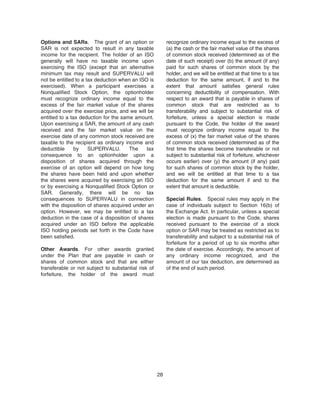
  • 4.
    in one ormore of our employee benefit plans, you will receive a single proxy card that covers both the shares credited to your plan account(s) and shares you own that are registered in the same name. If any of your plan accounts are not in the same name as your shares of record, you will receive separate proxy cards for your record and plan holdings. Proxies submitted by plan participants will serve as voting instructions to the trustee(s) for the plans whether provided by mail, telephone or Internet. • Revoking Your Proxy. You may revoke your proxy at any time before your shares are voted by sending a written statement to the Corporate Secretary, or by submitting another proxy with a later date. You may also revoke your proxy by voting in person at the meeting. It is important that all stockholders vote. If you submit a proxy by mail, telephone or Internet without indicating how you want to vote, your shares will be voted as recommended by the Board of Directors. ATTENDING THE ANNUAL MEETING If you plan to attend the Annual Meeting, you will not be admitted without an admission ticket or proof that you own SUPERVALU stock. • Record Stockholders. If you are a record stockholder (i.e., a person who owns shares registered directly in his or her name with SUPERVALU’s transfer agent) and plan to attend the meeting, please indicate this when voting, either by marking the attendance box on the proxy card or responding affirmatively when prompted during telephone or Internet voting. An admission ticket for record stockholders is printed on the proxy card together with directions to the meeting. The admission ticket must be brought to the meeting. • Owners of Shares Held in Street Name. Beneficial owners of SUPERVALU common stock held in street name by a broker, bank or other nominee will need proof of ownership to be admitted to the meeting. A recent brokerage statement or letter from the broker, bank or other nominee are examples of proof of ownership. If your shares are held in street name and you want to vote in person at the meeting, you must obtain a written proxy from the broker, bank or other nominee holding your shares. SECURITY OWNERSHIP OF CERTAIN BENEFICIAL OWNERS The following table sets forth information with respect to the only persons or groups known to us as of April 15, 2005, to be the beneficial owners of more than 5% of SUPERVALU common stock. Name and Address of Beneficial Owner Amount and Nature of Beneficial Ownership Percent of Class AXA Financial, Inc. and related entities 1290 Avenue of the Americas New York, New York 10104 (1) 14,100,710 10.4% Barclays Global Investors, N.A. 45 Fremont Street San Francisco, CA 94105 (2) 17,606,411 13.1% (1) Based on an amended Schedule 13G dated March 10, 2005, filed by AXA Financial, Inc. on behalf of AXA, AXA Assurances I.A.R.D. Mutuelle, AXA Assurances Vie Mutuelle, AXA Courtage Assurance Mutuelle, and its subsidiaries, Alliance Capital Management L.P. (a majority-owned subsidiary), Boston Advisors, Inc., and AXA Equitable Life Insurance Company. Alliance Capital Management L.P. beneficially owns 13,248,342 shares of SUPERVALU’s common stock, with sole voting power as to 6,715,232 of such shares, shared voting power as to 1,461,427 of such shares, sole dispositive power as to 13,234,422 shares and shared dispositive power as to 13,920 shares. Boston Advisors, Inc. beneficially owns 136,349 shares of SUPERVALU’s common stock, with sole voting power as to 4,350 shares and sole dispositive power as to 136,349 shares. AXA Equitable Life Insurance Company beneficially owns 2,396 shares of SUPERVALU’s common stock, with sole voting power as to 2,150 of such shares and sole dispositive power as to 2,396 of such shares. In addition, 2
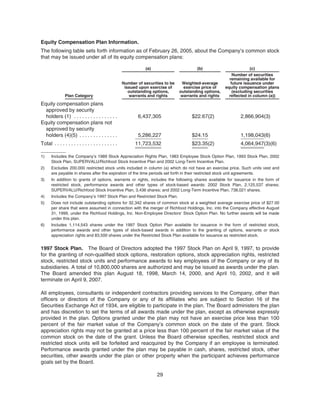
  • 5.
    AXA Konzern AG(Germany) and AXA Rosenberg Investment Management LLC, two entities of AXA, beneficially own shares of SUPERVALU’s common stock for investment purposes only. AXA Konzern AG (Germany) owns 30,600 common shares with sole voting and dispositive power as to all such shares. AXA Rosenberg Investment Management LLC owns 683,023 common shares with sole voting power as to 407,600 of such shares and sole dispositive power as to all of such shares. AXA, AXA Assurances I.A.R.D. Mutuelle, AXA Assurances Vie Mutuelle, and AXA Courtage Assurance Mutuelle disclaim beneficial ownership of 14,100,710 shares. (2) Based on a Schedule 13G dated February 14, 2005, filed by Barclays Global Investors, N.A. on behalf of itself, Barclays Global Fund Advisors, Barclays Global Investors, LTD., Barclays Bank PLC, Barclays Capital Securities, Limited, Palomino Limited, and other Barclays entities, reporting beneficial ownership of 17,606,411 shares of SUPERVALU’s common stock held in trust accounts for the economic benefit of the beneficiaries of these accounts. Of these shares, Barclays Global Investors, N.A. has sole voting power as to 12,224,217 shares and sole dispositive power as to 14,149,657 shares, Barclays Global Fund Advisors has sole voting power as to 642,384 shares and sole dispositive power as to 764,108 shares, Barclays Global Investors, Ltd. has sole voting power as to 2,461,847 shares and sole dispositive power as to 2,470,747 shares, Barclays Bank PLC has sole voting and dispositive power as to 177,884 shares, Barclays Capital Securities, Limited has sole voting and dispositive power as to 3,515 shares, and Palomino Limited has sole voting and dispositive power as to 40,500 shares. Other Barclays’ entities named in the filing report no voting or dispositive power as to the common stock of SUPERVALU. SECURITY OWNERSHIP OF MANAGEMENT The following table sets forth information as of April 15, 2005, concerning beneficial ownership of SUPERVALU’s common stock by each director and director nominee, each of the executive officers named in the Summary Compensation Table on page 12 and all of our directors and executive officers as a group. The definition of beneficial ownership for proxy statement purposes includes shares over which a person has sole or shared voting power, and shares over which a person has sole or shared dispositive power, whether or not a person has any economic interest in the shares. The definition also includes shares that a person has a right to acquire currently or within 60 days. Name of Beneficial Owner Amount and Nature of Beneficial Ownership (1) Options Exercisable Within 60 Days Percent Of Class Irwin Cohen 1,622 12,000 * Ronald E. Daly 3,036 12,000 * Lawrence A. Del Santo 17,235 44,000 * Susan E. Engel 18,663 34,000 * Edwin C. Gage 23,647 40,958 * Garnett L. Keith, Jr. 42,189 45,042 * Richard L. Knowlton 43,508 33,540 * Charles M. Lillis 32,458 32,000 * Marissa Peterson 814 12,000 * Steven S. Rogers 12,218 32,195 * Jeffrey Noddle 215,452 1,188,758 1% David L. Boehnen 170,193 305,362 * John H. Hooley 53,559 176,370 * Michael L. Jackson 65,318 251,150 * Pamela K. Knous 132,093 356,281 * All directors and executive officers as a group (24 persons) 1,196,152 4,249,250 3% * Less than 1% (1) All persons listed have sole voting and investment power with respect to all of the shares listed except: (i) the following non-employee director who has shared voting and investment power as follows: Mr. Gage, 8,000 shares, and (ii) the following non-employee directors who have sole voting power, but no investment power, over shares held in the Non-Employee Directors Deferred Stock Plan Trust as follows: Mr. Cohen, 1,622 shares; Mr. Daly, 3,036 shares; Mr. Del Santo, 17,235 shares; Ms. Engel, 18,663 shares; Mr. Gage, 8,647 shares; Mr. Keith, 29,992 shares; Mr. Knowlton, 25,168 shares; Mr. Lillis, 30,458 shares; Ms. Peterson, 664 shares; and Mr. Rogers, 6,413 shares. 3
  • 6.
    MEETINGS OF THEBOARD OF DIRECTORS AND COMMITTEES OF THE BOARD The Board of Directors held six regular meetings and no special meetings during the last fiscal year. Each director attended more than 75% of the meetings of the Board and its committees on which the director served. The Executive Committee of the Board does not have scheduled meetings and did not meet during the year. The Board maintains four other committees: Audit, Finance, Director Affairs, and Executive Personnel and Compensation. Each active committee of the Board has a separate written charter that is available on the Company’s website at http://www.supervalu.com. Click on the tab “Site Map” and then the caption “Corporate Governance.” Copies of the committee charters are also available to any stockholder who submits a request to the Corporate Secretary, SUPERVALU INC., P.O. Box 990, Minneapolis, Minnesota 55440. Membership on the Audit, Director Affairs, and Executive Personnel and Compensation Committees is limited to non-employee directors. The Board of Directors has determined that all of its non-employee directors, and therefore each member of the Audit, Director Affairs, and Executive Personnel and Compensation Committees, are independent directors as defined under the New York Stock Exchange listing standards. Audit Committee The following directors serve on the Audit Committee: Garnett L. Keith, Jr. (Chairperson), Irwin Cohen, Susan E. Engel, Charles M. Lillis and Steven S. Rogers. The Board has determined that all members of the Audit Committee are financially literate under the New York Stock Exchange listing standards and that Irwin Cohen qualifies as an “audit committee financial expert” under the rules of the Securities and Exchange Commission. The Audit Committee met six times during the last fiscal year. The primary responsibilities of the Audit Committee are to assist the Board of Directors in: • Its oversight of our accounting and financial reporting principles and policies, and internal controls and procedures; • Its oversight of our financial statements and the independent registered public accountants thereof; • Selecting, evaluating and, where deemed appropriate, replacing the independent registered public accountants; and • Evaluating the independence of the independent registered public accountants. Finance Committee The following directors serve on the Finance Committee: Charles M. Lillis (Chairperson), Irwin Cohen, Ronald E. Daly, Garnett L. Keith, Jr., Jeffrey Noddle, and Marissa Peterson. The Finance Committee met two times during the last fiscal year. The primary responsibilities of the Finance Committee are to review SUPERVALU’s financial structure, policies and future financial plans, and to make recommendations concerning them to the Board. In carrying out these responsibilities, the Finance Committee periodically reviews: • Our annual operating and capital budgets as proposed by management, and our performance as compared to the approved budgets; • Dividend policy and rates; • Investment performance of our employee benefit plans; • Our financing arrangements; • Our capital structure, including key financial ratios such as debt to equity ratios and coverage of fixed charges; and • Proposals for changes in our capitalization, including purchases of treasury stock. Director Affairs Committee The following directors serve on the Director Affairs Committee: Lawrence A. Del Santo (Chairperson), Edwin C. Gage, Richard L. Knowlton, Marissa Peterson and Steven S. Rogers. The Director Affairs Committee met three times during the last fiscal year. 4
  • 7.
    The mission ofthe Director Affairs Committee is to recommend a framework to assist the Board in fulfilling its corporate governance responsibilities. In carrying out its mission, the Director Affairs Committee establishes and regularly reviews the Board’s policies and procedures, which provide: • Criteria for the size and composition of the Board; • Procedures for the conduct of Board meetings, including executive sessions of the Board; • Policies on director retirement and resignation; and • Criteria regarding personal qualifications needed for Board membership. In addition, the Director Affairs Committee has the responsibility to: • Consider and recommend nominations for Board membership and the composition of Board Committees; • Evaluate Board practices at SUPERVALU and other well-managed companies and recommend appropriate changes to the Board (see “SUPERVALU Board Practices” below); • Consider governance issues raised by stockholders and recommend appropriate responses to the Board; and • Consider appropriate compensation for directors. Executive Personnel and Compensation Committee The following directors serve on the Executive Personnel and Compensation Committee: Edwin C. Gage (Chairperson), Ronald E. Daly, Lawrence A. Del Santo, Susan E. Engel, and Richard L. Knowlton. The Committee met five times during the last fiscal year. The primary functions of the Executive Personnel and Compensation Committee are to: • Determine the process to evaluate the performance of the Chief Executive Officer; • Review and recommend to the Board the compensation of the Chief Executive Officer; • Review and recommend to the Board major changes in executive compensation programs, executive stock options and retirement plans for officers; • Consider and make recommendations to the Board concerning the annual election of corporate officers and the succession plan for the Chief Executive Officer; • Approve annual salaries and bonuses of corporate officers and other executives at specified levels; • Review and approve participants and performance targets under our annual and long-term incentive compensation plans; and • Approve stock option grants and awards under our stock option plans, bonus and other incentive plans. SUPERVALU BOARD PRACTICES In order to help our stockholders better understand SUPERVALU’s Board practices, we are including the following description of current practices. The Director Affairs Committee periodically reviews these practices. Evaluation of Board Performance In order to continue to evaluate and improve the effectiveness of the Board, the Board, under the guidance of the Director Affairs Committee, annually evaluates the Board’s performance as a whole. The evaluation process includes a survey of the individual views of all directors, a summary of which is then shared with the Board. Each active Board Committee also evaluates its own performance on a yearly basis. Size of the Board Although the size of the Board may vary from time to time, the Board believes the size should preferably be not less than ten or more than fourteen members. The Board believes that the 5
  • 8.
    size of theBoard should accommodate the objectives of effective discussion and decision- making and adequate staffing of Board committees. Director Independence The Board believes that a substantial majority of its members should be independent, non- employee directors. It is the Board’s policy that no more than three members of the Board will be employees of SUPERVALU. These management members will include the Chief Executive Officer and up to two additional persons whose duties and responsibilities identify them as key managers of SUPERVALU. The Board currently has eleven members. One member is an employee of SUPERVALU: Mr. Noddle, Chairman, Chief Executive Officer and President. The Board has determined that all of its non-employee directors meet the requirements for independence under New York Stock Exchange listing standards. Director Retirement It is Board policy that non-employee directors retire at the annual meeting following the date they attain the age of seventy-two, and that non- employee directors elected after February 27, 1994, will serve a maximum term of fifteen years. Mr. Knowlton is seventy-two and therefore is retiring at the Annual Meeting. Directors who change the occupation they held when initially elected to the Board are expected to offer to resign from the Board. At that time, the Director Affairs Committee will review the continuation of Board membership under these new circumstances and make a recommendation to the full Board. The Board also has adopted a policy that requires employee directors, other than the Chief Executive Officer, to retire from the Board at the time of a change in their status as an officer of SUPERVALU. A former Chief Executive Officer may continue to serve on the Board until the third anniversary after his or her separation from SUPERVALU. However, if a former Chief Executive Officer leaves SUPERVALU to accept another position, the Chief Executive Officer is expected to retire as a director effective simultaneously with his or her separation from SUPERVALU. Selection of Directors The Director Affairs Committee is the standing committee responsible for determining the slate of director nominees for election by stockholders. The Director Affairs Committee considers and evaluates potential Board candidates based on the criteria set forth below, and makes its recommendation to the full Board. The criteria applied to director candidates stress independence, integrity, experience and sound judgment in areas relevant to SUPERVALU’s business, financial acumen, interpersonal skills, a proven record of accomplishment, a willingness to commit sufficient time to the Board, and the ability to challenge and stimulate management. The Director Affairs Committee will use the same process and criteria for evaluating all nominees, regardless of whether the nominee is submitted by a stockholder or by some other source. The Director Affairs Committee is not currently utilizing the services of an executive recruiting firm to assist in the identification or evaluation of director candidates. However, the committee has used such firms in the past and may engage a firm to provide such services in the future, as it deems necessary or appropriate. Directors and management are encouraged to submit the name of any candidate they believe to be qualified to serve on the Board, together with background information on the candidate, to the Chairperson of the Director Affairs Committee. In accordance with procedures set forth in our bylaws, stockholders may propose, and the Director Affairs Committee will consider, nominees for election to the Board of Directors by giving timely written notice to the Corporate Secretary, which must be received at our principal executive offices no later than the close of business on February 15, 2006, and no earlier than January 16, 2006. Any such notice must include the name of the nominee, a brief biographical sketch and resume, contact information and such other background materials on such nominee as the Director Affairs Committee may request. Board Meetings The full Board meets at least six times each year. Board meetings normally do not exceed 6
  • 9.
    one day inlength. The Board also schedules a longer multi-day off-site strategic planning meeting every two years and additional one-day strategic planning update meetings every other year. Executive Sessions of Outside Directors; Presiding Director Non-employee directors generally meet together as a group, without the Chief Executive Officer or any other employee directors in attendance, during three scheduled executive sessions each year. The Chairperson of the Director Affairs Committee will preside during any executive session of the Board; however, the Chairperson of the Executive Personnel and Compensation Committee will preside during any executive session held for the purpose of conducting the Chief Executive Officer’s performance review. Attendance at Stockholder Meetings The Board does not have a formal policy regarding director attendance at the Annual Meeting of Stockholders. However, all directors are strongly encouraged to attend the meeting. All directors attended the 2004 Annual Meeting of Stockholders. Stock Ownership Guidelines Non-employee directors are encouraged to acquire and own SUPERVALU common stock with a fair market value of five times a director’s annual retainer, within five years after the director is first elected. Governance Principles The Board maintains a formal statement of Governance Principles that sets forth the corporate governance practices for the Company. The Governance Principles are available on the Company’s website at http://www.supervalu.com. Click on the tab “Site Map” and then the caption “Corporate Governance.” Copies of the Governance Principles are also available to any stockholder who submits a request to the Corporate Secretary at SUPERVALU INC., P.O. Box 990, Minneapolis, Minnesota 55440. 7
  • 10.
    ELECTION OF DIRECTORS(ITEM 1) The Board is divided into three classes, with the number of directors to be divided as equally as possible among the three classes. Directors are elected for staggered terms of three years. If a vacancy exists or occurs during the year, the vacant directorship may be filled by the vote of the remaining directors until the next annual meeting, at which time the stockholders elect a director to fill the balance of the unexpired term or the term established by the Board. There are currently eleven members of the Board. One director, Richard L. Knowlton, will be retiring at the Annual Meeting in accordance with Board policies (see “Director Retirement” on page 6). Edwin C. Gage, Garnett L. Keith, Jr. and Marissa Peterson are nominated for three-year terms expiring in 2008. The Board of Directors is informed that each nominee is willing to serve as a director; however, if any nominee is unable to serve or for good cause will not serve, the proxy may be voted for another person as the persons named on the proxies decide. If all of the nominees are elected, following the Annual Meeting there will be ten members of the Board with four directors with terms expiring in 2006, three directors with terms expiring in 2007 and three directors with terms expiring in 2008. The following sets forth information, as of April 15, 2005, concerning the three nominees, the seven directors whose terms of office will continue after the Annual Meeting and the director who is retiring at the Annual Meeting. NOMINEES FOR ELECTION AS DIRECTORS AT THE ANNUAL MEETING FOR THREE-YEAR TERMS EXPIRING IN 2008 EDWIN C. GAGE, age 64 • Chairman and Chief Executive Officer of GAGE Marketing Group, L.L.C. (an integrated marketing services company) since 1991 • Elected a director of SUPERVALU in 1986 GARNETT L. KEITH, JR., age 69 • Chairman and Chief Executive Officer of SeaBridge Investment Advisors, LLC (a registered investment advisor) since 1996 • Elected a director of SUPERVALU in 1984 • Also a director of Pan-Holding Societe Anonyme MARISSA PETERSON, age 43 • Executive Vice President for Sun Microsystems, Inc. (a provider of hardware, software and services) from 2005 to present • Executive Vice President, Sun Services and Worldwide Operations; and Chief Customer Advocate for Sun Microsystems, Inc. from 2004 to 2005 • Executive Vice President, Worldwide Operations; and Chief Customer Advocate for Sun Microsystems, Inc. from 2002 to 2004 • Executive Vice President, Worldwide Operations for Sun Microsystems, Inc. from 1998 to 2002 • Elected a director of SUPERVALU in 2003 • Also a director of Lucille Packard Children’s Hospital and a member of the Board of Trustees of Kettering University 8
  • 11.
    DIRECTORS WHOSE TERMSEXPIRE AT THE ANNUAL MEETING IN 2006 IRWIN COHEN, age 64 • Retired Partner of Deloitte & Touche LLP (a professional services firm, providing audit, tax, financial advisory and consulting services), a position he held from 1972 to 2003 • Global Managing Partner of the Consumer Products, Retail and Services Practice of Deloitte & Touche LLP from 1997 to 2003 • Managing Partner of Deloitte & Touche LLP’s U.S. Retail Practice from 1980 to 2002 • Elected a director of SUPERVALU in 2003 • Also a director of Beall’s, Inc; Equinox Holdings, Inc; Phoenix House Foundation; and SmartBargains, Inc. RONALD E. DALY, age 58 • Former Chief Executive Officer and President of Oc´e USA Holding, Inc., a subsidiary of Oc´e N.V. (a supplier of digital document management technology and services) from 2002 to 2004 • President of RR Donnelley Print Solutions (a print solutions company) from 2001 to 2002 • President of RR Donnelley Telecommunications (a telecommunications industry printing company) from 1995 to 2001 • Elected a director of SUPERVALU in 2003 • Also a director of United States Cellular Corporation LAWRENCE A. DEL SANTO, age 71 • Retired Chief Executive Officer of The Vons Companies (a retail grocery company), a position he held from 1994 to 1997 • Elected a director of SUPERVALU in 1997 • Also a director of PETsMART, Inc. SUSAN E. ENGEL, age 58 • Chairwoman of the Board and Chief Executive Officer of Department 56, Inc. (a designer, importer and distributor of fine quality collectibles and other giftware products) since 1997 • Elected a director of SUPERVALU in 1999 • Also a director of Wells Fargo & Company 9
  • 12.
    DIRECTORS WHOSE TERMSEXPIRE AT THE ANNUAL MEETING IN 2007 CHARLES M. LILLIS, age 63 • General Partner, LoneTree Capital Management (a private equity company) since 2000 • Chairman, President and Chief Executive Officer of MediaOne Group, Inc. (a broadband communications company) from 1998 to 2000 • Elected a director of SUPERVALU in 1995 • Also a director of Medco Health Solutions and Williams Companies, Inc. JEFFREY NODDLE, age 58 • Chairman, Chief Executive Officer and President of SUPERVALU since 2002 • Chief Executive Officer and President of SUPERVALU from 2001 to 2002 • President and Chief Operating Officer of SUPERVALU from 2000 to 2001 • Executive Vice President; President and Chief Operating Officer-Wholesale Food Companies, for SUPERVALU from 1995 to 2000 • Elected a director of SUPERVALU in 2000 • Also a director of Donaldson Company, Inc. STEVEN S. ROGERS, age 47 • Clinical Professor of Finance and Management at J.L. Kellogg Graduate School of Management at Northwestern University since 1995 • Elected a director of SUPERVALU in 1998 • Also a director of Amcare Financial, Inc.; Duquesne Light, Inc.; and S.C. Johnson & Son, Inc. RETIRING DIRECTOR RICHARD L. KNOWLTON, age 72 • Chairman of the Hormel Foundation (a charitable foundation controlling 46.2% of Hormel Foods Corporation) since 1995 • Elected a director of SUPERVALU in 1994 • Also a director of ING America Insurance Holdings, Inc. Mr. Knowlton, whose term expires at the 2005 Annual Meeting, is retiring from the Board at that time in accordance with Board policies (see “Director Retirement” on page 6). He has served as a director for eleven years and SUPERVALU wishes to thank him for his valuable contributions to the Board. 10
  • 13.
    COMPENSATION OF DIRECTORS Non-employeedirectors receive the following compensation for their Board service: • Cash retainer of $35,000 per year; • Deferred retainer of $25,000 per year payable in SUPERVALU common stock under the Non-Employee Directors Deferred Stock Plan; • $1,800 for each Board meeting attended; • $1,000 for each committee meeting attended; and • At the time of the annual meeting, each director will receive an option to purchase 6,000 shares, and newly appointed directors will receive an option to purchase 6,000 shares when they first join the Board. Options are granted to directors at current fair market value and are fully exercisable upon grant. Committee Chairpersons receive an additional annual retainer in the following amounts: • Finance and Director Affairs Committees: $7,000; • Audit Committee: $9,000; and • Executive Personnel and Compensation Committee: $8,000. Effective June 27, 1996, our retirement/deferral program for directors was discontinued and benefits previously earned by directors were frozen. A director first elected to our Board prior to June 27, 1996, will receive an annual payment of $20,000 per year for the number of years of the director’s service on the Board prior to June 27, 1996, but for not more than ten years of such service, after such director ceases to be a member of the Board. Directors first elected to the Board after June 27, 1996, do not participate in the retirement/deferral program. Directors may elect to defer payment of their directors’ fees under one or more of the following arrangements: • Directors Deferred Compensation Plan and Executive Deferred Compensation Plan. Fees and quarterly interest are credited to an account for the director, until payment is made from the plan following retirement from the Board. • Non-Employee Directors Deferred Stock Plan. This plan is designed to encourage increased stock ownership among directors. Under the plan, a director may elect to have payment of all or a portion of the director’s fees deferred and credited to a deferred stock account. The Company then credits the director’s account with an additional amount equal to 10% of the amount of fees the director has elected to defer and contributes the total amounts in the director’s account to an irrevocable trust that uses the amounts to purchase shares of SUPERVALU common stock, which are then allocated to an account for the director under the trust. Each director is entitled to direct the trustee to vote all shares allocated to the director’s account in the trust. The common stock in each director’s deferred stock account will be distributed to the director after the director leaves the Board. Until that time, the trust assets remain subject to the claims of our creditors. 11
  • 14.
    COMPENSATION OF EXECUTIVEOFFICERS SUMMARY COMPENSATION TABLE The following table shows compensation for each of the last three fiscal years earned by the Chief Executive Officer and the other four most highly compensated persons serving as executive officers at the end of fiscal 2005. Name and Principal Position Year (1) Annual Compensation Long-Term Compensation Awards All Other Compensation ($)(4) Salary ($) Bonus ($) Other Annual Compensation ($) Restricted Stock Awards ($)(2) Securities Underlying Options/SARs (#)(3) Jeffrey Noddle Chairman, Chief Executive Officer and President 2005 2004 2003 900,000 866,346 812,500 1,800,000 1,046,893 0 0 0 0 1,199,962 0 0 196,893 371,191 200,000 4,621 1,714 4,578 David L. Boehnen Executive Vice President 2005 2004 2003 433,000 415,846 408,000 433,000 251,254 0 0 0 0 377,464 0 0 186,474 62,183 138,909 10,017 4,774 12,716 John H. Hooley Executive Vice President; President, Retail Food Companies 2005 2004 2003 475,000 407,692 400,000 617,500 320,226 0 0 0 0 366,775 628,000 0 65,000 84,893 60,000 10,241 6,600 8,623 Michael L. Jackson Executive Vice President; President and COO, Distribution Food Companies 2005 2004 2003 505,000 438,269 430,000 656,500 344,243 0 0 0 0 397,815 628,000 0 98,670 91,382 50,000 10,758 7,911 14,709 Pamela K. Knous Executive Vice President and Chief Financial Officer 2005 2004 2003 440,000 415,846 408,000 490,000 251,254 0 0 0 0 377,464 0 0 231,281 60,000 60,000 5,050 2,000 3,909 (1) Fiscal 2005 and fiscal 2003 were 52 week fiscal years. Fiscal 2004 was a 53 week fiscal year. This table includes 53 weeks of salary and bonus for fiscal 2004. (2) The amounts reflected represent the dollar value of: (a) Shares of restricted stock earned under our Long-Term Incentive Program based on the achievement of designated levels of corporate return on invested capital for three-year overlapping performance periods ending at the close of fiscal 2003 and fiscal 2005. There was no payout at the end of fiscal 2003 for the fiscal 2001-2003 performance period. The fiscal 2002-2004 performance period was replaced by the Special Fiscal 2002 Incentive Program (described in (c) below). Therefore there was no payout under the Long-Term Incentive Program at the close of fiscal 2004. The number of shares of restricted stock earned in fiscal 2005 for the fiscal 2003-2005 performance period under the Long-Term Incentive Program were as follows: 37,382 shares for Mr. Noddle; 11,759 shares for Mr. Boehnen; 11,426 shares for Mr. Hooley; 12,393 shares for Mr. Jackson; and 11,759 shares for Ms. Knous. The restrictions on these shares will lapse on March 2, 2006. (b) Restricted stock units granted for retention purposes. In fiscal 2004, Mr. Hooley and Mr. Jackson each received a special award of 40,000 restricted stock units as an incentive to remain with the Company until the attainment of a certain age and length of service. (c) The Special Fiscal 2002 Incentive Program was in effect for a single year (fiscal 2002) in lieu of a new three-year performance period under the Long-Term Incentive Program. The restrictions on the shares of restricted stock earned under this program for fiscal 2002 performance lapsed on March 2, 2004, for each of the named executive officers as follows: 18,763 shares for Mr. Noddle; 7,464 shares for Mr. Boehnen; 4,986 shares for Mr. Hooley; 7,260 shares for Mr. Jackson; and 7,427 shares for Ms. Knous. (d) For purposes of this table, the restricted stock and the restricted stock units are valued based on the closing price of our common stock on the date the restricted stock or restricted stock units were earned or granted. Dividends are paid on the shares of restricted stock. Dividends are not paid on restricted stock units. As of February 26, 2005, the last trading day of fiscal 2005, the number and fair market value of all shares of restricted stock and restricted stock units held or earned by the following named executive officers were as follows: Mr. Noddle: 97,382, $3,125,962; Mr. Boehnen: 41,759, $1,340,464; Mr. Hooley: 51,426, $1,650,775; Mr. Jackson: 52,393, $1,681,815; and Ms. Knous: 41,759, $1,340,464. 12
  • 15.
    (3) The totalnumber of shares subject to option awards includes those subject to restoration options (as more fully described below in note (1) to the table entitled “Option Grants in Last Fiscal Year”) received by the named executive officers as follows: Mr. Noddle, 71,191 shares in fiscal 2004 and 6,143 shares in fiscal 2002; Mr. Boehnen, 126,474 shares in fiscal 2005, 2,183 shares in fiscal 2004, and 88,909 shares in fiscal 2003; Mr. Hooley, 19,893 shares in fiscal 2004; Mr. Jackson, 33,670 shares in fiscal 2005 and 26,382 shares in fiscal 2004; and Ms. Knous, 166,280 shares in fiscal 2005. No stock appreciation rights were granted in fiscal 2005, 2004 or 2003. (4) For fiscal 2005, the amount of All Other Compensation reflects contributions made by us during the fiscal year under the Qualified Pre-Tax Savings and Profit Sharing 401(k) Plan, and additional contributions made by us to an unfunded non- qualified deferred compensation plan because of limitations on the annual compensation that can be taken into account under the 401(k) Plan. The amounts of contributions to the 401(k) Plan and the unfunded plan for fiscal 2005 were as follows: $4,621 and $0 for Mr. Noddle; $4,621 and $5,396 for Mr. Boehnen; $5,050 and $5,192 for Mr. Hooley; $4,621 and $5,957 for Mr. Jackson; $5,050 and $0 for Ms. Knous. OPTION GRANTS IN LAST FISCAL YEAR The following table provides information on grants of stock options during fiscal 2005 to the executive officers named in the Summary Compensation Table. Name Individual Grants Number of Securities Underlying Options Granted (#)(1) Percent of Total Options Granted to Employees in Fiscal Year Exercise or Base Price ($/Share) Expiration Date Potential Realizable Value at Assumed Annual Rates of Stock Price Appreciation for Option Term ($)(2) Prior Columns Annualized ($)(2)(3) 5%($) 10%($) 5%($) 10%($) Jeffrey Noddle 196,893 6.3 30.73 05/26/14 3,805,141 9,642,974 380,514 964,297 David L. Boehnen 60,000 8,490(4) 40,775(4) 17,503(4) 26,051(4) 33,655(4) 1.9 .3 1.3 .6 .8 1.1 29.90 30.94 30.94 30.94 30.94 31.85 04/07/04 04/08/06 04/06/09 04/09/13 03/14/10 04/08/08 1,128,237 24,992 337,343 293,036 263,306 193,892 2,859,174 51,032 742,684 719,036 594,103 411,342 112,824 2,499 33,734 29,304 26,331 19,389 285,917 5,103 74,268 71,904 59,410 41,134 John H. Hooley 65,000 2.1 29.90 04/07/14 1,222,257 3,097,438 122,256 309,744 Michael L. Jackson 65,000 8,253(4) 14,357(4) 11,060(4) 2.1 .3 .5 .4 29.90 29.96 29.96 29.96 04/07/14 03/14/10 04/09/07 03/14/10 1,222,257 73,931 54,211 99,076 3,097,438 164,920 112,251 221,012 122,256 7,393 5,421 9,908 309,744 16,492 11,225 22,101 Pamela K. Knous 65,000 4,776(4) 78,544(4) 1,258(4) 10,887(4) 70,816(4) 2.1 .2 2.5 .1 .3 2.3 29.90 31.80 31.80 31.80 30.62 30.46 04/07/14 04/09/13 09/22/07 04/09/13 04/09/13 03/14/10 1,222,257 76,680 370,161 20,198 169,515 708,215 3,097,438 185,601 774,083 48,887 410,870 1,599,006 122,226 7,668 37,016 2,020 16,952 70,822 309,744 18,560 77,408 4,889 41,087 159,901 (1) Options are granted with an exercise price equal to the fair market value of the shares of stock on the date of grant, for a term not exceeding ten years. All options, with the exception of restoration options as described below, vest and become exercisable with respect to 20% of the shares subject thereto on the grant date, and an additional 20% of such shares on each anniversary of the grant date. Options vest in full and become fully exercisable upon the occurrence of a change-in- control of SUPERVALU (as defined in the option award agreements) and vesting or exercisability will also be accelerated upon the occurrence of certain other events, such as death, disability or retirement. The exercise price may be paid by the delivery of previously owned shares of SUPERVALU common stock, and tax withholding obligations arising from the exercise may also be paid by delivery of such shares or the withholding of a portion of the shares to be received upon exercise of the option. A “restoration” option (also referred to as a “reload” option) is granted when the original option is exercised and payment of the exercise price is made by delivery of previously owned shares of SUPERVALU common stock. Each restoration option is granted for the number of shares tendered as payment for the exercise price and tax withholding obligation, has a per share exercise price equal to the fair market value of a share of SUPERVALU common stock on the date of grant, is exercisable in full on the date of grant, and expires on the same date as the original option. All original options reported in the table are entitled to restoration options. The options set forth in the table above (excluding restoration options) were granted to all named executive officers, except Mr. Noddle, on April 7, 2004. Mr. Noddle’s options were granted on May 26, 2004. No stock appreciation rights were granted in fiscal 2005. 13
  • 16.
    (2) The amountsindicated represent the potential realizable value to the optionholder if SUPERVALU common stock were to appreciate at the indicated annual rate and the options were held for their full term before being exercised. These amounts are the result of calculations at the 5% and 10% rates set by the Securities and Exchange Commission and therefore are not intended to forecast possible future appreciation, if any, in our stock price. Total potential realizable value for all of the named officers who received stock option grants is $11,284,703 and $27,829,290 at the 5% and 10% stock price growth assumptions, respectively. Assuming 5% and 10% stock price growth over a period of ten years commencing April 1, 2004, the increase in total stockholder value from stock price appreciation alone for all shares outstanding on that date would be $2,576,536,408 and $6,529,449,130, respectively. (3) Computed by dividing potential realizable value at the assumed annual rates of stock price appreciation by the term of the option. Options granted in fiscal 2005 have a ten-year term. Restoration options (described above) have a term equal to the remaining term of the original option. (4) Grant of a restoration option. AGGREGATED OPTION EXERCISES IN LAST FISCAL YEAR AND FISCAL YEAR-END OPTION VALUES The following table provides information on option exercises in fiscal 2005 by the executive officers named in the Summary Compensation Table, and the value of such officers’ unexercised options at the end of fiscal 2005. Name Shares Acquired on Exercise (#) Value Realized ($) Number of Securities Underlying Unexercised Options at Fiscal Year-End (#) Value of Unexercised In-the-Money Options at Fiscal Year-End ($) Exercisable Unexercisable Exercisable Unexercisable Jeffrey Noddle 37,949 305,810 1,120,570 497,514 14,011,279 4,077,694 David L. Boehnen 185,294 2,241,406 259,362 104,000 521,792 771,300 John H. Hooley 1,241 8,377 124,370 114,999 1,281,644 845,184 Michael L. Jackson 60,033 765,305 201,150 117,000 1,972,663 924,550 Pamela K. Knous 224,001 3,184,764 305,281 111,999 1,266,699 796,584 LONG-TERM INCENTIVE PLANS—AWARDS IN LAST FISCAL YEAR The following table provides information on awards made to the executive officers named in the Summary Compensation Table, during the last fiscal year. Name Number of Shares, Units or Other Rights (#)(1) Performance or Other Period Until Maturation or Payout (1) Jeffrey Noddle . . . . . . . . . . . . . . . . . . . . . . . . . . . . . . . . . . . . . . . . . . . . . . . . . . . . 95,132 Fiscal years 2005–2006 David L. Boehnen . . . . . . . . . . . . . . . . . . . . . . . . . . . . . . . . . . . . . . . . . . . . . . . . . 13,797 Fiscal years 2005–2006 John H. Hooley . . . . . . . . . . . . . . . . . . . . . . . . . . . . . . . . . . . . . . . . . . . . . . . . . . . 16,648 Fiscal years 2005–2006 Michael L. Jackson . . . . . . . . . . . . . . . . . . . . . . . . . . . . . . . . . . . . . . . . . . . . . . . . 17,700 Fiscal years 2005–2006 Pamela K. Knous . . . . . . . . . . . . . . . . . . . . . . . . . . . . . . . . . . . . . . . . . . . . . . . . . . 14,020 Fiscal years 2005–2006 (1) Awards are of stock units under the Company’s Long-Term Incentive Program, each of which represents the right to receive restricted stock upon achievement of specified performance objectives. Stock units will be converted to restricted stock based on the Company’s total return on invested capital (ROIC) relative to the specified performance objectives for the fiscal 2005—2006 performance period. No stock units will be converted to restricted stock if the pre-established minimum ROIC performance objective is not achieved. If the minimum, target or maximum ROIC performance objective is achieved, then 50%, 100% or 150%, respectively, of the awarded stock units will be converted to restricted stock. If the Company’s actual ROIC performance falls between the minimum and target or the target and maximum objectives, the percent of stock units converting to restricted stock will be extrapolated accordingly. Shares earned for ROIC performance as described above may be increased if Company sales for the two-year performance period increase at a rate equal to or in excess of the Consumer Price Index (CPI) for the performance period, but only if the ROIC performance is at or above target. At sales growth equal to the CPI, the stock units to be converted to restricted stock will be increased by 10% progressing linearly to a 25% increase in such restricted stock for sales growth equal to the CPI plus 3% or more. Shares of restricted stock issued upon conversion of stock units would vest at the end of fiscal 2007, provided that the named officer continues in the employ of the Company at the time of vesting. No dividends are paid on stock units. Dividends are paid on all shares of restricted stock that are issued. 14
  • 17.
    PENSION PLANS ANDRETIREMENT BENEFITS The following table shows the estimated maximum annual benefits that would be paid to an employee upon retirement at age 65 under the combination of the SUPERVALU Retirement Plan, the Non- Qualified Supplemental Executive Retirement Plan (or, if applicable, the Excess Benefit Plan) maintained for certain highly compensated employees, and the “Retirement Benefit Plan Account” of the Company’s Non-Qualified Deferred Compensation Plans. The table does not reflect the $170,000 per year limitation on annual benefits payable from the plans imposed by Section 415 of the Internal Revenue Code, nor the $210,000 per year limitation on compensation included in final annual average pay imposed by Section 401(a)(17) of the Internal Revenue Code. Our Non-Qualified Supplemental Executive Retirement Plan and Excess Benefit Plan allow payment of additional benefits so that retiring employees may receive, in the aggregate, at least the benefits they would have been entitled to receive if the Internal Revenue Code did not impose maximum limitations. Final annual average compensation under the plans is the average of the annual compensation for the five consecutive complete fiscal years prior to retirement that produce the highest average compensation. Annual compensation consists of salary and bonus (but not long-term compensation) as set forth in the Summary Compensation Table. Years of Service Final Annual Average Compensation 15 20 25 30 $ 500,000 . . . . . . . . . . . . . . . . . . . . . . . . . . . . . . . . . . . . . . . . . 109,500 146,000 182,500 219,000 800,000 . . . . . . . . . . . . . . . . . . . . . . . . . . . . . . . . . . . . . . . . . 181,500 242,000 302,500 363,000 1,100,000 . . . . . . . . . . . . . . . . . . . . . . . . . . . . . . . . . . . . . . . . . 253,500 338,000 422,500 507,000 1,400,000 . . . . . . . . . . . . . . . . . . . . . . . . . . . . . . . . . . . . . . . . . 325,500 434,000 542,500 651,000 1,700,000 . . . . . . . . . . . . . . . . . . . . . . . . . . . . . . . . . . . . . . . . . 397,500 530,000 662,500 795,000 2,000,000 . . . . . . . . . . . . . . . . . . . . . . . . . . . . . . . . . . . . . . . . . 469,500 626,000 782,500 939,000 The above estimates of annual benefits payable on normal retirement are computed using the straight- life annuity method and are based on certain assumptions, including (a) that the employee remains employed until the normal retirement age of 65 (although retirement is permitted at age 62 without any benefit reduction because of age); and (b) that the present retirement plans remain in force until the retirement date. Benefits payable under these plans will not be reduced or offset by the participant’s Social Security benefit. Our Non-Qualified Deferred Compensation Plans, the Non-Qualified Supplemental Executive Retirement Plan and the Excess Benefit Plan allow terminated and retired participants to receive their benefits in periodic installments or as a lump sum. As to each of the executive officers named in the Summary Compensation Table, the final annual average pay and credited years of service under the plans as of February 26, 2005, were as follows: Mr. Noddle: $1,350,638, 28.8 years; Mr. Boehnen: $651,911, 13.8 years; Mr. Hooley: $536,965, 30.2 years; Mr. Jackson: $633,836, 26.1 years; and Ms. Knous: $634,341, 7.4 years. The Company provides post-retirement death benefits for certain designated retired executive officers, which would include the executive officers named in the Summary Compensation Table if they retire under the Company’s retirement plan. The death benefit is fixed at an amount approximately equal to, on an after-tax basis, an eligible executive’s final base salary. The benefits are funded through life insurance policies owned by the Company. 15
  • 18.
    CHANGE-IN-CONTROL AGREEMENTS We haveentered into change-in-control agreements with certain of our executives and other employees, including all of the executive officers named in the Summary Compensation Table. In general, these agreements entitle the executive to receive a lump-sum cash payment if the executive’s employment is terminated (other than for cause or disability, as defined in the agreements) within two years after a change-in-control (as defined in the agreements). The lump-sum cash payment is equal to a multiple of one, two or three times the executive’s annual base salary, annual bonus and the value of the executive’s annual perquisites. The multiple is three for Mr. Noddle, Mr. Boehnen, Mr. Hooley, Mr. Jackson, and Ms. Knous; and one or two for all other recipients. Each executive would also receive a lump-sum retirement benefit equal to the present value of the additional qualified pension plan benefits the executive would have accrued under the plan absent the early termination. Generally, the executive would also be entitled to continued family medical, dental and life insurance coverage until the earlier of 24 months after termination or the commencement of comparable coverage with a subsequent employer. Each agreement includes a covenant not to compete with SUPERVALU. Due to the possible imposition of excise taxes on the payments, the agreements also provide that the severance benefits payable to an executive will be increased by an amount equal to the excise tax imposed on such payments. Several of our compensation and benefit plans contain provisions for enhanced benefits upon a change-in-control of SUPERVALU. These enhanced benefits include immediate vesting of stock options, performance shares, restricted stock and restricted stock unit awards. The executive officers named in the Summary Compensation Table and other executive officers also hold limited stock appreciation rights, granted in tandem with stock options that would become immediately exercisable upon a change-in-control, and allow the executive to receive cash for the bargain element in the related stock option. Under our executive deferred compensation plans, benefits payable upon termination may be increased by 130% to compensate the executive for any excise tax liability incurred following a change-in-control. Our retirement plans provide for full vesting if employment terminates under specified circumstances following a change-in-control, and preserve any excess plan assets for the benefit of plan participants for five years following a change-in-control. We may set aside funds in an irrevocable grantor trust to satisfy our obligations arising from certain of our benefit plans. Funds will be set aside in the trust automatically upon a change-in-control. The trust assets would remain subject to the claims of our creditors. REPORT OF EXECUTIVE PERSONNEL AND COMPENSATION COMMITTEE COMPENSATION PRINCIPLES The Executive Personnel and Compensation Committee of the Board of Directors is composed entirely of non-employee directors, all of whom are independent directors as defined under the New York Stock Exchange Listing Standards. The Committee has adopted a comprehensive Executive Compensation Program based on the following principles: • The program should enable SUPERVALU to attract, retain and motivate the key executives necessary for our current and long-term success; • Compensation plans should be designed to support SUPERVALU’s business strategy; • Executive compensation should be linked to corporate performance and the attainment of designated strategic objectives; • A significant portion of executive compensation should be tied to the enhancement of stockholder value; and • The Committee should exercise independent judgment and approval authority with respect to the Executive Compensation Program and the awards made under the program. 16
  • 19.
    COMPENSATION METHODOLOGY The structureof the Executive Compensation Program is based on a market comparison of compensation for equivalent positions in industries from which SUPERVALU draws executive talent, as well as a position evaluation system designed to achieve internal equity based on job responsibility. The market comparison is made using information on equivalent positions from twenty retail and distribution companies, which on average approximate SUPERVALU in terms of size. Compensation comparison to this peer group and the grocery companies within this peer group are the basis for designing our current compensation structure, which has a mix of fixed to variable compensation and short-term to long- term incentive potential approximating the mix within the compensation peer group. Comparisons are performed to ensure that the dollar values of the various plan components as well as total compensation are comparable to those of the compensation peer group. In addition to a review of compensation plan design and compensation levels, the Committee also reviews SUPERVALU’s performance on a number of key financial measures relative to the compensation peer group. The variable compensation components of the program are designed so that executives’ total compensation will be above the median of the compensation peer group when SUPERVALU’s performance is superior, and below the median of the compensation peer group when performance is below industry norms. This fluctuation in compensation value is increased by the substantial use of SUPERVALU common stock in the program, as described under the caption “Long-Term Incentive Compensation” below, so that total compensation will significantly increase or decrease in direct correlation to SUPERVALU’s stock price. The following summary explains the major components of the Executive Compensation Program. ANNUAL COMPENSATION Base Salaries. The base salary levels for executive officers are determined based on three objectives: • Internal equity based on job responsibility; • Individual performance and experience; and • Competitive salary levels with industries from which SUPERVALU draws executive talent. Our salary structure is based on the median salary levels of companies in similar industries and similar in size to SUPERVALU. Actual salaries may be set above or below this median depending on individual job performance and experience. Increases in base salaries for executives below the CEO level are proposed by the CEO based on performance evaluations, which include both progress on achievement of financial results and a qualitative assessment of performance. The Committee reviews and approves all salary increases for executive officers. Annual Bonuses. All of our executive officers are eligible to receive an annual cash bonus. The Annual Bonus Plan is designed to motivate executives to meet or exceed corporate financial goals that support our business plans. Specifically, the plan is primarily designed to stimulate and reward growth in SUPERVALU earnings. The Committee assigns target bonus levels to each executive, which are competitive with our compensation peer group. Among executive officers, these range from 25% of annual base salary to 100% of annual base salary for the CEO. For fiscal 2005 the bonus award potential for executive officers was based on corporate net profit growth performance, which could be further increased if revenue growth equaled or exceeded inflation as measured by the increase in the Consumer Price Index. Bonus payments increase as net profit growth meets and exceeds the annual growth rate targeted by the Board. The Company exceeded the net profit goal for fiscal 2005; however, the revenue growth factor was not achieved. For fiscal 2005 the maximum bonus was limited to twice the target bonus level. Bonuses for the CEO and four other named executive officers are paid from a special plan structured so that the payment will be tax- deductible as “qualified performance-based compensation” under Internal Revenue Code Section 162(m). The bonuses paid to these individuals for fiscal 2005 are shown in the Summary Compensation Table. 17
  • 20.
    LONG-TERM INCENTIVE COMPENSATION SUPERVALUmaintains a Long-Term Incentive Plan and stock option plans. Together, these plans tie a significant portion of executives’ total compensation to long-term results. The long- term incentive potential is intended to be competitive with programs offered by our compensation peer group. The Board of Directors, upon the recommendation of the Committee, is proposing that stockholders approve amendments to the 2002 Stock Plan at the 2005 Annual Meeting, so that additional shares of common stock will be available for future grants of stock options and other stock- based awards. Long-Term Incentive Program. The Long- Term Incentive Program is a component of the Long-Term Incentive Plan and provides for performance periods as follows: fiscal 2003- 2005 (completed), fiscal 2004-2006, and fiscal 2005-2006. The Committee selects program participants, approves awards and interprets and administers this program. Program participants are the CEO, Executive Vice Presidents, Senior Vice Presidents and other designated officers or executives. The performance measure under this program is overall corporate return on invested capital (“ROIC”) relative to pre-established objectives. If the designated ROIC objective is attained, the performance awards under the program may be increased if overall corporate revenue growth is above program targets. Commencing with fiscal 2005 the three-year overlapping performance period design was replaced with a two-year end- to-end design, and fiscal 2005-2006 is the first performance period under this new design. Awards of stock units for the fiscal 2005-2006 performance period for the Company’s five most highly compensated executive officers are shown on page 14 under the caption “Long- Term Incentive Plans—Awards in Last Fiscal Year.” Any payouts under this program are in the form of restricted stock with a one-year restriction on a recipient’s ability to sell the stock. For the fiscal 2003-2005 performance period SUPERVALU exceeded its ROIC performance objective, which produced the payouts shown in the Summary Compensation Table. ROIC Stock Incentive Program. Officers below the level of Senior Vice President, and certain Profit Center Presidents participate in an incentive program known as the Return On Invested Capital (ROIC) Stock Incentive Program. Amounts earned and paid out under this program are based entirely on fiscal year ROIC performance against pre-established objectives. Earned payouts are made in restricted stock at the end of the fiscal year, with the restrictions on such stock lapsing two years following the close of the fiscal year for which the stock was earned. For fiscal 2005, 9,387 shares of restricted stock were awarded to executive officers under this program. Stock Option Plans. The Committee believes that linking a portion of executive compensation and income potential to SUPERVALU’s stock price appreciation is the most effective way of aligning executive and stockholder interests. Two key programs together cause executives to view themselves as owners of a meaningful equity stake in the business over the long term. They are: • The executive stock option program; and • Stock ownership and retention guidelines for executive officers. Stock Option Grants. The Committee makes grants of stock options to key employees under established grant guidelines intended to be competitive with our compensation peer group. The Committee also considers subjective factors in determining grant size; grants are not automatically tied to a formula or the employee’s position in SUPERVALU. Corporate, profit center or individual performance will impact the size of an employee’s grant. In addition, current ownership of stock is a consideration in the size of option grants for officers and Profit Center Presidents. Based on the stock grant guidelines and the subjective factors described above, grant recommendations are developed by management, reviewed by the CEO and presented to the Committee for final approval. In fiscal 2005 the Committee granted options to certain key employees, including Mr. Noddle, as described below in the section on CEO 18
  • 21.
    compensation. All stockoptions were granted with an exercise price equal to the market price of our common stock on the date of grant. In order to encourage option exercises and share ownership, we also permit executives to exercise options using shares of our common stock to pay the exercise price. Upon such exercise, we grant the executive a restoration stock option (commonly referred to as a reload option) for the number of shares surrendered. Restoration options are exercisable at the then current market price and extend for the remainder of the original option’s term. Effective for stock option grants made after April 1, 2005 and thereafter, restoration options have been discontinued. In addition, the exercise term for options granted after April 1, 2005 and thereafter has been reduced to seven years from the previous ten-year term. Option grants, including restoration options, for executive officers are shown in the Summary Compensation Table. STOCK OWNERSHIP AND RETENTION GUIDELINES The Committee has established stock ownership and retention guidelines for executive officers so that they face the same downside risk and upside potential as stockholders experience. Executives are expected to show significant progress toward reaching these ownership goals. The goal for the CEO is ownership of 150,000 shares, excluding vested and unexercised stock options, which is between five and six times his annual base salary. Mr. Noddle’s current stock ownership, excluding vested and unexercised stock options, exceeds his ownership guideline. Prior to achieving their ownership goal, executives are expected to retain 100% of the net after-tax profit shares received from an option exercise or the vesting of restricted stock. After they meet their ownership goal, they are expected to retain 50% of the net after-tax profit shares received from option exercises or the vesting of restricted stock. This 50% retention requirement does not apply to executives who are 55 or older who have met their ownership goal. CHAIRMAN OF THE BOARD AND CHIEF EXECUTIVE OFFICER COMPENSATION The Chairperson of the Committee, together with the Chairperson of the Director Affairs Committee, conducts an annual performance evaluation of the CEO based on written input from all Board members. The following factors are considered in this performance evaluation: financial results, strategic planning, leadership, customer service, succession planning, human resource management/diversity, communications, external relations and Board interface. As a result of this evaluation, Mr. Noddle received an increase in base salary for fiscal 2005 from $850,000 to $900,000. There had been no increase in Mr. Noddle’s salary for fiscal 2004. On May 26, 2004, Mr. Noodle also received a stock option grant for 196,893 shares and an award of 95,132 stock units under SUPERVALU’s Long-Term Incentive Program, as described above and on page 14 under the caption “Long-Term Incentive Plans-Awards in Last Fiscal Year.” In determining these compensation elements, the Committee took into consideration the compensation peer group data and the recommendations made by an outside consultant retained by the Committee as to the appropriate total compensation level and the split of long-term incentive opportunity between stock options and other performance- based plans. The stock units will only be paid out if SUPERVALU achieves the specified performance objectives for the fiscal 2005-2006 performance period. In April 2005, Mr. Noddle received 37,382 shares of restricted stock pursuant to 24,921 stock units granted under the Long-Term Incentive Program in fiscal 2002, the maximum payout for exceeding the return on invested capital performance goals established for the fiscal 2003-2005 performance period, as described in Note 2(a) of the Summary Compensation Table. He also received an annual cash bonus of $1,800,000 for fiscal 2005 under SUPERVALU’s Annual Bonus Plan described above, as a result of SUPERVALU exceeding its corporate net profit performance goals for that year. 19
  • 22.
    POLICY REGARDING SECTION162(m) Section 162(m) of the Internal Revenue Code imposes limits on tax deductions to employers for executive compensation in excess of $1,000,000 paid to any of the five most highly compensated executive officers named in the Summary Compensation Table unless certain conditions are met. The Committee makes every reasonable effort to preserve this tax deduction consistent with the principles of the Executive Compensation Program. CONCLUSION The Committee believes that the retention and motivation of high-caliber executive management is fundamentally important to SUPERVALU’s performance. The Committee plays an active role in ensuring that our compensation plans implement our key compensation principles. Independent compensation consultants have assisted the Committee in designing these plans, assessing the effectiveness of the overall program and keeping overall compensation competitive with that of relevant peer companies. Total compensation is intended to be above industry averages when performance is superior, and below industry averages when performance is below expected levels or SUPERVALU’s stock fails to appreciate. The Committee believes that the Executive Compensation Program has been a substantial contributor toward motivating executives to focus on the creation of stockholder value. Respectfully submitted, Edwin C. Gage, Chairperson Ronald E. Daly Lawrence A. Del Santo Susan E. Engel Richard L. Knowlton 20
  • 23.
    STOCK PERFORMANCE GRAPH Thefollowing graph compares the cumulative total stockholder return on SUPERVALU’s common stock for the last five fiscal years with that of the S&P 500 Index and a group of peer companies in the retail food and food distribution industries. The graph assumes the investment of $100 in each Company on February 26, 2000, and the reinvestment of all dividends on a quarterly basis, with results calculated to the last business day in February each fiscal year. The returns of the companies were weighted based on their respective capitalization and on the relative percentage of SUPERVALU’s operating profit realized from retail food and food distribution operations for each year. The stock price performance shown on each graph below is not a projection of future price performance. Comparison of Five-Year Cumulative Total Return SUPERVALU INC., S&P 500 Index and Composite Peer Group The composite peer group is comprised of the following retail food companies: Albertson’s, Inc., Ingles Markets, Incorporated, Marsh Supermarkets, Inc., Great Atlantic & Pacific Tea Company, Inc., The Kroger Co., Safeway Inc., Pathmark Stores, Inc. and Weis Markets, Inc. Feb-00 Feb-01 Feb-02 Feb-03 Feb-04 Feb-05 SUPERVALU . . . . . . . . . . . . . . . . . . . . . . . $100.00 $ 88.24 $158.89 $99.00 $192.73 $222.95 S&P 500 . . . . . . . . . . . . . . . . . . . . . . . . . . . 100.00 94.54 83.86 66.38 91.19 98.11 Composite Peer Group (1) . . . . . . . . . . . . 100.00 139.68 123.81 79.96 101.18 91.46 (1) For fiscal 2005 and prior years, Winn-Dixie Stores, Inc., the common shares of which were listed for trading on the New York Stock Exchange, was included in the peer group. The common shares of Winn-Dixie Stores, Inc. were suspended from trading on February 22, 2005. Consequently, Winn-Dixie Stores, Inc. is not included in the peer group for fiscal 2005. 21
  • 24.
    REPORT OF AUDITCOMMITTEE The Audit Committee of the Board of Directors is composed of the following non-employee directors: Garnett L. Keith (Chairperson), Irwin Cohen, Susan E. Engel, Charles M. Lillis and Steven S. Rogers. All of the members of the Audit Committee are independent directors as defined under the New York Stock Exchange listing standards. In addition, the Board has determined that all members of the Audit Committee are financially literate under the New York Stock Exchange listing standards and that Irwin Cohen qualifies as an “audit committee financial expert” under the rules of the Securities and Exchange Commission. The Audit Committee operates under a written charter adopted by the Board of Directors, which is evaluated annually. The charter of the Audit Committee is available on the Company’s website at http://www.supervalu.com. Click on the tab “Site Map” and then the caption “Corporate Governance.” The Audit Committee selects, evaluates and, where deemed appropriate, replaces SUPERVALU’s independent registered public accountants. The Audit Committee also pre-approves all audit services, engagement fees and terms, and all permitted non-audit engagements, except for certain de minimus amounts. Management is responsible for SUPERVALU’s internal controls and the financial reporting process. SUPERVALU’s independent registered public accountants are responsible for performing an independent audit of SUPERVALU’s consolidated financial statements in accordance with auditing standards generally accepted in the United States of America and issuing a report on SUPERVALU’s consolidated financial statements. The Audit Committee’s responsibility is to monitor and oversee these processes. In this context, the Audit Committee has reviewed SUPERVALU’s audited financial statements for fiscal 2005 and has met and held discussions with management and KPMG LLP, the independent registered public accountants. Management represented to the Audit Committee that SUPERVALU’s consolidated financial statements for fiscal 2005 were prepared in accordance with accounting principles generally accepted in the United States of America, and the Audit Committee discussed the consolidated financial statements with KPMG. The Audit Committee also discussed with KPMG matters required to be discussed by Statement on Auditing Standards No. 61 (Communications with Audit Committees). KPMG also provided to the Audit Committee the written disclosure required by Independence Standards Board Standard No. 1 (Independence Discussions with Audit Committees), and the Audit Committee discussed with KPMG the accounting firm’s independence. Based upon the Audit Committee’s discussion with management and KPMG, and the Audit Committee’s review of the representation of management and the report of KPMG to the Audit Committee, the Audit Committee recommended to the Board of Directors that the audited consolidated financial statements be included in SUPERVALU’s Annual Report on Form 10-K for the fiscal year ended February 26, 2005, filed with the Securities and Exchange Commission. The Committee also considered whether non- audit services provided by the independent registered public accountants during fiscal 2005 were compatible with maintaining their independence and concluded that such non- audit services did not affect their independence. Respectfully submitted, Garnett L. Keith, Chairperson Irwin Cohen Susan E. Engel Charles M. Lillis Steven S. Rogers 22
  • 25.
    INDEPENDENT REGISTERED PUBLICACCOUNTANTS’ FEES The Audit Committee has a formal policy concerning the approval of audit and non-audit services to be provided by the Company’s independent registered public accountants. A copy of this policy can be found in the Audit Committee’s charter which is available on the Company’s website at http://www.supervalu.com. Click on the tab “Site Map” and then the caption “Corporate Governance.” The policy requires that the Audit Committee pre-approve all audit services, engagement fees and terms, and all permitted non-audit engagements, subject to the de minimus exceptions permitted pursuant to the Securities Exchange Act of 1934. The Chairperson of the Audit Committee is authorized to grant such pre-approvals in the event there is a need for such approvals prior to the next full Audit Committee meeting, provided all such pre-approvals are then reported to the full Audit Committee at its next scheduled meeting. During fiscal 2005 and 2004, KPMG LLP provided various audit, audit-related and non- audit services to the Company. The Audit Committee pre-approved all audit services, audit- related services and all other services provided by KPMG LLP in fiscal 2005. The following table presents fees for professional services charged by KPMG to the Company by type and amount for fiscal 2005 and fiscal 2004. 2005 2004 ($ in thousands) Audit fees . . . . . . . . . . . . . . . . . . . . . $2,294 $ 996 Audit-related fees (1) . . . . . . . . . . . . 518 377 Total audit and audit related fees . . . . . . . . . . . . . . 2,812 1,373 Tax fees (2) . . . . . . . . . . . . . . . . . . . 150 76 All other fees . . . . . . . . . . . . . . . . . . — — Total fees . . . . . . . . . . . . . . . . . $2,962 $1,449 (1) Audit-related fees consist principally of fees for audits of financial statements of certain employee benefit plans and audits of the financial statements of certain subsidiaries. (2) Tax fees consist of fees for tax consultation services. 23
  • 26.
    PROPOSAL TO RATIFYTHE APPOINTMENT OF INDEPENDENT REGISTERED PUBLIC ACCOUNTANTS (ITEM 2) The Audit Committee of our Board of Directors has appointed KPMG LLP as our independent registered public accountants for the year ending February 25, 2006. Stockholder ratification of the appointment of KPMG LLP as our independent registered public accountants is not required by our bylaws or otherwise. However, the Board of Directors is submitting the appointment of KPMG LLP to the stockholders for ratification as a matter of good corporate practice. If the stockholders fail to ratify the appointment, the Audit Committee will reconsider whether or not to retain that firm. Even if the appointment is ratified, the Audit Committee, which is solely responsible for appointing and terminating our independent registered public accountants, may in its discretion, direct the appointment of different independent registered public accountants at any time during the year if it determines that such a change would be in the best interests of the Company and its stockholders. A representative of KPMG LLP will be present at the Annual Meeting with the opportunity to make a statement and to respond to questions. The Board of Directors recommends a vote “FOR” the proposal to ratify the appointment of KPMG LLP as independent registered public accountants. PROPOSAL TO AMEND THE SUPERVALU INC. 2002 STOCK PLAN (ITEM 3) BACKGROUND. At the 2002 Annual Meeting, the stockholders approved the SUPERVALU INC. 2002 Stock Plan (the “Plan”). The Plan authorizes the grant of stock options, stock appreciation rights, restricted stock, restricted stock units, performance awards and other stock-based awards to eligible participants in the Plan up to a maximum of 4,000,000 shares of our common stock as further described under the caption “Maximum Number of Shares” below. Since the approval of the Plan, awards have been made thereunder, as well as under other equity compensation plans maintained by the Company. (See the table on page 26 under the caption “Equity Compensation Plan Information” for more information on grants made under the Plan as well as awards made under other equity compensation plans of the Company.) As of April 15, 2005, approximately 976,400 shares were available for future grants under the Plan and approximately 8,600 shares were available for issuance under the Company’s other equity compensation plans. The Company expects that the amount of shares available for future grants under the Plan will be insufficient to cover awards anticipated to be made under the Plan prior to the next Annual Meeting of Stockholders, as well as awards made thereafter. PROPOSED AMENDMENTS. The Board of Directors recommends that the stockholders approve amendments to the Plan as follows: • to increase the shares available for awards under the Plan from 4,000,000 to 13,000,000 shares, with 7,500,000 of such shares being reserved solely for issuance pursuant to stock option awards, as set forth in Section 4(a) of the Plan; • to establish a maximum term of seven years for newly granted stock option awards under the Plan, except for restoration options granted with respect to previously granted options, as set forth in Section 6(a)(ii) of the Plan; and • to eliminate the Company’s ability to grant restoration options in connection with newly granted stock option awards under the Plan, as set forth in Section 6(a)(iv) of the Plan. SUMMARY OF THE PLAN. A copy of the Plan is attached as Exhibit A to this Proxy Statement. The language added or altered by the proposed amendments is bolded and underlined. This discussion is only a summary. You should refer to the Plan for more complete information. 24
  • 27.
    Purpose. The purposeof the Plan is to aid the Company in attracting and retaining key management personnel and non-employee directors capable of assuring the future success of the Company and our affiliates, to offer these individuals incentives to put forth maximum efforts for the success of the Company’s business, and to afford these individuals an opportunity to acquire a proprietary interest in the Company. Maximum Number of Shares. Currently, up to 4,000,000 shares of our common stock may be issued for awards under the Plan (subject to certain adjustments). The Company proposes to amend the Plan to increase the shares available from 4,000,000 to 13,000,000 shares, with 7,500,000 of such shares being reserved solely for issuance pursuant to stock option awards. If any shares to which an award relates are forfeited, or if an award is otherwise terminated, then the number of shares with respect to such award, to the extent of any such forfeiture or termination, will again be available for grant under the Plan. The closing price of SUPERVALU common stock on April 15, 2005, as reported on the New York Stock Exchange, was $33.66. Administration. The Plan is administered by the Executive Personnel and Compensation Committee (the “Committee”). The Committee has the authority to select the individuals to whom awards are granted, to determine the types of awards and the number of shares of common stock covered by awards, and to set the terms and conditions of awards. The Committee also has the authority to establish rules for the administration of the Plan, and its determinations and interpretations are binding. The Committee has the authority to accelerate the vesting, exercisability or lapse of restrictions with respect to awards granted under the Plan and to determine whether shares or other amounts that may be payable under the Plan may be deferred. The Committee may delegate its authority to one or more directors or officers, except that the Committee may not delegate its authority (a) with respect to granting awards to any directors or officers who are subject to Section 16 of the Securities Exchange Act of 1934, (b) in any manner that would cause the Plan not to comply with the requirements of Section 162(m) of the Internal Revenue Code, or (c) in any manner that would not comply with Section 157 of the Delaware General Corporation Law. Eligible Participants. Any employee, officer, director, consultant or independent contractor providing services to SUPERVALU or our affiliates who is selected by the Committee is eligible to receive awards under the Plan. As of April 15, 2005, there were approximately 1,000 persons who were eligible to receive awards under the Plan. Types Of Awards. The Plan permits the grant of a variety of different types of awards: Stock options, including incentive stock options (“ISOs”) meeting the requirements of Section 422 of the Internal Revenue Code (the “Code”), and stock options that are not ISOs (“Nonqualified Stock Options”); stock appreciation rights (“SARs”); restricted stock and restricted stock units; performance awards payable in cash or stock, or a combination of cash and stock, upon attainment of specified objectives or goals; and other awards valued in whole or in part by reference to or based on SUPERVALU’s common stock. Awards may be granted for any amount of cash consideration or for no cash consideration so long as legal requirements are met. The Plan requires that options and SARs have an exercise price per share or grant price of not less than 100% of the fair market value of our common stock on the date of grant. 25
  • 28.
    New Plan Benefits 2002STOCK PLAN The following table sets forth the number of shares of SUPERVALU common stock covered by options or other awards granted under the Plan during the 2005 fiscal year. No incentive awards made under the 2002 Stock Plan prior to the date of the Annual Meeting, June 15, 2005, have been made subject to stockholder approval. The number and type of awards that will be granted in the future under the Plan to officers, employees and non-employee directors are not determinable as the Committee will make such determinations in its discretion. Name and Position Options Granted Restricted Stock Granted Jeffrey Noddle Chairman, Chief Executive Officer and President 196,893 0 David L. Boehnen Executive Vice President 186,474 0 John H. Hooley Executive Vice President; President, Retail Food Companies 65,000 0 Michael L. Jackson Executive Vice President; President and COO, Distribution Food Companies 98,670 0 Pamela K. Knous Executive Vice President and Chief Financial Officer 231,281 0 Executive Officer Group 1,103,375 35,266 Non-Executive Director Group 78,966 0 Nominees for Election as Director 0 0 Each associate of the above-mentioned directors, executive officers or nominees 0 0 Each other person who received or is to receive five percent of such options, warrants or rights 0 0 Non-Executive Officer Employee Group 75,922 0 Stock Options. Options may be exercised by payment of the exercise price, either in cash or, at the discretion of the Committee, by using shares of our common stock or other consideration having a fair market value equal to the exercise price. The Committee may also grant restoration options with terms and conditions established by the Committee. Restoration options (commonly referred to as “reload” options) may be granted when a participant pays the exercise price of the option by using previously owned shares of common stock. The restoration option is granted for a number of shares not exceeding the number of shares surrendered in payment of the option exercise price plus the number of shares, if any, surrendered or withheld in payment of tax obligations of the participant in connection with the exercise of the option. Restoration options have an exercise price equal to the fair market value of our common stock on the date of grant of the restoration option. The Committee has determined not to grant restoration options in connection with stock options granted after April 1, 2005, and the Company proposes to amend the Plan to reflect the Committee’s determination. The exercise term for options granted is established by the Committee at the date of grant. The Committee has determined to 26
  • 29.
    establish a maximumexercise term of seven years with respect to stock options granted after April 1, 2005, except for restoration options granted pursuant to the exercise of previously granted options, and the Company proposes to amend the Plan to reflect such determination. Stock Appreciation Rights. The holder of an SAR is entitled to receive the excess of the fair market value of a specified number of shares (calculated as of the exercise date or, if the Committee so determines, as of any time during a specified period before or after the exercise date) over the grant price of the SAR. Restricted Stock and Restricted Stock Units. Shares of restricted stock and restricted stock units may be awarded subject to such restrictions and other terms and conditions as the Committee may impose. Holders of restricted stock may have all of the rights of our stockholders (including the right to vote the shares subject to the restricted stock award and to receive any dividends with respect to the stock), or these rights may be restricted. Holders of restricted stock units will have the right, subject to any restrictions imposed by the Committee, to receive shares of restricted stock (or a cash payment equal to the fair market value of the shares) at some future date. Restricted stock may not be transferred by the holder until the restrictions established by the Committee lapse. Upon termination of the holder’s employment during the restriction period, restricted stock and restricted stock units are forfeited, unless the Committee determines otherwise. Performance Awards. Performance awards will provide their holders the right to receive payments, in whole or in part, upon the achievement of goals established by the Committee during performance periods established by the Committee. A performance award granted under the Plan may be denominated or payable in cash, shares of common stock or restricted stock, other securities, other awards or other property. Other Stock Based Awards. The Committee also is authorized to grant other types of awards that are denominated or payable in or otherwise relate to our common stock. The Plan provides that the Committee will establish the terms and conditions of such awards. Transferability. In general, no award and no right under any award granted under the Plan will be transferable by its recipient otherwise than by will or by the laws of descent and distribution. Withholding Obligations. Under the Plan, the Committee may permit participants receiving or exercising awards to surrender previously owned shares of our common stock to satisfy federal, state or local withholding tax obligations. Adjustments. The Committee may make adjustments to awards under the Plan in order to prevent dilution or enlargement of the benefits or potential benefits intended to be made available if any corporate transaction or event affects the shares of common stock so that an adjustment is appropriate. Term. The Plan will terminate on April 9, 2012, and no awards may be made after that date. However, any award granted before April 9, 2012 may extend beyond that date. Amendments. The Board of Directors may amend or terminate the Plan at any time, provided that stockholder approval must be obtained if the amendment (a) would violate the rules or regulations of the New York Stock Exchange or any other securities exchange or the National Association of Securities Dealers, Inc. that are applicable to SUPERVALU; (b) would cause us to be unable, under the Code, to grant ISOs under the Plan; (c) would amend the exercise price of any option or SAR previously granted, except for any adjustment made to prevent dilution or enlargement of benefits in the event of a corporate transaction or similar event affecting the shares of common stock, as described above under “Adjustments;” or (d) would allow the exercise price of any option or the grant price of any SAR to be less than 100% of the fair market value of our common stock on the date such option or SAR is granted. FEDERAL INCOME TAX CONSEQUENCES. The following is a summary of the principal U.S. federal income tax consequences generally applicable to awards under the Plan. 27
  • 30.
    Options and SARs.The grant of an option or SAR is not expected to result in any taxable income for the recipient. The holder of an ISO generally will have no taxable income upon exercising the ISO (except that an alternative minimum tax may result and SUPERVALU will not be entitled to a tax deduction when an ISO is exercised). When a participant exercises a Nonqualified Stock Option, the optionholder must recognize ordinary income equal to the excess of the fair market value of the shares acquired over the exercise price, and we will be entitled to a tax deduction for the same amount. Upon exercising a SAR, the amount of any cash received and the fair market value on the exercise date of any common stock received are taxable to the recipient as ordinary income and deductible by SUPERVALU. The tax consequence to an optionholder upon a disposition of shares acquired through the exercise of an option will depend on how long the shares have been held and upon whether the shares were acquired by exercising an ISO or by exercising a Nonqualified Stock Option or SAR. Generally, there will be no tax consequences to SUPERVALU in connection with the disposition of shares acquired under an option. However, we may be entitled to a tax deduction in the case of a disposition of shares acquired under an ISO before the applicable ISO holding periods set forth in the Code have been satisfied. Other Awards. For other awards granted under the Plan that are payable in cash or shares of common stock and that are either transferable or not subject to substantial risk of forfeiture, the holder of the award must recognize ordinary income equal to the excess of (a) the cash or the fair market value of the shares of common stock received (determined as of the date of such receipt) over (b) the amount (if any) paid for such shares of common stock by the holder, and we will be entitled at that time to a tax deduction for the same amount, if and to the extent that amount satisfies general rules concerning deductibility of compensation. With respect to an award that is payable in shares of common stock that are restricted as to transferability and subject to substantial risk of forfeiture, unless a special election is made pursuant to the Code, the holder of the award must recognize ordinary income equal to the excess of (x) the fair market value of the shares of common stock received (determined as of the first time the shares become transferable or not subject to substantial risk of forfeiture, whichever occurs earlier) over (y) the amount (if any) paid for such shares of common stock by the holder, and we will be entitled at that time to a tax deduction for the same amount if and to the extent that amount is deductible. Special Rules. Special rules may apply in the case of individuals subject to Section 16(b) of the Exchange Act. In particular, unless a special election is made pursuant to the Code, shares received pursuant to the exercise of a stock option or SAR may be treated as restricted as to transferability and subject to a substantial risk of forfeiture for a period of up to six months after the date of exercise. Accordingly, the amount of any ordinary income recognized, and the amount of our tax deduction, are determined as of the end of such period. 28
  • 31.
    Equity Compensation PlanInformation. The following table sets forth information as of February 26, 2005, about the Company’s common stock that may be issued under all of its equity compensation plans: Plan Category (a) (b) (c) Number of securities to be issued upon exercise of outstanding options, warrants and rights Weighted-average exercise price of outstanding options, warrants and rights Number of securities remaining available for future issuance under equity compensation plans (excluding securities reflected in column (a)) Equity compensation plans approved by security holders (1) . . . . . . . . . . . . . . . . 6,437,305 $22.67(2) 2,866,904(3) Equity compensation plans not approved by security holders (4)(5) . . . . . . . . . . . . . . 5,286,227 $24.15 1,198,043(6) Total . . . . . . . . . . . . . . . . . . . . . . . 11,723,532 $23.35(2) 4,064,947(3)(6) 1) Includes the Company’s 1989 Stock Appreciation Rights Plan, 1983 Employee Stock Option Plan, 1993 Stock Plan, 2002 Stock Plan, SUPERVALU/Richfood Stock Incentive Plan and 2002 Long-Term Incentive Plan. 2) Excludes 200,000 restricted stock units included in column (a) which do not have an exercise price. Such units vest and are payable in shares after the expiration of the time periods set forth in their restricted stock unit agreements. 3) In addition to grants of options, warrants or rights, includes the following shares available for issuance in the form of restricted stock, performance awards and other types of stock-based awards: 2002 Stock Plan, 2,125,537 shares; SUPERVALU/Richfood Stock Incentive Plan, 3,436 shares; and 2002 Long-Term Incentive Plan, 738,021 shares. 4) Includes the Company’s 1997 Stock Plan and Restricted Stock Plan. 5) Does not include outstanding options for 32,342 shares of common stock at a weighted average exercise price of $27.00 per share that were assumed in connection with the merger of Richfood Holdings, Inc. into the Company effective August 31, 1999, under the Richfood Holdings, Inc. Non-Employee Directors’ Stock Option Plan. No further awards will be made under this plan. 6) Includes 1,114,543 shares under the 1997 Stock Option Plan available for issuance in the form of restricted stock, performance awards and other types of stock-based awards in addition to the granting of options, warrants or stock appreciation rights and 83,500 shares under the Restricted Stock Plan available for issuance as restricted stock. 1997 Stock Plan. The Board of Directors adopted the 1997 Stock Plan on April 9, 1997, to provide for the granting of non-qualified stock options, restoration options, stock appreciation rights, restricted stock, restricted stock units and performance awards to key employees of the Company or any of its subsidiaries. A total of 10,800,000 shares are authorized and may be issued as awards under the plan. The Board amended this plan August 18, 1998, March 14, 2000, and April 10, 2002, and it will terminate on April 9, 2007. All employees, consultants or independent contractors providing services to the Company, other than officers or directors of the Company or any of its affiliates who are subject to Section 16 of the Securities Exchange Act of 1934, are eligible to participate in the plan. The Board administers the plan and has discretion to set the terms of all awards made under the plan, except as otherwise expressly provided in the plan. Options granted under the plan may not have an exercise price less than 100 percent of the fair market value of the Company’s common stock on the date of the grant. Stock appreciation rights may not be granted at a price less than 100 percent of the fair market value of the common stock on the date of the grant. Unless the Board otherwise specifies, restricted stock and restricted stock units will be forfeited and reacquired by the Company if an employee is terminated. Performance awards granted under the plan may be payable in cash, shares, restricted stock, other securities, other awards under the plan or other property when the participant achieves performance goals set by the Board. 29
  • 32.
    Restricted Stock Plan.The Board of Directors adopted the Restricted Stock Plan on April 10, 1991, to provide for the granting of restricted stock to key management employees of the Company or any of its subsidiaries who are not subject to the provisions of Section 16 of the Securities Exchange Act of 1934 at the time of an award. The Board amended this plan on February 24, 2001, to increase the total shares available for issuance to 300,000. This plan has no expiration date. The chief executive officer administers this plan and may determine who is eligible to participate in the plan, the number of shares to be covered by each award and the terms and conditions of any award or agreement under the plan (including the forfeiture, transfer or other restrictions relating to such award). The Board of Directors recommends a vote “FOR” the proposal to amend the 2002 Stock Plan. STOCKHOLDER PROPOSAL REGARDING DIRECTOR ELECTION MAJORITY VOTE STANDARD (ITEM 4) The United Brotherhood of Carpenters Pension Fund, 101 Constitution Avenue, N.W., Washington, D.C. 20001, which is the beneficial owner of approximately 2,200 shares of SUPERVALU common stock, has given notice that it intends to introduce a resolution at the Annual Meeting that relates to the director election majority vote standard. SUPERVALU’s Board of Directors unanimously opposes the proposed resolution for the reasons set forth below. The text of the resolution and the supporting statement of the United Brotherhood of Carpenters Pension Fund are printed below verbatim from its submission. Director Election Majority Vote Standard Proposal Resolved: That the shareholders of Supervalu Inc. (“Company”) hereby request that the Board of Directors initiate the appropriate process to amend the Company’s governance documents (certificate of incorporation or bylaws) to provide that director nominees shall be elected by the affirmative vote of the majority of votes cast at an annual meeting of shareholders. Supporting Statement: Our Company is incorporated in Delaware. Among other issues, Delaware corporate law addresses the issue of the level of voting support necessary for a specific action, such as the election of corporate directors. Delaware law provides that a company’s certificate of incorporation or bylaws may specify the number of votes that shall be necessary for the transaction of any business, including the election of directors. (DGCL, Title 8, Chapter 1, Subchapter VII, Section 216). Further, the law provides that if the level of voting support necessary for a specific action is not specified in the certificate of incorporation or bylaws of the corporation, directors “shall be elected by a plurality of the votes of the shares present in person or represented by proxy at the meeting and entitled to vote on the election of directors.” Our Company presently uses the plurality vote standard for the election of directors. We feel that it is appropriate and timely for the Board to initiate a change in the Company’s director election vote standard. Specifically, this shareholder proposal urges that the Board of Directors initiate a change to the director election vote standard to provide that in director elections a majority vote standard will be used in lieu of the Company’s current plurality vote standard. Specifically, the new standard should provide that nominees for the board of directors must receive a majority of the vote cast in order to be elected or re-elected to the Board. Under the Company’s current plurality vote standard, a director nominee in a director election can be elected or re-elected with as little as a single affirmative vote, even while a substantial majority of the votes cast are “withheld” from that director nominee. So even if 99.99% of the shares “withhold” authority to vote for a candidate or all the candidates, a 0.01% “for” vote results in the candidate’s election or re-election to the board. The proposed majority vote standard would require that a director receive a majority of the vote cast in order to be elected to the Board. 30
  • 33.
    It is ourcontention that the proposed majority vote standard for corporate board elections is a fair standard that will strengthen the Company’s governance and the Board. Our proposal is not intended to limit the judgment of the Board in crafting the requested governance change. For instance, the Board should address the status of incumbent directors who fail to receive a majority vote when standing for re-election under a majority vote standard or whether a plurality director election standard is appropriate in contested elections. We urge your support of this important director election reform. BOARD OF DIRECTORS’ RECOMMENDATION The Board of Directors recommends a vote AGAINST the foregoing proposal for the following reasons: Our Company is incorporated under the laws of the State of Delaware and is therefore governed by the Delaware General Corporation Law. Because the Company has not specified a different voting requirement in its certificate of incorporation or bylaws, the plurality standard established by the Delaware General Corporation Law governs the election of the Company’s directors. This statutory standard provides for the election of directors based on the highest number of votes cast by the Company’s stockholders, and is the same standard that governs many other public companies that are incorporated in Delaware. The Board of Directors believes that the plurality standard is fair and impartial and serves the best interests of the Company’s stockholders. Our Board of Directors is comprised of highly qualified directors from diverse backgrounds, all of whom (other than our Chief Executive Officer) are “independent” within the meaning of various criteria applied by federal regulatory agencies and investor rating companies, as well as standards adopted by the New York Stock Exchange. Each of these directors was elected by a plurality vote. Director nominees are evaluated and recommended for election by the Director Affairs Committee based on various criteria, including their independence, integrity, experience, and sound judgment in areas relevant to the Company’s business, financial acumen, interpersonal skills, a proven record of accomplishment, a willingness to commit sufficient time to the Board, and the ability to challenge and stimulate management. In addition, stockholders themselves may recommend candidates for election, as described in “Board Practices—Selection of Directors,” and the Director Affairs Committee will apply the same criteria in evaluating such nominees. The proposal infers that the members of our Company’s Board of Directors are being elected by minimal affirmative votes and that a change is therefore required. That clearly is not the case for our Company. During each of the past five years, at least 85% of the number of shares of the Company’s common stock entitled to vote at the Company’s Annual Meeting of Stockholders has been represented in person or by proxy at each meeting. Every director nominee during such period received the affirmative vote of more than 90% percent of the shares entitled to vote and present in person or by proxy at such meetings. Further, during such time period, no more than 10% percent of the shares entitled to vote and present in person or by proxy at any annual meeting were withheld for the election of any one director nominee. Consequently, changing from the Company’s plurality voting requirement to the voting requirement that has been proposed would not have had an effect on the outcome of our election process during the past five years. Given our stockholders’ history of electing highly qualified, independent directors under the current plurality system, we believe that a change in the voting requirement is not necessary to improve our corporate governance processes. The Company’s current plurality voting requirement for the election of directors is also fair and impartial in that it applies equally to any candidate who is nominated for election to the Board of Directors. Those nominees who receive the most votes cast for the number of directors to be elected will be elected to the Board of Directors, whether the candidate is nominated by the Board of Directors or a stockholder. For example, a stockholder nominee could be elected under the current standards if the number of 31
  • 34.
    votes cast forthat nominee exceeds the number of votes cast for one or more other nominees, including persons nominated by the Board. If the proposal were adopted, a stockholder nominee that received more votes during an election than an incumbent director nominee might, nonetheless, fail to win election to the Board unless such stockholder nominee received a majority of the votes cast. Finally, the proposal does not address what would happen if one or more candidates who are incumbent directors fail to receive a majority of the votes cast. Consistent with the provisions of the Delaware General Corporation Law, the Company’s bylaws provide that directors shall hold office from the date of their election until their successors have been elected and qualified. An incumbent director who did not receive a majority of the votes cast would nonetheless remain in office until such person’s successor was elected and qualified, absent resignation or removal from the Board of Directors. In the case of resignation or removal, the Board has the right pursuant to the Company’s bylaws to fill the vacancy, or the position might remain vacant. None of these alternatives would necessarily reflect the views of stockholders who have chosen to exercise their right to vote for the directors of their choice at an annual meeting, and could result in a less democratic process for the election of the Company’s directors. For these reasons, the Board of Directors of SUPERVALU believes that this stockholder proposal would not improve SUPERVALU’s corporate governance and is not in the best interests of SUPERVALU’s stockholders. Therefore, the Board of Directors unanimously recommends a vote “AGAINST” this proposal. OTHER INFORMATION SUPERVALU Mailing Address The mailing address of our principal executive offices is: SUPERVALU INC., P.O. Box 990, Minneapolis, Minnesota 55440. Stockholder Proposals for the 2006 Annual Meeting In accordance with rules of the Securities and Exchange Commission, all proposals of stockholders that are requested to be included in SUPERVALU’s Proxy Statement for the 2006 Annual Meeting of Stockholders must be received by the Corporate Secretary on or before January 12, 2006. In accordance with our bylaws and rules of the Securities and Exchange Commission, any other stockholder proposals to be presented at the 2006 Annual Meeting must be given in writing to the Corporate Secretary and received at our principal executive offices no later than the close of business on February 15, 2006, nor earlier than January 16, 2006. The proposal must contain specific information required by our bylaws, a copy of which is available on the Company’s website at http://www.supervalu.com. Click on the tab “Site Map” and then the caption “Corporate Governance.” Copies of the bylaws are also available by writing to the Corporate Secretary at the mailing address above. Communications with the Board of Directors Stockholders that desire to communicate with the non-management members of the Board of Directors or any individual non-management member may do so by sending a letter addressed to the director or directors in care of the Corporate Secretary at the mailing address above. All such correspondence will be forwarded to the non-management director or directors. Code of Ethics SUPERVALU has adopted a Code of Ethics that applies to its principal executive officer, principal financial officer, principal accounting officer or controller, or persons performing similar functions, and all other employees and non- employee directors. The Code of Ethics is available on the Company’s website at http://www.supervalu.com. Click on the tab “Site Map” and then the caption “Corporate Governance.” Copies of the Code of Ethics are also available to any stockholder who submits a request to the Corporate Secretary at the mailing address above. 32
  • 35.
    Expenses of Solicitation Thissolicitation of proxies is being made by SUPERVALU and we will pay the costs of such solicitation. We arrange with brokerage houses, custodians, nominees and other fiduciaries to send proxy materials to their principals, and we reimburse them for their expenses in this regard. In addition to solicitation by mail, proxies may be solicited by our employees, by telephone or personally. No additional compensation will be paid for such employee solicitation. We also have retained Innisfree M&A Incorporated to assist in the solicitation of proxies for an estimated fee of $10,000 plus out-of-pocket expenses. Section 16(a) Beneficial Ownership Reporting Compliance The rules of the Securities and Exchange Commission require our directors, executive officers and holders of more than 10% of our common stock to file reports of stock ownership and changes in ownership with the Commission. Based on the Section 16 reports filed by our directors and executive officers and written representations of our directors and executive officers, we believe there were no late or inaccurate filings for fiscal 2005. Householding Only one copy of each of our Annual Report to Stockholders and this Proxy Statement have been sent to multiple stockholders who share the same address and last name, unless we have received contrary instructions from one or more of those stockholders. This procedure is referred to as “householding.” We have been notified that certain intermediaries (brokers or banks) also will household proxy materials. We will deliver promptly, upon oral or written request, separate copies of the Annual Report and Proxy Statement to any stockholder at the same address. If you wish to receive separate copies of one or both of these documents, or if you do not wish to participate in householding in the future, you may write to SUPERVALU INC., P.O. Box 990, Minneapolis, Minnesota 55440, Attention: Corporate Secretary, or call (952) 828-4154. You may contact your broker or bank to make a similar request. Stockholders sharing an address who now receive multiple copies of our Annual Report and Proxy Statement may request delivery of a single copy of each document by writing or calling us at the above address or by contacting their broker or bank (provided the broker or bank has determined to household proxy materials). Electronic Access to Annual Report and Proxy Statement Our Notice of Annual Meeting, Proxy Statement, and Annual Report are available on the Company’s website at http://www.supervalu.com. Click on the tab “Site Map” and then the caption “Annual Report and Proxy Statement.” Instead of receiving paper copies of the Annual Report and Proxy Statement in the mail, you may elect to access these documents on the Internet. Opting to receive your proxy materials online saves us the cost of producing and mailing bulky documents to your home or business. Stockholders of Record: To consent to electronic access to these documents in the future, go to http://www.econsent.com/svu and follow the prompts. If you vote by Internet, simply follow the prompts that will link you to http://www.econsent.com/svu. If you vote by telephone or mail, you can enroll for access only through http://www.econsent.com/svu. Owners of Shares Held in Street Name: Check the information provided to you in the proxy materials mailed to you by your bank or broker. 33
  • 36.
    Exhibit A SUPERVALU INC. 2002STOCK PLAN Section 1. Purpose. The purpose of the Plan is to promote the interests of the Company and its stockholders by aiding the Company in attracting and retaining key management personnel for the Company and its Affiliates as well as non-employee directors for the Company, capable of assuring the future success of the Company and its Affiliates; to offer such individuals incentives to put forth maximum efforts for the success of the Company’s business; and, to afford such individuals an opportunity to acquire a proprietary interest in the Company. Section 2. Definitions. As used in the Plan, the following terms shall have the meanings set forth below: (a) “Affiliate” shall mean (i) any entity that, directly or indirectly through one or more intermediaries, is controlled by the Company and (ii) any entity in which the Company has a significant equity interest, in each case as determined by the Committee. (b) “Award” shall mean any Option, Stock Appreciation Right, Restricted Stock, Restricted Stock Unit, Performance Award, or Other Stock-Based Award granted under the Plan. (c) “Award Agreement” shall mean any written agreement, contract or other instrument or document evidencing any Award granted under the Plan. Each Award Agreement shall be subject to the applicable terms and conditions of the Plan and any other terms and conditions (not inconsistent with the Plan) determined by the Committee. (d) “Code” shall mean the Internal Revenue Code of 1986, as amended from time to time, and any regulations promulgated thereunder. (e) “Committee” shall mean a committee of the Board of Directors of the Company designated by such Board to administer the Plan. The Committee shall be comprised of not less than such number of directors as shall be required to permit Awards granted under the Plan to qualify under Rule 16b-3, and each member of the Committee shall be a “Non-Employee Director” within the meaning of Rule 16b-3 and an “outside director” within the meaning of Section 162(m) of the Code. The Company expects to have the Plan administered in accordance with the requirements for the award of “qualified performance- based compensation” within the meaning of Section 162(m) of the Code. (f) “Company” shall mean SUPERVALU INC., a Delaware corporation, and any successor corporation. (g) “Eligible Person” shall mean any employee, officer, consultant or independent contractor providing services to the Company or any Affiliate, who the Committee determines to be an Eligible Person, or any director of the Company who is not an employee of the Company or an Affiliate. (h) “Fair Market Value” shall mean, with respect to any property (including, without limitation, any Shares or other securities), the fair market value of such property determined by such methods or procedures as shall be established from time to time by the Committee. Notwithstanding the foregoing, unless otherwise determined by the Committee, the Fair Market Value of Shares on a given date for A-1
  • 37.
    purposes of thePlan shall be the average of the opening and closing sale price of the Shares as reported on the New York Stock Exchange on such date or, if such Exchange is not open for trading on such date, on the day closest to such date when such Exchange is open for trading. (i) “Incentive Stock Option” shall mean an option to purchase Shares that is granted under Section 6(a) of the Plan and intended to meet the requirements of Section 422 of the Code or any successor provision. (j) “Non-Qualified Stock Option” shall mean an option to purchase Shares that is granted under Section 6(a) of the Plan and is not intended to be an Incentive Stock Option. (k) “Option” shall mean an option to purchase Shares that is granted under Section 6(a) of the Plan as an Incentive Stock Option or a Non-Qualified Stock Option, and shall include Restoration Options. (l) “Other Stock-Based Award” shall mean any right granted under Section 6(e) of the Plan. (m) “Participant” shall mean an Eligible Person that is granted an Award under the Plan. (n) “Performance Award” shall mean any right granted under Section 6(d) of the Plan. (o) “Person” shall mean any individual, corporation, partnership, association or trust. (p) “Plan” shall mean this SUPERVALU INC. 2002 Stock Plan, as amended from time to time. (q) “Restoration Option” shall mean any Option granted under Section 6(a)(iv) of the Plan. (r) “Restricted Stock” shall mean any Share granted under Section 6(c) of the Plan. (s) “Restricted Stock Unit” shall mean any unit granted under Section 6(c) of the Plan evidencing the right to receive a Share (or a cash payment equal to the Fair Market Value of a Share) at some future date. (t) “Rule 16b-3” shall mean Rule 16b-3 promulgated by the Securities and Exchange Commission under the Securities Exchange Act of 1934, as amended, or any successor rule or regulation. (u) “Share” shall mean a share of the common stock of the Company, par value $1.00 per share, or such other security or property as may become subject to an Award pursuant to an adjustment made under Section 4(c) of the Plan. (v) “Stock Appreciation Right” shall mean any right granted under Section 6(b) of the Plan. Section 3. Administration. (a) Power and Authority of the Committee. The Plan shall be administered by the Committee. Subject to the express provisions of the Plan and applicable law, the Committee shall have full power and authority to: (i) designate Eligible Persons and Participants; (ii) determine the type or types of Awards to be granted to each Participant under the Plan; (iii) determine the number of Shares to be covered by (or with respect to which payments, rights or other matters are to be calculated in connection with) each Award; (iv) determine the terms and conditions of any Award or Award Agreement; (v) amend the terms and conditions of any Award or Award Agreement and accelerate the vesting or exercisability of Options, or the lapse of restrictions relating to Restricted Stock, Restricted A-2
  • 38.
    Stock Units orother Awards; provided however, that no such amendment shall amend the exercise price of any Option or Stock Appreciation Rights previously granted, except for any adjustment made under Section 4(c) of the Plan, without the approval of the Company’s stockholders; (vi) determine whether, to what extent and under what circumstances Awards may be exercised in cash, Shares, other securities, other Awards or other property, or canceled, forfeited or suspended; (vii) determine whether, to what extent and under what circumstances cash, Shares, other securities, other Awards, other property and other amounts payable with respect to an Award under the Plan shall be deferred either automatically or at the election of the holder thereof or the Committee; (viii) interpret and administer the Plan and any instrument or agreement, including an Award Agreement, relating to the Plan; (ix) establish, amend, suspend or waive such rules and regulations and appoint such agents as it shall deem appropriate for the proper administration of the Plan; and (x) make any other determination and take any other action that the Committee deems necessary or desirable for the administration of the Plan. Unless otherwise expressly provided in the Plan, all designations, determinations, interpretations and other decisions under or with respect to the Plan or any Award shall be within the sole discretion of the Committee, may be made at any time and shall be final, conclusive and binding upon any Eligible Person or Participant, any holder or beneficiary of any Award and any employee of the Company or any Affiliate. (b) Delegation. The Committee may delegate its powers and duties under the Plan to one or more directors or officers of the Company, or to a committee of directors or officers, subject to such terms, conditions and limitations as the Committee may establish in its sole discretion; provided, however, that the Committee shall not delegate its powers and duties under the Plan (i) with regard to officers or directors of the Company or any Affiliate who are subject to Section 16 of the Securities Exchange Act of 1934, (ii) in such a manner as would cause the Plan not to comply with the requirements of Section 162(m) of the Code or (iii) in such a manner as would contravene Section 157 of the Delaware General Corporation Law. (c) Power and Authority of the Board of Directors. Notwithstanding anything to the contrary contained herein, the Board of Directors may, at any time and from time to time, without any further action of the Committee, exercise the powers and duties of the Committee under the Plan. Section 4. Shares Available for Awards. (a) Shares Available. Subject to adjustment as provided in Section 4(c), the aggregate number of Shares that may be issued under all Awards under the Plan shall be 13,000,000, of which 7,500,000 shares shall be reserved solely for the grant of Awards designated as stock options. Shares to be issued under the Plan may be either Shares reacquired and held in the treasury or authorized but unissued Shares. If any Shares covered by an Award or to which an Award relates are not purchased or are forfeited, or if an Award otherwise terminates or is settled without delivery of any Shares, then the number of Shares counted against the aggregate number of Shares available under the Plan with respect to such Award, to the extent of any such forfeiture, termination or settlement, shall again be available for granting Awards under the Plan. Any shares tendered in payment of the exercise price of an Option granted under the Plan or an option granted under any other stock plan of the Company shall be credited to the number of Shares available for grant under the Plan. (b) Accounting for Awards. For purposes of this Section 4, if an Award entitles the holder thereof to receive or purchase Shares, the number of Shares covered by such Award or to which such Award relates shall be counted on the date of grant of such Award against the aggregate number of Shares available for granting Awards under the Plan. (c) Adjustments. In the event that the Committee shall determine that any dividend or other distribution (whether in the form of cash, Shares, other securities or other property), recapitalization, A-3
  • 39.
    stock split, reversestock split, reorganization, merger, consolidation, split-up, spin-off, combination, repurchase or exchange of Shares or other securities of the Company, issuance of warrants or other rights to purchase Shares or other securities of the Company or other similar corporate transaction or event affects the Shares such that an adjustment is determined by the Committee to be appropriate in order to prevent dilution or enlargement of the benefits or potential benefits intended to be made available under the Plan, then the Committee shall, in such manner as it may deem equitable, adjust any or all of (i) the number and type of Shares (or other securities or other property) which thereafter may be made the subject of Awards, (ii) the number and type of Shares (or other securities or other property) subject to outstanding Awards and (iii) the purchase or exercise price with respect to any Award; provided, however, that the number of Shares covered by any Award or to which such Award relates shall always be a whole number. (d) Award Limitations Under the Plan. No Eligible Person, who is an employee of the Company at the time of grant, may be granted any Option, Stock Appreciation Right or Other Stock- Based Award (the value of which is based solely on an increase in the value of the Shares after the date of grant) for more than 500,000 Shares (subject to adjustment as provided for in Section 4(c)), taking into account all such awards granted by the Company pursuant to any of its stock compensation plans, in any calendar year period beginning with the period commencing January 1, 2002. The foregoing annual limitation specifically includes the grant of any Awards representing “qualified performance-based compensation” within the meaning of Section 162(m) of the Code. Section 5. Eligibility. Any Eligible Person, including any Eligible Person who is an officer or director of the Company or any Affiliate, shall be eligible to be designated a Participant. In determining which Eligible Persons shall receive an Award and the terms of any Award, the Committee may take into account the nature of the services rendered by the respective Eligible Persons, their present and potential contributions to the success of the Company or such other factors as the Committee, in its discretion, shall deem relevant. Notwithstanding the foregoing, an Incentive Stock Option may only be granted to full-time or part-time employees (which term as used herein includes, without limitation, officers and directors who are also employees) and an Incentive Stock Option shall not be granted to an employee of an Affiliate unless such Affiliate is also a “subsidiary corporation” of the Company within the meaning of Section 424(f) of the Code or any successor provision. Section 6. Awards. (a) Options. The Committee is hereby authorized to grant Options to Participants with the following terms and conditions and with such additional terms and conditions not inconsistent with the provisions of the Plan as the Committee shall determine: (i) Exercise Price. The purchase price per Share purchasable under an Option shall be determined by the Committee; provided, however, that such purchase price shall not be less than 100% of the Fair Market Value of a Share on the date of grant of such Option and shall not be adjusted thereafter except as provided for in Section 4(c) of the Plan. (ii) Option Term. The term of each Option shall be fixed by the Committee, but shall not exceed seven years for Options granted after April 1, 2005, except for Restoration Options granted with respect to previously granted Options pursuant to clause (iv) below. (iii) Time and Method of Exercise. The Committee shall determine the time or times at which an Option may be exercised in whole or in part and the method or methods by which, and the form or forms (including, without limitation, cash, Shares, promissory notes, other securities, other A-4
  • 40.
    Awards or otherproperty, or any combination thereof, having a Fair Market Value on the exercise date equal to the relevant exercise price) in which, payment of the exercise price with respect thereto may be made or deemed to have been made. (iv) Restoration Options. The Committee may grant Restoration Options, separately or together with another Option, pursuant to which, subject to the terms and conditions established by the Committee and any applicable requirements of law, the Participant would be granted a new Option when the payment of the exercise price of the option to which such Restoration Option relates is made by the delivery of Shares pursuant to the relevant provisions of the plan or agreement relating to such option, which new Option would be an Option to purchase the number of Shares not exceeding the sum of (A) the number of Shares so provided as consideration upon the exercise of the previously granted option to which such Restoration Option relates, (B) the number of Shares, if any, tendered or withheld as payment of the amount required to be withheld under applicable tax laws in connection with the exercise of the option to which such Restoration Option relates, and (C) the number of previously owned Shares, if any, tendered as payment for additional tax obligations of the Participant in connection with the exercise of the option to which such Restoration Option relates pursuant to the relevant provisions of the plan or agreement relating to such option. Restoration Options may be granted with respect to options previously granted under the Plan or any other stock option plan of the Company, and may be granted in connection with any option granted under the Plan or any other stock option plan of the Company at the time of such grant. Such Restoration Options shall have a per share exercise price equal to the Fair Market Value of one Share as of the date of grant of the new Option. Any Restoration Option shall be subject to availability of sufficient Shares for grant under the Plan. Shares surrendered as part or all of the exercise price of the Option to which it relates that have been owned by the optionee less than six months will not be counted for purposes of determining the number of Shares that may be purchased pursuant to a Restoration Option. Notwithstanding the foregoing, no Restoration Option shall be granted in connection with Options granted under the Plan or any other stock option plan of the Company after April 1, 2005. (b) Stock Appreciation Rights. The Committee is hereby authorized to grant Stock Appreciation Rights to Participants subject to the terms of the Plan and any applicable Award Agreement. A Stock Appreciation Right granted under the Plan shall confer on the holder thereof a right to receive upon exercise thereof the excess of (i) the Fair Market Value of one Share on the date of exercise (or, if the Committee shall so determine, at any time during a specified period before or after the date of exercise) over (ii) the grant price of the Stock Appreciation Right as specified by the Committee, which price shall not be less than 100% of the Fair Market Value of one Share on the date of grant of the Stock Appreciation Right. Subject to the terms of the Plan and any applicable Award Agreement, the grant price, term, methods of exercise, dates of exercise, methods of settlement and any other terms and conditions of any Stock Appreciation Right shall be as determined by the Committee. The Committee may impose such conditions or restrictions on the exercise of any Stock Appreciation Right as it may deem appropriate. (c) Restricted Stock and Restricted Stock Units. The Committee is hereby authorized to grant Awards of Restricted Stock and Restricted Stock Units to Participants with the following terms and conditions and with such additional terms and conditions not inconsistent with the provisions of the Plan as the Committee shall determine: (i) Restrictions. Shares of Restricted Stock and Restricted Stock Units shall be subject to such restrictions as the Committee may impose (including, without limitation, any limitation on the right to vote a Share of Restricted Stock or the right to receive any dividend or other right or property with respect thereto), which restrictions may lapse separately or in combination at such time or times, in such installments or otherwise as the Committee may deem appropriate. (ii) Stock Certificates. Any Restricted Stock granted under the Plan shall, at the option of the Company, be evidenced by book entry Shares held in the Participant’s name on the records of the A-5
  • 41.
    Company’s transfer agentor by issuance of a stock certificate or certificates, which certificate or certificates shall be held by the Company. Such book entry Shares or certificate or certificates shall be registered in the name of the Participant and shall bear an appropriate legend referring to the terms, conditions and restrictions applicable to such Restricted Stock. In the case of Restricted Stock Units, no Shares shall be issued at the time such Awards are granted. (iii) Forfeiture; Delivery of Shares. Except as otherwise determined by the Committee, upon termination of employment (as determined under criteria established by the Committee) during the applicable restriction period, all Shares of Restricted Stock and all Restricted Stock Units at such time subject to restriction shall be forfeited and reacquired by the Company; provided, however, that the Committee may, when it finds that a waiver would be in the best interest of the Company, waive in whole or in part any or all remaining restrictions with respect to Shares of Restricted Stock or Restricted Stock Units. Any Share representing Restricted Stock that is no longer subject to restrictions shall be delivered to the holder thereof promptly after the applicable restrictions lapse or are waived. Upon the lapse or waiver of restrictions and the restricted period relating to Restricted Stock Units evidencing the right to receive Shares, such Shares shall be issued and delivered to the holders of the Restricted Stock Units. (d) Performance Awards. The Committee is hereby authorized to grant Performance Awards to Participants subject to the terms of the Plan and any applicable Award Agreement. A Performance Award granted under the Plan (i) may be denominated or payable in cash, Shares (including, without limitation, Restricted Stock), other securities, other Awards or other property and (ii) shall confer on the holder thereof the right to receive payments, in whole or in part, upon the achievement of such performance goals during such performance periods as the Committee shall establish. Subject to the terms of the Plan and any applicable Award Agreement, the performance goals to be achieved during any performance period, the length of any performance period, the amount of any Performance Award granted, the amount of any payment or transfer to be made pursuant to any Performance Award and any other terms and conditions of any Performance Award shall be determined by the Committee. (e) Other Stock-Based Awards. The Committee is hereby authorized to grant to Participants such other Awards that are denominated or payable in, valued in whole or in part by reference to, or otherwise based on or related to, Shares (including, without limitation, securities convertible into Shares), as are deemed by the Committee to be consistent with the purpose of the Plan; provided, however, that such grants must comply with applicable law. Subject to the terms of the Plan and any applicable Award Agreement, the Committee shall determine the terms and conditions of such Awards. Shares or other securities delivered pursuant to a purchase right granted under this Section 6(e) shall be purchased for such consideration, which may be paid by such method or methods and in such form or forms (including without limitation, cash, Shares, promissory notes, other securities, other Awards or other property or any combination thereof) as the Committee shall determine, the value of which consideration, as established by the Committee, shall not be less than 100% of the Fair Market Value of such Shares or other securities as of the date such purchase right is granted. (f) General. (i) Consideration for Awards. Awards may be granted for no cash consideration or for other consideration as may be determined by the Committee or required by applicable law. (ii) Awards May Be Granted Separately or Together. Awards may, in the discretion of the Committee, be granted either alone or in addition to, in tandem with or in substitution for any other Award or any award granted under any plan of the Company or any Affiliate other than the Plan. A-6
  • 42.
    Awards granted inaddition to or in tandem with other Awards or in addition to or in tandem with awards granted under any such other plan of the Company or any Affiliate may be granted either at the same time as or at a different time from the grant of such other Awards or awards. (iii) Forms of Payment under Awards. Subject to the terms of the Plan and of any applicable Award Agreement, payments or transfers to be made by the Company or an Affiliate upon the grant, exercise or payment of an Award may be made in such form or forms as the Committee shall determine (including, without limitation, cash, Shares, promissory notes, other securities, other Awards or other property or any combination thereof), and may be made in a single payment or transfer, in installments or on a deferred basis, in each case in accordance with rules and procedures established by the Committee. Such rules and procedures may include, without limitation, provisions for the payment or crediting of reasonable interest on installment or deferred payments. (iv) Limits on Transfer of Awards. No Award and no right under any such Award shall be transferable by a Participant other than by will or by the laws of descent and distribution; provided, however, that, if so determined by the Committee, a Participant may, in the manner established by the Committee, transfer Non-Qualified Stock Options or designate a beneficiary or beneficiaries to exercise the rights of the Participant and receive any property distributable with respect to any Award upon the death of the Participant. Each Award or right under any such Award shall be exercisable during the Participant’s lifetime only by the Participant (except as otherwise provided in an Award Agreement or amendment thereto relating to a Non-Qualified Stock Option pursuant to terms determined by the Committee) or, if permissible under applicable law, by the Participant’s guardian or legal representative. No Award or right under any such Award may be pledged, alienated, attached or otherwise encumbered, and any purported pledge, alienation, attachment or encumbrance thereof shall be void and unenforceable against the Company or any Affiliate. (v) Term of Awards. Except as provided in Section 6(a)(ii), the term of each Award shall be for such period as may be determined by the Committee. (vi) Restrictions; Securities Exchange Listing. All Shares or other securities delivered under the Plan pursuant to any Award or the exercise thereof shall be subject to such stop transfer orders or other restrictions as the Committee may deem advisable under the Plan or the rules, regulations and other requirements of the Securities and Exchange Commission and any applicable federal or state securities laws, and the Committee may cause a legend or legends to be placed on the certificates for such shares or other securities to reflect such restrictions. If the Shares or other securities are traded on a securities exchange, the Company shall not be required to deliver any Shares or other securities covered by an Award unless and until such Shares or other securities have been admitted for trading on such securities exchange. Section 7. Amendment and Termination; Adjustments. (a) Amendments to the Plan. The Board of Directors of the Company may amend, alter, suspend, discontinue or terminate the Plan; provided, however, that, notwithstanding any other provision of the Plan or any Award Agreement, without the approval of the stockholders of the Company, no such amendment, alteration, suspension, discontinuation or termination shall be made that, absent such approval: (i) would violate the rules or regulations of the New York Stock Exchange, any other securities exchange or the National Association of Securities Dealers, Inc. that are applicable to the Company; or (ii) would cause the Company to be unable, under the Code, to grant Incentive Stock Options under the Plan; or A-7
  • 43.
    (iii) would amendthe exercise price of any Option or Stock Appreciation Rights previously granted, except for any adjustment made under Section 4(c) of the Plan; or (iv) would allow exercise price of any Option or the grant price of any Stock Appreciation Right to be less than 100% of the Fair Market Value of one Share on the date such Option or Stock Appreciation Right is granted. (b) Amendments to Awards. Subject to the provisions of the Plan, the Committee may waive any conditions of or rights of the Company under any outstanding Award, prospectively or retroactively. The Committee may not amend, alter, suspend, discontinue or terminate any outstanding Award, prospectively or retroactively, in any manner that adversely affects any Award, without the consent of the Participant or holder or beneficiary thereof, except as otherwise herein provided or in an Award Agreement. (c) Correction of Defects, Omissions and Inconsistencies. The Committee may correct any defect, supply any omission or reconcile any inconsistency in the Plan or any Award in the manner and to the extent it shall deem desirable to carry the Plan into effect. Section 8. Income Tax Withholding and Payment. In order to comply with all applicable federal or state income tax laws or regulations, the Company may take such action as it deems appropriate to ensure that all applicable federal or state payroll, withholding, income or other taxes, which are the sole and absolute responsibility of a Participant, are withheld or collected from such Participant. In order to assist a Participant in paying all or a portion of the federal and state taxes to be withheld or collected upon exercise or receipt of (or the lapse of restrictions relating to) an Award, the Committee, in its discretion and subject to such additional terms and conditions as it may adopt, may permit the Participant to satisfy such tax obligation by (i) electing to have the Company withhold a portion of the Shares otherwise to be delivered upon exercise or receipt of (or the lapse of restrictions relating to) such Award with a Fair Market Value equal to the amount of such taxes or (ii) delivering to the Company Shares other than Shares issuable upon exercise or receipt of (or the lapse of restrictions relating to) such Award with a Fair Market Value equal to the amount of such taxes. In addition to the amounts required to be withheld to pay applicable taxes, subject to such terms and conditions as the Committee shall determine in its sole and absolute discretion, the Committee may permit the Participant to elect to deliver to the Company Shares (other than Shares issuable upon exercise or receipt of (or the lapse of restrictions relating to) such Award) with a Fair Market Value equal to the amount of such additional federal and/or state income taxes imposed on the Participant in connection with the exercise of the Award. All elections, if any, must be made on or before the date that the amount of tax to be withheld is determined. Section 9. General Provisions. (a) No Rights to Awards. No Eligible Person, Participant or other Person shall have any claim to be granted any Award under the Plan, and there is no obligation for uniformity of treatment of Eligible Persons, Participants or holders or beneficiaries of Awards under the Plan. The terms and conditions of Awards need not be the same with respect to any Participant or with respect to different Participants. (b) Award Agreements. No Participant will have rights under an Award granted to such Participant unless and until an Award Agreement shall have been duly executed on behalf of the Company and returned to the Company executed by the Participant. A-8
  • 44.
    (c) No Limiton Other Compensation Arrangements. Nothing contained in the Plan shall prevent the Company or any Affiliate from adopting or continuing in effect other or additional compensation arrangements, and such arrangements may be either generally applicable or applicable only in specific cases. (d) No Right to Employment. The grant of an Award shall not be construed as giving a Participant the right to be retained in the employ of the Company or any Affiliate, nor will it affect in any way the right of the Company or an Affiliate to terminate such employment at any time, with or without cause. In addition, the Company or an Affiliate may at any time dismiss a Participant from employment free from any liability or any claim under the Plan, unless otherwise expressly provided in the Plan or in any Award Agreement. (e) Governing Law. The validity, construction and effect of the Plan or any Award, and any rules and regulations relating to the Plan or any Award, shall be determined in accordance with the laws of the State of Delaware. (f) Severability. If any provision of the Plan or any Award is or becomes or is deemed to be invalid, illegal or unenforceable in any jurisdiction or would disqualify the Plan or any Award under any law deemed applicable by the Committee, such provision shall be construed or deemed amended to conform to applicable laws, or if it cannot be so construed or deemed amended without, in the determination of the Committee, materially altering the purpose or intent of the Plan or the Award, such provision shall be stricken as to such jurisdiction or Award, and the remainder of the Plan or any such Award shall remain in full force and effect. (g) No Trust or Fund Created. Neither the Plan nor any Award shall create or be construed to create a trust or separate fund of any kind or a fiduciary relationship between the Company or any Affiliate and a Participant or any other Person. To the extent that any Person acquires a right to receive payments from the Company or any Affiliate pursuant to an Award, such right shall be no greater than the right of any unsecured general creditor of the Company or any Affiliate. (h) No Fractional Shares. No fractional Shares shall be issued or delivered pursuant to the Plan or any Award, and the Committee shall determine whether cash shall be paid in lieu of any fractional Shares or whether such fractional Shares or any rights thereto shall be canceled, terminated or otherwise eliminated. (i) Headings. Headings are given to the Sections and subsections of the Plan solely as a convenience to facilitate reference. Such headings shall not be deemed in any way material or relevant to the construction or interpretation of the Plan or any provision thereof. Section 10. Effective Date of the Plan. The Plan shall be effective as of April 10, 2002, subject to approval by the stockholders of the Company within one year thereafter. Section 11. Term of the Plan. Unless the Plan shall have been discontinued or terminated as provided in Section 7(a), the Plan shall terminate on April 9, 2012. No Award shall be granted after the termination of the Plan. However, unless otherwise expressly provided in the Plan or in an applicable Award Agreement, any Award theretofore granted may extend beyond the termination of the Plan, and the authority of the Committee provided for hereunder with respect to the Plan and any Awards, and the authority of the Board of Directors of the Company to amend the Plan, shall extend beyond the termination of the Plan. A-9
  • 45.
    DIRECTIONS TO THEMINNEAPOLIS CONVENTION CENTER 1301 Second Avenue South—Minneapolis, Minnesota 55403 Main # (612) 335-6000 Directions Line # (612) 335-6025 http://www.mplsconvctr.org • I-94—FROM the EAST (St. Paul) Take I-94 West to the Downtown Minneapolis, 11th Street exit. Follow 11th Street to 2nd Avenue South. Turn left on 2nd Avenue South. Go one block and cross 12th Street. The Convention Center will be on your left, the Underground PLAZA Parking Ramp will be on your right. • I-94—FROM the WEST & NORTHWEST Take I-94 east to the Downtown Minneapolis, 4th Street exit. Follow 4th Street for 6 blocks, to 2nd Avenue SOUTH, (not 2nd Avenue NORTH). Turn right on 2nd Avenue South. Go eight blocks, cross 12th Street. The Convention Center will be on your left, the Underground PLAZA Parking Ramp will be on your right. • I-35W—FROM the SOUTH (Bloomington) Take I-35W North; follow the Downtown Minneapolis exit signs, to the 11th Street exit. Stay on 11th Street to 2nd Avenue South. Turn LEFT on 2nd Avenue South. Go one block, cross 12th Street. The Convention Center will be on your left, the Underground PLAZA Parking Ramp will be on your right. • I-35W—FROM the NORTH Take I-35W South to the I-94 exit. Follow I-94 to the 11th Street exit, (not 11th Avenue). Stay on 11th Street to 2nd Avenue South. Turn left on 2nd Avenue South. Go one block, cross 12th Street. The Convention Center will be on your left, the Underground PLAZA Parking Ramp will be on your right. • I-394—(Highway 12)—FROM the WEST Take I-394 east, to the Downtown, 12th Street exit. Follow 12th Street to 2nd Avenue South. Turn right on 2nd Avenue South. The Convention Center will be on your left; the Underground PLAZA Parking Ramp will be on your right.