Summary Writing
I. What is a summary?
 A summary is a shortened passage, which
retains the essential information of the
original. It is a fairly brief restatement --- in
your own words ---of the contents of a
passage.
 Note: you simply report back what the
writer has said, without making value
judgments.
II. Characteristics of a good summary
 Can be understood without reference
to the original;
 Is a faithful reproduction of, or contains
only the ideas or information of, the
original;
 Is brief without any unnecessary detail
(20-25% of the article);
 Is a readable unified whole
III. Techniques in summary writing
1. Paraphrasing
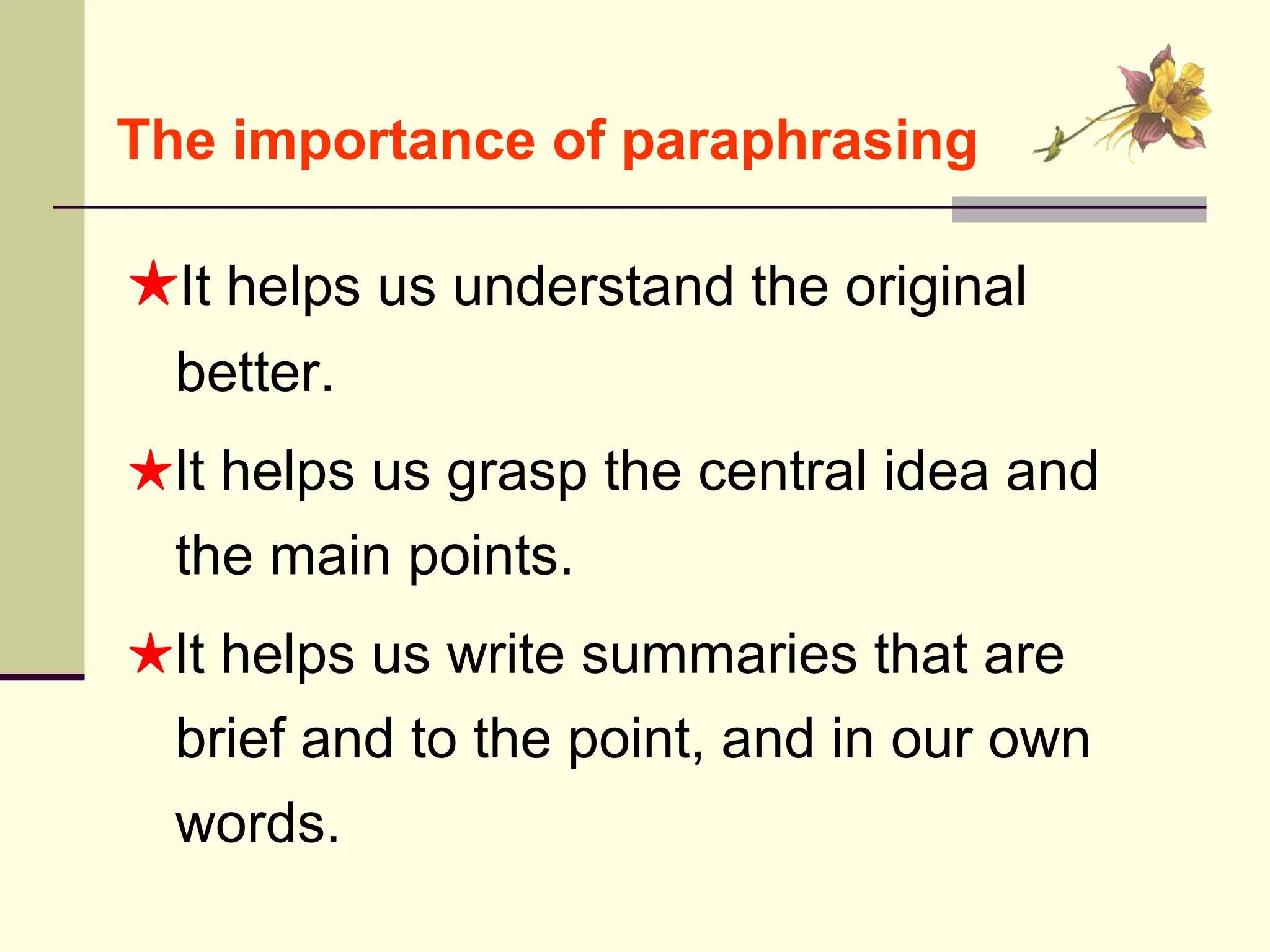
To paraphrase means to completely
and correctly express other people’s
ideas in one’s own words.
★It helps us understand the original
better.
★It helps us grasp the central idea and
the main points.
★It helps us write summaries that are
brief and to the point, and in our own
words.
The importance of paraphrasing
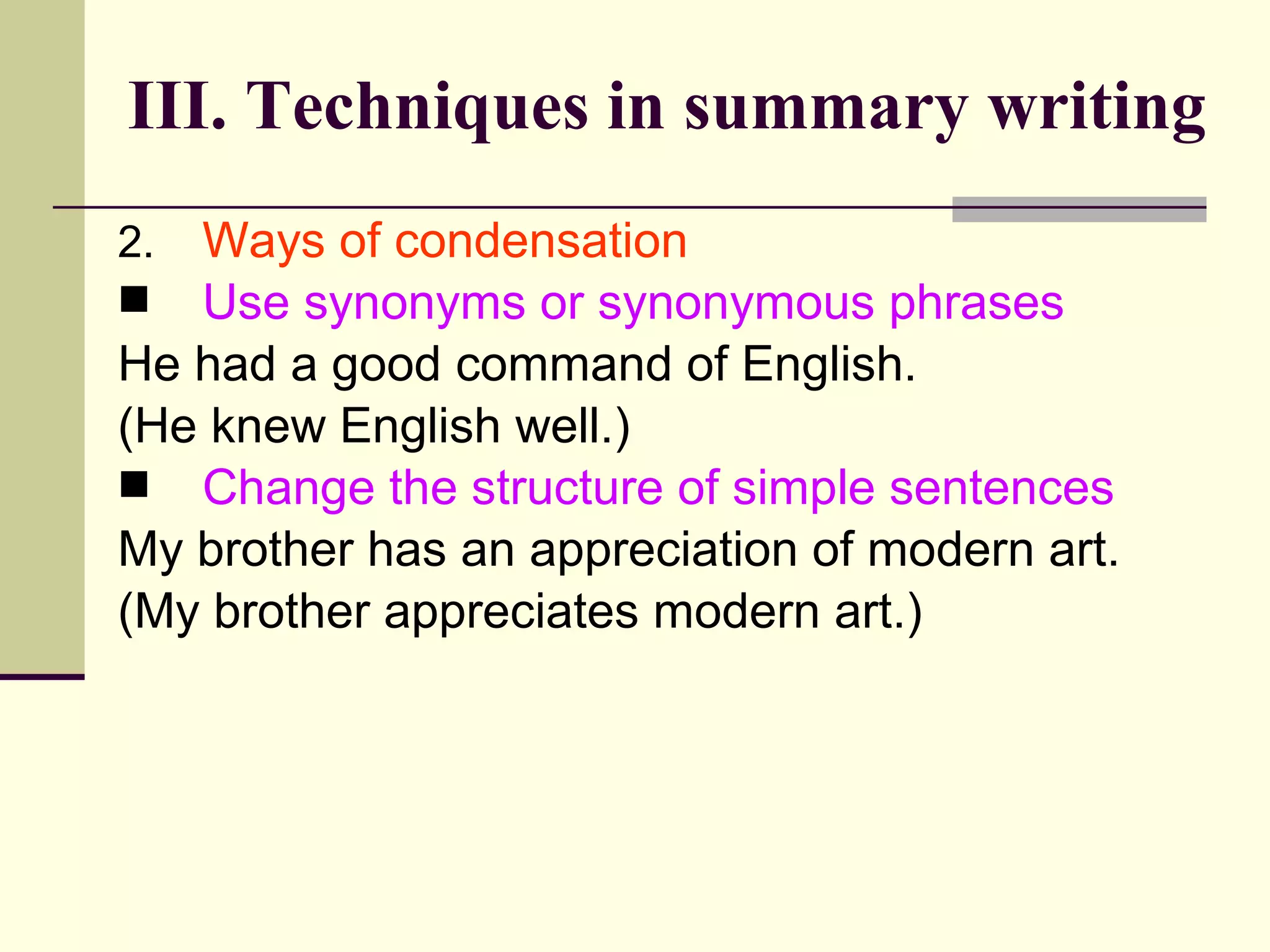
2. Ways of condensation
 Use synonyms or synonymous phrases
He had a good command of English.
(He knew English well.)
 Change the structure of simple sentences
My brother has an appreciation of modern art.
(My brother appreciates modern art.)
III. Techniques in summary writing
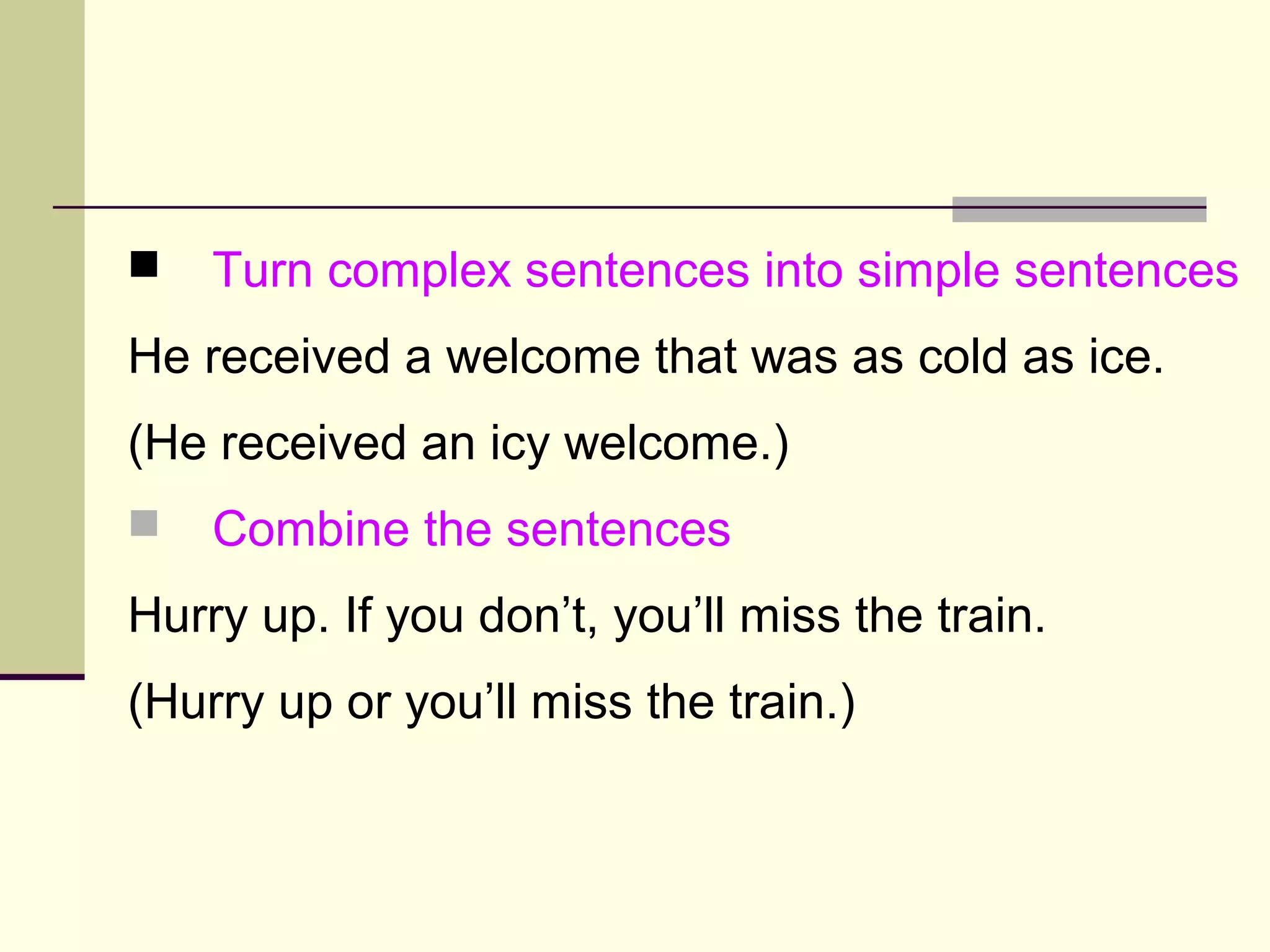
 Turn complex sentences into simple sentences
He received a welcome that was as cold as ice.
(He received an icy welcome.)
 Combine the sentences
Hurry up. If you don’t, you’ll miss the train.
(Hurry up or you’ll miss the train.)
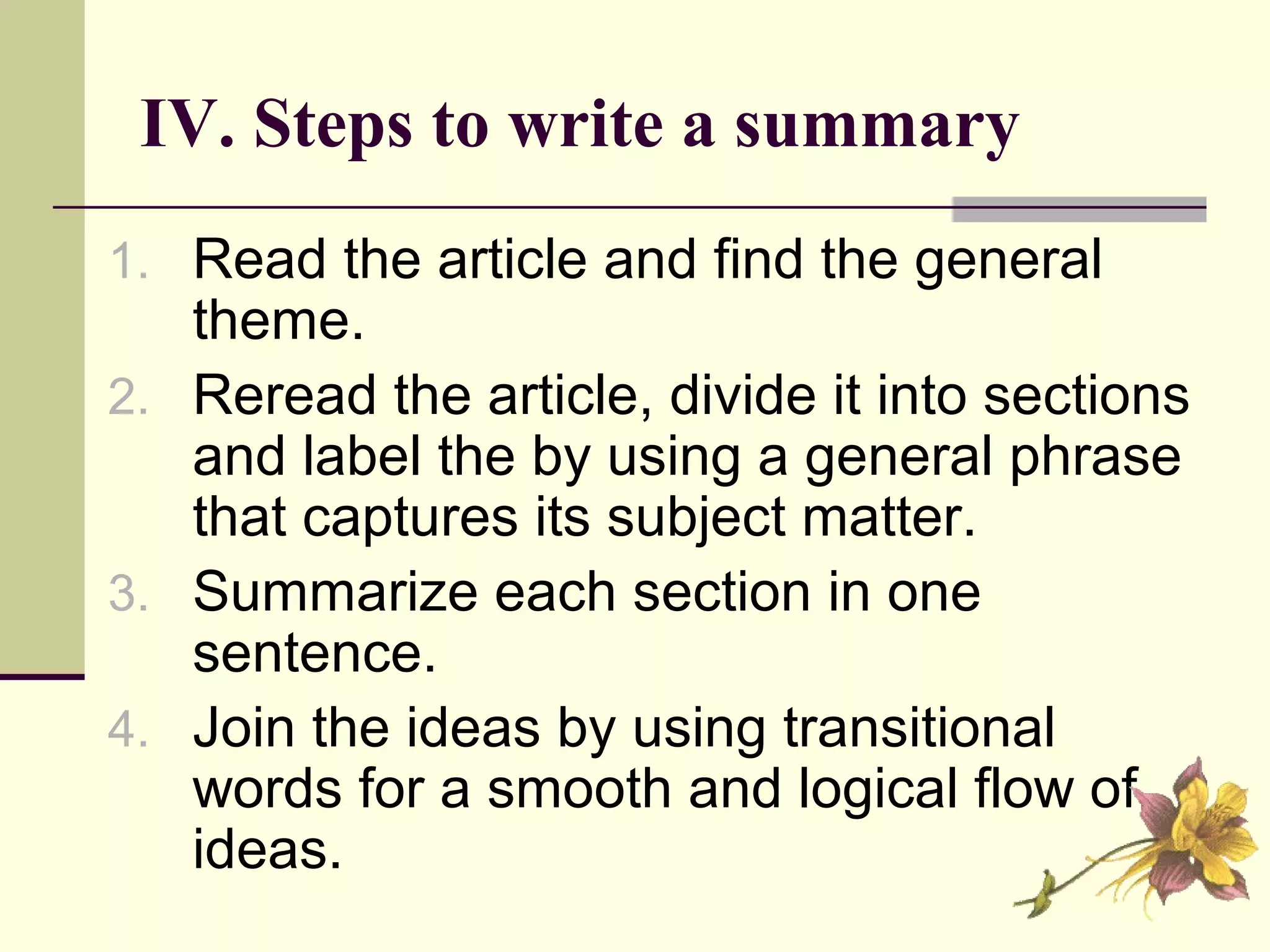
IV. Steps to write a summary
1. Read the article and find the general
theme.
2. Reread the article, divide it into sections
and label the by using a general phrase
that captures its subject matter.
3. Summarize each section in one
sentence.
4. Join the ideas by using transitional
words for a smooth and logical flow of
ideas.
IV. Steps to write a summary
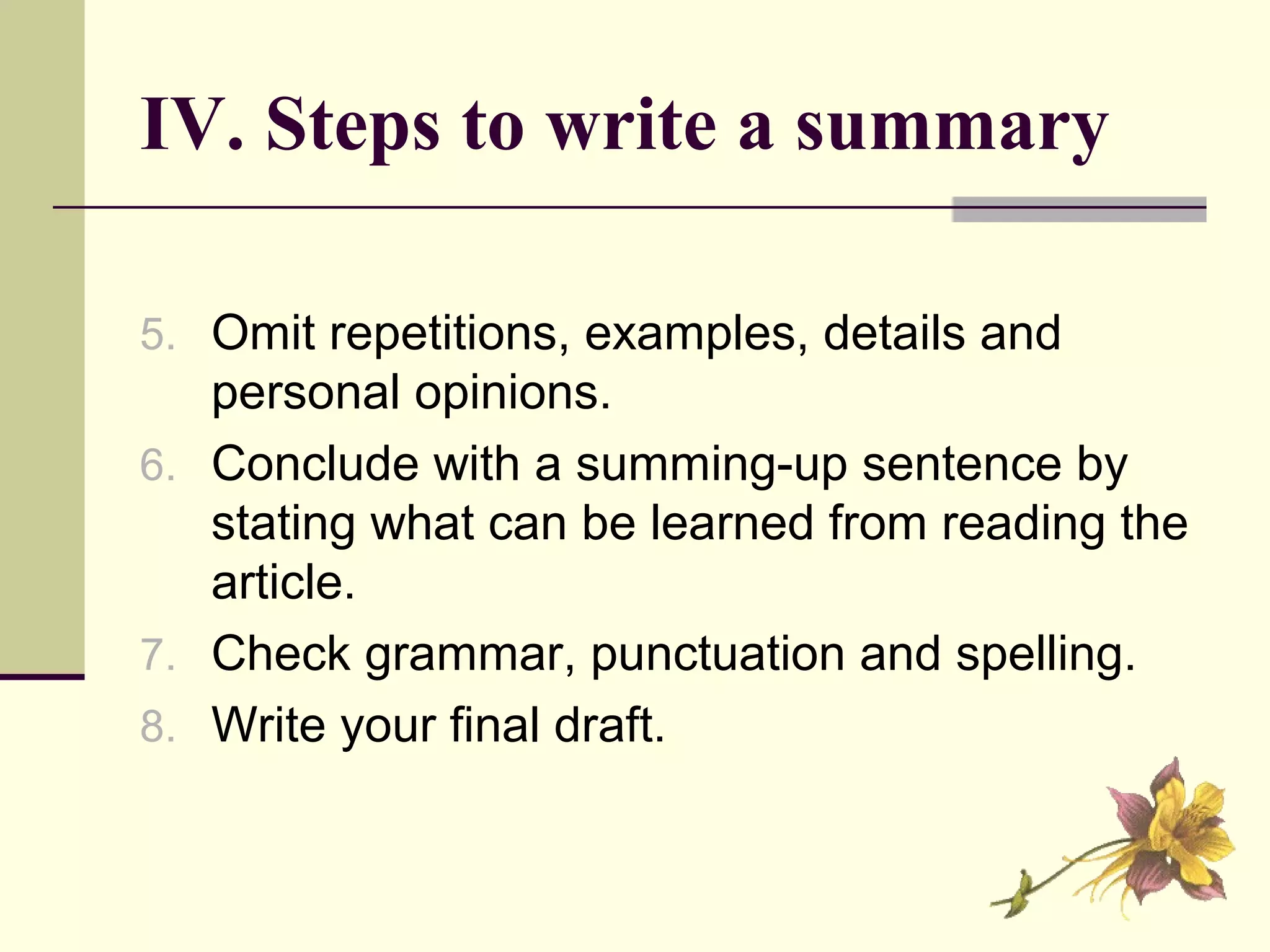
5. Omit repetitions, examples, details and
personal opinions.
6. Conclude with a summing-up sentence by
stating what can be learned from reading the
article.
7. Check grammar, punctuation and spelling.
8. Write your final draft.
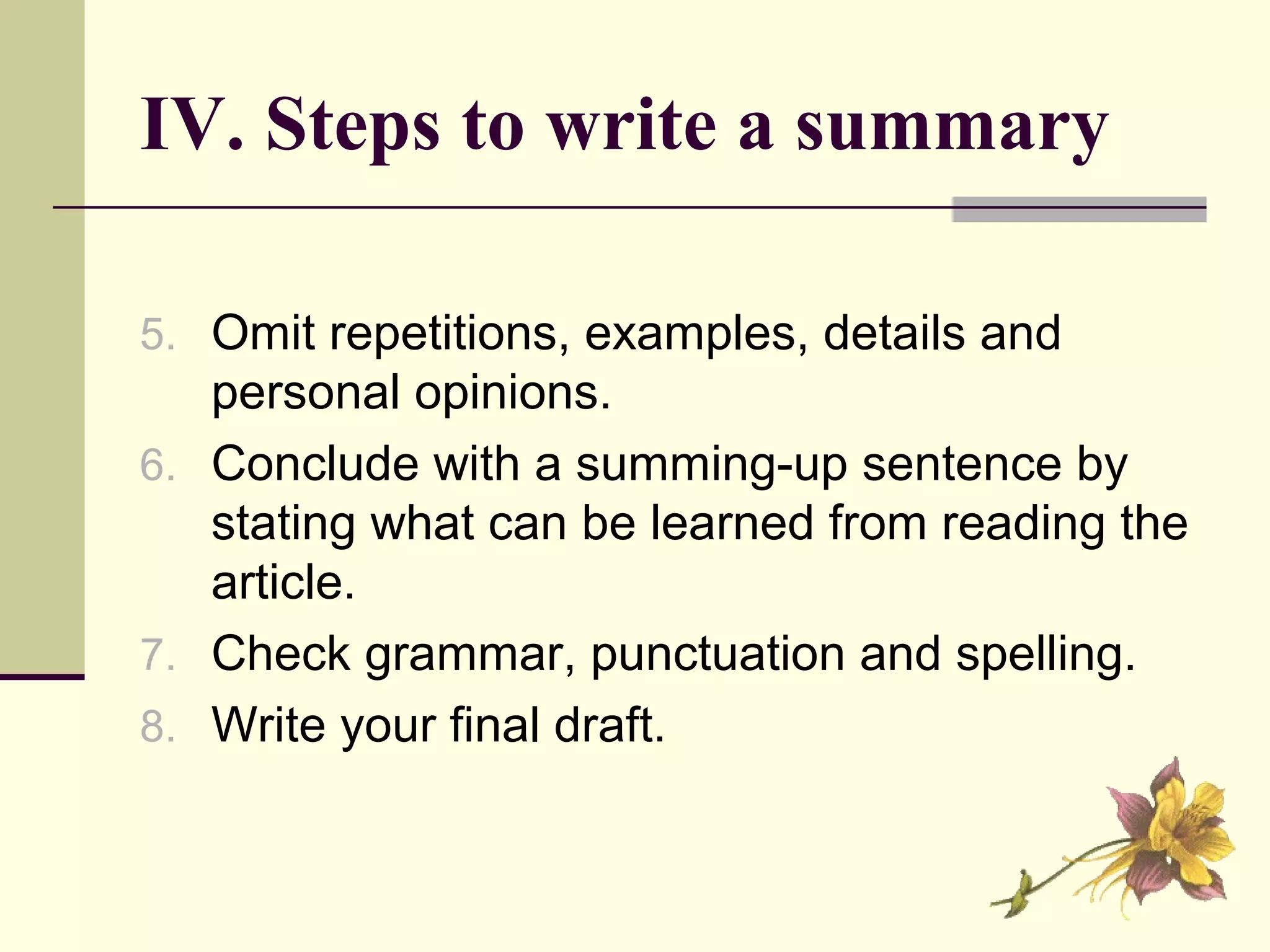
IV. Steps to write a summary
5. Omit repetitions, examples, details and
personal opinions.
6. Conclude with a summing-up sentence by
stating what can be learned from reading the
article.
7. Check grammar, punctuation and spelling.
8. Write your final draft.

Summary writing

  • 1.
  • 2.
    I. What isa summary?  A summary is a shortened passage, which retains the essential information of the original. It is a fairly brief restatement --- in your own words ---of the contents of a passage.  Note: you simply report back what the writer has said, without making value judgments.
  • 3.
    II. Characteristics ofa good summary  Can be understood without reference to the original;  Is a faithful reproduction of, or contains only the ideas or information of, the original;  Is brief without any unnecessary detail (20-25% of the article);  Is a readable unified whole
  • 4.
    III. Techniques insummary writing 1. Paraphrasing To paraphrase means to completely and correctly express other people’s ideas in one’s own words.
  • 5.
    ★It helps usunderstand the original better. ★It helps us grasp the central idea and the main points. ★It helps us write summaries that are brief and to the point, and in our own words. The importance of paraphrasing
  • 6.
    2. Ways ofcondensation  Use synonyms or synonymous phrases He had a good command of English. (He knew English well.)  Change the structure of simple sentences My brother has an appreciation of modern art. (My brother appreciates modern art.) III. Techniques in summary writing
  • 7.
     Turn complexsentences into simple sentences He received a welcome that was as cold as ice. (He received an icy welcome.)  Combine the sentences Hurry up. If you don’t, you’ll miss the train. (Hurry up or you’ll miss the train.)
  • 8.
    IV. Steps towrite a summary 1. Read the article and find the general theme. 2. Reread the article, divide it into sections and label the by using a general phrase that captures its subject matter. 3. Summarize each section in one sentence. 4. Join the ideas by using transitional words for a smooth and logical flow of ideas.
  • 9.
    IV. Steps towrite a summary 5. Omit repetitions, examples, details and personal opinions. 6. Conclude with a summing-up sentence by stating what can be learned from reading the article. 7. Check grammar, punctuation and spelling. 8. Write your final draft.
  • 10.
    IV. Steps towrite a summary 5. Omit repetitions, examples, details and personal opinions. 6. Conclude with a summing-up sentence by stating what can be learned from reading the article. 7. Check grammar, punctuation and spelling. 8. Write your final draft.