SUFFRAGE: Its Concept and Scope
Philippine Politics and Governance
4th
Quarter,2nd
Semester,A.Y. 2017-2018
CARL PATRICK S. TADEO, LPT
Faculty, Senior High School
Department of Social Sciences
0907-056-8095
CONCEPT OF SUFFRAGE
Suffrage – right to vote in an election and be voted into
public office
It is a RIGHT and an OBLIGATION at the same time.
Through this, citizens DIRECTLY participate in
government affairs.
Citizens who enjoy the right of suffrage are called
ELECTORATE.
Election as the traditional meaning of suffrage is therefore
the HALLMARK OF DEMOCRACY.
Basic Functions ofElection
1. As mechanism for leadership selection.
2. As performance review.
3. A renewalof consent.
4. As indices of political currents
5. As access channels.
SCOPE OF SUFFRAGE
Scope Description
Election Refers to the process of choosing from
among candidates for a limited period, the
people’s representative in exercising
government powers.
Plebiscite The process by which a proposed
amendment to the constitution is submitted
to the people for approval (see Art XVI,
Sec. 2)
Referendum The process by which a proposed law or a
part thereof is submitted to the people for
approval (see Art. VI, Sec. 32)
Initiative The process by which the people directly
propose and enact laws or amend the
constitution (see Art. XVII, Sec. 2)
Recall The process by which elected local
government officials are removed from
office even before the expiration of their
term by a vote of the people after the
registration of a petition of a required
percentage of voters (see Art. X, Sec 3)
NOTE:
The word “people” here refers to the registered voters
because the right to suffrage, just like the right to
citizenship, is subject to some conditions. Let us refer to
Article V, Section 1.
ARTICLE V, SECTKION 1, states:
“Suffrage may be exercised by all citizens of the
Philippines not otherwise disqualified by law, who are at
least eighteen years of age, and who shall have resided in
the Philippines for at least one year and in the place
wherein they propose to vote for at least six months
immediately preceding the election. No literacy, property
or other substantive requirements shall be imposed on the
exercise of suffrage.”
QUALIFICATIONS OF THE ELECTORATE
1. All citizens of the Philippines. Aliens have nothing
to do in electoral exercise;
2. Citizens not disqualified by law. The right of
suffrage as a political right can be withheld by the
state in some instances;
3. Citizens at least 18 years old.
4. Those who have resided in the Philippines for at
least one year and in the place wherein they
propose to vote for at least six months immediately
preceding the election.
NOTE: As stated in Section 1, the qualifications to
vote do not include literacy, property, sex, and
education. In the 1935 constitution, literacy is a
requirement in the exercise of suffrage.
DISQUALIFICATIONS
Under the Election Code, the following persons are
disqualified to vote even if they have necessary
qualifications as provided for in Section 1. These are:
1. Any person who has been sentenced by final
judgment to suffer an imprisonment of not less
than one year, such disability not having been
removed by plenary pardon; provided, however,
that any person disqualified to vote under this
paragraph shall automatically reacquire the right to
vote upon expiration of five years after service of
sentence;
2. Any person who has been adjudged by final
judgment by competent court of having violated
his allegiance to the Republic of the Philippines;
and
3. Insane or feeble-minded persons.
SECURING THE SECRECY AND SANCTITY OF
THE BALLOT
Voters are able to vote freely and are not influenced by
self-serving politicians. Votes should be counted honestly.
The constitutional provision that expressed in Section 2 of
Article V deals particularly in seeing to it that Congress
adopts a system for securing the sanctity of the ballot. Art.
V, Sec. 2, states:
“The Congress shall provide a system for
securing the secrecy and sanctity of the ballot as well as a
system for absentee voting by qualified Filipinos abroad.
The Congress shall also design a procedure for
the disabled and the illiterates to vote without the
assistance of other persons. Until then, they shall be
allowed to vote under existing laws and such rules as the
Commission on Elections may promulgate to protect the
secrecy of the ballot.”
SYSTEM OF ABSENTEE VOTING
1. Even though Filipinos are working abroad and
they are not in the country, they will be able to
participate directly in a very important political
decision of electing their representatives in
government. This is what we call ABSENTEE
VOTING.
2. Importance of participation of disabled and
illiterates to any given electoral exercise.
References:
Naguit, Reynaldo S. (2005). Discourses on the 1987
Philippine Constitution. Meycauayan, Bulacan:
Trinitas Publishing, Inc.

Suffrage

  • 1.
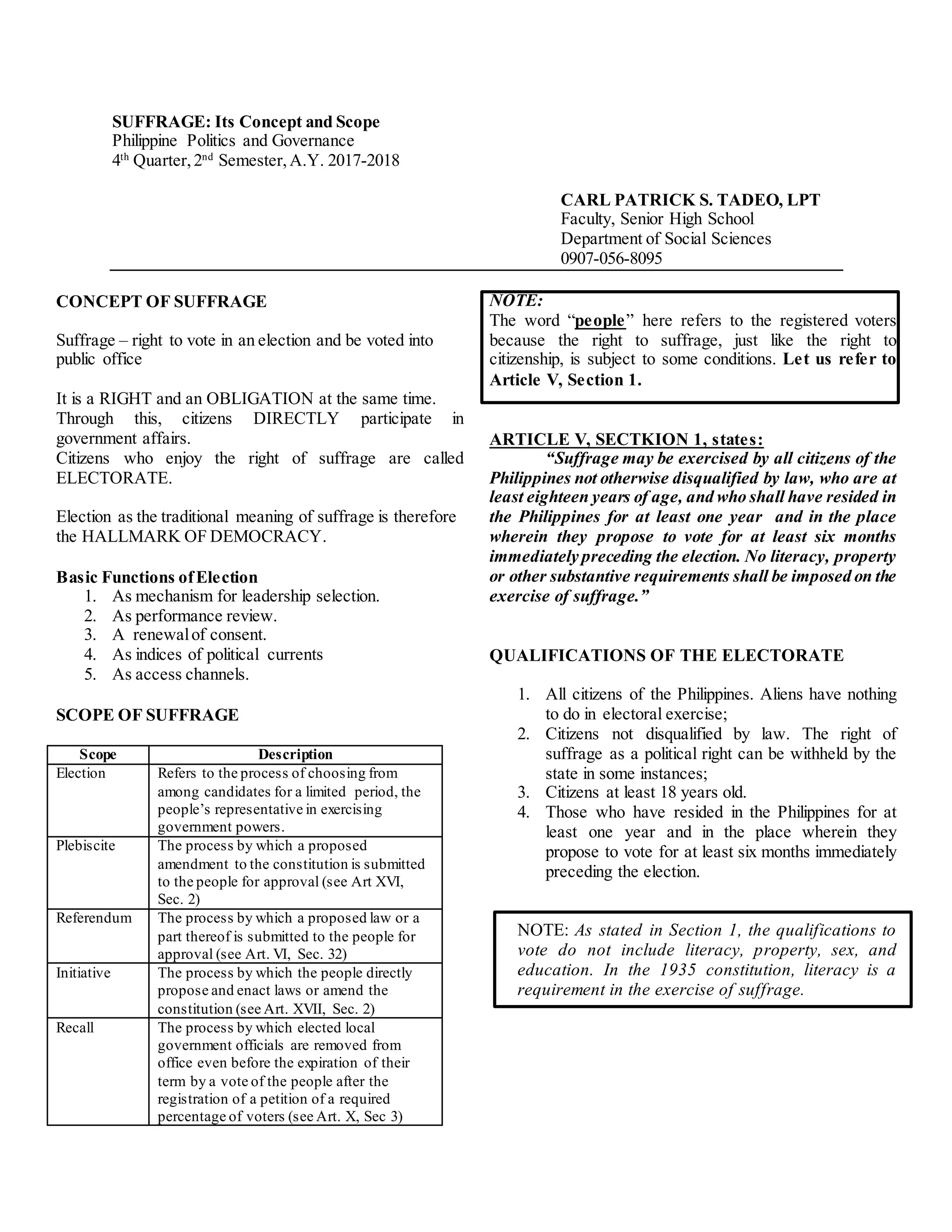
    SUFFRAGE: Its Conceptand Scope Philippine Politics and Governance 4th Quarter,2nd Semester,A.Y. 2017-2018 CARL PATRICK S. TADEO, LPT Faculty, Senior High School Department of Social Sciences 0907-056-8095 CONCEPT OF SUFFRAGE Suffrage – right to vote in an election and be voted into public office It is a RIGHT and an OBLIGATION at the same time. Through this, citizens DIRECTLY participate in government affairs. Citizens who enjoy the right of suffrage are called ELECTORATE. Election as the traditional meaning of suffrage is therefore the HALLMARK OF DEMOCRACY. Basic Functions ofElection 1. As mechanism for leadership selection. 2. As performance review. 3. A renewalof consent. 4. As indices of political currents 5. As access channels. SCOPE OF SUFFRAGE Scope Description Election Refers to the process of choosing from among candidates for a limited period, the people’s representative in exercising government powers. Plebiscite The process by which a proposed amendment to the constitution is submitted to the people for approval (see Art XVI, Sec. 2) Referendum The process by which a proposed law or a part thereof is submitted to the people for approval (see Art. VI, Sec. 32) Initiative The process by which the people directly propose and enact laws or amend the constitution (see Art. XVII, Sec. 2) Recall The process by which elected local government officials are removed from office even before the expiration of their term by a vote of the people after the registration of a petition of a required percentage of voters (see Art. X, Sec 3) NOTE: The word “people” here refers to the registered voters because the right to suffrage, just like the right to citizenship, is subject to some conditions. Let us refer to Article V, Section 1. ARTICLE V, SECTKION 1, states: “Suffrage may be exercised by all citizens of the Philippines not otherwise disqualified by law, who are at least eighteen years of age, and who shall have resided in the Philippines for at least one year and in the place wherein they propose to vote for at least six months immediately preceding the election. No literacy, property or other substantive requirements shall be imposed on the exercise of suffrage.” QUALIFICATIONS OF THE ELECTORATE 1. All citizens of the Philippines. Aliens have nothing to do in electoral exercise; 2. Citizens not disqualified by law. The right of suffrage as a political right can be withheld by the state in some instances; 3. Citizens at least 18 years old. 4. Those who have resided in the Philippines for at least one year and in the place wherein they propose to vote for at least six months immediately preceding the election. NOTE: As stated in Section 1, the qualifications to vote do not include literacy, property, sex, and education. In the 1935 constitution, literacy is a requirement in the exercise of suffrage.
  • 2.
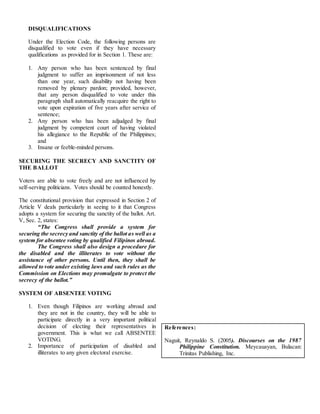
    DISQUALIFICATIONS Under the ElectionCode, the following persons are disqualified to vote even if they have necessary qualifications as provided for in Section 1. These are: 1. Any person who has been sentenced by final judgment to suffer an imprisonment of not less than one year, such disability not having been removed by plenary pardon; provided, however, that any person disqualified to vote under this paragraph shall automatically reacquire the right to vote upon expiration of five years after service of sentence; 2. Any person who has been adjudged by final judgment by competent court of having violated his allegiance to the Republic of the Philippines; and 3. Insane or feeble-minded persons. SECURING THE SECRECY AND SANCTITY OF THE BALLOT Voters are able to vote freely and are not influenced by self-serving politicians. Votes should be counted honestly. The constitutional provision that expressed in Section 2 of Article V deals particularly in seeing to it that Congress adopts a system for securing the sanctity of the ballot. Art. V, Sec. 2, states: “The Congress shall provide a system for securing the secrecy and sanctity of the ballot as well as a system for absentee voting by qualified Filipinos abroad. The Congress shall also design a procedure for the disabled and the illiterates to vote without the assistance of other persons. Until then, they shall be allowed to vote under existing laws and such rules as the Commission on Elections may promulgate to protect the secrecy of the ballot.” SYSTEM OF ABSENTEE VOTING 1. Even though Filipinos are working abroad and they are not in the country, they will be able to participate directly in a very important political decision of electing their representatives in government. This is what we call ABSENTEE VOTING. 2. Importance of participation of disabled and illiterates to any given electoral exercise. References: Naguit, Reynaldo S. (2005). Discourses on the 1987 Philippine Constitution. Meycauayan, Bulacan: Trinitas Publishing, Inc.