PGDM 614
Financial Accounting
A Presentation On
Cash Book, Pass Book, Bank
Reconciliation Statement
Presented By:-
Sudarshan Kr. Patel
Id- 1320
Flow Of Presentation
 Introduction
 Objectives
 Cash Book
 Types of Cash Book
 Simple Cash Book
 Two Column Cash Book
 Three Column Cash Book
 Petty Cash Book
 Pass Book
 Bank Reconciliation Statement
 Meaning
 Causes for difference between Cash Book Balance and
Passbook Balance.
 Procedure for preparation of Bank Reconciliation Statement.
 References
Introduction
Every entrepreneur should have knowledge of cash book and pass
book as from these books, he may check how much balance is
available to him for meeting his expenses and liabilities and what are
the details of receipts and payments of a particular period.
With the details of payments it can be checked that whether the
payments are of reasonable amount or not.
If the expenses are unreasonably high he may take steps to control
them.
An entrepreneur who regularly checks his cash and bank balances
would never face problems like dishonor of cheques or cash crisis
etc.
Objectives
 Explain the meaning of Cash Book, Pass Book, and Petty Cash
Book.
 Discuss the types of Cash Book.
 Enter the transactions in Cash Book.
 Explain the meaning, need and importance of Bank Reconciliation
Statement.
 Discuss the causes for difference between the balances of Pass
Book and Cash Book.
 Prepare Bank Reconciliation Statement
Cashbook
 In business most of the transactions relate to receipt of cash,
payments of cash, sale of goods and purchase of goods. So it is
convenient to have separate books for each such class of
transaction, one for receipts and payments of cash, one for
purchase of goods and one for sale of goods. These books are
called subsidiary books.
 Cash book is a subsidiary book, which records the receipts and
payment of cash. With the help of cash book cash and bank
balance can be checked at my point of time.
Types Of Cash Book
Cash book can be of four types:
 Simple Cash Book.
 Two column cash book.
 Three column cash book.
 Petty cash book
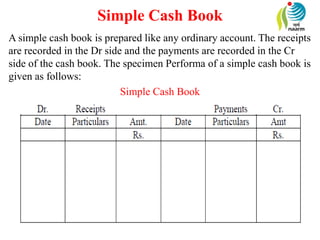
Simple Cash Book
A simple cash book is prepared like any ordinary account. The receipts
are recorded in the Dr side and the payments are recorded in the Cr
side of the cash book. The specimen Performa of a simple cash book is
given as follows:
Simple Cash Book
Cont.….
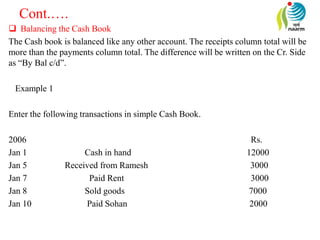
 Balancing the Cash Book
The Cash book is balanced like any other account. The receipts column total will be
more than the payments column total. The difference will be written on the Cr. Side
as “By Bal c/d”.
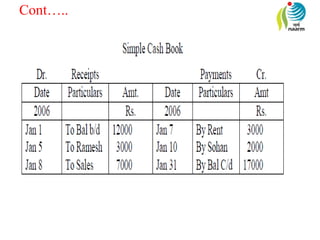
Example 1
Enter the following transactions in simple Cash Book.
2006 Rs.
Jan 1 Cash in hand 12000
Jan 5 Received from Ramesh 3000
Jan 7 Paid Rent 3000
Jan 8 Sold goods 7000
Jan 10 Paid Sohan 2000
Cont…..
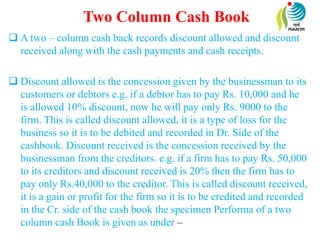
Two Column Cash Book
 A two – column cash back records discount allowed and discount
received along with the cash payments and cash receipts.
 Discount allowed is the concession given by the businessman to its
customers or debtors e.g. if a debtor has to pay Rs. 10,000 and he
is allowed 10% discount, now he will pay only Rs. 9000 to the
firm. This is called discount allowed, it is a type of loss for the
business so it is to be debited and recorded in Dr. Side of the
cashbook. Discount received is the concession received by the
businessman from the creditors. e.g. if a firm has to pay Rs. 50,000
to its creditors and discount received is 20% then the firm has to
pay only Rs.40,000 to the creditor. This is called discount received,
it is a gain or profit for the firm so it is to be credited and recorded
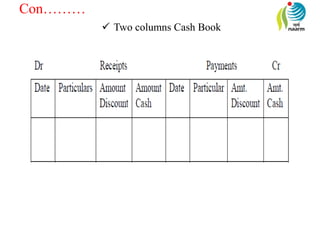
in the Cr. side of the cash book the specimen Performa of a two
column cash Book is given as under –
Con………
 Two columns Cash Book
Cont.……….
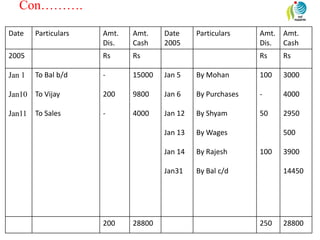
• Note:Discount columns are not balanced they are merely totaled.
Example 2:
Enter the following transactions in a two-column cash Book.
 2005 Rs.
 Jan 1 Cash in hand 15,000
 Jan 5 Paid to Mohan 3,000
 Jan 5 Discount allowed by him 100
 Jan 6 Purchased goods 4,000
 Jan 10 Received from Vijay 9,800
 Jan 10 Discount allowed 200
 Jan 11 Sold goods 4,000
 Jan 12 Paid to Shyam 2,950
Discount received Rs. 50 50
 Jan 13 Paid wages 500
 Jan 14 Paid to Rajesh in full settlement of hisAccount, which shows a
Cr.Balance of 4000
3900
Con……….
Date Particulars Amt.
Dis.
Amt.
Cash
Date
2005
Particulars Amt.
Dis.
Amt.
Cash
2005 Rs Rs Rs Rs
Jan 1
Jan10
Jan11
To Bal b/d
To Vijay
To Sales
-
200
-
15000
9800
4000
Jan 5
Jan 6
Jan 12
Jan 13
Jan 14
Jan31
By Mohan
By Purchases
By Shyam
By Wages
By Rajesh
By Bal c/d
100
-
50
100
3000
4000
2950
500
3900
14450
200 28800 250 28800
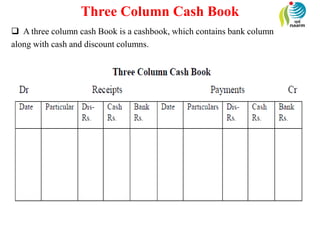
Three Column Cash Book
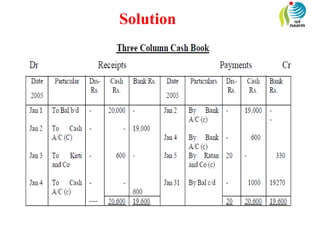
 A three column cash Book is a cashbook, which contains bank column
along with cash and discount columns.
Balancing
 The discount columns are totaled but not balanced. The cash
columns are balanced exactly in the same manner as indicated for
the simple cash book. The process is similar for balancing the bank
columns also. It is possible, however, that the bank may allow the
firm to withdraw more than the amount deposited, i.e. to have an
overdraft. In such a case the total of the bank column on the credit
side will be bigger than the one on the debit side. The difference is
written on the debit side as “To Bal c/d”. Then the totals are written
on the two sides opposite one another; the balance is then entered
on the credit side as “By Bal b/d”. However the usual case is that
payments into the bank will exceed the withdrawals or payments
out of the bank. Then the bank columns are balanced just like the
cash columns.
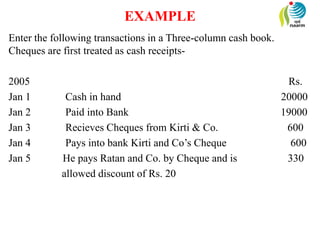
EXAMPLE
Enter the following transactions in a Three-column cash book.
Cheques are first treated as cash receipts-
2005 Rs.
Jan 1 Cash in hand 20000
Jan 2 Paid into Bank 19000
Jan 3 Recieves Cheques from Kirti & Co. 600
Jan 4 Pays into bank Kirti and Co’s Cheque 600
Jan 5 He pays Ratan and Co. by Cheque and is 330
allowed discount of Rs. 20
Solution
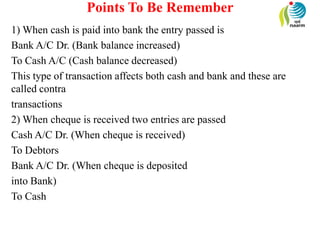
Points To Be Remember
1) When cash is paid into bank the entry passed is
Bank A/C Dr. (Bank balance increased)
To Cash A/C (Cash balance decreased)
This type of transaction affects both cash and bank and these are
called contra
transactions
2) When cheque is received two entries are passed
Cash A/C Dr. (When cheque is received)
To Debtors
Bank A/C Dr. (When cheque is deposited
into Bank)
To Cash
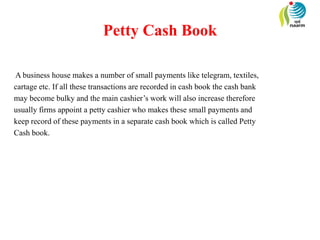
Petty Cash Book
A business house makes a number of small payments like telegram, textiles,
cartage etc. If all these transactions are recorded in cash book the cash bank
may become bulky and the main cashier’s work will also increase therefore
usually firms appoint a petty cashier who makes these small payments and
keep record of these payments in a separate cash book which is called Petty
Cash book.
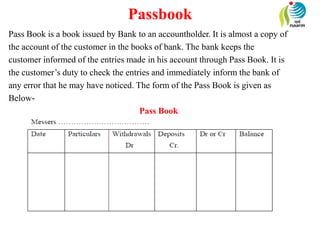
Passbook
Pass Book is a book issued by Bank to an accountholder. It is almost a copy of
the account of the customer in the books of bank. The bank keeps the
customer informed of the entries made in his account through Pass Book. It is
the customer’s duty to check the entries and immediately inform the bank of
any error that he may have noticed. The form of the Pass Book is given as
Below-
Pass Book
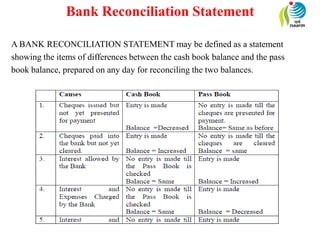
Bank Reconciliation Statement
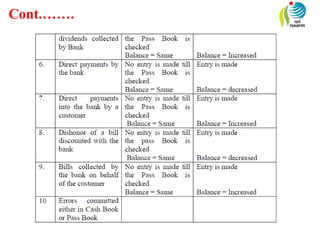
A BANK RECONCILIATION STATEMENT may be defined as a statement
showing the items of differences between the cash book balance and the pass
book balance, prepared on any day for reconciling the two balances.
Cont.…….
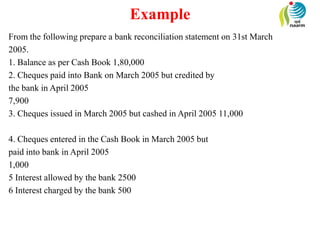
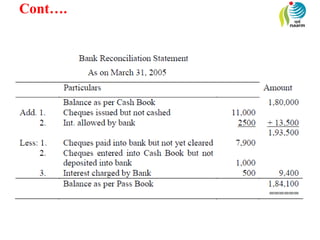
Example
From the following prepare a bank reconciliation statement on 31st March
2005.
1. Balance as per Cash Book 1,80,000
2. Cheques paid into Bank on March 2005 but credited by
the bank in April 2005
7,900
3. Cheques issued in March 2005 but cashed in April 2005 11,000
4. Cheques entered in the Cash Book in March 2005 but
paid into bank in April 2005
1,000
5 Interest allowed by the bank 2500
6 Interest charged by the bank 500
Cont….
References
T.S. Grewal, “Double Entry Book Keeping”,
Sultan Chand and sons. 28 Daryaganj, New
Delhi.
Jain and Narang, “Financial Accounting”.
Kalyani Publishers, New Delhi.
Slide Share
Cashbook, Passbook and BRC

Cashbook, Passbook and BRC

  • 1.
    PGDM 614 Financial Accounting APresentation On Cash Book, Pass Book, Bank Reconciliation Statement Presented By:- Sudarshan Kr. Patel Id- 1320
  • 2.
    Flow Of Presentation Introduction  Objectives  Cash Book  Types of Cash Book  Simple Cash Book  Two Column Cash Book  Three Column Cash Book  Petty Cash Book  Pass Book  Bank Reconciliation Statement  Meaning  Causes for difference between Cash Book Balance and Passbook Balance.  Procedure for preparation of Bank Reconciliation Statement.  References
  • 3.
    Introduction Every entrepreneur shouldhave knowledge of cash book and pass book as from these books, he may check how much balance is available to him for meeting his expenses and liabilities and what are the details of receipts and payments of a particular period. With the details of payments it can be checked that whether the payments are of reasonable amount or not. If the expenses are unreasonably high he may take steps to control them. An entrepreneur who regularly checks his cash and bank balances would never face problems like dishonor of cheques or cash crisis etc.
  • 4.
    Objectives  Explain themeaning of Cash Book, Pass Book, and Petty Cash Book.  Discuss the types of Cash Book.  Enter the transactions in Cash Book.  Explain the meaning, need and importance of Bank Reconciliation Statement.  Discuss the causes for difference between the balances of Pass Book and Cash Book.  Prepare Bank Reconciliation Statement
  • 5.
    Cashbook  In businessmost of the transactions relate to receipt of cash, payments of cash, sale of goods and purchase of goods. So it is convenient to have separate books for each such class of transaction, one for receipts and payments of cash, one for purchase of goods and one for sale of goods. These books are called subsidiary books.  Cash book is a subsidiary book, which records the receipts and payment of cash. With the help of cash book cash and bank balance can be checked at my point of time.
  • 6.
    Types Of CashBook Cash book can be of four types:  Simple Cash Book.  Two column cash book.  Three column cash book.  Petty cash book
  • 7.
    Simple Cash Book Asimple cash book is prepared like any ordinary account. The receipts are recorded in the Dr side and the payments are recorded in the Cr side of the cash book. The specimen Performa of a simple cash book is given as follows: Simple Cash Book
  • 8.
    Cont.….  Balancing theCash Book The Cash book is balanced like any other account. The receipts column total will be more than the payments column total. The difference will be written on the Cr. Side as “By Bal c/d”. Example 1 Enter the following transactions in simple Cash Book. 2006 Rs. Jan 1 Cash in hand 12000 Jan 5 Received from Ramesh 3000 Jan 7 Paid Rent 3000 Jan 8 Sold goods 7000 Jan 10 Paid Sohan 2000
  • 9.
  • 10.
    Two Column CashBook  A two – column cash back records discount allowed and discount received along with the cash payments and cash receipts.  Discount allowed is the concession given by the businessman to its customers or debtors e.g. if a debtor has to pay Rs. 10,000 and he is allowed 10% discount, now he will pay only Rs. 9000 to the firm. This is called discount allowed, it is a type of loss for the business so it is to be debited and recorded in Dr. Side of the cashbook. Discount received is the concession received by the businessman from the creditors. e.g. if a firm has to pay Rs. 50,000 to its creditors and discount received is 20% then the firm has to pay only Rs.40,000 to the creditor. This is called discount received, it is a gain or profit for the firm so it is to be credited and recorded in the Cr. side of the cash book the specimen Performa of a two column cash Book is given as under –
  • 11.
  • 12.
    Cont.………. • Note:Discount columnsare not balanced they are merely totaled. Example 2: Enter the following transactions in a two-column cash Book.  2005 Rs.  Jan 1 Cash in hand 15,000  Jan 5 Paid to Mohan 3,000  Jan 5 Discount allowed by him 100  Jan 6 Purchased goods 4,000  Jan 10 Received from Vijay 9,800  Jan 10 Discount allowed 200  Jan 11 Sold goods 4,000  Jan 12 Paid to Shyam 2,950 Discount received Rs. 50 50  Jan 13 Paid wages 500  Jan 14 Paid to Rajesh in full settlement of hisAccount, which shows a Cr.Balance of 4000 3900
  • 13.
    Con………. Date Particulars Amt. Dis. Amt. Cash Date 2005 ParticularsAmt. Dis. Amt. Cash 2005 Rs Rs Rs Rs Jan 1 Jan10 Jan11 To Bal b/d To Vijay To Sales - 200 - 15000 9800 4000 Jan 5 Jan 6 Jan 12 Jan 13 Jan 14 Jan31 By Mohan By Purchases By Shyam By Wages By Rajesh By Bal c/d 100 - 50 100 3000 4000 2950 500 3900 14450 200 28800 250 28800
  • 14.
    Three Column CashBook  A three column cash Book is a cashbook, which contains bank column along with cash and discount columns.
  • 15.
    Balancing  The discountcolumns are totaled but not balanced. The cash columns are balanced exactly in the same manner as indicated for the simple cash book. The process is similar for balancing the bank columns also. It is possible, however, that the bank may allow the firm to withdraw more than the amount deposited, i.e. to have an overdraft. In such a case the total of the bank column on the credit side will be bigger than the one on the debit side. The difference is written on the debit side as “To Bal c/d”. Then the totals are written on the two sides opposite one another; the balance is then entered on the credit side as “By Bal b/d”. However the usual case is that payments into the bank will exceed the withdrawals or payments out of the bank. Then the bank columns are balanced just like the cash columns.
  • 16.
    EXAMPLE Enter the followingtransactions in a Three-column cash book. Cheques are first treated as cash receipts- 2005 Rs. Jan 1 Cash in hand 20000 Jan 2 Paid into Bank 19000 Jan 3 Recieves Cheques from Kirti & Co. 600 Jan 4 Pays into bank Kirti and Co’s Cheque 600 Jan 5 He pays Ratan and Co. by Cheque and is 330 allowed discount of Rs. 20
  • 17.
  • 18.
    Points To BeRemember 1) When cash is paid into bank the entry passed is Bank A/C Dr. (Bank balance increased) To Cash A/C (Cash balance decreased) This type of transaction affects both cash and bank and these are called contra transactions 2) When cheque is received two entries are passed Cash A/C Dr. (When cheque is received) To Debtors Bank A/C Dr. (When cheque is deposited into Bank) To Cash
  • 19.
    Petty Cash Book Abusiness house makes a number of small payments like telegram, textiles, cartage etc. If all these transactions are recorded in cash book the cash bank may become bulky and the main cashier’s work will also increase therefore usually firms appoint a petty cashier who makes these small payments and keep record of these payments in a separate cash book which is called Petty Cash book.
  • 20.
    Passbook Pass Book isa book issued by Bank to an accountholder. It is almost a copy of the account of the customer in the books of bank. The bank keeps the customer informed of the entries made in his account through Pass Book. It is the customer’s duty to check the entries and immediately inform the bank of any error that he may have noticed. The form of the Pass Book is given as Below- Pass Book
  • 21.
    Bank Reconciliation Statement ABANK RECONCILIATION STATEMENT may be defined as a statement showing the items of differences between the cash book balance and the pass book balance, prepared on any day for reconciling the two balances.
  • 22.
  • 23.
    Example From the followingprepare a bank reconciliation statement on 31st March 2005. 1. Balance as per Cash Book 1,80,000 2. Cheques paid into Bank on March 2005 but credited by the bank in April 2005 7,900 3. Cheques issued in March 2005 but cashed in April 2005 11,000 4. Cheques entered in the Cash Book in March 2005 but paid into bank in April 2005 1,000 5 Interest allowed by the bank 2500 6 Interest charged by the bank 500
  • 24.
  • 25.
    References T.S. Grewal, “DoubleEntry Book Keeping”, Sultan Chand and sons. 28 Daryaganj, New Delhi. Jain and Narang, “Financial Accounting”. Kalyani Publishers, New Delhi. Slide Share