Using Government Sponsored Credit to Sell a Company Presented To: California Capital Summit Bruce Dobb Concerned Capital
Background  Field of economic development is when government creates or saves private sector jobs After the earthquake – SBA disaster loans Many small companies get big with help of government loans Often when these companies are sold they leave the community – defeats purpose  That’s when we get involved
What Concerned Capital Does We’re a bridge between public sector and private companies Help the owner figure out the best transfer strategy that fits his needs so the jobs stay in the community Provide financing for the new buyer using government credit supports Help management and/or workers to prepare for the transition
Government Credit Supports Takes many different forms Could be from state, local or federal government  (or World Bank) Lots of initials and regulations Not for the un-initiated  Make deals happen that would not otherwise
Non-traditional Financing That Makes Deals Work No down-payments deal Affordable sub-debt Zero interest leaseholds 20 year money Tax Credit Carry-forwards EDA/FRAP NMTC or CEDLI CRA SBA Empowerment Zone
Issues That Have a Negative  Impact on the Valuation of  Smaller Company Customer concentration Erratic financial performance Market competition – domestic and global When you’re forced to sell All reasons that credit supports may be necessary.
What Owner’s Think They’re Selling Vs. What the Market Thinks Owners Think they’re Selling  – on-going customers, brand recognition, legacy/dynasty,  non-intellectual proprietary properties, pleasant work atmosphere, happy employees, unique market niche, vendor credit  What the Market Pays for   – market buys multiples of cash flow – whether multiple of gross sale or multiple of profit or multiple of pre-tax profit (EBITDA),  or a multiple of free cash flow Source:  Garry Michael Kann, Kann Capital
Management/worker Buyouts As a Feasible Solution They understand the company, know its history and aren’t concerned about unknown liabilities They seek a quick, easy, rapid transition at the smallest expense possible Selling a corporation is a contract transaction without the need of escrow expense and time delays  The owner generally is willing  to stay in the picture and will often carry paper for a buyer he/she knows
 
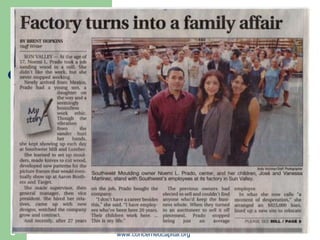
Southwest Mill and Lumber Asset only sale – an exception Purchase of business only Purchase price of $ 1 million  Bank loan + owner carry-back + equity  Relocation expenses Saved 65 jobs Made the front pages
Woodworking by Degree: Case #2 Eddie Bapon had run the day to day operations of cabinet and leasehold improvement company for 10 years Owner wanted to become a real estate lender and investor Sold the company with $ 100,000 carry-back note and $ 400,000 senior debt – fed funds. Saved 40 jobs went on to add 15 more
AdMail : A Success Story 45 year old LA mail order company with two aging owners who couldn’t sell for 5 years – dozens of lookers Company had sold its real estate and saddled with debt and negative earnings But had provided $ 350 year compensation to  owners for 10 years Successfully sold to management in 3 months Saved 60 jobs and retained customer base
When Transition to Existing  Management/Workforce  Makes Sense When potential purchaser knows how to run the company and has done it in the past for a considerable period of time When efforts to sell in the market make it clear that the real value of company will not be realized The management team strongly wants to own the company and MAKE MORE MONEY The real estate will not be transferred with the purchase The purchaser(s) have equity in their personal residents When a stock sale vs. an asset sale gives the owner a far better after tax return
Summing-up Advantages of a Sale to Existing Management/workforce Brings highest value for the  company to  the seller Saves taxes for the seller Avoids costly time and expense of dealing with traditional business brokers Keeps jobs in the community Gives the seller the satisfaction handing off his company to worthy buyer

Successful Owner Transition Westside

  • 1.
    Using Government SponsoredCredit to Sell a Company Presented To: California Capital Summit Bruce Dobb Concerned Capital
  • 2.
    Background Fieldof economic development is when government creates or saves private sector jobs After the earthquake – SBA disaster loans Many small companies get big with help of government loans Often when these companies are sold they leave the community – defeats purpose That’s when we get involved
  • 3.
    What Concerned CapitalDoes We’re a bridge between public sector and private companies Help the owner figure out the best transfer strategy that fits his needs so the jobs stay in the community Provide financing for the new buyer using government credit supports Help management and/or workers to prepare for the transition
  • 4.
    Government Credit SupportsTakes many different forms Could be from state, local or federal government (or World Bank) Lots of initials and regulations Not for the un-initiated Make deals happen that would not otherwise
  • 5.
    Non-traditional Financing ThatMakes Deals Work No down-payments deal Affordable sub-debt Zero interest leaseholds 20 year money Tax Credit Carry-forwards EDA/FRAP NMTC or CEDLI CRA SBA Empowerment Zone
  • 6.
    Issues That Havea Negative Impact on the Valuation of Smaller Company Customer concentration Erratic financial performance Market competition – domestic and global When you’re forced to sell All reasons that credit supports may be necessary.
  • 7.
    What Owner’s ThinkThey’re Selling Vs. What the Market Thinks Owners Think they’re Selling – on-going customers, brand recognition, legacy/dynasty, non-intellectual proprietary properties, pleasant work atmosphere, happy employees, unique market niche, vendor credit What the Market Pays for – market buys multiples of cash flow – whether multiple of gross sale or multiple of profit or multiple of pre-tax profit (EBITDA), or a multiple of free cash flow Source: Garry Michael Kann, Kann Capital
  • 8.
    Management/worker Buyouts Asa Feasible Solution They understand the company, know its history and aren’t concerned about unknown liabilities They seek a quick, easy, rapid transition at the smallest expense possible Selling a corporation is a contract transaction without the need of escrow expense and time delays The owner generally is willing to stay in the picture and will often carry paper for a buyer he/she knows
  • 9.
  • 10.
    Southwest Mill andLumber Asset only sale – an exception Purchase of business only Purchase price of $ 1 million Bank loan + owner carry-back + equity Relocation expenses Saved 65 jobs Made the front pages
  • 11.
    Woodworking by Degree:Case #2 Eddie Bapon had run the day to day operations of cabinet and leasehold improvement company for 10 years Owner wanted to become a real estate lender and investor Sold the company with $ 100,000 carry-back note and $ 400,000 senior debt – fed funds. Saved 40 jobs went on to add 15 more
  • 12.
    AdMail : ASuccess Story 45 year old LA mail order company with two aging owners who couldn’t sell for 5 years – dozens of lookers Company had sold its real estate and saddled with debt and negative earnings But had provided $ 350 year compensation to owners for 10 years Successfully sold to management in 3 months Saved 60 jobs and retained customer base
  • 13.
    When Transition toExisting Management/Workforce Makes Sense When potential purchaser knows how to run the company and has done it in the past for a considerable period of time When efforts to sell in the market make it clear that the real value of company will not be realized The management team strongly wants to own the company and MAKE MORE MONEY The real estate will not be transferred with the purchase The purchaser(s) have equity in their personal residents When a stock sale vs. an asset sale gives the owner a far better after tax return
  • 14.
    Summing-up Advantages ofa Sale to Existing Management/workforce Brings highest value for the company to the seller Saves taxes for the seller Avoids costly time and expense of dealing with traditional business brokers Keeps jobs in the community Gives the seller the satisfaction handing off his company to worthy buyer