International Research Journal of Engineering and Technology (IRJET) e-ISSN: 2395 -0056
Volume: 04 Issue: 03 | Mar -2017 www.irjet.net p-ISSN: 2395-0072
© 2017, IRJET | Impact Factor value: 5.181 | ISO 9001:2008 Certified Journal | Page 531
Successful Multimedia Learning for Vocational Schools
Model Development
Fitro Nur Hakim1, Achmad Solechan2, Migunani3
1Lecturer, Informatics Engineering Department, STMIK Provisi, Semarang, Indonesia
23Lecturer, Information System Departement STMIK Provisi, Semarang, Indonesia
---------------------------------------------------------------------***---------------------------------------------------------------------
Abstract - This study was to develop a new model taken
from the hypothetic and factual model researches which
applied in some Vocational Schools in Central Java Province.
The data collection method used was Focus Group Discussion
conducted in-depth interview and discussion with teachers
on vocational school for development of based multimedia
learning applied in subjects at school.
Sample was conducted using judgment area sampling
technique, based on the determination of research area
including Vocational Schools in Central Java which
implemented the multimedia learning model in their process
learning and teaching activity
Method for analysis used qualitative by using focus group
discussion was to discover the best practice of developing
multimedia learning for vocational schools in Central Java as
a new model in applying of multimedia.
The development of successful model of multimedia
learning referred in this study was to measure or to provide a
kind of guidance for teachers in multimedia usage. The
planning phase of multimedia learning successful model
consists of learning strategies, principles of multimedia
learning usages, sources of learning, teachers’ cognitive
understanding, teachers’ readiness, students’ readiness, and
the learning media readiness. The implementation phase of
this learning model consists of the usage of computers during
the learning process, audiovisual material usage, selection of
learning media, software and interactive media selection,
and selection of technology. The evaluation phase of the
multimedia learning consists of assessment of learning result
and the assessment of successful model of multimedia
learning.
Key Words: Multimedia Learning, Successful Model,
Vocational School, Research and Development, Learning
Strategies
1. INTRODUCTION
Information technology along with multimedia learning
has been one of facilitators for the learning activities,
providing a great contribution toward the basic shift on the
structure, operations, as well as organizational
management. Due to the multimedia learning method,
users find themselves easy to do their activities. This kind
of method has changed the monotonous traditional
learning method. The method influence the way material
and duties of the students deliver, it automates the process.
The main reason of the multimedia learning method used is
the needs of maintaining and improving the competition,
reducing the cost, and increasing the flexibility (Kadir,
2003: page 10).
Conventional learning activities still play an important
role in the learning process, especially in terms of
knowledge delivery effectiveness, communication and
interaction among individuals. This kind of learning
activities enables direct communication and interaction
between students and faculty and among the students
themselves. Under the condition, content delivery,
feedback, question and dialogue may occur in a lively
manner. Visualization clearly defined learning process
through a variety of media. Visual, verbal, gesture or facial
expression contribute to determine the understanding of
the processes of learning activities that take place (Hidayat,
2014, page.657).
One of the challanges in education system is how to
develop a knowledge based-society, where it takes a
certain model in terms of achieving such a goal. Multimedia
learning is method of learning using and applying the
information and communication technology (Chaeruman,
2008: page 30). Mutlimedia learning system is a system
that applying a learning process providing the users to use
such digital media and assets as internet and audio visual
(graphics and text) during the learning and teaching
prosess (Chaeruman, 2008: page 31). The teachers’
perception on students while using the multimedia
learning help them to maximize the usage of such a
technology.
The development of multimedia learning in the process
of teaching and learning at vocational schools is necessarily
applied. That is to transfer knowledge from the teacher to
the learners in order to run properly and effectively
learning process that in turn, will increase the productivity
of teacher performance, either individually or
organizationally. Teachers are important elements to
attend during the teaching learning process though the
learners can actually learn independently. It is because the
roles of teachers in the classroom are not only to teach, but
also they educate them. While the conventional teaching
and learning strategy simply uses textbooks and other
mold as the media, the communication and information
technology model is a quite different. The communication
and information technology has its widely impacts on our
International Research Journal of Engineering and Technology (IRJET) e-ISSN: 2395 -0056
Volume: 04 Issue: 03 | Mar -2017 www.irjet.net p-ISSN: 2395-0072
© 2017, IRJET | Impact Factor value: 5.181 | ISO 9001:2008 Certified Journal | Page 532
which one of them contributes to learning process in
school.
Audio visual is one of media attracting the students to
learn. The media has also enabled the students to learn
independently. It means that the students can learn by
themselves and they will comprehend more while the
teachers explain the materials they have learned through
the media. The usage of this multimedia media is useful for
the students to learn. This is also expected that multimedia
will finally help the students to learn independently by the
senses of sight and hearing.
2. THEORETICAL FOUNDATION
2.1. Multimedia Learning
Multimedia learning system is a system applying a
learning process providing freedom to the uers to connect
and use various digital media, internet, and audiovisual
(videos, graphics,and texts) during the learning teaching
activities (Chaeruman, 2008: page 31)
Through multimedia learning, learners are expected
to learn though they are physically absent or unable to
attend classes. Such a situation may take place if the
institution has developed and implemented a multimedia
learning in the learning activities that will, in turn, optimize
the students' learning. The interaction between learners
and teachers will no longer be restricted by the the
classroom course, but the interaction can be continued
through cyberspace/virtual room (Siahaan, 2008: page
44).
There are three functions of multimedia as one of
learning and teaching process. First, multimedia functions
as an instructional aided tool. Second, it can be used as
interactive tutorial tool, for example in simulation
activities. And the third, multimedia can be used as a source
of learning instruction, for instance as a means of storing a
set of microscopic slides or radiographics.
2.2. Successful Multimedia Learning
In the context of learning, the adaptation is about
creating a learner experience that purposely adjusts to
various conditions over a period of time with the intention
of increasing success for the effectiveness of learning
application (Dwi et.al., 2013:page 284).
The process of design an applied multimedia
learning is expected for function effectively. The
effectiveness shows that the development of multimedia
learning concept has been successful (Laudon and Laudon,
2000: page 24), describing that the success of multimedia
application is something difficult to do.
Based on the criticism of Laudon and Laudon
(2000:page 25), there are five variables to measure the
success of technology utilization. The five variables are the
high level of system use, user satisfaction on system,
favorable attitude, multimedia learning users, the achieved
objectives, and financial payoff. DeLone and McLean (1992:
page 65) have also proposed a model describing the
success of information technology utilization. Although the
model of DeLone and McLean (1992: page 67) was
arranged before Markus and Keil’ criticism (2005: page 15),
they included individual impacts and organizational
performance in their model on the success of multimedia
learning.
The results showed that students were satisfied with
the pedagogical approach, and their academic
achievements were also better than expected. Particularly
important is that the dropout rate was greatly diminished,
which could be related to students' satisfaction with the
support they received from the instructor and the system
(Linawati, et.al., 2012: page. 181).
3. Method of Data Collection
There were three methods used for data collection: (1)
observation, this was conducted by visiting some
vocational schools in Central Java Province, (2)
questionnaire, consisting of instruments or a list of
questions to ask to the respondents (the students of
vocational schools in Central Java Province) used to analyze
the success of multimedia learning applied in vocational
schools, (3) interview, conducted to dig more information
from the experts of multimedia in the observed vocational
schools, in this case the multimedia teachers as to find the
new application multimedia based-model
4. Method of Data Analysis
It used development and research method with Focus
Group Discussion involving the multimedia teachers at
vocational schools in Central Java Province to find out the
new model in terms of applying effective and efficient
multimedia (audio visual) method to use in learning and
teaching process.
5. RESULTS OF THE STUDY
5.1. Model Development Framework for
Successful Multimedia Based-Learning
Model
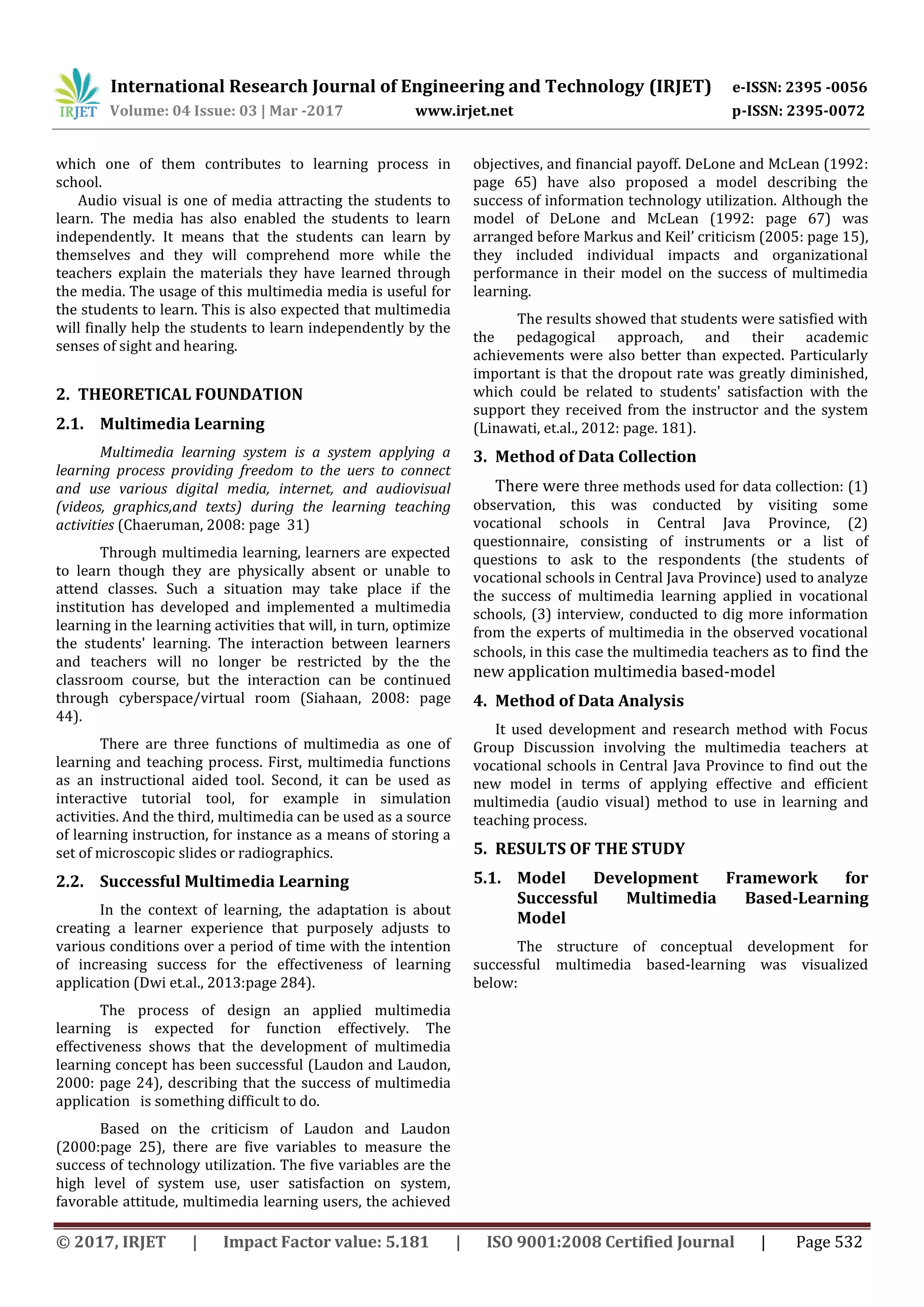
The structure of conceptual development for
successful multimedia based-learning was visualized
below:
International Research Journal of Engineering and Technology (IRJET) e-ISSN: 2395 -0056
Volume: 04 Issue: 03 | Mar -2017 www.irjet.net p-ISSN: 2395-0072
© 2017, IRJET | Impact Factor value: 5.181 | ISO 9001:2008 Certified Journal | Page 533
Fig-1: Early Conceptual Model for Successful Multimedia
Based-Learning
5.2. Research Procedure Steps
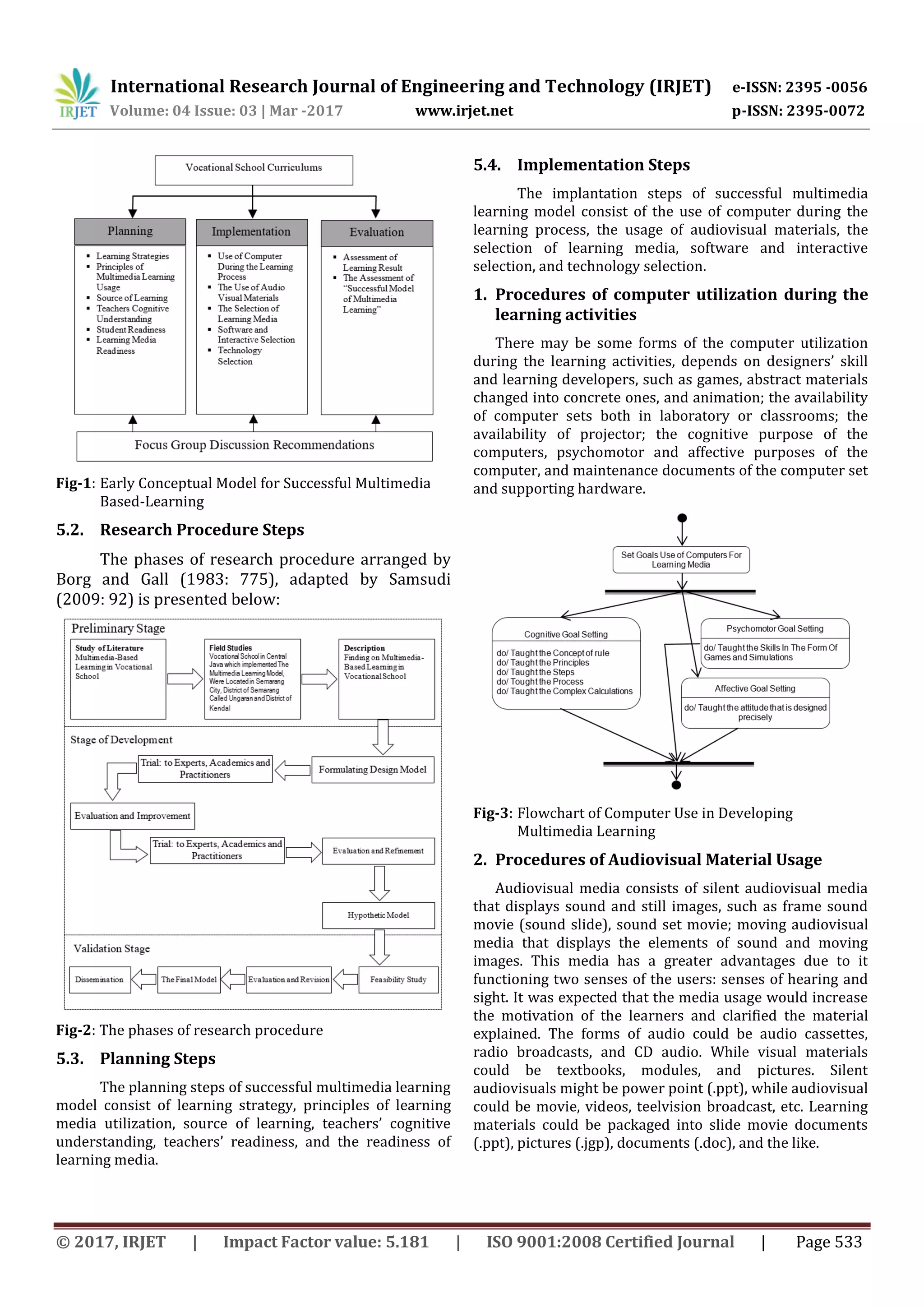
The phases of research procedure arranged by
Borg and Gall (1983: 775), adapted by Samsudi
(2009: 92) is presented below:
Fig-2: The phases of research procedure
5.3. Planning Steps
The planning steps of successful multimedia learning
model consist of learning strategy, principles of learning
media utilization, source of learning, teachers’ cognitive
understanding, teachers’ readiness, and the readiness of
learning media.
5.4. Implementation Steps
The implantation steps of successful multimedia
learning model consist of the use of computer during the
learning process, the usage of audiovisual materials, the
selection of learning media, software and interactive
selection, and technology selection.
1. Procedures of computer utilization during the
learning activities
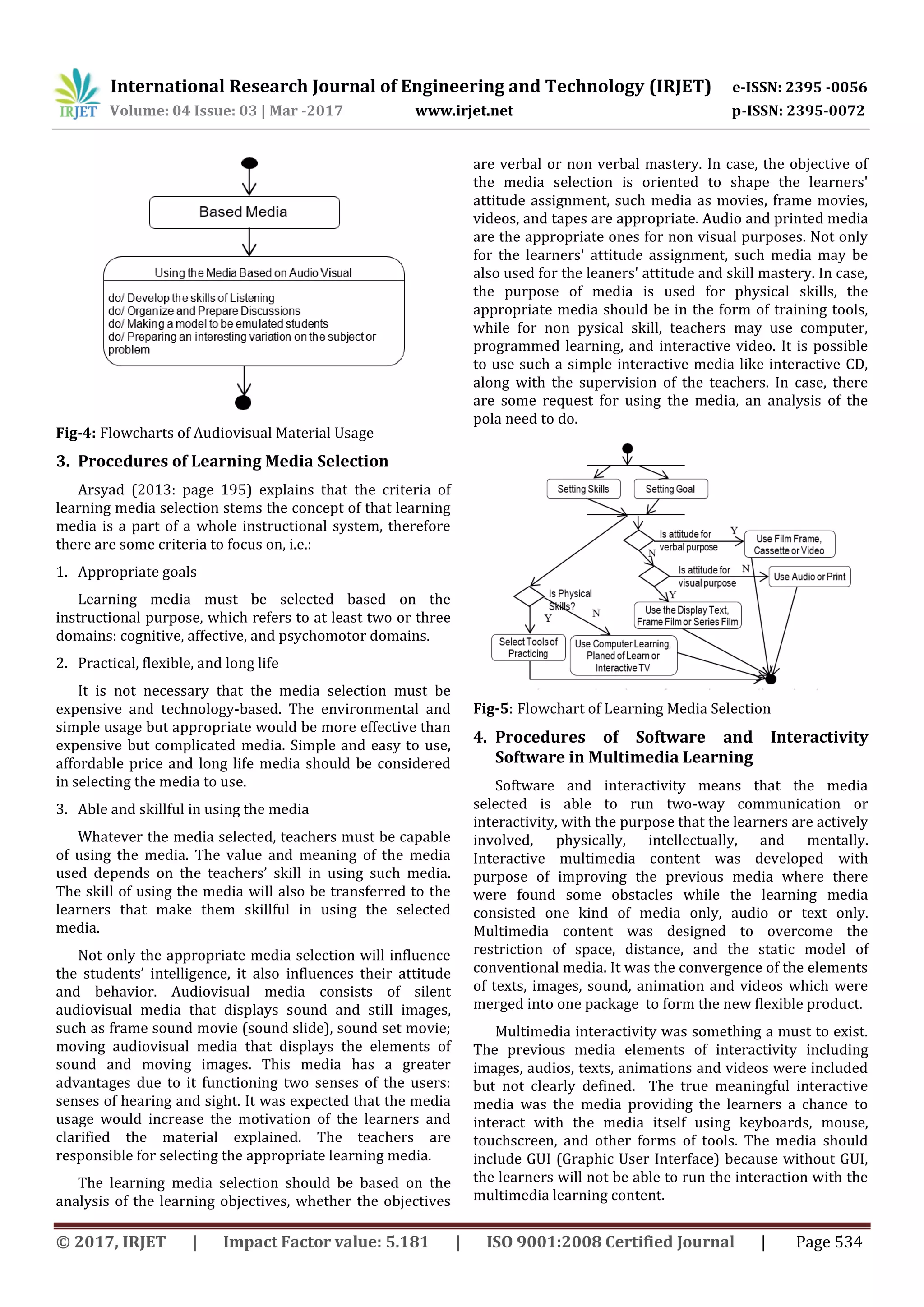
There may be some forms of the computer utilization
during the learning activities, depends on designers’ skill
and learning developers, such as games, abstract materials
changed into concrete ones, and animation; the availability
of computer sets both in laboratory or classrooms; the
availability of projector; the cognitive purpose of the
computers, psychomotor and affective purposes of the
computer, and maintenance documents of the computer set
and supporting hardware.
Fig-3: Flowchart of Computer Use in Developing
Multimedia Learning
2. Procedures of Audiovisual Material Usage
Audiovisual media consists of silent audiovisual media
that displays sound and still images, such as frame sound
movie (sound slide), sound set movie; moving audiovisual
media that displays the elements of sound and moving
images. This media has a greater advantages due to it
functioning two senses of the users: senses of hearing and
sight. It was expected that the media usage would increase
the motivation of the learners and clarified the material
explained. The forms of audio could be audio cassettes,
radio broadcasts, and CD audio. While visual materials
could be textbooks, modules, and pictures. Silent
audiovisuals might be power point (.ppt), while audiovisual
could be movie, videos, teelvision broadcast, etc. Learning
materials could be packaged into slide movie documents
(.ppt), pictures (.jgp), documents (.doc), and the like.
International Research Journal of Engineering and Technology (IRJET) e-ISSN: 2395 -0056
Volume: 04 Issue: 03 | Mar -2017 www.irjet.net p-ISSN: 2395-0072
© 2017, IRJET | Impact Factor value: 5.181 | ISO 9001:2008 Certified Journal | Page 534
Fig-4: Flowcharts of Audiovisual Material Usage
3. Procedures of Learning Media Selection
Arsyad (2013: page 195) explains that the criteria of
learning media selection stems the concept of that learning
media is a part of a whole instructional system, therefore
there are some criteria to focus on, i.e.:
1. Appropriate goals
Learning media must be selected based on the
instructional purpose, which refers to at least two or three
domains: cognitive, affective, and psychomotor domains.
2. Practical, flexible, and long life
It is not necessary that the media selection must be
expensive and technology-based. The environmental and
simple usage but appropriate would be more effective than
expensive but complicated media. Simple and easy to use,
affordable price and long life media should be considered
in selecting the media to use.
3. Able and skillful in using the media
Whatever the media selected, teachers must be capable
of using the media. The value and meaning of the media
used depends on the teachers’ skill in using such media.
The skill of using the media will also be transferred to the
learners that make them skillful in using the selected
media.
Not only the appropriate media selection will influence
the students’ intelligence, it also influences their attitude
and behavior. Audiovisual media consists of silent
audiovisual media that displays sound and still images,
such as frame sound movie (sound slide), sound set movie;
moving audiovisual media that displays the elements of
sound and moving images. This media has a greater
advantages due to it functioning two senses of the users:
senses of hearing and sight. It was expected that the media
usage would increase the motivation of the learners and
clarified the material explained. The teachers are
responsible for selecting the appropriate learning media.
The learning media selection should be based on the
analysis of the learning objectives, whether the objectives
are verbal or non verbal mastery. In case, the objective of
the media selection is oriented to shape the learners'
attitude assignment, such media as movies, frame movies,
videos, and tapes are appropriate. Audio and printed media
are the appropriate ones for non visual purposes. Not only
for the learners' attitude assignment, such media may be
also used for the leaners' attitude and skill mastery. In case,
the purpose of media is used for physical skills, the
appropriate media should be in the form of training tools,
while for non pysical skill, teachers may use computer,
programmed learning, and interactive video. It is possible
to use such a simple interactive media like interactive CD,
along with the supervision of the teachers. In case, there
are some request for using the media, an analysis of the
pola need to do.
Fig-5: Flowchart of Learning Media Selection
4. Procedures of Software and Interactivity
Software in Multimedia Learning
Software and interactivity means that the media
selected is able to run two-way communication or
interactivity, with the purpose that the learners are actively
involved, physically, intellectually, and mentally.
Interactive multimedia content was developed with
purpose of improving the previous media where there
were found some obstacles while the learning media
consisted one kind of media only, audio or text only.
Multimedia content was designed to overcome the
restriction of space, distance, and the static model of
conventional media. It was the convergence of the elements
of texts, images, sound, animation and videos which were
merged into one package to form the new flexible product.
Multimedia interactivity was something a must to exist.
The previous media elements of interactivity including
images, audios, texts, animations and videos were included
but not clearly defined. The true meaningful interactive
media was the media providing the learners a chance to
interact with the media itself using keyboards, mouse,
touchscreen, and other forms of tools. The media should
include GUI (Graphic User Interface) because without GUI,
the learners will not be able to run the interaction with the
multimedia learning content.
International Research Journal of Engineering and Technology (IRJET) e-ISSN: 2395 -0056
Volume: 04 Issue: 03 | Mar -2017 www.irjet.net p-ISSN: 2395-0072
© 2017, IRJET | Impact Factor value: 5.181 | ISO 9001:2008 Certified Journal | Page 535
Interactive multimedia should give full control for
students or provide flexibility for the learners to stop the
media played to provide them a space of time to to
document what is important and/or to replay on the
portion of the media they have not understood yet. The
elements of the media should be adopted from the contenct
tailored to the learning objectives or the purpose of the
multimedia created.
In order to make it more effective in achieving the
learning objectives, i.e. software or application mastery,
interactive multimedia should be flexible, easy to run at any
time with the lowest specification of computer used or
could run simply using optical drive only.
Although interactive media is better in its interactivity
than the conventional one, it does mean that the
superiority makes the learners taking for granted to
understand the material. Due to media by design, the
relevance of interactive multimedia should be adjusted
with the needs and purposes to achieve and adapted to the
characteristics of the users, the existing obstacles, and the
like.
There are many multimedia programs to use in
interactive media, such as video based multimedia
programs: final cut pro, canopus edius, imovie, pinnacle
studio, flash video encoder; audio based multimedia
programs: adobe audition, audacity, pro tools, soundslides,
vuvox; photography based multimedia programs:
photoshop, flickr, panorama software, soundslides, vuvox;
interactivity based multimedia program: flash, flex, after
effects, ajax; text based multimedia programs: wordpress,
dreamweaver, twitter, indesign, movable type; and graphic
based multimedia programs: illustrator, maya, freehand,
blender, flash.
Fig-6 :Flowchart of Software and Interactivity Selection in
Multimedia Learning
5. Procedures of Technology Selection in
Multimedia Learning
The learning technology is a discipline. It is not only
used for education, but also for any activities such
industries, companies, and community. This kind of
technology can be widely defined, not only hard
technology; it also deals with soft technology. The
synchronous learning environment (students involved
during the learning process) needs both audio and visual
media. In case, the learning environment needs visual
media and demonstration, the audiovisual media to use are
e learning and web based learning. Meanwhile, the
asynchronous learning environment (online education)
needs such visual video as television, e learning, and
videos.
Fig-7: Flowchart of Technology Selection in Multimedia
Learning
5.5. Evaluation Steps
The steps of evaluation in successful multimedia
learning model consist of assessment on learning results
and assessment on successful on multimedia learning
model.
6. CONCLUSSION
The development of successful model of multimedia
learning referred in this study was to measure or to
provide a kind of guidance for teachers in multimedia
usage. The planning phase of multimedia learning
successful model consists of learning strategies, principles
of multimedia learning usages, sources of learning,
teachers’ cognitive understanding, teachers’ readiness,
students’ readiness, and the learning media readiness. The
implementation phase of this learning model consists of the
usage of computers during the learning process,
audiovisual material usage, selection of learning media,
software and interactive media selection, and selection of
technology. The last, the evaluation phase of the
multimedia learning consists of assessment of learning
result and the assessment of successful model of
multimedia learning.
REFERENCES
[1] Arsyad, A. 2013. Media Pembelajaran. Jakarta: PT.
RajaGrafindo Persada
[2] Chaeruman, Uwes a., 2008. Mendorong Penerapan e-
learning di Sekolah. Jurnal Teknodik (Vol. XII No. 1
Juni 2008): 30-31.
[3] DeLone WH and McLean ER (1992) Information
systems success: the quest for the dependent
variable. Information Systems Research 3(1), 60–95.
International Research Journal of Engineering and Technology (IRJET) e-ISSN: 2395 -0056
Volume: 04 Issue: 03 | Mar -2017 www.irjet.net p-ISSN: 2395-0072
© 2017, IRJET | Impact Factor value: 5.181 | ISO 9001:2008 Certified Journal | Page 536
[4] Dwi, Andharini; Basuki, Ari; Sari, Eka Maia; and
Kustiyahningsih, Yeni. 2013. Design and Adaptive e-
Learning Application Architecture Based on IEEE
LTSA Reference Model. Telkomnika 13 (1), 284-289.
[5] Hidayat, Arief; Utomo, Victor Gayuh, 2014. Open
Source Based M-Learning Application for Supporting
Distance Learning. Telkomnika 12 (3), 657-664.
[6] Kadir, Abdul, 2003. Pengenalan Sistem Informasi.
Penerbit Andi Offset, Yogyakarta.
[7] Laudon, Kenneth C., and Jane P. Laudon, 2000.
Organization and Technology in The Networked
Enterprise. Prentice-Hall, New Jersey, USA.
[8] Linawati; Sukadarmika; Sasmita, GM. Arya. 2012.
Synchronization Interfaces for Improving Moodle
Utilization. Telkomnika 10 (1), 179-188.
[9] Markus, M.Lynne, and Mark Keil. 2005. ”If We Build
It, They Will Come: Designing Information Systems
That People Want To Use.” Sloan Management
Review (Summer). ABI/INFORM Vol. 35 No. 4 pp.11-
25
[10] Samsudi. 2009. Disain Penelitian Pendidikan.
Semarang: Unnes Press
[11] Siahaan, Sudirman. 2008. Mengapa Harus
Menggunakan e-Learning dalam Kegiatan
Pembelajaran. Jurnal Teknodik Vol. XII No. 1 Juni
2008 : 43-55.

Successful Multimedia Learning for Vocational Schools Model Development

  • 1.
    International Research Journalof Engineering and Technology (IRJET) e-ISSN: 2395 -0056 Volume: 04 Issue: 03 | Mar -2017 www.irjet.net p-ISSN: 2395-0072 © 2017, IRJET | Impact Factor value: 5.181 | ISO 9001:2008 Certified Journal | Page 531 Successful Multimedia Learning for Vocational Schools Model Development Fitro Nur Hakim1, Achmad Solechan2, Migunani3 1Lecturer, Informatics Engineering Department, STMIK Provisi, Semarang, Indonesia 23Lecturer, Information System Departement STMIK Provisi, Semarang, Indonesia ---------------------------------------------------------------------***--------------------------------------------------------------------- Abstract - This study was to develop a new model taken from the hypothetic and factual model researches which applied in some Vocational Schools in Central Java Province. The data collection method used was Focus Group Discussion conducted in-depth interview and discussion with teachers on vocational school for development of based multimedia learning applied in subjects at school. Sample was conducted using judgment area sampling technique, based on the determination of research area including Vocational Schools in Central Java which implemented the multimedia learning model in their process learning and teaching activity Method for analysis used qualitative by using focus group discussion was to discover the best practice of developing multimedia learning for vocational schools in Central Java as a new model in applying of multimedia. The development of successful model of multimedia learning referred in this study was to measure or to provide a kind of guidance for teachers in multimedia usage. The planning phase of multimedia learning successful model consists of learning strategies, principles of multimedia learning usages, sources of learning, teachers’ cognitive understanding, teachers’ readiness, students’ readiness, and the learning media readiness. The implementation phase of this learning model consists of the usage of computers during the learning process, audiovisual material usage, selection of learning media, software and interactive media selection, and selection of technology. The evaluation phase of the multimedia learning consists of assessment of learning result and the assessment of successful model of multimedia learning. Key Words: Multimedia Learning, Successful Model, Vocational School, Research and Development, Learning Strategies 1. INTRODUCTION Information technology along with multimedia learning has been one of facilitators for the learning activities, providing a great contribution toward the basic shift on the structure, operations, as well as organizational management. Due to the multimedia learning method, users find themselves easy to do their activities. This kind of method has changed the monotonous traditional learning method. The method influence the way material and duties of the students deliver, it automates the process. The main reason of the multimedia learning method used is the needs of maintaining and improving the competition, reducing the cost, and increasing the flexibility (Kadir, 2003: page 10). Conventional learning activities still play an important role in the learning process, especially in terms of knowledge delivery effectiveness, communication and interaction among individuals. This kind of learning activities enables direct communication and interaction between students and faculty and among the students themselves. Under the condition, content delivery, feedback, question and dialogue may occur in a lively manner. Visualization clearly defined learning process through a variety of media. Visual, verbal, gesture or facial expression contribute to determine the understanding of the processes of learning activities that take place (Hidayat, 2014, page.657). One of the challanges in education system is how to develop a knowledge based-society, where it takes a certain model in terms of achieving such a goal. Multimedia learning is method of learning using and applying the information and communication technology (Chaeruman, 2008: page 30). Mutlimedia learning system is a system that applying a learning process providing the users to use such digital media and assets as internet and audio visual (graphics and text) during the learning and teaching prosess (Chaeruman, 2008: page 31). The teachers’ perception on students while using the multimedia learning help them to maximize the usage of such a technology. The development of multimedia learning in the process of teaching and learning at vocational schools is necessarily applied. That is to transfer knowledge from the teacher to the learners in order to run properly and effectively learning process that in turn, will increase the productivity of teacher performance, either individually or organizationally. Teachers are important elements to attend during the teaching learning process though the learners can actually learn independently. It is because the roles of teachers in the classroom are not only to teach, but also they educate them. While the conventional teaching and learning strategy simply uses textbooks and other mold as the media, the communication and information technology model is a quite different. The communication and information technology has its widely impacts on our
  • 2.
    International Research Journalof Engineering and Technology (IRJET) e-ISSN: 2395 -0056 Volume: 04 Issue: 03 | Mar -2017 www.irjet.net p-ISSN: 2395-0072 © 2017, IRJET | Impact Factor value: 5.181 | ISO 9001:2008 Certified Journal | Page 532 which one of them contributes to learning process in school. Audio visual is one of media attracting the students to learn. The media has also enabled the students to learn independently. It means that the students can learn by themselves and they will comprehend more while the teachers explain the materials they have learned through the media. The usage of this multimedia media is useful for the students to learn. This is also expected that multimedia will finally help the students to learn independently by the senses of sight and hearing. 2. THEORETICAL FOUNDATION 2.1. Multimedia Learning Multimedia learning system is a system applying a learning process providing freedom to the uers to connect and use various digital media, internet, and audiovisual (videos, graphics,and texts) during the learning teaching activities (Chaeruman, 2008: page 31) Through multimedia learning, learners are expected to learn though they are physically absent or unable to attend classes. Such a situation may take place if the institution has developed and implemented a multimedia learning in the learning activities that will, in turn, optimize the students' learning. The interaction between learners and teachers will no longer be restricted by the the classroom course, but the interaction can be continued through cyberspace/virtual room (Siahaan, 2008: page 44). There are three functions of multimedia as one of learning and teaching process. First, multimedia functions as an instructional aided tool. Second, it can be used as interactive tutorial tool, for example in simulation activities. And the third, multimedia can be used as a source of learning instruction, for instance as a means of storing a set of microscopic slides or radiographics. 2.2. Successful Multimedia Learning In the context of learning, the adaptation is about creating a learner experience that purposely adjusts to various conditions over a period of time with the intention of increasing success for the effectiveness of learning application (Dwi et.al., 2013:page 284). The process of design an applied multimedia learning is expected for function effectively. The effectiveness shows that the development of multimedia learning concept has been successful (Laudon and Laudon, 2000: page 24), describing that the success of multimedia application is something difficult to do. Based on the criticism of Laudon and Laudon (2000:page 25), there are five variables to measure the success of technology utilization. The five variables are the high level of system use, user satisfaction on system, favorable attitude, multimedia learning users, the achieved objectives, and financial payoff. DeLone and McLean (1992: page 65) have also proposed a model describing the success of information technology utilization. Although the model of DeLone and McLean (1992: page 67) was arranged before Markus and Keil’ criticism (2005: page 15), they included individual impacts and organizational performance in their model on the success of multimedia learning. The results showed that students were satisfied with the pedagogical approach, and their academic achievements were also better than expected. Particularly important is that the dropout rate was greatly diminished, which could be related to students' satisfaction with the support they received from the instructor and the system (Linawati, et.al., 2012: page. 181). 3. Method of Data Collection There were three methods used for data collection: (1) observation, this was conducted by visiting some vocational schools in Central Java Province, (2) questionnaire, consisting of instruments or a list of questions to ask to the respondents (the students of vocational schools in Central Java Province) used to analyze the success of multimedia learning applied in vocational schools, (3) interview, conducted to dig more information from the experts of multimedia in the observed vocational schools, in this case the multimedia teachers as to find the new application multimedia based-model 4. Method of Data Analysis It used development and research method with Focus Group Discussion involving the multimedia teachers at vocational schools in Central Java Province to find out the new model in terms of applying effective and efficient multimedia (audio visual) method to use in learning and teaching process. 5. RESULTS OF THE STUDY 5.1. Model Development Framework for Successful Multimedia Based-Learning Model The structure of conceptual development for successful multimedia based-learning was visualized below:
  • 3.
    International Research Journalof Engineering and Technology (IRJET) e-ISSN: 2395 -0056 Volume: 04 Issue: 03 | Mar -2017 www.irjet.net p-ISSN: 2395-0072 © 2017, IRJET | Impact Factor value: 5.181 | ISO 9001:2008 Certified Journal | Page 533 Fig-1: Early Conceptual Model for Successful Multimedia Based-Learning 5.2. Research Procedure Steps The phases of research procedure arranged by Borg and Gall (1983: 775), adapted by Samsudi (2009: 92) is presented below: Fig-2: The phases of research procedure 5.3. Planning Steps The planning steps of successful multimedia learning model consist of learning strategy, principles of learning media utilization, source of learning, teachers’ cognitive understanding, teachers’ readiness, and the readiness of learning media. 5.4. Implementation Steps The implantation steps of successful multimedia learning model consist of the use of computer during the learning process, the usage of audiovisual materials, the selection of learning media, software and interactive selection, and technology selection. 1. Procedures of computer utilization during the learning activities There may be some forms of the computer utilization during the learning activities, depends on designers’ skill and learning developers, such as games, abstract materials changed into concrete ones, and animation; the availability of computer sets both in laboratory or classrooms; the availability of projector; the cognitive purpose of the computers, psychomotor and affective purposes of the computer, and maintenance documents of the computer set and supporting hardware. Fig-3: Flowchart of Computer Use in Developing Multimedia Learning 2. Procedures of Audiovisual Material Usage Audiovisual media consists of silent audiovisual media that displays sound and still images, such as frame sound movie (sound slide), sound set movie; moving audiovisual media that displays the elements of sound and moving images. This media has a greater advantages due to it functioning two senses of the users: senses of hearing and sight. It was expected that the media usage would increase the motivation of the learners and clarified the material explained. The forms of audio could be audio cassettes, radio broadcasts, and CD audio. While visual materials could be textbooks, modules, and pictures. Silent audiovisuals might be power point (.ppt), while audiovisual could be movie, videos, teelvision broadcast, etc. Learning materials could be packaged into slide movie documents (.ppt), pictures (.jgp), documents (.doc), and the like.
  • 4.
    International Research Journalof Engineering and Technology (IRJET) e-ISSN: 2395 -0056 Volume: 04 Issue: 03 | Mar -2017 www.irjet.net p-ISSN: 2395-0072 © 2017, IRJET | Impact Factor value: 5.181 | ISO 9001:2008 Certified Journal | Page 534 Fig-4: Flowcharts of Audiovisual Material Usage 3. Procedures of Learning Media Selection Arsyad (2013: page 195) explains that the criteria of learning media selection stems the concept of that learning media is a part of a whole instructional system, therefore there are some criteria to focus on, i.e.: 1. Appropriate goals Learning media must be selected based on the instructional purpose, which refers to at least two or three domains: cognitive, affective, and psychomotor domains. 2. Practical, flexible, and long life It is not necessary that the media selection must be expensive and technology-based. The environmental and simple usage but appropriate would be more effective than expensive but complicated media. Simple and easy to use, affordable price and long life media should be considered in selecting the media to use. 3. Able and skillful in using the media Whatever the media selected, teachers must be capable of using the media. The value and meaning of the media used depends on the teachers’ skill in using such media. The skill of using the media will also be transferred to the learners that make them skillful in using the selected media. Not only the appropriate media selection will influence the students’ intelligence, it also influences their attitude and behavior. Audiovisual media consists of silent audiovisual media that displays sound and still images, such as frame sound movie (sound slide), sound set movie; moving audiovisual media that displays the elements of sound and moving images. This media has a greater advantages due to it functioning two senses of the users: senses of hearing and sight. It was expected that the media usage would increase the motivation of the learners and clarified the material explained. The teachers are responsible for selecting the appropriate learning media. The learning media selection should be based on the analysis of the learning objectives, whether the objectives are verbal or non verbal mastery. In case, the objective of the media selection is oriented to shape the learners' attitude assignment, such media as movies, frame movies, videos, and tapes are appropriate. Audio and printed media are the appropriate ones for non visual purposes. Not only for the learners' attitude assignment, such media may be also used for the leaners' attitude and skill mastery. In case, the purpose of media is used for physical skills, the appropriate media should be in the form of training tools, while for non pysical skill, teachers may use computer, programmed learning, and interactive video. It is possible to use such a simple interactive media like interactive CD, along with the supervision of the teachers. In case, there are some request for using the media, an analysis of the pola need to do. Fig-5: Flowchart of Learning Media Selection 4. Procedures of Software and Interactivity Software in Multimedia Learning Software and interactivity means that the media selected is able to run two-way communication or interactivity, with the purpose that the learners are actively involved, physically, intellectually, and mentally. Interactive multimedia content was developed with purpose of improving the previous media where there were found some obstacles while the learning media consisted one kind of media only, audio or text only. Multimedia content was designed to overcome the restriction of space, distance, and the static model of conventional media. It was the convergence of the elements of texts, images, sound, animation and videos which were merged into one package to form the new flexible product. Multimedia interactivity was something a must to exist. The previous media elements of interactivity including images, audios, texts, animations and videos were included but not clearly defined. The true meaningful interactive media was the media providing the learners a chance to interact with the media itself using keyboards, mouse, touchscreen, and other forms of tools. The media should include GUI (Graphic User Interface) because without GUI, the learners will not be able to run the interaction with the multimedia learning content.
  • 5.
    International Research Journalof Engineering and Technology (IRJET) e-ISSN: 2395 -0056 Volume: 04 Issue: 03 | Mar -2017 www.irjet.net p-ISSN: 2395-0072 © 2017, IRJET | Impact Factor value: 5.181 | ISO 9001:2008 Certified Journal | Page 535 Interactive multimedia should give full control for students or provide flexibility for the learners to stop the media played to provide them a space of time to to document what is important and/or to replay on the portion of the media they have not understood yet. The elements of the media should be adopted from the contenct tailored to the learning objectives or the purpose of the multimedia created. In order to make it more effective in achieving the learning objectives, i.e. software or application mastery, interactive multimedia should be flexible, easy to run at any time with the lowest specification of computer used or could run simply using optical drive only. Although interactive media is better in its interactivity than the conventional one, it does mean that the superiority makes the learners taking for granted to understand the material. Due to media by design, the relevance of interactive multimedia should be adjusted with the needs and purposes to achieve and adapted to the characteristics of the users, the existing obstacles, and the like. There are many multimedia programs to use in interactive media, such as video based multimedia programs: final cut pro, canopus edius, imovie, pinnacle studio, flash video encoder; audio based multimedia programs: adobe audition, audacity, pro tools, soundslides, vuvox; photography based multimedia programs: photoshop, flickr, panorama software, soundslides, vuvox; interactivity based multimedia program: flash, flex, after effects, ajax; text based multimedia programs: wordpress, dreamweaver, twitter, indesign, movable type; and graphic based multimedia programs: illustrator, maya, freehand, blender, flash. Fig-6 :Flowchart of Software and Interactivity Selection in Multimedia Learning 5. Procedures of Technology Selection in Multimedia Learning The learning technology is a discipline. It is not only used for education, but also for any activities such industries, companies, and community. This kind of technology can be widely defined, not only hard technology; it also deals with soft technology. The synchronous learning environment (students involved during the learning process) needs both audio and visual media. In case, the learning environment needs visual media and demonstration, the audiovisual media to use are e learning and web based learning. Meanwhile, the asynchronous learning environment (online education) needs such visual video as television, e learning, and videos. Fig-7: Flowchart of Technology Selection in Multimedia Learning 5.5. Evaluation Steps The steps of evaluation in successful multimedia learning model consist of assessment on learning results and assessment on successful on multimedia learning model. 6. CONCLUSSION The development of successful model of multimedia learning referred in this study was to measure or to provide a kind of guidance for teachers in multimedia usage. The planning phase of multimedia learning successful model consists of learning strategies, principles of multimedia learning usages, sources of learning, teachers’ cognitive understanding, teachers’ readiness, students’ readiness, and the learning media readiness. The implementation phase of this learning model consists of the usage of computers during the learning process, audiovisual material usage, selection of learning media, software and interactive media selection, and selection of technology. The last, the evaluation phase of the multimedia learning consists of assessment of learning result and the assessment of successful model of multimedia learning. REFERENCES [1] Arsyad, A. 2013. Media Pembelajaran. Jakarta: PT. RajaGrafindo Persada [2] Chaeruman, Uwes a., 2008. Mendorong Penerapan e- learning di Sekolah. Jurnal Teknodik (Vol. XII No. 1 Juni 2008): 30-31. [3] DeLone WH and McLean ER (1992) Information systems success: the quest for the dependent variable. Information Systems Research 3(1), 60–95.
  • 6.
    International Research Journalof Engineering and Technology (IRJET) e-ISSN: 2395 -0056 Volume: 04 Issue: 03 | Mar -2017 www.irjet.net p-ISSN: 2395-0072 © 2017, IRJET | Impact Factor value: 5.181 | ISO 9001:2008 Certified Journal | Page 536 [4] Dwi, Andharini; Basuki, Ari; Sari, Eka Maia; and Kustiyahningsih, Yeni. 2013. Design and Adaptive e- Learning Application Architecture Based on IEEE LTSA Reference Model. Telkomnika 13 (1), 284-289. [5] Hidayat, Arief; Utomo, Victor Gayuh, 2014. Open Source Based M-Learning Application for Supporting Distance Learning. Telkomnika 12 (3), 657-664. [6] Kadir, Abdul, 2003. Pengenalan Sistem Informasi. Penerbit Andi Offset, Yogyakarta. [7] Laudon, Kenneth C., and Jane P. Laudon, 2000. Organization and Technology in The Networked Enterprise. Prentice-Hall, New Jersey, USA. [8] Linawati; Sukadarmika; Sasmita, GM. Arya. 2012. Synchronization Interfaces for Improving Moodle Utilization. Telkomnika 10 (1), 179-188. [9] Markus, M.Lynne, and Mark Keil. 2005. ”If We Build It, They Will Come: Designing Information Systems That People Want To Use.” Sloan Management Review (Summer). ABI/INFORM Vol. 35 No. 4 pp.11- 25 [10] Samsudi. 2009. Disain Penelitian Pendidikan. Semarang: Unnes Press [11] Siahaan, Sudirman. 2008. Mengapa Harus Menggunakan e-Learning dalam Kegiatan Pembelajaran. Jurnal Teknodik Vol. XII No. 1 Juni 2008 : 43-55.