Student Ready Program
An Overview
NATIONAL DAIRY RESEARCH INSTITUTE
KARNAL,HARYANA-132001
BISHAL BARMAN
B.Tech. (DAIRY TECHNOLOGY)
CONTENTS
INTRODUCTION
CATTLEYARD VISIT
NANNU AGRO VISIT
TAPRANA VISIT
CSSRI VISIT
VARIOUS TOPICS COVERED IN CLASSES
TRAINING IN VARIOUS SECTIONS OF CATTLEYARD
CONCLUSION
INTRODUCTION
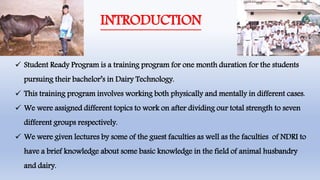
 Student Ready Program is a training program for one month duration for the students
pursuing their bachelor’s in Dairy Technology.
 This training program involves working both physically and mentally in different cases.
 We were assigned different topics to work on after dividing our total strength to seven
different groups respectively.
 We were given lectures by some of the guest faculties as well as the faculties of NDRI to
have a brief knowledge about some basic knowledge in the field of animal husbandry
and dairy.
NDRI CATTLE YARD VISIT
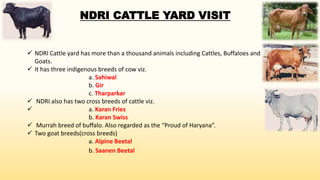
 NDRI Cattle yard has more than a thousand animals including Cattles, Buffaloes and
Goats.
 It has three indigenous breeds of cow viz.
a. Sahiwal
b. Gir
c. Tharparkar
 NDRI also has two cross breeds of cattle viz.
 a. Karan Fries
b. Karan Swiss
 Murrah breed of buffalo. Also regarded as the “Proud of Haryana”.
 Two goat breeds(cross breeds)
a. Alpine Beetal
b. Saanen Beetal
A BRIEF INTRODUCTION ABOUT AN INDIGENOUS CATTLE BREED
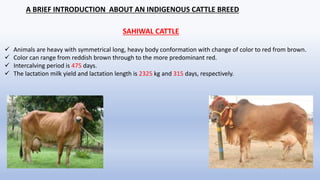
SAHIWAL CATTLE
 Animals are heavy with symmetrical long, heavy body conformation with change of color to red from brown.
 Color can range from reddish brown through to the more predominant red.
 Intercalving period is 475 days.
 The lactation milk yield and lactation length is 2325 kg and 315 days, respectively.
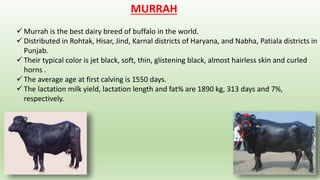
MURRAH
 Murrah is the best dairy breed of buffalo in the world.
 Distributed in Rohtak, Hisar, Jind, Karnal districts of Haryana, and Nabha, Patiala districts in
Punjab.
 Their typical color is jet black, soft, thin, glistening black, almost hairless skin and curled
horns .
 The average age at first calving is 1550 days.
 The lactation milk yield, lactation length and fat% are 1890 kg, 313 days and 7%,
respectively.
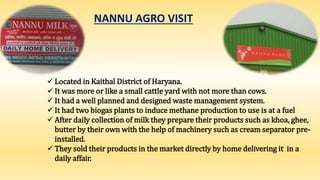
NANNU AGRO VISIT
 Located in Kaithal District of Haryana.
 It was more or like a small cattle yard with not more than cows.
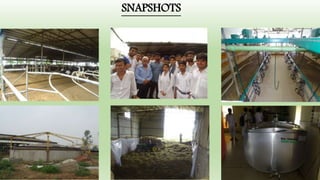
 It had a well planned and designed waste management system.
 It had two biogas plants to induce methane production to use is at a fuel
 After daily collection of milk they prepare their products such as khoa, ghee,
butter by their own with the help of machinery such as cream separator pre-
installed.
 They sold their products in the market directly by home delivering it in a
daily affair.
SNAPSHOTS
TAPRANA VILLAGE VISIT
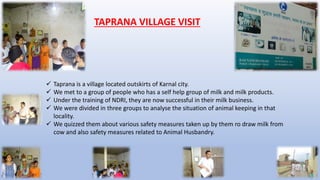
 Taprana is a village located outskirts of Karnal city.
 We met to a group of people who has a self help group of milk and milk products.
 Under the training of NDRI, they are now successful in their milk business.
 We were divided in three groups to analyse the situation of animal keeping in that
locality.
 We quizzed them about various safety measures taken up by them ro draw milk from
cow and also safety measures related to Animal Husbandry.
CSSRI VISIT
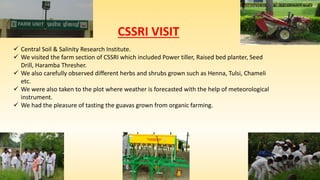
 Central Soil & Salinity Research Institute.
 We visited the farm section of CSSRI which included Power tiller, Raised bed planter, Seed
Drill, Haramba Thresher.
 We also carefully observed different herbs and shrubs grown such as Henna, Tulsi, Chameli
etc.
 We were also taken to the plot where weather is forecasted with the help of meteorological
instrument.
 We had the pleasure of tasting the guavas grown from organic farming.
VARIOUS IMPORTANT TOPICS COVERED IN CLASSES
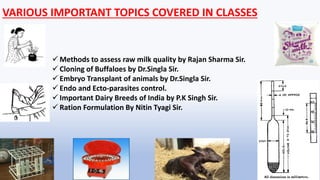
 Methods to assess raw milk quality by Rajan Sharma Sir.
 Cloning of Buffaloes by Dr.Singla Sir.
 Embryo Transplant of animals by Dr.Singla Sir.
 Endo and Ecto-parasites control.
 Important Dairy Breeds of India by P.K Singh Sir.
 Ration Formulation By Nitin Tyagi Sir.
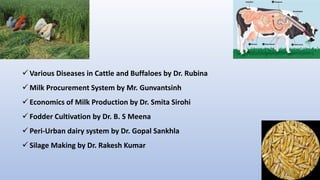
 Various Diseases in Cattle and Buffaloes by Dr. Rubina
 Milk Procurement System by Mr. Gunvantsinh
 Economics of Milk Production by Dr. Smita Sirohi
 Fodder Cultivation by Dr. B. S Meena
 Peri-Urban dairy system by Dr. Gopal Sankhla
 Silage Making by Dr. Rakesh Kumar
TRAINING IN VARIOUS SECTIONS
VIDEOGRAPHY CLASS
 This class was taken by Dr.H.R Meena Sir along with the official photographer of
NDRI.
 This class was beneficial for us to complete our assigned video of our respective
topic.
CLASS ON POSTER MAKING
 This class was taken by Dr.H.R Meena Sir.
 It helped us to prepare our final poster
 A poster should convey a message without any hesitation to the reader.
ANIMAL HEALTH COMPLEX
 Animal health complex deals with various health problems related to cattle.
 We were guided by Dr.Raju Sir who is a veterinarian.
 We treated the infected cows and me and my group also plastered a broken leg of a cow.
Fodder Section
 We inspected the feed and concentrate mixture given to the cow.
 Before fodder supply to the buffaloes and cattle, chopping is done for its better digestibility.
 We were guided by Rajveer Sir.
CALF SECTION
 We fed the calves with milk.
 We supplied Antiseptic in the dehorning wounds of the calves.

Student ready program

  • 1.
    Student Ready Program AnOverview NATIONAL DAIRY RESEARCH INSTITUTE KARNAL,HARYANA-132001 BISHAL BARMAN B.Tech. (DAIRY TECHNOLOGY)
  • 2.
    CONTENTS INTRODUCTION CATTLEYARD VISIT NANNU AGROVISIT TAPRANA VISIT CSSRI VISIT VARIOUS TOPICS COVERED IN CLASSES TRAINING IN VARIOUS SECTIONS OF CATTLEYARD CONCLUSION
  • 3.
    INTRODUCTION  Student ReadyProgram is a training program for one month duration for the students pursuing their bachelor’s in Dairy Technology.  This training program involves working both physically and mentally in different cases.  We were assigned different topics to work on after dividing our total strength to seven different groups respectively.  We were given lectures by some of the guest faculties as well as the faculties of NDRI to have a brief knowledge about some basic knowledge in the field of animal husbandry and dairy.
  • 4.
    NDRI CATTLE YARDVISIT  NDRI Cattle yard has more than a thousand animals including Cattles, Buffaloes and Goats.  It has three indigenous breeds of cow viz. a. Sahiwal b. Gir c. Tharparkar  NDRI also has two cross breeds of cattle viz.  a. Karan Fries b. Karan Swiss  Murrah breed of buffalo. Also regarded as the “Proud of Haryana”.  Two goat breeds(cross breeds) a. Alpine Beetal b. Saanen Beetal
  • 5.
    A BRIEF INTRODUCTIONABOUT AN INDIGENOUS CATTLE BREED SAHIWAL CATTLE  Animals are heavy with symmetrical long, heavy body conformation with change of color to red from brown.  Color can range from reddish brown through to the more predominant red.  Intercalving period is 475 days.  The lactation milk yield and lactation length is 2325 kg and 315 days, respectively.
  • 6.
    MURRAH  Murrah isthe best dairy breed of buffalo in the world.  Distributed in Rohtak, Hisar, Jind, Karnal districts of Haryana, and Nabha, Patiala districts in Punjab.  Their typical color is jet black, soft, thin, glistening black, almost hairless skin and curled horns .  The average age at first calving is 1550 days.  The lactation milk yield, lactation length and fat% are 1890 kg, 313 days and 7%, respectively.
  • 7.
    NANNU AGRO VISIT Located in Kaithal District of Haryana.  It was more or like a small cattle yard with not more than cows.  It had a well planned and designed waste management system.  It had two biogas plants to induce methane production to use is at a fuel  After daily collection of milk they prepare their products such as khoa, ghee, butter by their own with the help of machinery such as cream separator pre- installed.  They sold their products in the market directly by home delivering it in a daily affair.
  • 8.
  • 9.
    TAPRANA VILLAGE VISIT Taprana is a village located outskirts of Karnal city.  We met to a group of people who has a self help group of milk and milk products.  Under the training of NDRI, they are now successful in their milk business.  We were divided in three groups to analyse the situation of animal keeping in that locality.  We quizzed them about various safety measures taken up by them ro draw milk from cow and also safety measures related to Animal Husbandry.
  • 10.
    CSSRI VISIT  CentralSoil & Salinity Research Institute.  We visited the farm section of CSSRI which included Power tiller, Raised bed planter, Seed Drill, Haramba Thresher.  We also carefully observed different herbs and shrubs grown such as Henna, Tulsi, Chameli etc.  We were also taken to the plot where weather is forecasted with the help of meteorological instrument.  We had the pleasure of tasting the guavas grown from organic farming.
  • 11.
    VARIOUS IMPORTANT TOPICSCOVERED IN CLASSES  Methods to assess raw milk quality by Rajan Sharma Sir.  Cloning of Buffaloes by Dr.Singla Sir.  Embryo Transplant of animals by Dr.Singla Sir.  Endo and Ecto-parasites control.  Important Dairy Breeds of India by P.K Singh Sir.  Ration Formulation By Nitin Tyagi Sir.
  • 12.
     Various Diseasesin Cattle and Buffaloes by Dr. Rubina  Milk Procurement System by Mr. Gunvantsinh  Economics of Milk Production by Dr. Smita Sirohi  Fodder Cultivation by Dr. B. S Meena  Peri-Urban dairy system by Dr. Gopal Sankhla  Silage Making by Dr. Rakesh Kumar
  • 13.
    TRAINING IN VARIOUSSECTIONS VIDEOGRAPHY CLASS  This class was taken by Dr.H.R Meena Sir along with the official photographer of NDRI.  This class was beneficial for us to complete our assigned video of our respective topic. CLASS ON POSTER MAKING  This class was taken by Dr.H.R Meena Sir.  It helped us to prepare our final poster  A poster should convey a message without any hesitation to the reader.
  • 14.
    ANIMAL HEALTH COMPLEX Animal health complex deals with various health problems related to cattle.  We were guided by Dr.Raju Sir who is a veterinarian.  We treated the infected cows and me and my group also plastered a broken leg of a cow. Fodder Section  We inspected the feed and concentrate mixture given to the cow.  Before fodder supply to the buffaloes and cattle, chopping is done for its better digestibility.  We were guided by Rajveer Sir. CALF SECTION  We fed the calves with milk.  We supplied Antiseptic in the dehorning wounds of the calves.